From campus experiment to digital infrastructure
The arc of social media over the past two decades is no longer a story of novelty, but of infrastructure. What began with Facebook as a Harvard experiment in 2004 evolved into one of the defining technological transformations of the modern internet. The speed of that rise still matters as a marker of what followed: Facebook reached one million users within ten months and crossed the one billion mark in October 2012, by which point platforms such as Twitter and Instagram had already helped turn social networking into a normalized part of everyday life. The significance of that period is not simply that social media grew quickly, but that it established a model of digital participation that the world would then scale almost everywhere.
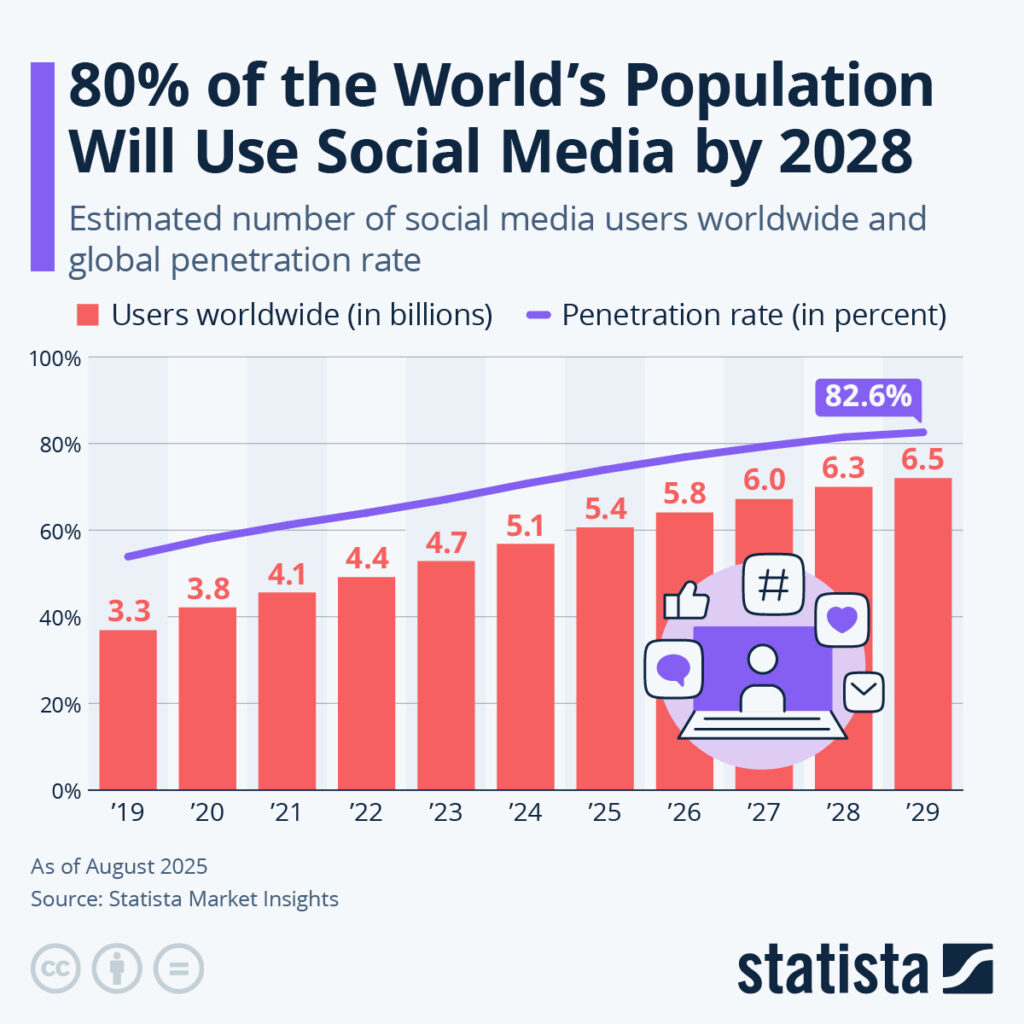
That scale is now approaching a new threshold. According to Statista Market Insights data cited in the source, more than 5 billion people were estimated to be using social media worldwide in 2024, representing a global penetration rate of nearly 71 percent. Those figures suggest that social media is no longer expanding from the margins toward the mainstream. It is advancing from mainstream ubiquity toward something closer to global default behavior.
The next phase is about saturation, not discovery
The forecast trajectory is revealing. Statista estimates that global social media penetration will reach 82.6 percent by 2029, a level that implies the industry is moving beyond rapid early adoption and into a mature phase defined by saturation. This matters because saturation changes the strategic logic of the sector. Growth increasingly depends less on introducing social media to new populations and more on retaining attention, deepening engagement, and competing within a world where digital participation is already assumed.
That shift also changes how social media should be understood culturally. For years, platforms were discussed as emerging environments with disruptive potential. Today, they are better seen as embedded systems through which communication, entertainment, commerce, identity and public discourse increasingly flow. Once penetration reaches this level, social media stops looking like a category of apps and starts looking like a foundational layer of modern social life.
Universal reach is bringing sharper scrutiny
Yet the closer social media comes to universality, the harder it becomes to ignore the costs attached to that success. Concerns around mental health, digital addiction and online safety have pushed governments to intervene more directly, especially where children are concerned. The source points to a significant policy example in Australia, which passed the Online Safety Amendment in November 2024, banning social media use for those under 16 and exposing platforms to substantial fines for noncompliance.
That move is not isolated. The article notes that several European countries are working on similar restrictions, while related legislation is set to take effect in Brazil in March 2026. These developments suggest that the regulatory conversation has entered a more serious phase. As social media becomes nearly universal, governments are no longer debating whether platforms matter enough to regulate, but how to limit their influence on younger users without fully severing them from digital life.
Maturity now means accountability
The broader meaning of the data is that social media has reached a stage where scale alone is no longer the most important story. The platforms have already won the adoption battle. What comes next is a contest over legitimacy, trust and the social terms under which this level of connectivity can continue. High penetration rates may confirm the durability of social media’s place in modern life, but they also intensify pressure on companies to address the harms that accompany such deep integration.
In that sense, the social media industry is entering a more demanding era. Its success is no longer measured only by user growth, but by whether it can function as a global communications layer without provoking escalating political and social resistance. The move from mass adoption to saturation is therefore not just a commercial milestone. It is the point at which social media becomes impossible to treat as anything less than a central institution of the digital age.
Source: 80% of the World’s Population Will Use Social Media by 2028