From directions to dialogue
Google’s latest update to Maps signals a broader shift in what navigation products are expected to do. The company is no longer treating Maps simply as a tool for getting from one point to another, but as a service that can interpret intent, weigh preferences, and answer practical questions in ordinary language. With the rollout of the Gemini-powered Ask Maps feature, Google is positioning the app as a conversational layer over its vast database of places, routes, reviews, and user behavior.
Table of Contents
That matters because many real-world decisions do not begin with a destination. They begin with a constraint, a mood, or a problem to solve. A user may not know which café, charging point, or late-night sports facility they need, only the conditions that matter in the moment. Ask Maps is designed to translate that ambiguity into usable recommendations, bringing search, planning, and local discovery into a single interaction rather than forcing users to piece them together manually.
Personalization becomes the core of local search
The most significant part of the feature is not that it accepts natural-language questions, but that it can personalize responses using signals from a user’s existing Google activity. Saved places, previous searches, and known preferences can shape the results, allowing Maps to recommend options that are not merely nearby, but contextually relevant. In practice, that turns the product from a neutral directory into a more opinionated assistant.
Google is also extending that logic to trip planning. A multi-stop journey can now become a conversation in which Maps suggests worthwhile detours, practical timing, and tips surfaced from other users. The ambition is clear: Google wants Maps to handle the fuzzier, more human side of planning, where people ask not just where to go, but what is worth doing along the way and how to make the trip smoother.
Navigation becomes more visual and less abstract
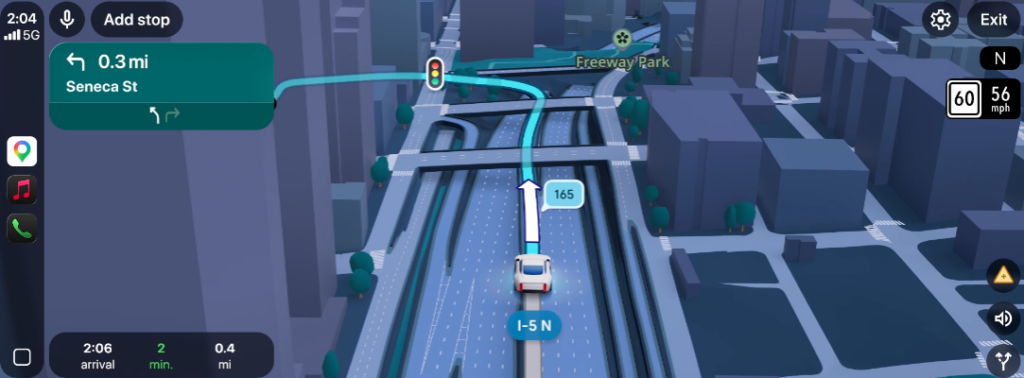
Alongside the conversational layer, Google is redesigning the driving experience through what it calls Immersive Navigation. The update introduces a more visually descriptive 3D view with nearby buildings, terrain, overpasses, lanes, crosswalks, traffic lights, and stop signs. The goal is not visual novelty for its own sake, but a reduction in uncertainty at the moments when drivers are most likely to hesitate or miss a turn.
This is complemented by smarter zooms, transparent buildings, and a broader look ahead on the route, all meant to help users anticipate lane changes and complicated junctions before they become stressful. Google is also making voice guidance sound more natural and more situational, replacing mechanical distance-based commands with instructions that better reflect how people actually process directions on the road.
A navigation app that explains trade-offs
One of the more practical updates is Maps’ new ability to clarify the compromises behind alternate routes. Rather than simply presenting options, it will explain whether one route is slower but less congested, or faster but includes a toll. Combined with alerts about road construction and crashes using data from both Google Maps and Waze, this makes the app feel less like a passive navigator and more like a system actively interpreting changing conditions on the user’s behalf.
The same philosophy extends to the end of the journey. Before arrival, users can preview the destination area through Street View imagery, receive parking recommendations, and see guidance about the correct entrance or side of the street. That last stretch of a trip is often where navigation apps remain least helpful, and Google is clearly trying to close that gap with more detailed, location-specific assistance.
Google is redefining what “using Maps” means
Taken together, these changes suggest Google sees the future of Maps not as incremental route optimization, but as a fuller rethinking of navigation as an intelligent, personalized experience. Ask Maps handles the uncertainty before a journey begins, while Immersive Navigation tries to remove friction once the journey is underway. The combination reflects a product strategy built around fewer decisions, less guesswork, and guidance that feels increasingly adaptive.
The rollout pattern reinforces that this is a substantial product push rather than a limited experiment. Ask Maps is launching in the U.S. and India on mobile, with desktop support to follow, while Immersive Navigation is beginning in the U.S. and expanding across supported mobile devices, in-car systems, and vehicles with Google built-in. What Google is building is not just a better map, but a more complete decision layer for movement itself.

Author:
Jan Bielik
CEO & Founder of Webiano Digital & Marketing Agency
Source: Google Maps is getting an AI ‘Ask Maps’ feature and upgraded ‘immersive’ navigation
Image source: blog.google