Why this tennis demo matters beyond the court
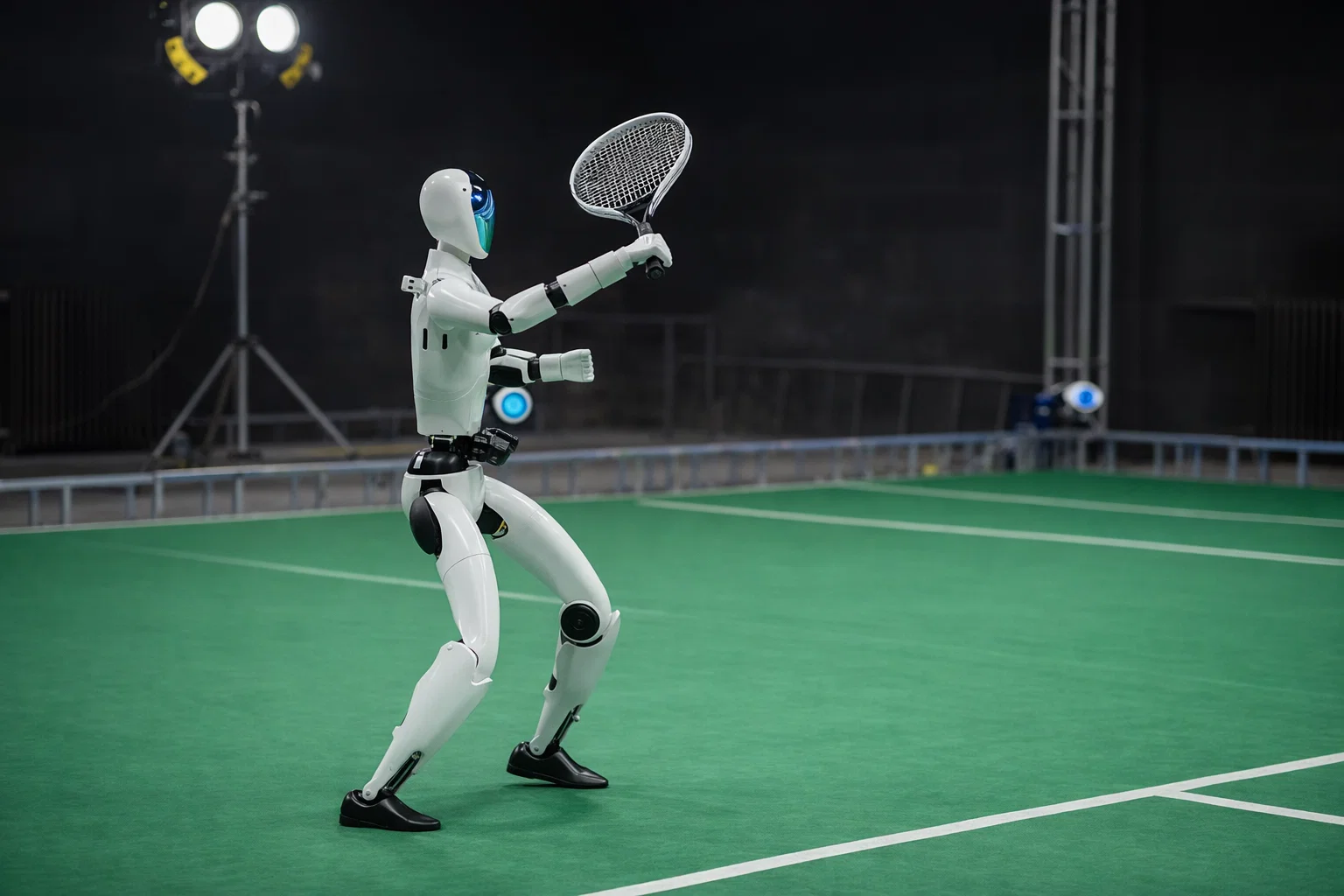
The most significant part of the Unitree G1’s tennis performance is not that a humanoid robot can return balls with striking consistency. It is that the machine learned a complex athletic task from just five hours of imperfect human motion data, rather than from the kind of pristine, expensive training pipeline that has long defined advanced robotics research. That shifts the story from spectacle to method. It suggests that the path toward more capable consumer humanoids may depend less on idealized laboratory inputs and more on the messy physical behavior people already produce every day.
Table of Contents
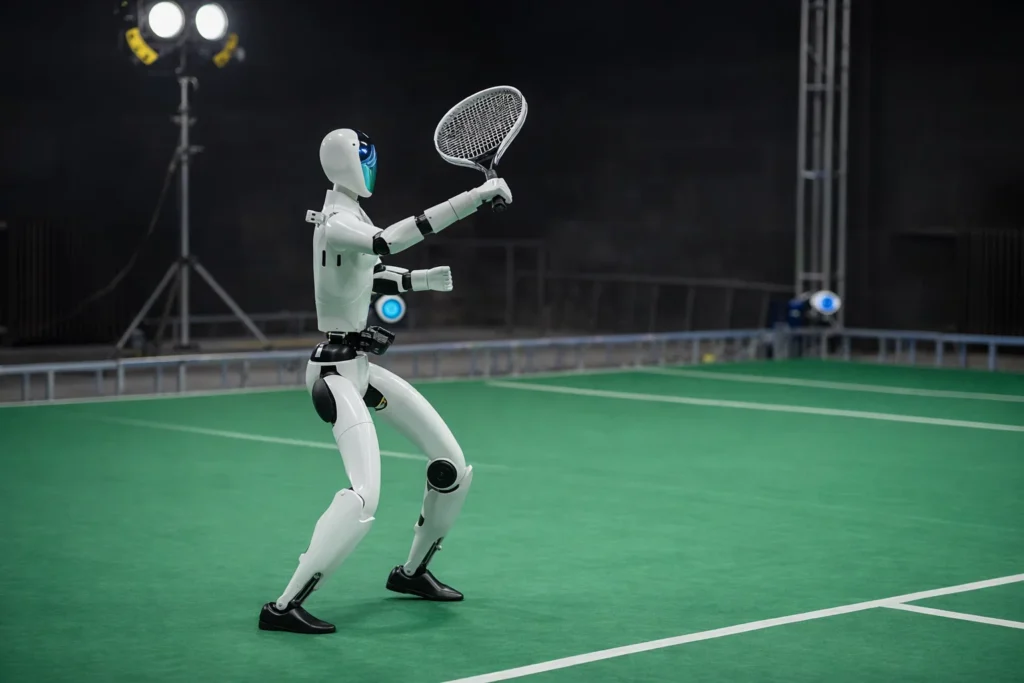
Galbot Robotics’ LATENT system turns that premise into something concrete. Working with researchers from Tsinghua University, Peking University, and Galbot, the team trained the four-foot Unitree G1 using short motion clips from five amateur players, breaking those movements into fragments and recombining them into usable tennis behaviors. The strategic breakthrough lies in treating imperfect human data as an asset rather than a limitation. In practical terms, that could lower the barrier to teaching robots dynamic skills that once seemed to require specialized capture environments and highly curated datasets.
From fragmented movements to functional rallies
The researchers’ approach reflects a broader change in how robotic learning is being framed. Instead of asking humans to perform ideal motions under controlled conditions, LATENT extracts what the team describes as priors about primitive human skills from “quasi-realistic” data. That means the system is not copying polished tennis strokes in a literal sense. It is learning how to assemble pieces of movement into a usable response under live conditions, which is far closer to how athletic competence actually develops.
That distinction matters because tennis is not a static demonstration task. It demands timing, balance, coordination, and repeated full-body adaptation as ball speed and placement change. A robot that can organize fragmented forehands, backhands, and side steps into sustained rallies is doing more than executing a canned motion routine. It is demonstrating that humanoid control systems are beginning to handle the kind of dynamic uncertainty that separates convincing robotics from theatrical robotics.
The numbers that give the result credibility
The performance metrics make this more than an eye-catching video. In real-world court conditions, the Unitree G1 reportedly achieved 90.9% forehand accuracy and 77% to 78% backhand accuracy, while sustaining rallies of more than 25 shots. It also handled balls traveling at over 15 meters per second across full-court positions. Those are the figures that matter, because robotics demonstrations often lose much of their capability the moment they leave simulation. Here, the transfer to a physical court appears to have held up.
There are still important limits. The G1 relies on external motion capture for ball tracking, meaning it does not yet perceive the game through onboard vision. That keeps the demo from being a fully autonomous tennis player in the way many viewers might imagine. Even so, the result remains notable because the underlying physical coordination is already credible. The robot is no longer failing at the basic athletic problem. It is participating in it with a level of consistency that begins to resemble a usable training partner rather than a lab curiosity.
What consumer robotics may be moving toward
At $16,000, the Unitree G1 sits in a price range that changes the meaning of the achievement. This is not an inaccessible research platform built solely for institutional labs. It points toward a class of humanoid machines that may eventually be evaluated not just by whether they can walk or wave, but by whether they can perform demanding physical tasks repeatedly and with practical value. Tennis, in that sense, is less a niche sport application than a stress test for whole-body robotic competence.
The broader implication is that consumer-grade humanoids are beginning to show the first signs of athletic usefulness, whether in sports training, entertainment, or future home environments that require fast, coordinated movement under time pressure. Lead researcher Zhikai Zhang’s account of watching the robot progress from missing every ball to beating him in straight sets captures the symbolic shift. The larger message is calmer and more consequential: when a relatively affordable humanoid can learn from ordinary human motion and produce reliable physical performance, robotics moves one step closer to everyday relevance.
Source: Humanoid Robot Hits Tennis Returns With 96% Accuracy
Image source: Reprofoto YouTube
Author:
Jan Bielik
CEO & Founder of Webiano Digital & Marketing Agency