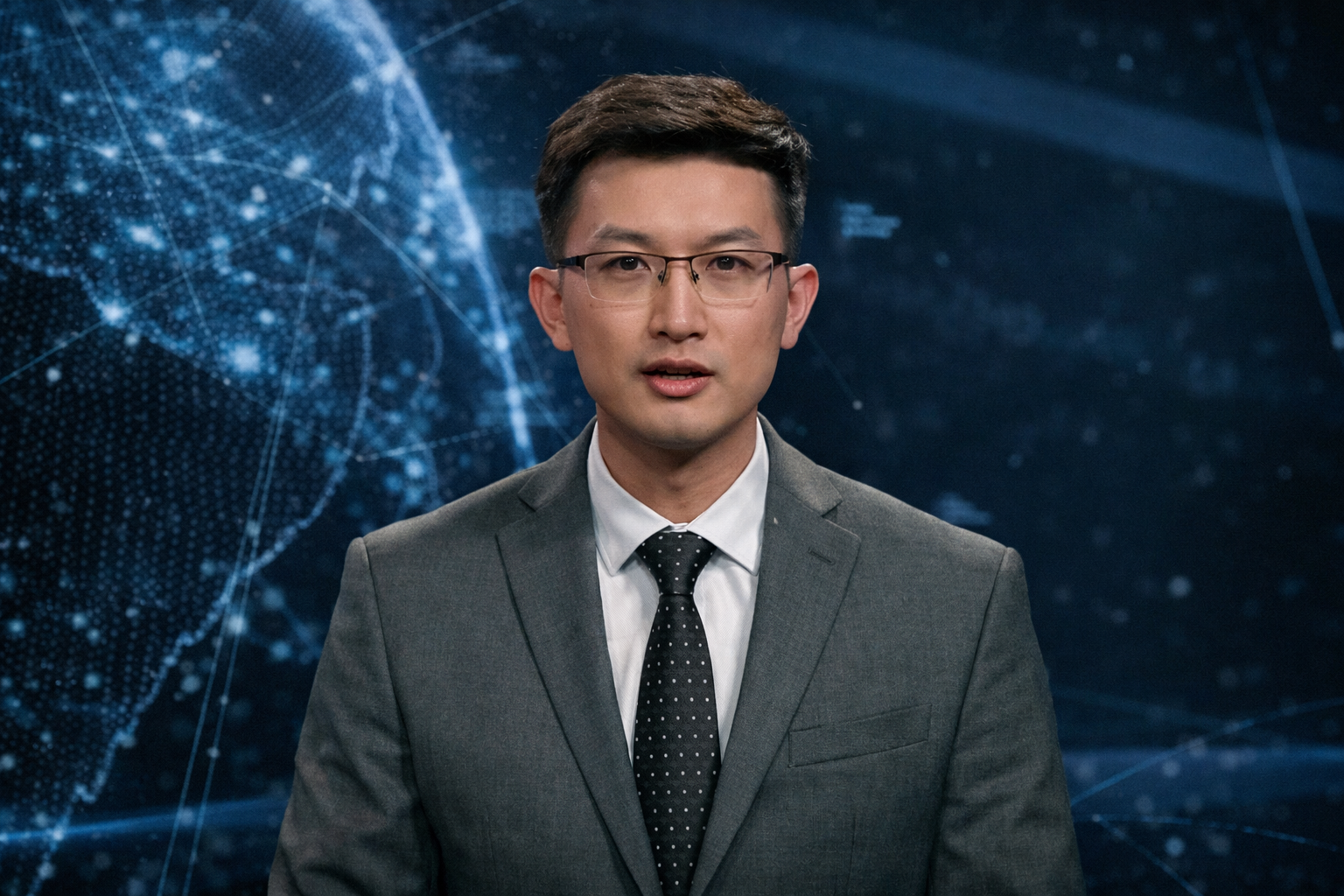
China stopped treating the AI presenter as a party trick a while ago. Xinhua unveiled what it called the world’s first AI news anchor on November 8, 2018, added a female AI anchor a few months later, and by March 2025 People’s Daily was describing Hangzhou News as already running six AI presenters in regular output. By February 2026, China’s official internet statistics said the country had 1.125 billion internet users and 602 million generative AI users. That is the backdrop for this debate: the screen has become part of a much larger national AI rollout, not a boutique media experiment.
Table of Contents
So, will AI end the era of TV presenters? No, not in the blunt, cinematic sense where human faces vanish from the screen. But China is already showing something more interesting and more disruptive: AI is stripping the job down into parts, automating the repetitive layer, and forcing human presenters to justify the rest. The era that looks endangered is not “people on television.” It is the older idea that a presenter’s core value lies in reading clean copy with calm diction and reliable posture. China has pushed that part of the job closest to automation first, and it is doing so at industrial scale, under explicit policy support and increasingly detailed regulation.
China has already crossed the novelty line
The easiest mistake in this discussion is to treat Chinese AI anchors as if they were still stuck in the demo phase. That description fit 2018. It does not fit 2025 or 2026. Xinhua’s first AI anchor was framed openly around efficiency: it could work 24 hours a day, reduce production costs, and publish across the agency’s website and social channels. A 2022 Xinhua feature on “virtual humans” said the same logic was spreading through the media field, naming news broadcasting, game commentary, and TV guides as obvious fits because virtual anchors were quick to build and cheap to run. That is not language of experimentation. It is language of workflow.
By 2025 the story had moved further. People’s Daily reported that Hangzhou News had deployed six AI presenters, and that they were stable enough to let human anchors step away during leave periods without interrupting broadcasts. One of those avatars, according to the report, used DeepSeek-V3 for natural language processing, teleprompter narration, script vetting, and source aggregation. Sixth Tone then described a sharper symbolic step: during the Lunar New Year period, Hangzhou Culture Radio Television Group handed eight nights of flagship holiday programming to AI anchors, a move it called the first time a Chinese broadcaster had entrusted an entire holiday primetime lineup to artificial intelligence. That is the moment novelty becomes routine.
Scale matters here. China had 346 generative AI services registered with the Cyberspace Administration of China by March 2025, according to a Xinhua report citing CNNIC, and 602 million generative AI users by the end of 2025. Once that many users, platforms, developers, and regulators are already inside the same system, the presenter question changes shape. It stops being “Can this be done?” and becomes “Which screen jobs are still worth paying humans to do?”
That is also why the user’s premise — that this is already a common thing in China — is close to the truth, with one necessary correction. It is not common in the sense that every Chinese TV channel has turned itself into an avatar network. It is common in the more important sense: AI presenters are now a normal option inside China’s media toolkit. Newsrooms, regional broadcasters, platforms, and brands no longer need to justify the existence of synthetic hosts. They need to decide where to place them.
The money is talking before the technology is finished
Technology stories often get dressed up as stories about wonder. This one is mostly about labor economics.
A human presenter is not a single cost. It is a chain of costs: salary, makeup, wardrobe, studio time, scheduling, transport, pre-production, retakes, downtime, and the simple fact that one person can only appear in one place at one moment. An AI presenter changes that equation. Xinhua said so plainly in 2018 when it framed its first anchor as a 24-hour worker that cut production costs. Its 2022 feature used even more direct language, describing virtual anchors as fast to develop and low-cost for standard media tasks.
China’s broader digital-human economy has taken that logic much further in livestreaming commerce, which matters because Chinese television, short video, and ecommerce have begun to share the same production grammar. On-screen selling, explanation, demonstration, moderation, and personality branding now sit on a continuum. World Internet Conference and China Daily reports from mid-2025 described Baidu-powered digital avatars co-hosting a Luo Yonghao livestream that ran for more than six hours, drew over 13 million views, and produced more than 55 million yuan in gross merchandise value. The same coverage described JD deploying a digital likeness of founder Liu Qiangdong, which drew more than 20 million views in its first hour and generated 50 million yuan in sales over the full broadcast.
Those are commerce numbers, not television ratings, but the lesson transfers cleanly. If an AI host can hold attention, read a script, respond to prompts, and front an endless stream of product explanations, it can also handle large volumes of low-risk broadcast presentation. The screen is the shared battlefield. China’s digital-human story is really about screen labor.
The corporate side is already absorbing that lesson. Reuters reported in December 2025 that Reckitt’s China business was leaning heavily on influencers, AI-generated avatars, and livestreaming on Douyin. E-commerce had risen to about 80% of Reckitt’s sales in China, up from roughly 30% before the pandemic, and the company said it had used more than one million short videos and 100,000 hours of livestreaming to reach 40 million new customers that year. AI avatars were part of that machine. The significance is bigger than one company. It shows that synthetic hosts are being adopted where attention is measurable, conversion is immediate, and performance pressure is unforgiving.
None of this proves that AI presenters are better in every sense. It proves that they are already good enough where employers value cost control, endless availability, consistency, and scale more than warmth. That is a major threshold. Industries do not wait for perfection before replacing expensive labor. They move when the cheaper substitute becomes “usable enough.” China’s media and platform economy has crossed that line.
Regulation is turning the avatar host into a managed media category
China’s approach to AI presenters would look very different without the state’s regulatory appetite. What makes the Chinese case especially important is not only that broadcasters and platforms adopted digital hosts early. It is that regulators have been building a rule stack around synthetic media for years.
The December 2022 Deep Synthesis Provisions, effective from January 10, 2023, are the foundation. They prohibit the use of deep synthesis services to create or spread false news, require real-identity verification for users who publish information, and mandate both technical and conspicuous labeling in cases where generated or edited content could cause public confusion or misrecognition. The rules also say providers involved in online publishing, culture, and audiovisual program services must comply with the rules of those sectors as well. In plain terms, China decided early that synthetic faces and voices would not sit outside media law.
The 2023 Interim Measures for Generative AI Services reinforced that logic. They apply to public generative AI services producing text, images, audio, video, and other content, but they also say that where the state has other rules for news publication, film and television production, and artistic creation, those rules govern. That carve-out matters. It signals that media is treated as a high-sensitivity domain, not a free-for-all playground for model providers.
Then came the March 2025 labeling measures. The CAC notice and accompanying measures set out explicit and implicit labels for AI-generated or AI-synthesized text, audio, images, video, and virtual scenes. The rules require service providers to place visible labels on relevant content and to insert hidden labels into file metadata. They also place duties on distribution platforms: if metadata identifies synthetic content, platforms must add clear notifications around the published content; if users declare it as generated, platforms must flag it; if a platform detects signs of synthetic generation even without disclosure, it must still warn the public that the content is suspected to be generated. That is not a symbolic transparency rule. It is an operational one.
The regulatory arc continued this month. Reuters reported on April 3, 2026 that China’s cyberspace regulator had issued draft rules to govern digital humans specifically, requiring clear labeling, restricting the use of personal information without consent, and banning uses that mislead minors or bypass identity verification. Official CAC commentary on the same day described digital virtual humans as already extending from virtual idols and digital anchors into finance, healthcare, cultural tourism, and news dissemination. Public comments are open until May 6, 2026. The message is hard to miss: China now treats the digital-human industry as a strategic governance problem, not a side effect of AI progress.
This regulatory architecture does two things at once. It lowers political uncertainty for deployment, because providers can see the boundaries. It also increases central control, because the state gets to define what kinds of synthetic media are acceptable, how they must be labeled, and where sector-specific rules still override general AI policy. That combination — permission plus control — helps explain why AI presenters have spread in China faster than in many markets that still have unresolved legal and editorial arguments about disclosure, impersonation, authorship, and liability.
Repetition is where the cuts will land first
AI will not erase every screen job equally. It will hit the parts of presenting that already look like automation from the outside.
Read a script in standard Mandarin. Maintain eye contact with the lens. Keep vocal pace steady. Pronounce names correctly. Appear at 6:00, 7:00, 9:00, and midnight without tiring. Move from weather to traffic to short bulletins to low-stakes studio explainers without improvising. Those are precisely the tasks Chinese media organizations and vendors keep describing when they talk about virtual anchors. Xinhua’s 2022 feature listed news broadcasting, game commentary, and TV guides. People’s Daily emphasized stable delivery and leave coverage. Sixth Tone captured the professional consequence neatly: presenters whose roles are limited to reading the news now need to pivot.
That is why the phrase “replace TV presenters” can mislead. AI does not replace an entire profession in one motion. It peels away the most standardized pieces first. Those pieces often sit at the bottom and middle of the hierarchy: local bulletins, overnight updates, short explainer clips, holiday coverage, branded segments, multilingual repackaging, and studio-based reading jobs that depend on discipline more than original reporting.
Where AI presenters fit best right now
| Screen role | AI already handles it well | Human edge still matters most |
|---|---|---|
| Scripted news reading | Consistent delivery, fast turnaround, no fatigue | Editorial judgment on nuance and framing |
| Holiday and overnight coverage | 24/7 availability and low staffing cost | Audience familiarity during major events |
| Weather, traffic, routine bulletins | Repeatable format and low ambiguity | Live adaptation when conditions shift suddenly |
| E-commerce hosting | Endless product repetition and real-time scale | Charisma, trust, and community loyalty |
| Multilingual clip production | Cheap duplication across formats and channels | Cultural tone, humor, and instinct |
| Live interviews and civic discussion | Still weak at spontaneity and emotional timing | Listening, interruption management, credibility |
That split reflects what Chinese practitioners themselves are saying. Sixth Tone quoted presenters and journalism faculty arguing that AI remains stiff in live interviews and civic news, even while it becomes increasingly convincing in scripted delivery. People’s Daily made a similar point, noting technical gains in realism but also unresolved weaknesses in complex interaction, privacy, data security, and ethics. The likely outcome is not a clean handover from human to machine. It is a sorting process. The more a presenting role looks like repeatable screen execution, the more exposed it is. The more it depends on live judgment and human presence, the safer it remains.
Trust refuses to be automated
If cost were the only variable, the answer to this article’s question would be easy. AI would sweep the desk. It has not, and the missing piece is trust.
Reuters reported in June 2024 that audiences were suspicious of AI in news production, especially for sensitive subjects such as politics. Citing the Reuters Institute Digital News Report, it noted that 52% of respondents in the United States and 63% in the United Kingdom were uncomfortable with news produced mostly with AI. The same Reuters Institute work found a broader pattern in 2024: across countries, only a minority felt comfortable with news made by humans with the help of AI, at 36%. A later Reuters Institute report in October 2025 found an even sharper “comfort gap”: only 12% were comfortable with entirely AI-made news, 21% with human oversight over mostly AI-made news, and 43% when humans led the process with AI assistance.
Those numbers do not come from China alone, and public opinion in China can differ from public opinion in Western countries. Still, the core lesson travels. Audiences do not evaluate a presenter only by fluency. They read presence, intention, authority, and risk. A synthetic anchor can appear polished and still feel oddly uncommitted, especially in moments of grief, conflict, scandal, or institutional failure. The face is there, but the accountability feels thinner.
That is one reason Chinese regulation keeps circling back to labels, confusion, and false information. The state sees the trust problem too, even if it frames it through control and social stability rather than newsroom philosophy. The 2022 deep synthesis rules explicitly ban fake news generated through such services. The 2025 labeling rules require visible and metadata-based disclosure. The 2026 draft rules for digital humans push the same logic further. Trust is not being left to market sentiment alone; it is being engineered through disclosure obligations.
Media ethicists are moving in the same direction. UNESCO highlighted in 2025 that press councils in South-East Europe and Türkiye had adopted a declaration calling for transparency, accountability, and AI literacy in journalism, and its World Press Freedom Day 2025 messaging framed AI as both an opportunity and a threat to press and media freedom. That broader international conversation matters because the AI presenter sits at a dangerous intersection: journalism, performance, impersonation, and synthetic media all meet on the same face.
So no, the human presenter is not surviving out of sentimentality. The job still carries functions that software struggles to replicate: visible responsibility, emotional timing, the sense that someone on screen understands the stakes of the story, and the ability to depart from script without looking broken. Those qualities are hardest to notice when they are present. They become obvious the moment they disappear.
China’s real experiment stretches far beyond television
The Chinese case makes more sense once television stops being treated as a sealed industry. The screen economy in China is deeply connected: broadcasters, ecommerce platforms, short-video apps, state media, public-service systems, and brand marketing teams are all learning from the same AI toolkit.
The CAC’s own recent expert interpretation of the draft digital-human rules says digital virtual humans have already spread from entertainment into finance, healthcare, cultural tourism, and news dissemination. People’s Daily writes about digital doctors. China Daily and the World Internet Conference write about digital sales hosts. Broadcasters deploy cloned presenters for holiday news output. These are not separate stories. They are one infrastructure story wearing different costumes.
That matters for television because the presenter’s role is being redefined by adjacent industries. In a narrower TV world, the anchor existed mainly to package news for a scheduled audience. In China’s current media system, the presenter is also a searchable clip generator, a livestream host, a branded identity asset, a multilingual template, and a potentially interactive avatar. Once the same synthetic face can front a news brief, a shopping session, a tourism promotion, and a customer-service interaction, the old boundaries around “television presenter” begin to dissolve.
There is also a political dimension. Microsoft warned in April 2024 that Chinese influence operations had increased their use of AI-generated content around the world. That does not mean every AI presenter is propaganda, and it would be sloppy to claim so. It does mean that synthetic on-screen personas fit neatly into a wider strategic logic: they are cheap to produce, easy to localize, available around the clock, and useful for high-volume narrative distribution. A digital presenter can sell a printer, read a bulletin, or package a message for millions of feeds with the same underlying machinery.
This is where China’s “AI Plus” policy drive becomes relevant. Official English-language summaries of the 2025 and 2026 government work reports describe AI as something to be applied across the economy, with support for large-scale model deployment, intelligent terminals, AI agents, and commercial use in key sectors. That policy style rewards exactly the kind of cross-sector spillover that turns a broadcast gimmick into a normal industrial capability.
Seen that way, asking whether AI will “end TV presenters” is slightly too small. China is running a larger experiment: what happens when synthetic people become a standard layer of screen-based labor across media, commerce, and public communication? Television is only one proving ground. It is no longer the whole story.
The presenter who survives will look different
The pressure created by AI does not erase the value of human presenters. It changes which human qualities earn a place on screen.
Sixth Tone’s reporting from Chinese journalism schools is revealing here. Faculty at the Communication University of China described a curriculum that now stretches beyond vocal delivery and posture into unscripted hosting, journalism, literature, linguistics, audiovisual production, computer science, large language models, and AI applications. Students are being pushed toward talk shows, live variety, interviews, and other formats where spontaneity matters more. That is a rational response. If software is improving at clean scripted delivery, the human career path moves toward ambiguity, interpretation, and personality.
A second shift concerns hierarchy. Top-tier presenters may become more valuable, not less. Distinctive voices, known editorial identities, and presenters who can hold live interviews or carry a tense public moment are harder to replace than entry-level readers. Reuters’ 2024 reporting on TikTok news behavior helps explain part of this. Among users who said they used TikTok for news, 57% said they mainly paid attention to individual personalities, against 34% who mainly followed journalists or news brands. The personality economy is already stronger than many legacy outlets would like to admit. On screen, generic competence is under pressure. Recognizable human identity still attracts attention.
The losers, if that word must be used, are likely to be the middle layers of the old broadcast system: capable but interchangeable desk readers whose main asset is polish. China’s AI rollout attacks precisely that zone. The better synthetic anchors get at tone, gesture, lip-sync, and multilingual scripting, the less scarce that kind of polish becomes. AI does not need to become a better journalist than a human to weaken the market for generic on-air presentation. It only needs to become a cheaper version of adequacy.
New work will appear around that change. Someone has to supervise models, verify scripts, manage likeness rights, maintain disclosure systems, audit synthetic errors, decide where the human stays visible, and protect newsroom standards when the temptation to automate is strongest. Yet those are not one-for-one substitutes for the jobs being thinned out. They belong to a different professional map. That is why the Chinese case feels so important: it shows not simply a tool entering the newsroom, but a redistribution of media labor around the face on the screen.
The screen is heading toward a hybrid future
The most sensible answer to the headline question is plain enough. AI will not end the era of TV presenters. It will end the era of the purely functional TV presenter much faster than many people expect.
China already offers the outline. The state has pushed AI as a broad economic initiative. Broadcasters and platforms have normalized synthetic presenters in low-risk, high-volume, repeatable roles. E-commerce has proven that digital hosts can perform where money is counted in real time. Regulators have built a layered system around deep synthesis, generative AI, labeling, and now digital humans specifically. Journalism schools are already retraining students for a market where reading well is no longer enough.
That hybrid future will probably look uneven. Routine bulletins, overnight updates, weather segments, clip factories, branded explainers, and large volumes of commercial video will become more synthetic. High-stakes interviews, breaking-news moderation, field reporting, premium analysis, crisis broadcasting, and presenter-led programs built on reputation will stay human much longer. The frontier will keep moving, but it will not move evenly.
China matters here because it has moved early, fast, and at scale. It has the user base, the policy push, the platform machinery, and the willingness to turn synthetic media into a governed industry. If you want a preview of where televised presentation may be heading, China is not offering a science-fiction trailer anymore. It is showing the pilot episode.
FAQ
No. China shows a more selective pattern. AI presenters are already being used for scripted, repetitive, and lower-risk output, but human presenters still hold clear advantages in live interviews, civic discussion, emotional timing, and editorial judgment.
China combines early adoption by state media, a huge user base for generative AI, strong platform ecosystems, explicit national policy support for “AI Plus,” and a regulatory system that has already built rules for deep synthesis, generative AI, and labeling.
Scripted news reading, overnight bulletins, holiday coverage, weather, traffic, TV-guide style segments, multilingual repackaging, and high-volume commercial hosting sit closest to automation. Those jobs depend heavily on consistency and scale.
Because audiences still connect trust with visible human responsibility. Reuters Institute data show strong public discomfort with AI-made news, especially when AI takes the lead rather than assisting journalists.
No. China’s rule stack increasingly pushes the opposite direction. The deep synthesis provisions require labeling in confusing or misleading cases, the 2025 labeling measures define explicit and hidden labels, and the 2026 draft digital-human rules continue that disclosure logic.
No. In China, the same digital-human systems are spreading through livestream commerce, public services, healthcare interfaces, tourism, and other on-screen communication roles. That broader spread is one reason AI presenters are becoming normalized.
They need more than voice and posture. The Chinese training response points toward unscripted hosting, interviewing, journalism, audiovisual production, AI literacy, and on-camera judgment that survives outside a script.
Author:
Jan Bielik
CEO & Founder of Webiano Digital & Marketing Agency
This article is an original analysis supported by the sources cited below
World’s first AI news anchor makes “his” China debut
Xinhua’s original report on the 2018 debut of its AI news anchor and the agency’s stated goals around cost and efficiency.
Xinhua unveils world’s first female AI anchor
Xinhua’s report marking the rollout of a female AI anchor in early 2019.
Feature: The rise of virtual human
Xinhua feature explaining how virtual anchors were already being framed as low-cost tools for media output.
Virtual anchors and hosts on the rise
People’s Daily report on Hangzhou News deploying six AI presenters and the wider digital-human industry.
China’s Next-Gen TV Anchors Hustle for a Job AI Is Already Doing
A strong on-the-ground feature on Chinese broadcasters, journalism schools, and the changing labor market for presenters.
China has over 1.12 billion internet users, boosting prowess in culture, AI
Xinhua summary of CNNIC data, including the number of generative AI services registered by March 2025.
China’s internet user base hits 1.125 billion, generative AI sees expanded adoption
Official report citing China’s 2025 internet user base and 602 million generative AI users.
Provisions on Administration of Deep Synthesis of Internet-based Information Services
The official CAC text establishing China’s early deep-synthesis rules, including false-news and labeling provisions.
Interim Measures for the Management of Generative Artificial Intelligence Services
English translation of China’s 2023 generative AI measures, useful for the text governing public-facing AI content services.
Notice on issuing the Measures for Labeling AI-Generated Synthetic Content
Official CAC notice and full text for the 2025 labeling regime covering text, audio, images, video, and virtual scenes.
China requires labeling of AI-generated online content
English-language government summary of the 2025 AI-content labeling rules.
China moves to regulate digital humans, bans addictive services for children
Reuters report on China’s April 2026 draft rules for digital humans and the public comment period.
Expert interpretation on strengthening safety barriers for digital virtual humans
CAC expert commentary describing digital virtual humans as already spreading into finance, healthcare, tourism, and news dissemination.
Digital humans show future of livestreaming e-commerce
World Internet Conference repost of China Daily reporting on Baidu-powered digital hosts, Luo Yonghao’s avatar stream, and the economics of virtual hosting.
Digital humans show future of livestreaming e-commerce
China Daily’s original article on digital hosts in livestreaming, including JD and Luo Yonghao case studies.
Avatars, influencers in China livestreams help drive Reckitt’s emerging-market led growth
Reuters reporting on corporate adoption of AI avatars in China’s commerce and video ecosystem.
Global audiences suspicious of AI-powered newsrooms, report finds
Reuters summary of Reuters Institute findings on public discomfort with AI-produced news.
Public attitudes towards the use of AI in journalism
Reuters Institute analysis of audience comfort levels with different levels of AI use in journalism.
Generative AI and News Report 2025
Reuters Institute report showing the sharp public comfort gap between human-led and AI-led news production.
AI and Media Ethics. Press councils from South-East Europe and Türkiye adopt landmark declaration
UNESCO article highlighting transparency, accountability, and AI literacy as core journalism principles.
WPFD 2025: Exploring the future of journalism in an AI-driven world
UNESCO framing of AI’s opportunities and risks for press freedom and the media system.
Same targets, new playbooks: East Asia threat actors employ unique methods
Microsoft Threat Intelligence report describing expanded Chinese use of AI-generated content in influence operations.
China evolving into AI ‘super market’ driven by scale, innovation
Official English-language summary of China’s 2025 government work report and the push to advance the AI Plus initiative.
China’s AI ecosystem leads global adoption, powers industrial upgrades
Xinhua reporting on the 2026 government work report and the expanded role of AI agents and large-scale commercial AI use.