A factory trial with implications beyond one plant
BMW’s decision to deploy humanoid robots in Germany for the first time is more than a narrowly technical pilot. At its Leipzig plant, the group is testing AEON, a wheeled humanoid developed by Hexagon Robotics, in what amounts to a broader statement about the direction of European manufacturing. The significance lies not only in the machine itself, but in the fact that one of Europe’s most established industrial groups is now treating physical AI as a practical production technology rather than a speculative future bet.
Table of Contents
That gives the project weight beyond BMW. Humanoid robotics has often been framed through developments in the United States and East Asia, with Europe cast more as an observer than a frontrunner. Leipzig challenges that assumption. By bringing a humanoid platform into a live German manufacturing environment, BMW is signaling that the next phase of factory automation will be shaped not just by software intelligence, but by machines designed to operate inside existing industrial systems.
AEON is designed for output, not spectacle
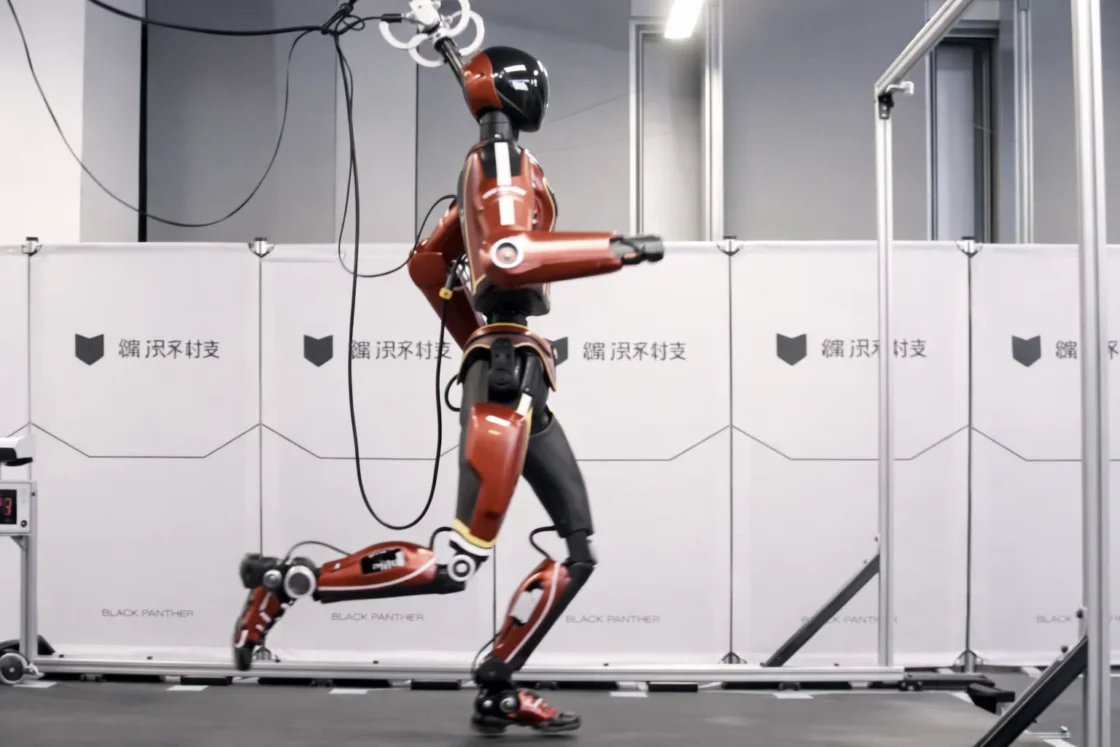
What makes AEON notable is the discipline of its design philosophy. Rather than chasing the theatrical image of a fully bipedal humanoid, Hexagon has built a machine around the realities of industrial work. AEON moves on wheels, a choice rooted in efficiency on flat factory floors where speed, energy use, and reliability matter more than human mimicry. At 1.65 metres tall and 60 kilograms, with a top speed of 2.5 metres per second, it is clearly intended as a production asset rather than a demonstration piece.
That logic extends to the rest of the platform. AEON can autonomously swap its own battery in 23 seconds, supporting near-continuous operation without depending on human intervention. Its 22 integrated sensors, including peripheral cameras, infrared, time-of-flight systems, SLAM cameras, and microphones, give it full spatial awareness in real time. The result is a robot built not for a single choreographed task, but for flexible work across changing production environments, including inspection and tool-based operations that demand more adaptability than conventional fixed automation typically offers.
Leipzig is being used as a real-world test bed for scale
BMW’s rollout strategy is cautious, but not tentative. After an initial test deployment in December 2025, a further run is scheduled for April 2026, followed by a fuller pilot in summer 2026 in which two AEON units will operate simultaneously. The initial focus on high-voltage battery assembly and component manufacturing for exterior parts shows that BMW is targeting areas where dexterity, consistency, and multifunctional deployment could offer clear operational value.
Leipzig is also a deliberate choice because of what the site represents inside BMW’s production network. It is the company’s most technologically comprehensive German plant, bringing together battery production, injection moulding, press operations, body shop work, and final assembly in one location. A successful deployment there would not validate one narrow use case, but the broader viability of humanoid robotics across multiple stages of industrial production. That is why BMW has also created a dedicated Centre of Competence for Physical AI in Production, giving the effort an institutional structure rather than treating it as an isolated experiment.
The real story is the manufacturing architecture behind the robot
The most important part of BMW’s approach may be what sits beneath the robot rather than the robot itself. AEON is entering a production environment where BMW has already worked to standardize data and reduce fragmentation across its manufacturing network. That matters because autonomous machines do not become useful simply by existing on a factory floor. They need access to clean, consistent, and shareable operational data if they are to act, adapt, and improve with any real independence.
In that sense, the humanoid is only the visible layer of a deeper industrial system. AEON runs on NVIDIA Jetson Orin onboard computers and was trained extensively in simulation using NVIDIA’s Isaac platform, allowing key locomotion capabilities to be developed far faster than would be possible through purely physical testing. Microsoft Azure supports model development at scale, while Maxon provides the actuators that enable motion. BMW is not inserting a robot into an unchanged factory; it is connecting a physical machine to a digital infrastructure built to support intelligent automation.
Europe is now under pressure to decide whether it will follow
BMW’s pilot arrives as the wider enterprise picture begins to move in the same direction. The source text cites Deloitte’s State of AI in the Enterprise 2026 report, which found that 58% of companies already use physical AI in some form, with that share projected to rise to 80% within two years. In that context, Leipzig looks less like a one-off experiment and more like an early European proof point in a transition already underway elsewhere.
That is why this pilot matters beyond BMW’s own production goals. The company is testing whether humanoid robots can meet the standards of real manufacturing, not just attract headlines. If the answer is yes, the implications will reach far beyond one German plant. The strategic question for European industry is no longer whether physical AI belongs on the factory floor, but whether established manufacturers can adopt it quickly enough to avoid falling behind the next wave of industrial automation.
Author:
Lucia Mihalkova
COO of Webiano Digital & Marketing Agency
Source: BMW puts humanoid robots to work in Germany–and Europe’s factories are watching