A factory that changes the scale of the market
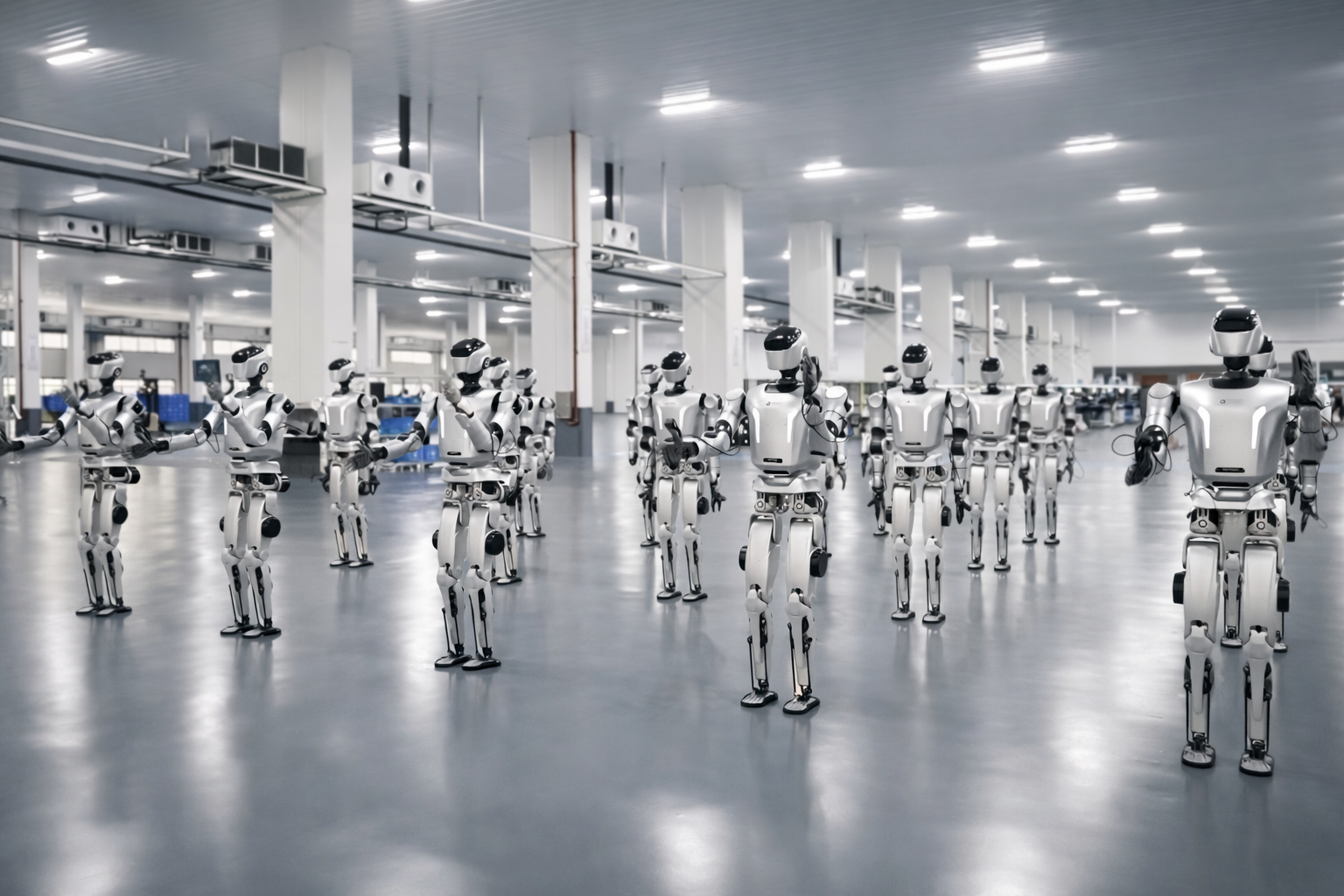
China’s humanoid robotics sector has crossed an important threshold with the launch of a new production facility in Guangdong that is reportedly capable of building up to 10000 robots a year. What matters here is not only the size of the plant, but what that capacity represents: a move away from limited pilot runs and toward something that looks much closer to repeatable industrial manufacturing. In a field where ambition has often outpaced execution, production volume is becoming a more meaningful signal of seriousness.
Table of Contents
The factory, launched on March 29, 2026, reflects a broader shift in how the market now measures progress. Humanoid robotics is no longer judged only by what can be demonstrated in a controlled setting, but by what can be built consistently, tested systematically, and delivered at scale. That change raises the bar for every company in the sector.
Manufacturing is becoming a competitive advantage in its own right
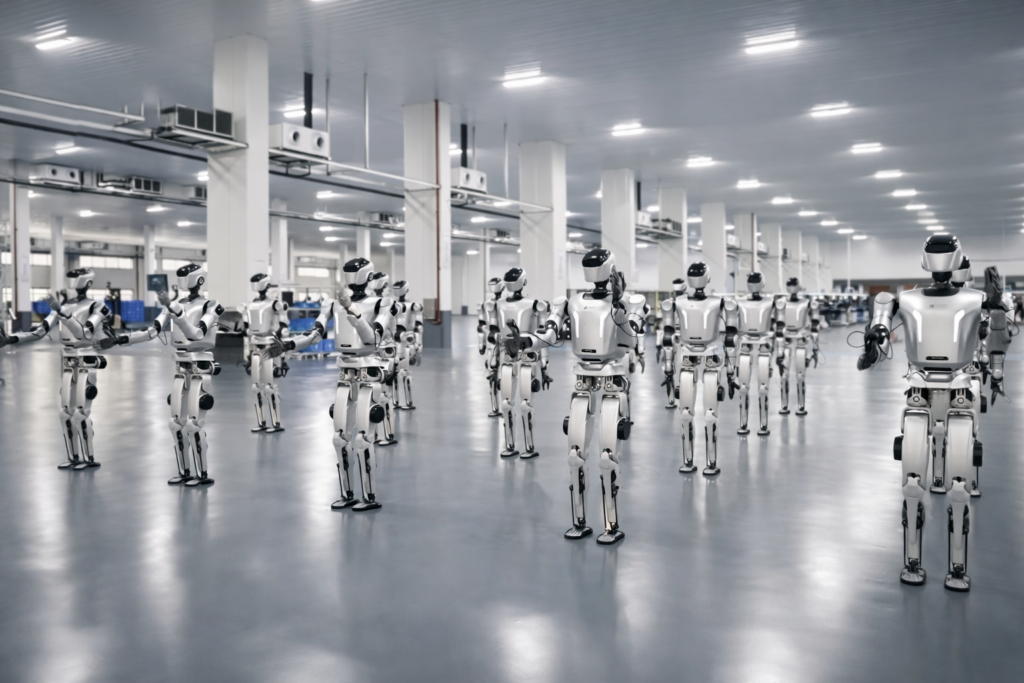
The Guangdong facility, developed jointly by Leju Robotics and Dongfang Precision Science and Technology, is designed around speed and standardization. According to details shared at launch, the line includes 24 precision assembly stages and 77 inspection checkpoints, with one completed humanoid robot rolling off the line roughly every 30 minutes. That translates into an efficiency gain of about 50 percent over more traditional assembly approaches, suggesting that manufacturing design itself is now part of the competitive equation.
Just as important is the line’s flexibility. With automated guided vehicles and digital control systems, the factory can shift between different robot models without requiring a full overhaul of production. That gives the operation a practical commercial edge, because it allows output to respond to demand from different industries, including automotive and home appliances, rather than locking capacity into a single rigid product path.
The business model is evolving alongside the machines
The partnership between Leju and Dongfang Precision also points to a structural change in the industry. Rather than trying to control every step internally, the two companies are dividing responsibilities: Leju focuses on robot design and software, while Dongfang Precision takes on large-scale manufacturing, system integration, and after-sales support. That separation between innovation and execution may prove as important as any hardware breakthrough.
This contract manufacturing approach addresses one of robotics’ most persistent weaknesses: the difficulty of turning impressive prototypes into reliable mass-produced systems. Dongfang Precision’s 2.8 percent equity stake in Leju reinforces that alignment, linking design ambition with production discipline. In practical terms, the arrangement is built to solve the gap between what a robot can do in development and what it can do when thousands of units must be built, supported, and deployed.
Output is now a signal to investors as much as to customers
Leju’s reported 10000-unit annual capacity places it in the middle of an increasingly aggressive production race. Other Chinese companies are also moving quickly: Agibot has announced the rollout of its 10000th humanoid robot, Unitree Robotics is backing a major funding push tied to a plant targeting 75000 units per year, and UBTECH Robotics is working toward 5000 units annually while aiming to lower costs below $20000 per robot. In this environment, manufacturing scale is becoming both a commercial metric and an investor narrative.
That is why the number itself matters. Reaching 10000 units is not merely symbolic; it is part of the argument that humanoid robotics can become an actual industry rather than a capital-intensive showcase. The 41 simulated work-condition tests applied to each robot before it leaves the line underline the same point: the market is no longer interested only in whether these machines can function, but whether they can function reliably in sustained industrial use.
The harder problem is no longer building the body
Yet the opening of a high-capacity factory does not settle the central question facing humanoid robotics. Hardware manufacturing may now be scaling, but the software required for robots to operate effectively in messy, unpredictable real-world settings remains immature. The bottleneck is shifting from production capacity to usable intelligence.
That shift may define the next phase of the industry. Guangdong’s supply chain can now support large-scale output, but mass production alone does not create commercial value. The pressure is moving toward AI developers, whose systems will determine whether these humanoid robots become productive workers in real industrial environments or remain technically impressive machines in search of a durable role.
Author:
Jan Bielik
CEO & Founder of Webiano Digital & Marketing Agency
Source: China’s new humanoid robot factory can make 10,000 units a year
Cover image: Reprophoto YouTube