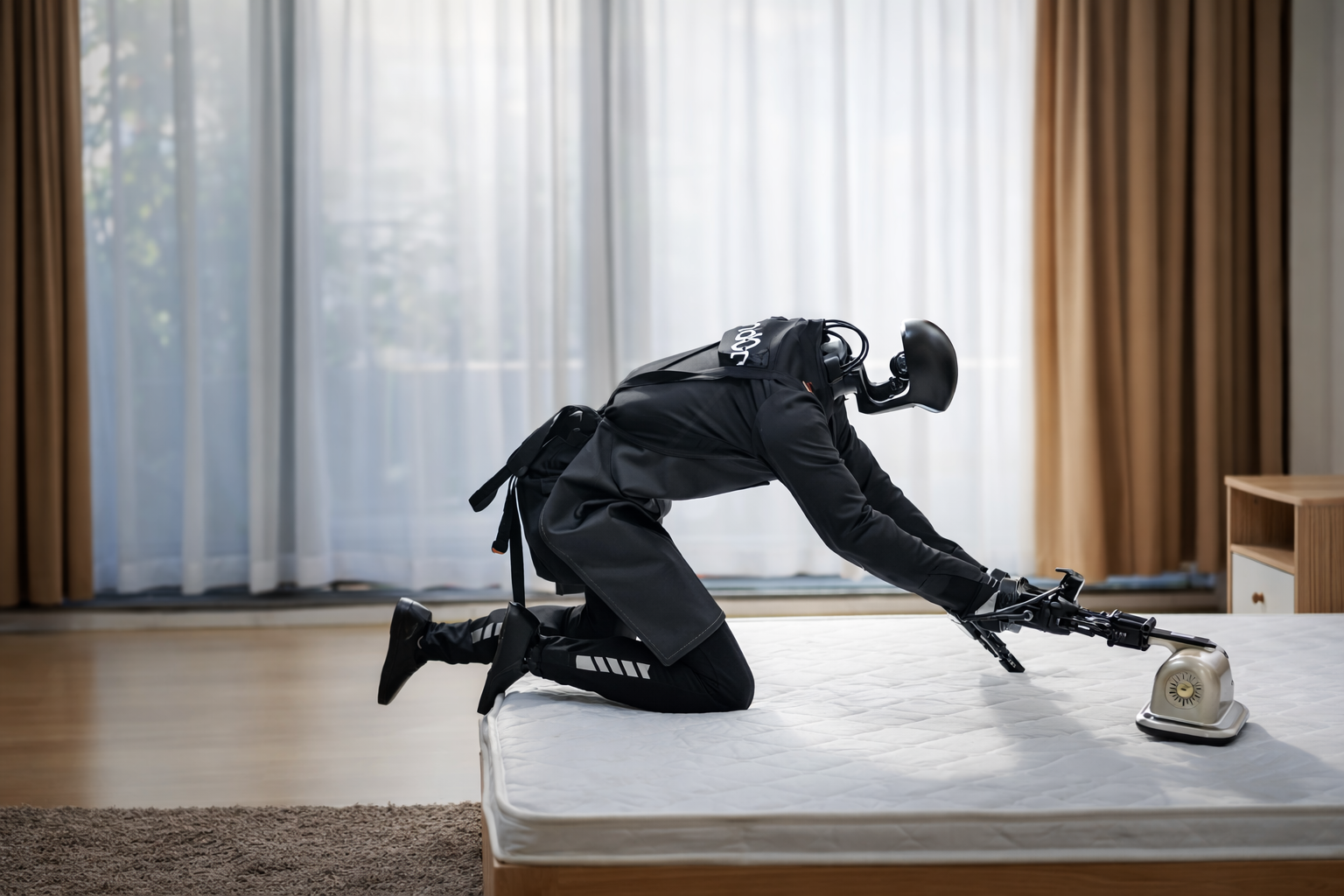
MindOn’s latest Unitree G1 clip matters for a simple reason: it compresses several of the hardest problems in humanoid robotics into one familiar domestic setting. In the November 2025 demo, the robot is shown opening curtains, watering plants, collecting a delivery, cleaning a bed surface, sorting household items, pulling trash from under furniture, and even playing frisbee with children, all under the claim that the footage is shown with “no speed up, no teleoperation.” MindOn itself is a young Shenzhen startup founded in 2025, not a legacy hardware manufacturer.
Table of Contents
That combination is what gives the video its force. A single chore is easy to oversell. A sequence of chores is much harder to fake into significance. Opening curtains asks for reach, balance, and contact with the environment. Plant care asks for gentleness. Carrying a package asks for locomotion under load. Tidying up and removing trash ask for crouching, perception in clutter, and recovery from awkward body positions. Playing with children introduces a different pressure altogether: movement has to look controlled, not merely successful. Viewed as a systems demo, it is less about housework than about coordinated whole-body behavior inside a human space.
A household demo that stacks the hard problems together
Most humanoid robot videos still live inside a safer grammar. A robot walks. A robot waves. A robot picks up one object from one clean surface. MindOn went after chores that force the machine to use more than one skill at once. The bed-cleaning sequence is especially revealing because it moves the G1 out of the usual upright posture and into a contact-rich situation where balance, body placement, and hand action all have to cooperate. That is much closer to the messiness of a real home than a polished tabletop pick-and-place demo.
The founder’s own explanation makes the choice of tasks even more interesting. Zhu Qingxu, a former Tencent Robotics X researcher who left in June 2025 to start MindOn, said the chores were inspired by a Xiaohongshu theme about a single mother’s day and were chosen precisely because they required the coordinated use of hands and feet. That is not random staging. It is a deliberate stress test for embodied control.
Task groups in the demo
| Task block | What it really tests |
|---|---|
| Curtains, bed-surface cleaning, trash pickup | Reaching above and below body height, crouching, kneeling, balance under contact, scene awareness |
| Plant care, package transport, tidying, play with children | Gentle grasping, locomotion while carrying, object placement, motion smoothing near people |
The table is compact, but the underlying point is large: these are not seven separate tricks. They are overlapping demands on perception, manipulation, locomotion, balance, and motion quality. That overlap is what makes the demo feel more important than a viral curiosity.
MindOn is trying to sell the brain, not the body
The most provocative part of the story may be the business model hiding inside the video. MindOn is not presenting a new humanoid body. It is presenting a software and control stack layered onto existing hardware. Public reporting describes the company as an algorithm-focused embodied intelligence startup founded by former Tencent Robotics X members Zhu Qingxu and Zhou Qinqin, with financing raised within months of launch.
That posture matters. If the body can be bought and the intelligence can be trained elsewhere, the competitive center of gravity shifts. The winner would not necessarily be the company with the flashiest chassis or the most cinematic factory; it would be the one with better data, better motion priors, better planning, better safety, and better transfer from training to real rooms. MindOn’s own technical pitch leans in that direction. Zhu has argued that teleoperation-based training has a structural weakness because it captures slow, overly conscious human control rather than fluid, instinctive movement. MindOn instead describes an approach built around optical motion capture plus UMI-style hand-object interaction data.
That argument lands at a moment when the rest of the field is still wrestling with data pipelines. Unitree’s own G1-D platform is marketed around data acquisition, labeling, training, and deployment tools, which is a quiet admission that the bottleneck is no longer just mechanics. The fight is increasingly about how robots learn, not merely how they look.
The Unitree G1 was a very deliberate platform choice
MindOn could not have made this point as sharply on a rare, expensive research machine. The Unitree G1 is meaningful because it sits at the more accessible end of humanoid hardware. Unitree lists the G1 at about 35 kilograms, with configurations ranging from 23 to 43 degrees of freedom, sensing built around depth camera plus 3D LiDAR, and battery life of about two hours. The company also markets optional dexterous hands and emphasizes force-position hybrid control for precise object handling. Reuters has reported that the G1 launched at a starting price of 99,000 yuan, making it far cheaper than earlier generations of humanoids.
That price does not make it a consumer appliance. It does make it a plausible platform. The distinction matters. A platform invites developers, labs, and startups to treat the robot as something closer to a computing substrate. Xinhua reported in early 2025 that demand for Unitree G1 rentals had surged, with daily rental prices for humanoids running from 8,000 to 15,000 yuan, which tells you the machine had already become a visible object in demonstrations, events, and experimentation before MindOn’s home-task video landed.
There is also a broader market signal behind the hardware choice. Reuters reported in March 2026 that humanoids had become Unitree’s key growth engine, accounting for 51.5% of its revenue in the first nine months of 2025, up from 27.6% in 2024. MindOn’s demo arrived inside a market that was already tilting toward humanoid commercial relevance. The clip did not create that shift, but it gave the shift a more vivid image.
A viral clip is not a household product
None of this turns the G1 into a ready-made home robot. That would be a lazy conclusion, and the sources do not support it. MindOn’s demo appears choreographed in the sensible sense of the word: the environment is prepared, the tasks are selected, and the robot is being shown in circumstances favorable to success. That still leaves a canyon between demonstrated capability and consumer reliability. Homes are non-standard, clutter changes by the hour, floors differ, children do not behave like evaluation datasets, and no household wants a machine that succeeds beautifully five times and fails dangerously on the sixth.
The academic literature makes that gap hard to ignore. Recent work on humanoid loco-manipulation still frames the field around high-dimensional control, unstable biped dynamics, sim-to-real transfer, and the heavy burden of task-specific tuning. SkillBlender presents versatility as an open research problem. ResMimic still treats robust whole-body loco-manipulation on a real Unitree G1 as a publishable advance. That is the right lens for MindOn’s video: impressive progress, not solved autonomy.
Battery life and economics bring the same reality check. A G1 with roughly two hours of listed battery life and a starting hardware price near 99,000 yuan is not about to replace a human caregiver, housekeeper, or parent. Even Zhu’s own public timeline is a near-future ambition, not a claim of immediate arrival: he has said bipedal humanoids could enter households within three to five years, while many others in the industry still place that milestone further out, around five to ten years.
The most important signal sits beneath the spectacle
The reason this demo lingered is not that a robot watered a plant. Plenty of robot videos can produce a single uncanny moment. MindOn’s G1 made a stronger argument: that domestic robotics is starting to move from isolated tricks toward chained, contact-rich routines on comparatively affordable hardware. That is a sharper, more consequential claim.
There is another reason it struck a nerve. The video implies that the household robot race may not be won by whoever builds the most iconic humanoid shell. It may be won by the team that best trains motion, perception, generalization, and safety on top of a broadly available body. If that reading is right, MindOn did more than make a viral clip. It sketched a possible market structure for the next phase of embodied AI.
The strongest closing judgment is a restrained one. MindOn has not proved that the robot housekeeper has arrived. It has shown something quieter and, in a way, more serious. The chores that used to expose the limits of humanoid demos are starting to look like training targets rather than science fiction. That does not end the argument. It changes its tone.
Author:
Jan Bielik
CEO & Founder of Webiano Digital & Marketing Agency
This article is an original analysis supported by the sources cited below
Startup’s Viral Video Shows Unitree G1 Mastering Chores
A report on the MindOn demo, the household task list, and the company’s no-teleoperation claim.
Is teleoperation holding robotics development back? MindOn Robotics makes its case
An English report based on 36Kr’s coverage of MindOn’s founder, data strategy, funding, and critique of teleoperation-first training.
Ex – Tencent Robotics X Algorithm Researcher Launches Business, Secures Three – Round Financing in Four Months, Aims to Bring Humanoid Robots to Households in 3 – 5 Years
A translated 36Kr article with Zhu Qingxu’s comments on household timelines, teleoperation limits, and the task selection behind the demo.
前腾讯Robotics X核心成员组团创业,拿到首轮融资
A Chinese report identifying MindOn’s founders, their Tencent Robotics X background, and the company’s early formation.
Humanoid robot G1_Humanoid Robot Functions_Humanoid Robot Price | Unitree Robotics
Unitree’s official G1 product page with core specifications including weight, degrees of freedom, sensors, and battery life.
Unitree G1
Unitree’s store page describing the G1’s dexterous hand positioning and manipulation capabilities.
China’s Unitree prices new humanoid robot at deep discount to 2024 model
Reuters reporting on Unitree’s humanoid pricing, including the G1’s 99,000 yuan starting price and 35-kilogram weight.
Unitree plans Shanghai IPO, testing interest in humanoid robots
Reuters coverage of Unitree’s revenue mix and the wider commercial momentum behind humanoid robots.
China Focus: China’s humanoid robot craze sparks surge in rentals
A Xinhua report showing how Unitree’s G1 had already become an active commercial and demonstration platform in China.
Unitree G1-D End-to-End Platform for Humanoid Robot
Unitree’s official page for its data acquisition, training, and deployment platform for humanoid development.
ResMimic: From General Motion Tracking to Humanoid Whole-body Loco-Manipulation via Residual Learning
A research paper showing the state of the art in real-world whole-body loco-manipulation on the Unitree G1.
SkillBlender: Towards Versatile Humanoid Whole-Body Loco-Manipulation via Skill Blending
A research paper framing versatile humanoid loco-manipulation as an active, unsolved technical challenge.
Cover photo: YouTube reprophoto.