A practical shift from spectacle to production
Renault’s latest move is not really about robotics as a symbol of the future, but about rewriting the economics and ergonomics of vehicle production. At its Douai electric-vehicle factory in France, the company has begun deploying humanoid robots to take over physically punishing tasks that add little value beyond repetition and endurance. The first machines are already operating on the line that feeds components into assembly, marking an early but tangible use of humanoid robotics in a live automotive production environment.
Table of Contents
What makes this notable is the company’s intent. Renault is not presenting these machines as futuristic mascots or as a demonstration of technical ambition. It is positioning them as tools for a clear industrial objective: reducing the physical burden on workers while helping the factory move faster and more cheaply. That makes the story less about novelty than about execution.
Where the gains are expected to come from
Renault plans to scale the deployment to 350 robots over the next 18 months, tying the rollout directly to its effort to reduce production hours per vehicle by 30%. The broader target is equally explicit: a 20% cut in production costs over the next five years. Those numbers suggest the robots are being treated not as experimental additions, but as part of a larger manufacturing program aimed at strengthening Renault’s competitive position.
The tasks assigned so far are revealing. The Calvin-40 robot is already handling tire movements to the conveyor system and carrying panels in the body shop. These are jobs defined by repetition, weight, and strain rather than finesse. In that sense, Renault is applying the technology where it is most credible today. The immediate value lies not in replacing skilled assembly work, but in removing the hardest and least sustainable physical routines from the human workflow.
Why Calvin-40 fits the factory floor
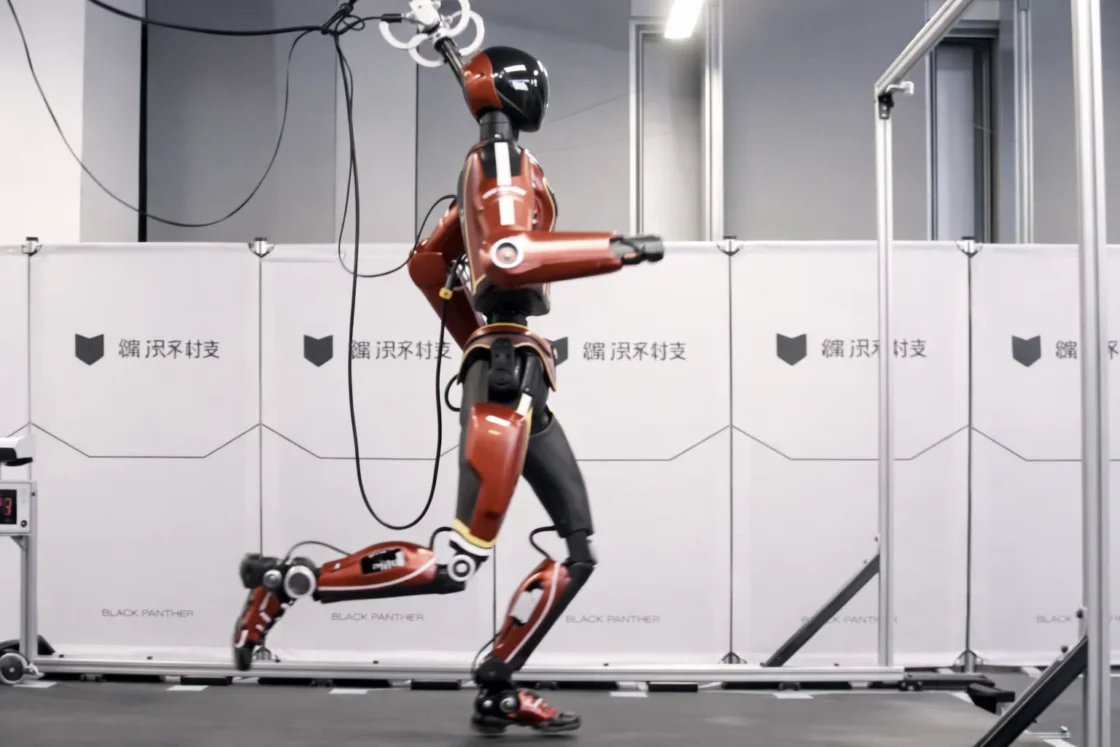
Built by New York-based startup Wandercraft, the Calvin-40 is designed with industrial usefulness in mind rather than human likeness. The headless, two-legged machine can lift up to 90 pounds, or 40 kilograms, repeatedly throughout the day without rest. Waist-mounted cameras and LED status indicators reinforce the impression of a robot intended to function safely and consistently inside a factory, not to imitate a person for its own sake.
That distinction matters. Renault itself contrasts this approach with more theatrical humanoid concepts, stressing that Calvin-40 was designed to work independently and integrate into industrial settings in a reliable way. Wandercraft says the second-generation robot was developed in just 40 days, and that artificial-intelligence training helped double its speed within roughly half a year after the first version appeared in April 2025. Renault then deepened the relationship in June 2025 by taking a minority stake in the company through a $75 million investment. The partnership now looks less like a technology bet in search of relevance and more like a supply-chain capability being built in real time.
The limits remain as important as the promise
For all the ambition behind the deployment, Renault is also drawing a clear line around what the robots cannot yet do. Calvin-40 can be trained to identify and retrieve mixed parts from bins, but its current use remains limited by speed and dexterity. That is why the robot is being used for lifting and transport rather than for the more intricate and variable tasks required on final assembly lines.
Thierry Charvet, Renault’s head of production, made that point directly by saying robots are not replacing people on final assembly because they still lack the necessary precision and pace. That admission gives the strategy more credibility, not less. Renault appears to understand that the near-term opportunity in humanoid robotics is narrow but meaningful: automate the exhausting margins of manufacturing first, and leave the most complex human work in human hands.
A more serious reading of industrial robotics
Renault’s claim that this is an industry first is significant less for its marketing value than for what it implies about maturity. Many companies have used humanoid robots to signal innovation in controlled public settings. Renault is arguing for something more consequential: that these machines can begin to earn their place on the production line. If that proves true at scale, the real shift will not be visual or symbolic. It will be operational.
In that sense, Renault’s experiment carries a broader message. The most important humanoid robot in manufacturing may not be the one that looks most like a person, but the one that can quietly absorb the hardest repetitive work without disrupting the line. If Douai becomes proof that such machines can deliver measurable efficiency while improving working conditions, Renault will have done more than introduce a new tool. It will have given humanoid robotics an industrial use case that is difficult to dismiss.
Author:
Jan Bielik
CEO & Founder of Webiano Digital & Marketing Agency

Source: Forget Tesla’s Optimus: Renault’s Robot Is Already Doing Backbreaking Work