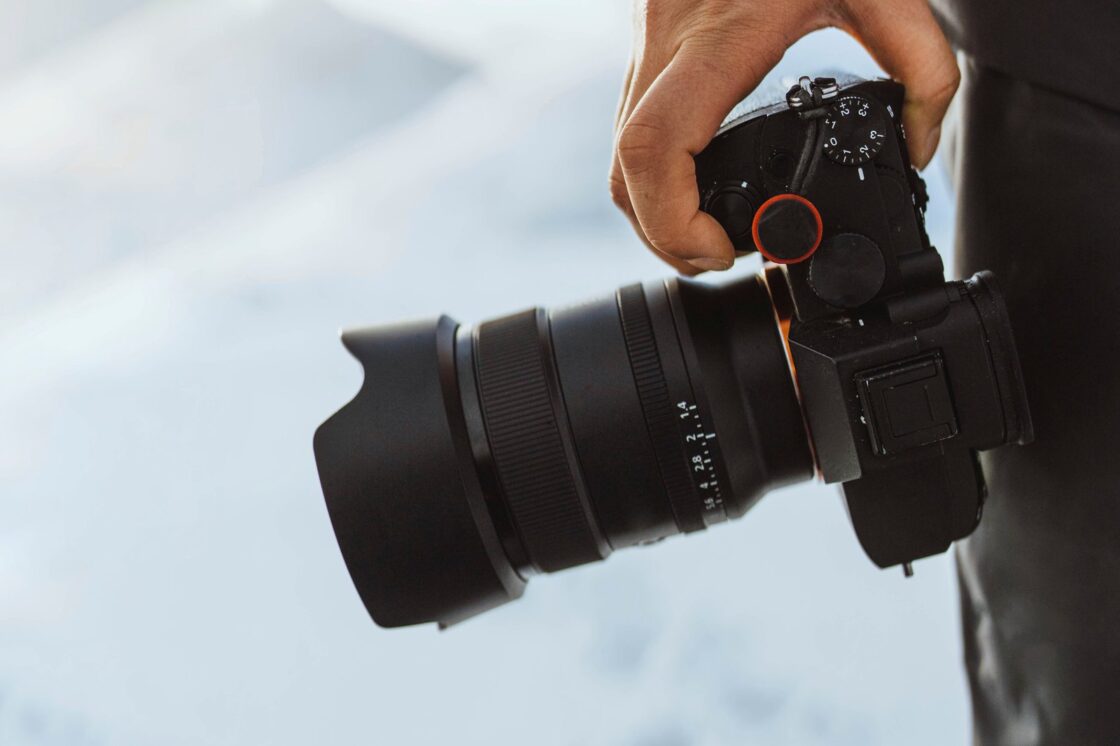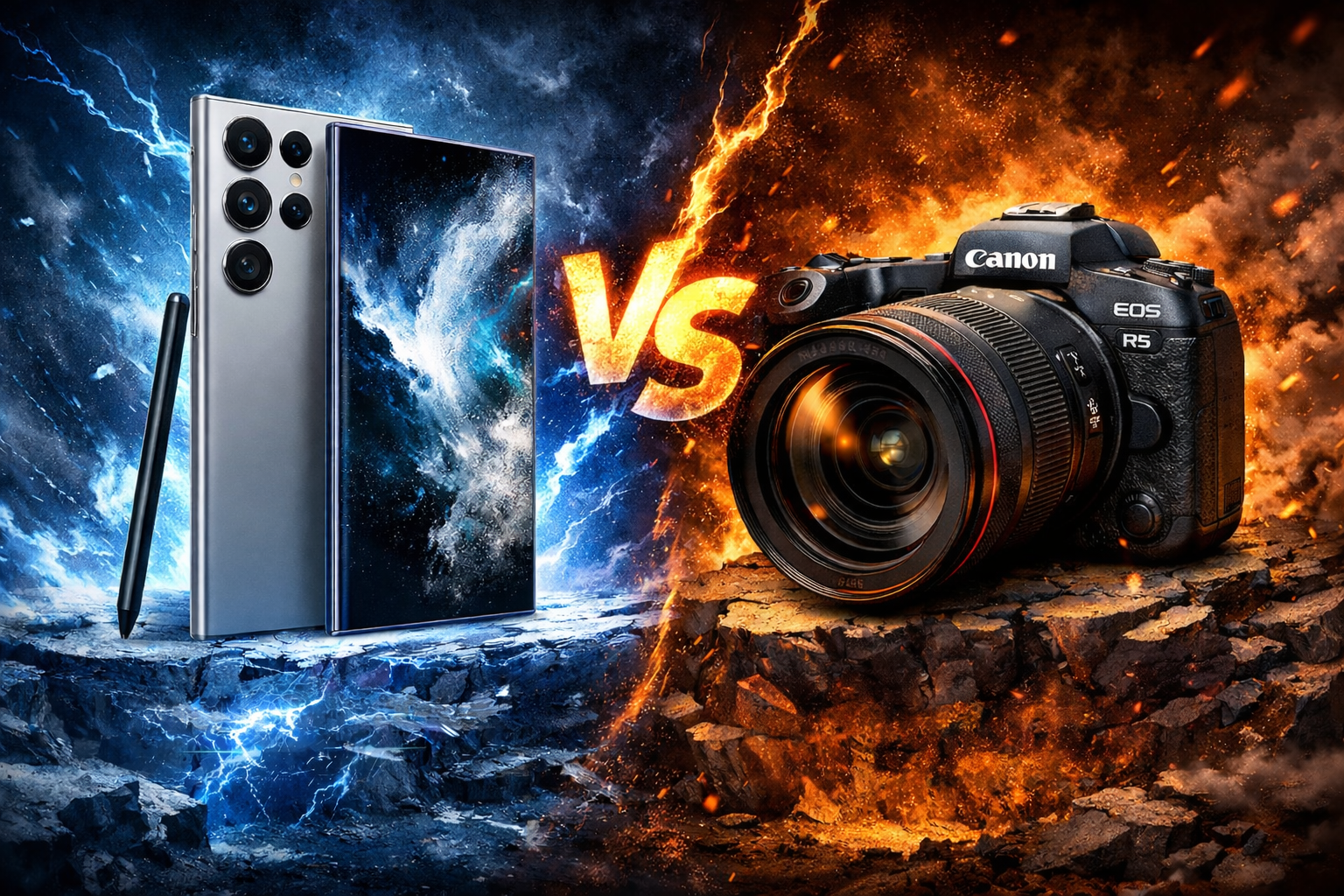
The promise that marketing sells
Samsung’s Galaxy S26 Ultra is a serious camera phone. Officially, it brings a 200 MP wide camera with an f/1.4 lens, a 50 MP ultra-wide, a 50 MP 5x telephoto, a 10 MP 3x telephoto, Nightography upgrades, AI Zoom, and prompt-based Photo Assist editing. Canon’s EOS R5 Mark II, on the other hand, is a 45 MP full-frame mirrorless camera with a back-illuminated stacked sensor, up to 30 fps shooting, 8K RAW up to 60p, advanced autofocus, and — in your comparison — a professional RF 24-105mm F4L IS USM zoom. On paper, both are high-end imaging tools. In practice, they are solving two very different problems.
Table of Contents
That difference matters because modern phone marketing increasingly bundles capture, enhancement, correction, and even generation into one story. Samsung promotes AI features that let users edit photos with natural-language prompts and add or alter elements in the frame. Those tools are useful. They can be fun. They can even make an ordinary photo look more impressive. But they are not the same thing as a larger sensor, better optics, or a more capable photographic system. They are software layers wrapped around a much smaller optical starting point.
So the blunt answer to your topic is this: a flagship phone such as the Galaxy S26 Ultra can produce beautiful, social-media-ready, sometimes astonishing images, but it still will not photograph like a professional mirrorless camera such as the Canon EOS R5 Mark II with the RF 24-105mm F4L IS USM, because physics, lens size, sensor area, RAW flexibility, and system control still matter more than marketing language or AI polish.
The real gap starts with sensor area
Canon’s own explanation of full-frame is simple: the format uses a 36 x 24 mm sensor, the same size as a frame of 35 mm film. Canon also notes that when sensor formats grow, photo receptors can capture more light, which improves dynamic range and reduces noise, especially in low light. That advantage is not a niche technicality. It is the foundation of why dedicated cameras still look cleaner, richer, and more flexible once light gets difficult or editing gets serious.
Smartphone imaging research describes the other side of the equation just as clearly. Modern phones are extraordinarily advanced, but they are constrained by miniature optics, tiny sensor packages, limited device thickness, and the physical compromises required to fit multiple camera modules into a slim body. That is why smartphone photography has progressed so aggressively through computational methods such as burst capture, noise reduction, HDR fusion, and super-resolution. Software is not there because phone makers are eccentric. It is there because small hardware needs help.
This is also why the megapixel argument is so often misleading. Samsung can advertise 200 MP and Canon can advertise 45 MP, yet those numbers do not describe the full photographic pipeline. Resolution is only one variable. Image quality also depends on how much light reaches the sensor, how cleanly the lens projects the image, how much dynamic range survives the capture, and how much flexibility remains afterward. A bigger imaging system starts with more real optical information before the software stage begins.
Why f/1.4 on a phone is not the same as f/1.4 on a camera
One of the most common traps in smartphone marketing is aperture language. An f/1.4 phone camera sounds spectacular next to an f/4 zoom lens. But those numbers do not mean the two systems are equivalent in the way most buyers imagine. Depth of field and rendering depend on sensor size and the actual focal length required to achieve a given angle of view. For the same framing, smaller sensors require much shorter real focal lengths, and that leads to deeper depth of field and less of the large-format separation people associate with professional photography.
That is why a phone portrait often looks “computed” when it tries to imitate the background blur of a larger camera. The mirrorless camera gets there optically. The phone often gets there by estimating subject depth and simulating blur in software. Sometimes the result looks convincing on a small screen. Sometimes it clips hair, glasses, fingers, or transparent objects. More importantly, even when it looks good, it is still an approximation of a look that the full-frame system can create natively.
There is also a brutal physical reality in your specific comparison. The Galaxy S26 Ultra is 7.9 mm thick. The Canon RF 24-105mm F4L IS USM reaches 105 mm at f/4. By simple optics, that implies an entrance pupil in the 26 mm range at the long end. A phone body that is under 8 mm thick cannot hide the optical geometry of a full-frame 105 mm f/4 zoom inside itself. No marketing campaign can negotiate with that fact. The only way a phone gets close is by changing modules, cropping, stacking frames, denoising, sharpening, and inventing the final look computationally.
Computational photography is brilliant but it is still compensation
None of this is an insult to phones. Computational photography is one of the most important advances in modern imaging. Researchers describe mobile photography as a field built on burst photography, noise reduction, super-resolution, HDR merging, and machine learning. Those techniques let a tiny camera system produce results that would have looked absurdly good a decade ago. They are the reason today’s high-end phones are so effective for everyday users.
But computational photography is still best understood as compensation and optimization, not a full replacement for optical scale. Adobe’s Project Indigo makes that point almost accidentally. Adobe describes the app as offering a more natural “SLR-like” look and the highest image quality that computational photography can provide. That is revealing language. The goal is to get closer to the look of a larger camera because the phone pipeline still starts from smaller optics and a smaller sensor. The software is chasing a photographic signature that dedicated cameras can produce more directly.
Samsung’s own Galaxy AI messaging reinforces the distinction. Photo Assist can move, remove, or add elements, and on the S26 generation it can use prompts to accelerate edits. That is useful for content creation, social sharing, and quick visual storytelling. It is not proof that the phone captured more real-world detail in the first place. In strict photographic terms, AI editing is downstream manipulation. It expands convenience and creativity, but it does not erase the hardware limits of the original exposure.
Real zoom still beats hybrid zoom
The Canon RF 24-105mm F4L IS USM is not even a wild, exotic specialty lens. It is a professional everyday zoom with a 24-105 mm range, a constant f/4 aperture, Nano USM autofocus, 5-stop image stabilization, and a 0.45 m minimum focus distance. In other words, this is a practical workhorse lens, not some laboratory monster built only to embarrass phones.
And yet even this practical workhorse exposes one of the biggest smartphone weaknesses: zoom consistency. Samsung says the S26 Ultra offers 3x and 5x optical zoom, 2x and 10x “optical quality zoom,” and up to 100x with AI-assisted processing. Samsung also notes that past 10x, image deterioration may appear and that AI Zoom accuracy is not guaranteed. That is an honest disclaimer, and it tells you everything. On a pro camera, the lens is doing the heavy lifting optically. On a phone, at longer ranges, the software increasingly joins the negotiation.
This matters because professionals care about repeatability. They want to know what 70 mm looks like, what 105 mm looks like, how the transition behaves, how contrast holds up, how edge detail responds, and what happens in difficult light. A dedicated zoom lens gives them an optical continuum. A phone gives them a mixture of separate modules, crops, reconstruction, and AI enhancement. The phone can look impressive. The mirrorless system is more predictable.
Motion, autofocus and reliability separate pro tools from smart devices
Canon built the EOS R5 Mark II for demanding stills and hybrid work. Officially, it combines a 45 MP stacked sensor, up to 30 fps shooting, Dual Pixel Intelligent AF, Action Priority for certain sports, Eye Control AF, and up to 8.5 stops of in-body stabilization with compatible lenses. Canon also says the stacked sensor design minimizes distortion in moving subjects, and Canon’s professional sensor explainer says stacked designs such as those in the EOS R5 Mark II greatly alleviate rolling shutter problems through faster readout.
A phone can absolutely capture moving subjects. Sometimes it will even produce a more flattering instant result because its software is aggressively selecting, merging, and beautifying the frame. But sports, wildlife, events, fast reportage, and unpredictable professional work are not only about getting one nice-looking frame. They are about getting the right frame, repeatedly, with controlled shutter behavior, dependable tracking, lens choice, and a workflow built for pressure. That is where a mirrorless body still feels like a tool, while a phone still feels like a clever compromise.
The same principle carries into video. The EOS R5 Mark II can record full-width 8K RAW up to 60p with 12-bit color depth, Canon Log 2 and Log 3, and broader post-production flexibility. Samsung can produce highly usable stabilized footage, and its Nightography and AI processing help a lot in difficult conditions, but the phone’s result is more heavily mediated by the processing pipeline. For serious color work, latitude, and motion discipline, the dedicated camera still gives the editor more genuine room to move.
Workflow, RAW latitude and consistency matter more than spec sheets
This is where many comparisons between phones and cameras collapse. People compare what looks best in one second on a phone screen. Professionals compare what survives a real workflow. Adobe’s RAW guidance is blunt: RAW files preserve more information and provide far better shadow and highlight recovery than compressed output. Canon’s own literature ties larger photo receptors to greater dynamic range and lower noise. Those are not abstract studio talking points. They directly affect whether a wedding dress keeps texture, whether a sunset sky bands apart, whether a dark suit retains detail, and whether a skin tone survives color grading.
Yes, Samsung offers Expert RAW, and that is a meaningful feature for advanced users. But Expert RAW on a phone still begins with the limitations of phone hardware. It is valuable because it gives the user more control and more latitude than standard processed output. It does not magically turn a small mobile module into a full-frame interchangeable-lens system. RAW helps. Physics still sets the ceiling.
This is why the Canon setup wins even before you move beyond the kit in your example. The RF 24-105mm F4L IS USM is a flexible professional zoom, not the absolute maximum that the EOS R5 Mark II can do. Once you add a fast prime, a longer telephoto, a macro lens, or specialized lighting, the gap becomes larger, not smaller. The phone is strongest when it keeps the user inside one elegant, automated pipeline. The mirrorless camera is strongest when the job demands control.
Where the phone genuinely wins
To be fair, the Galaxy S26 Ultra wins in areas that matter to real people. It is always with you. It is radically faster to share from. It automates HDR, night cleanup, stabilization, face handling, and quick edits. It gives non-specialists images they like immediately. Samsung’s AI tools, Photo Assist, zoom processing, and mobile workflow make it the better device for spontaneous daily capture, travel convenience, casual family moments, and content made to be seen primarily on phones. That is not a consolation prize. That is why phone cameras changed culture.
In some situations, the phone can even look “better” straight out of camera because it is making taste decisions for the user: brighter shadows, warmer skin, punchier contrast, stabilized motion, smarter HDR, cleaner night scenes. Many people do not actually want a neutral starting point. They want a pleasing finished picture. Phones understand that better than traditional cameras ever did.
But that still does not make the phone the superior photographic instrument. It makes it the superior instant-image appliance. Those are not the same category, and confusing them is where the marketing gets loudest.
The verdict
A high-end phone such as the Samsung Galaxy S26 Ultra will keep getting better. Its AI will get faster. Its denoising will improve. Its zoom reconstruction will look more convincing. Its editing tools will become even more magical. But as long as the device must remain a slim, pocketable slab, it will still be constrained by miniature optics, smaller sensors, deeper natural depth of field, and a stronger dependence on computational rescue.
The Canon EOS R5 Mark II with the RF 24-105mm F4L IS USM wins because it captures more of the image optically before software has to save it. It gives you a full-frame sensor, a real interchangeable lens, stronger motion handling, greater workflow latitude, more reliable zoom behavior, deeper control over RAW output, and a rendering style that does not need to imitate “real camera look” because it already is the real camera look.
So yes, despite brutal marketing and impressive AI functionality, a flagship phone will not photograph like a professional mirrorless camera in the sense that matters to professionals. It can simulate, optimize, beautify, and sometimes outperform in convenience. It still does not replace the larger sensor, larger lens, and larger creative headroom of a pro mirrorless system. That is not nostalgia. That is optics.
FAQ
No. It is one of Samsung’s most advanced camera phones, with a 200 MP main camera, multiple rear modules, Nightography improvements, AI Zoom, and Galaxy AI editing features. The point is not that it is bad. The point is that it still serves a different category from a professional full-frame mirrorless system.
Because megapixels are only one part of image quality. Sensor size, lens size, light capture, dynamic range, noise performance, autofocus behavior, and RAW flexibility all matter. A full-frame system starts from a much larger optical and sensor foundation.
Not in any simple apples-to-apples sense. Aperture numbers cannot be separated from sensor size and actual focal length. On a much smaller sensor, f/1.4 does not create the same depth of field, rendering, or large-format look that photographers associate with bigger cameras and lenses.
AI can narrow the gap in many everyday situations, especially for casual users and screen-first content. But the physical constraints of small optics and compact sensor packages still remain, which is why computational photography exists in the first place.
No. Expert RAW is valuable because it gives advanced users more control and more editing latitude than default processed output. It improves the phone experience, but it does not turn mobile hardware into a full-frame interchangeable-lens system.
It is powerful, but the RF 24-105mm F4L IS USM is also a practical general-purpose professional zoom, not a niche specialty lens. That actually strengthens the comparison, because the Canon wins on fundamentals without needing an extreme lens choice.
For travel convenience, spontaneous moments, quick sharing, social media content, casual family photography, instant HDR and night processing, and everyday carry. In those cases, the best camera is often the one already in your pocket and already connected to your workflow.
The Galaxy S26 Ultra is an excellent computational camera inside a phone, while the Canon EOS R5 Mark II is a professional imaging system built around a large sensor and real interchangeable optics.
Author:
Jan Bielik
CEO & Founder of Webiano Digital & Marketing Agency
Sources
Samsung Galaxy S26 Ultra | Specs & Features
Samsung’s official Galaxy S26 Ultra product page. Used for the phone’s camera setup, Nightography claims, AI features, zoom claims, thickness, and general positioning.
Specs | Samsung Galaxy S26 Ultra
Samsung’s official specifications page for the Galaxy S26 Ultra. Used to confirm the model lineup and official spec structure.
Galaxy AI | Mobile AI and AI features on devices
Samsung’s official Galaxy AI overview. Used for Photo Assist capabilities and the distinction between capture and AI editing.
Professional Photography with Galaxy Expert RAW App
Samsung support article for Expert RAW. Used to discuss mobile RAW workflow and its role for advanced users.
Canon EOS R5 Mark II Camera
Canon’s official EOS R5 Mark II product page. Used for the camera’s core features, autofocus, stabilization, and positioning.
Canon EOS R5 Mark II Camera – Specifications
Canon’s official EOS R5 Mark II specifications page. Used for sensor, shooting speed, video, and stabilization details.
Canon RF 24-105mm F4L IS USM
Canon’s official lens overview for the RF 24-105mm F4L IS USM. Used for lens identity and positioning as a professional everyday zoom.
Specifications & Features – RF 24-105mm F4L IS USM
Canon’s official lens specification page. Used for zoom range, stabilization, Nano USM, and minimum focus distance.
APS-C vs full-frame – the difference explained
Canon’s educational article on sensor formats. Used to confirm that full-frame means 36 x 24 mm and to support sensor-size comparisons.
Which Canon cameras have which features
Canon’s feature explainer for its camera lineup. Used for Canon’s explanation of why larger sensors with larger photo receptors improve dynamic range and low-light performance.
Camera sensors explained
Canon’s technical explainer on sensor behavior. Used for light-gathering principles and stacked-sensor readout advantages.
Shoot RAW vs. JPEG: Which format should you choose?
Adobe’s official RAW versus JPEG guide. Used for highlight and shadow recovery and the importance of RAW in editing workflows.
Project Indigo – a computational photography camera app
Adobe Research article on Project Indigo. Used for Adobe’s description of computational photography and its attempt at an SLR-like look.
Computational and Mobile Photography: The History of the Smartphone Camera
SIAM overview of how smartphone imaging evolved. Used for the role of burst processing, computational photography, and the modern phone camera pipeline.
Mobile Computational Photography: A Tour
Widely cited technical paper on mobile computational photography. Used for burst photography, noise reduction, and super-resolution concepts.
Smartphone imaging technology and its applications
Scholarly overview of smartphone imaging technology. Used for the physical limitations of smartphone optics, sensors, and form factor.
Digital Camera Sensor Sizes
Educational tutorial on sensor size. Used for the relationship between sensor format and depth of field.
Sensor Size, Perspective and Depth of Field
Photography Life explainer on equivalence and depth of field. Used to support why aperture numbers do not translate directly across very different sensor sizes.