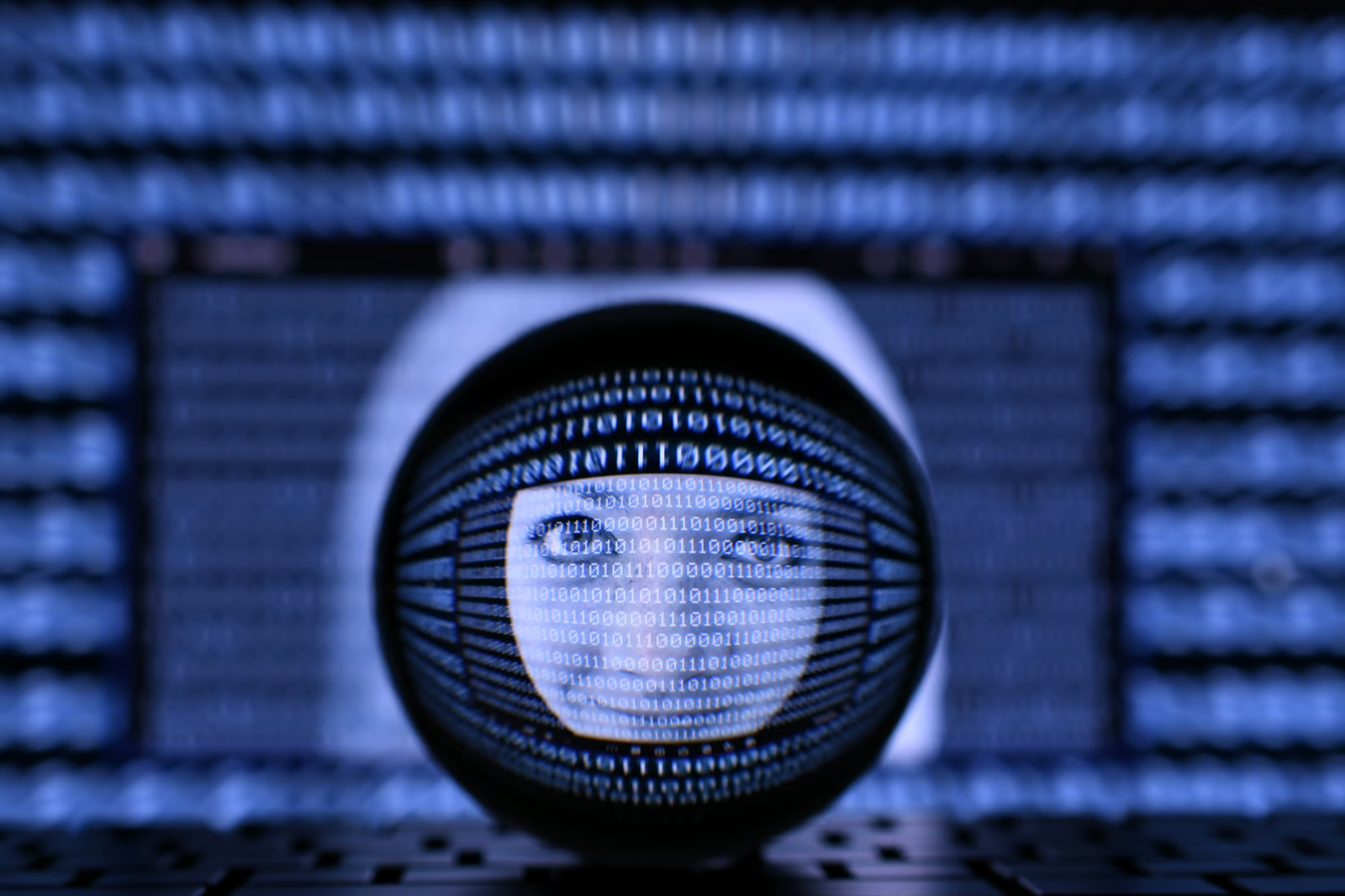
A deepfake is synthetic or manipulated media designed to look or sound real enough to persuade you that it is authentic. In stricter usage, it is a subset of synthetic media: AI-generated or AI-altered audio and audiovisual content that can make it appear that a real person said or did something they never said or did, or even create a convincing person who never existed at all. Europol describes deepfakes as synthetic media generated or manipulated using AI, while NIST places them inside the broader problem of synthetic content and digital content transparency.
Table of Contents
Deepfake is a type of synthetic media
The term is often used loosely. People call almost any AI-made image a deepfake, but that blurs an important distinction. Not every synthetic image is a deepfake, and not every deepfake is fully fabricated from scratch. Some are face swaps. Some are lip-sync manipulations. Some are reenactments that preserve a person’s appearance while changing expression or speech. Some are voice clones that mimic timbre, cadence, and prosody closely enough to sound like the original speaker. In other words, a deepfake may be wholly generated, partially edited, or built by stitching AI into authentic footage or recordings.
That distinction matters because the public argument about deepfakes is not really about whether computers can make fake media. They always could, in cruder ways. The real change is that modern systems can now produce highly persuasive falsification at scale, across video, audio, and imagery, with much less skill, time, and money than older visual-effects workflows required. Europol’s warning is not simply about fake clips online. It is about how this capability affects evidence, identity, fraud, public discourse, and law enforcement itself.
How deepfakes are made
Modern deepfakes are built with generative AI models trained on large volumes of data. NIST notes that today’s detection systems must contend with content produced or altered by models such as GANs, diffusion models, NeRFs, and VAEs. A recent survey accepted by ACM Computing Surveys describes four representative deepfake fields as face swapping, face reenactment, talking-face generation, and facial attribute editing. That is a useful way to think about the technology: some systems replace identity, some replace motion, some synthesize speech-linked facial movement, and some alter visible traits while leaving the scene intact.
For images and video, diffusion models have pushed realism forward by starting from noise and iteratively refining it into an output that matches a prompt or conditioning signal. For audio, NIST separates synthetic voice generation into text-to-speech methods and imitation-based methods. The latter can transform source speech so it sounds like another speaker without changing the linguistic content, which is why voice cloning has become such a powerful fraud tool.
What makes a deepfake convincing is not mystical intelligence. It is statistical imitation of the cues people use to decide what is real: mouth movement, micro-expressions, vocal texture, rhythm, lighting, continuity, accent, and contextual plausibility. Europol makes the deeper point clearly: people treat auditory and visual recordings as especially strong evidence because they seem to show reality directly. Deepfakes exploit that instinct. They do not just fake content. They counterfeit trust.
Why deepfakes matter beyond fake videos
The most obvious danger is disinformation. Deepfakes can be used to spread false claims, manipulate elections, inflame social conflict, or damage reputations just before correction becomes possible. UNESCO points to the 2023 Slovak election example, where an AI-generated audio deepfake circulated shortly before voting and appeared to capture political figures discussing election rigging. Europol similarly warns that deepfakes can be deployed in disinformation campaigns, election disruption, market manipulation, and efforts to intensify conflict by making false events appear documented.
But the most profitable harms are often more intimate and less theatrical. Europol lists extortion, fraud, identity falsification, document fraud, KYC evasion, non-consensual pornography, and manipulation of criminal evidence among the major risks. The FTC has warned that voice cloning makes emergency scams and executive impersonation more believable because a familiar voice short-circuits skepticism. A deepfake does not need to fool the whole internet. It only needs to fool one employee, one bank clerk, one relative, one voter, or one platform moderator at the right moment.
There is also a subtler danger sometimes called the liar’s dividend. Once convincing fake media becomes commonplace, authentic media becomes easier to dismiss. UNESCO’s analysis frames this as a wider crisis of knowing: not just the spread of falsehoods, but the erosion of shared confidence in how truth is verified. That may be the most corrosive effect of all. A society does not function well when every recording can be attacked as fake and every fake can ride on the authority of a recording.
Not every deepfake is malicious
The technology itself is not automatically abusive. The same toolchain can support film production, dubbing, accessibility, digital avatars, and voice restoration. The FTC notes that voice cloning can offer medical assistance to people who have lost their voices due to accident or illness. Research surveys also point to entertainment, movie production, and digital human creation as legitimate application areas. Even Europol, despite its law-enforcement framing, notes that synthetic media can also be used for positive applications.
That is why the strongest regulatory responses are moving toward transparency rather than blanket prohibition. The central policy question is usually not whether synthetic media may exist, but whether people encountering it are clearly informed, whether consent exists, whether impersonation is deceptive, and whether the use creates material harm. The line between art and abuse is often the line between disclosure and deception.
Why detection is harder than people think
A common public fantasy is that there will be a universal “deepfake detector” that settles the issue instantly. NIST’s work suggests a messier reality. It separates the response into provenance data tracking and synthetic content detection. Provenance methods try to preserve origin and history through metadata and watermarking. Detection methods try to infer whether content is synthetic or manipulated by analyzing the content itself. Those are related, but they are not the same thing, and neither is a silver bullet.
Watermarking helps, but it comes with trade-offs. NIST notes that watermarks can be more or less robust, more or less visible, and more or less resistant to tampering. Metadata can also help establish authenticity, but it can be stripped, corrupted, or fail to survive platform pipelines. Detection models have their own limits: NIST reports that performance varies sharply by dataset and generation method, and audio detection research remains heavily concentrated in English, which means tools may generalize unevenly across languages and dialects.
That is why deepfake defense increasingly combines several layers at once: model-side marking, capture-time authentication, platform labeling, forensic analysis, newsroom verification, and old-fashioned human skepticism. The future of trust will depend less on one magic detector than on interoperable proof systems and better verification habits. NIST explicitly frames provenance, watermarking, metadata recording, and content authentication as pieces of a broader transparency architecture rather than a single fix.
How the law is starting to respond
In the European Union, the AI Act creates transparency obligations for certain synthetic content and deepfakes. Article 50 requires providers of systems generating synthetic audio, image, video, or text to ensure outputs are marked in a machine-readable and detectable way as artificially generated or manipulated, and it requires deployers of systems generating or manipulating deepfake image, audio, or video content to disclose that fact. The same article also recognizes exceptions and lighter treatment for clearly artistic, creative, satirical, or fictional works. The Article 50 timeline page states an entry-into-force date of 2 August 2026.
In the United States, the legal picture is more fragmented, but the direction is clear. The FTC has treated impersonation and voice cloning as growing consumer-protection risks, promoted technical defenses through its Voice Cloning Challenge, and highlighted the role of enforcement and rulemaking. The FTC’s legal library also states that the TAKE IT DOWN Act criminalizes the publication of nonconsensual intimate visual depictions and requires covered platforms to provide a notice process and remove such depictions within 48 hours of notice.
What people should actually do when they suspect a deepfake
The practical response starts with a simple shift: treat sensational audio and video the way you would treat a suspicious financial message. Verify before reacting. The FTC’s advice on voice cloning is blunt and effective: if a call sounds like your boss or a loved one asking for money or sensitive information, break the spell and verify through a phone number you already know is real. That single step defeats the emotional leverage that makes many voice-clone scams work.
For public-facing media, source tracing matters. Look for the original uploader, the earliest version, independent reporting, provenance markers, platform labels, and whether reputable outlets or fact-checkers have authenticated the clip. UNESCO’s media-literacy guidance emphasizes collaborative verification, audience flagging, and newsroom analysis of suspicious files. In the Slovak case it cites, fact-checkers identified manipulation through close attention to diction, pauses, and vocal tone.
The deeper habit is intellectual rather than technical. Do not ask only, “Could this be fake?” Ask, “Who benefits if I believe this quickly?” Deepfakes succeed by hijacking urgency, outrage, intimacy, and tribal instinct. They flourish in moments when emotion outruns verification. The best defense is not permanent disbelief. It is disciplined belief.
The real meaning of deepfake
A deepfake is not just a fake video. It is a sign that digital evidence has entered a new phase. The camera is no longer enough. The recording is no longer enough. The voice is no longer enough. Authenticity now has to be established, not assumed. NIST’s emphasis on provenance and transparency, Europol’s focus on fraud and public-order risks, UNESCO’s concern about a crisis of knowing, and the FTC’s focus on impersonation all point to the same conclusion: the deepfake problem is ultimately a trust problem.
That is why the question “What is a deepfake?” has a larger answer than its dictionary definition. Technically, it is AI-generated or AI-manipulated media. Socially, it is a new method of deception. Politically, it is a pressure test for institutions that depend on evidence. Culturally, it forces people to rethink what they accept as proof. The age of deepfakes is not defined by fake pixels alone. It is defined by the cost of losing confidence in what appears to be real.
Author:
Jan Bielik
CEO & Founder of Webiano Digital & Marketing Agency
Sources
Reducing Risks Posed by Synthetic Content
NIST draft report on synthetic content, provenance, watermarking, and detection.
https://airc.nist.gov/docs/NIST.AI.100-4.SyntheticContent.ipd.pdf
Facing reality? Law enforcement and the challenge of deepfakes
Europol report on what deepfakes are and how they affect fraud, policing, disinformation, and public trust.
https://www.europol.europa.eu/cms/sites/default/files/documents/Europol_Innovation_Lab_Facing_Reality_Law_Enforcement_And_The_Challenge_Of_Deepfakes.pdf
Deepfake Generation and Detection A Benchmark and Survey
Research survey summarizing major deepfake generation methods, categories, and detection challenges.
https://arxiv.org/abs/2403.17881
Article 50 Transparency Obligations for Providers and Deployers of Certain AI Systems
Article-by-article presentation of the EU AI Act section covering synthetic content marking and deepfake disclosure.
https://artificialintelligenceact.eu/article/50/
Rules for trustworthy artificial intelligence in the EU
EUR-Lex summary of Regulation (EU) 2024/1689 and its risk-based transparency framework.
https://eur-lex.europa.eu/EN/legal-content/summary/rules-for-trustworthy-artificial-intelligence-in-the-eu.html
Fighting back against harmful voice cloning
FTC consumer guidance explaining how voice cloning scams work and how people should verify suspicious calls.
https://consumer.ftc.gov/consumer-alerts/2024/04/fighting-back-against-harmful-voice-cloning
The FTC Voice Cloning Challenge
FTC overview of voice cloning’s legitimate uses, risks, and technical ideas for defense.
https://www.ftc.gov/news-events/contests/ftc-voice-cloning-challenge
Tools to Address Known Exploitation by Immobilizing Technological Deepfakes on Websites and Networks Act
FTC legal summary of the TAKE IT DOWN Act and platform obligations around nonconsensual intimate imagery.
https://www.ftc.gov/legal-library/browse/statutes/tools-address-known-exploitation-immobilizing-technological-deepfakes-websites-networks-act-take-it
Case study Can we believe what we hear
UNESCO media-literacy case study on election-related deepfake audio and verification practices.
https://www.unesco.org/mil4teachers/en/toolkit-media/indicator-5/activities/ai-disinformation/case-study-2
Deepfakes and the crisis of knowing
UNESCO essay on how deepfakes weaken shared confidence in evidence and public knowledge.
https://www.unesco.org/en/articles/deepfakes-and-crisis-knowing