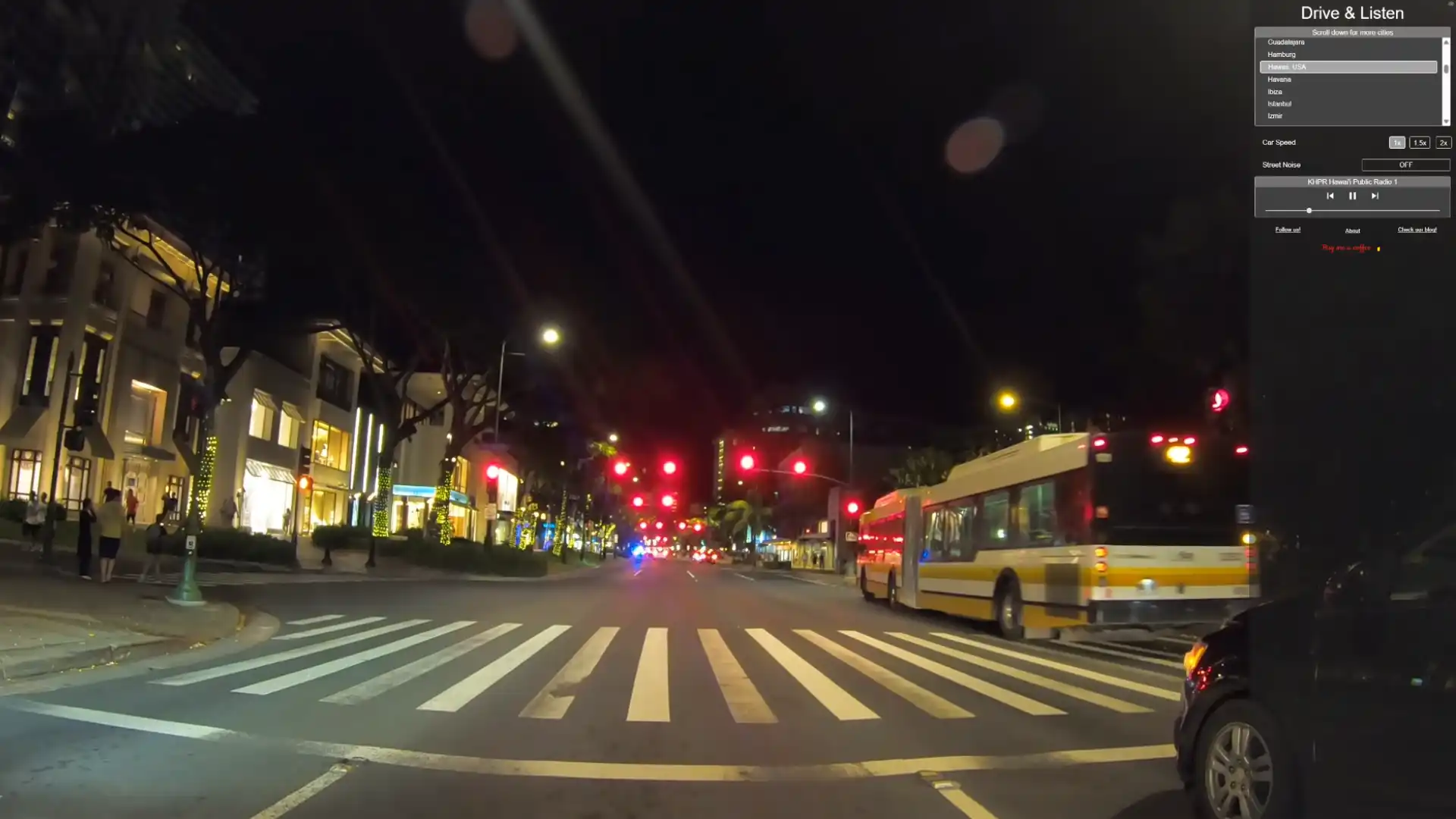
Drive and Listen works because it understands a small truth that most travel products miss: people do not only miss places, they miss being inside those places without having to perform for them. They miss the windshield view. They miss the radio half-tuned to something local. They miss the low-grade hum of traffic, the lazy stop at a red light, the sense that life is happening around them and they do not need to do anything except keep moving with it.
Table of Contents
That is the whole trick here, and it is a very good one. Drive and Listen lets you take virtual drives through more than 100 cities while listening to local radio stations. The current official site frames it simply: pick a city, hit play, and drift through Tokyo, Paris, New York City, Istanbul, and many others from home. The app was first launched on April 22, 2020 by Erkam Seker, and its origin story is unusually human for a web product: he missed Istanbul, started watching driving videos of the city, and then realized the experience needed radio and street sound to feel right.
The strange pleasure of being a passenger again
What makes the site memorable is not novelty by itself. The internet is full of novelty. What is rare is a site that knows exactly what mood it wants to create and does not spoil it by trying to become twelve other things at once.
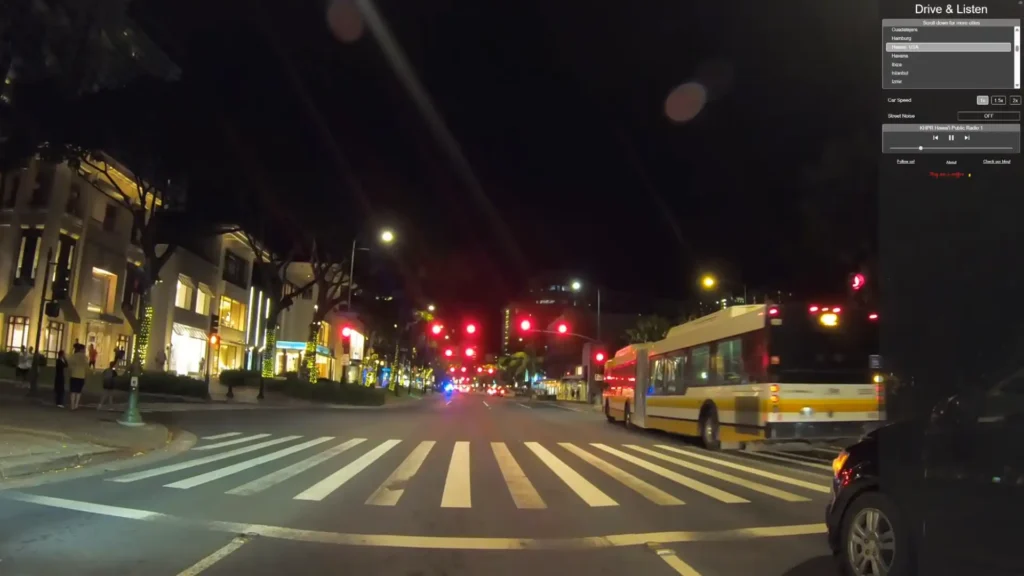
Drive and Listen is not a game, not quite a travel guide, not really slow TV, and definitely not a map product. It sits in a better category: ambient presence. You load a city, the footage rolls from a dashboard or front-seat view, local radio starts piping in, and the world becomes just detailed enough to settle your mind without demanding your attention. Coverage from 2020 and 2021 already noticed this quality. Business Insider described it as a brief escape for people missing their drives, while The Slowdown and Cool Hunting both focused on how the mix of prerecorded footage, live radio, and city sound turned it into a strangely transportive experience.
That balance matters. A lot of “relaxing” websites are dead on arrival because they are too static, too clean, or too obviously engineered around wellness clichés. Drive and Listen feels better because cities are never that tidy. Cars hesitate. Music choices are hit and miss. Street noise cuts in at odd moments. You are not floating through a branded dream of urban life. You are just there, moving through it.
What Drive and Listen actually gets right
The app’s best decision was pairing prerecorded video with live local radio streams instead of trying to fake a live drive. The official FAQ is clear that the video is not live, but the radio often is. That split turns out to be smarter than a live-only setup would be. Prerecorded footage gives the creator control over quality and pacing. Live radio supplies the instability that makes a city feel real right now.
The controls help, too, and they are the kind of controls that show real judgment. You can change the car speed, layer in street noise, and treat the experience more like a ride than a video player. The FAQ even stresses that this is not just ordinary playback speed or a simple unmute button. That distinction sounds minor until you use the site. A speed slider on YouTube would feel technical. A car-speed control feels like part of the fiction. Street noise is the same. It is not there to impress you with realism. It is there to make the radio feel located.
Another thing the app gets right is perspective. It does not pretend you are conquering the city. You are not roaming freely, chasing pins, or gamifying your way through landmarks. You are riding through someone else’s route. That makes the whole thing calmer and, oddly enough, more intimate. It feels closer to borrowing a familiar commute than taking a tour.
A web app built from longing, not feature creep
The origin story matters here because you can still feel it in the product. Seker told Business Insider that the first idea came from missing his hometown and watching Istanbul driving videos online. He then added radio and ambient street sound because seeing the city was not enough; he wanted the texture of being in it. That is why Drive and Listen still has a pulse. It was built around a feeling first and a feature set second.
That also explains why the project outlasted its first wave of pandemic attention. The official About page says the site went viral quickly after launch and reached more than 1 million daily unique visitors at peak, and that it still draws tens of thousands of people a day. Even if you take those numbers as the creator’s own framing, they fit the larger story: a lot of pandemic web curiosities burned bright and vanished, while this one stayed useful because the desire behind it never went away. People still miss home. People still miss travel. People still want a browser tab that changes the emotional temperature of a room.
There is also something quietly appealing about the fact that the original project is still being defended as the original project. The official FAQ says driveandlisten.app is the original site and notes that it was previously hosted on Heroku. Travel Massive also posted an update on February 10, 2026 saying the original Drive and Listen was back online at the official domain after the creator got in touch to point readers to the genuine version. On a web full of clones, SEO knockoffs, and thin copies, that detail counts.
What stands out after ten minutes
Spend ten minutes with Drive and Listen and the thing that stands out is not “wow, I can see cities.” You can see cities anywhere online. The thing that stands out is how little friction there is between curiosity and atmosphere.
You click a city, and the site gives you the part of urban life that usually gets edited out of travel media: not the hero shot, not the recommendation list, not the drone footage, but the in-between. Crosswalks. Side streets. Mid-rise buildings. Traffic that bunches and loosens. A skyline arriving late. The app is strongest when it lets ordinary urban texture do the work. That is why Istanbul feels good here. So does Tokyo. So does anywhere with enough visual rhythm to make even a slow stretch interesting.
It also helps that the site does not over-explain itself. There is no lecture attached to each city. No heavy educational wrapper. No desperate attempt to prove usefulness. That restraint gives the user room to project onto the drive. One person is using it as a focus tab. Another is checking whether a city they visited still feels the way they remember. Someone else is just tired and wants a moving picture with local radio instead of algorithm sludge.
What makes it worth opening
| What stands out | Why it works | Where it falls short |
|---|---|---|
| Real city footage | Streets feel lived-in, not simulated | You cannot choose your own route |
| Local radio streams | Gives each city an actual mood | Station quality varies by city |
| Street noise and car-speed controls | Makes the experience feel like a ride, not a clip | The interaction is intentionally light |
| More than 100 cities on the current site | Easy to hop between moods and places | Depth per city is limited compared with a full map tool |
The appeal is not completeness. It is tone control. Drive and Listen gives you just enough place, motion, and sound to shift your mood without turning the session into work. The limits are real, but they are also part of why it stays light on its feet.
Who will care and who probably will not
This is for people who like cities even when nothing spectacular is happening in them. It is for anyone who finds comfort in transit. It is for travelers, homesick expats, remote workers, night owls, and people who miss the part of commuting that had nothing to do with the office and everything to do with having a private moving room for twenty minutes.
It is also a good reminder that browsing does not always need a goal. Drive and Listen is useful in the old web sense of useful. Not productive. Not monetized into the floorboards. Just worth opening.
Still, some people will bounce off it. If you want free movement, route planning, street-level precision, or a deep city guide, this is the wrong product. The official FAQ says you cannot actually drive the route yourself, because the experience runs on recorded dashcam footage and selected videos rather than live navigation. It also says there is no native mobile app right now, though you can add the site to your home screen and use it like an app shortcut. Those are real limits, and they will matter for anyone expecting something closer to Google Street View with a radio layer on top.
Why this feels like an old internet gem
The best thing about Drive and Listen may be what it says about the web when the web is in a good mood. It shows that a site does not need massive ambition to be memorable. It needs a sharp premise, a real feeling behind it, and enough care to land the details.
This is why the project sticks in people’s heads. It is oddly specific. It does one thing. It does not insult you with overdesign. It is free, the creator says it will stay free, and the official site still feels like a browser-first experience rather than a funnel into some bloated platform stack. That makes it feel closer to the internet people say they miss: smaller, stranger, calmer, and more personal.
Drive and Listen is not the biggest travel product on the web. It is not trying to be. It is better than that. It is a reminder that one carefully observed human feeling can still produce a site people want to return to years later. You open it for a look. Then you leave it running. That is usually the sign you found something good.
FAQ
It is a browser-based website that lets you watch prerecorded driving footage from cities around the world while listening to local radio stations. The current official homepage says it offers drives through more than 100 cities.
No. The official FAQ says the driving videos are prerecorded. Many of the radio streams are live, which is a big part of why the experience still feels current.
No. You can adjust the car speed and sound layers, but you are not steering or choosing your own route. The site is built around recorded city drives.
Yes. The official FAQ says the site is free and will stay free.
Not a native one, at least for now. The official FAQ says there are no near-term plans for a mobile app, but you can add the website to your home screen for app-like access.
Because it recreates a very specific pleasure that most websites ignore: the feeling of moving through a place without needing to do anything except look and listen. The local radio, the dashboard view, and the city noise make it feel closer to memory than to content. That is the part people come back for.
Author:
Jan Bielik
CEO & Founder of Webiano Digital & Marketing Agency
This article is an original analysis supported by the sources cited below
Drive & Listen
Official homepage with the current description of the product and the claim that the site offers drives through more than 100 cities.
About – Drive & Listen Blog
Official background page covering the launch date, creator, viral growth, and media coverage around the project.
FAQ – Drive & Listen Blog
Official FAQ covering how the site works, whether it is live, whether it is free, whether it has a mobile app, and which domain is the original site.
Take a Virtual Drive Through Cities Around the World – Business Insider
Interview-based reporting on Erkam Seker’s original idea, built around homesickness for Istanbul and the addition of radio and ambient sound.
Real-Time Radio and Street Sounds Bring These Virtual Driving Tours to Life – The Slowdown
A concise description of the site’s atmosphere, city selection, dashboard view, and sound design.
Drive and Listen — Drive around cities while listening to their local radios – Travel Massive
Useful for the 2026 update confirming the original site’s return at driveandlisten.app and pointing readers to the official relaunch.
| Citing this article? Brief excerpts are welcome. Please credit Webiano.digital, name the author where stated, and include a link to https://webiano.digital and to this original article. Full or substantial republication requires prior written permission. Read our Copyright and Content Use Policy. |
This article was prepared with the assistance of artificial intelligence tools. The content underwent expert human review, and Webiano Digital & Marketing Agency assumes editorial responsibility for its final version and publication.