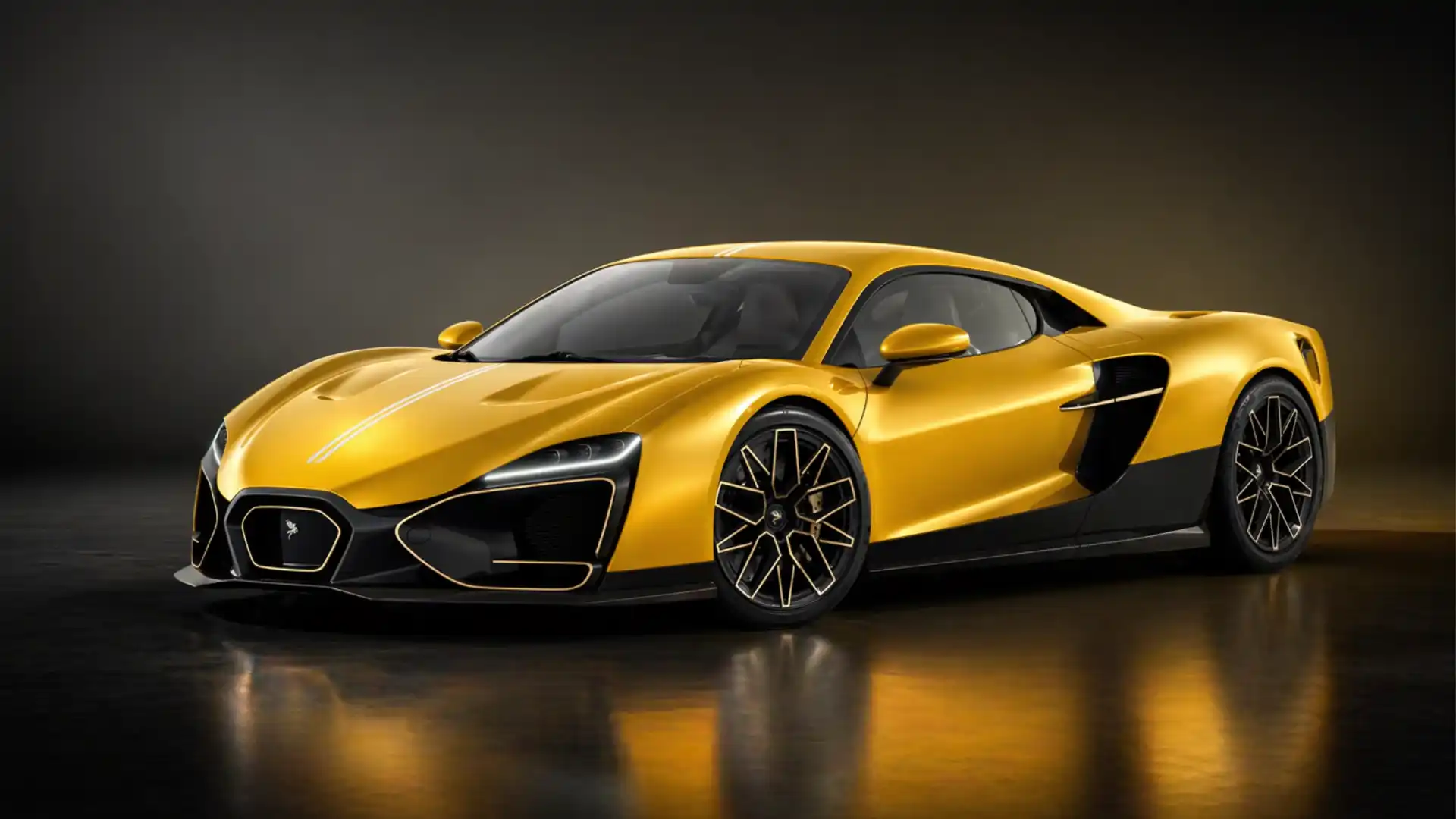
When Vittori unveiled the Turbio at the Concours Club in Miami on October 4, 2025, the easy headline was already waiting. A new hypercar brand. Pininfarina on the design. A naturally aspirated V12 with hybrid assistance. AI somewhere in the process. That combination guaranteed attention, but it also encouraged the wrong reading. The point was never that a machine sat down and designed a finished supercar. The point was that a startup chose to turn generative AI into part of its creative mythology while leaning on one of Italy’s oldest design names to make the result look credible, desirable, and buildable.
Table of Contents
The Turbio matters less as a finished automobile than as a signal. Vittori calls it a running concept and says its published figures are projected targets, not final certified numbers. Even the public record is already a little messy: Vittori’s own site now describes a 6.8-liter naturally aspirated V12 called the ITV12 Orion, up to 904 CV, 1,100 hp total with electric assistance, a carbon-fiber monocoque, rear-wheel drive, a price starting from $2.5 million, and deliveries targeted as early as 2028, while some outside reports published at launch cited slightly different displacement and output figures. That ambiguity is not a small footnote. It is part of the story. Hypercars often begin as declarations of intent long before they become reliable production facts.
What makes the Turbio worth examining is the mix of old and new instincts inside it. The old instincts are obvious: scarce production, Italian coachbuilding prestige, a high-revving multi-cylinder engine, physical controls, expensive materials, and language borrowed from sculpture rather than software. The new instincts are just as obvious: generative AI for early concept work, additive manufacturing, a startup narrative built around rapid iteration, and a brand that talks about road cars, eVTOLs, and private electric flight in one breath. The Turbio is not a clean break with supercar tradition. It is a negotiation with it.
The debut that made people ask the wrong question
The first question many people asked was whether AI designed the car. That question flatters the marketing and misses the mechanics. Vittori’s own language is much narrower. The company says it used generative AI in the earliest phases of creation as a “creative co-pilot” to explore bold design possibilities and generate many 2D concepts quickly. It also says the final lines were “human-crafted.” That wording matters because it places AI at the front edge of ideation, not at the end of the process where proportion, surfacing, brand discipline, engineering packaging, regulatory constraints, and manufacturability usually break weaker concepts apart.
That distinction lines up with what serious design research says about generative AI in automotive work. Autodesk Research’s paper on conceptual automotive design describes AI as a way to produce inspiration and concept material faster, especially from text and image inputs, while still recognizing the need for designer judgment, workflow integration, and control over style and diversity. The related Kia-Autodesk collaboration says much the same in plainer language: the tool was useful for the early stage, for producing many references quickly, and for reducing sketching time, but not for replacing the designer’s role in choosing, shaping, and carrying a concept forward. That is the more honest frame for Vittori’s claim. AI did not replace a studio. It accelerated the messy, image-heavy beginning of studio work.
This is why Pininfarina’s presence matters far more than the buzzword. Pininfarina was founded in 1930 to build special bodies and small runs, and its modern business still spans design, engineering, aerodynamic work, show cars, and limited series. That does not guarantee the Turbio will reach customers on time, or at all. It does tell you Vittori understood the problem correctly. A startup can get attention with renderings and claims. It needs a partner with long memory and industrial judgment to turn those claims into a car that does not collapse under the weight of its own ambition.
The public launch helped reinforce that split between spectacle and substance. Media coverage leaned hard on the AI angle because it was the freshest hook. Yet the more revealing details were not about machine intelligence. They were about who would carry concept development and limited-series production, where the car would be built, what sort of engine it would use, how analog the cockpit would feel, and how much of the structure would rely on carbon fiber and titanium. Those are the details that decide whether a reveal becomes a program.
The Vittori Turbio on paper and in public
On paper, the Turbio is pitched as a scarce, high-drama hybrid hypercar with a classic emotional core. Vittori says the car uses a 6.8-liter naturally aspirated V12 engineered by Italtecnica, with mild-hybrid assistance and total claimed output of 1,100 hp. It lists a projected 0–100 km/h time of under 2.5 seconds, a top speed above 225 mph, a carbon-fiber monocoque, weight under 1,500 kg, and just 50 units for the world. It also presents the cabin as deliberately analog, with titanium switches, leather, and carbon fiber rather than a screen-dominated interface.
The official material also carries its own warning label. Vittori says all figures are projected targets based on a running concept and that the production model and specifications may change before release. That is a serious caveat, not legal filler. Outside coverage around launch already showed variation in engine size, combustion-only output, and the exact role of the front electric unit. Autoweek reported a 6.7-liter V12 making 830 hp at 8,500 rpm, with the electric motor used more for emissions compliance than outright performance. Vittori’s own site now describes the powertrain differently and more assertively. For a startup at this stage, the gap between aspiration and settled specification is still wide.
The official pitch and the built-in caveats
| Official line from Vittori | What readers should keep in mind |
|---|---|
| 6.8-liter naturally aspirated V12 with hybrid assistance and 1,100 hp total | Vittori says the figures are projected targets, and third-party launch coverage reported somewhat different numbers |
| Under 2.5 seconds to 100 km/h and more than 225 mph | These are performance targets for a concept-stage program, not final certified production data |
| Carbon-fiber monocoque, under 1,500 kg, titanium-heavy analog interior | Materials and architecture fit the brand story, but final component choices can still move during development |
| 50 units worldwide, from $2.5 million, deliveries targeted from 2028 | Timing remains subject to development progress and regulatory approval |
That table is the fairest way to read the Turbio right now. The car is neither pure vapor nor settled fact. It sits in the unstable middle ground where many ambitious exotic programs live for a while.
Design-wise, the car is pitched as clean rather than overstated. Vittori talks about purity of proportion, seamless surfacing, sculpture, and classic Italian forms. Pininfarina’s involvement shows in that restraint. The Turbio does not read like a machine designed by a prompt that demanded aggression, futurism, and speed all at once. It reads like something that started from a lot of images and then had excess edited out. That may be the clearest argument for human authorship in the final result. A hypercar can survive loud numbers. It rarely survives visual indecision.
The point where AI stopped and Pininfarina took over
Vittori’s own phrasing gives away the handoff. Generative AI was used to explore “countless 2D concepts in hours instead of weeks.” From there, the company says, the final lines were refined by human designers. That is not a confession. It is the clearest and most credible description Vittori could offer. Early-phase design work is full of image mining, directional themes, keyword translation, and rapid visual branching. Generative systems are naturally good at that layer because they are fast, prolific, and not embarrassed by dead ends. They are much weaker at the deeper discipline that makes a car feel intentional instead of merely eye-catching.
Research from Autodesk and Kia makes this split explicit. Designers in those studies used AI to create many visual options and reference images, to move past bottlenecks in the first stage of concept generation, and to improve decision speed. They did not treat the system as a replacement for design judgment. The more sophisticated point in the research is that professional designers need tools that fit their workflow rather than bulldoze it. Brand identity, proportion, meaning, and the controlled evolution of a concept still sit with human teams. The output becomes useful only when someone with taste and responsibility knows what to keep and what to throw away.
Pininfarina has spent decades operating in exactly that territory between inspiration and execution. Its heritage is full of custom bodies, small runs, aerodynamic work, and the long transition from artisan studio to full design-and-engineering partner. The company’s current description of itself is not romantic fluff. It explicitly points to show cars, limited series, engineering, aerodynamics, and a wind tunnel built to support OEM-grade development work. Vittori needed more than visual legitimacy. It needed a partner whose brand already carries the idea that beauty and feasibility are allowed to occupy the same room.
The likely division of labor behind the Turbio
| Early-stage AI contribution | Human-led design and engineering work |
|---|---|
| Generating and iterating many 2D visual concepts quickly | Locking down proportion, package, surfaces, details, and brand coherence |
| Expanding the range of visual possibilities beyond familiar sketch habits | Judging which ideas suit the car’s architecture, production path, and audience |
| Creating fresh references from text and image prompts | Translating a theme into a coherent exterior, interior, and usable object |
That division is less glamorous than “AI designed a supercar,” but it is much more plausible. It also explains why the Turbio looks composed rather than random.
There is another reason the handoff matters. Automotive design is not just styling. It is packaging, cooling, occupant position, crash structure, air management, visibility, ingress, manufacturability, and serviceability. Even among established manufacturers, many beautiful early sketches die because they ask the impossible of the underlying architecture. A generative system can flood a wall with seductive images. It cannot carry the legal, physical, and financial accountability of signing off a vehicle. Vittori’s best move was not to pretend otherwise. Its best move was to let the AI headline draw attention while letting Pininfarina absorb the trust work.
A V12 hybrid built for emotion and regulation
The Turbio’s powertrain tells you almost everything about the audience Vittori wants. The company did not choose a downsized turbo engine, a quiet EV architecture, or a technical hybrid layout meant to impress software-minded buyers. It chose a naturally aspirated V12 and then wrapped hybrid assistance around it in a way that, according to both Vittori and outside reporting, is meant to preserve the combustion engine’s character. Vittori says the mild-hybrid assist exists only to meet emissions standards and preserve the “unfiltered soul” of the Orion V12. Autoweek reported much the same, saying the front-mounted motor was there more for compliance than for raw performance gain. That is not electrification as ideology. It is electrification as permit.
That choice places the Turbio in a broader performance market that has already accepted hybridization but not surrendered the value of theater. Lamborghini’s Revuelto pairs a new V12 with three electric motors for 1,015 CV and openly frames hybridization as a way to keep the V12 alive while cutting emissions. Bugatti’s Tourbillon uses electric motors not to erase the drama of a naturally aspirated engine but to amplify it around a new 8.3-liter V16. Ferrari’s F80 goes in a different direction, using a hybrid V6 to reach 1,200 hp. Pininfarina’s own Battista makes the opposite case: if you want outright numbers without combustion compromise, a 1,900-hp EV can do things an ICE car simply cannot.
Seen against that field, Vittori’s strategy is not technologically radical. It is emotionally targeted. The company is trying to sell a car that sounds like the past but is legal enough for the present. That is a very different proposition from trying to build the fastest spreadsheet weapon in the room. The analog cockpit language strengthens the same pitch. Titanium switches, physical interaction, leather, carbon fiber, and talk of “pure connection” are not incidental details. They are part of a deliberate refusal to make the car feel mediated by layers of digital abstraction.
This is where the Turbio becomes culturally more interesting than technically novel. The car is arguing that the future of the ultra-expensive performance car may not belong to the most advanced machine, but to the machine that hides its advancement most gracefully. Buyers at this level already know electrification is here. What they are deciding is whether they want it to dominate the experience or quietly protect a more familiar kind of mechanical intimacy. Vittori is betting that at least 50 people still want the second option.
Carbon fiber, titanium, and a startup manufacturing bet
Vittori’s material story is as important as its AI story, and far more likely to affect whether the program survives. The company says the Turbio is built around a carbon-fiber monocoque and talks up titanium details in the interior. Beyond that, Vittori announced a production partnership with Totum 3D and ShapeUp Studios to design, prototype, and manufacture titanium 3D-printed components as part of its broader roadmap. The press release is explicit about design-for-additive reviews, rapid prototyping, and short-run builds. It is also explicit that the same printed structures and thermal systems are meant to inform later air-mobility programs.
That is ambitious, but it is not irrational. Additive manufacturing has genuine appeal for low-volume exotics because it can reduce tooling burdens, shorten iteration loops, and make complex parts more feasible when volumes are tiny and margins are large. Vittori’s partnership language is full of familiar lightweighting logic: titanium where strength-to-weight matters, other alloys for hot zones or cooling hardware, printed parts paired with carbon-fiber structures, and small-run production that benefits from flexibility more than mass-scale efficiency. Designboom’s coverage of the Turbio also tied the car to 3D-printed titanium elements, carbon-fiber construction, and active aero hardware such as a dynamic diffuser, splitter, and rear spoiler.
Still, this is where startup romance meets industrial pain. Printing a dramatic titanium part for a press release is not the same thing as building a reliable supply chain for repeatable road-car production. Hypercars live on tiny numbers, but even tiny numbers require validation, consistency, repair logic, cost control, and a sober understanding of certification. The more unusual the parts, the more painful the aftersales reality becomes. Vittori’s own press materials acknowledge risk in a different way, with forward-looking language about certification, financing, supply chain, and technology. That caution is appropriate. Exotic materials do not make execution easier. They make failure more expensive.
There is also a branding layer here. Carbon fiber and titanium do functional work, but they also speak the language rich buyers expect from a 2020s hypercar. So does additive manufacturing. For Vittori, those materials serve two audiences at once: the engineering audience that wants a plausible technical basis, and the luxury audience that wants a story of scarcity, craft, and advanced production. The best exotic brands are good at fusing those two registers. The weaker ones sound like investor decks with gullwing doors. Vittori has not resolved that tension yet, but it has at least chosen the right vocabulary.
Italian legitimacy with American startup energy
Vittori is a young company, but it knows where hypercar legitimacy still lives. The brand is American-led and public-facing in the US, yet the car is designed and manufactured in Italy, uses an Italian design house, and leans on Italian engineering and materials partners. Professional Motorsport World and Automotive Powertrain Technology International both described the setup in nearly identical terms: an original visual concept by Vittori, designed with Pininfarina, with concept development, manufacturing, and exclusive limited-series production tied back to Pininfarina. Vittori’s own site and media page frame the car as sculpted with Pininfarina and engineered in Italy.
That choice is not just about aesthetics. Italy still carries unusual weight in the imagination of the supercar market because it bundles visual credibility, supplier networks, coachbuilding heritage, and an old habit of treating the car as both machine and object. Pininfarina’s own history was built on special bodies, small runs, aerodynamic studies, and later full design and engineering capability. Its present-day business still advertises limited series, aerodynamics, and engineering services alongside design. A startup that wants to be taken seriously by wealthy collectors does not have to be Italian, but it helps to speak fluent Italian through partners, processes, and place.
There is a quieter business reason for this too. Hypercars are sold on provenance as much as performance. Buyers are not just shopping for acceleration and top speed. They are buying into a lineage, or at least a believable imitation of one. Pininfarina supplies something Vittori cannot manufacture overnight: continuity. The design house has decades of association with Ferrari, Maserati, Alfa Romeo, and limited-run vehicles that mattered as objects before they mattered as stats. Vittori can borrow that gravity. Whether it can earn its own is still open.
This is one reason the AI angle will probably age badly if the car succeeds. The partners will end up mattering more than the prompt. If the Turbio becomes real in the fullest sense, people will remember the shape, the cockpit, the engine note, the feel, the delivery, and the ownership experience. They will not care very much that some of the first 2D branches came from generative software. History rarely preserves the ideation tool. It preserves the finished object and the people willing to stand behind it.
Generative AI as studio tool rather than design author
The broader industry context makes Vittori’s claim look less strange and less revolutionary than it first appeared. NVIDIA’s automotive pitch now openly says automakers are using AI, generative systems, and digital twins to accelerate design, engineering, manufacturing, and simulation. Autodesk has spent years arguing that generative design and AI-assisted ideation can expand the number of viable options teams examine early in development. SAE has written about generative design as a way to change how vehicles and equipment are created. By 2025 and 2026, AI in automotive design is no longer unusual. What is unusual is putting it this close to the front of a luxury car’s identity.
That choice comes with risk. Once a brand says “AI-designed,” people start looking for either miracle or fraud. If the car looks generic, AI gets blamed. If it looks distinctive, human designers get the credit. That asymmetry is hard to escape because design authorship still matters deeply in the car world. Buyers want to believe a machine was imagined by people with taste, nerve, and conviction. They do not want their seven-figure toy to feel like an efficient remix of training data. Vittori partly solved that problem by talking about AI as a co-pilot and by putting Pininfarina in front of the project. It would have created far more trouble by pretending a model had taken the lead.
The more serious limitation is brand language. Research on AI-assisted automotive design repeatedly circles back to workflow fit, designer control, style bias, and the need to keep outputs aligned with brand identity. In other words, generative AI is useful only if the team using it already knows what the brand should look and feel like. Startups do not always know that yet. Established houses do. This is another place where the Pininfarina partnership does real work. It acts as a corrective against aesthetic drift.
There is no shame in that. Cars have always been composites of different authorships: stylists, aerodynamicists, chassis engineers, package teams, suppliers, executives, test drivers, legal departments, and clients. AI is simply one more contributor entering the ideation stage. The useful question is not whether it was involved. The useful question is whether its involvement led to a better object, a faster path to clarity, or a stronger design process. In the Turbio’s case, the strongest evidence so far suggests AI widened the funnel, while humans narrowed it into something coherent.
The market pressures waiting outside the reveal hall
The Turbio is entering a world that has become much more crowded and much less forgiving. Lamborghini already has a V12 hybrid flagship in the Revuelto. Ferrari has moved the conversation with the 1,200-hp F80. Bugatti’s Tourbillon has seized the old-school engineering theater slot with an 8.3-liter naturally aspirated V16 hybrid and a design language built around timelessness rather than gadgetry. Automobili Pininfarina’s Battista remains a benchmark for electric hypercar violence, with 1,900 hp and performance numbers that make combustion-only heroics look quaint. Vittori is not stepping into an empty niche. It is stepping into a room full of giants that have already decided their answers to the future.
That makes differentiation difficult. The Turbio cannot win on scale, racing pedigree, manufacturing depth, or dealer network. It cannot out-history Pininfarina’s existing clients while borrowing Pininfarina’s name to get started. What it can do is offer a very specific mix: a scarce coachbuilt-feeling object, a naturally aspirated V12 kept alive by minimal electrification, a cabin that leans analog, and a design story that borrows AI without surrendering to it. That is narrow, but narrow is allowed at this price point. Often it is the point.
The challenge is credibility. Buyers in this part of the market have seen beautiful renderings before. They have heard founders speak in sculpture-and-flight metaphors before. Autoweek’s skepticism was not cynical for the sake of it. It reflected a simple truth: making a car is much harder than imagining one, and supplier discipline matters just as much as emotional language. The Turbio may turn out to be entirely real. It has not yet crossed the phase where belief becomes routine.
There is also timing pressure. If deliveries are targeted from 2028, Vittori is racing not just engineering milestones but the market’s patience. Hypercar buyers can wait for the right object, but they rarely reward drift. The company’s road-to-air messaging, with eVTOL and private electric jet ambitions following the car, may excite some backers. It may also worry buyers who want the focus to stay on getting the first product right. A new exotic brand does not earn trust by proving it can imagine three categories at once. It earns trust by shipping one difficult thing properly.
The harder chapter starts after the applause
The reveal was the easy part because the reveal only had to persuade the eye. The next chapter has to persuade engineers, regulators, suppliers, and buyers who wire large deposits only after they smell seriousness. That is why Vittori’s official disclaimers matter so much. The company is telling you, in careful legal language, that the production car may differ, the design may change, and timing depends on final development and regulatory approval. It is also telling you, more quietly, that it understands the distance between a compelling concept and a delivered hypercar.
If the Turbio works, it will not be because AI “designed” it. It will work because Vittori used the right modern tools in the right place and then handed the job to people who know where fantasy has to end. That is the lesson hiding underneath the launch. Generative AI is becoming ordinary inside the design studio. What remains rare is the ability to combine speed of ideation with depth of judgment. Pininfarina’s value to Vittori is not that it can produce beautiful sketches. Plenty of software can flood the zone with images. Its value is that it can decide which image deserves a future.
The Turbio also says something broader about where the exotic car may be heading. The market does not seem eager to choose between pure nostalgia and pure software. It wants machines that feel authored, tactile, and emotionally legible, even when they are born inside a digital workflow. That may be the most durable part of this whole story. The future supercar will probably use more AI, not less. But the brands that matter will be the ones that know how to hide the machine inside a human point of view. Vittori has announced that ambition loudly. The car now has to earn it quietly.
FAQ
No. Vittori describes the Turbio as a running concept hypercar and says the listed figures are projected targets, with the production model and specifications still subject to change.
No. Vittori says generative AI was used in the earliest concept phase as a creative co-pilot and that the final lines were refined into a human-crafted design.
The company says AI helped generate and iterate many 2D concept ideas quickly, speeding up the exploratory phase from weeks to hours.
Because Pininfarina brings more than styling. Its current business still covers design, engineering, aerodynamics, show cars, and limited series, which gives a startup partner real industrial credibility.
Vittori says the car uses the ITV12 Orion, a 6.8-liter naturally aspirated V12 engineered by Italtecnica, with hybrid assistance.
Vittori currently lists 1,100 hp total including the electric unit, while also citing up to 904 CV for the V12 in track mode.
No. Vittori explicitly says the numbers are projected targets and that the production model may change before release.
Because third-party launch coverage did not fully match Vittori’s later official wording. Autoweek, for example, cited a 6.7-liter 830-hp V12, which shows the program’s public specs were still moving at launch.
Vittori says the mild-hybrid assist exists to meet emissions standards while preserving the V12’s character, and Autoweek reported a similar interpretation from the company.
A notably analog one, with titanium switches, leather, carbon fiber, and an emphasis on physical interaction rather than a screen-first experience.
Yes. Vittori announced a partnership with Totum 3D and ShapeUp Studios around titanium additive production, and launch coverage also tied the car to 3D-printed titanium elements.
Vittori says the run will be limited to 50 cars worldwide.
The official site says the Turbio starts from $2.5 million USD.
Vittori says deliveries are targeted for as early as 2028, subject to development and regulatory approvals.
Because Italy still carries exceptional weight in design, supplier culture, coachbuilding heritage, and exotic-car prestige, and Vittori is clearly using that ecosystem to strengthen its credibility.
It sits in the same high-end conversation but takes a more nostalgic route, leaning on a naturally aspirated V12, light hybridization, and analog-feeling luxury rather than chasing a fully electric or ultra-complex technical identity.
No. The stronger lesson from both Vittori’s own description and industry research is that AI is becoming useful in early ideation, while human designers still carry judgment, coherence, and responsibility for the final object.
Not the launch images. The real tests are specification stability, prototype maturity, supply chain discipline, certification progress, and whether Vittori can move from concept drama to actual delivered cars.
Author:
Jan Bielik
CEO & Founder of Webiano Digital & Marketing Agency
This article is an original analysis supported by the sources cited below
Home
Vittori’s official Turbio page, used for the company’s claims about the car, the AI workflow, specifications, pricing, and delivery target.
Media
Vittori’s launch recap and media roundup, useful for the debut date, production run, and how the brand framed the reveal.
Vittori Partners with Totum 3D and ShapeUp Studios for Titanium Additive Production
The company announcement covering additive manufacturing plans, materials, and the wider road-to-air roadmap.
Pininfarina
Pininfarina’s official homepage, used for its current description of automotive, engineering, show-car, and limited-series capabilities.
Heritage
Pininfarina’s official history page, used for the company’s founding, coachbuilding roots, and long small-series tradition.
Our group
Pininfarina’s overview of its present-day scale, services, locations, and design-and-engineering structure.
Inspired by AI? A Novel Generative AI System To Assist Conceptual Automotive Design
Autodesk Research paper on generative AI in conceptual automotive design, used for the article’s treatment of AI as an ideation tool.
Between inspiration and conceptual design: Kia Global Design explores generative AI for automotive design
Autodesk’s feature on the Kia collaboration, used for practical evidence about where AI helps designers and where it still falls short.
NVIDIA AI for Automotive Industries
NVIDIA’s overview of how AI, simulation, and digital twins are being used across automotive design and engineering.
Generative design software exploits AI to change how new vehicles and equipment are designed
SAE’s explainer on generative design in vehicle development, used to place the Vittori story in a wider engineering context.
Lamborghini Revuelto: the first super sports V12 hybrid HPEV
Lamborghini’s official Revuelto launch material, used for hybrid V12 comparison.
F80: Ferrari’s new supercar
Ferrari’s official F80 article, used for comparison with a current hybrid hypercar from an established manufacturer.
The Bugatti Tourbillon: an automotive icon ‘Pour l’éternité’
Bugatti’s official Tourbillon release, used for comparison with another modern hybrid halo car built around combustion drama.
Battista
Automobili Pininfarina’s Battista page, used as the electric counterpoint to Vittori’s combustion-led proposition.
This V-12 Hypercar Has an AI-Assisted Design. But It’s Not as Bad as You Think
Motor1’s launch coverage, used for outside reporting on the AI-assisted framing and the 1,100-hp claim.
Here’s your first look at a new V12 hypercar designed by Pininfarina
Top Gear’s first-look piece, used for the debut framing and industry reaction.
Pininfarina-Designed Vittori Turbio Wants a Seat at the Hypercar Table
Hagerty’s coverage of the Turbio, used for context around positioning and market perception.
Is the Vittori Turbio a Real Thing?
Autoweek’s skeptical read on the project, used for the piece’s discussion of moving specs and execution risk.
Vittori unveils hybrid hypercar, designed in collaboration with Pininfarina
Professional Motorsport World’s report, used for the production and development role attributed to Pininfarina.
Vittori unveils hybrid hypercar, designed in collaboration with Pininfarina
Automotive Powertrain Technology International’s coverage, used to support details about the launch and program structure.
pininfarina works with startup vittori with turbio hypercar
Designboom’s story, used for the launch discussion around 3D-printed titanium parts and active aerodynamics.
Krafla
Giamaro’s official hypercar page, consulted for background on Italtecnica-linked high-performance Italian V12 development.
| Citing this article? Brief excerpts are welcome. Please credit Webiano.digital, name the author where stated, and include a link to https://webiano.digital and to this original article. Full or substantial republication requires prior written permission. Read our Copyright and Content Use Policy. |
This article was prepared with the assistance of artificial intelligence tools. The content underwent expert human review, and Webiano Digital & Marketing Agency assumes editorial responsibility for its final version and publication.