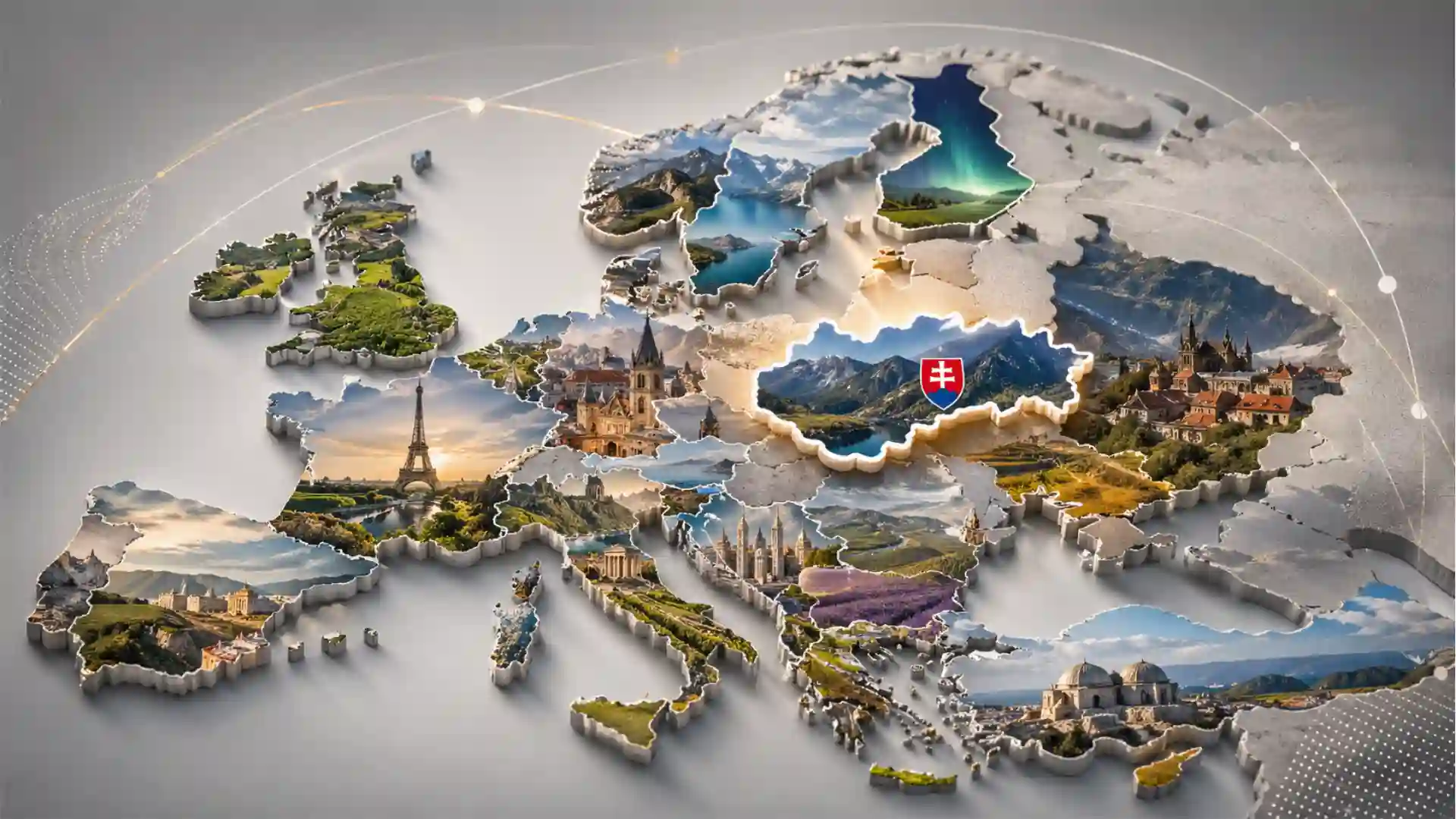
Europe is not short of beautiful countries. That is the basic problem for every national tourism board, including Slovakia’s. Mountains, castles, old towns, spas, vineyards, forests, lakes, rivers, gastronomy and folklore are not rare in the European travel market. They are the shared vocabulary of the continent. A state brand wins only when travellers can remember one clear reason to choose it, repeat that reason in their own words, and connect it with trips they might actually book.
Table of Contents
The contest has moved from visibility to memory
That is the tension behind Slovakia’s tourism positioning in 2026. Slovakia has real assets, a working official tourism portal at Slovakia.travel, a national tourism organisation in SLOVAKIA TRAVEL, a long-running umbrella idea in Good Idea Slovakia, and a new policy process around tourism development until 2035. It also sits inside a European market where demand has recovered strongly, where destination choice is more crowded than before, and where smaller countries must define themselves with more discipline than larger ones.
The pressure is not theoretical. Eurostat reported that EU tourist accommodation recorded nearly 3.1 billion nights in 2025, up 2.2% from 2024, with Spain, Italy, France and Germany accounting for 61.7% of the total. The European Travel Commission’s spring and summer 2026 sentiment monitor reported that 82% of Europeans planned to travel between April and September 2026, the highest level in that series since 2020, while travellers were becoming more cautious, planning fewer and shorter trips with tighter budgets.
That combination changes the role of state tourism branding. When people are travelling but spending with more care, destinations cannot rely on scenery alone. They need a promise that reduces uncertainty. They need to show why the trip is worth the money, time and planning friction. They need to be clear about who the country is for, which season it owns, which emotional territory it can credibly claim, and which experiences a visitor should connect with the name of the country.
Slovakia’s challenge is sharper because it sits between stronger mental maps. Austria owns Alpine ease and culture. Czechia owns Prague and layered historical depth. Hungary owns Budapest, thermal culture and a confident urban leisure identity. Poland is building on scale, surprise and city-plus-nature variety. Slovenia has disciplined its identity around green, boutique, active and emotionally felt experience. Croatia built mass recognition around the Adriatic and “Full of Life.” Slovakia is close to all of them, but proximity is not a position.
A state tourism brand is not only a logo, slogan or campaign line. It is a decision system. It decides what to repeat, what to leave out, what to make famous, what to connect across regions, what not to promise, and how to turn policy into traveller-facing meaning. The stronger European examples show that the best national tourism brands do not list attractions. They create a mental shortcut. Slovakia has not yet done that with enough force.
Slovakia’s current promise sits between idea and itinerary
Slovakia’s official tourism ecosystem contains two related but distinct layers. The public-facing Slovakia.travel portal presents tourism content for visitors, including cultural and natural sights, UNESCO sites, spas, activities, accommodation information, maps and events. SLOVAKIA TRAVEL, the national organisation, describes itself as a state budget organisation carrying out the tasks of the national tourism organisation for Slovakia, with a mission to promote Slovakia domestically and abroad as a tourism destination. It also says its long-term vision is to put Slovakia back on the European travel map and build a relevant position among V4 and other European countries.
That mission statement is revealing. It admits, without drama, that Slovakia’s task is not only promotion but position recovery. Being “back on the map” means Slovakia is not starting from zero, but it is not yet strongly fixed in the European traveller’s hierarchy. The country has awareness among neighbours and specialist segments, but it does not have the same automatic association as Austria, Slovenia, Croatia or Czechia.
The phrase “Good Idea Slovakia” gives the state a broad umbrella. The Ministry of Foreign and European Affairs presents it as a unifying thought for the long-term brand-building process of Slovakia, intended to help the country become recognisable abroad. The same official explanation says the idea is applicable across levels of presentation and is meant to characterise the country internally and externally.
The concept has strategic merit. “Good idea” is flexible. It can work for tourism, investment, exports, culture and sport. It can accommodate engineering, creative industries, nature, culture and events. It can fit a country that wants to be seen as clever, compact and capable. The problem is that flexibility becomes a weakness when the tourism market needs fast recognition. A good umbrella brand is not automatically a strong tourism position. A visitor does not book an umbrella. A visitor books a weekend, hike, family holiday, spa break, wine route, meeting, festival, city escape or route through a region.
Slovakia.travel therefore carries a burden heavier than normal destination content. It must turn the country-level “Good Idea” into trips that feel specific. That is where the current position is uneven. The portal and national organisation point to many valid assets: UNESCO heritage, castles, folk traditions, mountains, spas, wine, gastronomy, cities, caves, cycling, winter sports and regional experiences. The content is true. The missing element is hierarchy.
A strong destination hierarchy answers three questions quickly. First, what does the country own that neighbours cannot easily claim in the same way? Second, which visitor segments should the brand win first? Third, which experience should be repeated so often that the market starts to connect it with the national name? Slovakia has ingredients for all three answers, but its public positioning still feels more like a catalogue than a proposition.
Slovakia.travel has reach but not yet a single mental image
A national tourism portal is often mistaken for a brochure. It is not. In 2026, a portal is the structured memory of a destination. It feeds search engines, answer engines, travel media, tour operators, creators, AI travel planners, paid campaigns, social snippets, regional partners and domestic stakeholders. If the portal has a clear architecture, the country becomes easier to describe. If the portal has weak architecture, even strong assets become scattered.
Slovakia.travel’s public role is clear enough: it gives visitors an information point for places, activities, events and practical travel inspiration. Its English page positions Slovakia through cultural and natural sights, UNESCO, spas, activities, accommodation, maps and events. SLOVAKIA TRAVEL’s organisational site carries trade, media and institutional material, including press releases and B2B information.
The issue is not the existence of content. The issue is the lack of one dominant organising idea in the traveller’s mind. If a German, Czech, Austrian, Polish, Hungarian or Dutch traveller sees Slovakia in a search result, what should the country mean in two seconds? “Nature and heritage” is accurate but too broad. “Heart of Europe” is geographically familiar but heavily used by many Central European places. “Good idea” is pleasant but abstract. “UNESCO, spas and mountains” is closer, but it is still a bundle, not a position.
The strongest national portals in Europe reduce the cognitive load. Visit Estonia makes time the brand mechanism: “It’s about time.” Austria’s tourism brand frames holidays through emotion, hosts and “Holidays in Austria.” Finland turns national happiness into a visitor experience through the “Find Your Inner Finn” programme. Slovenia’s state and tourism brand turns green into a country-wide identity. These are not just slogans. They are systems that tell partners what kind of content to make and tell visitors how to remember the country.
Slovakia’s best option is not to imitate these countries. Imitation would weaken it. Slovakia’s opportunity is to define a mental image that grows out of its own geography and experience pattern. The country is compact but not flat. It is mountainous but not only Alpine. It is culturally layered but not as internationally overexposed as Prague, Vienna or Budapest. It has spa towns, caves, mining heritage, wooden churches, castles, wine regions, folk culture, modern Bratislava, and the High Tatras inside distances that feel workable.
That combination suggests a possible territory: compact intensity. Slovakia is not the largest, loudest or most famous destination in Central Europe. It is a country where many European experiences sit unusually close together. This does not mean using a bland “little big country” idea again. It means building proof around density: high mountains near living traditions; spa heritage near wine; castles near caves; urban weekends near national parks; road and rail routes that let a visitor feel difference without long travel days.
The portal could express this more clearly. Instead of presenting many experiences side by side, Slovakia.travel could build a few editorial pillars that repeat across landing pages, campaigns and market versions. “Tatras and thermal culture,” “castles and living craft,” “UNESCO routes in a small country,” “Central European spa and wine weekends,” “soft adventure without crowds,” and “Bratislava as a gateway, not the whole story” would give structure. The country would still have variety, but variety would be arranged around a memory.
Good Idea Slovakia works as an umbrella but needs tourism proof
The state brand “Good Idea Slovakia” deserves a fair reading. It was not designed only as a tourism line. Official material frames it as a long-term external presentation concept for Slovakia, meant to be recognisable, playful and applicable across tourism, investment, exports, culture and sport. The brand explanation also points to diversity, ingenuity, vitality, authenticity and original ideas as parts of Slovakia’s story.
That is a sensible country-brand ambition. Small states often need umbrella concepts because their reputation has to work across diplomacy, export promotion, talent attraction, investment, tourism, culture and national self-confidence. Fragmentation is costly. If every ministry, region and public agency uses a different identity, the state loses repetition. A shared thought makes Slovakia easier to present abroad.
The tourism problem starts when “Good Idea” is left at claim level. A traveller does not evaluate a country in the same way as an investor, buyer, diplomat or student. Tourism decisions are emotional, visual, seasonal and social. They are made through images, memory, peer influence, price, route logic, transport access, safety, weather, children’s needs, food, accommodation, search snippets and the simple feeling that a place is “for me.” A tourism brand has to show the good idea, not only say it.
That means the tourism layer should not abandon Good Idea Slovakia. It should make it concrete. “A good idea” for a traveller could mean a trip that is easier than expected, richer than expected, closer than expected, better priced than expected, less crowded than expected, and more varied than expected. The proof must be visible in itineraries, map logic, short-form video, editorial guides, route packaging, partner materials, influencer briefs and paid search campaigns.
For example, a campaign could present Slovakia as “the good idea between Vienna, Kraków and Budapest,” but only if it avoids sounding like a secondary add-on. The stronger version would present Slovakia as the place that makes Central Europe feel close, high, old, warm and local in one trip. The claim should be grounded in routes: Bratislava and Small Carpathian wine; Tatras and Spiš heritage; Banská Štiavnica and mining culture; wooden churches and eastern Slovakia; Piešťany, Trenčianske Teplice or Bardejovské Kúpele for spa heritage; Košice as an eastern cultural base.
The umbrella can also support export and culture. Slovak design, technology, gaming, automotive production, architecture and food could reinforce tourism if connected carefully. Many strong destination brands now work beyond leisure. Iceland connects tourism with work, study, business and culture through Inspired by Iceland. Slovenia uses “I feel Slovenia” as a country brand, not only a travel slogan. Portugal uses tourism promotion to carry ideas about living, studying, investing and events.
Slovakia has the same opportunity, but it needs stronger proof loops. The tourism brand should show the visitor that the country’s “good ideas” are not abstract. They are found in a clever weekend route, a restored monument, a spa town with a modern wellness offer, a mountain railway, a regional food product, a festival, a design hotel in a historic town, a mining route, a wine cellar, or a family itinerary that feels easy to plan.
The 2035 strategy raises the stakes
Slovakia’s tourism positioning is no longer only a communications question. The Ministry of Tourism and Sport published information in October 2025 on the Strategy for the Development of Sustainable Tourism in Slovakia until 2035, describing it as a Government strategic document with nationwide impact, setting the direction of tourism development until 2035 and applying to the entire territory of the Slovak Republic. The ministry also stated that the document is subject to impact assessment under Slovak law.
That matters for branding because a strategy document can either strengthen a destination brand or expose its weaknesses. If policy, infrastructure, regional development, product investment, data and promotion are not aligned around the same position, the brand becomes surface decoration. If they are aligned, branding becomes a governance tool. It helps decide where money goes, which products receive support, which regions are packaged together, and how Slovakia competes internationally.
The European Commission’s tourism transition framework also pushes destinations toward greener, more digital and more resilient tourism systems. It describes the EU tourism transition as a co-created pathway with industry, public authorities, social partners and other stakeholders, built around green and digital transition, resilience, skills and commitments.
For Slovakia, this is not only policy language. It is a positioning chance. Large, crowded destinations must manage overtourism, housing pressure, climate stress and visitor concentration. Slovakia has a different opportunity: it can build demand before it becomes distorted. It can present itself as a country of shorter routes, regional dispersal, lower-friction nature access, spa and wellness recovery, year-round culture, and authentic towns that do not need mass-volume tourism to matter.
That does not mean Slovakia should market itself as untouched. “Untouched” is often false and fragile. It invites the wrong visitor expectation and can damage the places it praises. A better position is managed intimacy. Slovakia can show that it offers European depth without the exhaustion of overexposed routes. This is credible only if product, transport, hospitality, digital information, visitor management and regional storytelling support it.
The 2035 strategy should therefore be treated as a brand architecture moment. The tourism ministry, SLOVAKIA TRAVEL, regional tourism organisations, city destination organisations, protected area managers, transport bodies, cultural institutions and private operators need a shared hierarchy. The question is not whether Slovakia has enough assets. It does. The question is whether the state can decide which assets create a national memory and which assets play supporting roles.
A weak strategy would produce more campaigns, more slogans, more trade fair stands and more short-term social posts. A stronger strategy would decide that Slovakia must be known for a small number of experience territories, then build the infrastructure, content, data, distribution and partner incentives around those territories. Branding and development would stop living in different rooms.
Europe’s record demand makes vague branding expensive
A growing market does not make positioning easier. It makes the opportunity cost higher. When European tourism demand rises, the best-known destinations capture attention first. Spain, Italy, France and Germany already dominate EU overnight volumes. Eurostat’s 2025 data shows those four countries recorded 61.7% of the EU’s tourist accommodation nights, while smaller countries competed for much thinner attention shares.
For a country like Slovakia, the danger is not that nobody travels. The danger is that people travel past it. A traveller may fly into Vienna, spend time in Austria, visit Budapest, add Prague, perhaps continue to Kraków, and still never form a clear reason to choose Slovakia. This is the classic problem of the in-between country. Geography gives access but also makes the destination easy to skip unless the brand creates a pull of its own.
The European Travel Commission’s April 2026 sentiment report adds a second pressure. With 82% of Europeans planning spring or summer travel but also watching budgets and shortening trips, destinations need to prove value quickly. They must show that a trip is not only attractive but efficient in the human sense: worth the effort, easy to understand, emotionally rewarding, and matched to the traveller’s budget and time.
Vague branding is expensive under these conditions because it wastes impressions. If a paid ad, article, landing page, social post or search result does not deepen the same mental association, the country pays again next season to start from zero. A small state cannot afford that. Every touchpoint should repeat a coherent idea, even when the content changes by market, season or product.
Slovakia’s current range of attractions is broad enough to support many segments. That is useful operationally, but risky strategically. If one market hears about spas, another hears about skiing, another hears about castles, another hears about folk culture, another hears about Bratislava, another hears about cycling, and another hears about UNESCO, the country may appear active but remain unpositioned. Reach without repetition does not build a destination brand.
The stronger European cases do not avoid variety. Austria still promotes cities, mountains, lakes, cuisine, culture and winter sports. Slovenia still promotes Alps, coast, caves, Ljubljana, wellness, gastronomy and active holidays. Estonia still promotes nature, Tallinn, islands, food and digital culture. The difference is that the variety is filtered through an idea. Austria sells a certain holiday feeling. Slovenia sells felt green balance. Estonia sells time and independent exploration. The visitor can remember the frame even if they forget the details.
Slovakia needs the same discipline. It does not need to reduce its tourism offer. It needs to reduce the mental work required to understand it.
Southern Europe proves the power and cost of fame
The largest European tourism brands show both sides of success. Spain, Italy, France and Greece benefit from deep global recognition, cultural memory, food identity, climate associations, route familiarity and enormous media repetition. Their brands do not begin from a blank screen. A traveller already has pictures in mind before opening a website.
Spain’s official tourism portal, Spain.info, can organise content around art, culture, museums, beaches, cities, routes, cuisine and nature because the country has a strong pre-existing frame. Greece can move between islands, mainland, mythology, food, beaches, heritage and sunlight because the name Greece already carries deep cultural associations. Portugal can run campaigns such as “Can’t Skip Portugal” and “Time to Be” because the destination has built a recognisable emotional tone around warmth, coast, cities, authenticity and visitor welcome.
These countries also face the cost of fame. Heavy demand concentrates pressure on housing, urban centres, beaches, islands, infrastructure, water use and resident tolerance. When a destination becomes too successful in too narrow a geography, the brand can turn from desire into conflict. The visitor still wants the place, but the place may resist the visitor.
For Slovakia, this offers a useful lesson. The goal should not be to copy high-volume tourism models. Slovakia does not need to become Spain or Croatia. It needs enough demand, better-yielding demand, and stronger regional distribution. A destination brand for Slovakia should be built for quality of attention, not sheer visitor count. The country should attract people who understand its geography, respect its places, travel beyond one icon, stay long enough to add value, and return for a second region.
This is where Central Europe can compete differently. The region offers shorter travel distances, rail and road touring, city combinations, spa traditions, wine regions, mountain access, living craft, historic towns and cross-border itineraries. But these advantages need framing. Without framing, they become a map full of options. With framing, they become a reason to go.
Southern Europe also shows why brand maturity needs product maturity. Spain’s move toward inland, cultural and culinary tourism outside classic peak-season beach demand is not only a campaign choice. It reflects infrastructure, data, hospitality, access and public policy. Portugal’s campaigns about future-facing tourism are stronger because they sit inside a visible tourism authority and an official promotion platform that connects VisitPortugal.com, social channels and thematic products.
Slovakia can use the same logic at a smaller scale. It should not promise a lower-pressure alternative to Europe unless it can organise that alternative. If Slovakia wants to own compact Central European depth, then visitor routes, accommodation clusters, mobility information, regional editorial content, booking paths, maps, local operators and seasonal offers need to prove that promise.
Small countries win by owning one emotion
The strongest smaller European destination brands often win through emotional precision. They do not try to appear complete. They try to be remembered. Slovenia owns “I feel Slovenia,” with green as the core colour, metaphor and development direction. Estonia owns time. Iceland owns elemental inspiration and the drama of remote nature made accessible. Finland owns happiness and everyday balance. Denmark owns simple pleasures, hygge, cycling, food culture and a tone that makes smallness feel appealing.
This is the central lesson for Slovakia. A smaller country does not need a smaller ambition, but it needs a sharper one. The traveller must be able to say: Slovenia is green and felt; Estonia gives me time; Iceland gives me elemental awe; Finland gives me happiness in nature and everyday design; Denmark gives me simple pleasures and human-scale cities. Slovakia currently risks being described as “nice nature, castles and Tatras.” That is not wrong. It is just not enough.
An emotion does not mean sentimentality. It means a compressed decision cue. It is the feeling that guides choice before rational comparison begins. When a traveller says “I need a calm green active break,” Slovenia enters the choice set. When they say “I want a different northern escape with time to breathe,” Estonia can enter. When they say “I want extraordinary landscapes and a big trip feeling,” Iceland enters. Slovakia needs an equivalent cue.
The cue must be grounded in truth. Slovakia cannot claim Mediterranean warmth, Nordic design minimalism, Alpine luxury at Austrian scale, or Adriatic coast. It can claim closeness, contrast, depth, recovery, localness, and the surprise of finding high mountains, spa culture, old towns, wine and folk traditions in a country that remains underchosen compared with neighbours. The emotional territory could be discovery without distance or European depth within reach. Those are not final slogans. They are strategic directions.
The emotion should also fit Slovak self-perception. External branding fails when residents do not recognise themselves in it. Slovenia’s brand works partly because green is both external promise and internal identity. Estonia’s time concept works because it connects compactness, digital ease, nature and independent spirit. Slovakia’s internal identity includes ingenuity, regional pride, mountains, hard work, humour, craft, hospitality, sport, culture, history and a sometimes complicated relationship with national visibility. A credible tourism brand should not flatten that. It should choose a frame residents can use without embarrassment.
Positioning patterns across selected European tourism brands
| Country | Main tourism memory cue | Strategic lesson for Slovakia |
|---|---|---|
| Slovenia | Green, felt, boutique, active | Turn one value into a whole system |
| Estonia | Time, independence, compact access | Sell the visitor’s experience of pace |
| Iceland | Elemental nature, inspiration, safe access | Make remoteness feel usable |
| Austria | Holiday feeling, culture, mountains, hosts | Join emotion with product quality |
| Finland | Happiness, nature, everyday balance | Convert a national reputation into visitor rituals |
| Denmark | Simple pleasures, hygge, cities, food | Use tone of voice as brand equity |
| Portugal | Emotional campaigns, warmth, future-facing tourism | Link campaigns to behaviour and policy |
| Slovakia | Good Idea, compact assets, Tatras, heritage | Move from broad claim to repeatable proof |
The pattern is clear: successful country brands do not merely present what exists. They select what should become famous. Slovakia’s position should be designed with the same selectivity.
Slovenia turned green from colour into system
Slovenia is the most relevant comparison for Slovakia because it is also a small Central European country with mountains, culture, regional diversity and a need to stand apart from larger neighbours. Its advantage is not only that “I feel Slovenia” is a memorable line. The advantage is that the brand has been managed as a state and tourism identity with green at its core.
The Slovenian Tourist Board states that “I feel Slovenia” combines all areas of Slovenia, including tourism, and that emotions, sensibility and the Slovenian green colour are at its core. The Government of Slovenia says the brand has been used since 2007 and is intended to strengthen visibility, position, reputation and influence at home and abroad. It also presents the brand as broader than tourism, tied to national identity and coordinated management.
This matters because Slovenia did not treat green as decoration. It turned green into a policy language, a product language, a visual identity, an experience promise and an international memory cue. The country can speak about Ljubljana, the Julian Alps, Lake Bled, caves, gastronomy, spas, coast and cycling without losing the master frame. The visitor hears variety, but the brand keeps returning to the same central association.
Slovakia could learn from the method without copying the colour. The method has four parts. First, choose one central idea that can hold multiple sectors. Second, define the idea in experience terms, not only visual terms. Third, create manuals and partner tools so regions and businesses can use the brand correctly. Fourth, repeat the idea for years. Slovenia’s brand has endurance because it has discipline.
Slovakia has a similar broad state framework in Good Idea Slovakia, but it has not yet turned the tourism expression into an equally strong system. “Good Idea” can support tourism, but it needs a visitor-facing layer that functions like Slovenia’s green. That layer should specify the country’s tone, trip types, priority markets, signature routes, image rules, editorial language, partner usage and success metrics.
A Slovak equivalent might centre on compact contrast, mountain-spa-cultural density, or close European discovery. The right idea should not be chosen by committee taste. It should be tested against market memory, resident acceptance, product truth and digital search behaviour. The winning concept should then become the organising principle of Slovakia.travel, campaign work, PR, trade materials, regional coordination and the 2035 strategy.
Slovenia also shows the value of avoiding an identity split. If a country brand says one thing, the tourism brand says another, the investment brand says another, and regional brands say ten more things, the country loses repetition. Slovakia should keep Good Idea Slovakia as the umbrella but make the tourism proof sharper. The umbrella can stay broad. The tourism promise cannot.
Estonia sells time, not just place
Estonia’s tourism brand is a useful lesson because it makes a strategic virtue out of scale. Brand Estonia’s tourism message says “It’s about time,” positioning Estonia as the independent nation for independent minds and a place for travellers seeking their own pace, deeper connection, natural escapes close to anywhere, authentic culture and compact accessibility. Visit Estonia’s public portal repeats this through slow travel, nature, cities, festivals, food and practical access.
The genius is not the phrase alone. It is the shift from destination features to visitor benefit. Estonia does not merely say it has forests, islands, Tallinn, food and culture. It says the country changes how time feels. That gives the brand a reason to exist beyond geography. It also solves a practical problem: Estonia is small and relatively peripheral in many European minds. Instead of apologising for that, it turns compactness into emotional value.
Slovakia has a similar chance. The country can make compactness an advantage, but it must avoid sounding small. “Small” can feel limited. “Close” can feel useful. “Dense” can feel rich. “Compact” can feel convenient. The framing must be carefully chosen. Slovakia is not small in experience; it is small in travel friction. That is a strong claim if supported by routes, maps and suggested stays.
Estonia also shows why tone of voice matters. The phrase “independent minds” has character. It speaks to a traveller type, not everyone. Slovakia should also define a traveller type. The country is not for visitors who want the world’s most famous icons in one checklist. It is for travellers who like discovering a place before it is overexposed, who enjoy nature and culture together, who value regional food and spa traditions, who like routes, who are comfortable with local textures, who want Central Europe without only capitals.
This does not mean excluding mainstream travellers. It means leading with a sharper invitation. National brands become weak when they fear leaving anyone out. A destination that tries to please every tourist becomes hard to remember. Estonia’s “independent minds” narrows the emotional target. Finland’s happiness narrows it. Slovenia’s green narrows it. Slovakia should narrow its first impression, then let the portal reveal the full range.
A Slovakia.travel repositioning could use time in another way. Rather than saying “it’s about time,” Slovakia could own the idea that travellers can feel many layers of Europe in less time: high mountains, spa towns, castles, folk culture, wine, caves, modern cities and forests. The benefit is not speed; it is richness without overplanning. A visitor should feel that Slovakia gives them more trip per day, without turning the trip into a race.
Iceland makes remoteness feel usable
Iceland’s tourism brand operates in a different geography, but its strategic mechanics are relevant. Visit Iceland presents practical planning, things to do, accommodation, safe travel, maps, carbon footprint information, regions, scenic routes, national parks and trip suggestions. Inspired by Iceland acts as a wider gateway to travel, business, work, study, equality and culture. Business Iceland identifies Inspired by Iceland as marketing initiatives to promote Icelandic tourism.
Iceland’s brand problem is the opposite of Slovakia’s. Iceland is not forgotten. It is visually famous. Its challenge is to make extraordinary nature feel safe, planned and manageable. The brand therefore connects inspiration with practical guidance. It turns remoteness into a trip structure.
Slovakia can borrow the principle. The country’s challenge is not to make remoteness usable. It is to make underfamiliarity usable. Many travellers have heard of Slovakia but do not know how to build a trip there. They may confuse Slovakia with Slovenia, reduce it to Bratislava, or see it as a pass-through between better-known capitals. The brand needs to lower that planning barrier.
Slovakia.travel should therefore work as a conversion engine for the underfamiliar traveller. It should not assume that visitors already understand the country’s regions. It should build routes from familiar anchors: Vienna to Bratislava and wine; Kraków to Tatras and Spiš; Budapest to Košice and Tokaj; Prague or Brno to Trenčín, Bojnice or the High Tatras; domestic routes from Bratislava to Banská Štiavnica, Low Tatras, Slovak Paradise and eastern heritage.
The user need is simple: “I know Slovakia exists, but where do I start?” A strong portal answers that with a few compelling routes. It does not overwhelm the visitor with every district. It gives them the first trip. Then it gives them reasons to return.
Iceland also shows the value of safety and responsibility content. The more a country promotes nature, the more it needs clear visitor guidance. Slovakia’s mountains, caves, protected areas and winter environments require practical information, not only images. A brand that promises nature without guidance risks disappointment or harm. Safety, access and responsible visitor behaviour can be brand assets when written clearly.
Slovakia’s underfamiliarity can be turned into curiosity, but curiosity must be paired with confidence. The visitor should feel: I have not seen this everywhere, but I know how to go. That is where branding becomes service.
Austria wraps nature and culture in one promise
Austria is Slovakia’s most direct benchmark because it is a neighbour, a tourism heavyweight and a country with strong international recognition for mountains, culture, lakes, cities, hospitality and winter travel. Austria.info speaks to visitors through nature, mountains, lakes, cultural treasures and year-round travel. Austria Tourism’s B2B brand page says “Holidays in Austria” sets the direction, defines what the brand stands for, which target groups it addresses, and how content and activities are shaped.
Austria’s advantage is brand coherence across product quality. The country can move between Vienna, Salzburg, Tyrol, lakes, skiing, hiking, cycling, cuisine and cultural heritage without seeming scattered because the overall promise is already understood. Austria means a polished holiday experience. It means landscape plus culture plus hosts plus reliability. The national tourism brand does not need to explain the country from scratch.
Slovakia cannot out-Austria Austria. That would be a losing strategy. The Tatras are powerful, but Austria owns Alpine tourism at global scale. Slovakia’s task is not to claim “like Austria, cheaper” or “hidden Austria.” Price-led positioning is dangerous because it attracts weak margins and becomes unstable as costs rise. The better position is contrast: Slovakia offers a more compact, less overdetermined, more discoverable Central European mountain-and-culture experience.
Austria’s brand also shows the need for host integration. Its brand language speaks about every host and touchpoint playing a role. This is not soft language; it is operational truth. A national brand is experienced through hotels, guides, drivers, restaurants, museums, ski services, spas, signage, digital information, events and local people. If the promise does not match the touchpoints, the brand weakens.
Slovakia should build a host-facing version of its tourism promise. Regional tourism organisations and private operators need clear language they can use. A small guesthouse in Liptov, a spa in Piešťany, a guide in Slovak Paradise, a museum in Banská Štiavnica, a wine cellar in the Small Carpathians and a hotel in Košice should all be able to connect their offer to the national idea without sounding forced. That requires brand training, templates, editorial examples, photography rules and route packaging.
Austria’s polished image can also work in Slovakia’s favour. Some travellers want Austria. Others want something nearby, culturally connected, less familiar and more personal. Slovakia should not present itself as the opposite of Austria, but as a different kind of Central European holiday: closer to local texture, still rich in nature and culture, and easier to combine with neighbouring gateways.
Finland turned happiness into an exportable ritual
Finland’s tourism branding is a strong example of turning a national reputation into a visitor action. Visit Finland’s “Find Your Inner Finn – Master in Happiness” programme presents Finnish happiness through video lessons, coaches and themes such as nature and lifestyle, health and balance, design and everyday life, and food and wellbeing. The page states that happiness is a skill that can be learned and connects it to nature and balanced living.
This is clever because it does not merely state that Finland is happy. It gives the visitor something to do with that idea. It turns a ranking-driven reputation into a participatory experience. It gives media an angle, travellers a story, and the tourism board a repeatable content platform.
Slovakia can learn the conversion principle. The country should not only claim that Slovakia is a good idea. It should let visitors perform that claim. A “good idea” could become itineraries, challenges, micro-routes, seasonal choices and local encounters that prove the visitor made a smart choice.
For example, Slovakia could create editorial formats around “three good ideas for a long weekend,” “one good idea after Vienna,” “a good idea for families who want mountains and thermal water,” “a good idea for travellers who have already seen Prague and Budapest,” or “a good idea for autumn wine and castles.” This sounds simple, but repetition would train the market. It would also tie the umbrella brand to real decision moments.
Finland’s approach also shows the value of ritual. Sauna, nature walks, simple food, design, silence and everyday wellbeing are not just attractions. They are behaviours. Slovakia has its own ritual assets: spa treatments, mountain huts, folk festivals, wine cellars, sheep cheese culture, wooden churches, mining heritage routes, castle visits, forest walks, thermal pools, Christmas markets, Easter traditions, and music or craft events. These can be presented not only as things to see, but as Slovak ways to restore, gather, taste, remember and move.
A strong brand translates assets into actions. “Visit a spa” is an asset. “Recover in a historic spa town after two days in the Tatras” is an itinerary. “Taste bryndza” is an asset. “Follow mountain food from shepherd tradition to modern restaurants” is a story. “See castles” is an asset. “Trace a route of borderlands, mining towns and noble houses” is a journey.
Finland makes happiness practical. Slovakia should make good ideas practical. That is how a phrase becomes a product system.
Denmark uses smallness as a tone of voice
Denmark’s official tourism presence is not built around grandeur. VisitDenmark leans into simple pleasures, islands, Copenhagen, food, cycling, hygge, approachable cities and a playful tone. Its portal tells visitors to expect “simple pleasures and unexpected delights,” describes its biggest cities as cosy and easy to explore, and openly frames the country through human scale.
This tone is strategic. Denmark does not need to shout. It has decided that ease, charm, lifestyle and everyday pleasure are part of its appeal. The country’s voice makes the offer feel accessible. It turns small-scale experiences into brand strengths.
Slovakia’s tone of voice is less settled. Official tourism language often falls into a familiar Central European style: beautiful, unique, rich, magical, unforgettable, diverse. These words are not wrong, but they blur because every country uses them. Slovakia needs a tone that sounds like Slovakia. It should be warmer, more specific, less grandiose and more confident in small details.
A Slovak tourism voice could be direct, grounded and quietly inviting. Instead of “discover the hidden gems of Slovakia,” say “start in a town where the mine shaped the streets.” Instead of “enjoy breathtaking views,” say “walk above glacial lakes before lunch and soak in thermal water by evening.” Instead of “rich cultural heritage,” say “wooden churches, mining towns, folk houses and castles still sit inside everyday landscapes.” Tone can make the country feel real.
Denmark also shows that humour can support national confidence. Slovakia has cultural humour, irony and a dry sense of reality that could make tourism content more human. The brand should not become jokey, but it can avoid stiff institutional language. A country that is trying to attract independent travellers should not sound like a ministry press release on every page.
The smaller-country advantage is intimacy. Denmark uses it. Estonia uses it. Slovenia uses it. Slovakia can use it too. It should invite travellers into a country that feels manageable but layered. The brand tone should say: you will not need to fight crowds to feel something real here; you will not need ten days to understand your route; you will not be reduced to one city; you will find Europe at a scale that lets you pay attention.
This is also a digital advantage. Search and AI systems increasingly surface concise, specific, answer-ready content. A natural, specific tone improves not only human readability but machine extraction. The country that explains itself clearly becomes easier to recommend.
Germany protects range with a service-oriented narrative
Germany has a different scale from Slovakia, but its tourism branding offers a lesson in managing range. The German National Tourist Board states that it promotes Germany worldwide on behalf of the federal ministry, works to strengthen inbound tourism, analyses travel trends with a focus on digital transformation, and builds marketing strategies with the international travel industry. It identifies “Germany simply inspiring” as the brand profile, tied to service-oriented, quality tourism and climate- and resource-friendly, socially responsible and inclusive offers.
Germany’s challenge is huge range: cities, culture, nature, castles, wine, industry, memory sites, Christmas markets, cycling, family travel, trade fairs, health, and many federal states. The brand cannot reduce Germany to one landscape. Instead, it uses a broad narrative around inspiration, service quality and responsible future-facing tourism.
Slovakia also has range, but at a smaller scale. The mistake would be to copy Germany’s broadness without Germany’s brand power. A large country can survive a wider frame because many sub-brands already carry recognition: Berlin, Bavaria, the Rhine, the Black Forest, Munich, Hamburg, Christmas markets. Slovakia’s sub-brands are less internationally loaded. Bratislava, Tatras and perhaps Košice have some recognition, but many regions need the national brand to carry them.
That means Slovakia’s range must be more tightly curated. The national portal should help visitors move from known to less known. Germany can let a visitor choose among many established routes. Slovakia needs to guide the first-time visitor more strongly.
Still, Germany’s service-oriented framing matters. Slovakia often debates branding as if the main question is identity. Identity is only half of the work. The other half is service. A destination brand is credible when the trip feels manageable: clear transport information, trustworthy booking paths, reliable opening hours, multilingual content, good maps, route suggestions, accessibility data, safety guidance, and seasonal accuracy.
This is where Slovakia.travel can build advantage. Many travellers do not need a new slogan first. They need a clear answer to practical questions: Do I need a car? Which airport makes sense? Can I combine Bratislava and the Tatras? How do I reach Slovak Paradise? Which spa towns work without a car? Which castles fit a two-day route? Which region should I choose in autumn? Which winter resorts are best for families? Which towns work for food and wine?
If the portal answers these questions with editorial clarity, brand trust rises. A country becomes more desirable when it becomes easier to plan. Germany shows that digital transformation and service quality belong inside tourism branding, not outside it.
Czechia is still translating depth beyond Prague
Czechia is both a neighbour and a warning. VisitCzechia says CzechTourism wants people to visit Czechia and to share the depth, details and culture of a modern destination that combines natural beauty with fascinating history. It also states that CzechTourism aims to increase awareness domestically and worldwide, with a network of foreign offices and cooperation with regional tourism offices, municipalities and business actors.
Czechia has one extraordinary advantage: Prague. It also has one structural problem: Prague. A world-famous capital brings global demand, but it can overshadow the rest of the country. CzechTourism’s use of “Czechia” and the emphasis on modern destination depth are efforts to widen the frame beyond the capital.
Slovakia’s situation is different. Bratislava is not Prague in global tourism memory. That makes Slovakia less visible, but also less trapped. The country does not have to fight the same level of capital dominance. Bratislava can be positioned as a gateway and city-break asset, but the national story should not depend on it alone.
This is a chance. Slovakia can present itself as a route country from the start. Instead of first winning huge Bratislava demand and then dispersing it, Slovakia can build itineraries that naturally connect the capital with wine, castles, spa towns, mountains and eastern cities. A visitor’s first trip to Slovakia should not necessarily be “Bratislava only.” It could be “Bratislava plus Small Carpathian wine,” “Bratislava plus Banská Štiavnica,” “Bratislava to Tatras by rail,” “Bratislava and Vienna with a Slovak countryside day,” or “Košice and eastern UNESCO heritage.”
Czechia also shows the value of the short country name as a brand issue. Slovakia does not face the Czechia/Czech Republic naming debate, but it has a confusion problem with Slovenia. That confusion is not solved by complaining about it. It is solved by attaching Slovakia to unmistakable proof: Tatras, Carpathian routes, spa towns, wooden churches, castles, caves, Danube-Bratislava, Košice, Slovak Paradise, Banská Štiavnica, Spiš Castle, wine, folk culture. The more the brand repeats these anchors, the less confusion matters.
Czechia’s regional work also offers a practical lesson. Slovakia’s regions should not be treated as separate mini-countries. They need to connect to the national promise. If the national idea is compact European depth, each region should show its role in that depth. Bratislava gives entry and urban life. The Tatras give height. Spiš gives heritage. Gemer and caves give underground drama. Banská Štiavnica gives mining imagination. Liptov gives family and active holidays. Tokaj gives wine and eastern character. Košice gives culture and an eastern gateway. The brand becomes a network.
Hungary leads with Budapest but needs more regional pull
Hungary’s official tourism positioning is anchored by Budapest but not limited to it. Visit Hungary’s B2B site says the national tourism organisation works internationally to promote Hungary as a colourful, vibrant and safe destination and wants to use tourism and hospitality to tell the country’s story while contributing to tourism development. VisitHungary.com presents Budapest, World Heritage sites, thermal baths, cafés, Hungarian specialities and wider national highlights.
Hungary is relevant to Slovakia because it owns several categories Slovakia could partly claim: thermal water, Central European city breaks, wine, gastronomy, living traditions and accessible regional trips. Budapest is a powerful anchor. Its architecture, Danube setting, nightlife, spas and air access give Hungary a strong first image.
Slovakia should not compete directly with Budapest. It should position around what Budapest cannot provide alone: a compact route from capital to mountains, spa towns, castles, caves and Carpathian landscapes. Slovakia’s advantage is not one dominant city but fast contrast. Hungary’s tourism brand often begins with urban grandeur and thermal culture. Slovakia can begin with a gateway city, then move quickly into terrain.
There is also cross-border opportunity. Travellers often build Central European trips across Vienna, Bratislava, Budapest, Prague and Kraków. Slovakia should not fear these combinations. It should design for them. The country can win add-on trips that become full trips later. The first step may be a two-night Slovak extension. The second step may be a Tatras holiday. The third may be a spa and wine trip. The brand’s job is to make Slovakia feel like a deliberate choice, not a spare day.
This requires packaging Slovakia in relation to access points. Vienna Airport, Budapest, Kraków and Prague are not threats if Slovakia.travel builds clear routes from them. The country needs pages such as “Slovakia from Vienna,” “Slovakia from Kraków,” “Slovakia from Budapest,” and “Slovakia by rail.” These should not be generic transport pages. They should be editorial routes that turn external gateways into Slovak demand.
Hungary’s “colourful, vibrant and safe” language also shows a broader Central European pattern: many state tourism brands rely on adjectives. Slovakia should resist that. Adjectives are weak unless attached to proof. Instead of saying Slovakia is vibrant, show a festival calendar. Instead of saying it is safe, provide clear practical guidance. Instead of saying it is colourful, show regions through specific seasonal experiences. The brand should move from claim to evidence.
Poland shows the strength of surprise at scale
Poland is a large Central European neighbour with far more domestic scale and international market weight than Slovakia. Its official tourism portal, Poland.travel, presents broad inspiration, while the Polish Tourism Organisation is responsible for promotion of tourism in Poland. Poland’s visitor image has widened during the past decade from heritage and city breaks toward food, nature, Baltic coast, mountains, cycling, family travel and modern urban culture.
Poland’s strength is surprise at scale. Travellers who know Kraków or Warsaw can discover Gdańsk, Wrocław, Poznań, Białowieża, Masuria, the Tatra region, Łódź, Silesia, spa towns and regional food. The country is large enough to support multiple tourism narratives, but its best brand work often benefits from the idea that Poland is more varied and more contemporary than outsiders expect.
Slovakia can use surprise too, but in a different way. Poland surprises by breadth. Slovakia can surprise by density. The visitor should feel that the country contains more layers than its size suggests. This is not a defensive “small but” message. It is a positive proposition: Slovakia gives concentrated Europe.
Poland also highlights the value of domestic tourism. Large domestic markets can stabilise destinations when international flows shift. Slovakia’s domestic market is smaller, but domestic tourism still matters for brand legitimacy. Residents are the first repeat users of the national tourism story. If Slovaks do not see themselves in the brand, they will not carry it.
The “Dovolenka na Slovensku” domestic idea can work alongside international positioning if it shares the same architecture. Domestic travellers may not need basic country awareness, but they need reasons to rediscover regions, travel off-season, use local services, and support regional economies. International and domestic campaigns should therefore share core pillars but change the level of explanation.
Poland’s scale also warns Slovakia against trying to be everything in Central Europe. Poland can support a broad “many Polands” message because it has the territory and city network. Slovakia must choose more tightly. The country should be bold enough to say: these are the experiences that define our tourism brand internationally; other experiences still matter, but they support the master story.
This is not exclusion. It is order. Without order, a small country becomes a list. With order, it becomes a choice.
Croatia faces the danger of a winning slogan
Croatia’s tourism brand shows the power of a simple, emotion-led line. “Croatia Full of Life” gave the country a broad, memorable frame that worked across coast, islands, cities, food, festivals, sailing, nature and culture. The official Croatia.hr portal still presents “Croatia full of life” and connects the country to experience-led travel, including nautical tourism, active holidays, culture and gastronomy.
Croatia’s core advantage is also obvious: the Adriatic. A strong natural icon gives the slogan a visual base. The phrase “Full of Life” works because visitors can attach it to beaches, historic towns, islands, summer atmosphere, food and nightlife. The brand does not need to explain why Croatia matters; the coast carries much of the first answer.
The warning is that a winning slogan can become too broad. Once a line becomes famous, it can continue to generate recognition even when the destination needs more refined management. Croatia now faces the same pressures as other popular coastal destinations: seasonality, crowding, housing concerns in some locations, cruise and island pressures, and the need to develop inland and year-round travel. A broad emotional line must eventually be supported by sharper product management.
Slovakia does not have Croatia’s coastal fame, but it can avoid Croatia’s later-stage problem by building distribution into the brand from the start. If Slovakia’s promise is compact contrast, then the brand naturally sends people across regions. It does not overfocus on one coast, one city or one season.
Croatia also shows that a state tourism brand must be easy to hashtag, easy to say and easy to visualise. Slovakia’s “Good Idea” has that potential, but it is not visually specific enough in tourism. “Full of Life” can be photographed in a harbour or festival. “Good Idea” needs proof. Without proof, it risks sounding like a clever internal line rather than a visitor emotion.
A future Slovak tourism platform should be tested visually. Can it be shown in one image? Can it work in a 10-second video? Can a travel writer use it naturally? Can a hotelier explain it at a trade fair? Can a region adapt it? Can AI travel tools extract it correctly? Can a visitor repeat it after the trip? If not, it is not yet strong enough.
Portugal makes campaigns carry a behavioural message
Portugal is one of Europe’s strongest examples of campaign continuity with emotional warmth. Turismo de Portugal describes its role as promoting Portugal as a destination to visit, live, study or invest in, and as a host for major national and international events. It identifies VisitPortugal.com as the official tourism promotion portal, available in ten languages, and lists campaigns such as “Can’t Skip Portugal,” “Can’t Skip Hope,” “Can’t Skip Tomorrow,” “Time to Be,” and “It’s not tourism. It’s futourism.”
The important point is that Portugal’s campaigns do not only sell attractions. They try to shape behaviour and feeling: longing, hope, responsibility, future-facing travel, time, belonging. The campaigns are also tied to a multi-channel platform, social media and the official portal. That creates continuity between message and distribution.
Slovakia can adopt this principle. A campaign should not be a seasonal decoration. It should teach the market how to choose the country. A Slovak campaign around compact European depth could promote longer stays across more than one region, shoulder-season travel, rail-linked itineraries, spa and wellness recovery, wine and culture weekends, and trips that combine nearby capitals with Slovak landscapes.
Portugal also shows that tourism can serve a wider country strategy. The destination is promoted not only for visits but also for living, studying, investing and events. Slovakia can do the same if it connects tourism with talent attraction, culture, creative industries, sport, education, conferences and regional development. A visitor who discovers Košice, Bratislava, the Tatras or Banská Štiavnica may later become a student, investor, remote worker, event organiser or repeat visitor.
This wider role should not dilute tourism messaging. It should strengthen it. The visitor-facing brand must remain emotionally clear, but the state should understand tourism as a first contact with the country. A good trip creates trust. Trust supports reputation. Reputation supports business, culture and diplomacy.
Portugal’s lesson for Slovakia is also editorial. The names of campaigns matter. “Can’t Skip Portugal” is direct. It tells the traveller what role Portugal should play in a trip. Slovakia needs similar decisiveness. The brand should stop asking politely to be considered and start giving a reason to be chosen. A country that sounds optional becomes optional.
Greece shows the limit of myth without management
Greece has one of the deepest tourism memory banks in the world: islands, Athens, democracy, mythology, sun, sea, food, hospitality, Orthodox traditions, archaeology, sailing and summer. Visit Greece’s official portal organises the country by islands, mainland destinations, experiences such as culture, gastronomy, nature, beaches, religious tourism and activities, and practical travel information.
For Slovakia, Greece is not a direct comparator, but it demonstrates a core rule: inherited fame is powerful, yet it still needs management. Greece can rely on ancient cultural memory in a way Slovakia cannot, but it still has to guide visitors across islands, seasons, mainland regions and practical choices. A myth brings attention. It does not automatically create balanced tourism.
Slovakia has less inherited international myth, but it has a different advantage: it can define its story more freshly. Countries with famous myths often struggle to escape them. Greece must always negotiate between ancient heritage and modern life, between islands and mainland, between summer and year-round tourism. Slovakia has more room to shape perception before it hardens.
That freedom should not be wasted on generic language. Slovakia’s brand story should draw from real historical layers: Great Moravian heritage, medieval towns, mining wealth, castles, borderlands, folk architecture, wooden churches, spa traditions, shepherd culture, the Carpathians, Danube connections, modern industry, creative talent and post-1989 transformation. These are not all campaign pillars, but they give depth.
The risk is turning history into an inventory. Greece can say “Athens” and the world brings meaning. Slovakia must build meaning through narrative. Banská Štiavnica is not only a pretty town; it is a story of mining, engineering, education, landscape and memory. Spiš Castle is not only a ruin; it is a regional anchor. Wooden churches are not only monuments; they are living traces of faith, craft and borderland culture. Spa towns are not only wellness facilities; they are social and architectural heritage.
Greece also shows the need to balance icon and spread. Slovakia’s icon is the Tatras, but the Tatras should not carry the whole national tourism brand. They are powerful and necessary. They are not enough. A strong Slovak brand must use the Tatras as height, then connect them to water, towns, caves, castles, wine and culture.
Switzerland turns precision into reassurance
Switzerland Tourism benefits from a rare level of national reputation: mountains, rail, quality, safety, precision, clean landscapes, watches, chocolate, finance, neutrality, lakes and Alpine villages. MySwitzerland.com presents destination information, experiences, offers, transport connections and seasonal inspiration through a polished official platform.
Switzerland’s lesson is reassurance. The country is expensive, but travellers often accept the price because the brand promises reliability. The tourism brand draws strength from wider national associations. A visitor expects things to work. That expectation is brand capital.
Slovakia cannot and should not imitate Swiss premium positioning. It does not have the same global reputation, price architecture or Alpine product infrastructure. But it can borrow the idea that trust is part of tourism desire. Underfamiliar countries need reassurance even more than famous ones. Travellers ask: Will I know where to go? Will language be a problem? Is transport clear? Are services open? Is the mountain route safe? Can I pay by card? Is the spa easy to book? Is the destination family-friendly? Are routes realistic?
A stronger Slovakia.travel should answer these questions before they become doubts. Trust-building content should be integrated into inspirational content. A page about the Tatras should include access, season, safety and alternatives. A page about spas should explain booking, treatments, medical heritage, wellness options and nearby towns. A page about castles should link routes, opening seasons and transport. A page about wine should explain regions, cellar visits and responsible travel.
Switzerland also shows the value of premium cues. Slovakia does not need to position as luxury, but it should not undersell itself. Too many Central European tourism brands have historically leaned on affordability. That is a weak long-term path. Slovakia should instead communicate value through richness, access and authenticity. Price can be a benefit, but it should not be the identity.
A country brand grows stronger when it gives visitors confidence. Slovakia’s next phase should treat clarity as a premium feature. The less familiar the country, the clearer the digital guidance must be.
Slovakia’s strongest assets are clustered but undernamed
Slovakia’s tourism assets are not random. They form clusters. The High Tatras and surrounding regions connect mountains, lakes, hiking, skiing, wellness, family travel and access from Poprad. Spiš connects castle heritage, medieval towns, church culture and landscapes. Central Slovakia connects Banská Štiavnica, mining heritage, Kremnica, mountain towns, forests and cultural routes. Western Slovakia connects Bratislava, the Danube, Small Carpathian wine, castles, spa towns and cross-border access from Vienna. Eastern Slovakia connects Košice, Tokaj, wooden churches, national parks, UNESCO heritage and borderland culture.
The brand problem is that these clusters are not named strongly enough for international use. A visitor may know “High Tatras,” but not understand what else belongs around them. They may know Bratislava, but not the Small Carpathians. They may know Košice from culture or flights, but not the eastern routes. They may see UNESCO items without understanding how to connect them.
Destination branding needs cluster names and route logic. The country should create a small number of internationally usable travel territories that connect regional brands without replacing local names. For instance: “Danube and wine gateway,” “Tatras and Spiš heritage,” “Central mining towns and forests,” “Eastern Slovakia and wooden churches,” “Spa Slovakia,” and “Slovak Paradise and caves.” These are not final names, but they show the principle.
Under-naming has a cost. Search engines need entities. AI systems need structured relationships. Tour operators need sellable routes. Journalists need story angles. Travellers need memory handles. If the country presents only municipality names and attraction names, it asks outsiders to build the map themselves.
The Tatras should become the strongest international anchor, but the brand should teach visitors that the Tatras are part of a wider Slovak experience. “Tatras plus Spiš” is more powerful than “Tatras” alone. “Bratislava plus wine and spa towns” is more powerful than “Bratislava” alone. “Košice plus eastern heritage” is more powerful than “Košice” alone. The goal is to make every known name pull a second name with it.
This is where Slovakia’s compactness becomes commercially useful. A destination like Switzerland or Austria often sells region by region because each region is already famous. Slovakia can sell connected contrasts. A route can move from capital to vineyard to castle to mountain to spa in a short trip. That should be the signature pattern.
The hidden advantage is compact intensity
Slovakia’s tourism brand should not be built on the claim that it has everything. No country has everything, and “everything” is not a position. The stronger claim is compact intensity: many distinct European experiences within a manageable geography. The visitor does not need to cross a continent to move from a capital city to vineyards, castles, mountains, spas, caves and folk culture.
This is not only a creative idea. It matches modern travel behaviour. With travellers taking fewer and shorter trips, and with budgets under pressure, a country that offers concentrated variety has a real advantage. The ETC’s spring and summer 2026 findings about shorter stays and tighter budgets make this point commercially relevant.
Compact intensity also fits Slovakia’s position in Central Europe. The country is accessible from several well-known gateways: Vienna, Budapest, Kraków, Prague and regional airports. It can be a standalone destination or part of a wider route. The brand should treat both as valid, but it should always convert transit attention into Slovak motivation.
A compact-intensity position could support several market segments. For nearby markets, it supports repeat short breaks. For longer-haul visitors, it supports an add-on that feels distinct. For families, it supports easy combinations of mountains and water. For active travellers, it supports hiking, cycling, caves and winter sports. For culture travellers, it supports towns, castles, wooden churches, mining heritage and festivals. For wellness travellers, it supports spa towns and thermal experiences. For food and wine travellers, it supports regional routes without pretending to be France or Italy.
The phrase itself may or may not be the final public wording. The strategic idea matters more. Slovakia should be known as the country where Central Europe changes quickly but still feels local. That is a strong space because it does not directly compete with Austria’s Alpine polish, Hungary’s Budapest-led energy, Czechia’s Prague-led heritage, or Slovenia’s green boutique identity.
The brand must then prove compact intensity at every level. Maps should show time between experiences. Itineraries should be realistic. Photography should pair contrasts. Short videos should show transitions: morning in a historic square, afternoon on a ridge, evening in thermal water; two days from Bratislava to wine and castles; Tatras plus Spiš; Košice plus Tokaj and wooden churches. Repetition would turn geography into memory.
The weak point is not content, it is hierarchy
Slovakia has enough content. That is not the issue. The country has official websites, brochures, press releases, events, regional tourism bodies, social channels, attractions, hotels, guides, cultural institutions and many authentic experiences. The weak point is hierarchy: the order in which the country explains itself.
Hierarchy decides what appears first, what gets repeated, what gets funded, what gets translated, what gets filmed, what gets pitched to media, what gets placed in campaigns, and what gets measured. Without hierarchy, every region wants equal attention, every attraction wants a page, every campaign wants novelty, and the national brand becomes a rotating noticeboard.
A visitor does not need equal attention. A visitor needs a path. That path should begin with the strongest national memory cues and then branch into detail. For Slovakia, the likely top-tier cues are Tatras, compact Central European routes, castles and UNESCO heritage, spa and thermal culture, living traditions, Bratislava as gateway, Košice and eastern Slovakia, wine and regional food, caves and national parks. These need ranking by market.
For the Czech, Polish, Hungarian and Austrian markets, familiarity and access are different than for the UK, Germany, Netherlands or long-haul visitors. A Polish traveller may already understand the Tatras but need reasons to explore beyond them. An Austrian traveller may need a reason to cross from Vienna into Bratislava, wine routes or spa towns. A German traveller may need clarity on routes, quality and nature access. A British or American traveller may need basic country orientation and a reason Slovakia belongs in a Central European itinerary.
Hierarchy also matters for search. Pages should be built around intent, not only attractions. People search for “best places to visit in Slovakia,” “Slovakia itinerary 5 days,” “High Tatras hiking,” “Bratislava to Tatras,” “Slovakia castles,” “Slovakia spa towns,” “is Slovakia worth visiting,” “Slovakia vs Slovenia,” “Slovakia family holiday,” “Slovakia by train.” The official portal should dominate these answers with structured, useful, vivid content.
The current official ecosystem contains useful material, but Slovakia needs stronger editorial ownership of the questions that shape demand. If third-party blogs answer better than the national portal, the state loses control of positioning. A national tourism portal should be the best answer on the internet for the country’s own travel questions.
Slovakia’s positioning scorecard for tourism branding
| Brand dimension | Current strength | Main gap | Strategic move |
|---|---|---|---|
| Awareness | Known regionally, weaker globally | Confusion and low salience | Repeat a few unmistakable anchors |
| Differentiation | Tatras, spas, castles, compact routes | Assets presented too evenly | Build a hierarchy around compact contrast |
| Digital clarity | Official portal and organisation exist | First-trip planning could be sharper | Create itinerary-led architecture |
| Emotional cue | Good Idea Slovakia is flexible | Tourism proof is not vivid enough | Translate “good idea” into trip formats |
| Regional spread | Strong regional assets | Weak national laddering | Connect regions into route clusters |
| Policy alignment | 2035 strategy process underway | Brand and development may diverge | Use positioning as a planning filter |
A scorecard is useful only if it changes decisions. For Slovakia, the practical lesson is that the country does not need more scattered visibility. It needs sharper repetition.
Slovakia needs a flagship narrative before more campaigns
Campaigns are tempting because they are visible. Strategy is harder because it requires saying no. Slovakia should resist launching more seasonal campaigns until the flagship narrative is clear. Otherwise each campaign will create short-term attention without compounding brand memory.
A flagship narrative is not necessarily a public slogan. It is the internal sentence that guides all public work. For Slovakia, that sentence could be: Slovakia is the compact Central European country where mountains, spa culture, heritage towns, castles, caves, wine and living traditions sit close enough to experience in one rich trip. Again, this is not polished copy. It is a strategic statement.
From that statement, campaign lines can vary by market. For nearby travellers, the message might be weekend discovery. For Germany and the Netherlands, it might be nature and culture without the pressure of overfamous routes. For Poland, it might be Tatras plus Slovak heritage and thermal recovery. For Austria, it might be Bratislava and wine routes beyond Vienna. For Hungary, it might be northern mountains, Košice and spa escapes. For the UK and North America, it might be the missing piece of a Central European itinerary.
A flagship narrative also prevents overclaiming. Slovakia should not claim to be Europe’s best-kept secret. That phrase is tired and often false. It should not claim untouched nature. It should not claim to be for everyone. It should not lean only on low prices. It should claim a real advantage and repeat it patiently.
The narrative must be translated into brand assets: photography, video, maps, route names, landing pages, headlines, partner copy, media kits, trade presentations, social series and data dashboards. The same idea should appear in different forms. A journalist should receive story angles that match it. A tour operator should receive route products that match it. A traveller should find itineraries that match it. A region should see how it contributes.
This is the difference between branding and advertising. Advertising buys attention. Branding organises meaning. Slovakia needs meaning first.
The brand should move from good idea to proof
The phrase “Good Idea Slovakia” has enough flexibility to remain useful, but tourism needs to convert it into proof. The visitor-facing question is not “Is Slovakia a good idea?” The question is “What makes this trip a good idea for me now?”
That question can be answered through specific trip benefits. Slovakia is a good idea if the traveller wants a mountain trip without choosing only Austria or Switzerland. It is a good idea if they want a Central European route beyond Prague, Vienna and Budapest. It is a good idea if they want spas and thermal water tied to history, not only wellness décor. It is a good idea if they want castles and towns without the same crowd patterns as better-known destinations. It is a good idea if they want wine, folk culture and forests close to a capital gateway. It is a good idea if they want to add depth to a regional itinerary.
The proof should be repeated in content formats. Slovakia.travel could build a “Good idea for…” architecture: good idea for your first trip, good idea after Vienna, good idea with kids, good idea for autumn, good idea for spa recovery, good idea for rail travellers, good idea for hikers, good idea for culture without crowds, good idea for wine weekends. This would use the existing umbrella without leaving it abstract.
Proof also requires evidence. The portal should show distances, days, routes, seasonal windows, booking tips, maps, public transport options, accessibility notes, safety guidance, event dates and realistic budgets. A beautiful claim becomes stronger when paired with practical detail.
The tone should be calm and specific. “A good idea” works best when it feels like sound advice, not a slogan shouting at the reader. Slovakia can sound like a knowledgeable local friend: “Stay two nights in Bratislava, then take the wine road into the Small Carpathians.” “Pair the High Tatras with Spiš Castle instead of treating the mountains as a single stop.” “Use Košice as a base for eastern Slovakia, not only as a city break.” “Choose a spa town after active days.” This is branding through usefulness.
A proof-led approach also helps with AI search. Answer engines reward structured, extractable recommendations. If Slovakia.travel gives clear first-trip routes, AI systems are more likely to present Slovakia coherently. If official content stays generic, AI tools will assemble the country from scattered third-party descriptions. That may be accurate, but it will not necessarily support the national brand.
Digital visibility now starts before the website
The official tourism website remains core, but the traveller’s first impression often forms before they click. Search snippets, Google Discover cards, AI answers, social thumbnails, YouTube titles, TikTok captions, map results, travel forums, OTA listings, creator videos and news articles all shape the country. Slovakia’s brand must therefore be readable outside its own domain.
This means content architecture matters. Titles should answer real questions. Images should carry recognisable cues. Meta descriptions should not waste space on generic praise. Structured data should support destinations, events, routes, FAQs and practical information. The portal should provide media-friendly facts and story angles. Regional pages should link upward to national themes and sideways to itineraries.
In the AI-search era, the country’s official pages need to function as source material. AI travel planning tools pull from pages that are clear, structured and semantically rich. If Slovakia wants to be recommended for “Central Europe nature and culture itinerary,” “less crowded alternatives to Austria,” “best spa towns in Central Europe,” or “five-day Slovakia itinerary,” its official content must explicitly address those intents.
This is not keyword stuffing. It is editorial service. The country should create pages that match how people actually plan. A visitor rarely starts with administrative regions. They start with time, season, companions, access point, budget and desired feeling. Slovakia.travel should reflect that: “3 days,” “5 days,” “one week,” “by train,” “with kids,” “from Vienna,” “first time,” “mountains and spas,” “UNESCO route,” “autumn wine,” “winter without extreme skiing.”
Digital visibility also depends on consistency across channels. If Instagram shows only scenery, the website shows categories, the trade deck shows regions, and press releases show institutional activity, the brand fragments. Each channel should adapt the same idea, not invent a new one.
The national organisation’s own website shows active press and trade communication, including 2026 articles and releases about fairs, UNESCO sites, Croatia presentations, Casa Slovacca and travel trends. That activity is useful, but it should always reinforce the master position.
A state brand grows when every channel teaches the same memory. Slovakia’s digital system should be designed so that a person who sees one post, one search result, one article and one itinerary gets the same answer: this country offers compact Central European depth, and here is the trip that proves it.
Search engines reward structured destination memory
Search is not only a technical channel. It is a map of demand. The queries people type reveal the country’s brand weaknesses. When many users search “is Slovakia worth visiting,” the market is asking for reassurance. When they search “Slovakia vs Slovenia,” it is asking for distinction. When they search “Slovakia itinerary,” it is asking for structure. When they search “Bratislava to High Tatras,” it is asking for route confidence.
The official tourism portal should treat these queries as brand questions. “Is Slovakia worth visiting?” should be answered by an official, honest, well-structured guide that gives the strongest reasons, who the country is best for, ideal trip lengths, best seasons and first-time routes. “Slovakia vs Slovenia” should not be ignored because it feels awkward. It should be addressed politely and confidently: Slovakia is the Central European country of the Tatras, castles, spa towns, caves, wine routes and Danube-Bratislava gateway; Slovenia is a neighbouring but different country south of Austria with Alps, coast and green boutique positioning. Clarity helps both.
Search also rewards entity relationships. A page about High Tatras should connect to Poprad, Štrbské Pleso, Tatranská Lomnica, Starý Smokovec, national park guidance, hiking seasons, winter travel, family trips, nearby Spiš heritage, and spa or wellness options. A page about Bratislava should connect to Vienna access, Danube, Small Carpathian wine, Devín Castle, modern food, events and onward routes. This helps both users and machines.
Slovakia should also build comparison content carefully. Not “Slovakia is better than Austria” or “Slovakia is cheaper than Czechia,” but “Slovakia for travellers who want…” This frames the country by fit, not rivalry. It can say: choose Slovakia if you want mountain landscapes, Central European towns, spa culture and heritage routes in a compact trip; choose Austria if you want the most developed Alpine infrastructure and classic imperial-city tourism; choose Slovenia if you want a green boutique route with Alps and Adriatic; choose Czechia if Prague is your main anchor. This kind of honesty builds trust.
Search strategy should also support Google News and Discover. Timely stories around the 2035 strategy, new routes, UNESCO anniversaries, festival calendars, spa heritage, rail access, sustainable visitor management, regional gastronomy and cultural events can earn news visibility. But these stories must point back to the same national position.
A country’s digital memory is built one page at a time. Slovakia should stop thinking of SEO as traffic work and treat it as reputation architecture.
AI answer engines punish vague country stories
AI travel tools are becoming new gatekeepers for destination discovery. A user can ask ChatGPT, Gemini, Perplexity, Copilot or Google AI features to plan a Central European trip, compare Slovakia with Slovenia, suggest alternatives to Austria, build a family itinerary from Vienna, or find spa towns near mountains. The answer will be assembled from available source material. If Slovakia’s official content is vague, the AI answer will be vague or will rely on third-party pages.
This changes the rules of tourism branding. A national tourism organisation now has to write for human emotion and machine interpretation at the same time. That does not mean robotic writing. It means clear definitions, extractable facts, structured itineraries, consistent names, concise answers, FAQ blocks, schema markup, date accuracy, source credibility and internal linking.
Slovakia has many AI-friendly themes, but they need clearer packaging. “Slovakia is a compact Central European destination known for the High Tatras, castles, spa towns, caves, UNESCO heritage, wine regions and Bratislava’s Danube gateway” is an extractable answer. “Slovakia has many beautiful places and unique experiences” is not.
AI tools also tend to recommend places that have strong associative patterns. Slovenia is green. Iceland is dramatic nature. Finland is happiness. Austria is Alps and culture. Croatia is Adriatic coast. Slovakia must feed the system with a repeated pattern. If it does not, AI will classify it under generic “Central Europe,” “nature,” or “hidden gem,” which reduces distinctiveness.
The solution is not to manipulate AI. It is to publish better official knowledge. Slovakia.travel should have answer-style sections for main travel intents. It should maintain current pages for seasons, access, safety, events and routes. It should provide downloadable and crawlable itineraries. It should make official images and media materials easier to understand and attribute. It should publish editorial explainers on the differences between regions.
AI search also increases the value of sources. Official government, national tourism, Eurostat, OECD, European Commission and recognised tourism bodies carry weight because they are authoritative. Slovakia’s official ecosystem should become the most authoritative source on Slovak travel planning, not only a promotional site.
The country that writes itself clearly will be recommended more clearly. In AI-driven discovery, ambiguity becomes a distribution problem.
The portal needs editorial architecture, not only inspiration
Many destination websites are built like galleries. They show beautiful images, categories and seasonal tips. That is useful, but not enough for a country that needs stronger positioning. Slovakia.travel should work more like an editorial travel desk: it should decide the best first story, the best second story, and the most useful route for each audience.
Editorial architecture has several layers. The first layer is the national promise. The second is experience pillars. The third is regional clusters. The fourth is itineraries. The fifth is practical planning. The sixth is events and seasonal updates. The seventh is partner and trade content. Each layer should connect.
For Slovakia, the top experience pillars might be:
The Tatras and mountain nature.
Spa, thermal and wellness culture.
Castles, UNESCO and historic towns.
Caves, national parks and active routes.
Bratislava, Košice and urban gateways.
Wine, regional food and living traditions.
These pillars should not sit as equal menu items only. They should be woven into first-trip journeys. A visitor should see how to combine them. “Five days in Slovakia” should not be a random list. It should express the brand.
The portal should also use market-specific entry points. A German visitor may care about hiking quality, road access, camping, wellness and family routes. A Polish visitor may care about Tatras, thermal parks, eastern routes and short stays. An Austrian visitor may care about Bratislava, wine, castles and spa weekends. A Hungarian visitor may care about mountains, Košice, northern trips and winter. A UK visitor may care about flights, underrated Europe, value, cities and nature. The national promise remains the same, but the doorway changes.
Editorial architecture also requires maintenance. Event pages must be current. Opening times must be reliable or linked to official local sources. Seasonal advice must be updated. Dead pages and vague descriptions weaken trust. A national portal must behave like infrastructure.
Slovakia.travel already provides a central information role. The next step is to make it the country’s brand engine. That means less passive listing, more guided decision-making. The question every page should answer is: after reading this, does the visitor understand Slovakia better, and do they know what to do next?
Regional brands must ladder into the state brand
Regional diversity is one of Slovakia’s strengths, but it can also fragment the national message. Every region has reasons to promote itself. That is normal. The state-level brand must give those regions a common ladder: each region should keep its character while strengthening the national memory.
A ladder means the region answers: what part of Slovakia’s promise do we prove? Bratislava proves gateway, Danube, urban life, events, food and nearby wine. The High Tatras prove height, nature and active travel. Liptov proves family mountain-water holidays. Spiš proves castles, towns and heritage. Banská Štiavnica proves mining history and creative atmosphere. Tokaj proves wine and eastern routes. Košice proves culture and an eastern urban base. Orava proves castles, folk culture and landscapes. Gemer proves caves and less crowded nature.
This approach prevents regional competition from becoming brand noise. Regions can still compete for visitors, but they compete inside a shared story. The state brand becomes stronger every time a region promotes itself.
SLOVAKIA TRAVEL’s mission includes domestic and international promotion and building Slovakia’s relevant position among V4 and other European countries. That mission cannot be fulfilled if regions communicate as disconnected islands.
The practical tools are straightforward: a national brand handbook for tourism; region-specific messaging matrices; approved route clusters; shared photography standards; official English names; content templates; partner training; annual editorial calendars; and campaign co-funding tied to brand alignment. Funding should reward regions that support the national position, not only those that submit attractive local campaigns.
Regional laddering also helps with product development. If the national strategy identifies spa and wellness as a pillar, then spa towns should receive product, content and infrastructure support aligned with the brand. If route tourism is a pillar, transport and signage matter. If UNESCO and heritage routes are pillars, interpretation and multilingual storytelling matter. Branding becomes a way to coordinate investment.
The goal is not central control over local identity. The goal is coherence. A visitor should feel that every region adds a chapter to the same book.
Domestic tourism should not be treated as a fallback
Domestic tourism often receives attention when international travel weakens, but that is a mistake. Domestic travellers are not a backup audience. They are brand carriers. They shape word-of-mouth, fill off-season demand, support regional businesses, and test whether the national story feels true.
For Slovakia, domestic tourism is also politically and culturally important. A country brand that Slovaks do not use will struggle abroad. Residents know when a slogan feels fake. They also know which places deserve more attention. A strong domestic tourism strategy should invite Slovaks to see their country with fresh eyes while respecting their local knowledge.
The domestic message can be more direct than the international one. Slovaks do not need to be told that Slovakia has mountains and castles. They need reasons to choose a region this year, to stay longer, to travel outside peak periods, to try a spa town, to visit eastern Slovakia, to bring children to heritage sites, to explore wine routes, to use public transport where practical, or to support local operators.
Domestic campaigns should also feed international content. Slovak travellers can create authentic stories, images and reviews. But this should be curated carefully. User-generated content is useful only when it supports the brand. A flood of random images does not create positioning.
Domestic tourism can prove compact intensity better than any foreign campaign. Slovaks can show weekend routes from Bratislava, family trips in Liptov, autumn in Tokaj, hikes in Slovak Paradise, cultural weekends in Košice, spa stays in Piešťany, folk festivals, cycling routes and castle trips. These are real behaviours, not invented advertising scenes.
The domestic audience can also help refine language. If “Good Idea Slovakia” feels too abstract, domestic use will reveal it. If a new tourism platform sounds natural in Slovak and English, it has a better chance. The brand should be tested with residents, operators and foreign travellers, not only approved internally.
A country becomes easier to sell abroad when its own residents can explain why it matters.
MICE and business travel need a cleaner role
Tourism branding often focuses on leisure, but meetings, incentives, conferences and events can strengthen a country’s position. Slovakia has cities, hotels, venues, accessibility from Vienna and regional experiences that could support business events, especially smaller and mid-sized formats. The challenge is to define MICE in relation to the national brand rather than treating it as a separate technical sector.
CzechTourism’s structure includes a Czech Convention Bureau focused on convention, congress and incentive tourism. Germany’s national tourism organisation connects travel trends, digital transformation and industry partnerships. Portugal positions tourism not only for visits but also for living, studying, investing and hosting major events. These examples show that business tourism belongs inside wider reputation work.
For Slovakia, the business event proposition should not try to compete with Vienna, Prague or Budapest at their own scale. It should focus on manageable, connected, experience-rich events. Bratislava’s proximity to Vienna Airport is an advantage. Košice can serve technology, culture and eastern regional themes. High Tatras venues can support incentives and retreats. Spa towns can support wellness-linked meetings. Heritage towns can support smaller cultural and academic gatherings.
The brand promise could be: Slovakia gives business events Central European access with a richer local extension. Delegates can meet in Bratislava and experience wine, castles or the Danube. Teams can gather in the Tatras and connect with nature. Conferences can use Košice as a base for eastern Slovakia. Incentive trips can combine spa, food, culture and active experiences.
This supports the broader tourism brand because business visitors often become leisure visitors later. A good event experience creates return intent. A delegate who discovers Bratislava, the Tatras or Košice may bring family later. MICE is not separate from destination memory; it is one of its entry points.
Slovakia should therefore give MICE a clear place in the hierarchy. It should not dominate the tourism brand, but it should reinforce the same compact-depth positioning. The message is not “we also have conference rooms.” The message is “meet in a country where the experience around the meeting is close, distinctive and easy to build.”
Culture, spas and nature should stop competing
Slovakia’s tourism communication often treats culture, spas and nature as separate categories. Visitors do not think that way. They want trips that combine moods: active and restorative, historic and scenic, local and comfortable, urban and rural. Slovakia’s strongest proposition lies exactly in these combinations.
A Tatras trip becomes more distinctive when paired with Spiš heritage or spa recovery. A Bratislava trip becomes more distinctive when paired with wine routes and Devín. A Banská Štiavnica visit becomes stronger when connected to mining heritage, landscape and creative stays. A Košice trip becomes richer when connected to Tokaj, wooden churches or national parks. A spa trip becomes more memorable when framed through history, architecture, medical tradition and nearby nature.
The brand should therefore stop presenting categories as silos. It should present trip patterns. Pattern one: city plus wine plus castle. Pattern two: mountain plus spa plus heritage. Pattern three: culture plus caves plus regional food. Pattern four: eastern city plus UNESCO plus Tokaj. Pattern five: family active holiday plus thermal water. These patterns are more useful than isolated lists.
This also supports year-round tourism. Nature alone can become seasonally narrow if framed only through summer hiking and winter skiing. Culture, spas, food and events can fill shoulder seasons. Spas can support winter and rainy periods. Wine can support autumn. Cities can support spring and winter. Castles and heritage can support multiple seasons with events and interpretation.
Slovakia’s positioning should therefore sell moods across seasons. A spring trip can mean towns, blossoms, wine and easier hikes. Summer can mean mountains, caves, lakes and festivals. Autumn can mean wine, forests, castles and spa stays. Winter can mean Tatras, thermal water, Christmas towns and culture.
This is not only marketing. Product development should follow it. Packages, routes, transport links, event calendars and partner offers should combine categories. The visitor should not have to build the combination from scratch.
Slovakia’s most ownable tourism space is not nature or culture alone. It is the closeness between them.
Sustainability must be translated into visitor choices
Sustainability is now present in almost every tourism strategy, but the word alone has lost force. Travellers need clear choices, not declarations. The European Commission’s tourism transition work places green and digital transition, resilience, skills and commitments at the centre of EU tourism change. Slovakia’s 2035 tourism strategy process also puts long-term development and sustainability principles into the national policy frame.
For Slovakia, the practical task is to turn this into visitor behaviour. Which routes reduce pressure on fragile sites? Which destinations are good outside peak season? Which places are accessible by train or bus? Which protected areas require special care? Which operators follow credible practices? Which spa or nature experiences are suitable for low-impact travel? Which events support local communities?
The brand should avoid moralising. Travellers do not want to be lectured. They want better choices made easier. Slovakia can present responsible travel as part of the “good idea”: stay longer in one region, travel beyond the obvious stop, respect mountain rules, book local guides, visit spa towns off-season, use rail where practical, choose marked trails, support local food and craft, and avoid overcrowding sensitive places.
Slovenia’s green system shows the advantage of making sustainability part of identity rather than an afterthought. Estonia’s tourism message frames sustainable travel as a tradition, not a trend. Germany includes climate- and resource-friendly, socially responsible and inclusive offerings in its brand core.
Slovakia does not need to claim leadership it cannot prove. It should be honest and concrete. “Here is how to visit Slovak Paradise responsibly.” “Here are spa towns that support longer stays.” “Here are rail-friendly routes.” “Here are lesser-known heritage towns worth your time.” “Here is why marked trails matter in the Tatras.” Concrete guidance is more credible than broad green claims.
Sustainability should also include residents. Tourism should strengthen local economies, not only generate visitor counts. A brand that pushes all visitors to the same icons risks local frustration and environmental pressure. A brand that spreads demand through routes, seasons and product clusters builds resilience.
The best tourism branding now asks not only “how do we attract visitors?” but “which visitors, to which places, at which times, with what value?” Slovakia’s next brand phase should ask that openly.
Measurement should track memory, not only reach
Tourism marketing often measures impressions, clicks, views, followers, campaign reach, fair attendance and press mentions. These numbers matter, but they do not prove positioning. Slovakia should also measure brand memory: what foreign travellers associate with Slovakia, whether they distinguish it from Slovenia, which assets they recall unaided, which trip types they consider, and whether the national promise changes behaviour.
Nation-brand measurement tools exist because country perception has economic consequences. The Anholt Nation Brands Index says it has tracked country images since 2005, polling perceptions of 50 countries each year, and Bloom Consulting’s Country Brand Ranking says it measures the impact international perceptions and reputation may have over time on country brands.
Slovakia does not need to rely only on global indexes. It can build its own tourism brand dashboard. The dashboard should track:
Unaided awareness in priority markets.
Confusion with Slovenia and other nearby countries.
Association strength for Tatras, Bratislava, castles, spas, UNESCO, wine, caves and Košice.
Search demand for key itineraries.
Share of official portal visibility in priority queries.
Engagement with route-based content.
Conversion from gateway pages such as Vienna-to-Slovakia or Kraków-to-Tatras.
Seasonal and regional dispersal.
Repeat visitation and intent.
Resident acceptance of the tourism brand.
The core question should be: after exposure to Slovakia’s content, what does the audience remember? If they remember only “beautiful nature,” the brand has not done enough. If they remember “Tatras plus castles and spa towns in a compact Central European trip,” the brand is working.
Measurement should also influence funding. Campaigns that generate reach but do not improve memory should be revised. Content that answers high-intent planning questions should receive more investment. Regions that strengthen the national position should be rewarded. Trade activity should be evaluated not only by meetings held but by products created and sold.
A brand is built through repeated decisions. Measurement tells whether those decisions are compounding or evaporating.
Slovakia’s window is narrow but real
Slovakia has a real chance in the European tourism market, but the window is not unlimited. Travel demand is strong, but competition is fierce. AI search is reshaping discovery. Larger neighbours have clearer images. Smaller competitors are sharpening their positions. Travellers are more selective with time and money. If Slovakia waits too long, it may remain a secondary mention in Central Europe rather than a deliberate choice.
The window is real because Slovakia’s assets match several current demand patterns. Travellers want nature but not always remote wilderness. They want culture but not only overcrowded capitals. They want wellness and recovery. They want shorter, richer trips. They want regional food. They want alternatives to overexposed routes. They want trips that feel authentic without being hard to plan. Slovakia can answer these desires credibly.
The window is narrow because many countries can say similar things. Slovenia is already strong in green active boutique travel. Austria owns mountain culture. Czechia owns Prague and historic depth. Hungary owns Budapest and thermal culture. Poland owns scale and surprise. Croatia owns coast and summer desire. Slovakia must therefore choose a sharper angle.
A realistic goal is not to become one of Europe’s highest-volume tourism countries. A realistic goal is to become one of Europe’s clearest underchosen destinations: a country that travellers understand quickly, choose for specific reasons, and recommend in a sentence that sounds distinct.
That sentence might become: Slovakia is where Central Europe feels close, mountainous, historic and still personal. Or: Slovakia gives you the Tatras, spa towns, castles and living traditions in one compact trip. Or: Slovakia is the good idea for travellers who want the depth of Central Europe without following the same route as everyone else.
The exact wording can be refined. The strategic direction should be decided soon. The 2035 strategy process, the recovery of European demand, and the rise of AI-mediated travel planning make this a timely brand moment.
A sharper Slovakia brand would help more than tourism
Tourism is often the first emotional experience foreigners have with a country. A strong trip changes how people read news, business opportunities, culture, products and people from that country. Slovakia’s tourism brand therefore matters beyond visitor nights.
A clearer tourism position could support exports by making Slovak origin more memorable. It could support investment by making the country feel more visible and accessible. It could support talent attraction by showing quality of life, nature access and city connections. It could support culture by creating international curiosity about Slovak design, music, film, craft, food and festivals. It could support regional pride by giving local communities a clearer role in the national story.
This is exactly why the umbrella brand Good Idea Slovakia has value. It can connect tourism with exports, culture, sport and investment. The missing piece is the tourism proof layer. If visitors experience Slovakia as a good idea, the broader country brand becomes more believable.
Tourism can also soften geopolitical and political noise. Countries are not perceived only through official statements. They are perceived through personal contact, hospitality, landscapes, food, guides, hotels, public spaces, trains, festivals and stories. A visitor who has a good trip carries a more textured image of the country.
That is why state tourism branding should not be treated as a cosmetic function. It is reputation infrastructure. The best national tourism organisations understand this. They do not merely post pretty photos. They manage memory, trust, demand, distribution and identity.
For Slovakia, the opportunity is to let tourism become the most accessible proof of the country’s modern identity: creative but grounded, compact but layered, natural but cultural, local but connected, traditional but not frozen. That is a stronger story than a list of attractions.
The test for 2026 is coherence
The next test for Slovakia’s tourism brand is not whether it can produce more content. It can. The test is coherence. Can Slovakia.travel, SLOVAKIA TRAVEL, the tourism ministry, regional tourism organisations, cities, national parks, cultural institutions, spa towns, hotels, guides and campaign partners repeat the same core idea in their own words?
Coherence does not mean sameness. It means every piece of communication adds to the same memory. A Tatras campaign should not feel disconnected from a spa campaign. A Bratislava weekend should not feel disconnected from wine routes. A UNESCO article should not feel disconnected from regional itineraries. A trade presentation should not use a different country logic from the consumer portal. A domestic campaign should not contradict the international promise.
The official material already contains many building blocks: Slovakia.travel as a visitor portal, SLOVAKIA TRAVEL as the national tourism organisation, Good Idea Slovakia as a state brand umbrella, and a strategic process for tourism development until 2035. The European market context is favourable but demanding: record EU tourism nights, strong 2026 travel intent, tighter budgets and stronger competition.
The strategic recommendation is clear. Slovakia should keep the Good Idea umbrella, but sharpen the tourism expression around proof. It should define one flagship narrative based on compact Central European depth. It should reorganise Slovakia.travel around first-trip clarity, route clusters and answer-style content. It should make regions ladder into the national promise. It should measure memory, not only reach. It should turn sustainability and digital planning into visitor choices. It should use nearby gateways as entry points, not threats.
The strongest position available to Slovakia is not “hidden gem,” “heart of Europe,” or “beautiful country.” Those are too soft. The stronger position is a country that makes Central Europe feel close, varied and personal: the Tatras, spa towns, castles, caves, wine, heritage and living traditions in a trip that feels richer than its distances suggest.
That is a tourism promise Slovakia can prove. It is also a promise Europe can remember.
Reader questions about Slovakia’s national tourism brand and European positioning
Slovakia.travel is the official tourism information portal for Slovakia. It presents travel inspiration, places, events, activities, accommodation information and practical content for people considering a trip to Slovakia.
SLOVAKIA TRAVEL is Slovakia’s national tourism organisation. It promotes Slovakia as a tourism destination at home and abroad and works with media, trade partners and tourism stakeholders.
Good Idea Slovakia is Slovakia’s country-brand umbrella. It is used to present Slovakia across areas such as tourism, investment, exports, culture and sport. For tourism, the challenge is to turn the broad idea into concrete trip reasons.
Slovakia competes with countries that already have stronger mental shortcuts, such as Austria for Alpine culture, Slovenia for green boutique travel, Croatia for the Adriatic and Czechia for Prague-led heritage. Slovakia needs a sharper reason to be chosen.
The strongest territory is compact Central European depth: mountains, spa towns, castles, caves, wine, cities, UNESCO heritage and living traditions within manageable distances.
The High Tatras are Slovakia’s strongest international nature icon, but they should not carry the whole brand alone. They work best when connected with Spiš heritage, spa stays, caves, towns and regional food.
Slovenia has a very clear brand system around “I feel Slovenia” and the colour green. Slovakia has a broader umbrella in Good Idea Slovakia, but its tourism proof needs to become more specific and repeatable.
Estonia turns small scale into a benefit by selling time, pace and independent travel. Slovakia can similarly turn compact geography into a strength by showing how many experiences fit into one trip.
Slovakia should not try to out-Austria Austria. It should position itself as a different Central European experience: more compact, less overexposed, locally textured and easier to combine with nearby gateways.
No. Bratislava is a useful gateway and city-break asset, but Slovakia’s national brand should connect it with wine routes, castles, spa towns, the Tatras, Košice and regional heritage.
Košice can serve as the cultural and urban gateway to eastern Slovakia. It should be linked with Tokaj, wooden churches, UNESCO heritage, national parks and eastern regional routes.
Vienna Airport can be treated as a gateway rather than a threat. Slovakia should create clear routes for travellers starting in Vienna and continuing to Bratislava, wine regions, spa towns or the Tatras.
Spa towns give Slovakia a strong wellness and heritage asset. They can extend stays, support off-season travel and combine naturally with mountain, culture and city itineraries.
The biggest weakness is hierarchy. Slovakia has many strong attractions, but the national brand needs a clearer order of priority and stronger route logic.
It should answer high-intent travel questions with structured pages, first-trip itineraries, route clusters, practical access guidance, seasonal advice, FAQs and clear links between regions and experiences.
Yes, but it must be practical. Visitors need clear choices: responsible mountain guidance, rail-friendly routes, off-season ideas, longer regional stays, local food, protected-area rules and ways to avoid pressure on fragile sites.
Slovakia should measure not only campaign reach but also memory: what foreign travellers associate with Slovakia, whether they distinguish it from Slovenia, which routes they understand, and whether they consider Slovakia for specific trip types.
Yes. Tourism often creates the first emotional contact with a country. A clearer tourism brand can support culture, exports, investment, talent attraction and national confidence.
Slovakia is the compact Central European country where the Tatras, spa towns, castles, caves, wine, historic towns and living traditions sit close enough to experience in one rich trip.
Author:
Jan Bielik
CEO & Founder of Webiano Digital & Marketing Agency
This article is an original analysis supported by the sources cited below
Slovakia.travel official tourism portal
Official visitor-facing tourism portal presenting travel information, attractions, activities, accommodation, maps and events in Slovakia.
SLOVAKIA TRAVEL official organisation site
Official site of Slovakia’s national tourism organisation, including its mission, trade communication, media information and recent tourism activity.
Brand of the Slovak Republic
Official Ministry of Foreign and European Affairs explanation of Good Idea Slovakia as the umbrella country-brand concept.
Strategy for the Development of Sustainable Tourism in Slovakia until 2035
Official Ministry of Tourism and Sport information on Slovakia’s nationwide tourism strategy process and impact assessment.
EU tourism nights at record 3.08 billion in 2025
Eurostat early estimate on EU tourist accommodation nights in 2025 and the balance between domestic and international guests.
Another record year for EU tourism in 2025
Eurostat March 2026 article with full-year 2025 EU tourism nights, country concentration and growth figures.
Monitoring Sentiment for Intra-European Travel Spring/Summer 2026
European Travel Commission summary of spring and summer 2026 travel intentions, including high travel intent and tighter travel budgets.
The transition of EU tourism
European Commission overview of the EU tourism transition pathway, including green transition, digital transition, resilience and workforce skills.
OECD Tourism Trends and Policies 2024
OECD report on tourism performance, governance, policy priorities, workforce issues and evidence-based tourism development.
Travel & Tourism Development Index 2024
World Economic Forum report page for the 2024 index benchmarking travel and tourism development conditions.
I feel Slovenia brand
Slovenian Tourist Board explanation of the I feel Slovenia brand, its green core, tourism handbook and brand management tools.
Slovenia’s brand I feel Slovenia
Government of Slovenia page explaining I feel Slovenia as the country brand used at home and abroad.
Tourism message of Brand Estonia
Brand Estonia’s official tourism messaging around “It’s about time,” independent minds, compact access and slow travel.
Visit Iceland official travel information
Official Iceland tourism portal covering trip planning, regions, activities, safe travel, scenic routes and related visitor resources.
Inspired by Iceland
Official gateway brand connecting Icelandic travel, business, work, study, equality and culture.
Holidays in Austria official travel portal
Austria’s official visitor-facing tourism portal presenting nature, mountains, lakes, culture and year-round holiday information.
Brand Holidays in Austria
Austria Tourism B2B explanation of the Holidays in Austria brand profile, target groups and content direction.
Find Your Inner Finn
Visit Finland campaign page turning Finnish happiness, nature, balance, design and wellbeing into visitor-facing lessons.
VisitDenmark official tourism portal
Official Denmark tourism portal using simple pleasures, cities, food, islands, hygge and practical travel inspiration.
The German National Tourist Board
Official explanation of the German National Tourist Board’s role, strategy, brand profile and focus on international tourism.
VisitCzechia about us
Official VisitCzechia page describing CzechTourism’s mission, global awareness role, regional cooperation and convention bureau.
Visit Hungary about us
Visit Hungary B2B page describing Hungary’s international tourism promotion and destination positioning.
Poland Travel official portal
Official Polish tourism portal providing visitor inspiration and national tourism information.
Polish Tourism Organisation
Official institutional website of the Polish Tourism Organisation responsible for tourism promotion activity.
Croatia full of life
Official Croatian tourism portal using the Croatia Full of Life brand and presenting national tourism experiences.
Visit Portugal official portal
Official tourism promotion portal for Portugal, presenting thematic travel ideas and visitor information.
Boosting Portugal, promoting the tourism destination
Turismo de Portugal page explaining national tourism promotion, VisitPortugal.com and major destination campaigns.
Visit Greece official portal
Official Greek National Tourism Organisation portal presenting islands, mainland destinations, culture, gastronomy, beaches and travel information.
Switzerland Tourism
Official Switzerland Tourism portal presenting destination information, experiences, offers and seasonal travel inspiration.
The Anholt Nation Brands Index
Official Anholt & Co. page explaining the Nation Brands Index and its annual measurement of country image perceptions.
Bloom Consulting Country Brand Ranking
Bloom Consulting page explaining its Country Brand Ranking and focus on the impact of international perceptions and reputation.
| Citing this article? Brief excerpts are welcome. Please credit Webiano.digital, name the author where stated, and include a link to https://webiano.digital and to this original article. Full or substantial republication requires prior written permission. Read our Copyright and Content Use Policy. |
This article was prepared with the assistance of artificial intelligence tools. The content underwent expert human review, and Webiano Digital & Marketing Agency assumes editorial responsibility for its final version and publication.