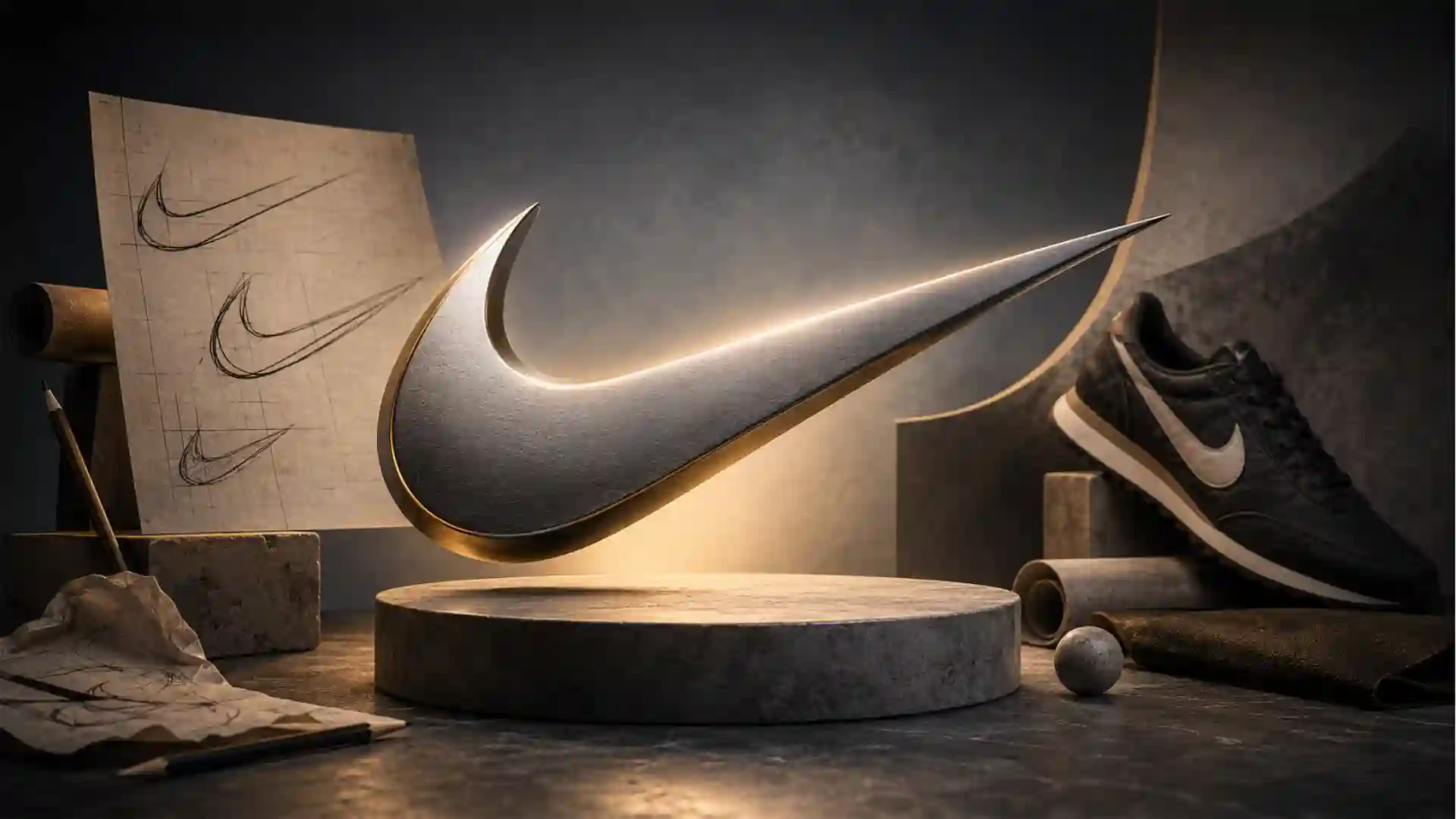
Carolyn Davidson’s Nike Swoosh was not born as a trophy of perfect brand strategy. It was a working mark, produced under deadline pressure for a small Oregon shoe business that needed its own identity before a factory run could begin. The payment was real: Davidson sent Phil Knight an invoice for $35 after Blue Ribbon Sports chose her curving stripe in 1971. Nike’s own history now presents that moment as the beginning of a symbol that outgrew the first product it marked.
Table of Contents
A cheap invoice became a permanent business asset
The story is easy to flatten into internet trivia: a student designs a logo for $35, the company becomes giant, the end. That version is too simple. It misses the harder lesson. The Swoosh did not make Nike powerful by itself. Nike made the Swoosh powerful by putting it on performance products, famous athletes, retail spaces, cultural campaigns, televised moments, and everyday clothing for more than five decades. A logo starts as a drawing. A brand becomes an asset when people meet that drawing in moments they already care about.
Davidson’s design was not treated like sacred art at first. Nike says Knight and a small group settled on the mark because the company needed to move production forward. Knight’s famous reaction was not praise. “I don’t love it,” he told Davidson, “but it will grow on me.” The mark was rushed to Mexico so shoes could be made, and the $35 invoice followed.
That founder hesitation matters. It captures a truth designers know and executives often forget: the future value of a brand mark is rarely visible at the approval meeting. A logo must survive use. It must hold shape at different sizes. It must work on products, packaging, ads, athlete uniforms, signs, receipts, websites, and social feeds. It must be simple enough to remember and strange enough not to vanish. The Swoosh had those traits before Nike fully understood them.
The design’s price also belongs to a specific business moment. Blue Ribbon Sports was not yet the Nike of stadium contracts, global flagship stores, and billion-dollar athlete portfolios. Knight and Bill Bowerman were still moving from distribution toward ownership. They had been importing Japanese running shoes, then reached the point where their future depended on a product and identity they controlled. The logo commission happened inside that shift. The Swoosh was cheap because the company was early, cash was tight, and the full use of the mark had not yet been proven.
The $35 story is not only a cheerful origin myth. It raises a fair question about creative value, ownership, and what companies owe people who shape their symbols. Reuters has treated claims that Davidson received only $35 as missing context, because Nike later gave her a gold-and-diamond Swoosh ring and stock. Yet the original invoice remains striking because creative work often enters a company before anyone can measure its future weight.
The better question is not whether a logo can be “worth” billions on the day it is drawn. It cannot. The better question is how a modest mark becomes one of the most recognized pieces of commercial language in sport. Nike’s answer was not decoration. It was repetition with discipline, performance with myth, and a rare ability to move a symbol from running culture into basketball, streetwear, women’s sport, youth identity, digital commerce, and public argument.
By 2026, the Swoosh carries a paradox. It remains one of the strongest signs in global apparel and sport, but Nike’s business is under pressure. Fiscal 2025 revenue fell 10% to $46.3 billion, Nike Direct revenue fell 13%, Nike Brand Digital dropped 20%, and gross margin declined to 42.7%. The Swoosh is still powerful. The company now has to prove again that the business behind the mark can move as fast as the symbol suggests.
The hallway meeting that shaped a global identity
The origin scene is unusually human. Davidson was a Portland State University student who could not afford an oil painting class. Knight, then teaching accounting while building his footwear business, overheard her conversation and offered freelance work. Portland State describes the exchange as a chance hallway meeting that led first to charts and graphs for Japanese footwear executives, then to more design work for Blue Ribbon Sports, then to the shoe stripe that became Nike’s central mark.
This matters because Nike’s origin is often told through founders, coaches, athletes, and deals. Davidson’s role shows another part of company formation: the early identity of a business is often made by people near the edge of the official story. She was not a famous agency partner. She was not brought in through a polished pitch process. She was a student with design skills, available time, and a practical need for income. That made her close enough to the company’s unfinished state to produce something direct.
Knight’s first need was not a grand brand platform. He needed something that would work on the side of a shoe and look different from Adidas. Portland State’s account says Knight liked Adidas’s three-band mark, and Davidson understood the Nike stripe had to look entirely different. The brief was brutally short: it had to look like speed.
That constraint was tougher than it sounds. A shoe mark is not a flat-page logo first. It lives on a curved object that moves through space. It must look right while bent, stretched, stitched, printed, scuffed, photographed, and seen from the side of a runner’s body. Davidson sketched options on tissue paper and held them against shoes to test them. That detail matters because the design problem was physical before it was symbolic.
The name Nike added another layer. The company took its name from the Greek goddess of victory, which gave the Swoosh a mythic echo without forcing it to be literal. The best commercial symbols often suggest a story without requiring the audience to study it. Most buyers do not need to know the goddess reference to feel that the mark points forward, cuts through air, and belongs to sport.
Davidson’s assignment also came at a moment when Blue Ribbon Sports needed independence. Nike’s history says the company’s supplier relationships were winding down, and Knight knew the business needed more than someone else’s product. It needed its own shoe and identity. That is the real business hinge. A distributor can sell. A brand must mean. The Swoosh became the bridge between a supply relationship and a company with its own demand.
The story also complicates the myth of instant genius. Davidson presented several options. The founders did not immediately see greatness. Time pressure pushed the decision. Boxes had to be printed, production had to move, and the company needed a mark before consensus arrived. Many brand decisions happen this way. Markets rarely wait until everyone loves the logo.
A later corporate giant can make its origin seem inevitable. It was not. The Swoosh could have been rejected. Another stripe could have been chosen. The Mexico-made shoes could have failed without leaving any trace. Nike’s identity began as a decision made under constraint, not as a fully formed theory. That is why the story still resonates: the most durable brand asset in sport began as a practical answer to a practical problem.
The Swoosh solved a product problem before it became a symbol
Nike did not first need a beautiful symbol. It needed a mark that could live on footwear. That difference matters. A logo designed mainly for a brochure may fail on a shoe because the product itself distorts it. A shoe is a narrow, curved, moving surface. Materials vary. Stitching changes edges. Panels create interruptions. A mark that looks sharp in a presentation can become dead once it is attached to leather, nylon, suede, mesh, or rubber.
The Swoosh had a product-native quality. It could stretch along a side panel without needing a box around it. It created direction from heel to toe. It gave the shoe a sense of speed before the wearer moved. It was open enough to adapt across models and bold enough to be seen at a distance. Early Nike shoes did not treat it with modern consistency; Nike says the stripe looked different on nearly every model, with factories and designers adjusting it depending on the shoe’s shape.
That early inconsistency would unsettle many present-day brand managers. Yet it helped reveal the mark’s strength. A rigid logo that needs perfect conditions is fragile. The Swoosh could survive imperfect stitching, shifting proportions, unusual placements, and rough early production standards. Its power came partly from tolerance. It could be used unevenly and still be recognized.
This quality became central to Nike’s later scale. Footwear categories expanded. Running, basketball, training, tennis, soccer, skateboarding, lifestyle sneakers, slides, kids’ shoes, and performance spikes all needed identity. Apparel added shirts, shorts, jackets, caps, bags, socks, warm-ups, uniforms, and licensed gear. Each product asked the same question: can the mark be placed here without losing its force? The Swoosh answered yes more often than most logos could.
The mark also avoided a common sports-brand trap. It did not describe a sport. It did not show a runner, ball, court, track, or shoe. That made it portable. A literal running logo might have trapped Nike inside its first category. A generic corporate wordmark might have lacked energy. The Swoosh gave Nike a visual verb. It could attach to any sport because it represented motion rather than a specific activity.
This is one reason the mark became useful for elite and casual buyers at the same time. A marathoner could read it as speed. A basketball player could read it as lift. A teenager could read it as status. A parent could read it as quality. A fashion buyer could read it as cultural membership. The symbol carried different meanings without needing a redesign for each audience.
The shoe stripe also gave Nike something Adidas already understood: footwear branding happens at body level. Three stripes identify Adidas even when the word is hidden. A Swoosh identifies Nike from the side of a shoe, from a television camera, from a school hallway, from a finish-line photograph. Products in sport are often seen in motion, partially blocked, or in crowds. The brand that can be recognized from a moving ankle gains a media edge.
The Swoosh’s shape created a useful tension. It was simple enough for memory but not so symmetrical that it became generic. Its asymmetry gave it life. On apparel, that asymmetry created early awkwardness, leading Nike to experiment with other identity devices. But the same asymmetry later became an advantage because it made the stand-alone Swoosh feel active. It looked like it had direction, weight, and release.
Many people call the Swoosh a checkmark. That is only partly right. A checkmark confirms. The Swoosh propels. Its thick-to-thin curve creates acceleration. The tail and point suggest entry and exit. It is not a static tick inside a box; it is a mark that appears to pass through space. That physical suggestion made it unusually suited to Nike’s future language of speed, training, victory, and refusal.
The $35 figure is true but incomplete
The $35 payment is confirmed by Nike’s own history and by Davidson’s later accounts. It is also incomplete when used as a claim that Nike exploited a designer and never looked back. Davidson told ABC News that Nike gave her more than the original fee, including her start in design, referrals, the nickname “Logo Lady,” a gold Swoosh ring with a diamond, and stock. Reuters later checked online posts that treated the $35 as the whole story and found that they lacked this context.
The details still require care. Reuters reported that Davidson said she had not cashed in a single share of the original stock but had sold some stock after splits. Reuters also noted that Nike’s stock had split 2-for-1 six times between 1990 and 2015, meaning 500 shares would become 32,000 shares. At Nike’s June 28, 2023 closing price of $113.03, Reuters calculated those shares would have been worth $3,616,960 on that date.
The current market price gives a different estimate. Nike Class B shares were trading around $42.42 on May 19, 2026, with a market capitalization of about $62.85 billion. On that price, 32,000 shares would be worth roughly $1.36 million before taxes and excluding dividends, assuming all shares were still held.
The ethical reading also needs precision. Davidson billed $35 because she did not know what to charge and because the company was not yet a global giant. She was paid for the work she invoiced. Later, Nike recognized her role with symbolic and financial gifts. None of that erases the fact that the original payment looks tiny next to the mark’s later cultural value. The story is not a simple case of theft or generosity. It is a case study in the unpredictable future value of creative work.
Creative labor often creates options before it creates measurable cash. A logo gives a company the option to build memory, preference, and legal protection around a visual asset. Most such assets never become famous. A few become priceless because the business behind them uses them well. The designer’s payment usually reflects the commission stage, not the future option value. That gap is where the Swoosh story keeps producing debate.
The later stock gift is also revealing. Nike did not simply send Davidson a belated check. It gave her participation in the company’s upside, at least to some degree. Whether that was a strategic gesture, a moral gesture, or a personal one, it aligned recognition with Nike’s growth better than a fixed fee would have. The gold ring added another layer: it turned the mark back into a personal object for its creator.
The lesson for modern founders is not that they can pay designers almost nothing because a logo’s future is uncertain. The lesson is sharper. If a company asks for identity work, it should understand that the asset may become central to its reputation. Fair pay, clear rights, and later recognition are not decorative niceties. They protect relationships and brand memory. Nike’s later gift helped turn a potentially ugly origin story into a more complex one.
The lesson for designers is just as direct. Price, rights, and use matter. A logo that begins as a small job may later appear on products, stores, ads, apps, uniforms, and stadiums. Most will not. A few will. Davidson’s story is rare, but its rarity is exactly why it remains a reference point in design education and business folklore.
The Swoosh story in hard numbers
| Fact | Figure or date | Business meaning |
|---|---|---|
| Original Swoosh invoice | $35 in 1971 | A student design solved an urgent identity need |
| Later stock gift often cited | 500 shares in 1983 | Recognition came after Nike had gone public |
| Split-adjusted shares after six 2-for-1 splits | 32,000 shares | Equity made the gift grow with Nike’s market value |
| Reuters 2023 calculation | $3.62 million | The stock gift looked far larger when Nike traded above $113 |
| May 19, 2026 share price used here | $42.42 | The same hypothetical holding would be worth about $1.36 million |
The table separates fixed history from market-dependent estimates. The $35 payment is fixed; the value of the later stock gift changes with share price, split assumptions, taxes, dividends, and whether shares were sold.
Blue Ribbon Sports needed its own myth before it needed scale
Before Nike became Nike, Blue Ribbon Sports lived in a less glamorous business: importing and selling shoes made by another company. Bowerman and Knight had an athlete-centered eye, but distribution is not ownership. A distributor depends on someone else’s product pipeline, design language, supply terms, and brand equity. When the company began moving toward its own footwear, it needed to cross a psychological line. It needed customers, athletes, retailers, and its own people to believe it had become the source.
The name Nike gave the company a myth. The Swoosh gave that myth a body. The combination was economical. A goddess of victory was too grand for a small company if handled literally. A wing-like curve on a shoe made the reference usable. Nike did not need buyers to recite Greek mythology. It needed them to feel movement, ambition, and sport when they saw the mark.
Bill Bowerman’s role made the myth credible. Nike’s own account of Bowerman emphasizes his obsession with lighter, more comfortable, more durable shoes and his habit of taking shoes apart to understand them. He was not merely a co-founder attached to a name; he gave the company a performance mentality rooted in athlete feedback and product tinkering. A victory symbol without product credibility would have looked hollow. Bowerman’s product culture helped keep Nike from becoming only a marketing company.
Knight brought another piece: competitive commercial storytelling. He understood that shoes had to be sold through belief as much as features. The early track culture around Nike was intimate and practical. Runners trusted coaches, teammates, local shops, and race results. A brand could not buy its way into that world with a logo alone. It had to show up at races, on bodies, and in results.
The 1972 Boston Marathon appearance helped. Nike says two top American finishers crossed the line wearing Nike shoes marked with Davidson’s design, the first confirmed Swoosh appearance in a major race. That placement gave the mark credibility before mass advertising did. It told serious runners that the new symbol belonged in competition, not only in a catalog.
The distinction matters because brand power in sport has a different origin than brand power in packaged goods. A cereal logo sits on a shelf. A sports logo performs. It loses credibility if the product fails under stress. It gains credibility when elite athletes and ordinary runners push it through sweat, injury, weather, and repetition. The Swoosh was not merely seen. It was tested in public.
Nike’s early myth also gained force from scarcity. The company was not yet everywhere. Seeing the Swoosh at a track meet or on a serious runner could feel like spotting membership in a subculture. Later ubiquity would make the mark global. Early scarcity made it credible. The strongest brands often pass through both phases: first they mean something to a small group with intensity, then they expand without fully losing that first meaning.
Blue Ribbon Sports’ transformation into Nike also shows why naming and identity must arrive before a company fully grows into them. A name like Nike was aspirational. So was the Swoosh. Both were larger than the early business. The danger of aspirational identity is embarrassment if the company cannot back it up. Nike backed it up through product, athlete relationships, and relentless presence in sport. The symbol stretched the company’s ambition without snapping.
The Swoosh became valuable through repeated evidence
A mark becomes powerful when it accumulates proof. Nike’s proof came through athletes, products, campaigns, stores, events, and communities. Each exposure added memory. Each credible performance reduced doubt. Each cultural moment gave the mark another meaning. The Swoosh became a container for evidence before it became an icon.
This is why the $35 origin cannot explain Nike’s brand power by itself. A symbol with no repeated evidence remains a sketch. Nike’s evidence machine was unusually strong. The company placed its mark on shoes designed for real use, on athletes with visible competitive stakes, and on campaigns that made sport feel personal rather than distant. It then repeated the mark across categories until it became a shorthand for athletic ambition.
The company’s visual system also made the Swoosh easy to separate from the word Nike. By the mid-1990s, Nike was able to let the Swoosh stand alone because decades of exposure had trained consumers to read the curve instantly. A stand-alone mark is one of the clearest signs of brand maturity. It means the company no longer has to name itself every time.
Nike’s 2025 brand status shows how much residual power remains. Brand Finance named Nike the strongest apparel brand globally in 2025, with a Brand Strength Index score of 94.7 out of 100, and said Nike was also the second strongest brand in the world across all sectors and countries in that report.
That fact sits beside another one: Nike’s business was weakening at the same time. A brand can be extremely strong in the mind while losing commercial momentum. Brand power is not immunity. It is stored trust, memory, and preference. It buys time; it does not stop time. It raises the odds of recovery; it does not guarantee it.
Repeated evidence also protects a brand against parody and overuse. Nike’s own history says the Swoosh has been oversized, miniaturized, multiplied, guarded, celebrated, parodied, and sometimes overused. Weak marks collapse under that treatment. Strong marks absorb it because recognition stays intact. The Swoosh became strong enough to survive both reverence and mockery.
The logo’s meaning expanded in layers. First it meant a new shoe. Then it meant running. Then performance. Then basketball. Then Jordan. Then youth culture. Then women’s sport. Then streetwear. Then self-improvement. Then controversy. Then sustainability pressure. Then direct digital membership. Now, in the Elliott Hill era, it also means a company trying to recover lost momentum. The mark has never had only one meaning. Its power lies in carrying many without becoming visually complicated.
For marketers, the Nike case is a warning against logo fetishism. A good mark helps memory. It does not create a business model, product pipeline, athlete roster, retail strategy, or cultural stance. Nike built those systems around the mark. The Swoosh became valuable because Nike kept giving people reasons to attach value to it.
Recognition alone is not the same as brand power
Many logos are recognized. Far fewer create behavior. Nike’s advantage has never been recognition alone. The Swoosh can trigger willingness to pay, willingness to try, willingness to belong, and willingness to forgive. Those are stronger commercial effects than visual recall. A consumer who recognizes a logo but feels nothing is not a brand asset. A consumer who recognizes it and changes a purchase decision is.
Brand valuation firms try to measure that invisible force from different angles. Kantar’s 2026 BrandZ ranking shows how technology brands dominate the top of the market, with Google, Apple, Microsoft, Amazon, and NVIDIA far ahead in total brand value. That context matters because claims that Nike is “the most powerful brand on the planet” need qualification. Nike is not the world’s most valuable brand overall in current major rankings. It is, however, one of the most powerful sports and apparel brands ever built.
Brand Finance’s 2025 data gives Nike a stronger claim in brand strength than in total brand value. Chanel overtook Louis Vuitton as the most valuable apparel brand in that report, while Nike led on strength. This distinction is useful. Value often reflects category economics, margins, growth, and financial forecasts. Strength reflects how the brand performs in the mind and behavior of consumers. Nike’s mindshare remains deep even while its business faces hard resets.
The Swoosh is therefore best understood as a high-grade asset under strain. It gives Nike reach that competitors would spend decades trying to build. It gets attention from consumers, retailers, athletes, collaborators, and media. It helps new products receive a first look. It gives campaigns an inherited emotional charge. But it cannot substitute for product freshness, local relevance, retail execution, and pricing discipline.
A logo can also become a burden when it promises more than the business delivers. The Swoosh suggests speed, confidence, and victory. When Nike’s sales fall, product cycles slow, or competitors win running credibility, the gap between symbol and reality becomes visible. A strong brand raises expectations. That is an advantage until the company falls short.
Recognition also changes as generations change. A mark loved by parents may feel inherited to teenagers. A slogan that motivated one generation may sound familiar but distant to another. Nike’s 2025 “Why Do It?” campaign tried to reintroduce “Just Do It” to younger athletes, nearly four decades after the slogan first launched in 1988. Nike framed the campaign as a way to hand the slogan to a generation facing different pressures around trying, failing, and showing up.
That move shows the maintenance cost of iconic status. Nike cannot simply rely on the fact that people know the Swoosh. It must keep refreshing the meanings attached to it. The mark is permanent. Its emotional use is not.
The first audience was not the whole world
Nike’s early audience was narrow by present-day standards: runners, coaches, track communities, and specialty retailers. That narrowness was not a weakness. It gave the brand a place to earn trust before scaling. Performance credibility inside a demanding subculture is harder to fake than broad lifestyle awareness. Runners are sensitive to fit, weight, cushioning, durability, injury risk, and small design differences. A shoe brand that wins there earns a different kind of respect.
The Swoosh benefited from this early credibility. A new mark on a serious runner can become a signal of discovery: someone knows something others have not yet noticed. Nike’s early presence around track and road racing gave the logo a performance aura before it became common. That aura later helped the brand stretch into mass culture without losing all technical authority.
A broad consumer brand often starts with awareness campaigns and then tries to prove product substance. Nike’s sequence was stronger. It began with product use in communities where performance mattered, then expanded storytelling. This order helped the logo feel earned. When later campaigns claimed emotional territory, the audience could connect them to actual athletes and products.
This pattern also explains Nike’s long dependence on athlete relationships. A sports brand needs human proof. Technical features are hard for mainstream consumers to evaluate on their own. Athletes make the product visible under conditions of high stakes. A runner crossing a finish line, a basketball player rising in traffic, a tennis player sliding on a hard court, a footballer sprinting into space: these moments convert product claims into images.
The Swoosh’s simplicity made those images easier to process. Television viewers did not need to read a long name. Photographers did not need perfect framing. Fans did not need a product education. A white curve on a dark shoe, or a black curve on a white jersey, could be enough. The mark worked as a broadcast signal before social media made every athlete a publisher.
Nike’s early audience also helped shape the brand’s tone. The company did not sound like a traditional apparel house. It sounded like a competitive locker room, a coach, a stubborn runner, a dare. That tone later hardened into campaigns that treated sport as a test of will. The Swoosh fit that voice because it did not feel ornamental. It looked like motion made into a mark.
The challenge today is that Nike’s first audience no longer controls the whole sportswear conversation. Running has changed. Boutique brands, specialist shoes, maximal cushioning, carbon plates, trail culture, recovery footwear, and fashion-driven performance hybrids have created more points of competition. The young athlete is also not a single archetype. Some want elite performance. Some want community. Some want local identity. Some want comfort. Some want resale value. Some want brands that feel less dominant.
That makes Nike’s origin useful but not sufficient. The company’s early playbook was built in a world of fewer media channels and fewer credible sportswear challengers. The Swoosh still carries the early aura, but Nike must keep earning credibility inside today’s smaller, faster-moving communities rather than assuming old authority will transfer automatically.
The Swoosh separated Nike from Adidas without copying it
Knight admired the commercial force of Adidas’s three stripes. Davidson knew the Nike stripe had to look different. Portland State’s account says Knight liked Adidas’s three-band logo, and Davidson understood that her mark could not echo it too closely. This competitive starting point is central to the Swoosh’s design value. Nike needed category recognition without imitation.
Adidas had already shown how a side-of-shoe device could become a brand asset. Three stripes were not merely decoration. They turned the shoe’s side panel into media. Every step showed the brand. Every athlete wearing the shoe carried the mark into photographs and broadcasts. Nike needed an equivalent visual advantage but could not build its identity as a weaker echo of the leader.
The Swoosh solved the problem by taking a different formal path. Adidas used repetition, geometry, and structure. Nike used curve, asymmetry, and motion. Adidas looked like support and discipline. Nike looked like acceleration. That difference allowed both brands to occupy sport without confusing the audience.
This contrast later supported deeper strategic differences. Adidas could draw from football heritage, European sport, street culture, and design collaborations. Nike could build around American track, basketball, training, athlete mythology, and self-challenge. The logos helped encode those positions. A good competitor mark does not only avoid legal conflict. It opens a separate emotional lane.
The Swoosh also avoided the trap of trying to out-Adidas Adidas. Many challenger brands define themselves by reacting too closely to the incumbent. They borrow category codes until their own identity has no independent force. Nike’s mark took enough from the category to be legible as a shoe stripe but enough distance to become its own language.
There is a business lesson here for any company entering a market with an established visual leader. Difference is not a slogan. It must show up at the level of product silhouette, logo behavior, tone, partnerships, retail, and use case. Nike’s Swoosh gave the company a distinct first impression before any consumer compared cushioning, price, or athlete endorsements.
The mark also gave Nike room to become more aggressive. A set of stripes can feel stable. The Swoosh can feel like an attack angle. That quality later fit Nike’s competitive advertising tone. The company could speak in challenges, dares, and absolutes because its symbol already carried pressure.
Yet difference is never finished. Adidas, New Balance, Puma, Asics, On, Hoka, Salomon, Lululemon, Anta, Li-Ning, and local running or outdoor brands have all built their own codes. Some use heritage. Some use comfort. Some use technical specialization. Some use local pride. Some use fashion scarcity. Nike’s visual distinction remains strong, but modern sportswear competition is not only a logo contest. It is a contest of product relevance, speed, community, and channel execution.
Motion made the Swoosh memorable
Davidson said the logo needed to show movement. That brief could have produced a literal runner, a wing, a speed line, or an abstract arrow. The Swoosh sits between literal and abstract. It is not a wing, but it can suggest one. It is not a track, but it can suggest a curve. It is not a checkmark, but it can suggest completion. A symbol that suggests motion without locking itself to one image can travel across categories for decades.
The mark’s motion is not only semantic. It is structural. The curve has a beginning and an end. It thickens and thins. It appears to cut across its surface. The eye follows it quickly. That means the viewer experiences movement while looking at a still image. Few corporate marks do this so cleanly.
Motion also aligned with Nike’s product promise. A shoe company sells movement before it sells style. Even lifestyle sneakers carry the memory of action. A static, heavy, symmetrical mark might have made the company feel less athletic. The Swoosh gave even basic products a performance charge.
This is why the mark could later stand on apparel, where actual performance might be secondary. A cotton T-shirt with a Swoosh borrows the movement implied by the shoe mark. A cap, hoodie, gym bag, or tracksuit can feel athletic even when used casually because the symbol carries stored motion from sport. That transfer helped Nike become a wardrobe brand rather than only a footwear brand.
The mark’s motion also fits modern media. In video, it can be animated easily. In digital interfaces, it can work as an app icon or small badge. On social platforms, it reads quickly. On athlete content, it does not need full explanation. A logo born for a shoe side turned out to work in a world of small screens because it was simple and directional.
There is another reason motion matters: sport is emotional because it is uncertain. A game is unresolved until it ends. A race changes with every step. Training asks for future effort. The Swoosh points into that uncertainty. It feels like action not yet complete. That makes it more psychologically useful than a static emblem of past achievement.
Nike has spent decades attaching the Swoosh to moments of attempted greatness, not just victory. “Just Do It” made the act of beginning central. Nike’s 2025 “Why Do It?” campaign returned to that idea by reframing greatness as a choice rather than an outcome. The Swoosh works with this message because it looks like initiation. It is the mark of starting, not only winning.
The danger is that motion as a symbol can expose operational slowness. When a brand built around speed appears slow in product cycles, local market response, or digital experience, the contradiction is sharp. Nike’s current turnaround pressure is therefore not just financial. It is symbolic. A slow Nike feels less like Nike.
The stand-alone Swoosh was earned, not assumed
A wordless logo is a privilege. Most brands cannot remove their name without losing recognition. Nike did it because the Swoosh had been seen enough, worn enough, and emotionally loaded enough to carry the brand alone. The move toward a stand-alone Swoosh did not create the mark’s power. It confirmed it.
This distinction matters. Startups often admire wordless marks and try to begin there. That rarely works. Without memory, a symbol is a puzzle. Nike could drop the word because the audience had already solved the puzzle through years of contact. A wordless logo is not a shortcut to iconic status; it is a reward for sustained recognition.
The Swoosh’s stand-alone use also changed the brand’s tone. A wordmark speaks. A symbol appears. The symbol gave Nike more confidence and less need to explain itself. It could sit on a shoe, a jersey, a billboard, or a store with a kind of quiet dominance. That visual silence suited Nike’s later cultural power. It made the brand feel less like a seller and more like an institution.
Yet stand-alone marks come with risk. The symbol must carry every association, including negative ones. When Nike faced criticism over labor practices, athlete controversies, political campaigns, or business performance, the Swoosh absorbed that criticism. A strong mark attracts love and protest because it is easy to identify. It becomes a target as well as a badge.
The mark’s simplicity also made it legally and culturally sensitive. Nike has to defend it because too much imitation would dilute its distinctiveness. But aggressive defense can make a brand look controlling. That tension is normal for iconic symbols. The company must protect what the public also feels it owns emotionally.
The stand-alone Swoosh also enabled a global language. The word “Nike” may be pronounced differently across markets, and language can create friction. The symbol crosses borders faster. It can appear in China, Brazil, France, India, the United States, and South Africa without translation. For a company that generated 57% of fiscal 2025 revenue outside the United States, that global portability is commercial infrastructure.
A wordless mark also supports premium behavior. It can be small, discreet, oversized, tonal, reflective, embroidered, embossed, or hidden. Luxury and streetwear both use subtle symbols to signal insider recognition. Nike has been able to play across mass and premium contexts partly because the Swoosh can change volume without changing identity.
The stand-alone Swoosh is therefore one of Nike’s strongest strategic assets. But it depends on constant replenishment. If younger consumers know the mark but no longer associate it with the most exciting products, the symbol becomes inherited memory. Nike’s task is to keep the stand-alone Swoosh feeling present, not archival.
Athlete proof turned a drawing into a social signal
Nike’s rise cannot be separated from athlete proof. The Swoosh became powerful because it appeared on bodies doing difficult things. A shoe on a shelf is an object. A shoe on an athlete becomes evidence. This distinction runs through Nike’s entire brand system.
Early runners gave Nike credibility. Later, stars gave it scale. Steve Prefontaine, Michael Jordan, Serena Williams, Tiger Woods, Kobe Bryant, LeBron James, Cristiano Ronaldo, Rafael Nadal, Naomi Osaka, Eliud Kipchoge, Caitlin Clark, Qinwen Zheng, and many others have carried Nike into different kinds of cultural attention. The exact athlete portfolio has changed, but the principle has stayed consistent: Nike uses human ambition to animate product.
Athlete proof works because sport is watched for stakes. Fans care who wins, who fails, who returns, who plays hurt, who breaks records, who changes style. A logo inside that drama gains emotional charge. A billboard can say a product is fast. A runner winning in the product says it differently.
The Swoosh is also unusually good at athlete transfer. It does not compete visually with the athlete’s body. It marks the body. It can sit on a shoe, chest, sleeve, headband, sock, or bag. It is small enough not to overwhelm the athlete and strong enough to be seen. That made it ideal for sponsorship economics.
Michael Jordan pushed this logic to a new level. The Air Jordan line turned an athlete relationship into a sub-brand, a product universe, and a cultural economy. The Jumpman eventually became its own symbol, but the foundation was Nike’s willingness to attach identity, product, and storytelling to an athlete as a central business bet. Jordan showed that a sports brand could create desire far beyond the performance needs of the sport itself.
The Jordan example also changed athlete economics. Signature products became a route to shared cultural ownership, not just endorsement fees. Consumers were not only buying Nike basketball shoes. They were buying proximity to a myth of flight, competitiveness, style, rebellion, and excellence. The Swoosh system made room for that myth because Nike already understood how symbols compound.
Athlete proof has grown more complicated. Modern athletes are media companies. They speak directly to fans, carry political positions, build personal brands, invest in companies, and face constant scrutiny. A sponsorship can create upside and risk at once. Nike has often accepted that tension. Its best athlete work has not tried to make athletes bland. It has used their edge.
The challenge is that athlete proof alone no longer guarantees product heat. Consumers can respect Nike’s roster while buying running shoes from Hoka or On, training gear from Lululemon, classics from Adidas, or local brands in China. Athlete associations still matter, but they must connect to products people want now. The Swoosh cannot live forever on borrowed greatness. It needs fresh product proof.
“Just Do It” gave the Swoosh a voice
The Swoosh was visual. “Just Do It” made it verbal. Nike launched the slogan in 1988, and the line gave the brand a voice that matched the mark’s forward motion. Nike’s 2025 campaign release says the original slogan was a call to start, try, and keep moving when effort is hard. That reading explains why the slogan lasted. It is not a product claim. It is a command aimed at the self.
A durable brand line must be broad without becoming empty. “Just Do It” works because it applies to elite athletes and ordinary people, but it does not sound soft. It has pressure in it. It removes excuses. It can be inspiring or confrontational depending on the viewer. That tonal range helped Nike speak across audiences without changing the line.
The slogan also solved a brand architecture problem. Nike had many sports, products, athletes, and campaigns. “Just Do It” tied them together. A runner, a basketball player, a girl entering sport, an aging jogger, a champion returning from injury, and a teenager practicing alone could all fit under the same imperative. The Swoosh marked the image. The line framed the feeling.
This pairing created one of modern marketing’s strongest combinations: a symbol that moves and a phrase that pushes. The Swoosh says go. “Just Do It” says stop hesitating. Together they turned Nike from a shoe company into a motivational force. That power helped the brand become part of personal identity, not merely purchase preference.
The line also gave Nike permission to speak to struggle. Many brands avoid discomfort. Nike made discomfort central. Training hurts. Failure happens. Social judgment exists. Competition exposes weakness. “Just Do It” does not deny any of that. It answers with action. That made the brand emotionally credible to people who use sport as a way to test themselves.
The 2025 “Why Do It?” campaign shows Nike trying to reframe this voice for a generation that may hear “Just Do It” differently. Young athletes live with public comparison, social feeds, fear of failure, and more visible mental pressure. Nike’s release describes the new campaign as a way to meet them where they are and present greatness as a choice. The effort is a recognition that even legendary language must be renewed.
The risk is nostalgia. A brand can become trapped by its own greatest line. Reusing “Just Do It” without new emotional insight would make Nike sound like a museum of itself. Reframing it through current athlete anxiety, participation barriers, and youth culture gives it a better chance. But the line still needs product heat and community relevance to carry weight.
The Swoosh gave Nike recognizability. “Just Do It” gave it inner speech. That is why the combination still matters. People do not only see Nike. They hear a command they can apply to themselves.
The Jordan model changed the economics of the Swoosh
Nike’s partnership with Michael Jordan did more than sell basketball shoes. It changed the relationship between brand, athlete, product, and culture. The Air Jordan line showed that a sports brand could build a separate myth inside the larger Nike system. The Swoosh helped create the conditions for that leap, even as Jordan’s own Jumpman later became a stand-alone force.
The Jordan model mattered because it turned endorsement into world-building. The athlete was not just wearing a product. The product became an extension of the athlete’s story. Design, color, performance, league controversy, advertising, scarcity, and personal mythology fused into a product line with its own emotional economy.
This changed how consumers understood sports shoes. A basketball shoe could be a performance tool, fashion object, status marker, collectible, and cultural artifact at once. Nike had already built a brand around sport and effort. Jordan proved the brand could create sub-brands around individual greatness.
The Swoosh benefited even when the Jumpman became dominant. Jordan’s success strengthened Nike’s reputation for athlete-centered storytelling, risk-taking, and cultural timing. It taught the company that a product could become a character in a larger drama. That lesson later shaped many Nike relationships beyond basketball.
The model also shaped athlete power. Signature lines gave athletes stronger economic and cultural participation. Consumers no longer saw athletes only as endorsers; they saw them as co-authors of product identity. This expectation has spread across sport and fashion. Modern athletes want equity, creative control, production companies, and long-term platforms. Nike helped create that world.
The risk is that signature mythology is hard to repeat. Jordan was singular. Later athletes may be globally famous but still not carry the same product heat. The cultural environment is more fragmented, attention is shorter, and consumers have more alternatives. Nike cannot simply apply the Jordan formula mechanically.
Jordan also created a high internal benchmark. When a brand has once produced a cultural phenomenon of that scale, normal success can look small. Investors, retailers, and fans keep asking where the next Jordan is. That question can distort strategy if the company chases myth before building product truth.
Still, the Jordan model remains one of Nike’s greatest examples of symbol compounding. The Swoosh gave Nike credibility. Jordan gave it flight. The product gave consumers something to own. The story gave them a reason to care. That is the deeper formula behind Nike’s brand power.
Nike entered fashion without leaving sport behind
Nike’s move into fashion did not require the Swoosh to become less athletic. It required sport to become part of everyday dress. This cultural shift made Nike far larger than a performance footwear company. Sneakers became social identity. Tracksuits, hoodies, caps, and performance fabrics moved into daily life. The gym, court, street, airport, school, and office began to share clothing codes.
The Swoosh was perfect for this shift because it carried athletic energy into non-athletic settings. A person wearing Nike casually could still borrow the symbolic charge of sport. The mark suggested movement even when the wearer was not training. That made it socially useful.
Fashion also changed the product calendar. Performance products answer athlete needs. Fashion products answer desire, mood, scarcity, and styling. Nike learned to operate in both modes. It could launch technical running shoes and revive retro silhouettes. It could supply team kits and collaborate with designers. It could sell basics and limited drops.
This dual role created huge value but also complexity. Performance credibility can make fashion products feel authentic. Fashion heat can make performance brands culturally alive. But if fashion dominates too much, serious athletes may question performance focus. If performance becomes too technical without cultural appeal, lifestyle demand may cool.
Nike’s best periods balance the two. The Swoosh on a race shoe proves capability. The Swoosh on a hoodie spreads culture. The Swoosh on a collaboration creates scarcity. The Swoosh on a youth team uniform builds early memory. The Swoosh on an athlete’s podium moment gives the entire system fresh proof.
The current challenge is that fashion cycles move faster than large companies. Sneaker communities tire of overused silhouettes. Resale energy shifts. Younger consumers may find smaller brands more personal. Vintage codes can revive competitors. Nike must manage heritage without flooding it.
This is where the $35 mark shows its versatility. It can be quiet on premium apparel, loud on sportswear, technical on footwear, nostalgic on retro products, and minimal on digital interfaces. Few marks can carry that many roles. The risk is not visual. The risk is strategic: too many roles can blur priority.
Nike entered fashion because sport entered everyday identity. The Swoosh made that identity visible. Keeping it alive now requires knowing when to protect icons, when to refresh them, and when to stop asking old franchises to carry new growth.
The direct-to-consumer bet strained the marketplace
Nike spent years pushing toward direct relationships through its stores, apps, and websites. The strategic logic was clear: more control, richer data, higher gross margin potential, and a closer relationship with members. The risk was just as clear: reduced wholesale reach, strained retailer relationships, higher dependency on Nike’s own traffic, and greater exposure to digital discounting when demand softened.
Fiscal 2025 showed the downside. Nike Direct revenue fell 13%, and Nike Brand Digital sales fell 20%. When a direct model works, it can make a brand feel more controlled and premium. When it weakens, the brand owns the traffic problem. It cannot blame the shelf.
Wholesale, once treated by many consumer brands as less glamorous than direct commerce, has regained strategic value. Retail partners provide discovery, local presence, category comparison, and consumer convenience. A runner may want to try several brands in one store. A parent may buy shoes where the child can be fitted quickly. A casual buyer may discover Nike next to competitors. Exiting or under-serving those contexts can reduce brand visibility at the moment of choice.
Nike’s fiscal 2026 third-quarter results showed wholesale revenue up 5% reported while Nike Direct fell 4% reported. That does not mean wholesale alone is the answer. It means the balance matters. A strong sportswear brand needs direct relationships and strong marketplace presence. Direct channels should deepen loyalty; wholesale channels should widen availability and category relevance.
The Swoosh is strong enough to pull traffic, but it is not immune to habit changes. If consumers get used to shopping multi-brand retailers, marketplaces, resale platforms, or specialist running stores, Nike must be present in those environments with the right products. A brand cannot force every purchase into its preferred channel without cost.
The direct push also affected product perception. Heavy digital promotions can train shoppers to wait. Nike’s fiscal 2025 release says higher discounts and channel mix were among the factors pressuring gross margin. When the Swoosh appears too often beside discounts, it risks losing some premium tension.
This is a delicate problem. Nike’s scale requires volume. Its brand power requires desire. Too much scarcity leaves money on the table and frustrates customers. Too much availability turns icons into inventory. The company’s best years often came when it managed both: broad access to core products and heat around new performance stories, athlete lines, or limited drops.
A more balanced marketplace strategy would treat retailers not as a step backward but as part of consumer reality. The Swoosh does not become weaker because it appears in a partner store. It becomes weaker if the product there feels stale, over-discounted, or disconnected from the best Nike stories. The channel is not the enemy. Poor channel orchestration is.
China shows the limits of global fame
Nike’s China problem is one of the clearest examples of why global brand recognition does not guarantee local relevance. Reuters reported in March 2026 that Nike’s China struggles reflected operational missteps, domestic competition, weaker consumer spending, inventory issues, eroding premium positioning, and the need for a more localized strategy. Greater China accounted for around 15% of Nike’s global revenue and remained its second-largest market outside North America.
The issue is not that Chinese consumers do not know Nike. They do. The issue is that awareness is not enough when local brands become more culturally resonant, faster in product response, and better tuned to price-sensitive or trend-sensitive demand. A global symbol can start to feel distant if it does not speak to local habits.
Nike’s current China weakness also shows the danger of relying too heavily on heritage. Jordan and classic Nike franchises carry enormous global history, but younger consumers may not treat that history as personal. They compare what is in front of them now: design, comfort, price, social relevance, local pride, digital experience, and community energy. If local competitors answer those needs better, the Swoosh’s past does not close the sale.
Reuters reported that Nike had logged six straight quarters of decline in China after a 17% drop in the latest quarter reported in December, while Anta and Li Ning had gained ground using agile supply chains and extensive store networks. The most damaging detail is not only the sales decline. It is the explanation from local observers: Nike was still charging a premium while giving shoppers weaker reasons to pay it.
Digital weakness is especially dangerous because Chinese commerce and brand culture are deeply shaped by platform behavior, livestreaming, short video, social commerce, and rapid trend cycles. A brand that is slow there looks old quickly. Nike can have universal recognition and still lose relevance to brands that move faster through local product cycles and local storytelling.
The China lesson applies beyond China. Global brands must respect local speed. A central brand idea can travel; execution cannot be identical everywhere. Product assortments, collaborations, retail formats, athlete choices, media channels, and price architecture must reflect local reality. The Swoosh can open doors, but local relevance keeps them open.
Nike has tried to respond. Reuters reported that Nike appointed Cathy Sparks to lead Greater China, with a mandate to improve retail ties, clear stale stock, and speed digital efforts. That is a practical reset, not a slogan. The company must rebuild trust with partners and consumers who have alternatives.
The deeper challenge is cultural humility. A brand that dominated a market can be slow to notice when admiration turns into selective buying. Consumers may still respect Nike, still wear Nike, and still follow Nike athletes, while shifting incremental purchases elsewhere. That is how brand erosion often begins: not with rejection, but with leakage.
China proves that the Swoosh is not a universal answer. It is a universal starting point. The answer must be built market by market.
Competitors have attacked Nike’s most trusted territory
Nike’s brand power was built in performance, especially running and basketball. The most dangerous competition is therefore not only in lifestyle sneakers. It is in the categories where Nike’s authority is supposed to be strongest. Hoka, On, Adidas, New Balance, Asics, Salomon, Lululemon, Anta, and Li-Ning have all pressured different parts of Nike’s map.
Running is especially sensitive. It has become more technical, more community-driven, and more fragmented. Some consumers want carbon-plated race shoes. Some want maximal cushioning for daily miles. Some want stylish comfort for walking. Some want trail durability. Some want run-club identity. Specialist brands have used these openings to build credibility.
Reuters reported in May 2026 that Nike’s share of the global sports footwear market fell three percentage points in 2025 to 22.9%, its third straight annual decline, while Adidas increased share to 12.2%. The same report described rising investor skepticism, growing short interest, stagnant inventory, deeper markdowns, and pressure from On and Hoka.
These brands do not need to become larger than Nike to hurt Nike. They only need to win high-influence purchases in categories that shape perception. A run-club member switching to Hoka or On may influence five friends. A fashion buyer choosing Salomon may shift a style code. A Chinese consumer buying Anta may reinforce local pride. A basketball player losing interest in a Nike release may damage Nike’s cultural pulse in a school gym.
Adidas has also regained cultural traction in some footwear franchises. New Balance has strengthened its premium lifestyle and running credibility. Salomon has brought outdoor technical codes into fashion. Lululemon has extended from apparel into footwear and community fitness. In China, Anta and Li-Ning bring local identity and scale. Each competitor attacks a different assumption behind Nike’s dominance.
This competition is not only about products. It is about freshness. A consumer can admire Nike and still feel that a challenger brand is where the interesting thing is happening. Fashion and sport both reward momentum. Once momentum shifts, the incumbent must work harder because familiarity becomes a disadvantage.
Nike’s advantage remains enormous. It has global scale, athlete portfolios, research capabilities, manufacturing relationships, retail presence, brand memory, and financial resources. Its 2025 10-K describes research, design, and development work spanning fields such as biomechanics, chemistry, exercise physiology, engineering, digital technologies, industrial design, sustainability, and athlete wear-testing. Few competitors can match that full system.
But the market does not reward capability in the abstract. It rewards products consumers choose. Nike must convert its internal resources into visible wins. Running shoes must feel competitive. Basketball products must carry energy. Women’s sport must be served with depth. Lifestyle franchises must avoid fatigue. Digital membership must feel useful. Wholesale partners must receive product that creates traffic.
The Swoosh remains a massive advantage, but competitors are no longer intimidated by it. They are finding openings around comfort, local culture, technical credibility, scarcity, and community. Nike’s comeback depends on closing those openings with better products and sharper timing, not louder nostalgia.
The Swoosh is also a pricing signal
When consumers see the Swoosh, they do not only identify the maker. They make assumptions about price, quality, status, and resale possibility. That makes the mark a pricing signal. Strong brands can charge more because buyers believe the product carries more trust, meaning, or social value than a generic alternative. The Swoosh has performed this function for decades.
Brand Finance noted Nike’s strong scores for price acceptance in markets including France, Italy, Sweden, South Africa, and Malaysia in its 2025 apparel analysis. Price acceptance is one of the clearest measures of brand power. If consumers accept a higher price because of the mark and what it stands for, the symbol has financial force.
But pricing power must be protected. Discounts are sometimes necessary, especially to clear inventory. Yet frequent discounting can teach consumers that full price is optional. Nike’s fiscal 2025 gross margin decline was tied partly to higher discounts, channel mix, and inventory obsolescence reserves. This is not just accounting. It affects brand behavior. If shoppers wait for markdowns, the Swoosh loses urgency.
The pricing signal also differs by category. A high-performance running shoe can justify price through technology and athlete proof. A lifestyle sneaker may justify it through style, heritage, scarcity, and social demand. A basic T-shirt relies more heavily on the logo itself. If the logo’s cultural heat cools, logo-led products become more vulnerable.
This explains why product innovation and brand marketing must work together. Marketing can create desire, but product must defend price. A premium mark on a mediocre product is dangerous. It may sell once, then weaken trust. A strong product with weak storytelling may underperform. Nike’s best work aligns both: product that earns belief and campaigns that make belief contagious.
Pricing power is also under pressure from tariffs and supply costs. Nike’s fiscal 2026 third-quarter release cited higher tariffs in North America as the main reason gross margin fell 130 basis points to 40.2%. If costs rise and consumers resist higher prices, even a strong brand feels squeezed.
The Swoosh helps Nike navigate that squeeze, but not without limits. Raising prices works when consumers feel product and brand value rising with them. It fails when price increases meet stale product, abundant discounts, or cheaper competitors with stronger current buzz. This is the narrow path Nike must walk.
A logo becomes financially powerful when it protects price. It becomes financially risky when the company uses it to cover weak value. Nike’s current margin pressure shows how thin that line can become.
The supply chain behind the Swoosh is part of the brand story
A logo can look weightless. A shoe is not. Nike’s products move through a global supply chain of materials, factories, workers, shipping routes, tariffs, inventories, and retail systems. The Swoosh on the final product compresses all of that into one simple sign. That compression is commercially powerful and ethically demanding.
Nike’s fiscal 2025 10-K shows the production footprint clearly. As of May 31, 2025, contract manufacturers operated 97 finished goods footwear factories in 11 countries and 303 apparel factories in 34 countries. Vietnam, Indonesia, and China produced about 51%, 28%, and 17% of Nike Brand footwear respectively. Vietnam, China, and Cambodia produced about 31%, 15%, and 15% of Nike Brand apparel respectively.
This footprint makes Nike efficient at scale, but it also exposes the company to tariffs, logistics shocks, labor scrutiny, currency moves, and geopolitical pressure. A sportswear brand may appear to compete through design and marketing, yet supply chain decisions shape price, margin, speed, and product availability.
Tariffs have become a direct pressure point. Nike’s fiscal 2026 third-quarter release said gross margin fell mainly because of higher tariffs in North America. That is where global policy reaches the sneaker shelf. Consumers may see only a price tag, but behind it sit trade rules, sourcing decisions, and the cost of moving goods across borders.
Supply chain also affects brand promises around labor and responsibility. Nike’s responsible supply chain page says 75% of strategic supplier facilities measured and improved worker engagement in FY24, 67% demonstrated gender equity, and 87% of strategic suppliers had developed safe and healthy workplaces by Nike’s internal measure. Skeptical readers may want third-party verification, but the point is clear: a brand of Nike’s scale must treat supplier performance as part of brand performance.
The Swoosh magnifies accountability because it gives the public a clear target. When a factory issue arises, people do not blame an anonymous supply chain. They see the mark. That visibility can be uncomfortable, but it can also force higher standards. Iconic brands are pushed harder because they have more to lose.
Supply chain choices also influence innovation speed. A company can design a great shoe and still miss the market if manufacturing cannot scale it, materials are constrained, or costs are too high. The strongest brands connect design ambition with operational capability. Nike’s challenge is not only to invent products but to deliver them at the right volume, margin, and moment.
Nike’s operating base behind the Swoosh
| Area | Fiscal 2025 data point | Strategic meaning |
|---|---|---|
| Total revenue | $46.3 billion | The Swoosh sits on a huge but pressured business |
| Nike Direct revenue | $18.8 billion | Direct sales weakened during the reset |
| Footwear factories | 97 in 11 countries | Scale depends on a broad contract-manufacturing network |
| Apparel factories | 303 in 34 countries | Apparel reach creates visibility but increases oversight demands |
| Non-U.S. revenue share | 57% | The brand must work across markets, languages, and cultures |
The table shows why the Swoosh is more than a graphic device. It marks a global operating system of product design, factories, channels, suppliers, stores, apps, athletes, and consumers.
Digital culture gives the Swoosh reach but not automatic sales
The Swoosh was designed for a shoe, but it works unusually well in digital culture. Small screens reward simple marks. Social feeds reward instant recognition. App icons, thumbnails, product cards, athlete posts, and short videos all compress attention. The Swoosh survives that compression.
This is one reason Nike’s digital weakness matters so much. The mark is well suited to digital environments, yet Nike Brand Digital sales fell 20% in fiscal 2025 and 9% in the third quarter of fiscal 2026. The visual asset is not the problem. The digital commercial experience, product mix, traffic quality, pricing, and consumer habit may be.
Digital brand strength is different from physical brand strength. A store can create immersion through space, product feel, staff, and local context. A digital experience must earn attention quickly and repeatedly. It must be useful enough to open, personal enough to feel relevant, and disciplined enough not to become a discount feed.
Nike’s apps, membership systems, training content, running tools, and commerce platforms give it direct channels competitors envy. But a member relationship is not useful by default. It becomes useful when the consumer uses it, trusts it, and buys through it without feeling manipulated. The Swoosh can get the app installed. It cannot guarantee habit.
Digital culture also changes brand authority. Consumers do not wait for official campaigns. They watch reviewers, creators, athletes, resellers, run clubs, Discord groups, TikTok videos, YouTube breakdowns, and Reddit debates. Nike’s message enters a noisy public evaluation system. The logo is recognized instantly, but the interpretation is shared.
This can help Nike when products hit. A strong shoe can travel fast through reviews and community recommendations. It can hurt when products disappoint or discounts spread. The same visibility that made Nike dominant in television-era sport now exposes it to fast feedback.
Nike’s new product bets also face digital scrutiny. Nike Mind, for example, has been presented by Nike as footwear designed to activate sensory receptors in the feet and connect body and brain before key moments. That claim may generate interest, but it also invites reviewers, scientists, athletes, and skeptical consumers to ask for evidence. In the digital era, product stories are tested in public.
The Swoosh’s digital advantage is therefore conditional. It gives Nike high mental availability. It helps content be attributed quickly. It lets small product images remain identifiable. But digital commerce rewards current relevance. A famous mark on an unwanted product is still unwanted.
Nike’s next digital task is likely less about owning every transaction and more about making every digital touchpoint build trust. That includes Nike-owned apps, retailer sites, social platforms, athlete content, and community channels. The Swoosh can appear anywhere. The brand experience must still feel coherent.
Brand valuation tells competing stories about Nike
Brand rankings are often treated like scoreboards, but they are more useful as diagnostic tools. Different firms measure different things. Kantar focuses on consumer perceptions and financial performance in its BrandZ approach. Brand Finance separates brand value and brand strength through its own methods. Interbrand uses its Best Global Brands method. Their numbers do not always agree because they are not measuring identical concepts.
For Nike, the mixed picture is revealing. Brand Finance’s 2025 apparel report placed Nike at the top for apparel brand strength with a 94.7 Brand Strength Index score and described it as the second strongest brand globally across all sectors in that ranking. Kantar’s 2026 global list, by contrast, shows Google, Apple, Microsoft, Amazon, and NVIDIA dominating total brand value.
The combined message is clear. Nike remains a deeply strong brand in the minds of consumers, especially in apparel and sport. But it is not immune to valuation declines, and it is not the most valuable brand on the planet. Any serious article should avoid that overclaim.
This matters because exaggerated praise weakens analysis. Saying Nike is “the most powerful brand on the planet” may sound dramatic, but it blurs the real story. The sharper claim is more interesting: a $35 mark became one of the strongest commercial symbols in sport, yet the company behind it is now trying to convert stored brand strength into renewed growth.
Brand valuation also raises a strategic question. If a brand remains strong while business performance weakens, what exactly is broken? The answer is usually not awareness. It may be product cadence, channel balance, local execution, category focus, inventory discipline, or pricing. Nike’s current data points in those directions.
The rankings also show that power depends on category. A search engine or phone ecosystem may create more total brand value than a sportswear company. But a sports logo lives on the body, inside youth identity, and in moments of public effort. A technology brand may be financially larger; Nike can still be more emotionally visible in everyday clothing and sport culture.
Nike’s business problem is not that people forgot the Swoosh. It is that familiarity alone no longer secures the next purchase. Consumers have credible alternatives and more sources of influence. If the mark feels familiar but the product feels less compelling than a competitor’s, brand value leaks.
The strongest reading of Nike’s brand data is neither triumphalist nor fatalistic. Nike has a rare reservoir of mental availability and emotional memory. It also faces measurable commercial pressure. The next phase depends on whether the company uses the Swoosh as a shield for old habits or as a rallying point for sharper behavior.
The $35 story became viral because it is emotionally tidy
The internet loves the Swoosh origin because it compresses a huge business story into a shocking contrast: $35 versus billions. That contrast is emotionally tidy. It flatters the audience’s sense that hidden value can come from anywhere. It also feeds resentment about underpaid creative labor and fascination with founder luck.
But tidy stories often remove the mechanism. The $35 did not become billions by magic. Nike built distribution, manufacturing, athlete relationships, marketing, legal protection, product franchises, retail systems, cultural campaigns, and global operations around the mark. Without that machinery, Davidson’s design would likely have remained a forgotten student project.
The viral version also tends to freeze Davidson as a passive victim or lucky beneficiary. Her own account is more grounded. She said Nike gave her a start, referrals, recognition, the ring, and stock. Reuters’ fact-check also makes clear that the $35-only version omits the later gifts. That does not diminish her contribution. It makes it more accurate.
The story spreads because it contains three fantasies at once. The first is the founder fantasy: a small decision can become enormous. The second is the designer fantasy: one simple mark can enter global culture. The third is the justice fantasy: early creative contribution may eventually be recognized. Nike’s later stock gift gives the story a more satisfying arc than many similar cases.
Yet the story also contains a warning. Most creative work does not get later recognition. Most logos do not become iconic. Most companies do not become Nike. A fair system cannot depend on rare generosity after success. Contracts, fees, and rights should be handled well at the start because future gratitude is uncertain.
For business readers, the viral story should be a reminder to document origins. Nike’s ability to tell the Swoosh story through official channels helps protect brand mythology. Portland State’s account, Davidson’s interviews, Reuters’ fact-check, and Nike’s own history all give the story a public record. Without that record, myth would drift further into distortion.
The internet version usually ends at the logo. The real story continues into every decision that made the Swoosh visible and credible. That is where the business lesson lives. A low-cost asset can become priceless only when a company compounds it with disciplined use.
Legal protection made recognition defensible
A famous logo is vulnerable if it cannot be protected. The Swoosh’s commercial power depends not only on consumer memory but on Nike’s ability to defend the mark against confusing use. Trademark law turns recognition into a defensible business asset. Without legal protection, imitation would blur the signal.
Nike’s logo has been protected in many forms across markets and product categories. A mark as simple as the Swoosh is especially sensitive because similar curves can appear in many designs. The company must defend distinctiveness without claiming ownership of every curve.
Legal protection also supports licensing, retail consistency, anti-counterfeit work, and athlete merchandise. A fan buying a jersey or shoe expects the mark to mean authentic Nike. If counterfeit products flood the market, trust erodes. The Swoosh’s simplicity makes it easy to recognize, but also easy to copy poorly. Enforcement is therefore part of brand maintenance.
Nike’s public filings show the practical scale of the business that depends on that trust: wholesale accounts, Nike-owned stores, digital commerce in more than 40 countries, and distribution centers across the United States and international markets. A shoe can be manufactured by competitors. A mark with five decades of meaning cannot be duplicated legally or culturally.
Trademark strength grows with use. The more consumers associate the Swoosh with Nike, the stronger the case for protection. This creates a loop: marketing builds recognition, recognition supports legal distinctiveness, legal protection preserves marketing value. Few brand assets show this loop as clearly as the Swoosh.
The legal dimension also helps explain why Nike’s logo has not been radically redesigned. A familiar protected mark has accumulated legal and consumer value. Changing it would risk weakening both. Minor refinements are normal; wholesale reinvention would be irrational. The Swoosh is not a dated package graphic. It is a protected shorthand for a global business.
Counterfeiting adds another layer. A fake Nike product borrows the Swoosh’s trust without carrying Nike’s product controls. That can harm consumers and the brand. Enforcement is therefore not only about corporate control. It is about preserving the meaning consumers rely on when they see the mark.
Legal protection, however, cannot create desire. It can only defend distinctiveness. The Swoosh is protected because it is famous, but it stays commercially powerful only if consumers still want what it marks. Law guards the symbol. The business must keep renewing the reasons to care.
The Swoosh made Nike both bigger and easier to criticize
Iconic brands attract scrutiny. Nike’s scale, visibility, athlete politics, labor history, environmental footprint, and cultural influence make it a frequent target. The Swoosh simplifies that attention. Supporters wear it as affiliation. Critics use it as shorthand for corporate power. The same recognizability that drives sales makes critique easier.
This is a normal price of cultural power. A little-known brand can avoid national debates. Nike cannot. When it makes a campaign choice, changes distribution, raises prices, faces labor questions, or reports weak China sales, the Swoosh turns the issue into a broader story about sport, capitalism, culture, and identity.
Nike has often chosen not to be bland. Campaigns around women’s sport, racial justice, athlete activism, disability, youth participation, and personal struggle have given the brand emotional depth and controversy. A neutral sportswear company might avoid backlash. Nike has often accepted backlash as the cost of being culturally present.
The question is whether controversy serves the brand’s core. Nike’s strongest cultural positions connect to sport and human effort. They feel earned because they extend the brand’s long-standing voice. When a message feels disconnected from product or community, it risks being dismissed as corporate posture. The Swoosh makes both outcomes more visible.
Labor and supply chain scrutiny are especially tied to Nike’s history. A brand that sells aspiration at premium prices must answer questions about the people who make the products. Nike’s own responsible supply chain materials describe work on worker engagement, gender equity, and safe workplaces. Such work is not separate from brand. It affects whether the Swoosh feels credible as a symbol of progress or becomes a symbol of contradiction.
Environmental pressure adds to the challenge. Sportswear depends on materials, chemical processes, global transport, and high product turnover. Nike has made sustainability claims and programs, but consumers, regulators, and activists increasingly expect evidence. A famous logo gives the company little room to hide.
The Swoosh also appears in public arguments about consumerism. Some people see it as motivation. Others see it as status pressure. Some see it as athlete empowerment. Others see it as corporate extraction from sport culture. All of these readings can coexist because the mark is culturally loaded.
This complexity is a sign of power. Weak brands are ignored. Strong brands are interpreted. The Swoosh became powerful enough to mean different things to different groups, including groups that reject it. Nike’s task is not to eliminate critique. It is to make sure the brand’s actions can withstand it.
Product innovation gives the Swoosh the right to ask for attention
Nike’s strongest product moments have made the Swoosh feel deserved. Bowerman’s tinkering, waffle-inspired traction, Air cushioning, visible Air Max units, Flyknit, ZoomX foam, Vaporfly racing controversy, adaptive products, and athlete-specific design work all show the same principle: technical stories give the logo substance.
Nike’s 2025 filing says its research, design, and development work uses staff and advisers in biomechanics, chemistry, exercise physiology, engineering, digital technologies, industrial design, sustainability, and related fields. It also says athletes wear-test and evaluate products during design and development. This machinery matters because the Swoosh promises performance. The company must keep feeding that promise.
A logo amplifies innovation when consumers trust the source. If Nike launches a new running technology, the Swoosh helps it receive attention. Reviewers test it, retailers feature it, athletes discuss it, and consumers compare it. A lesser-known brand may need years to earn that first look. Nike often gets it by default.
But default attention can become dangerous. If products disappoint, the fall is louder. A famous mark creates higher expectations and wider criticism. Nike cannot hide weak innovation behind the Swoosh because the audience is large and vocal. Runners talk. Sneaker communities compare materials. Basketball players test traction. Fashion buyers judge shape. Digital reviewers accelerate consensus.
Nike’s current innovation critique is therefore serious. Reuters reported in May 2026 that investors were concerned about Nike’s market-share decline, inventory, markdowns, and its need to produce more must-have shoes. The same report noted one bright spot: Nike said its Vomero 18 running shoe reached $100 million in sales in three months. Isolated wins matter, but they are not enough for a company that built its reputation on repeated product hits.
Innovation also has to be commercially timed. A brilliant product that arrives too late, is allocated poorly, or is drowned in discounting does not fully help the brand. Nike must connect research, athlete testing, manufacturing, storytelling, retail, and community activation. The logo can amplify the result only after the system delivers.
The company’s best path is not to chase novelty for its own sake. Nike’s strongest innovations solve felt problems: lighter weight, better cushioning, energy return, fit, breathability, access, durability, or confidence. The Swoosh then turns the solution into a recognizable story. Without a real problem solved, innovation language becomes noise.
The Swoosh gives Nike permission to ask for attention. Product gives Nike the right to keep it.
Women’s sport is central to Nike’s next chapter
Nike’s future cannot be built only on old male sports myths. Women’s sport is one of the strongest growth and cultural arenas in global athletics, and Nike has spent decades speaking to female athletes, from participation campaigns to elite sponsorships. The current moment raises the stakes. Basketball, football, running, training, tennis, and youth sport are all being reshaped by female athletes with large audiences and commercial power.
Nike’s 2025 “Why Do It?” campaign included athletes such as Caitlin Clark, Qinwen Zheng, Rayssa Leal, Tara Davis-Woodhall, and others alongside male stars. That mix reflects the new sports audience. Young consumers do not experience women’s sport as a side category in the same way older media systems often did. They follow athletes across social platforms, college programs, national teams, leagues, and brands.
For the Swoosh, this is not simply an inclusion story. It is a growth story and a relevance story. A brand that claims to speak for every athlete must show depth in women’s products, sizing, retail, storytelling, community support, and athlete investment. Campaign visibility matters, but product and access matter more.
Nike has a long history here, including campaigns such as “If You Let Me Play,” which its 2025 release described as a 1995 campaign showing how access to sport could change girls’ lives. That history gives Nike credibility. But history cannot replace present execution. Female athletes and consumers have more choices now, and they judge brands by fit, function, representation, and respect.
Women’s sport also changes design assumptions. Products cannot be scaled-down versions of men’s lines. They require research, athlete testing, and category-specific thinking. Nike’s R&D system gives it the tools to do this well, but the market will judge the outputs, not the intentions.
The cultural opportunity is large because women’s sport carries a sense of expansion. New fans, new media rights, new stars, and new participation models are forming. A brand that supports this movement credibly can build memory with a generation. A brand that treats it as campaign imagery may lose trust.
The Swoosh has always stood for movement. Women’s sport is one of the places where sport itself is moving. Nike’s relevance will depend on whether it helps shape that movement through products and long-term commitment, not only ads.
The business behind the mark is now being repriced
Nike’s market capitalization and share price have moved far below the company’s strongest periods. On May 19, 2026, Nike shares traded around $42.42, with a market capitalization near $62.85 billion. That still makes Nike a large public company. It also shows how far investor confidence has moved from the brand’s strongest market years.
Market repricing does not mean the brand has collapsed. It means investors are reassessing the earnings power behind the brand. Stocks price expectations, not nostalgia. If revenue falls, margins compress, China weakens, tariffs bite, and competitors gain share, even a beloved brand receives a lower valuation.
This is why the Davidson stock story has changed with time. At higher Nike share prices, the split-adjusted 32,000-share figure often produced viral estimates above $3 million. At the May 2026 market price, the same hypothetical holding is worth roughly $1.36 million before taxes and excluding dividends. The gift remains remarkable, but its current value reflects Nike’s market reset.
That reset also affects internal urgency. When a stock performs poorly, employees feel it through compensation, morale, media attention, and leadership pressure. Retail partners notice. Athletes and agents notice. Competitors use it as a sign that the incumbent is vulnerable. The Swoosh may still be culturally strong, but financial markets are asking for proof of business repair.
Nike’s shareholder returns remain part of its investor story. The company said in its third-quarter fiscal 2026 release that it had 24 consecutive years of increasing dividend payouts and returned about $609 million to shareholders through dividends during the quar That record signals maturity and cash discipline, but mature shareholder returns do not replace growth.
The market is also evaluating management credibility. Elliott Hill’s insider status buys goodwill with some observers, but Reuters reported that short interest surged after he became CEO, with 4.67% of Nike’s outstanding shares on loan as of May 1, 2026, compared with 0.41% when Hill took the reins in October 2 A turnaround narrative must become numbers.
This repricing gives the Swoosh story a modern edge. The same mark that once symbolized explosive ascent now sits on a company being forced to prove value again. That is not a contradiction. It is the life cycle of a great brand. Powerful symbols do not prevent hard business cycles. They give companies a better chance to survive and recover from them.
Elliott Hill inherited an icon and a repair job
Elliott Hill’s return to Nike is often described as a cultural reset. Nike’s official profile says Hill spent more than 32 years at the company, held senior leadership roles across Europe and North America, and helped grow the business to more than $39 billion before retiring in 2 That history matters because Nike’s current problem is not simply numerical. It is also cultural and organizational.
Hill inherited a brand with extraordinary memory and a business with several damaged muscles. Fiscal 2025 revenue fell. Digital traffic weakened. Discounts and channel mix hurt gross margin. China remained difficult. Competitors attacked running, outdoor, lifestyle, and local markets. Investors became impatient. Nike did not need a logo reset. It needed a business reset.
Nike’s fiscal 2026 third-quarter release used the language of repair. Hill said Nike had taken actions to improve the health and quality of the business, while CFO Matthew Friend said “Win Now” actions would keep affecting results during the rest of the calendar y That is a useful admission. A turnaround costs money before it produces cleaner growth.
The challenge for Hill is that Nike’s culture can be both strength and trap. Insiders understand the company’s voice, athlete relationships, product history, and internal rituals. They also may inherit assumptions that caused the slowdown. A return to roots works only if the roots are translated into current behavior: faster product cycles, better market listening, sharper retail partnerships, deeper category focus, and stronger local execution.
Hill’s task is not to make Nike sound like old Nike. It is to make Nike behave like a company that earns the Swoosh now. Running must regain credibility where specialist brands have gained trust. Basketball must deliver heat without relying too heavily on old icons. Women’s sport must receive product depth. China must be treated as a local market with its own culture, not only a region waiting for global campaigns. Digital must become useful rather than promotional.
The Swoosh gives Hill a rare advantage. Few CEOs inherit a symbol with such global familiarity. The danger is that familiarity may hide urgency. Nike does not need people to know its logo. Nike needs people to believe the best new sport products and stories are again coming from behind that logo.
Turnarounds are not glamorous. They require clearing stale inventory, protecting price, rebuilding wholesale trust, investing behind fewer priorities, cutting weak work, and accepting some near-term pain. That kind of discipline does not make a viral ad. It makes the next viral ad credible.
Hill’s real test is whether he can turn Nike’s stored brand equity into new proof. The Swoosh can create attention. It cannot by itself create momentum.
Founders should not confuse cheap with easy
The $35 fee tempts founders to believe that brand identity can be cheap. The lesson is almost the opposite. The logo was inexpensive. Building the meaning behind it was not. Nike spent decades and billions on product development, athlete contracts, campaigns, retail, factories, logistics, legal protection, and cultural presence. The initial mark cost little. The brand cost a fortune.
This is a crucial distinction for small companies. A simple logo is not a brand. A name is not a position. A slogan is not a strategy. A visual identity becomes powerful when a company repeatedly delivers a clear promise in contexts that matter. Nike did that through sport.
Founders should also understand timing. Nike needed a logo before it had proof because products had to be made. Early-stage identity often works this way. It is a bet on the kind of company the business wants to become. The mark should be strong enough to grow with the company, but it does not need to explain everything at the start.
The Swoosh also shows the value of distinctiveness. It did not try to describe footwear literally. It created an ownable shape tied to motion. A startup logo that looks like every competitor’s logo may feel safe, but safety becomes invisibility. Davidson’s mark was odd enough to be remembered.
At the same time, founders should not romanticize accidental genius. Nike’s success required relentless use. Many companies have good logos that go nowhere because the business behind them is weak. Design can create advantage, but it cannot compensate for poor product-market fit, weak distribution, bad pricing, or slow execution.
The story also warns against underpaying creative workers. Nike’s later recognition of Davidson helped the story age better. Most companies will not have that chance or generosity. Paying fairly and clarifying rights are practical safeguards. A founder who treats creative work as disposable may damage reputation later if the company succeeds.
The Swoosh also teaches founders to separate visual identity from brand operating behavior. If a company says it stands for speed but its product is late, the logo cannot save it. If a company says it stands for quality but its supply chain produces defects, the logo magnifies the failure. If a company says it stands for community but treats customers as transactions, the mark becomes hollow.
Cheap beginnings do not justify careless branding. They prove that early assets can matter more than early budgets suggest.
Designers should protect future use before the work leaves the desk
For designers, the Swoosh story is both inspiring and uncomfortable. It shows that a student’s mark can enter global culture. It also shows how hard it is to price creative work before its future value is known. Davidson charged $35 because she did not know the business side of design. She later received recognition and stock, but that outcome was rare.
Modern designers can draw practical lessons. Scope matters. Rights matter. Usage matters. A logo for a local event is not the same as a logo for a company that intends to produce global merchandise. A designer may not know which client will grow, but contracts can define what is being transferred and under what conditions.
This does not mean every logo commission should include royalties. Many clients cannot accept that structure, and many designers prefer fixed fees. But designers should understand the options: higher upfront fees, phased rights, usage-based licensing, equity, portfolio credit, or future renegotiation triggers. The right structure depends on client stage, risk, and bargaining power.
Davidson’s story also shows that design value includes judgment, not only drawing. Her mark had to be different from Adidas, work on a shoe, suggest speed, and be simple enough for production. Those constraints are real design problems. The final shape looks easy because good design often hides effort.
The Swoosh’s survival also proves the value of testing a mark in context. Davidson held tissue-paper designs against sh That physical testing mattered. A logo should be judged where it will live. For modern designers, that means testing across app icons, packaging, social avatars, product surfaces, signage, dark mode, embroidery, motion, and small sizes.
Designers should also notice Davidson’s humility without copying her underpricing. She did not inflate the story, but she also became known as the Logo Lady because the work was strong. The lesson is not to be modest about fees. It is to be honest about contribution and careful about business terms.
The Swoosh is a design-school case study because it makes invisible issues visible: pricing, usage, ownership, context, simplicity, and the strange afterlife of a mark once it leaves the designer’s desk. A logo is never only the file delivered to a client. It is a future system of use.
Nike’s turnaround depends on making the Swoosh feel earned again
Nike does not need to make people aware of the Swoosh. It needs to make the Swoosh feel earned in current categories. That requires product authority, better marketplace balance, stronger local execution, sharper digital experience, and renewed cultural energy.
The company’s own Q3 FY2026 release shows management knows the work is unfinished. Revenue was flat on a reported basis and down 3% on a currency-neutral basis. Nike Direct was down 4% reported and 7% currency-neutral. Gross margin fell to 40 Those numbers do not describe a finished recovery. They describe a company still paying for reset decisions.
A credible turnaround must show up first in product. Running needs clear wins. Basketball needs compelling performance and culture. Sportswear must avoid tired repetition. Women’s products must be deeper than campaign visibility. China needs localized relevance. Wholesale partners need reasons to prioritize Nike. Digital channels need to feel less dependent on promotions.
The Swoosh can support each move. It gives new products instant visibility. It gives retailers confidence that consumers will look. It gives athletes a platform. It gives campaigns memory. But support is not substitution. The brand asset must be activated by choices that consumers can feel.
Nike’s danger is not obscurity. It is complacency. A company with a globally known mark may assume it can regain heat through volume, campaign spend, or heritage. The market is showing that this is not enough. Consumers have credible alternatives. Retailers have other brands that drive excitement. Athletes have more business options. Investors can choose faster-growing companies.
The opportunity is still large. Few brands get a second chance with this much awareness, talent, and infrastructure. If Nike repairs product cadence and channel trust, the Swoosh can accelerate recovery. Brand memory can turn early wins into broader confidence faster than a lesser-known company could manage.
The $35 origin story remains relevant because it reminds Nike what the mark originally was: not a monument, but a tool for movement. It was created to help a shoe enter the market. It should still be judged by whether it helps products move, athletes move, consumers move, and the company move.
The Swoosh became iconic by being used, not admired. Nike’s next chapter depends on using it well again.
A victory symbol now faces a test of discipline
The irony is clear. Nike is named for victory, and its mark is tied to speed and forward motion. Yet its current business challenge is slow, disciplined repair. Turnarounds do not look like highlight reels. They involve clearing inventory, rebuilding retailer trust, cutting weaker product lines, absorbing margin hits, localizing market strategy, and waiting for new product cycles to prove themselves.
This is hard for a brand trained to project confidence. Nike’s voice has often been bold. Its current needs are more operational. It must do unglamorous work without losing cultural energy. That is a difficult balance. Too much operational focus can make the brand feel dull. Too much brand theater can make the recovery look unserious.
The Swoosh can help if it is treated as a standard rather than a shield. A standard asks whether each product, campaign, and partnership deserves the mark. A shield assumes the mark can protect weak choices. The first builds brand equity. The second spends it.
Nike’s history suggests it performs best when it connects athlete insight to strong products and then tells stories with nerve. Bowerman’s athlete-led product culture, Davidson’s movement mark, Jordan’s myth, and “Just Do It” all share a bias toward action. Current Nike must recover that bias in a more complex world.
The company also needs patience from the market, but patience must be earned. Investors may accept near-term pain if they see product traction, healthier inventory, margin path, and regional progress. Consumers may return if products feel fresh. Retailers may recommit if Nike drives traffic without flooding discounts. Athletes may deepen ties if the brand feels culturally alive.
The Swoosh’s greatest strength is that it still gives Nike a common language for all these groups. Few companies have such a clear rallying point. The danger is that everyone projects different expectations onto it. Consumers want better products. Investors want margin. Retailers want sell-through. Athletes want relevance. Employees want pride. The same mark must serve all.
A victory symbol under pressure is not a failed symbol. It is a tested one. The Swoosh’s next proof will not come from being recognized. It will come from whether Nike can make recognition pay again.
The “most powerful brand” claim needs sharper wording
Calling Nike the most powerful brand on the planet sounds compelling, but it is not accurate without qualification. Current global brand rankings are dominated by technology companies. Kantar’s 2026 BrandZ ranking lists Google, Apple, Microsoft, Amazon, and NVIDIA as the five most valuable brands in that rep
A better claim is that Nike created one of the most powerful sports and apparel brands on the planet and one of the world’s most recognized commercial symbols. That claim is strong enough. It does not need exaggeration. Brand Finance’s 2025 finding that Nike was the strongest apparel brand globally supports the argument direc
Power also needs definition. A brand can be powerful by value, strength, recognition, cultural influence, pricing power, loyalty, global reach, or resilience. Nike scores differently across these measures. It is not the largest by total brand value. It is extremely strong in apparel brand strength. It has deep recognition. It has cultural influence that exceeds many higher-valued brands. It has pricing power but is currently under margin pressure.
This precision matters for search, journalism, and business analysis. Readers deserve claims that can survive verification. Overstating Nike’s rank weakens the real story. The Swoosh does not have to beat Google or Apple in brand value to be historically extraordinary.
The “power” of the Swoosh is also category-specific. In sport, a logo appears on bodies, broadcasts, and moments of aspiration. That gives it emotional intensity that some higher-valued technology brands may not have in the same way. A search engine can be more financially valuable; a sports logo can be more personally symbolic. These are different kinds of power.
Nike’s cultural force is especially visible in how people use the brand for identity. Wearing the Swoosh can signal athletic ambition, taste, nostalgia, team affiliation, sneaker knowledge, or social belonging. Few technology brands are worn on the body with that kind of daily visibility. Apparel turns brand into self-presentation.
So the sharper thesis is this: a $35 design became a global sports symbol because Nike converted a simple mark into proof, memory, identity, and price power. That symbol remains potent, but current rankings and financial results show the company must earn its power again.
The Swoosh endures because it keeps absorbing new meanings
The Swoosh has survived because it is not tied to one product, athlete, slogan, or era. It can absorb new meanings without losing its base form. That is rare. Many logos become trapped in the decade that made them famous. Nike’s mark has stayed visually current because it was abstract from the start.
A 1970s wordmark might look dated. A literal runner might look dated. A retro mascot might look dated. The Swoosh can sit on a vintage Cortez and a modern race shoe without feeling incoherent. It can appear in black, white, neon, stitched thread, reflective material, debossed leather, digital pixels, or architectural scale. Its form remains stable while its surface changes.
This adaptability is not accidental. The mark’s simplicity gives designers room. It can be small or huge, quiet or loud. It can be placed traditionally or disrupted. It can be paired with type or stand alone. It can be part of a pattern or a single badge. A more complex logo would fight these uses.
The Swoosh also absorbs social meanings because it does not over-explain itself. Consumers can attach their own stories. A marathon finisher may see discipline. A basketball fan may see Jordan. A sneaker collector may see a grail. A young athlete may see possibility. A critic may see corporate dominance. The mark holds all of it.
This capacity makes the Swoosh resilient, but not invulnerable. A symbol can absorb many meanings until contradictions become too strong. If Nike’s products disappoint too often, if discounting becomes too common, if local markets feel ignored, if supply chain controversies deepen, or if competitors become culturally sharper, negative meanings can accumulate.
The future of the Swoosh therefore depends on active stewardship. Nike must keep choosing which meanings to add. Product excellence adds trust. Athlete courage adds emotion. Local relevance adds closeness. Fair labor practices add credibility. Strong retail adds experience. Smart scarcity adds desire. Excess discounting adds doubt. Stale products add fatigue.
The Swoosh endures because it is open. Nike’s job is to keep filling that openness with reasons to believe.
The real lesson is compounding, not luck
The $35 Swoosh story is often told as luck. Luck was involved. Knight happened to hear Davidson. Davidson happened to be available. The chosen mark happened to survive. Nike happened to grow. But luck is not the full lesson. The real lesson is compounding.
A good mark compounds when it is used consistently. Product proof compounds when athletes and consumers trust it. Cultural stories compound when campaigns build on a clear voice. Legal protection compounds when recognition grows. Equity compounds when a company’s value rises. Memory compounds when generations encounter the mark in their own lives.
Nike compounded the Swoosh across more than fifty years. Each era added something: early running credibility, product experimentation, national athlete visibility, Jordan, “Just Do It,” women’s sport campaigns, global football, sneaker culture, digital membership, and now the challenge of turnaround. The mark’s meaning is the sum of those deposits.
Compounding also explains why the Swoosh cannot be easily copied. A competitor can draw a simple curve in one afternoon. It cannot copy fifty years of accumulated proof. That time advantage is one of Nike’s deepest moats. But compounding can work backward too. Repeated weak experiences deposit doubt. Repeated discounts deposit price resistance. Repeated local misses deposit distance.
This is why brand management is daily work. It is not the launch of a logo. It is the protection of meaning through thousands of choices. Nike’s current situation shows how quickly even a great brand can spend stored equity when execution weakens.
The $35 figure should not make the Swoosh seem cheap. It should make the compounding seem extraordinary. A small design became a large asset because Nike kept investing meaning into it. Davidson created a shape that could hold that meaning. The company created the conditions for it to matter.
For founders, designers, marketers, and investors, the lesson is direct: the first cost of an asset may say almost nothing about its future value. What matters is whether the asset can compound. The Swoosh could. Nike’s task now is to keep that compounding alive.
The next Swoosh chapter will be measured in proof
The Swoosh will not disappear from global culture. It is too embedded. The question is whether it will regain the sharpness that made Nike feel like the company defining sport’s future rather than defending its past. That question will be answered by proof, not by heritage.
The proof will come through products runners choose without nostalgia. Basketball shoes young players want for performance and style. Women’s lines that fit real needs. China strategies that feel local rather than imported. Digital experiences that build habit without relying on markdowns. Wholesale relationships that put Nike back into the full path of consumer discovery. Supply chain choices that protect margin and trust. Campaigns that sound current without abandoning the brand’s voice.
Nike’s advantage is still huge. The Swoosh gives it a head start in attention, memory, and belief. Many brands would spend a century trying to build that. Nike already has it. But a head start is useful only if the runner keeps moving.
The $35 story remains powerful because it contains the whole arc of brand building in miniature. A student draws a mark. A founder hesitates. A company uses it. Athletes carry it. Consumers adopt it. Lawyers protect it. Markets value it. Critics challenge it. New competitors attack it. A new CEO tries to renew it. The symbol stays simple while the business around it becomes complex.
Nike’s Swoosh is not powerful because it was cheap. It is powerful because it became the visual address for decades of sport, effort, commerce, controversy, and identity. The original invoice bought a drawing. Everything after that built the brand.
Questions readers ask about Nike, the Swoosh and brand power
Carolyn Davidson, a graphic design student at Portland State University, designed the Nike Swoosh in 1971 after Phil Knight asked her to create a shoe stripe that suggested movement.
Davidson billed Phil Knight $35 for the Swoosh design. Nike’s own history confirms that figure.
Yes. The original invoice was $35, but that is not the whole story. Nike later gave Davidson a gold Swoosh ring with a diamond and shares of Nike stock.
Yes. Reuters’ review of the historical record says Davidson received Nike stock in 1983, and the common figure cited is 500 shares.
If 500 shares became 32,000 shares after later stock splits and were still held, they would be worth about $1.36 million at a Nike share price of $42.42 on May 19, 2026, before taxes and excluding dividends.
No. Knight reportedly said he did not love it but thought it might grow on him. That reaction has become part of Nike’s origin story.
The Swoosh is tied to motion, speed, and forward movement. It is also often linked to the wing of Nike, the Greek goddess of victory.
The company was still transitioning from Blue Ribbon Sports when the Swoosh was created. Nike’s identity emerged as the company moved from distributing other shoes toward making its own products.
Nike’s own history says the mark appeared on early Nike shoes and was worn by two top American finishers at the 1972 Boston Marathon, the first confirmed Swoosh appearance in a major race.
It became famous because Nike placed it on performance products, elite athletes, major campaigns, retail environments, and everyday apparel for decades. The drawing became powerful through repeated evidence.
No. Current major global rankings are led by technology brands such as Google, Apple, Microsoft, Amazon, and NVIDIA. Nike is better described as one of the world’s strongest sports and apparel brands.
Brand Finance named Nike the strongest apparel brand globally in 2025, with a Brand Strength Index score of 94.7 out of 100, although Chanel was the most valuable apparel brand in that report.
Nike has faced falling revenue, weaker Nike Direct sales, margin pressure, China weakness, tariff costs, inventory cleanup, and stronger competition from brands such as On, Hoka, Adidas, Anta, and Li-Ning.
Elliott Hill is Nike’s President and CEO. Nike says he spent more than 32 years at the company before returning to lead it.
“Win Now” is Nike’s turnaround language under Elliott Hill. It is focused on improving business health, product momentum, and long-term profitable growth, though Nike has said the actions will affect results during the recovery period.
Yes. Nike eventually allowed the Swoosh to stand alone because consumer recognition had become strong enough for the mark to identify the brand without the word Nike.
It is simple, distinctive, directional, and flexible. It works on shoes, apparel, retail spaces, digital platforms, and athlete uniforms without needing much explanation.
Designers can learn that context, usage rights, pricing, and long-term value matter. A logo should be tested where it will live, and contracts should account for how broadly the work may be used.
Founders can learn that a cheap logo is not a cheap brand. Nike paid $35 for the original mark, but decades of product, marketing, athlete partnerships, retail, and legal protection created its value.
The main lesson is compounding. A simple creative asset can become enormously valuable when a company repeatedly attaches proof, trust, culture, and demand to it over time.
Author:
Jan Bielik
CEO & Founder of Webiano Digital & Marketing Agency
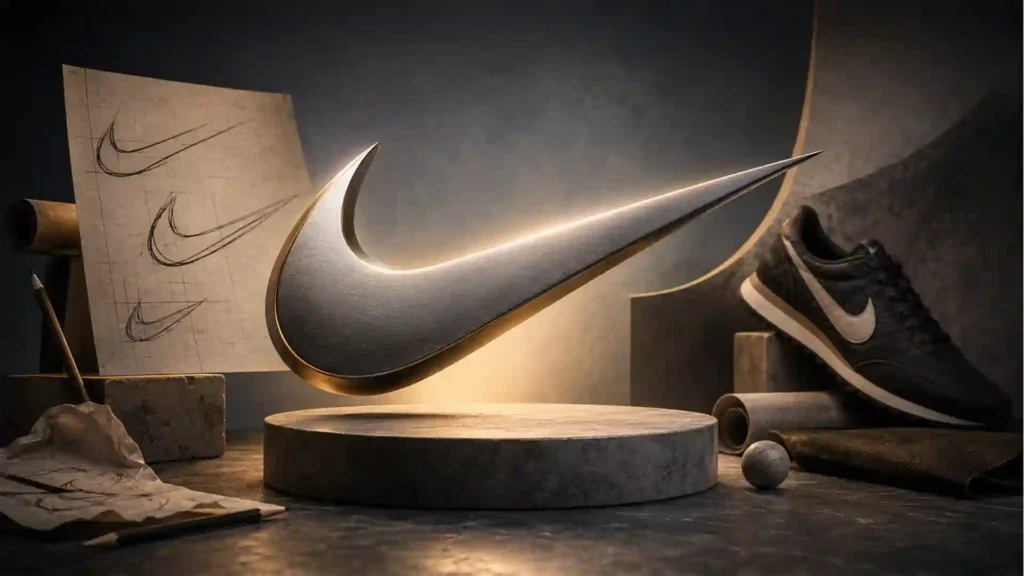
This article is an original analysis supported by the sources cited below
The Nike Swoosh logo from humble beginnings to global icon
Nike’s official history of the Swoosh, including Carolyn Davidson’s $35 invoice, the first shoe using the mark, Phil Knight’s reaction, and early uses of the logo.
Legendary by design
Portland State University’s alumni profile of Carolyn Davidson, covering the hallway meeting with Phil Knight, the design brief, the $35 bill, and later recognition.
Fact check Nike paid $35 for its logo but later gave the designer shares and a ring
Reuters’ verification of the $35 claim and the missing context around Nike’s later gifts to Davidson.
Nike stock splits
Nike Investor Relations page listing the company’s historical stock splits used to assess the split-adjusted value of the Davidson stock gift.
Nike 2025 Form 10-K
Nike’s fiscal 2025 annual filing with financial results, segment structure, manufacturing footprint, product development information, margins, and channel performance.
Nike reports fiscal 2025 fourth quarter and full year results
Nike’s June 26, 2025 earnings release with fiscal 2025 revenue, Nike Brand performance, Nike Direct results, demand creation expense, and full-year business context.
Nike reports fiscal 2026 third quarter results
Nike’s March 31, 2026 earnings release covering third-quarter revenue, gross margin, Direct and wholesale trends, net income, inventory, dividends, and management commentary.
Elliott Hill President and CEO
Nike’s executive profile of Elliott Hill, including his current role, more than 32 years at Nike, and prior commercial and marketing leadership responsibilities.
Nike reintroduces Just Do It to today’s generation with Why Do It campaign
Nike’s 2025 campaign release explaining the 1988 origin of “Just Do It,” the new “Why Do It?” campaign, and the athletes featured in the relaunch.
Nike is strongest apparel brand globally in 2025 Chanel is most valuable
Brand Finance’s 2025 apparel ranking release naming Nike the strongest apparel brand globally and explaining its Brand Strength Index score.
Kantar BrandZ most valuable global brands 2026
Kantar’s 2026 BrandZ global ranking page showing the dominance of technology brands and the broader brand-value context used to qualify Nike’s global position.
Bets surge against Nike heaping pressure on CEO Hill
Reuters’ May 2026 report on short interest, investor pressure, inventory, margins, innovation concerns, market share decline, and the market’s view of Nike’s turnaround.
Nike forecasts surprise sales drop as China weakness hurts turnaround efforts
Reuters’ coverage of Nike’s fiscal 2026 third-quarter market reaction, China weakness, sales outlook, direct-channel decline, and turnaround pressure.
Nike’s China stumble exposes execution gaps
Reuters’ analysis of Nike’s China challenges, including local competition, inventory issues, premium perception, localization, and operational execution.
Responsible supply chain
Nike’s description of its supply chain programs, including worker engagement, gender equity, safe workplaces, and supplier capability work.
Nike manufacturing map
Nike’s public manufacturing map for exploring independent factories and material suppliers used to manufacture Nike products.
Nike Mind
Nike’s product page describing Nike Mind technology and the company’s claims about sensory activation through underfoot design.
Nike debuts its first neuroscience-based footwear
Nike’s official release on the Mind 001 and Mind 002 footwear platform and its positioning around mind-body connection.
Health and safety
Nike’s supply chain health and safety page describing expectations for workplace safety across operations and suppliers.
Reuters company profile Nike Inc
Reuters’ Nike company page used as a current-news gateway for Nike’s market, business, and corporate coveage.
| Citing this article? Brief excerpts are welcome. Please credit Webiano.digital, name the author where stated, and include a link to https://webiano.digital and to this original article. Full or substantial republication requires prior written permission. Read our Copyright and Content Use Policy. |
This article was prepared with the assistance of artificial intelligence tools. The content underwent expert human review, and Webiano Digital & Marketing Agency assumes editorial responsibility for its final version and publication.