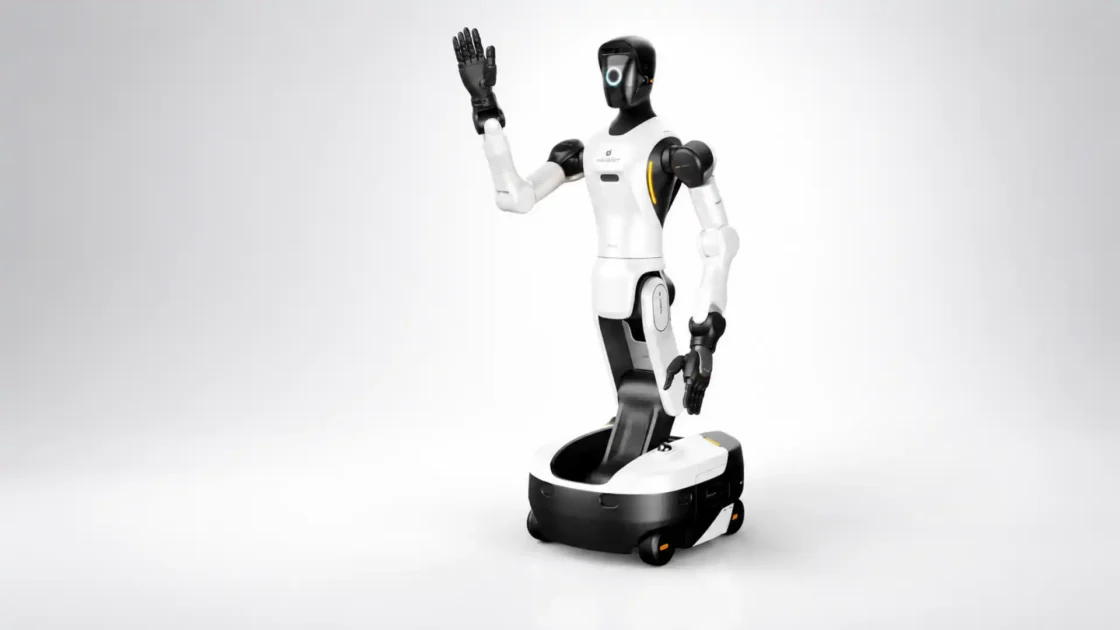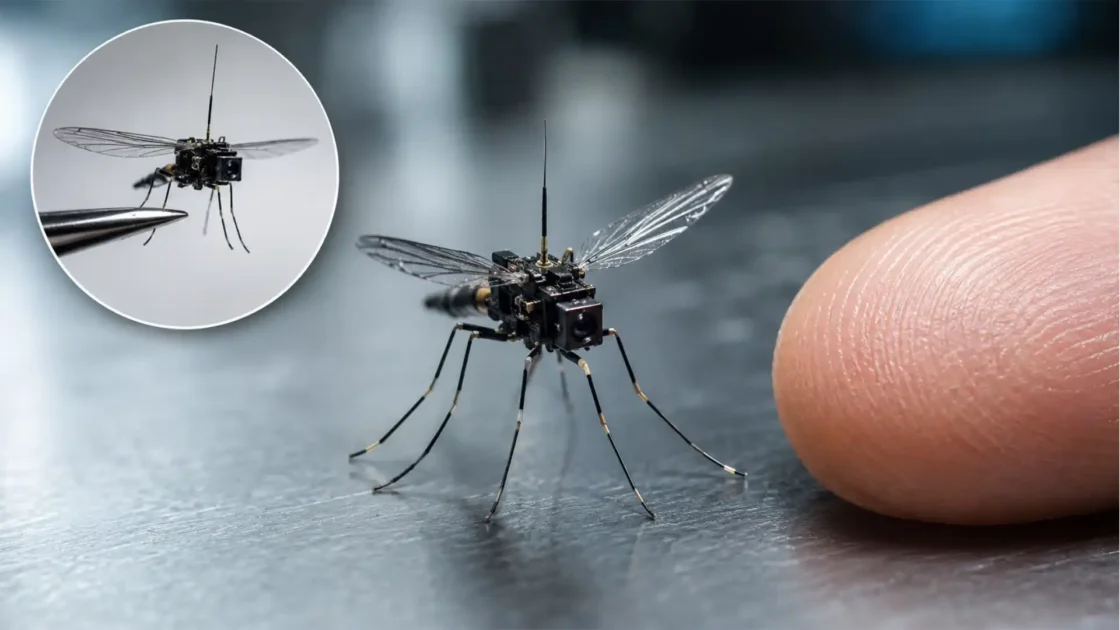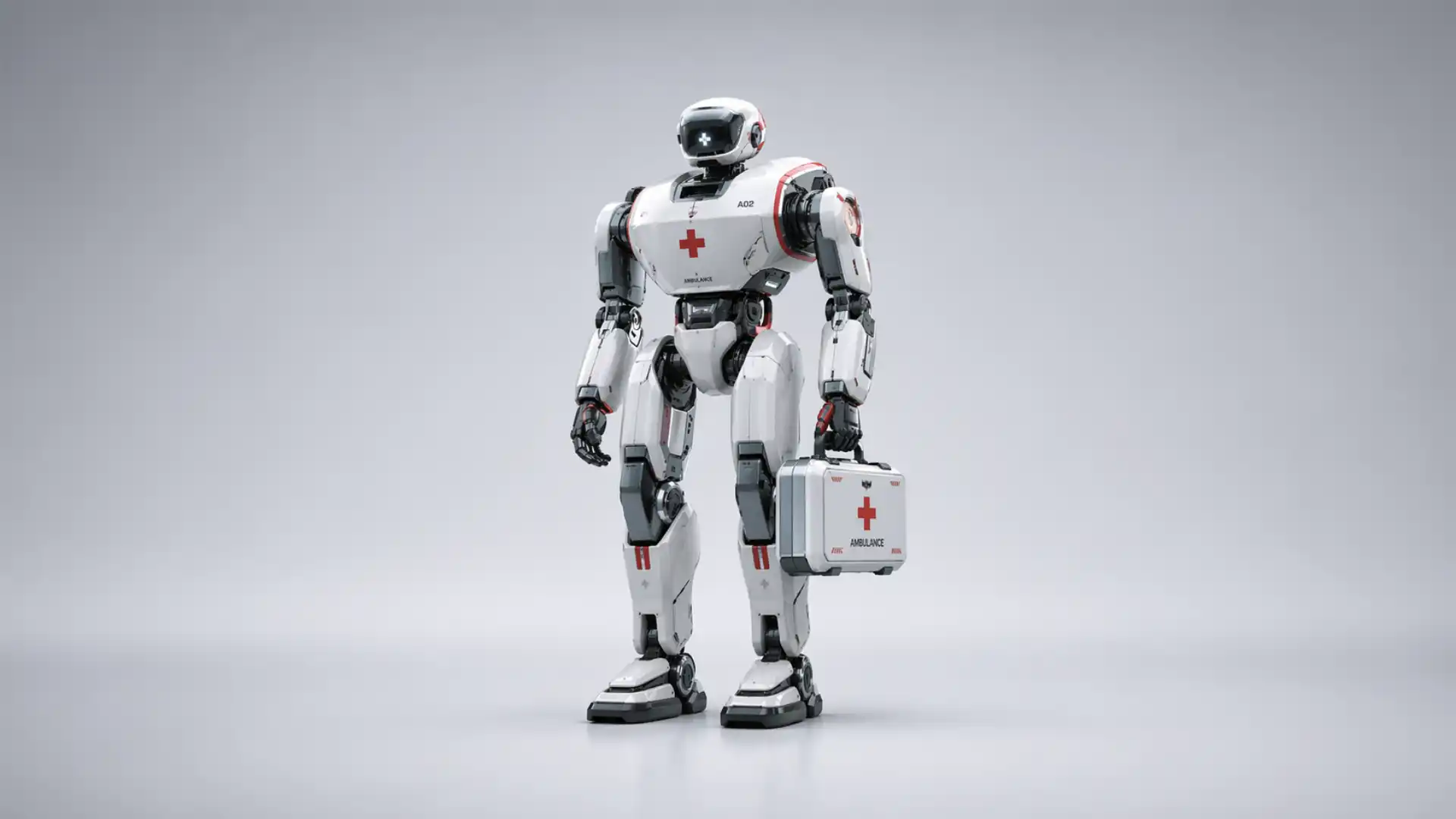
On April 15, 2026, JD officially launched a service in China called “robot ambulance”. It is not a medical ambulance for people. It is an after-sales rescue and repair network for humanoid robots, quadruped robots, AI companion robots, and related machines. JD says the service covers basic repairs, fault diagnosis, battery replacement and recharging, testing and certification, cosmetic maintenance, and equipment recycling. It started in Beijing, with a stated plan to reach more than 50 core Chinese cities within three years. JD and local reports also say parts of the service model have already reached European markets, with further international expansion planned.
Table of Contents
The phrase matters because it captures a shift that is easy to miss. A robot market stops looking experimental when somebody builds the tow truck. A flashy humanoid on a stage gets attention. A repair van, a spare-parts network, a same-day service promise, and a set of maintenance standards do not get the same applause, but they tell you much more about where the industry thinks demand is going. JD’s move lands at a moment when China’s humanoid and service-robot sector is expanding fast, policymakers are formalizing standards, and public events such as Beijing’s humanoid half-marathon are turning robots into highly visible stress tests rather than lab curiosities.
There is also a second reason the name lands so sharply. China has already experimented with AI-assisted ambulance systems for human emergency care, including trials aimed at beating traffic delays and sending pre-hospital data to centralized systems. That makes JD’s branding feel deliberate. It borrows the emotional grammar of emergency response, but applies it to machines. The message is blunt: robots are no longer being sold as gadgets that sit on shelves. They are being framed as assets that will break, need triage, require uptime, and deserve a service chain built around them.
A launch that says more than the press release
The easiest way to misread this story is to treat it as a novelty item. It is not. The launch is really about market maturity. When companies start arguing about response times, maintenance coverage, spare-parts logistics, and technician recruitment, they are no longer talking about robots as one-off demos. They are talking about installed base, service obligations, and repeatable commercial operations. JD’s own language reflects that. The company did not pitch a one-off workshop. It pitched a field service network, a response standard, and a workforce build-out.
That timing lines up with China’s industrial policy. Reuters reported in November 2023 that China’s industry ministry issued humanoid-robotics guidelines that aimed to have an innovation system taking shape by 2025. State Council and Xinhua reporting through 2024 and 2026 added the next layer: by 2027, China wants a secure and reliable industrial and supply-chain system, while officials and industry committees are building standards meant to support industrial application, household use, and broader commercial rollout.
That policy backdrop now meets a much denser market than China had even a short time ago. Xinhua reported in March 2026 that more than 140 domestic manufacturers released over 330 humanoid robot models in 2025, which the ministry treated as the first year of mass production for the segment. When that many models hit the market in that little time, after-sales support stops being a side issue. It becomes a structural problem. Buyers need someone to answer for failures. Brands need someone to handle warranty costs, field failures, transport, diagnosis, and parts. Platforms need someone to prevent public breakdowns from turning into trust collapse.
This is why JD’s announcement is more revealing than a product launch. It shows where the pressure is building. The pressure is no longer just on who can build a more graceful gait or a cheaper actuator. It is on who can keep a robot alive in the field, who can move broken units quickly, who can certify repairs, and who can do all of that across cities rather than inside one industrial park. That is infrastructure work, not showroom work.
The service behind the name
JD’s official and mirrored launch descriptions are unusually specific for a branding-heavy announcement. The company says the service will support humanoid robots, quadruped robots, and AI companion robots. Coverage includes maintenance and repair, diagnosis, battery-related services, testing and appraisal, cosmetic maintenance, and equipment recycling. The first operating geography is Beijing. The expansion plan is national, and the pitch is explicitly on-site.
The part that matters most is the service promise JD calls the “120” standard. The company says it is committing to a one-minute response, a two-hour on-site arrival, and same-day repair for “minor illnesses”. When damage is severe, the job moves from field rescue to a workshop model, with JD’s logistics network taking the unit to a nearby repair center. IT Home, citing JD’s official account, added that JD has already laid out eight repair centers nationwide, framed as the “central hospitals” for more serious robot failures. That language may be theatrical, but the structure is easy to understand: field diagnosis first, depot repair second, logistics in between.
What the service actually covers
| Service block | What JD says it will do |
|---|---|
| Field response | One-minute response, two-hour arrival, same-day repair for minor faults |
| Workshop escalation | Send heavily damaged robots through JD’s logistics network to nearby repair centers |
| Full lifecycle support | Repairs, diagnosis, battery service, testing, cosmetic care, and recycling |
The table looks simple because the commercial idea is simple. JD is trying to turn robot maintenance into a standardized service product. That matters more than the branding flourish. Once repair becomes a product with response times, routing rules, and service tiers, robot ownership starts to look less like a science project and more like a managed category.
JD is also talking scale, not boutique support. Another company-linked report said the service will eventually cover the vast majority of robot brands, reach 50-plus core cities, expand overseas, and grow the pool of robot engineers to more than 10,000 people. The same report says JD wants to connect brands to online and offline channels that can reach over 700 million active JD users and 8 million enterprise customers, while opening real-life scenarios through malls, supermarkets, pharmacies, and local services. That is not the language of a repair shop. It is the language of a platform trying to own the service layer of a new hardware category.
Repair becomes part of the product
A lot of new technology markets make the same mistake in their early phase: they behave as if the product ends when the unit ships. Robots expose that mistake fast. They have moving joints, batteries, sensors, software stacks, and bodies that collide with the world. They fall. They overheat. They lose calibration. They break in public. A customer buying a floor lamp can accept dead stock. A company renting a humanoid for reception, inspection, retail, sport, or training cares about uptime.
That is why the after-sales layer matters so much. For a robot brand, the real question is not only whether the machine can run, dance, or guide a visitor. It is whether the machine can do those things again next week, after transport, daily wear, firmware changes, and a bad battery cycle. The cost of failure is not just repair cost. It is reputation cost, demo failure, customer churn, and wasted deployment time. A robot that cannot be serviced at speed is a risky purchase even if the sticker price looks attractive.
Reuters captured the same tension in its preview of the 2026 Beijing robot half-marathon. The visible performance gains are real, but experts quoted in the piece said the industry still struggles with manual dexterity, real-world perception, and capabilities beyond narrow repetitive tasks. Chinese firms are pouring money into data collection because software remains a bottleneck, and analysts say components makers are still under cost pressure. In that environment, maintenance is not a side benefit. It is a way of buying time while the underlying models and hardware improve.
That logic also explains why JD’s pitch uses medical language so heavily. “Small illness” repaired the same day. “Big illness” routed to a center hospital. It is theater, but not empty theater. It gives enterprise buyers a familiar mental model. You do not need to understand every gearbox, controller, and model update. You only need to know that there is a chain of escalation when something fails. Markets often grow when technical complexity gets hidden behind service simplicity.
China’s robot surge is moving from prototypes to fleets
The broader Chinese robotics picture makes JD’s move easier to place. On the industrial side, the International Federation of Robotics said in September 2025 that China had reached a record 2.027 million industrial robots working in factories, with 295,000 installations in 2024 alone. The same organization said in April 2026 that Asia averaged 131 robots per 10,000 manufacturing employees in 2024, underscoring the depth of automation already present across the region. China is not building this service layer on top of a tiny robotics base. It is building it inside a country that already treats automation as core industrial infrastructure.
Humanoid numbers are still smaller, but the direction is unmistakable. The research estimates vary, which is worth saying plainly. Xinhua, citing Omdia, put global humanoid shipments in 2025 at about 13,000 units. CGTN, citing IDC, put the figure at around 18,000, up 508 percent year on year. The two estimates do not match, but they tell the same story: the market is still early, growth is steep, and Chinese firms dominate the supply side. Xinhua said AgiBot shipped more than 5,100 units in 2025, while CGTN said AgiBot and Unitree were leading shipments in a rapidly widening field.
Reuters added another useful benchmark ahead of the April 2026 half-marathon: China accounted for more than 80 percent of the 16,000 humanoid units installed worldwide in 2025, according to Counterpoint Research cited in the report. The same Reuters piece noted that domestic leaders AgiBot and Unitree each shipped more than 5,000 units last year, and that Unitree plans to raise annual capacity sharply. That is the kind of scale where maintenance headaches stop being anecdotal. They become a system problem.
There is also a consumer and service-market angle. Xinhua reported in February 2026 that China’s service robot output reached 13.5 million units in the first three quarters of 2025, already above the annual total for 2024. That figure covers a much broader universe than humanoids, but it matters because it shows where the pressure on after-sales systems will come from. The robot market that needs service is not just the humanoid market. It includes delivery, cleaning, reception, retail, inspection, education, and companion devices that are spreading across public and private spaces.
Beijing’s half-marathon worked as a public stress test
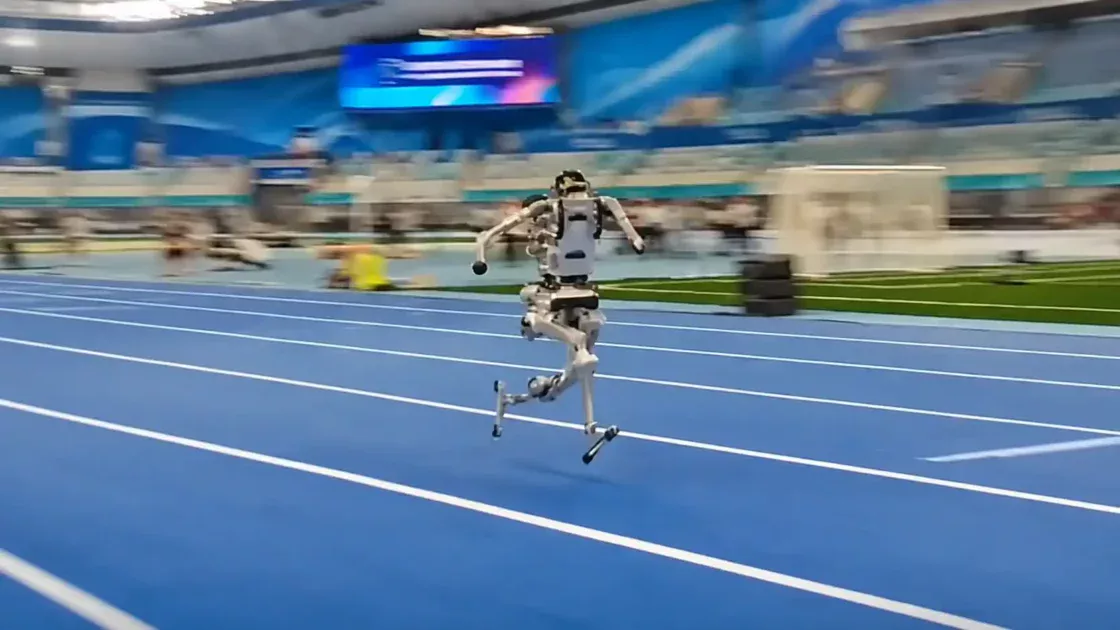
The Beijing E-Town half-marathon is easy to treat as a viral spectacle. It is also one of the clearest demonstrations of why a service network suddenly looks urgent. Beijing’s official event page said the 2026 E-Town Half Marathon and Humanoid Robot Half Marathon would welcome 12,000 participants. Reuters reported that more than 300 humanoid robots from over 70 teams were set to tackle a 21-kilometer course with tougher terrain than the year before, while nearly 40 percent were expected to navigate autonomously.
That is not a lab benchmark. It is an endurance test in public view. Reuters noted that all entrants in the prior year had been remotely controlled, while the 2026 race pushed autonomy much harder. Xinhua later reported that the robot called Flash won the 2026 race in 50 minutes and 26 seconds, beating the men’s human half-marathon world record. However dramatic that headline sounds, the same Reuters preview warned that the event would expose durability limits, battery-life questions, and the gap between showy locomotion and useful work.
JD positioned itself directly inside that gap. Company-linked reports said JD was the event’s AI technology strategic partner and would provide transport, rescue, repair, battery replacement, and storage support around the race. IT Home added that JD deployed multiple robot ambulances and stationed robot maintenance engineers along supply points so failures could be handled quickly. That is a smart place to market a service. A robot competition is public, unforgiving, mechanically stressful, and highly shareable online. Every repaired unit becomes a demonstration.
There is a larger point here. Events like this turn service into part of the performance. Nobody watching a robot stumble on a training track cares whether the failure came from software, hardware, thermal management, or damage in transport. They care whether it gets back up, gets back out, or disappears from the field. A working support chain becomes part of the product story. JD seems to understand that.
Standards and service rules are arriving at the same time
A repair network becomes far more useful when the things it repairs start to share standards. China is trying to move that part of the market too. In April 2025, Beijing’s English-language government site reported that China’s first national standards for humanoid robot technical requirements had been approved for development, covering environmental perception, decision-making and planning, motion control, and task execution. The Beijing Humanoid Robot Innovation Center was described as a major contributor to those standards.
The follow-through arrived in March 2026. Xinhua reported that China had released its first national standard system for humanoid robotics, described as a comprehensive top-level framework for the full industrial chain and lifecycle. It was developed with over 120 research institutions, companies, and industry users, and structured around six pillars including common standards, intelligent computing, components, full-system integration, application, and safety and ethics. Xinhua’s description matters because it explicitly says application standards govern development, operation, and maintenance across scenarios.
That makes JD’s launch look less isolated. A service network works best when parts, interfaces, testing criteria, and evaluation rules stop changing in completely incompatible ways from one vendor to the next. Standards reduce adaptation costs, lower spare-parts friction, and make technician training more transferable. Xinhua’s March 2026 report said the framework is supposed to unify technical specifications and evaluation criteria while helping modularization and large-scale production. Those are exactly the conditions that make a national repair network easier to run.
Beijing has been building the institutional side for a while. In late 2023, the Beijing Investment Promotion Service Center said the capital had established a humanoid robot innovation center in Beijing E-Town to accelerate technology supply and industrialization. State Council reporting in October 2024 said that center had been upgraded into a national-and-local co-built embodied AI robotics innovation center, with support for R&D, standards, cost reduction, and application expansion. JD’s service launch fits neatly into that policy environment. It is not the state building the repair vans, but it is a major platform adapting itself to the same industrial direction.
JD is borrowing its logistics playbook
JD did not wake up in April 2026 and discover robots. The company has spent years turning robotics and autonomous delivery into part of its logistics identity. JD’s corporate blog said in 2022 that JD Logistics was operating 700 delivery robots during Singles’ Day, including 600 autonomous outdoor robots and 100 indoor robots, and that the system had spread into retail and urban settings. The same source said each robot could carry up to 200 kilograms and travel 100 kilometers per charge.
Another JD corporate post from March 2022 said the company had deployed autonomous delivery robots in Shanghai during COVID restrictions, and that since 2020 it had used autonomous delivery vehicles in Wuhan, Shijiazhuang, Guangzhou, Beijing, Tianjin, Shenzhen, and Shanghai. That piece said the robots in Wuhan had traveled over 6,800 kilometers and delivered more than 13,000 packages during the peak of the early pandemic. It also said JD had debuted its first autonomous delivery vehicle in 2016 and its Level-4 robot in 2019.
An earlier JD in-depth report from 2021 adds the regulatory and operational context. JD said it was among the first companies in China to receive qualification for autonomous delivery vehicle road tests, and that its autonomous delivery vehicles were already in daily use in more than 20 Chinese cities. The report framed this as a response to labor costs and logistics efficiency, but the deeper value was organizational. JD has spent years building route planning, dispatch, roadside operations, localized delivery, and machine management. The robot ambulance service looks like a reuse of those competencies, not a leap into a foreign business.
That is why JD is a credible candidate to own this layer. A traditional robot maker may understand the machine better, but JD understands nationwide service choreography. It knows how to route assets, manage technicians, promise arrival windows, connect field work to depots, and fold customer service into a digital ordering system. It is effectively applying an e-commerce and logistics brain to a robotics after-sales problem.
The business case is broader than consumer novelty
Most readers see humanoid robots and think of showroom demos, social media clips, or corporate mascots. Those are part of the market, but not the whole thing. JD’s own partner-facing material says it wants to connect brands to retail channels, enterprise customers, and a long list of real-world scenarios through malls, supermarkets, pharmacies, and life services. That signals a category push beyond engineering labs. The goal is not just to fix robots after they fail. The goal is to make buying and deploying them feel normal.
China has reasons to want that. The country’s statistical communiqué said that by the end of 2024, the population aged 60 and above had reached 310.31 million, while those 65 and above totaled 220.23 million, or 15.6 percent of the population. Separate government guidance in January 2025 said China would promote humanoid robots and AI technologies for elderly care and home services. That does not prove humanoids are ready to take over care work. It does show where policymakers expect long-term demand to exist. If robots are supposed to move into homes, senior services, clinics, stores, and service counters, after-sales reliability becomes a public trust issue, not just a procurement detail.
The consumer side also matters because expectations are harsher there. An industrial buyer can tolerate downtime inside a pilot project. A household buyer or a mall operator usually will not. Xinhua reported in February 2026 that robots were already being used in malls, commercial performances, exhibition guidance, and custom enterprise scenarios, while a “future robot 6S center” in Jinan was offering sales, service, spare parts, scenario solutions, and training. That detail is revealing because it echoes the same pattern as JD’s launch: sales alone are not enough anymore. The market wants bundled support.
A repair-and-rescue service also helps the brands. Small and mid-sized robot makers may not have the money, headcount, or regional coverage to build a national field-service network on their own. Plugging into a platform operator with logistics depth can lower service risk and shorten time to market. JD’s partner pitch makes this explicit by tying service to commercialization speed, channel reach, and scenario rollout.
The weak points are still very real
None of this cancels the hard part. China’s robot market is growing faster than its reliability problem is disappearing. Reuters’ marathon preview quoted founders and analysts who said the sector is still at a very early stage, with weak success rates in applied models and a lot of “dancing disguised as working.” That phrase is brutal, but it captures the current gap perfectly. Public demos can outrun daily utility for a while. They cannot do it forever.
Xinhua’s March 2026 report on standards made the same point in more official language. It said the sector still faces scenario fragmentation, high costs, insufficient generalization of AI models, and partial reliance on imported core components. Those are not cosmetic issues. They cut directly into whether robots can be repaired cheaply, whether spare parts are interchangeable, whether technicians can solve problems consistently, and whether field support turns into a margin sink.
There is also a branding risk. Calling a repair van a “robot ambulance” is smart because it is memorable. It also raises the emotional stakes. If response times slip, if parts are unavailable, if brands dump weak hardware into the market and expect JD’s service layer to absorb the fallout, the branding could backfire. An ambulance is supposed to arrive. The metaphor carries a promise. Once the name catches on, performance will be judged against it.
A final limit sits in the economics. Fast field service is expensive. Same-day repair is expensive. Training 10,000 robot engineers is expensive. National coverage across 50 cities is expensive. Someone pays for that, whether it is the platform, the brand, the buyer, or a mix of all three. The success of JD’s move will depend on whether the robot market grows quickly enough to spread those costs across a large installed base. That is still an open question, even in China.
A small launch with large implications
The strongest reading of JD’s robot ambulance launch is not that China has invented a cute new service name. It is that the market has reached the point where maintenance is now a competitive battleground. That is a more serious development than a new demo robot or a one-day race result. It says the argument is shifting from what robots can do on stage to what they can survive in the field.
It also says something about who may win the next layer of the robotics business. The winners may not be only the firms with the best limbs, the smoothest gait, or the cheapest bill of materials. They may also be the firms that own dispatch, service, certification, battery support, spare parts, and trust. In that contest, a platform with national logistics muscle and millions of existing customer touchpoints has obvious advantages.
So the headline is slightly absurd, and still dead serious. China’s robot market now has roadside assistance. That sounds funny until you realize what it implies: more machines in circulation, more buyers willing to deploy them, more public failures that need quick recovery, and more confidence that robots are becoming part of everyday commercial life. That is what JD’s launch really marks. Not the arrival of a gimmick, but the arrival of a service layer that serious hardware markets usually need before they stop feeling provisional.
FAQ
It is an after-sales service for robots in China. JD says it provides repair, diagnosis, battery services, testing, cosmetic maintenance, and recycling for humanoid robots, quadruped robots, AI companion robots, and related devices.
No. The April 15, 2026 launch was a robot repair and rescue network for machines, not a human emergency-care ambulance. China has separately explored AI-assisted ambulance systems for human care in the past, which is why the name can confuse readers.
JD’s launch announcement was reported on April 15, 2026.
The first operating area is Beijing.
JD says the network is supposed to expand to more than 50 core Chinese cities within three years.
JD says it covers humanoid robots, quadruped robots, AI companion robots, and similar frontier robot products.
JD describes it as a service promise of a one-minute response, two-hour on-site arrival, and same-day repair for minor issues.
JD-linked reporting says severely damaged robots can be routed through JD’s logistics network to nearby repair centers, while field teams handle simpler faults on site.
IT Home, citing JD’s official account, said JD has laid out eight repair centers across China.
Because it shows the industry is moving beyond demo machines. A real service network suggests that vendors and buyers expect larger deployments, more failures in the field, and a need for predictable uptime.
Yes. The IFR said China had 2.027 million industrial robots operating in factories by 2024, with 295,000 new installations that year.
Estimates differ by research firm, but the direction is clear. Reuters cited Counterpoint saying China accounted for more than 80 percent of 2025 global humanoid installations, while Xinhua and CGTN summaries of Omdia and IDC reports also showed Chinese firms leading shipments.
It put more than 300 robots from over 70 teams on a 21-kilometer course, forcing public tests of durability, battery life, autonomy, and service support. JD also used the event to show its rescue and repair capability.
Xinhua reported that the robot Flash finished the 2026 Beijing E-Town robot half-marathon in 50 minutes and 26 seconds, faster than the standing men’s human half-marathon world record of 57:20.
Because common technical requirements and evaluation rules make parts, testing, training, and maintenance more transferable across products. China’s first national standard system for humanoid robotics is meant to reduce fragmentation and support industrial application.
Beijing E-Town has become a major center for embodied AI and humanoid robotics, hosting the half-marathon, innovation centers, and contributions to national standards.
Because it already has deep logistics, dispatch, and autonomous-delivery experience. JD has spent years operating delivery robots and autonomous vehicles in multiple Chinese cities.
Yes. A national repair and response network can lower the burden on brands that do not have the money or headcount to build their own field-service operations in dozens of cities. That is part of why JD is pitching the service as ecosystem infrastructure.
Not fully. Reuters and Xinhua both point to major limits, including weak generalization of AI models, high costs, fragmented scenarios, and the gap between eye-catching demos and dependable real work.
Author:
Jan Bielik
CEO & Founder of Webiano Digital & Marketing Agency
This article is an original analysis supported by the sources cited below
京东推出“机器人救护车”,已率先服务北京地区
A Beijing Daily-hosted version of JD’s launch announcement detailing scope, Beijing rollout, expansion, overseas plans, and the “120” service standard.
2026 人形机器人半马今日举行,京东部署多辆“机器人救护车”
IT Home report summarizing JD’s race-day support, eight repair centers, and the field-repair logic behind the service.
京东发布机器人产业服务全景图 护航保障2026北京亦庄人形机器人半程马拉松
JD-linked article outlining channel reach, partner strategy, city coverage targets, and engineer recruitment plans.
JD.com launches robot ambulance service, plans expansion to 50+ cities across China
English summary of the launch, including the Beijing pilot and national expansion timeline.
JD.com Launches “Robot Ambulance”
English industry report with added detail on overseas localization and the “120” promise.
China humanoid robot half-marathon to showcase technical leaps
Reuters report on the Beijing race, autonomy rates, commercial limits, shipment dominance, and the gap between demos and real deployment.
Humanoid robot surpasses human half-marathon world record in Beijing
Xinhua report on the 2026 race result and Flash’s record-setting finish.
Wanna Run with Robots? Registration Opens for 2026 E-Town Half Marathon
Official Beijing page confirming the event format and 12,000-participant scale.
China issues guidelines for development of humanoid robotics
Reuters coverage of MIIT’s 2023 humanoid robotics guidelines and 2025 innovation-system goal.
China pools efforts to fuel development of embodied AI robotics
State Council-linked report on the national and local innovation-center push and the 2027 supply-chain target.
China’s first national standard system for humanoid robotics poised to spur industry development
Xinhua report explaining the first national standard system, its six-pillar structure, and the market fragmentation it is meant to address.
China’s First National Standards for Humanoid Robots Approved for Development
Beijing government report on the first approved national technical standards for humanoid robots.
Beijing Establishes Humanoid Robot Innovation Center
Official Beijing investment page describing the city’s humanoid robot innovation-center buildout.
Chinese firms lead global humanoid robot production in 2025
Xinhua summary of Omdia data on leading vendors and 2025 shipment estimates.
IDC report: China leads the global humanoid robot rise in 2025
CGTN summary of IDC’s shipment, revenue, and product-mix estimates for 2025.
China Tops World Record of 2 Million Factory Robots
IFR press release showing China’s industrial robot stock and 2024 installation scale.
Robot Density Surges in Europe, Asia, and Americas
IFR update providing the broader automation context around manufacturing robot density.
Statistical communiqué of the People’s Republic of China on the 2024 national economic and social development
National Bureau of Statistics report used for China’s 2024 age-structure figures.
China to promote use of humanoid robots for elderly care
Official policy report showing where Chinese policymakers expect future service demand for humanoid robots.
AI ambulances and robot doctors: China seeks digital salve to ease hospital strain
Reuters report used to distinguish JD’s branding from earlier human-healthcare ambulance digitization efforts.
JD Logistics Operates 700 Delivery Robots to Serve This Singles’ Day
JD corporate report showing the company’s prior experience operating delivery robots at scale.
JD.com Utilizes Robots in Shanghai for Contactless Delivery
JD corporate report on pandemic-era robot deployment and the company’s long-running autonomous-delivery operations.
Report: Why, How and When about Autonomous Delivery Vehicles
JD corporate backgrounder on road-test qualifications, multi-city deployment, and the company’s autonomous delivery strategy.
Humanoid robots break new grounds for Chinese consumer market
Xinhua report on service-robot output, consumer-facing deployment, and the widening commercial use of robots in China.
| Citing this article? Brief excerpts are welcome. Please credit Webiano.digital, name the author where stated, and include a link to https://webiano.digital and to this original article. Full or substantial republication requires prior written permission. Read our Copyright and Content Use Policy. |
This article was prepared with the assistance of artificial intelligence tools. The content underwent expert human review, and Webiano Digital & Marketing Agency assumes editorial responsibility for its final version and publication.