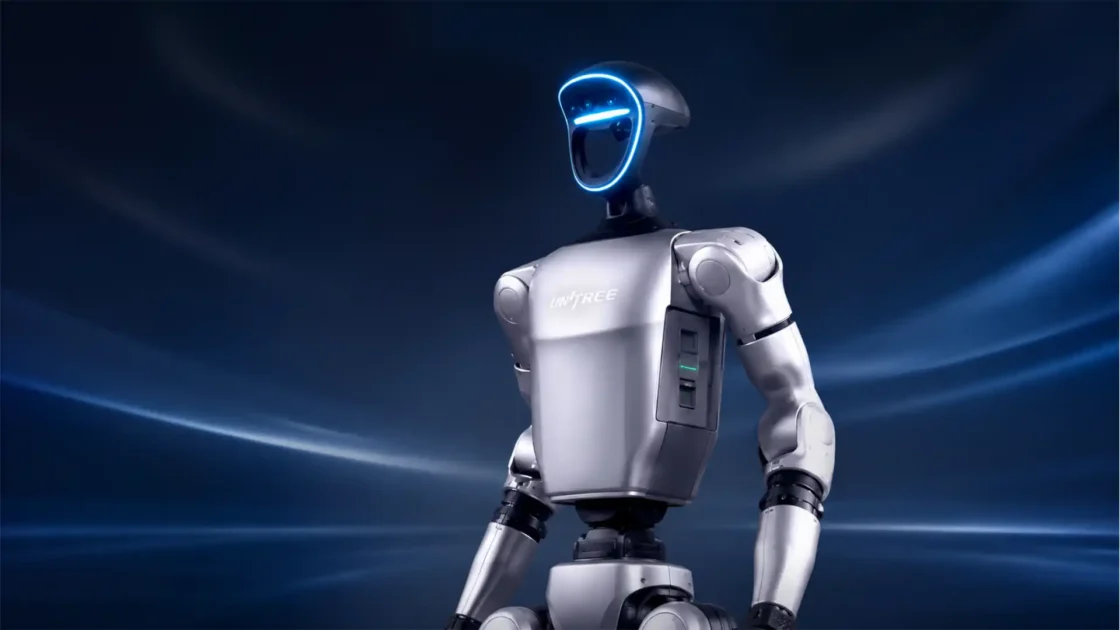
A headline built for virality
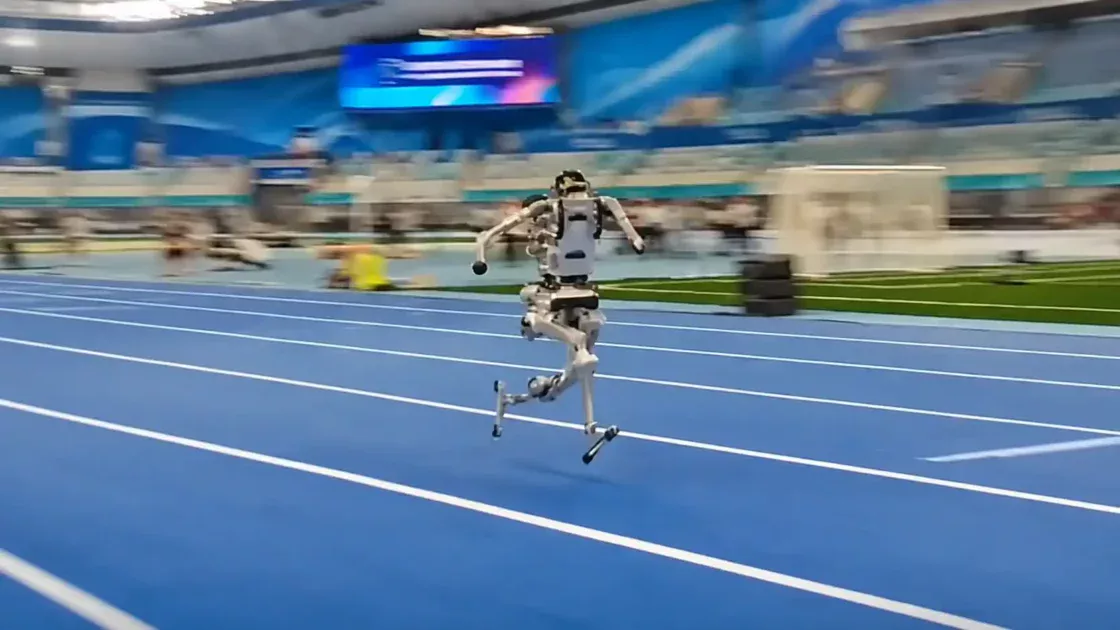
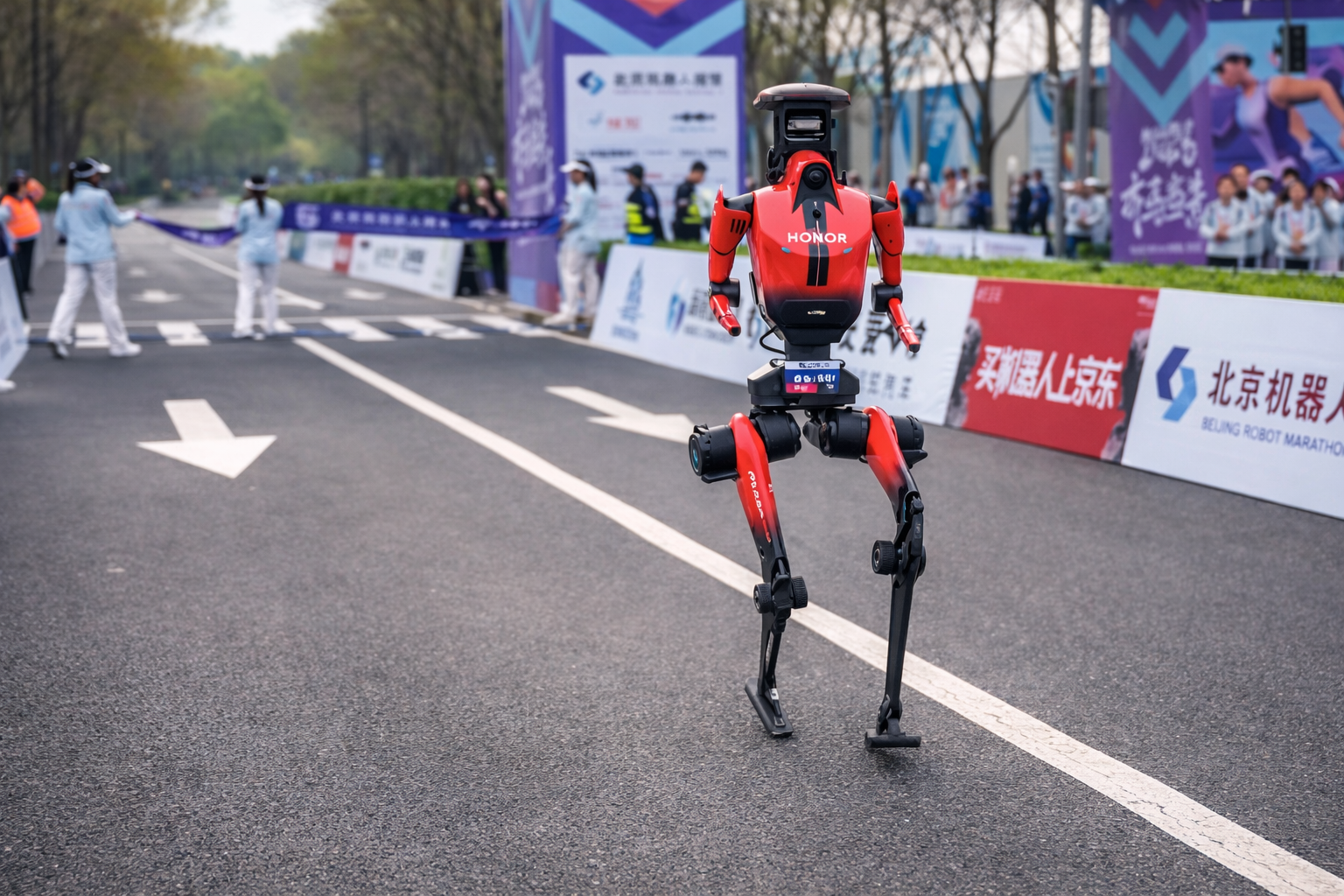
The headline is easy to understand and even easier to share: a robot in China ran a half marathon faster than a human. The core image is irresistible. A machine covers 21 kilometers in 50 minutes and 26 seconds. Human runners are on the same morning’s schedule. Photos show humanoid bodies striding down a course in Beijing. It feels like science fiction elbowing its way into the sports page. Reuters, AP, Xinhua and the Beijing municipal portal all agree on the basic result: an Honor-developed humanoid won the robot event in 50:26 during the 2026 Beijing E-Town Half Marathon and Humanoid Robot Half Marathon.
Table of Contents
The trouble starts when that result gets flattened into a cleaner, louder claim than the event itself supports. Yes, a robot posted a remarkable time. No, it did not enter the human half-marathon record system. No, it did not defeat elite human runners in a single undifferentiated field. The robots and human runners used the same general route, but they ran on separate tracks, divided by guardrails or medians, and the robot competition had its own structure, its own groups, and its own judging logic. Reuters said the 12,000 human runners and the robots ran in parallel lanes to avoid collisions, while Xinhua had already previewed the event as a same-route, separate-track race.
Even the robot’s name tells you something about how quickly this story traveled across languages. The Beijing government called the winner Shandian. Xinhua called it Flash. Other English reports used Lightning. All of those are translations of the same Chinese word, 闪电. A Slovak headline calling the robot Blesk is translating the same name again, not identifying a different machine.
That does not make the event less impressive. It makes it more interesting. The real story is not that robots have taken over road running. The real story is that long-distance humanoid locomotion, which looked shaky and almost comic only a year earlier, has improved at a startling pace. Beijing’s race turned a novelty into a serious engineering benchmark.
The facts under the viral claim
On race day, Beijing E-Town hosted a paired event: a conventional half marathon for human runners and a dedicated humanoid robot half marathon on the same overall course. The human side of the event was large. The Beijing municipal government said in March that the 2026 edition would welcome 12,000 participants. The robot side was also much larger than the 2025 debut. Reuters reported that more than 300 humanoid robots from more than 70 teams were expected, while the Beijing government’s race-day recap said over 100 teams competed on the course. Those counts are not mutually exclusive; one refers to robot units, the other to teams. They do show scale. The race had moved far beyond a one-off stunt.
The official winning time in the robot event was 50:26 for Honor’s autonomous entry. AP reported that a separate Honor robot in the remote-controlled category crossed first in 48:19, but the autonomous machine received the championship under weighted scoring rules that favored self-navigation. That distinction matters because it shows what organizers were really trying to test. This was not only a speed contest. It was also a public exam in perception, control, balance, thermal stability, battery management, and the ability to stay upright and on-course without constant human steering.
The claim in one glance
| Point | Best reading |
|---|---|
| A humanoid robot ran 21 km in 50:26 in Beijing | Correct |
| That time belongs in the human record books | No |
| The robot and humans ran under one identical competitive system | No |
The headline gets its force from the first row and its distortion from the next two. The stopwatch is real. The broader claim needs trimming. Reuters, Xinhua and the Beijing government all support the 50:26 result, while Reuters and Xinhua also make clear that the event used separate tracks and robot-specific competition rules.
There is also a quieter point that many quick summaries miss. The robot race was not hidden away in a lab or on a treadmill. It was embedded in a public sporting event with real terrain, public visibility, schedule pressure, and the kind of performance stress that exposes weak hardware fast. That matters because robotics headlines often come from highly controlled demos. A 21.0975-kilometer outdoor course is not controlled in the same way.
The stopwatch, the translations, and the record problem
The time itself is not in doubt. The harder question is the comparison with human records. Several race-day reports, including Reuters, AP and Xinhua, framed 50:26 as faster than the men’s half-marathon world record and pointed to Jacob Kiplimo’s 57:20 from Lisbon in March 2026.
Yet World Athletics’ own published all-time list currently shows something else. Its official top list for the men’s half marathon lists Jacob Kiplimo at 56:42, set in Barcelona on 16 February 2025, as the fastest mark on record. World Athletics also published a race report on that Barcelona performance calling it a world record. That creates an obvious conflict between some same-day news coverage and the governing body’s own record table.
The safest reading is blunt: the robot produced a sensational robot-racing time, but the human world-record comparison in some reports is inconsistent with World Athletics’ current official listing. That does not rescue the human-vs-robot framing. It weakens it. A machine cannot simply be dropped into human athletics recordkeeping because the number on the clock is lower, and here the clock comparison itself is muddied by conflicting reporting.
World Athletics’ recent record trail helps show why this got messy so fast. The organization ratified Yomif Kejelcha’s 57:30 from Valencia as a world record in October 2025, and its all-time list now places Kiplimo’s 56:42 above that. So the human benchmark has moved quickly, and some news reports around the robot race appear to have relied on a different, incompatible reference point. For readers, the important conclusion is not which of those conflicting headlines sounds bigger. It is that the official human record book remains a human record book.
Separate tracks, separate rules, different competition
The cleanest correction to the viral headline is also the most useful one: this was not a robot entering a human championship and taking the crown. The event was deliberately designed as a twin-format showcase. Xinhua said robots followed the same route as human runners on separate tracks, divided by guardrails or median strips. Reuters said the robots and the 12,000 human runners used parallel tracks to avoid collisions.
Rules mattered just as much as lanes. In the 2025 inaugural edition, Xinhua described robot support teams, sequential starts, dedicated tracks and battery swaps that functioned like Formula 1 pit stops. Awards also included categories beyond outright speed, such as endurance, gait design and innovation. The 2026 event kept that spirit while splitting robots into autonomous navigation and remote control groups. Once you know that, the race reads less like a simple footrace and more like a hybrid of sport, field test and industrial exhibition.
That does not cheapen the achievement. It clarifies it. Human road running is a contest of physiology, pacing, training, weather, tactics and pain tolerance inside a fixed rulebook. Robot road running adds a different stack of variables: actuator efficiency, fall recovery, sensor fusion, onboard computation, controller tuning, mechanical wear, heat dissipation, swap strategy and autonomy quality. The competition was never about asking whether a silicon-and-metal body is “better” than a trained human body in the same sporting category. It was about measuring how far embodied systems can go outside the lab.
That distinction also explains why an autonomous 50:26 could rank above a remote-controlled 48:19. Organizers were rewarding the thing they most wanted to advance: independent navigation under race conditions. If the only goal were raw speed, a different class of machine would win easily. The entire point of a humanoid robot half marathon is to test locomotion that resembles human movement in a public environment, not to discover whether wheels, rails or drones are faster ways to move from start to finish.
Running is one of the hardest jobs in humanoid robotics
A lot of robot demos look impressive because they are short. A wave. A dance routine. A neat pick-and-place move. A carefully staged forward flip. A half marathon strips away that comfort. Distance is cruel. Repetition is cruel. Heat is cruel. Tiny balance errors that do not matter in a 20-second clip become race-ending failures after thousands of steps. Xinhua’s 2025 event report described the technical burden in plain language: robots need dense integrated joints, bodies designed for endurance and heat dissipation, precise multi-joint coordination, navigation, obstacle avoidance, strong stability on slopes and turns, and enough battery life to survive the full route.
The course itself adds another layer. Reuters’ 2026 preview said the route included tougher terrain, including paved slopes and parkland. Xinhua’s 2025 coverage described cracked asphalt, gravel-strewn paths, undulating slopes and grassy sections. Those are modest obstacles for a healthy runner. For a humanoid system trying to keep its center of mass controlled while each foot strike sends shocks back through motors, gearboxes and frame, they are a serious systems test.
There is a reason engineers talk so much about gait. Human runners do not just move their legs quickly. They recycle momentum, stabilize with tiny subconscious corrections, adjust stride on broken surfaces, shift force through the hips, and absorb impact through tissues that have been shaped by biology for exactly this problem. Robots have to fake all of that with hardware and control loops. Reuters reported that Honor’s team built its winner with unusually long legs, roughly 90 to 95 centimeters, to mimic elite human runners, and with a liquid-cooling system derived from the company’s smartphone engineering. That detail sounds theatrical, but it points to the real puzzle: this is a whole-body integration problem, not a single fast-motor problem.
The 2025 event made that obvious. Some robots crashed or fell near the starting line. Xinhua noted a snapped ankle-motor connection during a 21-kilometer trial for one team before engineers reinforced the part. A race like this is valuable precisely because it humiliates weak assumptions. It is one thing to build a humanoid that can move. It is another to build one that can keep moving, stay balanced, stay cool, stay powered, and keep making good decisions after kilometer 15.
A one-year jump that deserves attention
The most impressive fact in this whole story may not be the comparison with humans at all. It may be the pace of improvement inside the robot field itself. In the inaugural 2025 Beijing robot half marathon, Tiangong Ultra won in 2:40:42. Only one year later, the 2026 winning robot posted 50:26. That is not a marginal gain. It is a leap that changes the tone of the conversation.
The field expanded just as sharply. People’s Daily described the 2025 event as a world-first “human-robot group run” with over 9,000 amateur runners and humanoid robots from nearly 20 robotics companies. By 2026, Beijing’s registration page set the human field at 12,000, and Reuters described a robot field of more than 300 robots from over 70 teams, later reporting that participating teams had jumped from 20 to more than 100. Growth in headline numbers is not proof of technological maturity, but it is proof that the event has become a serious national showcase.
The autonomy piece is just as striking. Reuters said every robot in the 2025 race was remotely controlled. In 2026, nearly 40% were expected to navigate autonomously, and AP said about 40% of the field did so on race day. That matters more than a viral finish-line clip. A robot that can run with less human steering is a different class of machine from a robot that is mostly being nursed through a course by its support crew.
None of this proves that humanoid robots are ready for mainstream daily life. It does prove that China’s top teams are iterating fast, and that public competitions can compress development cycles by exposing systems to embarrassment in front of everybody. That is a brutal but effective teacher. Motors overheat. sensors drift. linkages loosen. controllers fail. Then teams go home and fix them. One year later, a race that once looked like a novelty has genuine technical tension.
China’s industrial logic sits behind the spectacle
The Beijing race was not an isolated sports-tech carnival. It fits into a much larger industrial campaign. In late 2023, China’s industry policy set explicit ambitions for humanoid robotics: a preliminary innovation system by 2025, globally influential firms, and mass production goals, with a secure and reliable industrial and supply chain system by 2027. China Daily’s report on the MIIT guideline laid that out directly, and an English government summary in 2024 repeated the same broad targets.
Reuters described the policy logic in familiar terms. In 2024 it wrote that China’s robot push borrowed from the earlier EV playbook: government support, fierce competition, and a deep domestic supply chain. That same report said Beijing had launched a $1.4 billion state-backed robotics fund in January 2024 and Shanghai planned a similar humanoid industry fund. The half marathon makes more sense when seen through that lens. It is part demonstration, part recruitment drive, part benchmark, part propaganda for a sector China wants to dominate.
Industrial strength below the humanoid layer helps explain why China can run this kind of experiment at scale. The International Federation of Robotics says China has been the world’s largest industrial robot market since 2013 and accounted for 54% of global industrial robot installations in 2024. Its 2025 report also said worldwide factory demand had more than doubled over ten years, with Asia taking 74% of new deployments in 2024. Humanoids are still early, but they are growing on top of a very large automation base.
Standard-setting is part of the same build-out. Xinhua reported in March 2026 that China had released its first national standard system for humanoid robotics, covering foundational standards, neuromorphic computing, data lifecycle and model training, as well as limb and component specifications. That is the boring work that turns a fashionable technology wave into an industry. Not glamorous. Absolutely necessary.
Autonomy is the real story, not the finish-line photo
A robot that moves quickly under close human guidance is interesting. A robot that moves quickly while perceiving, deciding and correcting on its own is much more important. That is why the Beijing event’s split between autonomous and remote-control categories matters so much. It changes the meaning of the result. The winning 50:26 was not only a speed number. It was an autonomy number.
Reuters’ preview quoted the Beijing Innovation Center of Humanoid Robotics on the perception problem in unusually plain terms: when a robot runs at speeds approaching those of professional athletes, the time window for perception and decision-making becomes extremely short, placing heavy demands on computing power, algorithms and system response. That is the heart of embodied intelligence. A runner does not merely repeat a fixed motor script. A runner reads the world step by step. Robots must do something analogous if they are to leave tightly scripted demonstrations behind.
The race therefore worked as a public stress test for embodied AI. Sensors had to keep a stable read on terrain. Controllers had to adjust in real time. The machine had to remain dynamically balanced as fatigue, heat and minor disturbances accumulated. If the winner had posted a slower time but done the full distance with less human intervention, that could still have been a more meaningful technical result than a faster but heavily guided run. The weighted scoring rules hinted that organizers understood this perfectly well.
Honor’s own corporate messaging points in the same direction. At MWC 2026, the company said it was expanding from smartphones into a broader AI device ecosystem and unveiled its first humanoid robot, framing robotics as part of a larger embodied-intelligence strategy. That does not prove commercial success. It does show that firms from outside the old-core robotics world now see humanoids as a strategic frontier worth staking publicly.
The market still looks harder than the racecourse
The robot half marathon makes for spectacular video. It does not settle the commercial question. Reuters’ 2026 preview was candid: many experts still say the skills on display do not translate cleanly into industrial usefulness, where manual dexterity, rich perception and the ability to handle messy, unscripted tasks matter more than covering distance fast. The same report said many humanoids remain stuck in research or entertainment settings because software is still not strong enough.
That skepticism is not anti-robot cynicism. It is realism. A warehouse, factory or hospital is not a road race. A machine that can run efficiently still may not manipulate tools well, recover from cluttered edge cases, or work cheaply enough to justify deployment. Reuters’ 2024 report quoted an analyst saying large-scale commercial application may still be 20 to 30 years away. That may prove too pessimistic, but it captures the gap between a headline-grabbing demo and a business that scales.
Even so, the market is moving. UBTech says its Walker S1 has already been introduced into vehicle assembly lines. Reuters reported in January 2026 that Airbus had purchased UBTech’s Walker S2 for early concept testing in aviation manufacturing, and that UBTech’s 2025 humanoid order value exceeded 1.4 billion yuan with production capacity for industrial humanoids expected to exceed 10,000 units in 2026. Those are not proof that the field has arrived. They are proof that some of the largest players have moved beyond pure stagecraft.
The wiser stance is neither breathless nor dismissive. Humanoid robots are no longer only theater, but they are still partly theater. Beijing’s race sat exactly in that uncomfortable middle ground. It was a real technical achievement designed for maximum public drama. That combination is not a flaw. It is how emerging industries often grow.
The race that matters beyond sport
The deepest value of the Beijing robot half marathon is not athletic. It is diagnostic. A public road event gives engineers a brutally clear answer to one question: what still breaks when you stop pampering the machine? Hardware breaks. control systems wobble. thermal limits appear. autonomy fails in strange places. That kind of feedback is painful, public and useful.
It also gives the public a much better mental model of robotics progress. Most people do not read locomotion papers or benchmark reports. They understand a race. They understand a finish time. They understand the sight of engineers running beside a machine that would have fallen apart a year earlier. This is one reason Beijing keeps turning the sector into spectacle. Spectacle recruits money, talent and political support.
There is still a temptation to ask the wrong final question: did the robot beat humans? The better question is narrower and more revealing: what kind of machine can now survive 21 kilometers of public, repeated, high-speed locomotion, and what does that tell us about where embodied AI is heading? The answer, after Beijing 2026, is that the field has moved faster than many skeptics expected. Not all the way to consumer ubiquity. Not all the way to factory transformation. But far enough that old jokes about clumsy humanoids now sound dated.
So the sharp version of the story is this: China did stage a robot half marathon in which a humanoid posted 50:26 over 21 kilometers. The viral headline is based on a real performance. The cleanest version of the claim is still smaller than the hype. The robot did not rewrite human athletics. It did something almost as consequential for its own field: it made humanoid distance running look technically serious, commercially relevant, and impossible to ignore.
FAQ
Yes. Multiple reports on the 2026 Beijing E-Town Humanoid Robot Half Marathon put the winning autonomous robot at 50:26 over the half-marathon distance.
All of those point to the same name in translation. Beijing’s official English page used Shandian, Xinhua used Flash, and other coverage used Lightning. “Blesk” is a Slovak translation of the same idea.
No. Humans and robots used the same overall route but on separate tracks, and the robot event had its own competition rules.
No. Even though some race-day reports compared 50:26 with a human record figure, the official World Athletics all-time list remains a human record table and currently shows 56:42 by Jacob Kiplimo at the top.
Reuters, AP and Xinhua race-day coverage used that number in their comparisons, but World Athletics’ own top list currently shows 56:42 as the fastest official men’s half-marathon mark. The reporting around the comparison is inconsistent.
Yes, AP reported that a remotely controlled Honor robot crossed in 48:19, but the autonomous 50:26 entry won under the event’s weighted scoring rules.
Because the event rewarded self-navigation, not just raw speed. The official winner was the best performer under the robot race’s scoring system, not simply the fastest machine of any class.
The Beijing municipal government said the 2026 event would welcome 12,000 participants on the human side. Reuters also referred to 12,000 men and women running in parallel with the robot event.
Counts vary by source and by whether they refer to teams or robot units. Reuters previewed more than 300 robots from over 70 teams, while Beijing’s official race-day note said over 100 teams competed on the course.
Yes. In 2025, Tiangong Ultra won in 2:40:42. In 2026, the winning robot finished in 50:26, and far more teams and robots participated.
No. Reuters and AP both said about 40% of the field navigated autonomously, while the rest were remotely controlled.
Because it pushes endurance, joint reliability, heat dissipation, balance, obstacle avoidance, terrain adaptation, battery life and real-time control all at once. Xinhua’s 2025 technical description makes that clear.
The 2025 and 2026 descriptions included cracked asphalt, gravel, grassy areas, paved slopes and parkland, all of which are harder for humanoid balance and control than flat indoor floors.
Because it is a strong public benchmark for embodied AI and humanoid locomotion. It tests whether robots can keep moving, sensing and deciding under sustained outdoor stress.
Yes. Official and quasi-official sources describe clear national targets for innovation, mass production, industrial ecosystems and standard-setting in humanoid robotics.
Yes. The International Federation of Robotics says China has been the largest industrial robot market since 2013 and accounted for 54% of global installations in 2024.
In a limited way, yes. Reuters reported growing factory and aerospace testing, and UBTech says Walker S1 has entered vehicle manufacturing assembly lines. But experts still say large-scale commercial deployment remains difficult.
No. Honor publicly positioned robotics as part of a wider embodied-AI push at MWC 2026, where it introduced its first humanoid robot and linked robotics to a broader device ecosystem strategy.
A humanoid robot in Beijing posted a startling 50:26 over half-marathon distance in a robot-specific race held alongside a human half marathon, on separate tracks and under different rules.
Author:
Jan Bielik
CEO & Founder of Webiano Digital & Marketing Agency
This article is an original analysis supported by the sources cited below
Humanoid robots race past humans in Beijing half-marathon, showing rapid advances
Reuters’ race-day report on the 2026 Beijing event, including time, parallel tracks, team growth and autonomy details.
A humanoid robot beats the human half-marathon world record in Beijing
AP’s report covering the 50:26 result, the 48:19 remote-controlled run, and the event’s weighted scoring rules.
China humanoid robot half-marathon to showcase technical leaps
Reuters’ pre-race analysis of the field size, terrain, autonomy expectations and commercialization limits.
Wanna Run with Robots? Registration Opens for 2026 E-Town Half Marathon
Official Beijing government page stating the 2026 event would welcome 12,000 participants.
Who is Winner? Champion Crowned for Humanoid Robot Half Marathon
Official Beijing government race-day summary naming Shandian as the winner in 50:26.
Humanoid robot surpasses human half-marathon world record in Beijing
Xinhua’s short race-day item naming Flash and reporting the 50:26 time.
Update: Beijing E-Town humanoid robot half-marathon set for April 2026
Xinhua’s event preview explaining the same-route, separate-track setup for humans and robots.
Xinhua Headlines: Ready, set, robot! Beijing hosts world’s first humanoid half marathon
Detailed Xinhua report on the 2025 inaugural race, technical demands and Tiangong Ultra’s winning time.
Human-robot group run! World’s first humanoid robot half marathon launches
People’s Daily summary of the 2025 debut event with participation numbers.
Half Marathon – men – senior – all
World Athletics’ official all-time top list for the men’s half marathon.
Kiplimo obliterates world half marathon record in Barcelona, Kejelcha and Eisa impress in Castellón
World Athletics race report on Jacob Kiplimo’s 56:42 in Barcelona.
Ratified: Kejelcha’s world half marathon record
World Athletics press release documenting the recent progression of the men’s record.
China pools efforts to fuel development of embodied AI robotics
Government summary of China’s humanoid robotics targets and policy direction.
China aims to build innovation system for humanoid robots by 2025
China Daily’s report on the MIIT guideline covering innovation, mass production and industry goals.
China’s first national standard system for humanoid robotics poised to spur industry development
Xinhua coverage of China’s 2026 humanoid robotics standard system.
World Robotics 2025 report – INDUSTRIAL ROBOTS – released by IFR
IFR press release on global industrial robot demand and regional deployment trends.
Industrial Robots
IFR executive summary with China’s 2024 share of global industrial robot installations.
China’s robot makers chase Tesla to deliver humanoid workers
Reuters’ broader industry piece on China’s humanoid strategy, supply chain and commercialization timeline.
UBTech agrees Airbus deal to expand robot use in aviation manufacturing
Reuters report on early aerospace deployment, order value and planned production scale for humanoid robots.
HONOR Advances Its AI Vision at MWC 2026 with Robot Phone, Humanoid Robot and Magic V6
Honor’s official announcement linking its robotics work to a wider embodied-AI device strategy.
UBTECH Walker S1 Humanoid Robot
UBTech product page stating that Walker S1 has been introduced into vehicle manufacturing assembly lines.
Cover photo: Reprophoto YouTube, upscaled
| Citing this article? Brief excerpts are welcome. Please credit Webiano.digital, name the author where stated, and include a link to https://webiano.digital and to this original article. Full or substantial republication requires prior written permission. Read our Copyright and Content Use Policy. |
This article was prepared with the assistance of artificial intelligence tools. The content underwent expert human review, and Webiano Digital & Marketing Agency assumes editorial responsibility for its final version and publication.