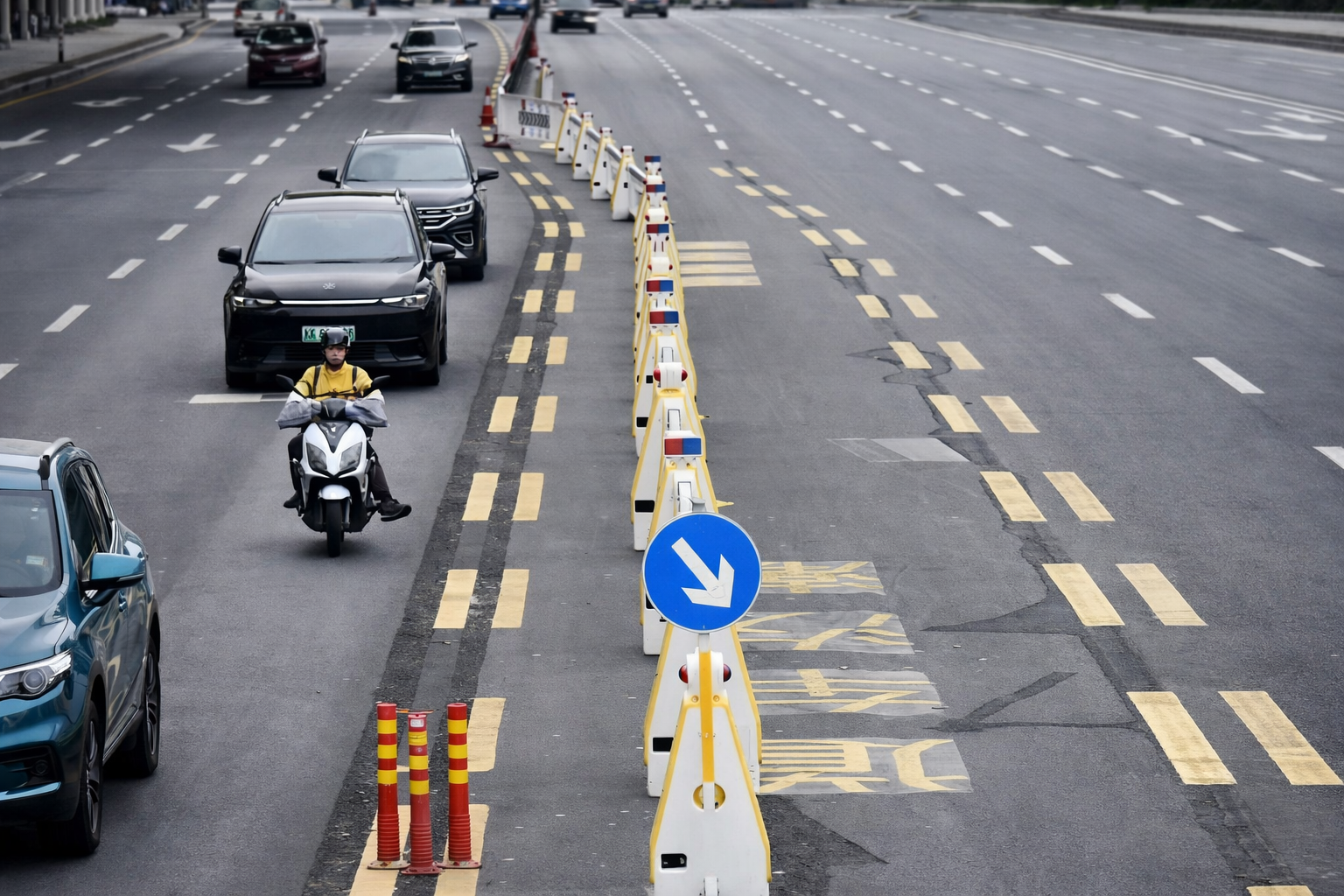
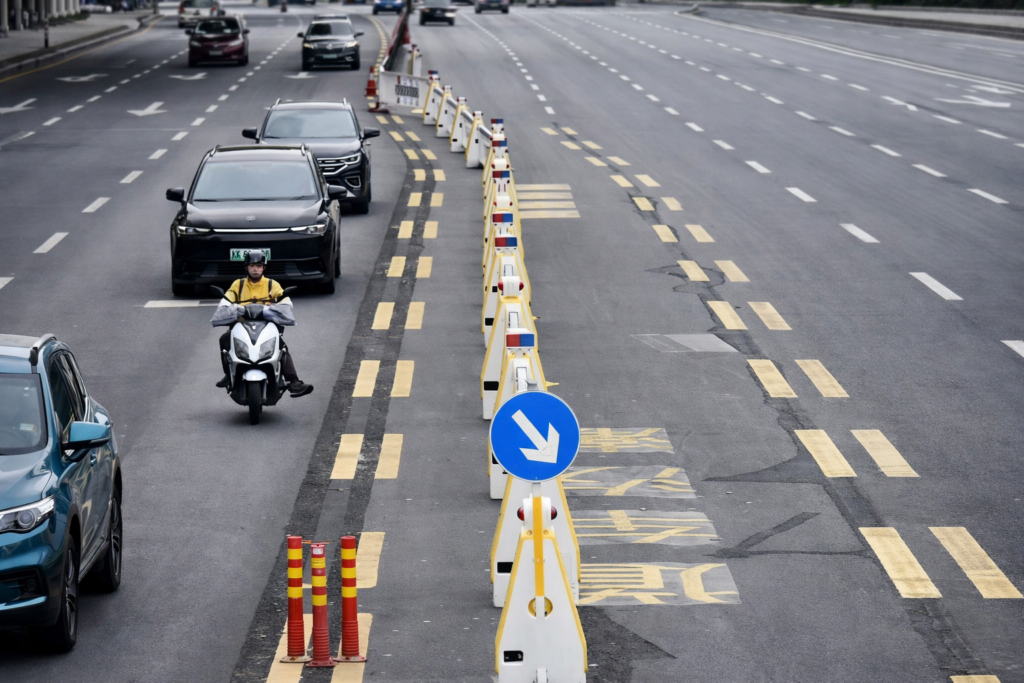
A robotic tidal lane is not a new road type. It is a new way of moving the boundary inside an existing road. The phrase has surfaced in recent coverage from Hangzhou, where local authorities deployed an automated lane-control system near schools in Qiandaohu town. The setup uses 18 movable lane-control robots over a 99-meter stretch and can reposition in about 40 seconds to change lane use during peak demand. In English-language traffic engineering, the older and more established terms are reversible lane and tidal flow lane. The newer “robotic” label points to the hardware now doing the switching, not to a brand-new traffic principle.
Table of Contents
That distinction matters. A lot of the online excitement around robotic tidal lanes treats them like a futuristic traffic trick. They make more sense when viewed as the next step in managed-lane control. Cities have been reversing lanes for decades to cope with rush-hour imbalance, event traffic, work zones, and evacuation routes. What changes with robotic systems is the transition itself. Instead of cones, manual crews, or a barrier-transfer truck moving one long median, the roadway can use a distributed line of machines, sensors, control logic, lane signals, and pavement guidance to reshape a short bottleneck quickly and repeatedly.
The idea behind a robotic tidal lane
The core problem is old. Roads are fixed. Demand is not. A corridor may carry a heavy inbound flow in the morning, a heavy outbound flow later in the day, and a school pickup surge in a narrow 30-minute window. When one side of a road is overloaded and the other side is underused, a reversible lane borrows space from the light side and gives it to the crowded side. FHWA guidance describes reversible-lane flow as a way to change directional capacity to match peak directional demand, and notes that the treatment makes most sense where the imbalance is strong enough to justify it. One FHWA rule of thumb cites a 70/30 directional split as a threshold worth examining.
That is why the phrase “tidal lane” exists at all. The traffic behaves like a tide, pushing hard one way and then receding. A recent review in Results in Engineering describes tidal traffic flow control as a long-used answer to this daily imbalance and traces its use across multiple road types since the 1930s. Older practice guides from ITE and NCHRP say much the same thing in plainer terms: use the spare capacity in the quiet direction instead of building more pavement you only need for a short period.
What makes the robotic version different is the boundary between directions. Classic reversible lanes often rely on overhead lane-use signals, pavement markings, fixed schedules, police direction, and sometimes manual barrier moves. A robotic tidal lane adds a moving physical divider that can change position without a crew walking into traffic. That shift is larger than it looks. The weak point in many older reversible-lane systems is not the concept itself. It is the moment of change—the period when drivers need to understand that the road they saw ten minutes ago is no longer the road in front of them.
So the right way to read the term is this: a robotic tidal lane is a reversible-lane system with automated physical lane separation and machine-assisted control. It belongs to the same family as movable-barrier systems, but it is better suited to short urban sections where a long barrier-transfer vehicle would be awkward or excessive. The recent Hangzhou deployment shows exactly that use case: a short, high-friction intersection area with school traffic spikes that standard signals and on-site traffic police were struggling to smooth out.
A static street facing moving demand
Most congestion is not a full-day problem. It is a timing problem. A road performs badly for ninety minutes in one direction and adequately the rest of the day. Widening that road is expensive, slow, politically hard, and often impossible on an urban street hemmed in by buildings, sidewalks, utilities, bus stops, or trees. Reversible-lane guidance has long framed the treatment as a way to avoid conventional lane additions where right-of-way is limited. That remains the strongest argument for robotic tidal lanes. They do not create capacity from nowhere, but they do let a city reassign scarce street space at the exact point and hour that matter most.
That is also why this idea keeps returning in new forms. A city may dislike the look or risk of old reversible lanes, then rediscover the same basic trade years later because the geometry of the street still has not changed. The question becomes less ideological and more practical: is it better to widen the corridor, accept daily queues, restrict turning movements, or make the boundary movable? Robotic systems enter that conversation as a middle path. They ask for more technology and more disciplined operation than a paint-only reversible lane, but far less concrete than a full rebuild.
The Hangzhou example is telling because it is not on a glamorous expressway. It is at a town intersection serving residential communities, businesses, and two schools. The local problem was sharp and repeatable: school drop-off and pickup produced concentrated turning demand, long queues, and safety pressure. That is exactly the kind of corridor where road agencies start looking for short-burst capacity rather than permanent widening. A robotic tidal lane fits that pattern far better than a mega-project.
Research on reversible lanes keeps arriving at the same broad conclusion. The treatment works best where directional imbalance is recurring, measurable, and localized. A 2023 Sustainability paper notes that reversible lanes can raise usable capacity without major changes to road structure or heavy new infrastructure. A 2021 report on Chicago’s Kennedy Expressway makes the point from the operations side: better control of reversible lanes reduces road congestion, travel time, and delays, especially when the lane direction is managed with real-time data rather than a static schedule.
None of that guarantees success. A bad corridor will stay bad even with automation. If both directions are equally crowded, lane reversal solves almost nothing. If lane changes near the switching zone are chaotic, or if turning patterns are too messy, the treatment may add confusion rather than relieve it. A robotic tidal lane is a precision tool. It is not a cure for a badly planned street.
The machine on the asphalt
The most useful way to picture a robotic tidal lane is not as a single robot but as a system of small machines attached to or integrated with a movable divider. The Hangzhou deployment uses 18 lane-control robots along a short stretch. Patent filings tied to this class of system describe a mobile guardrail group, mobile robots, UWB tags, base stations, and a central processing unit that receives position information and sends movement instructions so the barrier line can shift from one lane boundary to another. One patent explicitly says the setup forms a tidal lane without destroying the road surface, which matters on urban streets where heavy civil work is disruptive and expensive.
That architecture solves a very specific engineering problem. A barrier that moves sideways on a live roadway must know where it is, how far it has moved, whether the path is clear, and whether every unit in the line is keeping pace with the others. The earlier Chinese patent trail shows how designers have been working through those basics for years using compass angle measurement, ultrasonic ranging, infrared obstacle avoidance, photoelectric scanning, cameras, and laser ranging. A 2016 patent on electromagnetic isolation piers describes a different mechanical route to the same goal: shift the separator, change the direction of vehicle flow, reduce manual labor.
The recent Hangzhou installation looks like the urban cousin of older movable-barrier systems. It uses a lateral diversion design and changes the lane boundary in under a minute. An earlier Nanjing system from 2020, described by Duolun Technology, used a remote-control guardrail plus signal-light control, worked on a roughly 60-meter section, and could switch in 30 seconds. That matters because it shows the 2026 attention spike did not appear from nowhere. The hardware has been maturing in pieces—control, positioning, obstacle avoidance, power, signaling, and short-segment deployment.
The hardest part is not raw movement. A machine can move a barrier. The harder job is moving it safely, predictably, and legibly in a street environment where drivers glance up late, pedestrians misread signals, delivery vans stop where they should not, and weather hides markings. That is why the technology stack matters. A robotic tidal lane needs fail-safe logic, position verification, traffic-signal coordination, clear lane indications, and physical separation that remains credible after thousands of cycles. Without that, the robots are decoration.
Where the gains are real
The gain is not magical extra asphalt. The gain is timing and control. A city using a robotic tidal lane can turn one ordinary lane into a left-turn lane, an inbound peak lane, or an outbound peak lane for exactly the window that requires it. That matters near schools, stadiums, bridges, tunnels, ferry approaches, downtown arterials, and freeway bottlenecks with strong directional swings. FHWA, WSDOT, NCHRP, and long-standing state practice all point to the same use cases: rush-hour imbalance, special events, work zones, and evacuation or incident response.
A physical divider raises the ceiling on what agencies are willing to try. Painted or sign-only reversible lanes leave more room for driver error. Positive separation changes the safety conversation. FHWA’s median-barrier guidance notes that median barriers cut cross-median crashes, which are especially severe because they often involve high-speed opposing traffic. The Golden Gate Bridge offers the clearest public example. Before the movable median barrier went in, opposing traffic was separated by manually placed yellow tubes. After installation in January 2015, the bridge district said the new barrier virtually eliminated the possibility of head-on collisions.
That does not mean every robotic tidal lane needs a bridge-scale barrier. Some urban sites only need short-segment separation and clearer lane assignment. Still, the lesson holds: the closer the system gets to opposing traffic, the more valuable hard separation becomes. That is why road agencies and suppliers continue to invest in movable barriers rather than relying only on paint, cones, and signage. Lindsay’s Road Zipper system markets this logic directly—reallocating lanes quickly while protecting workers and drivers and avoiding the footprint of new construction. The sales pitch is self-interested, but the underlying need is real.
A compact comparison of lane-reversal approaches
| Approach | Boundary control | Switching method | Best fit | Main weakness |
|---|---|---|---|---|
| Traditional reversible lane | Signs, signals, pavement markings | Fixed schedule or manual operation | Simple commuter corridors | Driver confusion during transition |
| Movable-barrier system | Continuous crashworthy barrier | Barrier-transfer machine over long stretch | Bridges, tunnels, freeways, work zones | Bulky equipment and longer switching path |
| Robotic tidal lane | Distributed mobile divider units with control system | Short-segment automated repositioning | Urban bottlenecks, intersections, school peaks | Heavy dependence on software, sensing, and flawless signaling |
The table shows why robotic tidal lanes are drawing attention. They sit between paint-only reversible lanes and long movable-barrier systems. They aim to keep the physical clarity of a barrier while shrinking the equipment footprint enough for tight urban sites. That is a sensible target. It is also a demanding one. The smaller and faster the system becomes, the less room it has for sloppy control.
The safety problem hidden in every lane reversal
Every reversible-lane story eventually turns into a safety story. The road is simple only when it is stable. Once a lane can change direction, the agency must manage transition timing, wrong-way entry, driver expectation, signal visibility, pavement guidance, and barrier integrity. The 2023 MUTCD lays out that discipline in detail. Lane-use control signals are most commonly used for reversible lane control; pavement markings must accompany them; the system must guard against prohibited signal combinations; manual override must exist even under automatic control; and the signals must show the correct lane status continuously except in limited special cases.
That sounds bureaucratic until you look at what happens when old reversible systems age badly. On Rock Creek and Potomac Parkway in Washington, the National Park Service is now examining a plan that would end reversible operations and replace them with broader safety and operations changes. The NPS frames the project around improving safety for visitors and commuters, reducing congestion, and widening the multi-use trail, while specifically listing the end of reversible lanes as one of the measures under review. The message is blunt even without dramatic numbers: legacy lane reversals can become too risky, too labor-intensive, or too hard to justify if the corridor, devices, and rules no longer match modern standards.
This is where robotic systems make their strongest case. They promise to remove crews from the roadway during lane changes, reduce manual barrier handling, shorten the switch window, and keep the separator line coherent from one end to the other. Yet they also introduce new failure points: sensor faults, communication delays, bad software states, power loss, or a robot that stops mid-move. Automation does not erase safety risk. It changes the shape of it. Instead of asking whether a police officer moved the cones correctly, the agency has to ask whether the machine state, signal state, and lane state are always aligned.
That is why physical design and operating rules still outrank the robots themselves. A robotic tidal lane needs unmistakable approach signing, visible lane-use signals, road markings drivers can read at speed, a protected no-entry phase while the lane is being cleared, and a rule set for abnormal conditions. If the city treats the hardware as a novelty and neglects those basics, the project will earn headlines and then quietly become a procurement regret.
The software layer that makes or breaks the system
The hardware is visible. The real breakthrough sits in the control logic. A robotic tidal lane only earns its complexity if it switches at the right time, in the right direction, for the right duration. A 2020 study on real-time reversible-lane design in an intelligent cooperative vehicle-infrastructure system found that, compared with a traditional time-controlled scheme, the real-time version reduced average vehicle delay by 27.4 percent and lowered VOC, CO, and NOX emissions by 13.5 percent in simulation. That is the right benchmark: not “does automation look modern,” but “does it beat the fixed schedule.”
A 2023 paper in Sensors pushes the logic further by proposing lane reversal based on the density of congestion clusters rather than a clock. In that model, the reversible lane flips when congestion density reaches 0.37 and returns to conventional operation below 0.22. The point is not that every city should copy those exact numbers. The point is that a robotic tidal lane becomes much more persuasive when it behaves like a measured response to observed traffic, not like a mechanical ritual repeated every day whether traffic justifies it or not.
Safety research is moving in the same direction. The 2023 safety-control work on real-time reversible lanes focuses on no-entry zones, buffer zones, emptying zones, exit zones, recovery zones, lane length, and signal timing. That language sounds technical because it is. A lane reversal is not a single movement. It is a sequence: stop new entry, clear the lane, confirm the boundary, change the signals, reopen in the opposing direction, monitor the first wave of traffic. The robotic part works only if that sequence is formalized.
Newer optimization work aimed at autonomous-driving environments adds another layer: cost versus safety guarantee. A 2024 paper argues that reversible-lane design involves a trade between lower-cost, higher-risk installation modes and higher-cost, lower-risk modes, while connected and automated driving can reduce risk costs and improve adjustment speed. That is a useful reminder for cities tempted by the cheapest possible deployment. The cheapest robotic tidal lane is not always the one worth buying.
Streets that fit this model and streets that do not
A robotic tidal lane fits best where five conditions show up together. The corridor has a reliable directional imbalance, the congested window is short and recurring, widening is hard or wasteful, drivers can be given clear advance guidance, and the switching zone is short enough for the hardware to reposition fast without creating a long unstable transition. School approaches, bridgeheads, tunnel mouths, ferry links, and certain urban arterials check those boxes. Hangzhou’s new installation fits them almost perfectly.
A robotic tidal lane fits poorly where both directions are busy all day, where lane use changes would be hidden by vertical curves or cluttered sightlines, where heavy turning volumes make the logic too messy, or where public understanding is already weak. A confusing reversible lane does not become clear because it has robots under it. It may become worse, because drivers assume the system is smart enough to save them from their own late decisions. That is a bad bet on any roadway.
Urban context matters too. A short robotic installation may work well at an isolated bottleneck and fail on a corridor where the next intersection is only a few seconds away and feeds conflicting demand into the same lane. The lane-control treatment has to match the network around it. Research on urban road-network reversible-lane optimization makes that plain: the section choice matters, the timing matters, and the adjustment time matters. A lane reversal that looks logical in a single intersection diagram can fall apart once upstream queues and downstream spillback enter the picture.
There is also a cultural fit question. Reversible systems ask a lot of drivers. They ask people to notice overhead symbols, fresh lane lines, boundary movement, and changed turn permissions without hesitation. On roads where driver compliance is weak or where sight-reading the street is already hard, a city may need to fix more basic problems before adding movable lane boundaries. Technology rarely rescues a corridor with poor street literacy.
Cost, upkeep, and the politics under the hardware
The financial argument for robotic tidal lanes is easy to overstate. Yes, reversible-lane treatments are often cheaper than widening, and FHWA guidance has long described them as a more economical use of existing right-of-way under the right conditions. But “cheaper than reconstruction” is not the same as “cheap.” The Golden Gate Bridge’s movable median barrier project cost about $30 million. That is a bridge-scale job, not a small urban robotic install, yet it is a useful warning against techno-optimism. Anything that moves a safety barrier in live traffic, every day, for years, will cost real money.
The spending does not stop at purchase. A serious deployment needs maintenance contracts, replacement parts, control-system checks, lane-marking refresh, fail-safe testing, staff training, incident procedures, and public communication. Movable systems also live rough lives. They face grit, heat, rain, impact, poor drainage, accidental blockage, vandalism, and the small daily abuse that kills under-tested hardware. A city that budgets only for installation is budgeting for disappointment.
Politics sits underneath all of it. A robotic tidal lane changes not just traffic flow but the public story a city tells about street space. One constituency sees a nimble fix that avoids widening. Another sees public money spent on gadgets instead of transit, sidewalk repair, or enforcement. Another sees a safety tool that could remove police officers from dangerous manual lane changes. All three may be right at once. The choice is not purely technical. It is a judgment about which problem the city is trying to solve, for whom, and at what level of operational discipline.
That is why good projects usually start with a modest claim. Not “this will reinvent urban mobility,” but “this corridor has a recurring directional surge, and a robotic lane boundary is the least disruptive way to manage it.” That sentence is much easier to defend in procurement, in public meetings, and in after-action reviews. It also gives the agency a real standard to judge success against: queue length, delay, crash risk, switching reliability, and compliance.
A road that learns is still a road the public must trust
The best way to think about robotic tidal lanes is not as a flashy smart-city object but as a stricter, more controlled form of reversible-lane management. The idea itself is old. What is new is the attempt to make the boundary move quickly enough, safely enough, and clearly enough that a short urban bottleneck can be reconfigured without sending workers into traffic or forcing a city into heavy reconstruction. The Hangzhou deployment shows that this has moved beyond patents and renderings. The research literature shows that the control logic is catching up. The standards world shows that the safety burden remains high.
That mix of promise and constraint is healthy. Roads should be hard to change. The cost of getting them wrong is written in crash reports, not pitch decks. Robotic tidal lanes deserve serious attention because they address a real and stubborn problem: short, recurring directional surges on roads that cannot be widened sensibly. They also deserve skepticism, because every reversible-lane system lives or dies on transition safety, driver comprehension, and daily operating discipline.
So the real future here is not a road that “thinks” on its own. It is a road that is easier for a city to manage with precision. Where the corridor is right, the signage is legible, the barrier is credible, and the switching logic is conservative, robotic tidal lanes could become a practical urban tool. Where those conditions are missing, the robots will only make an old traffic idea look newer than it is.
The link to AI is real, but it is easy to exaggerate
A robotic tidal lane becomes far more useful when it is connected to traffic cameras, sensor feeds, and prediction models that can read queue growth, detect abnormal patterns, and decide whether a lane change is actually justified. AI can help forecast short traffic surges around schools, events, weather shifts, or incidents faster than a fixed timetable ever could, and it can also flag unsafe conditions before the system moves a physical divider. Still, the strongest version of this technology is not a road that “thinks” by itself. It is a road run by carefully bounded AI, backed by clear rules, human oversight, and fail-safe design, where machine judgment improves timing and awareness without taking safety decisions out of accountable hands.
FAQ
It is an automated form of reversible-lane control that uses movable lane-divider units, signaling, and control software to reassign road space based on changing traffic demand. The recent Hangzhou example uses 18 robots over 99 meters and can switch in about 40 seconds.
It looks more like a recent media-facing label than a long-established term of art. Transportation agencies and guidance documents more often use reversible lane or tidal flow lane.
The underlying traffic idea is the same. The difference is the physical boundary and the switching method. A robotic system adds automated movable separation instead of relying only on paint, signs, or manual operations.
Because many corridors suffer from short, repeatable directional surges, and widening the road may be slow, costly, or impossible. Robotic lane control gives agencies another way to reassign existing space.
Hangzhou reported a new smart tidal-lane robot system in Qiandaohu town, Chun’an county, aimed at easing traffic pressure near schools.
Patent documents for this class of system describe mobile guardrails, mobile robots, UWB tags, base stations, and a central processing unit that receives position data and sends movement commands.
Yes. Patent filings and earlier Chinese deployments show several years of work on tidal-lane changing systems using obstacle sensing, ranging, and controlled guardrail movement. A Nanjing system was publicly described in 2020.
It is strongest on roads with clear one-direction peaks for limited periods, especially where the city cannot justify permanent widening. School surges, commuter bottlenecks, bridges, tunnels, and event traffic are common examples.
No. They reassign existing capacity. The benefit comes from moving a lane to the side that needs it most during a specific window.
Because opposing traffic conflicts are severe. FHWA notes that median barriers reduce cross-median crashes, and the Golden Gate Bridge says its movable median barrier virtually eliminated the possibility of head-on collisions there.
The danger sits in the transition phase and in any mismatch between barrier position, lane-use signals, pavement markings, and driver expectation. Automation changes the failure points; it does not remove them.
Yes. The MUTCD sets rules for lane-use control signals, signal combinations, pavement-marking support, continuous operation, and manual override.
Research suggests yes. A 2020 study reported lower delay and lower emissions for a real-time reversible-lane scheme compared with a time-controlled one.
That depends on the system. Some use fixed schedules. Newer research looks at traffic density, congestion clusters, service levels, and signal timing, so the lane changes only when conditions justify it.
Possibly. A 2024 study argues that connected and automated driving could reduce risk costs and improve the speed and quality of reversible-lane adjustment.
Some are. The National Park Service is studying a plan that would end reversible operations on Rock Creek and Potomac Parkway as part of a broader safety and operations project.
They often are, but that does not make them cheap. Movable-barrier systems, control hardware, maintenance, testing, and operations still require serious funding and steady upkeep.
A corridor with a measured directional imbalance, strong sightlines, clear signals and markings, conservative switching logic, physical separation that drivers trust, and a maintenance plan that treats the system like safety equipment rather than street furniture.
Author:
Jan Bielik
CEO & Founder of Webiano Digital & Marketing Agency
This article is an original analysis supported by the sources cited below
Hangzhou deploys smart tidal lane robot to ease school-area congestion
Official Hangzhou government report on the 2026 deployment in Qiandaohu town, including the 18 robots, 99-meter corridor, and 40-second switching time.
Smart tidal lane robots ease traffic pressure in eastern China
Xinhua coverage confirming the Hangzhou system and its quick lane-switching role near schools.
AI-driven robots make traffic in Zhejiang smart
People’s Daily summary of the Chun’an deployment and its local traffic-management purpose.
Intelligent mobile robot control system and method for tidal lane
Patent text describing a mobile-guardrail architecture with robots, UWB tags, base stations, and a central processing unit.
A tidal lane changing system based on compass angle measurement and ultrasonic ranging
Patent record showing earlier work on sensing and control for lane-changing robots.
Automatic tidal lane provided with electromagnetic isolation piers
Patent describing a movable isolation system designed to change vehicle-flow direction with reduced manual labor.
Nanjing’s First Smart “Tidal Lane” Was Officially Launched, and Dolun Technology’s Magic Device to Prevent the Traffic Jam Will Stun the Audience
Company account of a 2020 Nanjing smart tidal-lane deployment, useful for tracing the pre-2026 evolution of the concept.
Chapter 8 Page 1 – Freeway Management and Operations Handbook
FHWA guidance explaining reversible-lane flow, directional imbalance, and the logic behind using existing right-of-way more effectively.
Managed Lanes: A Primer
FHWA primer placing reversible lanes within the broader family of managed-lane strategies.
MUTCD 11th Edition – Part 4
Current federal rules for lane-use control signals, including meanings, placement, coordination, manual override, and operating requirements.
Median Barriers
FHWA safety guidance on why median barriers matter for reducing severe opposing-traffic crashes.
Reversible lanes | TSMO | WSDOT
Straightforward state-agency explanation of when reversible lanes are most useful and why they depend on directional congestion patterns.
Reversible Lanes in Work Zones
TRB/NCHRP digest summarizing the purpose, benefits, and application conditions for reversible roadways.
Planning and Operational Practices for Reversible Roadways
ITE article on the history, uses, and practical issues surrounding reversible-lane systems.
Best Practice Operation of Reversible Express Lanes for the Kennedy Expressway
Research report on reversible-lane operation, real-time control, and performance outcomes in a major U.S. corridor.
A comprehensive review of tidal traffic flow control: From conventional lane reversal to emerging internal boundary control
Recent review article that frames tidal-flow control as a long-running traffic-management approach and surveys its modern forms.
Design of Real-Time Dynamic Reversible Lane in Intelligent Cooperative Vehicle Infrastructure System
Study on real-time reversible-lane control using connected infrastructure, with modeled effects on delay and emissions.
Construction of Real-time Dynamic Reversible Lane Safety Control Model in Intelligent Vehicle Infrastructure Cooperative System
Research focused on safety-control logic for real-time reversible lanes, including conflict areas and transition zones.
Dynamic Lane Reversal Strategy in Intelligent Transportation Systems in Smart Cities
Paper proposing congestion-cluster thresholds for lane reversal and showing how traffic-responsive control can outperform fixed timing.
Reversible Lane Optimization of the Urban Road Network Considering Adjustment Time Constraints
Study on network-level reversible-lane placement and the importance of section choice and adjustment time.
Dynamic reversible lane optimization in autonomous driving environments: Balancing efficiency and safety
Paper exploring the trade between cost and safety guarantees in reversible-lane design under connected and autonomous driving conditions.
Moveable Median Barrier – Bridge Operations
Official Golden Gate Bridge page describing the 2015 movable median barrier and its safety rationale.
Final Design & Budget – Moveable Median Barrier
Golden Gate Bridge project page with barrier dimensions, transfer-machine details, and project budget.
Road Zipper System For Highways
Supplier page for a widely deployed movable-barrier system, useful for understanding current barrier-transfer practice and deployment logic.
Elimination of Reversible Operations Along Rock Creek & Potomac Parkway: Transportation Impact Assessment and Appendices
National Park Service planning page showing the federal review of ending reversible operations on a historic commuter corridor.
Share your thoughts on safety and operational improvements for Rock Creek and Potomac Parkway
National Park Service project notice describing the broader safety, operations, trail, and barrier changes under consideration alongside removal of reversible lanes.
Cover photo: Reprophoto YouTube, upscaled
| Citing this article? Brief excerpts are welcome. Please credit Webiano.digital, name the author where stated, and include a link to https://webiano.digital and to this original article. Full or substantial republication requires prior written permission. Read our Copyright and Content Use Policy. |
This article was prepared with the assistance of artificial intelligence tools. The content underwent expert human review, and Webiano Digital & Marketing Agency assumes editorial responsibility for its final version and publication.