Warby Parker says preorders for the Samsung-built Intelligent Eyewear open on November 12, yet Samsung, Google and both eyewear brands have named no price. The glasses copy Meta’s display-free template, so the purchase decision rests on what the hardware does not settle: optician distribution, Gemini’s data terms and a price due in three days.
Table of Contents
Warby Parker told investors on November 5 that preorders for its first Intelligent Eyewear collection, the Samsung-built Android XR glasses, open on Thursday, November 12, with initial deliveries starting in mid-December. As of today, November 9, Samsung, Google, Warby Parker and Gentle Monster have published no price, and Samsung has not issued a launch date of its own. The countries of the first sales wave rest on a Korean press report.
That gap is the story. The first Samsung smart glasses are display-free frames with a camera, speakers, a Qualcomm chip and Gemini. Meta already sells that template and holds 69.2 percent of the category in IDC’s first-quarter 2026 tracker. Matching Meta on hardware gives a buyer no reason to switch.
This analysis argues that the Samsung glasses are a distribution and data-terms bet rather than a hardware bet. Warby Parker’s 364 stores supply the shelf and the prescription lenses, Google supplies the software and the data rules that come with it, and Samsung supplies the engineering and the link to Galaxy phones. The price Warby Parker publishes on Thursday will show which of the three partners the companies expect to carry the sale.
Three dates and one missing number
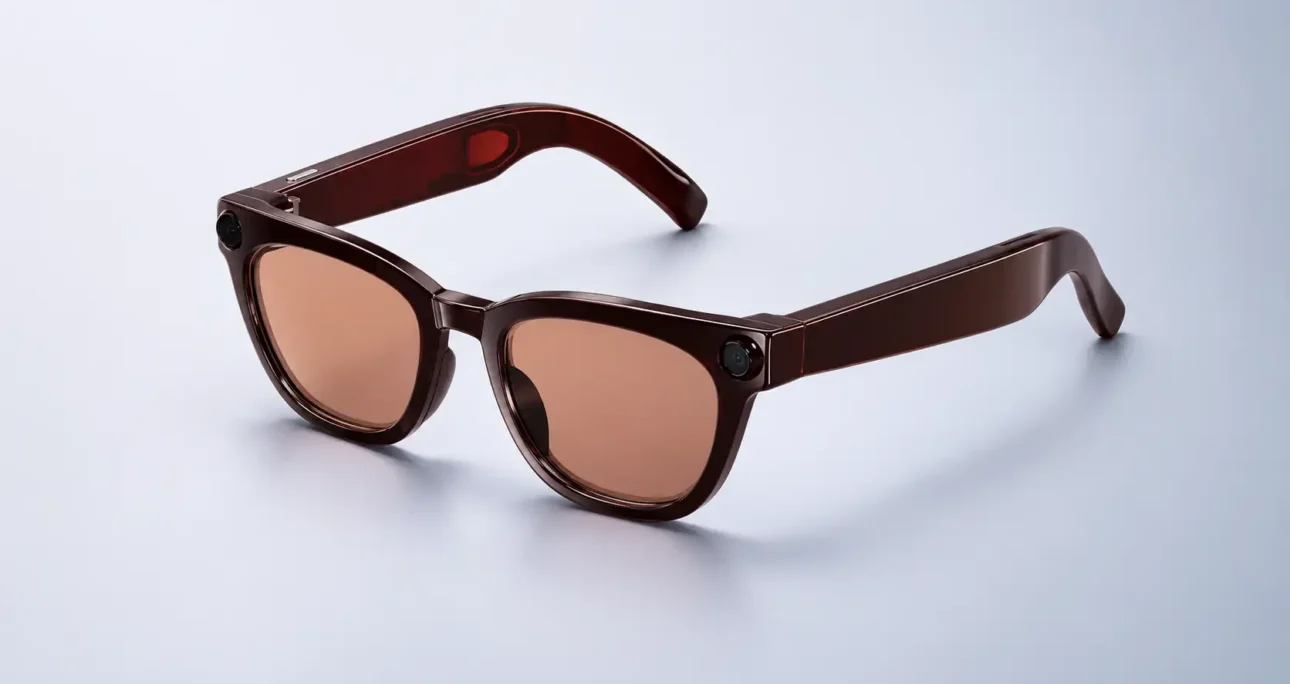
Google gave the first date on May 19, at its I/O conference, when it said audio glasses would launch first, later this fall, with display glasses to follow. Samsung showed two finished designs on July 22 at Galaxy Unpacked in London: a slim black Gentle Monster frame and a brown Warby Parker frame with an upswept brow line. Neither company attached a price to either announcement.
The window then narrowed through reporting rather than announcements. According to VR.org’s tracker of the launch, The Korea Herald reported on October 1 that a Samsung official had confirmed November, and ChosunBiz reported on October 30 that Samsung had settled on mid-December, selling first in South Korea and the United States with Europe, China and Japan later. Samsung has published neither the date nor the market list itself, so both remain press reports.
The firmest date came from a retailer. Warby Parker’s third-quarter release on November 5 quotes co-CEO Dave Gilboa on the November 12 preorder start, and the earnings call added the operating detail: demonstration appointments begin in 65 stores during the week of November 9 and extend to the full fleet of more than 360 stores a week later. Gilboa said the full collection, including pricing, will be unveiled on November 12. Warby Parker books revenue when a pair is delivered, not when it is ordered, which affects the 2026 numbers discussed below.
Gentle Monster, the second frame partner, says its collection launches in December, and Engadget reports that its website lists November 12 for preorders. Engadget adds that Google has confirmed neither date, and the Gentle Monster teaser names no price.
A display-free pair built to the Ray-Ban Meta template
The glasses carry no screen. Google’s I/O post describes speech as the output, through private over-ear speakers, with a camera and microphones feeding Gemini. A wearer says the wake phrase or taps the side of the frame, and Gemini answers questions about what the camera sees, gives turn-by-turn directions, summarizes missed messages, translates speech and signs, and takes photos and video. Samsung’s July release adds note capture from a whiteboard or meeting, and live visual sharing during a call.
Samsung’s stated hardware is thin. It confirms a Snapdragon AR1 Gen1 platform, a built-in camera and a battery rated for up to nine hours per charge, plus up to seven additional charges from the case, with the usual caveat that real life varies with network, features and settings. Weight and camera resolution are unannounced. FCC grants dated September 27 cover eleven frame models across two device IDs, according to VR.org, which also lists Bluetooth and Wi-Fi including the 6 GHz band.
The reference point is Meta. VR.org’s comparison table of manufacturer prices puts Ray-Ban Meta Gen 3 at $449 with the same nine-hour battery claim, the camera-free Ray-Ban Meta Audio at $349 and HTC’s Vive Eagle at $499. IDC counts display-less smart glasses at roughly 2.25 million units in the first quarter of 2026, up 167 percent year on year. Across its combined smart glasses tracking, Meta held 69.2 percent that quarter, and no named rival held more than 3.4 percent.
Two numbers from IDC frame the price fight ahead. The average selling price of smart glasses is about $376 in 2026, and IDC forecasts roughly $229 by 2030. A category whose price is expected to fall by nearly 40 percent in four years rewards whoever owns distribution and software, because the hardware margin shrinks every year.
Display glasses are the second product tier. Google says they come later and its post gives no year; VR.org reports that 9to5Google heard 2027 from Google at I/O. Nothing in the first-generation pair depends on that display tier arriving.
Google writes the software and Warby Parker owns the shelf
Three companies split the product, and each holds a different lever. Google built the Android XR platform with Samsung and Qualcomm and owns the assistant. Samsung engineers the hardware and, in an interview on its own newsroom, describes the glasses as a companion to Galaxy phones, with processing split between the frames and the connected phone. The eyewear brands contribute the designs and, in Warby Parker’s case, sell and fit them.
The phone link is where the partnership shows its seams. Google says the glasses pair with both Android phones and iPhones. Samsung’s release carries footnotes saying that some features need a compatible Galaxy device, and that gesture control works only through the Galaxy Watch9. An iPhone owner and a Galaxy owner may therefore buy the same frames and receive different feature sets, and the sources reviewed do not say which features differ. IDC makes the same point from the industry side: every one of these glasses needs a phone, so the competition is over whose phone it is and what that phone adds.
Warby Parker’s contribution is retail and lenses. Gilboa told analysts the glasses are designed for prescriptions from day one, with sun lenses and photochromic options, and that the company is expanding capacity at its two optical labs, in New York and Las Vegas, to fill lens orders. He expects most buyers to wear the smart pair alongside ordinary glasses rather than replace them. That expectation shapes the sale: a customer who wants the second pair to carry a prescription needs an optician, not an electronics aisle.
Distribution is the one asset Meta has already proven. IDC credits EssilorLuxottica’s retail network with placing Ray-Ban Meta frames in optician shops beside prescription lenses, a shelf position the analyst judges very hard for rivals to copy. Warby Parker’s 364 stores are the closest thing Android XR has to that shelf, though they sit in only two countries, the United States and Canada. A prescription pair is fitted and filled by an optician, which is the role Warby Parker plays here.
Partner money covers the launch while Warby Parker takes the margin hit
Marketing is where the partners’ incentives show most clearly. On the November 5 call, Warby Parker said its partners committed $75 million in reimbursements for launch and category-awareness marketing, and that more than $50 million of it remained. An analyst on the call described that money as funded by Google, and Gilboa said Google is committed to heavy awareness investment both at launch and over the long run. Warby Parker’s executives referred to the payer only as its partners, so the Google attribution rests on the analyst’s phrasing.
For Warby Parker the product carries a trade-off that its own executives stated. Gilboa said the glasses will be priced higher than its traditional eyewear and that the percentage gross margin on consumer electronics differs from eyewear, so the company is managing to gross profit dollars per order. He expects a large share of orders to include prescription lenses, sun lenses or photochromics, which carry margins comparable to its existing products. The company’s third quarter shows what the launch already costs: free cash flow was negative $2.0 million, which the release attributes to launch investments, and Warby Parker put $5.6 million into an optical lens technology company in October.
The revenue effect in 2026 is small by the company’s own guidance. Warby Parker now expects full-year revenue of $966 million to $976 million, which it describes as 11 to 12 percent growth, and says Intelligent Eyewear contributes up to 1 percentage point to full-year growth and several points to the fourth quarter. By our calculation, those figures imply a 2025 base of about $871 million, so one point is roughly $8.7 million. If the unconfirmed $349 to $499 price range circulating in leaks proved right, that ceiling would correspond to about 17,000 to 25,000 pairs recognized in 2026, an illustration rather than a forecast.
Against a smart glasses market that IDC expects to reach about 13.6 million display-less units this year, that is a rounding error. Warby Parker itself frames 2026 as product acceptance and 2027 as the year production scales.
Confirmed, reported and missing
| Item | Status | Source |
|---|---|---|
| Preorders open November 12 | Confirmed by Warby Parker and listed by Gentle Monster; Google has not confirmed | Q3 release, Engadget |
| Deliveries from mid-December | Confirmed by Warby Parker for its collection | Q3 call, November 5 |
| First sales in US and South Korea | Reported by ChosunBiz, not confirmed by Samsung | VR.org tracker |
| Price | Not announced by Samsung, Google, Warby Parker or Gentle Monster | VR.org tracker, Q3 call |
| Weight and camera resolution | Not announced | VR.org tracker |
| Display glasses | Google says later; 2027 reported secondhand | Google I/O post, VR.org |
The table separates what a seller has committed to from what the press has reported. Only the first two rows come from a company that will take the order, and both cover Warby Parker’s collection alone, so a buyer in another country or at another retailer has no confirmed date yet.
Gemini data terms travel with the glasses
Samsung’s privacy promise and Google’s data terms are different documents written by different companies, and the glasses sit under both. In its July 31 newsroom interview, Samsung says a wearer’s audio, video and screen-sharing data are not used to train AI models, and that privacy and personalization settings are managed through a connected Galaxy phone. That is a Samsung statement about Samsung’s handling.
Gemini is Google’s service. Google’s Gemini Apps Privacy Hub, last updated October 26, lists Gemini on Android XR among the products it covers. With the Keep activity setting on, activity auto-deletes after 18 months by default unless the user changes it to 3 or 36 months or switches auto-deletion off. A subset of chats goes to human reviewers, and reviewed chats are kept for up to three years, disconnected from the account, even after the user deletes their activity. With Keep activity off, chats are still held for 72 hours so Gemini can respond and to protect the service.
Google’s terms do contain protections that bear on a camera product. Gemini Live audio, video and screen shares are not used to improve Google services by default, though transcripts and uploads from Live chats are covered by the Keep activity setting. Google also states that Gemini Apps chats are not currently used to show ads. Work and school accounts may fall under different Workspace terms, so the answer for a corporate wearer can differ from the answer for a consumer.
The unanswered question is how the two documents meet. The sources reviewed do not say whether the glasses’ photos, video clips and voice requests are stored in Gemini Apps activity, whether a camera capture counts as an upload under Google’s notice, or how Samsung’s no-training statement maps onto Google’s reviewer retention. These are checkable facts, and they should appear in the setup flow or the privacy documentation that accompanies the preorder. A buyer who reads only the Samsung interview will have half of the picture.
Bystanders get an LED and a rulebook
Samsung’s design answer to bystander privacy is hardware. The company says an outward-facing LED and an inner LED show when recording is active, wear detection switches recording off when the glasses come off, and thwart detection disables recording if the outward LED is blocked. Samsung also says it will keep improving these features.
Google adds a rulebook that applies to every app. Its Android XR quality guidelines, last updated October 20, forbid apps from changing, dimming or disabling the LEDs or bypassing the tamper detection. They prohibit facial identification that surfaces bystanders’ personal information, doxxing, surveillance and the creation of non-consensual intimate imagery. They also bar one-to-many live streaming and public broadcasting from the camera while allowing video calls, and they forbid persistent background audio recording or transcription when the wearer is not actively using an app. Samsung describes its live visual sharing as happening during a call, which falls on the permitted side of that line.
Regulators have started writing the same expectations down. The European Data Protection Board adopted statement 1/2026 on smart glasses on October 13. It calls the guidance preliminary, says recording should be made obvious through bright LEDs or audio signals, and warns of heightened risk in hospitals, schools and workplaces. It also says a wearer becomes a data controller when sharing footage publicly or using the glasses for professional or official purposes, and that manufacturers and service providers cannot pass their own obligations on to users.
Meta’s troubles are also a commercial risk for Samsung. Senators Ron Wyden and Edward Markey wrote to Meta’s Mark Zuckerberg on October 28 about what they call serious privacy and safety risks in its glasses, citing reported covert filming of women and reports that contractors reviewed footage of people undressing. Engadget’s Warby Parker coverage notes that Google enters a market with growing distrust of camera wearers. Samsung’s glasses would be judged by the same suspicion on day one, whatever their safeguards.
Three ways the distribution thesis could break
The strongest objection is that Meta’s lead is too large for distribution to matter. Meta held 69.2 percent in IDC’s first-quarter data, EssilorLuxottica’s optician network is already stocked, and IDC lists Meta’s social graph and advertising income as further advantages that fund aggressive hardware pricing. A Samsung pair priced above Ray-Ban Meta Gen 3’s $449 would ask buyers to pay more for a second-place ecosystem. Warby Parker’s 364 stores are real, but Meta’s reach is wider.
A second objection concerns the hardware. Everything known about the glasses comes from the makers, and the battery rating carries Samsung’s own caveat that results vary with network and settings. The sources reviewed include no independent review of a retail unit. Weight, camera resolution and microphone count are unannounced, and comfort over a full day is the variable that decides whether a camera wearable stays on a face. If independent tests find a heavy frame, a weak camera or a battery that misses nine hours, the distribution argument will not rescue the product.
A third limit is the evidence about Warby Parker itself. On the same call its executives described softer eyewear traffic and unit growth across the category, and the release shows active customer growth of 3.0 percent to 2.74 million. The company therefore has its own reason to want a new draw into its stores, which makes its enthusiasm a motive as well as a signal. Its guidance also leaves out any halo effect on the core business and bakes in extra store staffing for demonstrations.
The thesis does survive three tests the sources allow. The marketing reimbursements come from Warby Parker’s partners, so the retailer does not fund the launch alone. Prescription fulfilment sits with an optician’s labs. And the data terms that govern the assistant are Google’s, which is why a buyer cannot assess the product from Samsung’s materials alone. What the sources cannot test is demand: no preorder count exists, and none will until Warby Parker reports its fourth quarter.
Decisions for buyers, developers and privacy officers
Galaxy phone owners are the buyers Samsung’s footnotes favor, with watch gestures that require a Galaxy Watch9. They should compare the Thursday price with Ray-Ban Meta Gen 3 at $449 before ordering, and book a demonstration before committing to a preorder, since Warby Parker’s demos start in 65 stores this week and reach its whole fleet the next.
iPhone owners face a narrower decision. Google says the glasses pair with iPhones, but Samsung’s footnotes tie some features to Galaxy devices, and no document reviewed lists which ones. The practical test is to ask a Warby Parker adviser to run live translation and a camera query from an iPhone before paying. Warby Parker’s own leaders say live translation draws the strongest reaction in demos, so it is the feature to try first.
Buyers who need a prescription should ask what the lens options cost and when the optical labs will fill them, since Warby Parker will deliver from mid-December and recognizes revenue on delivery. Anyone in Europe, China or Japan should treat the glasses as a 2027 purchase until Samsung confirms otherwise, because the first-wave markets reported by ChosunBiz are the United States and South Korea.
Developers have a published route. According to VR.org, Google Play accepts audio glasses apps through the ordinary phone release track, with a badge for apps built specifically for glasses. Those apps must live within the camera, microphone and LED rules in Google’s guidelines, including the ban on one-to-many streaming.
Privacy officers at hospitals, schools and employers have the clearest task. The EDPB lists exactly those settings as higher risk, so a policy that names smart glasses, sets recording rules and says who counts as responsible when footage leaves the building is overdue regardless of which maker’s glasses arrive first. For wearers, setting the Keep activity period deliberately on day one is among the controls the sources document.
A judgment that depends on Thursday’s number
Our judgment, which is analysis rather than reporting, is that Samsung’s glasses will not dent Meta’s lead in 2026. Warby Parker’s own guidance caps the 2026 contribution at one point of growth, Meta already sells in volume, and IDC’s forecast of 13.6 million display-less units this year dwarfs any pairs delivered before year end. The real test is 2027, when Warby Parker says production and deliveries scale.
The price Warby Parker names on November 12 will move that judgment in a specific direction. A figure at or below Ray-Ban Meta Gen 3’s $449 would show the partners prioritizing reach over unit margin, and would fit the thesis that the product is sold on distribution and software. A figure near or above the $499 top of the leaked range would turn the glasses into a Galaxy accessory sold to existing customers, and the 2027 ramp would then depend on buyers who already own Samsung phones.
Four observable events would change the picture. Samsung confirming its own date and markets would settle the reported US and South Korea launch. Warby Parker’s fourth-quarter report, which its executives said will share more on the combined business in February, would give the first read on preorder demand. Meta’s answer to the senators’ questions, due in late November, would show how much scrutiny the category’s privacy design must absorb. And Google’s display glasses, reported for 2027, would test whether Samsung’s first model is a product or a prelude.
Samsung smart glasses questions answered before the preorder date
Warby Parker says preorders for its Intelligent Eyewear collection open on November 12, 2026, with initial deliveries from mid-December. Engadget reports that Gentle Monster’s website lists the same preorder date and that the brand says its collection launches in December. Google has not confirmed either date, and Samsung has not published one.
No price has been announced by Samsung, Google, Warby Parker or Gentle Monster. Warby Parker says it will unveil the full collection, including pricing, on November 12. Figures between $349 and $499 come from leaks. For comparison, VR.org lists Ray-Ban Meta Gen 3 at $449 and the camera-free Ray-Ban Meta Audio at $349.
No. The first generation are audio glasses with speakers, microphones and a camera, and Gemini answers by voice. Google says display glasses come later, and VR.org reports that 9to5Google heard 2027 from Google at I/O.
Google says the glasses pair with both Android phones and iPhones. Samsung’s footnotes say some features need a compatible Galaxy device and that gesture control works only through the Galaxy Watch9. The sources reviewed do not list which features an iPhone owner would lose.
ChosunBiz reported on October 30 that Samsung would sell first in the United States and South Korea in mid-December, with Europe, China and Japan later. Samsung has not confirmed the market list.
Samsung rates the battery at up to nine hours on a single charge, with up to seven additional full charges from the charging case. Samsung notes that battery life varies with network, features, settings and the number of charges.
Samsung says an outward-facing LED and an inner LED show when recording is active, wear detection stops recording when the glasses come off, and thwart detection stops recording if the outward LED is blocked. Google’s Android XR guidelines bar apps from changing or disabling the LEDs.
Samsung says a wearer’s audio, video and screen-sharing data are not used to train AI models. Google’s Gemini Apps terms, which cover Gemini on Android XR, set a default 18-month auto-delete period and keep human-reviewed chats for up to three years. The sources reviewed do not explain how the two statements fit together for the glasses.
Both are display-free glasses with a camera, speakers and an AI assistant. Ray-Ban Meta Gen 3 costs $449 and uses Meta AI, according to VR.org, while Samsung’s glasses run Gemini on Android XR and have no announced price. IDC put Meta’s share of smart glasses at 69.2 percent in the first quarter of 2026.
Warby Parker and Gentle Monster design and sell the frames, and Samsung builds the glasses with Google. Warby Parker says the glasses are designed for prescriptions from the start, with sun lens and photochromic options.
Author:
Jan Bielik
CEO & Founder of Webiano Digital & Marketing Agency
This article is an original analysis supported by the sources cited below
Samsung Brings Galaxy Ecosystem Into Everyday Eyewear
Samsung’s July 22 Unpacked release, the source for the two frame designs, the Snapdragon AR1 Gen1 platform, the nine-hour battery rating with seven case charges, and the footnotes tying gestures to Galaxy Watch9 and some features to Galaxy devices.
Intelligent Eyewear: The First Step Toward the Next Mobile AI Interface
Samsung’s July 31 interview with XR head James Choi, which describes the phone-companion design, the outward and inner recording LEDs, wear and thwart detection, and Samsung’s statement that wearer audio, video and screen-sharing data are not used to train AI models.
Intelligent eyewear is coming this fall
Google’s May 19 I/O announcement of audio glasses first and display glasses later, the Gemini features, the Android XR partnership with Samsung and Qualcomm, and pairing with both Android and iOS phones.
Warby Parker Announces Third Quarter 2026 Results
The Business Wire release of November 5 carrying the November 12 preorder date, full-year revenue guidance of $966 million to $976 million, third-quarter free cash flow, active customers and store count.
Warby Parker (WRBY) Q3 2026 Earnings Call Transcript
Transcript of the November 5 call, the source for mid-December deliveries, store demonstrations, pricing and margin comments, the partner marketing reimbursements, lab capacity, and the up-to-one-point contribution to 2026 growth.
Smart Glasses Surge: The XR Market Is Rewriting Its Own Rules
IDC’s June 15 analysis of first-quarter 2026 shipments, Meta’s 69.2 percent share, the 13.6 million unit forecast for display-less glasses, and the average selling price outlook of $376 now and about $229 by 2030.
Warby Parker seemingly spilled the beans on Google’s Android XR smart glasses launch
Engadget’s November 5 report quoting Warby Parker’s preorder date and noting the absence of a price, plus its observation that the launch meets growing distrust of camera wearers.
Google’s eyewear partners can’t keep a lid on its smart glasses plans
Engadget’s November 6 report that Gentle Monster says its collection launches in December, that its website lists November 12 preorders, and that Google has confirmed neither date.
Samsung Android XR Glasses: Release Date, Price, Specs, and Everything We Know
VR.org’s dated tracker, used for the reported Korea Herald and ChosunBiz launch timing, the FCC grants for eleven frame models, competitor prices, and the status of price, weight and display glasses.
Gemini Apps Privacy Hub
Google’s privacy notice, updated October 2026, covering Gemini on Android XR, the 18-month default auto-delete period, human review and three-year retention, 72-hour retention with activity off, and the treatment of Gemini Live audio and video.
Android XR: App Quality Guidelines and Policies for augmented experiences
Google’s developer policies for glasses, last updated October 20, which bar apps from altering the recording LEDs or tamper detection and prohibit facial identification, doxxing, one-to-many live streaming and persistent background recording.
EDPB publishes statement on the data protection challenges of smart glasses
The European Data Protection Board’s October 13 announcement of statement 1/2026, setting out preliminary guidance on recording indicators, sensitive environments, wearer responsibility as data controller and manufacturer obligations.
Senators are looking into ‘serious privacy risks’ with Meta’s AI glasses
Engadget’s October 30 report on the Wyden and Markey letter to Meta, the incidents it cites, and its questions on indicator tampering, contractor access to footage and AI training.
| Citing this article? Brief excerpts are welcome. Please credit Webiano.digital, name the author where stated, and include a link to https://webiano.digital and to this original article. Full or substantial republication requires prior written permission. Read our Copyright and Content Use Policy. |
This article was prepared with the assistance of artificial intelligence tools. The content underwent expert human review, and Webiano Digital & Marketing Agency assumes editorial responsibility for its final version and publication.