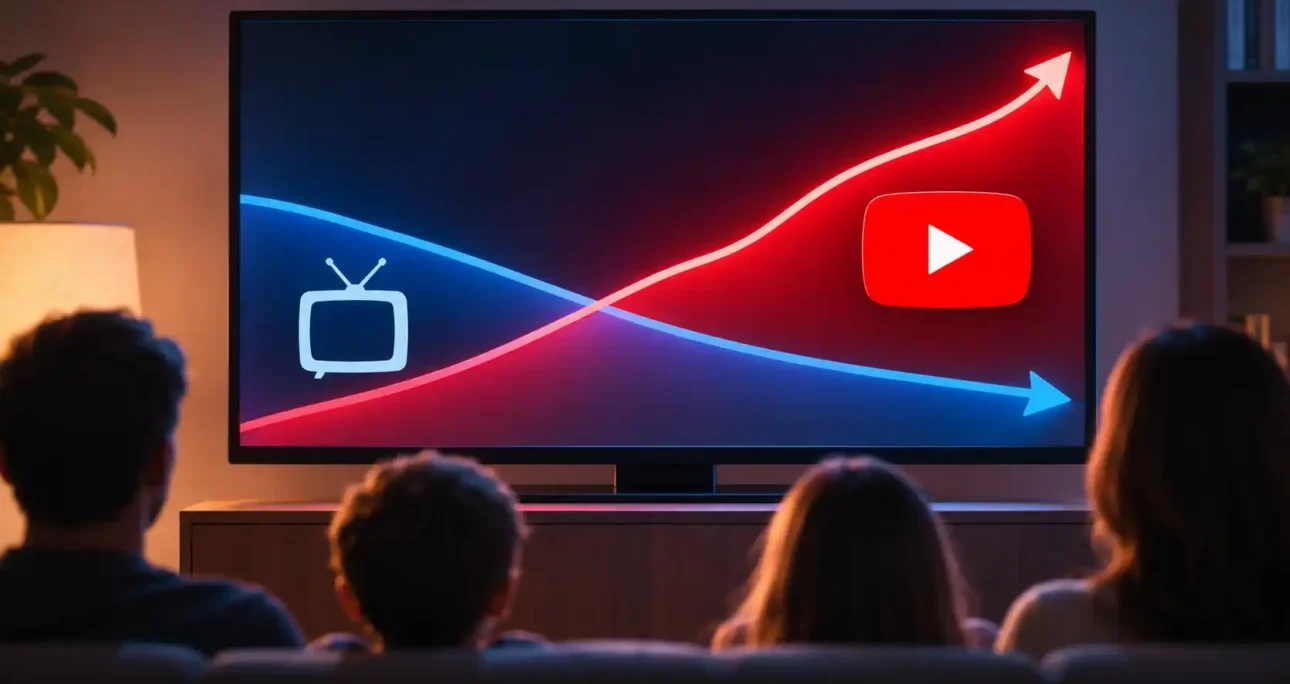
YouTube captured 15.8 percent of all television viewing time in the United States in August 2026, the highest figure Nielsen has ever recorded for the platform, according to The Gauge and Media Distributor Gauge that Nielsen published on 22 October 2026. The month was five weeks long, running from 27 July to 30 August. Total television usage fell 4.4 percent from July because the World Cup had ended, football had not started and school-age viewers drifted back to classrooms. YouTube moved against that current: its viewing on television sets rose 6 percent in the same month. One minute out of every six or seven that Americans spent in front of a TV screen in August went to a video platform that most traditional media executives still file under “user-generated content”.
Table of Contents
A record share of the American television screen
The ranking tells the same story from another angle. In Nielsen’s Media Distributor Gauge, which combines each company’s broadcast, cable and streaming minutes, YouTube stayed first. Disney came back to second place with 9.3 percent. Netflix finished third with 7.7 percent, narrowly ahead of NBCUniversal and its spun-off cable group Versant, which Nielsen still reports together because NBCUniversal keeps the advertising sales. Paramount reached 6.8 percent and Fox 5.6 percent. YouTube’s share is more than double Netflix’s, and it is larger than the combined weight of any two legacy media companies below Disney. Nielsen’s own May report had already described YouTube holding the top spot for a third consecutive month, at a then-record 13.8 percent. Three months later the record had moved by two full points.
Streaming as a whole reached 49.6 percent of television time, within half a point of a majority. Cable held 18.9 percent and broadcast 17.5 percent. Broadcast lost two share points in a month because its sports viewing collapsed from roughly 30 percent of broadcast time in July to under 9 percent in August. That detail matters for anyone trying to read the numbers honestly: broadcast’s August was weak partly for seasonal reasons, and cable’s and broadcast’s autumn will look better once American football returns. The long-run direction is not seasonal, though. The same Nielsen release shows streaming gaining share even in a month when every Gauge category lost minutes.
Why should a person who has just bought a camera or opened a channel care about a measurement of American couches? Three reasons stand out, and they structure the rest of this analysis.
First, the place where people watch has changed, and with it the kind of video that wins. A phone is held in the hand for a few minutes at a time. A television set sits across the room, plays for an hour, and is often shared by several people. Content built for the first situation and content built for the second are not the same product, and a beginner who understands the difference early has a real advantage.
Second, the competition is no longer only other YouTubers. Netflix, Disney, Amazon and national broadcasters are now buying, licensing or imitating creator-style programming, and they are doing it with money. Some of that money reaches creators who already have large audiences. Very little of it reaches someone with 200 subscribers.
Third, the rules for earning on the platform are being rewritten at the same moment. YouTube announced in August 2026 that from 1 February 2027 new applicants to its Partner Program will need double the watch time or double the Shorts views that were required until now. The platform’s record television share and its higher entry bar arrived within weeks of each other, and that timing is the central tension for a newcomer: YouTube has never been a bigger stage, and it has never asked more of the people who want to earn money on it.
This article is written for someone at the start of that path, with a particular eye on creators working in Slovak and Czech markets, where public data on YouTube’s share of television is thin and the numbers have to be read with care. It separates what the sources confirm from what is interpretation, because the creator economy produces a great deal of confident advice that rests on very little evidence. Where a figure comes from a company that sells creator tools, or from YouTube describing its own platform, the text says so.
One plain caution before going further. Nielsen’s Gauge measures viewing on television sets in the United States. It does not measure Slovakia, it does not measure phones, and it does not tell a new creator how many people will watch a first upload. It describes the size and direction of the stage. How a newcomer climbs onto it is a different question, and most of what follows is about that.
The counting rules behind the Gauge, and the gaps in them
Nielsen’s Gauge is the most quoted yardstick in the television business, so it pays to know exactly what sits inside the number. It measures time spent in front of television sets in United States homes, split by distributor and by delivery type. It does not count YouTube watched on a phone, a tablet or a laptop. When Nielsen says YouTube holds 15.8 percent, it means 15.8 percent of the minutes people spent watching a TV screen, and every minute of YouTube on a phone is invisible to it.
The second boundary is a classification choice. The paid live-TV subscription called YouTube TV is not counted as YouTube in the streaming ranking. Nielsen assigns its live channels to broadcast and cable, which is where the network owners would expect to find their own audience. The 15.8 percent is therefore the free and Premium video platform, the one where a creator uploads from a bedroom, and not the cable replacement that shares its name.
Third, the Gauge reports share of time, not reach and not attention. A music video left running during a dinner party and a documentary watched start to finish by two people both count as minutes. Nielsen cannot say how much YouTube viewing on a television is background use, and the question matters for creators, because a minute of ambient playback is worth less to an advertiser and to a business than a minute of focused viewing. The honest reading is that the share is real and large, and that its quality is not measured.
Fourth, the number covers all YouTube content, not just the work of independent creators. Music labels, broadcasters, sports bodies, children’s channels and media companies all upload to the platform and all contribute to the 15.8 percent. YouTube’s chief executive Neal Mohan has said that most living-room viewing on the platform is creator content, but that is YouTube describing itself, and Nielsen’s figure does not break it out.
A fifth point is about timing. Nielsen announced a one-time adjustment to the methodology of The Gauge, the Media Distributor Gauge and the Ad Supported Gauge, starting with the September 2026 measurement interval, in order to align the reports with Nielsen’s TV currency data, the numbers that advertisers actually trade on. Nielsen has said it will publish the September and October intervals together later in the year, which gives the industry time to absorb the change. The August report is therefore the last built on the old method, and the next one will not be a clean continuation of the same line. Anyone who compares a November release with the August record should expect a step in the data that comes from the method and not from viewers.
Publication lag is a related caution. The August data appeared on 22 October, roughly seven weeks after the month ended. Earlier in 2026 Nielsen delayed some releases amid disputes about methodology. A statement such as “YouTube is the biggest TV distributor in America” is true in the data we have, but the data describes a moment that is already two months old.
None of this weakens the main finding. Every credible measurement points the same direction, including the British regulator’s panel data discussed later. What the boundaries do is limit the claims a sensible writer can make. The Gauge supports “YouTube is now the largest single source of minutes on American television sets”. It does not support “YouTube has replaced television”, because linear channels together still hold more than a third of viewing time, and it does not support any statement about Slovakia.
Five months of climbing
The path to the August record is easier to see in a table than in prose. The figures below come from Nielsen’s monthly reports as reproduced by Nielsen itself, by YouTube and by trade outlets that carried the releases. The June share is left out because the sources reviewed for this article do not give it reliably.
Table 1. YouTube’s share of US television viewing time in Nielsen’s Gauge, 2026
| Month | YouTube share | Context from the same release |
|---|---|---|
| March | 13.2% | YouTube’s own post, citing the Media Distributor Gauge, after a February in which NBCUniversal briefly led |
| April | 13.4% | Up 0.2 points; Disney second with 10.3% |
| May | 13.8% | Platform best at the time; streaming 48.6% of TV |
| July | 14.2% | Record, in the World Cup month; streaming 49.0% |
| August | 15.8% | Record; total TV usage down 4.4%; streaming 49.6% |
The table shows a slow climb of about one point between March and July, followed by a jump of 1.6 points in a single month. The August leap deserves a closer look before anyone treats it as a trend. Nielsen reports that YouTube’s own viewing on television sets grew 6 percent from July to August while total television usage shrank 4.4 percent. Apply those two movements to the July share of 14.2 percent and the result is about 15.7 percent, which matches the reported 15.8 percent within rounding. Split into its parts, the 1.6-point gain breaks down roughly half and half: about 0.85 points came from YouTube adding minutes, and about 0.75 points came from the rest of television losing them. The back-to-school lull and the gap between the World Cup and football season shrank the denominator.
That decomposition is the author’s arithmetic, not a Nielsen statement, and it is worth keeping in mind when headlines call August a breakthrough. The honest picture is a steady, real climb that a quiet television month made look steeper. If total viewing recovers in the autumn, YouTube’s share may dip back toward 15 percent even while its absolute minutes stay high. A dip like that would reflect football and not a loss of interest, and a beginner planning a channel should not read it as a retreat.
What the table does establish is persistence. Streaming stood at 48.6 percent of television time in May, 49.0 in July and 49.6 in August, and YouTube led the distributor ranking in every month shown. The gap to the second-placed media company was roughly 6.5 points in August. Gaps of that size are not erased by one good Super Bowl or one bad school term.
Streaming at the doorstep of a majority
Streaming’s 49.6 percent in August 2026 is the figure that makes headlines, but its internal structure tells a beginner more than the total does. YouTube alone supplies 15.8 points of it. Netflix adds 7.7. Disney’s streaming services contribute 4.8 and Paramount’s 2.3. Peacock slipped to 1.6 after the World Cup and the summer reality season ended. Put differently, a single free, ad-supported platform delivers nearly a third of all streaming minutes in the country, and the subscription services that dominated the conversation five years ago share the rest with Amazon, free ad-supported channels and a long tail of smaller apps.
Cable and broadcast tell a different story. Cable usage fell 3 percent in August, yet the category gained 0.2 share points to reach 18.9 percent, because the rest of television fell faster. News is cable’s largest genre, with 25 percent of its viewing, against 8.2 percent for sports in a month when sports were quiet. Broadcast dropped 14 percent from July and ended at 17.5 percent, with dramas making up 22 percent of its time and news 18 percent. ABC World News Tonight topped the broadcast program ranking. That detail is a reminder of what linear television still does: it delivers a large, older, habitual audience to a fixed schedule, and in the United States that audience has not vanished.
The industry’s own analysts describe the trajectory without drama. S&P Global Market Intelligence’s annual cable economics report, summarized by Fortune in December 2025, says the American cable network business has formally entered the decline stage of its life cycle. The numbers behind that phrase are specific. Gross advertising revenue for cable networks fell 5.9 percent in 2024 to $20.2 billion, the lowest level since 2007. Affiliate fees, the per-subscriber payments that cable operators make to carry networks, slipped nearly 3 percent to about $38.7 billion. The average cable network lost 7.1 percent of its subscriber base and ended the year in 31.4 million homes. Subscriptions to the cable bundle peaked as far back as 2012.
What S&P does not forecast is a collapse. Its analyst Scott Robson wrote that the outlook is a continued slow decline as streaming develops, and the report noted that the pace of pay-TV subscriber loss appeared to ease in 2025, with a small gain in one quarter. A separate S&P note on sports argued that live games no longer hold households in the bundle: in a survey cited by the same Fortune article, about 90 percent of households that dropped pay TV over the past year were sports fans, and nearly two thirds of them watched five or more hours of sport a week. Live sport on the cable package did not stop them from leaving.
For a new creator this slow bleed carries two practical meanings. The first is about where the audience goes. Households leaving cable do not stop watching television sets. They move their viewing to apps, and the app with the largest share of that viewing is YouTube. The second is about what lingers. A declining business that still earns tens of billions of dollars in affiliate fees and advertising has the resources to buy, license and copy creator formats, and the next sections show it doing exactly that. Declining does not mean powerless.
A beginner should also resist a lazy reading of the numbers. Cable and broadcast together still account for 36.4 percent of viewing time in the Gauge, more than YouTube and Netflix combined, which stand at 23.5 percent. A good deal of that audience watches on a schedule, in a household where the television is switched on by habit, and it differs from the audience a creator reaches through search and recommendations. Whether a newcomer wants to reach those viewers, and whether a small channel could, is a separate question. The point for now is that the 15.8 percent coexists with a television industry that is large, contracting and busy defending what it has.
The living-room figures YouTube publishes about itself
Nielsen’s Gauge measures from outside. YouTube also publishes figures about its own television audience, and they are larger and more specific, with the limit that nobody outside the company can audit them. Treat each as a claim by the party with the most to gain from it, and then notice how consistent the claims are with Nielsen.
In May 2026 YouTube’s chief executive Neal Mohan told a conference audience that more than half of YouTube watch time in the United States now takes place on television screens. He put the American living-room audience at 200 million hours of watching per day and the global figure at more than 1 billion hours per day on living-room devices, and he said most of what people watch there comes from creators. The August 2026 Partner Program announcement repeated the global figure, describing more than a billion hours of daily watch time on TV. YouTube has also said that television overtook mobile as its main device for American viewing in early 2025.
In September 2026 Kurt Wilms, who runs product management for YouTube on TV, added a statistic that bears directly on beginners: over half of YouTube’s top 100 creators have television as their most-watched interface. The most successful channels on the platform are no longer phone-first businesses. Their typical viewer is sitting on a sofa, which changes how those channels are shot, titled and paced.
The format data points the same way. TechCrunch reported in May 2026 that viewers watch more than 2 billion hours of Shorts on televisions each month, even though Shorts were designed for a phone held vertically. YouTube’s own Made on YouTube announcements in September noted that microdramas, serialized vertical stories, passed 6.5 billion views in the first half of 2026, with watch time up more than 50 percent year over year and TV views alone up more than 90 percent. On podcasts, viewers watched more than 700 million hours per month on living-room devices in October 2025, up from 400 million a year earlier. In each case a format that started on a small screen has moved to a large one.
The money confirms the viewing. On Alphabet’s third-quarter call, held on 28 October 2026, chief business officer Philipp Schindler said the living room now accounts for more than one third of YouTube’s advertising revenue. YouTube’s advertising revenue in the quarter was $11.2 billion, up 9.2 percent from $10.26 billion a year earlier, which is YouTube’s slowest growth of 2026 and compares with roughly 13 percent in the second quarter. Alphabet also reported more than 150 million YouTube Music and Premium subscribers, a count that includes people on free trials. Schindler pointed to the cheaper Premium Lite tier as part of the picture, and he said more than 3 million creators now take part in the Partner Program.
Read carefully, these company numbers do not contradict Nielsen. They are the same phenomenon described with different instruments. Nielsen says YouTube holds 15.8 percent of television minutes in America. YouTube says television is now more than half of its American watch time and a third of its advertising revenue. Both can be true at once, and both suggest that a creator who ignores the television screen is ignoring the largest place where the audience sits.
Two cautions apply. YouTube’s slower ad growth in the third quarter is a reminder that a rising share of viewing does not automatically produce rising revenue per minute, because television viewing is often less commercially dense than mobile scrolling. And the company’s choice of metrics tells you what it wants creators to build: long sessions, series, podcasts and Shorts that behave like episodes. Those preferences are worth following, but a beginner should follow them knowing that they come from a platform with its own incentives.
Older viewers, children and the age shift
The stereotype of YouTube is a teenager with a phone. The August Nielsen release complicates it in one sentence: YouTube benefited from a 9 percent increase in viewing among adults aged 50 and older, in a month when viewing by 6 to 17 year olds fell because school had restarted. The platform’s record month was partly built by grandparents.
British regulator data points the same way, with more detail. Ofcom’s 2026 Media Nations report finds that weekly reach of YouTube among people aged 75 and over rose from 28 percent in 2022 to 33 percent in 2025. Children aged 4 to 15 remain YouTube’s largest audience group in the United Kingdom, while viewing among 16 to 24 year olds declined for a second consecutive year. Ofcom’s 2025 edition had already noted that children in the youngest generation go to YouTube first when they switch on the television, and that people over 55 had doubled their time on the service. So the platform has two large camps, the young who treat it as their television and the old who have discovered it on theirs, and the group in the middle is the one growing more slowly.
An independent dataset from CreatorDB, which tracks channels with at least 1,000 subscribers, adds a view from the supply side. Among channels above 100,000 subscribers whose main audience could be classified, 65 percent reach mainly 25 to 34 year olds and 26 percent reach mainly 18 to 24 year olds. Only 42 channels in the sample have a main audience of 13 to 17 year olds. The idea that big channels are built for teenagers does not survive contact with the data, though the sample excludes channels under 1,000 subscribers and rests on CreatorDB’s own classification.
Three practical readings follow, and the reader should treat them as interpretation and not as reported fact.
First, the television app lowers the technical barrier for older people. A person who would never open a phone app to follow a woodworking channel will press a button on a remote. That is plausible in light of Ofcom’s rise in over-75 reach, but nobody has measured how much of the growth comes from television specifically, and Ofcom’s report does not claim it.
Second, family viewing is back. A television set is shared, which means a video may be watched by a child and a grandparent in the same minute. Creators who work in children’s, cooking, home improvement, travel, history and finance niches are writing for a room and not for a person. Ofcom and Nielsen report individual or household minutes, not how many people sit behind each one, so the extent of co-viewing in any niche is unknown. The living-room setting still suggests that clarity, pacing and tone matter more than they do for a phone feed built on a thumb flick.
Third, the age mix is a warning against chasing trends aimed only at the young. The rise of vertical microdramas and challenge videos is real, yet the one viewer group that the Nielsen release credits with driving August is adults over 50. A beginner choosing a subject in a country where the audience is small, such as Slovakia, may find that a niche with older, loyal viewers produces watch hours faster than a crowded trend category.
None of this argues that young viewers do not matter. Short-form video remains the dominant habit among them, a point Ofcom makes directly, and brands still pay a premium to reach them. The argument is narrower: when the evidence shows YouTube’s growth coming from the old and the very young, advice that treats the platform as a teenage product is out of date.
The British evidence from Ofcom
Ofcom’s Media Nations report, published on 29 July 2026, is the best public cross-check on the Nielsen picture, because it comes from a regulator using Barb’s panel measurement of British television sets, a different country and a different instrument. It confirms the direction and shrinks the size.
The headline for the British market is competition at the top of the funnel. When people were asked which service they usually turn to first when looking for something to watch, 26 percent said Netflix and 25 percent said the BBC, a one-point gap that Ofcom says sits inside the margin of error. ITV came third at 15 percent. Broadcaster-owned on-demand services such as BBC iPlayer and ITVX grew viewing by 9 percent year on year, the fastest-growing category of television in the report, while subscription streaming services settled at about 70 percent of homes after years of expansion. In 2025, 70 percent of people in the United Kingdom watched content from traditional broadcasters for at least 15 minutes in an average week, down from 73 percent in 2024 and 78 percent in 2022, with falls in every age group.
YouTube’s part of the story is the living-room one. Average daily YouTube viewing on television sets rose from 9 minutes per person in 2022 to 19 minutes in 2025, and total YouTube viewing across every connected device in the home reached 41 minutes per person per day, up from 33. Trade coverage of the report by VideoWeek adds that linear television recorded its steepest annual decline in several years, 12 percent, to 1 hour and 51 minutes per day, and that younger audiences appear to be reaching saturation in streaming, which dragged down total at-home video viewing.
A rough comparison with the American figures is instructive, if handled with caution. Barb counts minutes per person across all individuals aged four and over, while Nielsen reports shares of television-set time, so the two cannot be laid side by side. Even so, the British proportions are visibly different: 19 minutes of YouTube on television sets against 111 minutes of linear viewing is a ratio of about one to six. In the American Gauge, YouTube’s 15.8 percent against 36.4 percent for broadcast and cable together is closer to one to two and a third. Britain looks like an earlier stage of the same transition, and smaller markets with languages of their own have little reason to be further along than Britain. Central European countries probably sit at or behind the British position, though no public source reviewed for this article provides a comparable figure.
The report also keeps the argument honest. Linear television still creates shared moments at scale. England’s World Cup semi-final defeat to Argentina on 15 July drew a peak of 24 million viewers across the BBC’s platforms, the BBC’s Celebrity Traitors finale averaged 14.8 million, and 85 percent of sports viewing in 2025 was live. Of the ten most-watched programmes of 2026 so far, the BBC holds eight. Creator content has not displaced these events and, for a beginner, there is a lesson in that: the biggest audiences still gather around moments that cannot be postponed, and a channel made of recorded videos is competing for a different part of the day.
Ofcom’s most useful sentence for a creator is its observation that public service broadcasters are making YouTube a core distribution strategy. Channel 4 and ITV have partnerships that put full-length programmes and digital-first content on the platform under commercial arrangements that keep more advertising control with the broadcaster, and the BBC has expanded platform-first commissions aimed at younger viewers. Television companies are no longer treating YouTube as a rival to avoid. They are treating it as a shop window, which means that a beginner uploading a first video will increasingly share the recommendation row with the output of national broadcasters.
Slovakia and Czechia, where the evening still belongs to television
A Slovak reader may fairly ask whether any of this applies at home. The honest answer is that the direction probably does and the size is unmeasured. No public source reviewed for this article gives YouTube’s share of television-set viewing in Slovakia or the Czech Republic, so every claim about the local scale of the shift is an inference from the American and British data.
What is measured is linear television, and it remains strong. Slovakia’s official peoplemeter ratings come from Fifty5Blue, with data published through the PMT system. For the first half of 2026, Markíza Group held a 32.58 percent market share among viewers aged 15 to 57, the commercial target group, which was redefined for 2026. JOJ Group reached 21.16 percent, the public broadcaster STVR 13.01 percent and the Prima stations 2.44 percent. In the wider group of everyone over 12, Markíza had 27.82 percent, JOJ 19.64 percent and STVR 17.11 percent, which shows that public television is much stronger among older viewers. The main Markíza channel averaged 19.83 percent all day in the commercial group against 11.97 percent for TV JOJ, and 20.65 against 14.63 percent in prime time.
Two details of the measurement matter. The figures include live viewing, guests in the household and time-shifted viewing within three days. And a market share is a share of television viewers’ time, not a share of the population, so it swings hard when one event pulls people away from rivals. STVR’s sports channel went from 0.9 percent in January to 12.2 percent during the Milan-Cortina Winter Olympics in February and back to 1.3 percent in March. JOJ’s sports channel rose from 0.8 percent in January to 3.6 percent in May on ice hockey. JOJ Group says the seven Slovak matches at the world championship, with their studio programmes, reached more than three million viewers aged 12 and over, which is the broadcaster’s own description of its performance. Slovak television still gathers a nation for a hockey match, as British television does for a World Cup semi-final.
The coverage that reported these ratings opens with a sentence worth keeping: television stations now compete not only with each other but with Netflix, YouTube and other streaming services. That is the local version of the Nielsen story, stated without a number.
The more interesting local evidence concerns the traffic between television and creators. TV JOJ’s Friday entertainment show Milujem Slovensko brought influencers into its studio for the first time in 2026, among them the presenter and online personality Samo_zvany and the food creator Čoje, alongside team captains Adela Vinczeová and Matej “Sajfa” Cifra, a former radio presenter who is also a YouTuber. In autumn 2025 JOJ launched the influencer reality show Behind the Fame first on its paid platform Joj Play and then on air; the broadcaster itself acknowledged that the show struggled in the television ratings while claiming more than 1.5 million interactions on social media and strong online demand. Whatever one thinks of the show, it illustrates a pattern: Slovak television borrows creators for the audience they bring, but the creator’s audience does not always follow onto the schedule. Reach on the platform and ratings on the channel are different currencies.
For a beginner in Slovakia or Czechia there are three concrete facts in YouTube’s own documentation. Both countries appear on YouTube’s list of countries where the expanded Partner Program, the 500-subscriber tier, is available. YouTube’s Hype feature, which lets viewers push up-and-coming channels with 500 to 500,000 subscribers, is listed as available in Slovakia. And the monetization thresholds that apply to a Slovak channel are the same global thresholds that apply to everyone, which means a Slovak creator competes for a Slovak-speaking audience of a few million people under rules calibrated for a platform with more than 2.7 billion monthly users.
That last point is the structural challenge of small language markets. The audience is loyal and under-served in some niches, yet it is limited in size, and 8,000 qualified watch hours in a year is a harder target when the potential audience is five million than when it is five hundred million. Section after section of this analysis returns to that arithmetic, because it determines what a realistic first year looks like.
Advertising money follows the screen
Attention moves first and budgets follow with a delay. In 2026 the delay is visibly closing. WARC Media’s forecast, published in September 2025, expected global linear television advertising to fall 11.3 percent in 2026 to $139.1 billion from $143.9 billion, the lowest total since 2005. Connected TV and streaming were forecast to rise 3.6 percent to $44.7 billion. Even so, linear still commanded about 75 percent of all global television and video investment, which is a reminder that budgets are slower than viewers.
In the United States the crossover has already been reported. The Interactive Advertising Bureau’s 2026 outlook puts digital video advertising, which covers connected TV, social video and online video including YouTube, at $81.9 billion, up 11 percent, about 20 percent faster than the whole ad market. Social video, at $31.9 billion and growing 13 percent, overtakes connected TV, at $29.3 billion and growing 11 percent, for the first time. Digital video holds 61 percent of annual television and video spending against 39 percent for linear, up from 58 and 42 a year earlier. IAB’s survey also found that 54 percent of the growth in connected TV spending comes from money that used to go to linear television.
YouTube sits across several of those categories at once. Its advertising revenue for the third quarter of 2026 was $11.2 billion, up 9.2 percent, and more than a third of it now comes from living-room viewing. The growth rate is the slowest of the year, though, and the same month brought a reminder that television-style advertising is not an easy business: Netflix cut its 2026 advertising revenue expectation to about $2.7 billion from roughly $3 billion, blaming a slower rollout of some ad product capabilities. Not every platform is profiting from the move to television screens at the speed its sales teams predicted.
A beginner should read the advertising numbers with two filters. The first is where the money lands. Billions flow into YouTube, but the creator receives a fixed share of ad revenue that is allocated by views and viewer value. The Partner Program pays creators 55 percent of ad revenue on long-form video and 45 percent of the Shorts pool, and those percentages did not change in the August 2026 update. A channel with a few thousand views a month will see little of the growth in the total, because revenue is proportional to the audience and not to the size of the market.
The second filter is who pays for attention that is not on a schedule. Television advertisers bought predictable audiences at fixed times. Creator content offers audiences that come when they choose, in amounts that vary by niche. Large advertisers increasingly pay creators directly instead of relying on platform auctions, which is why the section on brand deals later in this analysis matters more to a new creator’s income than the advertising revenue line in Alphabet’s accounts.
One further implication belongs here. Analyst Brian Wieser of Madison and Wall has projected that television and connected TV ad inventory will shrink as viewing moves to digital, where fewer ads are shown per hour, and eMarketer expects higher connected TV prices to offset part of that loss. For creators, that is an argument for building content that holds a viewer for a long session rather than content that is short and ad-light, but the evidence is about advertising markets and not about creator payouts, and no source reviewed here quantifies a link between the two.
The jobs television still does better than any creator
A fair analysis has to say what the incumbent is good at, because those strengths mark the places where a beginner should not try to compete and the habits worth borrowing.
Live, shared, unrepeatable events come first. Ofcom found that 85 percent of sports viewing in the United Kingdom in 2025 was watched live, and its example of the year was England’s World Cup semi-final, which peaked at 24 million viewers across BBC platforms. In Slovakia the same logic produced a three-million reach claim for the ice hockey world championship and a more than thirteen-fold jump in the audience share of a small sports channel during the Winter Olympics. People do not wait for a recording when a result matters, and a channel that uploads on Tuesday cannot match a broadcast that happens as the thing occurs.
Scale in a single moment is the second job. The 2025 Academy Awards drew 19.7 million viewers on ABC. A top creator can collect that many views over months, not in one evening with advertisers booked against a fixed slot. The Academy’s decision to move the ceremony to YouTube from 2029 is partly an admission that the ceremony will reach more people there, yet it is also a bet that a platform can recreate the single-evening gathering, and that remains untested.
Habit and ritual form the third. Nielsen’s August data shows news programmes leading both broadcast and cable. The most-watched broadcast programme was a national evening news bulletin, and news is the largest genre on cable, at 25 percent of its viewing. These are appointments: a presenter, a time, a familiar order. Television audiences return because the schedule is a decision that someone else has already made for them.
Age and household structure is the fourth. Ofcom’s 2024 report found that 95 percent of people aged 65 and over still watched broadcast television in an average week, a level that has barely moved. The oldest viewers keep the lights on at the broadcasters, which is one reason Slovak public television, with its strength among older viewers, retains a 17 percent share of everyone over 12 even though it has only 13 percent in the commercial group.
Editorial responsibility and production money is the fifth. A national broadcaster carries legal obligations, employs a newsroom, commissions drama and answers to a regulator. Ofcom counts more than 30,000 hours of first-run UK-originated programming from public service broadcasters in 2025. A solo creator has none of that apparatus, and the advantage of independence is paid for in the cost of verifying facts and the absence of a legal team.
Seen that way, television’s strengths translate into five habits that a creator can copy at small scale without competing head on. A creator can schedule releases so that viewers learn when to return, as the daily show Good Mythical Morning does with episodes that now appear on YouTube and Netflix on the same day. A creator can use live streams and premieres to give a recorded channel a moment of simultaneity. A creator can give a series a recognizable opening and structure, so that each episode feels like an appointment. A creator can treat verification as a product feature, which matters more as synthetic video spreads. And a creator can aim a niche at the older viewers whom both Nielsen and Ofcom show arriving on the platform.
There is also a limit to imitation. A channel cannot recreate a national moment. Its natural audience gathers around a subject, not a date, and attempts to manufacture event status, with countdowns and fake urgency, tend to age badly. The healthier version of the borrowed ritual is regularity without theatre.
The lesson for a beginner in a small market is practical. Television’s strength lies where the audience is large and the timing is fixed. YouTube’s strength lies where the audience is specific and the timing is the viewer’s. A new channel is far better placed to serve specific audiences than to chase general ones, and the data on the platform’s own growth, from older viewers, podcasts and long sessions on the sofa, suggests that specific audiences are where the platform’s living-room expansion is happening.
Pay-TV’s decline in company accounts
Industry-wide studies describe a slow decline. Company results show how it feels from inside. Versant, the cable-network company that Comcast spun off from NBCUniversal at the start of 2026, reported for the third quarter that linear distribution revenue fell 5.8 percent to $935 million and advertising revenue fell 5.3 percent to $373 million, even though its television ratings were stronger. Linear distribution still made up nearly 59 percent of quarterly revenue, against about 15 percent from platforms. A company whose audience is up and whose advertising income is down is a company in a structural decline, and the gap between ratings and revenue is the signature of the pattern: fewer homes pay for the bundle, and money spent on linear advertising keeps shrinking.
The merger market shows the same pressure. On 27 February 2026 Paramount Skydance and Warner Bros. Discovery announced a definitive merger agreement under which Paramount would acquire the company at $31 per share, an equity value of $80.9 billion, after Netflix had stepped aside from an earlier agreement and was paid a $2.8 billion termination fee. The parties said they expected the deal to close by the end of the third quarter of 2026, subject to regulatory clearances, and Paramount’s filing with the Securities and Exchange Commission shows a per-share ticking fee if closing slips past 30 September. This article does not claim the merger has closed, because the sources reviewed do not confirm it. What they do show is the plan: combine HBO Max and Paramount+ into one streaming service and keep the combined cable networks, whose management argues that two portfolios will stay healthy longer together than apart.
Consolidation of this kind is a rational response to decline, and its consequences for creators are indirect. Fewer large buyers of programming means fewer places to sell a show. A bigger streaming service with a larger library may also have less reason to pay for creator content, though Netflix’s recent deals suggest the opposite for the largest names. And the cable networks that remain will lean harder on sport, news and reality, which are the genres that survive on a schedule and which a creator cannot easily replace.
Carriage disputes complete the picture. S&P’s cable review noted that 2025 was marked by blackouts of Disney and TelevisaUnivision networks on the YouTube TV subscription service, as distributors pushed back against rising rates for shrinking audiences. The detail is useful because it shows YouTube on both sides of the table. As a free platform it takes viewing time from the cable bundle, and as a paid distributor it bargains with the same networks. That makes YouTube both an adversary and a customer of traditional television, which helps explain why Disney and others also strike content deals with its creators.
A beginner does not need to follow every merger, but one reading is worth keeping. When an industry that earns tens of billions of dollars shrinks by single-digit percentages every year, it does not disappear quickly, and it spends money to defend itself. Some of that money buys creator-led programming. The next two sections look at where it goes and who receives it, and the answer shows how narrow the door is for a newcomer.
Old media moves onto YouTube
The clearest sign that television regards YouTube as a venue and not a threat is where the biggest television events are going. On 17 December 2025 the Academy of Motion Picture Arts and Sciences announced that the Oscars will leave ABC after the 2028 ceremony and stream on YouTube from 2029, with global rights running through 2033. The ceremony, the red carpet, the nominations announcement and other Academy programming will be free to watch worldwide and also available to YouTube TV subscribers. Financial terms were not disclosed in the announcements reviewed here. It is the first of the big four American award shows to abandon broadcast entirely. The Emmys followed within a year: the Television Academy agreed a six-year deal that moves its ceremony to Amazon’s Prime Video from 2027, ending a relationship with broadcast networks of about seven decades.
Two different bets sit behind those announcements. The Academy chose a free global platform that reaches viewers in more than 200 territories where it previously depended on separate broadcast partners. The Television Academy chose a subscription service tied to a retail ecosystem. Both decisions accept what Nielsen’s numbers imply, that the biggest audience for a long, planned evening of video is now more likely to be found inside an app than on a channel number.
The same direction shows up at a smaller scale in how broadcasters and studios treat creators. Ofcom reports that Channel 4 and ITV distribute full-length programmes on YouTube under commercial arrangements that preserve their control of advertising, and that the BBC has expanded platform-first commissions and its channel presence to reach younger viewers. In the United States, Dhar Mann Studios, whose YouTube channel has about 27.5 million subscribers, signed a content deal with Disney in August 2026 to produce original programming for children, teenagers and families, beginning with a 20-episode series. TheWrap’s creator-economy columnist noted that it was the second major media deal Mann had signed that year, after a microseries deal with Fox. A producer who built an audience on YouTube is now supplying television networks, which reverses the supply chain of the past twenty years.
What does a beginner take from this? The big institutions are borrowing YouTube’s grammar and its audience, and they bring larger budgets, famous faces and legal departments. That has three effects on the channel of someone who has just started.
One effect is on the recommendation row. A viewer opening YouTube on a television now sees creator videos, music, sport and broadcaster programmes side by side. Competition for the first screen is more crowded than it was when the platform’s catalogue consisted mostly of independent uploads. A new creator should not assume that a good video will be surfaced because it is good. It must be better than what a broadcaster’s digital team has just published on the same subject, and sometimes it is, because those teams are slower and more cautious.
A second effect is on legitimacy. When the Oscars and public broadcasters treat YouTube as a home, the old hierarchy that placed a television credit above an online one weakens. Brands that once demanded a television presence now ask for a creator partnership. That is good for creators with an audience and irrelevant to those without one.
A third effect is on the talent market. Broadcasters, streamers and production companies scout YouTube for talent that has proven it can hold an audience, and they prefer proof of demand to a pitch. The path from a small channel to a deal with a studio runs through numbers: subscribers, retention, a repeatable format. That is another reason why the early target for a newcomer should be a channel with an identifiable audience, even a small one, rather than a general entertainment page that tries to please everyone.
There is a caution worth stating. Moves like the Oscars deal are announced years in advance, and their results are unknown. A ceremony that has been watched by tens of millions in a single evening will have to prove it can repeat that gathering on a platform built around personal choice. If it succeeds, YouTube will have demonstrated that it can host appointment viewing, and that would strengthen the case for creators who build scheduled series. If it fails, the lesson will be that scale in one evening still belongs to broadcast. Neither result is known in November 2026, and no analyst can honestly say which is likelier.
The Netflix creator land grab
In the summer of 2026 the most contested territory in streaming was a set of channels that started on YouTube. Netflix signed one creator deal after another, and by autumn the pattern had a name in the trade press. The Hollywood Reporter reported on 14 July that Good Mythical Morning, along with Mythical Kitchen and Last Meals, would appear on Netflix from September on the same day they are uploaded to YouTube, which made the Mythical Entertainment arrangement unusual: earlier deals with Ms. Rachel, Jordan and Salish Matter and Mark Rober repackaged content already produced, and the Stokes Twins, with more than 140 million YouTube subscribers, were bringing their archive. Netflix, the trade paper wrote, had been aggressively signing top creators, podcasts and publishers to bolster its library.
More followed. Kevin Langue, with 5.4 million YouTube subscribers and more than three billion lifetime views, put a catalogue of his guessing-game shows on Netflix from 5 September and committed to day-and-date releases. On 2 November Netflix announced a multi-year partnership with the comedian Druski for original programming, starting with a comedy series built around one of his characters. Netflix’s co-chief executive Ted Sarandos has called YouTube a “farm league” for talent, according to industry coverage, and the phrase captures the intent: Netflix wants proven audiences, bought after someone else paid the cost of building them.
YouTube’s response was to pay. Bloomberg reported on 19 August that YouTube had offered some of its biggest creators millions of dollars to stay off rival streamers. According to The Ankler, cited by TheWrap, at least 15 creators received offers ranging from the low seven figures up to $10 million, and a creator who declined could be left out of YouTube’s major advertising showcases such as Brandcast. MediaPost reported in October that executives had told creators who go non-exclusive to Netflix that they could receive less promotion and could lose brand deals, and that LightShed Partners saw the Netflix move as giving creators access to premium advertisers they could not otherwise reach. The platform that had spent a decade telling creators that YouTube was home was now bidding for loyalty.
Video podcasts show the same fight. Netflix signed 14 iHeartMedia video podcasts exclusively for early 2026, and a similar arrangement with Spotify covers shows from The Ringer. TechCrunch noted that podcasters who move their video to Netflix lose the ad revenue and reach of YouTube, which creates a real trade-off for them.
For a newcomer, the first conclusion is plain: these deals are for creators who already have large audiences, and no beginner is eligible for one. A channel with 300 subscribers does not appear on a Netflix scout’s list. The second conclusion is less obvious. The deals show that audience, once built, is a transferable asset. Industry observers quoted by NetInfluencer pointed out that creators who sign broad contracts may trade long-term control of their fan relationship for short-term validation, and that a creator who owns the community on YouTube keeps something the streamer cannot buy. A beginner is in a position to make that choice early, by collecting email addresses, running a community outside the algorithm and keeping the rights to the work.
The third conclusion is about bargaining strength. When two giant platforms bid for the same creators, those creators gain a stronger hand, but the gain is concentrated at the very top, where a handful of channels hold most of the viewing. The next section shows how concentrated that top is and why a newcomer should plan around the median, not the exception.
A beginner is not that creator
The creators who sign with Netflix, collect million-dollar retention offers and appear in the Nielsen numbers are an extreme tail of the distribution. Anyone planning a first channel should look at the whole curve, and the data on it comes from several independent directions that agree.
Start with viewing. The creator advertising company Agentio analysed more than 35,000 videos and found that the top 20,000 creators account for about 90 percent of all YouTube views in the United States. YouTube reports more than 3 million creators in its Partner Program, so the group that captures nearly all the viewing is a sliver of the monetized population, even allowing for the fact that Agentio counts American views and YouTube counts creators worldwide. Goldman Sachs Research, quoted in a creator-economy explainer from PPC Land, estimated that only about 4 percent of creators earn more than $100,000 a year. The Interactive Advertising Bureau counted roughly 200 million people worldwide who identify as creators in July 2026, with about 50 million of them professional or semi-professional. The IAB itself says part of the rise since 2020 reflects looser definitions rather than new entrants.
Now the subscriber ladder. CreatorDB’s index covers 2,153,140 channels with at least 1,000 subscribers as of June 2026, and in it only about 76,700 channels have ever passed one million subscribers, 2,991 have passed ten million and 17 have passed 100 million. The tool maker vidIQ analysed 61.2 million channels with at least one public subscriber in July 2026. About 40.6 percent had reached 1,000 subscribers, 7.9 percent had reached 10,000, 1.3 percent had reached 100,000 and 0.13 percent had reached one million. Among active channels, the median monthly subscriber growth was 1.26 percent for channels starting with fewer than 100 subscribers and 0.51 percent for those starting between 1,000 and 9,999, which meant a median gain of 13 subscribers a month in that band. CreatorDB adds that fewer than one channel in a hundred grew by more than 10 percent in a month over its study period, and only about 37 percent of tracked channels grew at all.
The earnings side is starker. In May 2026 vidIQ examined 1,027,773 channels sitting at 1,000 to 1,100 subscribers, the point that opens ad revenue under the current rules. Eighty-nine percent had fewer than 5,000 views a month and typically earned between nothing and about $20 a month from ads. Another 7.2 percent had 5,000 to 20,000 monthly views and earned an estimated $5 to $74. Only 4.2 percent had more than 20,000 monthly views, and for them vidIQ estimated ad income between $27 and $503 a month depending on niche. Those earnings figures are the company’s own estimates, built from standard niche rates and not from payout records, and vidIQ sells software to creators who want to grow. Even so, their order of magnitude fits everything else in the data: ad revenue at the 1,000-subscriber line is pocket money.
How should a beginner use these numbers? There are four sensible readings.
The first is that the median outcome is not a business. A channel that reaches 1,000 subscribers is ahead of about 59 percent of channels in vidIQ’s sample, yet most of those channels earn little. A plan that depends on reaching the long tail’s rare winners is a lottery ticket. A plan that treats the first year as an apprenticeship, with modest income from other sources, is a plan that survives the median.
The second reading is that growth is slow by default, and that is normal. A median gain of about 150 subscribers a year in the 1,000 to 9,999 band means that a creator who sees 40 new subscribers in a month is not failing. It also means that the stories of overnight channels are survivors: the ones who did not grow do not tell stories.
The third is that the top of the curve is a different business from the bottom. The channels in the Nielsen numbers employ editors, researchers and producers, and they negotiate with platforms. The cost structure and the career skills involved are those of a small production company, and a beginner who copies their output without their budget will exhaust themselves.
The fourth reading concerns time. These numbers describe a platform that has been open for twenty years. Late entrants face an audience that already has favourites in every obvious niche, which is why the specific, local and unfashionable niches deserve more attention than the common advice to chase big topics.
None of this discourages starting. It argues for starting with realistic expectations and for treating the Partner Program’s thresholds as milestones that most channels never reach, which is the background against which YouTube’s August 2026 announcement should be read.
The August 2026 Partner Program rewrite in full
On 10 August 2026 YouTube published what it called the first major changes to the Partner Program since 2018, and it presented them as a way of rewarding active creators. The company said that over 3 million creators take part, and that it expects to pay more to creators in 2027 than it did in 2026. The changes take effect on 1 February 2027, and every partner has to accept updated terms in YouTube Studio. The details matter, because several early summaries blurred them.
Entry thresholds for new applicants. To earn from ads and from YouTube Premium, a new applicant will need 1,000 subscribers plus either 8,000 qualified watch hours in the previous 365 days or 20 million qualified Shorts views in the previous 90 days. The existing bar is 4,000 hours or 10 million Shorts views. The subscriber requirement stays at 1,000. Channels already in the program keep their status.
What “qualified” means. YouTube’s explainer of 12 August says qualified watch hours come from public long-form videos. Shorts watch time, videos played as ads and live streams that are not archived do not count, and qualified Shorts views must come from public Shorts and be engaged views. In practice, private and unlisted videos, ad campaigns and deleted videos add nothing.
The fan-funding tier is unchanged. At 500 subscribers, with three public uploads in 90 days and either 3,000 qualified watch hours in a year or three million qualified Shorts views in 90 days, a channel can still join for memberships, Super Thanks, Shopping and Creator Partnerships. YouTube’s help page states that eligibility for fan funding, Creator Partnerships and Shopping does not change.
A rolling floor on Shorts payouts. From 1 February 2027, only creators with 10 million qualified Shorts views over the previous 90 days will share in Shorts ads and subscription revenue. Channels below that line remain in the Partner Program and keep earning on long-form video, and Shorts revenue sharing resumes automatically once they cross it again. For those channels, YouTube says it will introduce incentive programs tied to milestones, with bonuses for YouTube Shopping, incentives for brand deals and earnings boosts for starting and growing trends. It has not yet published amounts or rules for them.
More from Premium. YouTube is extending the cheaper Premium Lite subscription to every country where Premium is sold. The company allocates 30 percent of net Premium revenue and 60 percent of net Premium Lite revenue to a creator pool, which is distributed by member watch time, and creators receive 55 percent of it for long-form video and 45 percent for Shorts. The long-form and Shorts splits are unchanged.
New activity rules. From the same date a partner channel counts as active if it meets any one of three conditions: 1,000 qualified watch hours in the past 365 days, one million qualified Shorts views in 90 days, or two long-form videos or five Shorts uploaded every 90 days. A channel that slips below gets an extended 90-day window to meet the watch-hour or Shorts-view condition and stay in the program.
A separate change arrived on 24 August and is easy to confuse with the rest: YouTube began reporting total views as the main public number instead of engaged views. Agentio estimated the shift could raise public counts by as much as 30 percent. YouTube says earnings and Partner Program eligibility continue to rest on engaged views and watch hours, so the larger public numbers do not lower the bar or raise income.
Reading the rewrite as a message to newcomers
YouTube justified the higher entry bar by pointing to growth: the platform now sees more than 200 billion Shorts views a day and over a billion hours of television watch time daily, and the company argues that entry requirements should keep pace with that scale. The reasoning is odd on its face, because a larger audience does not make it harder for a new creator to deserve payment, but it reveals the real purpose. YouTube wants the ad-and-Premium revenue pool to go to channels that produce a lot of viewing, and it wants to direct everyone else toward other kinds of earning.
The scale of the new bar is easier to grasp in daily terms. vidIQ calculated that 8,000 watch hours over 365 days averages about 22 hours of channel watch time every day, and that 20 million Shorts views over 90 days averages about 222,000 qualified views a day. A second translation uses video length. If viewers watch an average of five minutes of each video, 8,000 hours equals about 96,000 views in a year, or roughly 1,850 views a week. At three minutes of average viewing it takes about 160,000 views, and at eight minutes about 60,000. That is the author’s arithmetic and not a YouTube figure, and the real average depends on the channel, but it shows why average view duration is as important as view count when the target is measured in hours.
Several things follow from the structure of the change.
First, ad revenue becomes the reward for channels that have already succeeded. For a new creator the revenue arriving at the 1,000-subscriber point under the old rules was small, as the vidIQ earnings data shows. Under the new rules it will arrive later and, for most channels, never. YouTube has said total creator investment is not shrinking, and that some money is being moved toward programs it will announce later. Until those programs are published, a creator cannot plan around them.
Second, Shorts are no longer a cheap route to a payout. Shorts views remain useful for discovery and for qualifying for the Partner Program at the lower tier, where three million views in 90 days still suffice for fan funding. But sharing in the Shorts pool will require holding at least ten million qualified views in every rolling 90 days, and YouTube says channels that already earn a lot from Shorts are unlikely to feel the change. Channels below the line will lose Shorts ad income without losing Partner Program membership. The company describes the replacement as incentive programs, which at present are an announcement and not a schedule.
Third, “monetized” becomes a weaker signal of quality, not a stronger one. A trade analysis aimed at brands vetting creators argued that a channel in the program before February 2027 will have met a lower bar than a channel admitted afterwards, so the badge will not mean the same thing across cohorts. Agentio’s chief executive saw the logic from the other side: stricter standards align with wanting creators who invest time and build audiences that brands will pay for. Both comments imply that for a newcomer the real credential will be a record of brand work and audience data, not Partner Program membership.
Fourth, the change pushes beginners toward direct revenue early. By leaving the 500-subscriber tier alone, YouTube is steering new channels toward memberships, tips, shopping and brand deals while they build the larger audience needed for ads. That is a legitimate path, but it asks a beginner to behave like a small business sooner than before.
Some creators have voiced concern that the change, together with the switch in how public views are counted, devalues the work of small channels. The criticism is understandable and also incomplete. The old bar, set in 2018, was low enough that a channel could pass it and still earn a few dollars a month, which did little for the creator and gave brands a poor signal. Raising it does not remove a living that existed. It removes a milestone that felt like progress and paid almost nothing.
A final point is about uncertainty. YouTube said it will share more details on the new incentive programs and has not yet done so in the sources available to this article. A responsible reading separates what is announced and dated, namely the thresholds, the Shorts floor and the activity rules, from what is promised and undefined, namely the incentives. A creator who builds a plan around a promised payment is relying on something that does not yet exist.
The 500-subscriber rung
The part of the Partner Program that did not change is the most useful for a beginner, and it is the least discussed. A channel that has 500 subscribers, three public uploads in the past 90 days and either 3,000 qualified watch hours in the last 12 months or three million qualified Shorts views in the last 90 days can apply for YouTube’s expanded Partner Program, provided it is based in an eligible country and has two-step verification turned on. Slovakia and the Czech Republic are both on YouTube’s list of eligible countries.
What does a channel get at that level? YouTube’s help documentation lists fan funding features such as channel memberships, Super Thanks and Super Chat, together with Shopping features that let a creator promote products. The company merged its BrandConnect tool into YouTube Creator Partnerships in March 2026, and the help page states that eligibility for Creator Partnerships is also unchanged at 500 subscribers. Ad revenue is not included at this tier. For a channel in Slovakia that means an audience of 500 people, who can pay a monthly membership or send a tip, and a place to attach affiliate products.
The sums are modest. A hundred members at the equivalent of a few euros a month produce a few hundred euros, but most channels at 500 subscribers will not have a hundred paying members, and a conversion rate of a few percent of subscribers is a more realistic expectation. That is the author’s illustration, not a measured rate, because no source reviewed here reports average membership conversion for small channels. The tier’s real value lies in something else: it teaches a creator to ask an audience for support, which is the skill that carries brand deals and eventually a business.
In his annual letter of February 2025, YouTube’s chief executive Neal Mohan noted that more than half of the channels earning five figures in 2024 made money from sources other than advertising and Premium revenue. The statement is YouTube’s own and does not say how many channels that covers, but it matches the broader picture that small and mid-sized channels build income from several streams. A creator who reaches 500 subscribers has the option to begin building the other streams while the audience for ads is still being assembled.
Local support exists as well. YouTube’s Hype feature, available in Slovakia, lets viewers boost new long-form videos from channels with 500 to 500,000 subscribers up to three times a week at no cost, and a channel with 500 subscribers receives far more points for each Hype than one with 500,000. That is a mechanism built for small channels, and nobody has published how much extra reach it produces, so it is a tool to test and not a strategy to rely on.
Three practical cautions come with this rung. The requirement of three public uploads in 90 days means a channel that stops posting loses its eligibility. The 3,000 hours must be qualified long-form hours, so Shorts-only channels need the three million views route. And the subscribers must be real: buying subscribers or views violates policy, and ad campaign views do not count toward qualified totals anyway.
The 500-subscriber rung is also where the timeline matters most. The tier is not changing, which means it is available after 1 February 2027 on the same terms. A creator who is a long way from 4,000 hours can aim at this milestone first, run memberships and brand work for six months, and then decide whether the new 8,000-hour target is realistic. Nothing in the announcement penalizes that sequence.
Shorts, long-form and the living-room test
YouTube’s two main formats are being pulled in different directions by the same television screen. Shorts, the vertical videos of up to three minutes, now average more than 200 billion views a day according to the company’s chief executive. Television is the least obvious place for them, and yet viewers watch more than 2 billion hours of Shorts on TV sets each month, and Google TV has added a “Short videos for you” row to its home feed. A format designed for a thumb has found a second life across the room.
On 23 September 2026 YouTube added a structure that bridges the two worlds. Shorts series lets a creator organize Shorts into seasons and episodes, with custom thumbnails and sequential playback, and it is rolling out to Partner Program members on web, mobile and television. YouTube cited microdramas as the proof of appetite: serialized vertical stories passed 6.5 billion views in the first half of 2026, with watch time up more than 50 percent and television views up more than 90 percent. The company is telling creators, in effect, that a short video on a TV set is more likely to be watched if it belongs to a series.
How should a beginner weigh Shorts against long-form? The facts that bear on the choice are these.
Shorts and watch hours are separate currencies. Watch time from Shorts does not count toward the 4,000-hour threshold today or the 8,000-hour threshold from February 2027. Shorts have their own gate, measured in qualified views, which will be 20 million in 90 days for new applicants. A channel that publishes only Shorts is therefore betting on the second gate, which is the harder one.
Shorts pay less per viewer and will soon pay only above a floor. The Shorts pool pays creators 45 percent of its revenue, and from February 2027 a channel needs ten million qualified Shorts views in a rolling 90 days to share in it. A beginner who reaches a million Shorts views a month will earn nothing from the pool under the new rules, though the Shorts views will still help qualify for the 500-subscriber tier.
Long-form is where the television audience pays attention. The company’s own statements place the top creators’ main interface on TV and describe most living-room viewing as creator content. Long sessions are also what raise watch hours quickly: a viewer who stays for 20 minutes adds the same watch time as 20 viewers who leave after a minute.
Discovery is where Shorts help. A short clip reaches people who do not know the channel and costs less to produce than a documentary. YouTube has not published how many Shorts viewers go on to watch long videos or subscribe, and the figure is not available in public sources reviewed here. Advice that treats Shorts as a reliable funnel rests on creators’ anecdotes and on tool vendors’ studies, not on platform data, and a beginner should test the effect on their own channel by comparing subscriber growth in weeks with and without Shorts.
The practical shape that fits the evidence is a long-form core with Shorts used as trailers and episode fragments. The long videos accumulate qualified hours and give the television audience something to settle into. The Shorts, grouped as a series where the subject suits it, give discovery and a route to the 500-subscriber tier. A channel that does the reverse, with Shorts as the core and long-form as an occasional extra, is exposed both to the new ten-million floor and to the harder Shorts entry bar.
A caution on microdramas: the format grew quickly and YouTube is promoting it, but it is expensive to produce well, it competes with dedicated apps and studios, and nothing in the data shows that a solo beginner can build an audience this way. It is an example of a trend to observe, and not a recommendation.
Video podcasts on the sofa
If one format shows how television and creator content have merged, it is the video podcast. Two people at a table with microphones, filmed from three angles, require little equipment, and viewers treat the result as company. YouTube said in February 2025 that it had more than one billion monthly active viewers of podcast content, a figure it repeated in May 2026, and in December 2025 it reported that viewers watched more than 700 million hours of podcasts on living-room devices in October 2025, up from 400 million a year earlier. That is a 75 percent increase in twelve months, and podcasts are a fast-growing viewing category on television sets.
The numbers come from the company and cover specific scopes. The billion is a count of monthly viewers worldwide as of January 2025, not unique podcast listeners across the industry, and the hours figures apply to living-room devices only. They explain why a podcaster would publish video. They say nothing about any particular show’s audience, and a beginner should not quote them to a sponsor as if they described a new channel.
Netflix’s entry into the format complicates the picture. Its deals with iHeartMedia and Spotify moved many shows to video on Netflix, and TechCrunch noted that podcasters who left YouTube for Netflix could lose reach and advertising income. That is the same trade-off creators face in the broader land grab, and it hits podcasts harder because their audience builds through repeated listening and recommendations inside one platform.
For a beginner the format has clear attractions and clear weaknesses. The attractions are practical. A conversation show needs one camera angle, decent audio and a subject, and it generates long watch time because episodes run for an hour or more. A single episode of 60 minutes watched for an average of 20 minutes by 500 people yields about 167 watch hours, which is the sort of arithmetic that makes 8,000 hours feel reachable. That is the author’s illustration and not a typical result.
The weaknesses are structural. The category is crowded with established names and media company productions, and discovery for a new show is hard. Audio quality matters more than picture quality, and weak audio drives viewers away quickly. A show about nothing in particular has no reason to exist, whereas a show with a narrow subject, a credible host and local language can serve an audience that English-language shows ignore. Slovak and Czech podcasts have the advantage of a language moat: large international productions are less likely to compete with them directly.
There is one more point. Podcasts are the format where television’s habits and creators’ habits overlap most. They are scheduled, they are watched on the sofa, they depend on a recognizable host and they reward regular release. Learning that rhythm costs almost nothing in equipment and a great deal in persistence, which makes it a fair test of whether a beginner has the staying power the rest of the creator economy demands.
Brand deals carry most of creator income
A beginner who studies platform payouts will quickly discover that the largest cheques in the creator economy do not come from platforms. Survey data cited by Goldman Sachs and summarized in a PPC Land explainer puts brand deals at about 70 percent of creator revenue, ahead of platform revenue sharing, fan payments and commerce. Unlike an ad sold through an auction, a brand deal is negotiated directly, priced by deliverable, usage rights and exclusivity, and the platform takes no share of the fee.
The market behind those deals is growing quickly. The Interactive Advertising Bureau estimated US creator advertising spending at $37 billion in 2025 and projected $43.9 billion for 2026. Its survey of more than 450 US advertisers found that 48 percent regard creators as a must-buy channel, behind only social media and paid search, and that 2025 spending grew 26 percent against 5.7 percent for media as a whole. Advertisers also increasingly pay to amplify creator posts that have already performed, through formats such as Meta’s Partnership Ads and TikTok’s Spark Ads, instead of paying only for the original post.
YouTube has built its own matchmaking system. In March 2026 it merged BrandConnect into Creator Partnerships, and the August Partner Program announcement lists incentives for brand deals among the programs planned for smaller channels. Brand work is also what the platform wants beginners to try early, which explains why Creator Partnerships stays open at 500 subscribers.
For a newcomer the market has four features worth knowing.
Pricing is still crude. The PPC Land explainer notes that buyers lean on public follower counts to set rates despite their weak link to real reach, and an Association of National Advertisers survey fielded in June and July 2026 found that 67 percent of marketers name measurement as the hardest step of influencer marketing, though only 78 respondents answered the core questions. In practice a small creator with a specific audience can argue that attention from 800 relevant viewers is worth more than a generic mention to 80,000 strangers, and brands that care about conversion often agree. A beginner needs their own data to make that case: audience location, age mix, average view duration and a record of clicks from earlier work.
Trust is the scarce resource. IAB Ireland research published in September 2026 found that 72 percent of Irish adults value authenticity and only 17 percent see it in sponsored creator content. In Britain, the IAB UK has cited Advertising Standards Authority research showing that only about 57 percent of influencer ads met disclosure rules. A creator who discloses clearly, accepts few sponsors and refuses products they would not use is building something that a brand can trust, and that trust is a form of capital that cannot be bought later.
Niche matters more than size. Brands pay for audiences with buying intent. A channel on repairing old bicycles, on Slovak mountain routes or on Czech tax questions for freelancers can offer a precise audience that a general entertainment channel cannot. The sources reviewed do not publish rates by niche, and a beginner should treat figures quoted on creator blogs as marketing.
The nature of a deal changes with the platform. Observers quoted by NetInfluencer say that a move from YouTube to a premium streaming service can change the tone of brand deals, because the content is produced at higher cost and sold to different buyers. For a beginner that is distant, but it clarifies where the value lies. Brands buy the relationship between a creator and an audience, and the platform is only the road.
How does this affect a first-year plan? A channel at 500 subscribers with a clear subject should treat brand work as a skill to practise, in small paid collaborations with local businesses, affiliate arrangements through YouTube Shopping where available, and sponsorship from tools or services the creator actually uses. The money will be modest at first. The learning, which covers negotiating a fee, writing a brief, delivering on time and reporting results, is what makes the later, larger deals possible. A creator who waits until the ad threshold is met before learning any of this will arrive at the larger market without having done the work.
One risk deserves a mention. A deal that depends on a single sponsor is a form of dependence that mirrors a dependence on one platform. Spreading income across several sources, and keeping contracts that allow work with competing brands outside the sponsor’s category, protects a small creator from the loss of a single relationship.
AI slop, faceless channels and the authenticity filter
A beginner entering YouTube in 2026 faces a rule that did not exist in this form a year ago. On 15 July 2025 YouTube renamed its repetitious content policy to inauthentic content, a label that covers mass-produced or repetitive videos, such as those made from a template with little change between uploads or content that can be replicated at scale. In January 2026 the platform terminated 16 channels that together had 35 million subscribers and 4.7 billion lifetime views, and the analytics firm Outlier Kit estimated that they earned about $10 million a year in advertising. The channels produced mass-generated, low-effort content, often with synthetic narration and a repeated visual template.
YouTube has said it is not banning AI. Videos labelled as made with AI are not penalized in recommendations or denied monetization, and the policy targets mass-produced material with no human creative input. The difficulty is that a platform enforcing rules at the scale of 20 million daily uploads relies on signals, and the signals are imperfect. Enforcement works at the channel level, so a pattern across a creator’s last few uploads can remove monetization from every video. The Next Web, reporting in June 2026, described faceless creators who had never used generative tools being caught up in the cleanup, and cited a Hollywood Reporter account of some hiring on-camera hosts through freelance marketplaces after an apparent algorithm preference for visible people. That preference is reported by creators and journalists; YouTube has not confirmed it as a ranking rule.
YouTube added further layers. From March 2026 it tested a pop-up that asks viewers to rate a video on a five-point scale for how much it feels like AI slop. It also labels AI-generated video automatically, using internal detection signals, C2PA content credentials and Google’s SynthID watermarks, and the labels are permanent for content made with its own tools. At the same time it is building generative tools into Shorts and its Create app. A study by Kapwing, cited by The Next Web, found that about 21 percent of the first 500 videos recommended to a new account were AI slop and a further 33 percent fell into a looser “brainrot” category, and a New York Times investigation found that more than 40 percent of Shorts recommended after popular preschool videos contained AI-generated material. The viewer’s environment is already crowded with synthetic content, and the platform is trying to sort it.
What does this mean for a new channel?
Human input is now a feature. A video that shows a real person making choices, with a face, a voice, a workshop or a screen recording, is easier to defend as original than a video assembled from stock footage and synthetic speech. The advantage is not guaranteed, but it matches both the policy and the audience’s appetite for trust.
Process documentation is cheap insurance. A creator who keeps raw footage, scripts, research notes and drafts can answer a monetization review or an appeal with evidence. That habit costs little and sits outside the algorithm’s control.
Templates need variation. A recognizable style is allowed, and YouTube’s guidance accepts consistent formats when each video offers distinct substance. Identical thumbnails, recycled title patterns and the same structure at industrial volume are the warning signs. A beginner who publishes one considered video a week is far from the scale at which the rule bites, but a creator who automates production to publish ten a day is within it.
Disclosure is required, not optional. YouTube requires creators to disclose realistic altered or synthetic content, and from August 2026 the European Union’s AI Act adds a legal duty in some cases, discussed in the next section.
The tension in YouTube’s own position should be stated plainly. It sells tools that make synthetic video easy while enforcing against the output of those tools when it appears at scale without human direction. A beginner can reasonably use AI for captions, translation, editing and idea generation. The line the platform draws is between assistance and substitution, and the safest side of it is a channel where a recognizable person is plainly responsible for the work.
EU rules that reach a small creator in 2026
A creator in Slovakia works under European rules, and two sets of them moved in 2026. Neither is written for creators, and both can touch one.
The first is the transparency chapter of the EU Artificial Intelligence Act. Article 50 began to apply on 2 August 2026. The Digital Omnibus on AI, Regulation (EU) 2026/1744, entered into force on 27 July 2026 and postponed most high-risk obligations, with stand-alone high-risk systems moving to 2 December 2027, but it left the transparency rules in place. The European Commission’s summary says deployers of AI systems must tell people when they are exposed to deepfakes, and when they are shown text on matters of public interest that was published without human review or editorial control. Providers of generative systems must add machine-readable marks that allow detection of AI-generated content. For generative systems already on the market before 2 August, the marking duty applies from 2 December 2026, and deepfakes made before 2 August do not need retroactive labels, though labelling them is encouraged. The Commission adopted final guidelines on Article 50 on 20 July 2026 and judged the Code of Practice on Transparency of AI-generated Content an adequate voluntary tool for showing compliance.
What does that mean for a one-person channel? The following is the author’s reading, not legal advice. A creator who uses a generative tool to produce a realistic video of a person saying something they did not say, or a realistic scene that did not happen, and publishes it in a professional setting, is probably a deployer who must disclose it. The Act’s exception for purely personal, non-professional use does not obviously cover a monetized channel. A creator who uses AI for subtitles, noise removal, colour correction or translation of their own voice is in a different position, because the Commission’s guidelines address standard editing as an exception. A creator who publishes AI-written text on a matter of public interest without any human review is also inside the rule, whereas text that a person edits and takes responsibility for is not.
The practical advice is simple and consistent with YouTube’s own rules. Label realistic synthetic material clearly on the video and use the platform’s disclosure setting. Keep a record of which tools were used. Do not present a synthetic person as a real one. YouTube already requires disclosure of realistic altered or synthetic content, so a creator who follows the platform’s rule is most of the way to meeting the legal one, though the legal duty comes from a different source and has its own penalties. Anyone with a commercial relationship that depends on this should ask a lawyer who knows Slovak media and advertising law.
The second set of rules is the review of the Audiovisual Media Services Directive, the law that governs television, on-demand services and video-sharing platforms in the EU. The Commission launched a public consultation on 10 February 2026, open until 1 May, and its press release lists the review’s core priorities as simplifying advertising rules, creating a level playing field between traditional and new digital players, and strengthening the protection of minors on video-sharing platforms. The Commission’s call for evidence named influencers as new players whose activity the review should consider, and invited them to respond. Article 33 of the Directive requires the Commission to deliver an evaluation report by 19 December 2026, accompanied where appropriate by proposals.
The point for creators is that the legal line between a television broadcaster and a popular channel is under review. Today the Directive’s heaviest duties fall on broadcasters and on providers of on-demand services with editorial responsibility, while video-sharing platforms and their users face lighter rules on advertising and minors. If the review extends broadcaster-style obligations to large creators, the likely effects would be on commercial communications, protection of children and the identification of sponsored content. The review has not produced a proposal yet, and no source available to this article says where it will draw the line or how big a channel must be before it counts. A beginner has no immediate duties under a rule that does not exist, but should expect the direction to be more clarity about sponsored content, not less.
There is a link between the two sets of rules. Both reward the habits already recommended on commercial grounds: clear disclosure, a visible responsible person behind the channel, careful treatment of children’s content, and records of what was made and how. A creator who builds those habits from the first upload will not need to retrofit them later, and will be ready for brand partners who increasingly ask about them.
Platform dependence and weak bargaining power
Every route described so far runs through one company. YouTube sets the revenue share, writes the thresholds, defines a view and decides which channels to recommend. A beginner who builds a livelihood on that foundation takes on a structural risk that has little to do with the quality of their work.
The French competition authority put numbers on it. In Opinion 26-A-02, published on 18 February 2026, the Autorité de la concurrence found that 80 percent of the country’s creators had weak or very weak bargaining power against the platforms that set revenue terms unilaterally, and it issued seven recommendations. It also warned that algorithmic control could steer advertisers away from sponsoring creators and toward the platforms’ own advertising inventory. The finding concerns French creators and both YouTube and TikTok, and it cannot be transferred automatically to Slovakia, but it describes a structure that does not depend on the country.
The events of summer 2026 supplied examples. TheWrap’s creator-economy column wrote that YouTube’s Bloomberg-reported payments to keep top creators off rival streamers, its new view-count policy and its Partner Program changes had produced “an uncharacteristic amount of shakiness” around what had been the most stable creator platform. The platform changed its public view counts on 24 August, raising reported numbers by as much as 30 percent according to Agentio and leaving the numbers that decide payment unchanged. Some creators said the larger numbers would devalue what a view means. Others argued that standardization with Shorts and rival platforms is useful to brands. A creator cannot know whether the next change will favour them, because the rules are made elsewhere and announced in blog posts.
Dependence also shows in the market for talent. When YouTube pays a handful of creators up to $10 million to stay and penalizes those who leave, it uses its position to set terms. For creators at the bottom there is no such counter-offer, and their bargaining power consists of their ability to move an audience, which is small and difficult to move.
Four steps reduce the exposure, and each costs less than the damage it prevents.
Collect contact details you own. An email list or a messaging community survives a policy change in a way that a subscriber count does not. A reader who has given an address can be reached when a channel is demonetized or a platform changes its rules.
Publish a home base. A simple website with an archive of work and a way to contact the creator gives brands and viewers somewhere to go that is independent of the algorithm.
Spread across formats and platforms, with discipline. Reposting a long video as clips on other services costs little and reduces reliance on one recommendation system. Spreading effort evenly across five platforms, on the other hand, produces five weak channels.
Read the terms and keep the evidence. The Partner Program terms must be accepted by 31 January 2027, and any creator in the program should read what they are accepting. Keeping records of original work, as discussed earlier, protects against mistaken enforcement.
None of these steps removes the dependence. They turn an invisible risk into a managed one, and that is the most a small creator can do against a platform with more than two billion monthly users.
Producing for a screen across the room
Moving from a phone to a television changes the viewer’s posture, distance and company, and a few craft decisions follow from that. One honest limit comes first: YouTube has published no study of which production choices raise retention on a television, and the sources reviewed for this article contain none. What follows combines YouTube’s announced television features with ordinary production judgment, and the table separates the two.
Table 2. What changes when the viewer sits across the room
| Element | Phone-first habit | Television-first habit | Basis |
|---|---|---|---|
| Thumbnail and title | Dense image, many words | One clear subject, few large words, readable from three metres | Craft judgment |
| On-screen text | Small captions near the edge | Large type inside the central frame | Craft judgment |
| Audio | Passable through earbuds | Clear speech and balanced music for television speakers | Craft judgment |
| Length and pacing | Short, fast, looping | Long sessions, chapters, a quick but unhurried opening | YouTube says most top creators watch mainly on TV |
| Structure | Single uploads | Series, seasons, playlists, sequential playback | YouTube’s Shorts series and Creator Shows |
| Community | Comments typed on the phone | Comments by voice on the remote, posts on the television | Announced by YouTube in September 2026 |
The table is short on purpose. Three of its rows rest on judgment and are open to testing. Three rest on something YouTube has said or built, which at least tells a creator where the platform is heading. A creator who tests one change at a time and reads the retention curve in YouTube Studio is generating better evidence than any list can offer.
Some specifics make the rows concrete. Frame for a wide screen. Shoot in a way that survives a big display: steady shots, enough light to avoid noise, and a clear background. Upload at the highest resolution the camera records cleanly, because a television exposes softness that a phone hides. A modern phone, a window or a basic lamp, and a small microphone placed near the speaker cost far less than most cameras and make a larger difference than a lens upgrade.
Treat audio as the main picture. A viewer in a living room will forgive a plain image sooner than muffled speech, because the television is often heard from a distance while someone cooks or talks. Record in a quiet room, keep music below the voice, and listen to the final export on a television speaker before publishing.
Plan an opening that earns the next ten seconds. Television viewers choose a video from a row of thumbnails with a remote, not from a thumb-flick feed, and a clear promise in the first moments helps them stay. Chapters let a viewer jump through a long video with a remote.
Think in series. YouTube’s own features point there. Creator Shows, Shorts series with seasons and episodes, and sequential playback all reward creators who give viewers a reason to continue. A numbered series with a consistent format is also the easiest way to build the habit loop that television has long relied on.
Use the new community tools carefully. YouTube said in September 2026 that viewers on supported televisions can post comments by voice, and that creator Posts are coming to the television screen in the coming months. Those features give a small creator a way to talk to a sofa audience, and a short reply to early comments is one of the few growth levers that costs nothing.
Use YouTube Studio’s analysis tools. At Made on YouTube in September the company announced further additions to Studio, including conversational analysis through Ask Studio and a research feature for examining which videos perform. Their value for a beginner is not that they give answers, but that they make it quicker to see what an audience actually did.
A note on language. Slovak and Czech are close enough that many viewers in both countries follow either, and YouTube offers AI-assisted multi-language audio, which its chief executive has described as a way to reduce language barriers. A Slovak creator can therefore consider reaching Czech viewers without a separate channel, and can test English or other audio tracks for subjects with international interest. The quality of automatic dubbing varies, and for a niche audience a natural voice in the viewer’s own language is still the better product.
The last craft question is time. A beginner with a full-time job has perhaps eight to ten hours a week for the channel. Spending that time on one long, well-prepared video a week will usually serve a television audience better than five thin uploads, and the arithmetic of watch hours points the same way, since a single twelve-minute video watched well by a few hundred people contributes more than a dozen clips watched for seconds.
A realistic first year for a Slovak creator
Planning is more useful than inspiration, and a plan needs numbers. This section sketches a year for a creator in Slovakia who has a job, a modest budget and a subject they know well. It is the author’s framework, built from the thresholds and data described above, and not a prediction.
Months one to three: choose the subject and make a pilot season. Pick a narrow subject where the creator has real knowledge or access, such as a trade, a hobby, a local region, a software tool or a form of study. Make ten to twelve videos in a consistent format, publish one a week and read the retention curve for each. The goal is not subscribers but a format that holds viewers. YouTube’s rules require at least three public uploads in each 90-day period for the 500-subscriber tier, so weekly publishing leaves ample margin.
Months four to six: reach the 500-subscriber tier. With a median monthly growth of half a percent among small channels in vidIQ’s sample, a creator should not expect to reach 500 subscribers by waiting. Growth in this range comes from specific videos that solve a search problem or answer a question that nobody else has answered in Slovak. The second requirement is 3,000 qualified watch hours in the last 12 months or three million Shorts views in 90 days. At five minutes of average viewing, 3,000 hours equals 36,000 views. A creator averaging 1,200 views per video across 30 videos has met it.
Months seven to nine: add a second income stream. Apply to the expanded program once eligible and open memberships only if there is a reason for members to join, such as early access, a community or a behind-the-scenes series. In parallel, try one small paid collaboration with a local business or a tool the creator already uses, and write down how much work it took and what it earned.
Months ten to twelve: decide on the ad bar. By this point the creator will know their average views, view duration and subscriber growth. If they are within reach of 1,000 subscribers and 4,000 hours, the old bar applies only until 31 January 2027, as the next section discusses. If they are far from it, the decision is whether to aim for 8,000 hours over the following year or to build income around brand work and memberships at the lower tier. Both are legitimate, and neither is a failure.
The budget side is similar. A beginner can start with a phone, a lavalier microphone and daylight. Editing software with a free tier exists, and YouTube’s own Create app is free. The larger cost is time, which at eight hours a week is about 400 hours in a year, and a creator who counts it honestly will see that income at the 1,000-subscriber point does not repay it. A first year is an investment in skills and assets: an audience, a catalogue and a track record.
Three cautions apply to the money. First, the revenue ceiling at small scale, as the vidIQ data shows, is a few dollars to a few hundred dollars a month, so a creator should not leave a job on the strength of a monetization approval. Second, income from a channel is taxable and in Slovakia typically means operating as a self-employed person or a company, with obligations to register and report; the details depend on the person’s circumstances, and an accountant should advise before the first payment arrives. Third, buying subscribers, views or comments violates platform policy and risks termination, and it does not produce the retention that the thresholds measure.
A final point is mental. The pressure to post constantly is a common route to giving up, and the right cadence is the one the creator can keep for two years. A plan that survives a busy month beats a plan that requires perfect months. The creators who reach the thresholds are, more than anything else, the ones who are still publishing when most others have stopped.
The timing question around 1 February 2027
A single date sits in the middle of every beginner’s plan: 1 February 2027. As this article is written on 6 November 2026, about twelve weeks remain until then. Applications for ad and Premium revenue sharing made before that date face the existing thresholds of 1,000 subscribers and either 4,000 qualified watch hours in 12 months or 10 million qualified Shorts views in 90 days. Applications made on or after it face 8,000 hours or 20 million Shorts views. YouTube’s help page states that channels already in the program are not affected.
For most beginners the date changes nothing, because they are nowhere near either bar. The group it matters to is narrow: channels with roughly 1,000 subscribers, or a clear path to them, and a total of qualified hours close to 4,000. For that group a short, disciplined push is rational, and the arithmetic should be done honestly.
Suppose a channel has 2,500 qualified hours and 900 subscribers. It needs 1,500 more hours and 100 more subscribers within the window. Twelve weeks is about 87 days, so 1,500 hours means roughly 17 hours of qualified watch time per day on top of what the channel already earns. At a five-minute average view, that is more than 200 additional views a day. A channel with a loyal audience and a good back catalogue may manage it. A channel whose recent videos draw 100 views each will not, and no tactic will bridge that gap legitimately.
Several rules shape what a push can look like. Only public long-form video counts toward the hours, so private, unlisted and deleted videos add nothing, and views from advertising campaigns and watch time from Shorts are excluded. Subscribers must be genuine, because purchased subscribers break policy. And review takes time: tool vendors’ guides say YouTube typically takes about a month to review an application, which means an application sent on 15 January is a safer plan than one on 31 January. That review time is reported by third parties, and YouTube’s documentation does not promise a timeline.
There is also real uncertainty about edge cases, and a careful creator should check YouTube’s current help pages before acting. The company’s wording says new creators applying will need the higher thresholds. Whether a channel that has joined the 500-subscriber tier and later qualifies for ads after February counts as new or existing is not answered in the sources reviewed, and a creator-services firm that says it confirmed the higher bar for such channels with YouTube partner support is reporting a private answer that readers cannot verify. Until YouTube states it publicly, a creator in the 500-subscriber tier should assume the new bar will apply to the move to ads.
The decision tree is short.
- Within reach of the old bar: make a focused, honest push of the kind a good channel would make anyway, such as a series on a subject the audience already watches, and apply as soon as the numbers are met.
- Far from the old bar but near the 500-subscriber tier: ignore the deadline and aim for the lower tier, which does not change.
- Far from both: ignore the deadline entirely and spend the next year building a catalogue and an audience.
A warning applies to all three groups. Deadlines create bad decisions. Creators who rush to meet a threshold sometimes publish dull videos, buy views, use misleading thumbnails or break the inauthentic content rules, and each of those can lead to a rejection or a loss of the channel. A rejected application is not fatal, since a creator can reapply, but a policy strike or a termination is far more costly than missing a date by a month.
Finally, the new terms: every partner, old or new, must review and accept the updated terms in YouTube Studio by 31 January 2027. A secondary summary says that partners who do not accept lose earnings from the features concerned without losing membership, which YouTube’s own pages should confirm. The rule applies to existing members as much as to applicants, and a creator in the program who ignores the notice may find revenue switched off for a reason that has nothing to do with content.
The larger lesson of the date is that platform rules move, and that a plan resting on a single threshold at a single moment is brittle. The version of the plan that survives is the one that is still sound if the date passes without an approval.
Risks the headline numbers hide
The case that YouTube has become television’s largest competitor is well supported. The conclusions beginners draw from it are less safe, and there are limits to what the evidence can carry.
The leading measurement is American. Nielsen’s Gauge covers the United States, and the strongest corroboration, from Ofcom, covers the United Kingdom. For Slovakia and Czechia the sources reviewed supply television ratings but no figure for YouTube on television sets. The direction of travel is probably similar and the size is unknown. A Slovak creator who quotes the 15.8 percent as if it described their audience is borrowing a number from another market.
The most specific figures come from YouTube. Statements that more than half of American watch time is on television, that most living-room content is creator content, and that over half of the top 100 creators watch mainly on TV are the company’s own and cannot be checked from outside. They are consistent with Nielsen’s data and with Ofcom’s, which gives them credibility, but they are also selected for their message. The same caution applies to payment statistics: the $100 billion paid over four years includes creators, artists and media companies, and a large share goes to music labels and broadcasters, not to beginners.
Commercial studies of creator earnings come from vendors. The vidIQ and CreatorDB datasets are large and consistent with other evidence, but their authors sell products to creators, and the earnings estimates in particular are modelled from average rates. Treat the proportions as indicative and the dollar amounts as rough.
The measurement itself is changing. Nielsen’s methodology adjustment from September 2026 means the next release will not continue the same line as August, and the combined September and October report will need careful reading. The relative ranking of YouTube and Netflix is unlikely to reverse, but the share could shift by a point or more through method alone.
Seasonality flatters August. As shown earlier, roughly half of the August jump came from the rest of television shrinking in a quiet month. A fall in YouTube’s share in the autumn would be a seasonal effect and not a loss of interest, and a rise should be read the same way.
Survivors tell the stories. Advice from successful creators describes what worked for the ones who succeeded. The data on median channels says that most never reach the thresholds, and a beginner who studies only winners will underestimate the odds.
Forecasts age quickly. WARC’s figure for 2026 linear TV advertising was published in September 2025, and the IAB and Madison and Wall forecasts will be revised. YouTube’s slowing advertising growth in the third quarter shows that even the strongest platform does not grow in a straight line.
Policy is in motion. The incentive programs promised for smaller channels are unpublished, the European Commission has not yet delivered its audiovisual review, and enforcement of the inauthentic content rule has caught creators who say they did nothing wrong. A plan should assume that some of today’s rules will change within the year.
A simple grading helps. Primary documents such as Nielsen’s release, Ofcom’s report, YouTube’s help pages and the European Commission’s pages deserve the most weight. Company statements deserve substantial weight on what the company does and less on how well it is doing. Vendor studies and trade commentary are useful for orientation and deserve less weight than either. Where this article relies on a lower-grade source, it has said so.
None of these limits overturns the central finding, and each one reduces the confidence a careful reader should place in any single number. A beginner who holds the numbers loosely and the plan firmly will make better decisions than one who does the reverse.
Open questions the evidence cannot settle
A confident forecast is available to anyone willing to ignore what is unknown. The following questions are open in November 2026, and each affects a beginner’s plan.
How large is the change in method? Nielsen has not said how far the September adjustment will move the shares of YouTube, Netflix and linear television. When the September and October figures appear together, the first job will be to separate the method’s effect from viewers’ behaviour. Until then, a claim that YouTube’s share rose or fell in autumn is a guess.
Has the living-room climb a ceiling? Ofcom’s report says younger audiences in the United Kingdom appear to be reaching saturation in streaming, and that viewing by 16 to 24 year olds on YouTube fell for a second year. Older viewers are still arriving. Whether the two movements cancel, and when, is not known. In the United States, YouTube’s share has risen in nearly every month for which this article has data, but a share cannot rise forever, and no source offers a reasoned ceiling.
What will the incentive programs pay? YouTube has promised milestone bonuses, shopping incentives, brand-deal incentives and trend boosts for channels below ten million Shorts views, and has not published amounts or rules. Their size determines whether the 2027 change is a modest reallocation or a real loss for small channels. The company’s statement that it expects to pay more to creators in 2027 than in 2026 refers to a total, which can rise while the share going to small channels falls.
Does Netflix’s creator push enlarge YouTube’s audience or drain it? The deals are mostly non-exclusive, with episodes arriving on both services the same day, and the creators involved are among the largest. If their Netflix audiences add to their YouTube audiences, the effect on the platform may be small. If viewers move, YouTube’s reported payments to retain top creators will prove to have been a cheap defence or an expensive one. No data in the sources reviewed answers that.
How will creator content perform when it is an event? The Oscars will move to YouTube in 2029, and the Academy and the platform will have to show that a planned evening can gather an audience on a service organized around choice. Three years is a long time to wait for evidence, and it will also depend on what the platform looks like by then.
What will the audiovisual review decide about influencers? The Commission has to deliver its evaluation by 19 December 2026. A narrow outcome would change little for small creators, and a broad outcome could extend broadcaster-style duties to larger channels. The text of any proposal, and the size threshold if there is one, will determine the effect on a Slovak channel.
Will fewer beginners start? A higher entry bar for ad revenue may reduce the number of new channels created for the purpose of earning from ads, and it may push beginners toward other platforms or toward brand work. Nobody can say yet how the 3 million existing partners and the next cohort of applicants will compare, and the data to answer it will arrive after February.
How much television viewing is attention? The Gauge counts time, and part of that time is background. If background viewing is a large part of YouTube’s growth on television, the commercial value of the 15.8 percent is smaller than the number suggests. Advertisers’ interest in attention measures is rising, and the platform’s reported share of ad revenue from the living room, more than a third, suggests buyers are paying for something, but the quality of that attention is not measured in public.
Where does Slovakia stand? Slovak television ratings are published, but a Slovak equivalent of the Gauge, with YouTube on television sets, does not appear in the sources reviewed. A creator, an agency or a media researcher who can obtain panel data on that question would produce the most useful figure for the Slovak market. Until then every claim about local scale rests on analogy.
What will synthetic content do to trust? The platform labels AI video, tests viewer surveys and enforces against mass production, while selling the tools that produce it. If viewers come to distrust unlabelled video generally, a visible human creator becomes more sought after. If synthetic video becomes ordinary and accepted, the premium may disappear. Evidence in the next year, from enforcement and from viewing data, will tell.
The right response to this list is to avoid commitments that depend on any single answer. A plan that works whether the incentive programs are generous or thin, whether the share keeps climbing or plateaus, and whether the Commission is strict or relaxed, is a plan that does not need to guess.
Scenarios for 2027 and 2028
Scenarios are a way to test a plan, not to predict. The three below are the author’s constructions from the evidence, and each carries signposts that a reader can watch.
Scenario one: the steady drift. YouTube keeps gaining a few tenths of a share point per quarter on television sets, with seasonal swings. Linear television declines slowly, as S&P describes, and the Partner Program change takes effect without a visible shock. Brand deals continue to grow and the incentive programs turn out to be modest but real. In this world a beginner who builds a narrow channel, reaches the 500-subscriber tier within a year and earns from small brand work is on a sound path. The advice is to keep going, and the main risk is impatience. The signposts are Nielsen shares in the high teens, YouTube announcing details of incentive programs on schedule, and no large change in the Commission’s audiovisual proposal.
Scenario two: the plateau. The British saturation signal turns out to apply more widely. YouTube’s share levels off in the mid-to-high teens, television’s live events hold their audiences, and total viewing recovers in autumn quarters. Streaming remains near half of television time, and the competition between platforms shifts from share to monetization. In this world the larger prize goes to creators who can monetize sofa viewers with products, memberships and brand partnerships, and the gap between small and large channels widens because incremental audience growth is harder. A beginner’s best response is to concentrate on loyalty and revenue per viewer rather than reach. The signposts are flat shares across three consecutive Gauge reports, falling 16 to 24 year old viewing in more markets, and YouTube’s advertising growth staying near the 9 percent of the third quarter.
Scenario three: the fragmentation. Netflix, Disney, Amazon and free ad-supported services keep signing creators, YouTube keeps paying to retain the biggest ones, and the top of the creator market becomes a contested talent business with exclusive windows and large guarantees. The middle and the bottom see little change, except that the best mid-sized channels get scouted earlier. The Oscars experiment in 2029 gives the platform a new kind of event. In this world a beginner’s main asset is an audience that can be moved, which means email addresses, a community and a brand that a buyer can identify. The signposts are further Netflix deals with creators below the top tier, YouTube extending retention payments, and a growing share of creator income coming from outside the platform.
A fourth possibility deserves a sentence. A shock could change the picture entirely, such as a change in platform policy that reverses the Partner Program direction, a competitor that pays beginners directly, or a regulatory ruling that forces YouTube to share more data or revenue. None of the evidence reviewed points to one, and none can be excluded.
What do the three have in common? In each, a beginner is better off with a specific audience than a general one, with direct contact with that audience, with several modest income streams, and with a production rhythm that can be sustained for years. In each, a plan based only on ad revenue at the 1,000-subscriber line fails, and a plan that treats the first year as an apprenticeship holds. The scenarios differ mostly in how fast the rewards arrive and who captures them.
A useful habit is to review the plan every quarter against these signposts. Nielsen’s reports, YouTube’s announcements and the Commission’s decisions all follow public calendars, and a creator who spends an hour each quarter on them will see a change earlier than one who reads only headlines.
The arithmetic of how YouTube pays
Creators often discuss the Partner Program as if it were a single faucet. It is closer to three pipes with different rules, and a beginner who understands them can judge what a threshold is worth.
The first pipe is advertising on long-form video. Ads are bought through Google’s tools and priced in an auction, and the creator receives 55 percent of the revenue attributed to their videos. The advertiser never negotiates with the creator. What the creator controls is the number of views, the viewers’ location and interests, and how long people stay, because those determine how many ads are shown and what advertisers pay for them. YouTube does not publish a standard rate per thousand views, and any figure on a creator blog is an estimate for a niche at a moment in time.
The second pipe is Premium. Viewers who pay for YouTube Premium do not see most ads, so their viewing is funded from subscription revenue. YouTube sets aside 30 percent of net Premium subscription revenue for creators and 60 percent of net Premium Lite revenue, after allowing for the costs of operating and promoting the service and for payments to music partners. The pool is shared out by member watch time and views, and creators receive 55 percent for long-form videos and 45 percent for Shorts from what is distributed. The company says that when a viewer signs up for Premium, partners on average earn more than when that viewer was watching ads, and it bases that claim on 2026 performance. It is YouTube’s statement and cannot be checked from outside, though it explains the company’s decision to extend the cheaper Lite tier to every country with Premium.
The third pipe is the Shorts pool. Revenue from ads between Shorts is pooled and divided among creators by views, with 45 percent going to creators. From February 2027 only channels with ten million qualified Shorts views in the previous 90 days will share in it. YouTube’s wording says that creators who already earn substantial revenue from Shorts are unlikely to be affected, which suggests the change removes small payments to many channels and leaves large payments unchanged.
Three consequences follow for someone starting out.
First, watch time pays twice. The hours that qualify a channel for the program also determine how much of the Premium pool it receives, because member watch time is the allocation key. A channel that holds viewers is building the entry ticket and the income at once, which is why average view duration deserves more attention than subscriber count.
Second, audience location matters as much as size. The auction pays more for viewers in markets where advertisers spend more, so a thousand viewers in a small language market can earn less than a thousand in a large one. The effect is not quantified in the sources reviewed here. For a Slovak creator it means that income per view will probably differ from the figures quoted by English-language creators, and that comparison with them is misleading.
Third, the Premium pool favours content people choose to watch. A viewer who pays to avoid ads is likely to watch deliberately, often on a television, and the pool rewards the channels they pick. A beginner who makes videos that a person would choose to sit through, not videos that merely stop a scroll, is aligned with that pool, and this fits the broader pattern of the platform’s rules.
What the arithmetic does not show is the actual amount. YouTube does not publish average payments to channels of different sizes, and the earnings estimates available are modelled. The sensible conclusion for a beginner is to treat income from the Partner Program as a bonus that arrives after the audience exists, and to learn their own rates from the first payment onward. A creator’s own analytics, in the months after reaching the threshold, will tell more about their business than any average.
A position a new creator can defend
The evidence supports a clear stance, and it is narrower than most commentary on this subject.
Television has not died, and it is not dying fast. Cable and broadcast together still hold 36.4 percent of American viewing time in August 2026, they dominate the live events that bring a country together, and in Slovakia the evening schedule still belongs to Markíza, JOJ and STVR. YouTube has nonetheless become the largest single source of minutes on American television sets, at 15.8 percent, and the regulator in Britain shows the same direction at an earlier stage. The living room is now a creator’s market, and the platform says so about its own numbers.
For a beginner that does not mean an open door. YouTube will raise the entry bar for ad revenue on 1 February 2027 to 8,000 qualified watch hours or 20 million Shorts views, it will stop paying Shorts revenue to channels below ten million views, and it has left a lower rung at 500 subscribers in place. The people who capture most of the viewing are a very small group, and the people who sign deals with Netflix are a smaller one. The median channel earns little, and the data on this point is consistent across independent sources.
So a position a newcomer can defend runs as follows. Treat television as a place where your viewers sit, not as a competitor, and treat YouTube as the road rather than the destination. Choose a narrow subject in which you can be useful in Slovak or Czech. Make long-form videos that suit a viewer on a sofa, and use Shorts to bring people to them. Aim first for the 500-subscriber tier and for a first small brand collaboration, and treat the ad threshold as a later question. Keep records, disclose synthetic material, and expect rules to change. Collect contact details that you own, so that the audience is yours and not the platform’s. Spend the first year learning and measure progress in retention and repeat viewers as well as in subscribers.
The position also contains a refusal. It refuses the claim that a new channel can reach a livelihood from ads alone in its first year, which no source supports. It refuses the opposite claim, that the platform is closed to newcomers, since the 500-subscriber tier, the Hype feature in Slovakia and the unpublished incentive programs show that YouTube still intends to keep a route open. And it refuses to treat any single number, including the 15.8 percent, as a verdict on a particular channel.
What remains is work. The platform has never been a larger stage, and it has never asked more of those who want to be paid for standing on it. A creator who understands both facts, who chooses a subject with care and who is still publishing when the next round of rule changes arrives, has done the part that the data suggests matters most.
Questions beginners ask about YouTube, television and the new Partner Program rules
How much of American television time does YouTube hold? Nielsen’s August 2026 Gauge puts YouTube at 15.8 percent of television viewing time in the United States, a record, ahead of Disney at 9.3 percent and Netflix at 7.7 percent in the Media Distributor Gauge. The figure covers viewing on television sets only and excludes phones and computers.
Does the 15.8 percent apply to Slovakia or Czechia? No. The figure measures the United States. The sources reviewed for this article give Slovak television ratings but no public share for YouTube on television sets in Slovakia or Czechia. The direction is probably similar, and the size is unmeasured.
Is YouTube bigger than Netflix on television? Yes, by a wide margin in Nielsen’s data. YouTube’s 15.8 percent is more than double Netflix’s 7.7 percent. YouTube is free and ad-supported, and most of its viewing comes from creators and media companies, so the two are not like-for-like products.
Does the paid YouTube TV service count in that share? No. Nielsen assigns the live channels of the YouTube TV subscription to broadcast and cable, not to YouTube’s streaming share. The 15.8 percent describes the free and Premium video platform where creators upload.
What will I need to join the Partner Program for ads from February 2027? New applicants will need 1,000 subscribers plus either 8,000 qualified watch hours in the last 365 days or 20 million qualified Shorts views in the last 90 days. Until 1 February 2027 the thresholds are 4,000 hours or 10 million Shorts views. Channels already in the program keep their status.
What does not change at 500 subscribers? Access to fan funding, Creator Partnerships and Shopping stays at 500 subscribers with three public uploads in 90 days and either 3,000 qualified watch hours in a year or three million qualified Shorts views in 90 days. Slovakia and Czechia are on YouTube’s list of eligible countries.
Do Shorts count toward the watch-hour requirement? No. Shorts watch time does not count toward qualified watch hours. Shorts have a separate route measured in qualified views, which will be 20 million in 90 days for new applicants from February 2027. Views from ad campaigns and private or unlisted videos do not count either.
How much does a channel earn at 1,000 subscribers? Usually very little. In vidIQ’s May 2026 study of 1,027,773 channels at 1,000 to 1,100 subscribers, 89 percent had under 5,000 monthly views and typically earned between nothing and about $20 a month from ads. These are modelled estimates from a vendor of creator tools.
How many channels reach 1,000 subscribers? In vidIQ’s July 2026 sample of 61.2 million channels, 40.6 percent had reached 1,000 subscribers, 7.9 percent had reached 10,000, 1.3 percent had reached 100,000 and 0.13 percent had reached one million. The sample includes only channels with at least one public subscriber.
Should I rush to apply before 1 February 2027? Only if the channel is already close to 1,000 subscribers and 4,000 qualified hours. Reviews reportedly take about a month, so applying in January is safer than the last day. A channel far from the old bar should ignore the deadline and avoid buying views or subscribers, which breaks policy.
Will Netflix or Disney sign small creators? The deals reported in 2026 involve creators with very large audiences, such as the Stokes Twins, Kevin Langue, Druski and Mythical Entertainment, and YouTube has reportedly offered some of its biggest creators up to $10 million to stay. A channel with a few hundred subscribers is not in that market.
Are faceless channels being demonetized? Not as a category. YouTube’s inauthentic content policy targets mass-produced or repetitive videos, and in January 2026 it terminated 16 channels with 35 million subscribers. Journalists report that legitimate faceless creators have also been caught, and enforcement works at channel level, so keeping records of original work is sensible.
Do I have to label AI-generated content? YouTube requires creators to disclose realistic altered or synthetic content. Since 2 August 2026 the EU AI Act’s Article 50 also requires deployers to disclose deepfakes and certain AI text on matters of public interest. Standard editing is treated differently. This is general information, and a lawyer should advise on specific cases.
Do brand deals pay more than YouTube ads? For most creators, yes. Survey data cited by Goldman Sachs puts brand deals at about 70 percent of creator revenue. Brands negotiate directly with creators, and the platform takes no share. Brands pay for specific audiences, so a narrow niche can be worth more than a large general audience.
Should a beginner focus on Shorts or long-form video? The evidence favours a long-form core with Shorts as a discovery tool. Long-form hours qualify a channel for the program and suit viewers on television, while Shorts will pay only above ten million views in 90 days. YouTube has not published how many Shorts viewers become long-form viewers.
How does the Premium Lite pool work? YouTube sets aside 30 percent of net Premium revenue and 60 percent of net Premium Lite revenue for creators, shared by member watch time and views. Creators receive 55 percent of the distributed amount for long-form video and 45 percent for Shorts. Premium Lite is expanding to every country where Premium is sold.
Is traditional television dying? It is declining slowly, not collapsing. Cable and broadcast together held 36.4 percent of American viewing time in August 2026, S&P describes a long slow decline of the cable bundle, and Markíza Group still held 32.58 percent of the Slovak commercial audience in the first half of 2026. Live events still draw large audiences.
Why did the August 2026 jump look so large? Part of it was seasonal. YouTube’s television viewing rose 6 percent while total television usage fell 4.4 percent, and the author’s arithmetic suggests about half of the 1.6-point gain came from the rest of television shrinking in a quiet month. The share may ease when football returns.
What happens to Nielsen’s numbers from September 2026? Nielsen is applying a one-time methodology adjustment from the September 2026 interval to align the Gauge with its television currency data, and it will publish September and October together later in the year. The next release will not be a clean continuation of the August series.
Author: Jan Bielik CEO & Founder of Webiano Digital & Marketing Agency
This article is an original analysis supported by the sources cited below
TV viewing cools off in Nielsen’s August Gauge reports as sports take a breather and school resumes Nielsen’s own release of the August 2026 Gauge and Media Distributor Gauge, with YouTube at 15.8 percent, streaming at 49.6 percent and the methodology note for September.
Nielsen Gauge and glossary Nielsen’s Gauge page carrying the May 2026 report, in which YouTube reached 13.8 percent and led the Media Distributor Gauge for a third consecutive month.
New opportunities to earn and changes to the YouTube Partner Program YouTube’s announcement of 10 August 2026 setting out the Premium Lite expansion, the Shorts floor and the new entry thresholds that take effect on 1 February 2027.
Changes to the YouTube Partner Program YouTube Help page with the new thresholds, the unchanged fan-funding tier and the channel activity rules that apply from February 2027.
What are qualified watch hours and Shorts views for the YouTube Partner Program? YouTube’s explanation of which watch time and Shorts views count toward Partner Program thresholds.
Overview of the expanded YouTube Partner Program YouTube Help page listing the 500-subscriber requirements and the eligible countries, including Slovakia and Czechia.
Hype a video YouTube Help page describing the Hype feature for channels with 500 to 500,000 subscribers and the countries where it is available, including Slovakia.
Connect with creators on the biggest screen with YouTube’s latest features Kurt Wilms of YouTube on television features announced in September 2026, including Shorts series, voice comments and the finding that over half of top creators watch mainly on TV.
Nation’s media habits revealed in annual Ofcom report Ofcom’s Media Nations 2026 release on Netflix and BBC as first choices, the doubling of YouTube viewing on television sets and the pattern across age groups.
Younger audiences reaching saturation in streaming, finds Ofcom VideoWeek’s coverage of Media Nations 2026, including the 12 percent fall in linear television viewing and the saturation among younger audiences.
Young people don’t watch telly, Ofcom Telecoms.com report on Ofcom’s 2024 findings, including the high weekly broadcast reach among people aged 65 and over.
Creatorverse: the YouTube vs. Netflix battle catches fire TheWrap’s column on YouTube’s reported retention offers to creators, the view-count change, Agentio’s findings on concentration and the Netflix and Disney creator deals.
The Netflix-Paramount saga caps a 2025 turning point, S&P says Fortune’s summary of S&P Global’s cable economics report on the decline stage of cable networks, with advertising, affiliate fee and subscriber figures.
Slovenské televízie majú jasného víťaza Slovak report on first-half 2026 television ratings from Fifty5Blue and PMT data, with shares for Markíza, JOJ, STVR and Prima and the effect of the Olympics and ice hockey.
Toto tu ešte nebolo. Milujem Slovensko otvorí dvere influencerom Mediaklik report on TV JOJ inviting influencers into the show Milujem Slovensko.
Joj dobehla konkurenciu: Šou plná influencerov valcuje na internete Mediaboom report on the online-first influencer show Behind the Fame and its split performance between Joj Play and television.
Explaining creator economy PPC Land explainer with Goldman Sachs and IAB sizing, the share of brand deals in creator revenue, concentration of high earners and the French competition authority’s findings.
YouTube ad revenue gains 9% to $11.2bn, its slowest growth of 2026 PPC Land analysis of Alphabet’s third-quarter results for YouTube and Netflix’s reduced advertising expectation.
YouTube ad revenue grows, but slows, during Alphabet’s Q3 The Desk’s breakdown of Alphabet’s third-quarter 2026 figures, including YouTube advertising revenue of $11.21 billion.
YouTube subscriptions are rising as more users turn to connected TV Social Media Today on the third-quarter call, covering living-room revenue above one third of YouTube advertising, 150 million subscribers and 3 million Partner Program creators.
Alphabet’s YouTube CEO touts AI, creators and TV as growth flywheel Report on Neal Mohan’s May 2026 remarks that more than half of American YouTube watch time is on television screens.
YouTube viewers watch 2 billion hours of Shorts on TVs each month TechCrunch on YouTube’s figure for Shorts viewing on television sets and the growth of podcasts in the living room.
YouTube CEO outlines 2026 push to treat creators as studios NetInfluencer’s summary of Neal Mohan’s 2026 letter, including 200 billion daily Shorts views and more than $100 billion paid in four years.
Netflix creator land grab: 23 experts weigh in Industry views on Netflix’s creator deals, including Ted Sarandos’s farm league remark and the trade-offs for creators who sign.
‘Good Mythical Morning’ coming to Netflix in streamer’s latest creator deal The Hollywood Reporter on the Mythical Entertainment deal, day-and-date releases and earlier Netflix agreements with Ms. Rachel, Mark Rober and the Stokes Twins.
Netflix adds Druski in multi-year deal as streaming services battle for creator audiences Cord Cutters News on the November 2026 Druski agreement and YouTube’s reported retention incentives.
Battle for creators: brand safety on YouTube, Netflix? MediaPost on non-exclusive Netflix arrangements and reports that YouTube warned creators of reduced promotion.
The Oscars will exclusively air on YouTube starting in 2029 Engadget on the Academy’s decision to move the Oscars from ABC to YouTube after the 2028 ceremony.
Emmy Awards move off broadcast television and head to Amazon’s Prime Video Associated Press report on the six-year Emmys deal with Prime Video starting in 2027.
Paramount Skydance Corp Form 10-Q for the first quarter of 2026 Paramount’s regulatory filing describing the Warner Bros. Discovery merger agreement, price terms and expected timetable.
Versant revenue falls 4% despite digital growth, stronger TV ratings TheWrap on Versant’s third-quarter 2026 results, with declines in linear distribution and advertising revenue.
Digital video spend to climb 11% to $82B in 2026: IAB MediaPost on the IAB forecast for digital video advertising and its share of television and video spending.
Global forecast: linear TV spend to drop 11% next year MediaPost on WARC’s forecast of global linear television advertising and the continuing weight of linear in total television investment.
Combined CTV and linear TV ad spend will near $100 billion in 2027 eMarketer note citing Madison and Wall’s projection of falling television inventory and higher connected TV prices.
YouTube subscriber benchmarks 2026 vidIQ’s study of 61 million channels with subscriber milestones and median monthly growth rates.
How much does YouTube pay for 1,000 subscribers in 2026? vidIQ’s analysis of more than one million channels at 1,000 subscribers and their views and estimated ad earnings.
YouTube Partner Program changes 2027 vidIQ’s guide to the new thresholds, including the daily watch-time and Shorts-view equivalents.
State of the creator economy 2026 CreatorDB’s research on 2.15 million channels, covering the rarity of million-subscriber channels, growth rates and audience age.
YouTube’s 2027 Partner Program changes: what brands vetting Shorts creators need to know Analysis of how the new thresholds change the meaning of monetized status for brands.
YouTube’s AI slop purge is punishing the human creators who never showed their faces The Next Web on the inauthentic content crackdown, the January 2026 terminations, viewer surveys and automatic AI labels.
YouTube AI slop crackdown 2026 Outlier Kit’s timeline and estimates for the channels removed under the inauthentic content policy.
Quick facts: transparency rules for AI systems European Commission summary of Article 50 of the AI Act, including deepfake labelling and the grace period for marking until December 2026.
EU AI Act deadlines after the Digital Omnibus Technology.org on Regulation (EU) 2026/1744, the delay of high-risk obligations and the transparency duties that were not postponed.
Commission seeks feedback on review of audiovisual media legislation European Commission press release of 10 February 2026 launching the consultation on the Audiovisual Media Services Directive.
YouTube statistics 2026: platform data points Compilation of sourced YouTube figures, including Nielsen shares and the treatment of YouTube TV in the Gauge.
YouTube podcast stats Summary of YouTube’s published figures on podcast viewers and living-room podcast watch hours.
YouTube is making view counts bigger, but creators aren’t getting any richer Digital Trends on YouTube’s August 2026 change to public view counts and why earnings still rest on engaged views.
YouTube Partner Program: requirements and how to join in 2026 vidIQ guide to Partner Program tiers, including the typical review time.
YouTube Partner Program requirements 2026: the complete guide AIR Media-Tech guide to the 2027 changes, including the firm’s account of confirmation from partner support.
| Citing this article? Brief excerpts are welcome. Please credit Webiano.digital, name the author where stated, and include a link to https://webiano.digital and to this original article. Full or substantial republication requires prior written permission. Read our Copyright and Content Use Policy. |
This article was prepared with the assistance of artificial intelligence tools. The content underwent expert human review, and Webiano Digital & Marketing Agency assumes editorial responsibility for its final version and publication.