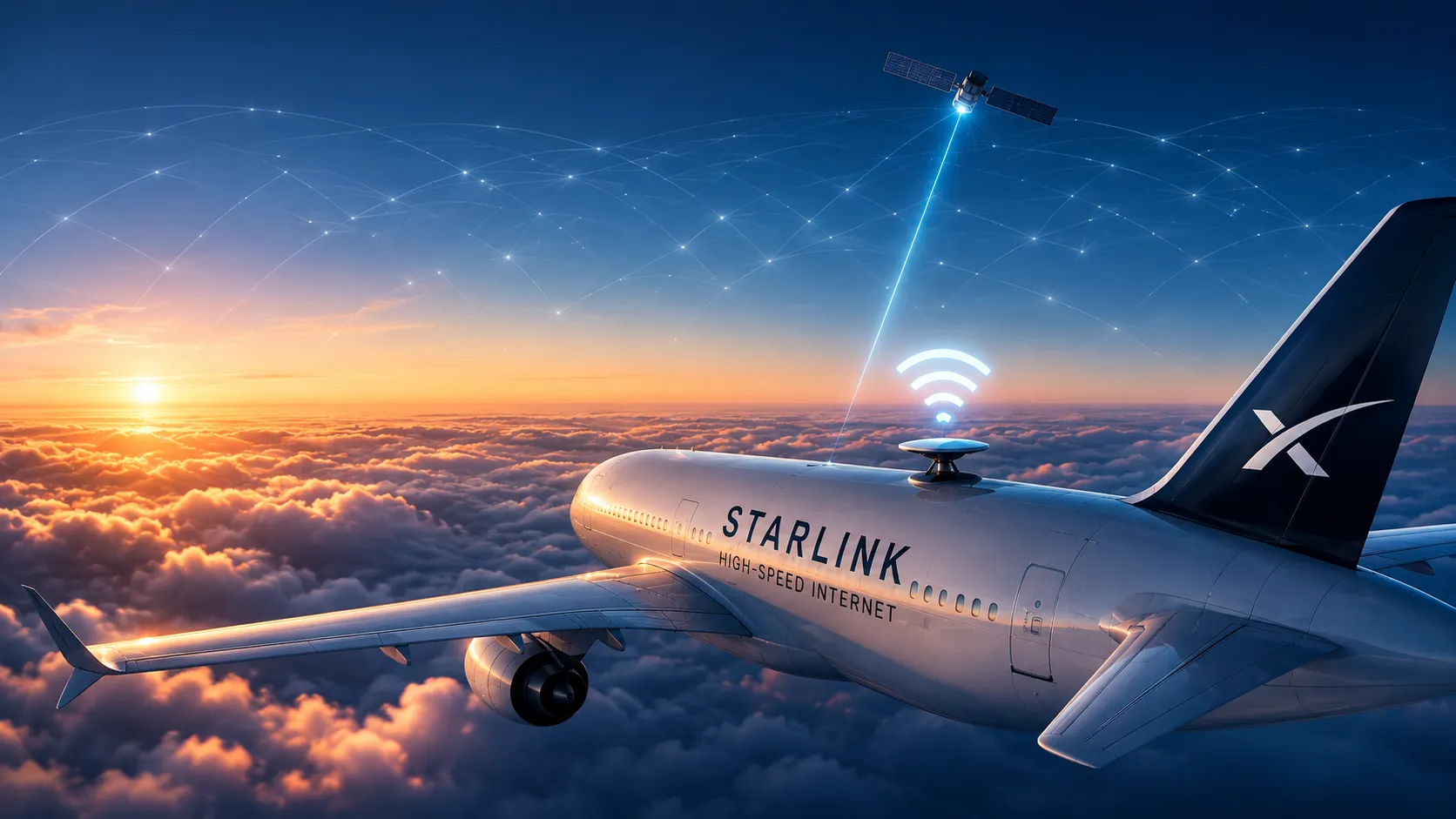
The business flight is being rewritten by a small antenna on the aircraft and a large satellite network above it. Starlink’s aviation service is no longer a futuristic promise for private jets and premium cabins. It is appearing across airline fleets, charter operators, business aircraft upgrades, and maintenance programs. The change matters because a flight used to force a pause. Now, for many routes and aircraft types, the cabin is becoming a place where executives can join meetings, send files, review dashboards, approve contracts, and stay connected to teams while crossing oceans.
Table of Contents
Starlink has moved from novelty to cabin infrastructure
Starlink’s move into aviation is not only another Wi-Fi upgrade. It changes the way airlines, business jet operators, corporate travel managers, and aircraft owners think about time in the air. For years, in-flight internet was tolerated rather than trusted. Passengers checked email, sent short messages, and hoped the connection survived until landing. Many companies built travel habits around that weakness. Long-haul flights became protected offline time. Short flights became gaps in the workday. Private jet cabins offered privacy and speed in travel, but not always the same digital continuity that teams expected on the ground.
Starlink Aviation now positions itself as high-speed, low-latency internet for aircraft, with Starlink’s own support page listing download speeds of 100–250 Mbps, peaks up to 450 Mbps, upload speeds up to 10–25 Mbps, and latency under 99 ms. The company says the service supports simultaneous video streaming, video calls, VPN access, and online gaming across passengers in flight. Those numbers do not guarantee the same result on every route, every aircraft, or every crowded cabin, but they mark a clear step away from the old idea that airborne internet is mostly a messaging tool.
The timing is important. On May 4, 2026, Singapore Airlines announced that it selected Starlink for aircraft including Airbus A350-900 long-haul, A350-900 ultra-long-range, and A380 aircraft from the first quarter of 2027. SIA said Starlink’s Aero Terminal can support up to 1 Gbps per antenna, and framed the service around video streaming, social media, gaming, sending large files, and productivity from takeoff to landing. That announcement gave the Starlink aviation story another premium long-haul reference point.
The commercial momentum is already visible elsewhere. Qatar Airways says nearly 120 widebody aircraft are Starlink-equipped, including Boeing 777, Airbus A350, and Boeing 787-8 aircraft, with more than 11 million passengers having used the service since the airline launched it in October 2024. The airline also says Starlink connected more than 21 million passengers across global airlines in 2025. Those figures matter because they move the discussion from testing to operating scale.
For business aviation, the adoption story is moving through OEM approvals, aftermarket upgrades, fleet commitments, and MRO installations. Gulfstream received FAA supplemental type certification for Starlink on the G650 and G650ER in 2024, Textron announced Starlink aftermarket availability for the Cessna Citation Ascend and EASA certification for the Citation 560XL series in April 2026, and Duncan Aviation announced Starlink installations on Falcon 7X aircraft across three MRO facilities.
The practical headline is simple: the aircraft cabin is becoming part of the enterprise network, not a break from it. That does not mean every flight is ready to become a fully reliable office. It does mean the standard for airborne connectivity is rising fast, and airlines that once sold Wi-Fi as an optional extra now face a market in which passengers expect it to work.
The old aviation internet problem was never only speed
Slow Wi-Fi was only one part of the old in-flight connectivity problem. The deeper problem was trust. A business passenger could not plan a serious workflow around a connection that might work at boarding, disappear over water, fail under cabin demand, block a VPN, or make a video call unusable. When trust is missing, speed tests mean little. People change behavior only when they believe the service will be available at the moment they need it.
Traditional aircraft connectivity had several constraints. Air-to-ground systems depended on terrestrial towers and worked best over land. Satellite systems using geostationary orbit could cover long routes, but the distance between aircraft, satellite, and ground infrastructure introduced latency. Capacity on busy routes could be uneven. Aircraft antennas added weight, drag, cost, and certification work. Airlines had to weigh every upgrade against downtime and fleet complexity. Passengers saw only the login screen, but the airline saw engineering, regulation, vendor contracts, aircraft scheduling, customer support, and a return-on-investment question.
The National Business Aviation Association describes the basic split clearly: aircraft connect either through air-to-ground networks or satellite systems, and satellite systems may use low Earth orbit or geostationary satellites. NBAA notes that air-to-ground networks depend on ground stations and that coverage typically ends around 100 miles offshore of the United States. For transoceanic business routes, that difference is not minor. A New York–London, Doha–Atlanta, Singapore–New York, or Los Angeles–Honolulu flight needs coverage where ground towers do not exist.
Low Earth orbit systems address some of these weaknesses by placing satellites far closer to Earth than geostationary satellites. The shorter path helps reduce latency, while large constellations distribute capacity across moving beams and routes. The system is not magic. Capacity is still finite. Aircraft need certified terminals. Certain countries can restrict service over their territory. Weather, network load, aircraft installation, cabin distribution equipment, and service plan design still matter. Yet LEO makes a different kind of passenger experience possible because it attacks the latency and coverage problems at the network level.
For corporate users, latency often matters more than headline download speed. A large presentation can be downloaded in the background. A delayed video call cannot be hidden. A remote desktop session, cloud dashboard, CRM entry, shared document edit, or VPN connection depends on responsiveness. The frustrating part of old aircraft Wi-Fi was not that a file took longer to send. It was that interactive work broke.
The value of Starlink in aviation is not that passengers can watch videos more comfortably. The business value is that interactive work becomes credible at altitude. That distinction changes the conversation from passenger entertainment to business continuity.
Low Earth orbit changes the economics of airborne work
The economics of in-flight connectivity used to be shaped by scarcity. Airlines charged for access because bandwidth was expensive, the experience was inconsistent, and only a portion of passengers were willing to pay. That model made sense when Wi-Fi was treated as a luxury or a convenience. It makes less sense when connectivity becomes a core part of the travel product.
Starlink’s aviation model is part of a wider shift from selling minutes and megabytes to selling the idea that the aircraft is always connected. Qatar Airways, Air France, Hawaiian Airlines, United, Singapore Airlines, and private aviation operators are all moving in that direction, though with different eligibility rules and rollout schedules. Some services are free for all passengers. Some require loyalty membership. Some apply only on equipped aircraft. Some are limited by route, aircraft type, or certification timing.
Qatar Airways has been the most aggressive public example. In July 2025, it said it completed Starlink installation across its Boeing 777 program in nine months, nearly 50% faster than planned, and cut retrofit time from three days to 9.5 hours per aircraft. It also said passengers in premium and economy cabins could use free gate-to-gate Wi-Fi with speeds up to 500 Mbps per aircraft on Starlink-equipped services.
The retrofit time matters as much as the speed claim. Every day an aircraft sits out of service is expensive. For an airline, rapid installation changes the financial case. For a private jet owner, pairing a Starlink installation with scheduled maintenance, paint, or an interior project can reduce disruption. Duncan Aviation explicitly encouraged Falcon 7X operators to schedule installation during maintenance events or cabin work, because the aircraft is already opened and unavailable for normal service.
The economics also shift because work time has value. A flight from London to Doha, New York to Los Angeles, Paris to Singapore, or Bratislava through a European hub to the United States can consume a full business day. If a CEO, founder, lawyer, investor, engineer, or sales director can use even half that time for live collaboration, the trip changes. A board deck can be revised during the flight. A customer issue can be handled before landing. A team in another time zone can receive an answer while it still matters.
The productivity calculation is not identical for every traveler. A leisure passenger may value streaming. A consultant may value VPN and shared documents. A founder may value investor calls. A medical specialist may value access to records, with security controls. A government traveler may need secure systems that ordinary cabin Wi-Fi cannot provide. The same antenna creates different value depending on the passenger’s work, risk tolerance, and governance rules.
This is where Starlink’s aviation expansion becomes more than a better passenger perk. It changes the cost-benefit equation of business travel. If companies expect travel spending to rise or stay stable, connected cabins become part of the justification for sending people at all. GBTA’s January 2026 poll found that 84% of business travel buyers expected their organization’s 2026 travel spending to increase or stay at 2025 levels, while 35% expected trip counts to rise and 47% expected trip levels to remain steady.
When travel budgets are under pressure, every hour must defend itself. A plane that keeps a team connected makes a trip easier to justify, especially for senior staff whose time is expensive. The risk is that companies overestimate the gain and erase useful rest time. The opportunity is that they treat the flight as flexible work time rather than lost time.
Business travel is being repriced around productive hours
Business travel is no longer judged only by airfare, hotel cost, and meeting outcome. It is increasingly judged by the total cost of time. A trip that removes two working days from a senior employee’s calendar is more expensive than the ticket suggests. If high-speed in-flight connectivity gives back several hours, the economic logic changes.
GBTA projected global business travel spending at $1.57 trillion in 2025, with 6.6% growth for that year and a projected rebound to 8.1% growth in 2026. It also warned that trade tensions, policy uncertainty, inflation, and shifting supply chains cloud the outlook. That mix is exactly why connectivity matters. Companies are not traveling without discipline. They are trying to decide which trips are worth the cost, which meetings must be in person, and which employee hours can be preserved.
Connected aircraft do not make every trip worthwhile. They do make certain trips less disruptive. A team flying to a client pitch can keep refining the offer. A CFO can approve a financing document. A software executive can monitor a launch. A legal team can coordinate across jurisdictions. A private equity partner can review diligence materials before landing. These are not imaginary use cases; they are normal business tasks that moved to cloud platforms years ago.
The catch is that airborne productivity depends on more than the satellite link. It depends on seat design, power outlets, cabin noise, company security policy, cloud application behavior, device battery life, crew rules, and the social norms of the cabin. A passenger can technically join a video call, but an airline may ask passengers to avoid voice calls or behave discreetly. Air France, for example, asks passengers to use electronic devices discreetly and not photograph or film passengers or crew without permission on its Wi-Fi information page.
Business travelers also need to consider time zones and cognitive load. An ultra-long-haul flight with constant internet can become a trap if every hour is filled with calls. The value is not permanent availability. It is selective availability. The best use of Starlink in the cabin may be a few targeted blocks of work, not a full attempt to recreate the office at 35,000 feet.
The future business travel question is not “does the aircraft have Wi-Fi?” It is “which tasks are safe, useful, and realistic to do during this flight?” Companies that answer that question well will get more value from connectivity than companies that simply expect employees to remain online at all times.
A practical corporate travel policy now needs a connectivity layer. It should say whether employees can use in-flight Wi-Fi for confidential work, whether VPN is required, which meetings are appropriate, whether voice and video calls are acceptable, and whether employees are expected to work during overnight flights. Without those norms, better internet may increase friction rather than productivity.
Private aviation is adopting Starlink for a different reason
Private aviation has always sold time, control, privacy, and access. Starlink strengthens each of those promises, but the value proposition is different from commercial airlines. On a private jet, the passenger often is the decision-maker. The person in the cabin may be the principal, owner, CEO, investor, or client paying for the trip. If that person can keep working during the flight, the aircraft becomes closer to a mobile boardroom.
Qatar Executive’s December 2025 announcement is a useful example. The private jet charter division of Qatar Airways Group said that by early 2026 every Gulfstream and Bombardier aircraft type in its fleet would be equipped with Starlink. It said half of its Gulfstream G650ER fleet and its entire Bombardier Global 5000 fleet were already operating with Starlink, while remaining G650ER and G700 installations were scheduled for completion by early 2026.
That announcement shows how private aviation operators are using connectivity as part of fleet positioning. A charter customer buying an ultra-long-range mission expects the aircraft to support work, family communication, streaming, and operational flexibility. A private jet without modern internet starts to look older than its cabin materials suggest.
The aircraft owner’s decision is more direct than an airline’s. The owner asks whether the upgrade supports mission needs, whether the aircraft has an available STC or approved installation path, how long the aircraft will be down, what the hardware and service cost, how the antenna affects performance, whether the interior must be opened, how warranty and support are handled, and whether future resale value improves.
Textron’s April 2026 announcement shows the aftermarket dynamic. The company said Starlink high-speed connectivity became available as an aftermarket upgrade for the Cessna Citation Ascend following FAA issuance of AeroMech’s STC, and that the Cessna Citation 560XL fleet received EASA certification for Starlink installation at Textron Aviation’s European service centers. Textron said the Starlink Aviation Kit includes an Aero Terminal, Power Supply Unit, and Wireless Access Point, and requires aircraft power input.
Duncan Aviation’s March 2024 dealership announcement shows the service network angle. Duncan said it finalized an agreement with SpaceX to sell and install Starlink hardware for a growing list of aircraft makes and models, and that installations were scheduled at major facilities and a satellite location. For aircraft owners, authorized installation capacity matters because connectivity upgrades are not mail-order accessories. They need engineering, certification, aircraft downtime planning, and support.
In business aviation, Starlink is less a passenger perk than an aircraft capability. It becomes part of aircraft competitiveness, charter quality, resale perception, and owner satisfaction. A private jet that can cross an ocean but cannot support a reliable video conference will feel misaligned with the way its passengers work.
Airlines are turning Wi-Fi into a loyalty feature
Commercial airlines face a different challenge. They need to serve hundreds of passengers, manage cabin behavior, protect operational reliability, and decide who pays. The strongest trend so far is not only faster Wi-Fi. It is free or loyalty-linked Wi-Fi.
United says Starlink Wi-Fi is free for MileagePlus members on equipped aircraft, while standard Wi-Fi pricing remains in place on non-Starlink aircraft. Its Wi-Fi terms state that there are no charges to connect to the internet on Starlink-equipped aircraft, but passengers must be MileagePlus members or join MileagePlus.
Air France uses a similar loyalty structure. It says free and unlimited high-speed Wi-Fi is reserved for Flying Blue members, with membership available at no cost. Its customer page tells passengers that thanks to Starlink Wi-Fi they can use a stable, secure connection where equipped, while aircraft not yet equipped still offer a free Message Pass or paid Wi-Fi Pass.
Qatar Airways has taken a broader position on many Starlink-equipped routes, marketing free Wi-Fi across cabins, and its Starlink page lists B777 and A350 aircraft equipped with Starlink on many destinations while warning that availability remains subject to equipment changes.
This model turns connectivity into a loyalty acquisition tool. The airline gives away internet, but receives a logged-in customer relationship. That can improve personalization, app engagement, direct booking behavior, and customer data quality. It also shifts the passenger’s perception of the airline. Free, fast Wi-Fi feels like a modern baseline; paid, slow Wi-Fi feels punitive once passengers have experienced the alternative.
There is a strategic risk. When Wi-Fi becomes free and expected, it stops being a differentiator and becomes a cost of competing. Airlines that advertise connected cabins must deliver reliable service or face sharper disappointment. A passenger who paid nothing for Wi-Fi may still feel misled if the airline promoted working and streaming but the aircraft was not equipped, the route restricted service, or the login failed.
Starlink turns Wi-Fi from a paid ancillary into a brand promise. That promise can lift loyalty, but it can also expose inconsistency across mixed fleets. Airlines with older aircraft, leased aircraft, regional partners, and multiple Wi-Fi vendors must explain the experience clearly.
A passenger now needs to ask three practical questions before relying on work in the air: Is this specific aircraft equipped? Is the route covered? Does access require a loyalty account or payment? Airline websites are improving this information, but aircraft swaps can still change the answer close to departure.
Qatar Airways shows the rollout speed airlines now want
Qatar Airways has become the benchmark case for fast Starlink deployment on long-haul widebody aircraft. The airline launched the world’s first Starlink-equipped Boeing 777 flight in October 2024, completed its Boeing 777 rollout in July 2025, completed its Airbus A350 rollout in December 2025, and announced in January 2026 that it had installed Starlink on Boeing 787-8 aircraft as well.
The airline’s January 2026 release says it became the first carrier globally to enable Boeing 787-8 with Starlink, had equipped its entire Airbus A350 fleet within eight months, and operated nearly 120 Starlink-connected widebody aircraft. It also said the program connected more than 11 million passengers since launch.
For the industry, the most interesting Qatar number may be installation time. The airline said the Boeing 777 retrofit time fell from three days to 9.5 hours per aircraft during its completed rollout. That changes the operational model. A three-day modification can be a planning burden. A sub-10-hour modification can fit more easily around scheduled maintenance if parts, staff, and certification work are ready.
Qatar’s strategy also shows that Starlink is not only a narrowbody or regional aircraft story. Widebody long-haul routes are where business travelers place high value on connectivity because flights are long enough to contain real working blocks. A passenger on a 15-hour Doha–Atlanta flight can hold multiple work sessions, review documents, rest, and still use the connection again before landing.
Qatar also used Starlink as a marketing stage. Its November 2025 “Sky Studio Challenge” with Google involved creating commercials during a 15-hour Doha–Atlanta flight on a Starlink-enabled Airbus A350. That kind of activation is not a normal passenger workflow, but it illustrates the claim that aircraft connectivity can handle cloud-based creative work.
The lesson for other airlines is not that every carrier can copy Qatar’s pace. Qatar has a specific fleet structure, hub model, brand positioning, and strategic willingness to push the rollout publicly. Airlines with more fragmented fleets will face slower deployment. Airlines with different vendors or existing contracts may take a multi-provider route. Regulators, installation slots, aircraft ownership, and maintenance schedules can all slow adoption.
Still, Qatar has raised passenger expectations for long-haul Wi-Fi faster than most airlines would have preferred. Once a traveler uses free, fast internet on a widebody flight, a slow paid connection on another premium airline feels outdated. That pressure matters.
United and Air France show two different adoption models
United and Air France are useful because they show two adoption models. United is using Starlink as a large U.S. fleet transformation with loyalty-linked access. Air France is using it as a full-brand move toward free high-speed Wi-Fi across its fleet, also tied to loyalty membership.
United began with regional aircraft. In March 2025, Reuters reported that the FAA approved United’s first Starlink-equipped aircraft type, the Embraer 175, with first commercial flight planned for May 2025 and a plan to add Starlink to around 40 regional jets per month. United’s larger agreement covered more than 1,000 aircraft over several years.
In September 2025, Reuters reported that United received FAA approval for its first mainline aircraft equipped with Starlink, the Boeing 737-800, clearing the way for an inaugural flight from the Newark/New York area on October 15. The report said the FAA approved an amendment to Starlink’s supplemental type certificate for that aircraft type.
United’s model shows the certification ladder. An airline does not simply decide to install Starlink across every aircraft overnight. It must secure approvals by type, schedule installations, train support teams, update passenger communication, and manage aircraft that are not yet equipped. The passenger experience can vary for years during that transition.
Air France’s model is more explicitly tied to a passenger promise. In September 2025, it said its high-speed Wi-Fi service was operational, with the fifth equipped aircraft entering service and plans to equip 30% of the fleet by the end of 2025 and the entire fleet by the end of 2026. The airline said the service would be free in all travel cabins and accessible through Flying Blue.
Air France had announced the plan in September 2024, saying it selected Starlink to provide ultra-high-speed connectivity from 2025 onward, across all aircraft over time, including regional aircraft. It framed the service as free in all cabins through a Flying Blue login and noted that restrictions may apply over some countries.
The contrast matters. United is a huge North American carrier using Starlink to reshape Wi-Fi across a massive mixed fleet. Air France is using Starlink to support a premium-service narrative in Europe and beyond. Both models point in the same direction: free high-speed Wi-Fi is becoming part of the loyalty economy, not just a cabin amenity.
For business passengers, the difference is practical. A United customer needs to check whether the aircraft is Starlink-equipped and have MileagePlus access. An Air France customer needs to know whether the aircraft has received the new Starlink system and be ready with Flying Blue login details. On both airlines, the work plan depends on fleet rollout, not brand-wide marketing alone.
Singapore Airlines adds another premium long-haul signal
Singapore Airlines’ May 2026 Starlink announcement matters because SIA already had a strong in-flight Wi-Fi proposition for many passengers. Its decision to adopt Starlink on long-haul and ultra-long-range aircraft suggests that premium airlines see LEO connectivity as the next standard, not merely a repair for poor existing service.
SIA said Starlink would be introduced progressively from the first quarter of 2027 on Airbus A350-900 long-haul, A350-900 ultra-long-range, and A380 aircraft. It also said customers in Suites, First Class, Business Class, PPS Club members, and KrisFlyer members in Premium Economy and Economy would continue to receive unlimited complimentary Wi-Fi on Starlink-enabled aircraft.
This is a business travel signal for three reasons. First, Singapore Airlines operates some of the world’s most important long-haul corporate routes, including ultra-long-range flights where onboard productivity has high value. Second, the aircraft types named in the announcement are premium-heavy long-haul aircraft, not short-hop aircraft alone. Third, the airline framed the use cases around productivity as well as entertainment.
The SIA release also included Starlink’s claim of more than 10,000 satellites launched to low Earth orbit and up to 1 Gbps per Aero Terminal antenna. The important detail is not only the number. It is the claim that the network is being scaled for aircraft as high-demand moving nodes, not just homes or remote ground sites.
For corporate travelers in Asia-Pacific, SIA’s move will put more pressure on competitors. Premium passengers often compare the whole travel chain: lounge, seat, food, service, schedule, punctuality, and digital access. If Wi-Fi becomes reliably strong on Singapore Airlines long-haul aircraft, rival carriers will need a comparable answer, whether through Starlink, Eutelsat OneWeb, Viasat, Intelsat, Panasonic, SES, or a multi-orbit architecture.
Singapore Airlines joining the Starlink aviation wave confirms that this is not limited to early adopters or publicity-driven carriers. It is moving into the decision-making of conservative premium airlines that protect brand consistency carefully.
The long lead time also reminds passengers not to confuse an announcement with immediate availability. SIA’s start is planned for the first quarter of 2027. For a traveler booking in 2026, that does not change tomorrow’s flight. For the industry, it changes the competitive map for the next fleet cycle.
The cabin office has real use cases and hard limits
The phrase “your business flies with you” is powerful because it captures a real shift. It is also easy to overuse. A connected aircraft is not the same as an office. It is a cabin shared with other passengers, crew duties, safety rules, limited space, changing noise levels, and a physical environment designed for travel first.
The strongest use cases are work that benefits from real-time access but does not require a fully private room. Email triage, document review, CRM updates, dashboard checks, chat with colleagues, written approvals, contract markups, project management, secure file transfer, market monitoring, and quiet participation in a meeting are all realistic. Video calls can be realistic when cabin etiquette, headset quality, lighting, and privacy allow it.
The weaker use cases are calls involving confidential personal data, sensitive negotiations, legal strategy, board discussions, medical details, unreleased financial results, or matters that cannot be overheard. A business-class seat with Starlink is still a public or semi-public environment. A private jet offers more control, but crew and guests may still be present. High-speed connectivity does not remove privacy obligations.
Airlines may also shape behavior. Even when the network supports video calls, the airline can ask passengers to avoid disruptive voice use. Passengers need to separate technical possibility from acceptable cabin behavior. A silent cloud workflow is different from a loud call across six rows.
Power is another limit. A long-haul aircraft may have outlets, but older aircraft or certain seats may not provide reliable power for continuous laptop use. A private jet may have better cabin power, but older interiors can still surprise passengers. Connectivity without power is not productivity.
Device posture matters too. Corporate laptops may require VPN, endpoint detection, disk encryption, and updated security certificates. Some corporate VPNs behave poorly over satellite links, even low-latency ones, because of packet loss, network switching, or strict security rules. Companies should test real applications, not only run speed tests.
The connected cabin works best when the passenger plans a flight workflow before boarding. Download backup copies of critical files. Check VPN behavior. Bring a privacy screen. Use noise-canceling headphones with a proper microphone. Keep sensitive calls for a private setting. Confirm loyalty login details. Expect aircraft swaps. Decide where the flight should be work time and where it should be recovery time.
Starlink makes airborne work more realistic. It does not make every task wise.
Video calls at altitude change executive behavior
Video calls are the symbolic test for in-flight Starlink. Passengers have been able to send email from aircraft for years. Video calls at altitude feel different because they collapse the old boundary between “reachable later” and “available now.”
For executives, the behavior change can be dramatic. A CEO can join a board prep call while flying to a client. A regional director can brief a team before landing. A founder can handle an investor update during a repositioning flight. A lawyer can remain present in a negotiation chain. A sales leader can join a final pricing discussion on the way to a pitch.
Starlink’s support page explicitly lists video calls and VPN access among supported simultaneous activities under its aviation performance claims. Qatar Airways markets speeds up to 500 Mbps on equipped aircraft and says passengers can work, stream, or game. Singapore Airlines named productivity and sending large files among the planned Starlink use cases for its equipped aircraft.
The strategic implication is that travel no longer automatically removes senior people from live decision loops. That helps companies operating across time zones. A European executive flying to Asia can still connect with the Americas. A U.S. team flying to the Middle East can stay connected to Europe. A private jet passenger crossing the Atlantic can keep a live link to headquarters.
Yet this always-on ability creates a management problem. If leaders are reachable during every flight, teams may stop protecting travel time. The result can be worse decisions, not better ones. Fatigue, jet lag, cramped work posture, cabin interruptions, and time-zone strain all affect judgment.
The best executives will use in-flight video selectively. They will join calls that truly need them, handle decisions that would block others, and avoid filling the flight with low-value meetings. The worst will treat every connected flight as another office day and land exhausted.
Cabin etiquette will become a bigger issue. Airlines may face passenger complaints if video calls spread through premium cabins. Private aviation has more flexibility, but guest dynamics still matter. A principal may be comfortable taking calls, while another passenger may expect quiet. Operators may need to set expectations before departure.
Video at altitude is a business continuity tool, not a license to turn the cabin into an open-plan office. The technology can support the call. The traveler still has to decide whether the call belongs there.
Secure access is the line between convenience and corporate readiness
For ordinary passengers, fast Wi-Fi means streaming, messaging, browsing, and social media. For companies, the real question is secure access. Can employees use in-flight internet without exposing confidential data, regulated information, credentials, or internal systems?
The answer depends on corporate controls, not only Starlink. A secure setup may include VPN, multi-factor authentication, device compliance checks, endpoint protection, encrypted storage, mobile device management, role-based access, and clear rules for public environments. A satellite link can carry encrypted traffic, but it does not decide whether the user opens a sensitive spreadsheet in view of another passenger.
Aviation regulators are also paying more attention to cyber risk. EASA says civil aviation is an attractive target for cyberattacks and that its role is to ensure cyber risks are considered during aircraft design, development, and operation and controlled to avoid adverse safety effects.
EASA also published a December 2025 revision of its Easy Access Rules for Information Security, incorporating regulatory material on the management of information security risks across aviation domains. For operators in Europe, this is a reminder that connectivity is not only a passenger service; it sits inside a wider aviation information-security environment.
The aircraft network itself must separate passenger connectivity from safety-critical systems. Modern aircraft certification and installation processes treat this seriously, but corporate users should not assume that “secure aircraft Wi-Fi” automatically means “safe for every business task.” Those are different questions. The aircraft may be protected from the passenger network, while the passenger can still mishandle company data.
For private jets, the security conversation becomes more personal. Owners may want custom cabin networks, separate SSIDs for crew and guests, content controls, logging, or integration with corporate IT. A charter operator may need a simpler setup that works for many clients. A managed aircraft may have to balance owner preferences with regulatory and maintenance responsibilities.
The threshold for corporate readiness is not bandwidth. It is policy, identity, encryption, device health, and user behavior. Starlink can supply the link. The company must supply the governance.
A practical corporate policy should classify work by sensitivity. Low-risk tasks can use in-flight Wi-Fi with standard controls. Medium-risk tasks may require VPN and a privacy screen. High-risk calls or data may be banned in shared cabins. Regulated data may require specific approval. That kind of policy protects both the company and the traveler.
Certification matters more than marketing claims
Aircraft connectivity is not a consumer gadget installation. A Starlink terminal on an aircraft must fit into aviation certification, aircraft engineering, maintenance documentation, electromagnetic compatibility requirements, structural considerations, power supply, aerodynamic effects, and operational approvals. The passenger sees Wi-Fi. The operator sees a certified aircraft modification.
A supplemental type certificate, or STC, approves a major change to an aircraft type. It tells the operator that the installation has been reviewed for the specific aircraft configuration and regulatory environment. Without the correct approval path, an aircraft owner cannot simply mount hardware and fly commercially.
United’s Starlink rollout illustrates this clearly. Reuters reported FAA approval for Starlink on Embraer 175 aircraft in March 2025, then a separate FAA approval for United’s first Starlink-equipped Boeing 737-800 in September 2025. The Boeing 737-800 approval involved an amendment to Starlink’s supplemental type certificate.
Textron’s April 2026 announcement is another example. The Cessna Citation Ascend aftermarket option followed FAA issuance of AeroMech’s STC, while the Cessna Citation 560XL fleet received EASA certification for installation at Textron’s European service centers.
Duncan Aviation’s Falcon 7X work uses Dassault Falcon Jet’s STC and OEM service bulletins, with compliance under FAA and EASA certification and Transport Canada approvals planned for Canadian-registered aircraft. That level of detail matters because business aircraft often operate internationally and owners want support that remains valid across jurisdictions.
Certification also explains why availability is uneven. One aircraft type may be approved while another waits. One region may have certification while another is still pending. An aircraft may be technically suitable but lack an approved installation pathway. An airline can announce a fleet agreement before every aircraft type is cleared.
The aircraft type, registration authority, STC status, and installation provider decide when Starlink becomes real for a specific passenger. Marketing language is not enough.
Passengers and aircraft owners should read availability claims carefully. “Coming to the fleet” is not the same as “on this tail number.” “Available as an aftermarket option” is not the same as installed. “Equipped aircraft” is not the same as every route. This gap between brand promise and aircraft reality will be one of the main sources of confusion during the rollout years.
Installation capacity is becoming a competitive bottleneck
The aviation connectivity race is not limited by satellite ambition alone. It is limited by installation capacity, certification paperwork, maintenance slots, trained technicians, supply chains, and aircraft downtime. Every aircraft needs physical work. Every operator must schedule that work without damaging the flying program.
Qatar Airways proved that retrofit time can fall sharply when an airline, vendor, maintenance organization, and regulator align. Its reported reduction from three days to 9.5 hours per Boeing 777 is exceptional and commercially meaningful.
Business aviation has a different installation rhythm. Aircraft often enter maintenance for inspections, paint, avionics work, interior changes, or owner-requested upgrades. Duncan Aviation’s advice to combine Starlink installation with a maintenance event or interior project reflects that reality. The best installation window is often the one already planned.
Textron’s service-center role matters for the same reason. Aircraft owners prefer upgrades that can be performed by trusted OEM or authorized service networks. They want fewer surprises, clear warranty treatment, and support if the system behaves badly later.
Installation bottlenecks can create a two-tier market. Operators with early STCs, strong maintenance relationships, and spare aircraft capacity can move quickly. Smaller operators, rare aircraft types, or aircraft based far from approved centers may wait. Fleet managers may prioritize aircraft used on long routes or by high-value customers.
Airlines face a related problem at larger scale. A carrier with 200 aircraft can install quickly if the work is short and repeatable. A carrier with 1,000 aircraft across multiple types and regions faces a multi-year program. United’s plan across more than 1,000 aircraft shows the scale of such a challenge.
Supply of terminals, radomes, mounting kits, power units, wireless access points, and trained installers will matter. So will software support. A failed cabin network after installation can damage passenger trust even if the satellite link is strong.
The winner in aviation connectivity will not be the provider with the boldest speed claim. It will be the provider and operator combination that installs quickly, certifies cleanly, supports reliably, and communicates honestly.
Fleet age and aircraft type still decide the passenger experience
A passenger may think they booked an airline. In connectivity terms, they booked an aircraft. Fleet age, aircraft type, cabin configuration, ownership status, and installation schedule decide the actual Wi-Fi experience.
Qatar Airways’ Starlink page states that B777 and A350 aircraft are equipped with Starlink on listed destinations, but it also says availability is subject to equipment changes. That sentence is critical. Airlines swap aircraft for operational reasons. A passenger who expected Starlink may end up on an aircraft without it.
Air France tells customers that it is not possible to confirm at booking whether a specific flight will have the new high-speed Wi-Fi because aircraft assignment can change up to the day of departure. That is a practical warning for anyone planning to work during a flight.
Hawaiian Airlines shows a different fleet decision. In September 2024, Hawaiian said fast and free Starlink Wi-Fi was available across its entire Airbus fleet and that it would install Starlink on its Boeing 787-9 fleet, but not on Boeing 717 aircraft used for short inter-island flights.
That is a rational airline decision. Not every aircraft produces the same return from a satellite internet upgrade. Long-haul, transoceanic, premium-heavy, or business-heavy routes justify more investment. Very short flights may not, especially when passengers barely have time to open laptops before descent.
Business aviation has similar segmentation. Ultra-long-range jets like the Gulfstream G650ER, Gulfstream G700, Bombardier Global series, and Dassault Falcon 7X naturally attract connectivity upgrades because their missions are long enough to make Wi-Fi valuable. Light jets and turboprops may adopt LEO connectivity too, but the economics and installation choices differ.
Fleet age can also affect cabin distribution. A modern satellite link can be weakened by poor internal Wi-Fi hardware, outdated access points, bad placement, or insufficient power access at seats. Airlines and owners must treat the cabin network as part of the upgrade, not an afterthought.
For passengers, the practical rule is to verify the aircraft close to departure and carry a backup work plan. For operators, the rule is to manage expectations by tail number, not by broad brand promise. The gap between “our airline offers Starlink” and “your flight has Starlink” will define the passenger experience during the transition.
Coverage is improving, but regulation still shapes the map
Starlink’s low Earth orbit network gives aviation a much better coverage story than older systems, especially over oceans and remote regions. Starlink’s own aviation support page describes expansive coverage and performance suitable for VPN access, video calls, streaming, and simultaneous use.
Yet coverage is not the same as permission. Aircraft fly through national airspace, over territorial waters, across controlled regions, and into jurisdictions with their own communications rules. A service can be technically available but restricted or disabled over certain countries. Air France’s 2024 announcement notes that restrictions may apply when flying over some countries.
This matters for business travelers because the moment they most need connectivity may occur over a restricted region. A flight from Europe to Asia, the Middle East to North America, or Asia to Europe crosses many jurisdictions. The passenger may experience a strong connection for much of the route and still face interruptions.
Coverage also depends on aircraft equipment and service plan. An aircraft with a certified Starlink terminal should have a different capability profile from an aircraft with older Wi-Fi hardware. A passenger cannot solve this by buying a better phone plan. The bottleneck is the aircraft system.
The United States regulatory foundation for Starlink’s mobile use dates back to the FCC’s 2022 authorization for SpaceX to use Starlink on vehicles in motion, including aircraft, boats, trucks, and recreational vehicles. That was an early step toward the aviation service now reaching commercial fleets.
Regulation will keep evolving because the sky is shared by aviation safety systems, satellite networks, terrestrial mobile services, national security rules, and spectrum policy. SpaceX’s constellation scale also attracts scrutiny around orbital safety, spectrum use, competition, and resilience. Reuters reported in January 2026 that the FCC approved SpaceX’s proposal to deploy an additional 7,500 second-generation Starlink satellites, while limiting the total approval at that stage and setting deployment deadlines.
The connected aircraft is a global product operating inside national rules. That tension will not disappear. It will shape route availability, service interruptions, airline disclaimers, and enterprise risk planning.
Business travelers should avoid assuming that a connected departure means a connected entire flight. The better assumption is that Starlink improves the odds of useful work in the air, while route, regulation, and equipment still decide the result.
The old in-flight Wi-Fi model is under pressure
For many years, airlines treated Wi-Fi as an ancillary service. Passengers paid for a pass. Speeds varied. The airline often avoided promising much. That model generated revenue from a small group of passengers willing to pay, but it kept usage low and expectations lower.
Starlink and other LEO or multi-orbit systems are pushing the market away from scarcity pricing. If connectivity is fast enough for many passengers at once, airlines can use it as part of the ticket experience, loyalty program, sponsorship model, or premium differentiation. Once enough airlines do this, paid basic Wi-Fi starts to look outdated.
American Airlines, Delta, United, Qatar Airways, Air France, Hawaiian, Singapore Airlines, and others are not all using the same vendors or access models, but the direction is clear. Free or loyalty-linked internet is becoming a competitive battleground. Starlink is accelerating that battle because it gives airlines a vivid upgrade story: lower latency, higher throughput, and better coverage across long routes.
Incumbent providers are not standing still. Viasat continues to offer in-flight connectivity across commercial aviation and emphasizes service to thousands of aircraft. Gogo is pushing Gogo Galileo, a LEO product for business aviation using the Eutelsat OneWeb network. Airbus is promoting HBCplus, a flexible multi-orbit offboard connectivity architecture that separates terminal and managed service provider choices. Eutelsat positions its aviation services around GEO and LEO options for commercial, business, government, and special operations aircraft.
This competition is healthy for operators. It prevents one provider from defining the entire market. It also gives airlines and aircraft owners different paths: single-provider Starlink, multi-orbit connectivity, GEO-plus-LEO service, air-to-ground plus satellite, or regional architectures tailored to route networks.
The pressure on the old model is strongest where passengers have a clear comparison. A traveler who experiences free, fast Starlink on one long-haul flight will judge the next airline harshly if it charges for slow access. Business travelers are especially unforgiving because the value of the connection is tied to work, not entertainment.
The in-flight Wi-Fi market is moving from “pay to try” toward “connect because the airline promised it.” That shift will reduce tolerance for vague claims, weak portals, confusing pricing, and aircraft-level inconsistency.
Starlink is not alone in the LEO aviation race
Starlink dominates attention, but it does not own the future of aviation connectivity by default. LEO competition is growing, and some operators may prefer multi-orbit approaches that combine the strengths of different networks.
Gogo Galileo uses the Eutelsat OneWeb LEO satellite network and is designed for business aviation. Gogo says it supports simultaneous streaming, web use, video conferences, and cloud applications for users on board.
Eutelsat says its aviation services combine GEO and LEO capabilities and serve commercial airlines, business jet operators, government, and special operations aircraft. It also emphasizes service-level agreements and committed information rates, which matter to operators who need predictable performance rather than peak speed claims.
Airbus HBCplus shows another strategic direction. Airbus describes it as a flexible multi-orbit offboard connectivity system that lets airlines choose managed service providers. It says the architecture decouples the connectivity terminal from the service provider, giving airlines freedom to choose and change providers or combine the system with different in-flight entertainment systems.
This is important because airlines dislike lock-in when a system affects the entire fleet. A single-vendor model can move quickly and produce a clear passenger experience. A multi-orbit model can reduce dependency and provide fallback options. The right answer depends on fleet, routes, bargaining power, installation timing, and customer promise.
Starlink’s advantage is scale, consumer recognition, SpaceX launch capacity, and visible airline wins. Its challenge is to maintain performance as more aircraft, ships, homes, businesses, and mobile users draw on the network. Competitors may win operators that prioritize service guarantees, multi-network resilience, regional coverage, or existing vendor relationships.
The future cabin may not be Starlink everywhere. It may be Starlink in many places, OneWeb in others, GEO and MEO capacity in mixed systems, and aircraft platforms built to switch providers more easily. For passengers, the brand of satellite may matter less than whether the connection works. For operators, the vendor decision will shape cost, control, resilience, and upgrade paths for years.
Airlines may use free Wi-Fi to gather loyalty data
Free Wi-Fi is rarely only free. When airlines require loyalty login, the service becomes a data and relationship channel. This is not necessarily harmful. Passengers may accept it because they receive a useful connection without a separate payment. But it changes the commercial logic.
Air France requires Flying Blue login for its free high-speed Wi-Fi. United requires MileagePlus membership for free Starlink access. Singapore Airlines connects its complimentary access model to cabin class, PPS Club, and KrisFlyer membership.
A logged-in Wi-Fi session can support direct customer engagement. It can push passengers toward airline apps, loyalty enrollment, offers, service updates, digital identity, and personalized content. It can help airlines understand usage patterns by route, cabin, time, and customer segment. It can also reduce payment friction and support sponsor-funded models.
The privacy and trust dimension matters. Airlines should be clear about what they collect, how internet usage data is handled, whether browsing content is inspected, how portal data connects to loyalty profiles, and how passengers can manage privacy choices. A passenger who logs in to stream a film is not thinking about data strategy. A regulator or privacy officer may be.
For business travelers, the issue is sharper. A company may not want employee browsing or application metadata linked to a personal loyalty account in ways that are unclear. Most corporate security teams focus on VPN and endpoint protection, but loyalty-linked connectivity adds another layer of data governance.
Airlines can reduce concern with plain language, privacy controls, and separation between connectivity authentication and intrusive profiling. If free Wi-Fi becomes a trust problem, it will damage the very loyalty airlines hope to build.
The commercial exchange is straightforward: the passenger gives identity, the airline gives connectivity. Whether that feels fair depends on transparency and performance. If the Wi-Fi is excellent and the privacy terms are clear, loyalty login feels acceptable. If the Wi-Fi fails and the data request feels excessive, it feels like a bad bargain.
Business aviation owners will judge the upgrade by downtime
A private aircraft owner usually judges a connectivity upgrade through a sharper lens than a commercial passenger. The owner cares about downtime, cost, certification, resale value, support, aircraft performance, and whether the system works on actual missions. A fast speed claim is only the start.
The best installation is the one that does not disrupt the owner’s schedule. That is why MRO planning matters. Duncan Aviation’s April 2026 Falcon 7X announcement points directly to maintenance-event pairing. The company says its teams installed Starlink systems at Battle Creek, Lincoln, and Provo, and recommends using anticipated downtime such as annual inspections, interior refurbishment, or paint work.
OEM support can reduce risk. Textron’s announcement gives Citation operators a path through Textron Aviation Service Centers and certified installation channels. Gulfstream’s FAA STC for the G650 and G650ER gave owners a direct path through the manufacturer.
Resale value is harder to quantify but real. Buyers of premium business jets increasingly expect modern connectivity. An aircraft with older Wi-Fi may require an immediate upgrade after purchase, which affects negotiation. A Starlink-equipped aircraft, or one with an approved installation path, may be easier to market if the rest of the aircraft is well maintained.
There are also aircraft-specific considerations. Antenna placement, drag, power requirements, compatibility with existing cabin management systems, and Wi-Fi distribution inside the cabin all matter. A small aircraft and a large-cabin jet do not face the same installation environment. International operations add service availability and regulatory questions.
The owner should ask for more than a quote. They should ask for aircraft-specific downtime, STC basis, warranty, support process, expected cabin Wi-Fi performance, coverage on typical routes, power and weight impact, inspection implications, and post-installation testing. A good provider will answer those questions without hiding behind generic performance claims.
For business aviation, Starlink’s value is proven not at installation, but on the first mission where the principal works without thinking about the connection. The best connectivity disappears into the trip. The worst becomes another item the crew has to explain.
Corporate travel policies need a new connectivity clause
Many companies still treat in-flight Wi-Fi as a personal convenience. That view is outdated. If employees can connect to corporate systems during flight, the company needs rules. Those rules should protect data, prevent unrealistic expectations, and help employees use travel time well.
A modern travel policy should cover at least six areas. First, whether employees may use airline or aircraft Wi-Fi for company work. Second, whether VPN is mandatory. Third, which data types cannot be accessed in shared cabins. Fourth, whether video or voice calls are allowed. Fifth, whether employees are expected to work on flights. Sixth, whether in-flight Wi-Fi costs are reimbursable when not free.
The answer does not need to be rigid for every employee. A sales manager reviewing public materials is not the same as a lawyer working on merger documents. A CEO on a private aircraft is not the same as an analyst in economy. The policy should classify risk rather than issue a blanket yes or no.
The policy should also protect rest. Companies that see connected flights as extra working hours may burn out frequent travelers. Long-haul travel already carries fatigue, disrupted sleep, and family strain. Connectivity should reduce stress, not make employees feel trapped online.
Security teams should test the major airline Wi-Fi environments their travelers use. Does the VPN connect? Does multi-factor authentication work? Are cloud applications usable? Does endpoint protection flag the network? Are there route-based interruptions? Is split tunneling allowed? These technical details decide whether a traveler can work safely.
Travel managers should track aircraft connectivity in booking tools where possible. A connected aircraft might influence flight choice for a time-sensitive trip. A traveler needing to join a meeting may prefer an airline with higher Starlink availability or a route where equipped aircraft are common. But booking tools must avoid overpromising because aircraft swaps remain possible.
The policy should say that connectivity enables work, but does not guarantee availability and does not override safety, privacy, or rest. That sentence alone would prevent many misunderstandings.
Noise, etiquette and crew workload move into view
Better Wi-Fi creates new cabin behavior. When messaging was the main use case, passengers stayed quiet. When video calls, gaming, streaming, live sports, and collaborative work become possible, the cabin becomes socially more complex.
Qatar Airways markets live sports streaming on Starlink-equipped aircraft, and Air France describes streaming, gaming, staying in touch, and following news live as passenger uses. These are attractive features, but each creates etiquette questions.
The first issue is sound. Passengers need headphones. Airlines may need to enforce quiet use more actively. A person watching a match without headphones or speaking loudly on a call can disturb dozens of people. Business cabins are especially sensitive because passengers pay for rest, privacy, and work.
The second issue is cameras. Video calls in public cabins can capture other passengers or crew. Air France explicitly asks passengers not to photograph or film passengers and crew without authorization. That guidance will become more important as video use grows.
The third issue is crew workload. Cabin crew are not IT help desks, yet passengers often ask them to solve Wi-Fi issues. As airlines promote high-speed service, crew may face more questions about login, loyalty accounts, aircraft status, connection interruptions, and device problems. Airlines need simple portals, preflight communication, and support channels that do not push every issue onto crew.
The fourth issue is passenger conflict. One traveler’s productive video call may be another traveler’s ruined rest. Airlines may need clearer norms by cabin, flight time, and aircraft type. Overnight long-haul flights may need stricter quiet expectations than daytime flights.
Private aviation has fewer passengers but higher expectations. A charter customer may expect to take calls freely. A crew still needs to manage safety and service. Aircraft managers may need to ask before departure whether passengers plan live calls, streaming, or high-bandwidth work so the cabin setup supports it.
The connected cabin needs social rules as much as technical capacity. Without etiquette, better Wi-Fi can make the cabin feel worse.
The productivity gain is real but easy to exaggerate
Starlink can turn flight time into useful work time. It does not turn every flight hour into a productive office hour. The difference matters for business planning.
On a two-hour flight, the usable work window may be short after boarding, taxi, climb, service, turbulence, descent, and landing preparation. On a 14-hour flight, the usable work window can be substantial, but the traveler also needs sleep, food, movement, and mental recovery. A private jet gives more control, but it still operates in an aviation environment.
The productivity gain is strongest when the task fits the cabin. Written work, asynchronous approvals, document review, dashboards, messaging, and short meetings work well. Long strategic workshops, confidential negotiations, emotional HR conversations, deep creative work, and complex legal calls may not.
Companies should measure the gain carefully. A traveler who clears 90 minutes of urgent work during a flight may save a project. A traveler who spends eight hours online and lands exhausted may hurt performance the next day. Connectivity shifts the choice; it does not remove human limits.
Airlines and operators should avoid overselling “office in the sky” language. The phrase is appealing, but the cabin is still a cabin. Better marketing would say: productive work is now possible on more flights, with limits. That is honest and more useful.
The same caution applies to speed claims. Peak speeds are not the same as guaranteed speeds. Aircraft load, route, terminal count, cabin Wi-Fi setup, satellite capacity, and regulatory restrictions affect experience. Passengers should treat published speeds as capability signals, not promises for a specific moment.
The real gain is not full office replacement. It is fewer forced gaps in the business day. That is still valuable. A single decision made before landing can be worth far more than the Wi-Fi cost.
The strategic meaning for airlines and aircraft operators
Starlink’s aviation expansion gives airlines a new way to compete for high-value passengers. For years, premium competition centered on seats, lounges, food, entertainment, schedule, loyalty benefits, and service. Connectivity now sits beside those factors.
A strong Wi-Fi experience can influence airline choice, especially for business travelers on long routes. A traveler with a board call, investor update, or live operational issue may pick the airline more likely to keep them connected. If that airline also offers the service free through loyalty, the choice becomes easier.
Airlines can use connectivity to improve operations too. The passenger internet system is separate from safety-critical aircraft systems, but a more connected aircraft environment can support crew tools, service updates, payment systems, entertainment refresh, customer communication, and disruption handling if designed properly. Operators will look for ways to turn the aircraft into a better digital node across the travel journey.
The risk is operational inconsistency. Nothing damages a connectivity promise faster than mixed fleet confusion. If a passenger sees Starlink advertising but boards an unequipped aircraft, disappointment can be stronger than if the airline had promised nothing. That is why aircraft-level information and honest disclaimers matter.
Private jet operators face another strategic pressure. Charter customers may begin asking for Starlink by name, even when another system would meet the need. Brand recognition can shape demand. Operators with older systems will need to explain performance, coverage, and upgrade timing clearly.
MROs and OEM service centers gain a new revenue and relationship opportunity. Connectivity upgrades bring aircraft into shops and create chances to combine avionics, cabin, paint, and interior work. The providers that make installation predictable will win trust.
Starlink is forcing aviation companies to treat connectivity as part of the product, not an accessory. That is the strategic shift. The companies that manage it well will use it to strengthen loyalty, mission value, and fleet competitiveness. Those that treat it as a marketing badge may create avoidable frustration.
The next phase belongs to reliability, not hype
The early phase of Starlink aviation was about proof: can low Earth orbit satellite internet work on aircraft at useful speeds? The answer is now yes, on many equipped aircraft and routes. The next phase is harder. It is about reliability at scale.
Qatar’s rollout figures, United’s certification steps, Air France’s fleet plan, Hawaiian’s Airbus deployment, Qatar Executive’s full-fleet private aviation plan, Textron’s Citation approvals, and Singapore Airlines’ 2027 launch plan all point to broader adoption. The question now is how the service performs when thousands more aircraft, passengers, and business users rely on it.
Reliability has several layers. Satellite capacity must keep pace with demand. Aircraft terminals must perform. Cabin Wi-Fi must distribute the signal well. Airline portals must be simple. Loyalty login must work. Restrictions over certain countries must be communicated. Support teams must handle failures. Aircraft swaps must be reflected in customer notices.
For business travelers, reliability means confidence. They need to know whether they can plan a meeting, submit a file, monitor an event, or stay in touch with a team. A 500 Mbps marketing claim is less useful than a clear statement of expected availability on a specific aircraft and route.
For aircraft owners, reliability means fewer complaints from principals and guests. The best system is the one passengers stop mentioning because it simply works. The worst system creates repeated questions for crew and maintenance teams.
For airlines, reliability means brand protection. Free Wi-Fi is a promise. If it fails, passengers will not care whether the cause is satellite congestion, aircraft swap, local restriction, or a portal bug. They will remember that the airline told them they could work.
The industry is moving from the launch phase to the trust phase. Starlink has helped reset expectations. Now operators must prove that connected flight can be dependable enough for business routines, not only impressive demonstrations.
The commercial cabin becomes part of the distributed workplace
Hybrid work changed offices, but it also changed travel. Employees no longer carry work only between fixed locations. Work now follows laptops, phones, identity systems, cloud applications, and messaging platforms. The aircraft cabin is the next contested space in that distributed workplace.
The shift is not just technical. It changes the psychology of travel. A passenger who once told colleagues, “I’ll reply after landing,” can now say, “I’ll review it during the flight.” That changes expectations before the trip starts. Colleagues may send more tasks. Managers may schedule around flight time. Clients may expect faster answers.
Companies need to be intentional. A connected flight can save a deal, but it can also erase boundaries. For senior people, this can be useful. For frequent travelers, it can become exhausting. A corporate culture that treats every flight as billable work time may damage retention and judgment. A smarter culture treats connected flight as optional capacity for high-value tasks.
The distributed workplace also has security implications. Employees may work from airports, lounges, aircraft, hotels, taxis, and client sites in the same day. In-flight Wi-Fi is one node in that chain. Security policy must cover the whole journey, not only the aircraft.
The aircraft cabin also changes collaboration between time zones. A team in Europe can receive decisions from a colleague crossing the Atlantic. A U.S. team can continue working with a leader en route to Asia. A private jet passenger can stay inside a live transaction process. This can shorten decision cycles, especially for global companies.
Yet decision speed is not always decision quality. Some matters benefit from waiting until landing, rest, or a private room. The connected cabin should be used for continuity, not reflex.
Starlink makes the aircraft part of the workday. Good companies will decide which parts of the workday belong there.
The private jet cabin becomes a stronger executive platform
The private jet has always been a tool for controlling time. High-speed in-flight internet turns it into a stronger executive platform. The aircraft can become a private meeting space, transaction room, family office node, investor call setting, or operational command point while still serving its main role: moving people quickly.
Qatar Executive’s full-fleet Starlink plan shows how luxury charter providers are positioning connectivity as part of the premium promise. With Gulfstream and Bombardier aircraft types equipped across the fleet by early 2026, the operator is aligning ultra-long-range travel with ground-like work expectations.
NetJets also announced that Starlink high-speed internet is coming to its fleet, signaling that fractional and large-scale private aviation providers see connectivity as a fleet-wide customer expectation, not a niche request.
The executive platform idea has limits. Sensitive work still needs secure practices. Cabin guests may include family, advisors, assistants, pilots, cabin crew, or clients. A private jet is more private than an airline seat, but it is not automatically a secure conference room. Owners should decide whether they need separate networks, guest access controls, VPN enforcement, or special procedures for sensitive trips.
Aircraft managers also need to think about support. A principal who expects Starlink to work will not want troubleshooting during taxi. Preflight checks, clear crew training, and support escalation are part of the product. A great cabin system can be undermined by a poor login process.
In private aviation, connectivity has become part of the aircraft’s mission capability. It supports the reason many clients fly privately in the first place: time saved, control preserved, decisions made sooner, and fewer forced compromises.
Regional aircraft and short-haul routes are no longer exempt
The Starlink aviation story often focuses on long-haul aircraft, but regional aircraft matter too. United began its rollout with Embraer 175 regional jets. JSX uses Starlink on its Embraer regional aircraft, and Hawaiian’s decision excluded Boeing 717 inter-island aircraft but covered Airbus routes where flight length supports more use.
Regional connectivity matters because business travel is not only long-haul. Many corporate trips involve short segments to hubs, regional client visits, or multi-city schedules. A 75-minute flight can still contain urgent work if the passenger is moving between meetings. For consultants, sales teams, field engineers, and executives, short flights are often the fragments that break the day.
The challenge is economics. Short-haul aircraft fly many cycles. Installation downtime and aircraft scheduling are sensitive. The value per passenger may be lower than on long-haul premium routes, but the competitive benefit can still be high if passengers notice the difference.
Airlines also use regional jets to feed hubs. A connected regional segment can keep a business traveler productive before a long-haul flight. If only the long-haul segment has reliable Wi-Fi, the journey still contains gaps. United’s regional-first Starlink deployment was notable because it treated smaller aircraft as part of the connected network, not an afterthought.
Business aviation has a parallel issue with smaller aircraft. A light or midsize jet may not need the same system as a Gulfstream G650ER, but passengers still expect modern connectivity. Gogo Galileo and other LEO products target this part of the market.
The connected travel day is only as strong as its weakest segment. Airlines and operators that connect regional and short-haul aircraft can make the whole journey feel more dependable, even if the flights are short.
Gate-to-gate connectivity changes the rhythm of travel
Old in-flight Wi-Fi often began after takeoff and ended before landing. Gate-to-gate connectivity changes the rhythm. Passengers can connect earlier, finish tasks during taxi, and avoid the awkward break between boarding and cruise.
Qatar Airways markets gate-to-gate Starlink access on equipped aircraft, though its public page notes that gate-to-gate access is available only at select airports. Air France and Singapore Airlines also frame the passenger experience around continuity from takeoff to landing or broad journey connectivity, subject to rollout and aircraft availability.
For business travelers, the boarding period is often productive dead space. People are seated, waiting, and unable to use cellular service normally. A gate-to-gate connection can let them send final messages, download documents, join a short call before doors close if allowed, or sync files before takeoff. On arrival, it can help them coordinate ground transport or respond before stepping into the terminal.
For airlines, gate-to-gate service can reduce passenger anxiety. A connected passenger can rebook, message colleagues, track delays, and update plans. But it can also complicate safety announcements and cabin compliance if passengers remain absorbed in devices. Crew procedures must preserve attention during critical phases.
There are regulatory and airport-specific limits. The phrase “gate-to-gate” should not be read as universal. Some airports, countries, or aircraft configurations may restrict availability. Airlines need to say this clearly.
The biggest change is psychological: the flight no longer begins with digital silence. For some passengers, that reduces stress. For others, it removes a rare pause. The better outcome depends on how travelers manage the new continuity.
The two-speed passenger experience will last for years
The industry is moving fast, but the transition will be uneven. For years, passengers will experience a two-speed market: aircraft with modern LEO or high-speed multi-orbit connectivity, and aircraft with older systems or limited access.
Air France plans full fleet deployment by the end of 2026, but its own customer page warns that aircraft assignments can change and not every aircraft is equipped during the transition. United’s full fleet path extends across aircraft types and certification steps. Singapore Airlines begins Starlink rollout in 2027. Qatar Airways is far ahead on widebodies, but still notes route and aircraft limits.
This unevenness will shape passenger behavior. Travelers will learn which aircraft and airlines are reliable for work. Corporate travel teams may begin tracking connected aircraft availability. Frequent flyers will share real-world performance. Airlines may add Wi-Fi status to preflight notifications, seat maps, or booking filters.
The two-speed market can also affect premium fares. A business-class seat without strong Wi-Fi may feel less premium, especially on daytime long-haul flights. Night flights may be different because sleep matters more. Route timing will influence perceived value.
Private aviation will face a similar split. Aircraft with Starlink or comparable LEO connectivity will feel more current. Aircraft without it may need to compete on price, availability, cabin condition, or mission fit. Some clients may request connectivity before aircraft model.
For a while, “does this flight have Starlink?” will be a normal passenger question. Later, the question may disappear because fast Wi-Fi becomes assumed. The transition period is where brand trust will be won or lost.
Compact comparison of aviation connectivity choices
Connectivity options shaping aircraft Wi-Fi
| Option | Main strength | Main limitation | Best fit |
|---|---|---|---|
| Air-to-ground | Lower equipment complexity over covered land areas | Limited offshore and remote coverage | Domestic land routes and some smaller aircraft |
| GEO satellite | Wide coverage from established satellite networks | Higher latency due to distance | Long-haul routes where latency is less critical |
| LEO satellite | Lower latency and stronger interactive performance | Needs large constellation capacity and certified aircraft terminals | Video calls, VPN, cloud work, streaming |
| Multi-orbit | More flexibility and resilience across networks | More integration complexity | Airlines wanting vendor choice and backup paths |
This table is a simplified map, not a buying guide. Aircraft type, route network, regulatory approvals, antenna options, service contracts, cabin systems, and passenger expectations decide the right architecture in practice.
Starlink changes the meaning of business class
Business class has always been partly about sleep and partly about work. Lie-flat seats, direct aisle access, power outlets, storage, lighting, privacy doors, and lounges all support that dual purpose. High-speed Wi-Fi adds a new layer. It makes the seat more valuable for travelers who need to stay involved during the flight.
A business-class passenger on a daytime transatlantic flight may now expect to work almost normally. A passenger on an overnight flight may expect to work briefly, then sleep. The airline that offers reliable connectivity can support both patterns, as long as cabin etiquette is managed.
This could change product design. Airlines may improve power access, device holders, privacy screens, Bluetooth audio, workspace surfaces, and lighting for connected work. In-flight entertainment systems may integrate live content, cloud services, or passenger-device workflows. Cabin designers may think harder about camera angles and privacy.
The risk is that business class becomes noisier. If passengers take calls freely, the premium cabin loses calm. Airlines will need to balance connectivity and quiet. The best premium product may be one where silent productivity is easy and voice use is constrained.
For airlines, business class connectivity can affect corporate contracts. A company choosing preferred carriers may consider Wi-Fi reliability as part of traveler productivity. This will not replace price, schedule, safety, and network, but it can influence tie-breaks.
Business class is becoming a connected work seat, not only a wider seat. Airlines that understand that will design the whole experience around power, privacy, quiet, and reliable access.
Starlink changes the meaning of economy too
The business impact is not limited to premium cabins. Many business travelers sit in economy or premium economy, especially on short-haul routes, internal company travel, startup budgets, public-sector travel, and cost-controlled policies. Free high-speed Wi-Fi in economy can make work more democratic.
Qatar Airways says passengers in premium and economy cabins can use free gate-to-gate Wi-Fi on Starlink-equipped aircraft. Air France says the new high-speed service is free in all cabins through Flying Blue. Singapore Airlines says KrisFlyer members in Premium Economy and Economy will continue to enjoy unlimited complimentary Wi-Fi on Starlink-enabled aircraft.
This changes the value of economy travel. A consultant in economy can still handle messages and documents. A founder can work without buying business class. A student entrepreneur can join a project call. A journalist can file notes. A researcher can access cloud materials. The productivity gap between cabins narrows for digital work, even if the comfort gap remains.
Yet economy cabins have more physical limits. Less space, less privacy, more noise, fewer power guarantees, and tighter seat pitch reduce serious work time. The connection may be strong, but the body still has to use the laptop in a cramped space.
Airlines may find that free Wi-Fi in economy raises satisfaction even when passengers do not work. Messaging family, checking transport, streaming, or following live events can make a flight feel shorter. That can improve brand perception across the cabin, not only among business travelers.
Starlink makes digital access less dependent on fare class. The remaining gap is comfort, privacy, and power, not only connectivity.
Aircraft connectivity becomes a sales argument for destinations and hubs
Airlines are not the only beneficiaries. Hubs and destinations can gain when flights become more productive. A long trip feels less costly when travelers can work during the journey. This can support business events, conferences, investor roadshows, trade missions, and long-haul corporate travel.
A city that is far from a company’s headquarters may feel more accessible if the flight time is not lost. A hub airline with strong connectivity can market not only the destination, but the productive journey. Doha, Singapore, Paris, London, New York, Chicago, and other global hubs all compete for premium connecting traffic. Wi-Fi now enters that competition.
Qatar Airways’ Starlink rollout supports Doha’s role as a long-haul connecting hub. Singapore Airlines’ Starlink adoption will support Changi-linked long-haul premium traffic from 2027. Air France’s fleet plan supports Paris as a connected hub. United’s rollout supports U.S. domestic and international connectivity through its hubs.
Business destinations may use this indirectly. If conference organizers know that inbound flights support reliable work, they can schedule differently. If investors can stay connected en route, roadshows become easier. If executives can handle tasks while traveling, distant markets face less resistance.
This does not erase distance. Time zones, fatigue, emissions policies, budgets, and visa rules still matter. But connectivity reduces one major friction: the fear of disappearing from work during travel.
The productive flight strengthens the economic case for long-haul business travel. That matters for airlines, airports, hotels, event organizers, and cities competing for global commerce.
Compact timeline of Starlink’s aviation acceleration
Major public Starlink aviation milestones
| Date | Organization | Development | Business meaning |
|---|---|---|---|
| October 2024 | Qatar Airways | First Starlink-equipped Boeing 777 flight launched | Widebody long-haul proof point |
| September 2025 | Air France | High-speed Starlink Wi-Fi became operational on first aircraft | European full-fleet premium signal |
| December 2025 | Qatar Executive | Full ultra-long-range fleet Starlink plan by early 2026 | Private aviation fleet standard |
| January 2026 | Qatar Airways | Boeing 787-8 Starlink launch and A350 rollout completion | Multi-type widebody scale |
| April 2026 | Textron and Duncan Aviation | Citation and Falcon installation progress | Aftermarket and MRO adoption |
| May 2026 | Singapore Airlines | Starlink selected for A350 and A380 aircraft from 2027 | Premium long-haul validation |
This timeline shows why the topic has moved beyond passenger novelty. Starlink is now visible across scheduled airlines, private jet charter, aircraft manufacturers, and maintenance providers.
The risk of overdependence on one satellite network
Starlink’s rapid aviation progress brings a strategic question: how much should airlines, operators, and companies depend on one satellite network? The answer differs by operator, but the risk deserves attention.
A single-provider model can deliver speed, simplicity, brand clarity, and faster rollout. Passengers know the name. Airlines can market the service easily. Installation and support may be more standardized. Starlink’s scale and SpaceX launch cadence make it a strong contender.
Dependence still creates concerns. Network outages, capacity constraints, geopolitical restrictions, regulatory disputes, pricing changes, hardware supply issues, or corporate governance concerns can affect customers. Airlines with deep Starlink integration may have less flexibility if conditions change.
Multi-orbit systems offer another path. Airbus HBCplus is built around provider choice, while Eutelsat and Gogo promote LEO and multi-network options.
There is no perfect architecture. Redundancy costs money and adds complexity. A single network can be simpler and perform well. A multi-network strategy can protect against certain risks but may slow deployment. Airlines must decide based on fleet plans, passenger promise, contract terms, and risk appetite.
Corporate customers may also ask questions. A company with sensitive operations may want to know whether employees can use in-flight internet on certain routes, whether data paths cross jurisdictions of concern, and whether alternative work plans exist if connectivity is unavailable.
The more essential in-flight internet becomes, the more resilience matters. Starlink’s success makes that question more urgent, not less.
Passenger expectations will outrun technical explanations
Passengers judge outcomes, not architecture. They do not care whether the aircraft uses LEO, GEO, MEO, air-to-ground, Ku-band, Ka-band, electronically steered antennas, or a hybrid system. They care whether the connection works.
That creates a communication challenge. Airlines need enough technical detail to be honest, but not so much that passengers are left confused. The message should be simple: this aircraft has high-speed Wi-Fi; access requires this login; service may be restricted on these routes; aircraft changes can affect availability; here is what to do if it fails.
Qatar Airways lists aircraft types and destinations, then warns that availability is subject to equipment changes. Air France tells passengers that specific aircraft Wi-Fi cannot be confirmed at booking because aircraft assignment can change. Those disclaimers are useful because they prevent false certainty.
The challenge grows when airlines operate multiple Wi-Fi systems. One aircraft may have Starlink, another Viasat, another Intelsat, another older messaging-only system. Passengers may see one brand campaign but receive different experiences. Booking tools and preflight notifications need to handle this carefully.
Business travelers will build their own intelligence. They will know which routes are reliable, which aircraft types have new systems, and which airlines communicate well. Travel managers may start treating connectivity as a service attribute in preferred-carrier reviews.
Passengers will not reward airlines for explaining why Wi-Fi failed. They will reward airlines for setting accurate expectations before boarding.
The cockpit and crew context must remain separate from passenger excitement
Passenger connectivity should never be confused with flight safety systems. The aircraft has certified systems, operational procedures, and crew responsibilities that sit far above passenger internet in priority. Better cabin Wi-Fi must fit inside that hierarchy.
The FAA’s guidance on portable electronic devices exists because PEDs can potentially interfere with aircraft navigation or communication systems, and operators must determine that permitted devices will not interfere with safe operation.
This does not mean passengers should fear ordinary Wi-Fi use on equipped aircraft. It means aircraft connectivity is regulated and tested for a reason. The installation process, STCs, OEM service bulletins, and operational procedures are not paperwork for its own sake. They protect the aircraft environment.
Crew workload matters too. Pilots and cabin crew should not be pulled into passenger internet expectations at the expense of safety duties. Airlines need support systems that keep connectivity issues from distracting crews. Passengers should understand that safety instructions, crew requests, and sterile-cockpit rules come first.
For business aviation, crew may face direct pressure from principals to keep internet working. Operators should train crews on basic troubleshooting but also set boundaries. A pilot should not be expected to manage a passenger’s VPN issue during a high-workload phase.
The connected cabin is still an aircraft cabin. Safety, crew authority, and certified operation come first. That principle protects both the passenger and the technology’s future.
Starlink’s aviation growth sits inside a larger space capacity race
Starlink Aviation depends on a much larger space infrastructure story. More aircraft using high-speed service means more demand on satellites, ground systems, spectrum, and network management. SpaceX’s launch capacity gives Starlink an advantage because it can add satellites at a pace few competitors can match.
Singapore Airlines’ May 2026 announcement said Starlink has launched more than 10,000 satellites to low Earth orbit and that its Aero Terminal can support up to 1 Gbps per antenna. Reuters reported in January 2026 that the FCC approved 7,500 more second-generation Starlink satellites, with deployment deadlines, while deferring part of SpaceX’s larger request.
For aviation, the capacity race matters because aircraft are demanding users. A widebody aircraft can contain hundreds of devices. A private jet may have fewer users, but they may expect high performance for video calls, large files, and streaming. Airlines that offer free Wi-Fi may drive high adoption across the cabin.
Capacity is not only a satellite count question. It involves spectrum, beam management, gateway placement, inter-satellite links, aircraft antenna performance, service policies, and user density. A network that works well with limited aircraft can face pressure as adoption rises.
Competitors will use this opening. Eutelsat OneWeb, Viasat, Intelsat, SES, Hughes, Panasonic, Gogo, and future Amazon Leo services all want parts of the aviation connectivity market. Airbus’s work on flexible provider choice shows that aircraft manufacturers know airlines want optionality.
The aviation Wi-Fi battle is now tied to the satellite capacity battle above Earth. Airlines are buying a passenger experience, but that experience depends on orbital infrastructure that is still growing.
The business traveler’s checklist before relying on Starlink
A traveler who wants to work during a flight should not treat Starlink availability as a vague comfort. They should prepare. The difference between a smooth airborne work session and a failed one often comes down to small details.
First, check whether the airline says the aircraft type is equipped. Qatar lists Starlink-equipped B777 and A350 services on many destinations but warns that aircraft changes can affect availability. Air France says aircraft assignment changes can prevent confirmation at booking.
Second, check login requirements. United requires MileagePlus membership for free Starlink access. Air France requires Flying Blue for free high-speed Wi-Fi. Singapore Airlines ties complimentary access to cabin class, PPS Club, and KrisFlyer eligibility on Starlink-enabled aircraft.
Third, prepare security. Confirm VPN credentials, multi-factor authentication, device compliance, and offline backup files. Do not assume that every corporate application will behave well over the aircraft network.
Fourth, protect privacy. Use a privacy screen. Avoid sensitive calls in shared cabins. Keep confidential documents out of sight. Remember that a connected cabin can still be crowded.
Fifth, plan around uncertainty. Download critical files before departure. Tell colleagues that in-flight availability is expected but not guaranteed. Avoid scheduling an irreplaceable meeting during a flight unless the stakes justify the risk.
Sixth, manage energy. Decide when to work and when to rest. A connected overnight flight can destroy the next day if used poorly.
The best in-flight work plan assumes connectivity will be useful, not perfect. That mindset lets travelers benefit from Starlink without depending on it blindly.
The operator’s checklist before promising Starlink
Airlines, charter operators, and aircraft managers need their own checklist before promoting Starlink or any high-speed cabin connectivity. Passenger trust depends on operational truth.
The first question is aircraft specificity. Which tail numbers are equipped? Which are scheduled? Which aircraft types have certification? Which routes have restrictions? Can the booking and operations systems expose this to customers accurately?
The second question is support. Who handles login failures, portal bugs, cabin access point issues, passenger complaints, and post-flight reporting? Crew should not be the only support channel.
The third question is service quality monitoring. Operators need real performance data by aircraft, route, cabin load, and time. A speed test by one passenger is not enough. Operators should know whether the cabin experience meets the promise.
The fourth question is cybersecurity. Passenger networks must be segmented, monitored where appropriate, and managed under aviation cyber rules. Operators in Europe must pay special attention to EASA’s information-security environment.
The fifth question is downtime planning. Business aviation should pair installations with scheduled maintenance where possible. Airlines should coordinate installations with checks, overnight stops, and fleet rotations. Duncan Aviation’s maintenance-pairing advice is a practical model.
The sixth question is expectation language. Avoid implying that every passenger on every aircraft can work perfectly everywhere. Say what is equipped, what is coming, and what may interrupt service.
The safest promise is not the biggest promise. It is the most accurate one. In aviation, trust is built by matching passenger expectations to aircraft reality.
The financial case for free Wi-Fi depends on more than goodwill
Free Wi-Fi has a cost. Airlines must pay for hardware, installation, service, maintenance, support, certification work, portal integration, and customer communication. The financial case depends on benefits that may be direct or indirect.
Direct revenue may come from loyalty acquisition, sponsorship, premium fares, corporate contracts, advertising, or package differentiation. Indirect value may come from customer satisfaction, brand preference, app engagement, operational communication, and reduced complaints about poor connectivity.
For business-heavy airlines, free Wi-Fi can protect premium revenue. If corporate travelers prefer a connected airline, the airline may win share even without charging directly for internet. For leisure-heavy airlines, free Wi-Fi may improve satisfaction and loyalty enrollment.
The trade-off is that free service drives usage. A paid service naturally limits demand because many passengers refuse to buy it. Free service invites everyone to connect. That can strain capacity, especially if passengers stream video or live sports. Airlines must decide whether to allow high-bandwidth use freely, manage quality, or shape behavior through fair-use policies.
Qatar’s public claims of free Wi-Fi up to 500 Mbps per aircraft are bold. Air France’s full-fleet free plan is ambitious. Singapore Airlines’ Starlink plan builds on an existing complimentary Wi-Fi positioning. These airlines are betting that connectivity value exceeds the cost.
Free Wi-Fi is not charity. It is a competitive investment. The return shows up in loyalty, preference, premium perception, and the airline’s role in a traveler’s connected life.
The environmental and sustainability discussion is complicated
Connectivity can make flights more productive, but it does not solve the sustainability challenges of business travel. A company cannot justify unnecessary flights simply because employees can work on board. Travel still carries emissions, cost, and human fatigue.
The more honest argument is narrower. If a trip is necessary, better connectivity can improve the value of the travel time. It can reduce the need for a separate follow-up trip if decisions are made sooner. It can help teams coordinate more efficiently. It may allow a traveler to handle work during travel instead of extending the trip. But those are case-by-case benefits, not broad environmental claims.
Business travel remains under scrutiny. Companies are balancing relationship-building, sales, operations, and culture against cost, carbon, and employee wellbeing. GBTA’s data shows spending growth, but also uncertainty and pressure from trade tensions and economic risk.
A connected cabin could even increase travel demand by making long flights feel less costly. That is good for airlines, but it complicates sustainability narratives. If connectivity makes distant meetings easier, some companies may travel more. Others may travel the same amount but get more value from each trip.
Satellite constellations also raise environmental and astronomical questions around launches, orbital debris, light pollution, and atmospheric reentry. Those issues sit beyond the passenger Wi-Fi experience but belong to the larger debate about scaling LEO networks.
The right sustainability framing is restrained: Starlink may improve the productivity of necessary flights, but it does not make business travel automatically responsible. Companies still need travel governance, emissions accounting, and thoughtful trip approval.
The human side of always-on travel
A connected aircraft can reduce anxiety. A traveler can message family, check on a child, update colleagues, track a disruption, or handle a problem before landing. That matters. Travel can be stressful, and connectivity can make it feel less isolating.
It can also increase pressure. The old airplane cabin created a forced boundary. People could rest because they had no choice. Starlink weakens that boundary. Some travelers will appreciate the control. Others will feel they are never unreachable.
Leaders should be careful with expectations. An employee on a long-haul overnight flight should not be expected to work the whole journey because Wi-Fi exists. A traveler returning from a difficult client meeting may need downtime. A parent traveling across time zones may use connectivity to keep family routines alive. Different people will use the same service differently.
Airlines also need to preserve spaces for quiet. Premium cabins, night flights, and long-haul rest periods should not become noisy work zones. Cabin culture will evolve, but it should not be left entirely to passenger conflict.
The human value of Starlink is control over connection, not permanent obligation. The best travel cultures will let people choose when connection helps and when silence is healthier.
The likely direction of the market through 2027
By 2027, high-speed in-flight Wi-Fi will be more common across long-haul fleets, premium carriers, and business aviation. Starlink will be a major player, but not the only one. Airline connectivity pages will become more detailed. Loyalty-linked access will spread. Aircraft-level Wi-Fi status will become more visible in booking and preflight notifications.
Singapore Airlines plans Starlink from the first quarter of 2027 on selected long-haul and ultra-long-range aircraft. United’s full fleet program continues across more aircraft types. Air France targets full fleet availability by the end of 2026. Qatar Airways already operates one of the largest Starlink-equipped widebody fleets. Private aviation operators and MROs are expanding installation channels.
The competitive pressure will rise in three areas. First, speed and latency claims. Second, free access models. Third, reliability and aircraft coverage. The third will matter most after the early excitement fades.
Passengers will become more demanding. They will expect streaming, messaging, work tools, and cloud access to function. They will complain when aircraft swaps remove service. They will compare airlines by real performance, not promises.
Corporate travel teams will adapt. They may favor connected airlines for certain routes, update security policies, and advise travelers on in-flight work. Private aircraft owners will ask for Starlink or comparable LEO capability during acquisitions and refurbishments.
The market will stop asking whether in-flight high-speed internet is possible. It will ask which operator delivers it consistently.
The business flight is no longer a blank space
Starlink on aircraft changes the meaning of travel time. The plane is no longer automatically a blank space between departure and arrival. For many equipped aircraft, it becomes a working environment, communication channel, entertainment platform, and loyalty touchpoint.
The change is already visible across Qatar Airways, United, Air France, Hawaiian, Qatar Executive, Textron, Duncan Aviation, and Singapore Airlines. It reaches scheduled airlines, private jets, regional aircraft, long-haul widebodies, OEM service networks, and maintenance providers. The pattern is too broad to dismiss as a gimmick.
For business passengers, the benefit is not that every flight becomes an office. The benefit is that the forced silence of air travel is ending on more routes. A traveler can remain present when it matters. A company can preserve decision speed. A private aircraft can better justify its role as a time machine. An airline can make a stronger promise to premium and economy passengers alike.
The limits are just as real. Certification takes time. Fleet rollout is uneven. Coverage can be restricted. Cybersecurity is not automatic. Cabin etiquette matters. Rest still matters. Speed claims do not equal guaranteed performance. Aircraft swaps will disappoint some passengers.
The business value of Starlink in the sky is continuity. Work does not have to stop just because the aircraft door closed. The companies, airlines, and operators that benefit most will be the ones that use that continuity with discipline.
Questions travelers and companies ask about Starlink in the sky
Yes, Starlink is already available on selected commercial airline aircraft and private jets. Qatar Airways, Hawaiian Airlines, United, Air France, JSX, Qatar Executive, and some business aviation operators have announced or deployed Starlink-equipped aircraft, while Singapore Airlines plans a rollout from the first quarter of 2027.
No. Availability depends on aircraft type, tail number, route, certification, installation status, and aircraft swaps. Airlines often warn that the assigned aircraft can change before departure.
It depends on the airline or operator. Qatar Airways has promoted free Starlink Wi-Fi on equipped aircraft, United offers free Starlink access for MileagePlus members, and Air France offers free high-speed Wi-Fi for Flying Blue members on equipped aircraft.
Starlink says its aviation service supports VPN access, but real performance depends on the company VPN, aircraft network, route, device setup, and security rules. Business travelers should test critical applications before relying on them.
On equipped aircraft, Starlink is designed to support video calls, but cabin etiquette, privacy, aircraft load, route restrictions, and airline rules still matter. A quiet document review may be more appropriate than a loud call in a shared cabin.
Qatar Airways is one of the most advanced public examples, with nearly 120 Starlink-equipped widebody aircraft announced in January 2026. Air France, United, Hawaiian Airlines, JSX, and Singapore Airlines are also important adopters or announced customers.
Singapore Airlines announced on May 4, 2026 that it will introduce Starlink progressively from the first quarter of 2027 on selected Airbus A350 and A380 aircraft. That means passengers should not assume Starlink availability on SIA flights in 2026.
Yes. Starlink is expanding in business aviation through operators, OEM service centers, and MRO providers. Qatar Executive, Gulfstream-related approvals, Textron Aviation upgrades, and Duncan Aviation installations show the private aviation rollout.
It can support aircraft appeal because buyers and charter clients increasingly expect strong connectivity. The actual value depends on aircraft type, installation quality, certification, service status, and the expectations of the target buyer or charter client.
Safety is not judged by brand name. Aircraft connectivity systems need certification, approved installation, network separation, and operational controls. Passengers should use secure corporate practices regardless of the Wi-Fi provider.
They can in some cases, but it depends on company policy and the sensitivity of the work. Shared cabins create privacy risks. VPN, privacy screens, device security, and rules for sensitive data are still needed.
Starlink’s aviation service is designed for broad in-flight coverage and is especially relevant on routes where air-to-ground systems do not work, including oceanic routes. Service can still be affected by route, aircraft equipment, and national restrictions.
Some airlines market gate-to-gate connectivity on equipped flights, but availability can depend on airport, country, aircraft, and airline rules. Passengers should check airline details for the specific flight.
No. Starlink will be a major player, but airlines and business aviation operators are also using or considering Viasat, Intelsat, Eutelsat OneWeb, Gogo, Panasonic, SES, Hughes, and multi-orbit systems.
Free Wi-Fi often requires loyalty login, which gives airlines a stronger customer relationship and data channel. Passengers should review privacy terms, especially when using airline Wi-Fi for work.
Check aircraft availability, confirm login requirements, test VPN access, download critical files before boarding, use a privacy screen, bring charged devices, and avoid scheduling irreplaceable meetings during the flight.
Companies should define whether employees may use in-flight Wi-Fi for work, when VPN is required, which data cannot be accessed in shared cabins, whether video calls are acceptable, and whether employees are expected to work during flights.
No. Connectivity gives travelers more control, but rest still matters. Companies should treat in-flight work as optional or task-specific unless a clear business need exists.
The biggest limit is not one thing. Certification, fleet rollout, aircraft swaps, route restrictions, cabin etiquette, cybersecurity, and network reliability all affect the actual experience.
The main business impact is continuity. Executives, teams, and travelers can stay connected during flights that used to create forced gaps in the workday.
Author:
Jan Bielik
CEO & Founder of Webiano Digital & Marketing Agency
This article is an original analysis supported by the sources cited below
Starlink Aviation
Official Starlink Aviation page describing the aviation service category and aircraft connectivity positioning.
Introduction to Starlink Aviation
Starlink support article listing aviation performance ranges, latency claims, and supported in-flight use cases.
Singapore Airlines selects Starlink to deliver next-generation high-speed in-flight Wi-Fi
Singapore Airlines announcement on Starlink deployment from the first quarter of 2027 on selected A350 and A380 aircraft.
Qatar Airways launches world’s first Starlink-equipped Boeing 787 and completes Airbus A350 Starlink rollout
Qatar Airways release covering Boeing 787-8 installation, Airbus A350 rollout completion, and nearly 120 Starlink-equipped widebody aircraft.
Qatar Airways leads industry with completion of Starlink installation programme for Boeing 777s
Qatar Airways release on Boeing 777 rollout, installation timing, and reported Wi-Fi speeds up to 500 Mbps per aircraft.
Qatar Airways Starlink onboard connectivity
Qatar Airways passenger page listing Starlink-equipped aircraft types, destination availability, and onboard Wi-Fi conditions.
Qatar Executive announces full-fleet Starlink installation
Qatar Executive release describing Starlink installation across Gulfstream and Bombardier aircraft types in its private jet fleet.
Air France complimentary high-speed Wi-Fi now available on board
Air France update on operational Starlink-powered high-speed Wi-Fi and planned fleet rollout by the end of 2026.
Air France launches free ultra-high-speed Wi-Fi on board all its aircraft
Air France announcement selecting Starlink and outlining free access through Flying Blue membership.
Air France in-flight Wi-Fi connectivity and options
Air France passenger information page explaining high-speed Wi-Fi access, Flying Blue requirements, and limits during aircraft transition.
Hawaiian Airlines now offering fast and free Starlink Wi-Fi across entire Airbus fleet
Hawaiian Airlines and Alaska Air Group release covering Starlink availability across the Airbus fleet and future Boeing 787-9 installation plans.
JSX frequently asked questions
JSX customer information page noting Starlink in-flight Wi-Fi availability on supported aircraft.
United receives FAA approval for first Starlink-equipped airplanes
Reuters report on FAA approval for United’s first Starlink-equipped Embraer 175 aircraft and planned regional rollout.
United Airlines gets FAA approval for Starlink internet on Boeing 737-800
Reuters report on FAA approval for United’s first mainline Starlink-equipped Boeing 737-800 aircraft.
United Wi-Fi and portal terms and conditions
United customer terms explaining Starlink access conditions and MileagePlus membership requirement.
Textron Aviation Starlink aftermarket option for Cessna Citation Ascend and 560XL series
Textron release on FAA and EASA certification progress for Starlink installation on Citation aircraft.
Duncan Aviation installs Starlink systems in Falcon 7X aircraft
Duncan Aviation release on Falcon 7X installations, MRO locations, and use of Dassault Falcon Jet STC and OEM service bulletins.
Duncan Aviation can now install Starlink satcom systems
Duncan Aviation release announcing its SpaceX dealership agreement for Starlink aircraft installations.
Gulfstream news releases
Gulfstream newsroom used for official Starlink G650 and G650ER certification context.
NetJets Starlink Wi-Fi to be installed across global fleet
NetJets customer page announcing Starlink high-speed internet plans for its private aviation fleet.
NBAA in-flight connectivity guide
NBAA article explaining aircraft connectivity choices including air-to-ground, LEO, and GEO systems.
Gogo Galileo LEO satellite solutions
Gogo Business Aviation page describing its LEO connectivity product using the Eutelsat OneWeb network.
Airbus HBCplus high bandwidth connectivity
Airbus page describing its flexible multi-orbit offboard connectivity architecture and provider-choice model.
Eutelsat satellite connectivity solutions for aviation
Eutelsat aviation page describing GEO and LEO connectivity services for commercial, business, government, and special operations aircraft.
GBTA business travel professionals signal stronger confidence heading into 2026
GBTA poll on 2026 business travel spending, trip volume expectations, and travel management budgets.
GBTA global business travel spending forecast
GBTA forecast covering 2025 global business travel spending and projected 2026 growth.
IATA 2025 global passenger survey
IATA release on passenger digital expectations, mobile-first travel behavior, and digital identity trends.
EASA cybersecurity overview
EASA page explaining aviation cyber risk and the agency’s role in design, development, and operational safety.
EASA easy access rules for information security revision
EASA December 2025 update on information-security rules and risk-management regulatory material.
FAA advisory circular on portable electronic devices aboard aircraft
FAA guidance page explaining portable electronic device rules and operator responsibility for safe aircraft use.Thought for 8m 46s
| Citing this article? Brief excerpts are welcome. Please credit Webiano.digital, name the author where stated, and include a link to https://webiano.digital and to this original article. Full or substantial republication requires prior written permission. Read our Copyright and Content Use Policy. |
This article was prepared with the assistance of artificial intelligence tools. The content underwent expert human review, and Webiano Digital & Marketing Agency assumes editorial responsibility for its final version and publication.