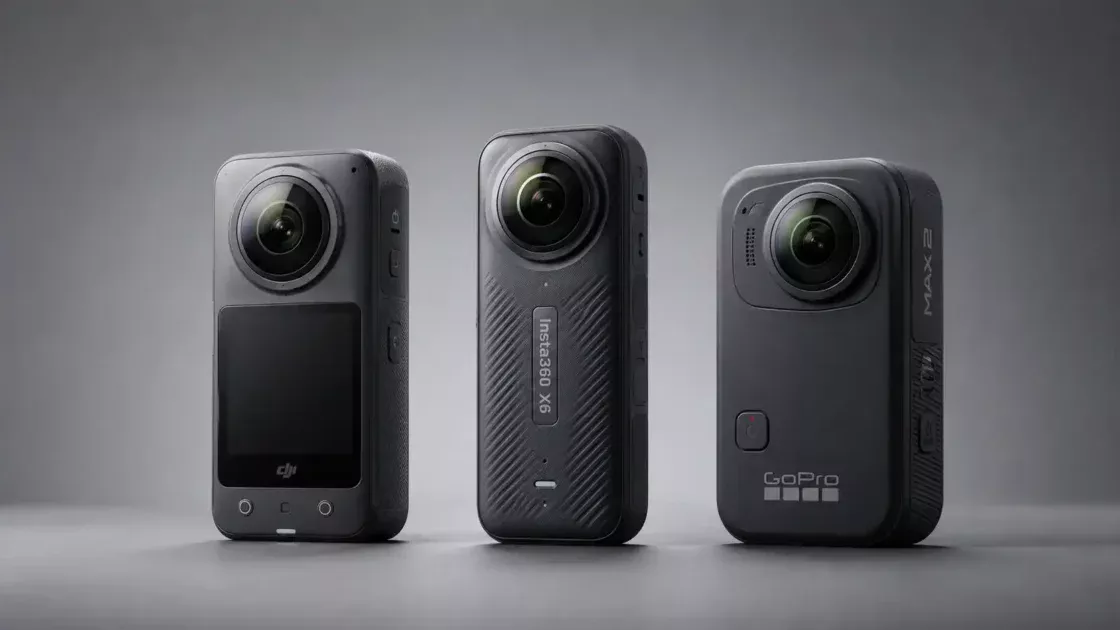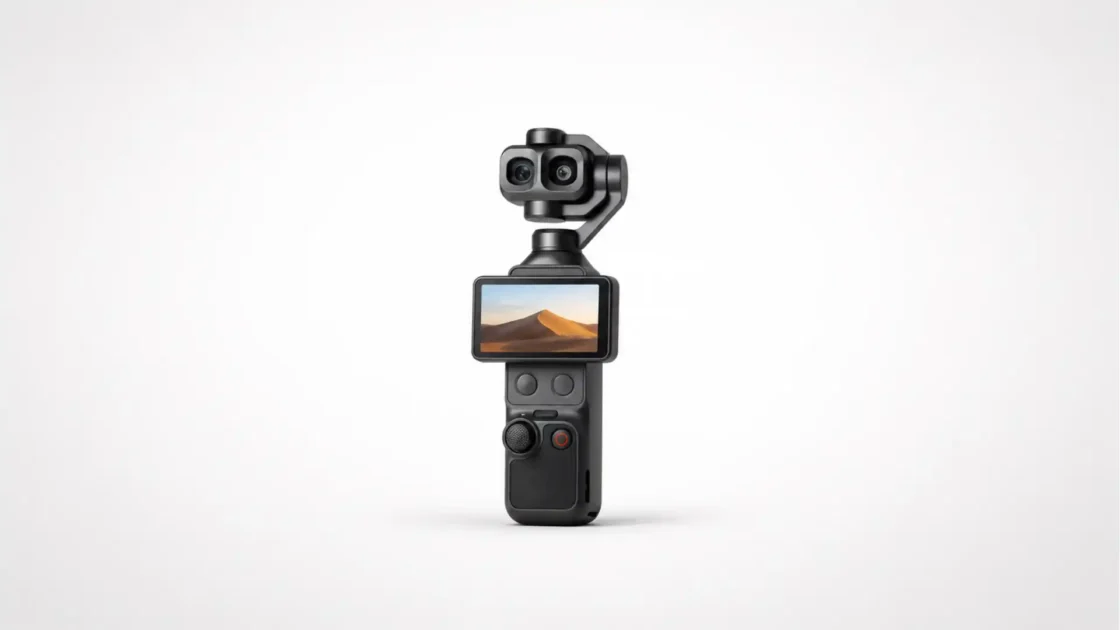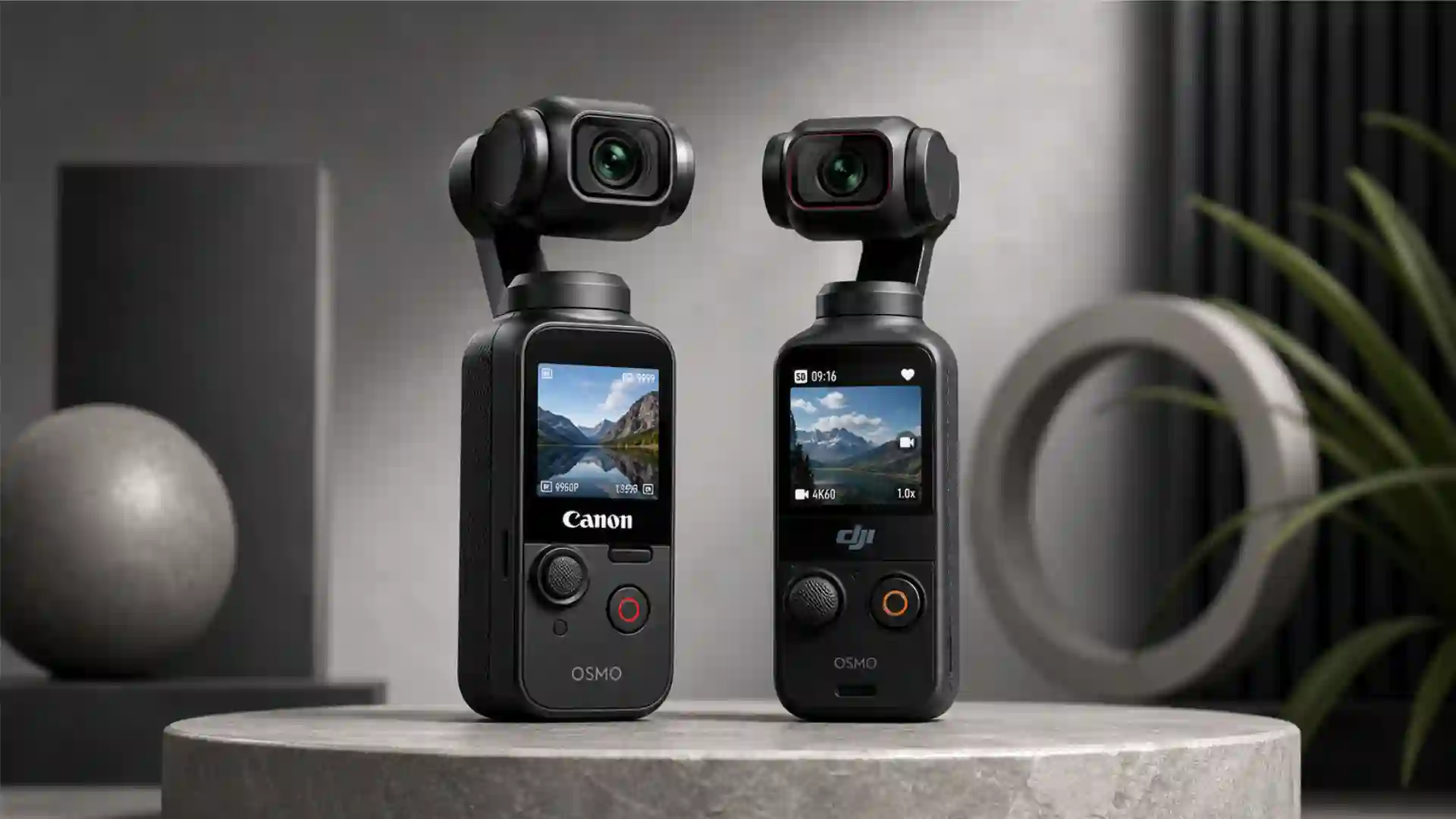
Canon is no longer treating pocket creator cameras as a side experiment. A newly surfaced Canon gimbal-camera patent points to a compact fixed-lens device with a three-axis stabilized head, a grip, a screen, and a smart folding shutdown system built around durability and power control. That matters because DJI’s Osmo Pocket line has owned this category for years, yet the market around it has changed fast. DJI now faces tougher regulation in the United States, Insta360 is pushing into dual-lens pocket gimbals, Oppo has confirmed interest, and Canon’s own PowerShot V1 has already shown that dedicated creator cameras are selling again.
Table of Contents
Canon’s patent is not a product launch, but it is a serious signal
Canon has not announced an Osmo Pocket rival. The company has not published a retail name, release date, price, sensor size, focal length, video codec, battery capacity, accessory plan, or distribution strategy for a pocket gimbal camera. The confirmed news is narrower and more useful: Canon is still filing detailed gimbal-camera intellectual property, and the latest design looks far more practical than the earlier concepts. That distinction matters because camera patents often describe research paths that never become products.
The April 2026 coverage around Canon’s latest gimbal design describes a handheld camera with a fixed lens, a grip, a screen, a stabilized head, and a folding mechanism that protects the gimbal during storage. The design is being read as Canon’s closest conceptual move yet toward a DJI Osmo Pocket-style device. The fresh patent coverage focuses less on speculative lens ambition and more on daily handling: detecting when the camera is no longer being used, moving the gimbal head into a safe folded position, and then cutting motor power.
That sequence may sound small next to headline specs such as 4K/240fps or a 1-inch sensor. It is not small. Pocket gimbal cameras live or die through trust. They are pulled from bags, thrown into jacket pockets, mounted on tripods, clipped to extension rods, used one-handed, shoved into cases, and asked to survive the rough habits of travel creators. A gimbal head that simply loses power and hangs loose can feel fragile even when the product is technically within spec. Canon appears to be studying the moment when the device stops filming and becomes a physical object that must be stored safely.
The pattern also fits Canon’s slow, engineering-led style. The company often enters categories after others have turned the format into a real market. It then competes with optics, autofocus, color, reliability, service infrastructure, and a deep retail footprint. A Canon pocket gimbal camera would not need to be the strangest or most dramatic product in the category. It would need to be dependable, simple to trust, good enough in low light, fast enough to focus on people, and familiar enough for creators who already know Canon menus and color.
A patent still leaves many open questions. Canon may never ship this design. The product could change shape. It could be delayed by cost, heat, battery life, supply constraints, or internal product overlap. The patent is best read as a strategic indicator, not a launch confirmation. Canon is studying the device class seriously, and the latest concept focuses on the problems that separate a cool prototype from a camera people actually carry.
DJI built the category Canon now wants to enter
DJI did not invent every part of the pocket gimbal camera, but it made the format legible for the creator market. The Osmo Pocket line gave solo shooters something that smartphones and action cameras could not quite replace: a self-contained stabilized camera with a dedicated grip, fast start-up, subject tracking, mechanical stabilization, and a small screen. That package solved a real workflow problem. Creators wanted movement without a full gimbal rig. DJI gave them a pocketable steadicam that did not require balancing a phone.
The Osmo Pocket 3 became the clearer breakout moment because it paired a larger 1-inch sensor with a rotating 2-inch screen, 4K/120fps, 10-bit D-Log M, HLG, full-pixel fast focusing, three-axis mechanical stabilization, ActiveTrack 6.0, and stronger wireless audio integration. DJI’s own product page frames the Pocket 3 around the 1-inch CMOS sensor, 4K/120fps recording, the rotatable screen, and the ability to shoot horizontal or vertical content quickly.
The Pocket 4 then raised the benchmark again. DJI announced the Osmo Pocket 4 on April 16, 2026, with a 1-inch CMOS sensor, 4K/240fps footage, 14 stops of dynamic range, 10-bit D-Log, three-axis stabilization, 107GB of built-in storage, 2× lossless zoom, ActiveTrack 7.0, and OsmoAudio four-channel output. DJI’s product page and release material present the device as a direct upgrade to a format the company already controls.
That means Canon would not be entering an empty field. It would be challenging a product line with muscle memory. Many creators know how to use DJI’s Pocket cameras. Accessory makers support them. Reviewers understand them. Buyers compare every small vlogging camera to them. For Canon, the task is not only to build a good camera. It must give creators a reason to leave a workflow that already works.
DJI’s strength is not just hardware. Its pocket cameras sit inside a broader creator ecosystem that includes wireless microphones, mobile apps, accessories, drones, action cameras, stabilization algorithms, and subject-tracking experience. DJI understands the movement needs of solo creators better than most traditional camera companies. The Osmo Pocket format is a natural extension of that knowledge.
Canon’s answer cannot be a normal compact camera attached to a gimbal. It needs a different point of view. The latest patent suggests Canon may see that. Instead of trying to out-DJI DJI with a flashy first move, Canon appears to be studying reliability, shutdown behavior, safe storage, and context awareness. That is a quieter path, but it fits the company’s brand.
The new Canon design looks more realistic than the old Canon dream
Canon’s earlier gimbal-camera patents were more ambitious. Reports around the 2021 concept described a compact handheld camera with a motorized gimbal and interchangeable lenses. That idea was exciting because it suggested a hybrid between a cinema tool and a pocket creator device. It was also mechanically awkward. A small gimbal has to manage weight, center of gravity, lens movement, heat, battery draw, and shock resistance. Add interchangeable lenses and the product becomes much harder to price, balance, protect, and explain.
The latest design appears to move away from that burden. It focuses on a fixed-lens device with integrated stabilization and a smarter storage sequence. Y.M.Cinema’s April 2026 report describes the new patent as a more practical step after Canon’s first lens-swappable vision and a later auto-flipping concept. Notebookcheck also frames the 2026 filing as a shift from the earlier interchangeable-lens idea toward fixed-lens portability and power management.
That is the right direction if Canon wants a real consumer product. Pocket gimbal cameras need to be bought by people who shoot daily life, travel, walk-and-talk videos, product demos, and social posts. Those buyers do not want a system camera in disguise. They want a device that comes out of a pocket, turns on, locks onto a face, records stable video, captures clean audio, then shuts down without fuss.
A fixed lens also gives Canon more control over the system. The company can tune autofocus, stabilization, lens correction, field of view, thermal behavior, and form factor around one optical design. It can make the grip smaller. It can set predictable balance targets for the gimbal motors. It can reduce accessory confusion. The move from interchangeable-lens ambition to fixed-lens execution is not a retreat; it is the difference between a concept that impresses engineers and a camera that could survive retail.
Canon’s PowerShot history gives it some credibility here. The company knows fixed-lens compacts. It knows pocket bodies. It knows small zoom lenses. It knows creator-facing shortcuts from the PowerShot V series. The missing piece is mechanical gimbal behavior, where DJI has deeper field experience. A fixed-lens design gives Canon the best chance to close that gap.
The gimbal category rewards integration more than modular freedom. The camera head, lens, sensor, motors, firmware, screen, power system, app, and audio path must behave like one unit. Any mismatch shows up as jitter, lag, overheating, cropped footage, soft focus, awkward framing, or short battery life. A fixed-lens Canon device would let the company own that entire chain.
The folding shutdown detail is more important than it sounds
The most interesting part of Canon’s latest concept is not that it looks like an Osmo Pocket. The interesting part is the shutdown logic. Reports describe a system that detects whether the device is still being used, guides the gimbal into a folded protected position, and only then cuts motor power. The patent coverage mentions inputs such as motor position changes, button or touch activity, image changes, and magnetic sensors that could detect storage in a case.
That is a human behavior problem disguised as a mechanical problem. Creators do not handle cameras gently when they are moving. They stop recording, drop the device into a bag, grab another camera, walk through security, board a train, mount a mic, or switch to a phone. The moment after recording ends is when fragile parts are most exposed. Canon’s idea appears to treat shutdown as part of the shooting workflow, not as a simple power-off event.
A smart folded position would serve several purposes. It could reduce stress on the motors. It could make the camera easier to put into a case. It could protect the lens. It could stop the head from rattling during travel. It could reduce power draw after safe positioning. It could also make the product feel more finished. A camera that folds itself with confidence sends a different message than one that goes limp.
Canon patent focus versus creator benefit
| Patent focus | Likely creator benefit | Strategic meaning |
|---|---|---|
| Integrated three-axis gimbal | Stable walking shots without a separate rig | Direct challenge to DJI’s core Pocket advantage |
| Fixed-lens camera head | Smaller body and predictable balance | More realistic than Canon’s earlier lens-swappable concept |
| Smart folding sequence | Safer storage after filming | Reliability as a selling point |
| Use-state detection | Fewer accidental shutdowns or loose-head moments | Context-aware camera behavior |
| Magnetic case detection | Cleaner transition from shooting to carrying | Better daily carry experience |
This table does not prove Canon will ship the camera. It shows why the patent has drawn attention: the design focuses on the boring physical moments that creators notice only when they go wrong.
The shutdown behavior also hints at a wider software direction. The best creator cameras are becoming context-aware devices. They do not just record video. They infer orientation, subject priority, face position, sound source, vertical or horizontal format, thermal limits, livestream state, and storage condition. A smart gimbal shutdown is part of that same shift. It asks: where is the camera, what is the user doing, and what should the device do next?
Canon has sometimes been conservative with computational features compared with phone makers and DJI. A pocket gimbal camera would force a different rhythm. It would need to read user intent quickly. It would need to decide when to track, when to reframe, when to recenter, when to sleep, when to protect the head, and when to wake from a bag. The patent suggests Canon understands that a creator camera is now a behavioral product, not only an imaging product.
The practical benefit could be brand-aligned. Canon’s strongest consumer reputation is not for wild novelty. It is for dependable cameras that produce pleasing images and keep working. A self-protecting gimbal could let Canon translate that reputation into a category where tiny mechanical parts are exposed by design.
Canon’s timing is sharper because DJI’s U.S. position has weakened
The competitive timing is unusually favorable for Canon. DJI remains the technical leader in pocket gimbal cameras, but its U.S. market path has become more complicated. The Osmo Pocket 4 launched outside the United States, while multiple reports said it was not available in the U.S. market at launch because authorization was still pending. The Verge’s review quoted DJI spokesperson Daisy Kong saying the Pocket 4 would not be available in the U.S. market because the authorization application was pending, and PetaPixel reported the same shift in DJI’s product availability language.
The issue sits inside a larger regulatory fight. Reuters reported in February 2026 that DJI filed suit challenging an FCC decision barring imports of all new DJI models and critical components, while noting that the December decision meant DJI, Autel, and other covered foreign drone companies could not obtain the necessary FCC approval for new models in the U.S., though existing versions could continue to be sold.
A pocket camera is not a drone in the way consumers experience it, but DJI’s broader regulatory status affects confidence, retail availability, and launch timing. If a new DJI creator device cannot reliably reach U.S. shelves, rivals gain an opening. That does not automatically make Canon a winner. It does change the buying conversation. U.S.-based creators care about warranty support, retail stock, returns, accessories, and long-term firmware service. Canon is already a conventional camera brand in the U.S. retail channel, not an import workaround.
The U.S. availability issue is one of Canon’s clearest openings. A Canon pocket gimbal camera that ships through normal camera retailers, with standard service support and no regulatory cloud around new model authorization, would instantly have an advantage for American buyers. It would not need to beat DJI on every spec to become the safer purchase for some creators, agencies, schools, and small production teams.
The same issue affects enterprise and institutional buyers. Newsrooms, public agencies, universities, corporate communications teams, tourism boards, and in-house marketing departments often buy tools through procurement processes. They may not want devices with uncertain import status or support paths. Canon already sells into those channels. A pocket gimbal camera could become a low-friction Canon ecosystem purchase for teams that need stable creator footage but do not want to explain a DJI procurement risk.
The timing also helps Canon psychologically. DJI’s brand is still strong among creators, but scarcity and uncertainty weaken any hardware platform. If buyers see Pocket 4 reviews from Europe while U.S. retailers cannot stock the device, the product becomes aspirational rather than available. Canon’s opportunity is to turn availability into trust.
Canon has already been preparing the creator market with PowerShot V
Canon’s pocket gimbal idea did not appear in isolation. The company has spent the last few years rebuilding a creator-facing compact lineup around the PowerShot V series. The PowerShot V10 arrived as a vertical, all-in-one vlogging camera with a 1-inch sensor, 4K recording, a built-in stand, stereo microphones, and a small body aimed at people who wanted something simpler than a mirrorless setup. Canon’s own PowerShot V10 material emphasizes a compact 211g body, 4K UHD recording, a wide-angle lens for video, built-in microphones, a built-in stand, and Wi-Fi/Bluetooth connectivity.
The PowerShot V1 then moved higher. Canon’s specification sheet lists a 1.4-inch sensor, roughly 22.3 effective megapixels, 4K 60p video, Full HD 120p, Dual Pixel autofocus, a 16-50mm f/2.8 lens, optical image stabilization, Movie Digital IS, Canon Log 3, a built-in ND filter, UVC/UAC support, a 3-inch vari-angle screen, a UHS-II SD card slot, and a 426g body.
TIPA named the Canon PowerShot V1 the Best Content Creator Camera at the 2026 TIPA World Awards, citing its 16-50mm zoom lens, three-microphone array, advanced autofocus, built-in cooling fan, stabilization, articulating display, video/stills switch, creative presets, and smartphone control via Bluetooth and Wi-Fi.
That award matters less as a trophy and more as market validation. Canon built a video-first compact and the imaging press recognized it as a creator tool. The V1 is not a pocket gimbal camera, but it proves Canon is willing to build small dedicated cameras around creator needs rather than simply repackaging traditional photography bodies.
The V1 also gives Canon a feature base that could translate into a gimbal product: Canon color, Dual Pixel autofocus, log capture, built-in ND, strong audio support, a dedicated creator interface, and a body designed for video first. A Canon Osmo Pocket rival would likely borrow lessons from the V series more than from the EOS R line. It would need to feel less like a mini cinema camera and more like a stabilized PowerShot made for daily shooting.
Canon’s challenge is that the PowerShot V1 and a pocket gimbal camera solve different movement problems. The V1 is a compact camera with optical and digital stabilization. DJI’s Pocket line is a mechanical gimbal device. The difference shows up when walking, panning, tracking, and framing yourself at arm’s length. If Canon enters the gimbal category, it must avoid making a V1 with a motorized head bolted on. It needs a native gimbal product.
The compact camera revival gives Canon permission to be bold
The camera market is not returning to the old point-and-shoot era, but fixed-lens cameras are having a real rebound. PetaPixel’s report on 2025 CIPA data noted that global digital camera shipments rose again in 2025, reaching 9.44 million units, the highest total since the pandemic period. It also reported that cameras with built-in lenses shipped around 2.44 million units in 2025, roughly 30% higher year over year.
That matters for Canon because a pocket gimbal camera is a fixed-lens camera, even if it sits in the video category. The device would not rely on an interchangeable-lens upgrade path. It would need to win as a dedicated object: easy to carry, emotionally appealing, better than a phone in specific scenarios, and affordable enough to buy as a second camera.
For years, conventional wisdom said phones had eaten compact cameras. That was true for generic point-and-shoots. It is less true for purpose-built compacts with strong lenses, distinctive color, better ergonomics, real controls, zoom, larger sensors, or video workflows that phones still complicate. The new fixed-lens demand is not nostalgia alone. It is partly creator fatigue with phones. Phones are powerful but distracting. They fill storage. They overprocess footage. They heat up. They interrupt filming with notifications. They lack the physical confidence of a dedicated tool.
Canon can use this shift. A gimbal camera would not need to persuade buyers that dedicated cameras still matter. The market is already doing that. The smarter question is whether Canon can build the right dedicated camera for the current creator moment.
The revival also changes internal business logic. A few years ago, Canon executives could have looked at a pocket gimbal concept and seen a niche gadget with uncertain margins. After the PowerShot V1, the V10, renewed interest in the G7 X style of compact, and stronger fixed-lens shipment data, the same concept looks more like a category gap. A Canon pocket gimbal camera would be less strange in 2026 than it would have been in 2021.
The buyer has changed too. Many younger creators do not think in old camera categories. They compare phones, compact cameras, action cameras, 360 cameras, drones, webcams, wireless microphones, and mirrorless bodies based on output and friction. They do not care whether a device belongs to the “compact digital camera” lineage. They care whether it makes TikTok, YouTube Shorts, Instagram Reels, travel videos, livestreams, and product clips easier to produce.
DJI still owns the movement problem
Canon’s camera credentials do not erase DJI’s movement advantage. DJI comes from drones and gimbals. It understands stabilization as a core product language. The Osmo Pocket line is not just a camera with a stabilized head. It is a miniature movement platform with recentering, tracking, modes, joystick input, tilt and pan behavior, and a user interface built around motion.
DJI’s Pocket 3 specs list a 179g body, a 2-inch touchscreen, three microphones, a microSD slot, and detailed gimbal motion ranges. Its three-axis mechanical stabilization and subject tracking are central to its appeal.
The Pocket 4 keeps that core while adding better imaging. DJI’s official page lists 4K/240fps, 14-stop dynamic range, 10-bit D-Log, 107GB built-in storage, ActiveTrack 7.0, intelligent focusing, and four-channel OsmoAudio output. That is a high bar.
Canon’s traditional strengths are different. Canon is loved for color, skin tones, autofocus, lens rendering, ergonomics, menu familiarity, service, and system trust. It is not known as the brand that defined consumer gimbal behavior. A Canon pocket gimbal will be judged against DJI’s smoothness immediately. Reviewers will walk with it. They will jog with it. They will pan across street scenes. They will test face tracking against backlight. They will compare audio. They will rotate between vertical and horizontal shooting. They will test whether the camera loses a subject behind a passerby.
The first Canon pocket gimbal would need to be stable before it is cinematic. It cannot rely on Canon color if the footage jitters. It cannot rely on autofocus if the framing feels clumsy. It cannot rely on a premium name if the gimbal feels fragile. DJI has made creators expect smooth motion from a device smaller than many microphones.
Canon’s best path may be to avoid trying to win every movement use case. It could target creators who want reliable walk-and-talk footage, strong skin tones, cleaner autofocus, good audio, and a safer U.S. retail path, not extreme motion. DJI can still own the travel-steadicam feel. Canon can own the dependable daily creator camera feel. The overlap is large enough to create a fight.
The Pocket 4 sets the spec benchmark Canon must answer
The Osmo Pocket 4 has reset expectations for the category. Its headline numbers matter because buyers use them as filters, even when they do not need every capability. A 1-inch sensor, 4K/240fps, 14 stops of dynamic range, 10-bit D-Log, 107GB internal storage, ActiveTrack 7.0, and four-channel audio support create a spec story that is easy to understand. It says: this is not a toy camera.
The Verge’s review described the Pocket 4 as an evolutionary upgrade rather than a reinvention, but also noted improvements across video quality, controls, internal storage, battery life, resolution, dynamic range, low-light ceiling, and slow motion. The review also pointed out that the gimbal hardware itself remained close to the Pocket 3, meaning DJI’s biggest changes were around imaging, controls, storage, and software.
That creates both pressure and opportunity for Canon. If DJI’s mechanical stabilization is already mature, rivals do not need to invent a radically new gimbal feel. They need to match enough movement competence and differentiate elsewhere. Canon could answer with a larger sensor, better color science, superior autofocus, built-in ND, stronger audio ports, better heat control, better touchscreen logic, a more reliable folding mechanism, or direct integration with Canon’s creator apps and EOS ecosystem.
Current category pressure points
| Brand or product path | Confirmed or reported position | Pressure on Canon |
|---|---|---|
| DJI Osmo Pocket 4 | Official 1-inch pocket gimbal with 4K/240fps and ActiveTrack 7.0 | Canon must match baseline stabilization and beat on trust or imaging |
| DJI Osmo Pocket 4 U.S. launch | Not available in U.S. market at launch because authorization was pending | Canon can compete on retail certainty |
| Insta360 Luna | Officially previewed as an upcoming creator device, with dual-camera discussion around the category | Canon may face a software-heavy rival, not only DJI |
| Oppo gimbal camera interest | Oppo confirmed it is exploring a handheld gimbal camera | Smartphone brands are circling the same creator buyer |
| Canon patent path | Fixed-lens gimbal concept with smart folding and use-state detection | Canon’s likely angle is reliability and refined handling |
The category is no longer a one-company niche. That helps Canon by making the format more legitimate, but it also raises the cost of entering late.
The biggest spec question is sensor size. Canon’s V1 uses a 1.4-inch sensor, larger than the 1-inch class used by the Pocket 3 and Pocket 4. A pocket gimbal product may not be able to house the same sensor without becoming too large, too hot, or too expensive. If Canon can fit a sensor larger than 1 inch into a stable pocket gimbal while keeping autofocus and heat under control, it would have a clean story. If not, it must win through processing, lens quality, color, ergonomics, and trust.
The second spec question is lens choice. DJI’s Pocket format prioritizes wide-angle self-shooting. Creators want arm’s-length framing, walking shots, and subject tracking. Canon could choose a fixed wide lens, a small zoom, or a dual-focal system. A zoom sounds attractive, but zoom changes balance and complicates gimbal tuning. The 2024 Canon gimbal patent reporting discussed weight and size issues around accurate gimbal control.
The third question is vertical video. Pocket devices must switch cleanly between horizontal and vertical capture. A rotatable screen is not enough. The image pipeline, crop, stabilization, UI, file metadata, audio monitoring, and app transfer all need to treat vertical shooting as native. Canon’s creator products already acknowledge vertical workflows, but DJI has trained buyers to expect instant format switching.
Canon’s likely advantage is trust, not novelty
Canon should not try to look like the wildest company in this category. It should try to look like the safest serious choice. That is not a timid strategy. In creator hardware, trust is a performance feature. A camera that turns on every time, holds focus, produces believable skin tones, avoids overheating, records clean audio, protects its gimbal, and is easy to service earns repeat use.
DJI is trusted by many creators, but its U.S. regulatory uncertainty complicates that trust for some buyers. Insta360 is trusted for action and 360 cameras, but a dedicated pocket gimbal is a newer lane. Oppo has phone camera experience, but no established standalone creator-camera line in this form. GoPro has action camera heritage, but its own pocket-gimbal interest remains patent-level reporting. Canon has decades of camera credibility and retail infrastructure.
That credibility alone will not win. Canon has also frustrated creators in the past with conservative feature segmentation, crop compromises, overheating concerns in certain models, and slow adoption of some software workflows. A pocket gimbal camera would expose any friction fast. The buyer expects appliance-like simplicity, not a menu maze.
Canon’s advantage becomes real only if the product feels finished on day one. The company cannot ship a half-step device and expect brand loyalty to carry it. The creator market is impatient. People compare footage on YouTube the same week a product launches. If autofocus hunts, if stabilization crops too much, if audio is thin, if the app is clumsy, if vertical files are awkward, if the gimbal feels delicate, the Canon name will not save it.
Trust must be visible in the physical design. The folding mechanism must feel precise. The grip must not feel slippery. The screen must be bright enough outdoors. The record button must be easy to hit while walking. The lens must resist flare and fingerprints. The case must make sense. The tripod mount must be where creators expect it. The battery must last through real 4K use, not only lab conditions.
Canon can win the buyer who says, “I want a Pocket-style camera, but I do not want to gamble.” That buyer exists. They may be a travel creator, wedding filmmaker, social media manager, real estate shooter, journalist, educator, small business owner, or parent who wants better video. They may already use Canon. They may want a dedicated creator tool without switching into DJI’s ecosystem. Canon’s job is to make that choice rational.
Color science still matters in the creator camera market
“Canon color” is often discussed loosely, but the underlying buyer behavior is real. Creators care about skin tones, pleasing JPEGs, low-effort color, and footage that does not require heavy grading before posting. A pocket gimbal camera is likely to be used by people who want fast output. They do not always want to shoot log, build LUTs, fix strange skin tones, or correct over-sharpened phone-like processing.
DJI has improved color significantly. Pocket 3 and Pocket 4 support 10-bit log profiles, and DJI’s default image is more refined than older compact action-style footage. Yet Canon still has a strong reputation among portrait, wedding, family, YouTube, and hybrid shooters for pleasing people footage. If Canon can put that look into a gimbal camera, it would have a real differentiator.
The tricky part is that gimbal cameras often use small sensors and heavy processing. Skin tone performance depends on more than brand taste. It depends on sensor readout, bit depth, noise reduction, lens contrast, white balance, highlight rolloff, color profiles, and compression. If Canon uses a small sensor and pushes the footage too hard, the “Canon color” promise could weaken. If it uses a larger sensor and strong image processing, the product could stand apart.
Canon Log 3 on the PowerShot V1 shows that Canon is willing to bring more serious color tools into compact creator products. The V1 spec sheet lists Canon Log 3, 4K 60p, a built-in ND filter, and UVC/UAC support.
A pocket gimbal version could combine a simple ready-to-post profile with a log option for more skilled creators. That two-mode approach matters. Many buyers want simple color. More advanced users want grading headroom. A Canon device that can do both without burying settings would be stronger.
The creator camera winner is not always the device with the most neutral image. It is often the one that makes people look good quickly. That is where Canon could pressure DJI. Travel landscapes, street scenes, food clips, interviews, product demos, and skin tones all benefit from a consistent color pipeline. If Canon’s camera produces less “action cam” footage and more “small Canon” footage, creators will notice.
The risk is overconfidence. Color alone will not outweigh weak stabilization. It can, though, tip a close decision. If a buyer sees two walk-and-talk clips that are similarly stable, the one with better faces, gentler highlights, cleaner audio, and fewer app frustrations wins.
Autofocus may be Canon’s most practical weapon
A pocket gimbal camera is only useful if it keeps the subject sharp while the camera moves. DJI’s tracking is strong because the company has years of experience identifying, following, and reframing subjects in motion. Canon’s counterweight is Dual Pixel autofocus, one of the company’s most trusted technologies across stills and video.
Canon’s PowerShot V1 spec sheet lists Dual Pixel CMOS AF with near-full-frame coverage and thousands of selectable positions for stills and movie shooting.
That matters because pocket gimbal users often film faces at close distance. They move between indoor and outdoor light. They hold products up to the lens. They turn around while walking. They pass through crowds. They film children, pets, food, objects, signs, landscapes, and themselves. The camera must know when to stay on a face and when to shift to a product or scene. Product-review creators in particular need a camera that can move between face and object without drama.
Canon already understands face and eye detection in hybrid cameras. The question is whether it can make that experience feel instant in a tiny gimbal body. Processing power, heat, and battery limits are harsher in a pocket device than in a larger EOS body. If Canon skimps on processor capability, autofocus could lose the polish buyers expect.
The best implementation would give creators simple subject modes: face priority, product priority, object lock, pet detection, and manual tap-to-track. It would also need tracking behavior that cooperates with the gimbal. Focus and framing are linked in a pocket gimbal camera. If the gimbal follows a subject but focus lags, the shot fails. If focus locks but framing drifts, the shot feels amateur. DJI treats those as one problem. Canon must do the same.
A Canon pocket gimbal should make autofocus feel invisible. The viewer should not notice the camera deciding. The creator should not need to check focus every few seconds. If Canon can bring its autofocus reputation into this form factor, it will have a more concrete advantage than vague brand nostalgia.
Autofocus also affects confidence for live use. A pocket gimbal camera may be used as a webcam, livestream tool, or mobile reporting camera. UVC/UAC support on Canon’s V1 shows the company understands plug-and-play creator workflows. A stabilized Canon camera with reliable autofocus and clean USB video could appeal beyond vloggers.
Audio will decide more purchases than camera brands admit
The creator market talks about resolution and slow motion, but bad audio ruins more videos than slightly worse image quality. DJI understands this. Its newer Pocket devices connect naturally with DJI’s wireless microphone ecosystem, and the Pocket 4 page lists OsmoAudio four-channel output.
Canon has improved audio in the V series. TIPA cited the PowerShot V1’s three-microphone array, and Canon’s V1 spec sheet lists stereo microphone recording. The V1 also offers accessory compatibility through the multi-function shoe and ports that matter to creators.
A pocket gimbal camera gives Canon a chance to make audio more central. The device should not treat audio as an afterthought. It should support internal microphones that are usable in quiet spaces, a simple wind reduction mode, wireless mic pairing, USB-C audio options, and clear on-screen audio meters. It should not require a maze of adapters for basic creator recording.
The physical challenge is hard. A tiny camera with a moving gimbal head has limited room for microphones, ports, wind shielding, and accessory mounts. A mic mounted in the wrong place can pick up handling noise or motor noise. A USB-C port in the wrong spot can interfere with grip, tripod mounting, or vertical shooting. Canon would need to design the body around audio from the beginning.
The buyer Canon should care about is the one who films people talking. That includes vloggers, educators, coaches, small business owners, reporters, religious organizations, corporate teams, and product reviewers. For them, clean audio is not optional. DJI’s mic ecosystem has become a major reason to stay with DJI. Canon needs either a strong native wireless audio plan or excellent compatibility with third-party microphones.
Canon could also use its multi-function accessory thinking from EOS and PowerShot products. A tiny cold shoe may not fit the Pocket form factor, but a magnetic or proprietary audio connector could work if it is open enough and not overpriced. The danger is making accessories feel restrictive. Creators already own microphones. A Canon device that plays well with common gear will be more attractive than one that demands a new closed audio kit.
Audio may be the fastest way for Canon to look serious. A pocket gimbal with great autofocus, reliable stabilization, and bad audio is a toy. A pocket gimbal with stable 4K, pleasing color, and clean wireless mic support becomes a daily production tool.
Heat and battery life will test Canon’s engineering discipline
Pocket creator cameras have a cruel thermal problem. They are small, sealed or semi-sealed, handheld, often used outdoors, often recording high-resolution video, and expected to run for long clips. A larger sensor improves image quality but adds heat. Higher frame rates add heat. Brighter screens add heat. Wireless audio and app connections add heat. Internal stabilization and gimbal motors draw power. There is no free performance.
Canon has direct experience with heat controversies and heat solutions. The PowerShot V1 includes a built-in cooling fan, a detail TIPA highlighted in its award description.
A pocket gimbal camera may not have room for a conventional fan, or the fan could introduce noise, dust concerns, or weather-sealing compromises. DJI’s Pocket devices manage the balance through small sensors, efficient processing, and careful recording modes. Canon would need to choose its performance targets honestly.
Creators do not forgive overheating in a dedicated video device. A phone can overheat and the buyer blames phone multitasking. A dedicated camera overheats and the buyer blames the camera. If Canon ships a product aimed at vloggers, it must sustain ordinary recording in warm conditions. It does not need unlimited 4K/240fps. It needs reliable 4K walking, talking, and event coverage.
Battery life is just as exposed. The Verge review of the Pocket 4 noted DJI’s 240-minute use claim is based on 1080p/24fps with Wi-Fi and the screen off, while real 4K use felt closer to an hour or so.
That is normal for the category, but it shapes expectations. Canon can compete if it is transparent. A user-replaceable battery would be attractive, though it may enlarge the body. USB-C power while shooting is nearly mandatory. A battery handle or grip extension would make sense. The device should show realistic remaining time, not a vague battery icon.
Canon’s product should be tuned for the most common creator session: 20 to 45 minutes of mixed recording, screen use, autofocus, stabilization, wireless audio, and file transfer. If it does that dependably, it can survive comparison. If it chases spec-sheet glory and overheats, it will become another cautionary camera launch.
Thermal design also affects image processing. Aggressive noise reduction, high bitrates, internal log recording, and slow motion all require decisions. Canon must decide whether this product is a casual creator device, a serious compact video tool, or a bridge between the two. The best answer may be tiered modes: easy standard recording for most users, higher-quality modes with clear limits for skilled users.
The lens choice will reveal Canon’s real target buyer
Canon’s patent reporting does not give a final retail lens. That leaves a core strategy question open. A pocket gimbal camera can use a fixed wide prime, a small zoom, a dual-lens system, or a crop-based digital zoom. Each path reveals a different buyer.
A wide fixed lens is simplest. It keeps the camera small, balances the gimbal easily, suits selfies and travel, and reduces cost. DJI’s Pocket formula has leaned on that logic. The downside is limited reach. Creators increasingly want tighter framing without walking closer, especially for travel details, street scenes, product shots, and event coverage.
A small optical zoom would fit Canon’s compact camera heritage. The PowerShot V1 uses a 16-50mm equivalent zoom and Canon knows how to build useful small zooms. The problem is gimbal balance. Zooming changes lens position, center of gravity, and motor load. Canon’s earlier patent discussions around weight reduction and accurate gimbal control show the company is aware of this challenge.
A dual-lens design would answer where the category is heading. DJI’s rumored and teased Pro path and Insta360’s Luna discussion have pushed attention toward dual-camera pocket gimbals. Digital Camera World reported that Oppo is exploring a handheld gimbal camera while noting broader interest from Insta360, Vivo, and Honor, and it described Insta360 as working on Luna devices in the same competitive space.
A dual-lens Canon would be more ambitious and harder to ship. It would need two optical paths, consistent color, stable switching, and a body that does not become top-heavy. A single wide lens with high-quality sensor crop may be more Canon-like for a first product.
The right lens depends on whether Canon wants vloggers, travel creators, or hybrid camera owners. Vloggers need wide, flattering, close-range framing. Travel creators want reach. Hybrid Canon users may want a familiar focal range and color. A first-generation Canon gimbal should probably nail the core wide-lens experience rather than chase every focal length.
The field of view must also account for stabilization crop and vertical video. A lens that looks wide on paper can become too tight once electronic stabilization, horizon correction, or vertical crop is applied. DJI has handled this through accessory lenses and crop modes. Canon should avoid a camera that forces users to stretch their arms uncomfortably for selfies.
Lens brightness is another issue. DJI’s Pocket 4 uses an f/2.0 aperture according to its product page. Canon’s PowerShot V1 starts at f/2.8. A pocket gimbal used indoors and at night benefits from a fast lens. Canon’s optical design must balance brightness, size, sharpness, flare, and close-focus performance. For creators, a usable close-focus distance for product demos may matter as much as corner sharpness.
Canon’s ecosystem could make the camera bigger than a gadget
A Canon pocket gimbal camera would not need to live alone. Canon has an existing ecosystem of cameras, lenses, apps, printers, cloud services, accessories, service programs, education, and retail partners. The trick is to connect that ecosystem without making the product feel heavy.
The buyer for a pocket gimbal may already own an EOS R50 V, EOS R8, EOS R6 Mark II, PowerShot V1, or Canon lenses. They may want a second angle for behind-the-scenes footage. They may want a stabilized camera for walk-ins, travel montages, or quick social clips while using a larger Canon camera for main footage. If Canon creates matching color profiles and easy file transfer across devices, the pocket gimbal becomes more than a standalone toy.
A Canon creator kit could bundle the gimbal camera with a small tripod grip, wireless mic receiver, carrying case, USB-C cable, and perhaps a simple mount for shoe or cage use. But it must avoid the trap of bloated bundles. DJI has made Creator Combos familiar. Canon can mirror the idea, but it needs a cleaner Canon-specific reason.
A useful integration would be shared color management. Imagine a small Canon gimbal that matches the look of a PowerShot V1 or EOS R50 V with minimal grading. That would appeal to creators who mix cameras. DJI footage can look good, but matching it to Canon footage often takes work. Canon could make “same-family color” a selling point.
The camera could also work as a webcam or livestream device. Canon’s V1 supports UVC/UAC, and the V10 was promoted around livestreaming and webcam-style use. A gimbal camera with clean USB output, face tracking, and audio compatibility could serve online teachers, streamers, worship teams, podcasters, and remote workers.
The strongest Canon version would be a pocket production node: handheld camera, webcam, livestream tool, second angle, travel camera, and Canon-color companion. That is more defensible than a simple DJI clone.
Canon also has a service advantage. Camera buyers know where to send Canon gear. Retailers know how to explain it. Rental houses and production teams understand Canon support. A pocket gimbal camera at the right price could enter workflows where DJI is popular but not always institutionally comfortable.
The risk is ecosystem friction. Canon apps have not always matched the simplicity of phone-native creator tools. If the app transfer process is slow, account-heavy, or unreliable, creators will complain. DJI’s software is not perfect, but it is built around fast mobile use. Canon must treat the phone app as part of the camera, not a support accessory.
The product name will matter more than Canon may think
Canon’s naming could shape whether the device feels like a fresh creator tool or another camera-line extension. “PowerShot V” already gives Canon a creator-facing umbrella. A pocket gimbal camera could sit naturally under that line, perhaps as a PowerShot V Gimbal, PowerShot VG, PowerShot V Pocket, or a new sub-brand.
The Osmo Pocket name works because it describes the format. Pocket is the promise. DJI has moved between “Osmo Pocket” and “Pocket” branding, but the idea is clear. Canon needs similar clarity. A technical model name would be a mistake. A buyer should know within two seconds that this is Canon’s pocket stabilized creator camera.
The name should also avoid implying it is only for vloggers. Vlogging is part of the market, but the buyer base is wider: solo filmmakers, travel creators, educators, real estate agents, journalists, small businesses, social teams, families, churches, and hybrid photographers. “Vlog camera” can sound narrow. “Creator camera” sounds broader, but sometimes bland. “Pocket gimbal camera” is functional and searchable.
Canon may be tempted to tie the product tightly to PowerShot because the line already covers fixed-lens cameras. That makes sense. The danger is that PowerShot still carries old compact-camera associations for some buyers. The V1 has helped update that meaning, and the TIPA award strengthens the line’s creator legitimacy.
A Canon pocket gimbal should be named around the job, not the sensor. Creators do not want to decode model hierarchies. They want to know what the device does. DJI won this early. Canon can learn from that.
Naming also matters for search. Buyers will search “Canon Osmo Pocket,” “Canon gimbal camera,” “Canon vlogging camera with stabilizer,” “Canon Pocket camera,” and “DJI Pocket alternative.” Canon’s landing page should naturally answer those queries without sounding like a comparison farm. The product needs clear semantic language: three-axis gimbal, pocket creator camera, stabilized vlogging camera, vertical video, Canon color, autofocus, wireless audio, livestreaming, travel video, walk-and-talk, product demo mode.
If Canon hides the product behind a cryptic camera name, DJI keeps the category language. If Canon names and explains it well, the company can build a parallel search identity.
Price will decide whether Canon is a rival or a curiosity
Canon’s pricing discipline will be decisive. DJI’s Pocket line has succeeded partly because it feels attainable compared with a mirrorless body, lens, gimbal, microphone, and tripod. The Pocket 4’s European pricing reported by The Verge places its bundles around the mid-hundreds in pounds and euros, depending on accessories.
Canon’s PowerShot V1 is a more expensive compact camera. In the U.S., it launched at a higher tier than DJI’s Pocket 3 and many beginner creator tools. That may work for a large-sensor compact with Canon’s stills and video strengths. A pocket gimbal camera has a different pricing ceiling. Buyers will compare it directly with DJI, Insta360, action cameras, used mirrorless kits, and phones they already own.
A Canon gimbal priced too high would become a niche product for Canon loyalists. A Canon gimbal priced near DJI could become a true rival. The challenge is Canon’s cost structure. A high-quality gimbal, Canon imaging pipeline, bright screen, battery, wireless audio support, strong body, and service margin may not be cheap. Canon also tends to protect product tiers.
The smartest structure would likely include two bundles: a standard kit with the camera, case, cable, and basic grip; and a creator kit with microphone support, tripod grip, battery handle, wind protection, and maybe a small light or wide accessory. Canon should not make essential accessories exclusive to the expensive kit. That would frustrate buyers.
The psychological target is simple: the buyer should feel that Canon costs a little more because it is safer, not much more because Canon is late. A modest premium can be justified by better color, autofocus, service, U.S. availability, and build. A large premium would invite ridicule unless the sensor, lens, and features clearly exceed DJI.
Canon may also have room for an entry model and a higher-end model later. The first product should avoid fragmentation. One strong camera is better than two compromised versions. DJI already has the category maturity to experiment with Pro variants. Canon needs a clean first message.
Price also affects the phone comparison. Many creators already own a flagship phone with strong video. A pocket gimbal camera must feel inexpensive enough to buy as a specialized tool. If the price approaches mirrorless territory, buyers ask why they should not buy a small EOS R body instead. Canon must protect the product from its own lineup.
The U.S. market could become Canon’s wedge
The United States is not the whole creator market, but it is unusually important for this story. DJI’s Pocket 4 availability issue gives competitors a rare wedge in a category where DJI normally sets the pace. PetaPixel reported that the Pocket 4 was not available at major U.S. retailers at launch and quoted DJI’s statement that the device would not be available in the U.S. market while authorization was pending.
For U.S. creators, this changes the decision from “Which pocket camera is best?” to “Which pocket camera can I actually buy, support, return, and replace?” That is a different market. Canon thrives in that kind of environment. It has authorized dealers, known warranties, repair channels, education programs, and brand familiarity beyond tech enthusiasts.
The timing could also matter for schools and institutions. Many media programs, universities, churches, local governments, and corporate teams buy Canon gear because it is easy to approve. DJI’s regulatory situation may push some organizations to look for alternatives even if they admire DJI’s products. A Canon pocket gimbal could become the default non-DJI recommendation if it arrives with credible performance.
This would not be the first time distribution changed a hardware category. Availability creates habits. If U.S. creators cannot buy the Pocket 4 through normal channels, they will keep using Pocket 3, import devices, buy used stock, or look at rivals. If Canon launches into that gap, it does not need to convert every DJI fan. It needs to catch buyers who are entering the category now.
Canon’s strongest launch market may be the buyer who wants DJI-like capability without DJI-like uncertainty. That buyer is not anti-DJI. They are risk-aware. They want a tool they can buy today and use tomorrow.
Canon should be careful not to frame the product as a regulatory opportunist. A negative campaign against DJI would be ugly and unnecessary. The better message is positive: Canon imaging, pocket stabilization, creator workflow, reliable support. The contrast will be obvious without being shouted.
The U.S. wedge could also help globally. If reviewers in the U.S. spend months asking what to buy instead of the Pocket 4, Canon has a chance to shape the answer. Search traffic, YouTube comparisons, buying guides, and retailer recommendations will reward any credible alternative.
Insta360 and Oppo make this a category race, not a two-brand fight
Canon’s potential entry is happening as the pocket gimbal category broadens. Insta360 has signaled movement around Luna, and its own NAB Show 2026 recap says the company previewed upcoming innovations at the event, including Luna-related creative imaging context. Digital Camera World reported that Oppo confirmed it is exploring a dedicated handheld gimbal camera during a Find X9 Ultra Q&A, while also noting interest from Insta360, Vivo, and Honor in similar or adjacent ideas.
GoPro has also been linked to an Osmo Pocket-style patent. PetaPixel reported in August 2025 that GoPro filed a patent showing a modular approach with an imaging module and handheld module, while stressing that a patent does not confirm a product.
This wider race helps explain why Canon’s patent is getting attention. A few years ago, a Canon gimbal patent could be dismissed as another internal experiment. In 2026, the same patent lands in a market where DJI has refreshed the Pocket line, Insta360 is visibly circling, Oppo has acknowledged interest, and regulatory pressure has made DJI alternatives more commercially interesting.
The category is attractive because it sits between phones and mirrorless cameras. Phone makers understand computational video, face tracking, and mobile sharing. Camera makers understand optics, color, ergonomics, and dedicated capture. Action camera brands understand stabilization, small bodies, accessories, and creator marketing. DJI understands all of those better than most because of drones and handheld stabilizers.
Canon is late, but late does not mean irrelevant. Late entrants can win when the first leader defines the category but leaves some buyers underserved. DJI has served creators who want the most mature pocket gimbal. Canon could serve creators who want a camera-company interpretation: stronger color, Canon autofocus, better stills, safer support, and a refined physical design.
The next phase of this category will not be about who copies the Pocket shape. It will be about who understands the creator job best. That job includes filming oneself, filming others, moving through places, capturing usable sound, transferring files fast, matching footage with other cameras, and trusting the device in public.
Insta360 may push software and dual-lens tricks. Oppo may push phone-camera intelligence. DJI will push ecosystem continuity. Canon should push camera confidence. Each path is distinct enough to make the market more interesting.
The phone is still the real competitor
Even if Canon and DJI dominate the hardware comparison, the phone remains the default camera for most creators. Any dedicated pocket device has to justify itself against a product buyers already own. Phones shoot excellent video, switch instantly to social apps, offer computational stabilization, use big screens, and carry 5G connectivity. The pocket gimbal must win on the moments where a phone feels awkward.
Those moments are real. Holding a phone at arm’s length for a walking vlog is uncomfortable. Phone stabilization can crop, warp, or look unnatural under certain movement. Phones run out of storage. Notifications interrupt shooting. Long recording can heat up the device. Audio usually needs extra gear. Mounting a phone to a gimbal adds bulk and setup time. A dedicated pocket gimbal gives a cleaner capture mindset: turn on, record, move, stop, store.
Canon’s opportunity is to make that mental separation feel worth paying for. The camera should feel like a tool, not another screen. It should wake fast. It should have a physical record button. It should not bury core controls behind phone-like menus. It should move files quickly without turning transfer into a chore.
Canon also has to resist copying phones too much. Some camera companies panic and make their devices feel like worse phones. That is a mistake. A Canon pocket gimbal should borrow phone convenience where useful, but it should stay camera-like in the right ways: grip, shutter/record confidence, lens quality, color control, audio meters, tripod mounting, and reliable files.
The sales pitch is not “better than your phone at everything.” It is “better than your phone when movement, focus, audio, and creator discipline matter.” That is a narrower claim, and it is stronger.
Phones also raise the bar for computational features. Subject tracking, face exposure, HDR, night video, horizon leveling, and instant sharing are now expected. Canon cannot lean only on optics. If a phone holds exposure better in a backlit walk-and-talk clip, the Canon device will be judged harshly. If a phone transfers faster, same problem. Dedicated cameras must beat phones where they choose to compete.
A Canon gimbal camera should treat the phone as a partner. The companion app should make transfer, remote control, quick edits, firmware updates, and livestream setup painless. The camera should still work fully without the app. That balance is vital. Creators hate hardware that becomes dependent on an app in the field.
The creator workflow has moved beyond vlogging
The Osmo Pocket category is often described as vlogging hardware, but that label is too small. These cameras are used for vertical reels, behind-the-scenes clips, travel sequences, real estate walkthroughs, restaurant coverage, product demos, event recaps, interviews, educational shorts, livestreams, documentary scouting, family videos, and second angles on professional shoots.
Canon’s strategy should reflect that. A “vlog camera” can sound like a toy for talking to camera. A pocket gimbal is closer to a stabilized content acquisition tool. It can serve a solo YouTuber and a corporate content team. It can sit in a wedding filmmaker’s bag as a quick movement camera. It can help a journalist record stable walking footage. It can let a real estate agent create smoother tours without a phone gimbal.
Canon already sells to many of these buyers through different product lines. A pocket gimbal camera could connect them. It could be the camera that a marketing assistant, photographer, and video contractor all understand without training. That simplicity is powerful.
The workflow must support fast deliverables. Social teams do not want to transcode for hours. They need files that import into phone editors, desktop NLEs, and cloud storage. The camera should offer sensible default codecs, clear file naming, reliable metadata, and simple orientation handling. Vertical clips should show up as vertical clips. Audio should sync without odd channel surprises. Battery and storage status should be obvious.
Canon’s product will fail if it is designed only by camera people for camera people. It must be designed by observing how creators actually shoot: one hand occupied, sunlight on the screen, mic clipped to a shirt, backpack open, deadline close, phone battery low, client waiting, crowd moving, no time to fix settings.
The PowerShot V1 shows Canon can think about creators, not only photographers. The next step is to think about movement and immediacy at the same level. The gimbal form factor leaves less room for old camera habits. It rewards direct buttons, simple modes, and predictable behavior.
A Canon pocket gimbal could also work as a teaching tool. Many beginners find mirrorless cameras intimidating. A stabilized pocket camera with Canon color and autofocus could become a first dedicated camera. From there, some buyers may move to EOS R bodies. That gives Canon a funnel DJI cannot match in the same way.
Canon must avoid the first-generation trap
First-generation category entries often try to prove too much. Canon should avoid that. The company does not need a pocket gimbal with every possible feature. It needs the right feature set executed cleanly. A flawed first product would damage the idea before Canon has time to refine it.
The first trap is overbuilding. If Canon tries to put a large sensor, optical zoom, mechanical gimbal, flip screen, fan, hot shoe, ND filter, big battery, weather resistance, and pro ports into one tiny body, the result may be bulky, expensive, or fragile. The product must stay pocketable. The category promise breaks if the camera needs a special bag.
The second trap is underbuilding. If Canon ships a cute stabilized camera with weak video specs, poor tracking, no log, no good audio path, and a high price, reviewers will call it late and conservative. It must meet the category baseline. In 2026, that likely means strong 4K, reliable tracking, vertical video, good low-light performance, wireless audio support, fast transfer, and a bright screen.
The third trap is segmentation. Canon sometimes protects higher-end products by limiting features in cheaper bodies. In a pocket gimbal camera, that would be dangerous. Buyers are not comparing it only to Canon’s lineup. They are comparing it to DJI, Insta360, phones, action cameras, and used gear. Artificial limits will look worse in that context.
The fourth trap is app neglect. Creator cameras now depend on phone workflows. A weak app can ruin strong hardware. Canon must treat app design, transfer speed, firmware updates, and remote control as launch-critical. Slow pairing, confusing permissions, and unreliable exports would be unacceptable.
The first Canon pocket gimbal should be boringly excellent before it is daring. Stable footage. Good faces. Clean audio. Fast start. Safe fold. Clear screen. Easy transfer. Sensible price. Those basics would do more damage to DJI than a dramatic spec that works only in perfect conditions.
Canon also needs to seed reviewers properly. The first wave of comparisons will define the product. Canon should put the camera in the hands of walking vloggers, travel shooters, educators, wedding filmmakers, real estate creators, and mobile journalists, not only photography reviewers. The category is practical. The launch proof must be practical too.
A real Canon rival would pressure DJI in three places
If Canon ships a strong pocket gimbal camera, DJI would feel pressure in three specific areas: trust, imaging character, and distribution. Those are not the same areas where DJI is strongest, which is why the threat matters.
Trust includes build, service, support, regulatory certainty, warranty, and long-term reliability. Canon can speak credibly here if the hardware feels solid. The smart folding patent idea directly supports this angle. A device that protects its gimbal head intelligently can be marketed as a camera built for daily carry.
Imaging character includes color, skin tones, autofocus, lens rendering, exposure, and grading flexibility. Canon has a chance to produce footage that feels less like a stabilized action camera and more like a Canon compact. That matters for creators who film people, products, weddings, interiors, and branded content.
Distribution includes the U.S. market, camera stores, institutional purchasing, service centers, bundles, and availability. DJI’s regulatory challenge makes this area newly vulnerable. Reuters’ reporting on the FCC dispute and The Verge/PetaPixel reporting on Pocket 4 availability show why this is not just theoretical.
DJI would still have major advantages: tracking history, gimbal expertise, creator mindshare, accessory ecosystem, and category ownership. Canon would not erase those quickly. But a credible Canon device could stop DJI from being the automatic answer.
The first goal for Canon is not to dethrone DJI worldwide. It is to become the default alternative. Once Canon owns that position, later versions can attack more directly. The product can mature. Accessories can grow. Canon can add Pro variants, better sensors, or multi-camera workflows.
DJI should take Canon seriously because Canon has patience. Canon does not need a viral novelty hit. It can build a product line slowly, improve it every cycle, and sell through channels DJI cannot always access comfortably. If the compact creator category keeps growing, Canon’s incentive to stay increases.
The pressure may also improve DJI products. Competition forces clearer pricing, better availability, stronger support, and fewer assumptions. The Pocket 4 is already a polished device. A Canon rival could make the Pocket 5 or Pocket 4P more aggressive. Creators benefit either way.
A weak Canon launch would strengthen DJI instead
Canon’s risk is not only failure. A weak product could make DJI look even stronger. If Canon enters late and underperforms, reviewers will use it as proof that DJI’s lead is wider than expected. That would hurt Canon’s creator-camera credibility.
The most likely failure mode is a product that is too camera-like and not enough gimbal-like. Canon might deliver good image quality but mediocre movement. That would disappoint buyers because the category’s first promise is stabilization. A pocket gimbal is bought for motion first. Color and autofocus come after.
Another failure mode is price. A $900 or $1,000 Canon pocket gimbal would need to be extraordinary. If it lacks DJI’s mature tracking or Pocket 4-level specs, it will be attacked as a premium-priced late entry. Canon can charge for quality, but it must respect category anchors.
A third failure mode is bulk. The PowerShot V1 is pocketable in a loose sense, but it is not Osmo Pocket-small. A gimbal version that becomes too large may compete with compact cameras rather than pocket gimbals. The grip-and-head silhouette needs to remain easy to carry.
A fourth failure mode is software. Canon’s imaging may be strong, but if the app experience lags behind DJI, creators who live on phones will complain. Fast transfer is not a bonus. It is part of the capture loop.
Canon should launch only when the camera can win real walking tests. Patent filings are exciting, but the market will not reward intention. It will reward footage. It will reward ease. It will reward reliability.
Canon also needs to set expectations honestly. If the product is a casual creator camera, price it and market it that way. If it is a pro-leaning compact gimbal, give it the codec, audio, heat, and control depth to match. Mixed messaging could hurt it.
A flawed first product is recoverable, but the creator market moves fast. DJI, Insta360, Oppo, GoPro, and phone makers will not pause. Canon’s first impression should be disciplined.
The smartest Canon product would not copy DJI feature for feature
A Canon Osmo Pocket rival should not become a checklist clone. Feature parity matters, but identity matters more. DJI owns the language of miniature mechanical movement. Canon should own the language of pocket Canon imaging with stabilized confidence.
That could mean a slightly larger body with better grip and battery. It could mean less extreme slow motion but better skin tones and autofocus. It could mean a safer folding head. It could mean stronger still photo capture than DJI. It could mean easier matching with EOS footage. It could mean better U.S. service support.
The product should still meet modern expectations. It needs three-axis stabilization, vertical/horizontal shooting, a bright screen, subject tracking, 4K recording, good slow motion, wireless audio support, USB-C, app transfer, tripod mounting, and a useful case. But the point should not be “we also made an Osmo Pocket.” The point should be “Canon made a pocket stabilized creator camera that feels like Canon.”
A stills angle could help. DJI’s Pocket cameras are video-first. Canon could make a device that also works as a small travel stills camera. That would require a good shutter experience, fast capture, decent RAW support, and a lens suited to more than selfies. The PowerShot V1 already blends stills and video better than many creator cameras. A gimbal product could borrow that hybrid thinking.
The danger is trying to satisfy photographers too much. A pocket gimbal camera should not become a mini G-series compact with a moving head. It must remain a video-first movement tool. Stills should be a bonus, not the design center.
Canon’s differentiation should be practical, not theatrical: better-looking people footage, safer storage, stronger autofocus, cleaner audio paths, real support, and smooth enough motion. That is a credible alternative to DJI.
Canon could also use physical controls better. The Pocket 4 added buttons, and The Verge welcomed them while still criticizing some touchscreen fiddliness. Canon knows camera controls. A tiny device with a smart record button, recenter button, zoom rocker or mode switch, and quick exposure/audio controls could feel more serious than a touch-only interface.
The pocket gimbal that wins daily use will be the one that reduces hesitation. If creators trust it, they carry it. If they carry it, they use it. If they use it, the ecosystem grows.
The patent language points toward reliability as product strategy
Canon’s reported use-state detection is revealing because it focuses on the edges of the recording experience. Most marketing highlights what happens while filming. Canon’s patent concept pays attention to what happens after filming stops. That is reliability thinking.
A camera that knows when it has been placed in a case, when the image is no longer changing, when buttons are idle, when external force is moving the gimbal, and when it can safely cut power is a camera designed around real-world abuse. It may reduce battery drain and mechanical stress. It may also reduce user anxiety.
This approach could extend to other behaviors. A Canon gimbal could detect when it is on a tripod versus handheld. It could switch stabilization modes based on walking or static use. It could detect when the lens is blocked in a pocket. It could warn if the gimbal head is constrained before power-up. It could lock the head for transport. It could enter a low-power standby after a stable period. It could wake quickly when lifted.
Context awareness is the next frontier for dedicated creator cameras. Phones already do this constantly through sensors and software. Camera companies have been slower. A pocket gimbal camera is a natural place to catch up because it has motors, motion sensors, screen orientation, image analysis, and user inputs all tied together.
Canon’s challenge is to make intelligence invisible. Users should not feel like they are negotiating with the camera. The device should simply avoid dumb behavior. It should not shut down while the user is reframing. It should not leave the head loose in a bag. It should not fight the user when placing it on a table. It should not wake accidentally and drain the battery.
Reliability as strategy also fits Canon’s financial and patent culture. Canon U.S.A. said Canon Inc. had about $29.5 billion in global revenue and had ranked in the top 10 for U.S. patents granted for 42 consecutive years as of 2025. That does not guarantee a successful pocket camera, but it shows the company has the engineering depth and patent habit to pursue this kind of product carefully.
The risk is that reliability is harder to market than specs. “4K/240fps” is easy. “Smart folding to reduce mechanical stress” is less glamorous. Canon will need to translate it into plain creator benefits: safer in your bag, ready faster, less fragile, less battery waste, built for daily carry.
Canon’s creator line needs a bridge below EOS
Canon’s EOS R system is strong, but not every creator wants an interchangeable-lens camera. The EOS R50 V and PowerShot V1 address video creators from different directions: one is a compact mirrorless system body, the other a fixed-lens premium compact. A pocket gimbal would create a third entry point: stabilized movement.
That matters because creator buying journeys are no longer linear. Someone may start with a phone, buy a pocket gimbal, then add a mirrorless camera. Or they may own a mirrorless camera and buy a pocket gimbal for travel. Or they may use a compact camera and add a gimbal device for motion. Canon can catch more of those journeys if its product ladder includes a stabilized pocket tool.
The bridge below EOS should be simple. Canon should not require lens knowledge, exposure theory, or rig building. The product should work in auto mode but reward skill. That is the PowerShot tradition updated for video.
A pocket gimbal could also protect Canon from losing young creators to DJI or Insta360 before they ever consider EOS. If a creator’s first dedicated camera is DJI, their next purchases may be DJI microphones, action cameras, drones, or future cameras. If their first dedicated camera is Canon, Canon has a chance to bring them into EOS later.
Canon needs creator entry points that feel native to social video, not adapted from photography. The PowerShot V10 was one attempt. The V1 was a stronger attempt. A pocket gimbal would be the clearest sign that Canon understands movement-first content.
The product could also support professional Canon users. Many wedding and event filmmakers carry small cameras for quick social edits. A Canon gimbal camera that matches Canon color could be used for venue walkthroughs, dance-floor movement, bridal prep clips, behind-the-scenes content, and same-day reels. That is a real market.
Canon should not overcomplicate the lineup. A pocket gimbal belongs below EOS but beside PowerShot V, not beneath it as a cheap toy. It should be a serious creator accessory that can stand alone.
The accessory ecosystem could make or break the launch
Pocket gimbal cameras are small, but accessories make them useful. Tripod grips, battery handles, wireless mics, wide adapters, ND filters, clamps, cases, mounts, lights, and extension rods turn a pocket device into a shooting kit. DJI understands this deeply. Its Creator Combos are part of the product identity.
Canon has accessory experience, but it needs a pocket-specific plan. A standard camera strap and generic case are not enough. The gimbal head needs protection. The grip needs tripod compatibility. Wireless audio needs a clean mounting and connection path. A small light should not block movement. Filters should not overload the gimbal.
An ND solution is especially interesting. The PowerShot V1 includes a built-in ND filter. A pocket gimbal camera would benefit from ND because creators shoot outdoors and want natural motion blur. DJI users often rely on add-on magnetic ND filters. Canon could build ND into the device if space allows, or offer very light magnetic filters. Built-in ND would be a major Canon-style advantage, but it may add size and complexity.
Cases matter more than expected. The reported patent focus on folding and case detection suggests Canon is thinking about transport. A great case would let users drop the camera into a bag without worrying about the head. It should be fast, not a fussy shell that discourages use. The best pocket camera is the one people actually carry.
Canon should treat the case, grip, mic path, and ND solution as part of the camera design. Accessories added after the fact will feel clumsy.
Third-party accessories will also matter. Canon should publish enough physical specs and mounting points for accessory makers to support the product quickly. DJI benefits from a lively accessory ecosystem. Canon can attract accessory makers if the product sells and the form factor is stable. A proprietary-heavy approach would slow adoption.
A professional accessory path could include cage support, cold shoe adapters, external monitor output, and timecode or sync features if Canon wants to appeal to advanced creators. That may be overkill for a first version, but basic mounting and audio support should be strong.
The still-photo question could separate Canon from DJI
DJI’s Pocket line is primarily understood as video gear. It can shoot stills, and the Pocket 4 improves still resolution, but buyers do not usually choose it as their main still camera. Canon could exploit that gap if it builds a pocket gimbal with stronger still-photo behavior.
Canon’s PowerShot heritage is built on fixed-lens still cameras. A gimbal device could use that heritage for travel creators who want both stabilized video and decent stills. The product would need a shutter feel, RAW capture, fast autofocus, good exposure, and a lens that is not too distorted for general photography. It would also need stills access that does not feel like a buried mode.
This could be especially useful for creators who make mixed content: a short video, a thumbnail, a carousel post, a blog image, and a few personal travel photos from the same device. Phones do this well, but a Canon camera could offer a different look and a distraction-free workflow.
The limitation is form factor. A gimbal camera’s lens is usually wide and optimized for video. Wide still photos can be useful, but they do not replace a compact zoom. A small optical zoom would help stills but complicate gimbal balance. Canon must choose carefully.
A Canon pocket gimbal does not need to be a photographer’s compact. It needs to capture stills good enough that creators do not reach for a phone for every thumbnail. That is a realistic target.
Stills could also help Canon justify a higher price. If the device feels like both a Pocket rival and a small Canon travel camera, buyers may accept a premium. But the stills story must not dilute the video story. The product’s first job remains movement.
Canon could include simple stills presets, RAW/JPEG options, and easy transfer to the phone. It should avoid complex photo menus. The still mode should feel like a benefit, not a second camera hidden inside the first.
The regulatory story should be handled with care
The DJI regulatory issue is central to market timing, but it is not a simple morality play. DJI disputes the U.S. actions. Reuters reported that DJI challenged the FCC decision and argued the move restricted its U.S. business and denied customers access to its latest technology. PetaPixel quoted DJI saying the Covered List decision was procedurally and substantively flawed and that the company had not been given a chance to address or refute concerns.
Canon does not need to take a political position to benefit from the uncertainty. Buyers simply see availability risk. Retailers see stocking risk. Institutions see procurement risk. Competitors see a market opening.
A fair analysis must separate confirmed facts from implications. Confirmed: DJI’s Pocket 4 was not available in the U.S. market at launch because authorization was pending, according to DJI statements reported by The Verge and PetaPixel. Confirmed: DJI sued to challenge the FCC decision affecting new model approvals and imports, according to Reuters. The implication: U.S. buyers may be more receptive to non-DJI alternatives if those alternatives are credible.
Canon’s opportunity comes from buyer friction, not from DJI weakness in product design. DJI continues to make strong hardware. The Pocket 4 appears to be a strong evolution. The problem is market access in one of the world’s most influential creator economies.
This distinction matters because a weak Canon device will not win simply because DJI faces regulatory pressure. U.S. buyers can keep using Pocket 3, import products, buy used devices, use phones, or wait. Canon must earn the switch.
The regulatory context also affects marketing language. Canon should not say “buy us because DJI is blocked.” It should say “buy us because this is a Canon creator camera with reliable support.” The market will connect the dots.
Canon’s best launch window may be sooner than its usual rhythm
Canon is not famous for rushing. That can be good for quality, but the pocket gimbal category is moving quickly. DJI launched Pocket 4 in April 2026. Insta360 has been previewing Luna-related work. Oppo has confirmed it is exploring the category. GoPro has patent-level interest. If Canon waits too long, the field may harden around second-generation rivals.
At the same time, launching too early would be dangerous. A gimbal camera is unforgiving. Firmware polish, motor tuning, heat management, autofocus, app transfer, and accessory fit all need to be mature. A rushed Canon product would be punished.
The best window is one where Canon can enter while DJI’s U.S. availability story remains unsettled and before Insta360 or phone brands fully define the next wave. That suggests Canon would benefit from moving faster than its old compact-camera cadence, but only if the product is ready.
The market opening is real, but it will not stay open forever. DJI can resolve some availability issues, rebrand through partners, or push new models outside the U.S. Insta360 can take the innovation spotlight. Oppo and other phone brands can turn computational video into a hardware advantage. Canon’s patent progression suggests preparation, but the company still needs execution.
A 2026 announcement would be aggressive. A 2027 product could still work if the category keeps growing, but the competitive story will be tougher. By then, buyers may expect dual lenses, stronger AI tracking, higher frame rates, and deeper wireless audio systems as standard.
Canon can also test the market through limited regional launches, as it did with some creator products. That could reduce risk, but it might frustrate U.S. buyers if the product appears abroad first. Given DJI’s U.S. friction, Canon’s cleanest move would be a broad launch with U.S. availability from day one.
The creator camera battle is becoming a software battle
Hardware shape gets the attention, but software will decide much of the next fight. DJI’s strength comes from stabilization, tracking, app integration, and accessory communication as much as from sensor specs. Insta360’s strength comes from reframing, stabilization, AI tools, and mobile-first editing. Oppo’s phone heritage points toward computational imaging and subject understanding. Canon must compete in that software space.
Canon’s camera software has improved, but the company still carries the habits of traditional camera design: modes, menus, settings, and file workflows built for photographers and videographers who expect control. Pocket creators expect control too, but they expect the device to make good choices quickly.
A Canon gimbal camera needs smart defaults. Auto exposure should protect faces without destroying skies. White balance should avoid ugly shifts while walking through mixed light. Subject tracking should recover gracefully. Audio gain should avoid clipping. Vertical video should be handled cleanly. File transfer should be obvious. Firmware updates should not feel risky.
The app should not be an afterthought. It should support quick preview, clip transfer, remote control, firmware update, basic edit, social export, LUT/profile management, and maybe automatic highlight creation. Canon does not need to build a full editor, but it needs a frictionless bridge to existing phone workflows.
The product that wins creators is the product that reduces decisions without removing control. DJI has been good at that. Canon must get better at it.
Software also affects future revenue. Canon could connect the camera to cloud storage, creator presets, remote shooting, livestreaming services, or multi-camera sync. It should be careful not to over-monetize. Subscriptions would be poorly received if they lock basic features. But optional cloud or workflow tools could appeal to teams.
Computational stabilization may also blend with mechanical stabilization. A Canon device could use the gimbal for primary motion and digital correction for horizon, micro-jitters, and vertical framing. The balance must avoid over-cropped footage. The field of view must remain useful.
Professional creators may use it differently than Canon expects
Professional video shooters rarely replace their main cameras with pocket gimbals. They use them as problem solvers. A Canon pocket gimbal could become a quick motion camera in bags already full of EOS, Cinema EOS, Sony, Blackmagic, Fujifilm, or Panasonic gear. That audience has different needs than casual vloggers.
They want predictable color, manual exposure, lockable white balance, log profiles, time-saving mounting, good audio options, and files that edit cleanly. They may accept a slightly bigger device if it gives them better output. They may not care about beauty filters, but they care about exposure tools. They may want zebras, histogram, waveform, focus peaking, and assignable buttons. The product cannot be too simplified.
The challenge is serving pros without scaring beginners. Canon can solve this through interface layers. A simple creator mode can hide complexity. A pro mode can reveal exposure, log, audio, and monitoring tools. The hardware should support both without clutter.
The best Canon pocket gimbal would be easy enough for beginners and honest enough for professionals. That is hard, but Canon has experience building cameras that span skill levels.
Professional use could also create halo value. If wedding filmmakers, documentary shooters, and YouTube educators praise the camera as a reliable second angle, casual buyers will trust it. DJI benefited from this pattern: Pocket cameras are simple enough for beginners but respected by many serious creators.
Canon should seed the camera to people who will test it in real work: all-day events, travel shoots, city walks, interviews, windy outdoor scenes, low-light restaurants, and crowded environments. Studio demos will not prove enough.
If Canon can match the color of EOS cameras, professional users may adopt it quickly. Multi-camera matching is a persistent pain point. A tiny Canon gimbal that cuts with Canon mirrorless footage would have a strong niche even if DJI remains better at some tracking features.
Retailers would welcome a credible non-DJI pocket gimbal
Camera retailers have lived through category shifts: DSLRs to mirrorless, point-and-shoot collapse, action camera waves, drone growth, compact revival, and creator-camera demand. A credible Canon pocket gimbal would be easy for retailers to explain because customers already ask for DJI alternatives, vlogging cameras, travel cameras, and creator kits.
Retailers like products with accessory attach rates. A pocket gimbal can sell cases, cards, mics, tripods, grips, lights, filters, warranties, and education. Canon’s presence in camera stores would help. DJI is strong in consumer electronics and camera retail, but regulatory uncertainty can complicate U.S. stock. Canon can be more straightforward for dealers.
The product could also sit nicely beside PowerShot V1 and EOS R50 V. A salesperson could ask: do you want the smallest stabilized movement camera, the best fixed-lens compact creator camera, or an interchangeable-lens creator body? That is a clean Canon creator wall.
Retail clarity matters because many buyers are confused by creator camera categories. They do not know whether they need an action camera, 360 camera, compact camera, phone gimbal, mirrorless camera, or pocket gimbal. Canon can win if its product page and retail positioning explain the use case plainly.
Retailers will also care about returns. Pocket gimbals can be returned if buyers misunderstand field of view, low-light limits, or audio needs. Canon should communicate honestly. Sample footage should show real walking, indoor scenes, and audio examples, not only polished travel montages.
A Canon product may also appeal to buyers who avoid DJI for data, procurement, or policy reasons. Retailers can recommend it without entering political debate. They can simply say: this is the Canon option.
The global picture is more complicated than the U.S. story
The U.S. regulatory opening is large, but DJI remains powerful globally. In Europe, Asia, Australia, and many other markets, Pocket 4 availability may be more normal. Canon would face DJI head-to-head on product quality, not availability. That raises the bar.
Canon is a global camera brand with strong reach, but DJI’s creator mindshare is global too. In many countries, the Osmo Pocket is the default recommendation. Canon would need localized pricing, support, languages, and distribution. It would also need to account for markets where smartphones dominate even more strongly and dedicated camera budgets are tighter.
The compact camera revival appears global but uneven. PetaPixel’s CIPA coverage noted growth across regions and particularly strong movement in China, while the Americas remained a major market by year-end.
Canon’s device could perform differently by region. In the U.S., support and availability may be key. In Japan, compact camera enthusiasm and brand loyalty may help. In Europe, pricing and travel use may matter. In Southeast Asia, creator culture and mobile-first workflows may be decisive. In China, competition from DJI, Insta360, and phone brands would be intense.
Canon should not assume one launch story fits every market. The global message can be Canon stabilized creator camera, but the local emphasis should shift: availability, color, travel, vlogging, business content, livestreaming, or ecosystem matching.
The product’s app also needs global platform awareness. Livestreaming and social workflows vary by market. YouTube, TikTok, Instagram, Facebook, Douyin, Bilibili, Twitch, and regional platforms each shape file formats and creator habits. Canon does not need direct integration with every platform, but it must avoid workflows that feel U.S.-centric or desktop-centric.
Global pricing will be watched closely. DJI’s local pricing can be aggressive. Canon’s camera pricing often varies by region. If the Canon device is priced too high in Europe or Asia, it may become a niche product while DJI remains mainstream.
Canon’s patent could still be defensive rather than product-driven
One sober possibility is that Canon’s patent work is defensive. Large technology companies file patents to protect ideas, explore options, block competitors, or preserve future freedom. A detailed patent does not mean a product team is building a launch candidate.
Canon has a long patent history and a broad imaging business. It may study gimbal systems because they intersect with compact cameras, robotics, remote cameras, PTZ systems, drones, or stabilization research. The pocket creator interpretation is plausible, but not guaranteed.
That is why the analysis should not overclaim. The patent shows Canon is thinking seriously about pocket gimbal mechanics; it does not prove Canon has decided to sell a DJI Pocket rival. The distinction is central to reader trust.
Still, defensive patents often reveal strategic awareness. Canon knows the category exists. It knows DJI has traction. It knows compact cameras are selling again. It knows creator tools are reshaping buying habits. Even if this exact design never ships, the patent points toward problems Canon considers worth solving.
The number and progression of Canon’s gimbal-related filings also matter. Canon Rumors reported on a 2024 patent application, 2024-112386, describing a camera system made lighter and smaller while ensuring precise gimbal control, and noted its resemblance to the DJI Osmo Pocket 3 category. Y.M.Cinema’s 2026 analysis connects multiple Canon gimbal patent steps, from an earlier ambitious design to a more practical fixed-lens concept.
That arc is harder to dismiss as random. It looks like sustained interest. Sustained interest can still end in cancellation, but it deserves attention.
The most realistic reading is that Canon is keeping the door open. The door is now more commercially attractive than it was when the earliest concepts appeared. That increases the chance of a product, but it does not confirm one.
A Canon launch would force cleaner category definitions
A Canon pocket gimbal camera would make the category easier to define for mainstream buyers. Right now, many people see the Osmo Pocket as a DJI oddity: not exactly an action camera, not a compact camera, not a phone, not a gimbal accessory. Canon’s entry would signal that this is a broader camera category.
That matters for search, retail, reviews, and buyer education. Once Canon enters, the product class becomes less “DJI Pocket and alternatives” and more “pocket gimbal cameras.” Other brands would benefit too. Insta360, Oppo, GoPro, and smaller players would find a clearer shelf.
Canon’s presence would also pull traditional camera reviewers deeper into the category. They would test color, dynamic range, autofocus, bitrates, rolling shutter, audio, and stills in ways that may raise standards. DJI has already faced those tests, but more camera-brand competition will sharpen them.
The market needs better language for these devices. “Vlogging camera” is too narrow. “Pocket gimbal camera” is accurate but mechanical. “Creator camera” is broad but vague. Canon could help define the category around stabilized content creation. The best term may vary by platform, but the buyer need is clear: smooth video from a dedicated device that fits in a pocket.
Cleaner category language also helps Canon’s SEO and GEO visibility. Search engines and AI answer systems need strong entity connections: Canon, PowerShot V, pocket gimbal camera, DJI Osmo Pocket rival, content creator camera, 3-axis stabilization, Canon color, vlogging camera, compact video camera. If Canon ships, it must own those terms with clear official pages, specs, FAQs, sample footage, and comparisons that do not feel spammy.
A patent alone can already shape search demand. People are now searching for Canon Osmo Pocket rival. Canon has an opportunity to capture that interest with thought leadership even before a product, though it must avoid promising what it has not announced.
The product needs a reason to exist beside the PowerShot V1
Canon’s own lineup creates a strategic question: why buy a pocket gimbal instead of the PowerShot V1? The V1 already targets content creators with a larger 1.4-inch sensor, 16-50mm lens, 4K 60p, Canon Log 3, built-in ND, optical stabilization, Movie Digital IS, vari-angle display, and UVC/UAC support.
The answer must be movement. The V1 is a compact camera. A pocket gimbal is a stabilized motion camera. If Canon explains that clearly, the products can coexist. If not, they will confuse buyers.
The V1 is for creators who want better image quality, zoom flexibility, stronger stills, and a more conventional camera body. The pocket gimbal would be for creators who prioritize walking footage, one-handed movement, subject tracking, travel portability, and stable vertical clips. Some buyers will own both.
Canon can present the lineup as a creator toolkit:
PowerShot V10 for simple entry vlogging.
PowerShot V1 for premium fixed-lens creator imaging.
EOS R50 V for interchangeable-lens creator growth.
Pocket gimbal camera for stabilized motion and travel.
That would be coherent. The missing piece is the gimbal.
Canon should avoid making the pocket gimbal too close to the V1 in price and purpose. If both are expensive fixed-lens creator cameras, buyers will hesitate. The gimbal needs a distinct form, price, and message.
The pocket gimbal also should not cannibalize EOS too much. It will not replace EOS for interchangeable lenses, shallow depth of field, professional photo work, or serious production. It will complement those systems. Canon should embrace that instead of limiting the product artificially.
The V1’s success gives Canon confidence that creators will buy dedicated compact cameras. A gimbal version would test whether they will buy Canon for movement too.
The biggest unanswered technical questions
The patent reports leave core technical questions unanswered. These questions determine whether Canon can move from interesting idea to serious product.
Sensor size comes first. A 1-inch sensor would meet the DJI baseline. A larger sensor would create a Canon advantage but raise size, heat, and gimbal-balance issues. A smaller sensor would make the product cheaper and easier to stabilize but harder to justify against DJI and phones.
Lens design comes next. Fixed wide, small zoom, crop zoom, or dual lens? Each choice creates trade-offs. Canon’s compact camera heritage makes a small zoom tempting, but the gimbal format rewards fixed balance.
Video modes matter. DJI’s Pocket 4 supports 4K/240fps according to DJI’s official material. Canon does not necessarily need to match 240fps, but 4K 60p should be expected, and strong 4K 120p would help. If Canon only offers modest video modes, it will look behind.
Autofocus and tracking must be strong. Canon can bring Dual Pixel credibility, but subject tracking in a moving gimbal context is a distinct challenge. It must keep both focus and framing aligned.
Audio integration is open. Canon needs either native wireless audio or clean third-party support. A creator camera without simple audio will struggle.
App workflow is open. Canon must prove it can transfer, control, and update the device as smoothly as creator buyers expect.
Battery and heat are open. The device must sustain real-world 4K without becoming annoying.
The patent solves none of these questions. It only suggests Canon is thinking about the mechanical and behavioral foundation. That is useful, but the final product would live or die through the full system.
The most encouraging detail is the move toward practical reliability. Companies often file flashy patents around exotic designs. Canon’s latest reported direction sounds like a camera engineer worrying about what happens in a bag. That is the kind of thinking real products need.
Canon’s path to winning creators is narrower than the headline suggests
The phrase “stealing DJI’s crown” is catchy, but the real path is narrower. Canon does not need to become the new DJI overnight. It needs to win specific buyer groups that DJI is less able to serve right now.
Those groups include U.S. buyers concerned about availability, Canon users who want color-matched stabilized clips, creators who prefer traditional camera brands, institutions with procurement concerns, and hybrid shooters who want a pocket movement camera beside EOS gear. This is enough for a serious product line.
DJI will remain strong among travel vloggers, tech-forward creators, and users already invested in DJI microphones, drones, and accessories. Insta360 may attract creators who want dual-lens novelty and software tricks. Phone makers may attract mobile-first buyers. Canon should not chase all of them equally.
Canon’s best buyer is the creator who wants less friction and more confidence, not the buyer who wants the most futuristic gadget. That buyer may be less loud online but commercially solid.
This also means Canon’s marketing should be calm. Show real footage. Show walking stability. Show skin tones. Show audio in wind. Show the gimbal folding into a case. Show a creator moving from pocket to shot in seconds. Show matching with EOS footage. Show U.S. availability. Do not overpromise cinema quality from a tiny camera.
The headline battle with DJI will drive attention. The product must be built for the everyday work after attention fades.
The likely market impact if Canon ships
If Canon ships a pocket gimbal camera in the next product cycle, the immediate impact would be a wave of comparisons: Canon versus DJI Pocket 4, Canon versus DJI Pocket 3, Canon versus PowerShot V1, Canon versus Insta360 Luna, Canon versus phone gimbal, Canon versus action camera. Reviewers would test stability, focus, color, low light, audio, heat, battery, app transfer, and price.
If the product is good, buying guides will change quickly. DJI will still be recommended, but Canon could become the safe alternative, especially in the U.S. Retailers would promote creator kits. Canon users would add it to existing workflows. Accessory makers would watch sales and respond.
If the product is average, it will become a curiosity. People will say Canon is interested but not ready. DJI’s lead will look larger. Insta360 and phone brands will gain space to define the future.
If the product is excellent, the category changes. DJI will face a camera-brand rival with global reach. Canon will gain a new creator entry point. The PowerShot V line will look more strategic. The compact camera revival will gain another proof point. Competitors will move faster.
The most realistic outcome, if Canon ships, is not a crown theft. It is category normalization. DJI becomes the leader rather than the only obvious answer. Canon becomes the serious camera-brand alternative. Insta360, Oppo, and GoPro make the market more crowded. Buyers get better choices.
That outcome would still be a big deal. The Osmo Pocket line has been unusually uncontested for a product so visible among creators. Competition is overdue.
The practical buying advice for creators right now
Creators should not wait for an unannounced Canon product if they need a pocket gimbal camera today. A patent is not a product. The DJI Pocket 3 remains widely relevant, and the Pocket 4 is the new benchmark where it is available. Buyers outside the U.S. who want the strongest current DJI pocket gimbal should look at Pocket 4 reviews and local availability. U.S. buyers need to account for the Pocket 4 authorization issue and may still find Pocket 3 the practical DJI option.
Creators already in Canon’s ecosystem should watch this space closely. If Canon announces a pocket gimbal, it could be especially useful for matching Canon footage, adding stabilized walk-and-talk shots, and staying inside familiar support channels. But buying decisions should be based on shipping products, not patent excitement.
For creators choosing between PowerShot V1 and a pocket gimbal, the question is movement. If image quality, zoom, stills, Canon Log, ND, and a conventional camera body matter most, the V1 is the Canon option. If stabilized walking footage and pocket movement matter most, DJI’s Pocket line currently owns that job.
Do not buy a camera for a rumored future workflow. Buy for the shots you need this month. Canon’s patent is a strong signal for market watchers, not a reason to pause all purchases.
For businesses and institutions, the calculus is different. If procurement policies make DJI difficult, it may be worth waiting to see whether Canon or another traditional camera brand enters soon. In the meantime, Canon’s V1, EOS R50 V, and other compact setups may cover many creator needs without mechanical gimbal stabilization.
For DJI users, the Canon patent is not a reason to panic. It is a sign that the category is becoming more competitive. If Canon ships, DJI will respond. The best outcome is better tools on both sides.
The crown is vulnerable because the category is changing
DJI’s crown is not vulnerable because DJI forgot how to build pocket cameras. The Pocket 4 shows the opposite. It is vulnerable because the category around DJI has changed. Compact cameras are selling again. Creators want dedicated tools. U.S. regulatory pressure has made DJI availability less predictable. Insta360 and phone makers see the opportunity. Canon’s PowerShot V line has gained legitimacy. Canon’s latest gimbal patent looks more practical than its old experiments.
That combination is rare. A market leader can handle one challenge. It is harder to handle several at once: new rivals, regulatory friction, changing buyer expectations, and a category shifting from novelty to mainstream creator tool.
Canon’s patent does not steal anything by itself. The threat is that Canon may finally have the right market conditions, product logic, and creator lineup to turn a gimbal-camera concept into a serious commercial move. If it does, DJI will face something it has not faced often in this niche: a traditional camera giant with a credible reason to be there.
The winning Canon product would be compact, stable, color-rich, autofocus-secure, audio-aware, thermally honest, fairly priced, and easy to buy. It would fold safely, wake quickly, transfer cleanly, and match Canon footage. It would not need to out-spec DJI everywhere. It would need to make creators trust it.
That is the real problem for DJI. Specs can be answered. Trust, availability, and ecosystem comfort are harder to fight when a company like Canon gets them right.
Answers for creators watching Canon’s possible DJI rival
Canon has not announced a retail product, but recent patent coverage shows Canon is still developing ideas for a compact fixed-lens gimbal camera with a three-axis stabilized head and smart folding behavior. A patent does not confirm a launch.
The latest reports describe a practical handheld design with a grip, screen, fixed lens, integrated three-axis gimbal, and a shutdown sequence that can fold the gimbal into a safer storage position before cutting motor power.
No. Camera companies file many patents that never become products. The filing is a strong signal of interest, not a release date.
The reported Canon design resembles the core Osmo Pocket idea: a pocketable handheld camera with mechanical stabilization for creators, vloggers, travel shooters, and solo video users.
DJI’s Osmo Pocket 4 is the current benchmark where available, with a 1-inch CMOS sensor, 4K/240fps, 14-stop dynamic range, 10-bit D-Log, 107GB built-in storage, ActiveTrack 7.0, and three-axis stabilization.
The DJI Osmo Pocket 4 was not available in the U.S. market at launch because authorization was pending. That creates an opening for a credible alternative from a brand with normal U.S. retail and support channels.
DJI has deep gimbal and tracking experience, so Canon would have to prove itself through real movement tests. Canon’s likely advantage would be trust, imaging character, autofocus, color, and support rather than instant dominance in gimbal behavior.
A serious Canon rival would need three-axis stabilization, strong 4K video, vertical and horizontal shooting, reliable subject tracking, good audio support, fast phone transfer, a bright screen, safe gimbal storage, and a fair price.
That would make sense because Canon’s PowerShot V line already targets creators. Canon has not confirmed naming, and the product may never ship.
The PowerShot V1 shows Canon is already serious about video-first compact creator cameras. It is not a gimbal camera, but its autofocus, color, Canon Log 3, ND filter, and creator design could influence a future pocket gimbal.
Only partly. The V1 is a compact fixed-lens creator camera, while DJI’s Pocket line is built around mechanical gimbal stabilization. The V1 competes for creator budgets, but it does not solve the same movement problem.
Canon could try, especially given the 1.4-inch sensor in the PowerShot V1, but a larger sensor creates heat, size, and gimbal-balance challenges. A 1-inch-class sensor may be more realistic for a pocket gimbal.
It could be stronger than DJI for stills if Canon leans on its PowerShot heritage, but the main purpose would still be stabilized video. Stills would be a useful bonus, not the core reason to buy.
It suggests Canon is thinking about durability and daily carry. A gimbal head that moves into a protected position before power-off could feel safer in a bag and reduce mechanical stress.
Insta360 has previewed Luna-related creator technology, Oppo has confirmed it is exploring a handheld gimbal camera, and GoPro has been linked to a modular Osmo Pocket-style patent.
No, not if they need a camera now. Canon has not announced a product. Buyers should choose from shipping devices unless they can afford to wait.
Canon users, U.S. buyers concerned about DJI availability, educators, small businesses, travel creators, and hybrid shooters who want Canon color with pocket stabilization would be likely early audiences.
Weak stabilization, poor app workflow, bad audio, overheating, high pricing, bulky design, or artificial feature limits would make the product look late rather than competitive.
Not immediately. A stronger first goal would be becoming the default non-DJI alternative. If Canon executes well over multiple generations, it could become a major force in the category.
Author:
Jan Bielik
CEO & Founder of Webiano Digital & Marketing Agency
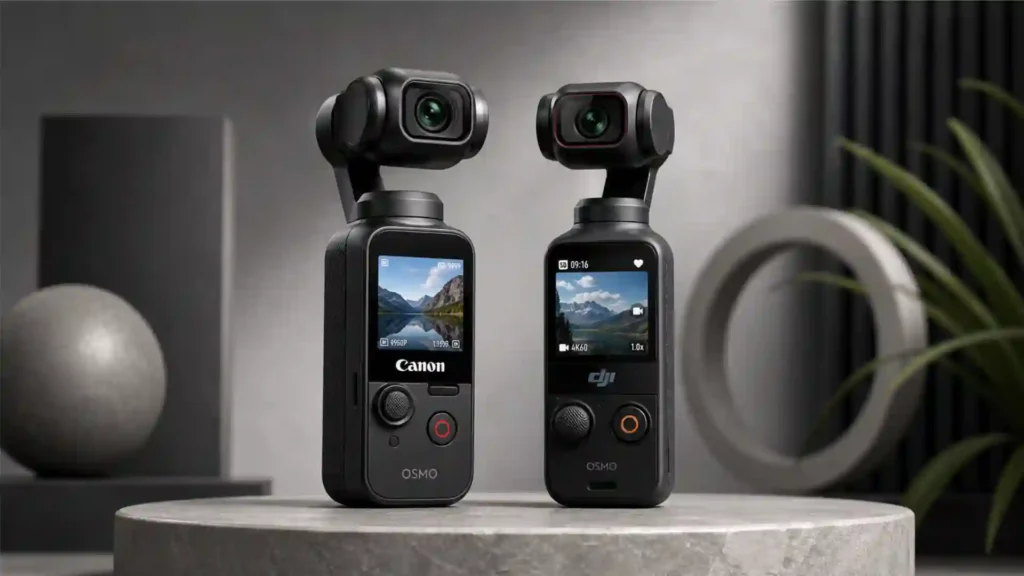
This article is an original analysis supported by the sources cited below
Canon is stealing DJI’s content creator crown with its own Osmo Pocket rival
Yanko Design report on Canon’s April 2026 gimbal-camera patent and its implications for the Osmo Pocket category.
Canon continues to develop its gimbal camera
Y.M.Cinema analysis of Canon’s latest gimbal-camera patent and its progression from earlier concepts.
Canon’s DJI Osmo Pocket gimbal camera rival with fresh new design taking shape
Notebookcheck report on the 2026 Canon gimbal patent, smart folding behavior, and market timing.
Canon patent application handheld gimbal camera
Canon Rumors coverage of Canon’s 2024 gimbal-related patent application and its focus on smaller, lighter gimbal control.
Canon PowerShot V1 specifications
Official Canon specification page for the PowerShot V1, including sensor, video, autofocus, stabilization, lens, ND filter, and connectivity details.
Canon PowerShot V1
Official Canon Europe product page for the PowerShot V1 creator camera.
Canon PowerShot V1 TIPA World Awards 2026
Official TIPA award page naming the Canon PowerShot V1 Best Content Creator Camera.
Canon PowerShot V10
Official Canon product page for the PowerShot V10, Canon’s earlier compact vlogging camera.
Canon PowerShot V10 specifications
Official Canon Europe specification page for the PowerShot V10.
Canon publishes annual report for the year ended Dec. 31, 2025
Canon U.S.A. announcement summarizing Canon Inc.’s Annual Report 2025 and corporate patent standing.
DJI Osmo Pocket 4
Official DJI product page for the Osmo Pocket 4, including 1-inch CMOS, 4K/240fps, 14-stop dynamic range, ActiveTrack 7.0, and built-in storage claims.
DJI releases Osmo Pocket 4
Official DJI announcement for the Osmo Pocket 4 launch on April 16, 2026.
DJI Osmo Pocket 3
Official DJI product page for the Osmo Pocket 3, including 1-inch CMOS, 4K/120fps, rotatable screen, and stabilization features.
DJI Osmo Pocket 3 specifications
Official DJI specification page for the Osmo Pocket 3, including dimensions, weight, screen, microphones, storage, and gimbal range.
DJI’s Osmo Pocket 4 review
The Verge review of the Osmo Pocket 4, including U.S. availability context, imaging upgrades, controls, storage, and battery observations.
The DJI Osmo Pocket 4 isn’t available in the US, and it might never be
PetaPixel report on the Osmo Pocket 4’s U.S. launch absence and DJI’s authorization statement.
Chinese dronemaker DJI sues to challenge US import ban on new models
Reuters report on DJI’s legal challenge to the FCC decision affecting new DJI model imports and approvals.
Camera shipments increased for consecutive years for the first time in nearly 20 years
PetaPixel analysis of 2025 CIPA camera shipment data, including the fixed-lens compact camera rebound.
Oppo confirms its working on its own gimbal camera to rival the DJI Osmo Pocket
Digital Camera World report on Oppo’s confirmed interest in a dedicated handheld gimbal camera and wider category competition.
NAB Show 2026 wrapped
Insta360’s official NAB Show 2026 recap referencing Luna-related creative imaging activity and upcoming innovations.
GoPro has designed an Osmo Pocket competitor with modular pieces
PetaPixel report on GoPro’s patent for a modular stabilized camera concept that could compete with the Osmo Pocket format.
| Citing this article? Brief excerpts are welcome. Please credit Webiano.digital, name the author where stated, and include a link to https://webiano.digital and to this original article. Full or substantial republication requires prior written permission. Read our Copyright and Content Use Policy. |
This article was prepared with the assistance of artificial intelligence tools. The content underwent expert human review, and Webiano Digital & Marketing Agency assumes editorial responsibility for its final version and publication.