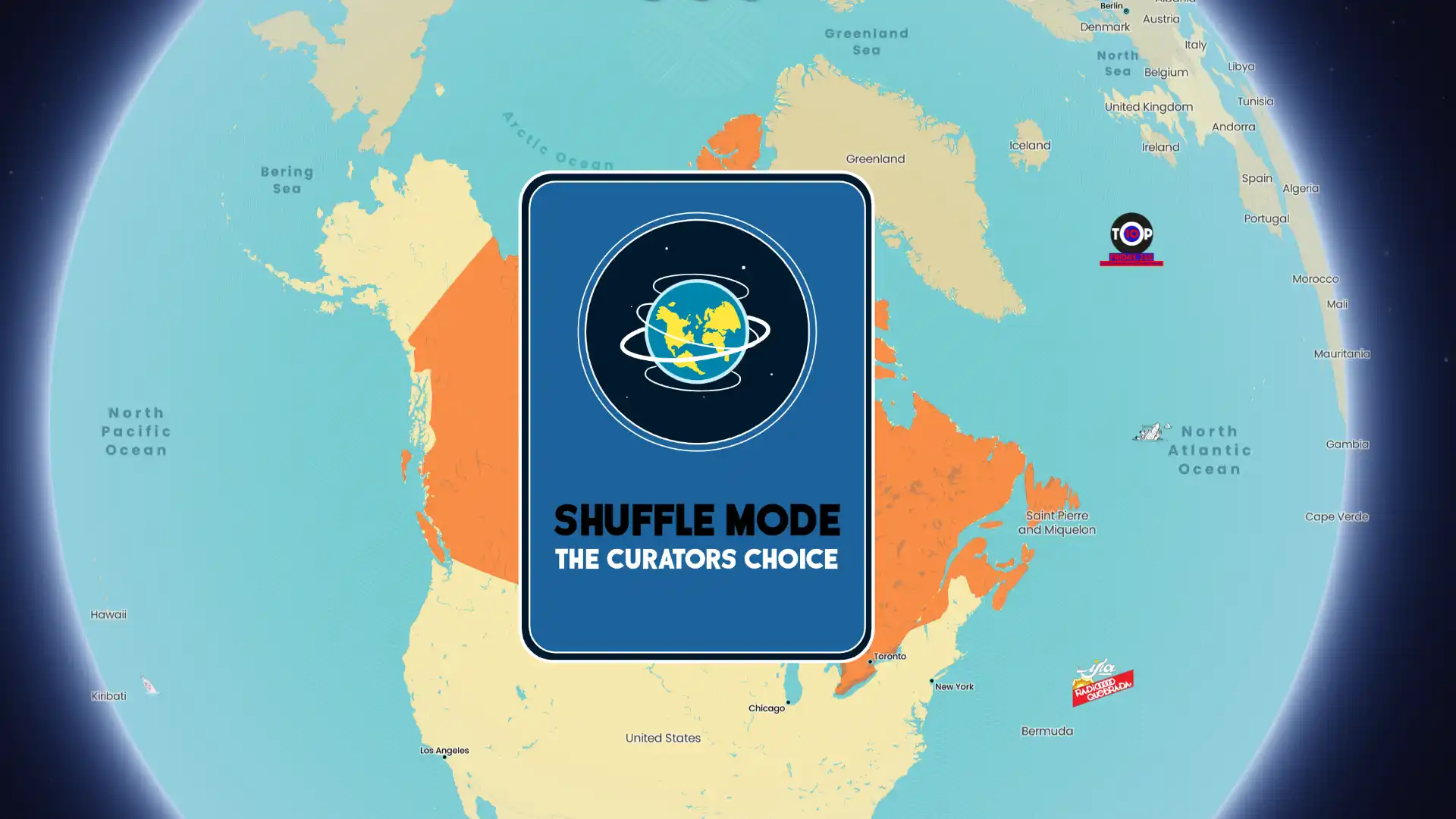
Radiooooo starts with a proposition so simple that explaining it takes roughly ten seconds. Pick a country. Pick a decade. Press play. Instead of asking for an artist, genre, playlist, mood taxonomy, or vaguely humiliating confession about what you usually listen to, the site gives you a map of the world and a row of years. Choose Brazil in the 1960s. Ethiopia in the 1970s. Japan in the 1980s. France in the 1930s. Radiooooo starts playing.
Table of Contents
Radiooooo turns a century of music into a place you can wander
Then something slightly unusual happens. You stop looking for music and start wondering where else you could go.
That distinction is the whole reason Radiooooo remains one of the web’s more memorable music projects more than a decade after its creation. It is technically a streaming service and music-discovery platform. Calling it either feels inadequate. Its operating logic is closer to a battered atlas found beside an enormous record collection: geography gives you one coordinate, time gives you another, and somebody with excellent taste has already rummaged through the shelves for whatever might be hiding at their intersection.
The site currently describes itself as “The Musical Time Machine,” and the metaphor is unusually accurate. Its main modes still revolve around geographical and temporal exploration, with options such as Explore, Shuffle, Taxi and Islands alongside the wonderfully unsophisticated mood choices Slow, Fast and Weird.
Those three mood buttons deserve some respect. Modern streaming services have spent years building increasingly detailed vocabularies for categorising human listening: chill, focus, sleep, workout, dinner, commute, productivity, heartbreak, energy, rainy mornings, hot summer evenings and thousands of genre subdivisions that most listeners could never define. Radiooooo effectively says: is it slow, fast or weird?
There is confidence in that reduction.
The bigger idea is even better. Radiooooo organises its collection around where and when, two dimensions that most streaming interfaces treat as metadata rather than the central mechanism of discovery. The result changes the question from “What music do I like?” to “What was happening over there?”
That tiny shift produces a remarkable amount of curiosity.
Select Cambodia in the 1960s and you are no longer merely hunting for a song. Select Ghana in the 1970s and you are not asking a recommendation engine to supply something statistically adjacent to yesterday’s playlist. Select Soviet-era geography, postwar France or prewar Argentina and listening starts acquiring an almost archaeological quality.
Radiooooo is not an academic archive, and treating it as one would misunderstand the project. Its collection is curated according to taste, not assembled as a comprehensive historical record. Its founders have been unusually explicit about that distinction. When The New Yorker profiled Radiooooo in 2016, co-founder Benjamin Moreau described an instinctive selection process based on whether a track immediately affected the curators rather than ethnomusicological criteria. The publication reported that Radiooooo’s editorial filter rejected roughly 90 percent of submissions at that time.
That subjectivity is not a defect accidentally left in the machine. It is the machine.
Radiooooo works because somebody is choosing.
The map changes what discovery feels like
Most digital music interfaces begin with a blank rectangle.
Search.
You already need to know something before anything interesting happens.
Type a musician’s name. Enter a song. Browse a genre. Pick a playlist whose title describes either an activity or a minor emotional condition. Streaming platforms are extraordinarily good once you have supplied an intention. Radiooooo is interesting because it works before you have one.
A map is different from a search box. Nobody looks at a world map without noticing places they were not thinking about a moment earlier. Peru sits beside Ecuador. Senegal pulls your eye toward Mali. Indonesia sprawls across the sea. Madagascar hangs away from the African coast. Mongolia suddenly looks enormous.
Radiooooo turns all of those places into musical temptations.
The map therefore does more than organise content. It continually advertises alternative directions. You might arrive intending to hear 1970s Nigerian music and notice Cameroon next door. You might pick 1960s Italy, then wonder about Yugoslavia. You might choose Mexico in the 1950s, jump south to Colombia and find yourself half an hour later listening somewhere completely unrelated to your starting point.
That behaviour is hard to reproduce through conventional search because search is built to collapse possibilities around an expressed request. A map expands them.
Radiooooo’s history explains why the interface feels so committed to the idea.
According to the account Benjamin Moreau gave The New Yorker, the initial spark came during a drive in a 1966 Renault Caravelle on the French Riviera. The old car created an atmosphere that was immediately shattered when its radio produced contemporary commercial music. Moreau began imagining a system in which music could be organised through time and place rather than artist names, genres or algorithmic recommendations. He developed the idea with music producer and soundtrack supervisor Raphaël Hamburger, whose record collection already ranged widely across countries and styles. The project secured funding and launched in 2013.
The origin story has survived because it contains the product in miniature. The wrong music can break the feeling of a place or moment. The right music can reconstruct one.
That is quite different from historical accuracy.
A recording from Beirut in 1975 does not allow a listener to understand Beirut in 1975. A handful of records from Tokyo in the 1960s cannot stand for what millions of people heard, liked, rejected or ignored. Popular recordings move across borders. Release dates and recording dates differ. Musical cultures are too complicated to be reduced to dots on a map.
Radiooooo becomes much more enjoyable once you stop demanding that sort of authority from it.
Think of each coordinate as a door rather than a documentary.
Behind it might be a glamorous orchestral recording, strange electronic experiment, novelty song, syrupy ballad, dance-floor missile, regional pop hit or forgotten piece of studio eccentricity. Some tracks sound immediately tied to a period. Others feel unexpectedly contemporary. Some remind you how quickly production conventions date. Others make the supposedly neat borders between eras look ridiculous.
That unpredictability gives the map life.
A traditional genre directory tends to reinforce taxonomy. Funk goes here. Highlife goes there. Psychedelia gets another shelf. Electronic music fragments into increasingly narrow subdivisions. Radiooooo refuses to make you begin there. Geography creates collisions that genre labels would normally separate.
A country in a particular decade might contain cabaret, rock, folk traditions, jazz, imported dance fashions, television music, orchestral pop and sounds that resist an English-language category entirely. Selecting the country instead of the category makes those collisions audible.
There is also something quietly important about reversing the usual hierarchy of global streaming.
On giant music platforms, most users encounter international recordings through artists famous enough to enter global recommendation systems, through specialist playlists, or through a genre term they already know. Radiooooo makes the country itself the invitation. You do not have to know the name of a Turkish psychedelic musician to wonder what Turkey sounded like in 1972.
You only need to click Turkey.
This makes musical ignorance productive instead of embarrassing.
The experience is particularly good when you choose somewhere about whose musical history you know almost nothing. Knowledge creates expectations. Ignorance leaves room for genuine surprise. Radiooooo repeatedly supplies moments when a track begins and your mental image of a decade, place or musical culture needs immediate revision.
That is why one of the best ways to use the site is almost deliberately irresponsible: choose coordinates before researching them.
Listen first.
Look things up later.
When a track catches you, investigate the performer, label, scene, producer or style elsewhere. Radiooooo becomes the first link in a chain rather than the place where the research ends. Used this way, it behaves like a very good record-shop recommendation: enough information to make you curious, not enough to satisfy the curiosity.
The project’s visual character helps. The New Yorker’s 2016 profile noted that Radiooooo’s map was hand-drawn by Moreau and artistic director Noemi Ferst with pen and ink. The service has changed technically since then, but the underlying concept still feels handmade in a part of the internet that usually feels computational.
Even its name carries a peculiar analogue joke. Radiooooo has five O’s. The New Yorker reported that they were intended to represent the five continental landmasses in the project’s conception. It is a ridiculous spelling until you use the site twice, after which “Radiooooo” somehow looks completely correct.
The map, the name, the loose language of Taxi trips and Islands, the Slow/Fast/Weird controls: none of this behaves like the vocabulary of a conventional software product.
It behaves like somebody built a toy and then discovered the toy was a serious way to listen.
That quality is rarer online than it should be.
Human taste is the real recommendation engine
Radiooooo often gets described as an alternative to algorithmic music recommendation. That is true, but the phrase can make it sound like an ideological project: humans good, algorithms bad.
The reality is more interesting.
Radiooooo replaces one kind of bias with another, deliberately.
Algorithmic recommendations infer relationships from signals: listening history, skips, saves, similarity, popularity, collaborative behaviour, audio characteristics and numerous other inputs. Human curation involves memory, obsession, fashion, personal taste, blind spots, collecting habits, historical knowledge, accidents and arguments.
Neither is neutral.
Radiooooo simply makes a persuasive case that subjective filtering can produce better surprises.
The project was built around contributions from music obsessives. In the 2016 New Yorker profile, Anne-Claire Troubat described contributors as “treasure hunters,” while curators reviewed incoming tracks and determined whether they fitted Radiooooo’s editorial character. At the time, the community included almost 30,000 contributors.
The service’s current Android listing still describes Radiooooo as a collaborative site, born in 2013, with the music selected “by humans for humans.” That language is marketing, of course, but it accurately identifies the interesting part of the product.
A human-selected collection has texture because taste leaves fingerprints.
Listen long enough and you start sensing an invisible editor behind the tracks. Radiooooo is attracted to recordings with character. Sometimes character means beauty. Sometimes it means eccentric production, unusual instrumentation, irresistible rhythm, naïve charm, unexpected synthesis or a voice you cannot imagine arriving through contemporary radio.
The “Weird” filter makes the editorial instinct explicit.
“Weird” is not a musicological category. It is almost aggressively subjective. Weird to whom? By what cultural baseline? Compared with which decade? A novelty recording considered ridiculous in its own country might sound conventional elsewhere; an experimental composition might seem ordinary to listeners familiar with the scene that produced it.
Radiooooo does not solve that problem. It turns the problem into a button.
This is one reason the service feels human. Humans make fuzzy judgments constantly. We know what somebody means when they hand us a record and say, “You need to hear this, it’s weird,” even though the description would collapse under formal scrutiny.
The same is true of Slow and Fast.
Radiooooo is not trying to tell you that these are objectively sufficient descriptors of music. They are steering wheels. Three crude controls are sometimes better for discovery than forty precise ones because they leave more of the decision to whoever built the collection.
That design philosophy matters.
Streaming interfaces frequently confuse control with freedom. Give users enough filters, sorting mechanisms, sliders and categories and they can theoretically locate exactly what they want. The trouble appears when the listener does not know what they want.
That condition is common.
You want music. Nothing sounds right. You open your usual app. Your home screen contains recognisable artists and playlists derived from previous behaviour. You skim it. You search nothing because there is nothing specific in your head. Eventually you play something familiar.
An abundance of technically relevant choices can produce astonishingly repetitive listening.
Radiooooo takes the opposite route. It gives you very little control over the individual track. Historically, this restriction was even stronger: The New Yorker noted in 2016 that listeners could not simply skip disliked songs in the conventional sense; changing the country or decade became the escape route.
The current product has evolved, so old descriptions should not be treated as a perfect guide to every present-day control. The philosophy remains visible, though. The unit of choice is primarily the journey, not the track.
Pick a coordinate.
Let someone else choose what happens there.
This creates a small but useful reversal of responsibility. On Spotify, Apple Music, YouTube Music or another enormous catalogue, failure feels partly yours. The music exists; you merely failed to find it. On Radiooooo, you surrender enough control that a mediocre track becomes temporary scenery on the way to something else.
That resembles radio.
The comparison matters because traditional radio has a property that on-demand media struggles to reproduce: the listener does not own the sequence. A DJ chooses. A station has a personality. Songs arrive without permission. You hear endings because you did not choose beginnings.
Streaming conquered radio partly by removing that friction. Radiooooo smuggles some of it back.
The clever part is that it does so without recreating terrestrial radio literally. There is no requirement to tune into whichever broadcast currently happens to exist in Buenos Aires or Seoul. Radiooooo constructs imaginary stations out of historical coordinates.
Select 1970s Lebanon and you are not listening to an archival transmission of one specific Lebanese station. You are listening to an editorial fiction convincing enough to stimulate curiosity.
That distinction is easy to miss because the interface feels so intuitive.
The best metaphor may not be radio at all. Radiooooo resembles a museum whose rooms are labelled only by place and decade, except the collection continually plays itself and nobody forces you to walk chronologically.
A good museum is not merely a warehouse containing everything. Somebody selects, excludes, juxtaposes and frames. The omissions are part of the experience.
Radiooooo’s curators have always embraced that role. Moreau told The New Yorker that selections were based on immediate emotional reaction rather than an attempt to apply formal ethnomusicological criteria.
That admission makes the service more trustworthy, not less.
A platform claiming to represent “the music of 1960s Thailand” authoritatively would deserve suspicion. A group of collectors saying, in effect, “we found these records wonderful and think you should hear them” is making a narrower and more believable promise.
The reward is a catalogue that often feels discovered rather than ingested.
That difference is difficult to measure but easy to hear.
Giant streaming libraries are designed around coverage. A track is available because rights, ingestion pipelines and commercial arrangements allow it to be available. Radiooooo’s collection is designed around selection. A track belongs because somebody thought it deserved the trip.
The community aspect adds another layer. Music collecting used to depend heavily on physical geography: record shops, flea markets, local distributors, bootlegs, imported releases and the luck of meeting collectors whose shelves extended beyond yours. The internet made the world’s recordings theoretically more reachable while simultaneously making the volume of available material absurd.
Radiooooo responds by recruiting obsession as infrastructure.
Someone knows Indonesian pop singles from the 1970s.
Someone knows obscure French soundtrack recordings.
Someone has spent years listening to West African dance music.
Someone understands a corner of Brazilian music invisible to somebody searching only for bossa nova.
Someone found a private pressing that sounds as if it dropped out of a different universe.
Bring enough of those people together and a map stops being decoration. It becomes a collective index of private enthusiasms.
Radiooooo’s older press coverage makes this human network central to the origin of the platform, not incidental to it. The site is partly a front end for other people’s unreasonable levels of curiosity.
That is exactly what recommendation systems should expose more often.
The best journeys begin with bad intentions
There is a respectable way to use Radiooooo.
Pick a country you are studying. Choose a period. Listen carefully. Note artists. Research the recordings. Follow labels, scenes and movements. Build historical context around what you find.
You should do that sometime.
First, click something stupid.
Choose a decade because you dislike its clothes.
Pick a country because you have never knowingly heard one record from it.
Select Weird.
Jump from 1930s Egypt to 1980s Finland.
Build a Taxi route that makes no historical sense.
Shuffle until you land somewhere whose musical culture you could not identify if somebody offered you money.
Radiooooo is unusually good at rewarding unserious behaviour.
Its Shuffle function reduces exploration to chance. The Taxi concept, present since the service’s earlier years and still surfaced in the current interface, lets the journey become the organising metaphor rather than a single fixed coordinate. Islands provide another way into curated collections outside the basic country-and-decade grid.
These additions matter because a map eventually develops habits too.
Everybody has geographical biases. Western European listeners may click France, Britain, Italy, Germany and the United States first because those countries already occupy familiar musical territory. A Brazilian listener may approach the map differently. Somebody steeped in jazz history may immediately seek the United States of the 1940s and 1950s. A collector of African records will have another itinerary.
Randomness reveals the parts of the map you keep ignoring.
It is easy to underestimate how useful that is.
Recommendation systems usually interpret repeated interest as a signal to produce more related material. If you listen constantly to Italian library music, the machine sensibly concludes that Italian library music is relevant to you. It may gradually expand into adjacent composers, labels and soundtrack styles.
Radiooooo can respond to the same obsession by letting you click 1970s Italy forever.
Or you can click Bolivia.
No theory of your identity needs to be updated.
The system does not need to decide that you are “the kind of person” who enjoys Bolivian music. You chose a place once. The experiment can end there.
This makes Radiooooo feel unusually low-stakes.
Modern recommendation engines accumulate behaviour. Each click can feel like training. Watch three restoration videos and a platform decides you have entered your restoration era. Listen to a novelty song and recommendations may echo the joke for days. Search for children’s music for a family member and your carefully constructed profile develops a sudden interest in cartoon dinosaurs.
Radiooooo’s map encourages temporary selves.
Tonight you are curious about Greece in the 1960s.
Ten minutes later you are curious about 1980s Senegal.
Neither preference needs to become an identity.
Curiosity is allowed to remain episodic.
That is one of the healthiest things about the project.
The decades themselves are wonderfully blunt instruments. Music history rarely changes neatly on January 1 of a year ending in zero. A 1969 recording and a 1971 recording might belong to the same musical movement. A remote regional scene can follow different technological and stylistic rhythms from a major recording centre. Political history does not align politely with decade selectors either.
Yet the decade remains an excellent exploratory unit precisely because everyone immediately understands it.
You do not need a tutorial for 1970s.
The label already carries associations: recording technology, fashion, political events, cinema, visual design and whatever pop-cultural fragments your own life has attached to the period. Radiooooo lets the music challenge that bundle of assumptions.
The most enjoyable tracks are often the ones that seem temporally impossible.
A synthesizer texture arrives years earlier than expected.
A guitar sound seems decades ahead of itself.
A vocal recording feels impossibly old until the rhythm enters.
A 1930s performance contains humour that still lands instantly.
A supposed relic sounds ready for a current DJ set.
A recording from the 1990s already seems more historically distant than something made forty years earlier.
These moments break the popular idea that music progresses in a straight line from primitive to sophisticated.
Recording technology changes. Distribution changes. Instruments change. Fashion changes. Inventiveness does not wait for the future.
Radiooooo lets you stumble over that truth repeatedly without announcing a lesson.
A few ways to use the machine
| Mode | What you choose | What it is good for |
|---|---|---|
| Explore | Country, decade and mood | Focused wandering |
| Shuffle | Chance | Escaping your usual map |
| Taxi | Multiple destinations | Longer musical detours |
| Islands | Curated thematic spaces | Listening outside the basic grid |
| Slow, Fast, Weird | A loose character | Changing the flavour without learning genre taxonomy |
The table looks almost comically simple because the product is simple. Radiooooo’s strength comes from what happens after those choices, not from how many controls it can place between you and a recording. The current interface visibly retains these core routes into the collection.
There are some particularly good personal games hidden inside the format.
Try the neighbour test. Pick a country and decade you know reasonably well. After two or three songs, choose a bordering country without changing the decade. Keep moving across borders. What survives? What changes immediately? Which musical fashions seem to travel?
Try the same-year test. Keep the decade fixed and cross continents. Even the crude ten-year bucket reveals how misleading the phrase “the sound of the sixties” becomes once the geography expands.
Try the home test. Pick your own country during a decade before you were born. Familiarity becomes uncanny. You recognise linguistic rhythms, melodic habits or cultural references without recognising the recordings themselves.
Then try your childhood decade.
Nostalgia becomes much stranger when someone else curates it.
Instead of hearing the universally recycled hits that survived into retrospective playlists, you encounter recordings that may have occupied the same period but disappeared from your personal memory. The decade expands beyond the version preserved by greatest-hits radio.
There is also the future-memory test: choose the decade when you first became musically self-aware, then listen somewhere far from where you grew up. Same years, completely different soundtrack.
That can be more disorienting than going fifty years backwards.
The calendar tells you these events were simultaneous. Pop culture rarely makes simultaneity feel real. Every national history tends to become its own timeline. Radiooooo places them side by side.
This is where the map performs a trick no ordinary playlist title quite manages. It makes time feel horizontal.
The year 1974 is no longer merely an item in a chronological sequence leading toward 1975. It becomes a surface stretching from Peru to Pakistan, Nigeria to Norway, Indonesia to Iceland.
Every click says: this was happening too.
Not everything you hear will be obscure, nor should obscurity become a fetish. A forgotten recording is not automatically more interesting than a hit. Collectors sometimes confuse difficulty of acquisition with artistic value. Radiooooo at its best avoids making rarity the only point.
The attraction is unexpected placement.
A familiar artist encountered from an unfamiliar national or chronological angle can work as well as a lost single. A mainstream recording becomes strange when you arrive at it through the map rather than by searching its title.
Context changes listening.
Radiooooo keeps changing the context.
A website from another idea of the internet
There is something pleasantly anachronistic about Radiooooo that has nothing to do with old records.
It feels like a website built around an idea.
That sentence used to describe an enormous portion of the web.
Somebody would invent a strange mechanism, make a site around it and publish the thing because the mechanism itself was entertaining. Maps of odd objects. Endless collaborative drawings. Databases devoted to forgotten packaging. Generators for imaginary products. Single-purpose archives. Tiny games. Personal indexes. Visual experiments nobody had commissioned.
Radiooooo belongs to that lineage even though it became a commercial service with mobile apps and subscriptions.
Its premise can be represented in a single image: a map crossed with a time dial.
No productivity claim is required.
No ecosystem needs explaining.
No business workflow is being repaired.
No artificial intelligence is composing a personalised soundtrack for your morning routine.
You click Morocco and 1960.
Music happens.
That purity gives Radiooooo durability.
A site tied too closely to a technical novelty can become irrelevant once the novelty becomes standard. A site built around a strong interaction can survive enormous changes in the surrounding technology. Maps are old. Radio is old. Recorded music is old. Time is reasonably established.
The combination still feels fresh.
Radiooooo launched in 2013, according to its own current app description and contemporary histories of the project. Thirteen years later, the central trick needs no modernisation.
The contrast with contemporary streaming is sharper now than when the site appeared.
Personalisation has become an assumed property of digital media. Home pages continually reorganise themselves around inferred preferences. Recommendation systems compete to predict the next click. Large language models and generative systems increasingly promise to create media on demand from precise requests.
Radiooooo asks for comparatively little information and produces something you did not specify.
That makes it almost anti-prompt.
You describe coordinates, not content.
The distinction is subtle but fascinating.
A normal request might be: “Play upbeat Ethiopian jazz with brass and vintage recording quality.”
Radiooooo’s version is closer to: “Ethiopia, 1970s, fast.”
The first expresses an expectation.
The second creates a condition for surprise.
That is why the Slow, Fast and Weird system seems smarter the longer you use it. It keeps language deliberately coarse. Describing music too accurately before hearing it risks reducing discovery to fulfilment.
Radiooooo lets the collection answer a badly specified request.
The approach shares something with browsing physical shelves. Walk into a record shop and the categories get you near an area; the object you leave with may still be one you could not have searched for by name.
Album art catches your attention.
A label looks interesting.
A shopkeeper recommends something.
A country of origin catches your eye.
A date surprises you.
Another shopper puts a record back in the wrong section.
Discovery thrives on imperfect indexes.
Large digital catalogues tend to remove these accidents because good databases are designed to return the correct thing. Radiooooo builds productive imperfection into the interface.
Its editorial model reinforces the feeling. The New Yorker’s description of contributors, curators and subjective selection reads almost like the operating manual for an independent record shop scaled across the internet.
The database is large, but the personality is larger.
There is a danger here.
Human curation can become gatekeeping dressed as sophistication. A strong aesthetic may exclude commercially obvious material in interesting ways, but it can also reproduce the tastes of a small cultural group. A map suggesting global coverage carries an implicit authority that any selective collection should treat carefully.
Radiooooo’s own history makes clear that the selection has never aimed at exhaustive representation. The curators choose “treasures” according to a subjective editorial line.
The right mental model is therefore not “this is what Country X sounded like in Decade Y.”
It is “somebody thinks these are wonderful records from that coordinate.”
That small linguistic adjustment prevents a lot of nonsense.
The map is also a reminder that political geography itself changes. Borders, state names and national identities do not remain fixed across a century. Any project mapping recordings historically has to decide how to represent territories whose political status shifted, split, merged, disappeared or remains disputed.
Users have noticed this over the years; discussions of Radiooooo have pointed out that its changing map can itself become part of the fascination while also revealing inevitable simplifications and historical inconsistencies.
That complexity does not make the concept unusable. It makes the apparent simplicity more interesting.
A musical map is always making arguments about geography, even when it only wants to play records.
The same applies to dates.
What year belongs to a song? Recording year? Release year? First commercial issue? Reissue? Local release? International release? Archival discovery? Every large historical music collection eventually collides with metadata ambiguity.
Radiooooo should not be used as a scholarly source when exact provenance matters.
It works better as an ignition system for curiosity.
Hear something.
Copy the artist and title.
Go hunting.
Find the label.
Read about the scene.
Check Discogs, specialist archives, artist histories, record collectors, library holdings or reissue notes.
Listen to related work.
Come back.
The web is good when one site produces ten tabs.
Radiooooo is excellent at producing ten tabs.
The service also resists another increasingly common web habit: reducing discovery to feed consumption. There is no requirement to scroll through an endless vertical sequence of thumbnails waiting for one to outperform its neighbours. The map gives the screen a stable spatial logic.
You go somewhere instead of consuming downward.
That sounds trivial until you notice how much of the contemporary internet uses the same gesture.
News: scroll.
Social media: scroll.
Video: scroll.
Shopping: scroll.
Search results: scroll.
Streaming recommendations: scroll.
Radiooooo replaces the feed with geography.
The map waits.
The listener moves.
That reversal gives the site an oddly calm quality even when the music is chaotic.
The limitation is part of the pleasure
Radiooooo is easy to recommend and slightly harder to describe fairly because some of its best characteristics look like weaknesses on a feature checklist.
You cannot treat it like an unlimited jukebox.
If you want a particular album right now, use something else.
If you need complete discographies, use something else.
If you want a meticulously documented historical archive with scholarly provenance, use something else.
If your idea of music discovery is typing the name of a known artist and selecting the top result, Radiooooo is solving a problem you do not currently have.
The site becomes interesting when you want the unknown more than the known.
That orientation explains its paid model too.
Radiooooo’s current plan page advertises membership at US $4.99 per month or US $49.99 per year and lists broader access to the map and features among the subscription offering. The precise package can change, so anyone considering payment should check the live plan page rather than rely on an old review.
The current Google Play listing, meanwhile, describes the Android product as supporting in-app purchases and says the application was last updated on February 1, 2024. The listing currently reports more than 100,000 downloads.
This places Radiooooo in an awkward but understandable category of web project.
It is too developed to be merely a charming hobby site.
It is too idiosyncratic to compete with Spotify on catalogue logic.
Its editorial value depends on labour.
Its appeal is strongest among people who actively want discovery.
Paying for it means paying for somebody else’s taste and organisation, not merely server access to audio.
Whether that feels reasonable depends on what you expect from music software.
People accustomed to enormous streaming catalogues may compare the price against services capable of supplying nearly any requested mainstream release and reasonably ask why they should subscribe to a more restrictive product.
Collectors, DJs, filmmakers, designers, music supervisors and incurably curious listeners may ask a different question: how much is one genuinely unexpected record worth?
One perfect discovery can trigger hours of research.
A producer discovers an unfamiliar rhythm.
A DJ finds a track for a set.
A director hears a sound that changes how a scene should feel.
A designer finds the right musical atmosphere for an exhibition.
A listener encounters a singer they then follow through three albums and two reissue labels.
Discovery has asymmetric value. Most clicks produce nothing dramatic. Occasionally one rearranges a corner of your taste.
Radiooooo is built for those occasional clicks.
Its biggest weakness is the mirror image of that strength: editorial selection means absence is invisible.
When Spotify lacks a recording, a search might at least make the absence obvious. Radiooooo never promises completeness, so you cannot easily know which missing artists, regions, styles or scenes would have changed your impression of a coordinate.
The map can therefore create an illusion of coverage.
A country lights up.
Music plays.
The psychological temptation is to treat the result as representative.
Resist it.
A better phrase than “music from 1970s Kenya” is “Radiooooo’s selection from 1970s Kenya.”
The difference preserves the magic without granting the platform authority it never claimed.
Reliability creates another practical distinction between concept and implementation. User reviews of the mobile apps have at times mentioned playback or interface problems, though individual reviews are anecdotal and software changes over time. Google Play currently gives the Android application a strong aggregate rating, but anyone choosing between web and mobile should treat the live product as the final test rather than old commentary.
The web application itself also depends heavily on JavaScript. Search-engine snapshots of the current app expose its main controls but cannot reproduce the actual interactive experience. Radiooooo is something to open, not something a search result can adequately summarise.
There is also a broader issue that affects any international historical music platform: rights, availability and catalogue continuity.
Recordings can disappear.
Licensing conditions change.
Metadata gets corrected.
Features move behind subscription tiers.
Apps stop receiving updates.
Historical descriptions of Radiooooo therefore need dates attached to them.
For example, the 2016 New Yorker profile is exceptionally useful for understanding the project’s origin, curation philosophy and early interface, but it describes Radiooooo in 2016, not a frozen specification for 2026.
The current website and store listings are better evidence for what is visibly offered now.
That separation between enduring idea and changing product is worth making because Radiooooo’s enduring idea is much stronger than any specific feature.
The great part is not Taxi Mode.
The great part is not Weird.
The great part is not the hand-drawn map.
The great part is using time and geography as the primary grammar of listening.
Almost every interface element can change while that remains intact.
And there is still room for the project to become stranger.
Imagine historical coordinates connected through migration routes rather than national borders.
Imagine tracing one rhythm across ports.
Imagine following record labels rather than performers.
Imagine hearing the same composition interpreted in five countries across four decades.
Imagine a “wrong decade” mode that deliberately surfaces recordings whose production sounds temporally displaced.
Imagine collaborative journeys assembled by collectors whose only instruction is “make this route surprising.”
Radiooooo does not need any of those ideas to justify itself. Its existing constraint is already fertile enough.
That may be another lesson contemporary software frequently forgets.
A good product does not need to become an operating system.
Sometimes one strange interaction deserves to remain one strange interaction.
Practical questions before you disappear into the map
Is Radiooooo a normal internet radio station?
Not really. It borrows radio’s surrender of track-by-track control, but its organising mechanism is a map and timeline. You choose a geographical area and decade rather than tuning into a conventional live station. Radiooooo’s current presentation still centres Explore, Shuffle, Taxi, Islands and loose mood controls.
The result feels closer to an imaginary historical station assembled from curated recordings.
That distinction matters because Radiooooo is not promising to reproduce an actual broadcast schedule from a particular place and year. When you click a country and decade, you are entering a selection associated with that coordinate.
Treat it as editorial listening, not broadcast archaeology.
Is the music chosen by an algorithm?
Human curation has been central to Radiooooo from the start. Its current Android description explicitly says the collection is selected by humans, while early reporting documented a contributor community feeding recordings to curators who applied a strong subjective editorial filter.
That does not mean software plays no role in running the service. Any modern streaming platform obviously relies on software for delivery, accounts and interaction. The meaningful distinction is that the identity of the catalogue comes from human selection rather than personalised recommendation alone.
This is what gives Radiooooo its particular flavour.
A machine trying to maximise relevance usually stays near what it already knows about you.
A collector trying to impress you may put on something completely unreasonable.
Radiooooo prefers the collector.
Is Radiooooo historically accurate?
Use it for discovery, not as a definitive historical source.
The recordings are associated with countries and periods, but the collection is selective. Its founders have described an aesthetic process rather than scholarly documentation, and any century-spanning map also has to simplify changes in borders, political identities and metadata.
That does not reduce the pleasure of the site.
It changes the responsible interpretation.
Radiooooo can prompt good historical questions:
Why was this style popular here?
Who recorded this?
Was it commercially successful?
Which language is being sung?
Was the record locally produced or imported?
What label released it?
Was this artist part of a larger scene?
Those questions belong after the click.
For serious research, verify the answers elsewhere.
Does Radiooooo have obscure music?
Often, and that is a large part of its reputation. The project grew around submissions from collectors and music enthusiasts, with curators selecting tracks according to an editorial taste that favoured material they considered worth discovering. The 2016 New Yorker profile documented collectors specialising in scenes ranging from Mandopop and Afrobeat to Italo disco and Yé-yé.
“Obscure” should not become the only measure, though.
The better reason to visit is contextual surprise.
You might know a record and still hear it differently when it appears between unfamiliar tracks from the same place and period. You might discover that a musical style you mentally associate with one country had relatives elsewhere. You may encounter a familiar decade stripped of the twenty canonical songs that retrospective radio endlessly recycles.
The map continually changes the frame around the recording.
What is Taxi Mode for?
Taxi Mode was designed as a musical journey across multiple countries and periods rather than a single fixed coordinate. The New Yorker described the feature in 2016 as a way to combine countries and decades into a kind of road trip, and Taxi remains one of the main modes exposed by Radiooooo’s present interface.
It is probably the mode that best expresses the project’s playful side.
A normal playlist groups tracks according to some shared rationale.
A Radiooooo Taxi can work because the route itself is the rationale.
Colombia to Ethiopia to Sweden.
1950s to 1970s.
No essay required.
The sequence produces its own connections.
What does the Weird filter actually mean?
Exactly what a good friend means when they tell you a record is weird.
Radiooooo has long offered Slow, Fast and Weird as loose listening filters. Weird is openly subjective, which makes it much more entertaining than a meticulously labelled genre hierarchy.
Do not expect a stable definition.
Expect records selected because somebody found them peculiar enough to merit the category.
The filter works because you are not being asked to agree with the classification. You are being invited to test it.
Sometimes the weirdness will be obvious.
Sometimes you will wonder what anybody found strange.
That disagreement becomes part of the listening.
Is there a free version?
Radiooooo currently mixes limited access with paid membership, and its offering should be checked directly because plan details can change. As of August 2026, the live plan page advertises membership at US $4.99 per month or US $49.99 per year and describes subscriber access to broader map and feature options.
The current wording also references periodic free Island access.
Because access rules are exactly the sort of product detail that changes, the live plan screen is more trustworthy than old reviews.
Is there a mobile app?
Yes. Radiooooo is available through mobile app stores as well as the web. Its Google Play listing identifies it as “Radiooooo – The Musical Time Machine,” shows in-app purchases and says the Android app was last updated on February 1, 2024. Apple also lists Radiooooo for iPhone and iPad.
If you mainly listen while moving, the mobile version makes obvious sense.
If the map itself is part of the appeal, the larger web experience remains a particularly natural way to encounter the idea.
What does the Android app say about privacy?
Google Play currently states that, according to information provided by the developer, the Android app does not share data with third parties, may collect personal information, encrypts data in transit and allows users to request deletion of data.
Platform privacy declarations are useful but should not be confused with an independent audit.
Anyone with strict privacy requirements should read the current developer policy and store disclosures before creating an account.
Who will get the most out of Radiooooo?
People whose taste still has holes in it and who enjoy finding them.
DJs are an obvious audience because unfamiliar records have practical value.
Music supervisors can use it for atmospheric research before licensing anything properly elsewhere.
Filmmakers and photographers can explore the sonic character associated with a period.
Writers can use it while trying to escape their own cultural references.
Designers may find that a decade sounds different from how it looks in the standard moodboard.
Record collectors will recognise the pleasure immediately.
Travellers can listen before visiting somewhere or after returning.
Musicians can hear how ideas migrate, mutate and recur.
Teachers could use individual discoveries as starting points, provided Radiooooo is not presented as a comprehensive historical archive.
And ordinary listeners who are bored by their own recommendation loops may be the best audience of all.
You do not need specialist knowledge to use Radiooooo. Specialist knowledge is one possible consequence of using it.
What should you do when you find a great track?
Stop treating Radiooooo as the destination.
Follow the record out onto the wider web.
Search the artist.
Find the original release.
Check the label.
Look for reissues.
Read interviews.
Find out who played on it.
Search for the producer.
See whether somebody has documented the scene.
Listen to the album if one exists.
Find the collector or compiler who rescued it from obscurity.
Look for contemporary recordings from the same city.
This is where Radiooooo becomes much bigger than Radiooooo.
A well-designed discovery tool should generate new curiosity outside itself, not trap every possible action inside one proprietary interface.
Radiooooo repeatedly sends you away with a name you did not know five minutes earlier.
That may be its most generous feature.
The joy is not knowing what comes next
Open Radiooooo after using a conventional music service and the difference initially looks superficial.
There is a map instead of rows of album covers.
There are decades instead of genre menus.
There are funny controls.
Then you notice something deeper.
Radiooooo does not begin by constructing a portrait of you.
It does not need to know that you spent Tuesday listening to ambient records and Wednesday rediscovering 1990s hip-hop. It does not need to decide whether your sudden interest in Japanese city pop is permanent. It does not need an elaborate profile to make the next song plausible.
You point.
It plays.
This changes the emotional texture of discovery.
Personalised platforms are mirrors with increasingly sophisticated memory. They learn your outline and keep handing pieces of it back. At their best, they surface astonishingly relevant material. At their worst, they make taste feel like a room whose walls move inward whenever you touch them.
Radiooooo behaves more like a window.
The view depends mainly on where you point it.
That does not make the service technologically innocent or magically free of computational systems. It is still software. It has accounts, subscriptions, apps, infrastructure and product decisions.
The important difference is conceptual.
Its central recommendation is geographical curiosity.
Where have you not listened?
When have you not listened?
Those are wonderfully large questions.
There is no completion bar.
Nobody will finish the map.
Even a dedicated listener could spend years returning to the same countries and decades as the collection changes, hearing tracks missed before or approaching familiar coordinates with new knowledge.
The simplest interaction therefore contains enormous depth.
Country.
Decade.
Play.
A surprising amount of web design tries to achieve depth by adding layers. Radiooooo achieves it by choosing two dimensions that are already almost inexhaustible.
Time is enormous.
The world is enormous.
Music is enormous.
The interface can afford to be small.
The project also understands something about nostalgia that many retro websites miss.
Nostalgia becomes boring when it merely returns your own past.
Radiooooo lets you borrow somebody else’s.
You can be nostalgic for a decade you never lived through in a country you have never visited, not because the memory is real but because recorded sound is exceptionally good at manufacturing emotional proximity.
A crackling vocal recording can make eighty years collapse.
A drum machine can instantly date a room.
An orchestral arrangement can reconstruct glamour.
An electric organ can create an entire imagined nightclub.
A badly recorded guitar can suggest heat, walls, microphones and crowded space.
Sound provides architecture with your eyes closed.
Radiooooo arranges entrances.
This may explain why the original time-machine metaphor never feels like cheap branding.
The service does not send you into history in any rigorous sense.
It sends you into imagined rooms built from historical recordings.
The listener supplies the missing walls.
That is enough.
Radiooooo is at its best when you stop trying to extract utility from it and let the next song remain temporarily unidentified. There is a modern compulsion to capture every interesting thing immediately: save it, favourite it, add it to a playlist, identify it, categorise it, send it somewhere.
Sometimes you should.
Sometimes the better experience is to let a recording disappear.
You heard something beautiful from somewhere.
You did not catch the name.
The next track started.
Radio returns partly through the possibility of loss.
Digital media has trained us to expect perfect retrieval. Everything can supposedly be searched again. Every moment can be bookmarked. Every preference can be stored.
Discovery becomes collection.
Radiooooo reminds you that listening can also be passage.
The song existed before you arrived.
It played.
You happened to be there.
Then the map continued.
That is probably why the site inspires unusually affectionate descriptions despite being neither the largest music platform nor the most technically powerful. Open Culture described its time-and-place mechanism as a way of recreating radio’s transportive quality, while The New Yorker focused on its resistance to the monotony that algorithmic curation can produce.
The descriptions converge on the same sensation.
Radiooooo makes discovery feel like travel rather than retrieval.
That is the reason to open it.
Not because every track will be extraordinary.
Not because the map is a perfect account of global music history.
Not because human curators possess mystical taste.
Not because algorithms are inherently incapable of surprise.
Open it because a rectangular search field is a miserable representation of how curiosity actually moves.
Curiosity zigzags.
It notices neighbours.
It jumps decades.
It follows mistakes.
It changes its mind halfway through.
It chooses the strange option merely because someone labelled it Weird.
It goes to 1960s Thailand because there is no good reason not to.
It leaves with the name of a singer it had never encountered.
Then it goes somewhere else.
Radiooooo gives that behaviour a map.
Author:
Jan Bielik
CEO & Founder of Webiano Digital & Marketing Agency
This article is an original analysis supported by the sources cited below
Radiooooo
The official Radiooooo website and current web application, used to verify the project’s present positioning and its Explore, Shuffle, Taxi, Islands, Slow, Fast and Weird modes.
A better way to find music
Radiooooo’s current membership page, used to verify subscription pricing and the access model available in August 2026.
Radiooooo on Google Play
The official Android store listing, used for the project’s description of human curation, current app information, download range and developer-provided data-safety disclosures.
Radiooooo on the App Store
Apple’s official listing for the Radiooooo mobile application, used to verify its availability on Apple devices and its country-and-decade discovery concept.
Radiooooo The Hit Tune Time Machine
E. P. Licursi’s 2016 New Yorker profile, used for Radiooooo’s origin story, founders, early contributor community, human curation philosophy, hand-drawn map, mood filters and Taxi Mode.
Radiooooo Discover the Musical Time Machine That Lets You Hear What Played on the Radio in Different Times and Places
Open Culture’s overview of Radiooooo and its country-and-decade listening mechanism, used as supporting context for the project’s radio-like approach to musical time travel.
| Citing this article? Brief excerpts are welcome. Please credit Webiano.digital, name the author where stated, and include a link to https://webiano.digital and to this original article. Full or substantial republication requires prior written permission. Read our Copyright and Content Use Policy. |
This article was prepared with the assistance of artificial intelligence tools. The content underwent expert human review, and Webiano Digital & Marketing Agency assumes editorial responsibility for its final version and publication.