A website is not truly global just because it is online.
Table of Contents
Anyone can open a website from another country. Understanding what it says is a different matter. A visitor may find a company through search, follow a recommendation or open an article shared by a colleague, only to discover that the most important information is written in a language they cannot comfortably read. The website works perfectly from a technical perspective, but the conversation ends before it begins.
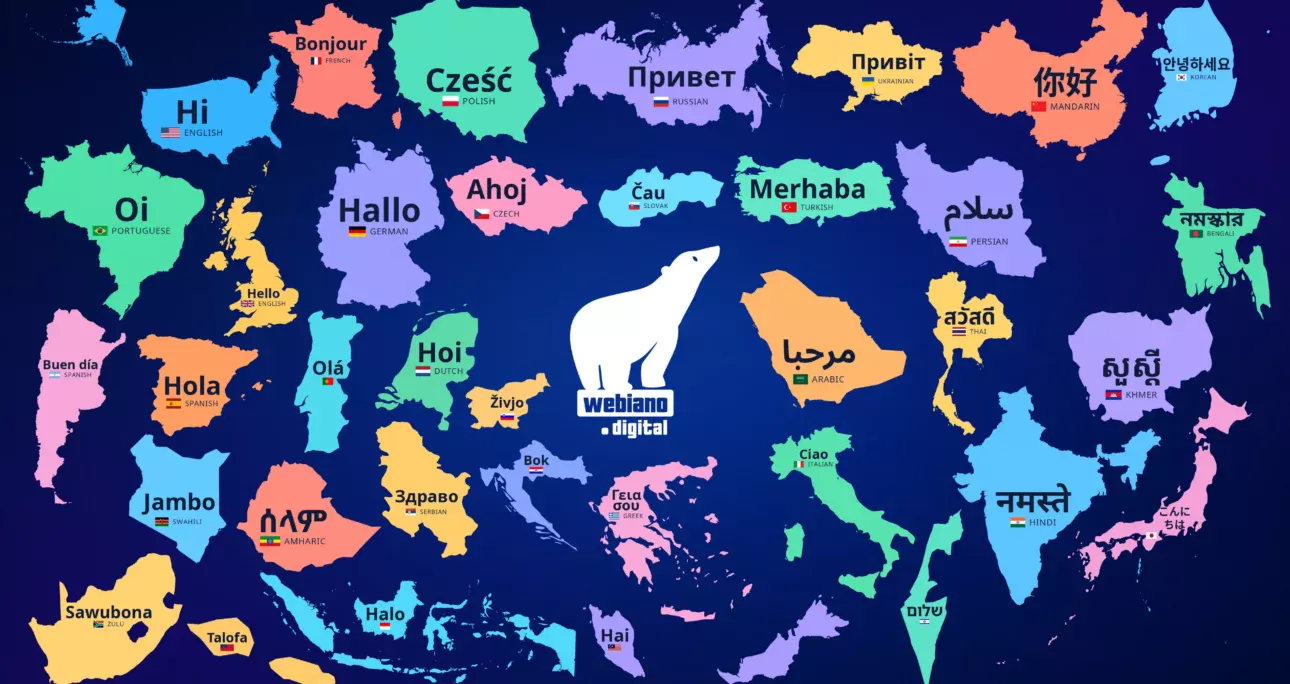
We have taken a practical step to reduce that barrier. Webiano.digital is now available through automatic translation in 104 languages. Visitors from a much wider range of linguistic backgrounds can explore our services, editorial work and approach to digital business in a language familiar to them.
Being accessible to the world means little if people cannot understand who you are and what you do. Language should open doors, not quietly close them. — Jan Bielik, CEO & Founder, Webiano Digital & Marketing Agency
I see this as a useful improvement to the website, rather than an achievement that needs to be dressed up as global expansion. We are an independent boutique agency rooted in Central Europe. Making our international website easier to read does not mean we suddenly operate as a fully localized business in 104 markets. It means that language is less likely to be the reason someone leaves without understanding what we do.
The distinction matters, especially for an agency whose work combines communication, technology and long-term digital infrastructure. We expect websites to solve problems for the people using them. Our own website should meet the same standard.
What has changed for visitors
The most visible change is straightforward: content on webiano.digital can now be read through an automatic translation layer covering 104 languages. That includes widely used languages such as Spanish, French, German, Arabic, Chinese and Hindi, alongside languages that many international corporate websites rarely offer. The breadth is useful because we cannot predict every route through which someone will discover our work.
Consider a potential partner in Japan who encounters one of our articles about digital infrastructure. They may be interested in the subject without having any previous relationship with Webiano. A reader in Poland might want to understand our approach to strategy before deciding whether to make contact. Someone working in a multilingual European organization could share our services with colleagues who prefer different languages. In each case, translation can make the first visit easier. These are examples of the access we want to enable, not claims about visitors or enquiries we have already received.
The change is particularly relevant to an agency website because our work is difficult to explain with pictures alone. A portfolio image may demonstrate visual quality, but it cannot fully describe how we plan a project, handle technical responsibility or think about long-term results. The words around the work matter. If those words are inaccessible, even a well-designed website leaves much of its value hidden.
The language count is a capability, not a claim that every language represents an active market. No serious company should treat a translation menu as evidence of local staff, local support or established commercial operations. Those require separate commitments. For us, the immediate benefit is simpler: a person should be able to form a reasonably informed first impression without needing to paste every paragraph into an external translator.
There is also a practical advantage for the editorial side of Webiano. Our articles deal with developments in AI, security, web technology, marketing and digital work. Those subjects cross national boundaries. An article written for an international readership becomes more useful when a language barrier is less likely to stop someone from reading it. Whether a translation preserves the technical meaning accurately is a separate question, and one we should take seriously.
Automatic translation is useful, but it is not localization
I want to be precise about what this update does and what it does not do. Automatic translation is not the same as a fully localized website. A translation system can make content understandable across many languages at a scale that would be unrealistic to reproduce manually. It cannot guarantee that every phrase will carry the same nuance, that every technical term will be rendered correctly or that every message will feel natural in its new cultural context.
True international reach is not measured by the number of languages a website supports, but by the connections it makes possible and the trust it builds across borders. — Jan Bielik, CEO & Founder, Webiano Digital & Marketing Agency
For everyday reading, an imperfect translation may still be very helpful. A visitor can understand the broad services we provide, the subjects we write about and the type of agency we are. The standard becomes more demanding when a page deals with contractual obligations, technical instructions, legal details or decisions involving money. In those situations, a small difference in wording can change the meaning. Visitors should be able to check important points directly with us rather than assume that a machine-generated sentence is authoritative.
Marketing terminology offers its own traps. The word performance, for example, can refer to advertising results, business outcomes or technical speed depending on context. The word conversion has a particular meaning in analytics that a general-language translation may not preserve. Even apparently simple expressions such as boutique agency or digital infrastructure can acquire strange connotations when translated literally. This is one reason our source content must be clear before it is translated. Ambiguity in the original tends to become more troublesome, not less, in another language.
The user interface deserves equal attention. Translated headings can become substantially longer than their English equivalents. Navigation labels may wrap, buttons can lose their intended meaning, and right-to-left scripts such as Arabic require care in layout and reading order. A page that displays translated paragraphs but breaks its menus or forms has not solved the visitor’s problem. The practical test is whether someone can read, navigate and contact us successfully after changing the language.
A translation layer also should not be confused with accessibility in the broader technical sense. Screen-reader support, keyboard navigation, colour contrast and accessible forms remain separate responsibilities. More languages improve linguistic access; they do not automatically make a site compliant with accessibility standards.
For markets that become especially important, human review and genuinely local content may be worth the additional investment. That could mean rewriting a service description, adapting examples, clarifying local terminology or developing editorial material that answers questions specific to a region. The decision should follow actual relevance. Broad translation is a sensible first layer because it lets us open the website to more readers now, without pretending that the deeper work has already been completed everywhere.
One international website, with room for local relevance
This update also fits the structure visitors can already see on the Webiano homepage. Webiano.digital serves as our international home, while the website presents separate directions for Slovakia, Czechia, Hungary, North Macedonia and Europe. The arrangement distinguishes a broadly readable international presence from websites intended to carry more regional context.
Those are different jobs. A translated article about PHP security can be useful to someone in almost any country. A regional service page may need to address local expectations, terminology, business practices or contact information. A client choosing an agency in Slovakia and a client assessing a partner for a Czech project may share many concerns, but the details that establish confidence will not always be identical. Translation can carry our general message across borders; local publishing can address the differences that matter within them.
We should also be careful about the work involved in maintaining several domains. Creating another website is comparatively easy. Keeping its content accurate, its technical foundations healthy and its messages consistent takes continuing attention. A regional site should earn its place by being genuinely useful, rather than exist merely to add another country to a corporate map. The same applies to language-specific content: publishing dozens of near-identical versions has little value if nobody is responsible for their quality.
The international domain gives us a common point of reference for the agency’s identity, services and editorial thinking. Regional websites can develop their own emphasis where it makes sense. The aim is consistency without forcing every market into the same presentation. Visitors should recognise Webiano across these different addresses, while also seeing information relevant to the place in which they work.
Our roots remain in Central Europe, and I consider that an advantage. We understand the realities of working across neighbouring markets where languages, regulations and business habits can change within a relatively short distance. A broader international readership does not require us to hide that background. It simply allows people who do not share our original language to understand it.
What multilingual access means for search and AI
The timing of this change is important. People no longer discover businesses only by typing a phrase into a search engine and clicking through a familiar list of results. They encounter websites through social posts, shared articles, AI-generated answers, search summaries and recommendations that often travel between languages. Someone may first see an explanation of our work in their own language even when the original article was written in English.
That creates an obvious reason to improve readability at the destination. A useful summary can introduce an unfamiliar company, but the website still has to explain itself when the reader arrives. If the visitor wants to examine the original argument, review our services or assess our credibility, we should not make the next step unnecessarily difficult.
However, there is an SEO distinction that deserves particular emphasis. Offering a translation in 104 languages does not mean Google will index 104 independent versions of every page. Search visibility depends on how those versions are delivered, whether search engines can crawl distinct content, the quality of the pages and the signals used to identify the intended language. Google recommends separate URLs for language versions when publishers want those versions to be found independently, with appropriate hreflang annotations where applicable. A translation displayed dynamically in the browser does not automatically provide that structure.
Nor does adding machine-translated pages guarantee better rankings. Automatically generating large quantities of low-value pages merely to attract search traffic can create quality and policy problems. Readers must come first. A translation that helps a real person understand an original, useful article has a different purpose from manufacturing hundreds of pages to occupy search results.
The same caution applies to AI visibility. AI systems may retrieve, summarize or translate information about a company, but none of them owes a website additional exposure because a language selector offers a large number of options. Clear source material, technical accessibility, credible information and an understandable identity still matter more than the count on a menu.
We should therefore distinguish two possible benefits. The first is immediate and human: a visitor can choose a language and read more comfortably. The second is potential search discovery in additional languages, which requires its own technical decisions and evidence. Treating those as separate outcomes keeps expectations realistic and gives us a more useful basis for evaluating the work.
The questions that will tell us whether this is working
A multilingual website is easy to announce and harder to judge properly. The tempting measurement is the number of languages supported. That is useful product information, but it tells us almost nothing about whether people are having a better experience. I would rather know whether the translation helps someone reach a service page, understand an article or make contact with fewer obstacles.
Quality comes first. Do navigation elements remain usable when translated text becomes longer? Are service names and important calls to action intelligible? Do forms still make sense? Are phone numbers, addresses, company names and other factual details preserved accurately? Does the layout handle languages written from right to left? A few targeted checks across different scripts can reveal problems that are invisible when reviewing only English or Slovak.
The next question is whether the expanded language access is actually being used. Over time, analytics can help identify which language options attract attention, what content those readers explore and whether they continue beyond the first page. Geographic location and preferred language are not the same thing, so the data should be interpreted carefully. A German-speaking visitor may be in Slovakia; an English-speaking visitor may be anywhere. Useful analysis has to account for the gap between a person’s language, their location and their commercial intent.
We should also pay attention to feedback. If a visitor points out an awkward translation of a technical term, that is more valuable than a flattering but vague statement about global reach. A wrongly translated menu item or misunderstood contact instruction is an opportunity to fix something tangible. With a language set this broad, quality control cannot depend on the assumption that every generated sentence will be perfect.
Finally, there is the business question: does wider readability lead to more meaningful conversations? The answer may be different for technical articles, service pages and the main agency presentation. We should resist the temptation to attach a conversion claim to the launch before we have evidence. The value of this update should be demonstrated through better use of the website, not inferred from the size of the language list.
A wider front door, without losing our identity
Webiano is a boutique agency by choice. For me, that means staying close to the work, taking responsibility for decisions and building relationships that deserve to last. It does not mean restricting who is allowed to understand us. A boutique agency may choose to remain selective, but it should not become accidentally inaccessible. That line from our original thinking still captures the decision better than a grand announcement about international ambition ever could.
There is a difference between being available worldwide and having a meaningful presence in every market. We are not claiming the second simply because we have improved the first. Our regional websites have their own purpose, the international site has another, and automatic translation makes that international site more useful to people who encounter it from unfamiliar linguistic directions.
For visitors, the change should feel ordinary. They arrive, choose a language they are comfortable with, read what interests them and decide whether Webiano is relevant. If something requires precision beyond what automatic translation can provide, there should still be a real conversation. In the end, that is a much better measure of digital maturity than a large number next to a language icon.
The internet has always made it possible for someone on the other side of the world to open our website. We are making it easier for that person to understand what they find there. It is a modest description of a meaningful improvement, and it leaves us with the right responsibility: to keep the experience useful after the announcement is over.
Languages available through automatic translation
Afrikaans, Albanian, Amharic, Arabic, Armenian, Azerbaijani, Basque, Belarusian, Bengali, Bosnian, Bulgarian, Catalan, Cebuano, Chichewa, Chinese (Simplified), Chinese (Traditional), Corsican, Croatian, Czech, Danish, Dutch, English, Esperanto, Estonian, Filipino, Finnish, French, Frisian, Galician, Georgian, German, Greek, Gujarati, Haitian Creole, Hausa, Hawaiian, Hebrew, Hindi, Hmong, Hungarian, Icelandic, Igbo, Indonesian, Irish, Italian, Japanese, Javanese, Kannada, Kazakh, Khmer, Korean, Kurdish (Kurmanji), Kyrgyz, Lao, Latin, Latvian, Lithuanian, Luxembourgish, Macedonian, Malagasy, Malay, Malayalam, Maltese, Maori, Marathi, Mongolian, Myanmar (Burmese), Nepali, Norwegian, Pashto, Persian, Polish, Portuguese, Punjabi, Romanian, Russian, Samoan, Scottish Gaelic, Serbian, Sesotho, Shona, Sindhi, Sinhala, Slovak, Slovenian, Somali, Spanish, Sundanese, Swahili, Swedish, Tajik, Tamil, Telugu, Thai, Turkish, Ukrainian, Urdu, Uzbek, Vietnamese, Welsh, Xhosa, Yiddish, Yoruba and Zulu.
Author:
Jan Bielik
CEO & Founder of Webiano Digital & Marketing Agency
| Citing this article? Brief excerpts are welcome. Please credit Webiano.digital, name the author where stated, and include a link to https://webiano.digital and to this original article. Full or substantial republication requires prior written permission. Read our Copyright and Content Use Policy. |
This article was prepared with the assistance of artificial intelligence tools. The content underwent expert human review, and Webiano Digital & Marketing Agency assumes editorial responsibility for its final version and publication.