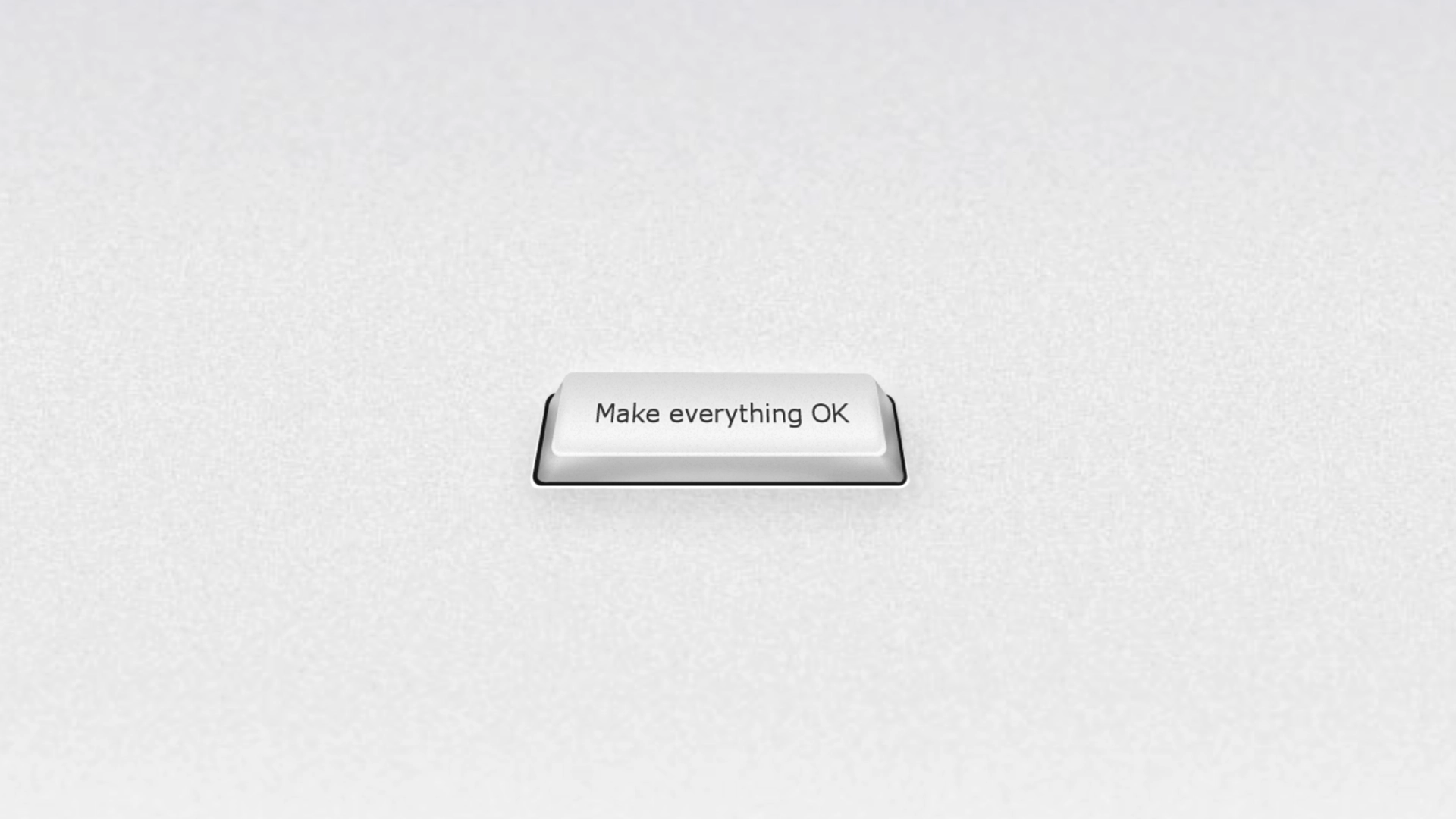
You click a button. The site tells you that making everything OK is in progress. A moment later it declares, Everything is OK now. If you disagree, the page offers one of the best throwaway lines on the web: try checking your “settings of perception of objective reality.” That is the whole experience, and it is still funny because it speaks with the absolute confidence of software while offering nothing except a tiny shift in your mood.
Table of Contents
The joke lands in one click
Make Everything OK is the kind of site the internet used to produce more often: fast, small, clean, and built around one idea instead of a business model. A recent Boing Boing write-up described it as a site containing “nothing but a single button.” That feels right. There is no onboarding, no explanation, no attempt to keep you around longer than the joke needs. You press, you wait, you get the result, you move on. The site itself backs that up with almost no text beyond the promise, the punchline, a “continue” link, and a feedback link.
What makes it better than a throwaway meme is the tone. This is not frantic internet humor. It does not beg for your attention. It behaves like a calm system utility that just happens to be spiritually unserious. The page acts as though reality is a settings problem, and that deadpan framing is what gives the joke its bite. It turns existential mess into a solvable interface issue. That is silly, but it is also weirdly familiar. Most software already speaks to us as if every human problem is a process that can be normalized, repaired, or completed. Make Everything OK just pushes that logic to its cleanest, dumbest conclusion.
It also understands something many bigger products miss: a tiny ritual can feel satisfying even when it changes nothing concrete. You click. A small sequence plays out. A verdict arrives. For a few seconds, the browser gives you a ceremonial version of relief. It is a digital placebo, and it knows it. That self-awareness saves it from feeling twee.
Why this tiny site works so well
The site’s strength is not novelty alone. Plenty of “weird websites” are random for the sake of it, then go flat after ten seconds. Make Everything OK sticks because the mechanic and the emotion match. Most people do, at some point, want a magic button. Not a wellness program. Not a dashboard. Not a productivity method. A button. The page takes that fantasy literally, then delivers a joke that is gentle enough to feel almost helpful. Creative Manila called it a “single-serving site,” which is exactly the right category. It exists to do one thing once, then leave your head a little lighter than before.
What stands out right away
| Element | Why it matters |
|---|---|
| One clear promise | The site wastes no time deciding what it is |
| Fake repair sequence | A tiny process makes the joke feel official |
| Perfect punchline | The “objective reality” line turns comfort into absurd philosophy |
| Old-web restraint | No clutter, no feed, no platform logic |
| Quick emotional payoff | You smirk, breathe out, and close the tab |
That mix is why the site lasts in memory. It gives you structure, confidence, and a punchline in under a minute, which is more disciplined than many polished products manage in ten. The effect is small, but small is the point.
There is also a design lesson hiding in it. The page understands the pleasure of completion. Software has trained people to trust status messages, progress indicators, and finished states. Make Everything OK borrows that visual and emotional grammar, then uses it for comedy instead of productivity. The joke lands because the interface feels plausible. You are not laughing at chaos. You are laughing at bureaucratic certainty applied to the impossible.
It belongs to a better corner of the web
Loadmo.re, which curates unusual mobile web experiences, filed the site under Default Aesthetics. That tag matters. Make Everything OK has the look of something you might have discovered by accident fifteen years ago, sent to three friends, and remembered for a decade. It does not chase contemporary polish. It trusts the old web trick of doing one strange thing clearly enough that people pass it around for years.
That old-web energy is a big part of its appeal. The current internet is full of systems trying to hold you in place: subscriptions, prompts, nudges, feeds, popups, layered menus, friction disguised as engagement. This site does the opposite. It makes its joke and lets you leave. That sounds minor, but it now feels rare. A page that asks almost nothing from you can feel more generous than an app with fifty features.
There is a reason people still keep lists of “useless,” odd, or delightful websites. Those sites remind you that the web is not only a marketplace, a workplace, or a content chute. It is also a playground for tiny acts of wit. Make Everything OK is not useful in any normal sense. It is useful in the sense that it briefly restores the feeling that somebody made a webpage because they had a clean idea and trusted it to stand on its own.
The site has outlived the moment that made it
A lot of disposable internet humor expires as soon as its format becomes familiar. This one did not. It was on Hacker News in July 2011, where reactions ranged from annoyance to genuine affection. One commenter said it “made me smile.” Another joked about sending it to a boss “if something goes wrong.” Fifteen years later, Boing Boing was still able to post it as a fresh little find. That is a good test for whether a web oddity has real staying power. It does not need a trend cycle. It survives on shape, timing, and tone.
That longevity says something interesting about internet culture. People do not just want new things. They want things that feel sharable in a low-pressure way. Make Everything OK has no lore barrier, no interface learning curve, no context requirement. You can send it to someone with zero explanation. The site will explain itself in seconds. That makes it highly portable. It travels well across years, platforms, and moods.
It also keeps renewing its relevance because the fantasy behind it never stops being current. Every era invents new systems that promise total clarity, total optimization, total peace of mind. Against that backdrop, a blunt Make Everything OK button stays funny. It parodies the oldest and newest forms of tech solutionism at the same time. It feels like a relic and a satire of the present.
Who will actually enjoy it
This site is for people who still like finding corners of the web that feel handmade, pointed, and slightly pointless in the best way. If you love single-purpose pages, old-school internet discoveries, interface jokes, or the genre of websites that exist mostly to make you grin and send a link, this is easy to recommend. Designers and product people may get an extra kick from how neatly it mimics the language of resolution without resolving anything. Writers will appreciate the punchline. Stressed office workers will probably click it twice.
It is not for someone looking for depth, interactivity, or a rabbit hole. There is no hidden world here. The experience is the premise. That is not a flaw. The discipline is part of the charm. Make Everything OK knows exactly how much attention it deserves and stops there. Many websites would improve if they had the same self-control.
What I like most is that the site does not overplay its hand. It does not try to become profound. It just gives you one compact absurdity with clean timing. In a browser packed with overbuilt seriousness, that can feel like a small form of mercy. You click, it lies to you politely, and for a second the lie is oddly comforting.
Ten quick questions before you click
You press the button, the page runs through a brief “making everything OK” sequence, then it tells you that everything is now OK. If you still disagree, it blames your perception of objective reality.
No. The site is a joke, not a tool. Its effect is emotional and comic, not practical. That is exactly why it works.
Because the premise is instantly readable and still funny. The site was circulating on Hacker News in 2011 and got rediscovered again by Boing Boing in 2026, which tells you the bit still travels.
Almost nothing. The site keeps its footprint tiny, with just the core text, a continue link, and a feedback link. That restraint is part of the appeal.
Yes. There is no sign-up, no paywall, and no setup. You open the page and the experience is already there.
Yes. It fits neatly into the old single-serving-site tradition: one idea, one mechanic, one payoff. Creative Manila described it that way, and the label suits it.
Because it belongs to an internet style that values clarity and eccentricity over polish theater. Loadmo.re even curates it under “Default Aesthetics,” which captures that plain, deliberate look.
Mostly comedy, though a little comfort sneaks in through the ritual. A confident message, a short wait, and a finished state can calm people more than they should.
Anyone who likes weird websites, deadpan interface humor, or tiny links that make a bad afternoon slightly less heavy. It is also perfect for sending to someone after a minor disaster in chat.
Yes, if you collect internet oddities that are fast to share and hard to forget. No, if you need every tab to justify itself with utility. Make Everything OK earns its place by being brief, memorable, and surprisingly replayable.
Make Everything OK is not a masterpiece of engineering, and that is a relief. It is a small, sharp example of what the web does well when nobody is trying to turn every page into a product. The site offers a tiny ceremony of false repair, a good line, and a clean exit. That is enough. In fact, that is why it lasts.
Author:
Jan Bielik
CEO & Founder of Webiano Digital & Marketing Agency
This article is an original analysis supported by the sources cited below
The magic button — Make Everything OK
The site itself, including its core text, structure, and punchline.
The magic button — Make Everything OK | Hacker News
An early 2011 discussion that shows how the site was received and shared.
THE MAGIC BUTTON: Make Everything OK
A concise curatorial write-up that frames the site as a single-serving web experience.
Make Everything Ok
A curation entry that places the site inside the “Default Aesthetics” corner of web culture.
I found a “make everything ok” button on the internet
A recent rediscovery that shows the site still plays well online years later.
| Citing this article? Brief excerpts are welcome. Please credit Webiano.digital, name the author where stated, and include a link to https://webiano.digital and to this original article. Full or substantial republication requires prior written permission. Read our Copyright and Content Use Policy. |
This article was prepared with the assistance of artificial intelligence tools. The content underwent expert human review, and Webiano Digital & Marketing Agency assumes editorial responsibility for its final version and publication.