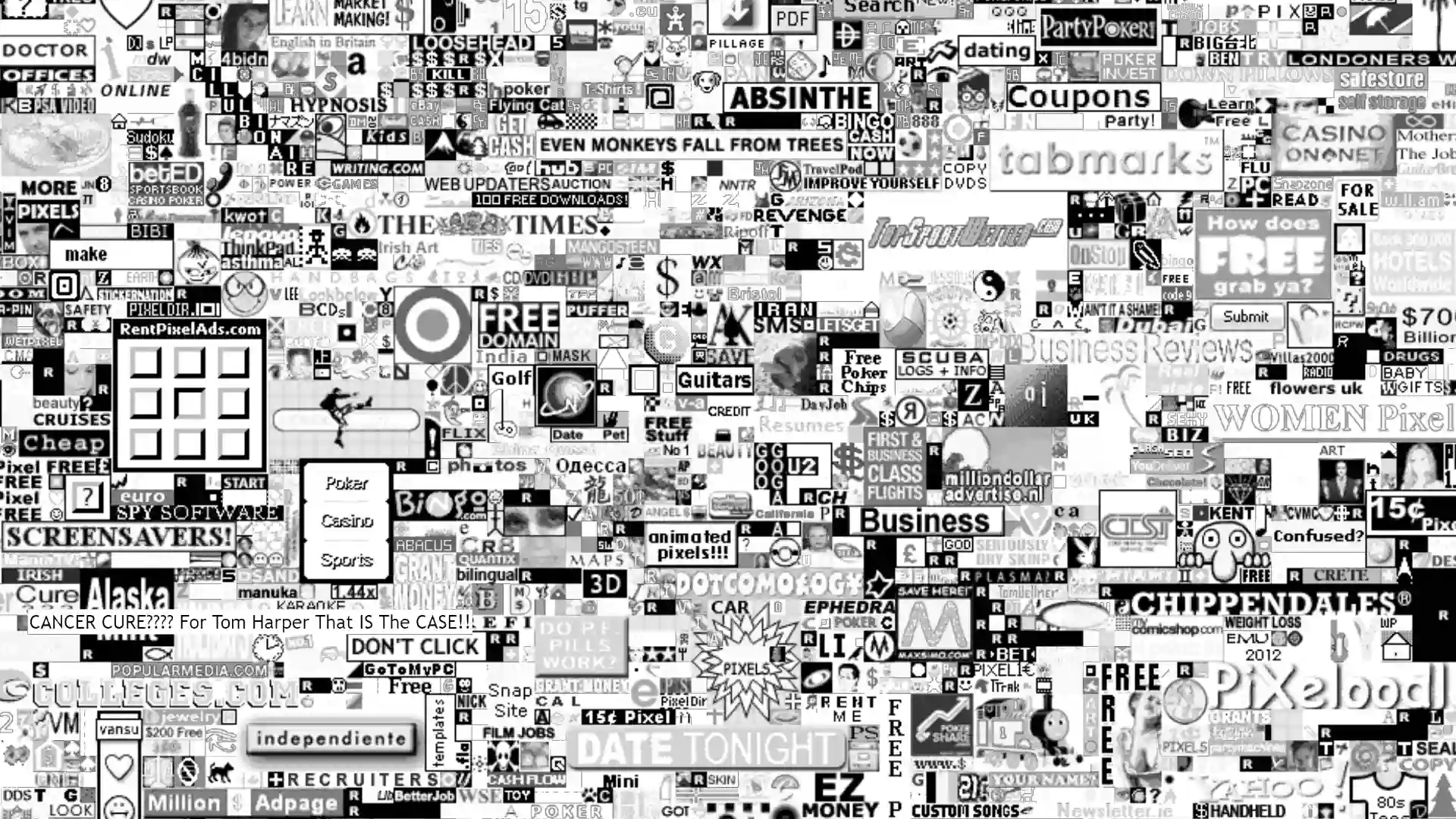
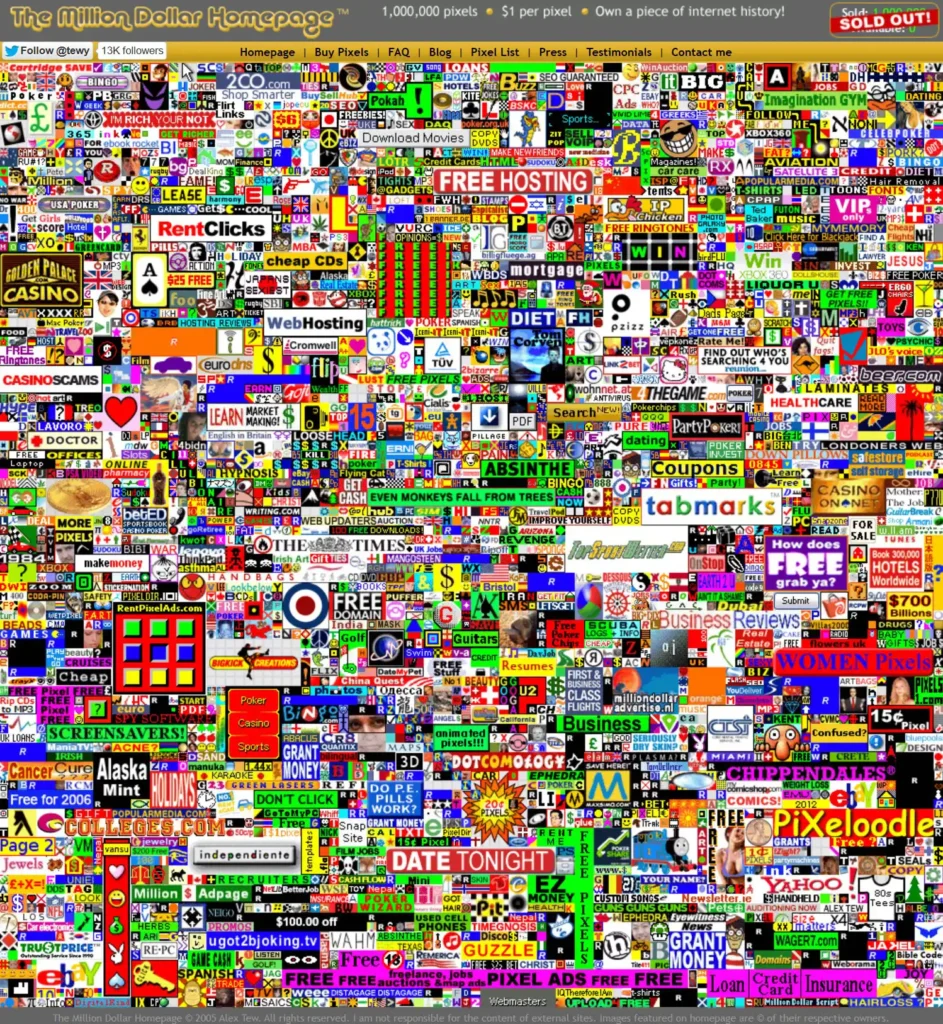
The Million Dollar Homepage still opens with the same old pitch: “Own a piece of internet history.” That line began as ad copy. Now it reads like an accidental museum label. The homepage is still online, still jammed with tiny ads, still loud in exactly the way the mid-2000s internet was loud, and still oddly hard to stop looking at.
Table of Contents
Alex Tew built it in 2005 when he was 21 and trying to avoid dragging university debt behind him for years. His idea was blunt enough to fit in one sentence: sell one million pixels of homepage real estate for $1 each, in 10×10 blocks, so the minimum buy was $100. It sounded like a joke with a calculator attached. That was part of the genius. Anyone could understand it instantly, and just as important, anyone could repeat it to someone else.
The joke turned into real money at internet speed. By late December 2005, Wired reported that sales had already passed $900,000. On January 11, 2006, Tew auctioned the final 1,000 pixels on eBay for $38,100, pushing the gross total to $1,037,100. That number matters, but it is not the real reason the site still deserves a click. The real reason is that the page captures a moment when the web still felt cheap, open, scrappy, ugly, opportunistic, and weirdly full of possibility.
The joke that made real money
What makes The Million Dollar Homepage memorable is not just the stunt. It is the purity of the stunt. There was no complicated platform logic, no subscription layer, no audience-segment jargon, no fake mission. It was a single page, a hard limit, a public counter, and a clean piece of scarcity. Tew did not need people to believe they were buying premium media. He needed them to believe they were buying into a story while it was still unfolding. That is a much easier sale.
The site also hit a sweet spot between comedy and commerce. It looked ridiculous, but not unserious. Advertisers got a link, a tiny image, and the chance to say they were on the page everyone was talking about. Some probably bought for traffic. Some bought for novelty. Some bought because the page itself became a badge. Wired described buyers ranging from Japanese dating companies to toy-train dealers, which tells you almost everything about the site’s appeal. It was less a targeted ad product than a chaotic public square for anyone who wanted a small patch of a growing spectacle.
Tew also had the rare good luck of launching a simple idea at exactly the right moment. The web still rewarded odd little standalone sites. A press release could still catch fire. Blogs still mattered. Link culture still had the power to swing attention toward one absurd page built by one person with a sharp instinct for what people would talk about next. Wired said the project spread like online wildfire after its early push, and that phrasing feels right. The page was made of pixels, but its real material was word of mouth.
Why it is still worth opening
| What you get | Why it matters |
|---|---|
| One giant page of tiny linked ads | The whole idea is visible at once |
| A pricing model you can explain in seconds | The concept had perfect viral clarity |
| A homepage that still survives | The stunt became an artifact |
| Broken subpages and aging links | Time is part of the experience now |
| A mess of fonts, logos, and bait | It preserves the mood of early web advertising |
That is the trick of the site in 2026: it is still legible. You do not need context first. You open it, and the premise explains itself faster than most modern products do.
What it feels like to open it now
A lot of old internet legends are disappointing on revisit. The Million Dollar Homepage is not. It is better on revisit, because now it has two layers. The first is the original one: a single gigantic ad quilt. The second is the decay. The homepage still loads, but some of the old supporting pages that once made the project feel like a live business, including FAQ, Press, and Testimonials, now return 404 errors. The sales pitch survived. The scaffolding around it did not.
That split changes the meaning of the site. In 2005 it was a hustle. In 2026 it is also a ruin. Harvard’s Library Innovation Lab called it a “decaying digital artifact,” which is exactly right. Their 2017 analysis found 2,816 embedded links accounting for 999,400 pixels, with 547 links entirely unreachable and 489 redirecting elsewhere. The dollar value of the dead links alone was striking: 342,000 pixels attached to unreachable destinations, plus another 145,000 tied to redirects.
That sounds gloomy, but it is part of the appeal. The page is no longer just a success story. It is a record of what the web forgets. Old domains die. Companies vanish. Clever microsites rot. Domains get flipped. Promises evaporate. Yet the page still holds their ghosts in place, each tiny square acting like a plaque for a vanished ambition. Harvard noted that the page remains an intact record of the aesthetics and commercialization patterns of the internet around 2005. Open it now and that observation feels generous, maybe even understated. It is not only a record. It is a preserved mess.
The real product was attention
The standard reading of The Million Dollar Homepage is that Tew sold pixels. He did, obviously. But the better reading is that he sold attention made visible. Every pixel block was small, but the page itself was large enough to become news. Buyers were not just paying for clicks. They were paying for participation in a public event. That is why the page feels strangely modern even now.
Modern internet businesses talk endlessly about attention, community, scarcity, and creator economics. Tew got to the same territory with a page so basic it almost mocked the need for theory. He gave people a limited supply, a visible scoreboard, a public object, and social proof that kept compounding as coverage spread. That is an old web stunt, but it also sounds uncomfortably close to a lot of later internet business models. The details changed. The psychology did not.
The site also worked because it embraced ugliness instead of fighting it. Nobody came for design purity. They came because the clutter itself was proof that the thing was happening. Each new block made the page worse in the visual sense and better in the commercial sense. That contradiction is still funny, and still smart. Most websites try to persuade you they are elegant. The Million Dollar Homepage won by making success look crowded.
A frozen snapshot of 2005 web culture
Spend a few minutes scanning the page and you start to notice how much of the old web sits inside it. The fonts are blunt. The ads are shameless. The promises are lurid. Bits of amateur design sit next to gambling offers, novelty brands, bargain pitches, and thin little attempts at internet legitimacy. Harvard’s description of “clunky fonts,” sketchy-looking gambling sites, risqué promises, and banners that resemble the clickbait economy to come lands because the page really does feel like a compressed sample of that era’s commercial web.
That matters because the site is not merely famous. It is revealing. The Million Dollar Homepage shows an internet before feeds swallowed everything. A web page could be the whole product. A fixed homepage could carry cultural weight. A silly premise could travel globally without needing an app, a growth team, or a stack of behavioral dashboards. The page feels primitive next to modern platforms, but primitive is not the same thing as weak. It had one idea and no friction between the idea and the experience.
You can also see why it was hard to copy. People did copy it, but the core magic was not the grid. The magic was timing, novelty, and the creator’s nerve. Once one student had sold the web a million tiny squares, the second student was just selling an imitation. The format was repeatable. The moment was not. Wired noted, even at the finish, that similar pixel-selling sites were already around for anyone who felt they had missed the original. Most of them are forgotten because they were never the event. The first page got there first and took the mythology with it.
Why the page still matters
A lot of internet history is explained through giant platforms and giant companies. The Million Dollar Homepage is a useful correction. Sometimes the web changes through small, sharp ideas that catch everybody slightly off guard. Tew did not build infrastructure. He built a cultural object. The object made money, attracted press, survived a DDoS extortion attempt, and then kept sitting there long enough to become something else: evidence. Wired reported that after the final sale, the site was hit by an attack tied to ransom demands, and Tew ended up working with a security company to get it back online. Even the chaos around the win became part of the legend.
The site also matters because it demonstrates a point many polished founders still miss: people do not always reward the most technically impressive thing. They reward the thing they can understand, repeat, and feel early to. The Million Dollar Homepage was not subtle. It did not need to be. It made scarcity visible and made participation feel public. That was enough.
And there is one more reason to click it now. The page has crossed from novelty into texture. It no longer asks whether pixel ads are a smart buy. It asks what the web used to look like when one person could still throw up a bizarre page, catch the mood of the moment, and turn a throwaway idea into a permanent cultural reference point. For a site built from almost nothing, that is a serious afterlife.
The questions that still follow it
It is a one-page website made of one million pixels that Alex Tew sold as tiny blocks of ad space for $1 per pixel. Buyers could place a miniature image and a link on their patch of the page.
Alex Tew, a 21-year-old from Wiltshire in England, created it in 2005. Multiple contemporary reports identify him as a student trying to fund university costs.
He wanted a way to pay for university without years of debt. That goal was part of the original pitch and a big part of why the story spread.
The headline price was $1 per pixel, but the actual units were 10×10 blocks, so the minimum purchase was $100. That made the scheme simple enough to explain and cheap enough for small buyers to join.
Yes. The final gross went beyond the headline and reached $1,037,100 after the last 1,000 pixels were auctioned.
Because the last 1,000 pixels were not sold at face value. They were auctioned on eBay and the winning bid came in at $38,100.
Yes. The homepage is still live and still presents itself as The Million Dollar Homepage.
No. The main page survives, but some old supporting pages such as FAQ, Press, and Testimonials now return 404 errors.
Not even close. Harvard’s 2017 analysis found hundreds of unreachable links and hundreds more redirects, with many remaining destinations no longer matching their original purpose.
Some wanted traffic, some wanted novelty, and many wanted to be part of the internet event itself. The page became famous enough that the placement carried its own bragging rights.
For some buyers, probably yes in the short term, because the page got intense attention while the story was hot. As a long-term ad format, the value was far less stable, which the later link rot makes painfully clear.
Yes. Similar pixel-selling sites appeared very quickly, but they never had the original novelty. The format was easy to clone; the moment was not.
It was hit by a DDoS extortion attack around the time the final pixels were sold. Wired reported ransom demands and a temporary outage before protections were put in place.
No. Reports after the success of the project say he dropped out of the business degree the site had originally been built to fund.
He went on to other internet ventures and later became a co-founder of Calm. Calm’s own about page lists Alex Tew and Michael Acton Smith as the founders.
Because it is no longer just a famous stunt. It is a preserved piece of internet culture, half success story and half digital ruin, and very few old websites manage to be both at once.
Author:
Jan Bielik
CEO & Founder of Webiano Digital & Marketing Agency
This article is an original analysis supported by the sources cited below
The Million Dollar Homepage
The surviving homepage itself, including its original pitch and current live state.
Dot’s a Lotta Dinero
Contemporary Wired coverage from December 2005 on the idea, early sales momentum, and why the stunt spread so fast.
Your Money or Your Site
Wired’s later account of the final sale, the DDoS extortion attack, and the aftermath.
Student Makes a Million Selling Pixels
ABC News report on the final eBay auction and Tew’s reaction after crossing the million-dollar mark.
Million-dollar student hits the big time with a simple idea
A useful contemporary snapshot of the project while it was still climbing and before the final sellout.
A Million Squandered: The “Million Dollar Homepage” as a Decaying Digital Artifact
Harvard Library Innovation Lab’s analysis of link rot and the site’s second life as a preserved fragment of early web culture.
Welcome to Calm
Calm’s official about page confirming Alex Tew as one of the company’s founders.
| Citing this article? Brief excerpts are welcome. Please credit Webiano.digital, name the author where stated, and include a link to https://webiano.digital and to this original article. Full or substantial republication requires prior written permission. Read our Copyright and Content Use Policy. |
This article was prepared with the assistance of artificial intelligence tools. The content underwent expert human review, and Webiano Digital & Marketing Agency assumes editorial responsibility for its final version and publication.