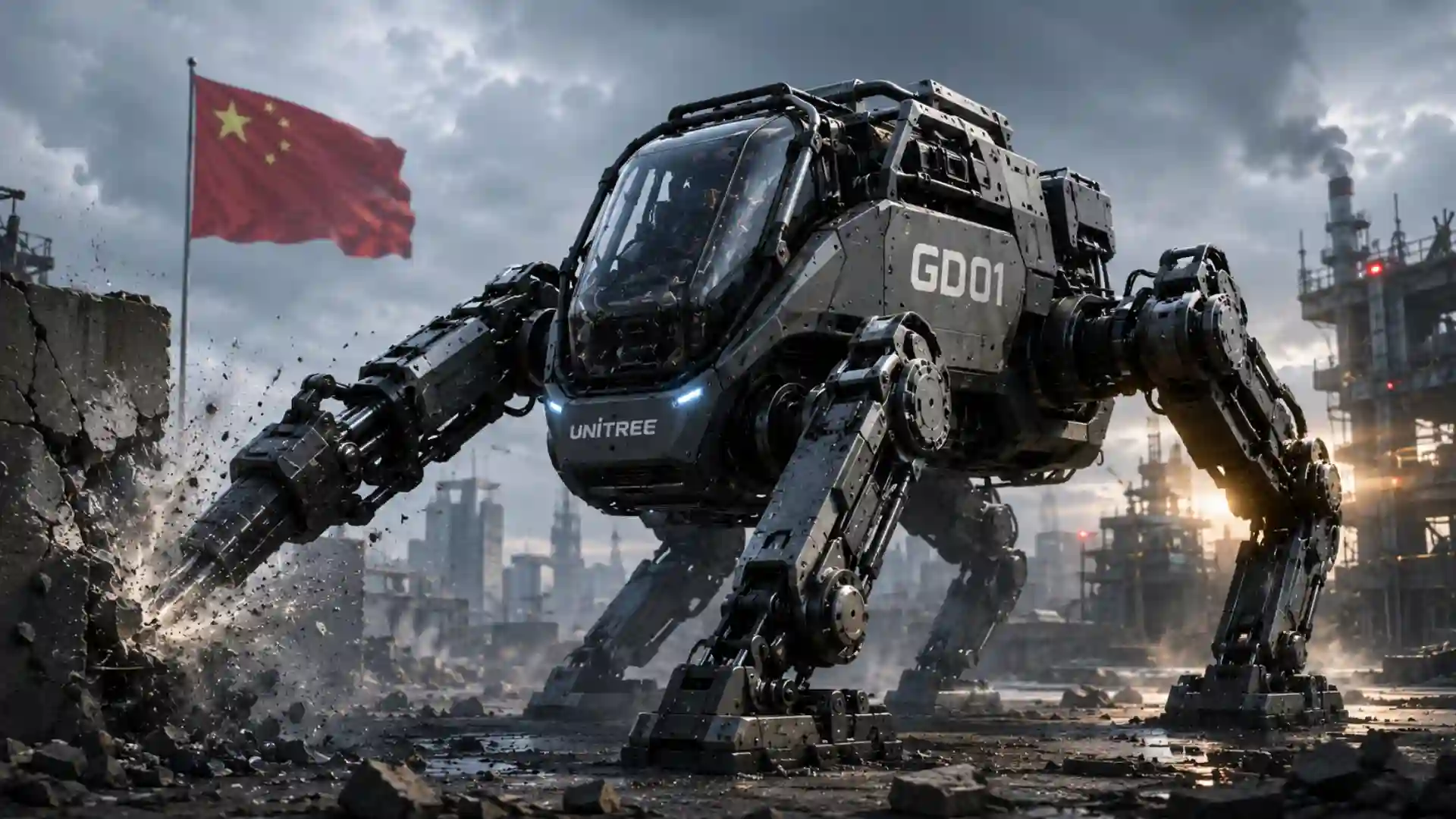
Unitree Robotics has put a human-carrying machine on video that walks upright, drops into a four-legged posture, smashes through a wall and arrives with a price tag. The Chinese company calls the GD01 a civilian vehicle. That claim matters. So does the shape of the machine. A 2.7-meter, roughly half-ton, pilotable robot that can shift between bipedal and quadrupedal movement is not a tank, not a truck, and not a standard humanoid. It is a new category of public-facing robotic platform whose military uses are too obvious to ignore. Unitree says the GD01 weighs about 500 kilograms with a person inside and has been presented as the world’s first production-ready manned mecha, with a preliminary price around 3.9 million yuan, or about $650,000.
Table of Contents
A viral robot that deserves a sober reading
The first mistake is to treat the GD01 only as a social-media stunt. The second mistake is to treat it as a battlefield-ready war machine. The useful reading sits between those extremes. Unitree has shown a machine that borrows the language of anime, construction equipment, humanoid robotics, quadruped mobility and personal transport. Its demo is theatrical by design. It is meant to be watched. It is meant to make viewers say that science fiction has crossed into the street. Yet even a theatrical robot can expose a serious engineering direction.
The confirmed public facts are limited. The GD01 is not documented as a People’s Liberation Army program. It has not been shown with weapons. Unitree and Chinese media describe it as a civilian platform, and one report quotes the company warning users to handle the robot safely and avoid hazardous or dangerous modifications. The company has not published a serious mission profile explaining whether the GD01 is meant for industrial rescue, entertainment, research, extreme mobility, inspection, display, defense-adjacent testing or high-end private ownership.
That lack of clarity is part of the story. The GD01 is easier to understand as a platform than as a finished product. A platform is a physical base that can carry sensors, software, tools, payloads and operators. Armies care about platforms because platforms can be adapted. A pickup truck becomes a weapons carrier. A commercial drone becomes a reconnaissance asset. A robot dog becomes a scout, a radio relay or, in more troubling cases, a firing mount. A pilotable mech has the same dual-use logic, even if the first version is expensive, awkward and built partly for attention.
The public demo also lands at a specific moment in China’s robotics push. Unitree is not a marginal hobbyist firm. Reuters reported that Unitree filed for a Shanghai Stock Exchange IPO in March 2026, seeking to raise 4.2 billion yuan, and that humanoid robots had become its main growth driver. The same report said Unitree’s operating income grew 335 percent year on year in 2025, while its humanoid robot shipments reached more than 5,500 units, giving it 32.4 percent of the global humanoid market according to the company’s prospectus.
That scale changes the meaning of a strange prototype. A garage-built mech would be a curiosity. A half-ton transformable robot from a fast-growing Chinese robotics company with public-market ambitions is a signal. It tells investors, rivals, defense planners and policymakers that Chinese embodied-AI companies are moving fast across the boundary between laboratory demonstration and purchasable hardware. The first GD01 may not be practical. The fifth or tenth generation could be harder to dismiss.
The confirmed GD01 facts and the claims still missing
The GD01 story has spread faster than the technical detail behind it. Chinese state-linked outlets, technology media and Unitree’s own promotional material agree on the broad outline: a pilotable, transformable mecha-like robot; about 2.7 meters tall; roughly 500 kilograms with a rider; two-legged and four-legged movement modes; and a starting reference price around $650,000. China Daily reported that the bipedal mode is shown walking and turning on urban streets, while quadruped mode is designed for more difficult terrain such as stairs and slopes.
Several details remain unresolved. We do not yet know its battery capacity, runtime, rated payload without a rider, maximum speed, actuator architecture, control method, autonomy stack, sensor suite, safety certification, braking method, fall-protection design or maintenance cycle. We also do not know whether the version shown is close to a deliverable customer product or a publicity model with a production price attached. The company has described the price as preliminary, and a Unitree marketing staff member told Global Times that the final production version could be adjusted as performance and cost are refined.
Those unknowns matter because robots are not judged by one dramatic motion. They are judged by repeatability. Can the GD01 walk for an hour without overheating? Can it recover from a stumble? Can it carry a real adult safely on uneven ground? Can it be repaired quickly when an actuator fails? Can it operate in rain, dust, rubble or smoke? Can it keep balance if a payload shifts? Can the pilot exit after a fall? The demo answers none of those questions.
It does answer one question: Unitree can build a large robotic body that is visually coherent, mechanically expressive and stable enough for controlled public video. That is not the same as operational maturity, but it is not nothing. In robotics, public demonstrations often sit on a spectrum between real capability and careful staging. A staged capability can still be technically meaningful if it reveals that the company has actuators, control software, balance methods and structural design good enough to perform under repeatable conditions.
Western coverage has rightly treated the GD01 with humor and caution. The Verge noted that Unitree does not clearly explain the intended function, that the video shows wall-smashing and mode-switching, and that some clips appear to show operation without a person inside. Wired reported that Unitree confirmed the GD01 was an actual product it is selling, not a prank, while also arguing that the machine appears aimed as much at publicity as utility.
That assessment is fair. The GD01 is both a real robot and a piece of engineered spectacle. In the robotics market, the spectacle is not separate from business strategy. It attracts researchers, customers, recruits, media attention and political interest. It tells suppliers that Unitree will keep buying components. It tells investors that the company can dominate public imagination. It tells competitors that Unitree is willing to turn science-fiction imagery into hardware faster than most firms would dare.
A mecha label with real engineering beneath it
“Mecha” is a cultural word before it is an engineering word. It belongs to anime, manga, games and films where giant human-shaped machines carry pilots into combat. The GD01 borrows that emotional vocabulary. The cockpit, the upright stance, the arm movement and the folding posture all make the viewer compare it with Gundam, Transformers or the Power Loader from Aliens. That comparison is useful for marketing. It is less useful for technical analysis.
A real machine must obey weight, torque, power and stability limits. A bipedal robot standing 2.7 meters tall with a human rider faces a hard center-of-gravity problem. Tall robots fall with force. They need strong joints, fast control loops, accurate sensing and enough structural stiffness to prevent wobble from becoming instability. The heavier the machine, the more serious the energy problem becomes. Every step requires acceleration and deceleration of large limbs. Every correction burns power.
The GD01’s four-legged mode is more than a visual trick. Quadruped posture lowers the center of gravity and spreads the load across more contact points. That helps on slopes, stairs, loose ground and rubble. A four-legged robot can also pause in a more stable position while carrying weight or applying force. The biped-to-quadruped transformation is best understood as a stability-management strategy, not only a science-fiction gesture.
The open question is whether this transformation is useful enough to justify the added mechanical complexity. A conventional tracked unmanned ground vehicle has fewer balance problems. A wheeled robot is simpler and cheaper on roads. A quadruped robot without a pilot is lighter, smaller and easier to protect. A compact excavator can break walls with proven hydraulics. The GD01 must prove that its unusual body creates mission value that simpler machines cannot deliver.
The most plausible technical value lies in environments designed for humans but damaged enough to defeat wheels. Stairs, narrow passages, steep slopes, debris piles, collapsed structures, industrial sites and urban ruins all favor articulated legs in theory. A large walking machine could step over obstacles and position tools at human height. Its arms could push, pull, lift or clear. Its cockpit could give a person direct situational awareness when remote operation is poor. That list describes rescue and industrial work as easily as it describes military engineering tasks.
The difficult part is durability. A machine that looks impressive in a one-minute demo may still struggle with dust, water ingress, shock loads, dropped debris, broken stairs, rebar, mud, temperature swings and electromagnetic interference. Robots that work in promotional clips often face long delays before they become useful in dirty places. The GD01 is no exception. Its military relevance depends less on its current form than on whether its underlying technologies improve through iteration.
The civilian claim is real, but it does not end the debate
Unitree’s public framing matters because it sets the legal and commercial baseline. The GD01 is presented as a civilian vehicle. Unitree’s warning against dangerous modifications is also meaningful. Companies know that public weaponization of their robots creates reputational, regulatory and export problems. Boston Dynamics, for example, has repeatedly distanced its quadruped robots from weaponization, and the broader robotics industry has struggled with how to handle platforms that can be adapted by third parties. Unitree’s own warning belongs in that wider debate.
Yet dual-use technology cannot be controlled by declared intent alone. A robot that can carry a person, move across rough ground and apply heavy force has military relevance even if its first sales brochure says civilian. The same traits that make a machine useful in disaster response make it useful in combat support. A robot that can move through rubble can move through a bombed urban block. A robot that can carry tools can carry ammunition. A robot that can drag equipment can drag casualties. A robot that can scout dangerous industrial spaces can scout dangerous streets.
Dual-use does not mean every product is secretly military. It means the same engineering choices satisfy both civil and defense tasks. Cameras, LiDAR, batteries, electric actuators, carbon-fiber structures, edge AI processors, navigation software and remote-control links all travel between commercial and defense markets. The military question around GD01 is not whether Unitree has announced a weapons program. It has not. The question is whether the platform points toward bodies, control systems and supply chains that could be adapted by military actors.
China’s policy environment makes that question sharper. Reuters reported in its Unitree IPO coverage that Beijing views embodied artificial intelligence as a strategic future industry alongside fields such as quantum technology, 6G, nuclear fusion and brain-computer interfaces. China also plans broader deployment of humanoid robots and AI automation in production lines, although real factory use remains limited.
That matters because national industrial policy creates scale. Scale lowers component costs. Lower component costs make experimentation cheaper. Cheaper experimentation creates more prototypes. More prototypes generate more operational data. The path from civilian robotics to defense-relevant robotics rarely begins with a single sinister product. It begins with a domestic ecosystem that can produce motors, reducers, batteries, sensors, embedded computers, controllers and trained engineers at speed.
The GD01 therefore should be read as part of a larger Chinese capability buildout. It is not proof of a Chinese mech army. It is evidence that one of China’s most visible robotics firms is willing to test large, human-carrying, transformable bodies in public while the country is standardizing humanoid robotics, expanding embodied AI policy and scaling robot manufacturing.
The wall-smashing demo and the meaning of force
The most cinematic GD01 moment is the wall strike. Reports describe the machine smashing through wall material or cinder blocks. China Daily and Global Times say Unitree CEO Wang Xingxing was shown piloting the machine, while The Verge and Wired describe clips of the robot knocking down or smashing a wall of blocks.
A wall-smashing clip is not a measure of combat power. Promotional walls are often built to fail. They may be thin, unreinforced, dry-stacked, pre-weakened or chosen to make a safe visual point. No serious defense planner should infer that GD01 can breach reinforced concrete, survive enemy fire or replace combat engineers from that footage alone. But the demo is still interesting because it shows Unitree wants viewers to associate the machine with applied force, not just locomotion.
Robots that apply force are harder than robots that move. A walking robot can be lightly loaded and still impress. A force robot must transmit loads through joints and structure without tipping, breaking or losing control. Punching is especially inefficient for real work, but pushing, prying, lifting and dragging are practical. In a disaster zone, a robot might move debris. In an industrial site, it might position heavy equipment. In a military context, it might clear obstacles, breach light barriers, tow loads or open paths under fire.
The GD01’s arms raise the platform’s ambition. A rideable quadruped without arms would be a mobility device. A large biped with arms becomes a tool carrier and manipulator. It can interact with vertical surfaces, doors, windows, barriers and objects at human scale. The military relevance begins when mobility and manipulation meet. A robot that only drives can transport. A robot that walks and manipulates can alter the environment.
The hard engineering question is whether electric actuators can deliver useful work repeatedly at this size. Hydraulic machines have long dominated heavy-force tasks because they handle high loads well. Electric robots offer cleaner control, lower maintenance in some contexts and better integration with software, but large electric humanoid systems face heat and torque limits. Unitree’s smaller robots already show strong actuator design; its B2 quadruped page advertises a 6 m/s running speed, about 360 N·m joint torque, a standing load of at least 120 kilograms, and continuous walking load above 40 kilograms.
GD01’s public specs do not yet show comparable engineering detail. Until Unitree publishes duty cycles, payload curves and test data, the wall-smashing clip should be treated as a demonstration of direction rather than proof of capacity. The direction is clear enough: Unitree is not only chasing humanoid dexterity. It is also exploring larger bodies that can impose physical effects on the world.
Unitree’s real advantage is not one robot
Unitree’s more important achievement is not the GD01 itself. It is the company’s ability to produce attention-grabbing robots at prices that force global comparison. Reuters reported that Unitree launched the R1 bipedal humanoid in July 2025 at 39,900 yuan, or about $5,566, far below the earlier G1’s 99,000-yuan starting price. Wired noted that Unitree’s cheaper G1 model was around $15,000, while comparable U.S.-made humanoid robots can cost far more.
Those numbers reveal the real strategic lever: cost compression. In robotics, price affects adoption more than spectacle. Universities can buy more units. Developers can test more code. Small companies can experiment. Researchers can break machines, repair them and try again. Software improves when hardware exists in volume. A country with many low-cost robots gains training data, engineering experience and customer feedback faster than a country with a few exquisite prototypes.
Unitree sits at the intersection of performance theater and manufacturing discipline. Its robots dance, fight, run and appear in media events, but the company is also building product lines across quadrupeds, humanoids, arms, perception modules and components. Its official site lists consumer and education robots, industrial quadrupeds, humanoids, robotic arms, LiDAR and components.
This breadth matters. A mecha is a system of systems. It needs legged locomotion, body control, perception, power management, human-machine interface, safety logic, mechanical structure and software. Unitree already works across many of those layers. The GD01 may look like a strange one-off, but it draws from the same component and control ecosystem as the company’s smaller robots.
China’s hardware supply chain then amplifies the effect. The International Federation of Robotics reported that China accounted for 54 percent of global industrial robot deployments in 2024, installed 295,000 industrial robots that year, and exceeded 2 million industrial robots in operation. Chinese robot suppliers also sold more than foreign suppliers in China for the first time, reaching 57 percent domestic market share.
That industrial base is not identical to humanoid robotics, but it gives China dense manufacturing capacity, automation expertise and supplier networks. The strategic issue is not whether GD01 is ready for war. It is whether China can iterate physical AI systems faster and cheaper than rivals. Unitree’s pricing history suggests that it can push costs down aggressively once a category becomes productized.
China’s robot surge gives the GD01 a larger backdrop
China’s robotics push is no longer confined to factory arms behind safety cages. It now covers humanoids, quadrupeds, embodied AI, service robots, industrial inspection systems, logistics machines and military-adjacent unmanned platforms. Xinhua reported in March 2026 that China released its first national standard system for humanoid robotics and embodied intelligence, calling it a top-level framework covering the full industrial chain and lifecycle.
Standards can sound dull, but they are industrial infrastructure. They define interfaces, safety expectations, component categories, testing methods, data rules and application norms. When a state-backed standards system emerges around humanoid robots, it helps reduce fragmentation. Suppliers know what to build toward. Buyers know what to ask for. Regulators know what to inspect. Investors know the sector has political attention. Researchers know their work is part of an organized national project.
The GD01 appears just as this standardization effort is becoming visible. It is not a direct product of that framework, based on public evidence. But the timing is revealing. China is trying to move embodied intelligence from scattered demos into commercialization. Unitree is trying to turn attention into sales and public-market value. State media is eager to frame the machine as a moment when science fiction becomes reality. Global observers are measuring China’s robotics speed against Western programs.
The industrial backdrop also helps explain why a machine that looks impractical today can still be strategically meaningful. Early electric vehicles were expensive and limited. Early drones were fragile. Early humanoids were slow, clumsy and restricted to labs. Once supply chains mature and use cases sharpen, the technology often changes faster than early skeptics expect. Some categories fail. Others become normal almost suddenly.
Robotics is full of failed promises, so caution is necessary. Humanoid robots are still far from doing most messy human work. The Financial Times, Reuters and other business coverage have repeatedly pointed out that many real-world industrial deployments remain limited compared with promotional enthusiasm. Reuters reported that Unitree’s prospectus described much of its industry-application revenue as coming from reception, tour-guide use, intelligent manufacturing and inspection, with tour-guide use accounting for a large share.
Even so, China’s scale gives failure a different meaning. One failed robot is waste. Many failed robots across many companies are also a learning system. The GD01 may never become common. Its components, control methods and public lessons may still feed future machines.
The military interpretation starts with logistics, not lasers
Public imagination jumps from “mech” to armed combat. Real militaries would likely begin somewhere more prosaic: logistics. The most valuable battlefield robots today are often not glamorous attack machines. They move ammunition, water, batteries, radios, food, stretchers and sensors through areas too dangerous for soldiers or vehicles. They reduce exposure. They keep units supplied under drone surveillance and artillery fire.
Ukraine has made that logic impossible to ignore. Defense News reported in April 2026 that Ukraine planned to contract 25,000 unmanned ground vehicles in the first half of 2026 as its Defense Ministry moved to shift frontline logistics from soldiers to robots. Reuters reported earlier that Ukraine’s defense minister said robotic vehicles would be used for offense, defense, logistics, casualty evacuation, mine-laying and mine-clearing.
The GD01 is far more complex and expensive than most battlefield UGVs, but the mission logic overlaps. A machine with legs can travel where small wheeled logistics robots struggle. A human-carrying cockpit is not necessary for basic resupply, and it may even be a liability. Yet the same large robotic body, without a pilot or with optional remote operation, could in theory carry supplies, climb rough obstacles, tow equipment or serve as a mobile power and sensor node.
The safest military use case for a platform like GD01 would be combat support outside direct fire: moving loads in devastated infrastructure, carrying tools for engineers, helping with casualty extraction in rubble, hauling batteries for drone teams, positioning communication repeaters, or serving as a testbed for human-machine control. None of those require turning the machine into a Hollywood combat mech.
The harder question is whether a large legged machine survives in the modern kill zone. Ukraine shows that aerial drones can detect, track and strike vehicles with brutal speed. A 500-kilogram walking robot is noisy, expensive, visually distinct and likely vulnerable to mines, shaped charges, artillery fragments and FPV drones. Armor would add weight. Weight would reduce endurance and agility. The machine could become a costly target.
That is why the near-term military future of GD01-like systems is probably not direct assault against prepared defenders. It is dangerous support work where human exposure is unacceptable and conventional vehicles cannot move well. The battlefield prizes machines that are cheap enough to lose. GD01 is not cheap. But technologies that begin expensive often produce smaller, cheaper derivatives.
Assault operations remain the hardest and most tempting use case
The user-level reaction to a wall-punching mech is obvious: send it first through the door. Armies have the same temptation. Urban assault is lethal. The first soldier into a building faces mines, ambushes, booby traps, hidden shooters, drones, fire and collapsing structures. A robot that can enter first, absorb risk and provide video would be attractive. A robot that can breach light obstacles and carry shields or tools would be more attractive.
China has already shown interest in human-unmanned teaming for urban combat. CGTN reported in April 2026 that a PLA urban warfare drill used drones, robotic dogs and unmanned ground vehicles alongside human troops in a mock city, with unmanned systems supporting reconnaissance, precision strikes and mobility in high-risk environments.
That does not mean the GD01 is destined for PLA assault teams. It means the tactical logic is visible inside Chinese military experimentation. The PLA is testing how robots and troops move together in built-up terrain. A GD01-like machine would raise the same questions at larger scale: Can it go through doorways? Can it climb stairs under load? Can it fit in alleys? Can it take cover? Can it be recovered when disabled? Can infantry move around it? Can its sensors see through smoke? Can it operate after jamming? Can it avoid crushing its own troops?
Assault use also raises moral and legal risks. If a large robot carries weapons and operates with autonomy, the question of target selection becomes urgent. If it is remotely operated, communications reliability becomes urgent. If a pilot sits inside, the whole point of risk reduction weakens. A cockpit may make sense for controlled civil use or for test pilots. It is harder to justify in a drone-saturated battlefield, where the pilot becomes a high-value vulnerable human inside an expensive machine.
The likely path, if armies experiment with mecha-like bodies, is optional control: onboard pilot for development and certain civil tasks, remote control for dangerous military tasks, assisted autonomy for navigation, and human authorization for force. Wired observed that the GD01 video includes moments where the machine appears to operate without a pilot on board, though Unitree has not clearly described the operating method.
The cockpit may be less important than it looks. It is the visual hook. The deeper military question is whether the same body can be driven remotely, controlled semi-autonomously and fitted with mission modules. If the answer becomes yes, the mecha aesthetic becomes a sideshow.
Casualty evacuation is the humane argument armies will use
Robots enter military planning most easily when the argument is life-saving. Casualty evacuation is the strongest example. Pulling wounded soldiers from fire is one of the most dangerous tasks in war. It forces medics and teammates to move through areas already targeted by artillery, drones or snipers. A ground robot that can reach a casualty, carry or drag them, and return under remote control offers a clear moral and tactical benefit.
Ukraine again provides the live case. The Modern War Institute at West Point described Ukrainian UGVs handling casualty evacuation and cited a widely reported case in which Ukraine’s 1st Medical Battalion used a Maul UGV to retrieve a wounded soldier deep inside Russian-held territory, with the robot returning under drone strikes and surviving at least one mine blast.
A GD01-like robot would not need a humanoid shape to evacuate casualties. A low tracked stretcher robot may be better. It is harder to detect, cheaper, easier to armor and easier to repair. Yet legs could matter in collapsed urban terrain, stairs, trenches, steep banks or rubble piles where wheeled robots fail. Arms could help lift a casualty, open a door, move debris or stabilize a stretcher.
This is where the pilotable design becomes ambiguous. A human inside a rescue robot might help in disaster response when judgment, communication and manual override are valuable. In combat, putting a rescuer inside the robot risks turning casualty evacuation into casualty multiplication. Remote or autonomous operation is more logical. The GD01’s cockpit may be useful in peacetime development but less useful in war.
Still, the life-saving mission will shape public acceptance. People resist weaponized robots. They accept rescue robots. A company can develop mobility, manipulation and ruggedization for civil rescue while creating technologies that later support military evacuation. The strongest dual-use bridge for large legged robots is not combat. It is rescue under conditions that look mechanically similar to combat.
That bridge complicates regulation. A robot that saves miners, firefighters or earthquake victims should not be banned because it might save soldiers. But a robot designed for rescue can be adapted to carry sensors, ammunition or weapons. Policymakers face the same old dual-use problem with a more physical body.
Ammunition delivery and the return of the mechanical mule
The battlefield mule is an old idea. Soldiers have always needed help carrying weight. Food, water, ammunition, batteries, anti-tank missiles, mortars, radios, medical kits, drones and electronic warfare gear all add mass. As infantry units carry more sensors and power-hungry systems, the load problem worsens. Robots promise to move some of that weight without exposing drivers or porters.
Unitree’s existing quadruped work is relevant here. Its B2 industrial robot dog advertises obstacle crossing, slope handling, long endurance and load capabilities that fit inspection, rescue and industrial mobility. A military buyer looking at those traits would immediately translate them into patrol support, sensor carriage, battery delivery and small logistics.
The GD01 scales that logic up dramatically. A 500-kilogram class robot is no longer a small squad assistant. It is closer to a personal mobility platform, load carrier or engineering assistant. It could in theory carry heavier payloads than robot dogs, use arms to manage cargo, and move in both upright and low-stability postures. The question is whether its cost and complexity beat simpler unmanned cargo vehicles.
Most logistics missions favor simplicity. A robot delivering ammunition to a trench does not need arms or a cockpit. It needs range, reliability, low noise, low profile, cheap parts, resistance to mud, easy battery swapping and strong communications. A simple tracked platform may beat a mecha nine times out of ten. But the tenth case matters: stairs, steep rubble, broken urban terrain, collapsed overpasses, industrial platforms, ships, mines, mountain routes.
This suggests a narrow but real niche. GD01-like machines make more sense where the environment is built vertically or irregularly, not where roads and fields are open. China’s military planners care about urban operations, ports, islands, tunnels, mountains and industrial infrastructure. Those are places where legged mobility may be worth paying for if the machine becomes rugged enough.
Ammunition delivery also raises escalation risk. A robot that carries ammunition is not necessarily a weapon, but it is part of the kill chain. A robot that carries loitering munitions, anti-tank missiles or explosive charges becomes more sensitive. A robot that chooses where to deliver them based on AI-enabled targeting becomes more sensitive still. The line between logistics robot and weapons platform can shift through software and payload, not body shape.
Reconnaissance is where robots become tactically useful fastest
Reconnaissance is the easiest combat role to justify for ground robots. Send the machine where a soldier should not go. Look around corners. Enter alleys. Map rooms. Detect mines. Carry microphones, thermal cameras, chemical sensors or radio relays. Stay low, quiet and expendable. Report back.
A large mecha is not ideal for stealth reconnaissance. It is tall and conspicuous. But reconnaissance is not only stealth. It also includes route proving, obstacle assessment, communications relay, damaged-building inspection, tunnel entrance checks and urban overwatch. A tall robot with sensors mounted above human height could see over barriers. A transformable robot could lower itself for stability or concealment, then rise to look over obstacles.
China’s military interest in robotic reconnaissance is already visible through smaller platforms. People’s Daily Online reported in July 2025 that “robot wolves” appeared in a PLA human-drone collaborative exercise, with some carrying reconnaissance payloads and others shown with rifles. The report said this was the first public appearance of such quadruped robots in a PLA drill shown publicly.
That matters because small quadrupeds teach militaries how to integrate legged machines into units. They create doctrine for control, charging, transport, maintenance, sensor feeds, radio links and infantry coordination. A GD01-like platform would require heavier logistics, but it would inherit some of the same human-machine teaming lessons.
The reconnaissance role also exposes the communications problem. Ground robots in urban terrain often lose signal. Buildings block radio. Basements and tunnels are worse. Enemy electronic warfare can jam control links. Autonomous navigation helps, but full autonomy in contested terrain remains difficult. A robot that cannot be controlled or recovered becomes a liability.
The NATO-linked white paper on unmanned ground systems at the tactical edge notes that ground systems have lagged behind aerial drones partly because their operational environment is more complex. Air systems fly over obstacles; ground systems must handle mud, buildings, vegetation, slopes, rubble, doors, civilians, mines and enemy contact.
That is why the GD01’s dual movement modes are interesting. They are an answer, or at least an attempted answer, to ground complexity. Whether the answer is practical remains unproven.
The cockpit is both the most dramatic and least military feature
The human cockpit makes the GD01 feel like a “real mech.” It also creates design compromises. A pilot needs a seat, restraints, ingress and egress, structural protection, emergency shutdown, visibility, ventilation, shock protection and safe orientation. The Verge noted that the seating position appears limited when the machine switches posture, raising the possibility that a passenger would be poorly oriented in quadruped mode.
For consumer spectacle, a cockpit is the point. For defense work, it is often a problem. Modern militaries are trying to remove humans from exposed platforms, not put them inside taller and stranger ones. A pilot inside a GD01 would be vulnerable to falls, small arms, fragments, mines, drones and fire. Adding armor would make the robot heavier and less agile. Adding life support or blast protection would push it toward the complexity of armored vehicles without the armor efficiency of armored vehicles.
The cockpit still has value as a development tool. Human-in-the-loop operation allows engineers to test balance, motion, control responsiveness and user perception. It also creates a direct embodied experience: the operator feels the machine’s timing, delay, vibration and posture. For civil rescue or industrial work, an onboard pilot could make decisions where remote sensing is inadequate.
Yet the military future of such bodies likely belongs to optional manning. A machine may be piloted in safe zones, remotely controlled near danger, and given autonomous navigation assistance for limited tasks. The cockpit then becomes one control mode among several. A rideable robot becomes an optionally manned ground system.
That shift matters legally and ethically. A manned machine fits existing vehicle thinking. A remotely controlled machine fits drone thinking. An autonomous machine enters the lethal autonomous weapons debate if armed. The same GD01 body could sit in three regulatory worlds depending on software, payload and control mode. That is why early clarity from manufacturers matters. The public needs to know whether a platform is designed only for human piloting, whether remote operation is standard, whether autonomy is built in, and whether payload restrictions exist.
Wired observed that Unitree’s robots are either remotely controlled or perform relatively simple autonomous actions and that they lack the AI needed for complex tasks in messy environments. That is a useful brake on hype. The cockpit looks futuristic, but the hard frontier is reliable autonomy outside controlled demos.
Humanoid robots, quadrupeds and mechs are converging
Robotics categories used to be cleaner. Industrial arms worked in factories. Wheeled robots rolled through warehouses. Quadrupeds walked over rough ground. Humanoids tried to copy human movement. Exoskeletons attached to people. The GD01 blurs these lines. It has a cockpit like a vehicle, arms like a humanoid, four-limb contact like a quadruped and transformation like a pop-culture mech.
This convergence is not random. Engineers are searching for bodies that can work in human-designed environments without rebuilding those environments. Human infrastructure has stairs, doors, handles, ladders, vehicles, tools and uneven surfaces. Humanoid robots target that world by copying human proportions. Quadrupeds target rough terrain with stability. Wheeled-legged robots target speed and efficiency. Mecha-like platforms target a mixed problem: mobility, force and human-scale manipulation.
Unitree already works in several of these categories. Its G1 humanoid page emphasizes joint range, imitation and reinforcement learning, force-position hybrid hand control and dexterous manipulation. Its B2 quadruped page emphasizes industrial mobility, speed, endurance, load and terrain adaptation. The GD01 appears to sit between those product families, borrowing human-like arms and quadruped stability.
The convergence is important for military planning because armies do not buy aesthetics. They buy tasks. If a humanoid body is too fragile, they will use a quadruped. If a quadruped lacks manipulation, they will add an arm. If a tracked robot is too limited, they will add legs or wheels. If an optionally manned vehicle is too risky, they will remove the pilot. The result may look less like anime and more like a modular animal-machine hybrid.
GD01 may influence that design language even if it never becomes a dominant product. It normalizes the idea that a robot can switch body plans. It invites buyers to ask for more payload, more manipulation and more human-scale interaction. It gives engineers a public benchmark. It gives competitors a reason to show their own large embodied platforms.
The “mech” label may fade. The convergence of legged mobility, manipulation and optional human control will not. That is the part defense analysts should watch.
China’s standards push turns demos into an industrial program
The release of China’s humanoid robotics and embodied intelligence standard system is a quiet but serious development. Xinhua described it as China’s first comprehensive top-level design covering the industrial chain and full lifecycle of humanoid robotics and embodied intelligence. Other Chinese state-linked reporting said the framework aims to guide components, systems, applications, safety and ethics across the sector.
A standard system does not guarantee success. It can also freeze bad assumptions or create bureaucratic paperwork. But when applied well, standards reduce friction. They help companies build compatible components. They give testing labs common benchmarks. They help insurers and regulators evaluate safety. They help universities align research with industry needs.
For GD01-like systems, standards could touch many pain points: fall safety, emergency stops, remote-control protocols, battery safety, human carriage, actuator failure modes, data logging, cybersecurity, collision avoidance, functional testing and maintenance documentation. Without standards, a pilotable robot is a legal nightmare. With standards, it becomes easier to test, certify and sell.
This is where China’s state-market model can move quickly. Local governments support robotics parks, demonstration zones, procurement pilots and industrial funds. National standards committees create shared language. Companies like Unitree produce attention and hardware. Universities train engineers. Defense institutions monitor dual-use opportunities. Investors chase public listings. Not every piece works cleanly, but the machinery pushes in the same direction.
The GD01 is especially useful to that machinery because it is visible. A humanoid robot doing factory sorting may be more economically important, but a giant mecha creates public emotion. It makes abstract policy tangible. It tells citizens, investors and officials that robotics is no longer only hidden inside factories. It gives China a symbolic technology object, much like high-speed trains, EVs and drones did before.
The risk is hype misallocation. When politicians and investors reward spectacle, companies may prioritize viral demos over boring reliability. China’s own officials have warned about overheating in the humanoid robotics sector. The Verge reported in late 2025 that China’s National Development and Reform Commission warned of a potential humanoid robot bubble, citing concerns about many companies producing similar models and limited practical use cases.
The GD01 sits inside that tension. It could be a useful platform experiment. It could also be a symptom of a sector where attention sometimes outruns deployment. Both readings can be true.
The market signal behind a $650,000 robot
A $650,000 robot is not a mass consumer product. It is a rich-buyer object, research platform, corporate showpiece, government demonstration asset or specialized machine. Global Times quoted Unitree’s marketing staff saying the 3.9-million-yuan figure is a preliminary reference price and that cost reduction and functional refinement will take time.
The price still matters. It is high for a personal machine but low compared with many defense prototypes, industrial vehicles or custom research platforms. A luxury sports car can cost more. Some industrial robots, sensor packages and test vehicles can cost similar amounts once support is included. For a university robotics lab, $650,000 is large but not unimaginable. For a defense lab, it is modest. For a municipal disaster-response agency, it is expensive but potentially fundable if the mission is clear.
The problem is that the mission is not clear yet. A buyer needs to know what the GD01 does better than existing equipment. Construction firms already have compact loaders, excavators and demolition robots. Fire services already use drones and tracked robots. Militaries already have UGVs, quadcopters and armored vehicles. Theme parks and entertainment companies may love the spectacle, but that does not prove industrial value.
Unitree’s strategy may not require immediate practical dominance. The GD01 can serve as a halo product. It makes the company seem bold. It draws attention to smaller robots that are more affordable and useful. It shows investors a future category. It signals engineering confidence before an IPO. In that sense, the GD01 may do for Unitree what concept cars do for automakers: not sell in volume, but define ambition.
Reuters’ IPO report shows why that ambition matters. Unitree’s humanoid revenue share rose sharply, and the company is seeking public capital while China backs embodied AI as a strategic industry. A spectacular robot can help shape market perception, especially when investors are trying to decide whether humanoid robotics is a serious industrial category or a bubble.
The GD01’s $650,000 price is less important as a sales tag than as a marker of productization. Unitree is not merely showing a lab prototype behind closed doors. It is attaching a number, however preliminary, and presenting a commercialization path. That is the difference between “look what we built” and “look what we may sell.”
China’s military robotics path already exists without GD01
The military relevance of GD01 does not require guessing about secret programs. China has publicly displayed and tested many unmanned and robotic systems already. The U.S. Department of Defense’s 2025 report on China said China advertised several developmental military unmanned systems claiming AI-assisted navigation and coordination with other unmanned systems, while noting that such systems often still require human operators to preprogram targets, remote pilot them or provide extensive inputs.
That is an important caution. Military AI rhetoric often outruns autonomy. A robot described as “AI-enabled” may still be teleoperated. A swarm may still depend on scripted behavior. A target-recognition system may work only under specific conditions. The world is not yet full of independent robot soldiers. Human operators remain central.
At the same time, the direction is unmistakable. Reuters reviewed Chinese research papers, patents and procurement records and found evidence of PLA-linked efforts in autonomous target recognition, battlefield decision support, robot dogs, drone swarms and AI-enabled planning. Reuters also reported that Chinese defense leaders publicly commit to human control over weapons systems, while documents suggest investment in more autonomous battlefield technology.
The PLA’s public robot-dog exercises show the smaller end of that path. Urban drills with drones, robotic dogs and UGVs show integration with troops. Procurement competitions for unmanned logistics show interest in support roles. None of this needs GD01. China is already moving into human-unmanned teaming.
GD01’s significance is that it extends the visible body size and theatrical ambition of that movement. It asks whether legged robotic systems might grow beyond small scout dogs and humanoid research machines into human-carrying or heavy-manipulation platforms. Even if GD01 itself stays civilian, defense institutions will study its control, mechanics and possible derivatives.
The likely transfer would be indirect. Military researchers may not want a GD01 with a cockpit. They may want its actuators, transformation concept, balance control, structural lessons, sensor integration or manufacturing methods. They may ask suppliers to build smaller rugged versions. They may fund separate companies to create military-specific bodies. The civilian demo becomes a reference point, not necessarily the procurement object.
That pattern is common in dual-use technology. Consumer drones did not become military drones unchanged. They shaped expectations, supply chains and tactics. Commercial AI models are not battlefield command systems by themselves, but they influence military software. GD01 may play a similar role for large embodied machines.
Civil-military fusion makes intent harder to read
China’s civil-military fusion strategy is often discussed too loosely, as if every Chinese technology company were automatically an arm of the PLA. That is not a careful claim. Companies have their own commercial incentives, investors, export markets, talent needs and brand concerns. Unitree’s public GD01 messaging is civilian. There is no public evidence that GD01 is a PLA project.
But China’s policy system does encourage channels between civilian technology and military capability. The Foundation for Defense of Democracies describes PLA “intelligentized warfare” as involving AI, robotics, automation and big-data systems, and argues that China’s military-civil fusion strategy directs civilian companies, capital and talent toward military capability development.
The useful point is not that every robot is secretly military. The useful point is that civilian robotics progress in China can be watched by defense institutions as a pool of future capability. A company may build for factories, entertainment, research and inspection; a military lab may adapt lessons for reconnaissance, logistics or assault support. The same motors and perception modules may pass through different markets.
CSET’s translation and reporting on PLA challenges and competitions gives a concrete example of military interest in unmanned logistics. It describes a 2024 unmanned systems challenge focused on discovering advanced technologies, guiding intelligent unmanned logistics and promoting rapid transformation of cutting-edge technologies in joint logistics.
That is exactly the kind of channel through which commercial robotics knowledge becomes defense-relevant. A competition does not need a giant mech. It needs companies, researchers and military units solving practical problems: moving supplies, operating across terrain, coordinating multiple platforms and surviving field conditions.
For foreign governments and companies, the challenge is analysis without paranoia. Overstating the military nature of every Chinese robot leads to bad policy and unnecessary decoupling. Understating dual-use transfer leads to surprise. The GD01 should not be labeled a weapon. It should be treated as a public signal of capabilities that may feed civilian, industrial and defense ecosystems at the same time.
The Ukraine war is rewriting the ground robot playbook
No discussion of military robotics is credible without Ukraine. The war has shown that cheap aerial drones can reshape tactics, that electronic warfare can rapidly alter drone performance, and that ground robots become valuable when troops face constant surveillance and strike risk. Ukraine’s UGV expansion is the clearest live example of why armies want machines to do dangerous ground work.
Reuters reported in February 2025 that Ukraine would create robotic vehicle units at the front, with officials saying both sides were deploying tens of thousands of drones each month and that a race was underway to replace soldiers on the ground with UGVs where possible. The defense minister’s statement named offense, defense, logistics, casualty evacuation and mine tasks.
Defense News then reported the larger 2026 contracting target of 25,000 UGVs for frontline logistics. That scale is crucial. It suggests ground robots are moving from experiments to force structure. Not every unit will be sophisticated. Many will be rough, cheap and mission-specific. But mass use creates doctrine fast.
The NATO-linked white paper puts the lesson in a broader frame: air drones reshaped observation and strike, while unmanned ground systems lagged because ground operations are inherently complex. It argues that future advantage will come from integrating ground systems with aerial systems, where air platforms provide reconnaissance, targeting and communications while ground systems deliver persistence, payload and presence.
That air-ground pairing is the future GD01 must be judged against. A large legged robot alone is vulnerable. A large legged robot guided by drones, protected by electronic warfare, supported by relay networks and used for specific tasks could be more useful. The robot is not the system. The system is sensors, communications, operators, doctrine, maintenance and mission design.
Ukraine also shows the economic rule: attritable machines win in the kill zone. A robot must be cheap enough to lose or valuable enough to justify protection. GD01 is neither today. It is expensive and likely vulnerable. But its descendants, stripped of cockpit, simplified and ruggedized, could fit future ground robot roles better.
The robot dog precedent is already here
Robot dogs were once comic internet objects. They are now serious military discussion items. The same pattern could happen with larger legged machines, though not necessarily at the same speed. Small quadrupeds are easier to transport, hide and deploy. They can enter buildings, carry sensors and scout. They can also be weaponized, which creates ethical and tactical controversy.
China has already shown armed or reconnaissance robot wolves in PLA exercises, according to People’s Daily Online. Reuters reported that China had previously deployed armed robot dogs from Unitree in military drills, based on state-media images, while noting that Unitree did not respond to questions about PLA work.
This precedent matters for GD01 because it shows how quickly a civil-looking robotic form can enter military imagery. Robot dogs were marketed globally for inspection, research, entertainment and public safety. Defense users then explored them for scouting, target practice support, perimeter security and weapons mounts. The same ambiguity surrounds humanoids and mechs, only with greater emotional charge.
The robot dog debate also teaches a lesson about platform control. A manufacturer can discourage weaponization, but third parties may mount weapons. Export controls, user agreements, software locks and public norms can slow misuse, but they cannot fully prevent adaptation once hardware spreads. Larger robots are harder to modify casually, but state actors and defense contractors can adapt them.
GD01’s size makes weaponization more tempting in one sense and less practical in another. It could carry heavier payloads than a small robot dog. But it is more visible, costly and difficult to protect. A rifle on a robot dog is already controversial. Heavy weapons on a pilotable or remotely operated mech would trigger far more legal and political scrutiny.
The more likely near-term defense use is not a GD01 with a gun. It is GD01-derived mobility and manipulation technology appearing in logistics, engineering, rescue and reconnaissance platforms. The robot dog precedent suggests that the military imagination will move faster than regulation.
Human-machine teams, not independent robot soldiers
The most realistic near-term model is human-machine teaming. Robots scout, carry, relay, breach, distract, map and evacuate. Humans decide, command, repair, interpret, authorize force and handle unpredictable social situations. Autonomy supports navigation and perception, but humans remain central.
This is also how major militaries frame responsible autonomy, even as they race to adopt AI. The U.S. Department of Defense directive on autonomy in weapon systems requires autonomous and semi-autonomous weapon systems to be designed so commanders and operators can exercise appropriate levels of human judgment over the use of force, with verification, validation, testing, cybersecurity and understandable human-machine interfaces.
China’s diplomatic position also acknowledges the risks. China’s Ministry of Foreign Affairs said in 2024 that China attaches great importance to the humanitarian, legal and ethical issues raised by lethal autonomous weapons systems and views the Convention on Certain Conventional Weapons as the most appropriate forum, while supporting a legally binding instrument when conditions are ripe.
The gap between policy language and battlefield pressure is the danger. When communication is jammed, units may want more autonomy. When decisions must be made in seconds, commanders may accept machine recommendations. When casualties rise, political tolerance for robotic risk may increase. The line between assisted control and delegated force can shift during war.
GD01 is not an autonomous weapon. It is not even shown as a weapon. But its form makes the autonomy debate more concrete. A large robot body capable of moving through human spaces raises questions that a software system does not. Who is responsible if it crushes a civilian? Who authorizes its movement in a crowd? Who verifies its sensors? Who can stop it if communications fail? What happens if a commercial machine is modified into a combat system?
The robot soldier fantasy is misleading. The real issue is the gradual delegation of dangerous tasks to machines in mixed human-machine units. GD01 is a symbol of that shift because it makes the machine large enough to imagine beside a soldier, not just above them as a drone.
The autonomy debate is moving slower than the machines
International law has not caught up with the speed of robotic experimentation. The United Nations Office for Disarmament Affairs states that there is no commonly agreed definition of lethal autonomous weapons systems. Reuters reported in March 2026 that 128 states were discussing a possible non-binding text in Geneva and that while states agree international humanitarian law applies, specific binding international standards remain virtually nonexistent.
The International Committee of the Red Cross has recommended new legally binding rules to prohibit unpredictable autonomous weapons and systems designed or used to apply force against persons, while restricting all other autonomous weapons. The ICRC has also warned that loss of human control and judgment over life-and-death decisions raises serious humanitarian, legal and ethical concerns.
This debate usually focuses on weapons that select and engage targets. GD01 is outside that category unless armed and given target-selection functions. But the platform still matters because physical robots are where legal abstractions become operational. A sensor on a tripod is one thing. A mobile machine that can move, push, carry and potentially carry weapons is another.
The hardest legal cases may involve semi-autonomous support systems that are not weapons in themselves. A robot that identifies a route for troops, carries ammunition to a firing point, maps a building for assault or drags a casualty across a battlefield influences force without firing. Existing law can handle many of these cases through command responsibility and weapons review, but rapid modularity makes oversight difficult.
China’s 2022 working paper on lethal autonomous weapons argued that discussions should focus on weapons systems with autonomous killing capabilities and lethal mission payloads, while noting the dual-use nature of LAWS-related technologies.
That framing would likely exclude a civilian GD01. It might also exclude many support robots. The policy challenge is that dual-use support systems can still shift battlefield power. Regulation focused only on autonomous killing may miss the broader robotic infrastructure that makes future combat faster, more distributed and less visible to human judgment.
The defense value of “shape-shifting” is not fantasy
The word “transform” invites ridicule because it sounds like toys and cartoons. In robotics, reconfiguration can be practical. A robot that changes posture can trade speed for stability, height for concealment, reach for load distribution, or human-scale interaction for rough-terrain movement. Shape-shifting is not magic; it is mechanical adaptation.
GD01’s bipedal mode lets it occupy a vertical human-like profile. That can help with visibility, arm use and navigation through certain spaces. Its quadruped mode lowers the body and creates a wider support base. That can help on slopes, stairs and unstable surfaces. China Daily’s report explicitly frames quadruped mode as intended for harder terrain such as stairs and slopes.
For military support, reconfiguration could solve specific problems. A robot might travel low under cover, rise to look over a wall, brace itself on four limbs while lifting, then stand to manipulate a door or window. A robot might move in a stable quadruped posture while carrying cargo, then stand to hand off supplies at human height. A rescue robot might crawl under partial collapse, then lift debris with its arms.
The challenge is that every added mode adds failure points. Hinges, actuators, sensors, locks and control states all multiply. A simple robot that does one task well often beats a complex robot that does five tasks poorly. The military history of multi-role platforms is mixed. Flexibility can be useful, but complexity hurts maintenance and training.
A transformable machine must prove not only that it can transform, but that transformation saves time, reduces risk or enables a mission that cannot be done otherwise. In GD01’s case, the public video proves the visual concept. It does not prove mission economics.
Still, the underlying principle of adaptive posture is serious. Future combat robots may not look like humanoids, dogs or tanks. They may be bodies that change stance depending on terrain and task. GD01’s most lasting contribution may be to normalize that design ambition.
Urban warfare gives legged robots their strongest case
Urban warfare is where GD01-like thinking becomes most plausible. Cities are vertical, cluttered, broken and full of human-scale obstacles. Stairs, curbs, alleys, rubble, doorframes, basements, rooftops, vehicles, barricades and interiors create terrain that frustrates wheels and tracks. Drones can see from above, but ground truth still matters inside buildings and under cover.
The PLA drill reported by CGTN took place at an urban combat training base with complex obstacles and used unmanned systems to support reconnaissance, precision strikes and mobility. That kind of training environment is exactly where legged platforms become attractive.
A GD01-sized robot would face severe constraints in cities. It may be too large for interiors. It may damage floors or stairs. It may be unable to turn in tight rooms. It may be too loud. It may draw fire. But outside buildings, in streets, courtyards, industrial compounds, ports and collapsed structures, a large legged robot could offer useful mobility and manipulation if rugged enough.
The most likely urban role is not room-clearing with a gun. It is engineering support. Clear debris. Move barriers. Carry shields or sensors. Place cameras. Tow cables. Deliver supplies to a doorway. Evacuate a casualty down a street under observation. Probe a suspected minefield or booby-trapped route. Act as a visible decoy to draw fire and reveal enemy positions. Some of those roles could be filled by cheaper robots, but legs may help when streets are blocked and stairs matter.
Urban warfare also increases civilian-protection concerns. A large robot in a city may operate near noncombatants, damaged infrastructure and ambiguous targets. If armed, it raises difficult questions about distinction and proportionality. If unarmed but heavy, it still poses physical danger. If remotely operated through video, the operator may misread context. If AI-assisted, errors may be harder to anticipate.
That makes testing and doctrine central. A robot’s body is only half the issue. The operating rules decide whether it reduces harm or creates new hazards.
Disaster response is the civilian path that will fund the same muscles
Civilian rescue is the cleanest public mission for a GD01-like robot. Earthquakes, industrial explosions, mine collapses, fires, floods and chemical accidents all create places where humans face deadly risk. A large robot with legs and arms could enter unstable terrain, carry sensors, clear light debris, deliver supplies, pull victims, open doors or support firefighters.
This mission fits Unitree’s public language better than combat. Global Times quoted a Unitree marketing staff member saying the company’s products are aimed at changing the way people work and can be used in high-risk and harsh environments.
The rescue argument is technologically honest. Many robotics breakthroughs come from attempts to work in dangerous civil environments. Nuclear plants, offshore platforms, mines, disaster zones and chemical facilities all need machines that can move where humans should not. Legged robots already serve inspection roles. Larger machines could extend that work if they become reliable enough.
But disaster response and military engineering share physical requirements. Both involve rubble, smoke, broken infrastructure, poor communications, time pressure and human risk. The same sensors that find victims can find soldiers. The same arms that move debris can move obstacles. The same mobility that crosses collapsed buildings can cross urban battle damage.
This is not a reason to reject rescue robotics. It is a reason to be honest about dual-use funding. A company can pursue civil rescue while defense agencies observe, test and adapt. Governments may fund disaster robots partly because they strengthen national emergency response and partly because they build strategic robotics competence.
The civil future of GD01 may be more plausible than the combat future, but the civil path is also the route through which the technology becomes mature enough for military adaptation. That is the dual-use paradox in its cleanest form.
The machine is vulnerable in the drone age
A giant walking robot looks powerful until seen through the camera of a cheap FPV drone. Modern battlefields punish visible, slow, expensive platforms. Drones spot movement. Artillery follows. Loitering munitions strike. Mines channel routes. Electronic warfare disrupts control. A 500-kilogram robot with a human pilot or high-cost sensors is not naturally survivable.
This vulnerability is the strongest argument against near-term combat use. Tanks, already armored and heavily armed, face new risks from drones and top-attack munitions. A lightly protected mech would face worse. It may step over rubble, but it cannot ignore explosive charges. It may punch a wall, but it cannot shrug off a shaped-charge drone. It may carry a person, but that person may be safer in an armored vehicle.
The solution would be layers: remote operation, armor, active protection, counter-drone support, electronic warfare, camouflage, route planning, decoys and cheaper expendable variants. Those layers add cost and complexity. They also push the robot away from the elegant viral image and toward the ugly reality of field equipment.
Ukraine’s experience suggests that ground robots survive best when used carefully: short missions, specific routes, remote control, drone overwatch, repairable designs and acceptable loss rates. The Modern War Institute’s analysis emphasizes networking and integration rather than heroic individual machines.
GD01 as shown is not attritable. At $650,000, losing one hurts. At larger defense costs with sensors and armor, losing one hurts more. This may confine early military interest to testing, engineering support away from the front, special rescue missions or controlled environments.
Still, vulnerability does not erase usefulness. Helicopters are vulnerable but useful. Armored vehicles are vulnerable but useful. Robots can be vulnerable and useful if they reduce human exposure or accomplish tasks that cheaper tools cannot. The burden of proof is high for GD01 because its shape is complex. It must justify itself against simpler robots.
Batteries, actuators and heat decide the future more than AI does
The public conversation around robots often centers on artificial intelligence. For GD01-like machines, the limiting factors may be more physical: energy density, actuator efficiency, thermal management, structural fatigue, water resistance, impact survival, battery swapping, field repair and safe failure.
A large legged robot uses energy aggressively. Every step lifts and redirects mass. Every balance correction consumes power. Arms applying force create heat in motors and stress in joints. A robot carrying a pilot or payload must handle peak loads without burning out. Batteries must supply high current safely. Cooling must work in dust and heat. If the robot falls, expensive parts can break.
AI can improve motion planning and perception, but it cannot repeal physics. A robot that runs out of battery after a short demo is not useful. A robot that needs delicate maintenance after each mission is not useful. A robot that cannot tolerate rain, mud or shock is not useful. These problems are often less glamorous than autonomy, but they decide deployment.
Unitree’s smaller product lines suggest competence in compact actuators and legged control. The B2’s published figures on speed, torque and endurance show that Unitree is willing to market measurable mobility claims. The G1 page emphasizes joint range and learning-driven control.
GD01 needs comparable data. Runtime under load. Slope limits. Stair dimensions. Payload limits. Maximum safe fall angle. Operating temperature. Waterproofing. Dust rating. Remote-control range. Emergency stop modes. Maintenance hours per operating hour. Without those numbers, analysis must remain cautious.
The future of mecha-like robots will be won in batteries, joints and maintenance bays before it is won in AI demos. Software matters, but hardware reliability will separate viral machines from working machines.
The AI layer is still weaker than the body suggests
A robot body can look futuristic while its intelligence remains basic. Wired noted that Unitree’s robots are either remotely controlled or perform relatively simple autonomous actions and that they lack the AI needed for complex tasks in messy real-world environments. That observation should frame the GD01 debate.
The hardest robotics problems are not walking in a clean demo. They are perceiving cluttered environments, understanding intent, handling unexpected objects, recovering from failures, following human instructions safely, managing uncertainty and acting reliably when sensors degrade. A robot in a factory can work inside a structured process. A robot in a damaged building or battlefield faces chaos.
Embodied AI is supposed to close that gap by linking perception, language, planning and motor control. China is investing heavily in that direction. Reuters reported that China views embodied AI as a strategic future industry and plans broader deployment of humanoid robots and AI automation. MERICS noted that China has the world’s largest installed base of industrial robots and is actively exploring humanoid robotics, while still depending on parts of the Nvidia AI chip and software ecosystem even as it localizes hardware supply chains.
For military use, the AI layer must meet a higher bar. A robot can make mistakes in a warehouse and damage goods. In combat or rescue, mistakes can kill people. The system must know when it is uncertain. It must degrade safely. It must let humans understand what it is doing. It must resist spoofing and cyberattack. It must work under smoke, dust, darkness and jamming.
GD01’s public demo does not show that level of intelligence. It shows motion and force. The next meaningful milestone would be task autonomy: navigate through an unknown rubble course, locate a person, carry a payload, avoid obstacles, respond to human commands, recover from slips, and return safely. Until then, the AI claims around mecha-like robots should remain modest.
Export controls and geopolitics will follow the body
As robots become more capable, governments will ask whether they should be controlled like drones, machine tools, sensors, AI chips or vehicles. GD01-like systems sit awkwardly across those categories. They may use high-performance actuators, LiDAR, thermal cameras, edge processors, encrypted radios and autonomy software. Some components already fall under export-control scrutiny. Others do not.
The geopolitical concern is not only the finished robot. It is the supply chain. High-torque actuators, reducers, batteries, embedded compute, sensors and robot-control software can strengthen many systems. A country that dominates affordable robot components gains leverage across civil and military markets. That is why China’s domestic robot supplier growth matters beyond factory automation.
The U.S. and its allies already restrict advanced chips and some dual-use technologies. Reuters’ investigation into Chinese military AI noted continued interest in Nvidia chips among PLA-linked entities, while also describing a shift toward domestic Huawei AI chips and Chinese models such as DeepSeek in military procurement and research contexts.
Robotics may become the next arena where hardware and software controls intersect. A legged robot can be exported for inspection or education, then adapted. A component can be sold for a warehouse robot, then used in a military UGV. A model trained for navigation can support reconnaissance. The more modular the sector becomes, the harder control becomes.
There is also a reverse concern for Chinese firms. If Unitree wants global markets, military associations could hurt sales. Universities, companies and governments may hesitate to buy robots perceived as PLA-adjacent. Export restrictions could limit components. Sanctions risk could rise. Unitree therefore has a commercial reason to keep GD01 framed as civilian and safe.
The GD01’s public identity is part of a geopolitical negotiation: Chinese companies want global robotics legitimacy, while foreign governments will ask how easily those robots feed military capability. That tension will shape sales, partnerships and regulation.
The West should not laugh too long
A common Western response to Chinese spectacle is mockery. Sometimes mockery is deserved. Viral robot demos can be overproduced. State media can exaggerate. Prototype culture can confuse performance with utility. But laughing too long is dangerous. Many technologies that looked clumsy in early Chinese demonstrations matured quickly once manufacturing scale, supplier depth and state policy aligned.
China’s EV sector, drone sector and solar industry all show how fast cost curves can move. Robotics is harder than those categories because embodied machines face messy physics and safety constraints. Still, the combination of low-cost manufacturing, aggressive iteration and large domestic demand should not be underestimated.
Reuters’ Unitree IPO report and IFR’s industrial robot data point to a country with both robotics ambition and manufacturing base. China accounted for more than half of global industrial robot deployments in 2024, while Unitree claims a large share of humanoid robot shipments in its prospectus.
Western robotics firms often lead in advanced software, safety culture, high-end research and specialized defense programs. They also face higher labor costs, smaller manufacturing ecosystems in some components and more fragmented demand. A U.S. or European humanoid may be technically impressive but too expensive for broad experimentation. China’s advantage may be not the best robot, but the most robots in the hands of developers.
GD01 should therefore be treated as a warning about iteration speed. The first version may be awkward. The second may be lighter. The third may remove the cockpit. The fourth may become a rugged cargo platform. The fifth may not look like GD01 at all but may inherit its lessons.
The right response is not panic. It is investment in practical robotics, component supply chains, testing infrastructure, field exercises, safety standards and procurement models that reward usefulness over theater. Western governments should study GD01 without imitating its aesthetics blindly.
The real competition is industrial learning
Robotics competition is often framed as a race to build the best humanoid. That framing is too narrow. The real competition is industrial learning: how fast a country can turn prototypes into reliable machines, put those machines into real environments, collect failure data, redesign components, train operators, build maintenance systems and reduce cost.
China has advantages in several parts of that loop. It has massive manufacturing demand, dense suppliers, state-backed industrial policy, strong hardware talent and companies willing to productize quickly. It also has weaknesses: uneven software maturity, possible hype bubbles, safety concerns, dependence on some foreign AI chips and limited proof of broad real-world humanoid deployment.
The United States, Europe, Japan and South Korea have different strengths: advanced robotics research, defense experience, high-end components, rigorous testing cultures, world-class AI labs and established safety standards. Their weakness is often speed from demo to affordable volume.
The GD01 is useful because it reveals Unitree’s appetite for risky category creation. Many firms would fear ridicule. Unitree uses ridicule as marketing fuel. It shows the machine, attaches a price, lets the internet argue and moves the brand forward. That strategy can produce noise, but it can also accelerate learning if real customers and testers emerge.
Industrial learning does not require every product to succeed. It requires enough products to exist, fail, improve and spread. China appears willing to tolerate that messy process in robotics. GD01 is one noisy piece of it.
The table stakes of a pilotable robot
GD01 claims, confirmed details and open questions
| Area | Publicly reported detail | Strategic reading | Open question |
|---|---|---|---|
| Size | About 2.7 meters tall | Large enough for human-scale tasks | Exact dimensions and safe clearances |
| Weight | About 500 kg with rider | Too heavy for casual use, still lighter than vehicles | Payload without rider |
| Movement | Bipedal and quadruped modes | Posture adaptation could matter on rubble | Runtime and reliability |
| Price | Around 3.9 million yuan, about $650,000 | Halo product or research platform | Final production cost |
| Use | Framed as civilian | Dual-use traits are obvious | Real target customers |
| Force | Shown smashing wall material | Demonstrates applied-force ambition | Repeatable work rating |
This table separates what is publicly reported from what can only be inferred. The most important gap is not whether the GD01 looks impressive. It is whether Unitree can provide operating data that proves the machine can perform useful work outside a staged demo.
The engineering threshold China wants to claim
Global Times quoted Chen Jing of the Technology and Strategy Research Institute saying the GD01 shows China has crossed an “engineering threshold” in embodied AI because it is no longer only a proof-of-concept machine confined to laboratories but a product with a price tag and commercialization roadmap.
That claim should be read carefully. A price tag does not prove commercial maturity. A roadmap does not prove demand. But the phrase “engineering threshold” captures the intended message. China wants the world to see its robotics sector as moving from demonstrations to products. Unitree wants to be the company that makes that shift visible.
Thresholds matter in robotics because the field has long been trapped between impressive labs and poor deployment. A robot can work once in a controlled room and fail in a customer site. A humanoid can dance but not stock shelves. A quadruped can run but not justify its cost. A robot arm can manipulate a trained object but fail on clutter. Productization requires repeatability, support and price discipline.
GD01’s threshold is different. It is not about solving a mature customer problem. It is about showing that a giant, transformable, human-carrying robot can be built as a sellable object. That threshold is symbolic, but symbols influence capital and talent. Young engineers may join Unitree because the company builds wild machines. Investors may fund embodied AI because the public is excited. Local governments may support robotics parks because the sector looks national-strategic.
The risk is that symbolic thresholds distract from operational thresholds. A rescue agency does not need a symbol. It needs a machine that survives a collapsed building. A factory does not need a viral demo. It needs uptime. A military unit does not need a mech. It needs a robot that can complete a mission under fire and be repaired by tired technicians.
The GD01 crosses a visibility threshold. It has not yet crossed a utility threshold. The next serious evidence would be third-party testing, customer pilots, technical documentation and repeated performance in rough environments.
The business case may begin with buyers who value attention
The earliest GD01 buyers, if sales occur, may not be the users analysts imagine. Theme parks, film studios, robotics exhibitions, wealthy collectors, research institutions, state-backed demonstration centers, tourism districts and technology museums may value the spectacle more than practical work. For them, attention is the product.
That does not make the machine irrelevant. Entertainment and research markets can fund early hardware that later matures. Drones were toys before they were work tools for many buyers. VR headsets moved through gaming and enterprise experiments. Robot dogs appeared in media before inspection and security uses developed.
A GD01 in a controlled entertainment site could generate user data: boarding, safety, motion sickness, control ergonomics, maintenance, public interaction, fall prevention and emergency procedures. A GD01 in a university lab could become a platform for locomotion research. A GD01 in a government expo could inspire procurement conversations. These are not battlefield roles, but they build ecosystem familiarity.
The danger is that attention buyers do not demand ruggedness. A robot that performs for cameras may not become a robot that works in rain. If Unitree wants GD01 to matter beyond spectacle, it will need demanding customers in industrial, rescue or research settings. Those customers will ask uncomfortable questions about uptime, spare parts, warranties and liability.
The company’s IPO context makes this business case important. Public investors will want revenue, not only viral clips. Reuters reported that Unitree’s real-world factory deployment remains limited and that much of its industry-application humanoid revenue comes from reception, tour-guide, manufacturing and inspection uses.
GD01 may therefore be less about immediate revenue than brand authority. It tells the market that Unitree can define categories. That message can support sales of more practical robots, including G1, R1, B2 and inspection platforms. If so, the GD01’s military significance may be indirect again: it strengthens a company whose broader robotics ecosystem has dual-use relevance.
The armed mech fantasy clashes with battlefield economics
A science-fiction mech usually carries weapons, armor and a heroic pilot. A real armed GD01-style machine would face ugly economics. It would need protection, targeting systems, stabilization, recoil management, ammunition storage, secure communications, fire-control safety, legal review and operator training. Each addition adds weight and cost. The taller profile makes concealment harder. Legs create maintenance burden. The result may be inferior to a turreted UGV, a drone, a loitering munition or a standard armored vehicle.
This does not mean no one will try. Militaries and contractors experiment with many concepts. Some armed robot dogs have already appeared publicly. Armed UGVs exist in many countries. A large robot with arms could carry weapons in theory. But a feasible weapons platform is not the same as an efficient one.
The strongest argument against an armed mech is target value. In a drone-saturated battlespace, expensive visible platforms attract cheap munitions. A $650,000 base robot carrying weapons and sensors could be disabled by a much cheaper explosive drone if not protected. That exchange ratio is poor.
The second argument is stability. Accurate firing from a moving legged platform is difficult. Recoil, vibration and posture changes complicate aim. A tracked or wheeled platform can provide a lower, more stable base. A drone can attack from angles a ground mech cannot reach. A missile team hidden in rubble may be cheaper and harder to detect.
The third argument is doctrine. Armed robots need rules of engagement, target identification, fail-safes and accountability. The political cost of a robot causing civilian harm may be high even if the tactical effect is modest.
The more plausible military value is unarmed or lightly equipped support, not heroic robotic assault. The GD01 may look like a combat mech, but battlefield economics push it toward cargo, engineering, rescue, sensing and testing.
The psychological effect still matters
Military machines are not judged only by mechanical efficiency. They also affect morale, fear, confidence and perception. A large walking robot entering a street would have psychological impact. It could intimidate enemy troops, reassure friendly troops, impress domestic audiences and signal technological sophistication. That is one reason public demos matter.
China’s state media coverage of GD01 leaned into public imagination. Global Times described viral reactions from Chinese and overseas social media, including comparisons to Transformers and Gundam.
Psychological effect can be useful, but it is unstable. A machine that looks terrifying in a video may look ridiculous after it falls. A robot that inspires troops may demoralize them if it fails at the front. A propaganda object can become a propaganda liability. The bigger the claim, the harsher the reaction to failure.
The GD01’s image also affects foreign perception of China’s technological trajectory. For some viewers, it confirms China as an engineering powerhouse. For others, it confirms hype. For defense planners, it adds another data point to China’s robotics ambition. The exact machine may matter less than the signal: Chinese firms are willing to make physical AI visible, dramatic and purchasable.
In conflict, visible robots could also be used as decoys. A large platform might draw fire, reveal positions or distract defenders while smaller drones attack. Decoy use does not require high endurance or weaponization. It requires movement, signature and expendability. GD01 is too expensive for that now, but cheaper large robotic decoys may emerge.
The psychological dimension should not be exaggerated, but it should not be ignored. Militaries have always used machines to project power. A mech is unusually powerful as an image because it fuses human form, armor, machine force and science-fiction memory. Unitree understands that.
Safety is the first regulatory test
Before military regulation comes civil safety. A half-ton pilotable robot walking near people raises immediate questions. What happens if it falls? How fast can it stop? What if software freezes? What if a joint locks? What if a battery catches fire? What if the pilot panics? What if a bystander walks into its path? What if it tips on stairs?
Unitree’s warning to use the robot in a friendly and safe manner is not enough by itself. The company will need formal safety systems if GD01 becomes a real product. That means emergency stops, redundant sensors, fall detection, speed limits near people, training requirements, inspection schedules, safe operating zones and legal disclaimers. Depending on jurisdiction, it may also need vehicle classification, workplace certification or amusement-device approval.
The safety challenge grows with autonomy. A manually piloted robot can be regulated like unusual machinery. A remotely controlled robot raises communication and operator-view issues. An autonomous robot raises decision-making issues. A robot carrying a human raises occupant safety issues. A robot capable of applying force raises machinery hazard issues.
Civil regulators may become the first serious check on GD01-like platforms. Cities may restrict where they can operate. Industrial sites may require risk assessments. Insurers may demand certification. Export markets may impose standards. These rules will shape the technology before military law does.
China’s new humanoid and embodied intelligence standard system may help domestic companies navigate these issues, though public reporting does not yet show how detailed enforcement will be.
If GD01 becomes more than a demo, safety certification will be as important as walking performance. A giant robot cannot enter everyday life on viral confidence alone.
The two futures of GD01
GD01 has two plausible futures. In the first, it remains a spectacular niche product. It appears at expos, tech parks, videos and private demonstrations. A few buyers purchase it for attention. It influences branding but not operations. Robotics historians later treat it as a colorful artifact of the humanoid hype cycle.
In the second, it becomes an early marker for a family of large adaptive robots. The cockpit becomes optional. The body becomes more rugged. The arms become tools rather than theatrical limbs. The posture transformation becomes smoother. A civil rescue version appears. A logistics version appears. Defense researchers test derivatives. Smaller and cheaper machines inherit its architecture. The original GD01 still looks crude, but the category survives.
Both futures are plausible. The deciding factor is not public excitement. It is whether the machine solves hard tasks at acceptable cost. The first generation does not need to solve all of them. It needs to generate enough learning and demand for the second generation.
The history of robotics warns against straight-line predictions. Humanoids have repeatedly been declared imminent and then delayed. Autonomous vehicles seemed close to mass deployment and then hit edge cases. Warehouse robots succeeded where tasks were constrained. Surgical robots found niches. Drone warfare exploded because costs fell and missions were clear. Legged robots are still looking for their breakout economics.
GD01’s best chance is to avoid pretending to be a universal machine. The strongest path is specialized: disaster response, industrial hazard work, engineering support, rough-terrain cargo, research and controlled public demonstration. Military use, if it comes, will likely be derivative and mission-specific.
The worst path is chasing the fantasy of a general-purpose combat mech. That would collide with physics, cost and law. The smarter path is to treat the body as an experimental platform for mobility and manipulation in places where wheels fail and humans face danger.
The strategic lesson for defense planners
Defense planners should not ask, “Will GD01 fight?” They should ask, “Which parts of GD01-like technology will become useful when separated from the viral form?” That question points to actuators, balance control, terrain adaptation, cockpit-to-remote control transitions, rugged manipulation, human-machine interfaces, modular payloads and manufacturing cost curves.
They should also study China’s ecosystem rather than the single robot. Unitree’s IPO filing, China’s humanoid standards, industrial robot dominance, PLA unmanned systems experiments, robot dog drills and AI procurement signals all matter more together than separately.
The Western response should be practical. Build and test ground robots in dirty conditions. Fund logistics and casualty-evacuation systems. Connect air and ground drones. Train units to repair robots. Develop safety and legal review processes before crisis. Support domestic component supply chains. Avoid procurement programs that produce exquisite machines too expensive to lose.
Militaries should also be honest about autonomy. Human control cannot be a slogan. It must be designed into interfaces, communications, doctrine and accountability. The DoD directive’s emphasis on human judgment, verification and transparent human-machine interfaces is a useful benchmark, even for countries outside the U.S. system.
For policymakers, GD01 is a reminder that dual-use robotics will not arrive neatly labeled. A civilian machine can have defense implications. A military technology can be developed through civil supply chains. A rescue robot can teach combat engineering. A toy-like demo can point toward serious industrial capability.
The strategic lesson is not that giant mechs are about to dominate war. It is that embodied machines are moving from screens and labs into purchasable bodies, and China is pushing that transition with unusual speed.
The table that matters more than the spectacle
Civil missions and military analogues for GD01-like platforms
| Civil mission | Shared technical need | Military analogue | Main limiting factor |
|---|---|---|---|
| Disaster rescue | Rubble mobility, lifting, sensing | Casualty evacuation | Reliability under damage |
| Industrial inspection | Sensors, stairs, autonomy | Reconnaissance | Communications in clutter |
| Hazardous maintenance | Tool use, force control | Combat engineering | Payload and endurance |
| Heavy site assistance | Load carrying, stability | Ammunition delivery | Cost versus simple UGVs |
| Public demonstration | Safe piloting, spectacle | Psychological signaling | Practical mission value |
The overlap does not prove military intent. It shows why the same robot body attracts both civil buyers and defense observers. The sharper the civil mission becomes, the easier it is for militaries to imagine an analogue.
The public should separate awe from evidence
The GD01 is worth awe. It is also worth skepticism. Those emotions can coexist. A machine can be impressive and impractical. A demo can be real and incomplete. A civilian robot can be honestly civilian and still strategically relevant. A Chinese company can be commercially ambitious and still operate in a national ecosystem that defense planners watch closely.
Readers should demand evidence at the right level. For basic existence, the video and multiple reports are enough. For product readiness, buyers need specifications and delivery terms. For safety, regulators need tests. For military relevance, analysts need mission fit, survivability and cost comparisons. For claims about autonomy, engineers need task demonstrations in uncontrolled environments.
The most misleading claim would be that GD01 means “real mechs are here” in the combat sense. The second most misleading claim would be that GD01 is meaningless because it looks theatrical. Reality is more interesting. GD01 is a public prototype-product hybrid that compresses many future debates into one machine: civil robotics, military dual use, embodied AI, Chinese manufacturing scale, human-machine control and the cultural power of science fiction.
The real story is not a robot punching a wall. It is a company and a country testing how far the public, markets and institutions are ready to follow machines that look less like tools and more like bodies.
A future shaped by boring iterations
The next few years will decide whether GD01 matters. The signs to watch are not more dramatic wall punches. They are quieter: technical sheets, customer pilots, safety approvals, endurance tests, repair data, field trials, third-party evaluations, modular tool attachments, remote-operation details, and lower-cost variants.
If Unitree shows a GD01 operating for hours in a rough environment, that matters. If it shows a rescue scenario with real manipulation, that matters. If it publishes payload and runtime curves, that matters. If a government agency buys and tests it, that matters. If defense exhibitions show similar large legged platforms, that matters. If the machine disappears after viral coverage, that matters too.
The military future of robotics will likely be built from boring iterations rather than cinematic leaps. Ukraine’s UGVs are often practical, rough machines solving urgent tasks. Industrial robots became powerful through decades of incremental reliability. Drones changed war because they became cheap, numerous and easy enough to adapt. GD01 will only matter if it joins that pattern of iteration.
China’s advantage may be patience at scale. A country that can produce many robot bodies can afford to learn from many failures. A company that can sell low-cost humanoids can build a developer base. A state that treats embodied AI as strategic can coordinate standards and investment. Those forces do not guarantee useful mechs, but they make surprises more likely.
The GD01 should therefore be filed under early warning, not final form. It is not the future of war by itself. It is a visible sign that the boundary between vehicle, robot, tool and body is becoming less stable.
The answer behind the science-fiction image
The GD01 matters because it makes a hidden transition visible. For decades, robots were either fixed factory machines, small research projects or remote drones. Now companies are trying to build large embodied systems that move through the physical world with enough strength to affect it. That shift is messy, expensive and full of hype. It is also real.
Unitree’s machine is civilian on paper, theatrical in presentation and limited by unknown performance data. It is also strategically legible. The same design traits that excite fans of mecha fiction interest militaries: mobility across rough ground, human-scale manipulation, payload carriage, optional control modes and operation in places too dangerous for people. That does not make GD01 a weapon. It makes it a dual-use signal.
The most grounded forecast is this: GD01 itself will probably not march into combat. Its descendants, components or ideas may influence rescue robots, industrial machines, military logistics platforms, engineering robots or testbeds for human-machine teaming. The first generation may remain rare. The category may still evolve.
China has not shown the world a finished combat mech. It has shown a large, purchasable, transformable robot from a serious robotics company at a time when China is scaling embodied AI and the PLA is experimenting with unmanned systems. That combination is enough to deserve attention.
The correct response is neither panic nor laughter. It is careful watching, serious testing, honest regulation and a clear understanding that the future of robotics will arrive through machines that first look strange, then useful, then ordinary.
Questions readers are asking about Unitree GD01 and combat robotics
No public evidence shows that the GD01 is a PLA military project. Unitree and Chinese media describe it as a civilian vehicle. Its military relevance comes from dual-use traits: legged mobility, human-scale manipulation, payload potential and operation in dangerous environments.
The GD01 is a large pilotable transformable robot presented by Unitree Robotics. Public reports describe it as about 2.7 meters tall, roughly 500 kilograms with a rider, capable of bipedal and quadrupedal movement, and priced from about 3.9 million yuan, or $650,000.
People use the “mech” label because the GD01 has a human-carrying cockpit, upright movement, arm-like limbs and a transformation into a four-legged posture. It resembles machines from anime and science fiction, although its real engineering limits are much stricter.
Public reports and the launch video describe the GD01 switching between bipedal and quadrupedal modes. The two-legged mode appears intended for upright movement, while the four-legged mode should improve stability on harder terrain.
The public demo shows the robot smashing wall or block material. That does not prove it can breach reinforced concrete or perform serious demolition work. The clip should be treated as a force demonstration, not a construction-grade performance test.
Wired reported that Unitree confirmed the GD01 is an actual product it is selling, not a prank. Global Times reported a preliminary reference price of 3.9 million yuan, while Unitree staff said the final version may still change.
Armies care because the same abilities useful in civil rescue or industrial hazard work can support combat logistics, casualty evacuation, reconnaissance and engineering tasks. Dual-use value comes from the platform’s capabilities, not only from declared intent.
Probably not in its current public form. It appears too expensive, visible and vulnerable for frontline assault. Near-term military value would more likely involve support tasks such as logistics, rescue, engineering or testing.
A large robot body could theoretically carry weapons if modified, but there is no public evidence that GD01 is designed or sold as a weapons platform. Weaponization would raise serious safety, legal and reputational issues.
The cockpit makes the robot visually dramatic and allows human piloting. Militarily, it is also a weakness because a pilot inside a tall robot would be vulnerable. Optional remote control would be more useful for dangerous missions.
A GD01-like platform could in theory support casualty evacuation, especially in rubble or terrain where wheeled robots struggle. A simpler tracked or low-profile UGV may often be cheaper and safer for that mission.
China is moving quickly. Reuters reported that Unitree shipped more than 5,500 humanoid robots in 2025 and claimed 32.4 percent of the global humanoid market in its prospectus. China also has the world’s largest industrial robot market.
Yes. Chinese state-linked reporting has shown robot wolves or robot dogs in PLA exercises, including reconnaissance payloads and weapon-mounted examples. That does not prove GD01 is military, but it shows Chinese military interest in legged robotic systems.
Embodied AI refers to artificial intelligence connected to physical machines that sense, move and act in the real world. Humanoid robots, quadrupeds, robotic arms and autonomous ground vehicles are common examples.
The transformation matters because it changes the robot’s stability and posture. Four-legged mode can lower the center of gravity and improve support on rough terrain, while upright mode can help with human-scale manipulation and visibility.
The biggest unknowns are battery life, heat, actuator durability, payload, fall safety, weather resistance, maintenance needs, remote-control reliability and real performance in uncontrolled environments.
That is one of the more plausible civil uses. A large legged robot with arms could help inspect dangerous areas, move light debris, carry supplies or support rescue teams, but only if it proves reliable and safe.
Ukraine has shown how ground robots can support logistics, casualty evacuation, mine work and combat tasks under drone-heavy conditions. That battlefield experience explains why armies worldwide are taking unmanned ground systems more seriously.
Not in the combat sense. GD01 is a real large robot with a mecha-like form, but it is not proof that armored walking war machines are ready. It is better understood as an early platform experiment with serious dual-use implications.
Watch for real specifications, endurance tests, customer deployments, safety certifications, rescue or industrial trials, remote-operation details, lower-cost versions and any evidence that similar platforms appear in defense testing.
Author:
Jan Bielik
CEO & Founder of Webiano Digital & Marketing Agency
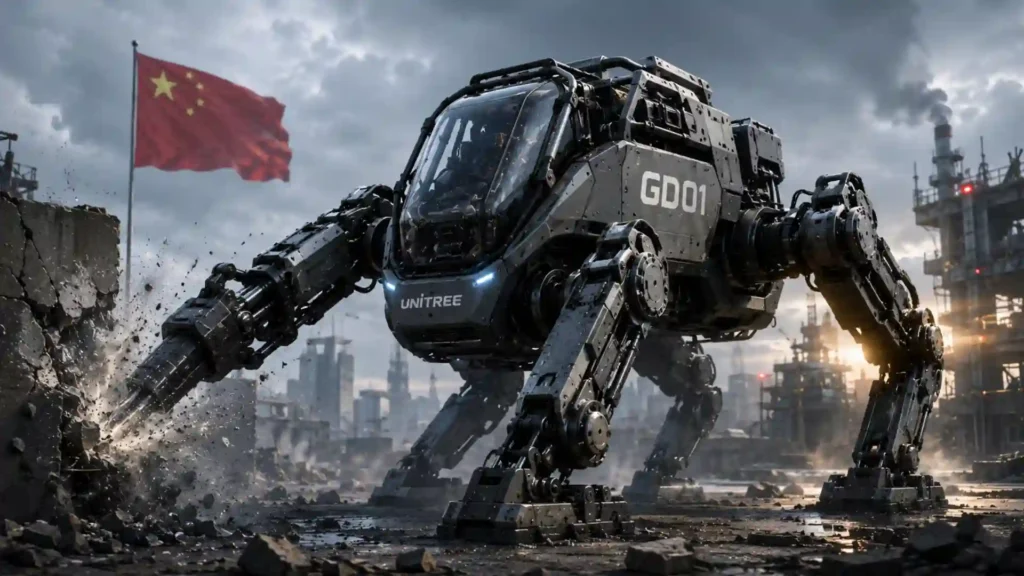
This article is an original analysis supported by the sources cited below
Science fiction becomes reality: Unitree Robotics unveils world’s first production-ready manned mecha
Global Times report with Unitree comments on GD01’s price, civilian framing, weight and early commercialization language.
Unitree Robotics debuts world’s first mass-produced robot GD01
China Daily report describing GD01’s weight, two-legged and four-legged modes, and terrain claims.
Unitree will sell you a massive ‘transformable mecha’ for $650,000
The Verge coverage noting Unitree’s product description, safety warning, cockpit questions and transformation limits.
If you have $650,000 and don’t buy this giant mecha robot you’re a fool
Wired report confirming with Unitree that GD01 is a real product and analyzing its spectacle-driven positioning.
Chinese firm unveils ‘transformer’ style manned robot
Al Jazeera video report on Unitree’s GD01 footage, size and pricing.
Unitree plans Shanghai IPO, testing interest in humanoid robots
Reuters report on Unitree’s IPO filing, revenue growth, humanoid sales and China’s embodied AI ambitions.
China’s Unitree prices new humanoid robot at deep discount to 2024 model
Reuters report on Unitree’s lower-cost R1 humanoid and price compression in Chinese robotics.
Humanoid robot G1
Unitree product page describing G1’s joint range, learning-driven control and dexterous hand features.
Robot dog B2
Unitree product page listing B2 quadruped specifications, including speed, torque, endurance and load claims.
World Robotics 2025 report – Industrial robots
International Federation of Robotics release on global industrial robot deployments and China’s record robot stock.
China’s first national standard system for humanoid robotics poised to spur industry development
Xinhua report on China’s national standard system for humanoid robotics and embodied intelligence.
China introduces a standard framework for humanoid and embodied intelligence
China Daily and Qiushi English report on China’s 2026 humanoid and embodied intelligence standard framework.
Embodied AI: China’s ambitious path to transform its robotics industry
MERICS analysis of China’s embodied AI strategy, hardware localization and humanoid robotics push.
2025 Annual Report to Congress: Military and Security Developments Involving the People’s Republic of China
U.S. Department of Defense report discussing China’s military modernization and developmental unmanned systems.
Chinese army tests human-unmanned team tactics in urban warfare drill
CGTN report on PLA urban combat training with drones, robotic dogs and unmanned ground vehicles.
China’s robot wolves join PLA exercise, official media reveals
People’s Daily Online report on robot wolves appearing in a PLA human-drone collaborative exercise.
How China could use DeepSeek and AI for an era of war
Reuters investigation into Chinese military AI, robot dogs, drone swarms, procurement records and autonomy concerns.
China’s PLA challenges and competitions
CSET analysis of PLA challenge competitions, including unmanned logistics and intelligent unmanned systems.
China’s war wolves: From commercial tech to combat power
Foundation for Defense of Democracies analysis of commercial robotics, intelligentized warfare and civil-military fusion.
Ukraine’s military to roll out units of robotic vehicles
Reuters report on Ukraine creating robotic vehicle units for offense, defense, logistics, casualty evacuation and mine tasks.
Ukraine to field 25,000 ground robots in push to replace soldiers for frontline logistics
Defense News report on Ukraine’s plan to contract 25,000 unmanned ground vehicles for frontline logistics.
Networked for war: Lessons from Ukraine’s ground robots
Modern War Institute analysis of Ukrainian ground robots, including casualty evacuation and networked drone-robot operations.
Unmanned ground systems at the tactical edge
NATO-linked white paper on tactical unmanned ground systems, operational complexity and air-ground robotic integration.
Lethal autonomous weapon systems
United Nations Office for Disarmament Affairs page noting the lack of a commonly agreed LAWS definition.
Autonomous weapons
International Committee of the Red Cross position on autonomous weapons and proposed legally binding limits.
Autonomous weapon systems and international humanitarian law: Selected issues
ICRC analysis of humanitarian, legal and ethical risks from autonomous weapon systems.
Progress on rules for lethal autonomous weapons urgently needed, says chair of Geneva talks
Reuters report on 2026 Geneva talks over lethal autonomous weapons and the absence of binding global standards.
DoD Directive 3000.09, autonomy in weapon systems
U.S. Department of Defense directive on autonomous and semi-autonomous weapon systems, human judgment and testing.
Statement of the Chinese delegation at the thematic discussion on conventional weapons
Chinese Ministry of Foreign Affairs statement on lethal autonomous weapons systems and CCW negotiations.
Working paper of the People’s Republic of China on lethal autonomous weapons systems
China’s UN working paper outlining its approach to AI military applications and LAWS-related dual-use concerns.
| Citing this article? Brief excerpts are welcome. Please credit Webiano.digital, name the author where stated, and include a link to https://webiano.digital and to this original article. Full or substantial republication requires prior written permission. Read our Copyright and Content Use Policy. |
This article was prepared with the assistance of artificial intelligence tools. The content underwent expert human review, and Webiano Digital & Marketing Agency assumes editorial responsibility for its final version and publication.