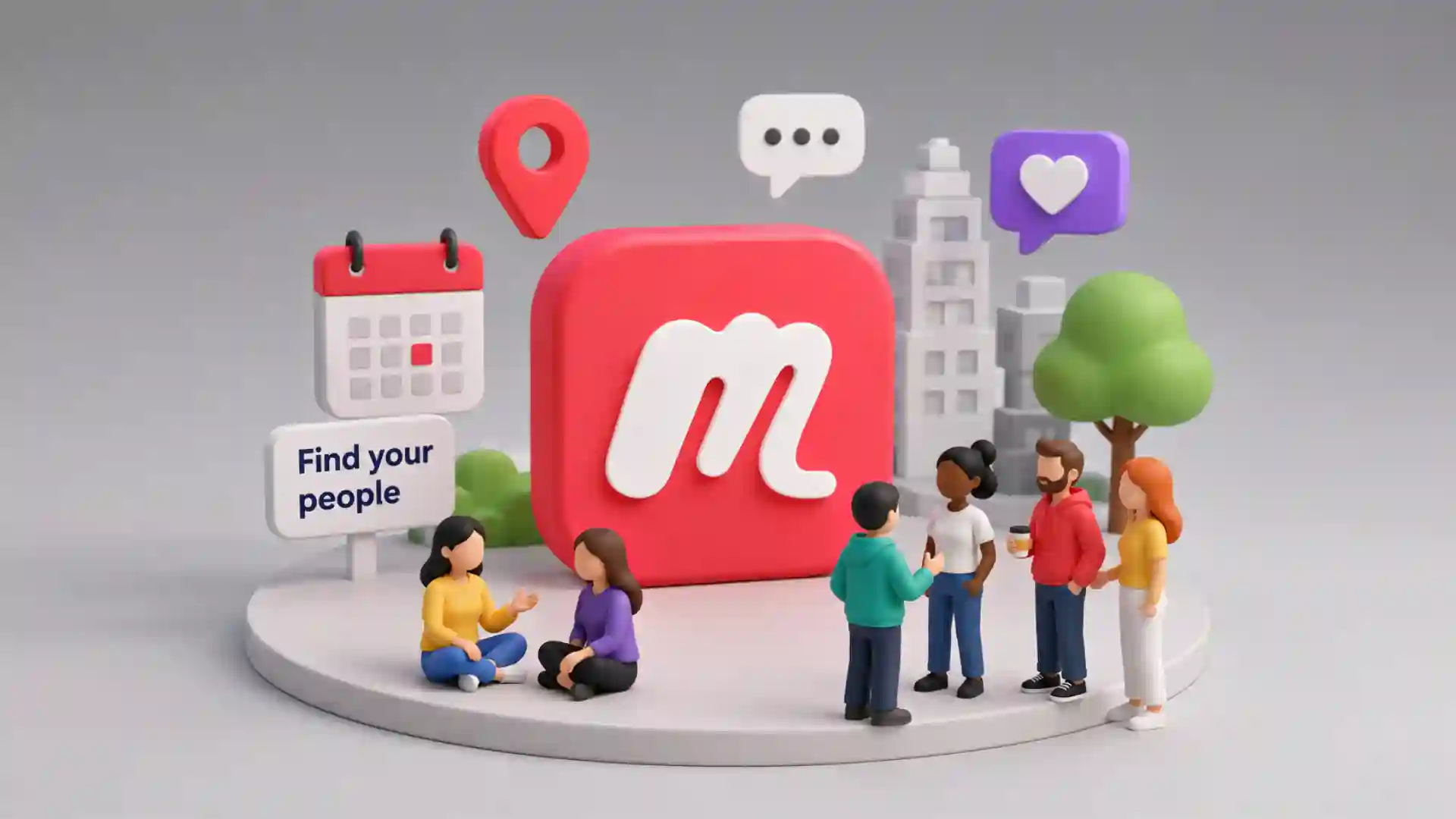
Meetup looks almost out of place now, which is exactly why it is worth opening. While most social products compete for your idle minutes, Meetup still has the odd, stubborn, almost unfashionable goal of getting you into a room, onto a trail, inside a workshop, around a table, or at least into a live online gathering with people who chose the same little corner of interest. The site is not trying to become your daily feed. It is trying to make the internet useful enough that you eventually stop staring at it.
Table of Contents
That sounds ordinary until you actually compare it with the web around it. Most platforms use your interests to keep you scrolling through people you will probably never meet. Meetup uses your interests as a sorting device for presence. Pick hiking, Python, board games, language exchange, startup pitching, grief support, figure drawing, meditation, book clubs, data science, women in tech, urban sketching, expat socials, or weekend tennis, and the site’s implied promise is blunt: somewhere nearby, or somewhere reachable online, other people are making time for this too.
The homepage keeps the proposition plain. Meetup says people use it to meet new people, learn new things, find support, get out of their comfort zones, and pursue passions together; it also says membership is free. Its top category grid includes travel and outdoor, social activities, hobbies and passions, sports and fitness, health and wellbeing, technology, art and culture, games, career and business, and science and education. That list is not glamorous, but it is revealing. Meetup is built around the fact that people rarely need one more content channel. They need a reason to leave the apartment, meet a possible friend, ask a beginner question, or return to a hobby that got buried under work.
The best way to understand Meetup is not as an event listing site. It is a half-social, half-logistical layer for human friction. It gives lonely people a lower-risk invitation. It gives organizers a ready-made audience. It gives niche communities a public doorway. It gives cities a strange public map of what their residents are secretly into. Open Meetup in a new place and you learn something that tourism guides miss: what people are actually making time for on a Tuesday night.
That is the charm. Meetup is not cool in the sleek, venture-backed, drop-shadowed sense. It is useful in the way community noticeboards, library bulletin boards, and pub flyers were useful before the web ate them. It has profiles, RSVPs, event pages, recommendations, messages, subscriptions, and paid organizer plans. Underneath all of that, the core object is still humble: a group of strangers agreeing to be less strange to one another at a given time.
A social network that still asks you to leave the screen
Meetup belongs to an older idea of the internet. The web was supposed to connect people, but in the early social web that often meant something more literal than follower counts. You found a forum, a mailing list, an IRC channel, a fandom page, a city board, a running club calendar, a hacker group, or a niche directory, and the online space pointed somewhere else. It was a map, not the destination. Meetup still carries that older smell of the web: search, discover, RSVP, show up.
Its origin story fits that design. Meetup’s own story traces the idea to founder Scott Heiferman’s experience in downtown New York after September 11, 2001, when he noticed neighbors coming together in a way they had not before. The platform was born from the thought that people should not need a disaster to meet the humans living around them. Meetup’s history page also says the site was born on June 14, 2002, before smartphones and app-first social habits reshaped the web.
That origin matters because it explains the product’s temperament. Meetup has always treated common interest as a practical bridge, not a personality brand. You do not need to be interesting to everyone. You only need enough shared context to enter a room without feeling absurd. “I saw the urban gardening meetup” is easier than “I am looking for friends.” “I am here for the JavaScript talk” is less exposed than “I moved here last month and feel lost.” The platform gives people a socially acceptable excuse to do the thing they wanted to do anyway.
The format is especially strong for adults. Children get classrooms, sports teams, school trips, shared timetables, and parents arranging the social world around them. Students get campuses, clubs, dorms, seminars, and cheap nights out. Adults often get a calendar full of work, errands, private chats, and vague promises to catch up soon. Meetup inserts a public invitation into that dead zone. It says: here is a group, here is the time, here is the host, here is the topic, here are the people who said yes.
That small structure is more powerful than it looks. A person who would never post “Does anyone want to be friends?” might RSVP to a beginner bouldering session. A developer who hates networking might attend a Go meetup because the talk has a title, a venue, and a speaker. A retired person who misses routine might join a walking group. A new parent might find a local support circle. A city newcomer might browse what is happening nearby before they know which neighborhoods matter.
Meetup’s homepage now speaks in this practical language. It shows current events, city discovery, categories, and a simple “how it works” flow: discover events and groups, connect over shared interests, and start a group to host events. The footer still exposes the old directory bones too: groups, events, topics, cities, online events, local guides, make friends. There is something refreshingly literal about that navigation. It does not hide the product behind a lifestyle theory.
The site is also a reminder that online identity is not the only kind of identity. On a feed, interests often become signals. People perform taste, politics, career ambition, body discipline, cultural literacy, or aesthetic belonging. On Meetup, interests become appointments. That shift changes the stakes. A person who says they like chess on a profile is one thing. A person who goes to a chess night every Thursday is another. Meetup rewards the second kind of identity: the one that survives contact with a calendar.
This is why the site feels more grounded than many social products. Its best communities are not built from constant posting. They are built from recurrence. Weekly language practice. Monthly founder dinners. Saturday hikes. Morning yoga. Indie game dev nights. Life drawing. Board game Sundays. Volunteer cleanups. Public speaking practice. The group page is a container, but the rhythm is the real product. When a Meetup group works, it becomes part of someone’s week, not just another icon on their phone.
The web has spent years making presence optional. Remote work, streaming, food delivery, private messaging, online courses, multiplayer games, and social feeds have made it easier to live richly through screens, and sometimes that is a gift. Meetup sits at the counterweight end of that pattern. It uses the same machinery of profiles, notifications, recommendations, and calendars, but points the machinery toward attendance. It does not reject the internet. It puts the internet in service of the room.
The quick read before you open it
| Part of Meetup | What it does well | What to watch |
|---|---|---|
| Events | Turns interests into dated invitations | Quality depends on the organizer |
| Groups | Creates repeatable local community | Some groups go quiet |
| Organizer tools | Gives hosts a ready framework | Serious organizing usually costs money |
| Discovery | Reveals niche activity near you | Big cities get the richest results |
| Profiles and RSVPs | Lower the fear of showing up cold | Attendance is never perfectly predictable |
The table captures the whole tension of Meetup. It is not magic social glue. It is a structured invitation system. Its best moments come from the people who use it well; its weakest moments come from stale groups, vague event descriptions, no-show culture, and uneven moderation. That is not a failure of the model. It is the cost of building around real people instead of polished content.
What makes Meetup worth opening
The first reason to open Meetup is curiosity. Type in a city and you see a layer of civic life that rarely appears on Instagram or Google Maps. Restaurants and landmarks tell one story about a place. Meetup tells another: who is learning Korean, who is trying stand-up comedy, who wants to talk about machine learning, who is walking after work, who is practicing English, who is building startups, who is looking for sober social events, who is playing Dungeons and Dragons, who is meeting other dog owners, who is tired of doing everything alone.
This discovery layer has a nice, messy honesty. Some events look polished. Some look amateur. Some are clearly run by a business, a coach, a recruiter, a yoga studio, a founder community, or a tech organization. Some are just a person with enough initiative to pick a café and invite strangers. The mix is part of the appeal. Meetup is not a curated culture magazine. It is a public surface where private interests become scheduled.
The second reason is low commitment. Joining a group is not the same as joining a club with membership rituals, hidden norms, and social debt. Many Meetup events let you test a scene once. You can attend a walk, a talk, a board game night, or a casual coffee without making a dramatic identity claim. That trial quality matters because many people are not sure what they want. They want more friends, more movement, more learning, more professional contact, or more life outside the house, but the category is blurry. Meetup lets them sample.
The third reason is that groups create context before conversation starts. Walking into a room of strangers is hard when the only shared fact is “we are all here.” Walking into a room where everyone came for beginner salsa, climate tech, UX research, watercolor, Spanish practice, or single-parent hiking is much easier. The topic does some of the social labor. It gives people a first sentence. It gives the host a way to shape the room. It gives nervous attendees a reason to stay even if the first five minutes feel awkward.
The fourth reason is the archive effect. A good Meetup group page shows more than a single event. It hints at history: past events, member count, organizer profile, photos, descriptions, themes, ratings, and frequency. That gives a newcomer a sense of whether the group is alive. A group with regular events feels safer than a random one-off. A group with clear expectations feels safer than a vague listing. A group with photos from previous gatherings feels less like a trapdoor into the unknown.
The fifth reason is that Meetup is useful even when you do not RSVP. Browsing alone has value. It tells you what exists. It might reveal that your city has a silent book club, a data visualization group, a women’s cycling circle, a language exchange, a philosophy salon, a sober social group, a knitting night, an indie founders breakfast, or a weekend nature cleanup. Even if you do nothing, the map changes. Your city becomes less opaque.
That may be Meetup’s most underrated feature: it makes a place feel more enterable. Cities are full of closed loops. Friend groups, private chats, alumni networks, office circles, gyms, clubs, studios, and recurring dinners are hard to see from outside. Meetup exposes some of those loops and adds a doorbell. Not every door opens warmly, but at least the door exists in public.
The platform also works for people in transition. Moving to a new city, changing careers, returning from burnout, becoming single, entering parenthood, retiring, working remotely, or leaving university all create social gaps. Meetup cannot repair a life by itself, but it gives transition a practical interface. Instead of “find your people,” which is too large and sentimental, it offers a smaller action: attend this event next Wednesday.
That concrete action is the reason the site has survived so long. Social need is constant, but vague. Meetup translates it into listings, RSVPs, reminders, organizers, venues, and calendars. The product is at its best when it does not over-explain connection. It simply shows that twenty-three people plan to do the same thing at the same time, then lets your curiosity compete with your reluctance.
Meetup’s official About page frames the range well. It gives examples such as exploring a city, trying food, hiking, touring breweries, building a career, testing a prototype, networking, taking a class, learning a language, pitching to investors, creating a podcast, writing a screenplay, discussing art, or getting feedback on creative work. That breadth is not just category inflation. It shows the central trick: Meetup works for recreation, identity, work, support, and skill-building because all of them benefit from repeated gathering.
The site’s best use cases are not equally visible, though. Tech meetups, language exchanges, hiking groups, social mixers, and professional communities tend to be easy to understand. Support groups, identity-based groups, and small hobby groups can be more delicate. The difference between a great group and a bad one often lies in tone: whether the organizer describes who belongs, what happens, what the event costs, what beginners should expect, how accessible the venue is, and whether the space has rules against sales pitches or harassment.
That is where Meetup feels less like software and more like civic infrastructure. A city’s Meetup scene depends on people willing to host. The software provides forms, search, payments, reminders, and group pages. The community depends on somebody choosing the venue, setting the mood, writing the description, greeting new people, handling the awkward person, answering messages, and posting the next date. The hidden labor is huge.
This is also why browsing Meetup can be strangely moving. Behind every decent group is a person who decided the interest was worth making public. Someone thought, “There should be a place for this.” There should be a place for women learning to code. There should be a place for anxious beginners to hike. There should be a place for divorced dads to talk. There should be a place for people learning French badly. There should be a place for product managers to compare notes without pretending work is their whole personality.
A feed turns that kind of impulse into posts. Meetup turns it into logistics. The difference sounds small but feels large. Posting about wanting community is expressive. Hosting a recurring community is administrative, social, and risky. Meetup’s value lives in the gap between those two acts.
The organizer economy underneath the calendar
Meetup is free to join, but it is not free to run at the serious end. That is one of the most important things a new user should understand. Members can browse and join without paying a membership fee, but organizers who create and maintain groups often sit inside Meetup’s subscription model. The platform’s help center says organizer subscription prices start at $29.99 per month for Standard, with six-month and annual starting prices shown, while Pro starts at $55 per group per month or $47 per group per month on a longer billing period. Prices vary by location, offer, currency, platform, taxes, and account circumstances.
That payment structure shapes the culture of the site. On one side, charging organizers makes sense. A person who wants to gather strangers at scale needs tools, notifications, member management, event pages, messaging, and discovery. On another side, the fee creates pressure. Organizers may collect dues, charge event fees, seek sponsors, promote a business, or treat the group as part of a marketing funnel. That does not automatically make the group bad. It does change the social contract.
The platform is honest about the organizer’s role. Meetup’s billing help says every Meetup group needs a local organizer with an active subscription plan, and groups without an active organizer close after fourteen days without a named organizer. It also says many organizers collect member dues or event fees to cover costs. That line explains a lot of what a newcomer sees: free events, paid workshops, donation-based circles, professional communities, branded networks, and social groups asking for small contributions.
The strongest Meetup organizers tend to understand the difference between hosting and harvesting. Hosting means creating a room where people feel oriented, expected, and safe enough to participate. Harvesting means treating attendees as leads, eyeballs, or wallet-openers. The platform contains both. You can find generous volunteer organizers who have kept a walking group alive for years. You can also find events that look like community from a distance and become sales seminars once you arrive.
That tension is not unique to Meetup. Any public gathering layer attracts people with motives. The useful question is not whether commercial intent exists. It is whether the intent is clear. A paid drawing class, founder dinner, yoga session, or professional workshop can be excellent when the price, host, format, and expectations are transparent. A “free networking night” that quietly turns into a pitch funnel feels worse because it borrows the language of community while chasing extraction.
Meetup Pro makes this commercial layer even clearer. The Pro page describes tools for building an email list, branding a community, creating groups across the globe, hosting multi-group or hybrid events, sending cross-group messages, and using insights to understand engagement. It is aimed at larger communities, brands, institutions, and organizations that want a network rather than a single local group.
There is nothing wrong with that, but it changes the flavor. A tiny book club and a global product community both fit inside Meetup, yet they do not feel like the same species. The tiny book club depends on trust, taste, regularity, and a host who remembers your name. The global product community depends on systems, branding, communications, data, and repeatable event formats. Meetup’s product has to serve both, which explains some of its occasional awkwardness.
The pricing model also creates a quiet barrier for civic good. A person who wants to start a free neighborhood walking group, mutual-aid circle, poetry night, or support community may hesitate when hosting requires a subscription beyond the lightest available paths. Meetup introduced Starter as a free plan for first-time organizers, according to its 2026 roadmap, and that matters because many good communities start as a small experiment before they become worth paying to maintain.
The best product question for Meetup is not “How does it make money?” It is “How does it charge without discouraging the exact people who make the platform worth using?” Community software has a fragile supply side. If organizers burn out, leave, or move to private chats, the discovery layer loses oxygen. If the platform undercharges, it has no business. If it overcharges or overcomplicates, it risks turning the most generous organizers into reluctant customers.
That balance is part of Meetup’s current chapter. Bending Spoons entered into an agreement to acquire Meetup in January 2024, and the acquisition closed later that month. In public statements around the deal, the company described Meetup as a community-building platform with more than 60 million registered members; the Business Wire announcement also described more than 330,000 groups active across 184 countries and 10,000 cities.
The new owner has put product improvement at the center of its pitch. In a February 2024 Meetup blog post, Bending Spoons said it intended to invest nearly $50 million over the next few years into improving the product and growing membership. The post named event discoverability, easier event creation, organizer engagement, simplification, automation, and fixing buggy areas as early priorities.
Those priorities sound practical rather than glamorous, which is probably right. Meetup does not need to become a metaverse, creator economy platform, or content network. It needs to help people find the right thing, trust the thing, attend the thing, and maybe return. It needs to make organizers less exhausted. It needs to keep stale pages from making cities look dead. It needs to make discovery better without burying odd little groups under polished professional events.
The danger is that community products are easy to over-instrument. Once a platform starts measuring engagement, attendee conversion, group growth, recommendation clicks, organizer retention, and paid plan upgrades, it may start favoring the kinds of gatherings that behave best in dashboards. Big, repeatable, commercially useful events often look healthier than fragile, local, deeply human ones. A twelve-person grief walk may be more important than a hundred-person webinar, but the software may not know how to value that.
Meetup’s promise depends on resisting that flattening. The platform needs its polished professional communities and its deeply unfashionable hobby groups. It needs the AI automation webinar with hundreds of attendees, but it also needs the person hosting ten beginners in a library room. It needs high-volume event discovery, but it also needs the small group where the organizer writes, “Come even if you are new; I will be wearing a green scarf near the entrance.”
That last sentence is the soul of Meetup. The product can modernize, redesign, automate, and recommend. The magic still happens when a stranger feels expected.
A slightly awkward product in a very useful way
Meetup’s awkwardness is part of its appeal. A lot of modern social software tries to erase social discomfort with polish: infinite swipes, algorithmic matching, AI icebreakers, glossy profiles, frictionless messaging, staged authenticity. Meetup cannot erase the actual hard part. You may still have to put on shoes, find the venue, walk through the door, say your name, and survive the first ten minutes of uncertainty.
That friction is not a bug. It is the point. Friendship, trust, confidence, and local belonging rarely arrive through a perfect interface. They arrive through repeated low-grade awkwardness that becomes familiar. Meetup’s interface can make the first step easier, but it cannot fake the second one. You still have to show up.
This gives Meetup a different emotional texture from friend-making apps. Apps that match individuals often create intense one-to-one pressure. The stakes feel personal before the relationship exists. Meetup shifts the pressure onto the activity. You are not meeting “a friend match.” You are attending a sketching session, a talk, a run, or a board game night. If no friendship sparks, the event still had a purpose. That is a healthier bargain for many people.
Group context also reduces the risk of rejection. A bad one-to-one meetup can feel like a verdict. A mediocre group event is just a mediocre evening. You can talk to someone else, listen quietly, focus on the activity, or leave early. The group diffuses the spotlight. For shy, cautious, or socially tired people, that matters.
The product’s calendar structure keeps desire honest too. People often like the idea of becoming social, fit, creative, professionally connected, or locally involved. The test is whether they reserve time. Meetup converts vague aspiration into scheduling. That is why the RSVP button carries a small psychological charge. It asks you to move from imagining a life to placing a claim on an evening.
Of course, RSVPs are not attendance. Every Meetup organizer knows the gap between people who click yes and people who arrive. Weather, nerves, work, children, transport, social anxiety, and ordinary fatigue all interfere. The product can remind, nudge, message, and simplify check-in, but it cannot make strangers brave on command. The organizer’s real work is to make the event feel worth the effort before it happens and welcoming once it begins.
Meetup’s 2026 roadmap shows that the company understands some of this. It says 2025 brought the platform’s most notable redesign in years, with a new web design rolled out in October and mobile design finalized in December. For 2026, Meetup says it plans a unified app for organizers and members, QR-code attendance tracking, richer member profiles, a Super Organizer badge, and experimental connection tools outside events. It also says 75 percent of organizers started as members, which is one of the most important facts about the platform’s social loop.
That 75 percent figure explains why the member experience and organizer experience cannot be separated. A bored member is not just a lost attendee. They might have been a future host. A nervous attendee who has a good first event might later create a group. A group regular might become a co-host. The platform grows when people move from joining to hosting, and that movement is cultural before it is technical.
The planned unified app is interesting for that reason. Separate organizer tools can make sense for power users, but they may also reinforce a wall between “people who attend” and “people who run things.” A single shared home suggests a softer ladder. You attend, help, co-host, create, repeat. The best community platforms make leadership feel reachable, not mystical.
The Super Organizer badge is more delicate. On one hand, it could help members identify reliable hosts. Newcomers need signals, especially when safety and quality matter. On another hand, badges can nudge community toward platform-approved performance. The small, weird, quiet, non-optimized groups may not look “super” in a metric system, yet they may be exactly what someone needs.
Richer profiles are delicate too. Meetup’s help center already describes member insights for organizers and Member+ subscribers, including first-time attendees, gender ratio, age range, what members are looking for, and shared interests, with some data drawn from personal information users submit. Those signals may reduce anxiety by helping people understand who might attend. They also raise taste questions about how much pre-knowledge improves social life and how much turns people into filters before they meet.
There is a fine line between confidence and pre-judgment. A newcomer may feel safer knowing the group includes first-timers and people near their age. Yet too many demographic hints can make people shop for social comfort instead of entering mixed rooms. Meetup’s challenge is to make attendance less scary without making social discovery too sanitized.
That tension touches a deeper truth about the web. The internet trained people to preview everything: restaurant menus, Airbnb beds, dates, employers, hiking routes, apartments, movies, gyms, doctors, and strangers. Meetup belongs to that preview culture, but its best results still require unpreviewable human reality. The person who looks boring online may be warm in the room. The group with a clumsy description may have the kindest host. The event with beautiful copy may be sterile.
Meetup should not remove all uncertainty. It should remove needless uncertainty: where to go, what to bring, whether beginners are welcome, who is hosting, what the cost is, what happens if it rains, whether the event is accessible, how long it lasts, and how to find the group. The remaining uncertainty is social life itself. A platform that tries to eliminate that would accidentally eliminate the reason to gather.
This is why Meetup’s old-fashioned calendar is still a strong product object. A feed is endless and soft. A calendar is finite and firm. It forces choice. It creates anticipation. It lets people plan around a future self who might be a little braver than the present one. “Thursday at 7” is a tiny contract between your current hope and your future body.
Why Meetup still matters after the feed won
The feed won attention, but it did not win belonging. That distinction explains Meetup’s staying power. A person can spend three hours reading posts from people who share their interests and still feel socially untouched. They can know every debate in their field, every meme in their fandom, every outrage in their city, and every aesthetic trend in their subculture, yet have nobody to call on a quiet Saturday. Meetup addresses the gap between shared interest as content and shared interest as contact.
That gap has widened with remote work and private messaging. Many people now spend less accidental time with loose acquaintances. Offices, cafés, classrooms, gyms, churches, unions, clubs, and neighborhood spaces no longer supply the same default social texture for everyone. Private chats are great for existing relationships, but weak for creating new ones from scratch. Feeds provide ambient social noise. Meetup offers public entry points.
Public entry points are underrated. A healthy city needs more than venues and apps. It needs visible reasons for strangers to gather without pretending they already know someone. Meetup groups can provide that reason at small scale. A chess night is not a major institution. A weekly coding meetup is not a civic miracle. A Saturday walking group is not a loneliness policy. Yet these little doors add up. They make the difference between a city that is physically crowded and socially locked, and one with cracks where newcomers can enter.
This is especially useful for niche interests. Mainstream social life tends to reward broad categories: drinks, dinner, sports, work, school, family, dating. Niche interests need discovery infrastructure. A person into climate fiction, Arduino, urban foraging, improv for beginners, Stoic philosophy, birdwatching, queer board games, indie hacking, or Korean conversation may not find their people by chance. Meetup makes small demand visible enough for supply to gather around it.
The platform is also a living index of participation. Social media shows what people want to display. Meetup shows what people are willing to schedule. That difference gives it cultural value. You can learn a lot from what a city’s residents do when no one is forcing them: which skills they study, which anxieties they organize around, which hobbies survive adulthood, which professional tribes recruit publicly, which communities need support, and which trends have escaped screens into rooms.
Some of Meetup’s strongest categories reveal practical loneliness rather than glamorous lifestyle. Language exchanges, make-friends events, new-in-town groups, over-50 socials, introvert-friendly meetups, divorce support, grief walks, career transitions, and hobby re-entry groups all point to people trying to rebuild ordinary social fabric. The site’s homepage says members use Meetup to make new friends and connect with locals over shared interests, and that phrasing is plain because the need is plain.
There is a temptation to dismiss this as obvious. Of course people need friends. Of course hobbies are good. Of course local groups matter. Yet the web has repeatedly built products that monetize social appetite while avoiding the heavy work of actual social repair. Meetup remains interesting because it never fully separated online discovery from offline commitment. It keeps dragging the conversation back to attendance.
It also has a healthier relationship with scale than many social products. A Meetup group does not always become better when it becomes huge. Some events need twenty people, not two thousand. Some communities lose their warmth when they grow too fast. Some groups need a slow rhythm and a trusted host. This makes Meetup a strange fit for growth culture. The platform may want more members, more events, and more subscriptions, but the human unit often works best at modest size.
That modesty is refreshing. The web is full of tools that promise reach. Meetup is more interested in enoughness: enough people for a hike, enough people for a room, enough people for a discussion, enough people for a recurring habit. “Enough” is an underrated product metric. It is what communities feel when they are alive but not overwhelmed.
Meetup’s relationship with online events complicates the story. The platform now includes online and hybrid events, and the homepage exposes online events in its navigation. Online events are not a betrayal of the mission; they are useful for niche topics, accessibility, illness, distance, and professional learning. Yet Meetup is most distinctive when the possibility of physical presence remains nearby. A Zoom webinar can happen anywhere. A Wednesday night group at a library branch belongs to a place.
Hybrid events may become one of the product’s most useful middle grounds. The Pro and subscription materials refer to hybrid event tools, and the 2026 roadmap mentions QR-code check-ins for smoother attendance tracking. These features sound mundane, but mundane features often decide whether organizers keep going. If attendance is easier to track, if communications are clearer, if event duplication is simpler, if reminders work, if the door check-in is less chaotic, hosts have more energy left for hospitality.
Hospitality is the word that matters. The best Meetup organizers are not merely admins. They are hosts. They create the emotional weather of the group. They decide whether newcomers are greeted or left hovering near the door. They decide whether the loudest person dominates. They decide whether the event starts on time, whether the description matches reality, whether the group has norms, and whether people have a reason to return.
Software rarely talks well about hospitality. It talks about engagement, retention, conversion, growth, insights, and communications. Those words describe platform health. Hospitality describes human health inside the event. Meetup’s future depends on whether its product improvements support hospitality rather than simply measuring activity around it.
That is why the old groups matter. A long-running Meetup group is more than content inventory. It is social memory. It has inside jokes, recurring faces, traditions, preferred venues, seasonal rhythms, and a host who knows the difference between a quiet newcomer and a disruptive attendee. If the platform makes life easier for these organizers, it preserves real local knowledge. If it alienates them, it loses more than listings.
The Bending Spoons era makes this question sharper. Acquisitions often bring product energy, engineering resources, pricing changes, redesigns, and sharper business goals. Meetup’s 2026 roadmap promises deeper connection, easier organizing, and a more supported member experience. The promise is sensible. The test will be whether members and organizers feel more capable, not merely more managed.
The platform’s age is an asset here. A twenty-plus-year-old social product carries habits newer apps have to invent. People already understand what a meetup is. Cities already have organizers who know the format. Professional communities already use it. New residents already search it. That cultural memory lowers explanation costs. You do not have to teach the concept from zero.
Age is also a liability. Old social products accumulate stale groups, abandoned pages, weird edge cases, confused pricing memories, uneven app experiences, and users who remember earlier versions better than the current one. Meetup’s challenge is to modernize without sanding off the public-noticeboard quality that makes it useful. Too much polish could make it feel like any other event platform. Too little care could make it feel neglected.
Its best path is probably boring in the best sense. Better discovery. Cleaner event pages. Fewer dead groups in search. Clearer host signals. Better first-timer cues. Easier co-hosting. Smarter reminders. More transparent pricing. Safer reporting. Stronger organizer support. A calendar that syncs properly. Profiles that reduce anxiety without turning people into demographic menus. None of that sounds spectacular. All of it matters.
Small doubts before you RSVP
Meetup is not equally good everywhere. Big cities and university towns tend to show more activity, more niches, and more professional groups. Smaller places may have fewer listings, older groups, or less frequent events. That does not make the platform useless; it changes the way you use it. In a thin market, Meetup may be less of a menu and more of a prompt. If the group you want does not exist, that absence tells you something too.
The organizer quality varies a lot. This is the price of openness. Some organizers write clear descriptions, manage expectations, and build warm rooms. Some disappear, overpromote, cancel late, or fail to host. Some groups are really communities. Some are lead funnels. The platform can signal quality, but it cannot replace judgment. New attendees should read the full description, check recent activity, look at past events, scan comments, and notice whether the host sounds specific or vague.
The RSVP count deserves skepticism. A large RSVP number can mean energy, but it can also mean casual clicking. A small RSVP number can mean intimacy, not failure. The better signals are recurrence, host clarity, photos, comments, and whether the event has a concrete plan. “Meet new people downtown” is weaker than “We meet at this café, sit near the back, play three rounds of beginner-friendly games, and new people are introduced at 7:10.”
Safety deserves plain thought. Meetup’s public structure makes events easier to assess than random private invitations, but public does not mean risk-free. First events are best in public venues, with clear hosts, visible group history, and practical exit options. Identity-based, dating-adjacent, wellness, finance, and support communities require extra judgment because the social stakes are higher. A warm event description is good. Clear rules are better.
Meetup’s help center keeps community guidelines, reporting, content policies, organizer standards, and member restrictions under its policies area. That matters because a gathering platform has to manage more than spam. It has to deal with harassment, misleading events, unsafe behavior, commercial misuse, and conflicts between organizers and attendees. The existence of policy pages does not guarantee perfect enforcement, but it signals that Meetup is operating as a moderated social platform, not just a neutral calendar.
The paid layers also deserve attention. Meetup’s pricing pages make clear that rates vary and that exact subscription prices should be checked inside the account. New organizers should not rely on someone else’s old price screenshot, a Reddit thread, or a memory from years ago. They should inspect the current plan shown to them, think about whether dues or ticket fees are appropriate, and decide whether the group has enough purpose to justify the cost.
For ordinary members, the paid ecosystem appears in softer ways. Some events cost money. Some groups ask for dues. Some insights sit behind Member+ or organizer access. Some communities use Meetup as a top-of-funnel entry into a separate newsletter, course, venue, or business. Again, that is not automatically a problem. The question is whether the exchange feels honest. Good community commerce feels clear. Bad community commerce feels disguised.
Meetup’s old strength was that it made informal organizing look legitimate. A person could start a group about almost anything and borrow enough platform structure to attract strangers. Its newer challenge is that legitimacy can be imitated. A polished event page may cloak a thin experience. A clumsy page may hide a wonderful group. The user has to develop taste.
Taste on Meetup starts with specificity. Good listings tell you what will happen, who the event is for, what level is expected, whether newcomers are welcome, whether there is a fee, where to meet, how to recognize the group, what to bring, and what happens after. Bad listings lean on misty promises of connection, success, confidence, or transformation. The more vulnerable the topic, the more specific the event should be.
Another good sign is repetition without desperation. A group that runs regularly, keeps descriptions fresh, shares photos or comments, and has a host who responds like a human is promising. A group that constantly posts grand claims, vague webinars, or recycled events across many cities may still be useful, but it should be read with sharper eyes. Meetup’s scale lets real communities and aggressive marketing occupy nearby tiles.
The platform itself can sometimes feel busy. Between groups, events, subscriptions, member insights, Pro features, notifications, and recommendations, Meetup carries years of product layers. This is common in older platforms, but it affects trust. The simpler the user’s goal, the more the interface should stay out of the way. Find something, understand it, RSVP, attend, return. Anything that distracts from that path weakens the core.
Yet the imperfections are part of why the site feels real. A too-perfect social discovery product would be suspicious. Real communities are uneven. Real calendars have cancellations. Real hosts get tired. Real newcomers no-show. Real local scenes include oddballs, professionals, hobbyists, lonely people, helpers, sellers, learners, and people who just want a reason not to spend another evening alone. Meetup’s messiness mirrors the thing it organizes.
The best user posture is hopeful but not gullible. Open the site with curiosity. Read carefully. Start with public, beginner-friendly events. Try more than one group before judging the whole platform. Notice organizers who do the hard work of making strangers comfortable. Pay for events when the value is clear. Leave spaces that feel off. Return to the ones where the host remembers newcomers matter.
That posture turns Meetup from a directory into a habit. Browsing once may be interesting. Attending once may be awkward. Returning three times is where the product begins to work. Familiarity accumulates. The venue becomes known. Names stick. The host recognizes you. Someone asks whether you are coming next week. The group stops being an event listing and becomes a small piece of your life.
The practical doubts before you RSVP
Yes, but activity depends heavily on location and category. The company’s public acquisition announcement in 2024 described more than 60 million registered members, more than 330,000 active groups, 184 countries, and 10,000 cities. Those numbers do not guarantee a lively scene in every neighborhood, but they do show the platform is not a relic sitting untouched on the web.
No. Meetup includes online events and hybrid events, and its homepage links directly to online events. The platform is still most distinctive when it connects people to local rooms and recurring groups, but online gatherings make sense for niche professional topics, remote communities, accessibility, and people who want a softer first step.
Basic membership is free, according to Meetup’s homepage. Costs may appear through event tickets, group dues, Member+ features, or organizer-run activities. Organizers face a separate subscription model, with Standard and Pro plans listed in the help center and exact rates depending on account, platform, currency, location, taxes, and offers.
It is strongest for people who want a structured excuse to meet others through a shared interest: newcomers to a city, remote workers, hobby returners, career switchers, tech learners, language learners, founders, hikers, board gamers, creatives, and anyone who prefers a group context over one-to-one social apps. The site is less strong for people who want instant friendship without attending, because the whole model depends on showing up.
Yes, when the group has substance. Meetup’s About page explicitly includes career activities such as testing prototypes, networking, taking classes, learning skills, pitching to investors, and building a career. Tech, startup, design, product, data, and founder groups are often some of the most visible Meetup communities in larger cities. The best professional events teach or gather around a real topic; the worst ones are thin rooms full of people trying to extract value from one another.
It can be, but the wording matters. Meetup is better at creating repeated low-pressure contact than instantly producing friendship. A single event may be pleasant and still lead nowhere. A recurring group gives familiarity a chance. The strongest friend-making path is usually not a generic “make friends” event, although those can work. It is often a repeated activity where conversation happens naturally because the group has something to do.
Yes, if they are willing to host rather than merely announce. Starting a group means setting expectations, answering questions, welcoming newcomers, handling cancellations, maintaining rhythm, and sometimes paying. Meetup’s own roadmap says 75 percent of organizers started as members, which suggests the healthiest path is to attend first, learn what good hosting feels like, then create the group you wish existed.
They treat one awkward event as proof that the whole platform is bad. Meetup is a marketplace of rooms, not a single room. One group may be stale, salesy, or socially flat. Another may become the best part of your month. The product works through sampling, taste, and return.
They assume a listing is enough. It is not. People need clarity before the event and welcome during the event. A strong organizer writes like a host, not a promoter. They say exactly what will happen, who belongs, how to find the group, what the first ten minutes look like, and why a newcomer will not feel stranded.
The web gem hiding in plain sight
Meetup is not hidden in the usual sense. It is not an obscure side project, a tiny experimental site, or a one-person tool with a cult following. It is a large, old, known platform with millions of registered users and a corporate owner. Yet it still fits Web Radar because many people have forgotten what kind of internet it represents. It is hiding in plain sight as a working relic of a more useful web.
The interesting part is not nostalgia. Plenty of old websites survive by inertia. Meetup survives because the problem keeps renewing itself. People move. Friend groups dissolve. Work becomes remote. Hobbies fade. Cities feel anonymous. Professional scenes shift. People leave school and lose the last institution that made social life automatic. The need for public, interest-based gathering keeps returning with each new phase of adulthood.
Meetup’s design has always been conceptually simple: use the internet to get off the internet. The company’s own story uses almost that exact idea, saying people could use the internet and then connect in real life. That line is still the whole pitch. It is also a small rebuke to much of the social web, which learned to treat connection as something that happens inside the product.
The best version of Meetup feels almost anti-addictive. You browse, choose, RSVP, attend, and leave the platform behind for a while. A perfect Meetup session does not end with you doomscrolling more Meetup. It ends with you walking home with someone’s name in your head, a new place in your city unlocked, a skill practiced, a business card in your pocket, a photo from a hike, or a reason to return next week.
That makes it an oddly moral product category. Not moral because Meetup is pure or because every group is good. Moral because the product’s healthiest success happens outside the product. The company may measure sign-ups, subscriptions, RSVPs, engagement, and retention, but the user’s real win is often invisible: a friend made, a fear reduced, a city softened, a habit restarted, a professional doorway opened, a lonely night avoided.
The web needs more products whose best outcomes are not trapped inside their dashboards. Meetup is not alone here; maps, ticketing sites, library calendars, local newsletters, volunteer directories, and independent community boards all share some of this spirit. But Meetup’s scale and longevity make it one of the clearest examples. It is a web platform with an exit wound built into the model.
There is also something quietly radical in the phrase “start a group.” Most platforms invite you to post, follow, subscribe, comment, like, share, or create content. Meetup invites you to convene. Convening is harder than posting because it involves responsibility for other people’s time. It asks for care, planning, and social courage. The platform’s future depends on whether it keeps making that act feel possible for ordinary people, not just brands and professional organizers.
This is where the 2026 roadmap sounds promising. A free Starter plan for first-time organizers, a unified app, better attendance tracking, richer profiles, stronger organizer signals, and experimental connection tools all point toward lowering the gap between member and host. The right execution could make Meetup feel less like a directory and more like a living ladder from curiosity to participation to leadership.
The wrong execution would make it feel over-managed. If badges become too dominant, if paid features split trust too sharply, if recommendation systems bury small communities, if commercial events crowd out local hobby groups, or if organizers feel squeezed, Meetup could lose the warm middle that makes it special. Community products do not fail only when they break. They fail when the best people stop caring enough to host.
For now, the site remains worth opening precisely because it is not trying to be everything. It is a calendar with social memory. It is a search engine for shared interests. It is a directory of possible rooms. It is a business built on unpaid and paid hosting labor. It is a local discovery tool. It is a professional community platform. It is also, at its best, a small antidote to the loneliness of endless online proximity.
The most underrated way to use Meetup is to browse it before you need it. Look at your city while life is fine. Notice the groups that seem alive. Save the ones that feel like a future version of you. Check the organizers who write with care. Join one low-pressure event before loneliness or career panic makes the stakes feel too high. Community is easier to enter before it becomes urgent.
The most generous way to use Meetup is to host something clear and modest. Not a grand movement. Not a personal brand. Not a funnel pretending to be a circle. A walk. A reading group. A beginner practice session. A demo night. A quiet coworking table. A local breakfast for people in the same field. A Saturday sketch club. A monthly “new here” coffee. The platform is built for exactly that scale of courage.
The most honest verdict is that Meetup is uneven, sometimes clunky, sometimes commercial, and still unusually worth keeping in your internet toolkit. It will not give everyone a community. It will not make every city feel alive. It will not turn awkwardness into ease. What it does is rarer than it looks: it keeps a public door open between online interest and offline life.
Open it when you move somewhere new. Open it when your social world has quietly shrunk. Open it when you want to learn something without making it a private self-improvement project. Open it when you are bored of feeds that know your interests but not your absence. Open it when you want proof that somewhere nearby, people are still gathering around oddly specific things.
Meetup’s staying power comes from one simple truth: the internet is better when it helps people find a room they would not have found alone. That room may be physical, virtual, hybrid, professional, playful, serious, awkward, or unexpectedly warm. The point is not that every RSVP changes your life. The point is that a website still exists to make showing up feel slightly more possible.
Author:
Jan Bielik
CEO & Founder of Webiano Digital & Marketing Agency
This article is an original analysis supported by the sources cited below
Meetup homepage
Official homepage used to confirm Meetup’s current member-facing promise, free membership wording, discovery categories, event examples, city browsing, and basic “discover, connect, start a group” flow.
Meetup about page
Official About page used to understand how Meetup describes its purpose and the activities it wants to support, from exploring a city to career-building and creative work.
The story of Meetup
Meetup’s own history piece used for the origin story after September 11, the founding idea, and the “internet to real life” framing behind the product.
Highlights and milestones from 20 years of Meetup
Meetup’s anniversary article used to confirm the June 2002 launch timing and the platform’s early social-web context.
A new home for Meetup
Meetup blog post by Bending Spoons CEO Luca Ferrari used to confirm the January 2024 acquisition announcement and the ownership transition.
Recent changes and a look toward the future
Meetup blog post used to confirm Bending Spoons’ stated investment plan and early product priorities after the acquisition.
The 2026 Meetup roadmap
Meetup product roadmap used to confirm the 2025 redesign, Starter plan, organizer-to-member loop, unified app plan, attendance check-in plan, richer profiles, Super Organizer badge, and experimental connection tools.
Organizer subscription prices overview
Meetup Help Center pricing article used to confirm current starting prices for Standard and Pro organizer plans and the differences between Standard and Pro features.
Who pays for a Meetup group
Meetup Help Center article used to confirm that primary organizers pay for organizer subscriptions and that groups require an active organizer.
| Citing this article? Brief excerpts are welcome. Please credit Webiano.digital, name the author where stated, and include a link to https://webiano.digital and to this original article. Full or substantial republication requires prior written permission. Read our Copyright and Content Use Policy. |
This article was prepared with the assistance of artificial intelligence tools. The content underwent expert human review, and Webiano Digital & Marketing Agency assumes editorial responsibility for its final version and publication.