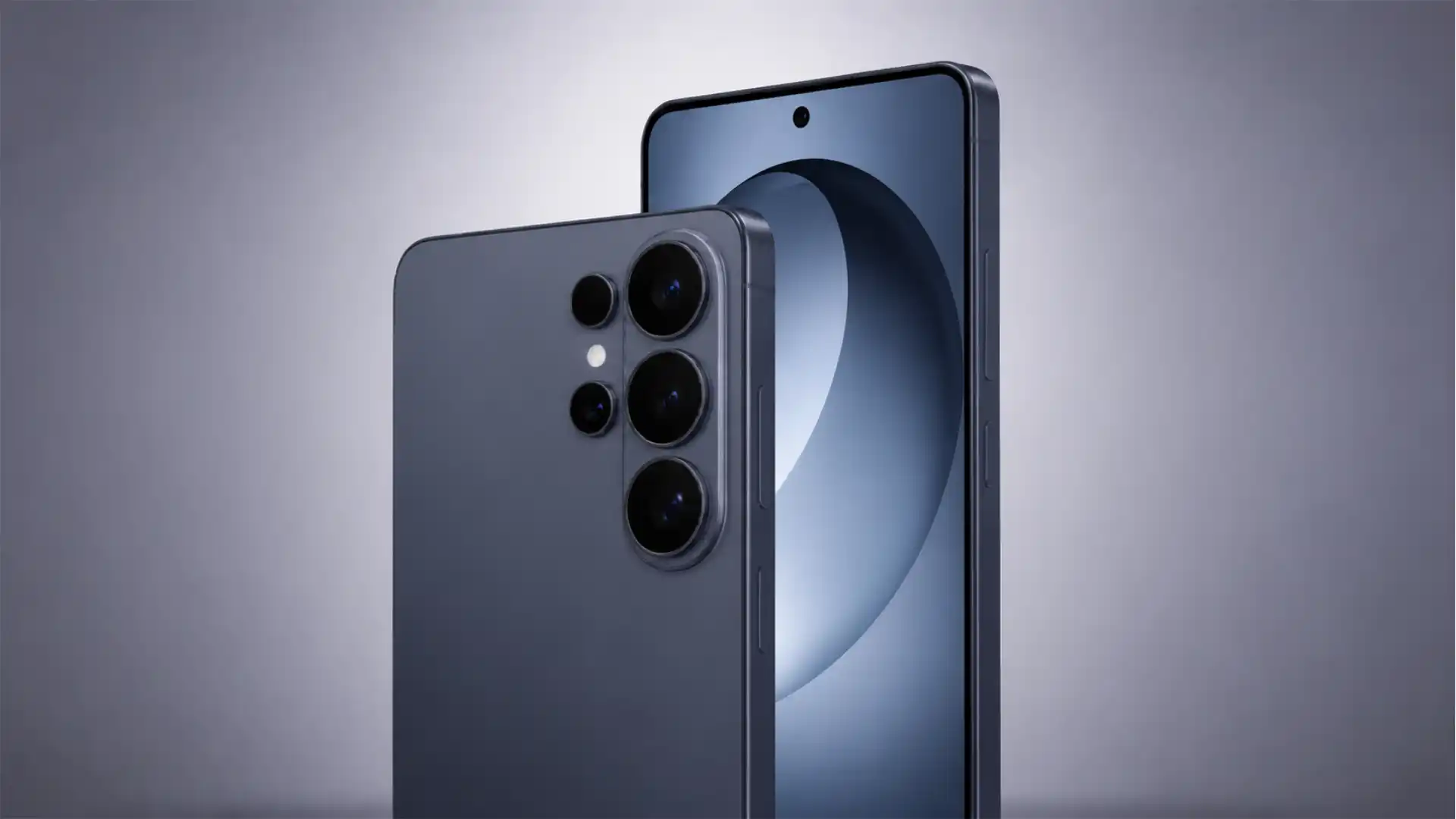
Samsung has filed paperwork for a phone it has never announced. Records uncovered in the GSMA database list four separate Galaxy S27 model numbers: the base Galaxy S27 (SM-S952U), the Galaxy S27+ (SM-S956U), a new Galaxy S27 Pro (SM-S957B/DS), and the Galaxy S27 Ultra (SM-S958U). For a company that has sold exactly three S-series phones every year since 2020, that fourth entry is the story.
Table of Contents
A fourth flagship enters Samsung’s lineup
The Pro slot sits between the Plus and the Ultra, and everything leaked so far points to a phone built around a simple pitch: nearly all of the Ultra’s hardware, minus the S Pen, in a body smaller than the Plus. Samsung has said nothing official. No teaser, no roadmap slide, no confirmation at a shareholder call. What exists instead is a regulatory filing, several independent supply chain leaks out of South Korea, and one Chinese tipster with a strong track record on Samsung hardware.
That combination matters because Samsung tried this exact move last year and backed out. The Galaxy S26 Pro was rumored for months, reportedly had suppliers lined up, and then never appeared at Unpacked. The 2026 lineup shipped as three phones, with a visible gap between a Plus that few people bought and an Ultra that sold exceptionally well. If the S27 Pro reaches the shelf, it will be Samsung’s first attempt in the S-series to run four concurrent flagships rather than three, mirroring the structure Apple has used with the iPhone Pro and Pro Max for years.
The distinction between a leak and a filing is not cosmetic. Companies do not pay carrier certification and international database fees for products they have already scrapped. The S26 Pro never reached that stage. The S27 Pro has. That single fact is why coverage of this phone shifted tone in June 2026, from speculative to something closer to confirmed-but-unspecified.
None of this guarantees a launch. Samsung could still shelve the project between certification and Unpacked, and the company has a documented history of doing exactly that. But the bar for taking the S27 Pro seriously is now higher than it was for the S26 Pro, and the reasoning behind a fourth tier is easy to follow once you look at how the 2026 lineup actually sold.
What Galaxy S27 Pro means as a product category
“Pro” is doing specific work in this name, and it is worth being precise about what that word is signaling before diving into the leaked spec sheet.
In Samsung’s existing structure, the base Galaxy S27 aims for entry-level flagship pricing, the Plus offers a bigger screen with modest upgrades over the base model, and the Ultra sits at the top with the S Pen, the biggest camera array, and the largest battery. None of those three phones has ever tried to be small and maximally specced at the same time. The Plus is bigger than the base model but not meaningfully more capable. The Ultra is the most capable but also the largest and most expensive.
The Pro, as leaked, breaks that pattern. Reports converge on a 6.47-inch to 6.5-inch display, smaller than the Plus, while carrying a camera system, chipset, and display technology that reportedly matches the Ultra almost feature for feature. That is a genuinely new position in Samsung’s lineup: a compact body with an Ultra-tier spec sheet, sold at a price below the Ultra but likely at or near what the Plus costs today.
Apple has run a version of this idea since 2020, when it introduced the iPhone Pro as a separate tier from the standard iPhone, distinguished mainly by camera hardware and build materials rather than sheer screen size. Samsung’s approach is different in one respect: the Pro is reportedly smaller than the Plus, not larger. It is a size-down move layered onto a specs-up move, which is a harder trick to pull off than simply adding a bigger, better phone at the top of the range.
The practical test for whether “Pro” earns its name will be whether Samsung actually holds the line on near-Ultra internals while shrinking the chassis, or whether cost pressure from component shortages (a factor examined later in this piece) forces trims that blur the Pro back toward Plus-tier hardware with a premium sticker price.
The GSMA filing that changed the story
The turning point in the Galaxy S27 Pro rumor cycle was not a spec leak. It was a database entry.
Ovrplus, a tipster tracking regulatory filings, found the Galaxy S27 Pro listed in the GSMA database with model number SM-S957B/DS, reported first via SamMobile. The filing appeared alongside three other entries — the base S27, the S27+, and the S27 Ultra — giving Samsung’s entire 2027 flagship family its own paper trail for the first time. Forbes contributor Jay McGregor covered the filing in detail, framing it as Samsung’s first quiet confirmation that the Pro tier exists as a real product in development, distinct from an internal concept that gets killed before reaching outside vendors.
GSMA listings do not include specifications. They confirm existence, market name, and model number, not the internal hardware. So the filing answers one question — does this phone exist as a product Samsung is actively developing — while leaving every hardware question open. That is an important distinction, because much of the coverage that followed treated the filing as validation of the leaked spec sheet, when in fact the two are independent. The specs still trace back to supply chain leaks; only the phone’s existence traces back to the filing.
What the filing does rule out is the scenario where “Galaxy S27 Pro” is purely a rumor mill invention with no basis in Samsung’s actual product planning. Companies do not register carrier certification model numbers for phones with no development path. Whatever the Pro ends up being, Samsung is building it.
The “DS” suffix on the model number typically denotes a dual-SIM variant, common in markets like South Korea, China, and India, and gives a small hint that Samsung is planning region-specific configurations for the Pro rather than a single global SKU — consistent with how it handles the rest of the S-series.
Tracing the leak timeline from April to June 2026
Piecing together how this story developed matters for judging how reliable it is likely to be by the time Unpacked 2027 arrives.
The earliest Galaxy S27 Pro rumors surfaced around April 2026, when Android Central and other outlets picked up chatter about a fourth Galaxy S model without much specificity. At that point, most coverage treated the idea skeptically, given the S26 Pro’s cancellation just months earlier. The framing was closer to “here we go again” than “this is happening.”
By May 2026, the tipster Ice Universe posted on Weibo that the S27 Pro could share “the same” main and ultrawide cameras as the Ultra, with the possibility of “entirely new sensors” for those lenses, and flagged the telephoto as the one area likely to differ. Around the same time, PhoneArena and other outlets reported early camera parity claims: a 200MP primary sensor and 50MP ultrawide matching the Ultra’s first two cameras.
Late May and early June 2026 brought the first detailed hardware leaks tying the Pro to Ultra-grade internals: the Snapdragon 8 Elite Gen 6 Pro chipset, up to 16GB of RAM, up to 1TB of storage, and — notably — Samsung’s Privacy Display technology, previously exclusive to the Galaxy S26 Ultra. Reliable Chinese tipster Digital Chat Station corroborated the 6.47-inch display figure and the Privacy Display claim on Weibo, with South Korean outlet ETNews independently reporting similar supply chain details.
The GSMA filing surfaced in late June 2026, roughly the point at which most tech outlets shifted from treating the Pro as speculative to treating its existence as functionally confirmed, even while specs remained leak-based. That is the state of the story as of this writing: the phone is real, the specs are directional, and the price is unconfirmed.
Display specifications and the 6.47-inch question
Display size is the one spec where leaks genuinely disagree, and the disagreement is informative rather than just noisy.
Most reports converge on a 6.47-inch panel, cited by Digital Chat Station, ETNews-sourced coverage, and multiple outlets including Gizchina and Geeky Gadgets. SamMobile’s reporting instead points to 6.5 inches, describing a Dynamic AMOLED 2X panel with QHD+ resolution and a 1Hz to 120Hz variable refresh rate. Android Central’s early coverage cited a slightly smaller 6.4-inch figure from an earlier round of rumors. The spread across 6.4 to 6.5 inches is narrow enough that it likely reflects normal leak-stage imprecision rather than genuinely conflicting information — these are early engineering samples, and exact panel dimensions can shift by fractions of an inch before mass production locks in.
What is more interesting than the exact number is where that size lands the Pro in Samsung’s existing lineup. At roughly 6.47 inches, the Pro would sit larger than the base Galaxy S27 and smaller than the Galaxy S27+, while the Ultra remains the largest at a rumored 6.9 inches. That makes the Pro the second-smallest phone in the family by screen size, while reportedly outspecing the Plus by a wide margin elsewhere on the sheet — a deliberate positioning choice rather than an engineering accident.
QHD+ resolution and a full variable refresh range down to 1Hz would match Ultra-tier display specs rather than the more modest panels Samsung tends to use on Plus models. If that holds, the Pro’s screen would be functionally indistinguishable from the Ultra’s in resolution and refresh behavior, with the size difference being the only real differentiator on paper.
Comparing the Galaxy S27 family by rumored screen size
| Model | Rumored display size | Rumored resolution |
|---|---|---|
| Galaxy S27 | Smallest in lineup | FHD+ tier |
| Galaxy S27+ | Mid-size | QHD+ tier (unconfirmed) |
| Galaxy S27 Pro | ~6.47–6.5 inches | QHD+, 1–120Hz |
| Galaxy S27 Ultra | ~6.9 inches | QHD+, adaptive refresh |
This table reflects leaked figures only; Samsung has not confirmed any display specification for the 2027 Galaxy S lineup. The pattern it shows — the Pro sitting closer to the Ultra in resolution while staying physically smaller — is the core of the Pro’s entire value proposition, and it is the reason outlets have started calling it a “mini Ultra” rather than a bigger base model.
Privacy Display technology explained
The single most distinctive spec attached to the Galaxy S27 Pro leaks is Privacy Display, a hardware-level feature Samsung introduced exclusively on the Galaxy S26 Ultra in early 2026.
Privacy Display is not a software dimming trick and not a bolt-on screen protector. Samsung built it into the panel itself using what the company calls Flex Magic Pixel architecture: a display with two interleaved pixel structures, “narrow” pixels and “wide” pixels, that can be independently controlled. In normal operation, both pixel types are active and the screen behaves like a standard OLED panel with wide viewing angles. When Privacy Display is switched on, the wide pixels are disabled and only the narrow pixels — combined with a “Black Matrix” light-control layer — remain lit. That narrows the effective viewing cone so someone sitting beside you sees a dark, largely unreadable screen while you, looking straight on, see the content normally.
There is a second, more aggressive mode called Maximum Privacy Display, which re-enables some of the wide pixels specifically in the darkened side regions, pushing those areas toward a flatter middle-gray rather than pure black. That further reduces off-axis legibility at the cost of contrast and color accuracy even when viewed head-on.
Samsung is reportedly declining to license the underlying panel technology to other display customers for now — a detail multiple outlets have flagged as notable specifically because Samsung’s display division supplies OLED panels to Apple for the iPhone. If accurate, that means Apple would not get access to a Samsung-built version of this feature even as a paying customer, at least in the near term, keeping Privacy Display as Samsung-exclusive differentiation for as long as the licensing hold lasts.
The leaked claim that Privacy Display extends to the Galaxy S27 Pro — not just the S27 Ultra — is significant because it would mark the first time this technology reaches a non-Ultra device. Multiple independent sources, including Digital Chat Station and ETNews-sourced reporting, converge on this point, which gives it more weight than a single-source rumor would carry. If Samsung follows through, Privacy Display becomes the headline feature separating the Pro from the Plus rather than raw camera or chip specs, most of which reportedly overlap heavily with the Ultra anyway.
How Privacy Display performed on the Galaxy S26 Ultra
Because Privacy Display already shipped on the Galaxy S26 Ultra, there is real-world testing to draw on rather than pure speculation — and the reviews are more mixed than the marketing pitch suggests.
Independent lab testing from LTT Labs measured the feature directly, rotating the S26 Ultra in 10-degree increments along both axes while displaying a white HDR test pattern and recording luminance with a calibrated meter. The standard Privacy Display mode meaningfully reduced off-axis brightness. Maximum Privacy Display went further, pulling the dark regions toward middle gray and creating a much steeper falloff in visibility as viewing angle increased. LTT’s conclusion was that the effect works roughly as advertised, but that traditional luminance measurements alone understate how much the Maximum mode changes perceived clarity, since the shift is about contrast collapse as much as raw brightness.
Consumer-facing reviews were more pointed about trade-offs. Gizmodo’s review, published after several months of daily use, called Privacy Display “nice to have, but not essential,” noting that the feature works well and is more convenient than a physical privacy screen protector — but that the novelty wears off for most users, and that the phone otherwise reads as an incremental update over its predecessor. The review flagged reduced peak brightness even with Privacy Display switched off entirely, and observed that Samsung appeared to have downgraded the anti-reflective coating compared to the Galaxy S25 Ultra, a change the reviewer attributed to the new pixel architecture required to support the privacy feature.
Android Central’s dedicated display review went further, describing the S26 Ultra’s screen as arguably one of the weaker flagship displays in recent memory from a pure image-quality standpoint: lower apparent sharpness requiring a compensating sharpening filter, continued use of 480Hz PWM dimming at a time when competitors have pushed toward 5,000Hz or higher, and persistence of 8-bit color with temporal dithering to simulate 10-bit output rather than a true 10-bit panel. The review’s framing was that Privacy Display might still be compelling to ordinary buyers who do not scrutinize display metrics closely, even as it represents a technical step back by the standards Samsung itself had set with earlier Ultra models.
A separate Android Central piece focused on real-world use cases found more enthusiasm, describing Privacy Display as effective for travel and commuting scenarios, and noting that One UI lets users configure automatic activation tied to specific triggers — entering a PIN or password, opening particular apps, or receiving notifications in public settings — rather than requiring a manual toggle every time.
The consistent thread across independent testing: Privacy Display genuinely works as a privacy feature, but it comes with measurable image-quality costs that persist even when the feature is switched off, because the underlying pixel architecture is different from a standard OLED panel. Whether that trade-off makes sense on a phone smaller and more portable than the Ultra — where users might reasonably use it in public more often — is one of the more interesting open questions the S27 Pro raises.
Camera system architecture and sensor sourcing
The camera claims attached to the Galaxy S27 Pro are the leaks that most directly support the “mini Ultra” framing, and they come from multiple independent sources rather than a single tipster.
The consistent core claim across Gizchina, SamMobile, PhoneArena, and Geeky Gadgets is a 200MP primary sensor, a 50MP ultrawide, and a 50MP periscope telephoto. On paper, that system spec is close to identical to what is expected on the Galaxy S27 Ultra. Ice Universe’s Weibo post specifically stated the main and ultrawide cameras could be “the same” as the Ultra’s, potentially using entirely new sensors shared across both models rather than hand-me-down components from the previous generation.
The front-facing camera is reported at 12MP across most sources, consistent with Samsung’s recent flagship selfie camera specification, which has not moved much across several generations.
Where the leaks diverge is optical zoom on the telephoto lens. Gizchina’s reporting on the initial Digital Chat Station leak described a 5x optical zoom periscope module matching the Ultra’s telephoto range. SamMobile, Memeburn, and several other outlets instead cite 3.5x optical zoom, a shorter range more typical of Plus-tier telephoto implementations. PhoneArena’s coverage frames this explicitly as the one area where the Pro’s camera system is expected to differ meaningfully from the Ultra, even if the main and ultrawide sensors end up matching.
This is a real and unresolved discrepancy rather than rounding error — 5x and 3.5x optical zoom represent genuinely different telephoto hardware, not variations on the same module. It is possible different leakers are describing different prototype configurations still being evaluated internally, which would not be unusual this early in a device’s development cycle. It’s also possible one set of sources is simply wrong. Until closer to launch, treat the telephoto spec specifically as the least reliable figure in the camera leak set, even though the 200MP main and 50MP ultrawide figures look solid across sources.
The telephoto question and ALoP ambitions
One detail buried in PhoneArena’s Galaxy S27 Ultra coverage is worth pulling out specifically because it bears directly on the Pro’s telephoto uncertainty: Samsung’s ALoP technology, short for “All Lenses on Prism.”
Samsung first showed ALoP publicly back in 2024 as a next-generation periscope telephoto design, but no shipped Galaxy phone has used it yet. The pitch behind ALoP is that it restructures how light passes through a periscope module’s prism and lens stack, which Samsung claims improves brightness and reduces noise in telephoto shots while allowing the camera module itself to sit shorter — meaning a slimmer camera bump than a conventional periscope design of similar zoom range.
PhoneArena’s reporting connects ALoP specifically to the Galaxy S27 Pro’s rumored telephoto system, citing the 3.5x optical zoom figure as consistent with a first commercial ALoP implementation rather than a scaled-down version of the Ultra’s existing periscope hardware. If that connection holds, it would explain the telephoto discrepancy discussed above: the Pro’s telephoto might genuinely differ from the Ultra’s not because Samsung is cutting a corner, but because it is a different — and reportedly improved — technology being tested on a device where a shorter camera module matters more, given the Pro’s smaller and reportedly slimmer chassis.
There’s a reasonable strategic logic to launching genuinely new telephoto hardware on a second-tier model rather than the flagship Ultra. It lets Samsung validate ALoP in the market with lower stakes before committing it to the phone that carries the most brand weight and price scrutiny. Whether that logic is actually what’s happening, or whether outlets are simply speculating to explain a spec discrepancy, is not something the current leak set settles either way.
Snapdragon 8 Elite Gen 6 Pro as the performance foundation
Every credible Galaxy S27 Pro leak agrees on one point: the chipset is the Snapdragon 8 Elite Gen 6 Pro, Qualcomm’s new top-tier mobile processor and the first time the company has split its flagship silicon into a standard and a “Pro” variant, echoing Apple’s approach with its own chip lineup.
Reliable tipster Digital Chat Station identified the two chips by internal Qualcomm model numbers: SM8950 for the standard Snapdragon 8 Elite Gen 6, and SM8975 for the Pro variant. Both are built on TSMC’s 2nm process, marking Qualcomm’s first jump to that node — a meaningful manufacturing upgrade from the 3nm process used in the current Snapdragon 8 Elite Gen 5. The Pro variant specifically uses TSMC’s newer N2P refinement of the 2nm node, which multiple reports describe as delivering roughly 5% better performance than the base N2 process while letting Qualcomm reuse the same chip design rather than undertaking a costly full redesign.
On the CPU side, both chips reportedly keep a 2+3+3 cluster arrangement — two prime performance cores, three mid-tier performance cores, and three efficiency cores — a structural shift from the 2+6 layout Qualcomm has used across recent Oryon-based Snapdragon chips. One tipster’s account suggests the CPU uplift itself may be modest, under 20% over the current generation, with Qualcomm instead prioritizing efficiency gains and a higher peak clock, potentially reaching 5GHz, which would make it the first smartphone chip to cross that threshold if the figure holds.
The bigger differentiation between the standard and Pro chips is graphics. The standard Snapdragon 8 Elite Gen 6 reportedly uses an Adreno 845 GPU with 12MB of GMEM graphics cache and 6MB of last-level cache — notably a step down in cache from the current Snapdragon 8 Elite Gen 5’s 18MB Adreno HPM configuration, described by multiple outlets as a deliberate cost-cutting move. The Pro variant instead uses an Adreno 850 GPU with 18MB of GMEM and 8MB of LLC, a roughly 50% increase in graphics cache over the standard chip. That gap is large enough that outlets including Android Authority and GSMArena describe it as effectively splitting Qualcomm’s flagship tier into three distinct products: a base Snapdragon 8 without the Elite branding, the standard Elite Gen 6, and the significantly more capable Elite Gen 6 Pro.
The Pro chip also reportedly introduces heat path block (HPB) technology, described as an advanced hardware-level thermal management system that would be a first for a Qualcomm chip, aimed at sustaining performance for longer sessions without the throttling that affects sustained gaming or extended camera use on smaller chassis. Digital Chat Station has separately described the Pro chip as “extremely expensive” to produce, which is the direct link between this chipset choice and the pricing pressure discussed later in this piece — putting the same silicon inside four different phones, rather than reserving it for the Ultra alone, would meaningfully raise Samsung’s component costs across the entire S27 lineup.
Why Samsung is skipping Exynos for this model
Multiple sources, including Memeburn’s detailed leak roundup, report that the Galaxy S27 Pro will use the Snapdragon 8 Elite Gen 6 Pro globally, with no Exynos variant for this specific model.
That is a notable departure from Samsung’s historical pattern. For years, the company has split its Galaxy S lineup regionally, using Qualcomm Snapdragon chips in markets like the United States and China while deploying its own Exynos silicon in Europe and other regions, largely as a cost and supply-diversification strategy. That dual-sourcing approach has persisted despite years of consumer complaints that Exynos variants tend to run hotter and deliver worse battery life and benchmark scores than their Snapdragon counterparts in the same physical chassis.
Separately, other coverage in this same rumor cycle reports that Samsung’s chip division has confirmed the Exynos 2700 is on track and progressing well, with early benchmarks showing a 10-core CPU configuration at up to 2.88GHz paired with an Xclipse 970 GPU — suggesting Exynos silicon is very much alive as a strategy for at least some 2027 Galaxy devices, even if not confirmed for the Pro specifically.
If the Pro genuinely launches Snapdragon-only worldwide, one plausible explanation is that Samsung wants to avoid regional performance inconsistency on a model explicitly positioned as a near-Ultra flagship — a Pro-branded phone running noticeably slower silicon in some regions than others would undercut the entire premise of the tier. It is also possible Samsung is simply prioritizing limited Exynos 2700 supply for higher-volume models like the base S27 and Plus, where regional cost savings matter more, while reserving both the S27 Ultra and the smaller-volume Pro for Snapdragon exclusively. Neither explanation is confirmed; Samsung has not addressed chipset regional strategy for the Pro at all, and SamMobile’s reporting specifically flags this as an open question rather than settled fact.
Battery capacity and the S Pen trade-off
The Galaxy S27 Pro’s battery leaks tell a coherent story about where Samsung is spending its internal volume budget, and the S Pen’s absence is the mechanism that makes it possible.
Multiple sources converge on a 5,000mAh battery for the Pro — Memeburn, Gizchina, Geeky Gadgets, and PhoneArena’s coverage all cite this figure, with Android Police adding a specific comparative data point from tipster kro (via SammyGuru): the Pro’s battery would reportedly exceed the Galaxy S26+’s 4,900mAh cell and comfortably beat the base Galaxy S26’s 4,300mAh cell, despite the Pro reportedly having a smaller physical footprint than the Plus.
That comparison is the actual headline here, not the raw mAh figure. A phone that is physically smaller than the S26+ but carries a larger battery than it is only possible because Samsung is reclaiming internal volume from somewhere else in the chassis — and every report on this device agrees on where: the S Pen slot and its associated digitizer hardware, which the Pro omits entirely.
The S Pen has been the Ultra’s defining differentiator since Samsung folded the standalone Note line into the S-series. Its housing requires a dedicated cavity running the length of the phone, plus supporting digitizer layers beneath the display. Removing that hardware frees meaningful internal space in exactly the kind of compact chassis where every cubic millimeter matters for battery capacity. SamMobile’s reporting frames this explicitly: the freed internal volume is what allows a smaller phone to carry a battery competitive with — or larger than — the Plus, addressing what multiple outlets describe as one of the two most common complaints about compact flagships, the other being camera quality, which the leaked 200MP/50MP/50MP array is meant to address in parallel.
Worth noting: SamMobile’s reporting also flags that the battery capacity itself “hasn’t been confirmed,” despite the consistency across leaks. A 5,000mAh figure recurring across five or six independent reports is meaningfully more credible than a single-source claim, but it still falls short of an official specification, and mid-development battery capacity figures have shifted before final production in past Galaxy launches.
Charging speeds and thermal design
Charging specifications for the Galaxy S27 Pro are less contested than battery capacity, though still leak-based rather than confirmed.
PhoneArena’s coverage cites 60W wired charging, explicitly matching the charging speed Samsung shipped on the Galaxy S26 Ultra — a detail that reinforces the broader “Ultra parity” framing running through nearly every leaked spec for this device. Geeky Gadgets’ roundup instead describes “45W+ fast charging,” a vaguer figure that is compatible with, but less specific than, the 60W claim from other sources. Wireless charging speed has not been specified in any report reviewed for this piece, though Samsung’s recent flagships have generally supported 15W fast wireless charging alongside reverse wireless charging for accessories.
Thermal design is where the Snapdragon 8 Elite Gen 6 Pro’s reported heat path block (HPB) technology, discussed earlier, becomes directly relevant to the Pro’s chassis constraints. A phone with a smaller body than the Galaxy S27+ but the same flagship chipset as the Ultra faces a harder thermal management problem than either of those phones individually: less surface area and internal volume to dissipate heat, paired with silicon that Qualcomm itself describes as needing improved cooling to sustain performance. If HPB technology performs as leaked, it would matter more for the Pro’s real-world benchmark consistency than for the Ultra’s, simply because the Ultra has more chassis volume to work with as a thermal buffer even without a novel cooling mechanism.
None of the current leaks address IP rating, though Geeky Gadgets and other outlets list an expected IP68 rating for dust and water resistance, consistent with Samsung’s entire recent flagship lineup and not a meaningful point of differentiation between the four rumored S27 models.
Memory, storage, and the LPDDR6 question
RAM and storage figures for the Galaxy S27 Pro cluster fairly tightly across sources, with one open technical question hanging over the entire category.
Most reports agree on at least 12GB of RAM as the baseline configuration, with Gadget Hacks’ PhoneArena-sourced coverage specifically citing up to 16GB as a higher-tier option. Storage figures are more generous: 256GB as the minimum, with 512GB and 1TB options expected, matching or approaching what Samsung offers on the Ultra. Memeburn’s reporting frames the 256GB/512GB/1TB structure as effectively locked across sources, even while conceding that pricing for each tier remains unknown.
The more technically interesting question sits one level down, in what memory standard the Pro uses rather than how much it carries. The Snapdragon 8 Elite Gen 6 Pro chipset reportedly supports LPDDR6 memory for the first time in an Android flagship chip, alongside backward compatibility with LPDDR5X. Leaked chip specifications describe support for either quad-channel 24-bit LPDDR6 or quad-channel 16-bit LPDDR5X, paired with 18MB of GMEM graphics cache and 8MB of last-level cache. LPDDR6 offers meaningfully higher bandwidth than LPDDR5X, which matters directly for sustained high-frame-rate gaming, on-device large language model inference, and heavy multitasking — the workloads Samsung’s Galaxy AI features increasingly depend on.
Whether the Galaxy S27 Pro specifically ships with LPDDR6 rather than the older LPDDR5X standard is not addressed in any leak reviewed for this piece. The chipset supports both, which means Samsung has a real choice to make per SKU, and that choice is likely to be driven heavily by the same component-cost pressure discussed in the next section. LPDDR6 is a newer, more expensive standard in a period when memory prices generally are already elevated; a company managing four simultaneous flagship SKUs has a strong incentive to reserve the newer, costlier standard for its highest-margin model — most likely the Ultra — while using the cheaper LPDDR5X option elsewhere in the lineup, including potentially on the Pro despite its otherwise Ultra-adjacent spec sheet.
RAM and NAND shortage context shaping 2027 flagships
No analysis of Galaxy S27 Pro pricing or specification decisions is complete without accounting for the memory supply crisis that has been reshaping the entire consumer electronics industry since 2025 — because it is the single biggest external constraint on what Samsung can realistically ship at what price.
The shortage traces back to a structural shift in how memory manufacturers allocate production capacity. IDC’s analysis describes the mechanism directly: demand for HBM (High Bandwidth Memory), used in AI data center accelerators, has become so lucrative that Samsung, SK Hynix, and Micron have redirected cleanroom capacity and capital spending away from consumer-grade DRAM and NAND flash toward enterprise AI components. Samsung reportedly earns roughly 60% margins on HBM compared to roughly 40% on standard commodity DRAM, which makes the reallocation a straightforward business decision from the manufacturers’ side, even as it starves consumer device makers of supply. IDC projects consumer DRAM and NAND supply growth for 2026 will run well below historical norms — 16% and 17% year-on-year respectively — even as demand keeps climbing.
The price impact has already been severe. Network World’s reporting cites Samsung raising prices on 32GB DDR5 modules from $149 to $239 in a single move, and contract DDR5 pricing surging past $19.50 per unit from roughly $7 earlier in 2025. Micron’s CEO Sanjay Mehrotra stated in June 2026 that he expects the shortage to persist through 2027, with supply only gradually improving starting in 2028 — meaning the entire Galaxy S27 generation will launch and sell through its full lifecycle inside this shortage window, not after it has eased.
For smartphone makers specifically, the consequence is a documented split between two survival strategies: raise prices, or cut specifications. TechCrunch’s coverage of IDC and Counterpoint forecasts cites analyst estimates of a 12% to 12.9% decline in global smartphone shipments in 2026 — the sharpest single-year drop in over a decade — driven substantially by memory-cost pressure forcing price increases that some buyers simply won’t absorb. Nothing co-founder Carl Pei was quoted warning that brands face a stark choice: raise prices by 30% or more in some cases, or downgrade specs, adding that the “more specs for less money” model many value-focused brands built their businesses on is no longer sustainable under current memory pricing.
Analyst commentary specifically flags flagship RAM configurations as a target for cost-driven restraint. IDC’s analysis states plainly that new 2026 flagship models are likely to see no RAM upgrades, with “Pro” tier phones sticking to 12GB rather than moving to 16GB, despite growing on-device AI workloads that would benefit from more memory. That is directly relevant to the Galaxy S27 Pro’s leaked 12GB baseline: it is consistent with an industry-wide pattern of manufacturers holding RAM steady specifically because increasing it has become disproportionately expensive relative to the marginal benefit, not because 12GB represents some natural ceiling for flagship performance in 2027.
How the memory shortage is projected to affect flagship phone pricing
| Scenario | Smartphone ASP change | Shipment impact |
|---|---|---|
| Moderate downside | +3% to +5% | -2.9% market contraction |
| Pessimistic downside | +6% to +8% | -5.2% market contraction |
| Independent analyst estimates (TechCrunch/IDC/Counterpoint) | Price increases of 10–30%+ reported in early 2026 | 12% to 12.9% shipment decline |
This table draws on IDC’s official downside scenarios alongside separately reported 2026 analyst estimates; the two data sets are not directly comparable methodologically, but together they establish that upward price pressure on 2027 flagships, including whichever Galaxy S27 Pro configuration actually ships, is close to a market-wide certainty rather than a Samsung-specific risk.
The practical upshot for the Galaxy S27 Pro: every spec discussed in this piece — RAM ceiling, LPDDR6 versus LPDDR5X, UFS 5.0 storage lanes, even chipset selection — is being decided by Samsung’s product teams against a backdrop where component costs are actively climbing month over month, and where the company’s own executives have publicly acknowledged that even Samsung’s scale cannot fully insulate its products from the pressure. Whatever launches in early 2027 will be a phone priced for that environment, not for the calmer memory market of 2024 or 2025.
Software platform and One UI 9.5 expectations
Software leaks for the Galaxy S27 Pro are thinner than hardware leaks, but the pattern that exists is consistent with Samsung’s established release cadence.
Multiple sources, including SamMobile’s reporting, expect the Pro to launch running One UI 9.5, built on Android 17, out of the box. That would put it in line with whatever software version the rest of the Galaxy S27 family ships with — there is no indication in any leak reviewed for this piece that Samsung plans to differentiate the Pro’s out-of-box software version from its siblings, which would be an unusual move given the company’s historical practice of unifying software across a single generation’s lineup.
SamMobile’s coverage also cites an expectation of seven years of software update support, matching the commitment Samsung extended to its Galaxy S25 and S26 generations after years of gradually lengthening its support window from the historical four-year standard. If the Pro receives the same seven-year commitment as the rest of the S27 line, that would reinforce its positioning as a genuine flagship rather than a cost-reduced variant — software support windows have historically tracked with a phone’s tier more reliably than almost any other spec, since extending update support carries real ongoing engineering cost for Samsung regardless of the phone’s original sale price.
One detail worth flagging: Samsung’s broader push toward under-display camera (UDC) technology, discussed by Sammy Fans in the context of competitive pressure from Apple’s rumored iPhone 18 Pro redesign, is described as mature enough by 2027 that Samsung could credibly discuss readiness even if it doesn’t ship a fully under-display selfie camera on the Galaxy S27 Ultra specifically. Whether any version of that technology reaches the Pro tier at all is unaddressed in current leaks, and given the Pro’s positioning below the Ultra, it would be a surprising place for Samsung to debut a display technology this novel before proving it on the flagship model first.
Galaxy AI features likely to carry over
Samsung has treated Galaxy AI as the primary differentiator across its recent flagship marketing, layering on-device and cloud-assisted generative features across photo editing, translation, note-taking, and system-wide search. None of the leaks reviewed for this piece address Galaxy AI feature parity for the S27 Pro specifically, which is itself a meaningful gap given how central AI messaging has become to Samsung’s flagship positioning over the past two generations.
What can be inferred from adjacent reporting is more about capacity than feature lists. The Snapdragon 8 Elite Gen 6 Pro chipset’s support for LPDDR6 memory is specifically tied, in leak coverage, to running “complex AI assistants” and generating images faster using on-device processing — meaning the chipset itself is being marketed around AI throughput even before Samsung layers its own software features on top. If the Pro does end up shipping with LPDDR5X rather than LPDDR6, as discussed earlier, that would represent a real-world constraint on how well it can run the more demanding on-device AI workloads Samsung is expected to keep expanding through One UI 9.5 and beyond — a distinction unlikely to show up on a retail spec sheet but potentially very real in day-to-day performance.
Samsung’s general pattern across the S25 and S26 generations has been to launch Galaxy AI features simultaneously across the full lineup rather than reserving specific capabilities for the Ultra alone, with hardware capability differences (RAM, NPU throughput) creating performance gaps rather than Samsung deliberately locking features to specific tiers. If that pattern holds for the S27 Pro, the practical AI experience should track closely with whatever the Ultra offers, moderated by whatever memory configuration the Pro actually ships with.
Historical background: Samsung’s four-tier experiment
Samsung’s Galaxy S line has not always looked the way it does today, and understanding how the current three-tier structure formed helps explain why a fourth tier is a bigger structural change than it might first appear.
For most of the Galaxy S series’ history through the mid-2010s, Samsung sold a single flagship model per generation, later splitting into a standard and “Edge” or “Plus” variant distinguished mainly by screen curvature and size rather than meaningfully different internals. The Note line ran in parallel as Samsung’s stylus-equipped, larger-screened alternative, targeting a distinct productivity-focused buyer separate from the mainstream S-series audience.
That changed with the Galaxy S20 generation in 2020, when Samsung folded the Note’s positioning into a new Ultra tier within the S-series itself, eventually merging the S Pen into the Ultra outright starting with the Galaxy S21 Ultra’s successor generations. That consolidation created the three-tier structure — base, Plus, Ultra — that has defined every Galaxy S launch since, with the Ultra absorbing the Note’s role as Samsung’s most capable and most expensive phone, distinguished by S Pen support, the best camera array, and the largest battery.
Within that three-tier era, Samsung has occasionally experimented with a fourth model sitting outside the main structure rather than slotting cleanly between existing tiers. The Galaxy S25 Edge, launched in 2025, is the most direct and most relevant precedent, discussed in detail in the next section. The attempted Galaxy S26 Pro — covered extensively throughout this piece — represents a different kind of fourth-tier experiment: not a form-factor novelty like the Edge, but an attempt to insert a genuine specification tier between the Plus and Ultra, which is exactly the structural slot the Galaxy S27 Pro is now attempting to fill.
The throughline across these experiments is that Samsung has repeatedly identified the same gap in its own lineup — buyers who want more than the Plus offers but don’t want the Ultra’s size, price, or S Pen — without yet successfully shipping a phone that fills it. The Galaxy S27 Pro is the third attempt at solving a problem Samsung has recognized in its own sales data for at least two consecutive generations.
The Galaxy S26 Pro cancellation and what it signals
The clearest reason to treat Galaxy S27 Pro leaks with real skepticism, despite the GSMA filing, is that Samsung has been in almost exactly this position before and walked away.
Reports throughout 2025 described a Galaxy S26 Pro in active development, with supplier relationships reportedly established and specifications circulating in the same kind of supply chain leak ecosystem now covering the S27 Pro. Coverage at the time treated the S26 Pro as increasingly likely to ship. It did not. Samsung launched the Galaxy S26 generation as three phones — base, Plus, Ultra — at Unpacked, with no fourth model and no acknowledgment that a Pro variant had ever been under serious consideration.
The aftermath is the more instructive part of this story. Multiple outlets covering the S27 Pro rumor cycle explicitly frame the S26 Pro’s absence as having created a visible structural problem in the 2026 lineup: a gap between the Plus — described by Gadget Hacks as “a fine phone that few people bought” — and the Ultra, which reportedly sold exceptionally well. That sales disparity is presented across multiple sources as the direct lesson Samsung is now acting on: buyers wanted Ultra-grade hardware, not simply a larger base model, and the Plus in its current form was not solving that demand.
That framing gives the Galaxy S27 Pro a different character than a typical leaked flagship. It is not a speculative new idea; it is Samsung’s second attempt at a specific fix for a problem the company’s own 2026 sales results reportedly confirmed. Whether that increases the odds the S27 Pro actually ships is a matter of interpretation rather than fact — a company that recognizes a real gap in its lineup has a stronger incentive to fill it than one chasing a hypothetical opportunity, but recognizing a problem and successfully executing a fix inside a single product cycle, under active memory-cost pressure, are two different challenges.
The GSMA filing is the concrete difference between this cycle and the S26 Pro cycle. The S26 Pro reportedly never reached regulatory certification before Samsung scrapped it. The S27 Pro has. That is a meaningful, if not conclusive, signal that this attempt has progressed further through Samsung’s internal development pipeline than its predecessor did.
The Galaxy S25 Edge precedent and Samsung’s form-factor bets
A second cancellation precedent, distinct from the S26 Pro, is worth examining separately because it illustrates a different failure mode for Samsung’s experimental flagship tiers.
The Galaxy S25 Edge, launched in 2025, pursued an ultra-slim chassis as its primary differentiator rather than a specifications tier between existing models. Gadget Hacks’ reporting on the Galaxy S27 Pro rumor cycle describes the Edge as having “reportedly seen weak consumer demand,” and states that Samsung subsequently canceled plans for a Galaxy S26 Edge successor — meaning the Edge concept was tried once, underperformed, and was retired within a single generation, a notably faster cancellation cycle than the S26 Pro’s multi-month leak-then-scrap pattern.
The distinction between the Edge’s failure and the S26 Pro’s failure matters for judging the S27 Pro’s prospects. The Edge was a form-factor novelty — its pitch was thinness for its own sake, without a corresponding jump in capability that would justify a premium price to a mainstream buyer. The S26 Pro, and now the S27 Pro, represent a different kind of bet: not a novel shape, but flagship performance in a smaller, more manageable size, which is a more conventional and more historically successful value proposition in the smartphone market generally — compact flagships with genuine flagship internals, rather than compact flagships that compromise specs for thinness, have periodically found real audiences across the industry, including at Apple with the iPhone mini generations, even though Apple itself discontinued that specific line after weak sales.
Outlets covering the S27 Pro explicitly frame it as learning from the Edge’s failure rather than repeating it: Gadget Hacks describes the Pro as “a more defensible pitch, but only if the hardware backs it up” — meaning the strategic reasoning behind the Pro is sounder than the reasoning behind the Edge, but execution risk remains the deciding factor regardless of how sound the underlying strategy is.
Positioning against the Galaxy S27 Plus
The most immediate competitive question the Galaxy S27 Pro raises is internal to Samsung’s own lineup: what happens to the Galaxy S27 Plus once a phone with substantially better specs exists at a similar price point?
Gadget Hacks’ analysis is direct about the risk here: if S27 Pro pricing lands where leaks suggest — $100 to $200 below the Ultra, which would put it somewhere around $1,099 to $1,199 based on the Galaxy S26 Ultra’s $1,299 starting price — that range overlaps almost exactly with where the Galaxy S26 Plus launched, at $1,099. If the S27 Plus follows a similar pricing pattern to its predecessor, Samsung would be selling two phones at nearly identical price points, one of which reportedly offers a meaningfully better camera system, matching chipset, and Ultra-adjacent display technology.
That is not a hypothetical Samsung can ignore, because it directly threatens Plus sales rather than simply adding a new option alongside them. A buyer choosing between a Galaxy S27+ and a Galaxy S27 Pro at similar prices, once the Pro’s spec advantages become widely known through reviews and comparison coverage, would have little rational reason to choose the Plus — unless the Plus retains some advantage the Pro leaks haven’t addressed, such as a meaningfully larger battery, a bigger display for buyers who prioritize screen size over camera quality, or a lower price than current leaks suggest.
SamMobile’s reporting states explicitly that Samsung is expected to position the Pro as a premium compact alternative to the Ultra, with the Plus remaining in the lineup at its own tier rather than being replaced — meaning Samsung’s own apparent plan is to keep the Plus around despite the overlap risk, rather than using the Pro to phase it out. Whether that coexistence actually works commercially, or whether the Plus becomes the new “phone few people buy” that the Ultra effectively created in the outgoing three-tier structure, is one of the more consequential open questions the Pro raises for Samsung’s overall lineup health — and it is a question Samsung’s own past behavior, cancelling the S26 Pro specifically to avoid this kind of internal cannibalization, suggests the company has weighed carefully rather than overlooked.
Positioning against the Galaxy S27 Ultra
The inverse question — what does the Ultra retain once the Pro exists — is in some ways easier to answer, because the S Pen provides a clean, hard differentiator that leaks agree on consistently.
Every source covering the Galaxy S27 Pro’s camera, chipset, display, and Privacy Display leaks frames the same conclusion: the Pro is designed to match the Ultra almost feature for feature except for stylus support and, to a lesser and less certain degree, telephoto zoom range and screen size. That is a narrower gap than existed between the Plus and Ultra in the outgoing three-tier structure, where the Ultra’s advantages spanned camera quality, chipset consistency (given the Exynos/Snapdragon regional split affecting the Plus in some markets), display technology, and battery capacity, in addition to the S Pen.
For buyers who have no interest in the S Pen — a meaningful segment, given that stylus usage rates on Ultra devices have never been publicly disclosed by Samsung but are generally assumed by industry analysts to be a minority use case relative to total Ultra sales — the Pro’s value proposition is straightforward: nearly identical hardware at a lower price, in a smaller and presumably lighter body. That is a genuinely compelling pitch if the leaked specs hold, and it is the same logic that has made iPhone Pro (non-Max) models outsell Pro Max variants in some markets, where buyers want top-tier capability without the largest possible chassis.
For S Pen users, the calculus doesn’t change. The Ultra remains the only Galaxy S phone with stylus support, and nothing in current leaks suggests Samsung plans to change that. If anything, concentrating the S Pen exclusively on the Ultra — after competing directly against a Pro model with nearly identical everything else — makes the S Pen a more clearly load-bearing justification for the Ultra’s higher price than it has been in recent generations, where Ultra buyers were also paying for a meaningfully better camera and larger battery that a Pro-tier phone, per these leaks, would no longer clearly lose on.
Competing with the iPhone Pro tier
Samsung’s four-tier Galaxy S27 structure invites an obvious comparison to Apple’s own Pro/Pro Max split, and the comparison is closer than Samsung’s past lineups have been, though the two companies are solving somewhat different problems.
Apple has run iPhone Pro and Pro Max as a two-tier premium structure since 2020, distinguished mainly by screen size and battery capacity, with camera and chipset largely shared between them within a given generation. That is structurally simpler than what Samsung is attempting: Apple’s Pro tier doesn’t have to compete against a separate “Plus” sitting at a similar price with weaker specs, because Apple’s non-Pro iPhone line is priced meaningfully lower and specced meaningfully differently from the Pro line, avoiding the internal overlap risk discussed earlier regarding the Galaxy S27 Plus.
The iPhone 18 Pro, expected to launch in the same general window as the Galaxy S27 family, is itself rumored to bring meaningful camera changes, including a possible variable aperture — a feature Samsung pioneered on the Galaxy S9 and S10 in 2018 and 2019 before dropping it in 2020 due to added device thickness and production cost. PhoneArena’s reporting indicates Samsung has reportedly placed camera module orders suggesting variable aperture could return on the Galaxy S27 Ultra specifically, positioned explicitly as a response to Apple’s rumored move — meaning the two companies may both reintroduce a nearly identical camera technology in the same product cycle, each citing competitive pressure from the other as at least part of the motivation.
Sammy Fans’ analysis of display technology positions the comparison slightly differently: framing Apple’s rumored under-display camera move on the iPhone 18 Pro as catching up to display technology Samsung has been developing for years, rather than Samsung playing catch-up to Apple, at least on that specific front. That is a useful corrective to coverage that sometimes assumes Apple sets the pace and Samsung follows; on UDC specifically, the maturity gap runs the other direction, even if Apple’s execution on its first attempt could still turn out more polished.
The Galaxy S27 Pro doesn’t have a direct iPhone equivalent in the way the Ultra maps loosely onto the Pro Max and the base S27 maps loosely onto the standard iPhone. It occupies a size and price slot — smaller than the Plus/Pro Max-adjacent tier, more capable than the base model — that Apple’s current two-tier Pro structure simply doesn’t offer. If the Pro succeeds, it would give Samsung a genuinely distinct competitive position against Apple rather than a parallel one, at least until or unless Apple decides to add its own third premium tier in response.
Competing with other Android flagships
Beyond Apple, the Galaxy S27 Pro enters a competitive field where several other manufacturers are pursuing the same underlying chipset generation, which flattens some of the differentiation Samsung might otherwise claim purely from silicon.
MediaTek’s upcoming Dimensity 9600 series is reported to potentially sit between the standard Snapdragon 8 Elite Gen 6 and the Pro variant in raw performance, according to Digital Chat Station’s leak, with Gizmochina and Android Authority both noting that MediaTek may also adopt the same TSMC N2P node used in the Snapdragon 8 Elite Gen 6 Pro specifically to close the performance gap with Qualcomm and Apple. PhoneArena has separately reported on an unnamed rumored MediaTek processor that could outperform both the iPhone 18 Pro and the Galaxy S27 Ultra, suggesting the 2nm generation across the industry is producing unusually tight competition at the very top of the performance tier, rather than Qualcomm holding a clear lead as it has in some previous generations.
OnePlus is reported to be among the first brands to actually ship the standard Snapdragon 8 Elite Gen 6, with the OnePlus 16 potentially launching as early as late 2026 in China, ahead of the Galaxy S27 family’s expected early 2027 debut. If accurate, that would mean the standard (non-Pro) version of Qualcomm’s new chip generation reaches the market months before Samsung’s flagships do, giving early benchmark and real-world performance data a chance to circulate well ahead of the Galaxy S27 Pro’s own launch — useful context for judging Qualcomm’s marketing claims independently of Samsung’s own framing.
For a buyer specifically comparing the Galaxy S27 Pro against other Android flagships rather than against Apple, the practical differentiators are less likely to be raw chipset performance — which is converging across the top of the market as multiple manufacturers adopt the same or similar 2nm silicon — and more likely to be Samsung-specific software (One UI, Galaxy AI, the long update-support window) and hardware features unique to Samsung, chiefly Privacy Display, which no other manufacturer currently offers in any form given Samsung’s reported unwillingness to license the underlying panel technology.
Pricing scenarios and what they would mean
Pricing is the single least-confirmed and most consequential figure in the entire Galaxy S27 Pro leak set, and it deserves to be treated with real caution given how directly it determines whether the phone’s positioning actually works.
PhoneArena’s reporting, cited by Gadget Hacks, floats a Pro price $100 to $200 below the Galaxy S27 Ultra. Using the Galaxy S26 Ultra’s $1,299 starting price as the reference point, that arithmetic produces a range of roughly $1,099 to $1,199 for a base-configuration Galaxy S27 Pro, assuming Ultra pricing doesn’t itself increase for the S27 generation — an assumption that is far from safe given the memory-cost pressure detailed earlier in this piece.
A separate outlet, Sunday Guardian Live, cites a similar but slightly wider range: $1,099 to $1,299 for the US market, with regional figures including £999 to £1,199 for the UK, €1,099 to €1,299 for continental Europe, CAD 1,499 to CAD 1,749 for Canada, AUD 1,799 to AUD 2,099 for Australia, and ₹99,999 to ₹1,24,999 for India. These regional figures should be read as directional estimates extrapolated from historical regional pricing ratios rather than independently sourced leaks specific to the Pro, and the outlet itself frames them with that caveat.
The core tension in any of these estimates is the overlap with Galaxy S27 Plus pricing discussed earlier. If the Pro genuinely lands at $1,099, and the Plus follows its predecessor’s $1,099 starting price without adjustment, Samsung faces the internal cannibalization risk in its starkest form: identical price, substantially different specs. Samsung’s most straightforward way to avoid that outcome is to either price the Pro higher than the low end of current estimates, price the Plus lower than its S26 predecessor, or accept that the Plus’s role in the lineup depends on differentiators other than price and top-line specs, such as a marginally larger or more comfortable-to-hold body.
Given the memory shortage context, there is also a real possibility that final pricing across the entire S27 lineup, not just the Pro, comes in above current leaked estimates. PhoneArena’s own Galaxy S27 Ultra coverage notes Samsung already raised prices on select configurations of the S26 generation — the base S26 and Plus by $100, the Ultra’s 512GB variant by $80, and its 1TB variant by a steep $140 — even before the more severe phase of the memory shortage fully materialized in pricing. A repeat or acceleration of that pattern for S27, driven by the shortage dynamics detailed earlier, would push all of these price estimates upward, potentially by a meaningful margin.
Regional pricing and availability patterns
Beyond the headline US pricing figures, regional availability is likely to follow patterns Samsung has used consistently across recent Galaxy S generations, even though no leak has specifically confirmed regional rollout plans for the Pro.
Samsung has historically launched its full S-series lineup simultaneously across most major markets — North America, Europe, South Korea, and key Asian markets including India and China — rather than staggering availability by region, with the exception of certain carrier-specific configurations and occasional regional chipset differences (the historical Exynos/Snapdragon split discussed earlier). If the Pro follows the same pattern once launched, it would be available at or near the same time as the base S27, S27+, and S27 Ultra, rather than arriving as a delayed addition to the lineup.
The model number’s “DS” suffix, indicating dual-SIM support, is itself a regional signal. Dual-SIM configurations are standard in markets including India, China, and parts of the Middle East and Southeast Asia, where carrying two active SIM cards — often one for a primary personal number and one for a work or secondary line — is common consumer behavior in a way it generally isn’t in North America. That the GSMA filing specifically includes a DS variant suggests Samsung is planning for these markets from the outset rather than treating the Pro as a US/Europe-focused product with dual-SIM support added later as an afterthought.
Currency-adjusted regional pricing has historically run higher than a simple exchange-rate conversion of US pricing would suggest, largely due to import duties, local taxes, and Samsung’s own regional pricing strategy, which tends to price flagship phones at what local markets will bear rather than at a fixed dollar-equivalent figure worldwide. The regional estimates cited by Sunday Guardian Live in the previous section should be read with that pattern in mind: actual launch pricing in markets like India and Australia, in particular, could diverge meaningfully from a straightforward currency conversion of whatever the US price turns out to be.
Business impact for carriers and retailers
A fourth flagship tier changes the retail and carrier calculus around the Galaxy S27 launch in ways that are worth examining separately from the consumer-facing pricing question.
Carriers that subsidize flagship phones through installment plans and trade-in promotions generally build marketing and inventory strategy around a small number of clearly differentiated tiers, because sales staff and in-store displays need a simple story to tell customers quickly. A three-tier structure — good, better, best — maps cleanly onto that retail logic. A four-tier structure, where the third tier (Pro) and fourth tier (Ultra) differ mainly by one feature (the S Pen) rather than a broad specification gap, is a harder story to tell on a retail floor without confusing customers who are comparing options quickly rather than reading detailed spec sheets.
Carriers and retailers have a direct financial interest in whichever tier they can sell at the highest margin with the least return/exchange friction, and Samsung’s own trade-in and promotional financing structures for past launches have generally been calibrated per-model rather than per-lineup, meaning the Pro’s introduction likely requires carriers to build and staff-train around an entirely new set of trade-in value tables, promotional bundle options, and staff talking points specific to justifying the Pro’s existence against both its cheaper sibling (the Plus) and its more expensive one (the Ultra).
This operational complexity is not a reason to expect the Pro will fail commercially, but it is a real cost Samsung is asking its retail and carrier partners to absorb, on top of the cost pressure already flowing through the memory shortage discussed earlier. Retailers with limited shelf and display space for a given product category have historically pushed back, at least informally, against manufacturers adding SKUs without removing others, and Samsung’s stated intent to keep the Plus in the lineup alongside the Pro means retail partners will be asked to actively market and stock four Galaxy S phones simultaneously rather than three, for the first time in the series’ history.
Impact on accessory and case makers
A less-discussed but genuinely material consequence of a new phone size and chassis is the disruption it creates for the accessory ecosystem that has built up around Samsung’s existing Galaxy S models.
Case, screen protector, and holster manufacturers generally begin tooling production molds based on leaked dimensions well before a phone officially launches, precisely because the accessory market’s commercial window is front-loaded — most case sales for any given flagship phone happen in the weeks immediately surrounding launch, when early buyers are actively shopping for protection. A genuinely new chassis size, as the Galaxy S27 Pro’s rumored 6.47 to 6.5-inch dimensions would represent — sitting between the existing base and Plus footprints rather than matching either — means accessory makers cannot simply reuse molds designed for the S27 or S27+ and need entirely new tooling specific to the Pro.
The reported absence of an S Pen slot is itself a relevant design detail for accessory makers specifically: cases designed for the Ultra generally incorporate cutouts or channels accommodating stylus storage and removal, a design consideration the Pro’s case ecosystem would not need to address at all, simplifying that particular aspect of case design even while the overall dimensions remain a fresh unknown.
Given how uncertain final Pro dimensions remain — the 6.4 to 6.5-inch spread across sources translates to real physical differences at the tolerances case manufacturers work with — accessory makers face a genuine choice between waiting for firmer specifications closer to launch (reducing their available lead time to have cases ready on day one) or beginning tooling now based on current best-guess figures (accepting the risk that final dimensions shift and early-run cases don’t fit properly). This is a recurring dynamic ahead of any leaked-but-unconfirmed flagship phone, but it is somewhat more pronounced here given the unusually wide spread in leaked display size figures compared to a typical device at this stage of its rumor cycle.
Impact on enterprise and business buyers
Enterprise procurement teams evaluate flagship phone tiers differently from individual consumers, generally weighing total cost of ownership, update-support duration, and security feature set more heavily than raw specification bragging rights, and the Galaxy S27 Pro’s leaked profile is a reasonably strong fit for that evaluation framework if the leaks hold.
The reported seven-year software update commitment, discussed earlier, is directly relevant to enterprise total-cost-of-ownership calculations, since longer support windows extend the useful deployment life of a device fleet and reduce the frequency of costly refresh cycles. If the Pro genuinely matches the Ultra’s software support duration despite a lower purchase price, it would offer enterprise buyers a meaningfully better cost-per-year-of-support ratio than the Ultra, without most of the compromises that made the Plus a weaker enterprise option in the outgoing three-tier structure.
Privacy Display specifically has an enterprise angle that consumer-focused coverage has mostly overlooked. A hardware-level feature that narrows viewing angles on demand has direct relevance to business travelers handling sensitive information in shared spaces — airports, trains, open-plan offices, and client meetings — a use case Android Central’s practical-use review touched on when describing the feature as “genuinely useful during travel and commuting.” If Privacy Display does extend to the Pro as leaked, it becomes a genuine differentiator for the specific enterprise buyer persona who travels frequently and handles confidential material on a personal device, independent of whether ordinary consumers find the feature essential.
Enterprise mobility management (EMM) and mobile device management (MDM) compatibility has not been addressed in any leak reviewed for this piece, but Samsung’s Knox security platform has historically launched simultaneously across the full Galaxy S lineup rather than being restricted to specific tiers, and there is no indication in current leaks that the Pro would be treated differently.
Impact for photography-focused users
For buyers who prioritize camera capability specifically, the Galaxy S27 Pro’s leaked specifications represent one of the more consequential shifts within Samsung’s own lineup in recent memory, assuming the core camera claims hold through to launch.
The reported 200MP primary sensor and 50MP ultrawide, described by Ice Universe as potentially matching the Ultra using entirely new sensors rather than carried-over components, would mean a phone smaller and cheaper than the Ultra no longer clearly loses to it on the two most commonly used camera modules — main and ultrawide — which handle the overwhelming majority of everyday smartphone photography for most users. Telephoto is the one area of genuine uncertainty, given the unresolved 3.5x-versus-5x optical zoom discrepancy discussed earlier, and buyers who specifically prioritize long-range zoom photography (wildlife, sports, distant architecture) should weight that uncertainty heavily in any pre-launch purchase planning, since it represents the most likely area where the Pro could underperform the Ultra in ways that matter for a photography-focused use case specifically.
The possible ALoP telephoto implementation discussed earlier adds a layer of genuine upside risk-reward for photography enthusiasts specifically: if Samsung’s claims about ALoP’s brightness and noise improvements hold in real-world testing, and if the technology does debut on the Pro rather than the Ultra, early Pro buyers could end up with better low-light telephoto performance than Ultra buyers in that specific generation, despite the Pro’s shorter zoom range — an unusual scenario where a “lesser” model outperforms the flagship in one specific and technically demonstrable respect.
For buyers weighing whether to wait for the Galaxy S27 Ultra specifically for camera reasons versus considering the Pro once further details emerge, the practical guidance is to wait for independent camera comparison testing after launch rather than relying on spec-sheet parity claims — megapixel counts and sensor size figures correlate loosely with real-world image quality, and Samsung’s own image processing pipeline, not just the sensor hardware, has historically been a major factor in how similar-looking spec sheets translate into meaningfully different photo output between Samsung’s own tiers.
Impact for everyday upgraders from older Galaxy phones
For the largest practical buyer segment — people upgrading from an older Galaxy S phone rather than switching platforms or chasing the newest possible spec sheet — the Galaxy S27 Pro’s value proposition depends heavily on which older device they’re replacing and what they actually use their phone for day to day.
Someone upgrading from a Galaxy S22, S23, or earlier Ultra who never used the S Pen regularly is close to the ideal Pro customer profile as currently leaked: they would gain several generations of camera, chipset, and display improvement, in a body smaller than what they’re used to from an older Ultra, without paying for stylus hardware they weren’t using anyway. The battery improvement specifically — a reported 5,000mAh cell exceeding even the Galaxy S26+’s capacity in a smaller chassis — directly addresses one of the most common complaints among multi-generation upgraders, who frequently cite battery degradation on their existing device as a primary upgrade trigger.
Someone currently using a Galaxy S24 or S25 Plus or base model faces a more genuinely difficult decision, precisely because the Pro’s leaked positioning creates the price overlap with the Plus discussed earlier. If the Pro’s price and the new Plus’s price land close together, a Plus-tier upgrader comparing the two new options would reasonably lean toward the Pro for the camera and Privacy Display advantages, unless screen size specifically matters more to them than those upgrades — the Plus is expected to retain a larger display than the Pro even if final dimensions aren’t yet confirmed for either.
Someone currently using an Ultra and actively relying on the S Pen for note-taking, signature capture, or precise photo editing has no real reason to consider the Pro at all, regardless of how close the rest of the spec sheet gets — the S Pen remains Ultra-exclusive in every leak reviewed for this piece, and no coverage suggests Samsung is considering adding stylus support to the Pro at any point in its planning.
Regulatory and certification path toward launch
The GSMA filing is one step in a longer regulatory process that any new phone must clear before reaching retail shelves, and understanding that sequence helps set realistic expectations for when firmer Galaxy S27 Pro details will actually surface.
Memeburn’s reporting lays out the expected timeline explicitly: detailed specifications and pricing typically don’t surface until FCC filings arrive, generally around September 2026 for a phone targeting an early-2027 launch, based on Samsung’s historical certification patterns for previous S-series generations. FCC filings, required for any device sold in the United States that uses radio frequencies, typically reveal battery capacity, wireless charging specifications, and sometimes internal component photographs, making them a historically reliable source of hard confirmation that supersedes earlier supply-chain leaks on specific technical points.
Beyond the FCC, Samsung’s own Unpacked event scheduling typically locks in during late October or November of the preceding year, according to Memeburn’s analysis of past launch patterns — meaning a concrete Unpacked date and venue announcement is realistically still several months away from mid-2026, even though the phone’s existence is already effectively confirmed through the GSMA filing.
Regional certifications beyond the US FCC — including South Korea’s own domestic certification process, the EU’s CE marking requirements, and similar bodies in other major markets — generally follow a broadly similar timeline to the FCC filing, clustering in the months immediately before a global launch event, though exact sequencing varies by market and by how Samsung structures its regional rollout for a given generation.
Privacy and data-handling angle of the Privacy Display feature
Privacy Display’s name invites a natural question that most consumer-facing coverage has not directly addressed: does the feature involve any data collection, and if so, what happens to that data?
Based on how Android Central’s practical usage guide describes the feature’s automatic-activation options — triggering Privacy Display when entering a PIN or password, or when specific apps open — the underlying detection mechanism appears to rely on system-level triggers already present in Android and One UI (recognizing when a password entry field is focused, or when a specific app comes to the foreground) rather than any new form of external data collection or transmission. That is meaningfully different, from a privacy standpoint, from a feature that might use the front-facing camera to detect nearby faces or eye-tracking to determine when to activate — a capability description that appeared in at least one piece of coverage reviewed for this article but was not corroborated by the independent lab testing conducted by LTT Labs, which measured the feature purely as a static, manually or trigger-toggled display mode rather than a continuously camera-monitored one.
Given that discrepancy between sources, and the current absence of any technical teardown or Samsung documentation specifically addressing whether Privacy Display uses camera-based proximity or gaze detection versus simple software triggers, this is a genuine open question rather than a settled technical fact — and it’s a question that will matter more, not less, if Privacy Display does expand from the Ultra-exclusive feature it currently is to a Pro-tier feature reaching a meaningfully larger number of buyers.
Samsung has not published a dedicated privacy or security whitepaper specifically addressing Privacy Display’s data handling in any source reviewed for this piece. For buyers with specific privacy or compliance requirements — particularly enterprise buyers in regulated industries — the reasonable approach ahead of the Galaxy S27 Pro’s actual launch is to look for Samsung’s own technical documentation once the feature’s inclusion is confirmed, rather than relying on secondhand descriptions from launch marketing, which has historically emphasized the user-facing benefit of the feature far more than the technical mechanism underlying it.
Risks and open questions in the current leak set
Stepping back from individual specifications, several structural risks and unresolved questions run across the entire Galaxy S27 Pro story, and they are worth stating plainly rather than letting individual spec claims imply more certainty than currently exists.
Samsung has cancelled a strategically similar product once already. The Galaxy S26 Pro’s cancellation, despite months of leaks and reported supplier relationships, is the single strongest reason for continued skepticism, and the GSMA filing — while a genuine escalation compared to the S26 Pro’s leak-only status — does not guarantee a launch. Companies have, in rare cases, pulled products even after regulatory filings, though it is uncommon specifically because certification carries real cost and companies typically don’t pursue it without strong internal conviction the product will ship.
The telephoto specification is genuinely unresolved, with credible sources citing both 3.5x and 5x optical zoom, a discrepancy this piece has not been able to resolve using currently available reporting. Readers should treat any single figure for Pro telephoto zoom as provisional until closer to an official announcement or FCC filing.
Pricing carries the widest uncertainty band of any major spec, compounded by the memory shortage’s ongoing and unpredictable effect on component costs through the remainder of 2026 and into 2027. Every price estimate cited in this piece should be read as a snapshot of mid-2026 industry expectations, not a forecast with any particular confidence attached.
Whether Privacy Display genuinely extends to the Pro, and in what form, rests on convergent leaks from credible tipsters rather than an official Samsung statement or a regulatory filing detail. It is currently the best-supported unconfirmed claim in the entire leak set — multiple independent, historically reliable sources agree — but “best-supported unconfirmed claim” is still meaningfully different from confirmed.
The RAM standard (LPDDR6 versus LPDDR5X) for the Pro specifically has not been addressed by any source, despite the chipset supporting both, and this is a case where the absence of a specific leak is itself informative: it suggests either that Samsung hasn’t finalized this decision internally yet, or that no source with visibility into that decision has spoken publicly, either of which would be consistent with a product still several months from launch.
What supply chain sources are and aren’t saying
It is worth being explicit about the nature and limits of the sourcing underlying this entire story, since the reliability of individual claims varies meaningfully by source type.
Digital Chat Station, a Weibo-based tipster, has a long track record of accurate Samsung and broader Android hardware leaks and is treated as one of the more reliable individual sources in this ecosystem by outlets including Gizchina, Android Authority, GSMArena, and Tom’s Guide, all of which have independently cited the tipster’s chipset and display claims without significant contradiction from other sources on those specific points.
Ice Universe, another Weibo-based tipster frequently cited in Samsung coverage, provided the camera-sensor commonality claims discussed earlier, framed explicitly as directional (“could feature,” “the same,” with hedging around “entirely new sensors” as a possibility rather than a certainty) rather than presented as confirmed fact even by Ice Universe’s own phrasing as reported by Android Central.
ETNews, a South Korean outlet with a history of sourcing from Samsung’s own supply chain and manufacturing partners, corroborated the 6.47-inch display and Privacy Display claims independently of Digital Chat Station, which is meaningful because independent corroboration from a geographically and organizationally distinct source is generally treated as stronger evidence than repetition of the same original leak across multiple outlets.
The GSMA filing is qualitatively different from all of the above: it is a primary-source regulatory document rather than a leak or tip, discovered and reported by Ovrplus and covered independently by SamMobile, Android Central, Forbes, and Memeburn. It confirms the phone’s existence and model number with a level of certainty no tipster claim can match, while confirming nothing about specifications.
Taken together, this is a story with unusually strong sourcing for a phone still roughly seven to eight months from an expected launch, by the standards of smartphone leak journalism generally — multiple independent tipster corroboration plus a primary-source regulatory filing is a stronger evidentiary combination than most flagship phones have at this stage of their rumor cycle. That strength applies specifically to the phone’s existence and its broad positioning; it applies much less to individual disputed specifications like the telephoto zoom figure.
Expert and analyst reactions so far
Reaction to the Galaxy S27 Pro concept from industry analysts and tech reviewers has focused less on whether the specific leaked specs are accurate and more on whether the underlying strategic logic makes sense for Samsung’s business.
Gadget Hacks’ analysis frames the core strategic tension clearly: Samsung’s four-model structure creates “a genuine challenge” specifically because of the Plus/Pro price overlap risk, describing the situation as one where “buyers would face two phones at nearly identical price points” if current pricing leaks hold — a framing that treats the Pro’s potential success as inseparable from how Samsung manages Plus pricing and positioning, not as an independent product decision.
Coverage from Android Central has been comparatively more enthusiastic about the Pro’s consumer appeal specifically, with one piece framing it directly as “the flagship to buy” and describing it as delivering the “mini Ultra I’ve wanted for years” — reflecting a genuine appetite among some reviewers and enthusiasts for exactly the compact-but-capable positioning Samsung appears to be targeting, suggesting the Pro’s core pitch resonates with at least a meaningful segment of engaged, informed buyers even before final specs and pricing are confirmed.
Memeburn’s analysis is the most cautious in tone among sources reviewed for this piece, repeatedly emphasizing that “specs and pricing are still in the leak cycle” and that readers should “revisit closer to Unpacked” — a framing that treats the GSMA filing as settling the phone’s existence while explicitly declining to treat any current specification claim as reliable enough to build firm expectations around.
No formal analyst report from firms like IDC, Counterpoint, or Gartner specifically addressing the Galaxy S27 Pro’s projected sales impact or market positioning was found in the research for this piece, which is itself informative: this remains a product in the leak and rumor stage from a market-analysis perspective, not yet a launched device with sales data or even firm enough specifications for formal analyst forecasting to attach numbers to.
Practical guidance for prospective buyers right now
For anyone actively deciding whether to wait for the Galaxy S27 Pro or buy something else in the meantime, a few practical points from the current state of the leaks are worth weighing directly.
If your current phone is functioning adequately, waiting costs little. The Galaxy S27 Pro, along with the rest of the S27 lineup, is not expected until January or February 2027 at the earliest, based on Samsung’s historical Unpacked scheduling pattern and the current certification timeline. That is a meaningful wait from mid-2026, and a phone purchased today will have roughly six to eight months of use before the Pro even becomes available for purchase, let alone before independent reviews clarify whether the leaked specs held up in the shipping product.
If you specifically want the S Pen, the Pro is irrelevant to your decision regardless of how its other specs compare to the Ultra — every leak confirms stylus support remains Ultra-exclusive, and no coverage suggests that changing.
If telephoto zoom range is your primary photography priority, treat the Pro’s camera system as more uncertain than its main and ultrawide specs suggest, given the unresolved 3.5x-versus-5x discrepancy discussed earlier, and wait for FCC filings or closer-to-launch leaks that typically resolve this kind of specification conflict before final production locks in.
If Privacy Display specifically is the feature drawing your interest, keep in mind that the Galaxy S26 Ultra’s implementation — the only version currently shipping and independently tested — comes with real trade-offs in peak brightness, anti-reflective coating quality, and color accuracy that persist even with the feature switched off, based on Android Central’s dedicated display testing. Whether the Pro’s implementation would carry the same trade-offs, a lesser version, or an improved one is not addressed in current leaks, and it would be reasonable to wait for independent display testing of the Pro specifically rather than assuming parity with the Ultra’s known performance.
If price is your primary constraint, be aware that current leaked estimates were formed before the fuller effects of the ongoing memory shortage are reflected in final 2027 flagship pricing, and treat the $1,099–$1,199 range discussed earlier as a floor rather than a reliable final figure, given the documented pattern of Samsung raising prices generation over generation even before the shortage intensified.
Strategic outlook for Samsung’s flagship structure
Looking past the Galaxy S27 Pro specifically, this launch — if it happens — represents a genuine test of whether Samsung’s three-tier flagship structure, largely unchanged in its basic shape since the Galaxy S20 generation folded in the Note line, still fits how people actually buy phones in 2027.
The evidence Samsung appears to be acting on — Ultra sales reportedly outperforming Plus sales by a wide margin in the outgoing generation — suggests genuine specification tiering matters more to current flagship buyers than screen size tiering does. That is a meaningfully different buyer psychology than existed a decade ago, when a bigger screen alone was often sufficient justification for a higher price point. If that shift is durable rather than a one-generation anomaly, Samsung’s traditional Plus tier faces a longer-term strategic problem regardless of what happens specifically with the Pro: a “bigger but not meaningfully better” positioning may simply not be what a large enough segment of premium buyers wants anymore.
The memory shortage adds a second, independent pressure pushing Samsung toward more careful tier differentiation rather than fewer, larger jumps in specification: with component costs rising across the board, the cost gap between tiers matters more to Samsung’s margins than it has in a lower-cost-of-goods environment, making a cleanly differentiated four-tier structure — where each step up in price corresponds to a clear, defensible step up in capability — more valuable to Samsung’s own profitability than a structure with confusing overlap between adjacent tiers.
Whether Samsung successfully threads this needle with the Galaxy S27 Pro, avoiding the Plus-cannibalization risk while genuinely filling the gap its own sales data reportedly identified, will likely shape whether the four-tier structure becomes a permanent fixture of the Galaxy S line going forward or a second failed experiment following the Edge and the S26 Pro. Given that this is Samsung’s third attempt at solving a version of the same underlying problem across three consecutive generations, the company clearly views the underlying opportunity as real even as its execution approach keeps changing.
Realistic scenarios for Unpacked 2027
Based on everything currently known, three broad scenarios for how this plays out at Unpacked 2027 seem realistic, each with meaningfully different implications for anyone currently tracking this phone.
Scenario one: the Pro launches largely as leaked. Samsung follows through on the GSMA filing with a phone matching most of the currently leaked specifications — 6.47-inch display, Privacy Display, Snapdragon 8 Elite Gen 6 Pro, 200MP/50MP camera array, 5,000mAh battery — priced in the $1,099 to $1,199 range or somewhat higher to account for memory-cost pressure. This scenario validates the current leak ecosystem’s reliability and gives Samsung its first successful four-tier flagship launch after two prior experimental failures.
Scenario two: the Pro launches but with meaningful spec compromises. Given the RAM-shortage pressure detailed throughout this piece, Samsung could ship a Pro that exists and carries the “Pro” name and general positioning, but trims specific costly components relative to current leaks — sticking with LPDDR5X rather than LPDDR6, holding RAM at 12GB rather than offering a 16GB option, or using the shorter 3.5x telephoto rather than 5x. This scenario would still represent a genuine four-tier lineup, just a less maximalist version of the Pro than current leaks suggest, consistent with IDC’s broader industry-wide prediction that 2026-2027 flagships generally hold RAM steady rather than upgrading.
Scenario three: Samsung cancels the Pro again, repeating the S26 Pro pattern despite the GSMA filing. This is the least likely scenario given how much further this product has progressed through certification compared to its predecessor, but it is not impossible — companies have occasionally scrapped certified products for reasons ranging from last-minute internal reprioritization to unexpected supply constraints for a specific component, and the memory shortage specifically creates exactly the kind of unexpected supply disruption that could force a late-stage cancellation Samsung didn’t originally plan for.
Given the balance of evidence — a primary-source regulatory filing, convergent independent tipster corroboration, and a clear, well-documented business rationale rooted in Samsung’s own 2026 sales results — scenario one or two, rather than scenario three, currently looks like the more probable outcome. But given Samsung’s specific history with this exact product category, treating any outcome as certain before an official Unpacked announcement would be a mistake this piece has tried consistently to avoid.
Connectivity, biometrics, and the specification details leaks agree on
Beyond the headline display, camera, and chipset claims, SamMobile’s detailed rundown of the Galaxy S27 Pro fills in a layer of secondary specifications that rarely make headlines but shape daily use as much as any single flagship feature.
The Pro is expected to use an in-display ultrasonic fingerprint reader, consistent with Samsung’s approach across recent Ultra and Plus models, rather than a side-mounted or capacitive sensor. Audio is reported as stereo speakers with Dolby Atmos support, again matching Ultra-tier expectations rather than a stripped-down Plus-style configuration. On the display side specifically, SamMobile’s sourcing adds detail beyond the size and resolution figures discussed earlier: HDR10+ support and peak brightness exceeding 2,600 nits, both figures that would put the Pro’s screen brightness in the same range as recent Ultra models rather than meaningfully behind them.
Connectivity specifications reported by SamMobile include Wi-Fi 7, Bluetooth 6.0, ultra-wideband (UWB) support for precision item-finding and compatible accessories, NFC, and a USB 3.2 Gen 2 Type-C port rated for transfer speeds up to 10Gbps. The phone is expected to support all major global navigation satellite systems, global 5G connectivity, Samsung Pay, and Wireless DeX, Samsung’s feature that turns a connected phone into a desktop-style interface on an external display without requiring a physical dock. None of these specifications differentiate the Pro from the Ultra in any leak reviewed for this piece — they appear to be treated as baseline flagship-tier features Samsung applies uniformly rather than tiered.
Video recording capability, per SamMobile’s sourcing, is expected to top out at 8K at 30 frames per second for the rear cameras and 4K at 60fps across all cameras including the front-facing sensor, with HDR and electronic image stabilization supported throughout. Reported wireless charging speed is up to 25W, faster than the 15W figure commonly cited for older Samsung flagships, with 4.5W reverse wireless charging for topping up accessories like earbuds or a smartwatch directly from the phone’s battery.
Taken together, these secondary specifications reinforce the broader “near-Ultra, minus the S Pen” framing that has defined Galaxy S27 Pro coverage since the earliest leaks. There is no secondary spec in SamMobile’s detailed breakdown that clearly signals a cost-cut version of Ultra-tier hardware; the differentiation, as far as current leaks describe it, is concentrated specifically in stylus support, screen size, and — per the disputed figures discussed earlier — possibly telephoto zoom range.
A specific price figure and what it implies
Most coverage of Galaxy S27 Pro pricing, discussed earlier in this piece, has dealt in ranges rather than a single number. SamMobile’s reporting is a partial exception, floating a specific figure: $1,200, described as slotting the Pro “cleanly between the cost of the Galaxy S27+ and the Galaxy S27 Ultra.”
That figure is worth examining against the pricing structure Memeburn separately laid out for the current Galaxy S26 generation: $899 for the base model, $1,099 for the Plus, and $1,299 for the Ultra. A $1,200 Pro would sit almost exactly at the midpoint between the Plus and Ultra figures — a symmetric, intuitive slotting that would give Samsung’s sales staff and marketing materials a clean, easy story to tell on a retail floor, addressing the exact operational concern raised earlier regarding carrier and retailer confusion over a four-tier structure.
Memeburn’s analysis frames the arithmetic slightly differently, noting that inserting a Pro at that kind of price point forces Samsung into one of two structural choices for the rest of the lineup: compress the Plus down toward $999, creating clearer separation between Plus and Pro pricing, or push Ultra pricing past $1,300, widening the gap on the top end instead. Neither adjustment is confirmed in any leak, and Memeburn explicitly frames both as speculative, but the underlying logic is sound: a $1,200 Pro sitting only $100 above a $1,099 Plus does not obviously solve the Plus-cannibalization risk discussed earlier in this piece, whereas a $1,200 Pro sitting $200 above a $999 Plus creates a meaningfully cleaner tier structure.
SamMobile’s reporting also adds a specific launch-sequencing detail: the Pro could go official in February 2027 with pre-orders opening the same day in select markets, followed by general retail availability roughly two weeks later — a cadence consistent with how Samsung has sequenced its S-series launches in several recent generations, where an Unpacked keynote is followed by a pre-order window before phones actually ship to buyers.
Design direction: cameras, magnets, and the horizontal bar question
Design leaks for the broader Galaxy S27 family carry direct implications for the Pro specifically, even where the leaks in question are framed around the Ultra rather than the Pro by name.
Android Police’s reporting traces a specific supply-chain leak describing a shift toward native magnets built into the rear of Galaxy S27-generation phones, aimed at enabling Qi2-style magnetic wireless charging and accessory attachment, similar to Apple’s MagSafe system on iPhone and Google’s magnetic implementation on the Pixel 10. The leak’s source is described as a company within Samsung’s supply chain, and while the report does not explicitly name the Galaxy S27 Pro, it frames the magnet integration as a lineup-wide design change rather than one confined to a single model — meaning the Pro would plausibly inherit native magnetic charging alongside its siblings if the change materializes as leaked.
That magnet integration appears connected to a separate and more visually dramatic leak: a potential shift toward a horizontal camera bar design on the Galaxy S27 Ultra, replacing the vertical or clustered camera arrangement Samsung has used for several generations. GSM GoTech’s coverage of concept renders based on tipster Ice Universe’s description frames the redesign as driven specifically by the magnet integration challenge — a horizontal bar creates a wider, more uniform area for embedding a magnetic array than a vertical cluster does, and reduces the number of individual cutouts in the rear glass, which the report suggests could also modestly improve structural integrity.
Whether this exact redesign extends to the Galaxy S27 Pro is not addressed directly in any source reviewed for this piece, though the Pro’s reported camera module count — three rear cameras, matching a design also rumored for the Ultra itself in its next generation — suggests at least the possibility of a shared design language across the two upper tiers of the lineup. Digit.in’s coverage separately notes that the Galaxy S27 Ultra itself is rumored to drop to three rear cameras, one fewer than its predecessor, while adopting new main and ultrawide sensors — raising an additional open question about whether the Pro’s camera hardware, if it inherits “the same” sensors as Ice Universe described, would also inherit this reduced camera count rather than the four-camera arrangement recent Ultra models have used.
It is worth treating all of this design-specific reporting with somewhat more caution than the hardware specification leaks discussed earlier in this piece. Concept renders, by GSM GoTech’s own description, are AI-generated visual interpretations of a tipster’s verbal description rather than leaked internal Samsung imagery, and the underlying source for the camera-bar claim is characterized even by the leak’s own framing as “a single source related to the company” — credible, but explicitly less corroborated than the multi-source convergence behind claims like the 6.47-inch display size or the Snapdragon 8 Elite Gen 6 Pro chipset.
How the base Galaxy S27 and Plus are shaping up by comparison
Understanding where the Pro sits requires understanding what Samsung appears to be doing with the rest of the lineup, and the picture emerging for the base Galaxy S27 specifically is notably less flattering than the Pro’s.
Geeky Gadgets’ reporting describes a base Galaxy S27 that, for the first time in 16 years, would use BOE display panels rather than Samsung’s own in-house display division — a cost-reduction move that the report frames as creating a real quality gap between the base model’s M13 screen material and the more advanced M14 material reportedly reserved for the Ultra. The same reporting describes the base model’s camera specifications as having remained largely unchanged since the Galaxy S22, a multi-generation stagnation the report frames as a deliberate trade-off to protect entry-level pricing rather than an oversight.
That combination — a base model absorbing cost cuts in display sourcing and camera hardware while a new Pro tier absorbs Ultra-adjacent upgrades — describes a lineup where Samsung appears to be widening the gap between its cheapest and most capable non-Ultra phones rather than narrowing it. Geeky Gadgets’ analysis frames this directly as a risk to the base S27’s flagship identity, suggesting it may increasingly read as a mid-range device wearing flagship branding, even as the Pro absorbs the “compact flagship” positioning that might once have applied more loosely to the standard model.
Memeburn’s reporting adds a cleaner picture of the expected chipset split across all four models: the Pro and Ultra both use Snapdragon globally, while the base S27 and S27+ use Samsung’s own Exynos 2700 outside the United States — meaning the historical regional Snapdragon/Exynos split, abandoned for the Pro and Ultra specifically, would persist for the base and Plus models. Memeburn frames this as “a simpler division than Samsung has managed in previous years,” since it cleanly separates the lineup into a Snapdragon-exclusive premium half (Pro, Ultra) and a regionally-split value half (base, Plus), rather than the more inconsistent regional patterns Samsung has used in some past generations.
The Galaxy S27 FE and Samsung’s fifth possible tier
One further wrinkle, largely absent from Pro-focused coverage but directly relevant to how crowded Samsung’s 2027 lineup could become, is the Galaxy S27 FE, or Fan Edition — a budget-flagship model Samsung has released in select recent generations roughly six to eight months after the main S-series launch.
Memeburn’s reporting describes the expected pattern: an FE model launching in late 2027, priced in the $599 to $699 range, built using the previous generation’s components rather than the newest silicon — a deliberate value play aimed at buyers who want the Galaxy S experience without flagship-tier pricing, filling a role distinct from any of the four main S27 models discussed throughout this piece.
If the FE materializes on its usual schedule, Samsung’s 2027 Galaxy S branding would encompass five distinct models across a single generation once the FE is counted alongside the base S27, S27+, S27 Pro, and S27 Ultra — a lineup breadth with no real precedent in the series’ history. That raises the same retail and marketing complexity concerns discussed earlier regarding the four-tier main lineup, compounded further by an FE model that, by design, occupies a price range below all four main models and could plausibly create its own overlap or confusion at the lower end of the range, mirroring the Plus/Pro overlap risk already identified at the upper end.
Because the FE typically launches on a delayed schedule relative to the main lineup, it falls outside the immediate Unpacked 2027 timeline this piece has focused on, and firm details are correspondingly even less developed than for the Pro. It is included here specifically because it completes the picture of how substantially Samsung’s flagship strategy appears to be expanding across 2027, beyond just the headline Pro-tier addition this piece has examined in detail.
Reader questions worth asking before Unpacked details arrive
Given how much of this story remains unsettled, it’s worth walking through the specific questions a careful reader should hold onto rather than treating any single leaked figure as settled, since the answers to these questions will determine far more about the Pro’s real-world appeal than any individual spec currently circulating.
Will the Pro’s price actually create separation from the Plus, or will the two phones compete directly at checkout? This is arguably the single most consequential open question in the entire leak set, because it determines whether Samsung’s four-tier experiment succeeds as a genuine expansion of choice or backfires as confusing internal competition. The SamMobile-reported $1,200 figure, read against Memeburn’s structural analysis, suggests Samsung is aware of this risk and may adjust Plus pricing downward specifically to avoid it — but no leak has confirmed that adjustment as of this writing.
Does the telephoto discrepancy resolve toward 3.5x or 5x, and does it matter for how the phone is marketed? A 5x optical zoom would let Samsung market the Pro’s camera system as functionally identical to the Ultra’s across all three rear lenses, strengthening the “mini Ultra” positioning that has defined enthusiast coverage of this phone. A 3.5x figure, especially if paired with the ALoP technology discussed earlier, gives Samsung a different marketing angle — not “identical to the Ultra” but “a new, differently optimized telephoto system” — which is a more complicated story to tell simply but could be a genuine technical advantage if ALoP’s claimed benefits hold up.
Does Privacy Display arrive in the same form as the Galaxy S26 Ultra’s implementation, a refined version, or a scaled-back one? Given the real trade-offs independent reviewers identified in the S26 Ultra’s execution — reduced peak brightness, a weaker anti-reflective coating, persistent PWM dimming concerns — there is room for Samsung to either address those issues in a second-generation implementation or to carry them over unchanged onto a new device. Nothing in current leaks addresses which outcome is more likely.
Will LPDDR6 memory reach the Pro, or will cost pressure confine it to the Ultra alone? This question matters less for marketing than for genuine on-device AI performance, and it is exactly the kind of decision that tends to get made late in a device’s development cycle, in response to final component costs and availability closer to production — meaning it may not resolve in leaks until much closer to the February 2027 launch window than any of the other open questions discussed here.
Does Samsung actually ship this phone at all? Every other question in this list is moot if Samsung repeats the Galaxy S26 Pro pattern and cancels the Pro before Unpacked. The GSMA filing is the strongest evidence yet that this specific risk is lower than it was for the S26 Pro, but “lower” is not the same as “eliminated,” and this piece has tried throughout to avoid treating the Pro’s eventual launch as a foregone conclusion despite the genuinely stronger evidentiary basis behind this round of rumors.
Comparing this leak cycle to the Galaxy S26 Ultra’s own pre-launch coverage
One useful way to calibrate how much confidence the current Galaxy S27 Pro leak set deserves is to look back at how accurate comparable pre-launch coverage of the Galaxy S26 Ultra turned out to be, since that device has now shipped and been independently reviewed, giving a real benchmark to measure leak reliability against.
Privacy Display itself was leaked well ahead of the Galaxy S26 Ultra’s actual launch, and the core technical description that eventually circulated — a dual pixel-structure OLED panel using narrow and wide pixels to control viewing angle — turned out to closely match what LTT Labs and other independent testers measured after the phone shipped. The Flex Magic Pixel branding, the two-tier standard/maximum privacy modes, and the basic mechanism of disabling wide pixels off-axis all appeared in pre-launch reporting in substantially the same form that ended up in the retail product. That is a meaningfully strong track record for the specific leak ecosystem — including outlets like Android Central and tipster sourcing patterns — that is now covering the Galaxy S27 Pro.
Where pre-launch S26 Ultra coverage was less accurate was in some of the more granular display-quality outcomes: the extent of the brightness reduction, the specific degree to which the anti-reflective coating changed relative to the S25 Ultra, and the persistence of 480Hz PWM dimming despite competitor and even some Apple and Google accessibility-focused moves in the same window, were not prominently flagged in pre-launch leak coverage and only became clear through post-launch independent lab testing. That is a useful caution for how to read Galaxy S27 Pro leaks specifically regarding Privacy Display: the core feature description is likely to be roughly accurate based on this precedent, but second-order quality trade-offs of whatever implementation the Pro uses are unlikely to be knowable until independent testing occurs after launch, regardless of how much pre-launch leak coverage circulates in the interim.
This pattern — core feature and headline spec leaks proving broadly reliable, while nuanced real-world performance trade-offs remain unknowable until independent post-launch testing — is a reasonable framework for weighing every claim in this piece. The 200MP camera, the Snapdragon 8 Elite Gen 6 Pro chipset, the general Privacy Display extension to the Pro, and the roughly 6.47-inch display size all sit in the “core spec, reasonably reliable” category based on this precedent and the strength of independent multi-source corroboration discussed earlier. Actual image quality, actual battery life under real usage patterns, and actual display comfort metrics sit in the “unknowable until review units ship” category, regardless of how detailed the pre-launch leaks eventually become.
What changes if the memory shortage worsens or eases faster than expected
Because so much of this piece’s pricing and specification analysis rests on the memory shortage discussed earlier, it’s worth explicitly addressing how the Galaxy S27 Pro’s eventual specifications and price could shift under different shortage trajectories between now and its expected February 2027 launch.
If the shortage eases meaningfully faster than Micron’s CEO projected — recall his June 2026 statement expecting the shortage to persist through 2027 with improvement starting only in 2028 — Samsung would have more room to hold the line on both pricing and the more generous end of leaked specifications, including the 16GB RAM ceiling and potentially LPDDR6 memory across a wider set of configurations than cost pressure might otherwise allow. This scenario is possible but runs against the grain of essentially every analyst statement cited in this piece, including Samsung’s own public comments regarding 2026 pricing pressure, and would require a faster-than-currently-expected resolution to the underlying HBM demand dynamics driving the shortage.
If the shortage worsens beyond current projections — a scenario Kearney’s PERLab analysis flagged as possible, projecting the shortage could persist “at least until 2030” in a worse-case reading — the Galaxy S27 Pro would face compounding pressure on exactly the components most central to its current leaked identity: the RAM configuration, the storage tiers, and potentially even chipset allocation if Qualcomm’s “extremely expensive” Pro-tier silicon becomes harder to secure at volume. In this scenario, the most likely outcomes are some combination of the trimmed-specification path described earlier as “scenario two,” a higher final price than current leaks suggest, or a narrower initial regional rollout that prioritizes higher-margin markets before expanding availability.
The most likely outcome, based on the balance of current analyst commentary, is a shortage that neither meaningfully eases nor meaningfully worsens between mid-2026 and the Pro’s expected launch — essentially the trajectory Micron’s CEO described, persisting through 2027 without dramatic acceleration in either direction. Under that baseline scenario, the pricing and specification estimates discussed throughout this piece should hold up reasonably well, with the important caveat that “holding up reasonably well” still leaves room for the kind of $50–$100 lineup-wide price increase Memeburn’s analysis flagged as plausible and consistent with real component costs, rather than an arbitrary markup.
For a reader trying to decide how much weight to put on any specific price figure cited in this piece, the practical takeaway is that the shortage trajectory over the next six to eight months is itself one of the larger sources of uncertainty in this entire story — arguably larger than any individual disputed hardware spec discussed earlier, since it affects not just the Pro but the pricing and specification ceiling for the entire Galaxy S27 lineup and, by extension, most of the flagship Android and iOS market launching in the same window.
How this fits into Samsung’s broader 2026 product cycle
The Galaxy S27 Pro does not exist in isolation from the rest of Samsung’s product calendar, and a few adjacent launches from earlier in 2026 provide useful context for the company’s current strategic posture heading into the S27 generation.
Samsung’s Galaxy Z Fold 8, referenced in passing across several of the sources cited throughout this piece, is expected in the same general window and represents a parallel example of Samsung adding differentiation within an existing product line rather than launching an entirely new category. One detail surfaced in Forbes’ coverage of the Galaxy S27 Pro’s GSMA filing is directly relevant here: Samsung’s Privacy Display technology, despite debuting on the Galaxy S26 Ultra and reportedly extending to the Galaxy S27 Pro, is not expected to reach the Galaxy Z Fold 8 — Samsung’s most expensive phone by list price. That is a genuinely counterintuitive allocation of a headline feature, giving a sub-Ultra, sub-Fold phone in the Pro a feature the company’s actual flagship foldable will lack, and it reinforces a pattern visible throughout this piece: Samsung’s feature allocation across its lineup does not always track cleanly with price or prestige, and the Pro’s positioning specifically benefits from landing in exactly the tier Samsung has chosen to prioritize for this particular technology rollout.
The Galaxy S26 Ultra’s own reception, discussed at length earlier in this piece through independent reviews from Gizmodo, Android Central, and LTT Labs, is worth revisiting specifically for what it suggests about Samsung’s current innovation cadence more broadly. Gizmodo’s review explicitly frames the S26 Ultra as needing “a gimmick to give it extra oomph” over competitors, name-checking Privacy Display as that gimmick, and describes the broader smartphone category as having become “forgettable” due to specs-bump-only annual upgrades. If that framing is accurate, it suggests Samsung’s flagship strategy generally, not just the Pro specifically, is increasingly reliant on distinctive single features — Privacy Display this generation, potentially variable aperture or ALoP telephoto technology next — to create differentiation in a market where raw specification improvements year over year have become less visible and less compelling to ordinary buyers.
Samsung’s own executive commentary on the memory shortage, cited earlier through Wonjin Lee’s Bloomberg interview, adds one further piece of context: Samsung is speaking about the shortage’s pricing impact in fairly blunt terms as an industry-wide inevitability rather than something the company expects to shield its own customers from. That kind of public framing ahead of a launch generally serves to manage expectations before pricing news breaks, which is consistent with — though not direct evidence for — the higher end of the pricing estimates discussed throughout this piece proving closer to reality than the lower end once the Galaxy S27 Pro’s actual price is confirmed.
The compact flagship category beyond Samsung and Apple
Samsung and Apple are not the only companies wrestling with how to serve buyers who want flagship capability in a smaller chassis, and looking briefly at how other manufacturers have approached this same tension adds useful context for judging whether the Galaxy S27 Pro’s specific approach is likely to work.
The iPhone mini line, discontinued by Apple after the iPhone 13 mini generation due to weak sales, is the most frequently cited cautionary tale in this category, and it is worth being precise about why it failed relative to what the Galaxy S27 Pro is attempting. The iPhone mini’s core problem, according to most retrospective industry analysis, was that it asked buyers to trade away battery life and, in later comparisons, camera capability in exchange for a smaller size — a straightforward compromise that a large enough share of buyers were simply unwilling to accept once larger iPhones with better cameras and battery life were available at similar or only modestly higher prices. That is a meaningfully different value proposition than what Galaxy S27 Pro leaks currently describe: a phone that is smaller than the Plus while reportedly matching or exceeding it on both camera hardware and battery capacity, rather than trading those attributes away for size.
Vivo’s X500 Pro mini, referenced in passing in PhoneArena’s iPhone 18 coverage cited earlier in this piece, represents a more directly comparable contemporary attempt at the same positioning Samsung is targeting with the Pro: a genuinely compact body paired with a camera system the manufacturer explicitly markets as “Pro” tier rather than a scaled-down version of its flagship optics. That PhoneArena’s own coverage frames the Vivo model, the Galaxy S27, and the iPhone 18 together as three “petite phones” competing on which one manages a genuinely capable main camera in a small body suggests this general category — small phone, uncompromised camera — is an active area of competition across the industry in 2026 and 2027, not a niche Samsung is pursuing in isolation.
Google’s Pixel line has taken a somewhat different approach to the same underlying tension, generally offering its Pro-tier camera and chipset across both a standard-size and an XL variant rather than a genuinely compact option, closer to Apple’s Pro/Pro Max structure than to what Samsung is now attempting with a size-down Pro relative to its own Plus model. The reference to Pixel 10’s native Qi2 magnetic charging support, cited earlier in the design discussion of Samsung’s own rumored magnet integration, indicates Google has been a competitive reference point for at least one specific hardware feature Samsung appears to be responding to directly, even outside the compact-flagship positioning question specifically.
Set against this wider field, Samsung’s specific bet with the Galaxy S27 Pro — uncompromised or near-uncompromised camera and chipset specs in a body smaller than its own second-tier model — is neither a totally novel idea nor a repeat of a design that has already failed elsewhere. It is closer to an attempt to succeed at a positioning that Apple’s iPhone mini failed to execute properly, using a different and arguably more disciplined trade-off: give up the stylus and accept some uncertainty on telephoto range, rather than giving up battery life or core camera quality, which is what actually killed the mini line commercially.
Reading the source material critically: leak fatigue and pattern-matching risk
One structural risk in covering a phone this far ahead of launch deserves direct acknowledgment: outlets covering the smartphone beat have strong incentives to publish confidently-framed leak roundups regardless of how genuinely settled the underlying information is, and readers should build that incentive structure into how they weigh headline claims from any single piece of coverage, including pieces cited throughout this article.
Several outlets referenced in this piece frame Galaxy S27 Pro claims with headlines suggesting more certainty than the body text of the same article actually supports — a common pattern in leak journalism generally, where a definitive-sounding headline drives clicks while hedged language buried in paragraph three carries the actual epistemic status of the claim. PhoneArena’s own headline asking whether the Pro is “starting to look like Samsung’s real flagship for 2027,” for instance, is explicitly framed as a provocative question rather than a settled conclusion, and the practice of using rhetorical headlines to generate engagement around still-uncertain leaks is worth keeping in mind when judging how much weight any single piece of coverage — including a headline claim — actually deserves relative to the underlying sourcing behind it.
There is also a recognizable pattern-matching risk specific to this device: because the Galaxy S26 Pro rumor cycle ran for months before ending in cancellation, outlets covering the S27 Pro have an incentive to differentiate this round of coverage by emphasizing evidence of increased seriousness — the GSMA filing chief among it — partly to justify continued coverage of a topic that could otherwise invite reader skepticism given the immediately preceding failed prediction cycle. That doesn’t make the GSMA filing itself any less real or any less significant as a piece of evidence, but it is worth recognizing that outlets have a professional and financial interest in framing this cycle as meaningfully different from the last one, independent of whether the underlying facts actually justify that framing to the degree some headlines suggest.
None of this is a reason to dismiss the Galaxy S27 Pro story, which this piece has argued throughout rests on unusually strong evidence for a device still many months from launch. It is a reason to hold every individual claim — including the ones presented with the most confidence in this piece’s own sourcing — with the same evidentiary skepticism this piece has tried to model consistently: treating primary-source documents like the GSMA filing as the strongest category of evidence, multi-source tipster corroboration as the next strongest, single-source tipster claims as directional rather than confirmed, and outlet framing or headline language as essentially irrelevant to a claim’s underlying reliability.
Where this leaves prospective Galaxy S27 Pro buyers today
Pulling together everything this piece has covered, the state of the Galaxy S27 Pro as of mid-2026 can be summarized honestly in a way that neither overstates nor understates what is actually known.
The phone almost certainly exists as an active Samsung product in development. The GSMA filing, combined with the volume and independence of supply-chain sourcing across Digital Chat Station, Ice Universe, and ETNews, gives this claim a stronger evidentiary basis than most leaked flagship phones carry at a comparable distance from launch. This is meaningfully different from the Galaxy S26 Pro’s rumor cycle, which never reached a comparable level of primary-source confirmation before Samsung scrapped the project.
Its core positioning — near-Ultra hardware, smaller than the Plus, no S Pen — is consistent enough across independent sources to treat as reliable. The display size, chipset, general camera architecture, Privacy Display extension, and battery capacity claims all draw on multiple independent sources rather than a single leaker, which is the strongest pattern of corroboration this piece has been able to identify across any category of Galaxy S27 Pro claim.
Specific numbers — telephoto zoom range, exact RAM ceiling, exact price, exact display dimension to the tenth of an inch — remain genuinely unsettled, with credible sources disagreeing on several of them in ways this piece has not been able to resolve using currently available reporting. Readers should treat any single figure in these categories as provisional rather than final until closer to an FCC filing or official Samsung announcement.
The broader pricing and specification ceiling for the entire device depends heavily on a memory shortage whose trajectory over the next six to eight months is itself uncertain, adding a layer of macro-level unpredictability on top of the device-specific uncertainty already discussed. This is arguably underappreciated in most consumer-facing coverage of the Pro, which tends to treat leaked specs as fixed targets rather than figures actively being negotiated against a rapidly shifting cost environment.
For a buyer specifically weighing whether to anticipate this device, the most defensible position is cautious interest rather than either confident anticipation or dismissive skepticism: better evidence than the Galaxy S26 Pro had, a coherent and well-reasoned strategic rationale rooted in Samsung’s own apparent sales data, and a genuinely compelling value proposition if the leaked specs hold — balanced against real execution risk, unresolved internal contradictions in the leak set, and a broader industry cost environment that could still meaningfully reshape the final product between now and an expected February 2027 launch.
A short glossary of the technical terms in this piece
Several technical terms recur throughout the leak coverage examined in this piece, and defining them precisely helps clarify exactly what each specification claim is describing.
GMEM refers to graphics memory cache on Qualcomm’s Adreno GPUs, sometimes called Adreno HPM (High Performance Memory) in earlier branding. More GMEM generally improves sustained graphics performance in demanding tasks like high-resolution gaming and ray tracing, because the GPU can keep more working data close to the processing cores rather than repeatedly fetching it from slower main system memory.
LPDDR6 and LPDDR5X are both mobile memory standards, with LPDDR6 representing the newer, faster, and more expensive generation. The distinction matters for real-world performance in memory-bandwidth-intensive tasks, including on-device AI inference, though the practical difference is unlikely to be obvious in typical daily use like web browsing or messaging.
UFS (Universal Flash Storage) is the storage interface standard used in modern flagship phones, with each generational number (UFS 4.0, UFS 5.0) representing faster read and write speeds. UFS 5.0, expected across the Galaxy S27 lineup per several sources cited in this piece, would represent a meaningful jump over the UFS 4.0 standard used in the current generation.
ALoP (All Lenses on Prism, sometimes rendered as Advanced Lens on Prism across different sources) describes a periscope telephoto camera design where lens elements are arranged horizontally around a prism rather than stacked vertically, a structural change Samsung has described as improving light capture and allowing a shorter camera module.
PWM (pulse-width modulation) dimming is the technique many OLED displays use to control brightness by rapidly flickering pixels on and off rather than continuously varying their voltage. Higher PWM frequencies are generally associated with less visible flicker and reduced eye strain for sensitive users, which is why Android Central’s criticism of the Galaxy S26 Ultra’s 480Hz rate, discussed earlier in this piece, is a meaningful technical complaint rather than a cosmetic one.
HBM (High Bandwidth Memory) is a specialized, high-performance memory type used primarily in AI data center accelerators rather than consumer devices, and its surging demand is the root cause of the broader memory shortage discussed at length in this piece’s analysis of 2027 flagship pricing pressure.
Final framing: a leak cycle worth taking seriously, not one to treat as settled
Every section of this piece has tried to hold two things true at once: that the Galaxy S27 Pro rests on unusually strong evidence for a device still many months from launch, and that “unusually strong” evidence is still fundamentally different from official confirmation.
The GSMA filing changes the character of this story in a way that no amount of tipster corroboration could on its own — it is documentary evidence of Samsung’s own regulatory activity, not a claim about what Samsung is planning. That distinction is why this piece has repeatedly separated claims about the phone’s existence, which now rests on primary-source evidence, from claims about its specifications, which remain leak-based regardless of how consistently they recur across independent sources.
If Samsung follows through, the Galaxy S27 Pro would represent the company’s most significant flagship lineup restructuring since folding the Note line into the Ultra tier back in 2020 — and it would do so at a moment when component costs, memory supply, and manufacturing economics are under more sustained pressure than at almost any point in the smartphone industry’s recent history. Whether that combination produces a genuinely successful new category within Samsung’s lineup, a second cancelled experiment following the S26 Pro, or something in between — a phone that ships but compromises meaningfully on the specs currently circulating — should become clear well before Unpacked 2027 actually happens, as FCC filings, closer-to-launch leaks, and eventually official Samsung materials progressively narrow the uncertainty this piece has tried to describe honestly rather than resolve prematurely.
For now, the most useful thing a reader can do with this story is exactly what this piece has tried to model throughout: separate the parts that are genuinely well-supported from the parts that are still contested, keep the memory-shortage backdrop in view when judging any specific price figure, and resist the pull — strong in smartphone leak coverage generally — to treat a consistent-sounding spec sheet as equivalent to an announced product. Samsung will say what it’s building when it’s ready to say it. Everything before that point, however well-sourced, is still a forecast rather than a fact, and this generation’s Galaxy S27 Pro deserves to be read that way regardless of how much closer it now sits to reality than its cancelled predecessor ever did.
That said, the sheer density of independent, mutually corroborating sourcing behind this particular device — spanning Chinese supply-chain tipsters, South Korean trade press, a primary-source regulatory filing, and detailed reporting from outlets with direct lines into Samsung’s manufacturing ecosystem — puts the Galaxy S27 Pro in a genuinely unusual position for a phone still roughly seven months from any expected official announcement. Readers who track flagship smartphone leaks regularly will recognize how rare that combination of evidence actually is at this stage of a device’s development cycle, which is precisely why this piece has treated the Pro’s eventual arrival as the more probable outcome, even while declining to treat any individual specification as locked in until Samsung itself says otherwise. Until that official word arrives, the fairest summary of where things stand is this: Samsung appears to be building a genuinely new kind of Galaxy S phone, the evidence behind it is stronger than the evidence behind almost any comparably early flagship leak cycle in recent memory, and the specifics that will ultimately decide whether it succeeds — price, telephoto range, and how it handles the Plus overlap it inevitably creates — remain the parts still being written.
Galaxy S27 Pro questions readers keep asking
Not by Samsung directly. The strongest confirmation so far is a GSMA regulatory database filing listing the model number SM-S957B/DS under the market name “Galaxy S27 Pro,” reported by Ovrplus and covered by SamMobile, Android Central, and Forbes. Samsung has not made any public statement about the device.
Most industry trackers expect a Galaxy Unpacked event in January or February 2027, with SamMobile specifically citing a possible February 2027 announcement followed by pre-orders the same day and retail availability roughly two weeks later. No official date has been set.
Estimates vary. SamMobile cites a specific figure of $1,200. PhoneArena-sourced estimates suggest $1,100 to $1,199, positioning it $100 to $200 below the Galaxy S27 Ultra. Regional estimates from other outlets include roughly £999–£1,199 in the UK and €1,099–€1,299 in the EU. None of these figures are confirmed by Samsung.
No. Every leak reviewed agrees the S Pen remains exclusive to the Galaxy S27 Ultra. The Pro reportedly uses the internal space freed by omitting the stylus slot for a larger battery instead.
Leaks consistently point to the Snapdragon 8 Elite Gen 6 Pro, reportedly used globally with no regional Exynos variant for this specific model, unlike the base Galaxy S27 and S27+, which are expected to use Samsung’s Exynos 2700 outside the United States.
Multiple independent sources, including tipster Digital Chat Station and South Korean outlet ETNews, report that Privacy Display — the hardware-level anti-peeping screen technology introduced on the Galaxy S26 Ultra — will extend to the Galaxy S27 Pro, making it the second Galaxy model to offer the feature.
Most reports cite approximately 6.47 inches, with SamMobile citing 6.5 inches and earlier leaks suggesting 6.4 inches. The exact figure has not been confirmed and may shift slightly before mass production.
Leaks describe a 200MP primary sensor, a 50MP ultrawide, and a 50MP telephoto, with a 12MP front camera. The telephoto’s optical zoom range is disputed across sources, with figures ranging from 3.5x to 5x.
Multiple sources cite approximately 5,000mAh, reportedly larger than both the Galaxy S26’s 4,300mAh and the Galaxy S26+’s 4,900mAh cells, despite the Pro having a smaller footprint than the Plus. SamMobile notes this figure has not been officially confirmed.
No. SamMobile’s reporting states Samsung plans to keep the Plus in the lineup alongside the Pro rather than replacing it, despite analyst concerns about price overlap between the two models.
Leaks point to at least 12GB of RAM, with some reports suggesting up to 16GB as a higher configuration. Storage is expected to start at 256GB, with 512GB and 1TB options.
Samsung reportedly developed a Galaxy S26 Pro with supplier relationships in place, but cancelled it before Unpacked, launching only the base S26, S26+, and S26 Ultra in 2026. The gap this left between the Plus and Ultra is widely cited as the motivation behind the S27 Pro.
SamMobile’s reporting cites up to 25W fast wireless charging and 4.5W reverse wireless charging, alongside 60W wired charging, though other outlets cite a lower 45W+ figure for wired charging.
Expected to launch on One UI 9.5 based on Android 17, matching the rest of the Galaxy S27 lineup, with a reported seven-year software update commitment extending through roughly Android 24.
Functionally, that is close to how leaks describe it: near-identical chipset, similar main and ultrawide camera sensors, and shared Privacy Display technology, minus the S Pen, in a smaller and reportedly lighter body. The Ultra is still expected to lead on screen size, and possibly on telephoto zoom range and total camera count.
No region-specific rollout has been confirmed, but the model number’s “DS” (dual-SIM) suffix suggests Samsung is planning variants for markets like India, China, and the Middle East where dual-SIM support is standard, alongside a global release consistent with Samsung’s historical simultaneous-launch pattern.
Direct comparisons remain speculative since neither phone has launched. Both are expected to compete on camera technology, with rumors suggesting both may reintroduce variable aperture camera hardware in the same generation. The Galaxy S27 Pro’s compact-but-uncompromised positioning does not have a direct equivalent in Apple’s current two-tier Pro/Pro Max structure.
A global memory chip shortage, driven by AI data center demand for high-bandwidth memory, has pushed DRAM and NAND prices sharply higher since 2025. Analysts including Micron’s CEO expect the shortage to persist through 2027, directly affecting component costs and likely final pricing for the entire Galaxy S27 lineup, including the Pro.
If your current phone works adequately, waiting costs little since the Pro is not expected until early 2027 at the earliest. If you specifically need the S Pen, the Pro will not be relevant regardless of final specs, since stylus support is expected to remain Ultra-exclusive.
Author:
Jan Bielik
CEO & Founder of Webiano Digital & Marketing Agency
This article is an original analysis supported by the sources cited below
Samsung Galaxy S27 Pro Leaks: 6.47-Inch Display, Hardware Privacy Screen, and Ultra Specs Without the Pen Gizchina’s roundup of Digital Chat Station and ETNews sourcing on the Galaxy S27 Pro’s display, camera, and chipset leaks.
Another leak hints at an Ultra display feature for the Samsung Galaxy S27 Pro SamMobile’s coverage of display resolution, refresh rate, and camera specifications attributed to supply chain leaks.
Samsung Galaxy S27 Pro specs leak: smaller size, Ultra-tier chips Gadget Hacks’ analysis of Plus/Pro price overlap risk and the Galaxy S25 Edge cancellation precedent.
These early Galaxy S27 ‘Pro’ leaked specs give us an idea about this mini-Ultra Android Central’s coverage of Ice Universe’s camera sensor claims and early display size rumors.
Galaxy S27 Release Date: Samsung Confirms New Phone Early Forbes’ reporting on the GSMA database filing confirming the Galaxy S27 Pro’s model number and existence.
Samsung Galaxy S27 Lineup Leaks Reveal New Pro Model Geeky Gadgets’ overview of Privacy Display, camera, and battery specifications for the Galaxy S27 Pro.
New S27 Pro leak reveals Samsung’s answer to the Ultra problem: smaller phone, bigger battery Android Police’s coverage of tipster kro’s battery capacity comparison against the Galaxy S26 and S26+.
Samsung Galaxy S27 Pro Latest Leak: Will the New Advanced Privacy Display Feature Debut on the Pro Model? Sunday Guardian Live’s regional pricing estimates and Privacy Display mechanism explanation.
Leaked Galaxy S27 Pro listing has us looking forward to next year Android Central’s reporting on the Ovrplus GSMA database discovery and model number details.
Samsung Galaxy S27 Pro Confirmed: Release Date & Specs 2027 Memeburn’s detailed breakdown of pricing structure, chipset regional strategy, and the Galaxy S27 FE.
Snapdragon 8 Elite Gen 6 Pro: Here’s everything we know so far Gizmochina’s roundup of CPU cluster architecture, clock speed, and GPU cache specifications for the Snapdragon 8 Elite Gen 6 Pro.
Snapdragon 8 Elite Gen 6 & Gen 6 Pro | MegaMobileContent Detailed breakdown of the SM8950 and SM8975 model numbers and the TSMC 2nm manufacturing transition.
Snapdragon 8 Elite Gen 6: Specs, upgrades, and everything else we know so far Gizmochina’s coverage of heat path block thermal technology and modem specifications.
Snapdragon 8 Elite Gen 6 tipped for a major performance jump — but it could be very bad for your wallet Tom’s Guide’s analysis of production cost implications for the Snapdragon 8 Elite Gen 6 Pro.
Snapdragon 8 Elite Gen 6, 8 Elite Gen 6 Pro specifications leak GSMArena’s technical summary of GPU and memory specifications for both chip variants.
Snapdragon 8 Elite Gen 6 leak makes 2027’s Ultra phones look both exciting and scary Android Authority’s analysis connecting Snapdragon 8 Elite Gen 6 Pro costs to potential flagship price increases.
Snapdragon 8 Elite Gen 6 Pro Release Date and AnTuTu Score: All Details Here Cashify’s coverage of clock speed projections and package-on-package memory technology.
Samsung Galaxy S26 Ultra Privacy Display | LTT Labs Independent laboratory luminance testing of Privacy Display and Maximum Privacy Display modes.
Samsung Galaxy S26 Ultra Review: A Private Screen Only Goes So Far Gizmodo’s hands-on review assessing Privacy Display’s practical value and display trade-offs.
Galaxy S26 Ultra display review: Privacy at the cost of everything else Android Central’s dedicated display testing covering PWM dimming, color depth, and anti-reflective coating changes.
Privacy Display is my favorite Galaxy S26 Ultra feature, and this is how I master it Android Central’s practical usage guide covering automatic activation triggers and brightness trade-offs.
Galaxy S26 Ultra Review: Privacy Display Changes Everything Gadget Hacks’ hands-on impressions of Privacy Display’s real-world travel and commuting use cases.
Apple iPhone 18 Pro Max vs Samsung Galaxy S27 Ultra – specs comparison PhoneArena’s side-by-side specification comparison tool for both devices.
Samsung Galaxy S27 Ultra release date expectations, price estimates, and upgrades PhoneArena’s comprehensive Galaxy S27 Ultra hub covering variable aperture rumors and battery capacity speculation.
Samsung Galaxy S27 Ultra Rumored Specifications PhoneArena’s specification database entry with historical pricing context for the Galaxy S26 generation.
Apple iPhone 18 Rumored Specifications PhoneArena’s rumor tracking hub for the iPhone 18, including compact-flagship camera comparisons.
Will iPhone 18 Pro display evolution influence Galaxy S27? Sammy Fans’ analysis of under-display camera technology maturity between Samsung and Apple.
iPhone 18 Pro Max vs Galaxy S27 Ultra: the camera race gets real VietnamNet’s coverage of variable aperture camera technology returning to both companies’ flagship lines.
Global Memory Shortage Crisis: Market Analysis and the Potential Impact on the Smartphone and PC Markets in 2026 IDC’s official downside-scenario analysis of memory shortage impact on smartphone pricing and shipment volumes.
2025–present global memory supply shortage Comprehensive background on the DRAM and NAND shortage timeline, including Micron CEO statements on expected duration.
Samsung warns of memory shortages driving industry-wide price surge in 2026 Network World’s coverage of Samsung executive commentary on industry-wide memory pricing pressure.
Memory shortage could cause the biggest dip in smartphone shipments in over a decade TechCrunch’s reporting on IDC and Counterpoint shipment decline forecasts tied to memory cost pressure.
Why Your Next Smartphone Will Be Significantly Pricier—And It’s Not Just Inflation Android Headlines’ analysis of HBM demand reallocation and its cascading effect on consumer device RAM configurations.
Samsung Galaxy S27 Pro: design, camera, specifications and everything we know so far Digit’s detailed breakdown of the ALoP telephoto system and camera sensor sourcing questions.
Samsung Galaxy S27 Pro: Everything you need to know SamMobile’s comprehensive specification and pricing rundown, including the $1,200 price estimate and launch sequencing.
Samsung’s S27 series camera layout could look very different Android Police’s reporting on native magnet integration and its connection to Qi2 wireless charging.
Samsung Galaxy S27 Pro Steals the Ultra’s Best Features, Leaving Other Models Behind Geeky Gadgets’ analysis of the base Galaxy S27’s display and camera cost-cutting relative to the Pro tier.
Samsung Galaxy S27 Ultra Concept Renders Reveal Radical Redesign GSM GoTech’s coverage of the horizontal camera bar redesign concept and its connection to magnet integration.
| Citing this article? Brief excerpts are welcome. Please credit Webiano.digital, name the author where stated, and include a link to https://webiano.digital and to this original article. Full or substantial republication requires prior written permission. Read our Copyright and Content Use Policy. |
This article was prepared with the assistance of artificial intelligence tools. The content underwent expert human review, and Webiano Digital & Marketing Agency assumes editorial responsibility for its final version and publication.