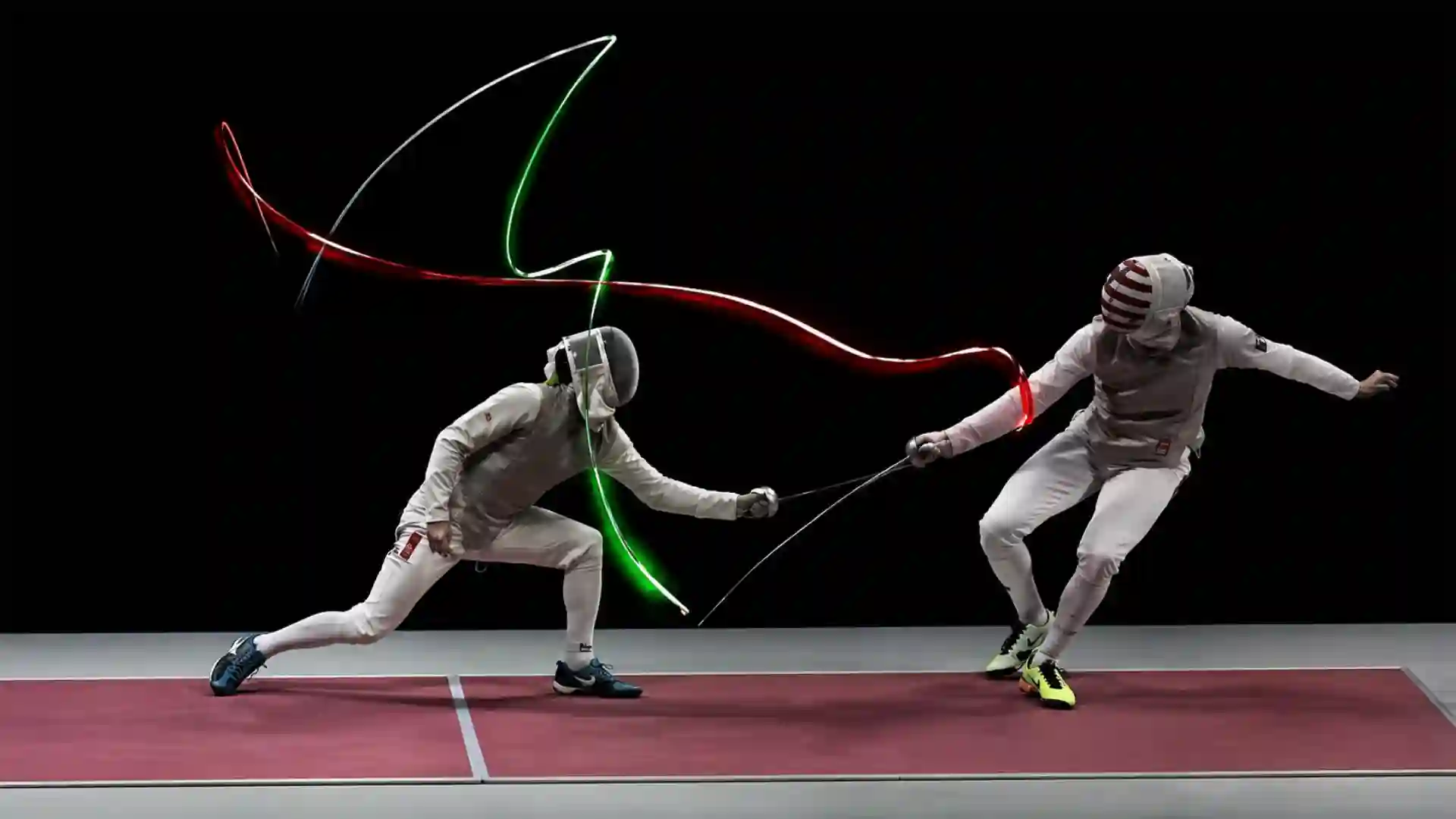
Fencing has always had the raw material of a spectator sport: speed, nerve, precision, danger translated into rules, and short exchanges that can flip a match in a fraction of a second. The problem was never that fencing lacked drama. The problem was that much of its drama happened too quickly, too thinly, and too privately for ordinary viewers to see.
Table of Contents
Fencing finally gets the visual language its speed deserves
A foil, épée, or sabre exchange often reads on television as a white blur, a pair of masked athletes, a quick contraction of bodies, two lights, a referee’s call, and a crowd reaction that arrives before many viewers have understood the action. For specialists, that blur contains intent. For casual viewers, it can look like a chaotic jerk in white uniforms. The new generation of Fencing Visualized technology changes the viewing contract by making the blade’s movement visible, not by slowing fencing down, but by giving speed a readable shape.
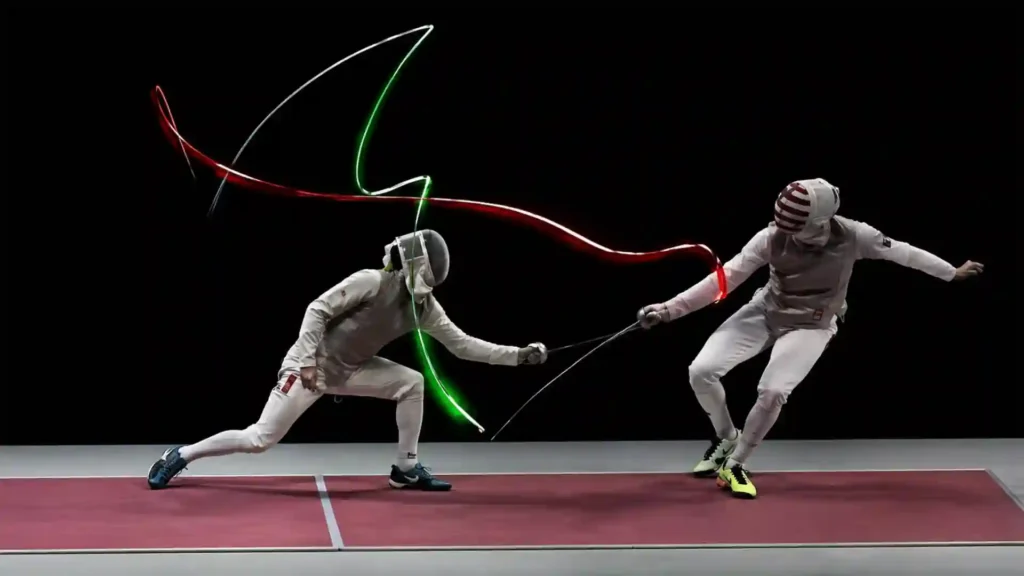
Developed around the Fencing Visualized project by Rhizomatiks and Dentsu Lab Tokyo, the system tracks sword-tip motion and draws colored trajectories over the action. Early versions used markers, reflective tape, infrared capture, and broadcast compositing. The newer markerless versions use computer vision and deep learning to detect the blade tip without adding sensors or physical markers to the weapon. That shift matters. A visual effect becomes far more serious when it does not ask the athlete to wear the technology.
The result can look, at first glance, like a lightsaber duel finally made acceptable for elite sport. But the deeper story is less about spectacle than translation. Fencing Visualized does not add drama from outside the sport. It exposes drama that was already there.
Fencing finally becomes legible
The first thing the colored trail does is remove the feeling that fencing is hiding something from the viewer. A lunge that once flashed past as a twitch now leaves a curve. A parry leaves evidence. A failed attack shows its geometry. A riposte becomes a visible answer, not just a point added to the scoring machine. The eye gets a record of motion instead of a single vanishing instant.
That matters because fencing is not only fast. It is fast in a way that defeats normal broadcast grammar. In football, basketball, tennis, and athletics, the object of attention is usually large enough to follow: a ball, a runner, a finish line, a goal. In fencing, the most decisive object is a weapon tip only a few pixels wide in a camera frame, moving quickly and bending under force. The most important part of the exchange is also the least visible.
For trained fencers, the body tells much of the story. They read distance, tempo, preparation, blade line, invitation, attack, parry, disengage, counterattack. They can see intent in foot placement and arm extension. A casual viewer usually sees two bodies moving at once and a scoring light. That gap between expert perception and public perception has been fencing’s broadcast problem for decades.
The colored trail narrows that gap. It gives viewers a second visual layer that says: look here, the blade moved through this path; the attack came from this angle; the defense met it here; the point landed after this motion. It does for fencing what the glowing puck once tried to do for hockey, but with a better reason for existing. The sword tip is not merely hard to see; it is the technical center of the sport.
The best sports graphics do not explain everything. They direct attention. They teach the viewer where to look next time. After watching a few exchanges with blade trails, even a new viewer begins to expect the line of attack and notice changes in distance. The overlay becomes a bridge, not a crutch.
That is why the system feels more serious than a cosmetic filter. It does not merely make fencing prettier. It makes fencing easier to parse as action. A sport can be beautiful and still fail on screen if the viewer cannot tell what changed. Fencing Visualized supplies a missing visual memory. The trail lingers just long enough for the brain to connect cause and effect.
The public comparison to lightsabers is inevitable because glowing lines are culturally legible. Yet the comparison also undersells the work. A lightsaber is fiction made visible by design. A fencing blade is a real object whose decisive motion can vanish between frames, camera angles, and human reaction time. The system earns its cinematic look by solving a real perceptual problem.
The old broadcast problem was not a lack of drama
Fencing can be brutally tense. Elite fencers spend whole exchanges manipulating distance by centimeters. A tiny hesitation can invite an attack. A blade contact can transfer priority. A counterattack can fail not because it misses, but because it arrives under the wrong tactical condition. None of that is dull. Much of it is simply hidden from viewers who do not already know the code.
The old fencing broadcast often relied on three things: the scoring apparatus, the referee’s hand signal, and replay. That works for record keeping. It does not always work for storytelling. A viewer sees a red or green light and learns who scored, but not necessarily why. Slow motion helps, but even slow motion can fail if the blade is thin, blurred, occluded by bodies, or lost against the background. A replay can slow down time without clarifying space.
This is where fencing differs from a sport like tennis. In tennis, the ball is small and fast, but the court is a clean geometric field. Even before Hawk-Eye and electronic line calling, the viewer could usually understand the basic question: did the ball land in or out? In fencing, the question is not always only whether a touch occurred. In foil and sabre, priority and the sequence of actions matter. In épée, timing and double touches create a different logic. The scoring light is only the end of the sentence.
For the untrained viewer, fencing often arrives as a verdict without the evidence. A fencer attacks, both athletes react, lights appear, the referee speaks, and the point goes one way. The expert audience may debate the phrase. The casual audience may shrug. A sport that depends on tactical sequencing suffers when viewers see only the verdict.
Fencing Visualized changes the hierarchy of attention. It does not replace the referee. It does not turn the sport into a video game. It gives the audience a better view of the evidence. A blade trail can reveal who initiated with a clear line, who searched for the blade, where the disengage passed, or why a riposte looked decisive. Even when it cannot settle the rule question by itself, it makes the question more visible.
The bigger issue is that modern sports compete for attention in clips as much as in full broadcasts. Fencing’s most spectacular moments are short, but historically they have not always survived well as clips because the viewer needs context and technical knowledge. A clean trajectory overlay makes a ten-second exchange more self-contained. The motion tells more of the story without a commentator needing to rescue it.
That is not a small media advantage. Sports with strong visual signatures travel better online. A basketball dunk, a tennis passing shot, a curling stone, a skateboard trick, a gymnast’s dismount, a football free kick: each has a readable shape. Fencing’s readable shape has always existed, but the camera did not capture it in a way that most viewers could keep. Colored trajectories give fencing a shareable visual grammar.
Fencing Visualized turns invisible motion into evidence
The core idea sounds simple: track the sword tip and draw a line behind it. The implementation is not simple at all. A fencing blade is narrow, reflective, flexible, partly occluded by the athlete’s body, and subject to rapid changes in angle. The tip may blur, disappear, or occupy only a tiny cluster of pixels. The background can include white uniforms, metallic scoring equipment, lighting glare, referees, spectators, and another blade crossing the same region.
The Rhizomatiks system evolved through several stages because each stage solved one constraint while revealing the next. Early work used optical motion capture and retro-reflective markers. A 2017-era Sword Tracer system, developed by NHK researchers, used infrared light reflected from tape at the sword tip and composited a colored trajectory into the broadcast image. That approach was compact compared with full-body motion capture, and it worked well enough for official match use and replay. Still, it depended on a physical marker.
The markerless Fencing Visualized approach is more ambitious. It aims to detect the sword tip directly from camera images, using a model trained to recognize a target that traditional image processing struggles to isolate. Rhizomatiks describes the problem plainly: even in 4K footage, the sword tip may be only a few pixels wide. The blade bends. The tip moves too quickly. A single camera cannot cover the whole piste. Their 2019 system used a multi-camera setup around the piste, deep neural networks based on YOLO-style object detection, 2D and 3D estimation, and pose-aware visualization.
That is the technical heart of the achievement. The system does not merely follow a bright object. It tries to infer a tiny, fast, deforming object under competition conditions. It must do so quickly enough for live use and accurately enough that the overlay does not mislead the audience.
This is a hard boundary for sports AI. Lab demos can look polished when the camera is fixed, the background is clean, and the action is repeated. Elite sport resists clean inputs. Athletes move unpredictably. Cameras pan. Lighting changes. Objects overlap. A blade can vanish behind the opponent’s guard. The system has to choose between missing the tip, drawing a wrong trail, or estimating through uncertainty. Bad overlays are worse than no overlays because they teach the viewer the wrong thing.
The best markerless systems therefore combine detection, prediction, and restraint. Detection finds the object when it is visible. Prediction estimates where it has gone when frames are ambiguous. Restraint controls how confidently the graphic appears. A broadcast graphic must be not only accurate, but honest about what it knows.
That is especially true in fencing, where a drawn line can feel authoritative. Viewers may assume the overlay is evidence equal to the scoring apparatus. It is not. It is a visualization layer. Its job is to help people see motion, not to become the judge. The technology becomes more trustworthy when its public role is clearly defined.
Markerless tracking changes the bargain with athletes
Sports technology often fails when it asks athletes to compromise the sport for the broadcast. Fencers cannot be expected to attach bulky devices to the blade, change grip behavior, accept extra weight, or move differently so a visual system can perform. The overlay has to fit fencing, not the other way around.
That is why markerless tracking is more than a technical upgrade. It protects the athlete’s relationship with the weapon. A fencing weapon is not a prop. It is a tuned extension of timing, pressure, reach, and habit. Even a small addition can change feel, balance, or psychological comfort. Reflective tape is lighter than a sensor, but it is still an intervention. Motion-capture markers are useful in controlled environments, but they are not the natural language of competition.
The markerless goal says: keep the athlete untouched, keep the weapon legal and familiar, and let the cameras and models do the work. That approach aligns with a basic principle for sport technology: the best spectator layer should not impose itself on the contest. It should sit outside the athlete’s performance loop unless the sport has formally adopted it as equipment, officiating, or safety infrastructure.
The same principle separates broadcast visualization from wearable analytics. A heart-rate display can create drama, but it also raises questions about privacy, consent, competitive information, and athlete dignity. A blade trajectory is less invasive because it visualizes the public action of the bout. It still needs careful governance, but it is closer to a replay angle than a biometric disclosure.
Markerless tracking also makes scaling more plausible. A system that depends on weapon modifications becomes harder to introduce across events, federations, and disciplines. A camera-based system can be installed, calibrated, tested, and improved without changing the athlete’s kit. It may still require major hardware, staff, and venue control, but the burden moves from the competitor to the production layer.
That distinction matters for trust. Fencers and coaches are more likely to accept a system that does not alter the bout. Officials are more likely to accept it when it is framed as a viewing aid rather than a hidden judge. Broadcasters are more likely to use it when setup can be standardized. The cleaner the boundary between competition and visualization, the stronger the case for adoption.
Markerless tracking is not magic, though. It can require more cameras, better calibration, richer training data, and stronger processing. Rhizomatiks’ own materials describe a setup with 24 cameras to cover the full piste, plus large annotated and synthetic datasets to train models under many conditions. The absence of a marker on the blade does not mean the system is lightweight behind the scenes. It means the weight has been moved away from the athlete.
That is the right trade. Sport should not be redesigned around the overlay. The overlay should work hard enough to respect the sport.
The visual grammar matters as much as the model
A tracking system can find the blade and still produce a bad broadcast if the graphic is ugly, confusing, too bright, too delayed, or too eager. Fencing Visualized succeeds because it treats visualization as a design problem, not only a detection problem.
The colored trail has to answer several questions at once. Which fencer does the line belong to? How long should the trail remain visible? Should the line fade quickly or persist through the exchange? Should it show the whole path or only the final attacking motion? Should the graphic distinguish attack, parry, riposte, and remise? Should it appear live, on replay, on the venue screen, or all three?
These are editorial choices. A live overlay that is too dense can obscure the athletes. A replay overlay that appears after the exchange can teach without distracting. Venue graphics can be larger and more theatrical than television graphics because the viewing distance is different. Mobile clips may need bolder contrast. Serious analysis may need cleaner lines and less glow.
The system’s design language has to carry both clarity and restraint. Too little graphic support leaves the viewer where they started. Too much turns the bout into decoration. Fencing’s beauty comes from the body, the line, the risk, and the timing. The overlay should reveal those things, not compete with them.
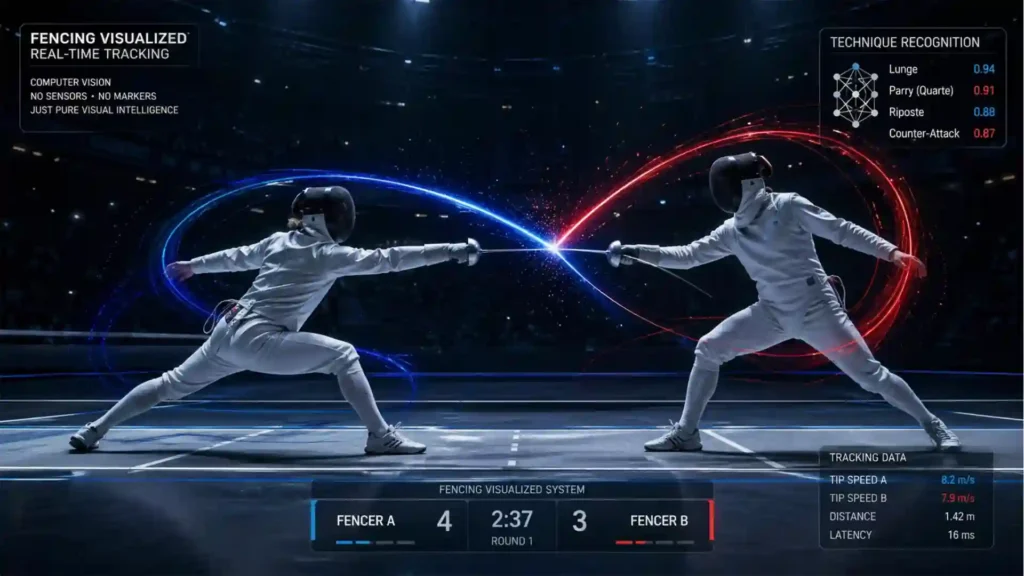
Dentsu Lab Tokyo’s work on icons and visual language points toward a richer idea: translating technique, not just drawing speed. A blade trail is the foundation. Technique recognition and iconography are the next layer. If a system can identify a lunge, parry, disengage, or riposte and present it cleanly, it can teach viewers the vocabulary of fencing over time.
The danger is simplification. A fencing phrase is not always clean. Real exchanges are messy, contested, and shaped by convention. A graphic that labels too aggressively may flatten expert disagreement into false certainty. That is why the best design may be probabilistic in spirit even if the viewer never sees a percentage. It can show motion clearly and reserve rule interpretation for commentary and officiating.
A good comparison comes from football’s semi-automated offside animations. They are not merely technical outputs. They are public explanations. The animation must be clear enough to justify a decision and calm enough not to look like propaganda for the machine. In tennis, electronic line calling works partly because the question is narrowly defined. In fencing, the visual layer must be more careful because motion and rule logic are intertwined.
The trail should therefore be treated as a first layer of evidence. It says: this is where the blade traveled. It should not say: this is the only valid interpretation of the phrase. The strongest sports graphics help viewers ask better questions before they claim to answer all of them.
A sword tip is a hostile computer-vision target
Computer vision loves clean shapes, stable contrast, and repeated patterns. Fencing offers almost the opposite. The target is tiny. The motion is fast. The blade bends. The opponent’s blade may overlap it. The weapon can align almost edge-on to the camera. Uniforms, masks, piste reflections, and lighting can create noise. The referee and venue objects can enter the frame. A body or guard can hide the tip at the exact moment viewers most want to see it.
The sword tip is also not a ball. Balls have volume, texture, expected trajectories, and often contrast against a court or field. A sword tip is a point at the end of a flexible line. It may be visible in one frame, blurred in the next, and absent in the third. A model cannot simply track a round object through space. It has to infer a technical extremity.
That is why fencing is a strong test for sports AI. If a system can track a fencing blade under match conditions, it is solving one of the nastier versions of real-time sports perception. It must handle small-object detection, temporal prediction, camera calibration, multi-object identity, occlusion, and low-latency rendering.
Research outside the Rhizomatiks project points in the same direction. Chuo University researchers have explored markerless sword-tip tracking using instance segmentation, skeleton keypoints, wrist information, and temporal convolutional prediction for missing tip positions. Their work names the same central difficulty: the sword tip is small, fast, and sometimes absent from the video. The research also shows why prediction becomes necessary. A system cannot wait for perfect visibility because perfect visibility does not exist in competition.
The underlying pattern appears across sports computer vision. A tracking system needs perception, identity, prediction, and context. Detection alone is brittle. A model may see a blade-like shape and be wrong. It may lose the object when two swords overlap. It may confuse the opponent’s wrist or guard with the tip. Temporal models help because sport is not a random sequence of still images. The previous frames constrain the next frame. The athlete’s wrist position constrains the sword. The piste geometry constrains the action. The rules constrain the plausible sequence.
That is why the strongest versions of these systems will not be pure object detectors. They will combine object detection, pose estimation, time-series modeling, 3D reconstruction, and rule-aware interpretation. Each layer reduces ambiguity. Each layer also adds failure modes. A wrong pose estimate can corrupt sword prediction. A bad camera calibration can shift a trajectory. A model trained on one venue may degrade in another.
The lesson is blunt: the prettier the overlay, the more invisible engineering it must carry. A glowing trail looks effortless only when the system has already survived the ugly parts of vision.
From reflective tape to deep learning
Fencing Visualized did not appear fully formed. Its history is a useful case study in how sports technology matures: first in controlled demonstrations, then in marker-assisted systems, then in live replay, then in markerless tracking, then in richer interpretation.
Early prototypes could prove the concept by making the sword path visible. That alone was enough to show that the viewing experience could change. A viewer did not need to understand the model to feel the difference. The problem was portability. Motion capture and markers are excellent for proof, but elite competition requires less interference.
NHK’s Sword Tracer represented a practical intermediate step. It used reflective tape on the sword tip, infrared illumination, a camera architecture that aligned IR and RGB views, supervised machine learning for detection, particle filtering for prediction, and real-time compositing. It was not markerless, but it was compact enough for official fencing contexts and gave commentators a tool for explaining exchanges.
Rhizomatiks then pushed toward camera-only detection. The project moved through YOLO-based object detection, multi-camera coverage, annotated datasets, synthetic CG data, and 3D sword-tip estimation. That path is typical of serious computer-vision work. The public sees the final overlay. The real project is dataset creation, annotation, calibration, testing, and failure reduction.
A compact map of the technical shift
| Stage | Main method | Viewing gain | Main limitation |
|---|---|---|---|
| Demonstration and motion capture | Markers, high-speed capture, post-production AR | Proved that sword paths could make fencing easier to read | Not natural enough for regular competition use |
| Marker-assisted live systems | Reflective tape, IR camera, supervised tracking, real-time compositing | Made official-match trajectory replays practical | Still required a physical marker on the weapon |
| Markerless Fencing Visualized | Multi-camera computer vision, deep learning, 2D and 3D estimation | Keeps the athlete and weapon untouched while revealing blade motion | Requires demanding camera coverage, calibration, data, and reliability checks |
The table makes the real advance clearer. The visual effect is the visible part, but the strategic shift is from adding trackable material to the weapon toward extracting the weapon’s motion from the scene itself. That is the difference between a clever demo and a technology with a credible future in elite sport.
Deep learning is not a magic word here. It matters because the object is too small and variable for brittle hand-built rules. Traditional corner detection and simple image-processing tricks can fail when the blade bends, blurs, or disappears. A trained detector can learn richer visual patterns, but it needs enough data to generalize. Rhizomatiks’ use of annotated match-like footage and CG data augmentation speaks to that need.
There is also an editorial shift. Early systems answered, “Can we draw the sword path?” Later systems ask, “Can we understand enough of the action to draw the right thing at the right time?” The second question is harder and more useful. It moves from spectacle toward comprehension.
The best version of Fencing Visualized is not a neon afterimage. It is a live translation layer built from years of technical compromise.
The system also teaches viewers the language of fencing
A sport becomes easier to love when viewers learn its nouns and verbs. Fencing’s nouns are familiar enough: sword, mask, piste, touch, point. Its verbs are harder: attack, parry, riposte, disengage, beat, counterattack, remise, fleche, lunge, stop hit. The viewer who cannot name those actions can still enjoy speed, but the tactical story remains thin.
Dentsu Lab Tokyo’s Fencing Visualized work included the idea of converting techniques into icons and presenting them as part of the viewing experience. That is a smart move because blade trails reveal motion, while icons and labels can reveal vocabulary. A trail shows that the blade curved around the opponent’s defense. A clean technique label can teach that this might be a disengage. A sequence of labels can show that fencing is not random striking but a language of threats and answers.
This education must be paced carefully. Viewers do not need a textbook during a bout. They need repeated, well-timed cues. If a graphic labels every movement, the screen becomes homework. If it labels only key moments on replay, viewers slowly connect what they saw with a term they can remember. Good sports education is cumulative. It teaches through attention, not interruption.
The system’s ability to recognize techniques also has value beyond spectators. Coaches already analyze video, often manually. Automated tagging can reduce the burden of searching through bouts for examples of specific actions. A training archive that can find all lunges, failed ripostes, or blade engagements becomes more useful. Research such as FenceNet shows the direction: skeleton-based action recognition can classify fine-grained footwork from 2D pose data without wearable sensors. Other work on fencing strategy extraction and referee assistance points toward richer interpretation of motion.
Spectator-facing systems and coaching systems should not be confused, though. A coaching tool can expose detail, uncertainty, and edge cases. A broadcast tool must remain readable under pressure. The same model may feed both, but the interface should differ. Coaches want data density. Viewers want a path into the action.
The best public version could work like a layered replay. First, show the clean exchange. Then show the blade trails. Then add one or two technique cues. The viewer learns without losing the physical reality of the bout. The athlete stays central. The model stays in service of the action.
Fencing has a reputation for opacity partly because its rules and techniques are compressed into tiny intervals. Visualizing the blade stretches that interval just enough for comprehension. Technique recognition can then give the viewer words for what the eyes have started to see. A sport becomes stickier when the audience can say not only who scored, but what happened.
Right of way remains the hard part
The blade trail makes fencing more visible, but it does not erase the complexity of the rules. Foil and sabre use priority, often called right of way. Épée does not. In épée, touches are awarded based on who hits first, and double hits can count if they occur within the allowed timing window. In foil and sabre, two lights do not automatically mean two points. The referee must interpret the fencing phrase.
That distinction is essential for understanding the limits of visualization. A trajectory can show where the blade moved. It may show who extended first, who searched for the blade, who parried, and who responded. But right of way is not a raw pixel measurement. It is a convention applied to a sequence of actions. It includes definitions of a properly executed attack, parry, riposte, point in line, preparation, and continuity.
The FIE technical rules make the referee’s role explicit in foil and sabre priority decisions. That should remain clear in any public use of AI. A visualized trail can support understanding, but it should not be treated as an automatic priority ruling unless the sport formally adopts such a system under tested rules and governance.
AI referee-assistant research is moving in that direction, but cautiously. A pose-based foil framework such as FERA separates perception from rule application and emphasizes auditable state estimates. That separation is wise. Fencing is not only a vision problem. It is a rule-reasoning problem with fast bilateral motion. A model has to detect bodies and blades, reconstruct timing, classify actions, and then apply conventions that can be debated even by experienced humans.
The risk is false authority. Viewers may trust a smooth animation more than a referee because the animation looks objective. Yet every visual system has thresholds, training data, missed detections, interpolation, and uncertainty. A clean line can be a guess made elegant. Sports technology loses trust when it hides that fact.
For now, Fencing Visualized is strongest as a comprehension layer. It helps viewers follow the action and gives commentators better visual evidence. It can make expert debate more accessible. It can support coaching and post-bout analysis. It should not be sold as a replacement for the referee.
That restraint protects the system. Once a visualization claims to decide, every failure becomes a scandal. Once it claims to clarify, it can improve the viewer’s relationship with the sport without carrying the full burden of justice. Fencing may one day use AI-assisted officiating in limited ways, especially in training or lower-resource environments, but competition adoption would need transparent testing, appeal processes, version control, and federation approval.
The trail helps people see the phrase. It does not own the phrase.
The light-trail effect is cinematic, but not a gimmick
The first viral reaction to Fencing Visualized is usually aesthetic. People see glowing colored trails and say fencing looks like science fiction. That reaction is not shallow. Spectator sports live partly through visual identity. A system that makes fencing instantly recognizable in a clip gives the sport a stronger public face.
Still, the cinematic quality works only because it is anchored to real movement. A fake glow added for drama would feel cheap. A trajectory drawn from actual blade motion feels different. The line is beautiful because it is evidence. The graphic succeeds when the viewer senses that the athlete made the shape, not the designer.
This is an old rule in sports media. The most memorable graphics reveal invisible structure: the first-down line in American football, the strike zone box in baseball, the ball-tracking path in tennis or cricket, the offside line in football, the racing ghost in skiing, the world-record line in swimming. These overlays work because they map something true and difficult to see. They become annoying when they decorate without revealing.
Fencing’s trail sits closer to the useful end of that spectrum. It reveals the path of a decisive object. It also carries emotional force. A quick attack becomes a streak. A parry becomes a crossing line. A repeated probing action becomes a visible pattern. The sport gains a visual rhythm.
The danger is that producers may push the effect too far. More glow, longer trails, dramatic color bursts, and sound effects could turn a serious match into a novelty. Fencing does not need to cosplay as science fiction. It needs to let non-experts see the skill. The difference is taste.
A good fencing overlay should feel like notation, not fireworks. Music notation does not replace the music; it gives structure to sound. Blade trails can do the same for fencing. They let viewers see tempo, angle, and response. They should fade before they bury the athlete.
There is also a question of venue versus broadcast. A live crowd may benefit from bigger theatrical cues because distance makes the blade harder to follow. Television viewers have closer angles and replays, so subtlety may work better. Mobile viewers need high contrast because screens are small. A single graphic style will not fit every platform. The same tracking data can feed different visual treatments.
The broader lesson is simple: sports technology must respect the native beauty of the sport. Fencing already has elegance, aggression, silence, impact, ritual, and speed. The overlay should not import excitement from outside. It should make the existing excitement legible.
Sports technology works best when it reveals skill
The strongest argument for Fencing Visualized is not entertainment. It is fairness to the athletes. Elite fencers perform skills that many viewers cannot see. A system that reveals those skills gives the athletes a better stage.
That principle applies across sport. Tennis ball tracking reveals line precision. Football goal-line technology reveals whether the whole ball crossed the line. Semi-automated offside systems reveal body positions that were previously judged through manual line drawing. Swimming graphics reveal world-record pace. Athletics split graphics reveal acceleration and fatigue. The public gains respect when the hidden difficulty becomes visible.
Fencing has been underserved by this kind of translation because the relevant object is so hard to track. The scoring apparatus records touches, but it does not show the craft that produced them. A colored blade trail can reveal a fencer’s hand speed, deception, timing, and control. It can show that a “simple” point was the end of a carefully shaped exchange.
A good overlay expands admiration. It tells the viewer: the athlete did more than you saw. Watch again.
That matters for growth. Sports do not build audiences only by simplifying rules. They build audiences by helping people recognize excellence. Once a viewer understands what separates a lazy attack from a well-timed one, the sport becomes richer. Once they see how a defender closes a line, the exchange gains suspense. Once they recognize a fencer’s style, they return.
The system can also shift commentary. Instead of relying on generic praise for speed, commentators can point to the trajectory: the attack line was closed, the disengage went under the blade, the riposte came straight, the final touch arrived after the parry. Visual evidence lets commentary become more precise without alienating beginners.
This is where Fencing Visualized aligns with E-E-A-T-style content and search value as well. The sport needs public explanations that are accurate, expert-informed, and readable. Visual systems create quotable, teachable moments. A clip can say: here is the parry; here is the riposte; here is the blade path; here is why the point made sense.
There is an ethical side too. Revealing skill should not expose private data unnecessarily. A blade path is public performance. Heart rate, fatigue indicators, stress metrics, or predictive weakness models are more sensitive. The line between education and surveillance must be guarded.
For fencing, the blade trail sits in the right zone. It reveals what the athlete already did in public, but in a form the human eye can keep. It dignifies the action by making it visible.
Fencing is a good test case for AI-assisted sport
AI in sport often arrives wrapped in vague promises. Fencing gives it a concrete test. Can a model detect a tiny sword tip in real time? Can it maintain identity across two crossing blades? Can it estimate motion through blur and occlusion? Can it produce a useful graphic without misleading viewers? Can it help explain technique while leaving judgment to qualified officials?
These are answerable questions. That makes the project more valuable than a generic “AI in sports” claim. Fencing Visualized is compelling because the problem is specific. The system either tracks the blade well enough or it does not. The overlay either helps viewers or it clutters the action. The model either works under competition pressure or fails.
Sports AI needs this kind of discipline. The field is full of use cases: player tracking, pose estimation, tactical analysis, injury-risk modeling, automated highlights, referee support, audience personalization, training feedback. Many are useful. Many are oversold. Fencing reminds us that good AI work starts with a narrow perception problem and a clear user need.
The perception problem is severe. The user need is obvious. Viewers cannot follow the blade. Coaches want better analysis. Producers want clearer storytelling. The technology has a natural role.
The rule problem is tougher. Automated judgment in fencing would require more than vision. It would need a model of conventions, timing, priority, and uncertainty. It would need to distinguish preparation from attack, a parry from incidental blade contact, a continuous phrase from a broken one. It would need to handle ambiguous cases and explain itself to humans. That is not impossible, but it is a different tier of responsibility.
This distinction should guide development. Phase one: make motion visible. Phase two: recognize common techniques. Phase three: support coaching and commentary. Phase four, only after deep testing: assist rule interpretation in limited contexts. Skipping steps would be reckless.
Fencing’s small public profile may actually help. A technology can mature in a sport where the need is acute and the community is technically engaged, before the same ideas migrate to larger sports. The visual challenge is harder than many ball-tracking tasks, but the bounded piste and two-athlete format provide structure. That combination makes fencing a useful laboratory.
The eventual prize is not a robot referee. It is a better chain from performance to perception. AI should make the sport more intelligible without making the athlete secondary. Fencing is a sharp test of whether sports technology can stay in that lane.
Broadcast overlays need restraint
Every successful sports graphic creates a temptation to overuse it. Producers discover that viewers notice the overlay, social media clips perform well, sponsors see inventory, and the screen gradually fills with data. The sport can then become harder to watch for a new reason: not because too little is visible, but because too much is shouting.
Fencing should avoid that trap. The sport’s visual field is already narrow and intense. The piste is clean, the athletes are masked, and the blade work is subtle. A trail can clarify. A stack of icons, labels, biometric panels, win-probability bars, and animated effects can suffocate the bout.
The right broadcast grammar may be selective. Live action could use minimal or no trails unless the system is stable and the graphic is subtle. Replays can use fuller trajectories. Tactical breakdowns can add technique labels. Venue screens can use bolder graphics after points. Social clips can use trails to make highlights self-explanatory. Coaching feeds can carry deeper data.
One feed should not serve every audience. Experts may prefer cleaner footage. New viewers may want guided replays. Children at a demo event may enjoy icons and more theatrical motion. A federation broadcast may need a conservative treatment. A promotional reel can be more expressive.
Latency is another limit. AR sports research shows that delay, registration error, and jitter can damage user experience. A blade trail that lags behind the weapon or floats off the point will break trust quickly. In fencing, where timing is the whole story, even a small visual mismatch can feel wrong. Better to show the overlay on replay than to show a live line that is not stable.
There is also the problem of graphic certainty. A trajectory line has to fade, interrupt, or change behavior when the system loses confidence. If it draws through an occlusion as if it saw the blade, it may mislead. If it vanishes too often, it frustrates. The design needs a language for uncertainty that does not burden the viewer with technical details. A shorter fade, reduced intensity, or replay-only treatment can solve more than a loud warning.
Sports fans are not anti-technology. They are anti-nonsense. They accept graphics that help and reject graphics that condescend. Fencing Visualized has the advantage of solving a problem viewers already feel: they cannot see the blade. The system should not waste that trust by turning every exchange into a tech demo.
The overlay should appear when it earns its place.
Athletes and officials should stay above the algorithm
The arrival of computer vision in sport always raises a governance question: who controls the output, and what status does it have? For Fencing Visualized, the answer should be plain. The athlete performs. The referee judges under the rules. The technology visualizes and explains unless the governing body gives it a formal officiating role after testing.
That hierarchy protects everyone. It protects athletes from being judged by an unapproved model. It protects referees from public confusion between visualization and authority. It protects the system from being blamed for decisions it was never designed to make. It protects viewers from false certainty.
The issue is not theoretical. Football’s VAR and semi-automated offside systems show how quickly public trust depends on communication. The technology may be accurate, but if viewers do not understand what is being checked, who validates it, and why a decision still involves human judgment, frustration grows. Tennis electronic line calling is easier because the binary question is narrower. Fencing resembles football more than tennis in this respect because the visual fact and the rule interpretation are not always the same thing.
A blade trail may show that two actions happened close together. It may not settle whether an attack was correctly executed, whether the opponent had successfully parried, or whether priority transferred. A model may classify a move as a lunge, but the referee still has to interpret the phrase. The line can inform judgment without becoming judgment.
If AI-assisted refereeing ever enters fencing, it should be transparent by design. Models should be versioned. Datasets should be documented. Error rates should be tested across weapons, camera angles, fencer styles, venues, lighting, and competition levels. Officials should receive training. Athletes should know when and how the system is used. Appeals and overrides should be defined. A black-box call would be unacceptable in a sport where convention and sequence matter.
For public visualization, the governance burden is lighter but still real. Broadcasts should avoid implying that the overlay is official unless it is. If a replay graphic is illustrative, say so through consistent presentation. If it is tied to official data, make that clear. The language around the system matters.
The safest long-term path is to keep Fencing Visualized as a respected visual layer first. Let it educate viewers, support commentators, improve highlights, and help coaching. Let the community build trust in what the system can and cannot see. Authority can come later, if the evidence justifies it.
A sport should adopt technology at the speed of trust, not at the speed of hype.
The same idea will spread beyond fencing
Once viewers see fencing with visible blade paths, it becomes natural to ask why other sports do not expose their hidden motions just as clearly. Some already do. Tennis uses ball tracking and electronic line calling. Football uses goal-line cameras, offside animations, and tracking data. Cricket has ball paths and edge detection. Swimming and athletics use record lines and split graphics. The pattern is clear: modern sports are learning to visualize the invisible layer of performance.
Fencing’s contribution is different because it focuses on a weapon rather than a ball or body. That opens a category. Any sport with a fast, thin, hidden, or ambiguous technical object could use similar thinking: badminton racket paths, table tennis paddle contact, hockey stick blade movement, baseball bat path, cricket bat angle, lacrosse stick motion, martial arts strike trajectories, even curling brush pressure if the data were available and ethically shown.
The user’s joke about giving a football a flaming tail is funny because it points to a truth. Football already has an object everyone can see, so a fire tail would mostly be decoration. But football tracking data can reveal things viewers cannot see: offside geometry, pressing traps, player spacing, run timing, passing lanes, shot velocity, and ball spin. The valuable overlay is not always the flashiest one.
The rule should be simple: visualize what the viewer needs help understanding. In fencing, that is the blade tip. In football, it may be space. In tennis, it may be bounce location. In basketball, it may be defensive rotation. In skiing, it may be line choice. In swimming, it may be pace against a record.
This is where sports visualization can mature. The future is not every sport covered in neon trails. It is each sport finding the hidden variable that explains excellence. Fencing’s hidden variable is unusually cinematic, which is lucky. But the underlying principle is broader.
AI search and answer systems will also reward sports that create clearer visual and semantic data. A bout with tagged actions, clean trajectories, and structured metadata becomes easier to summarize, search, teach, and archive. Fans can find “left-handed sabre parry riposte,” coaches can query “failed attacks after long preparation,” broadcasters can assemble technique packages, and newcomers can learn through examples.
The risk is data extraction without cultural care. Sports are not just motion datasets. They have histories, rules, rituals, and communities. A model that tags actions without respect for fencing language will produce noise. A graphic that chases novelty will age quickly. The systems that last will be those built with athletes, coaches, referees, designers, and broadcasters in the room.
Fencing Visualized works because it begins from a precise frustration: people cannot see the blade. That same honesty should guide every sport that follows.
The real achievement is translation, not decoration
Fencing Visualized is easy to describe as a visual upgrade. That phrase is too small. The project is better understood as translation. It translates a technical action into a public image. It translates expert perception into beginner perception. It translates speed into memory. It translates a hidden line of intent into a line the audience can actually see.
That is why the technology feels satisfying. It does not ask fencing to become simpler. It makes the viewer more capable. The best sports technology does not dumb the sport down. It raises the audience up.
The Japanese work around Fencing Visualized also shows why design and engineering belong together. Computer vision finds the blade. AR renders the trail. Icons and technique language teach the viewer. Broadcast judgment decides when to show the graphic. The system succeeds only when all of those parts respect the bout.
There will be limits. Markerless tracking is hardware-heavy at elite quality. Models can fail under occlusion. Technique recognition will face ambiguous exchanges. Right-of-way interpretation remains a human and rule-based challenge. Overlays can be overused. Cost may restrict deployment to major events for a while. These limits do not weaken the project. They make clear why it is serious.
The most promising future is layered. Casual broadcasts get clean trails and guided replays. Expert feeds can turn overlays off or use more analytical views. Coaches get searchable data. Young fencers get educational clips. Officials retain authority. Researchers improve perception and rule-aware models under transparent evaluation. The sport gains a visual identity that matches its actual speed.
Fencing has always looked futuristic in the imagination: masks, blades, rituals, electric scoring, explosive movement. On screen, it often looked older than it was because the decisive action disappeared. Fencing Visualized corrects that mismatch. It lets the sport look as sharp as it feels.
The lightsaber comparison will keep following the project, and that is fine. It gives the public a doorway. But the better comparison is translation subtitles for motion. The fencers were already speaking. The rest of us can finally read more of the sentence.
That is the achievement: not a trick, not a filter, not a gimmick, but a visual language for a sport that was moving too fast for its own audience.
Questions readers ask about Fencing Visualized
Fencing Visualized is a project associated with Rhizomatiks and Dentsu Lab Tokyo that uses tracking, augmented reality, and visual design to make fencing action easier to understand. Its most recognizable feature is the colored trajectory drawn behind a sword tip so viewers can follow blade motion that normally disappears too quickly.
The project has been developed by Rhizomatiks in collaboration with Dentsu Lab Tokyo. The broader Japanese fencing visualization effort also connects to earlier work involving Yuki Ota, Dentsu, Rhizomatiks, and related broadcast and research projects.
The markerless version is designed to track blade-tip motion without attaching physical markers or sensors to the sword. Earlier stages used motion capture, reflective markers, or reflective tape, but the newer direction relies on computer vision and deep learning.
The decisive object is often the sword tip, which is small, fast, thin, and sometimes blurred or hidden. Viewers may see scoring lights before they understand the action that caused them. Foil and sabre add another layer because priority must be interpreted, not simply measured.
No. The visible trail is a graphic, but it is based on tracking real blade motion. Its value comes from clarifying movement and helping viewers understand the exchange. The effect looks cinematic, but the underlying purpose is technical and educational.
Not by itself. The system is best understood as a visualization and explanation layer. Official scoring and priority decisions still belong to the fencing rules, scoring apparatus, and referee unless a governing body formally approves a specific technology for officiating.
Markerless tracking avoids changing the athlete’s weapon or movement. That matters because fencers are sensitive to balance, feel, and timing. A system that works from cameras instead of attached hardware respects the competition more cleanly.
Systems use object detection, camera coverage, temporal prediction, calibration, and sometimes pose information to estimate where the tip is. The task is difficult because the blade can blur, bend, overlap with another blade, or disappear from a camera view.
Deep learning helps detect and classify visual patterns that traditional image-processing rules struggle to handle. Rhizomatiks describes using YOLO-based object detection and large training datasets to improve sword-tip detection under match-like conditions.
Sword Tracer was a system developed by NHK researchers to visualize sword trajectories using infrared light reflected from tape on the sword tip, supervised machine learning, particle filtering, and real-time broadcast compositing. It represents an important marker-assisted step before fully markerless approaches.
Dentsu Lab Tokyo’s Fencing Visualized materials describe techniques being turned into icons for viewers. Related research in fencing action recognition and footwork recognition shows that neural networks can classify certain fencing movements from pose or video data, although full match interpretation remains hard.
Épée rewards touches based mainly on timing and allows double touches within the rules. Foil and sabre use priority, so the sequence and correctness of actions matter. A blade trail helps in all three, but rule interpretation is more complex in foil and sabre.
AI may assist training, analysis, and perhaps future officiating support, but full refereeing would require reliable perception, rule reasoning, transparency, and federation approval. Fencing priority is too complex to hand over casually to a black-box model.
The colored trails naturally resemble science-fiction blades because they turn invisible high-speed motion into glowing paths. The comparison is useful for public attention, but the system is grounded in real tracking rather than fantasy styling.
It can help by making the sport easier to understand in broadcasts, clips, and venue screens. Popularity also depends on athletes, events, storytelling, access, and federation strategy, but clearer visuals remove a major barrier for new viewers.
Some experts may prefer clean footage, especially during live action. Many may still value trails in replay, coaching analysis, or educational content. The strongest approach is layered coverage that lets different audiences choose the level of visual aid.
Yes. Many sports already use tracking graphics for balls, lines, players, and decisions. Fencing is unusual because it visualizes a fast weapon tip. Similar ideas could apply to other hidden or hard-to-read motions, such as racket paths, bat angles, stick movement, or tactical spacing.
The biggest risk is false clarity. If a graphic is inaccurate, delayed, too strong, or presented as official when it is only illustrative, it can mislead viewers. Restraint and clear communication are as important as technical performance.
Its real value is translation. It lets viewers see the movement, timing, and tactics that fencers already produce. It does not make fencing interesting; fencing already is interesting. It makes the interest visible.
Author:
Jan Bielik
CEO & Founder of Webiano Digital & Marketing Agency
This article is an original analysis supported by the sources cited below
Fencing tracking and visualization system
Rhizomatiks’ detailed technical and historical account of the Fencing Visualized core tracking system, including markerless development, YOLO-based detection, multi-camera coverage, datasets, and 3D estimation.
Fencing tracking and visualization system | Work | Rhizomatiks
Rhizomatiks’ project page summarizing the AR sword-trajectory system, markerless deep-learning version, live deployments, and event track record.
“Fencing Visualized” Deployed in Live Competition at the World Fencing League (LA)
Rhizomatiks’ announcement of the system’s deployment at the World Fencing League in Los Angeles, describing real-time blade-tip visualization without markers.
Fencing Visualized
Dentsu Lab Tokyo’s project page explaining the design language, motion capture, AR visualization, and technique-icon concept behind Fencing Visualized.
All Japan Fencing Championships
Dentsu Lab Tokyo’s account of the All Japan Fencing Championships project, including blade-tip trajectory visualization, biometric displays, and venue data.
Making Fencing Fun to Watch for People Like Me Who Don’t Really Like Spectator Sports
Dentsu’s editorial reflection on the spectator problem in fencing and the project’s attempt to make rules, athletes, and techniques easier to follow.
Sword Tracer: Visualization of Sword Trajectories in Fencing
SIGGRAPH 2018 paper describing NHK’s Sword Tracer system for tracking and rendering fencing sword-tip trajectories in real time using infrared reflection and machine learning.
Real-time visualization of sword trajectories in fencing matches
Peer-reviewed research article on Sword Tracer, including tracking design, real-time compositing, broadcast use, and viewer response.
Instance Segmentation-Based Markerless Tracking of Fencing Sword Tips
Research paper on markerless sword-tip tracking using instance segmentation, pose estimation, temporal prediction, and interpolation for difficult fencing footage.
FenceNet: Fine-grained Footwork Recognition in Fencing
Computer-vision research on recognizing fine-grained fencing footwork from 2D pose data without wearable sensors.
VirtualFencer: Generating Fencing Bouts based on Strategies Extracted from In-the-Wild Videos
Research paper proposing extraction of 3D fencing motion and strategy from in-the-wild video for realistic fencing behavior generation.
FERA: A Pose-Based Framework for Rule-Grounded Multimedia Decision Support with a Foil Fencing Case Study
Research on pose-based fencing decision support that separates perception, rule reasoning, and explanation for foil fencing.
YOLOv3: An Incremental Improvement
Technical report on YOLOv3, the object-detection approach referenced in Rhizomatiks’ account of its sword-tip tracking system.
You Only Look Once: Unified, Real-Time Object Detection
Foundational YOLO paper describing real-time object detection as a single neural-network regression problem.
New to Fencing
International Fencing Federation guide explaining the three weapons, target areas, right-of-way differences, and épée double-hit timing.
Technical rules
FIE technical rules document covering foil, épée, sabre, target validity, priority, and referee decision responsibilities.
Fencing
Tokyo 2020 fencing overview describing the piste, bout format, event structure, and valid target differences.
Makuhari Messe Hall
Tokyo 2020 venue page identifying Makuhari Messe Hall B as the Olympic fencing venue and providing venue context.
A Comprehensive Review of Computer Vision in Sports
Review article surveying computer-vision tasks in sport, including tracking, trajectory prediction, player detection, action recognition, and broadcast-related analysis.
A Survey of Deep Learning in Sports Applications: Perception, Comprehension, and Decision
Survey paper framing deep learning in sport through perception, comprehension, and decision tasks, with relevance to tracking and action understanding.
Sports Visualization in the Wild: The Impact of Technical Factors on User Experience in Augmented Reality Sports Spectating
Research article on AR sports spectating, latency, registration accuracy, jitter, and their impact on user experience.
Semi-automated offside technology
FIFA’s official explanation of semi-automated offside technology, including tracking cameras, ball sensor data, AI-assisted alerts, and 3D fan-facing animations.
Goal-line technology
FIFA’s official page describing goal-line technology, high-speed camera use, referee signals, and 3D visualizations for fans.
Electronic Line Calling Live To Be Adopted Across The ATP Tour
ATP announcement on adopting Electronic Line Calling Live across the tour from 2025, with implications for officiating and tracking data.
Line calling
International Tennis Federation document explaining the evaluation and development of electronic line-calling systems, including Hawk-Eye and live systems.
| Citing this article? Brief excerpts are welcome. Please credit Webiano.digital, name the author where stated, and include a link to https://webiano.digital and to this original article. Full or substantial republication requires prior written permission. Read our Copyright and Content Use Policy. |
This article was prepared with the assistance of artificial intelligence tools. The content underwent expert human review, and Webiano Digital & Marketing Agency assumes editorial responsibility for its final version and publication.