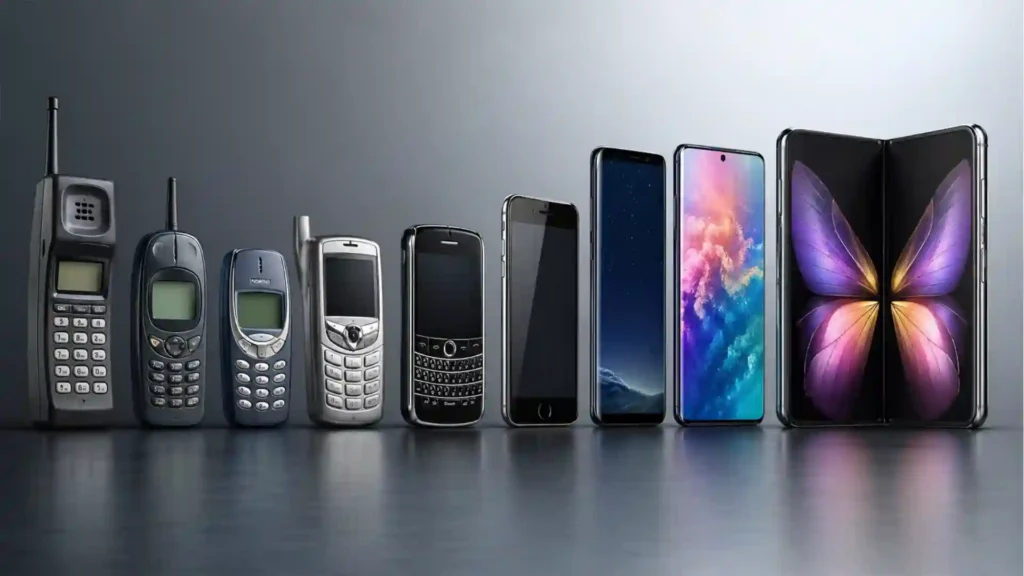
The mobile phone began as a promise of reachability. A person could leave the desk, the house, the office, or the car and still be contacted. That was enough to make early portable phones feel remarkable, even when they were heavy, expensive, awkward, and limited. The Motorola DynaTAC 8000X, approved by the FCC in 1983 and sold commercially in 1984, was not a pocket computer. It was closer to a status object with a radio inside it, a device built around the single act of making a call away from a fixed line. Motorola describes the DynaTAC 8000X as the world’s first commercial portable cell phone, while the Smithsonian notes its 2.5-pound weight, roughly 30 minutes of battery life, and $4,000 price. The first mobile breakthrough was not intelligence. It was mobility itself.
Table of Contents
The phone stopped being just a phone
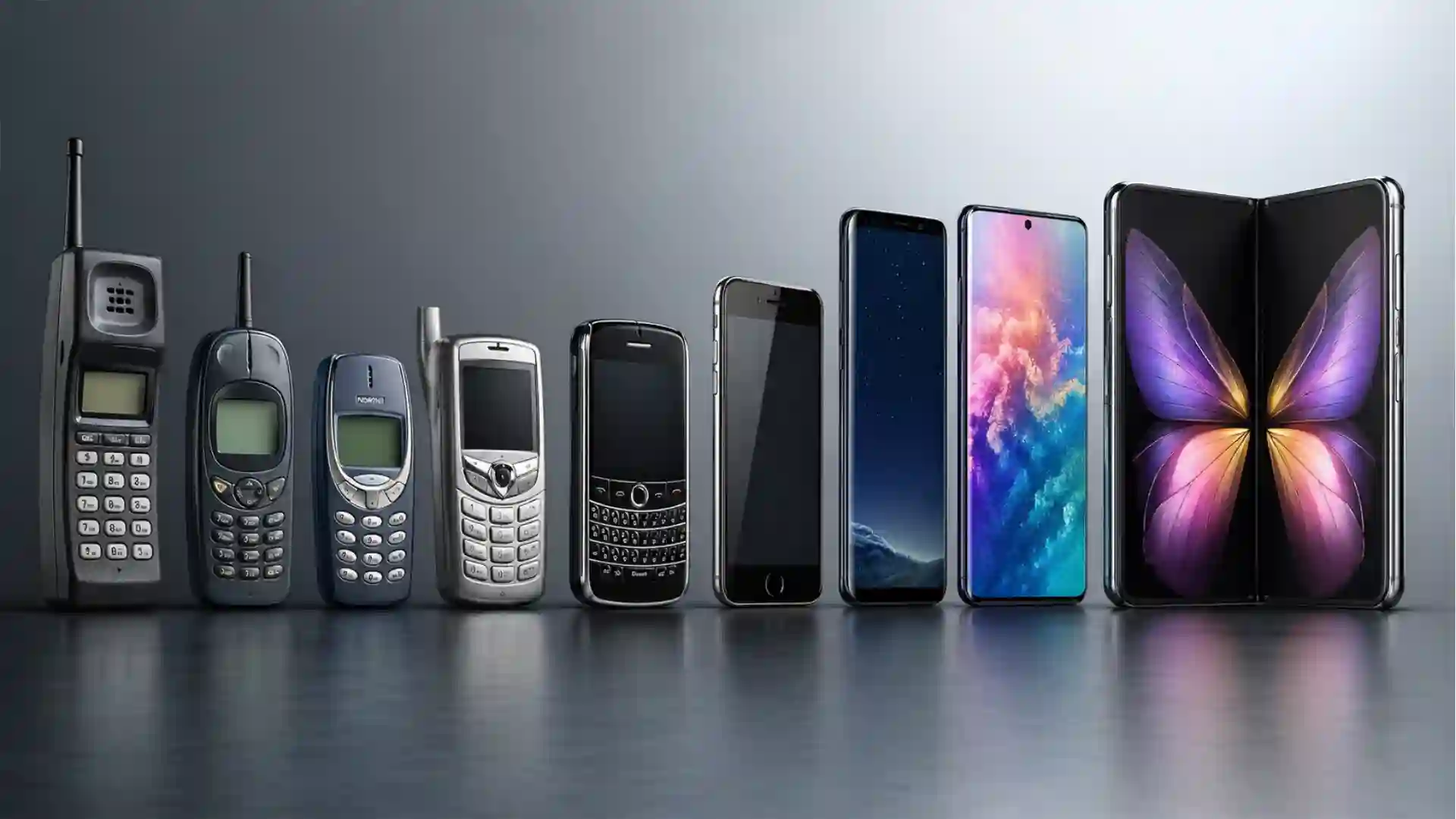
That distinction matters because the evolution from dumb phones to AI-powered foldables was never a clean march from simple to advanced. It was a sequence of trade-offs. Early mobile phones gave people freedom from place, but not freedom from friction. They were expensive to own, poor at storing information, slow to charge, and useful for a narrow set of tasks. Later feature phones became smaller, cheaper, tougher, and socially important because they handled calls and text messages reliably. Early smartphones added calendars, email, fax, web browsing, touchscreens, and third-party software before the market was fully prepared for them. Foldables arrived after the rectangular slab smartphone had matured so completely that the industry needed a new physical idea.
The deepest shift is that the phone gradually moved from communication object to software surface, then from software surface to context-aware personal computer. A dumb phone waited for direct commands: call this number, open this message, set this alarm. A smartphone let software reshape the device through apps. An AI phone tries to interpret intent across text, images, voice, location, screen content, camera input, and personal context. A foldable AI phone adds one more layer: it changes its shape to give that intelligence more room.
The story is not only about hardware. It is about the slow transfer of value from the network to the device, from the device to the operating system, from the operating system to the app ecosystem, and now from the app ecosystem to AI models and personal data architecture. The phone became powerful because every generation absorbed the job of another object. It swallowed the address book, the pager, the camera, the music player, the map, the wallet, the notebook, the voice recorder, the translator, the scanner, and part of the laptop. Foldables are the industry’s attempt to swallow the small tablet as well.
The dumb phone era was stricter than nostalgia admits
The phrase “dumb phone” is affectionate, but it can be misleading. Many basic and feature phones were brilliant products by the standards that mattered to their users. They were durable, affordable, simple to repair, easy to learn, and excellent at conserving battery. The best of them did not pretend to be computers. They were communication appliances, and that clarity made them trustworthy. People could type without looking, replace batteries, share chargers, drop the device without panic, and go days without hunting for a wall socket.
The limits were real. A basic phone’s interface was constrained by a small monochrome or low-resolution screen, a numeric keypad, a short menu tree, and carrier-controlled services. Text entry depended on multi-tap or predictive typing. Storage was tiny. Cameras, when they arrived, were first treated as novelty features rather than serious imaging systems. The web, if available, often felt like a stripped-down parallel universe. These phones were not built around continuous computing. They were built around interruption: a call, a message, a ringtone, a reminder, a quick game, a saved contact.
That strictness shaped behavior. A dumb phone did not ask for constant visual attention because it had little to show. It did not create infinite feeds. It did not make every service compete for screen time. It made communication portable without making the entire internet portable. For many people, that remains the source of its appeal. The modern interest in minimalist phones and digital detox devices is partly a reaction against the smartphone’s success. The smartphone became so useful that it became hard to ignore.
The older phones also exposed a lesson the current industry sometimes forgets: a good mobile device must be legible under stress. A person should be able to call, navigate, pay, authenticate, translate, or capture information quickly. Early phones forced designers to prioritize. There was no room for decorative complexity. Every menu item had to justify itself because the screen could show only a handful of lines.
Modern foldables and AI phones are moving in the opposite direction: more display area, more modes, more sensors, more background intelligence, more software layers. That gives them power, but it also raises the danger of cognitive clutter. The dumb phone era matters because it proves that restraint is not the enemy of usefulness. The best AI foldable will not be the one with the most features. It will be the one that makes a complex device feel calm.
GSM and SMS made mobility social
The first mobile phones made people reachable. Digital cellular networks made mobile communication scalable. The shift from analog systems to GSM helped standardize mobile service, improve interoperability, and create the conditions for text messaging and data services. Nokia’s own reflection on the first GSM call notes that GSM led to data calls, SMS messaging, and data services, and that Nokia launched its first GSM cell phone, the 1011, in late 1992. The mobile phone became a mass-market object only after networks, standards, pricing, batteries, and industrial design started improving together.
SMS deserves special attention because it changed the emotional texture of the phone. A voice call demands presence. A text message permits delay, ambiguity, and low-pressure contact. For teenagers, workers, families, and whole social groups, texting turned the phone into a quiet social channel. It also trained users to treat the handset as a reading and writing device, not only a talking device. That habit prepared the ground for email, instant messaging, social apps, and AI chat interfaces later.
The evolution from dumb phones to smartphones was therefore not only a jump in computing power. It was a change in social rhythm. People learned to keep the phone nearby because messages could arrive at any time. They learned to check small screens for tiny pieces of context. They learned to compress language into short bursts. They learned that a phone could hold not just numbers, but relationships.
This is where feature phones were smarter than their reputation. They supported address books, custom ringtones, calendars, alarms, calculators, games, early browsers, Bluetooth, infrared, music playback, memory cards, and cameras. Some could install Java apps. Some supported email. Some were clamshells, sliders, swivels, candy bars, or QWERTY devices. The market experimented aggressively with shape before the glass rectangle won.
That experimentation later returned through foldables. The clamshell foldable echoes flip phones. The book-style foldable echoes pocket notebooks, PDAs, and mini laptops. The tri-fold concept pushes toward a pocket tablet. Foldables are not a sudden break from phone history. They are a return to the idea that the phone’s shape should match the task.
The difference is that old form factors were shaped mostly around keys, antennas, batteries, and pocketability. New form factors are shaped around screens, hinges, cameras, thermal limits, AI workloads, multitasking, and media. The social need is familiar. The engineering problem has become much harder.
The first smartphones arrived before the public had a category for them
The smartphone did not begin with the iPhone. It began as an awkward convergence of phone, organizer, pager, modem, email terminal, and pocket computer. The IBM Simon Personal Communicator, released in 1994, is widely treated as an early smartphone because it combined cellular calling with PDA functions and a touchscreen-style interface. It was too early for the conditions that would make smartphones mass-market: dense mobile data networks, compact batteries, cheap memory, fast processors, intuitive software, and strong app distribution.
Nokia’s Communicator line made the same point in a different form. The Nokia 9000 Communicator, introduced in 1996, opened like a tiny laptop and included a full keyboard, email, fax, calendar, contacts, and web browsing capabilities. It looks strange beside today’s smooth slabs, but conceptually it was close to the foldable phone: closed, it was a phone; open, it was a work machine. The book-style foldable did not invent dual-mode mobile computing. It gave that idea a modern screen.
BlackBerry later refined the productivity phone around secure push email and the physical keyboard. Palm and Windows Mobile devices appealed to people who wanted their calendars, documents, and enterprise systems in a pocket. Symbian powered many advanced Nokia devices long before app stores became the central distribution model. These products were not failures of imagination. They were limited by timing.
The early smartphone problem was that every function carried visible compromise. Email worked, but setup could be painful. Web browsing existed, but mobile pages were limited. Screens were small, styluses were easy to lose, carriers controlled too much, and software installation could feel technical. The phone was becoming a computer, but the computer part still felt bolted on.
That matters for the AI foldable era because the industry is again ahead of everyday habits. AI features often look impressive in demos: summarizing notes, translating calls, removing objects from photos, searching screen content, drafting messages, interpreting images, or acting across apps. Yet many people still use phones through familiar manual routines. They open an app, tap, scroll, type, send, and close. A technology becomes mainstream only when it stops feeling like a feature and starts feeling like the normal way to use the device.
The first smartphones needed time for infrastructure and behavior to catch up. AI foldables face the same test.
Touchscreens turned the phone into software
The 2007 iPhone did not introduce every ingredient of the smartphone, but it rearranged the hierarchy. Apple presented it as three products in one: a mobile phone, a widescreen iPod with touch controls, and an internet communications device. The real disruption was the large multi-touch display and the decision to make software, not keys, define the interface. The screen became the phone.
Before the touchscreen slab became dominant, physical design carried identity. A Nokia felt like a Nokia partly because of its keypad. A BlackBerry felt like a BlackBerry because of its keyboard and trackball or trackpad. A Motorola Razr felt like a Razr because of its thin flip body. After the touchscreen took over, phones became more visually similar from the front. Differentiation moved into operating systems, app ecosystems, cameras, chips, services, materials, and brand trust.
The touchscreen also changed software economics. A physical button is fixed after manufacturing. A touchscreen button can appear, disappear, resize, animate, translate, and change meaning depending on the app. That turned the phone into a programmable surface. A calculator, keyboard, gamepad, camera control panel, piano, map, book, boarding pass, and bank card could all occupy the same glass.
This is the foundation foldables build on. A foldable phone is not merely a bigger screen. It is a screen that can change its available surface area during use. Closed, it behaves like a narrow phone. Open, it behaves more like a small tablet. Half-open, it can become a camera stand, video-call device, bedside clock, interpreter screen, or split-interface machine. The hinge adds physical state to software design.
Touchscreens made that possible because they taught users to accept interfaces that change shape. AI will push the same idea further. A system that understands what is on the screen, what the user is trying to do, and which display state the device is in can adapt the interface without waiting for every command. On a foldable, that adaptation has more room to become useful.
The risk is that software becomes too fluid. People need stable mental models. Buttons that move, assistants that guess poorly, and split-screen modes that behave inconsistently can make advanced devices feel less reliable than old ones. The touchscreen won because it made complexity feel direct. AI foldables must do the same.
App stores made the phone a platform
The app store era changed the phone from a finished product into a living marketplace. Apple’s App Store opened in July 2008 with 500 apps, and Apple later framed that launch as the start of a major app economy. The same period saw Android mature into the other global smartphone platform, with Google’s Android releases becoming the backbone for thousands of devices across many manufacturers.
The most important part of the app store was not the icon grid. It was permissioned distribution at scale. Developers gained a direct path to users. Users gained a safer and simpler way to install software. Phone makers gained a reason for people to choose ecosystems, not only handsets. The carrier portal, once central to mobile services, lost influence. The phone became valuable because other people could keep adding new reasons to use it.
This shift explains why the smartphone replaced so many objects quickly. The camera improved through hardware, but photo sharing depended on apps. GPS chips mattered, but navigation became indispensable through mapping software and live traffic data. NFC existed as hardware, but mobile payments needed banks, secure elements, tokens, and merchant acceptance. Fitness tracking needed sensors and health apps. Messaging became fragmented because apps turned communication into competing networks.
Foldables entered a world shaped by this app logic. Their success depends less on the hinge alone and more on whether apps reward the larger display. A book-style foldable that merely stretches phone apps feels underused. A foldable that lets a user keep a chat beside a document, edit a photo with full controls, compare products, read a PDF, drag content between windows, or use the camera while previewing on another display gives the hardware a reason to exist.
AI changes the platform model again. Traditional apps ask the user to choose the tool. AI tries to infer the tool from the task. A user might not think, “Open translate, copy text, paste, switch app, send.” They might ask the phone to translate and send a reply in the right tone. That does not remove apps, but it changes their role. Apps may become databases, action endpoints, and permission containers that an assistant works across.
Compact map of the mobile shift
| Era | Dominant device idea | User behavior it encouraged | Main constraint |
|---|---|---|---|
| Dumb and feature phones | Reliable portable communication | Calling, texting, quick utilities | Small screens and limited software |
| Early smartphones | Phone plus organizer and email | Mobile work and personal information management | Complexity, cost and weak mobile data |
| Touchscreen smartphones | Software-defined pocket computer | Apps, media, maps, camera, constant internet | Attention overload and platform lock-in |
| Foldable AI phones | Shape-shifting context device | Multitasking, large-screen work, AI assistance | Price, durability, battery, trust |
The table simplifies a messy history, but it shows the real pattern. Each era expanded the phone’s job while creating a new kind of friction. The next winning design will not be the one that merely adds intelligence. It will reduce the friction created by the intelligence it adds.
Hardware convergence turned the phone into the default computer
Smartphones became central because hardware convergence made them good enough at many tasks, not perfect at one. The modern phone combines a processor, GPU, neural processing unit, cellular modem, Wi-Fi, Bluetooth, GPS, multiple cameras, microphones, speakers, secure enclave or trusted execution hardware, biometric sensors, accelerometers, gyroscopes, barometers, haptics, OLED display, high-density battery, fast charging, and a pocketable chassis. No single piece explains the shift. The power came from integration.
The camera is the clearest example. Early camera phones were convenient but weak. Later smartphones used better sensors, lenses, image signal processors, optical stabilization, computational photography, night modes, portrait segmentation, multi-frame HDR, and AI-based editing. The result was not just a better phone camera. It was the collapse of the casual compact camera market into the smartphone.
The same happened with music players, navigation devices, voice recorders, scanners, flashlights, two-factor authentication keys, contactless payment cards, and pocket notebooks. The phone did not need to beat specialized devices in every technical measure. It needed to be present, connected, and good enough at the moment of need.
Foldables extend hardware convergence by challenging the last obvious limitation of the slab: display area. A normal smartphone is excellent for quick tasks and poor for sustained work. It fits the hand but constrains documents, spreadsheets, multitasking, long reading, image editing, and video timelines. Tablets solve screen size but do not fit normal pockets. Book-style foldables try to occupy the space between them.
This middle space is difficult. A foldable must be thin enough when closed, strong enough at the hinge, light enough for one-handed use, wide enough on the cover screen, large enough when open, bright enough outdoors, and efficient enough to power two displays. It must also justify a higher price. The engineering burden is much higher than for a normal slab phone.
AI adds pressure to the same hardware stack. On-device models need memory bandwidth, neural accelerators, thermal headroom, storage, and energy discipline. A phone cannot behave like a data center. It has to run intelligence within a small battery envelope while staying cool in a pocket. Qualcomm’s Snapdragon 8 Elite platform, for example, emphasizes on-device multimodal generative AI alongside CPU, GPU, camera, 5G, and Wi-Fi features.
The smartphone became the default computer by absorbing other devices. The AI foldable wants to absorb both the tablet and part of the assistant.
Connectivity changed from coverage to expectation
A mobile phone without a network is still a camera, notebook, wallet, and offline computer, but its social value drops sharply. Connectivity has always been the invisible half of mobile evolution. The public sees the handset. The experience depends on spectrum, towers, standards, roaming agreements, SIMs and eSIMs, backhaul, cloud services, app servers, content delivery networks, and regulation.
The move from 2G to 3G made mobile data plausible. 4G made app-based media feel normal. 5G increased capacity, reduced latency in the right conditions, and gave operators a new architecture for future services. 3GPP describes Release 15 as the point where standalone 5G scope expanded to include a new radio system and next-generation core network. Ericsson’s November 2025 Mobility Report states that 5G subscriptions accounted for one-third of total mobile subscriptions and that mobile network data traffic grew 20 percent between Q3 2024 and Q3 2025.
Connectivity also became unevenly political. Regulators influence charging ports, spectrum auctions, privacy rules, right-to-repair debates, security requirements, and platform competition. The European Commission’s common charger rules require new devices sold in the EU to support USB-C charging, a policy meant to reduce charger fragmentation and electronic waste.
For AI phones, connectivity creates a split design problem. Some AI tasks should happen on the device because they are private, fast, or available offline. Others need cloud models because they require more compute, larger context windows, fresher knowledge, or heavy generation. The phone must decide where a request should run without confusing the user or exposing sensitive data unnecessarily.
Foldables complicate this because they encourage heavier workflows. A user may open a foldable to summarize a long PDF, translate a live conversation, edit a high-resolution image, run a video call while taking notes, or compare multiple sources. These tasks consume data, compute, memory, and battery. A weak network makes the magic look broken.
The old mobile question was “Do I have signal?” The new one is “Can this device, network and AI stack respond with enough speed, privacy and accuracy for the task I am doing right now?” That is a much harder standard.
Foldables revived the old argument about form
The slab smartphone won because it was simple, manufacturable, and versatile. A rectangle of glass leaves the largest possible uninterrupted interface on the front of a pocketable object. It works for cameras, games, reading, messaging, maps, video, browsing, and payments. For more than a decade, the slab became so dominant that phone design started to feel inevitable.
Foldables reopened the argument. Samsung unveiled the Galaxy Fold in 2019 with a 7.3-inch Infinity Flex Display that folded into a compact device with a cover display. Samsung later announced commercial availability in Korea in September 2019, followed by other markets. The first generation carried the burden of every new category: excitement, skepticism, durability concerns, price shock, and app uncertainty.
The first question around foldables was whether the screen could survive. The second was whether people needed one. Those are different questions. Engineering can improve hinges, layers, adhesives, cover windows, dust resistance, water resistance, and crease behavior. Need is slower. People must discover repeatable use cases that make returning to a normal slab feel like a loss.
Book-style foldables serve people who want a phone that can become a reading, productivity, gaming, or multitasking surface. Clamshell foldables serve people who want a full smartphone that collapses into a smaller pocket shape, often with an external display for quick tasks. Tri-fold devices push the idea toward a pocketable tablet, but with even higher cost and mechanical complexity. Samsung’s Galaxy Z TriFold announcement in late 2025 framed the device as a multi-folding form factor for the mobile AI era, while Huawei’s Mate XT Ultimate Design showed how a triple-screen format can create a 10.2-inch unfolded display.
The real revival is not nostalgia for flip phones. It is the return of task-based physical design. A folded state is for pocket, glance, payment, call, and quick reply. An unfolded state is for reading, creation, comparison, and focus. A half-folded state is for camera previews, video calls, watching, interpreting, or hands-free use.
Foldables are most persuasive when the hinge is not a gimmick but a mode switch. The device should feel as if it knows why it has been opened.
The engineering beneath the folding screen
A foldable display looks magical because it hides a violent mechanical problem. Glass wants to be rigid. OLED layers can be flexible, but the full display stack includes cover materials, adhesives, polarizers, touch layers, protective films, substrates, and support structures. Every fold creates stress. Every particle near the hinge is a risk. Every extra millimeter of thickness affects pocket feel. Every reduction in thickness can reduce durability, battery capacity, camera space, or thermal performance.
Samsung Display describes flexible OLED as using flexible substrate technology rather than rigid glass, and Samsung has discussed Ultra Thin Glass as a key material in foldable displays. Its 2020 announcement described commercialized UTG as around 30 micrometers thick, produced through a process meant to improve flexibility and durability. Samsung also explains that foldable display stacks may include a protective layer above UTG and AMOLED layers underneath.
Durability has improved sharply. Samsung Display said in July 2025 that its latest foldable OLED panel remained functional after a 500,000-fold test verified by Bureau Veritas, raising its internal benchmark from 200,000 folds. That claim does not mean every foldable phone is indestructible. It means the category has moved from proof of concept toward a more mature engineering discipline.
The hinge is just as important as the panel. It must control the fold radius, protect the display from sharp bending, reduce crease visibility, resist wobble, keep alignment, and prevent debris from damaging the internal stack. A good hinge also changes software behavior because it can hold intermediate angles. That supports tabletop modes, camera modes, video calls, interpreter layouts, and split controls.
Foldables also create packaging problems. Cameras compete with thinness. Batteries may be split across two sides. Antennas must work across multiple grips and orientations. Speakers must sound balanced. Heat must spread across a body that is interrupted by a hinge. Repair is harder because the display assembly is expensive and mechanically delicate.
The miracle of a modern foldable is not that it bends once. It is that it bends thousands of times while still behaving like an ordinary phone. That ordinariness is the achievement.
The larger screen changes software behavior
A foldable’s value appears only when software respects the display. Stretching a phone app across a larger canvas is not enough. The screen needs layouts that use width, panes, drag-and-drop, floating windows, continuity between cover and inner displays, and sensible keyboard behavior. The best foldable software feels neither like a blown-up phone nor a shrunken desktop. It sits in a third category.
Samsung’s Galaxy Z Fold7 materials emphasize One UI 8, multimodal AI, Gemini Live, and contextual help tied to what is visible on screen. Google’s Pixel 9 Pro Fold launch described a foldable with the company’s largest display at the time, supported by Tensor G4 and Google AI features. Both examples show the same direction: foldables are being sold less as novelty screens and more as large-context mobile computers.
A bigger screen changes the psychology of work. On a slab phone, the user often jumps between full-screen apps. On a foldable, two or three pieces of information can stay visible. A person can compare messages and calendars, read while taking notes, keep a video call beside a document, or edit an image with controls that do not cover the subject. These are ordinary desktop patterns adapted to a handheld object.
AI makes this more powerful because context becomes visible. A multimodal assistant can potentially understand the document on one side, the message on another, and the user’s spoken instruction. The large display gives both the human and the model more shared reference. A user can say “summarize this section,” “turn these notes into a reply,” or “compare these two options,” and the screen can show the evidence, draft, and action side by side.
The challenge is developer support. Apps must adapt to changing display states, aspect ratios, and window sizes. Many developers will not redesign deeply for a small premium segment unless the user base grows. Platform-level tools can help, but the strongest experiences often require product thinking, not just responsive layout.
Foldables need a software culture that treats space as a feature. Without that, the hardware becomes an expensive way to watch larger videos. With it, the phone starts to recover some of the productivity that was lost when computing moved into narrow slabs.
AI moved the phone from command device to context device
AI on phones did not appear suddenly with generative models. Phones have used machine learning for years in camera processing, face unlock, speech recognition, predictive text, spam filtering, battery management, noise reduction, image classification, and accessibility. The change now is visibility. Generative AI puts the model in front of the user as a writer, translator, summarizer, editor, search companion, image tool, and assistant.
Samsung’s Galaxy S24 launch framed Galaxy AI around communication, productivity, and creativity features such as Interpreter, Live Translate, Chat Assist, Note Assist, Transcript Assist, and generative photo editing. Apple introduced Apple Intelligence in 2024 as a personal intelligence system across iPhone, iPad, and Mac. Google positions Gemini Nano as a foundation model for on-device Android use through AICore, with low-latency inference and device hardware support.
The shift is from command to context. A command device waits for explicit input: open app, type query, tap button. A context device reads the surrounding situation: the screen, the camera, the last message, the calendar, the document, the user’s location, the language being spoken, the object in view, the tone of a draft. The promise is not that the phone becomes human. It is that it reduces the number of mechanical steps between intention and result.
That promise is fragile. AI can misunderstand context, hallucinate, overreach, expose private data, flatten personal voice, or produce fluent nonsense. The more integrated AI becomes, the higher the trust bar rises. A bad photo suggestion is annoying. A wrong translation in a business call, a flawed medical summary, or an inaccurate financial interpretation can cause real harm. Phone AI must be judged by reliability under ordinary pressure, not by demo-stage cleverness.
Foldables give AI more useful surfaces. Live translation can show both languages across a split display. A camera-based assistant can analyze the scene while the user sees controls and results separately. A note-taking assistant can summarize a meeting on one pane while the transcript remains visible. A shopping or research task can show comparison, source, and draft message at once.
The old smartphone made apps touchable. The AI smartphone makes context actionable. The foldable AI smartphone gives that action more room to breathe.
On-device AI became a hardware race
The phone industry has entered a new hardware race, but it is not only about benchmark speed. The race now includes neural processing units, memory bandwidth, model compression, thermal design, private inference, multimodal input, camera pipelines, and power management. AI features that run locally need chips that can execute model operations quickly without draining the battery or heating the device uncomfortably.
Qualcomm, Apple, Google, Samsung, MediaTek, and other chip and platform companies are all building around this shift. Qualcomm’s Snapdragon 8 Elite materials emphasize support for on-device multimodal generative AI. Google’s Gemini Nano documentation says the model runs in Android’s AICore system service and uses device hardware to reduce inference latency. Apple’s foundation model work describes on-device and server models integrated into Apple Intelligence across its platforms.
On-device AI matters for four practical reasons. First, it can be faster because the request does not always travel to a server. Second, it can work offline for selected tasks. Third, it can protect sensitive information by keeping data local. Fourth, it reduces cloud compute costs for companies if tasks can be handled on the handset.
The limits are just as real. Phone models are smaller than frontier cloud models. They may have shorter context windows, narrower knowledge, weaker reasoning, or fewer capabilities. Compression can reduce quality. Running local models consumes battery. Some tasks still need cloud support because they require larger models, live search, heavy generation, or cross-service data.
This is why hybrid AI is becoming the normal architecture. The phone handles immediate, private, low-latency tasks. The cloud handles heavier requests. The user should not need to understand every routing decision, but they should be able to trust the privacy and quality implications.
Market researchers have started to track this category directly. IDC forecast more than 370 million GenAI smartphones shipped globally in 2025, representing about 30 percent share, and projected that on-device GenAI would become standard in more mid-range devices over time. Gartner separately projected worldwide end-user spending on GenAI smartphones at $298.2 billion by the end of 2025.
The AI phone is not only a software update. It is a new silicon, memory, battery and privacy problem packed into a familiar object.
Privacy became part of the architecture
The more personal the phone becomes, the less privacy can be treated as a settings menu. A dumb phone held contacts and messages. A smartphone holds location trails, health data, photos, payments, work accounts, biometric credentials, search history, smart home access, travel documents, authentication codes, and years of private conversations. An AI phone may process all of that as context.
Apple’s Private Cloud Compute documentation describes a system designed to support computationally intensive Apple Intelligence requests with privacy and security protections. Apple says Apple Intelligence uses on-device processing where possible and can draw on larger server-based models through Private Cloud Compute for more complex requests. Google’s Android documentation positions Gemini Nano as an on-device model through AICore, and Samsung’s Galaxy AI materials show a mix of local and connected features, with some services carrying network, account, language, or availability requirements.
The architectural question is simple to state and difficult to solve: Where does the data go? If a model summarizes a private message, analyzes a screen, translates a call, edits a face, or searches through personal content, users deserve to know whether the data stayed on device, went to a company server, went to a third-party model provider, was retained, or was used for improvement.
This is not only about secrecy. It is about power. AI assistants that work across apps may need permissions that individual apps never had. A conventional app sees its own data. A system assistant might see content from many apps at once. That creates convenience and risk together.
Foldables add a subtle privacy issue because they make more information visible at once. A large inner screen is useful for multitasking, but it is also easier for someone nearby to read. AI summaries, message drafts, translation windows, and document previews can expose sensitive content in public. Design must account for glance privacy, external-display behavior, and what appears when a device is half-open or mirrored.
Trust will become a product feature. Companies that explain AI routing clearly, give users control, minimize data transfer, and prove security claims will have an advantage. Companies that hide behind vague assurances will face suspicion. The AI phone will not be accepted as a personal assistant until it behaves like a trustworthy one.
Foldables and AI fit together better than they first appeared
Foldables and AI are often discussed as separate trends: one hardware-led, the other software-led. In reality, they solve parts of each other’s problem. Foldables need stronger reasons to justify cost and complexity. AI needs richer interfaces than a small chat box on a narrow screen. Together, they point toward a phone that is less about opening apps and more about managing tasks.
Consider translation. On a slab phone, live translation often feels cramped: one person speaks, the device shows a result, the other person waits. A foldable can place languages on opposite sides or use a tabletop posture where both participants see their side. Consider research. A foldable can show the source material, AI summary, and draft response without constant switching. Consider photography. A foldable can use the rear camera for better selfies with a cover-screen preview, or place camera controls and preview in different areas. Consider meetings. Transcript, summary, calendar, and action items can coexist.
Samsung’s Galaxy Z Fold7 materials explicitly connect the foldable format with multimodal AI, including Gemini Live screen sharing and contextual requests based on what is visible. Samsung’s Z TriFold announcement goes further, framing multi-folding hardware as part of the mobile AI era. These claims are marketing, but they reveal a real strategic bet: larger and more flexible screens make AI assistance easier to see, verify and act on.
Verification is the overlooked benefit. On a small screen, AI output can crowd out the evidence. On a larger foldable, the user can keep the original content visible while reviewing the model’s summary or suggested action. That matters because AI is not always correct. A device that helps users compare output against source material is more trustworthy than one that hides the source behind a generated answer.
There is also a design risk. AI interfaces can become another layer of pop-ups, bubbles, summaries, and assistant panels. Foldables could make that clutter worse if every app competes for the new space. The better approach is contextual restraint: show the AI layer when it reduces work, hide it when it does not, and keep source content visible.
The foldable AI phone should not feel like a small laptop with a chatbot attached. It should feel like a pocket computer that expands when the task needs shared context.
The market still has hard limits
Foldables are no longer science fiction, but they remain a premium niche compared with the full smartphone market. Price is the most visible barrier. A book-style foldable often costs far more than a mainstream flagship. A tri-fold can move into luxury-device territory. Repair cost, insurance, durability anxiety, and resale uncertainty add to the hesitation.
Market data reflects the tension between excitement and scale. Counterpoint Research reported that global foldable smartphone shipments grew 14 percent year over year in Q3 2025 and reached the category’s highest quarterly volume, while IDC forecast worldwide foldable shipments to grow to 20.6 million units in 2025. Those numbers show momentum, but they are still small beside the broader smartphone market, where IDC reported total smartphone shipments of 1.26 billion units for 2025.
AI phones face a different adoption challenge. Consumers may buy an AI-capable phone without buying it because of AI. Camera quality, battery life, brand loyalty, price, display, storage, trade-in offers, and ecosystem lock-in still drive decisions. AI becomes persuasive when it saves time in repeated daily tasks. A feature used twice in the first week and then forgotten does not change upgrade behavior.
Battery remains the quiet constraint. A foldable has more display area to power. AI tasks can stress chips and memory. Thinness limits battery volume. Users expect all-day endurance. Engineers can improve efficiency, but physics still matters. A phone that is brilliant for three hours and anxious by dinner will not feel premium.
Durability perception may lag behind engineering reality. Even if a panel survives hundreds of thousands of folds in controlled testing, consumers worry about dust, drops, pets, sand, pockets, children, repair prices, and long-term crease behavior. Slab phones feel familiar. Foldables ask for trust.
There is also the issue of app support. A foldable without strong app layouts is a premium screen with ordinary software. An AI phone without reliable integrations is a collection of clever demos. The market will not reward possibility forever. It will reward repeated usefulness.
Digital inclusion did not end with smartphones
The evolution toward AI foldables can make the industry sound as if everyone already lives in the premium tier. That is not true. The global phone market still includes basic phones, low-cost Android devices, used iPhones, refurbished handsets, shared devices, prepaid plans, and people who remain offline or underconnected because of affordability, skills, safety, coverage, disability, or trust.
Pew Research Center reported in 2025 that 98 percent of U.S. adults owned a cellphone of some kind and 91 percent owned a smartphone, up from 35 percent in its first smartphone ownership survey in 2011. Globally, ITU’s Facts and Figures 2024 reported 112 mobile-cellular subscriptions per 100 inhabitants and 95 mobile broadband subscriptions per 100 inhabitants. GSMA’s connectivity work continues to emphasize adoption barriers in low- and middle-income markets, including affordability, digital skills, safety, and usage gaps.
This matters because AI could widen or narrow gaps. On one side, AI features can help people translate, read, write, navigate, learn, access services, and use phones despite literacy barriers or disabilities. Voice-first and camera-first interfaces can reduce dependence on typing. Real-time translation can support migrants, travelers, workers, and families. Image understanding can help with forms, instructions, labels, and accessibility.
On the other side, premium AI phones may concentrate the best features among people who already have expensive devices, strong connectivity, cloud accounts, and paid services. If core AI features require high-end chips, newer operating systems, constant data, or subscriptions, the benefits will not spread evenly. A foldable AI phone may define the high end while many users still need cheaper, tougher, simpler smartphones.
The dumb phone remains relevant here. It reminds the industry that progress cannot only mean more. For some users, the right phone is affordable, repairable, private, long-lasting, and simple. For others, it is a camera-first social device. For others, it is a work machine. For others, it is an accessibility lifeline.
The future of mobile computing will not be one form factor. It will be a stack of choices, from minimalist phones to AI foldables, shaped by money, culture, work, regulation and trust.
The phone is becoming a sensor for the world
A dumb phone knew little about its surroundings. It knew signal strength, keypad input, stored contacts, maybe time, maybe location through the network. A modern phone senses motion, orientation, light, sound, faces, fingerprints, location, nearby devices, payment terminals, wireless networks, health signals through connected wearables, and visual scenes through cameras. AI turns that sensor data into interpretation.
This is why multimodal AI matters. A text-only assistant is useful, but a phone is not a text-only object. It has cameras, microphones, displays, motion sensors, radios, and personal data. A multimodal model can combine voice, image, text, and screen context. Google’s Android AI documentation presents Gemini Nano for on-device generative use cases, while Samsung’s newer foldable materials point to screen-aware Gemini Live experiences. Apple Intelligence similarly ties generative models into writing, notification summaries, images, and system-level personal context.
The phone’s role changes when it can interpret the world rather than merely capture it. A camera used to take a picture of a menu. Now it can translate it. A screenshot used to save information. Now it can become a query. A voice recording used to preserve a meeting. Now it can become a transcript, summary, and task list. A photo used to document a receipt. Now it can feed expense software.
Foldables again add surface area for interpretation. The inner display can show the captured object, recognized text, suggested action, translation, and source at once. A tabletop fold can point the camera outward while the user sees results on the other half. A tri-fold can approximate a small workspace for field work, travel, education, or inspection tasks.
The danger is over-interpretation. Not every object needs a prompt. Not every moment should be analyzed. A phone that constantly offers interpretations can become intrusive. The best systems will understand when to stay quiet. Intelligence in a personal device is not measured only by what it can infer. It is measured by what it knows not to interrupt.
The old phone still explains the new one
The line from dumb phones to AI foldables is not a clean replacement story. It is a layering story. Calls still matter. Texts still matter. Battery still matters. Pocketability still matters. Durability still matters. Price still matters. The most advanced phone still fails if it cannot perform the old jobs reliably.
That is why the term “phone” survives even when calling is only one function among hundreds. The word carries a promise: this object connects me. At first it connected voices. Then it connected messages, services, media, money, maps, work, identity, and memory. Now it is beginning to connect intention with action. The AI foldable is still a phone because the central promise is still connection, only the meaning of connection has expanded.
The dumb phone era also explains the emotional conflict around modern devices. People miss the calm, but not the limitations. They miss long battery life, but not tiny inboxes. They miss tactile keys, but not typing web addresses on a numeric keypad. They miss low distraction, but not carrying a separate camera, map, music player, and laptop. The nostalgia is not for worse technology. It is for clearer boundaries.
Foldables and AI will succeed if they restore some of those boundaries while preserving modern power. A foldable can be closed for quick, contained use and opened for deeper work. AI can reduce repetitive tapping instead of adding more notifications. On-device processing can protect private tasks. Better app layouts can make the larger screen purposeful rather than noisy. Strong defaults can keep complexity out of the way.
The evolution has always been a negotiation between capability and control. The DynaTAC gave mobility to the call. GSM and SMS made mobility social. Early smartphones made mobility productive. The iPhone and Android made mobility software-defined. App stores made it expandable. Foldables make it physically adaptive. AI makes it context-aware.
The next great mobile device will not be impressive because it folds or because it runs a model. Those will be expected. It will be impressive because it knows which mode the human needs: quiet phone, open workspace, camera interpreter, private assistant, creative tool, or simple communicator. The phone’s future is not only smarter. It is more conditional, more personal, and more dependent on design judgment than raw novelty.
Practical questions about dumb phones, foldables and AI phones
A dumb phone usually means a basic mobile phone focused on calls, texts, alarms, contacts, and simple tools. A feature phone is often a more capable version with a camera, music player, basic browser, app support, Bluetooth, or memory card slot. The terms overlap in casual use. The better distinction is that feature phones add limited digital services, while smartphones run advanced operating systems and large app ecosystems.
They solved their core job well. They were cheaper, tougher, simpler, and more power-efficient than early smartphones. Many people did not need mobile email, app stores, large screens, or constant internet access. In many markets, affordability and battery life mattered more than advanced software. Even now, basic phones remain useful for backup devices, children, older users, workers in harsh environments, and people who want fewer distractions.
No. Devices such as the IBM Simon and Nokia 9000 Communicator arrived much earlier with phone and organizer functions. The iPhone changed the mainstream direction of the category by making a large multi-touch display and software-led interface central to the phone. Its impact came from timing, design, internet usability, media integration, and the later App Store ecosystem.
Touchscreens made interfaces flexible. A software keyboard can change language, layout, size, emoji, autocorrect behavior, and disappear when not needed. Removing physical keyboards also allowed larger screens in the same device footprint. Some users still prefer tactile typing, but the market largely chose screen space and software flexibility over dedicated keys.
App stores turned the phone into a platform that could keep gaining functions after purchase. Developers could distribute software at scale, users could install apps safely and easily, and phone makers could build ecosystems around services, payments, subscriptions, games, work tools, and media. The app store model shifted value away from the handset alone and toward the full software economy around it.
Foldables use more complex displays, hinges, mechanical structures, batteries, antennas, and manufacturing processes than slab phones. The flexible display stack is expensive, repair costs are higher, and production volumes are smaller. Premium chips, cameras, materials, and software support also raise the price. Prices may fall as production improves, but foldables remain harder to build than conventional smartphones.
Modern foldable screens are much more durable than early models, with improved hinges, protective layers, Ultra Thin Glass, water resistance on many devices, and higher fold-test benchmarks. They are still more delicate than slab phone glass in some ways, especially around the inner display and hinge area. Care, repair cost, dust exposure, and long-term crease behavior remain part of the buying decision.
A book-style foldable gives users a normal phone when closed and a small tablet-like workspace when opened. It is useful for reading, multitasking, editing photos, comparing information, using maps, taking notes, gaming, and handling work documents. Its value depends heavily on software. If apps use the larger screen well, the device feels different from a slab. If they do not, it feels oversized and expensive.
A clamshell foldable focuses on pocketability and quick interactions. It opens into a full smartphone but folds into a smaller square-like shape. The external display can handle notifications, music controls, payments, camera previews, widgets, and quick replies. Its appeal is less about productivity and more about compact design, style, and using the phone without fully opening it every time.
Tri-fold phones are still early, expensive, and mechanically complex. They can create a much larger display than book-style foldables, approaching small-tablet territory, but they add weight, thickness, hinge complexity, and cost. They make sense for people who want the largest possible screen in a pocketable device, but they are not yet mainstream products.
An AI-powered phone includes hardware and software designed for machine learning and generative AI tasks. It may summarize text, translate calls, edit photos, interpret images, search screen content, draft messages, transcribe meetings, or run an assistant across apps. The strongest AI phones combine on-device models, cloud models, neural processors, privacy controls, and system-level integration.
On-device AI is better for speed, privacy, offline use, and lower cloud dependence. Cloud AI is better for heavy tasks, larger models, broader knowledge, and more complex reasoning. Most advanced phones will use both. The important question is not which is better in every case, but whether the phone routes tasks clearly, safely, and reliably.
AI can make foldables more useful because larger screens give users more room to verify, edit, compare, and act on AI output. A foldable can show source material beside a summary, translation beside original speech, or a document beside an AI-generated reply. The combination works best when AI reduces task switching rather than adding extra interface clutter.
AI will not fully replace apps soon. Apps still hold accounts, workflows, data, permissions, payments, and specialized interfaces. AI may change how people use apps by acting across them or reducing manual steps. Instead of opening five apps for a task, a user may ask the assistant to gather, summarize, draft, schedule, or send. Apps remain the structure behind many actions.
AI phones may process sensitive messages, photos, locations, voice recordings, screen content, documents, and personal patterns. The risks include unwanted data transfer to cloud servers, unclear retention, third-party model access, inaccurate summaries, overbroad permissions, and assistant access across apps. Strong privacy architecture, local processing, transparent routing, and user control are critical.
Generative AI models require many mathematical operations, memory access, and energy. Neural processing units and modern system-on-chips help run these tasks faster and with less battery drain than relying on the CPU alone. Better chips also support camera AI, speech models, translation, image editing, and multimodal features. Hardware quality affects speed, heat, battery life, and which AI features can run locally.
They will not replace smartphones, but they will keep a role. Some people want simpler phones for focus, affordability, child safety, elder care, outdoor work, travel backup, or privacy. Minimalist phones also appeal to users tired of constant notifications. The larger trend is not a mass return to dumb phones, but a demand for smarter boundaries inside advanced devices.
Buyers should look beyond the hinge. The main questions are cover-screen comfort, inner-screen app support, durability rating, repair cost, battery life, camera trade-offs, weight, software update policy, multitasking quality, and price after trade-in. A foldable is worth it when the user regularly benefits from the larger display. If most use is quick messaging and social scrolling, a slab phone may still be better.
The next stage will likely mix AI, foldable and multi-fold designs, stronger on-device processing, better privacy systems, satellite and advanced connectivity, improved batteries, richer accessibility, and more adaptive interfaces. The phone will remain central because it is always present, personal, sensor-rich, and connected. The winning devices will not merely add features. They will make complex tasks feel less fragmented.
Author:
Jan Bielik
CEO & Founder of Webiano Digital & Marketing Agency
This article is an original analysis supported by the sources cited below
Cell Phone Development
Motorola’s historical overview of the DynaTAC 8000X and the development of the first commercial portable cell phone.
Dynatac Cellular Telephone
Smithsonian collection entry documenting the Motorola DynaTAC’s weight, battery life, commercial context, and early mobile-phone significance.
Thirty years on from the call that transformed how we communicate
Nokia’s reflection on GSM, the first GSM call, SMS, data services, and Nokia’s early GSM handset history.
Apple Reinvents the Phone with iPhone
Apple’s original 2007 iPhone announcement describing the combination of phone, iPod, internet device, and multi-touch interface.
The App Store turns 10
Apple’s retrospective on the App Store launch, its 500 opening apps, and the development of the mobile app economy.
Android Releases
Google’s official Android developer page listing Android platform releases and giving context for Android’s evolution as a mobile operating system.
Release 15
3GPP’s official Release 15 overview explaining the standards foundation for early 5G systems and standalone 5G development.
The Mobile Economy 2025
GSMA’s global mobile economy report covering mobile’s economic role, connectivity trends, 5G, and the wider mobile ecosystem.
Explore the Ericsson Mobility Report, November 2025
Ericsson’s mobility report with current data on 5G subscriptions, traffic growth, and mobile network development.
Mobile Fact Sheet
Pew Research Center’s fact sheet on U.S. cellphone and smartphone ownership trends.
Facts and Figures 2024 Subscriptions
ITU statistics on global mobile-cellular and mobile broadband subscriptions.
EU common charger rules
European Commission explanation of USB-C common charger rules and their consumer and e-waste rationale.
Samsung Unfolds the Future with a Whole New Mobile Category Introducing Galaxy Fold
Samsung’s launch announcement for the original Galaxy Fold and its foldable display concept.
Samsung Galaxy Fold Now Available
Samsung’s announcement of Galaxy Fold commercial availability and early foldable-market rollout.
Galaxy Unpacked 2025 A First Look at the Galaxy Z Fold7
Samsung’s overview of Galaxy Z Fold7, One UI 8, multimodal AI, and foldable design direction.
Introducing Pixel 9 Pro Fold
Google’s official Pixel 9 Pro Fold announcement describing its foldable hardware, Tensor G4, and Google AI positioning.
Introducing Galaxy Z TriFold
Samsung’s official announcement of Galaxy Z TriFold and its multi-folding form factor for the mobile AI era.
HUAWEI Mate XT Ultimate Design
Huawei’s official Mate XT product page documenting the tri-fold display format and large unfolded screen experience.
Snapdragon 8 Elite Mobile Platform
Qualcomm’s official Snapdragon 8 Elite platform page describing on-device multimodal generative AI and flagship mobile processing.
Gemini Nano
Google’s Android developer documentation for Gemini Nano and the AICore system service for on-device AI.
Introducing Apple Intelligence for iPhone, iPad, and Mac
Apple’s announcement of Apple Intelligence and its integration across iPhone, iPad, and Mac.
Private Cloud Compute Security Guide
Apple’s security documentation for Private Cloud Compute and its privacy architecture for Apple Intelligence requests.
Enter the New Era of Mobile AI with Samsung Galaxy S24 Series
Samsung Mobile Press release detailing Galaxy AI features such as Interpreter, Live Translate, and productivity tools.
Inside Samsung’s Ultra Thin Glass Innovation
Samsung Newsroom article explaining Ultra Thin Glass production and its role in foldable display design.
Samsung Display’s Foldable OLED Panel Proves Durability with 500,000-Fold Test
Samsung Display announcement describing foldable OLED durability testing and the 500,000-fold benchmark.
Worldwide Smartphone Market Forecast to Grow 1% in 2025
IDC market forecast covering smartphone shipment growth and the projected rise of GenAI smartphones.
Global Foldable Smartphone Shipments Hit Record in Q3 2025
Counterpoint Research analysis of foldable smartphone shipment growth and category momentum in 2025.
LE Audio
Bluetooth SIG explainer on LE Audio, Auracast broadcast audio, multi-stream audio, and hearing-assistance use cases.
| Citing this article? Brief excerpts are welcome. Please credit Webiano.digital, name the author where stated, and include a link to https://webiano.digital and to this original article. Full or substantial republication requires prior written permission. Read our Copyright and Content Use Policy. |
This article was prepared with the assistance of artificial intelligence tools. The content underwent expert human review, and Webiano Digital & Marketing Agency assumes editorial responsibility for its final version and publication.