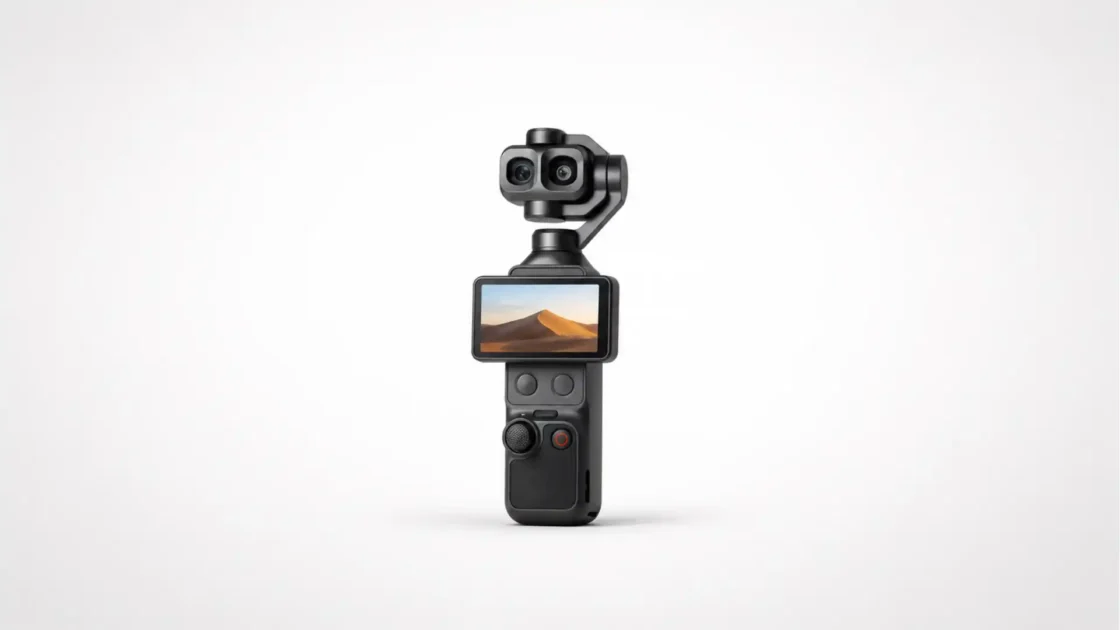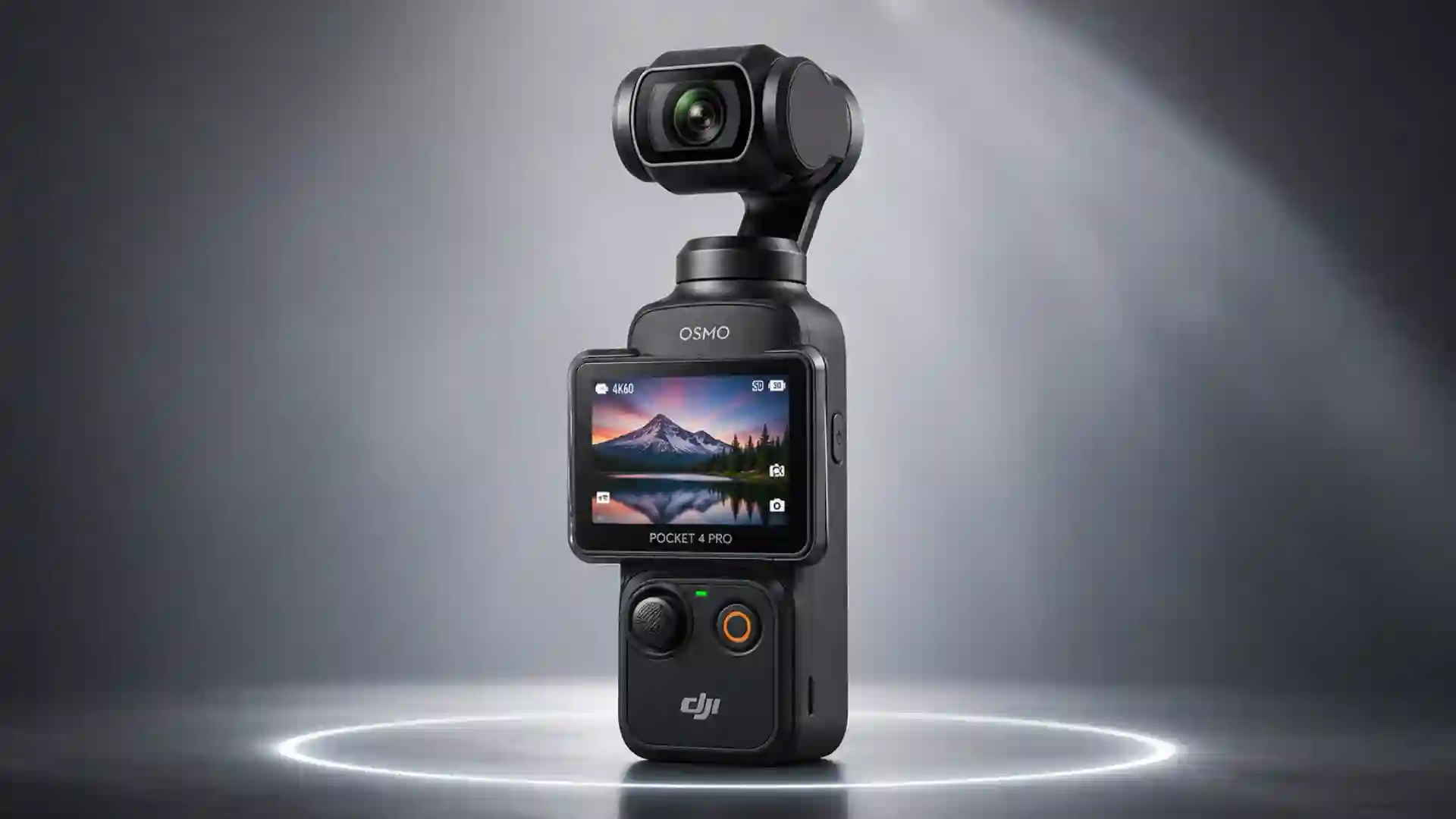
DJI had barely moved the Osmo Pocket line into its fourth generation before the next question arrived: what is the Osmo Pocket 4 Pro, and why does it appear to exist at all? The latest leak is not a minor packaging slip or a vague accessory listing. It points to a separate, higher-end pocket gimbal camera with a dual-camera head, a likely optical zoom lens, and a more ambitious role than the standard Osmo Pocket 4.
Table of Contents
The leak that changed the Pocket 4 story
The most credible early signal came from images shared by leaker Igor Bogdanov and reported by The Verge on April 14, 2026. The report described an image showing two handheld stabilized cameras, one of them believed to be a Pro version of DJI’s next Pocket camera. The same report said the rumored Pro model could combine an ultrawide lens with a telephoto lens, giving the Pocket line a capability it has never truly had: real optical reach inside a pocket gimbal body. The Verge also noted that the standard Osmo Pocket 4 was expected on April 16, while the Pro model might arrive later, possibly in May or June.
That timing now looks more plausible because the standard Osmo Pocket 4 has already been announced and its official feature set does not include a second lens. DJI’s own product page lists the Pocket 4 as a one-camera, 1-inch CMOS model with 4K/240fps recording, 14-stop dynamic range, 10-bit D-Log, 107GB of built-in storage, 2× lossless zoom, ActiveTrack 7.0, and three-axis stabilization. Those are serious upgrades, but they are not the same as a second optical path.
The leak became harder to dismiss when New Camera published what it described as five separate photo-shoot leak posts containing around 18 real-world images of the alleged Pocket 4 Pro. A single blurred device image can be wrong, staged, or misread. A larger set of field-style images is still not confirmation, but it raises the odds that a physical prototype exists. New Camera framed it as the most detailed look yet at the coming pocket gimbal camera.
The name itself also matters. DJI has used “Pro” in other product families to mark a sharper separation in capability, not just a bundle difference. If the Osmo Pocket 4 Pro is real, DJI may be preparing to split the Pocket line into two lanes: a standard creator camera for fast, stabilized everyday video, and a Pro model for creators who want better framing options, higher-resolution capture, and less dependence on digital zoom.
That split would make commercial sense. The Osmo Pocket 3 became a breakout success because it solved a very specific problem: stable, attractive, low-effort video in a device small enough to carry every day. The Pocket 4 improves that formula. A Pro model would need to do something different. It cannot only add a larger battery, another button, and a few software modes. It needs a reason to sit above a standard model that already records 4K slow motion at 240fps and includes 107GB of internal storage.
The rumored answer is zoom. Pocket cameras have always been excellent at walking shots, selfies, travel clips, food videos, casual event coverage, and social video. They have always been weaker when the subject is not close. A fixed 20mm-equivalent lens is friendly for vlogging, but it is less useful for stage footage, details across a street, compressed portraits, product cutaways, or travel scenes where the creator cannot physically move closer. A Pocket 4 Pro with a real telephoto module would attack the line’s oldest creative limitation.
That is why this leak matters even before DJI says a word. It is not only a rumor about another model. It points to a possible change in what a pocket gimbal camera is supposed to be. The original Osmo Pocket was a stabilizer with a tiny camera. The Pocket 3 became a creator camera with real image quality. The Pocket 4 sharpened that tool. A Pocket 4 Pro could turn the format into something closer to a tiny stabilized camera system.
A Pro model would solve a real Pocket problem
The Osmo Pocket formula has always been built around a trade. DJI gives the user mechanical stabilization, a tiny body, fast startup, strong tracking, and a lens that works well at arm’s length. The user accepts limited focal length flexibility. That trade is reasonable for vlogging, but it becomes frustrating as soon as the camera is used as a main travel or event camera.
A wide lens is forgiving. It keeps the creator in frame. It handles walking shots without demanding exact composition. It makes small rooms look bigger. It also reduces the visible impact of hand movement because wide angles exaggerate less shake than longer lenses. For a camera mounted on a miniature gimbal, that is the safe default. The problem is that wide-angle video often looks repetitive when it is used for every scene. A day shot entirely at roughly 20mm can feel flat, even when the image is sharp and the stabilization is excellent.
Creators know this problem well. A strong video sequence needs distance changes, foreground compression, detail shots, wider context, and tighter emotional beats. Smartphones now solve that with multi-camera arrays. A modern phone can jump from ultrawide to standard to telephoto in a second. The Osmo Pocket, by contrast, has had one optical personality. Digital zoom exists, and the standard Pocket 4 now advertises 2× lossless zoom, but a zoomed crop is not the same as a dedicated telephoto module with its own optical design. DJI’s spec page for the Pocket 4 lists zoom as digital, with 2× in stills at 7680×4320 and up to 4× for video depending on mode. It also excludes zoom in low-light, slow-motion, and timelapse modes.
A Pro model can justify itself if it changes that physical reality. A second camera could let creators film tighter shots without destroying detail, without cropping aggressively, and without switching to a smartphone or mirrorless camera. That matters for travel creators filming architecture, wildlife in tourist spaces, stage performances, food preparation across a counter, details on cars or bikes, or people in a scene where walking closer would ruin the moment.
The Pocket line also has a social-video problem that is less obvious. Short-form platforms reward variety inside a compact edit. A vertical clip that begins with a wide walking shot, cuts to a tighter detail, then returns to the speaker feels richer than a single-focal-length clip. Phone makers know this. Their camera systems are built for rapid perspective changes. DJI has superior stabilization, but phones have superior optical versatility. A dual-camera Pocket Pro would be DJI borrowing the one smartphone idea the Pocket line most badly needs.
The difficulty is that a telephoto lens makes the entire product harder to engineer. Longer focal lengths magnify movement. Even with a gimbal, micro-vibrations and tracking errors become more visible. The gimbal motors need to hold a more complicated camera head. The body must manage heat if higher-resolution modes such as 6K are real. The interface must let users switch focal lengths without missing the shot. The focusing system must behave predictably at tighter fields of view. A Pro model therefore cannot be judged only by whether it has two lenses. The quality of the transition between lenses may matter as much as the lenses themselves.
That is where DJI has a possible advantage. The company has spent years making cameras, gimbals, drones, subject-tracking systems, wireless microphones, and creator accessories feel like parts of one workflow. A dual-camera Pocket would not be a pure imaging problem. It would be a control problem, a stabilization problem, an autofocus problem, and a software problem. DJI’s best products work because these layers feel connected. A Pocket 4 Pro would need that same discipline.
A weak version of the product would be easy to imagine: a second lens that looks good in marketing but is noisy, soft, overprocessed, or unavailable in key modes. A strong version would be much more interesting: a compact gimbal camera that can hold a subject, switch perspective, maintain color consistency, and keep footage stable even when zoomed. That is the threshold the leak sets. Anything less would make “Pro” feel decorative.
Confirmed Pocket 4 facts set the baseline
The standard Osmo Pocket 4 is no placeholder. DJI officially announced it on April 16, 2026, and the company’s own product materials show a camera with a 1-inch CMOS sensor, an f/2.0 lens, 4K/240fps slow motion, 14-stop dynamic range, 10-bit D-Log, 107GB of built-in storage, 800MB/s transfer, ActiveTrack 7.0, and OsmoAudio four-channel output. DJI’s press release frames the Pocket 4 as an image-quality upgrade built on the global success of the Pocket 3.
That baseline matters because a Pro model has to clear it. The standard Pocket 4 already fixes several practical complaints from Pocket 3 users. Built-in storage reduces the risk of arriving without a microSD card. A brighter 1000-nit screen improves outdoor operation compared with the Pocket 3’s 700-nit display. The 4K/240fps slow-motion mode doubles the Pocket 3’s 4K/120fps ceiling. ActiveTrack 7.0 pushes the camera further into solo-creator territory. The 240-minute battery claim, while measured at 1080p/24fps with Wi-Fi disabled and the screen off, is still a much stronger headline than the older Pocket generation offered.
DJI’s official specs list the Pocket 4 at 144.2×44.4×33.5 mm and 190.5 g. That makes it slightly larger and heavier than the Pocket 3, which DJI lists at 139.7×42.2×33.5 mm and 179 g. The change is small enough that the Pocket identity remains intact, but it shows how little room DJI has to add hardware without compromising the format. A Pro version with a second lens would have an even tighter design problem.
Confirmed Pocket 4 versus rumored Pocket 4 Pro
| Area | Osmo Pocket 4 confirmed | Osmo Pocket 4 Pro rumored |
|---|---|---|
| Camera design | Single 1-inch CMOS camera with 20mm-equivalent f/2.0 lens | Dual-camera head, likely wide plus telephoto |
| Video headline | 4K up to 240fps slow motion | Reports mention 6K at 60fps and 4K slow motion |
| Zoom | Digital zoom, including 2× lossless claim in DJI marketing | Optical zoom, with some reports suggesting roughly 3× to 4× |
| Launch status | Officially announced on April 16, 2026 | Unannounced, with leaks pointing to May or June 2026 |
| Best fit | Solo creators, travel video, social clips, stabilized everyday footage | Creators who want tighter framing and more flexible shot variety |
The table shows why the Pro leak has weight. DJI has already made the standard model strong enough that the Pro cannot live on small refinements. It needs a different creative promise.
Independent reviewers have described the Pocket 4 in the same general terms: a refinement, not a radical break. Tom’s Guide called out the improved 1-inch sensor and processing, 4K/240fps slow motion, film-simulation-style in-camera looks, 107GB of internal memory, and a starting UK price of £429, while also noting that U.S. availability was pending because authorization had not cleared. CineD described the Pocket 4 as retaining the 1-inch CMOS sensor and 20mm f/2.0 lens while adding 14 stops of dynamic range, 10-bit D-Log, 4K/240fps slow motion, 107GB storage, and USB 3.1 transfer up to 800MB/s.
The same point appears from another angle in RedShark’s announcement coverage. RedShark listed 4K/240, 37MP stills, 14-stop dynamic range, 10-bit D-Log, 180 Mbps maximum bitrate, ActiveTrack 7.0, gesture control, and European/UK pricing starting from €479 or £429. It also noted that the Pocket 4 line arrived after months of leaks and that the confirmed product matched many of the pre-launch rumors.
For buyers, the standard Pocket 4 is already enough camera for most mobile video work. For DJI, that creates a strange challenge. A Pro model cannot merely be “better.” It must be better in a way that the standard product cannot become through firmware. A second optical system is one of the few upgrades that would meet that test.
The dual-camera idea points to optical reach
The dual-camera rumor is the center of the Pocket 4 Pro story because it changes the camera’s job. The Verge reported the possibility of an ultrawide and telephoto pairing. Geeky Gadgets, citing later field-testing claims, described a 6K dual-camera device with 3–4× optical zoom and a possible June 2026 release. RedShark also reported a rumored June window and connected the Pro discussion to a possible dual-camera model that was held back from the standard Pocket 4 launch.
The safest reading is not that all of these claimed specs are correct. They may not be. The field-testing claims could mix prototype capability, marketing shorthand, and speculation. The more grounded reading is that multiple reports are pointing in the same direction: DJI is testing or preparing a Pocket model that uses more than one camera module.
That would follow a pattern already familiar in phone cameras. A dedicated telephoto module is not only about making distant things larger. It changes the look of the scene. It compresses space, isolates subjects, reduces the exaggeration of wide-angle faces, and lets creators build more polished sequences without carrying another camera. On a mechanical gimbal, that becomes especially attractive because handheld telephoto video is hard. The longer the focal length, the more tiny movements become visible. A phone’s optical stabilization and electronic stabilization can manage some of this. A mechanical gimbal could manage more, if tuned well.
The question is whether DJI can make a dual-camera head small and balanced enough. The Osmo Pocket’s head is not a phone slab. It has to rotate, tilt, and roll inside a miniature gimbal assembly. Two camera modules add mass, complexity, and shape constraints. The lens positions must not interfere with the gimbal range. The head must not become so bulky that it feels fragile in a pocket. Heat from higher-resolution recording must leave the body without a fan that ruins audio or a chassis that becomes uncomfortable to hold.
There is also the issue of color matching. Anyone who has used multi-camera phones has seen the problem: switch lenses and the color, exposure, noise reduction, or contrast changes. On a quick social clip, that may be acceptable. On a Pro-branded DJI creator camera, it would be less acceptable. A Pocket 4 Pro needs its two lenses to feel like one camera system, not two cameras stitched into the same head.
Optical zoom inside this format would also require careful mode restrictions. DJI may limit the telephoto lens in low light, slow motion, or high frame-rate recording. That would not be surprising. Small telephoto modules often have slower lenses, smaller sensors, or tighter thermal limits. If the Pro model ships with a headline zoom number but restricts that zoom in the exact modes creators want, buyers will notice. The feature has to survive real shooting conditions, not only spec-sheet reading.
Still, the dual-camera direction feels credible because it gives DJI a way to compete with smartphones without copying smartphones completely. A Pocket camera does not need seven focal lengths. It needs one wide lens that handles vlogging and one tighter lens that gives sequences shape. Two good focal lengths would be more useful than four compromised ones.
Six-kilopixel rumors need careful reading
The 6K rumor is attractive, but it needs restraint. Geeky Gadgets reported claims of 6K video at 60fps, 4K slow motion, ActiveTrack 7.0, 10-bit D-Log M, a redesigned ergonomic body, and a larger battery or expanded internal storage. It also described field testing focused on stabilization, color accuracy, and subject tracking.
That sounds plausible at a surface level, but there are reasons to avoid treating 6K as a confirmed feature. DJI’s standard Pocket 4 already records stills at 7680×4320 in 16:9, according to the official spec sheet. That is an 8K-shaped still frame, not an 8K video mode. The line between sensor readout capability and final video recording capability is often misunderstood in leaks. A camera may capture a high-resolution readout for stills, crop, stabilization, or oversampling, while video modes remain lower. DJI’s confirmed video modes for Pocket 4 top out at standard 4K/60 and 4K slow motion up to 240fps.
If the Pro model has a different sensor pipeline, 6K/60 is possible. It would give DJI a sharper distinction from the standard model and make the Pro more attractive as a B-camera for editors who want room to crop into a 4K timeline. For solo creators, 6K can be useful when reframing horizontal footage into vertical clips, stabilizing further in post, or punching in during an interview. Resolution is not only about sharpness; it is about editorial flexibility.
Yet 6K is not free. It increases heat, battery drain, file size, and processing load. It can also expose lens weakness. A tiny lens and small sensor that look clean at 4K may look less convincing at 6K if the optics are soft near the edges or the noise reduction is too aggressive. Higher resolution also demands higher bitrates to avoid mushy detail. The standard Pocket 4’s maximum bitrate is 180 Mbps, according to DJI’s official specs. A credible 6K mode would need enough data to avoid looking like a marketing feature.
There is also a terminology risk. Some reports mention 10-bit D-Log M for the rumored Pro, while DJI has promoted 10-bit D-Log for the Pocket 4. Tom’s Guide says DJI moved away from D-Log M on the Pocket 4 toward a more genuine D-Log profile, though DJI’s own public materials use the shorter “D-Log” language. Leak reports often recycle older profile names, and that can muddy the picture. A final Pro spec sheet would need to clarify whether the camera uses D-Log, D-Log M, HLG, normal color, or a new profile tied to DJI’s broader camera ecosystem.
The most useful stance is simple: 6K would make the Pocket 4 Pro more credible as a professional companion camera, but optical flexibility matters more than the resolution number. A clean, stable, color-consistent 4K image from two focal lengths would be more useful than a hot, noisy, heavily cropped 6K mode that creators avoid. DJI’s real test is not whether it can print 6K on a box. The test is whether the Pro model produces footage people trust.
Optical zoom is the feature creators keep asking for
Optical zoom matters in this category because the Pocket line already does the easy parts well. Stabilization is strong. Startup is quick. Tracking has improved. Audio integration with DJI microphones is useful. Vertical shooting is built into the product idea. The missing piece is not another menu mode. The missing piece is shot variety without carrying a second camera.
The fixed wide lens is perfect for first-person travel energy. It is less convincing for visual storytelling beyond the creator’s immediate space. Imagine filming a market, a musician, a building detail, a boat from shore, a speaker on stage, or a dog running across a park. A wide Pocket camera forces the creator to move closer or accept a small subject in the frame. Digital zoom can help, but it cannot change optical perspective. A real telephoto module can.
A 3× or 4× optical reach, if the rumors are close, would be a major shift. From a 20mm-equivalent wide lens, 3× would land around 60mm equivalent and 4× around 80mm equivalent. Those are useful focal lengths. A 60mm-equivalent view can produce natural detail shots and less distorted portraits. An 80mm-equivalent view can isolate subjects and compress backgrounds. That would let a Pocket camera shoot cutaways that now belong to smartphones, compact cameras, or mirrorless setups.
There is a reason the Canon PowerShot V1 and similar creator compacts remain relevant. Canon’s V1 uses a 1.4-inch sensor, roughly 22.3 effective megapixels, 4K/60p video, Dual Pixel autofocus, and a built-in 16–50mm f/2.8-4.5 lens. It lacks a built-in three-axis gimbal, but it gives creators optical range, a larger sensor area than typical 1-inch compacts, and a more traditional camera grip. A Pocket 4 Pro would attack that same creator need from the opposite direction: keep the gimbal, keep the pocket body, add focal length flexibility.
There are limits. A pocket gimbal telephoto will not replace an interchangeable-lens camera. It will not give the shallow depth of field, manual lens options, low-light headroom, or heat management of larger systems. It might also struggle in very dark scenes if the telephoto module uses a smaller sensor or slower aperture. But creator tools do not win only by having the best image quality. They win when they are the camera people actually use. The Pocket line’s strength is that it removes friction. A Pro model should preserve that and add reach.
That is the tricky balance. If DJI makes the Pro model too large, it becomes less Pocket. If it keeps the body tiny but compromises the telephoto image too much, it becomes less Pro. The ideal version would not pretend to replace a Sony, Canon, Fujifilm, or Panasonic setup. It would claim a narrower and more useful role: the smallest stabilized camera that can shoot both wide creator footage and tight editorial details.
The fact that people are reacting strongly to the leak says something about the market. Creators do not only want higher frame rates. They want cameras that make footage look less repetitive. Optical reach is a storytelling feature disguised as a spec. DJI seems to know that.
A telephoto lens would reshape Pocket filming
A telephoto Pocket camera would change how people film with the device. Today’s Pocket workflow is usually physical: move closer, move back, turn the screen, hold the handle higher, lower the gimbal, let ActiveTrack follow the subject. A telephoto module adds a second kind of movement: visual compression from a fixed position. That is a different creative language.
For travel work, this is huge. The standard Pocket is excellent when the creator walks through a street or speaks to camera. It is less strong when the subject is across the square, on a balcony, behind a stall, or in a crowd. A telephoto lens would let creators capture texture without intruding. The camera could move from a wide establishing shot to a detail of hands preparing food, signage, architecture, or a face in a scene. That kind of sequence feels edited rather than merely recorded.
For event work, optical reach is even more useful. Pocket cameras are popular at conferences, weddings, trade shows, family gatherings, and small performances because they are discreet. A wide-only camera at an event often produces too much empty frame. A telephoto lens could isolate speakers, products, table details, reactions, or stage moments without requiring a long lens on a mirrorless body. It would not replace a professional event kit, but it would become a better second camera.
For product creators, the benefit is tighter cutaways. A wide lens exaggerates shape and makes products near the lens look distorted. A moderate telephoto view looks more natural. It can show buttons, textures, stitching, ports, screens, labels, and materials without forcing the camera close enough to cast shadows or lose focus. DJI’s Pocket cameras already have a close minimum focus distance around 0.2 m on the standard models. A telephoto module could make close detail shots feel less cramped if its focusing distance supports that use.
For solo vlogging, the benefit is more subtle. Most creators will still use the wide camera for speaking to the lens. The telephoto module would become the cutaway tool. A creator could film a face-to-camera segment, then switch to a tighter shot of the location, an object, or a person being discussed. It would reduce dependence on smartphone inserts. That would make the Pocket feel more like a complete video kit and less like a stabilized selfie camera.
There is one risk: zoom encourages lazy filming when it is too easy. Bad digital zoom has trained people to punch in from the same angle rather than move or recompose. A Pro Pocket should not become a “zoom everything” device. Its value is not that users can stand still. Its value is that they can build more varied scenes while still moving lightly. DJI’s interface could shape that behavior. A physical zoom dial, if the rumor is right, would be useful only if it feels precise, not like a smartphone pinch gesture translated into a tiny camera.
The stabilization burden will be heavier at telephoto. A wide gimbal shot can hide small errors. A telephoto gimbal shot exposes them. If DJI ships a Pro model with optical zoom, reviewers will test walking shots at the longer focal length immediately. That may become the product’s defining test. A telephoto that works only when standing still is useful. A telephoto that works while walking is much more valuable.
The body design challenge is bigger than the spec sheet
Leaked feature lists are easy to read as a straight upgrade path: add a lens, add resolution, add a battery, add internal storage, add a dial. Hardware design is rarely that generous. The Osmo Pocket body is already an exercise in compromise. It has to hold a gimbal, camera, touchscreen, battery, storage, microphones, wireless radios, USB-C, cooling paths, control buttons, and accessory contacts in a body that still feels pocketable.
The standard Pocket 4 gained size and weight over the Pocket 3. The difference is modest, but it shows the direction: more capability needs more physical room. DJI lists the Pocket 4 at 190.5 g compared with the Pocket 3 at 179 g, while the screen grows brighter but remains 2.0 inches at 556×314 resolution. A Pro body with two cameras may need a larger head or wider gimbal envelope. That could affect pocketability, startup speed, case design, accessory compatibility, and perceived durability.
The gimbal head is the hardest part. A second lens changes mass distribution. A telephoto lens may require more glass or a folded optical path. The motor system must remain strong enough to handle fast movements and stable enough to avoid micro jitter. The protective shutdown position must still work. The camera must survive being carried in a bag. A Pocket product cannot feel delicate. It lives in pockets, sling bags, backpacks, luggage, and jacket compartments. A Pro model with a visibly more complex camera head may make buyers nervous if it lacks a convincing protective design.
Thermals are another quiet challenge. The standard Pocket 4 already packs 4K/240fps slow motion and 107GB of internal storage into a tiny body. Reviewers have noted that compact creator cameras can get warm during heavy use; TechRadar’s vlogging camera guide lists warmth during continuous 4K shooting as a reason to avoid the Pocket 4 for some users. A 6K Pro model, if real, would increase that burden. Heat can reduce recording limits, affect battery life, force lower brightness, or trigger mode restrictions.
Controls may define whether the Pro feels professional. A zoom camera needs fast focal length control. Touchscreen-only zoom can work, but it is less reliable when walking, filming in cold weather, or working quickly. Geeky Gadgets’ report mentions a physical zoom dial among the rumored ergonomic changes. If DJI adds one, the dial’s behavior matters: stepped focal lengths versus smooth zoom, damping, accidental input prevention, and custom functions. A bad dial becomes a gimmick. A good dial becomes the reason people use the camera every day.
Battery life is just as complicated. A larger battery sounds good, but it adds weight and heat. The standard Pocket 4’s 1545 mAh battery is rated for 240 minutes only under limited lab conditions: 1080p/24fps, Wi-Fi off, screen off, and 25°C ambient temperature. The same spec sheet lists charging to 80 percent in 18 minutes and 100 percent in 32 minutes with DJI’s 65W portable charger. A Pro model may advertise strong endurance, but users will care about real-world 4K, 6K, tracking, screen-on, mic-connected use.
A Pro product can fail if it wins the spec sheet but loses the feel. The Pocket line is loved because it is immediate. You turn it on, it stabilizes, it frames, it records. If the Pro adds friction, it risks weakening the very reason the product exists. DJI’s job is not to make a tiny mirrorless camera. It is to make a more capable Pocket that still behaves like a Pocket.
DJI’s software advantage still matters
The hardware leak gets attention, but DJI’s software is the reason a Pocket 4 Pro could work. Small cameras live or die by automation. A creator holding a tiny gimbal at arm’s length cannot constantly ride focus, exposure, gimbal angle, face tracking, zoom, and audio levels. The camera must make strong decisions quickly.
The standard Pocket 4 already pushes this direction. DJI promotes ActiveTrack 7.0, intelligent focusing, 2× lossless zoom, and OsmoAudio four-channel output. Its official video modes include normal 4K up to 60fps, vertical 3K up to 60fps, 4K slow motion up to 240fps, timelapse, motionlapse, and low-light video. The product is not merely a camera on a stick. It is a small automated filming system.
A Pro version would need more automation, not less. Two lenses complicate tracking. If a subject is tracked on the wide lens and the user switches to telephoto, the camera must keep the subject centered, adjust focus, avoid sudden exposure jumps, and maintain stabilization. If the telephoto lens has different low-light behavior, the system must warn the user or adapt gracefully. If zoom is available during tracking, the gimbal and software need to agree on framing.
This is where DJI’s drone heritage matters. The company has long worked on subject tracking, gimbal control, scene recognition, and camera automation under movement. A Pocket camera is simpler than a drone in some ways, but harder in others because the user’s hand is less predictable than a flight controller. A Pro model with optical zoom would bring drone-like tracking expectations into a handheld creator device. People will expect the camera to behave like a tiny operator, not just a stabilized lens.
The software also has to handle creator memory. Modern creator tools increasingly remember faces, preferred settings, button mappings, and shooting orientations. RedShark’s Pocket 4 announcement coverage mentions Subject Lock Tracking and Registered Subject Priority on the standard Pocket 4, which let users prioritize specific faces. On a Pro model, such features could become more useful because tighter focal lengths make framing mistakes more obvious. If the camera knows which person matters, telephoto tracking becomes less chaotic.
Color management is another software advantage. A dual-camera system needs matching. A creator using both lenses in one edit should not have to fix obvious color shifts after every cut. DJI’s D-Log workflow, normal profile, and any in-camera looks must behave predictably across modules. If the Pro also connects to DJI drones or action cameras in a larger kit, color consistency becomes a selling point. Many creators already mix drone footage, action camera footage, phone footage, and Pocket footage. A Pro Pocket that grades cleanly could become the glue camera in that kit.
The software risk is over-automation. A Pro user may want more manual control, not less. DJI has to support fast automatic shooting while giving advanced users access to shutter, ISO, exposure lock, focus behavior, color profiles, and audio routing. The standard Pocket 4 already uses MP4 HEVC, JPEG/DNG stills, and 180 Mbps max bitrate. A Pro version should not bury serious controls under social-camera simplicity.
The best DJI products feel confident because the automation usually guesses correctly and manual control appears when needed. The Pocket 4 Pro leak is exciting because it hints at new hardware. The final product, if it arrives, will succeed only if the software makes that hardware feel effortless.
Audio is part of the Pro case
People often discuss Pocket cameras as image devices, but the creator market is unforgiving about audio. A beautiful walking vlog with bad voice capture is hard to use. A product demo with unstable levels feels amateur. A travel clip with no useful ambient sound loses place and texture. A Pro Pocket model needs to treat audio as part of the camera, not an afterthought.
DJI has already moved in that direction with OsmoAudio. The standard Pocket 4 product page lists four-channel OsmoAudio output, while Tom’s Guide says pairing the Pocket 4 with DJI microphones gives access to four-channel recording, spatial audio, and audio zoom, where audio direction can match the zoom area. Notebookcheck also reported on Pocket 4 Audio Zoom and Spatial Audio as part of the device’s more advanced sound capture story.
This matters more if the Pro model has optical zoom. When the camera moves from wide to telephoto, the audio question changes. A wide shot often wants ambient sound. A telephoto shot may imply attention to a specific subject. If the camera can narrow visual attention but the microphones still capture a broad wash of sound, the result feels disconnected. Audio zoom attempts to solve that by aligning sound emphasis with visual framing. It is not magic, and creators will still use wireless microphones for speech, but it fits the Pro idea.
A dual-camera Pocket could also serve event creators who need ambient audio plus lavalier audio. Four-channel output could support a mix of internal mics, wireless mic transmitters, and environmental capture. DJI’s Mic ecosystem gives the company a strong base here. Many Pocket buyers already choose Creator Combos because audio accessories make the camera more useful. If the Pro model ships with deeper audio modes, a bundled microphone, or better internal microphone processing, the price will be easier to defend.
The design challenge is physical. More camera hardware can crowd microphone placement. A larger gimbal head may block or reflect sound differently. A fan would be terrible for internal audio, so if the Pro model runs hotter, DJI must control heat without adding audible noise. The standard Pocket 4’s three-microphone design shows DJI has not moved to a larger mic array in the base model. A Pro version may need smarter processing rather than more microphones.
Audio also affects U.S. and regulatory questions because wireless systems need authorization. The Pocket body, wireless microphone pairing, Bluetooth, Wi-Fi, and transfer features all tie into certification regimes. DJI’s standard Pocket 4 spec sheet lists Wi-Fi bands, Bluetooth BLE 5.4 and BR/EDR, and region-specific transmitter power limits. Any Pro model with similar radios faces the same kind of market-by-market approval process.
The Pro case is strongest when image, stabilization, tracking, and audio are viewed together. A dual-camera Pocket with weak sound is only half a creator tool. A dual-camera Pocket with strong wireless mic integration, useful internal backup audio, and audio behavior that follows framing becomes much harder for rivals to copy.
The Pocket 3 created the pressure DJI now faces
The Osmo Pocket 3 changed expectations for the whole category. Before it, the Pocket line was clever but not always taken seriously as a main creator camera. DJI Pocket 2 had improved the formula with a 1/1.7-inch sensor, 64MP high-resolution stills, 4K/60fps video, a wider 20mm-equivalent lens, HDR video, and stronger creator accessories. But the Pocket 3’s move to a 1-inch CMOS sensor, 4K/120fps video, 10-bit D-Log M, a larger rotatable screen, and better low-light behavior made the product feel less like a novelty and more like a serious tool.
That success created a problem for DJI. Once a compact gimbal camera becomes good enough for serious work, users start asking for serious-camera flexibility. They want better dynamic range, better color, faster slow motion, stronger tracking, internal storage, better audio, and optical options. The Pocket 4 answers many of those demands. The rumored Pro exists because the Pocket 4 cannot answer all of them while staying in its standard body and price band.
The original Osmo Pocket, announced in 2018, was described by DJI as its smallest three-axis stabilized handheld camera. It had a tiny form, a three-axis gimbal, and the idea that everyday moments could look cinematic without a larger stabilizer. DPReview reported at the time that it used a 1/2.3-inch sensor for 12MP photos and 4K/60p video at 100 Mbps. That first model’s magic was not pure image quality. It was the shock of seeing stable footage from something so small.
Pocket 2 improved imaging and audio, but Pocket 3 made the category explode because its image no longer felt tiny-camera compromised in normal use. It could handle creator work, travel, low-light interiors, talking-head clips, and vertical video in a way that felt modern. The 2-inch rotatable screen also changed the experience. It made horizontal and vertical framing feel native instead of awkward. DJI’s Pocket 3 spec page lists the 2-inch display, 700-nit brightness, 1-inch CMOS sensor, 20mm f/2.0 lens, and microSD support up to 1TB.
Pocket 4 refined that success rather than replacing it. Tom’s Guide said the Pocket 4 looked almost identical to its predecessor, with the most meaningful gains under the hood: improved sensor processing, slow motion, storage, controls, stabilization tweaks, and audio integration. That kind of refinement is exactly what standard models often do. It gives most buyers a better version of the thing they already liked.
A Pro line would give DJI another route. It could preserve the standard Pocket’s simplicity while letting ambitious users pay for more complex imaging. That is the same logic used across phones, drones, and cameras. The base model becomes the reliable default. The Pro model carries the experiments, the higher margin, and the features that cannot fit the base price.
The irony is that DJI’s Pocket 3 success may have made a Pro model unavoidable. A category that once needed to prove it was useful now has users asking for optical zoom and 6K rumors. That is a sign of maturity. People do not ask for Pro features from a toy. They ask when a tool has already earned a place in the bag.
Osmo Pocket 4 sharpened the standard model without taking the Pro lane
DJI’s standard Pocket 4 choices look deliberate. The company did not make it a dual-camera product. It did not turn it into a bulky compact camera. It kept the 20mm-equivalent f/2.0 lens, the 1-inch sensor class, the rotatable screen, and the pocketable gimbal identity. Then it improved the features that make everyday shooting easier: slow motion, dynamic range, internal storage, screen brightness, tracking, battery, transfer speed, and audio.
That gives the product a clear role. It is the best choice for users who want a fast, stable, self-contained camera for social video, travel, walking clips, family footage, and lightweight production. It is not asking those users to pay for a telephoto module they may never need. It also keeps DJI’s pricing ladder open. RedShark reported EU and UK pricing from €479/£429 for the Essential Combo, €499/£445 for Standard Combo, and €619/£549 for Creator Combo.
The standard model’s 107GB internal storage is a particularly smart upgrade. Forgetting a memory card is one of the oldest camera mistakes. Internal storage does not remove the need for microSD, but it gives the camera a fallback. DJI’s official spec sheet says the Pocket 4 has 107GB of internal storage and can be expanded via microSD. OWC also highlighted 107GB storage, 37MP photos, a brighter OLED screen, and true 10-bit D-Log as major Pocket 4 improvements.
The brighter screen matters more than it sounds. Pocket cameras are often used outside, one-handed, and in motion. A 1000-nit display is not a luxury when the user is trying to confirm framing in sunlight. DJI’s Pocket 4 specs list the 2.0-inch touchscreen at 556×314 and 1000 nits, up from the Pocket 3’s 700 nits. This is the kind of improvement that does not dominate headlines but changes daily use.
ActiveTrack 7.0 is the other standard-model pillar. Solo creators need tracking they can trust. TechRadar’s vlogging camera guide ranked the Osmo Pocket 4 as its top overall vlogging camera and singled out 4K/240fps recording, gimbal stabilization, and ActiveTrack 7.0 as major strengths, while also noting heat during continuous 4K use and weaker still-photo performance than some rivals. That is the standard Pocket 4’s identity in one paragraph: excellent creator video, not a full camera replacement.
A Pro model should not blur that identity. It should sit above it with a different promise. If DJI prices it too close to the standard Creator Combo, it may confuse buyers. If it prices it near mirrorless cameras, it must justify the premium with features no mirrorless camera gives in that size. The Pro cannot merely be the Pocket 4 with a badge. It needs to be the optical-flexibility model.
This is why the leak feels less random than many tech rumors. DJI has created the product gap itself. The standard Pocket 4 is strong and focused. The Pro, if real, has room to be more specialized.
Pricing could decide whether Pro feels serious or excessive
The rumored Pocket 4 Pro price range is not confirmed, but leaks and commentary tend to place it above the standard Pocket 4 and below entry-level mirrorless kits. Geeky Gadgets mentions an expected price around $700, while RedShark says dollar pricing is difficult because of U.S. availability questions and points to Europe and Asia as more likely targets if the FCC issue blocks U.S. certification.
That range makes sense, but it creates a narrow value window. At around €600–€700, a Pocket 4 Pro would compete not only with the Pocket 4 Creator Combo but also with compact creator cameras, used mirrorless kits, smartphones, action cameras, and 360 cameras. The value depends on whether optical zoom and Pro modes feel genuinely useful. At this price, the Pro model cannot rely on DJI loyalty alone.
The standard Pocket 4’s European pricing gives DJI room. If the Essential Combo starts around €479 and the Creator Combo around €619, a Pro model could start higher without immediately cannibalizing the base model. But bundles complicate the comparison. A Pro Essential Combo without a microphone may look worse than a standard Creator Combo with DJI Mic hardware included. A Pro Creator Combo with a microphone, fill light, wide-angle accessory, handle, and case may push the price into mirrorless territory.
Creators do not compare only MSRP. They compare working-kit cost. A Pocket camera often needs a microphone, ND filters, extension handle, tripod, case, and sometimes a battery handle. A Pro model with optical zoom may also need new accessories if the head shape changes. If DJI preserves compatibility with existing Pocket 4 accessories, that will help. If the Pro needs a different clamp, case, wide-angle adapter, filter set, or protective shell, the real upgrade cost rises.
The pricing argument also depends on the buyer. A travel creator who uses the Pocket every day may find a Pro model cheap compared with a camera body, lens, gimbal, microphone, and tripod. A casual user who only wants vacation clips may see the standard Pocket 4 as already more than enough. A professional may buy it as a B-camera, but only if the codec, color, reliability, and battery behavior fit paid work.
The threat from smartphones is always present. A flagship phone already has multiple lenses, strong stabilization, instant sharing, and excellent HDR processing. The Pocket Pro needs to justify itself against the phone in the buyer’s pocket. Its argument is mechanical stabilization, dedicated ergonomics, better creator framing, stronger audio integration, and a filming posture that does not drain or occupy the phone. If optical zoom joins that list, the Pocket Pro argument becomes much stronger.
Price also influences leak perception. A rumored feature that sounds exciting at $599 can feel inadequate at $899. If DJI launches a Pro model, it will need a disciplined positioning message. Not “the best Pocket ever,” because that says too little. More like: the Pocket for creators who need wide and tight shots from one stabilized camera. The sharper the promise, the easier the price becomes to understand.
United States availability may become the hardest question
The Pocket 4 Pro story is not only about camera technology. It is also about access. U.S. buyers have become a complicated part of DJI product launches because of regulatory restrictions and FCC authorization issues. The standard Pocket 4 itself has already been affected. Tom’s Guide reported DJI’s statement that it had no U.S. pricing and that the Osmo Pocket 4 would not be available in the U.S. market while its authorization application was still pending.
The wider issue traces back to the FCC’s Covered List decision. The Verge reported in December 2025 that the FCC had banned new foreign-made drones from being imported into the U.S. unless the Department of Defense or Department of Homeland Security recommends them, and that drones and critical parts from companies like DJI were treated as presenting unacceptable national-security risks. The same report noted that existing foreign-made drones could still be used. AP reported that the FCC decision would keep new Chinese-made drones such as those from DJI and Autel out of the U.S. market, while the FCC cited unacceptable risks and said specific exemptions could apply if defense or homeland-security agencies found a device did not pose those risks.
The Pocket line is not a drone, but DJI’s product ecosystem depends on radio authorization, import rules, and political scrutiny. RedShark’s Pro leak analysis argues that DJI’s addition to the FCC Covered List creates a practical problem for future devices, suggesting the standard Pocket 4 may have filed before the cutoff while the Pro may not have. It says the Pro is expected to target Europe and Asia, with U.S. buyers potentially pushed toward gray-market imports that may lack warranty coverage.
TechRadar added another layer in April 2026, reporting DJI’s court filings in which the company claimed the U.S. block could cost it about $1.5 billion across the year, including regulatory costs and lost revenue from new 2026 products. The same report said 25 DJI product launches were planned for 2026 and that the U.S. appeals court would have to decide whether DJI’s challenge could move forward. Reuters reported China’s commerce ministry urging the U.S. to stop adding foreign-made drone systems and key components to the Covered List, while noting the FCC action would bar approvals of new drone types for import or sale in the United States.
For a Pocket 4 Pro buyer, the practical question is simple: will the camera be officially sold, supported, and warrantied in your market? A gray-market import may work technically, but creators should think carefully before buying a new DJI device without local warranty, service coverage, app support clarity, or accessory availability. That is especially true for a more complex Pro model with a dual-camera gimbal head.
The U.S. issue could also help rivals. If DJI cannot officially sell new creator cameras in the United States, Insta360, Canon, Sony, GoPro, Panasonic, and smartphone brands gain room. A creator who cannot buy a Pocket 4 Pro through normal channels may choose a Canon PowerShot V1, Sony ZV model, Insta360 Luna, or a phone-based setup instead. Availability is a feature. If buyers cannot get the product cleanly, the spec sheet loses power.
Insta360 and Oppo make the timing more urgent
DJI’s Pocket line once felt like a category of one. That is changing. Insta360 is now openly circling the same space. PetaPixel reported that Insta360 teased a Luna series co-engineered with Leica at NAB in Las Vegas, with Luna Pro and Luna Ultra models hidden behind partially frosted glass and aimed at DJI’s Osmo Pocket 4 and rumored dual-camera Pocket 4P. T3 reported that Insta360 had released a teaser for a compact camera to be demoed at NAB 2026, positioning it as a DJI Osmo Pocket rival with dual-camera interest.
That matters because Insta360 is not a random entrant. It understands small cameras, creator workflows, stabilization, mobile apps, reframing, and influencer-driven launches. It also has a Leica partnership in parts of its camera lineup, which gives it a color and optics story DJI cannot ignore. If the Luna Ultra rumors about modularity or stronger zoom prove true, DJI will not be competing only against leaks. It will be competing against a company that knows how to make odd camera formats feel normal.
Oppo adds another signal. Digital Camera World reported on April 21, 2026, that Oppo product manager Schofield Lu confirmed during a Find X9 Ultra Q&A that the company is exploring a dedicated handheld gimbal camera. The report also mentioned Vivo rumors, Honor’s robot gimbal concept, and Insta360’s confirmed work on Luna-style pocket gimbal cameras.
Smartphone brands entering this category would make sense. They already invest heavily in image processing, multi-camera systems, portrait video, stabilization, and computational photography. A standalone gimbal camera would let them extend phone camera technology into a creator device without being constrained by phone shape. It would also let them sell accessories, apps, cloud workflows, and ecosystem tie-ins. For Oppo, Vivo, or Honor, a pocket gimbal camera is not a strange detour. It is a camera-phone idea freed from the phone.
DJI still has the strongest brand in this exact form factor. The Pocket line has credibility because it has years of real users behind it. But competition changes the rhythm of product planning. A Pocket 4 Pro leak arriving right after the standard Pocket 4 and alongside Insta360 Luna teasers does not feel accidental. DJI may need to show that it has a higher-end answer before rivals define the next wave.
Competition also shifts buyer expectations. If Insta360 offers a dual-camera gimbal with Leica color, DJI’s Pro model must answer with stabilization, tracking, ecosystem, reliability, and image quality. If Oppo enters with phone-grade computational processing, DJI must answer with dedicated-camera ergonomics and accessory depth. If Canon and Sony continue improving compact creator cameras, DJI must defend the value of a gimbal-first product.
The result is good for creators. A category with one serious player tends to refine slowly. A category with DJI, Insta360, phone makers, and traditional camera brands becomes sharper. The Pocket 4 Pro leak feels like the first visible sign of that fight.
The creator camera category is splitting into three jobs
The Pocket 4 Pro rumor makes more sense when the creator-camera market is separated into jobs rather than product types. Most buyers do not wake up wanting “a compact camera” in the abstract. They want to film themselves, film movement, record trips, make product videos, capture events, shoot vertical content, or create polished clips without carrying a full rig.
The first job is frictionless self-filming. The Osmo Pocket line is excellent here. A tiny gimbal camera with face tracking, a rotatable screen, and wireless mic support is almost purpose-built for solo creators. A phone can do it, but it ties up the phone and often needs a grip or tripod. A mirrorless camera can do it with better image quality, but it requires more setup. The Pocket wins by being fast.
The second job is rugged action capture. GoPro, DJI Osmo Action, Insta360 action cameras, and 360 cameras lead this space. They survive water, impacts, helmets, bikes, boards, chest mounts, and rough use. The Pocket is not an action camera. Tom’s Guide notes the Pocket 4 is not waterproof, which is expected for its design. A Pro model will not change that unless DJI makes a very different product, which seems unlikely. It should not try to be a GoPro.
The third job is compact editorial capture. This is where the Pocket 4 Pro leak sits. Editorial capture means more than filming yourself. It means shooting scenes, details, people, places, products, and motion in a way that cuts together cleanly. That job benefits from optical reach, stronger color, better audio, reliable tracking, and a camera that can be carried all day. A dual-camera Pocket would make a direct play for this job.
Traditional compact cameras and mirrorless cameras still have strengths. Canon’s PowerShot V1 has a larger 1.4-inch sensor, optical zoom, Canon autofocus, and 4K/60p video. Sony’s ZV series gives creators strong autofocus, larger sensors in some models, and conventional camera controls. TechRadar’s vlogging guide still praises the Sony ZV-1 for compactness, real-time Eye AF, mic port, articulating screen, and crisp 4K/30p video, while naming the Panasonic GH7 as a premium option with deep video features. These cameras win when image quality, lens choice, or long recording are more important than pocket gimbal convenience.
The Pocket 4 Pro, if real, would not erase those categories. It would occupy a narrower middle: more versatile than a fixed-lens Pocket, more stable than a normal compact, smaller than a mirrorless rig, less rugged than an action camera, and more dedicated than a smartphone. That is a useful space.
Buyers should choose by job, not hype. A travel vlogger who mainly talks to camera may buy the standard Pocket 4 and never miss the Pro. A wedding filmmaker may use a Pro Pocket for discreet cutaways but still rely on larger cameras. A product reviewer may love the telephoto detail shots. A hiker may prefer an action camera because weather sealing matters more. A journalist may value a Pocket Pro if it stays small and records clean audio.
The leak is exciting because it suggests DJI understands this split. The standard Pocket 4 handles frictionless self-filming. The rumored Pro could handle compact editorial capture. That would make the lineup clearer, not more confusing.
Practical buying advice while the Pro remains unannounced
Anyone buying now faces a familiar problem: buy the excellent camera that exists, or wait for the more exciting one that might arrive. The correct answer depends less on rumors and more on the user’s next three months of work.
The standard Osmo Pocket 4 is real. It has official specs, reviews, pricing outside the U.S., accessories, and a clear feature set. If you need a pocket gimbal camera now for travel, vlogging, social content, events, or everyday filming, it is the safer choice. DJI’s own materials and independent coverage agree on the core strengths: 1-inch CMOS, 4K/240fps slow motion, 10-bit D-Log, 14-stop dynamic range, internal storage, strong tracking, and three-axis stabilization.
Waiting makes sense if optical zoom is central to your work. If you often film subjects you cannot approach, if you want tighter product cutaways, if you need more polished travel sequences, or if you already own a Pocket 3 and do not urgently need the Pocket 4’s refinements, the Pro leak is worth watching. The strongest reason to wait is not 6K. It is the possibility of a real second focal length.
Pocket 3 owners should be especially cautious. The Pocket 4 improves dynamic range, slow motion, storage, tracking, screen brightness, battery claims, and workflow. But if your Pocket 3 still earns its place and you mainly feel limited by focal length, upgrading to the standard Pocket 4 may not solve your biggest complaint. The Pro might. DJI’s Pocket 3 remains a strong camera with a 1-inch sensor, 4K/120fps, rotatable screen, and 10-bit D-Log M/HLG support.
New buyers should separate creator needs from gear anxiety. Rumors make every current product feel obsolete. That is not fair to the Pocket 4. A dual-camera Pro could be more expensive, heavier, delayed, limited by region, or compromised in low light. It may arrive in June, or later, or not in the exact form described. It may lack U.S. availability. It may require new accessories. A camera you can use now is often worth more than a rumored camera that misses your project.
U.S. buyers face a different calculation. Official availability and warranty support matter. If the standard Pocket 4 is not available through DJI in the U.S. and the Pro faces an even harder certification path, buyers should avoid assuming that international launch equals local availability. A gray-market unit may be tempting, but repairs, returns, app support, and accessory service can become painful. For U.S. creators, availability may be as decisive as image quality.
The best waiting strategy is to define the trigger. Wait only if you can name the feature that would make the Pro worth it. “I want the newest one” is not a strategy. “I need optical zoom in a stabilized pocket camera” is. “I need 6K for reframing vertical edits” might be. “I already own a Pocket 3 and can wait two months for clarity” is reasonable. “I have a trip next week and need reliable footage” points toward buying what exists.
Creators should also watch Insta360. If Luna Pro or Luna Ultra becomes official before DJI confirms Pocket 4 Pro, the comparison may change quickly. A competitor with modularity, Leica co-engineering, wider zoom, or cleaner U.S. availability could pressure DJI on price and features. That does not mean it will beat DJI. It means waiting may bring more than one option.
Rumors worth watching before launch
Not all leaks deserve equal attention. Some details are easy to fake or misread. Others are harder to fake and more meaningful. For the Pocket 4 Pro, the most useful signals will be certification filings, retail listings, accessory compatibility, real sample footage, product-box images, and firmware references.
Certification filings can reveal model numbers, wireless radios, battery information, and market intent. They may not reveal camera specs, but they can show whether a product is moving toward release. RedShark’s report mentions a separate FCC number in connection with the Pro, while warning that the standard Pocket 4 may have had a different regulatory timing advantage. If more filings appear in Europe or Asia, that would support the theory that DJI is targeting those markets first.
Accessory leaks are valuable because they show physical design. A new gimbal clamp, case, filter set, wide-angle adapter, or protective cover can reveal head shape and lens layout. If the Pro has two lenses, existing filters may not fit. That would force DJI to create a new accessory set. Accessory compatibility will also tell Pocket 3 and Pocket 4 owners how expensive the upgrade really is.
Real sample footage will matter more than still images. A dual-camera product must prove lens switching, stabilization at telephoto, autofocus reliability, low-light behavior, color matching, and audio. Leaked photos of a device can confirm shape. Footage confirms whether the shape works. The first credible side-by-side clips between wide and telephoto will be more useful than any spec list.
Battery and heat behavior deserve close attention. If the Pro claims 6K/60, reviewers should test recording time, body temperature, file size, charging during use, and whether tracking or stabilization changes in high-performance modes. Small cameras often hide their compromises in footnotes. DJI’s standard Pocket 4 battery claim already includes careful test conditions. Pro buyers should read the footnotes before reacting to headline endurance.
The lens specifications will be decisive. A “3–4× optical zoom” claim could mean several things: a fixed telephoto module, a stepped dual-camera switch, a true optical zoom lens, or a hybrid optical-digital range. The Pocket format makes a true continuous optical zoom harder than a dual fixed-lens design, though not impossible. Marketing language may blur the difference. Buyers should look for equivalent focal lengths, apertures, sensor sizes per module, minimum focus distance, and which video modes support each lens.
The color profile also needs clarity. Reports mentioning D-Log M may be behind DJI’s newer Pocket 4 language. A Pro spec sheet should state exact profiles, bit depth, bitrate, codec, and whether both cameras support the same color modes. If the telephoto module supports only normal color or lower bit depth, the Pro’s editing promise weakens.
The launch window itself remains uncertain. RedShark points to a rumored June 2026 window. The Verge mentioned May or June as possibilities before the standard model was announced. A June launch would be strategically sharp: close enough to the Pocket 4 to keep attention, far enough to avoid completely stepping on the standard model’s first sales wave, and timed against Insta360’s NAB-era Luna push. But leaks about launch windows are among the easiest to change. Production, certification, software stability, or competitive timing can shift the date.
The rule is simple: believe patterns, not isolated claims. A dual-camera pattern is emerging. Optical zoom is plausible. A Pro model in mid-2026 is plausible. Exact resolution, price, launch date, U.S. availability, and lens behavior remain unconfirmed.
The bigger regulatory shadow over DJI’s creator cameras
The Pocket 4 Pro leak arrives at an awkward moment for DJI. The company remains dominant in many creative hardware categories, but regulatory pressure in the United States is no longer a background issue. It now affects product availability, pricing expectations, and buyer confidence.
For drones, the FCC Covered List decision is direct. For handheld cameras, the connection is less direct but still commercially powerful. If DJI cannot secure authorizations or chooses not to launch certain products officially in the U.S., creators lose normal purchase paths. Retailers lose clarity. Reviewers in the U.S. may rely on imports or international samples. Accessory makers may hesitate. Buyers may delay because warranty support feels uncertain.
This uncertainty can change the product’s global story. A camera that launches in Europe and Asia but not the U.S. is still a real product, but its online visibility changes. U.S. creators are heavily represented on YouTube, TikTok, Instagram, and gear media. If they cannot buy a device normally, the product’s cultural reach suffers. The Pocket line is global, yet U.S. availability remains a major amplifier.
The regulatory issue may also influence DJI’s timing. If a Pro model cannot reach the U.S. soon, DJI may push harder in Europe, the UK, Asia-Pacific, and other markets where the Pocket line is strong. Pricing, bundles, influencer campaigns, and retail demos may concentrate there. That could make the Pro feel globally uneven at launch.
Rivals will exploit the gap. Insta360 can position Luna as the camera U.S. creators can actually buy if DJI’s Pro model is delayed or absent. Canon and Sony can stress official support, repair networks, and retail availability. Smartphone makers can remind users that their phone camera is already in their pocket and supported by carriers. Regulatory friction turns availability into a competitive feature.
DJI’s brand loyalty is strong, but creator buyers are practical. If a wedding filmmaker, journalist, educator, or YouTuber needs gear for paid work, warranty and service matter. A camera with a delicate dual-camera gimbal head is not something every buyer will happily import without support. The more complex the Pro model becomes, the more official service matters.
The U.S. issue also muddies pricing. Imported units may appear at markups. Third-party sellers may list products before official clarity. Buyers may see conflicting prices and assume DJI is charging more than it is. That happened with other constrained electronics markets many times. DJI will need clear regional messaging if the Pocket 4 Pro launches unevenly.
This does not kill the product. Many cameras succeed without simultaneous U.S. availability. But it changes the article a reviewer writes, the video a creator makes, and the confidence a buyer feels. For the Osmo Pocket 4 Pro, the hardest question may not be whether the leak is real. It may be where the camera can be bought without compromise.
The Pro model would not replace smartphones
A common reaction to any pocket camera is simple: why not use a phone? It is a fair question. Flagship smartphones already offer multiple lenses, strong HDR, impressive stabilization, instant editing, direct upload, and excellent screens. For many people, the phone is enough.
The Pocket argument is different. A Pocket camera is a dedicated filming tool. It does not interrupt messages, navigation, calls, payments, or battery life. It is easier to hold for long walking shots. Its mechanical gimbal gives a kind of movement that phone stabilization still struggles to match, especially in low light or during slow pans. It pairs cleanly with DJI microphones. It starts from a posture of filming, not computing.
A Pro version with optical zoom would sharpen that distinction. Phones have optical zoom, but they do not have a tiny three-axis gimbal built around that zoom. Phone telephoto footage can look excellent in good light, but stabilization, lens switching, noise reduction, and sharpening vary heavily by brand. A Pocket 4 Pro could win by producing a more controlled, camera-like image with smoother motion and better accessory audio.
Phones will still win in speed of sharing. A phone can record, edit, caption, and upload in one device. DJI’s app workflows help, but they do not erase the phone’s advantage. Phones also win in computational still photography. A Pocket 4 Pro is unlikely to beat flagship phones for casual stills, night photos, portraits, or instant social sharing. It does not need to.
The better comparison is working style. A creator using a phone often films in a phone-like way: quick, reactive, handheld, casual. A creator using a Pocket often films in a camera-like way: intentional movement, stable tracking, planned audio, separate footage management. The Pocket Pro, if it adds optical reach, would invite more intentional shooting without forcing a full camera rig.
Smartphones also have a social drawback: they are distracting. When the phone is the camera, every notification is one tap away. A dedicated device creates focus. That sounds soft, but creators know it matters. A walk-and-talk recorded on a Pocket feels different because the phone can stay in a pocket, used only as a monitor or app when needed.
The Pro model should not pretend to “beat” phones broadly. That would be a weak claim. It should beat phones at a specific job: stabilized wide and telephoto creator footage with better handling, stronger audio workflow, and less friction during longer shoots. That is enough.
The Pro model would not replace mirrorless cameras either
The other comparison is mirrorless. A $700-ish Pocket Pro, if that rumor lands near reality, enters the psychological territory of entry-level creator cameras. Buyers may compare it with a used Sony ZV-E10, Canon EOS R50, Fujifilm X-M5, Panasonic G-series body, or compact options like the Canon PowerShot V1. That comparison can be unfair in both directions.
A mirrorless camera gives larger sensors, interchangeable lenses, better depth of field control, stronger low-light performance, more ports, longer recording options in some bodies, better stills, and more professional codecs at higher tiers. It also needs lenses, stabilization strategy, audio accessories, a bag, and more setup. A Pocket Pro would lose many pure image-quality comparisons but win the carry test.
The Canon PowerShot V1 is a particularly interesting middle competitor because it is not mirrorless but offers a serious compact creator design. Canon lists a 1.4-inch sensor, 22MP stills, 4K/60p video, Full HD 120p, Dual Pixel autofocus, and a 16–50mm f/2.8 lens on its product page. It gives optical zoom and a larger sensor, but it does not include DJI’s mechanical gimbal. A creator choosing between a V1 and a Pocket Pro would be choosing between optical camera tradition and gimbal-first mobility.
Mirrorless cameras remain better for controlled production. Interviews, commercial work, low-light events, lens-specific looks, and high-end grading all favor larger systems. A Pocket Pro would be strongest as a companion camera: establishing movement, quick cutaways, travel inserts, behind-the-scenes clips, social edits, and discreet stabilized footage.
That companion role is not small. Many professional kits include small cameras because big cameras are not always practical. The Pocket 3 already proved that a tiny gimbal camera can appear in serious workflows. CineD noted that the Pocket line has become compelling even for professionals looking for an ultra-portable B-camera, and the Pocket 3 impressed them in vlogging and documentary workflow contexts. A Pro model with optical reach could expand that B-camera role.
The danger is overpricing against mirrorless kits. If the Pro costs too much, buyers will ask why they should not buy a camera with a larger sensor and real lens options. DJI must answer with size, stabilization, tracking, audio integration, and speed. The Pro value is not maximum image quality per euro. It is maximum usable footage per gram.
That phrase captures the Pocket line’s appeal. It is not the camera for every shot. It is the camera that gets shots other cameras miss because they were too large, too slow, or too annoying to carry. A Pro model should make those missed shots more varied.
A cleaner product ladder would help DJI
If DJI launches the Osmo Pocket 4 Pro, it should make the lineup easier to understand, not harder. The current naming already risks confusion: Pocket 3, Pocket 4, Creator Combo, Standard Combo, Essential Combo, possible Pocket 4 Pro, possible Pro Creator Combo. Buyers need a clear ladder.
The cleanest ladder would be:
Pocket 4 for most creators who want stabilized wide-angle video, strong tracking, slow motion, internal storage, and simple operation.
Pocket 4 Pro for creators who need optical focal length flexibility, higher-end capture options, and more control.
That would mirror how buyers already think. Standard models are for the core job. Pro models are for the extra capability that changes work. The Pro should not be defined by bundle contents. It should be defined by a different camera system.
DJI should also be careful with the word “Pro.” Many creator products use it loosely. A true Pro Pocket does not need to satisfy cinema-camera operators, but it should offer professional-grade reliability in its own category. That means consistent color, predictable battery behavior, strong build, transparent mode limits, solid audio, clear storage workflow, and accessory support. A “Pro” badge on a fragile or confusing pocket camera would backfire.
A clear lineup would help retailers and reviewers. The standard Pocket 4 already has a strong story: 4K/240, 14 stops, D-Log, 107GB, ActiveTrack 7.0, improved screen, and pocket gimbal stability. The Pro story should not repeat those points for the first five minutes. It should begin with the second lens, explain the focal lengths, show the footage difference, and then discuss resolution, color, and tracking.
Bundles should support the distinction. A Pro Creator Combo should likely include the microphone hardware that makes the camera feel complete, a protective case designed for the larger head, a mini tripod, battery or handle solution, and filters if the lens design demands them. If optical zoom is the headline, DJI should include control and protection accessories that make zoom shooting practical.
DJI also has to manage Pocket 4 buyers who feel burned if the Pro launches too soon. A quick Pro announcement after the standard model can create frustration. The company can reduce that by making the difference clear: the Pocket 4 is not obsolete; it is the lightweight, simpler, cheaper model. The Pro is for a different need. Apple, Sony, Canon, and DJI’s own drone lines all use this kind of segmentation. It works when the roles are honest.
The leak suggests DJI may already be doing that. The standard Pocket 4 did not include the second lens. It focused on the core formula. A later Pro model would let DJI catch the high-end attention without making the standard model too expensive or complicated. That is a sensible product strategy if executed cleanly.
The biggest risks hiding behind the leak
The Pocket 4 Pro leak is exciting, but several risks could weaken the final product. The first is overpromising. If months of leaks train buyers to expect 6K/60, optical zoom, larger battery, Pro color, ergonomic redesign, and worldwide availability, the final product may disappoint even if it is good. DJI cannot control every rumor, but its launch messaging will need to be sharp and factual.
The second risk is lens mismatch. A dual-camera system that shifts color, sharpness, exposure, or noise between wide and telephoto can make editing frustrating. Many phones still struggle with this. A creator camera has less excuse. DJI must make the two modules feel coherent.
The third risk is telephoto stabilization. A telephoto lens on a pocket gimbal is technically seductive but unforgiving. If reviewers find jitter, hunting, rolling corrections, or weak walking performance at the longer focal length, the headline feature becomes conditional. Conditional features are still useful, but they weaken marketing.
The fourth risk is mode fragmentation. A camera that supports optical zoom only in standard 4K but not in slow motion, low light, tracking, or vertical video may frustrate creators. Some restrictions are inevitable. DJI should make them clear. Hidden limitations create bad first impressions.
The fifth risk is heat. Higher resolution and dual processing can push a tiny body too hard. If the Pro throttles, stops recording, dims the screen, or becomes uncomfortable during normal use, creators will not care how impressive the announcement looked. Compact camera buyers tolerate limits when they are transparent. They resent surprises.
The sixth risk is accessory reset. If Pocket 3 and Pocket 4 owners need to rebuy every accessory, the upgrade cost grows. Some change may be unavoidable with a new head design, but DJI should preserve compatibility where possible.
The seventh risk is availability. U.S. uncertainty may split the audience. If the Pro is unofficial or delayed in a major creator market, online conversation may be dominated by frustration rather than footage. That is not a product-quality issue, but it affects adoption.
The eighth risk is competition arriving first. Insta360 Luna Pro or Luna Ultra could become official with a strong feature set, especially if Leica co-engineering and modular design are real. DJI has the Pocket brand, but a rival can still own the “next idea” if it ships sooner or communicates better.
None of these risks make the Pro unlikely. They define the launch test. The Pocket 4 Pro does not need every rumored feature to succeed. It needs the right features to work cleanly. In a small creator camera, trust matters more than spectacle.
A leak that says the quiet part out loud
The most interesting part of the Osmo Pocket 4 Pro leak is not the possible 6K mode or the exact zoom number. It is the admission hidden inside the rumor: the pocket gimbal camera is growing up.
For years, this category was judged against convenience. Is it small? Is it stable? Is it easy? Does it make quick video look better than a phone held in the hand? The Pocket 3 raised the image-quality bar. The Pocket 4 refined the tool. A Pocket 4 Pro with a second lens would move the category into a new argument: can a pocket gimbal camera offer enough shot variety to become a real miniature production camera?
That is a much more interesting question. It brings DJI into direct tension with phones, compact cameras, action cameras, 360 cameras, and mirrorless kits. It also invites new rivals. Insta360 sees it. Oppo appears to see it. Canon and Sony already serve parts of the same creator need from more traditional camera bodies. The category is no longer a curiosity sitting beside drones and action cams. It is becoming one of the most contested forms of creator hardware.
DJI has a strong starting position. The standard Pocket 4 is real, capable, and clearly improved. The Pro leak points to the one feature that would make the line feel less visually limited. If DJI can add optical reach without ruining size, stabilization, color, heat, battery, or simplicity, the Pocket 4 Pro could become the most interesting creator camera of 2026.
But the leak should be read with patience. Until DJI confirms the device, every spec remains provisional. The safe claim is that credible reports and leaked images point toward a dual-camera Pro model, possibly for mid-2026, likely built around optical zoom and a more ambitious creator role. The stronger claim will require official specs, real footage, pricing, and market availability.
The standard Pocket 4 is the camera people can judge today. The Pocket 4 Pro is the idea everyone is watching because it promises to fix the Pocket line’s most stubborn weakness. If DJI gets it right, the Pro will not merely be a better Pocket. It will be the first Pocket that can properly change perspective.
FAQ about DJI’s Osmo Pocket 4 Pro leak
No. As of April 28, 2026, DJI has not officially announced the Osmo Pocket 4 Pro. The current information comes from leak reports, field-style images, and industry coverage. The standard Osmo Pocket 4 is official; the Pro model remains unconfirmed.
The main rumored feature is a dual-camera system. Reports point to a wide camera paired with a telephoto camera, giving the Pocket line optical zoom or optical reach for the first time in a Pro-style model.
Leaks suggest optical zoom, with some reports mentioning roughly 3× to 4× reach. DJI has not confirmed this. The exact design could be a fixed telephoto module, hybrid zoom, or another dual-camera implementation.
No. Some reports mention 6K/60fps video, but DJI has not confirmed any Pro specs. The standard Osmo Pocket 4 records normal 4K video up to 60fps and 4K slow motion up to 240fps.
The standard Pocket 4 is a single-camera 1-inch CMOS pocket gimbal with 4K/240fps slow motion, 14-stop dynamic range, 10-bit D-Log, 107GB internal storage, and ActiveTrack 7.0. The rumored Pro model appears to focus on dual-camera shooting and optical reach.
Leak reports point to May or June 2026, with June appearing in several discussions. That window is not official and could change because of production, certification, software, or market strategy.
That is uncertain. DJI products face regulatory and authorization complications in the U.S. The standard Pocket 4 itself has no clear U.S. launch at the time of reporting. The Pro model may face an even harder path if it did not complete required authorization steps.
They should be cautious. Gray-market imports may lack local warranty support, DJI Care availability, official service options, and easy returns. For a complex gimbal camera, service coverage matters.
Yes, for many users. The standard Pocket 4 is already strong for vlogging, travel, social video, stabilized walking shots, and everyday creator work. Waiting makes more sense for users who specifically need optical zoom or tighter framing.
Pocket 3 owners who need better slow motion, internal storage, improved tracking, brighter screen, and stronger workflow may like the Pocket 4. Owners mainly frustrated by the fixed wide lens may want to wait for official Pro details.
No. A Pocket Pro would likely be a compact stabilized companion camera, not a replacement for larger systems with interchangeable lenses, bigger sensors, deeper codecs, and stronger low-light flexibility.
Not for everyone. Phones remain better for instant sharing, computational stills, and everyday convenience. A Pocket Pro would aim to beat phones at stabilized creator footage, dedicated handling, audio workflow, and possibly optical telephoto movement.
Optical zoom would let creators capture tighter details, portraits, stage shots, travel scenes, and product cutaways without moving closer or relying on digital crop. It would make Pocket footage more varied and less locked to a wide-angle look.
The biggest risks are weak telephoto stabilization, mismatched color between lenses, heat limits, restricted modes, high price, poor accessory compatibility, and limited availability in key markets.
Yes. Insta360 has teased Luna Pro and Luna Ultra models co-engineered with Leica, and reports suggest they are aimed directly at DJI’s Pocket line. If Insta360 ships strong hardware with broad availability, it could become a serious rival.
Oppo and other smartphone brands already work deeply with camera processing, multi-lens imaging, stabilization, and creator features. A standalone gimbal camera would extend phone-camera ideas into a dedicated filming device.
There is no credible confirmation that it will be waterproof. The standard Pocket 4 is not an action camera. A Pro model with a dual-camera gimbal head is unlikely to be built for rugged water use unless DJI makes a major design shift.
That is unknown. If the Pro has a larger or differently shaped gimbal head, filters, clamps, cases, and some adapters may need new versions. Handles, microphones, and tripods may have a better chance of compatibility.
Buyers should watch for official DJI specs, confirmed focal lengths, real sample footage, lens-switching behavior, telephoto stabilization tests, battery and heat results, accessory compatibility, pricing, and regional availability.
Author:
Jan Bielik
CEO & Founder of Webiano Digital & Marketing Agency
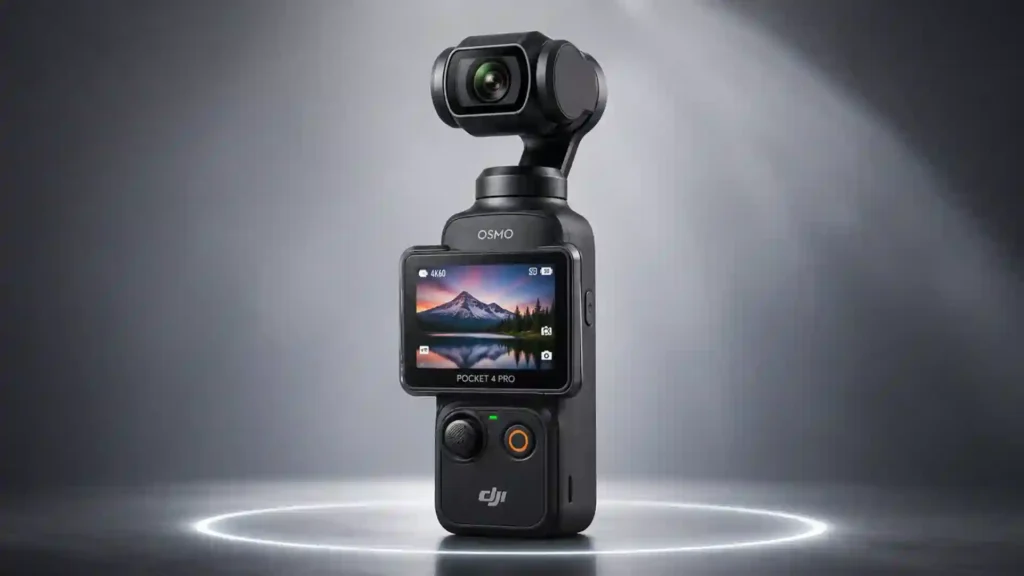
This article is an original analysis supported by the sources cited below
Leaked images reveal a dual-lens pro version of DJI’s next Osmo Pocket camera
The Verge report that first framed the leaked dual-camera Pocket model as a possible Osmo Pocket 4 Pro.
DJI Osmo Pocket 4 Pro specs price and release date
RedShark analysis of rumored Pocket 4 Pro timing, expected positioning, and possible U.S. availability issues.
DJI Pocket 4 Pro photo shoot images leak online
New Camera report describing a larger set of leaked real-world Pocket 4 Pro images.
DJI Pocket 4 Pro leaks with a 6K dual-camera but U.S. buyers might miss out
Geeky Gadgets coverage of later field-testing claims around 6K recording, optical zoom, and launch timing.
Osmo Pocket 4
DJI’s official Osmo Pocket 4 product page, used for confirmed feature claims and positioning.
Osmo Pocket 4 specs
DJI’s official specifications page for dimensions, camera modes, storage, battery, wireless, and screen details.
DJI delivers next-generation imaging capabilities with Osmo Pocket 4
DJI’s official April 16, 2026 announcement for the Osmo Pocket 4.
Osmo Pocket 3
DJI’s official Osmo Pocket 3 product page, used for baseline comparison with the newer Pocket 4.
Osmo Pocket 3 specs
DJI’s official specifications page for the Pocket 3’s body, screen, sensor, lens, and storage details.
DJI releases the Osmo Pocket 3 for moving moments with unparalleled precision
DJI’s launch material for the Pocket 3, including its 1-inch sensor and 4K/120fps creator focus.
Capture life’s meaningful moments with DJI’s smallest handheld stabilized camera
DJI’s Pocket 2 announcement, used for historical context on the Pocket line’s development.
DJI Pocket 2 specs
DJI’s official Pocket 2 specifications, used for sensor, resolution, and video comparison.
Osmo Pocket product information
DJI’s official product information for the original Osmo Pocket, used for category history.
DJI announces the Osmo Pocket the world’s smallest three-axis gimbal that shoots 4K60p video
DPReview’s launch-era coverage of the original Osmo Pocket and its early imaging specifications.
I tested DJI’s new Osmo Pocket 4
Tom’s Guide review used for hands-on observations, U.S. availability notes, storage, audio, and image-quality context.
Best cameras for vlogging
TechRadar’s 2026 vlogging camera guide, used for category comparison and Pocket 4 strengths and limits.
DJI Osmo Pocket 4 announced 4K 240fps ActiveTrack 7.0 and built-in 107GB storage
CineD’s technical announcement coverage of the Pocket 4 and its role as a compact creator camera.
This is the DJI Osmo Pocket 4
OWC’s overview of the Pocket 4’s storage, D-Log, 37MP stills, and creator workflow improvements.
DJI Osmo Pocket 4 announced confirmed spec and details
RedShark’s confirmed Pocket 4 feature and pricing report.
DJI fans in the U.S. will miss out on 25 drone and camera launches this year due to ban
TechRadar coverage of DJI’s U.S. legal and commercial pressure around blocked product launches.
The FCC’s foreign drone ban is here
The Verge report explaining the December 2025 FCC Covered List action and its effect on foreign-made drones.
FCC bans new Chinese-made drones citing security risks
Associated Press reporting on the FCC decision, exemptions, and reactions from DJI and industry figures.
China’s commerce ministry urges U.S. to drop drone supplier ban
Reuters report on China’s response to the FCC action and its implications for approvals of new foreign-made drones.
Oppo confirms it is working on its own gimbal camera to rival the DJI Osmo Pocket
Digital Camera World report on Oppo’s interest in a dedicated handheld gimbal camera and wider category competition.
Insta360’s Luna series cameras put the DJI Osmo Pocket in the crosshairs
PetaPixel report on Insta360 Luna Pro and Luna Ultra as Leica co-engineered rivals to DJI’s Pocket line.
Insta360 teases DJI Osmo Pocket rival with dual cameras
T3 coverage of Insta360’s NAB 2026 teaser for a compact camera aimed at the Pocket category.
Canon PowerShot V1 camera specifications
Canon Europe’s official specifications for the PowerShot V1, used as a compact creator-camera comparison.
Canon PowerShot V1 camera
Canon UK’s official product page for the PowerShot V1, used for sensor, lens, autofocus, and video feature comparison.
| Citing this article? Brief excerpts are welcome. Please credit Webiano.digital, name the author where stated, and include a link to https://webiano.digital and to this original article. Full or substantial republication requires prior written permission. Read our Copyright and Content Use Policy. |
This article was prepared with the assistance of artificial intelligence tools. The content underwent expert human review, and Webiano Digital & Marketing Agency assumes editorial responsibility for its final version and publication.