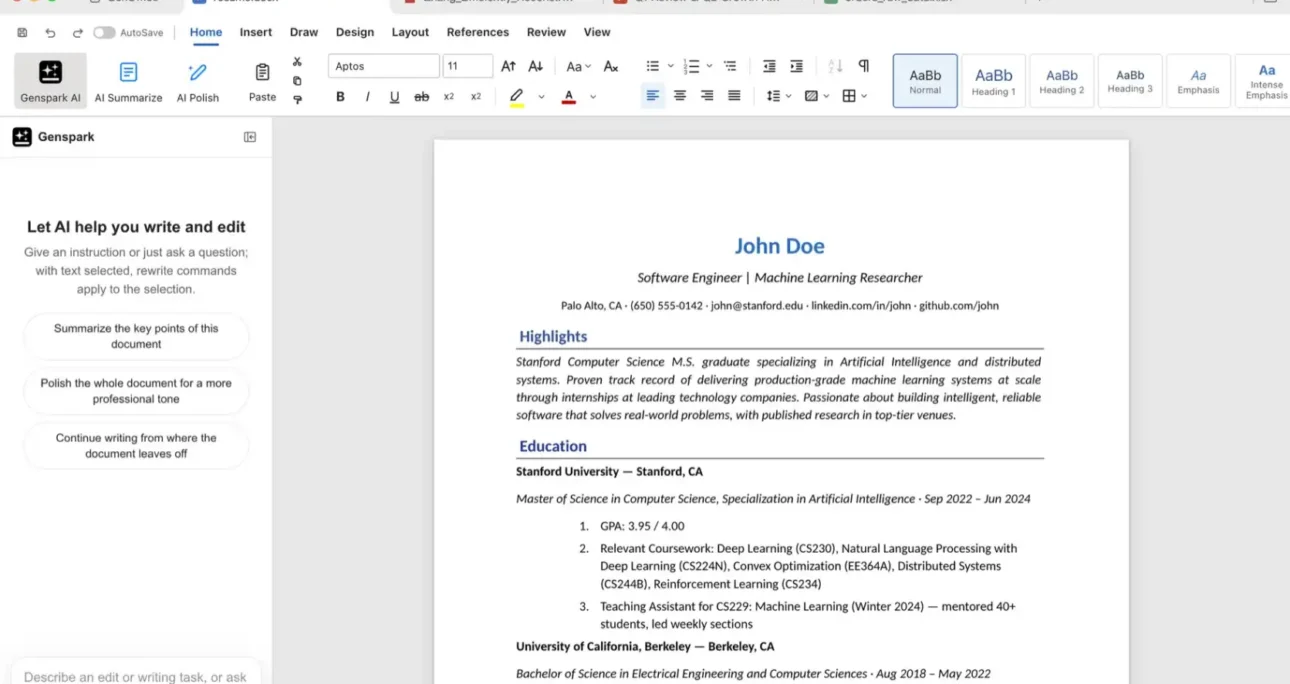
GenOffice arrives with an unusually direct proposition: six desktop editors, support for Microsoft’s familiar document formats, and an AI agent able to modify the file in front of you. Its developers call it the world’s first full-featured open-source AI office suite. That is the project’s own description, not an independently established ranking or a finding that every Microsoft Office feature has been reproduced. The distinction matters. A useful office replacement must do more than open a clean demonstration document. It must preserve the awkward files that organisations accumulate over years: complicated spreadsheets, heavily formatted contracts, slides with embedded media, documents with tracked revisions, and templates that nobody wants to rebuild. GenOffice deserves serious attention because it targets that practical problem rather than selling only another writing assistant.
Table of Contents
The promise that needs testing
The software is real, free to download, and available for Windows, macOS and Linux, according to its official site and public repository. Its core editors handle Word, Excel and PowerPoint’s modern file extensions, alongside PDF, Markdown and HTML. On 4 November 2026, the project’s release page listed version 0.12.852 as its latest stable installer. That precise version is useful for identifying the state of the project at the time of this assessment, not for declaring the software mature. The version number, the detailed change log, and the pace of visible fixes all suggest a product still developing quickly. An individual may happily accept that pace. A business that must exchange exact files with clients needs to understand what it risks.
The interesting part is not simply the price. GenOffice treats the document as something an AI agent can inspect and edit, then gives the human an opportunity to review the modifications. The project describes snapshots, visual differences and reversible changes; spreadsheet agents can write formulas, while slide agents create elements on an editable canvas. That is a different workflow from copying a chatbot’s answer into a blank document and repairing the layout. It can eliminate mechanical work when it performs as described. But it also introduces a new category of error: an agent may alter a file in a plausible way while misunderstanding the instruction, the data or the significance of a protected field.
A fair evaluation therefore has two tracks. First, can the conventional editors stand on their own without AI? Second, does AI improve actual file work without compromising correctness, confidentiality or the user’s control? A free program that edits simple letters competently might already be valuable for a student or a small organisation. A person responsible for signed contracts, financial reporting or legally significant records will set a much higher bar. Confusing those audiences produces either excessive enthusiasm or an unfair dismissal. The right question is which daily tasks can move safely, which need a trial, and which should remain with proven tools for now.
GenOffice began publicly as an alpha, and its own August announcement was unusually candid about bugs, missing features and rough edges. The November release notes document fixes across legacy Word imports, formulas, slide handling and PDF operations. That is evidence of active engineering, not a verified failure rate and not a guarantee that no important defect remains. The public repository also displays source code, a contribution guide and issue tracking. Openness makes examination and community participation possible, but a public repository is not itself a formal security audit, accessibility certification, enterprise support agreement or independent compatibility laboratory.
The project’s ambitions also extend beyond replacing a subscription. It exposes a command-line interface and a Model Context Protocol server so external coding assistants can create, inspect, convert and modify real Office files. That gives a local document engine a role in broader automated workflows. A report can potentially be built by an agent without opening an editor, then inspected visually and opened by a person for approval. For developers, this is arguably the more distinctive claim: an office suite becomes an instrument that other tools can operate. For ordinary users, the immediate benefit is simpler—the same file can be edited manually or by instructions in natural language.
There is a historical reason to approach the word “replacement” carefully. Office compatibility is not one feature; it is a long chain of decisions about formats, layout, calculation and collaboration. Two applications can both write an XLSX file yet interpret a specialised formula differently. A document may preserve its text but move a page break. A slide deck may keep every object while substituting a font and changing the message’s visual emphasis. Microsoft itself documents differences between its Open XML and OpenDocument formats. Compatibility should always be measured against the documents a particular user exchanges, not an abstract yes-or-no label on a product comparison page.
For this analysis, the evidence comes from the developer’s documentation, public releases, licensing and privacy statements, and authoritative documentation about office formats and competing workflows. No claim of original hands-on benchmarking is made. Where the project describes a feature, the text identifies it as a documented capability; where independent testing would be required to confirm reliability, the limitation remains explicit. That approach may be less dramatic than calling GenOffice an instant Office killer, but it helps anyone considering a serious change. A convincing replacement does not need exaggerated claims. It needs repeatable results on the files that actually matter.
Six editors with one operating idea
GenOffice combines a word processor, spreadsheet editor, presentation tool, PDF editor, HTML editor and Markdown editor under one desktop workspace. The official site lists DOCX, XLSX, PPTX, PDF, HTML and MD formats prominently. This is a broad collection, although not all six editors perform the same type of work. The first three compete directly with Word, Excel and PowerPoint. PDF editing targets fixed-layout documents. Markdown serves lightweight structured writing. HTML covers pages, visual reports and interface mockups that traditional office suites often handle awkwardly. Treating all six as identical replacements for Microsoft applications would obscure why the additional two editors are there.
The DOCX editor is designed around actual Word files, rather than a proprietary document format that requires conversion before every exchange. According to the repository, it can preserve untouched package components when saving edits. It also describes pagination, headers, footers, comments, equations and tracked changes, including mail merge with spreadsheet or CSV recipient lists. These are important design commitments. A company receiving a contract wants to amend a clause without silently destroying its style definitions or embedded content. Yet these features need more than a demonstration: a cautious adopter would send representative edited files back through Word and compare what changed beyond the intended text.
The spreadsheet editor uses an in-house engine with a Rust component for XLSX processing. The documentation covers formulas, charts, pivot tables, slicers, conditional formatting and workbook operations that go beyond a simple grid. It describes AI-generated summaries built from formula expressions rather than pasted answers. That distinction is essential because a spreadsheet is a live model. If an assistant writes the final total as an ordinary number, the result may look correct today but fail when transactions change tomorrow. If it writes the correct formula with appropriate references, the sheet can remain useful. Whether complex financial models calculate identically to Excel requires targeted verification.
The slide editor writes editable PPTX files, according to the project, and offers master slides, layouts, guides and media handling. This matters because one of the great frustrations with automated presentation generation is receiving a set of flattened pictures: visually polished slides whose text and graphs are almost impossible to change. GenOffice’s documented workflow aims to place native elements on the slide so a human can continue editing. A design team should still test font substitution, animations, master layouts, charts, video and presenter tools. A visually acceptable preview on the author’s machine does not guarantee faithful playback in a client’s PowerPoint environment.
PDF is treated as a working format rather than only an export target. The vendor says users can edit text and images on the page, annotate files, and convert PDFs to Word, Excel or PowerPoint locally. The website specifies system OCR for scanned-page conversion on macOS and Windows. That is a meaningful addition for people dealing with scanned contracts, historical documents or records that arrive only as PDF. It is also an area where expectations need discipline. Text recognition can misread similar characters, and a document reconstructed from page geometry may not recover the logical structure of the original authoring file. Conversion is an aid to editing, not proof that nothing was lost.
The Markdown editor keeps its plain-text identity. The repository describes headings, lists, tables, code blocks, diagrams and wiki-style links, with local export to Word. This opens a different audience: developers, technical writers, researchers and publishers who prefer readable source text over complex binary document packages. Markdown does not need to behave like Word to be successful. Its value is portability, legibility and suitability for version-controlled writing. The question is whether its richer conveniences—embedded images, backlinks and special syntax—remain portable to other Markdown programs or bind the writer to GenOffice-specific interpretation.
The HTML editor takes on small web and design deliverables: standalone pages, reports, posters, dashboards and prototypes. Its stated process begins with a design brief and lets users refine the result visually or in source code. Output can be presented directly or exported to PDF and Word. A single HTML file can be convenient for a preview or internal report, but it is not automatically a production website. Accessibility, semantic markup, scripting safety, responsive behaviour, hosting requirements and maintainability still require the usual web development checks. An AI-generated landing page is a draft, not a deployment policy or a substitute for testing on actual devices.
The unifying element is an AI panel that works alongside the active file. The project says it can inspect relevant blocks, propose edits and record enough information for the user to review or undo them. That can be much more useful than switching between an office app and a separate chatbot because context is preserved. However, the value of context is conditional: the system must correctly identify the relevant cells, paragraphs or slides. An agent that reads the wrong source column can confidently edit the right-looking part of a workbook. Successful automation depends as much on scope selection and validation as on model fluency.
The six-editor strategy gives GenOffice a broader daily-use story than a specialist text assistant. A single project might move from a Markdown brief to a Word report, an Excel budget, a presentation and a PDF handout without changing software families. That is a workflow illustration, not a claim that every conversion is perfect. The user still needs to decide which file is authoritative at each step and where reviews occur. Saving five representations of a proposal creates five opportunities for divergence; coordinated tools reduce friction only when the team retains a clear revision process. Otherwise the convenience of generating files may produce more uncontrolled versions, not fewer.
One workspace also does not necessarily mean one collaborative platform. Microsoft 365 includes services such as OneDrive and SharePoint for simultaneous coauthoring and governance. GenOffice’s documented strengths are local editing, interchangeable AI providers and a programmable file engine. A team expecting the same real-time, presence-aware editing, permissions, enterprise identity or audit controls must establish which integrations actually exist. The difference between a desktop office suite and a managed collaboration service is structural, not merely a missing checkbox. It will become central when the software moves from an individual laptop to a regulated business department.
File compatibility is the real contest
Microsoft’s documentation identifies DOCX, XLSX and PPTX as the default Open XML formats for Word, Excel and PowerPoint. These are not simple streams of text, rows or pictures. Each file is a package containing interrelated parts that may include styles, relationships, metadata, references, tables, embedded objects and content that only becomes meaningful when interpreted by an application. Reading such a package and writing one back is a demanding engineering problem. A replacement has to understand enough of the structure to make its intended change without damaging something elsewhere. This helps explain why opening a file is an inadequate compatibility test.
GenOffice’s repository describes a narrow-patching approach to Office files. In its Word workflow, the source package remains the starting point; the editor associates visible document blocks with their original XML fragments and rewrites only the portions that the user changed. Untouched package entries are carried forward. That is a thoughtful response to a familiar problem: importing a document into a new application’s internal representation, then regenerating everything, can accidentally remove unsupported constructs. A narrow edit tries to limit that risk. But preserving untouched bytes is not the same thing as understanding or correctly modifying every possible construct. Both properties deserve independent testing.
Consider a hypothetical legal agreement with several sections, custom numbering, signature placeholders, tracked revisions and a company logo. A safe edit means more than keeping the sentences readable. It means that clause numbers remain stable, fields still point to the right content, comments stay attached, revisions retain their meaning and the final pagination is acceptable. A change to an apparently ordinary paragraph can alter layout around a table or signature area. The package may preserve the original bytes of untouched components while the visual result changes because the application computes line wrapping or page breaks differently. Those are separate failure modes, and they require separate tests.
Spreadsheets raise an even less visible challenge. Calculation semantics can matter more than appearance. A workbook may contain named ranges, cross-sheet references, structured tables, validation lists, date logic, chart ranges or formula caches. A business may care that a monthly total recalculates correctly after new rows arrive, not merely that the current result matches the screenshot. If an AI tool constructs formulas, a reviewer should inspect the expression itself, its cell references, the sheet structure and the result after test data changes. Excel compatibility includes user expectations about these behaviours, not only the ability to save a file with the expected extension.
Presentation files bring their own complexity. A slide deck can remain technically editable while becoming visually inaccurate if fonts change, placeholder sizing differs, cropped images shift or layers render in a different order. Presentations often move between computers attached to projectors, video conferencing tools or conference AV systems. An apparently small spacing problem can hide the final line of a message. An audio or video asset may play correctly on one installation and fail elsewhere. An organisation evaluating GenOffice should render the same deck through the target version of PowerPoint and compare each slide, rather than relying exclusively on the GenOffice preview.
The distinctions that matter in file handling
| Claim or behaviour | What it establishes | What it does not establish |
|---|---|---|
| Opening DOCX, XLSX or PPTX | A recognised file can be imported | Every feature is represented correctly |
| Saving the same extension | A file can be written in a familiar package format | The result has complete visual or functional parity |
| Preserving untouched parts | Unedited package components can remain intact | Changed parts preserve all surrounding semantics |
| Writing formulas into XLSX | Cells can contain executable expressions | All functions and recalculation paths match Excel |
| Exporting an editable PPTX | A slide is not merely one flattened image | Fonts, animations and linked media reproduce everywhere |
| Converting PDF to DOCX | An editable approximation can be produced | The original logical document structure is recovered |
The table separates file-level interoperability from workflow-level reliability. A serious migration test needs both. The project’s design choices may reduce some kinds of damage, but only representative documents and round-trip checks can establish whether they reduce the risks that matter to a particular organisation.
GenOffice also documents one-way imports for legacy and OpenDocument files. Formats such as ODT, ODS, ODP, older Word DOC and older Excel XLS can be opened as converted copies, while saving generally writes modern OOXML rather than the original source format. The project notes an exception for CSV behaviour in its spreadsheet editor. For users, this means that “supports ODT” and “edits ODT natively” are very different promises. Someone whose organisation exchanges ODF files under a formal policy cannot assume that a conversion to DOCX meets its requirements. Conversion may be useful, but the source workflow has changed.
That matters especially because OpenDocument is itself a published standard, with a distinct history and feature model. OASIS describes the format as platform-independent and covers text, spreadsheets, graphics and formulas. LibreOffice provides established support for both OpenDocument and Microsoft’s formats, while Microsoft documents some limitations in translating features between them. None of those facts makes one family universally superior. They show why a product’s format strategy must be examined in the context of its user base. GenOffice appears to prioritise Microsoft-centric exchange by using OOXML as its working destination for several imports.
A practical evaluation should start with an inventory of file categories, not a random collection of convenient examples. Separate simple letters from branded reports, routine budgets from financial models, basic pitch decks from presentations with video, and born-digital PDFs from scans. Identify templates with embedded forms or macros. Note whether files are merely read, actively edited, jointly authored, signed or retained for evidence. Then select a small, representative sample for each category, including deliberately difficult documents. This is not a published GenOffice benchmark; it is a risk-based method for finding problems before they reach customers.
The most revealing test is often a round trip: open a trusted file, change one designated element, save it, reopen in the incumbent application, and inspect every unintended difference. Then repeat in the other direction where appropriate. Compare visible output, internal structures that matter, calculations and any warnings. Preserve the untouched original and label every generated copy. If a file fails, record the exact version and document features involved. That information is actionable for a support issue and much more useful than saying the software is compatible or incompatible as a whole.
There is also a question of institutional trust. Many organisations have official templates, approved forms and client-specific file rules. A document may be legally acceptable only after the proper review process, not because a file parser preserved its XML. Digital signatures, rights restrictions and external links can introduce behaviour outside the visible editor. The decision to change authoring software therefore belongs partly to operations, legal, compliance and security staff. GenOffice can be trialled without demanding that every workflow migrate at once. A phased approach protects important documents while allowing teams to discover genuine productivity gains.
Word documents without a Word subscription
A word processor appears straightforward until it becomes the tool used to produce proposals, contracts, policy manuals, books and complex reports. The work is not just typing. Users apply headings that generate navigation, insert tables that must remain aligned, manage references, reuse styles, track colleagues’ edits, and deliver consistent printed pages. GenOffice’s documentation advertises page-aware DOCX handling, sections, headers and footers, revisions, comments, equations, content controls and mail merge. This gives the Docs editor a credible set of targets. The next question is the fidelity of those operations on actual files, particularly files created over many years by different Office versions and third-party systems.
One strong use case is the document that needs a narrowly defined revision. Suppose a marketing agency receives an existing proposal and must update a project scope without changing the typography or the commercial terms. Instead of prompting a general chatbot to rewrite the entire file, the editor could apply a selection-specific instruction to the relevant section. The surrounding document would ideally remain intact, and the result could be reviewed as a change. This is the kind of job for which the project’s block-aware editing approach is well suited in principle. The agency should nevertheless compare the final exported pages, including headers, page numbering and tables, before sending the result.
Tracked changes are a trust mechanism, not merely a visual flourish. They allow a reviewer to distinguish what an author proposed from what was previously agreed. GenOffice’s November release notes discuss expanded Word-style revision handling, including a reviewing pane, markup filters and revisions that affect more than plain text. That development is encouraging because enterprise documents often move through several people before approval. But one should not infer identical behaviour for every advanced Word workflow merely because the interface uses familiar terminology. Test acceptance and rejection of changes, comments on moved text, overlapping revisions and documents with several authors before relying on the workflow for sensitive material.
A second compelling use case is mail merge from structured data. The repository says GenOffice Docs can use an XLSX or CSV recipient list, insert Word-compatible merge fields, preview records and generate one document per recipient or a combined result. This may cover a familiar need for letters, notices, certificates or personalised offers. The risk lies in mapping. A column named Company may contain the billing entity while another contains the trading name; an automated merge that uses the wrong field can produce a professionally formatted but substantively incorrect letter. Before sending a batch, verify several records deliberately chosen to expose missing values, unusual characters, long names and address formatting.
Word files are also fragile at the border between structure and appearance. The same heading may use a font that is installed on one computer but absent on another. A table may move across pages when printer metrics differ. A report containing floating objects, diagrams and carefully placed text boxes may be more demanding than a plain letter. GenOffice’s release notes explicitly refer to improvements in legacy DOC import, nested and floating tables, text columns and page layout. Those details indicate where engineering effort is being applied; they also suggest why complex compatibility should be treated as a continuing development area rather than an already solved problem.
AI rewriting must preserve factual meaning as well as style. A request to make a legal clause “clearer” may cause the model to substitute a term that is ordinary in conversation but significant in a contract. A request to simplify a technical report may accidentally remove a qualification that changes the conclusion. An editor that highlights the changed text gives the human a chance to detect these errors, but review requires the appropriate expertise. The best instruction might be more constrained than “improve this”: specify the audience, exact section, what must remain unchanged and the type of edits permitted. Such constraints reduce ambiguity without eliminating the need for human approval.
The project also describes document-aware mind maps and block citations. These are potentially useful for understanding large reports, planning restructuring or preparing a briefing. A node that points back to its source paragraph is more auditable than a summary with no traceable location. Yet the presence of a citation does not prove the interpretation is correct; it only makes the claim easier to inspect. A writer preparing a board report might use a map to identify duplicate sections, missing dependencies or inconsistent terminology. The next step should be opening the cited passages and checking the original text, not accepting an automatically assembled outline as authoritative.
For publishing workflows, Markdown-to-Word conversion offers an alternative starting point. A technically comfortable writer can draft in plain text, review differences through version control, and export an editable file for clients who need DOCX. GenOffice states that this conversion runs locally. The attraction is a separation between content authoring and delivery format. The compromise is that elaborate Word layout may require additional work after conversion. A document with dozens of custom style definitions and complex cross-references will not necessarily emerge from a simple Markdown source with equivalent sophistication. Choosing the source format should depend on the complexity of the desired output.
The software should also be judged on ordinary editorial ergonomics. Can someone use styles consistently without thinking about underlying XML? Can the author control page breaks, lists, image anchors, tables, spellchecking and selection behaviour? Can a reviewer navigate comments quickly and print without surprises? Release notes mention repairs to double-click selection, image placement, font menus and pagination. These changes matter because a replacement becomes credible through thousands of small interactions that users expect to work reliably. A visible AI panel cannot compensate for an editor that interrupts routine formatting every few minutes.
An organisation that only prepares basic letters and internal drafts may find GenOffice Docs sufficient much sooner than a publisher producing an intricate illustrated catalogue. The principle is workload fit. Trial files should cover the organisation’s document families, not a manufacturer’s hand-picked demo. Save representative templates in a protected test folder, create realistic revisions, and ask colleagues who normally approve the documents to review the results. Include printed or PDF output in the acceptance criteria. A successful trial produces a list of supported use cases with known boundaries, not a single sweeping declaration that Word has been replaced.
A final distinction concerns communication outside the organisation. A supplier may demand a DOCX file because its internal system processes comments or merges field values; a public authority may require an established template; a client may use a particular Word version. The recipient does not care which desktop application created the file as long as its expected workflow survives. GenOffice’s native-format focus is designed around that expectation. Whether it succeeds for a given class of documents is directly testable, and that test is worth doing. The most persuasive result is not an attractive screenshot. It is the absence of unwanted changes when another person continues the document in the tool they already use.
Spreadsheets are the hardest promise to keep
A spreadsheet is not a document with boxes. It is a small execution environment disguised as a table, and the people who depend on it have often built workflows that no software architect would design from scratch. A workbook may contain formulas copied through thousands of rows, lookup tables, defined names, hidden assumptions, imported transactions, conditional formatting and visualisations used to make decisions. GenOffice’s own website advertises charts, pivot tables and slicers, while the repository describes a native Rust engine for XLSX import and export. Those are serious capabilities. They do not establish that an arbitrary Excel workbook will behave identically under every change a user can make.
The first issue is the difference between a displayed result and an executable formula. If a cell displays a profit figure, it may be the output of a formula, a hard-coded number or an imported value. The visual result alone cannot tell the reviewer whether the spreadsheet remains useful. GenOffice describes AI that adds formula expressions and recalculates them rather than simply pasting an answer into the final cell. That is a good design goal. An agency preparing a budget should still inspect whether the agent selected gross or net revenue, included the right period, handled blanks correctly and made references that survive new rows and recalculation.
Imagine a hypothetical campaign workbook containing a monthly budget, a regional breakdown and a cost-per-lead calculation. An instruction to “build a regional performance summary” is underspecified. Should regions be assigned by invoice address, client location or campaign targeting? Should cancelled transactions count? Are advertising credits treated as negative expenses or reductions of net cost? The AI may be perfectly capable of constructing a valid SUMIF or pivot table but choose the wrong business definition. A spreadsheet agent cannot infer an organisation’s accounting rules from the shape of its cells alone. The human must define the measure before asking the tool to calculate it.
This is where cell-level traceability becomes valuable. The repository says the AI can refer to exact workbook cells when explaining an answer. A reviewer should use those references to inspect the source ranges, not only the generated explanation. The first spreadsheet test ought to contain totals that can be independently recomputed, deliberate edge cases and a few rows whose correct treatment is obvious to the reviewer. Change a transaction amount, add a new region, insert a row, and see whether the summary responds. A credible formula survives ordinary maintenance rather than matching a single static example once.
Pivot tables and slicers are especially revealing because they sit between stored data and a user’s interactive view. Their usefulness depends on refresh behaviour, grouping, filters and cache handling. GenOffice advertises these features, and the command-line documentation describes some distinctions between operations available headlessly and operations that remain tied to an editor session. This is a reminder that a feature name is not enough to describe its limits. A finance or operations team should test creating a pivot, updating the source, refreshing it, changing filters and reopening the workbook in Excel. If the workbook is part of an automated report, repeat those checks without the visible application open.
Dates are another source of subtle errors. A date-like cell may be a serial value with formatting, a text string, or a formula output, and careless conversion can change sorting, comparisons or reporting periods. A new spreadsheet engine must also make decisions about floating-point calculations, blank versus zero values, error propagation and formulas that depend on external data. The public release notes mention improvements to XLSX dates, formula caches, shared formulas, external links and sorting behaviour. That specificity is useful evidence of active attention to data correctness. It is not enough to conclude that every unusual workbook is safe. Users should test the operations that their reporting depends on.
The format itself creates a trap for simplistic compatibility claims. Microsoft explains that XLSX files cannot store VBA macros, whereas XLSM is a macro-enabled workbook format. Some business workbooks rely on VBA, add-ins, data connections or integration with other applications. A suite that opens normal XLSX workbooks may still be inappropriate as the sole replacement for an Excel deployment built around automation. Before migration, inventory any workbooks containing code, queries, external connectors or operational procedures. Keeping Excel for a limited set of special workbooks is often more sensible than forcing a full replacement and then recreating months of automation work.
The security side of spreadsheets matters too. Macros are powerful but have long been abused for malware delivery; Microsoft documents blocking macros from internet-origin files by default. That does not mean an unfamiliar spreadsheet from a third party becomes safe merely because the editor lacks one automation feature. Formulas can reference external content, files may include links, and an AI agent may interpret data containing malicious instructions. The right control begins with the trustworthiness of the source file. Testing a new editor should not involve enabling every permission or running automation from untrusted workbooks simply to see whether the feature works.
Spreadsheets generated from natural-language prompts need explicit acceptance criteria. For an expense tracker, that might mean preserving original transactions, creating separate columns for tax and fees, storing formulas rather than fixed totals, and producing a summary that remains correct after a row is added. For a project tracker, it might require dates to sort correctly, owners to remain text fields, and conditional formatting to reflect a documented status rule. These are illustrative requirements, not claims about a benchmark carried out here. Their value lies in turning an impressive AI demonstration into a reproducible test that another employee can independently judge.
Performance under load is a separate question from formula correctness. A small sample can open instantly while a workbook with complex dependency chains, high-cardinality pivots or many shapes may use substantial memory. The public materials do not establish a universal upper limit that applies to every computer and workbook type. Users should therefore test realistic file sizes on the devices they actually own. Record opening time, save time, calculation time and whether edits remain responsive. Compare not only GenOffice against Excel but also the cost of maintaining the existing workflow, including licence administration and training. A program that is free but routinely disrupts reporting can become expensive through staff time.
The AI’s proposed spreadsheet edits also deserve a reversible transaction boundary. GenOffice’s documentation describes operations applied as undoable batches, with rejected operations leaving files untouched in its CLI workflow. That principle is valuable: multiple related changes should be inspectable and recoverable together. Even so, undo history is not an adequate backup strategy. If an agent overwrites the wrong formula and the workbook is later shared, the error may already have propagated into a report. Keep originals, review formula changes, and create versioned copies before major transformations. A transparent agent is easier to supervise, but supervision must be part of the process.
The strongest reason to try GenOffice Sheets is the possibility of moving from a business question to an editable calculation without manually constructing every step. That can be a real advantage for analysts who understand the business but do not remember every formula syntax. The strongest reason not to migrate blindly is the same feature: a plausible spreadsheet can hide a wrong assumption behind professional formatting. The correct standard is not whether an agent makes an attractive dashboard. It is whether another person can explain the result, reproduce its logic, revise its inputs and trust the saved workbook after exchanging it with colleagues who use Excel.
Slides should remain slides after the AI finishes
Presentation generation has a familiar weakness: the output looks impressive until someone tries to edit it. A chatbot may create a picture of a slide, an online service may export flattened pages, or a deck may contain text boxes that are technically editable but positioned in ways that resist normal work. GenOffice’s Slides editor is built around PPTX files and native editable elements, according to its repository. The project describes layouts, master slides, smart guides, non-destructive image cropping and a staged generation workflow. These are exactly the kinds of capabilities that make the difference between a presentation preview and a working file a team can maintain.
The documented approach begins with a requested purpose and a planned storyline, rather than just a list of slide titles. The agent can prepare an outline, generate content and place objects on the canvas. In a separate command-line workflow, the project describes style specifications, slide-by-slide validation, rendering and checks for overflow or overlap. That is a more disciplined engineering story than a single opaque generation step. It does not guarantee that the chosen facts are true, the argument is persuasive or the visual hierarchy meets a particular brand standard. Those decisions still belong to the person responsible for the presentation.
A presentation is a compressed argument. One wrong number can matter more than a dozen attractive illustrations. If an agent is instructed to create a pitch deck from a few notes, it may infer a market size, business projection or customer claim that was never supplied. The earlier Genspark launch article used a demonstration pitch to show a stylised set of slides, but a demonstration is not a verified source for the business facts inside a hypothetical deck. A reliable workflow separates sourced material from creative layout. Provide the approved figures and exact wording for sensitive claims, then allow the agent to design around them. Every chart and metric should be checked against the approved source.
Editable charts and shapes are central to long-term usefulness. An investor or manager may ask for a revised figure minutes before a meeting. If the deck contains native PowerPoint elements and linked or reconstructable data, the revision is manageable. If the number is baked into a large image, the author may have to regenerate the entire slide. GenOffice documents real slide objects and a mechanism to replace individual slides from a specification. These are promising foundations for iterative work. A test should prove that common text, shape, chart and image elements remain accessible after saving and reopening in Microsoft PowerPoint.
Visual fidelity also depends on things the file format cannot fully control, such as installed fonts, operating-system rendering and presentation hardware. A slide may look different on a Mac, a Windows workstation and a Linux laptop even when the underlying PPTX is valid. Long headings, tight table cells, complex diagrams and captions near page boundaries are particularly vulnerable. GenOffice’s ability to render slide images for inspection can help catch overflow before delivery. Yet the final check should happen in the environment where the presentation will be shown. A conference machine with another PowerPoint version is a more demanding test than the author’s own editor preview.
There is a broader difference between visual consistency and visual accuracy. A model can obey a palette and use the same typography across every slide while still designing an unreadable chart or confusing information hierarchy. In an internal report, accessibility matters: colour alone should not encode the distinction between categories, text should remain legible when projected, and charts need labels that survive export. None of these qualities follows automatically from an AI’s ability to generate a deck. A human designer or experienced presenter should inspect the actual story, the density of information and the likely viewing conditions.
GenOffice’s November releases mention PPT import work, MathType preview fixes, printing changes and drawing tools. These are not glamorous headline features, but they matter to the users who already possess years of slide decks. A school or training department may have archive presentations in legacy PPT format; an engineering team may rely on equations; a sales organisation may print handouts. The appearance of fixes in these areas is evidence that the product is addressing real-world obstacles. It also supports caution: users with mission-critical decks should test the exact imported object types and printing behaviour they need before replacing the incumbent editor.
A simple presentation benchmark can be designed around a deliberately mixed deck. Include a title slide with branded typography, a chart, a table, a diagram, a full-bleed photograph, speaker notes, a video and a slide with a long footnote. Save the file in PowerPoint, open it in GenOffice, make controlled edits, export it and compare every slide. Then attempt a second edit in PowerPoint. The test should include more than screenshots. Inspect whether objects remain editable, speaker notes survive, images retain cropping, chart data can be revised and slide ordering remains intact. This exercise turns vague compatibility into measurable work.
AI can save time on the parts of presentation work that are repetitive: transforming an approved brief into a first outline, applying a consistent layout, creating alternative headings or reorganising sections after feedback. It should not receive permission to invent citations or alter financial assumptions to make the story look stronger. Teams can reduce that risk by preparing a source pack and an explicit list of statements that must be copied without alteration. They can also separate the person who approves data from the person who approves design. That division is not bureaucratic; it prevents a polished visual result from concealing a faulty claim.
Automation creates another useful possibility: a deck can be assembled from structured components and checked before someone opens it. GenOffice’s CLI instructions describe an outline, page specifications, audits and rendered previews. A reporting team might use a controlled version of that process to produce recurring presentations from approved material. The opportunity is greater consistency and fewer mechanical layout tasks. The risk is that an unnoticed error can be repeated across every generated deck. Automated production should therefore include validation of its data source, a review sample and clear responsibility for the final presentation.
The practical value of a presentation editor extends beyond AI creation. A colleague must be able to fix the final slide manually without asking the model again. This requires predictable selection, alignment, layers, keyboard shortcuts and export behaviour. A slide engine can pass technical file checks yet still feel frustrating to someone accustomed to PowerPoint. Pilot users should therefore include ordinary presenters, not only developers excited about the command line. Ask them to make late-stage edits under realistic conditions. Their experience will reveal whether GenOffice improves daily work or only changes the way the first draft is produced.
For a small company making standard sales decks, the combination of editable PPTX output and agent-driven layout could be substantial. For a large organisation with prescribed masters, specialist animations, enterprise templates and integrated review workflows, the decision is harder. Neither answer should be universal. GenOffice is compelling because it aims to keep the generated work in a familiar editable format; its remaining challenge is to demonstrate reliable behaviour across the untidy details of established PowerPoint practice. The winning benchmark is whether people can confidently continue working with the file after the novelty of the first AI-generated slide has worn off.
PDF editing moves into the office workflow
PDF began as a way to preserve the appearance of a document, and it is still commonly used for contracts, invoices, forms, specifications, archived records and documents intended for printing. Those use cases create a tension: the recipient wants stable layout, but somebody eventually needs to edit the file. GenOffice advertises direct editing of page text and images, annotations and conversion into editable office formats. Its technical description identifies PDFium as part of the processing path. That is notable because some lightweight PDF tools only let users draw a new text box over the existing page; GenOffice says it can modify text content in place. The claim deserves testing against representative fonts, encodings and layouts.
A born-digital PDF and a scanned PDF are fundamentally different inputs. The first may contain searchable text and structured drawing instructions. The second may be little more than page images, so an OCR engine must identify characters before meaningful text edits become possible. The official website says scanned-page OCR is supported on macOS and Windows, while ordinary PDF-to-Office conversion runs locally without AI credits. That is a material distinction for a business with confidential documents. The conversion does not necessarily require an online model, although any subsequent AI request may send selected content to the configured provider. Users should confirm the exact workflow before processing protected material.
OCR accuracy is often discussed as a single percentage, but the location of an error matters more than its frequency. A single mistake in an account number, expiry date, technical tolerance or legal reference can be consequential even when hundreds of ordinary words were read correctly. Tables with merged cells, stamps, handwriting and poor scans are difficult because characters must be associated with the right logical positions. A responsible conversion workflow retains the original PDF, highlights uncertain fields where possible, and has a person compare critical numbers and names. GenOffice can supply an editable starting point; responsibility for the accuracy of the resulting document remains with its operator.
The PDF-to-Word promise should be interpreted as reconstruction, not recovery of the missing Word source file. A PDF records what appears on pages, while a Word document contains editable paragraphs, styles, fields and sometimes structure that is not visible at all. Reconstructing paragraphs and tables from geometric positions requires judgment. GenOffice’s repository describes character-level extraction and layout analysis in its local conversion pipeline. That can create a usable document, but a column heading may become a separate paragraph or a carefully positioned table may need repair. People converting reports should compare page by page and be especially cautious about documents that mix columns, footnotes, charts and sidebars.
PDF-to-Excel conversion presents a different test. A financial statement may display a table, but the original spreadsheet formulas usually are not in the PDF. The target XLSX file can therefore contain the recovered visible numbers without the calculation logic that produced them. That distinction matters when someone plans to continue using the spreadsheet as a monthly model. After conversion, validate number formats, negative signs, decimal separators, dates, subtotal rows and column alignment. If a cell appears correct only because its text was placed in the wrong column, an elegant spreadsheet interface will not detect the underlying accounting error. The reconstructed workbook should be treated as imported data until its structure is verified.
A PDF-to-PowerPoint conversion is similarly a compromise. A page might be represented as editable objects, but not necessarily as the same native elements and relationships the original presentation contained. A chart originally built in PowerPoint could arrive as a graphic or a group of page elements. Text may be broken into fragments because the PDF preserves positioning rather than the author’s editing intent. For a small update to a printed handout, that might be sufficient. For a conference deck that will undergo significant revision, it may be faster and safer to rebuild the content from approved source data than to modify an imperfect reconstruction.
Direct editing of PDF text introduces its own hazards. The original font may be embedded only as a subset, or the file may use character mappings that complicate substitutions. Replacing a short phrase with a longer one may overflow a fixed block or shift nearby elements. A page with transparent objects, signatures or annotations may render differently after edits. GenOffice says it attempts to preserve original fonts and layout. A cautious user should save a new copy, compare before-and-after page images and inspect text extraction after the change. Successful appearance is not the entire requirement if the file will later be searched, indexed or converted again.
The November release notes show ongoing PDF fixes, including more resilient handling of large files, improvements to repeated headers during conversion, annotations and OCR-related repairs in recent releases. These details are encouraging because PDF is a large and complicated specification with many historical variations. They also show why a beta-like mindset is appropriate: users should monitor release notes and retest workflows after meaningful changes. A PDF editor used for occasional internal annotation is a very different operational risk from one embedded in a high-volume document processing pipeline. The latter needs repeatable tests and a rollback plan.
For routine office work, a local PDF editor can reduce tool sprawl. A person may no longer need one subscription for word processing, another for slide work and a third simply to correct a label or extract a table from a PDF. That convenience is legitimate, but the comparison should cover the exact operations used. Some PDF environments offer advanced capabilities such as specialised preflight checks, preservation features or organisation-specific signing and approval workflows. The GenOffice materials reviewed do not establish parity with every such capability. A team should name the tasks it needs instead of assuming all tools described as PDF editors are interchangeable.
Security and authenticity are important whenever a PDF serves as evidence. Editing a PDF is not the same as preserving a verifiable record. An organisation may need original copies, hashes, retention rules and evidence of who approved an alteration. Where legally meaningful signatures or certified documents are involved, a modified copy can be inappropriate even if the editor makes the operation easy. The software choice should follow the document policy, not determine it. An editor capable of changing a page is useful for authorised revisions; it should never encourage an employee to overwrite a source file whose original state must be retained.
A simple test pack could include a searchable invoice, a scanned letter, a technical table, a two-column report and a PDF with complex typography. For each, identify the intended task: annotate, replace text, extract a table or reconstruct a Word document. Record the effort required to reach an acceptable result and check for unintended changes. Test conversion without invoking AI to verify the vendor’s local-processing claim for the workflow being considered. Then, if AI assistance is needed, review the network and data-handling implications separately. This separation is especially useful when the same document contains confidential information and innocuous page layout details.
The PDF editor may ultimately be one of GenOffice’s most practical attractions, particularly for individuals who already spend much of their day moving between Office files and PDFs. Its value is not that every PDF becomes a perfect Word document, but that more document work can occur in one place. A business should judge it by the accuracy of the operations it actually performs, the quality of the result after round trips, and the time saved after verification. As with the rest of GenOffice, the strongest argument comes from a bounded, repeatable task rather than from an unlimited promise of format compatibility.
Markdown gives the suite a different audience
Markdown is often treated as a developer format, but its simplicity addresses a problem found throughout office work: rich documents are difficult to inspect, compare and move between systems. A Markdown file contains readable text with lightweight symbols for headings, emphasis, lists and other structure. That makes it suitable for notes, technical documentation, editorial drafts and material that will eventually be published somewhere else. GenOffice includes a visual Markdown editor while saving the underlying file as plain Markdown, according to its documentation. The combination may appeal to writers who want structured text without sacrificing a familiar graphical editor.
Plain-text portability is the attraction, not an illusion that Markdown can express every Word feature. Version-control systems can show which sentences changed, text editors can open the file decades later, and publishing pipelines can convert it to other formats. An editor that preserves ordinary Markdown syntax helps maintain that advantage. Yet different Markdown implementations interpret tables, diagrams, footnotes and embedded content differently. Users should distinguish standard syntax from extensions they depend on. A note that appears rich inside GenOffice may display as raw text elsewhere, particularly if it relies on specialised links or diagrams that other programs do not recognise.
GenOffice’s repository describes wiki-style links, backlinks, graph views and embedded notes. These features resemble the habits of personal knowledge management systems, where documents refer to other documents rather than existing as isolated files. In practice, this can help a researcher connect interview notes with a draft, a software team tie design decisions to implementation records, or a writer trace references across a project folder. The feature is strongest when links point to durable filenames and the vault stays organised. Moving folders, renaming files or sharing only part of the vault can break the assumptions on which navigation depends.
A local full-text index changes how files are discovered. Instead of relying on a remembered filename, the user can search words that occur inside a report, worksheet, slide deck, PDF or note. The project says it uses SQLite indexing locally and can optionally ask a separate relevance model to rerank search results. This creates a useful bridge between Markdown notes and traditional office files. However, search indexing is not the same as intelligent understanding. A document containing the query terms may be ranked highly while failing to answer the actual question. Model-based reranking may improve relevance, but it introduces another data flow when excerpts leave the machine.
Backlinks are only useful when the user can understand the source of each reference. A connected knowledge base can become confusing if every automatic summary produces links whose meaning is unclear. Consider a technical writer documenting a new product. A useful graph might distinguish requirements, testing notes, release documentation and known limitations. If every note is connected to every other through generic keywords, the display becomes decorative rather than informative. The tool can provide the interface, but someone still needs a consistent naming method and an editorial decision about what constitutes a meaningful link. This is a workflow design question, not a software defect.
Markdown also offers a manageable starting format for AI-assisted writing. A user can ask the model to revise a section, compare paragraphs or produce a proposed structure, then inspect the plain-text result. Because Markdown avoids much of Word’s invisible formatting machinery, differences may be easier to understand. GenOffice’s shared AI panel can act on selected passages, and the repository describes queues of anchored edits. Yet the model can still introduce factual errors, misread a note or change a technical term. Transparent file structure makes review easier; it does not make language-model output automatically reliable.
The Markdown-to-Word conversion described by GenOffice could make the suite useful to writers who collaborate with clients demanding DOCX files. A report might be drafted and reviewed as Markdown, then exported for a client to add comments in Word. The workflow becomes less attractive if the Word file is repeatedly edited independently and then converted back, because the two versions can diverge. Teams should agree on which format remains authoritative. If the client owns final revisions in Word, the Markdown original may become an archive rather than an active source. Knowing when to stop converting is as important as knowing how to convert.
There is also a place for machine-readable editorial workflows. Markdown files work well with linters, build systems, documentation generators and version-control checks. A team could keep a technical knowledge base in a repository, have AI suggest edits, and require review of the actual text differences before publishing. GenOffice’s CLI may add a graphical front end or conversion step to such processes. But not every Markdown editor is a full documentation platform. Search, deployment, access control, public publishing and automated link checking may still live in other tools. The best integration is usually the one that leaves each system responsible for the task it performs reliably.
For non-technical users, the value of Markdown depends on whether its restrictions feel freeing or limiting. Someone preparing a simple internal policy may appreciate consistent headings and a clean page. Someone designing a complex brochure may immediately need features that Markdown does not express naturally. GenOffice’s simultaneous support for Docs and Markdown gives users a choice rather than forcing one writing format on every project. A useful pilot can compare the same short document authored in both editors. Note which tasks are faster, which results are easier to revise, and which format survives exchange with colleagues.
The danger of an editor combining several paradigms is false consistency. A person may expect a drag-and-drop layout action in Markdown to behave exactly like the same action in Word or HTML, even though the underlying formats have different capabilities. A visual interface can conceal these distinctions until export. The product should be judged on how clearly it communicates what will be saved. Does it warn when an operation cannot be represented in plain Markdown? Can users inspect the raw source? Are generated links and images portable? These practical questions matter more than the number of icons in the toolbar.
For publishers and documentation teams, Markdown’s modest promise can be an advantage over heavyweight Office imitation. It encourages a deliberate separation of text, structure and presentation. The same source can be adapted to a website, a repository, a PDF or a Word handout with an appropriate conversion step. GenOffice can participate in that process because it offers both the plain-text editor and neighbouring document tools. The gain should be measured in fewer manual transfers and clearer review history, not in a claim that Markdown has somehow acquired all the functions of Word, Excel or PowerPoint.
The larger editorial point is that GenOffice is attempting to cover two working cultures: people whose files must remain compatible with Microsoft Office, and people whose daily work lives in text files, code projects and agent-driven tools. Those cultures often intersect in small digital businesses. A developer writes documentation in Markdown, a project manager wants a Word report, and a client expects a polished PDF. A suite that can bridge those formats locally may reduce friction. It must still respect their differences rather than pretending that one editor or one AI prompt can erase the structural limits of each file type.
HTML brings web-style design into office work
The HTML editor is perhaps the clearest sign that GenOffice is not trying to reproduce Microsoft’s application list exactly. It offers a way to prepare self-contained pages, visual reports, posters, dashboards and interface mockups, with an AI-driven design brief and a source view. That moves the suite toward work usually handled by web designers, front-end developers or specialist visual-reporting platforms. A single HTML file can combine text, layout and graphics in a way that is easy to preview in a browser. For a business that distributes internal reports or prototypes, this can be useful. For a business that runs a public website, the distinction between a prototype and deployable software remains crucial.
HTML is a document format and an application surface at the same time. That versatility makes it powerful and raises questions that do not arise in an ordinary letter. A generated page may contain scripts, interactive controls, external resources or CSS rules that behave differently across browsers and screen sizes. GenOffice says its HTML workflow begins with a design brief covering purpose, style and audience, then builds a standalone file. A user should inspect whether the final file genuinely contains all dependencies it needs, whether external links and resources are intentional, and whether interactive elements perform their advertised functions. A visual preview cannot replace functional verification.
A particularly useful scenario is an internal performance report that people need to read rather than edit. The author could prepare a concise layout with a headline metric, explanatory notes, a chart and links to supporting material. A self-contained HTML file might be easier to distribute than a large spreadsheet whose readers accidentally change cells. But the numbers should still be produced from approved sources, not invented by a language model to fill attractive boxes. Where the report includes charts, a careful reviewer checks axes, categories, scale and labels. The presentation format should make the underlying analysis clearer, not disguise uncertainty behind glossy cards.
GenOffice’s documented HTML-to-Word export is another distinctive capability. The repository explains that some visual structures can become editable Word elements, while decorations without direct Word equivalents may be embedded as pictures. This is a sensible technical compromise but a warning against assuming exact reversibility. A page built with flexible CSS layout may not translate into the fixed editing structures of Word without changes. If the client needs a DOCX file that will be heavily edited, prepare the intended Word structure early. If the primary purpose is a web preview or PDF handout, an HTML-first design may be perfectly appropriate.
Accessibility cannot be inferred from attractive visual output. A generated page should have a logical heading hierarchy, keyboard-reachable controls, readable contrast, useful alternative text and labels for form elements. Responsive design should be tested on narrow screens, at zoom levels and with long content. These are general engineering requirements, not assertions that GenOffice fails them. The point is that a language model’s ability to write valid-looking HTML is different from proof that the resulting interface meets accessibility or usability standards. A team should define its own acceptance criteria and inspect the output with suitable tools and users.
Security is equally important for generated pages. HTML can carry executable behaviour, and the source may be opened in environments with different browser restrictions. GenOffice’s public security policy describes sandboxing and constrained rendering paths inside its Electron application, but that policy should not be confused with a guarantee that every exported page is safe to deploy. If an AI-created prototype is uploaded to a public server, the developer must examine its scripts, form destinations, authentication assumptions and use of external libraries. A one-file design tool can accelerate a draft; it cannot perform a full web application security review on behalf of the organisation.
The design-brief approach may improve revision quality when the initial instruction is precise. A request such as “make a premium dashboard” leaves too much to guess. A stronger brief defines the audience, information hierarchy, data provenance, typography constraints, target viewport, accessibility requirements and what interactions must actually work. The AI may then propose a starting layout that a designer can refine visually. This resembles working with a junior collaborator: useful for generating options, less reliable when asked to decide unstated business priorities. The final design should be evaluated by whether users understand the information and can perform the intended task.
GenOffice’s source view creates a route out of the visual editor. A developer can inspect the markup, adjust it and reuse portions elsewhere. That reduces dependence on an opaque proprietary design format, although external integration may still require rewriting. A production website commonly uses routing, components, build tooling, deployment configuration, tests and monitoring that a self-contained HTML export does not provide. It is better to treat the generated file as a deliverable for the task it suits: a static report, mockup, simple prototype or shareable page. Calling it a replacement for a complete web development process would overstate what the documented feature establishes.
Export decisions should begin with the reader. An employee who needs to annotate the result may prefer PDF; a manager who wants to rewrite headings may require Word; a developer who will adapt the layout needs HTML source. GenOffice’s range of formats creates flexibility, but each conversion step may alter structure. The author should keep a known-good original and decide which output is authoritative. This avoids the familiar problem of receiving a corrected Word file and manually copying those changes back into a separate HTML or PDF edition without any reliable reconciliation process.
For freelancers and small teams, the HTML editor could replace several small, disconnected tasks. A client may want a one-page report, a simple landing-page concept and a PDF version of the same design. The shared workspace could make producing these variations easier. The realistic benefit is shorter iteration and fewer manual handoffs, provided the output passes checks for content, usability and layout. The unrealistic expectation is that the same generated file will meet every content-management, analytics, security and maintenance need of a real website. A responsible review celebrates the former without confusing it with the latter.
The HTML editor also reveals something about GenOffice’s product philosophy. Its designers are treating a document not only as text on pages, but as a structured artefact that can be rendered, revised, converted and operated on by agents. That is a broader concept than the conventional office suite. It may produce useful bridges between publishing, reporting and development work, especially where a team already uses multiple formats. Whether the interface is pleasant enough for daily use remains a question for hands-on testing. But the conceptual difference is clear from the documented feature set: GenOffice is attempting to make files into working surfaces for both people and software agents.
An AI agent that changes the file itself
Many applications now advertise an AI chat box. The more consequential design choice is whether the assistant can make controlled edits to a real document. GenOffice’s documentation emphasises block-level operations, snapshots, differences and reversible changes in its editors. An instruction can target a paragraph, worksheet range or slide object rather than producing a response that someone must copy and paste. This creates the possibility of less mechanical transfer and fewer formatting accidents. It also changes the risk profile: an assistant that writes suggestions is mostly a source of text, while an assistant that modifies files can alter important work directly.
The practical value of direct editing depends on scope, precision and reviewability. If a user selects a heading and asks for a shorter title, the task has a narrow boundary. If the same user asks the agent to “fix the document”, it may infer priorities that were never agreed. A good workflow gives the model a specific target, an explicit objective and restrictions on what must remain unchanged. The application then needs a way to show which parts were touched. GenOffice says it provides this kind of review through snapshots and differences. That is a promising design, but the user must actually inspect them for the mechanism to protect anything.
Human approval should occur before an AI-edited document becomes authoritative. A change can be grammatically polished and legally wrong, visually polished and financially misleading, or mathematically consistent with the wrong source range. The model does not know which business rule the organisation considers binding unless it has been supplied clearly. This is why NIST’s guidance on generative AI risk management is relevant even to ordinary office software: AI output should be evaluated within the context of the decisions and harms it can affect. Risk is not the same for a private study note and a contract sent to a client.
The distinction between AI-generated content and AI-executed operations helps explain both the attraction and the danger. A model may first decide that a spreadsheet requires new columns, then ask an editor engine to create them and populate formulas. If the engine validates the requested operations, malformed edits may be rejected. That is useful engineering. But a syntactically valid operation can still embody a bad business decision. The tool can confirm that a cell reference exists without knowing whether the reference is the correct input for a tax calculation. Review must examine intent and meaning, not only whether an operation completed without error.
GenOffice describes a way to hide selected text or cell ranges from the in-app model, substituting placeholders when an AI request is formed. The repository carefully explains that this protection applies to the application’s AI context, not to all other programmatic access. The CLI, MCP tools and certain export processes can read the underlying file. This is a vital limitation to understand. A privacy control that changes what one model sees does not encrypt the data or stop other authorised software from reading it. Anyone drafting a policy for confidential files should define exactly which tools can access those files and which network destinations receive content.
Cross-file questions are another part of the agent story. GenOffice says users can mark documents and ask questions across the selected set, receiving citations to the source files. That could be valuable when preparing a project summary from meeting notes, spreadsheet forecasts and a draft proposal. But the answer is only as good as the indexed material and the model’s interpretation. A citation to a file is a verification aid, not a guarantee that the claim follows from the cited passage. The reviewer should open the original document, examine the relevant excerpt and check whether a newer or conflicting source exists.
This is particularly important with versioned business information. A folder might contain an outdated price list, a draft budget and an approved contract. A search agent may retrieve all three because they use similar terminology. Unless the user specifies which source is authoritative, the assistant can blend incompatible facts. A safe instruction identifies the approved document, the relevant date and any sources to exclude. Better yet, teams should label current and superseded files consistently. An AI assistant can reduce reading time, but it cannot repair a chaotic document governance system simply by searching harder.
AI interfaces also encourage tasks described in ordinary language rather than software commands. A user might say “add a summary table by region” rather than learn a spreadsheet function, or “turn these notes into a slide outline” rather than build every slide manually. That accessibility is a genuine potential benefit. However, natural language is often ambiguous precisely where business processes are precise. A competent operator should see the draft plan or result before it is accepted. For high-impact actions, the agent should be asked to state assumptions or present alternatives rather than silently choose a definition that happens to sound reasonable.
The claim that AI works “in your files” may imply a local model to some readers, but the documented arrangements are more varied. GenOffice can route requests through Genspark or a separately configured provider, including compatible local model endpoints. The editor itself is local; the AI may be local or remote depending on the configuration. That separation should be explained at installation and reinforced in staff training. A desktop icon is not a privacy guarantee, and an open-source client does not control the data policies of every third-party model service it can contact. The provider choice is part of the system’s actual design.
Document agents introduce a new form of quality assurance. Traditional office review asks whether the human’s edits are correct. An agent workflow also asks whether the instruction was correctly interpreted, whether the right file was selected, whether the right context was supplied, and whether the operation produced the intended result. Each stage can fail independently. The appropriate response is not to abandon AI, but to make the stages visible. Keep a copy of the source, phrase the task narrowly, review differences, validate the output in the destination application and avoid sending the document externally until approval is complete.
One promising part of GenOffice is the division between a language model that decides and an editor engine that executes. The CLI documentation describes commands that validate proposed operations, make atomic changes and report errors. This gives developers opportunities to build tests around the editor rather than trusting an agent’s free-form text. It also makes failure easier to diagnose: a rejected structural operation differs from an incorrect model decision. That separation does not remove risk, but it offers useful points at which an automated system can stop, ask for review or run independent checks before a new file is accepted.
The larger shift is from a suite of passive editing tools toward a workspace in which people supervise software that performs part of the editing. The best result is not an office where nobody reads a document again. It is one where humans spend less time copying data and more time checking the meaning of work that has already been assembled. GenOffice’s documented features point toward that possibility. The unanswered question is reliability across different documents, models and workflows. A credible pilot should measure the number of correct, approved changes after review, not merely the number of prompts answered or files produced.
Free software does not mean free AI
The GenOffice website makes an appealing claim: the office applications are free to download and use, without advertising, watermarks or a licence fee. It then adds an essential qualification. AI features rely on Genspark credits or on an API key supplied by the user, and the model provider may charge for usage. That is not a minor footnote. The difference between free editing and metered AI determines whether a team can treat the software as a low-cost replacement or as a new recurring service expense. Users should read the two parts of the offer together instead of repeating only the word “free”.
Bring your own key changes who supplies the model, not necessarily who pays for it. GenOffice documents connections to several families of models, including Claude, OpenAI, Gemini and others, and supports custom OpenAI-compatible endpoints. A developer may prefer a provider already used in the organisation, while a small business may find Genspark’s account-based arrangement simpler. Neither choice establishes a universal price. Cost depends on the model selected, the volume of input and output, any tool calls and the billing terms of the provider. The official material reviewed does not justify publishing a single fixed per-document AI price that would apply to every configuration.
The cost structure of file editing differs from that of chatting about files. A request to change one sentence might require the model to see only a short passage. A request to analyse a large report, create a complex deck or inspect multiple documents may consume far more context and tool activity. Image generation and web research may also involve separate services and charges. This means that two apparently similar tasks can have materially different costs. A business should run a small set of repeatable tasks, record usage with its provider’s billing tools, and calculate cost per approved deliverable rather than cost per prompt.
The number of retries affects the economics. An AI-generated deck that takes several revisions to satisfy the brief may cost more in model usage and staff time than one produced with a stable template. A spreadsheet agent that repeatedly selects the wrong input range may be cheap per request but expensive to supervise. Conversely, automation that reliably performs a recurring task can deliver savings even when the underlying model is metered. The relevant comparison is total workflow cost: subscriptions, model calls, staff review, compatibility fixes, training, backups and incident handling. A free installer addresses only one component of that calculation.
Local model endpoints introduce another option. Running a model on your own hardware may reduce exposure to an external AI service, depending on configuration, but it does not remove operational cost. Hardware, electricity, memory, model management, updates and staff support all have a price. A smaller local model may also perform differently from a remote service on complex document reasoning. GenOffice’s support for compatible endpoints is therefore flexibility rather than a promise that every AI function will work equally well offline. A technical team needs to verify endpoint compatibility, response quality, supported tools and the privacy boundary in the exact setup it chooses.
Model portability is commercially important because prices, capabilities and service terms can change. If a suite ties every AI action to a single vendor, an organisation has limited bargaining power. GenOffice’s documented provider options give users another degree of control. Yet portability is not always perfect: prompts, tool conventions, context limits and structured-output behaviour vary between providers. A workflow built for one model may need new tests after switching to another. Keeping the underlying Office file format open is useful; keeping the AI task description and its acceptance criteria portable is useful too.
For an organisation comparing GenOffice with Microsoft 365, the subscription comparison must be fair. Microsoft sells more than desktop Word, Excel and PowerPoint in many plans. Its ecosystem may also include collaboration, storage, identity, administrative controls and other services. GenOffice offers a different combination, centred on desktop editing and programmable local files. Replacing one subscription can save money if the organisation never needed the extra services. It can create additional costs if those functions have to be rebuilt through separate products. A meaningful comparison maps the actual work and services used, not the number of product icons in two packages.
A simple budgeting exercise might classify tasks as ordinary editing, assisted editing and automated production. Ordinary editing should be tested without AI and priced at the advertised application cost. Assisted editing may include rewriting an approved paragraph or summarising a bounded set of notes. Automated production could involve creating reports, charts or presentations through an agent and may incur multiple model or media calls. For each category, record how many outputs pass review on the first attempt. This prevents teams from mistaking a fast first draft for a completed job and understating the cost of correction.
Staff training also has a measurable cost. Even a familiar-looking editor introduces different shortcuts, menus, import behaviour and failure patterns. People may lose time discovering how to perform established tasks, especially when working with legacy templates or enterprise collaboration requirements. On the other hand, some employees may need less training to perform advanced tasks when a constrained natural-language instruction produces a reviewable result. The correct evaluation compares time before and after training, including error correction, rather than assuming that AI automatically cancels the learning curve.
The open-source licence adds a different economic dimension. Apache-2.0 permits broad use and modification under its conditions, although trademark rights and special repository exceptions need attention. The GenOffice repository identifies an enterprise-oriented directory with different licensing terms. For most ordinary users, the free editor offer is the immediate concern. For organisations considering redistribution, commercial integration or internal forks, licence review becomes important. The existence of accessible source code can reduce dependence on one supplier, but maintaining a fork is a software engineering commitment, not a costless insurance policy.
A realistic purchasing decision should include a fallback budget. Even if GenOffice handles most internal work, a company may retain limited Microsoft Office licences for specialist files, client compatibility or collaboration. That hybrid arrangement is not a failure. It can capture some savings while limiting operational exposure. The more important achievement is to know which employees genuinely need which tools. A blanket migration driven by a headline can replace visible licence costs with hidden workarounds. A controlled transition lets the organisation measure where the new suite is sufficient and where established software still earns its price.
The strongest financial case for GenOffice is not that all AI work becomes free, because the provider says otherwise. It is that the underlying editor and file engine can be used without a conventional office licence, while the user decides whether and how to pay for intelligence. That split is attractive to people who want control over their software spending. It requires discipline: choose model providers deliberately, monitor charges, document the tasks that justify them and stop paying for workflows that do not survive review. In business software, a zero-price installer is valuable, but a low cost per dependable outcome is what creates durable savings.
Local files, remote models and an honest privacy boundary
A desktop program running on a user’s computer feels private, but location of the interface is not the same as location of the data processing. GenOffice’s privacy statement says opening, editing and saving documents happen locally. The repository says local conversion and file indexing also operate on the machine. AI requests, however, are sent to the configured provider when the user invokes relevant features. That is a useful separation of responsibilities and a fact that should appear prominently in any workplace deployment guide. An employee must know when an action remains on the device and when selected content may travel over a network.
The project’s privacy page discloses another important detail: official packaged builds send limited usage analytics by default, including events from the initial launch before the onboarding explanation is shown. The documented events include application launches and file actions with metadata such as the file extension, application version, operating-system version and a pseudonymous installation identifier. The statement says analytics does not send document contents, filenames, file paths, account identity or email addresses. It also says reporting can be disabled in Settings under General, and that source builds without the packaged analytics metadata behave differently. This is disclosure by the developer, not an independent packet-capture audit.
The analytics destination matters. GenOffice identifies Google Analytics 4 and explains that a network recipient necessarily sees connection metadata such as the public IP address, even if the application does not explicitly include the address in its analytics payload. Users who interpret “anonymous” as “no information leaves the machine” would misunderstand that distinction. Organisations with restrictive outbound-network policies should review the privacy statement, disable unnecessary telemetry and verify network behaviour in their managed installation. A privacy policy is useful evidence of the developer’s stated processing; it is not a substitute for technical verification where sensitive data is involved.
AI introduces a second, usually more consequential data flow. A prompt may contain selected document passages, table cells or other context necessary for the task. The amount of context can depend on the feature and provider. GenOffice says requests are sent when users invoke AI operations; it also provides configurations for Genspark and separate model services. A company should not assume that every model provider applies the same data retention, logging or training terms. The correct policy names the approved providers and permitted types of information. One arrangement might be acceptable for public marketing copy but inappropriate for client health records or commercially sensitive contracts.
The repository documents a feature that hides selected content from the in-app AI by replacing chosen passages or cell ranges with placeholders. This is a useful control for a narrowly scoped writing task. It can reduce unnecessary exposure when an assistant does not need to see personal information or confidential figures. But the project’s own description makes clear that the hiding mechanism does not prevent direct file access through its CLI, MCP tools or export paths. It is therefore an application-level context filter rather than general file encryption or an enterprise rights-management system. Policies must reflect the actual scope of the control.
The full-text search index is described as local, which can be appealing to users who do not want to upload an entire folder to a remote knowledge service. A local index still deserves operational care. It may reveal filenames or excerpts to anyone with access to the device or application profile. Backups, disk encryption, account permissions and device security remain relevant. Search also introduces a governance question: a file that was easy to overlook in a folder may now be easy to discover by its contents. Organisations should test whether their existing access boundaries remain appropriate when information becomes easier to retrieve across document collections.
GenOffice’s optional TypeSafe Jev search reranking adds a configurable network request. The repository says excerpts from top local search hits can be sent to the selected service when the feature is enabled, and describes it as off by default. That is a different privacy profile from purely local keyword search. It may offer improved relevance in exchange for remote processing of excerpts. An administrator should decide whether the benefit justifies the transfer, document the chosen endpoint, and test what information leaves the machine. A general statement that “search is local” would be incomplete if it failed to mention the optional reranking mode.
For a European organisation, the GDPR remains relevant whenever personal data is processed, regardless of whether a file is edited locally or through an AI service. The European Commission explains the legal framework for personal-data protection and the role of controllers, processors and authorities. A desktop suite does not exempt an organisation from its own obligations. Before routing personal data to a third-party model, a responsible operator should identify the legal basis, the provider relationship, applicable contractual terms, possible international transfers and any necessary safeguards. The exact legal analysis depends on the processing and jurisdiction; software documentation alone cannot provide it.
Backups and document retention are also privacy and integrity questions. A local-first application may reduce cloud dependency, but it places more responsibility on the device owner for disaster recovery. If a laptop fails, locally stored documents may be lost unless they are backed up. If an AI agent overwrites a current report, the ability to restore the previous version matters. Organisations should define backup intervals, access controls, restoration tests and retention schedules independently of the editor. The decision to use local files should be an intentional architecture, not an accidental absence of a cloud service.
A worthwhile privacy test separates three different operations: ordinary editing, local conversion and AI assistance. Start by opening and saving a harmless test file with AI disabled. Observe whether any network requests occur and whether they correspond to permitted telemetry or update checks. Next, convert a PDF or Markdown file locally. Finally, invoke AI on an intentionally non-sensitive sample and inspect the provider routing. This is a suggested technical methodology, not a claim that such testing was conducted for this article. It gives administrators a way to verify the vendor’s statements against their own configuration and security requirements.
Prompt content can contain secrets even when the original file is not uploaded as a whole. A selected paragraph may include an account number, a password embedded in notes, an employee record or a confidential client detail. Users should not infer safety from the fact that only excerpts are transmitted. The governing principle should be data minimisation: supply only the material required for the task, and use a provider approved for that classification. For especially sensitive work, avoid remote AI altogether unless the organisation has verified the necessary controls. GenOffice offers configuration choices; the operator must make those choices responsibly.
The privacy verdict is more useful when it is precise. GenOffice documents local editing and conversion, remote AI calls when used, configurable search reranking and opt-out telemetry in official builds. Those are materially different operations with different implications. None should be compressed into the absolute statement that the software “never sends data” or the equally misleading claim that it “uploads every document”. The credible path for adoption is to understand each data route, test the installed build, choose approved services and train staff to recognise when they are changing from a local editing operation to a cloud-assisted one.
The security problem with an agent inside an editor
An AI agent that reads a document and changes it on command creates a trust boundary that conventional office software did not have in the same form. The application must distinguish the user’s instruction from text encountered inside the file. A malicious document might contain a paragraph that looks like a system command, an instruction to reveal information or a request to modify an unrelated file. That text is part of the content being processed, not an authorised instruction from the operator. The OWASP GenAI Security Project identifies prompt injection, sensitive information disclosure and excessive agency among the risks that developers of language-model applications need to consider. Those concerns apply directly to document assistants.
Prompt injection can enter through ordinary-looking material. Imagine an employee asks the agent to summarise a vendor proposal. Deep inside the proposal is a malicious passage telling the assistant to ignore the employee’s task and transmit confidential notes elsewhere. A human reader would recognise the passage as untrusted text in a third-party file, but a model may struggle to maintain that distinction unless its tools and instructions enforce it. This is a hypothetical threat illustration, not a reported GenOffice breach. The lesson is that documents are inputs, and inputs should not automatically gain permission to direct the software’s actions.
The GenOffice security policy describes Electron renderer isolation, disabled Node integration and sandboxed document windows, alongside validated communication between renderer and main process. It also documents restrictions on external URLs and a constrained interpreter for AI-generated slide layout instructions. These are meaningful design details because an office application handles potentially hostile file content and AI output. The stated controls should be treated as the developer’s security posture, not a guarantee that every component is free of vulnerabilities. Independent code review, timely updates and responsible vulnerability reporting remain necessary. A well-described boundary is stronger evidence than a vague claim of safety, but it still needs testing.
The project’s explanation of slide layout scripts is particularly instructive. Instead of evaluating arbitrary JavaScript supplied by a model, the described system parses a limited language and permits only specified operations on slide objects. That reduces the opportunity for a generated instruction to become unrestricted code execution. The difference is crucial: “AI can move a text box” should not imply “AI can run any program on the computer”. The same design principle should govern every action surface. A document agent ought to receive only the capabilities needed for the current task, and a user should know when a request requires broader permissions.
File access through CLI and MCP tools creates additional exposure. GenOffice documents modes in which external agents can inspect, create and edit local Office files. Those interfaces are useful for automation, but their security depends on how they are launched, which directories they can access and whether they are reachable from the network. A local command available only to the user is different from an HTTP server listening on all interfaces. The repository describes optional token protection and restricted file roots for remote operation. Administrators should not expose such services casually or assume that because the tool is associated with an office suite it has a harmless network surface.
The source documentation says the local HTTP server for visible editing is off by default, while command-line and server modes have their own configuration. That distinction is important in a Windows or Linux environment where users might enable an integration for convenience and forget it. Any service bound to an external network interface should be treated as an administrative decision. Define the permitted hosts, require authentication where appropriate, limit available files, and monitor use. A token in a configuration file must itself be protected. The ability to edit documents remotely is a powerful capability and should not become a broadly accessible endpoint by accident.
Malicious model output is another risk channel. A model can suggest an HTML page with unsafe scripting, a spreadsheet formula that retrieves unexpected data or a file operation that overwrites an existing artefact. GenOffice’s documentation emphasises validated operations and atomic writes in parts of its CLI workflow. Those controls can reduce accidental corruption, but they cannot decide every business-security question. An action may be structurally valid while violating an organisation’s policy. A workflow that automatically sends generated content to clients, publishes a page or modifies a shared contract should place authorisation and review outside the model’s own judgment.
Supply-chain maintenance matters because GenOffice includes a broad software stack. Its contribution guide describes several Electron applications, TypeScript packages and a Rust XLSX engine. Like other desktop applications, the project depends on components that must be maintained and packaged safely. A public repository and build scripts support inspection, but organisations should also check signed installers, update mechanisms, release history and vulnerability handling. The official release page identifies signed macOS and Windows installers, while the security policy provides a route for private reporting. These details are positive, but they do not replace normal endpoint security controls, package verification and backups.
A careful organisation should use separate levels of trust for different documents and tasks. Public marketing material might be suitable for model-assisted rewriting under ordinary review. Internal budgets may require more restricted providers and approval. Personal records or confidential legal files may require a local-only workflow or no agent access at all. Technical controls should reflect those classifications. A single global switch labelled “AI enabled” is too crude to represent the different consequences of a wrong action or an unnecessary disclosure. Staff need examples of permitted and prohibited uses grounded in the documents they handle.
The human-in-the-loop principle must have teeth. A review dialog is not effective if employees habitually click Accept without examining the changes. For significant tasks, show differences in a form that allows comparison with the source and require an explicit approval step. Limit batch size when mistakes would be hard to detect. Record which inputs were used and which files were produced. For automated reporting, compare generated calculations with independently known totals. These controls can be established by organisational procedure even when the editor lacks a dedicated enterprise approval workflow.
The application’s open-source character is valuable for transparency but not immunity. Developers can examine the code, contributors can report problems and users can build or alter the project within the applicable licence. At the same time, the public contribution guide says development occurs in a private tree that is periodically mirrored to GitHub. That is an important factual nuance. The repository is publicly readable and accepts external contributions, but its public commit history does not necessarily expose every internal development step. Anyone assessing governance should read that disclosure rather than assume an entirely public development process from the presence of a GitHub repository alone.
The security conclusion is therefore conditional. GenOffice documents credible protective mechanisms, but an AI-enabled file editor needs ordinary endpoint defences plus agent-specific safeguards. Its public claims do not establish a universal security certification, nor is an untested allegation of insecurity justified. The relevant questions are what the agent can read, what it can modify, where data can travel, which interfaces are reachable and how changes are approved. An organisation that answers those questions can evaluate the tool responsibly. One that accepts the phrase “local-first” as a complete security model has not yet completed the assessment.
The command line changes the market position
The most unusual part of GenOffice may not be its interface. The genoffice command-line tool exposes document engines to scripts and external agents, according to the project’s CLI reference. It can inspect files, convert between formats, create documents from structured inputs and apply changes without requiring the user to open each file in a window. This shifts the suite from a desktop productivity product toward a programmable document service. For developers and technical teams, that can be more consequential than another toolbar button. It creates a route for office artefacts to participate in automated workflows while remaining ordinary DOCX, XLSX and PPTX files.
Inspecting a file before editing it is an essential first step. The CLI describes commands for reading document structure, slides, spreadsheet cells and other properties. A programmatic agent should use those commands to understand what exists rather than assuming a document’s layout from its filename. This matters when a report has several tables, a workbook contains hidden sheets or a deck follows an approved master. The more an automation relies on guesswork, the more likely it is to edit the wrong content. Read operations provide a chance to establish exact targets and reject unexpected input before making changes.
The project also documents creating Word files from Markdown, spreadsheets from structured JSON and decks from staged specifications. These workflows are attractive because they allow a task to be expressed and checked in machine-readable steps. A monthly report could start with approved data, generate charts and text, render pages for visual inspection and then produce the final artefact. This is an illustrative workflow, not a claim that GenOffice ships a ready-made integration with a particular accounting system. The integration work remains the developer’s responsibility. Nevertheless, exposing a file engine by command line makes such work technically more approachable than automating a desktop interface through mouse clicks.
Atomic operations are a critical part of reliable automation. The CLI documentation says rejected edits can leave the file untouched and return a guided error, and existing output files may require an explicit force option. A system that validates operations before committing them is easier to test than one that partially edits a document and fails halfway through. That should encourage developers to write workflows that stop on an error, preserve originals and report the exact operation that failed. Atomicity does not establish correctness, but it makes error recovery more predictable and reduces one category of file corruption.
The slide workflow illustrates a staged document-production process. The agent can prepare a style sheet and outline, write specifications for individual pages, run checks for layout issues, assemble the PPTX and render the result. The human or another process can then review the images and replace particular slides. This is fundamentally different from asking a chatbot for a presentation and accepting whatever binary file appears. Its strength is the separation of planning, construction, validation and review. Each stage can carry explicit constraints. A production system should use that opportunity to reject missing sources, overflowing text or inconsistent branding before final approval.
A command line is not automatically an AI service. The GenOffice documentation states that file-engine commands can run locally and that model reasoning is supplied by the external agent or configured AI provider. That is a valuable architectural separation. A deterministic command can be invoked by a script even when no language model is involved. A user might convert files in a scheduled batch, inspect document metadata or generate a spreadsheet from a trusted data source without asking AI to interpret anything. This creates utility beyond the current model market and reduces dependence on the quality of an individual prompt.
For IT teams, structured output matters as much as command coverage. The CLI describes JSON responses that other programs can parse. A script can check whether a conversion succeeded, store a resulting path and decide whether to continue. It can also reject a file whose structure does not match expectations. This is preferable to reading a terminal message meant for a human and guessing what it means. Operational reliability depends on careful handling of exit codes, file locks, errors, timeouts and unexpected inputs. Even a capable CLI becomes fragile when automation ignores those ordinary software engineering concerns.
The same interface could support local AI coding assistants, including tools such as Claude Code, Codex, Cursor and OpenCode, for which the project documents skill installation. This expands the possible audience. A developer who is comfortable asking an agent to modify code could also ask it to build a budget workbook or report. But granting a coding agent access to office files raises permission questions: the agent may have shell access or other tools alongside GenOffice. The document engine cannot guarantee safety if the surrounding agent operates with excessive privileges. A secure workflow limits accessible paths and keeps review and execution boundaries explicit.
Automation should be designed around idempotence and reproducibility, even when the document engine itself is not responsible for those properties. Running a monthly report job twice should not accidentally create duplicate records or overwrite an approved file without warning. A practical script can write to a new versioned filename, validate that all required inputs exist and store a record of the generated artefact. If a step fails, the previous approved version remains available. These are generic engineering practices, but the ability to operate office files headlessly makes them newly relevant to teams that previously handled all reporting through manual desktop actions.
A recurring problem with office automation is the gap between programmatic validity and visual quality. A DOCX may be structurally correct but print with broken pagination. A spreadsheet may contain correct formulas but unreadable column widths. A presentation may pass schema checks while placing an important caption too close to the edge. GenOffice’s documented render and slide-audit commands help close that gap. Developers should still inspect representative output in target applications and, where necessary, use a human approval step. The fact that a process can generate a file without a window is not a reason to stop looking at the finished document.
CLI integration changes the skill requirements inside a business. Some work can move from employees manually formatting reports to a developer maintaining templates and validation scripts. That can make recurring output more consistent, but it also concentrates responsibility for templates and data transformations. If the developer leaves, the company needs documented instructions and reproducible build steps. If an upstream data schema changes, the job must fail visibly instead of silently producing a plausible report. A modern office stack can be more automated without being maintenance-free.
GenOffice’s command line deserves attention because it offers a plausible common engine for people editing files and agents generating them. The interface becomes one way to inspect and revise the same artefacts that scripts create. This could reduce discrepancies between a headless conversion library and a separate desktop editor. The public material documents that architecture, but does not establish reliability under every operational load. A development team should test it with its own files, capture errors and benchmark throughput before placing it inside production. The promise is a useful bridge between office work and software development, not an automatic replacement for careful integration engineering.
MCP turns documents into tools for other agents
Model Context Protocol has become a way for compatible assistants to discover and call tools rather than limiting every interaction to chat text. GenOffice documents an MCP server that exposes document operations, allowing an external assistant to inspect, create, modify and render office files. This is related to, but distinct from, the command-line interface. The CLI is designed for programs that can launch a local process; MCP offers structured tool calls to assistants that operate within a supported client. The appeal is straightforward: an agent working on a project could create an actual spreadsheet or presentation without treating the deliverable as an afterthought.
The repository describes a standard-input and standard-output server launched by the client. In this arrangement, the assistant starts a local GenOffice process and communicates with it over a defined tool interface. That can avoid keeping a separate web service running in the background. The documentation also describes an optional local HTTP server that drives a visible Word editor session, and another HTTP mode for remote use. These modes should not be treated as interchangeable merely because they all use MCP terminology. They differ in file handling, visibility and network exposure, and they should be configured for the intended use case.
For an ordinary user, the important story is what happens to the finished file. An agent could receive instructions to create a project briefing, call document-generation tools, and produce a DOCX or PPTX that opens in a conventional editor. That is more useful than receiving raw Markdown when the organisation needs an editable Office document. GenOffice’s MCP documentation describes tool calls for document and slide operations, along with rendering and validation. This creates a plausible path from request to inspectable artefact. It does not eliminate the requirement to supply approved information, check factual claims or confirm that recipients can open the result correctly.
Tool discovery can reduce fragile prompt instructions. Without a structured interface, an assistant may try to invent command syntax or make assumptions about the available operations. A well-described MCP tool provides a named operation and a schema that software can validate. GenOffice says its server exposes guides and references alongside the available commands. That helps an agent choose a supported operation rather than treating arbitrary textual instructions as executable code. Still, even valid tool calls can act on the wrong document if the surrounding task context is ambiguous. The user must identify the target file, the permitted changes and the desired output.
The repository’s remote HTTP option deserves particular security scrutiny. It describes an authentication token, file-transfer behaviour and restrictions on the directories available to sessions. A remote client may upload files to the server’s scratch area and retrieve generated output. These are powerful capabilities, but they carry the usual risks of network services: exposed ports, leaked credentials, malicious input files and incorrect access rules. A developer should start with a local-only setup and move to remote access only when the operational requirement is explicit. Opening the server to a wider network should be accompanied by authentication, firewall rules, logging and a clear retention policy for uploaded documents.
A company building a document-generation pipeline may find MCP easier to govern than unrestricted shell access. A constrained agent can be given document-specific tools without permission to execute arbitrary commands. That is a useful security objective, though the precise limits depend on the server and client configuration. The GenOffice documentation explains that some modes omit operations that make sense only on the local desktop. Those boundaries should be tested rather than assumed. An agent with access to other tools may still perform actions outside GenOffice, so reviewing the complete agent environment matters as much as reviewing the document server itself.
The existence of a tool interface does not prove that every workflow is deterministic. A slide operation may be predictable, but the language model that decides which slides to create is probabilistic. Search results may change, source material may be revised and model providers may release updates. To make production reliable, record input versions, template specifications, software versions and outputs. Where possible, validate structural requirements automatically and reserve creative judgment for deliberate human review. A repeatable workflow should be able to explain why a file changed between two runs, rather than attributing every difference to the mysterious behaviour of an AI model.
A well-designed agent might use a sequence of limited, reviewable tasks. It could inspect a source spreadsheet, identify the approved reporting period, create a new summary workbook, render a presentation from verified figures and return both files for inspection. Each step would require explicit input and could stop if a validation rule failed. This is a proposed engineering pattern, not a benchmark of GenOffice in a production organisation. It illustrates why the combination of a file engine, CLI and MCP interface matters: one system could support familiar editing and programmatic creation without moving data through an unrelated collection of ad hoc conversion services.
MCP also makes incident boundaries more complicated. If a document agent produces an incorrect file, a team needs to determine whether the model selected bad data, the MCP request contained wrong arguments, the editor engine mishandled the operation or the reviewer accepted the wrong result. Clear logs and structured errors can help distinguish these causes. The safest systems do not hide every stage behind a single success message. They preserve enough information to reproduce the action using non-sensitive test data. This is standard debugging practice applied to office work that increasingly involves autonomous components.
For developers, the ability to use external agents such as Claude Code, Codex or Cursor is a genuine feature of the project’s documented architecture. For companies, the advantage may be the ability to choose an assistant without rebuilding the document backend each time. But compatibility between a client and an MCP server should be checked against the exact versions and transport modes involved. Different tool clients may handle large results, file resources or long-running tasks differently. Treat an example configuration as a starting point, then test error behaviour, cancellation and recovery before asking the workflow to process valuable originals.
A final concern is the difference between generating a file and authorising its distribution. An agent should not automatically email a contract because a document tool returned a valid DOCX. Distribution introduces external recipients, confidentiality, sign-off and possibly legal obligations. Separate file creation from approval and delivery. A controlled MCP workflow could end with a reviewable artefact and a notification to an authorised employee. That design makes the agent useful without assigning it decisions that require human accountability. It also reduces the chance that a prompt injection in a source document becomes a chain of unauthorised actions across connected tools.
The deeper significance of MCP is that the office suite becomes a component in an agent’s workbench. It is not merely a desktop interface with an embedded chatbot. Whether this approach succeeds depends on maintainable tools, clear permissions, robust file handling and realistic human oversight. GenOffice’s public documentation provides the outlines of that architecture. The right next step for a developer is a small, local proof of concept using non-sensitive files, followed by measured checks of output fidelity and failure recovery. A successful test earns expanded access; the breadth of the marketing description does not grant it in advance.
Installing GenOffice on three desktop platforms
The official download page lists macOS, Windows and Linux builds, and the repository provides more precise compatibility information. macOS users are offered separate Apple Silicon and Intel installers, with macOS 11 or newer listed as the baseline. Windows has x64 installers for typical Intel and AMD computers, while Windows on Arm has its own ARM64 package. Linux builds include DEB, RPM and AppImage formats, with an x86-64 system and a suitable glibc version specified. These requirements should be checked against the particular computer, not guessed from the operating system name alone.
Windows users should begin with the processor architecture. A normal modern desktop or laptop using Intel or AMD generally needs the x64 installer, while an ARM-based device requires the ARM64 build. The release notes explicitly identify Windows 10 and later for x64 and Windows 11 on Arm for the ARM64 version. Download from the official project site or its linked release assets rather than a random mirror. A digital signature is helpful for verifying the distributor, but the safest practice still includes reading release information, checking security software warnings and maintaining a backup before adopting an unfamiliar editor for important documents.
On Debian or Ubuntu, the project’s documented installation method uses the downloaded DEB package with the system’s package manager. An illustrative command is sudo apt install ./genoffice_<version>_amd64.deb, with the placeholder replaced by the actual file name from the release. This should be run on a compatible graphical Linux installation, not blindly pasted into an unrelated server environment. The package manager resolves dependencies and adds the application to the desktop menu. Users should confirm the downloaded version and source first. If the system lacks a graphical session, installing a desktop office suite may make little operational sense even if its CLI can be useful in some environments.
RPM-based distributions have their own packages, with the repository showing normal installation through the appropriate distribution package manager. The AppImage is an alternative for supported Linux systems, but it may require a FUSE compatibility library. That is a practical detail that often catches new users: downloading an AppImage is not the same as obtaining a file that will run on every Linux installation. The runtime architecture and libraries still matter. After installation, open a harmless test file, inspect the fonts and printing system, then verify saving and reopening before using the editor for anything critical.
For a computer running Windows 11 with Debian under WSL 2, the correct installation choice depends on where the user intends the editor to run. The Windows build runs directly as a Windows desktop application. The Linux build belongs inside a Linux environment with the necessary graphical support and libraries. The WSL route may be useful for a development workflow or CLI integration, but it introduces extra boundaries around file paths, graphical display, permissions and access to Windows files. A person who simply wants to edit Word documents on the Windows desktop will usually have fewer moving parts by choosing the Windows installer.
Server installation is a separate decision from desktop installation. The mere existence of a CLI and MCP server does not mean the full application is designed as a permanently exposed multi-user document service. The repository explains that some conversions still launch a hidden application renderer and that headless environments may require a virtual display. A Linux administrator should review those requirements before designing an automation pipeline. Avoid installing a broad graphical application and enabling remote file services on a production web server without a defined need, isolation plan and update policy. The better architecture may be a separate worker or controlled host with restricted access to source documents.
The published ChromeOS guide uses Linux application support through Crostini on compatible x86-64 Chromebooks. The documentation describes installing the Linux package and sharing files between ChromeOS and the Linux environment. This is an additional route, not evidence of a native ChromeOS build. Its limitations matter: files in a Linux container may have different backup or sharing behaviour from files managed directly by ChromeOS. The lesson generalises to WSL and other virtualised environments. When a document tool runs inside a container or virtual machine, users need to know which filesystem contains the authoritative copy and how it is backed up.
Installation is only the beginning of an office-suite migration. People need fonts, dictionaries, printer configuration, file associations, default saving choices and perhaps company templates. A successful setup should reproduce the ordinary workday. Open a DOCX from email, edit it, print it, create a spreadsheet, paste data, save a presentation and reopen everything. If the organisation requires a particular display language or keyboard behaviour, confirm those settings. GenOffice’s repository lists numerous interface languages, but a language option alone does not guarantee perfect spellchecking, hyphenation or support for every locale-specific format.
The AI setup is separate from the installation of the editing applications. A user can work with ordinary files without configuring a paid AI provider, according to the website’s description of the free editors. To use AI, the user can sign in with Genspark or configure an accepted provider key. That choice should happen deliberately, particularly on a managed company device. A personal API key used for business documents may create billing and privacy problems. An IT department should define who owns the account, who can change the endpoint, which models are approved and what kinds of material may be sent for processing.
After the first launch, review the privacy settings before importing a sensitive folder. GenOffice’s published privacy statement says official builds send limited analytics by default and describes a switch under Settings, General, to disable it. The same onboarding process should cover automatic updates and model configuration. Administrators should keep a record of the installed version and test important workflows after updates. Rapid releases can fix real problems, but the organisation needs to know when a changed parser, spreadsheet engine or AI integration could affect an established process. A release note is a reason to test, not a reason to assume the new build is harmless or harmful.
The first files should be copies, ideally from a test pack containing uncomplicated and complex examples. Begin with a simple Word letter, a spreadsheet containing known formulas, a short deck and a PDF. Confirm that each opens, edits, saves and reopens. Then move to files with tables, comments, formulas, external references and embedded media. Keep the originals untouched and compare results in the software the organisation’s recipients use. If an import requires conversion, identify the destination format before continuing. This approach makes onboarding a controlled learning exercise rather than a risky experiment on live client work.
The most useful installation guide is therefore a sequence of operational decisions rather than a single download command. Choose the right platform build, verify its source, install it, configure privacy and AI settings, prepare fonts and templates, and run a bounded compatibility test. Only then decide whether to change default file associations or roll the software out to colleagues. GenOffice may be easy to install, but the cost of a careless switch is usually paid later in document repair and confusion over file versions. A careful start gives the software an opportunity to demonstrate its strengths without exposing valuable work to avoidable risk.
Microsoft Office remains more than three file editors
The headline comparison with Microsoft Office is understandable because Word, Excel and PowerPoint have become the reference points for document work. GenOffice targets their modern file formats, offers similar editing categories and adds agent-driven operations. But Microsoft 365 is not merely three desktop programs sold in a bundle. Depending on the subscription and organisation, it also supplies cloud storage, coauthoring, account management, information protection and administrative tools. Microsoft documents real-time coauthoring through OneDrive and SharePoint, subject to supported apps and modern file types. A replacement argument that ignores collaboration compares unlike products and risks disappointing people whose work depends on shared documents.
GenOffice may be enough for a person who mainly edits files alone. A freelance writer who exchanges DOCX documents, a teacher preparing simple slides or an analyst building modest internal spreadsheets may have little need for enterprise identity management. If GenOffice’s editor handles their documents accurately, paying for a broad collaboration suite may not be necessary. The economics change for a team that simultaneously edits proposals, tracks review comments across departments and depends on regulated retention policies. The same file format can participate in very different services, and the fact that it opens in a new editor does not reproduce the services around it.
Microsoft has also introduced AI-assisted creation in Word, Excel and PowerPoint through its Copilot products. Its support documentation describes agents that create drafts of documents, spreadsheets and presentations from user instructions, subject to relevant licensing. This makes the claim that GenOffice is the first full-featured AI office suite an assertion requiring careful definition. AI functions exist in other office environments; a developer may mean a particular combination of open-source licensing, desktop integration and cross-file editing. The available evidence does not establish a universal first-place ranking. An editorial article should report the developer’s claim without treating it as a historically verified fact.
The most interesting competitive difference may be model choice. GenOffice documents a range of model providers and compatibility with custom endpoints, including some local deployments. A company that already maintains AI infrastructure could prefer that freedom. Microsoft offers a more integrated ecosystem with its own account, product and governance arrangements. Neither structure is automatically better for every organisation. Integrated systems can simplify administration at the price of ecosystem dependence. Configurable systems can increase control at the price of more setup and responsibility. Teams should choose based on the skills, policies and support capacity they actually have.
The spreadsheet comparison is particularly unforgiving. Excel is often an application platform inside a company, not just a place to total numbers. Microsoft documents macro-enabled file extensions and extensive integration behaviour. Some organisations rely on VBA, specialised add-ins, external data connections and established collaboration patterns. The GenOffice materials advertise formulas, pivots, slicers and other major features, but they do not establish full compatibility with every Excel extension or automation workflow. A company should first identify the workbooks that contain code or unusual dependencies. Those workbooks are often the wrong place to begin a migration, even when ordinary departmental budgets perform well.
Word can be similarly embedded in policy and compliance processes. A Microsoft 365 environment may apply sensitivity labels to files, and Microsoft’s documentation describes labels that travel with protected content. GenOffice’s documented ability to open and edit DOCX does not by itself establish parity with such enterprise rights-management workflows. Organisations should test whether protected documents open at all, whether restrictions are respected and whether any conversion path is permitted. A successful technical edit may still breach an internal policy if it bypasses a required control. This is not an allegation about GenOffice; it is a reminder that security and compliance features are part of what some companies are buying when they pay for Microsoft 365.
PowerPoint adds a more visible compatibility test. A large organisation may maintain custom masters and detailed brand guidelines, and users expect those templates to survive edits across teams and devices. GenOffice’s documentation includes PPTX handling and slide masters, but a brand team must inspect the actual output. A deck may pass a file-opening test yet be unacceptable because typography, charts or speaker notes have changed. Conversely, a small team that needs a dozen straightforward slides may find an AI-assisted editable deck more useful than a sophisticated template ecosystem it rarely uses. The right comparison uses actual presentations and the frequency of their revisions.
Switching costs are cumulative. Employees have muscle memory, templates have owners and processes have been built around particular applications. Some organisations also depend on Outlook, Teams, SharePoint or other Microsoft services, which an alternative office editor does not replace. Removing Word from a laptop does not remove the need for mail, chat or document governance. A purchasing decision should identify what would genuinely disappear from the subscription bill and what would remain. It is possible to replace an editor while retaining cloud collaboration services, but the exact arrangement must be supported and tested, not assumed.
GenOffice’s greatest advantage against Microsoft may be the control provided by an open codebase and a scriptable file engine. An organisation can inspect the implementation, build integrations and operate the editor without paying the office application licence described by the vendor. That can be valuable in organisations seeking flexibility or reducing dependence on a single suite. Open source, however, transfers some responsibility to the adopter. If a commercial service guarantees support, compliance features and maintenance under a contract, the cost of self-support must be acknowledged. The ability to modify code does not automatically produce the staffing to maintain it.
The comparison should separate desktop capability from cloud-service capability, and advertised features from verified reliability. A review that merely counts menu items will miss the work that happens between employees. Test whether colleagues can edit the same files safely, whether approvals remain traceable and whether the chosen combination of services matches the organisation’s needs. If Microsoft 365 is used mainly as expensive local document software, GenOffice could be an interesting alternative. If it is the backbone of identity, collaboration and information governance, a full replacement requires much more than another editor.
A hybrid outcome may be rational. Use GenOffice for personal drafts, local conversion, developer-driven automation or work where compatibility has been verified. Retain Microsoft applications for especially complex files, mandated workflows or collaborative tasks that depend on the existing platform. Reevaluate as GenOffice evolves. This does not diminish the newcomer. It measures it against the actual tasks it can perform safely today. An open-source tool can be strategically valuable without replacing every incumbent feature on day one, and an organisation can gain flexibility before making a wholesale purchasing change.
The decisive evidence would be independent, repeatable testing across representative files and workflows, not a slogan about replacing Microsoft Office. The public release history and documentation make GenOffice interesting enough to test. They do not authorise a blanket declaration of full equivalence. For readers choosing software, that distinction protects time and money. A tool that handles a meaningful share of work reliably is useful; a tool expected to handle everything because its landing page says “full-featured” may be set up for unfair expectations and preventable failure.
LibreOffice and ONLYOFFICE make the field more crowded
Any claim that GenOffice is the first serious free alternative to Microsoft Office would be incorrect. LibreOffice and ONLYOFFICE already provide established alternatives with support for Microsoft formats, and their official materials document a long list of editing capabilities. GenOffice’s novelty lies in the particular way it combines AI agents, a local file engine, broad model choice and developer automation. That may be compelling, but it must be distinguished from inventing free office software itself. Competition matters because users have options with different strengths, histories and licensing terms. Choosing the newest tool by default would ignore years of compatibility work in existing suites.
LibreOffice Writer, Calc and Impress can open and save Microsoft Office formats, as the project’s help documentation explains. LibreOffice also places significant emphasis on OpenDocument as a native standard. For organisations that exchange ODT, ODS or ODP files, that is a different format strategy from GenOffice’s documented one-way import of several ODF formats into OOXML copies. This distinction matters more than aesthetic preference. A public institution working under an ODF requirement may prefer a tool with native ODF authoring. A business that receives almost exclusively DOCX, XLSX and PPTX may prioritise interoperability with Microsoft’s formats instead.
ONLYOFFICE Desktop Editors offers another strong comparison. Its official repository lists document, spreadsheet, presentation, PDF and form tools, alongside cloud connections and AI-powered functions. Its help centre describes a community edition and an enterprise offering, with different arrangements around AI tools. This makes “AI plus free desktop office” an increasingly competitive category rather than a unique territory. The exact depth of agent integration, licensing model and collaboration setup varies, so a proper comparison should test the user’s workflow rather than declare a universal winner. Source documentation can establish advertised capabilities, not the outcome of an independent benchmark that has not been performed.
A task-centred comparison of the office approaches
| Product family | Document strategy | AI arrangement | Main decision factor |
|---|---|---|---|
| GenOffice | DOCX, XLSX, PPTX; local PDF, HTML and Markdown; ODF imports convert to OOXML | Built-in agent, Genspark or user-selected providers; CLI and MCP | Editable AI operations and programmable local files |
| Microsoft 365 | Native Office apps plus integrated cloud services | Microsoft Copilot features under applicable licences | Enterprise collaboration and governance requirements |
| LibreOffice | Native OpenDocument workflow with Microsoft-format import and export | AI choices depend on separate integrations and configuration | OpenDocument priority and established open-source editing |
| ONLYOFFICE Desktop Editors | Office-oriented documents, spreadsheets, slides, PDF and forms | AI tools and integrations documented by provider | Familiar office editing, formats and collaboration options |
The comparison describes documented product approaches, not a tested ranking. Specific features and licensing conditions change with product editions and releases. Anyone deciding between them should verify the exact build, workflow, AI provider and file types rather than treating the table as a performance benchmark.
The meaning of open source also differs across products and components. The GenOffice repository presents Apache-2.0 licensing with a separate exception for its enterprise directory. ONLYOFFICE’s community desktop edition is documented under AGPL licensing. LibreOffice’s codebase and licensing have their own governance structure. These are not merely labels to place beside a price. The obligations affect developers who redistribute modified software, companies that integrate components and organisations that maintain internal forks. Ordinary desktop users may care more about cost and function, but commercial implementers should review the precise licence texts instead of assuming that all open-source suites allow exactly the same activities.
A comparison of AI features should ask where the model receives context and what it can change. A writing assistant that drafts a paragraph is not equivalent to an agent that edits a selected DOCX block. A plugin that answers questions about spreadsheet data is not identical to an engine that writes formulas into the workbook. A presentation generator that returns a collection of images differs from one that creates editable PPTX elements. GenOffice’s documentation specifically highlights file-changing operations, snapshots and external agent interfaces. A fair review should test those concrete mechanisms in competing products, not compare vague labels such as “AI-enabled”.
Compatibility is best measured through the same test pack in every suite. Take representative Word, Excel and PowerPoint files, repeat controlled edits, save them and inspect the output in the recipient’s software. Record which features survive and which require repair. A task such as changing a heading is too easy to settle the question. Include tracked revisions, complex tables, named ranges, charts, fonts and presentation masters. The experiment should report failures honestly, including defects in the incumbent application where relevant. Independent evidence would come from these documented tests, not from repeating any vendor’s assertion of perfect compatibility.
The choice can also be shaped by the organisation’s data architecture. A local-first suite is appealing to users who keep files on encrypted devices and manage backups themselves. A team expecting browser collaboration may prefer an integrated web platform. An institution with a requirement for a particular document standard may prioritise native support for that standard. A development team might value a CLI that can generate and inspect files inside a pipeline. These priorities are not interchangeable, and ranking products without stating the workload produces a misleading result. The best alternative depends on what the organisation already uses and what problems it wants to solve.
Support maturity is another difference that cannot be reduced to version numbers. An established project may have years of community knowledge, packaging experience and workarounds for unusual files. A newer project may add features quickly, respond to reports and introduce a more modern interaction model. GenOffice’s rapid release history suggests active iteration, while its public launch acknowledged missing features. Both observations matter. Rapid development can be an advantage for an adventurous team and a source of operational change for a department that needs predictable behaviour over long retention periods. Neither speed nor age alone proves quality.
For technical teams, integration is a serious selection criterion. GenOffice offers CLI and MCP operations, while other suites have their own APIs, macro systems, plugins and deployment options. A team should test the exact automation that matters: generating a report from approved data, applying a known template, converting a document, or updating a chart. Compare failure handling, logs, output fidelity and maintenance burden. A system that produces a valid file but gives no useful error when it fails may be less practical than a slower alternative with dependable diagnostics. The strongest architecture is often the one the organisation can understand and support.
The competitive picture also undermines the habit of judging office software by a single screenshot. Interfaces can look familiar or modern while hiding important differences in calculation, file exchange or collaboration. A comparison should include accessibility, keyboard use, localisation, printing, PDF handling, policy support and resource consumption on ordinary hardware. These are mundane criteria, but they determine whether people accept the tool. An AI panel may attract attention; reliable everyday editing retains users. GenOffice should be praised for the functions it documents and challenged on the behaviours it has not yet demonstrated independently.
The presence of credible alternatives is good news for users. They can run bounded pilots instead of making a leap of faith. LibreOffice may be attractive for OpenDocument-centred workflows. ONLYOFFICE may suit teams seeking a familiar office interface with specific collaboration options. Microsoft 365 remains important where the surrounding cloud and administrative platform is a major requirement. GenOffice is particularly interesting where a programmable local file engine and selectable AI are valued. A decision made through real documents, costs and governance requirements will outlast the excitement of any one launch announcement.
A sensible pilot before replacing an office suite
An office migration should begin with a clearly defined pilot, not a company-wide change of default applications. The purpose is to learn which tasks GenOffice performs reliably and which remain better suited to the incumbent tools. Start by identifying the teams, file types and processes that generate the most routine work. A marketing department may care about reports, proposals and presentations; finance may depend on advanced spreadsheets; legal staff may have complex Word revisions and strict retention rules. Each group should provide representative files and name the consequences of a wrong result. The pilot should be designed around those consequences rather than around the most impressive AI demonstration.
Create a protected collection of original files, then work only on copies. Include ordinary examples and intentionally difficult cases. A word-processing set could contain a one-page letter, a branded report, a contract with tracked changes and a legacy document. A spreadsheet set could contain basic formulas, a budget with multiple sheets, a pivot table and a workbook with external links or macros. A presentation set could contain a simple deck and a visually complex deck with custom masters. For PDF, include both searchable and scanned files. The point is not to manufacture failures, but to expose the differences that users already encounter in normal work.
For each file, write down the intended operation before opening the new software. For a report, it might be updating a single paragraph and preserving all other styles. For a budget, it might be inserting a new month and verifying that all totals recalculate. For a deck, it might be replacing a chart value without altering the master. For a PDF, it might be correcting a label or reconstructing a table. These operations form acceptance tests. If the instruction is vague, the result will be difficult to judge. Precision helps make the trial fair to the software and useful to the people who must decide whether to adopt it.
Measure unintended change separately from intended improvement. A program can produce a better-sounding paragraph and still ruin the page layout. It can generate a more attractive chart and still calculate the wrong metric. It can preserve every slide object and still change the visual weight of the presentation through font substitution. Reviewers should compare the original and edited files both semantically and visually. For spreadsheets, inspect actual formulas and recalculate after modifying input data. For documents, compare page images and revision histories. For presentations, render both versions in the recipient’s application. A simple pass-or-fail label should be accompanied by a description of what happened.
AI should be evaluated through two distinct exercises. In the first, use the editor manually with no model involved. This establishes whether the basic software is fit for purpose. In the second, enable the approved AI provider and run a set of narrowly scoped instructions. Compare time, accuracy and review effort. If the AI saves ten minutes of typing but introduces twenty minutes of verification work, the gain is questionable for that task. If it reliably produces a correct first draft that an employee can approve quickly, the value becomes measurable. The benchmark is useful work completed to an acceptable standard, not prompts executed.
Record costs and data flows during the AI exercise. Note whether the task uses Genspark credits, a separately billed provider or a local model. Track requests and review the provider’s usage information. Determine whether document excerpts leave the device, and confirm the settings for analytics and optional search reranking. For a company, this step belongs in the pilot rather than after deployment. A model may perform well but be unsuitable for the material the company handles. A local editor may be acceptable while its chosen remote AI endpoint is not. The organisation should make separate decisions about the editing software and each provider connection.
Include the people who receive the finished files. A contract reviewer using Word, a client using PowerPoint and an accountant using Excel may discover issues that the GenOffice author does not notice. Ask them to open, edit and return the documents as they normally would. Their feedback is particularly valuable because office files are shared artefacts. A local preview that looks perfect may not survive the recipient’s environment. The migration decision should consider the complete exchange cycle, including comments, fonts, formulas, conversion steps and the behaviour of later edits.
The pilot also needs an operational failure plan. Identify how users return to the original tool if a file cannot be opened or saved correctly. Keep prior versions and test that they can be restored. Decide who investigates a compatibility defect and how it is reported, including the software version and a sample that does not expose confidential information. Review the project’s release notes after updates and rerun a small regression set. These practices do not require a large enterprise IT department. Even a small team can maintain a folder of test files and a short record of accepted workflows.
Do not use a public GitHub issue as a repository for confidential client documents. When reporting a problem to any open-source project, create a minimal reproduction using synthetic data or obtain proper permission before sharing a sample. That approach protects personal information, business secrets and third-party material. The GenOffice repository welcomes bug reports and contributions, and its security policy gives a separate route for private vulnerability reporting. Support channels are useful only when the information shared through them is appropriate. A company should name a responsible person who can prepare safe reproductions rather than inviting employees to upload live records casually.
A pilot should end with a workflow-level decision matrix, not a universal product score. A team may approve GenOffice for simple DOCX work, Markdown editing and local PDF conversions while retaining Excel for financial models and PowerPoint for branded conference decks. Another team may approve agent-generated internal presentations but prohibit remote AI on client contracts. These conclusions are more valuable than an arbitrary rating because they can become practical policy. They also allow expansion: as the project improves, teams can retest previously unsupported tasks instead of repeating the entire evaluation from the beginning.
Training materials should describe real tasks and known limits. Rather than teaching every toolbar icon, show employees how to open a client file safely, save a copy, review an AI edit, check formula changes, convert a PDF and choose the correct export format. Explain when they must keep using the incumbent application. Where AI is involved, define approved providers and information classes. A short, precise guide can prevent many errors that a more elaborate feature catalogue would not address. A migration works when ordinary users know which decisions the software makes for them and which remain theirs.
The pilot’s ultimate test is whether staff continue using the approved workflows after the excitement fades. A product that performs an impressive first demonstration but creates constant small inconveniences will struggle to displace familiar applications. A product that quietly handles repeated daily jobs can earn adoption without dramatic claims. Measure the frequency of successful tasks, the effort required to repair failures, the number of files that need fallback software and the confidence of recipients. Those results determine whether GenOffice is ready to replace a portion of the current office stack—or whether it should remain an additional tool while development continues.
The meaningful verdict on GenOffice
GenOffice deserves attention because its ambition is larger than adding a chatbot to a document editor. It combines six file-oriented applications with editable Office output, local conversion paths, selectable AI models, a command line and MCP integrations. Those capabilities are described in public product materials and a substantial source repository, and the releases show active development. The project’s own August launch statement acknowledged that the initial alpha had bugs and unfinished areas. The November releases demonstrate continued fixes, not final proof of universal reliability. Both facts can be true at once: the software can be technically interesting and still require cautious adoption.
The phrase “world’s first full-featured open-source AI office suite” should be attributed to its creators, not repeated as an independently confirmed record. Other open-source office products and Microsoft applications already offer AI-related features, and the meaning of “full-featured” depends on what a user needs. The claim is most useful as a description of the developer’s ambition. Its factual limits should not distract from the real difference: GenOffice tries to let models operate directly on ordinary Office files while keeping a person able to inspect the result. That is a meaningful design choice whether or not the marketing superlative withstands historical scrutiny.
Calling GenOffice a complete Microsoft Office replacement today would overstate the available evidence. A true replacement for a specific organisation has to satisfy the organisation’s templates, calculations, collaboration practices, accessibility requirements and security policies. Public documentation establishes supported functions and describes engineering methods; it does not verify all the files an organisation uses. The product’s own website advises checking complex formatting before sharing. That warning is not a reason to dismiss GenOffice. It is an accurate expression of the burden carried by any application that exchanges complicated documents with another ecosystem.
The strongest early uses appear to be bounded local editing, file conversion, AI-assisted drafting and developer-driven document automation, where an individual can inspect the result before it matters. Markdown and HTML bring the suite into technical publishing and lightweight design work, while the CLI makes recurring file production more approachable. These are judgments based on documented capabilities and workflow analysis, not claims of hands-on testing. A small team may find the combination sufficient for much of its routine work, especially if it already manages files locally and does not require Microsoft’s cloud collaboration services. A regulated organisation should proceed through more demanding tests and approvals.
The privacy story is neither absolute secrecy nor automatic upload of every file. The developer says documents are edited locally and ordinary conversions can run on the device, while AI calls and optional search reranking can send context to selected providers. It also discloses default analytics in official builds, with an option to turn them off. Those facts should inform the installation and provider policy. Anyone processing confidential or personal data needs to understand the actual network routes and the limits of context-hiding features. The presence of source code makes investigation possible; it does not eliminate the need for clear operational choices.
The same realism applies to cost. The editor can be free while AI usage is billed through credits or external providers. This is not a contradiction, but it changes the economics of the user’s work. A company should measure cost per accepted document, not only download price. If GenOffice replaces expensive routine editing and reduces repetitive formatting, the savings can be tangible. If it triggers repeated retries, extensive repair or unsupported workflow migration, the total cost can rise. Models, employees, templates and review procedures all contribute to the eventual result. A convincing business case counts them together.
For developers, GenOffice’s most important contribution may be its accessible document engine. CLI and MCP operations suggest a future in which a project agent can build a spreadsheet, inspect a Word report, generate a presentation and return editable files through a common local backend. That direction matters because business work does not end when a chatbot writes a persuasive paragraph. It ends when the right file exists, contains the right information and can be opened, audited and revised by the next person. GenOffice is designed around that more demanding definition of a deliverable. Its operational reliability still needs to be proved case by case.
No single office suite is the best option for every user. Microsoft 365 remains relevant where enterprise collaboration and governance are integral to the job. LibreOffice has a well-established OpenDocument orientation and broad document editing capabilities. ONLYOFFICE offers another free desktop environment with familiar formats and AI tools. GenOffice differentiates itself through the particular combination of agent editing, model choice and programmable file operations. The strongest selection process begins with the tasks, file formats and responsibilities the organisation actually has. Vendor language should never be the substitute for that inventory.
A person curious about the software can test it without committing to a migration. Install the appropriate build from the official source, review privacy and provider settings, open copies of ordinary files and compare saved output in the application the recipient will use. Add AI only after confirming the basic editor. Begin with harmless material and narrow instructions. If the results are correct, expand the range of tasks gradually. That sequence protects work while giving the project a fair chance to demonstrate genuine value. It also makes failure informative rather than catastrophic.
The most persuasive part of GenOffice is the possibility of keeping control over both the file and the assistant. Files are meant to remain in editable, recognisable formats; the model provider can be selected; programmatic interfaces invite custom workflows; source code is available for inspection under the published licensing structure. Those choices answer real frustrations with closed, subscription-based software and AI services that return polished but difficult-to-edit artefacts. They do not guarantee that every corner of Word, Excel or PowerPoint has been reproduced. They offer another route for people who value portability, local work and deliberate automation.
The proper headline is therefore not that Microsoft Office has suddenly become obsolete. GenOffice is a credible new contender whose combination of editors and AI agents deserves a serious trial. It should be judged by whether documents survive the round trip, calculations remain correct, generated slides stay editable, private material stays within approved boundaries and users can reverse mistakes. Those are demanding standards, but they are also fair ones. If GenOffice keeps improving against them, it may replace substantial parts of existing office workflows. Until then, the strongest recommendation is curiosity matched with evidence, not unquestioning migration.
Author:
Jan Bielik
CEO & Founder of Webiano Digital & Marketing Agency
This article is an original analysis supported by the sources cited below
GenOffice — Free, Open-Source AI Office Suite
The official product page documents the six editors, supported desktop operating systems, downloads, AI pricing distinction and compatibility caveats.
GenOffice source code and project overview
The project’s public repository explains its editors, file import behaviour, agent features, local conversion paths, command-line interfaces, licensing boundaries and supported formats.
GenOffice: The First Open-Source AI Office Suite
The developer’s August 2026 launch announcement describes the original alpha, the intended workflow and acknowledged early limitations.
GenOffice releases
The public release history identifies version 0.12.852, published on 4 November 2026, and documents ongoing changes and fixes.
GenOffice privacy policy
The project’s privacy document specifies local processing, AI-provider data flows, analytics collection, default settings and opt-out controls.
GenOffice security policy
The maintained security document sets out relevant application protections, vulnerability reporting and the boundaries of the stated controls.
GenOffice license
The repository’s license text establishes the terms of its Apache-licensed components, considered alongside the repository’s stated enterprise directory exception.
Contributing to GenOffice
The developer guide describes the application architecture and confirms that public repository commits are snapshots synchronised from a private development tree.
GenOffice command-line interface
CLI documentation describes headless document processing, available commands and practical constraints relevant to automation.
GenOffice agent skill
The project’s packaged instructions for agent-based document work clarify how external assistants use the document engine and review its results.
GenOffice on ChromeOS
The Linux-container installation guide documents the project’s ChromeOS pathway through Crostini, rather than claiming a native browser office suite.
Open XML Formats and file name extensions
Microsoft’s reference explains modern Office file extensions, including the distinction between ordinary files and macro-enabled formats.
Macros from the internet are blocked by default in Office
Microsoft’s security guidance establishes how Office treats macros from untrusted internet locations and why macro compatibility is a separate migration concern.
Document collaboration and co-authoring
Microsoft’s support documentation describes the document collaboration functions used in SharePoint and Microsoft 365 workflows.
Get started with Word, Excel, and PowerPoint Agents in Microsoft Copilot
Microsoft’s own documentation confirms existing agent functionality in the Office ecosystem, preventing an unsupported claim that GenOffice invented AI document agents.
Apply sensitivity labels to your files
The official instructions document file sensitivity labels relevant to enterprise information governance and the limits of comparing office suites only by editors.
Using Microsoft Office and LibreOffice
LibreOffice’s own help confirms Word, Excel and PowerPoint file interchange and places alternative suite compatibility in context.
ONLYOFFICE Desktop Editors source repository
The open-source Desktop Editors repository documents an established competitor with document, spreadsheet, presentation and PDF functionality.
Getting started with ONLYOFFICE Desktop Editors
The official help centre documents the desktop suite, installation routes and editor ecosystem.
ONLYOFFICE Desktop Editors
The vendor’s product page identifies the available desktop editing applications, offline operation and cloud-connected workflows.
OASIS standards archive
The standards catalogue establishes the existence and status of OpenDocument specifications relevant to interoperability and native file formats.
Apache Licensing and Distribution FAQ
The Apache Software Foundation explains rights and obligations associated with Apache licensing, used to distinguish open source from unrestricted branding.
Apache License, Version 2.0
The primary license text provides the definitive terms for Apache-licensed material and the limits of what the license grants.
OWASP Top 10 for Large Language Model Applications
The security project’s reference identifies relevant LLM application risks, including untrusted instructions and unsafe tool actions.
Artificial Intelligence Risk Management Framework: Generative Artificial Intelligence Profile
The NIST publication provides a risk-management basis for evaluating the behaviour and governance of generative AI tools in business processes.
Legal framework of EU data protection
The European Commission explains the EU’s personal-data legal framework, relevant when office AI transfers document content to external service providers.
Learn about file formats
Microsoft’s file-format guidance supports discussion of interoperability choices and the effects of converting between office formats.
ONLYOFFICE Desktop Editors API overview
The developer documentation describes local desktop editors, supported document formats, extensibility and a programmatic alternative to GenOffice.
| Citing this article? Brief excerpts are welcome. Please credit Webiano.digital, name the author where stated, and include a link to https://webiano.digital and to this original article. Full or substantial republication requires prior written permission. Read our Copyright and Content Use Policy. |
This article was prepared with the assistance of artificial intelligence tools. The content underwent expert human review, and Webiano Digital & Marketing Agency assumes editorial responsibility for its final version and publication.