Search used to be easier to define. A user typed a query, scanned a results page, clicked a link, and judged the answer on the destination site. The search engine was a gateway. The website carried the burden of explanation. Ranking was the main commercial prize.
Table of Contents
AI search is no longer one market
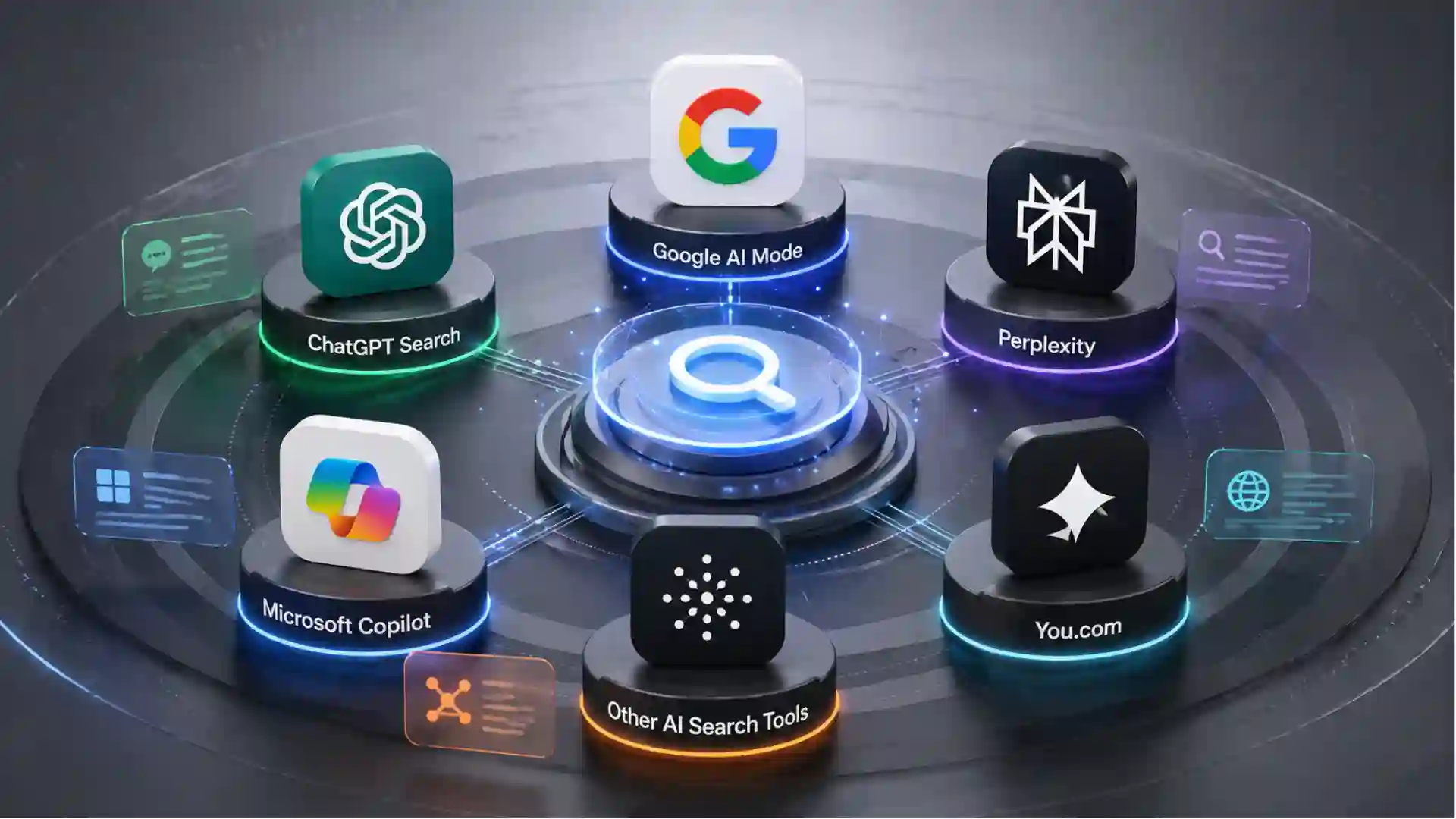
That model still exists, but it no longer explains the whole search market. Google AI Mode, ChatGPT search, Perplexity, Microsoft Copilot Search, Gemini Deep Research, Claude web search, Grok, Brave Search AI and similar tools are not just alternative search boxes. They are competing answer systems with different ideas about trust, speed, sourcing, context, action and commercial intent. Some still feel like search engines. Some feel like research assistants. Some are drifting toward agents that can shop, book, compare, file, summarize and act.
Google AI Mode sits inside the world’s dominant search habit. ChatGPT search sits inside a conversational assistant that many users already treat as a thinking partner. Perplexity was built around cited answers from the start. Copilot Search is tied to Bing, Microsoft 365 and enterprise workflows. Claude brings cautious web access into a writing and reasoning tool. Grok’s edge is real-time web and X data. Brave is trying to connect private search with AI answers without surrendering its anti-surveillance identity. The same query can behave very differently across these systems.
A user asking “best CRM for a 20-person agency in Europe” is not merely asking for a list. Google AI Mode may split the task into subtopics, blend web results with product and review signals, and keep the user near Google’s search interface. ChatGPT search may turn the question into a discussion about requirements, budget, integrations and trade-offs. Perplexity may answer with dense citations and follow-up prompts. Copilot may become more useful if the user is already inside Microsoft work data. Gemini Deep Research may build a longer report. Claude may be better for reading source material and drafting a decision memo. Grok may catch fast-moving social sentiment sooner than slower indexed sources.
The fight is not only about who gives the best answer. It is about who owns the user’s next step. A traditional search engine sends traffic outward. An AI answer engine may keep the user in the answer. An AI assistant may turn the answer into a plan. An AI agent may execute part of the plan. This is why AI search matters to users, marketers, publishers, software buyers and anyone who relies on online discovery.
The public facts also show how quickly the category is moving. Google’s AI Mode support page describes AI Mode as Google’s most powerful AI search experience and says it uses query fan-out to divide questions into subtopics and search across data sources. OpenAI’s help page says ChatGPT search is available to Free, Plus, Team, Edu and Enterprise users, including logged-out Free users. Microsoft describes Copilot Search in Bing as a cited, summarized answer experience. Perplexity still presents itself as an AI-powered answer engine built around real-time answers.
The user-facing difference looks simple. Ask a question, get an answer. The strategic difference is much larger. AI search rewrites discovery around synthesis, citation, memory, personal context and action. A website no longer competes only for position one. It competes to be selected as evidence. A brand no longer appears only as a blue link or an ad. It appears inside generated language, ranked comparisons and shopping recommendations. A publisher no longer negotiates only with crawler traffic. It negotiates with answer engines that may summarize without producing a visit.
This is the new search problem: not “which AI tool is best?” but which AI system is best for a given intent, how does it find evidence, and what does it do after it answers?
Google AI Mode keeps search at the center
Google AI Mode is the most consequential AI search product because it extends the existing Google habit rather than asking users to adopt a new one. For many people, Google is still the default place where questions begin. AI Mode changes what happens after the question is typed. Instead of presenting only ranked links, Google can generate an answer, cite web sources, invite follow-up questions and organize a multi-step exploration inside Search.
Google’s own wording matters here. Its support page says AI Mode expands what AI Overviews can do through more advanced reasoning and new ways of interacting. It also says AI Mode uses “query fan-out,” splitting a question into subtopics and searching each one at once. That matters because AI Mode is not merely a chatbot pasted onto Search. It is a retrieval system that breaks the user’s visible query into many hidden retrieval tasks, then rebuilds those results into one answer.
Google’s public AI Mode page now describes the experience as using Gemini 3 with reasoning, thinking and multimodal understanding. The page also frames AI Mode around broad tasks: learning a topic, finding recommendations, comparing products and asking through text, voice or images. This tells us where Google is aiming. AI Mode is not built only for factual lookup. It is built for the messy middle of search: “help me understand,” “help me decide,” “compare these options,” “show me what I missed.”
That puts AI Mode in a different category from old featured snippets. Featured snippets answered narrow questions with extracted text. AI Mode can synthesize across sources and hold a thread. The product direction is closer to a guided research session. A query such as “plan a 5-day family trip to Lisbon with food, public transport and rain options” is not one search. It contains geography, weather, transport, child-friendly attractions, restaurant suitability, opening hours, budget and local logistics. Query fan-out lets Google search those parts in parallel.
The strength of Google AI Mode is obvious: Google has the deepest search index, mature ranking systems, maps, shopping data, local signals, YouTube, images, news and a user habit that competitors envy. When AI Mode works well, it can feel like a search engine that finally understands the shape of the task rather than only the wording of the query.
The weakness is also tied to Google’s strength. Google must protect a huge ads business, publisher relationships, regulatory exposure and user trust. AI Mode cannot move like a small startup. It sits inside a search system that already mediates commerce, news, health information, local business discovery and public knowledge. Every design choice affects traffic, ad placement, publisher economics and competition policy. European publishers have already challenged Google’s AI-generated summaries, arguing that the model threatens open web journalism and gives publishers weak choices because opting out can damage search visibility. Google rejects that view and says its AI features surface web content and offer controls.
For users, Google AI Mode is strongest when the task benefits from web breadth, local or shopping context, visual search, maps, recent pages and mainstream source coverage. It is weaker when the user needs a transparent research process, strict source control or a writing assistant that can revise a document across many turns. AI Mode is still Google Search first. That is its advantage and its constraint.
For brands and publishers, Google AI Mode creates a clear lesson: classic SEO is not dead, but ranking alone is no longer enough. Google’s Search Central documentation says AI features such as AI Overviews and AI Mode use content from Google Search’s systems, and the same controls used for search snippets can affect how content appears. Strong technical SEO, crawlability, structured content, entity clarity and topical authority still matter. The difference is that the output may be an answer citation rather than a visit.
ChatGPT search turns search into conversation
ChatGPT search begins from a different mental model. Google begins with search and adds conversation. ChatGPT begins with conversation and adds web retrieval. That distinction shapes everything.
OpenAI describes ChatGPT search as a way to get fast, timely answers with links to relevant web sources, without visiting a separate search engine. ChatGPT can decide to search based on the user’s request, or the user can trigger search manually. The user does not need to translate every thought into search-engine syntax. A prompt can include background, constraints, doubts, preferences and a desired format. Search becomes one tool inside a larger reasoning session.
This is why ChatGPT search often feels less like “find me the answer” and more like “work through this with me.” A user can ask for a comparison, challenge the result, paste notes, request a different angle, ask for a table, turn the findings into an email, then ask for a buying checklist. The search step is not the final product. It is raw material for synthesis, writing, planning and decision support.
OpenAI’s help documentation says ChatGPT responses that use search may include inline citations, and when citations are not shown, users can open a Sources panel. That is a major trust layer, but the experience is still less “source-first” than Perplexity. ChatGPT usually tries to answer the user’s task, not show its search process. This can be better for flow and worse for users who want to audit every claim quickly.
ChatGPT search is especially strong when the user’s query is under-specified. Traditional search engines punish fuzzy questions because the results page forces the user to refine. ChatGPT can ask clarifying questions, infer a likely structure, and turn scattered intent into a useful working answer. For example, “which AI search tool should our B2B SaaS team care about?” is not a simple lookup. It needs assumptions about target customers, content operations, category competition, sales cycle and geographic market. ChatGPT can hold those assumptions in the conversation and revise them.
The product has also expanded beyond quick web lookup. OpenAI’s deep research feature is designed for longer, structured reports with citations or source links, where users can choose sources, review a plan and track progress. OpenAI’s own academy material separates regular search from deep research, with search suited to faster current answers and deep research suited to multi-source analysis. This split matters because “AI search” now spans several time horizons. A 20-second answer and a 20-minute research report are not the same product.
ChatGPT also points toward action. OpenAI introduced Instant Checkout and the Agentic Commerce Protocol in 2025 as steps toward shopping inside ChatGPT. Its shopping research feature helps users compare products and, where available, purchase through merchants connected to Instant Checkout. OpenAI’s ChatGPT agent can browse and take actions with user guidance, and OpenAI says agent outputs include source links or screenshots.
The trade-off is trust calibration. ChatGPT is powerful because it can turn search into usable work. That same fluency can make unsupported claims sound smoother than they deserve. Users need to inspect citations, ask for source separation, and request uncertainty when the topic is sensitive. ChatGPT search is strongest as a reasoning and production layer over web retrieval. It is not always the best raw source-discovery interface.
For publishers and brands, ChatGPT creates a different visibility path from Google. OpenAI documents OAI-SearchBot as the crawler used to surface websites in ChatGPT search features, and says sites that opt out of OAI-SearchBot will not be shown in ChatGPT search answers, though they may still appear as navigational links. That gives technical teams a concrete AI visibility checkpoint: if the site blocks the retrieval layer, the brand may be absent from the answer layer.
Perplexity is the cleanest answer engine
Perplexity’s identity is sharper than most of its rivals. It is not trying to be the default operating system for work, the dominant global search engine or the broadest consumer assistant. It is trying to be the answer engine people trust when they want current information with visible sources.
Perplexity’s homepage describes the product as a free AI-powered answer engine that provides accurate, trusted and real-time answers. Its help center says Perplexity searches the internet in real time, gathers information from strong sources and distills it into a conversational summary. The claim is simple: ask, get an answer, see where it came from.
That source-forward design is Perplexity’s main advantage. Many users do not want to watch a reasoning trace or browse ten tabs. They want a compact answer with citations and the option to investigate. Perplexity is often quicker than a full research agent and more transparent than a general assistant. It is good for “What changed?”, “Which sources support this?”, “Give me a market snapshot,” “Compare these tools,” “Find current documentation,” and “Summarize the strongest evidence.”
Perplexity also built product surfaces around research workflows. Its help center lists Pro Search, Threads, Spaces, Pages, memory and recurring tasks. File uploads let users attach files and keep context in a thread. Its API platform offers real-time web search results, domain filtering, multi-query search and content extraction for developers. This makes Perplexity more than a consumer answer page. It is also infrastructure for grounded AI products.
Perplexity’s Deep Research work shows where the company wants to compete: multi-step research, not only quick answers. Its research page on Deep Research evaluation describes a model-agnostic harness and continued evaluations as stronger agentic models appear. That model-agnostic posture is part of Perplexity’s appeal. It can route around models, search layers and source types without asking users to think about the plumbing.
Perplexity’s Comet browser pushes the product into a more agentic direction. Perplexity describes Comet as an AI browser and personal assistant that can research the web, organize email and automate tasks. This matters because browsers are where intent becomes action. If the answer engine lives inside the browser, it can summarize tabs, compare pages, help fill forms, track products and work inside the user’s actual browsing context. The browser becomes a research surface, not only a rendering surface.
Perplexity’s weakness is distribution. Google has Search. Microsoft has Windows, Bing, Edge and Microsoft 365. OpenAI has ChatGPT’s massive user base and developer ecosystem. Perplexity has a clear product idea, but it needs users to choose a new habit. That is hard. A source-rich answer engine can win among researchers, journalists, analysts, students, marketers and technical teams. Winning the average “weather,” “restaurant,” “near me,” “login,” or “how do I fix this phone setting” query is a different battle.
The other tension is publisher trust. Perplexity documents PerplexityBot as a crawler designed to surface and link websites in search results, not to crawl content for foundation model training. Yet Perplexity has faced public disputes over crawling and publisher content access, including Cloudflare’s 2025 accusation that Perplexity evaded blocks, which Perplexity disputed. For an answer engine built on citation trust, source-owner trust is not a side issue. It is part of the product’s long-term moat.
Perplexity is best understood as the most search-native of the AI-first challengers. It is less of a general companion than ChatGPT, less tied to enterprise workflow than Copilot, less integrated into the web’s default discovery path than Google. Its strength is clean retrieval, citations and research rhythm.
Microsoft Copilot Search is strongest where work and web meet
Microsoft Copilot Search has two faces. One lives in Bing as a consumer AI search experience. The other lives across Microsoft 365, Copilot Chat, Copilot Studio and enterprise knowledge. The combination makes Copilot less elegant than Perplexity and less culturally dominant than ChatGPT, but more relevant inside organizations that already run on Microsoft.
Microsoft describes Copilot Search in Bing as an AI-powered experience with quick summarized answers, cited sources and suggestions for further exploration. The Bing blog announcement says Copilot Search can provide a summary, clear answer or smart layout depending on the query. Microsoft’s official blog frames it as a blend of traditional and generative search, with cross-checking across multiple sites and cited sources.
The consumer product competes directly with Google AI Mode and ChatGPT search for general queries. Its challenge is habit. Bing has long lived in Google’s shadow for general search. AI does not erase that overnight. But Copilot Search can still matter because it sits inside Microsoft’s broader AI layer. The question is not only whether a user opens Bing. It is whether Copilot appears inside Windows, Edge, Office, Teams, Outlook, SharePoint, Microsoft 365 and enterprise agents.
Microsoft’s enterprise documentation shows that Copilot Chat and agents can use web search to improve answers by referencing public information beyond work content. Microsoft 365 Copilot Search documentation says Copilot Answers may include references from external sources, connected cloud-backed services and the web, depending on grounding settings. That gives Copilot a distinct role: it can blend organizational context with web context under enterprise controls.
This is where Microsoft differs from Google AI Mode, ChatGPT search and Perplexity. In a company, the most useful answer often lives between public information and private work data. “Summarize the market for warehouse automation in Germany” is public research. “Summarize the market and compare it with our last three sales decks, customer notes and pricing files” is enterprise knowledge work. Copilot has a natural route into that second task because Microsoft controls much of the workplace graph.
Microsoft is also building AI visibility tools for site owners. Bing Webmaster Tools introduced an AI Performance dashboard that shows when a site is cited in AI-generated answers across Microsoft Copilot experiences. Microsoft’s ads blog describes page-level citation activity and visibility trends for AI citation activity. This is a serious shift. Search analytics used to track impressions, clicks and rank. AI search needs citation tracking, answer inclusion and query-level grounding visibility.
Copilot is also moving toward shopping and agentic commerce. Microsoft’s support page says Copilot shopping features can discover, compare and buy products, track price drops and streamline purchases in certain markets. Microsoft Advertising announced Copilot Checkout and brand agents in January 2026, with merchant infrastructure tied to PayPal and other commerce partners.
The risk for Copilot is complexity. Microsoft has many Copilot products, names, surfaces and licensing models. Users can be unsure whether they are using Bing Copilot Search, consumer Copilot, Microsoft 365 Copilot Chat, Copilot Studio, Researcher or another branded surface. Google’s advantage is simple habit. ChatGPT’s advantage is simple conversation. Perplexity’s advantage is simple answer-with-sources. Microsoft’s advantage is work context, but it must keep the experience understandable.
Copilot Search is not the cleanest AI search tool. It may become the most practical one for organizations already living in Microsoft 365. For enterprise users, the winning search tool is often the one that knows where the documents are and respects access rights.
Gemini, Claude, Grok and Brave form the second ring of AI search
A comparison of AI search cannot stop with Google AI Mode, ChatGPT search, Perplexity and Copilot. The category is wider, and the next layer matters because each competitor bends search toward a different use case.
Gemini Deep Research is Google’s research-assistant product outside the standard Search interface. Google describes it as a system that breaks down complex research tasks, explores web sources and Workspace content when the user chooses, and synthesizes findings into reports. Google’s developer documentation for Gemini Deep Research Agent says it autonomously plans, executes and synthesizes multi-step research tasks and produces cited reports. In April 2026, Google announced Deep Research Max with Gemini 3.1 Pro, MCP support, native visualizations and stronger long-horizon research workflows.
The distinction between Google AI Mode and Gemini Deep Research is useful. AI Mode is for interactive search inside Search. Gemini Deep Research is for longer research work. A user looking for quick comparisons may prefer AI Mode. A user building a market brief may prefer Gemini Deep Research. Google owns both layers, which gives it a full ladder from quick answer to report.
Claude’s web search has a different character. Anthropic’s developer documentation says the web search tool gives Claude direct access to real-time web content and includes citations for sources drawn from search results. It also describes a 2026 web search tool version that supports dynamic filtering for certain Claude models, letting Claude filter search results before they reach the context window. Claude tends to appeal to users who care about writing quality, document reasoning, source reading and cautious analysis. Its search feature matters because it reduces the gap between a strong reasoning model and current information.
Grok’s position is built around real-time access to the web and X. xAI describes Grok as an assistant that can provide real-time answers from the web and X, and its developer documentation describes Web Search as a tool that lets Grok search the web in real time and browse pages for up-to-date content. That makes Grok more relevant for breaking news, social narratives, live controversy, memes, public sentiment and fast-moving events. Its weakness is that speed and social freshness can amplify noise. For research that demands careful source hierarchy, real-time social access is not enough.
Brave occupies a privacy-first position. Brave says its AI features are private and user-first, while its search help page says AI Answers provide concise summary answers with references to sources and that provenance and transparency are central to the feature. Brave also launched Ask Brave as a combined search and AI chat interface available from Brave Search. Brave’s real significance may be larger in the infrastructure layer. Its Search API has become a retrieval source for AI applications, and Brave announced a revamped Search API in 2026 aimed at AI developers.
These “others” show that AI search is not converging into one shape. The market is segmenting by retrieval source, trust style, privacy stance, workflow depth and action layer. Google has the search index and consumer default. OpenAI has assistant behavior and broad tool use. Perplexity has answer transparency. Microsoft has work context. Gemini has deep research across Google’s ecosystem. Claude has careful reasoning with citations. Grok has real-time social data. Brave has privacy and independent search infrastructure.
For users, this means the best tool depends on the job. For businesses, it means AI visibility cannot be measured by one ranking report. A brand can be visible in Google AI Mode but weak in Perplexity. It can be cited in Copilot but absent from ChatGPT search due to crawler rules. It can appear in Grok because people discuss it on X, while failing to appear in Gemini Deep Research because its documentation is thin. AI search visibility is fragmented, and that fragmentation is now part of search strategy.
Search intent now determines the winning tool
The old search market trained people to ask, “Which search engine is better?” AI search makes that question too blunt. The better question is: what kind of intent is this, and which system handles that intent with the least distortion?
Navigational intent is still simple. If a user wants the login page for Stripe, the website for a local dentist, a government form or a brand’s support page, classic search may still be faster than an AI answer. The risk of AI mediation is unnecessary interpretation. A direct link is better than a generated explanation.
Factual intent is split. For stable facts, many AI systems can answer well. For current facts, the system needs live retrieval, timestamps and source links. ChatGPT search, Perplexity, Copilot Search, Claude web search, Grok and Brave AI Answers can all retrieve current information, but they differ in source presentation and confidence. A user checking a law, price, product feature or public policy should not trust the prose alone. The citation is part of the answer.
Exploratory intent is where AI search becomes more useful than classic search. Questions such as “compare AI search tools for a B2B content team” or “what are the trade-offs between Perplexity and ChatGPT search for research?” benefit from synthesis. A list of links forces the user to build the comparison manually. An AI system can map criteria, separate use cases and ask follow-up questions.
Research intent needs depth and auditability. Perplexity, ChatGPT deep research, Gemini Deep Research, Microsoft Deep Research and Claude with web access all belong here, but for different users. Perplexity is fast and citation-forward. ChatGPT deep research is strong when the output must become a report, plan, brief or reusable document. Gemini Deep Research can connect with Google’s broader ecosystem. Microsoft Researcher and Copilot Deep Research make more sense inside Microsoft 365 environments. Claude suits careful reading and writing workflows.
Commercial intent is becoming the most contested zone. Google has the Shopping Graph, ads, merchant feeds and agentic checkout experiments. OpenAI has shopping research and Instant Checkout. Microsoft has Copilot shopping and Copilot Checkout. Perplexity has built shopping features with product cards and in-chat buying for eligible users in past releases. AI search does not only recommend products. It may soon become the purchase path.
Local intent still favors Google because Google Maps, reviews, business profiles and location signals are hard to match. A user asking “best brunch near me open now” still expects maps, hours, photos, reviews and directions. AI can summarize, but the ground truth often comes from local data. Copilot and ChatGPT can help reason about options, but Google’s local graph remains a huge advantage.
Social and trend intent may favor Grok or systems that ingest fresh social data. For fast-moving memes, platform controversies, creator drama, live events and sentiment spikes, a web index may lag. Grok’s X connection gives it a differentiated feed, though users need to separate signal from noise. Traditional news sources may be slower but more verified.
Platform fit by search task
| Task type | Strong fit | Why it fits |
|---|---|---|
| Fast web answer with citations | Perplexity, ChatGPT search, Copilot Search | They turn current web retrieval into cited summaries without requiring manual link scanning. |
| Complex exploratory search | Google AI Mode, ChatGPT search, Perplexity | They handle broad questions, comparisons and follow-up prompts better than classic results pages. |
| Long research report | ChatGPT deep research, Gemini Deep Research, Microsoft Deep Research, Perplexity Deep Research | They can plan, gather sources and produce structured outputs with citations or source links. |
| Local and commercial discovery | Google AI Mode, Copilot shopping, ChatGPT shopping research | They connect search answers with product, merchant, map or checkout layers. |
| Work-context search | Microsoft Copilot, ChatGPT with connected apps, Gemini with Workspace context | They can blend web information with private or workspace data when permissions allow. |
| Social and breaking signals | Grok, Google news surfaces, Perplexity | Grok has native X access, while search-first tools can catch news once indexed and cited. |
This table is not a permanent ranking. AI search products change quickly. Its value is the pattern: the best AI search tool is the one whose retrieval source, interface and action layer match the intent. A user who treats every question as a generic chatbot prompt will get weaker results than a user who chooses the right system for the job.
Citations are not all the same
AI search products all talk about sources, but citations behave differently across systems. This is where many comparisons become shallow. A citation can mean “the model used this source,” “the system found this source,” “this link supports part of the answer,” “this link is one of several relevant references,” or “this is a route for further reading.” Those are not the same thing.
Perplexity made citations central to its product identity. The answer is usually built around visible source links. This creates a reading rhythm where the user can quickly check whether the answer rests on official documentation, news coverage, forums, old blog posts or low-quality pages. It does not guarantee correctness, but it makes source inspection natural.
ChatGPT search can show inline citations or a Sources panel, but the interface is still conversation-first. The user may ask for a cleaner answer and ignore citations, or ask ChatGPT to rewrite findings into a memo where sources become less prominent. That makes ChatGPT powerful for synthesis and production, but users need discipline when accuracy matters. Asking for “claim-by-claim citations” or “separate sourced facts from your inference” often improves the result.
Google AI Mode gives links for further exploration, but it also sits within the broader Google Search environment. Google’s advantage is ranking infrastructure; its risk is that users may assume generated answers carry the same reliability aura as traditional Google results. Google’s own AI Mode support page says generated responses may make mistakes, and users should evaluate information using links and other sources. That warning is not cosmetic. AI search answers are summaries, not court-certified facts.
Microsoft Copilot Search displays cited sources in Bing’s AI answer experience. Inside Microsoft 365, citations also become part of workplace verification. Microsoft’s March 2026 Copilot update said citations display in Word when responses include web content or Work IQ sources, helping users verify the origin of generated content. In enterprise settings, this is more than a nice feature. A generated answer without traceable sources can create compliance, procurement and legal risk.
Claude’s web search documentation says responses include citations for sources drawn from search results. Brave’s AI Answers help page says it shows references to support claims and stresses provenance. These are good signs, but users still need to judge citation quality. A cited false claim is still false. A cited forum thread may reflect real user sentiment but not verified fact. A citation to a product page may confirm a feature but not prove it works well.
The serious user’s habit should be simple: inspect the source class, not only the source count. Official docs carry different weight from affiliate roundups. Peer-reviewed research carries different weight from vendor claims. Fresh news carries different weight from old cached content. Government pages carry different weight from anonymous posts. AI search makes this easier in some ways because citations are bundled into the answer. It also makes it easier to become lazy because the prose feels complete.
For content creators, citation behavior creates a new writing standard. Pages that answer clearly, state dates, identify authors, cite their own sources, use clean headings and avoid vague marketing language are easier for retrieval systems to select and quote. The page must be useful both to a human reader and to an answer engine trying to extract reliable claims.
Query fan-out changes visibility
Query fan-out is one of the most important concepts in AI search visibility. It is also one of the easiest to underestimate.
In classic SEO, a page could be optimized around a primary keyword and a cluster of related terms. The user searched one visible phrase. The search engine matched and ranked documents. AI search changes this because the visible query may be broken into many hidden searches. Google says AI Mode divides questions into subtopics and searches each one simultaneously. Its May 2025 AI Mode update said the same technique lets Search go deeper into the web than a traditional Google search and discover highly relevant content matching the user’s question.
Suppose a user asks: “Which project management tool is best for a remote creative agency with EU clients and strict data protection needs?” A fan-out system might generate sub-queries about project management tools, remote agency workflows, GDPR, data residency, client portals, creative proofing, pricing, user reviews, integrations, security certifications and alternatives to the user’s known tools. The final answer may cite pages that did not rank for the full original query. A vendor can win part of the answer by owning one subtopic.
That changes content strategy. A brand no longer needs only one “best project management software” page. It needs strong evidence pages for the sub-questions AI systems ask behind the scenes. Security pages. Pricing pages. Comparison pages. Integration pages. Region pages. Use-case pages. Documentation. Case studies. Support articles. Independent reviews. Schema. Author profiles. Clear update dates. The answer engine assembles a judgment from pieces.
Query fan-out also raises the value of topical completeness. Thin pages may rank for narrow keywords, but they are weak evidence for a multi-part answer. A detailed page that explains mechanisms, limitations, scenarios and data may be more likely to appear as a citation for a sub-answer. AI search is not only looking for matching words. It is looking for useful chunks.
Google AI Mode makes this issue highly visible, but the pattern extends across AI search. Perplexity’s API platform mentions multi-query search. ChatGPT deep research can scan many sources and synthesize a report. Gemini Deep Research plans and executes multi-step research tasks. Microsoft Copilot Studio documentation describes query processing for generative answers using Bing Custom Search, including query optimization from conversational context and retrieval from configured sources.
For SEO and GEO, the implication is direct. Search visibility is moving from page-level ranking to answer-level evidence selection. A page may receive fewer clicks but still shape the answer. A brand may be mentioned without being the top organic result. A source may be cited for one claim while another source is cited for another claim. The unit of competition is no longer only the URL. It is the retrievable claim.
This also exposes weak content. If a company’s website buries proof behind PDFs, vague claims, empty case studies or sales language, AI systems may choose clearer third-party explanations instead. If a product page says “powerful platform for modern teams” but a competitor says “SOC 2 Type II, EU data residency, Slack and Jira integrations, starts at €18 per user,” the second page gives retrieval systems more useful facts.
Query fan-out rewards content that answers the actual buying, learning or decision path. The brands that win AI search will not be the ones that stuff more keywords into pages. They will be the ones that publish the evidence an AI system needs to make a fair comparison.
Speed, depth and source control create three different products
AI search tools are often compared as if they all respond to the same stopwatch. That misses the real distinction. Speed, depth and source control define three different products.
The first product is the instant AI answer. Google AI Mode, ChatGPT search, Perplexity, Copilot Search, Brave AI Answers and Grok can all answer quickly when the task is modest. The value is reduced friction. A user does not open ten tabs or extract the answer manually. The system reads, condenses and cites. This works well for quick orientation, definitions, current checks, product facts and surface-level comparisons.
The second product is guided exploration. This is where follow-up questions matter. Google AI Mode lets users go deeper through follow-ups. ChatGPT and Perplexity are naturally conversational. Copilot Search suggests further exploration. Brave Ask adds chat-like follow-ups to search. Guided exploration is useful when the user’s first query is not precise enough. The tool becomes a way to think.
The third product is deep research. OpenAI’s deep research lets users choose sources, review a plan and receive a structured report with citations or source links. Gemini Deep Research breaks down tasks and synthesizes findings from web and optional Workspace content. Microsoft Copilot Deep Research is described as a tool for detailed research reports grounded in credible information. Perplexity is building its own Deep Research evaluation path.
These products should not be judged by the same criteria. A quick answer should be fast, readable and sufficiently sourced. A deep research output should be slower, better planned, more transparent and easier to audit. A guided conversation should preserve context and adapt to the user’s changing intent.
Source control is the deciding feature for high-stakes work. OpenAI’s deep research documentation says users can restrict research to specific websites or prioritize certain sites while still allowing broader web search. Perplexity’s Search API offers domain filtering, region and language controls. Anthropic’s web search tool supports domain controls through its API documentation. Microsoft Copilot Studio can use configured public websites as knowledge sources for grounded answers.
For a casual user, source control may feel technical. For a company, it is critical. A legal team does not want an answer grounded in random blog posts. A medical publisher does not want low-quality sources shaping summaries. A procurement manager may want only vendor docs, analyst reports and internal files. A journalist may want official filings and primary statements before commentary.
The next mature phase of AI search will not be about the longest answer. It will be about controllable evidence. Users will ask not only “answer this” but “answer this using these sources, excluding those sources, separating fact from interpretation, and showing where each claim came from.” Tools that expose those controls without making the interface painful will earn trust.
For daily use, the practical rule is simple. Use quick AI search for orientation. Use conversational search for framing and comparisons. Use deep research when the output will guide money, policy, hiring, strategy, legal exposure or public claims. The difference is not academic. It is the difference between a helpful summary and a document you can defend.
Shopping turns AI search into a transaction layer
Search has always been commercial. What changes with AI search is that the product recommendation, comparison and checkout can happen in one conversational path. The user may not move from search to review site to retailer to checkout. The AI system may compress those steps.
Google has the strongest commercial search base. Its shopping infrastructure, merchant data, ads system, product listings and Shopping Graph give AI Mode a deep commercial substrate. Google announced agentic checkout for Search, including AI Mode, starting with eligible U.S. merchants such as Wayfair, Chewy, Quince and select Shopify merchants. Earlier Google shopping updates described a “buy for me” flow where users can track a product price, set preferences and confirm purchase details when the price fits.
OpenAI is building its own path. Its Instant Checkout announcement introduced agentic commerce in ChatGPT, and its shopping research feature helps users compare products with the stated future ability to buy directly through ChatGPT for merchants in Instant Checkout where available. OpenAI’s help page for shopping with ChatGPT Search says merchant lists can be ranked based on availability, price, quality, whether the merchant is the maker or primary seller and whether Instant Checkout is enabled.
Microsoft is moving in the same direction. Its shopping support page says Copilot can discover, compare and buy products, track price drops and streamline purchases in certain markets. Microsoft Advertising’s January 2026 announcement framed Copilot Checkout and brand agents around conversational commerce and PayPal merchant infrastructure.
Perplexity has experimented with in-chat shopping as well. The Verge reported in 2024 that Perplexity introduced “Buy with Pro” for U.S. Pro subscribers, product cards and a “Snap to Shop” feature. Perplexity’s commerce ambitions fit its answer-engine identity: find the product, compare the evidence, show the source, enable the next step.
The commercial shift is huge for merchants. AI search may become a filter before the storefront. A retailer’s product page may not be the first persuasive experience. The AI answer may compare products, summarize reviews, note availability and route the user to checkout. The merchant must feed the answer layer with clean product data, clear availability, trustworthy reviews, policies, return terms, images, specs and brand signals.
This also changes advertising. In classic search ads, a brand bids on a query and wins placement near links. In AI commerce, paid influence may appear inside recommendations, sponsored suggestions, merchant rankings, checkout eligibility or brand agents. Regulators and users will demand clarity. A generated product recommendation that mixes organic evidence with commercial placement without clear labeling would damage trust quickly.
For users, AI shopping is convenient but risky. A helpful assistant can narrow options, but it can also hide the comparison process. Users should ask why a product was recommended, which merchants were considered, whether sponsored placements affected ranking, and what sources support claims about quality. For expensive purchases, AI search should be a filter, not the only judge.
The broader direction is clear. AI search is becoming the front end of agentic commerce. The companies that control search, assistant behavior, payment flows and merchant data will compete for the most profitable intent on the web: a user ready to buy but still open to influence.
Personalization will separate helpful answers from generic summaries
The first wave of AI search focused on retrieval and synthesis. The next wave is personalization. Not the crude personalization of inserting a name into a response, but the deeper form: understanding the user’s location, preferences, work context, past queries, files, calendar, budget, devices, subscriptions, team norms and decision history.
Google has a natural personalization base through Search, Maps, Gmail, YouTube, Android, Chrome and Workspace, though privacy, consent and regulation shape what can be used where. Google AI Mode already accepts complex, multimodal questions, and Gemini Deep Research can use Workspace content if the user chooses. The long-term appeal is obvious: “plan my trip” is far better if the system knows travel dates, airport, dietary needs, saved places and calendar limits.
ChatGPT personalizes through memory, projects, custom instructions, connected apps and ongoing conversation. OpenAI’s Projects documentation says projects can use web search with up-to-date citations, and paid plans may include agent mode and deep research depending on subscription. The strongest ChatGPT search sessions often happen when the user gives context: role, region, goals, constraints, prior research and preferred output. The model can then search with a shaped intent rather than a naked query.
Copilot’s personalization is more enterprise-centered. Microsoft’s documentation around Copilot Search and Microsoft 365 grounding shows how Copilot can reference work content, external sources and web information according to permissions and settings. This makes it powerful inside organizations because the best answer may depend on internal documents, meeting history and files that public search cannot see.
Perplexity has memory and spaces for organizing research, while Comet extends context into browser activity. Claude can hold long document context and use web search when needed. Grok benefits from social and real-time context. Brave’s personalization is more constrained by its privacy-first posture, which can be a feature rather than a limitation for users who do not want deep profiling.
Personalization creates a quality jump because many “best” answers are not universal. The best AI search tool for a student is different from the best tool for a lawyer. The best answer for a Slovak ecommerce brand selling into Germany differs from the answer for a U.S. SaaS startup. The best software recommendation depends on budget, team size, integrations, compliance needs and user tolerance for complexity.
But personalization also creates a trust problem. The more an AI search system knows, the more useful it becomes. The more it knows, the more it can shape choices invisibly. Users need clear controls over memory, connected data, personalization and deletion. Enterprises need access control, audit logs and data-loss prevention. Microsoft’s March 2026 Copilot update included controls to safeguard web searches and prompts with Microsoft Purview Data Loss Prevention for sensitive data in Copilot prompts.
For AI search providers, the product challenge is subtle. A generic answer feels safe but shallow. A personalized answer feels useful but invasive if the system does not explain what context it used. The strongest products will likely show context boundaries clearly: “I used your uploaded file,” “I searched the web,” “I used your workspace data,” “I did not use memory,” “I excluded private sources.” Trust will depend on the interface, not only the model.
Publishers are entering the citation economy
For publishers, AI search is not a minor interface change. It alters the exchange between content creators and search platforms.
The old bargain was imperfect but clear: publishers allowed crawling because search sent traffic. The traffic funded subscriptions, ads, lead generation, donations, brand authority or commerce. AI search weakens that bargain because the answer can satisfy the user before a click happens. A cited publisher may gain authority but lose the visit.
Pew Research Center’s March 2025 analysis found that U.S. Google users who encountered an AI summary clicked a traditional search result in 8% of visits, compared with 15% when no AI summary appeared. It also found users clicked a link inside the AI summary itself in only 1% of visits. That is not a small behavioral change. It suggests that AI summaries may reduce both traditional clicks and source-link clicks.
BrightEdge data published in 2026 said AI Overviews triggered on nearly half of tracked queries, while organic search still controlled much of search traffic. SparkToro’s 2024 zero-click study showed that only 374 of every 1,000 U.S. Google searches and 360 of every 1,000 EU Google searches led to clicks to the open web. AI answers did not create zero-click search, but they accelerate the logic of it.
This leads to a new metric: citation value. A publisher may be cited in an AI answer and gain brand visibility without a click. That can matter for reputation, subscriptions and future direct visits. But citation value is harder to monetize than traffic. A news site cannot pay reporters with “brand presence” alone. A niche publisher may survive if citations drive qualified readers. A general information site may suffer if answers replace visits.
Google’s Search Central documentation tells site owners that AI features are part of Google Search and explains how content inclusion and preview controls relate to those features. OpenAI documents OAI-SearchBot for surfacing websites in ChatGPT search results. Perplexity documents PerplexityBot for surfacing and linking websites in Perplexity search results. Microsoft’s Bing Webmaster Tools AI Performance report gives publishers a way to see citations across Microsoft AI answers.
These controls and reports are useful, but they do not solve the economic tension. Publishers want visibility, traffic, control, attribution and compensation. AI search systems want source access, answer quality, user retention and product speed. The citation economy will be negotiated through robots.txt, licensing deals, lawsuits, platform dashboards, regulatory pressure and new commercial models.
For publishers, the strategic question is not whether to block or allow every AI crawler. That binary is too crude. The better question is which content should be discoverable, under what terms, through which agents, and with what measurement. Evergreen guides, public service information, author pages, product reviews, data pages and breaking news may deserve different treatment.
For brands with owned content, the same issue appears in a friendlier form. A citation in Google AI Mode, ChatGPT search, Perplexity or Copilot can influence a buyer before they visit the site. That makes cited content a demand-generation asset even without a click. The challenge is proving the value internally.
SEO becomes retrieval design
SEO is not disappearing. It is being absorbed into a larger discipline: retrieval design. Classic SEO asks how a page can be crawled, indexed, ranked and clicked. Retrieval design asks how a page can be found, understood, trusted, chunked, cited and used by answer systems.
The basics still matter. Crawl access matters. Indexability matters. Page speed matters. Structured data matters. Internal linking matters. Canonicalization matters. Snippet controls matter. If a page cannot be crawled or understood by traditional systems, it will struggle in AI search as well. Google’s AI features documentation explicitly connects AI Overviews and AI Mode to Google Search systems and site controls.
The difference is the target output. A classic SEO page might be designed to rank for “best accounting software for freelancers.” A retrieval-designed page needs to support many sub-questions: pricing, tax regions, integrations, invoice templates, accountant collaboration, mobile app limits, data export, support quality, compliance and migration. It should make those facts easy to extract.
AI search favors content that states claims clearly and surrounds them with proof. A vague page gives the model nothing dependable. A clear page with dates, definitions, author credentials, source links, tables, examples, limitations and update history gives the model material. This is not keyword stuffing. It is evidence architecture.
Entity clarity matters more. Search systems need to know who the author is, what the brand does, which product is being described, which geography applies, what date the statement belongs to and how the page connects to other known entities. A page about “our platform” is weaker than a page that names the product, category, use case, integrations and audience.
Comparison content needs to be fairer than many old SEO pages. AI systems can cross-check claims across sources. A page that says “we are the best alternative to X” without explaining trade-offs may be less useful than a page that says “choose us if you need A and B; choose X if you need C.” Generative engines reward extractable judgment, not empty superiority claims.
Technical access also widens. OpenAI’s crawler documentation separates OAI-SearchBot for search from GPTBot for model training. Perplexity says PerplexityBot is for surfacing and linking websites, not training foundation models. This distinction matters because publishers may want to allow search retrieval while blocking training. Robots policies should be explicit, reviewed and tested. Many sites still treat AI crawlers as one category, which is too blunt for 2026.
Measurement must change. Rankings and clicks do not show whether a brand is being cited or summarized. Bing’s AI Performance dashboard points toward the next analytics layer: total citations, cited pages and citation activity over time. Brands will need to track prompts, answer share, citation share, sentiment, source inclusion, competitor mentions and conversion paths that begin inside AI answers.
The winning content team will look less like an old keyword factory and more like an editorial, technical and evidence team. Writers will need subject knowledge. SEOs will need retrieval literacy. Developers will need crawler and schema discipline. PR teams will need entity and source authority. Product teams will need clear public documentation. AI search rewards organizational clarity.
GEO is really answer-market positioning
Generative engine optimization, or GEO, is often sold as a new SEO trick. That framing is too small. GEO is not a checklist for manipulating ChatGPT, Perplexity, Google AI Mode or Copilot. GEO is answer-market positioning: making sure an AI system has reliable, current and well-structured reasons to mention, cite and describe your brand correctly.
The difference matters because AI answers are not simple ranked lists. They combine retrieval, model interpretation, source trust, user context and prompt intent. A brand can be included as a citation, mentioned without a citation, described as an option, compared against rivals, excluded entirely or framed negatively. GEO must account for all of those outcomes.
The first layer is factual completeness. If a company’s public information is scattered, outdated or vague, answer engines will fill gaps from third-party sources. That may include old reviews, forum complaints, directories, scraped descriptions, competitor comparisons or news stories. The brand’s own site should answer basic entity questions: what it is, who it serves, where it operates, pricing signals, features, limitations, compliance posture, integrations, support channels and update history.
The second layer is independent corroboration. AI systems do not rely only on brand-owned pages. They compare across sources. Reviews, analyst mentions, documentation, news coverage, partner pages, app marketplace listings, GitHub repositories, standards certifications, public datasets and high-quality community discussions all shape answer confidence. A brand with clean owned content but no third-party footprint may still look weak.
The third layer is language precision. AI systems extract sentences. A page that says “our solution helps teams succeed” contributes little. A page that says “the platform supports SOC 2 reports, SAML SSO, EU data residency, Jira integration and role-based permissions” gives retrievable facts. The best GEO writing sounds human but behaves like structured evidence.
The fourth layer is freshness. AI search tools with live retrieval can surface recent updates quickly, but only if those updates are public and crawlable. Product changelogs, dated documentation, release notes, updated comparison pages and fresh FAQs all matter. A stale page may lose to a newer third-party summary even if the brand’s product has changed.
The fifth layer is answer testing. Brands should run realistic prompts across Google AI Mode, ChatGPT search, Perplexity, Copilot, Gemini, Claude, Grok and Brave. The goal is not to cherry-pick flattering outputs. It is to see how systems describe the category, which competitors appear, which sources are cited, what claims are wrong, and which gaps repeat. A repeated omission is a content strategy signal. A repeated wrong claim is a reputation risk.
The sixth layer is crawler governance. OpenAI, Perplexity, Google and Bing each expose different documentation and controls around search, AI features and crawling. Blocking everything may protect content but reduce answer visibility. Allowing everything may expose content in ways the business does not want. The policy should match the business model.
GEO should not replace SEO. It should sit above it. SEO wins pages. GEO wins descriptions. SEO earns visibility in search results. GEO earns presence inside the generated answer. The strongest strategy does both.
Brand reputation now lives inside generated language
Brand reputation used to be distributed across search results, reviews, social media, news and word of mouth. AI search compresses that reputation into paragraphs. That compression is convenient for users and uncomfortable for brands.
Ask an AI search tool about a software product and it may summarize strengths, weaknesses, pricing complaints, support issues, security concerns and alternatives. The user may never click the source. The generated description becomes the brand’s first impression. That description may be fair, outdated, incomplete or biased by source selection.
This matters because AI answers often sound more authoritative than a list of links. A blue link says “go judge this.” A generated answer says “here is the judgment.” Even with citations, the psychological effect is different. Users may treat the summary as a consensus when it is really a synthesis based on available sources, ranking signals and model behavior.
BrightEdge’s 2026 analysis of AI Overviews and brand sentiment, reported by Business Insider, found that Google AI Overviews were more likely than ChatGPT to express negative sentiment toward brands in the dataset, while Google disputed aspects of the methodology and said the gap was small. The specific numbers matter less than the direction. AI systems are not only retrieving brand mentions. They are judging and phrasing them.
For companies, reputation management now includes answer monitoring. A brand should know how major AI search systems respond to:
“Is [brand] reliable?”
“[Brand] vs [competitor]”
“Best alternatives to [brand]”
“Problems with [brand]”
“Is [brand] worth it?”
“Which [category] tools should I avoid?”
“Best [category] for [specific audience]”
The goal is not to manipulate negative information away. That rarely works and often backfires. The goal is to make accurate, current, well-sourced information easy to retrieve. If a product limitation exists, explain it. If a feature changed, publish the update. If a complaint is common, address it in support docs. If a competitor comparison is fair, write it honestly. AI search rewards clarity more than defensiveness.
Reviews and community discussions will carry more weight because they provide external evidence. A brand that ignores Reddit, forums, app marketplaces, G2-style reviews, GitHub issues or support communities may discover that AI answers quote the public frustration more clearly than the brand’s own positioning. This does not mean brands should flood communities with promotional posts. It means product quality, support quality and public documentation now feed AI visibility.
For publishers and agencies, this creates a new service category: answer reputation audits. Not vanity screenshots, but systematic tracking of prompts, sources, sentiment, claim accuracy and competitor placement. The audit should identify which sources drive the answer and which missing assets would improve the evidence base.
AI search turns reputation into generated language. Brands that already communicate clearly, serve customers well and publish trustworthy information have an advantage. Brands that rely on vague positioning and buried facts will look weaker when answer engines summarize the market.
Trust is still the unresolved problem
The main weakness of AI search is not that it can be wrong. Traditional search can also surface wrong pages. The deeper weakness is that AI search can be wrong in a voice that feels finished.
A list of links shows disagreement. An AI answer often resolves disagreement into a single narrative. That can be useful, but it can also hide uncertainty. A user may not see which sources were excluded, which claims were inferred, whether the answer mixed dates, or whether a citation supports the sentence beside it.
Google’s AI Mode support page warns that AI responses may make mistakes and encourages users to evaluate information with links and other sources. OpenAI’s search and deep research documentation stresses citations and source links. Brave says provenance and transparency are central to its AI Answers. The platforms know trust is the product.
Yet user behavior often undercuts the safety design. Many users read the answer and skip the sources. They copy AI summaries into documents. They act on product recommendations. They cite AI outputs in meetings. They accept plausible text because it saves time. That is where mistakes become expensive.
The risk varies by topic. For entertainment, travel ideas or brainstorming, a rough answer may be fine. For law, health, finance, technical configuration, public policy, procurement, security or journalism, source checking is not optional. AI search tools should be treated as research accelerators, not final authorities.
News is especially hard. AI systems summarize fast-moving events where facts change, sources conflict and early reports are incomplete. A BBC and European Broadcasting Union study in 2025 found high levels of problems in AI-generated news summaries across assistants, with issues in accuracy, sourcing, context and fact-opinion separation. Even if models improve, the news problem remains structurally difficult because the ground truth is moving.
For enterprise use, trust also includes data boundaries. A tool may answer accurately but expose sensitive information, cite internal files inappropriately or blend private and public data in a way the user does not notice. Microsoft’s work on Purview controls for Copilot web searches points to the kind of governance large organizations need.
The user’s trust checklist should be direct:
Does the answer cite sources?
Are the sources primary, recent and relevant?
Do the citations support the claim?
Does the answer separate fact from interpretation?
Does the tool say what it searched?
Can the user restrict sources?
Is the topic high-risk enough to require human review?
The best AI search experience is not the one that sounds most confident. It is the one that makes verification easy. Confidence without evidence is a liability. Evidence without usability is slow. The winning tools will balance both.
Privacy, crawlers and data rights are now part of search quality
AI search quality is not only about answer accuracy. It is also about how the system gets information, what it remembers, which crawlers it uses, how it handles private data and whether publishers can set boundaries.
Crawlers used to be mostly a technical SEO issue. AI changed that. Publishers now ask whether a crawler is retrieving content for search answers, training models, user-requested browsing, ads, safety review or another purpose. OpenAI’s crawler documentation separates OAI-SearchBot for ChatGPT search from GPTBot and other agents. Perplexity’s documentation says PerplexityBot is designed for surfacing and linking websites in Perplexity search results and not for foundation model training.
That separation is useful. A publisher may accept retrieval with attribution but reject training. A SaaS company may want product pages visible in ChatGPT search but not internal staging areas. A news publisher may allow summaries for some content but reserve subscriber-only reporting. The web needs more granular controls than “allow all bots” or “block all bots.”
Google’s situation is more complex because AI Mode and AI Overviews are part of Google Search. Google’s Search Central documentation explains how AI features relate to website inclusion and existing preview controls. For publishers, this is difficult. Blocking Google too aggressively can harm classic search visibility. Allowing Google may expose content to AI summaries. This tension is central to publisher complaints.
Perplexity’s crawling controversy shows how fragile trust can be. Cloudflare accused Perplexity of stealth crawling blocked sites in 2025; Perplexity disputed the claims. Regardless of the final interpretation, the incident showed that AI answer engines need clean, verifiable crawler behavior. A product built on citing the web cannot afford ambiguity about how it accesses the web.
Privacy also differs by product. Brave emphasizes private, user-first AI. Microsoft emphasizes enterprise controls and grounding settings. ChatGPT offers search, projects, deep research and connected apps, with different data and plan settings depending on use. Google’s personalization power is huge but tightly watched by regulators and users. Grok’s real-time social access raises separate questions about public conversation, platform control and data interpretation.
For businesses, the practical response is governance. Maintain a bot policy. Review robots.txt and server logs. Distinguish search retrieval bots from training bots. Track AI crawler traffic. Decide which content types should be accessible. Keep documentation public when visibility matters. Protect private, gated or licensed content properly rather than relying on hope.
For users, privacy choices should match sensitivity. A travel plan and a legal dispute are not the same. A public product comparison and a confidential acquisition analysis are not the same. AI search is safest when users understand which data they are giving the tool and which data the tool can retrieve.
The best tool depends on the work, not the hype
A clean ranking would be satisfying. Google AI Mode first, ChatGPT search second, Perplexity third, Copilot fourth. Or the reverse. But that would be fake certainty. These products solve different parts of the search problem.
Use Google AI Mode when the task benefits from Google’s web breadth, local data, shopping graph, images, maps and mainstream search coverage. It is a strong default for complex consumer search, product discovery, local exploration and broad web orientation. It is especially relevant because it lives where users already search.
Use ChatGPT search when the answer needs to become work: a plan, email, brief, outline, table, strategy, rewrite, decision memo or follow-up conversation. It is strong when intent is messy and context matters. It is weaker when the user needs a source-first audit unless the user asks for stricter citations.
Use Perplexity when the priority is current, cited answers with fast source inspection. It is excellent for research snapshots, technical lookups, competitive scans, source discovery and answer verification. It is less suited to broad document production than ChatGPT and less dominant in local or shopping ecosystems than Google.
Use Microsoft Copilot Search when the user is inside Microsoft’s ecosystem or needs work-context grounding. It is especially strong for organizations that want web search, internal documents and enterprise controls in one environment. It can feel fragmented as a consumer product but practical as workplace infrastructure.
Use Gemini Deep Research when the task deserves longer research and the user benefits from Google’s AI ecosystem or Workspace connection. Use Claude when careful reasoning, writing and document handling matter, with web search as a current-information layer. Use Grok for real-time social and X-adjacent signals, with extra caution on source quality. Use Brave for users who value private search and source references within an independent search product.
The hype cycle pushes users toward brand loyalty. The work pushes them toward tool choice. A research analyst may use Perplexity for source discovery, ChatGPT for synthesis, Claude for editing, Google AI Mode for broad checking, Copilot for internal files and Grok for social pulse. That is not indecision. It is mature AI search behavior.
The best AI search user is not loyal to one box. The best AI search user knows which box to use.
A business playbook for AI search visibility
Businesses need a grounded playbook because AI search affects discovery, reputation, support, sales and content. The playbook begins with a simple audit.
First, test how major AI systems describe the brand and category. Use real buyer prompts, not vanity prompts. Ask about alternatives, weaknesses, comparisons, pricing, support, security, compliance and use cases. Record which sources appear. Note wrong claims. Repeat every month because answers change.
Second, fix the factual layer. Publish clear pages for product features, pricing logic, use cases, integrations, compliance, security, support, implementation, migration and limitations. Use dates. Name products and entities consistently. Avoid vague language that says nothing. If a claim matters, back it with evidence.
Third, improve source diversity. AI systems look beyond the brand website. Build a footprint in places that retrieval systems trust: partner pages, app marketplaces, public docs, customer stories, reputable media, standards bodies, review platforms and high-quality community discussions. Do not manufacture fake signals. Weak signals become reputational debt.
Fourth, manage crawlers deliberately. Check whether OAI-SearchBot, PerplexityBot, Googlebot and Bingbot can access the content you want surfaced. Review bot documentation and logs. Avoid blocking retrieval bots accidentally through blanket AI-bot rules. Protect private content properly.
Fifth, structure content for extraction. Use clear headings, tables where helpful, concise definitions, comparison logic and claim-proof patterns. Long-form content should not be bloated. It should be deep enough that an AI system can answer sub-questions from it. A strong page can serve humans, search engines and answer engines together.
Sixth, measure beyond clicks. Track citations, mentions, answer sentiment, competitor inclusion and traffic from AI referrers where possible. Bing’s AI Performance dashboard is an early example of native citation measurement. Other platforms will need similar reporting because brands will demand visibility into answer inclusion.
Seventh, align PR, SEO, product marketing and support. AI search does not respect departmental boundaries. Support complaints can shape brand answers. Product docs can support sales. PR coverage can affect comparison prompts. SEO pages can become citation sources. A brand’s answer profile is the sum of its public evidence.
Eighth, write for judgment. AI systems are asked to compare, rank and recommend. Content that refuses to discuss trade-offs is less useful. A good comparison page should state who the product is for, who it is not for, what it does well, what requires setup, where it is priced, which alternatives fit other needs and which claims are documented.
The business that wins AI search will be the business that makes itself easy to understand accurately. That sounds simple. Many companies fail at it.
Users need new search habits
AI search gives users power, but it also demands better habits. The old search skill was query formulation: choosing the right keywords, operators and sources. The new skill is task framing.
A weak AI search prompt asks, “best laptop.” A stronger prompt says, “compare laptops for a freelance video editor in Europe, under €1,800, with good battery life, strong screen, quiet fan noise and at least 32 GB RAM. Prioritize recent reviews and official specs. Show trade-offs.” The second prompt gives the system a decision frame, not only a category.
Users should also ask for source behavior. “Use official documentation where possible.” “Separate vendor claims from independent reviews.” “Cite each pricing claim.” “Ignore forum posts unless discussing user sentiment.” “Use sources from the last 12 months.” “Tell me what you could not verify.” These instructions turn AI search from a summary machine into a research partner.
Follow-up questions are the hidden advantage. If an answer seems too broad, ask for narrower criteria. If it names five tools, ask which one it would remove and why. If it cites weak sources, ask for better ones. If it sounds too confident, ask for uncertainty. If it compares products, ask for missing evidence. AI search quality often improves in the second and third turn.
Users should keep separate modes for low-risk and high-risk searches. For low-risk tasks, speed matters. Ask, skim, move on. For high-risk tasks, verification matters. Open sources. Check dates. Compare multiple tools. Look for primary documents. Do not rely on a single generated answer for medical, legal, financial, security or public claims.
Users also need to watch for personalization traps. A personalized answer may fit preferences, but it may also narrow options too early. Ask for alternatives outside your usual pattern. Ask what a skeptical expert would challenge. Ask which sources disagree. Good AI search should widen thinking before narrowing decisions.
The best habit is to treat AI search as a first synthesis, not the final truth. It can save time, reveal structure and surface sources. The user still owns judgment.
The next search battle will happen before the click
The old web battle was for the click. The next battle is for the answer before the click.
Google AI Mode wants to keep the user inside Search while giving enough web links to preserve trust and ecosystem health. ChatGPT search wants to turn live information into conversation, reasoning and action. Perplexity wants to own the source-rich answer. Copilot wants to connect web answers with work context and enterprise controls. Gemini, Claude, Grok and Brave pull the category toward deep research, cautious reasoning, social freshness and privacy.
The companies are not only competing over answers. They are competing over user habit, source access, payment flows, enterprise data, commerce infrastructure, publisher relationships and trust. That is why the category feels unstable. It is not one feature race. It is a reorganization of how people ask, learn, compare and decide online.
For users, the opportunity is better answers with less friction. For businesses, the opportunity is visibility inside the answer layer. For publishers, the challenge is preserving a fair exchange for the content that makes those answers possible. For search companies, the challenge is proving that generated answers can be useful without becoming opaque, extractive or careless.
AI search will not kill the open web in one dramatic moment. The bigger risk is quieter: fewer clicks, more summaries, more decisions made inside interfaces that only partly reveal their evidence. The open web can still matter, but its role changes. It becomes the source layer, proof layer and citation layer for answer systems.
That gives every serious publisher, brand and content team a new mandate. Publish information worth citing. Make evidence clear. Keep facts current. State trade-offs. Respect readers. Track how AI systems describe you. Fix the gaps.
The future of search will not be a single answer box replacing every link. It will be a layered market: classic links, AI summaries, cited answers, deep research agents, shopping agents, work assistants and private search tools. The winners will not be the loudest tools. They will be the ones users can trust when the answer matters.
Questions readers ask about AI search platforms
Google AI Mode is better for users who want AI answers inside the Google Search ecosystem, especially for broad web discovery, local information, shopping, images and mainstream queries. ChatGPT search is better when the answer needs to become a conversation, plan, draft, memo, strategy or multi-step task. The better choice depends on whether the user wants search-first exploration or assistant-first reasoning.
Perplexity is often easier to verify because citations are central to the interface. ChatGPT search can also cite sources, but it is more conversation-first and may require stronger prompting for claim-level sourcing. Accuracy depends on the query, sources, freshness and how carefully the user checks citations.
No. Google AI Mode is an AI-powered search experience within Google Search, while standard results and other search tabs still exist. AI Mode is designed for more complex, exploratory and conversational queries, not every navigational or simple lookup task.
Query fan-out matters because an AI system may break one user query into many sub-queries and pull evidence from several pages. Brands can appear in an AI answer by owning a relevant subtopic, even if they do not rank first for the visible user query.
Perplexity is strong for fast cited research. ChatGPT deep research is strong when the user needs a structured report or reusable output. Gemini Deep Research is strong for longer research inside Google’s ecosystem. Microsoft Copilot Deep Research is useful for organizations already using Microsoft 365 and work data.
Google AI Mode has strong shopping data because of Google’s product and merchant ecosystem. ChatGPT shopping research and Instant Checkout are growing inside ChatGPT. Microsoft Copilot shopping and Copilot Checkout connect product discovery with commerce flows. The best tool depends on region, merchant coverage and whether the user wants comparison, checkout or price tracking.
It can. Pew Research found that users who encountered Google AI summaries clicked traditional results less often than users who did not encounter those summaries. AI answers can satisfy intent before a click, which changes how publishers and brands measure visibility.
Yes, but they overlap. SEO focuses on crawlability, ranking and clicks in search engines. GEO focuses on whether generative systems mention, cite and describe a brand accurately inside AI answers. Strong technical SEO supports GEO, but GEO also needs clear evidence, entity clarity, source diversity and answer monitoring.
A site can control access to OpenAI’s search crawler, OAI-SearchBot, through robots.txt and related controls. OpenAI says sites that opt out of OAI-SearchBot will not be shown in ChatGPT search answers, though they may still appear as navigational links.
Perplexity documents PerplexityBot as a crawler for surfacing and linking websites in Perplexity search results, not for training foundation models. Site owners should still review crawler documentation, logs and robots policies to match their own content strategy.
Yes. Copilot Search in Bing is part of Microsoft’s Bing search experience, and Microsoft 365 Copilot can use web search through Microsoft’s search and grounding systems depending on user settings, tenant controls and the product surface.
Microsoft Copilot is strongest for many enterprise teams already using Microsoft 365 because it can connect web search with work context and access controls. ChatGPT Business or Enterprise, Gemini, Claude and Perplexity Enterprise may fit different teams depending on connectors, security needs, research workflows and model preferences.
No. A citation may not fully support the sentence near it, and the source itself may be weak, old or biased. Users should inspect source quality, date, relevance and whether the cited page directly proves the claim.
Grok can be useful for real-time X and social signals. Google, Perplexity, ChatGPT search and Copilot can surface news once indexed or retrieved. For serious news verification, users should compare several sources and prefer primary reporting or official statements.
No, but it will change their work. Agencies will need to handle technical SEO, content quality, entity strategy, AI citation tracking, crawler governance, answer testing and reputation monitoring across several AI platforms.
Brands should publish clear, current and crawlable pages about products, pricing, use cases, integrations, security, compliance, limitations, comparisons and support. AI systems need facts and proof, not vague positioning.
Perplexity gives fast answers with visible citations and a research-focused interface. It is useful when the user wants to inspect sources quickly without opening a full deep research workflow.
ChatGPT search is useful because it combines current web retrieval with conversation, reasoning, writing and task completion. It is not just a search engine; it can turn search results into briefs, plans, emails, comparisons and workflows.
The biggest risk is misplaced trust. AI answers can sound complete even when they are wrong, outdated or weakly sourced. Users should verify sources for high-risk topics and businesses should monitor how AI systems describe them.
Use several tools based on intent. Build content that is crawlable, clear, factual and source-backed. Track citations and brand mentions across AI systems. Treat AI search visibility as an evidence problem, not a keyword trick.
Author:
Jan Bielik
CEO & Founder of Webiano Digital & Marketing Agency
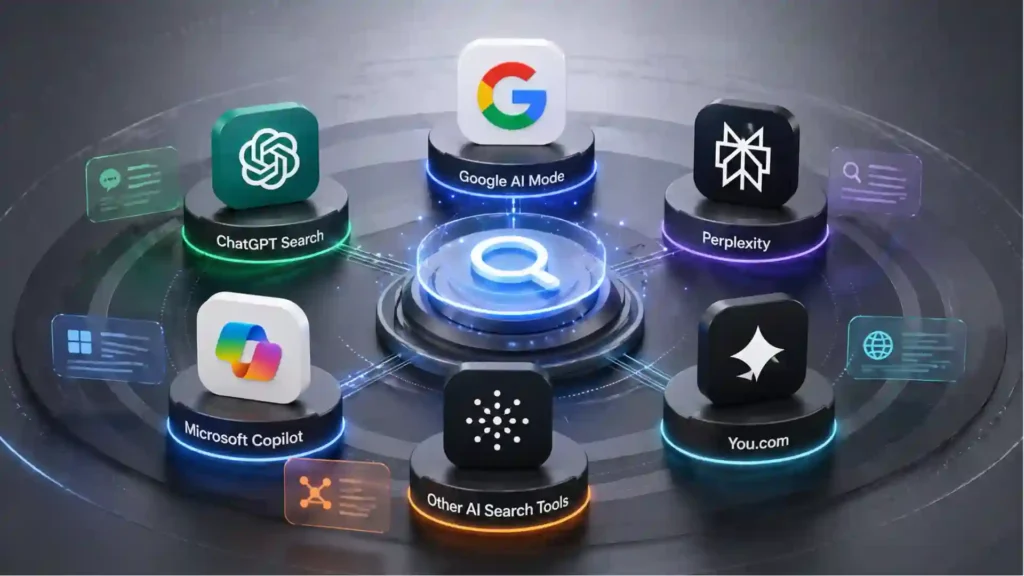
This article is an original analysis supported by the sources cited below
Google AI Mode
Google’s official AI Mode page describing the Search experience, Gemini model use, multimodal input and core user tasks.
Get AI-powered responses with AI Mode in Google Search
Google Search Help documentation explaining AI Mode, follow-up questions, query fan-out and links to web sources.
AI in Search: Going beyond information to intelligence
Google’s May 2025 product update explaining AI Mode’s query fan-out technique and expanded AI search direction.
Expanding AI Overviews and introducing AI Mode
Google’s March 2025 announcement introducing AI Mode as an experimental Search feature and expanding AI Overviews.
AI features and your website
Google Search Central guidance for site owners on AI Overviews, AI Mode and content inclusion in AI search features.
Robots meta tag, data-nosnippet, and X-Robots-Tag specifications
Google Search Central documentation on preview and snippet controls that affect how content can appear in Google Search.
ChatGPT search
OpenAI Help Center documentation covering ChatGPT search availability, citations and source panels.
Introducing ChatGPT search
OpenAI’s announcement describing ChatGPT search, timely answers, web sources and the shift toward conversational search.
Deep research in ChatGPT
OpenAI Help Center documentation explaining deep research workflows, source selection, reports and citations.
Research with ChatGPT
OpenAI Academy guidance comparing ChatGPT search and deep research for web-based research tasks.
Buy it in ChatGPT
OpenAI’s announcement of Instant Checkout and the Agentic Commerce Protocol for shopping inside ChatGPT.
Shopping with ChatGPT Search
OpenAI Help Center documentation on shopping results, merchant ranking factors and Instant Checkout signals.
Overview of OpenAI crawlers
OpenAI developer documentation explaining OAI-SearchBot, GPTBot and crawler access for ChatGPT search visibility.
Perplexity AI
Perplexity’s official homepage describing the product as an AI-powered answer engine for real-time answers.
How does Perplexity work?
Perplexity Help Center article explaining real-time web search, source gathering and answer generation.
Perplexity API Platform
Perplexity’s official API platform page covering real-time search, domain filtering, multi-query search and extraction.
Perplexity Search API
Perplexity developer documentation describing ranked web results, source controls, regions and API use cases.
File Uploads
Perplexity Help Center documentation covering file uploads, threads and contextual follow-up questions.
Perplexity crawlers
Perplexity developer documentation explaining PerplexityBot and its role in surfacing and linking websites.
Comet Browser
Perplexity’s official Comet page describing its AI browser, assistant features and browser-based task support.
Evaluating Deep Research Performance in the Wild with the DRACO Benchmark
Perplexity Research article discussing Deep Research evaluation and model-agnostic research workflows.
Copilot Search in Bing
Microsoft’s official Copilot Search page describing summarized answers, cited sources and follow-up exploration.
Introducing Copilot Search in Bing
Bing’s official announcement of Copilot Search, including summaries, answer layouts and discovery flows.
Your AI Companion
Microsoft’s official blog post framing Copilot Search as a blend of traditional and generative search with cited sources.
Understanding web search in Microsoft 365 Copilot Chat and agents
Microsoft Support documentation explaining web search grounding in Copilot Chat and agents.
Microsoft 365 Copilot Search
Microsoft Learn documentation covering Copilot Answers, web sources and grounding settings.
Introducing AI Performance in Bing Webmaster Tools
Bing Webmaster announcement of AI citation reporting for site owners and AI-generated answers.
Shopping with Microsoft Copilot
Microsoft Support documentation describing Copilot shopping, product comparison, price tracking and checkout support.
Conversations that Convert: Copilot Checkout and Brand Agents
Microsoft Advertising article introducing Copilot Checkout, brand agents and commerce infrastructure partners.
Web search tool
Anthropic developer documentation explaining Claude’s web search tool, source citations and filtering support.
Gemini Deep Research
Google’s Gemini page describing Deep Research, web and Workspace source use, and report synthesis.
Gemini Deep Research Agent
Google AI for Developers documentation explaining autonomous planning, execution and cited reports in Gemini Deep Research.
Deep Research Max
Google DeepMind article announcing Deep Research Max, Gemini 3.1 Pro, MCP support and advanced research workflows.
Grok
xAI’s Grok page describing real-time answers from the web and X.
Web Search
xAI developer documentation explaining Grok’s real-time web search and page-browsing tool.
Brave AI
Brave’s AI page describing private, user-first AI features for answers, tasks and AI applications.
AI in Brave Search
Brave Search Help documentation explaining AI Answers, references and provenance in Brave Search.
Introducing Ask Brave
Brave’s announcement of Ask Brave, a combined search and AI chat interface.
Brave launches most powerful search API for AI to date
Brave’s 2026 announcement of a revamped Search API aimed at AI retrieval and developer use cases.
Do people click on links in Google AI summaries?
Pew Research Center analysis of click behavior when Google users encounter AI summaries.
AI Overviews at the One-Year Mark
BrightEdge research on AI Overview presence, growth and citation behavior across tracked queries.
2024 Zero-Click Search Study
SparkToro and Datos study on zero-click search behavior in the United States and European Union.
| Citing this article? Brief excerpts are welcome. Please credit Webiano.digital, name the author where stated, and include a link to https://webiano.digital and to this original article. Full or substantial republication requires prior written permission. Read our Copyright and Content Use Policy. |
This article was prepared with the assistance of artificial intelligence tools. The content underwent expert human review, and Webiano Digital & Marketing Agency assumes editorial responsibility for its final version and publication.