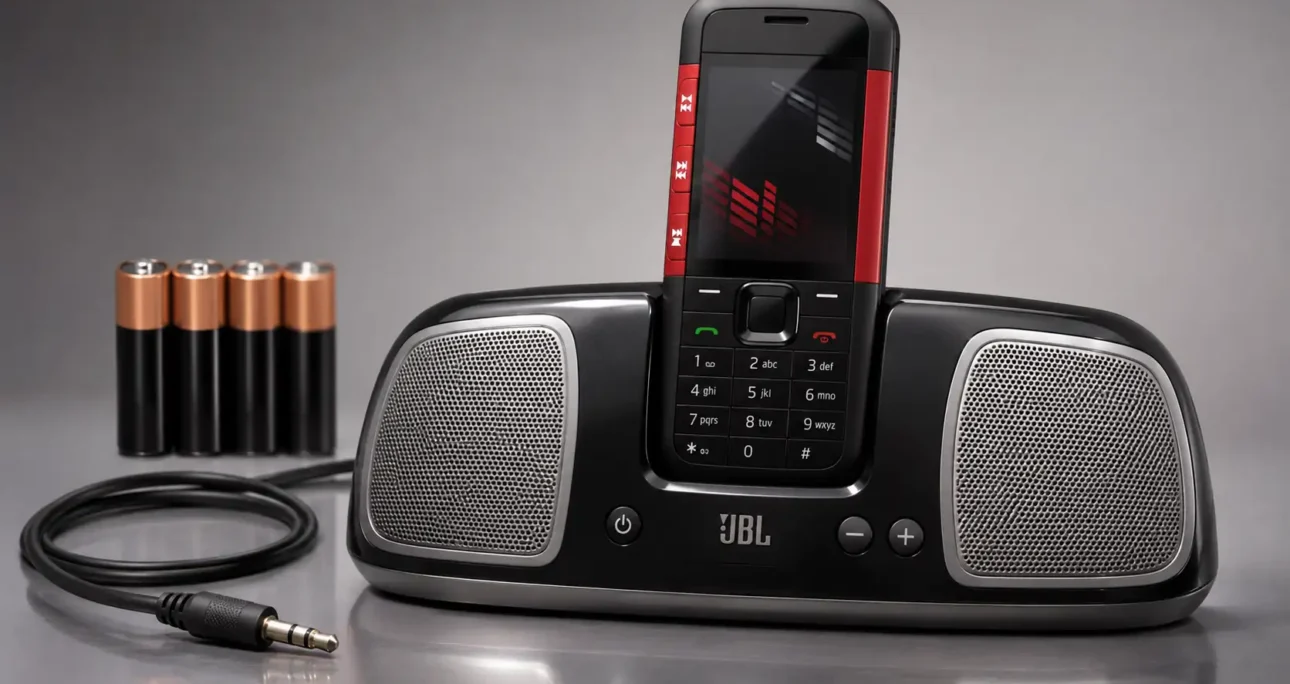
The JBL On Call 5310 turned a Nokia 5310 XpressMusic into a small speaker system in 2007, but JBL’s documents describe two 3 W channels, four AA cells, a charge connector and no Bluetooth. The dock was a wired, single-model accessory that arrived just as wireless pairing began to make that design obsolete.
Table of Contents
JBL launched the On Call 5310 in September 2007, a speaker dock built for one handset, the Nokia 5310 XpressMusic. TechRadar reported the launch on 4 September 2007 at around £67 and passed on JBL’s claim that it was the first iPod-style dock for mobile phones. The documentation is plainer than the retellings: two 3-watt channels, four AA batteries, a charge connector and a 3.5 mm input. JBL’s specification lists no Bluetooth input, although the phone it served supported stereo Bluetooth. That gap is the useful finding. The 5310 sold in the millions, the dock’s documented sales window is 2008 to 2009, and the wired, single-model accessory soon gave way to speakers that paired with any phone.
Announced in 2007, listed by JBL as a 2008 product
The date in the retelling is half right. TechRadar’s report on 4 September 2007 said the dock would sell for around £67 in November, and Nokia’s 2007 XpressMusic accessory brochure already listed it beside the phone. The phone itself was announced on 29 August 2007 at €225, about $307, with shipping promised for the fourth quarter, and GSMArena records an October 2007 release.
JBL’s own support pages tell a different story about the product’s life. The US page says the dock was manufactured from 2008 until 2009, and the regional pages say it was sold from 2008 until 2009. JBL’s printed brochure carries a 2008 copyright, while the product information sheet carries 2007.
The 2007 date marks the announcement; JBL’s records place the sales window in 2008 and 2009. Either a delayed rollout or a support site that records only the production run would explain the gap, and no document says which.
A dock built around one charge connector
The design centred on a single connector. The owner’s manual tells the user to slide the Nokia 5310 into the dock, hold down the bottom of the phone and slide the dock’s charge connector into the handset. Playback is then controlled from the phone, and the dock adds volume buttons, a kickstand that rotates the unit between horizontal and upright positions, and a quick-release for the phone. Nokia’s brochure adds that the unit can be wall-mounted.
A second path took audio from anything else. The box held cables for 2.5 mm and 3.5 mm outputs, and JBL’s brochure names iPods, Zune players, MP3 and CD players, computers and satellite radios as sources. The unit measured 115 by 65 by 175 mm; the manual gives its weight as 0.6 kg and the specification page as 0.68 kg.
The dock was a charging cradle with a speaker attached, not a wireless receiver. Its distinctive feature depended on the phone being physically seated in it.
Three watts per channel and a 100 Hz floor
The 6 W figure comes from adding two channels. JBL’s specification page lists amplifier power of 3 watts RMS per channel, and the brochure and manual give 2 x 3 watts at 1 percent total harmonic distortion. The manual names the 25 mm Odyssey drivers as tweeters, and the brochure describes two full-range transducers on neodymium magnets.
The stated frequency response runs from 100 Hz to 20 kHz, so JBL’s own numbers promise no output in the deep bass, and the signal-to-noise ratio is listed as better than 80 dB. TechRadar’s verdict at launch was blunt: not the most powerful speaker dock it had seen, though notable for being designed for a Nokia phone rather than an iPod.
Read as a speaker, the On Call 5310 was a desk and travel unit. The 25 watts of maximum power consumption in the manual is a mains figure, not an acoustic one.
Mains for charging, batteries for the road
The dock offered two power modes. Nokia’s brochure lists a 12 V, 1,250 mA mains adapter and four replaceable AA batteries, and it promises six hours of playback on the batteries. TechRadar repeated the six-hour figure in 2007. The manual adds three limits: the unit draws no battery power while on mains, it does not recharge batteries placed in it, and the phone’s FM radio feature does not work under battery power.
Charging has its own condition. JBL’s brochure says the charge port charges the Nokia 5310 whether the dock is switched on or off, and Nokia’s brochure says the dock charges the phone while it plays when plugged into the mains. No document reviewed says the connector charges the phone on battery power.
The two headline features, portability and phone charging, therefore ran on different power paths. A traveller on four AA cells had a speaker; a listener at a desk had a speaker and a charger. This is an inference from the documents, not a tested result.
13 million phones behind a $119.95 dock
A single-model dock makes commercial sense when one model sells in volume, and the 5310 did. In October 2008 Nokia claimed that more than 10 million units had sold since the previous year, which it called the best-selling music phone in the world. In April 2009 TechRadar reported 13 million, after a Nokia executive had confused the 5310 with the 5800 and forced a correction. Both numbers come from Nokia, not from an audit. TechRadar added that the 5310 was the first handset to carry Nokia’s Comes With Music service, which in practice relaunched the phone and extended the market a dock could address.
JBL’s US list price for the dock was $119.95. Engadget priced the phone at €225, about $307, at announcement, so the dock cost roughly 39 percent of the handset’s launch price. That ratio is a calculation across two markets and two currencies, so it indicates scale and nothing finer.
The bet was that a phone with a very large installed base would carry a dedicated accessory. Apple’s week was a warning. It pulled the iPod Hi-Fi from its online store on 5 September 2007, the day after TechRadar’s report, and told Engadget that hundreds of speaker systems already served the iPod. A one-device dock entered a crowded field, and the phone’s own popularity did not guarantee that buyers would pay for a cradle.
Bluetooth siblings and wireless successors
Harman was not short of wireless options. Nokia’s brochure lists a second JBL speaker, the On Tour XTB, next to the dock. The feature list printed under the pair includes Bluetooth A2DP stereo audio, a speakerphone, a universal USB port and a carry case, none of which the dock’s own list contains, plus the same six hours from four AA batteries. The wired dock was a choice and not a limit of the catalogue.
The pattern continued. In September 2011 Harman released the $199 JBL On Tour iBT, which paired over Bluetooth with iPhones, Android phones and computers, ran on four AA batteries or a wall outlet, and charged an iPad, iPhone or iPod through a USB socket when on the adapter. In September 2012 the JBL PlayUp speaker for Nokia Lumia phones added NFC pairing and a rechargeable battery rated at up to 10 hours, for around €149.
Within five years the phone-specific connector disappeared, the AA cells followed it, and pairing replaced docking. The On Call 5310 sits at the start of that sequence, not at its end.
Claims the record cannot confirm
Several widely repeated claims rest on thin evidence. The line that this was the world’s first phone speaker dock is JBL’s, relayed by TechRadar, and no independent check was found. The six-hour runtime comes from Nokia’s brochure and TechRadar’s report, not from a lab test, and the manual gives no runtime at all. No independent measurement of output, no review that tested the dock and no sales figure for it turned up in the sources reviewed. The £67 and $119.95 prices cannot be compared without exchange rates and sales tax, and no UK list price from JBL was found.
The specifications also conflict. The specification page gives 0.68 kg while the manual gives 0.6 kg, and the page lists a mains input of 110 to 240 V while the brochure and manual list region-specific units: 120 V for the US and Canada, 220 to 230 V for Europe and the UK, 100 V for Japan and 240 V for Australia.
The documents support a modest product: a wired, single-model dock with two 3 W channels. Anything larger, including a leading role in the history of portable speakers, is interpretation.
Retold claims against JBL’s own documents
| Claim | What the documents say | Status |
|---|---|---|
| Launched in 2007 | Reported 4 September 2007; JBL’s support page lists 2008 to 2009 | Announcement only |
| 6 W output | 3 W RMS per channel, 2 x 3 W at 1% THD | Sum of two channels |
| Six hours on batteries | Nokia’s brochure and TechRadar say so; no test found | Unverified |
| Charges the phone while playing | On or off; Nokia ties it to mains power | Mains only |
| 3.5 mm input | Included, with a 2.5 mm cable as well | Confirmed |
| Bluetooth | No Bluetooth input listed | Absent |
The table checks each retold specification against JBL’s and Nokia’s own documents. Only the 3.5 mm input is confirmed as stated; the other claims are reworded, qualified or unverified.
Buying, powering and describing the dock today
Readers who meet the dock today face three practical decisions. A buyer of a used unit should check the label for its regional mains version before plugging it in: the specification page claims 110 to 240 V, but the manual lists separate versions, and a 120 V US unit is not a European 220 to 230 V unit. Travel use needs four AA cells, alkaline or nickel-metal-hydride according to the manual, which warns against mixing battery types or charged and part-charged cells and says the dock will not recharge them.
Compatibility is narrow. JBL’s documents name the Nokia 5310 XpressMusic, and GSMArena lists a separate Nokia 5310 (2020) phone as a related device. Whether the dock’s connector fits that phone is not documented, so treat the fit as unproven. For other sources the brochure promises compatibility with any music source that has an audio jack.
Writers and editors have a simpler decision. Describe it as two 3 W channels with a wired input, not as a 6 W or wireless speaker. Give September 2007 as the announcement and 2008 to 2009 as JBL’s listed sales window, and say that charging is documented on mains power only.
The dock as a marker of the wired-to-wireless handoff
The evidence supports a narrow judgment, offered here as analysis: the On Call 5310 belongs to the last stretch in which a phone-specific connector was a selling point. Its maker shipped a Bluetooth sibling in the same brochure, then released universal speakers and a phone-brand speaker with NFC pairing within five years.
The brand outlived the format. Harman, the parent of JBL, became a Samsung subsidiary in March 2017 in a deal Engadget put at about $8 billion, so the name on the dock now belongs to a Samsung unit.
Three findings would change this reading: a JBL or retailer record showing 2007 sales, an independent test showing that the dock charged the phone on battery power, or sales data showing that it outsold its Bluetooth sibling. Any of them would make the wired design look less like a dead end and more like a deliberate premium choice. Until one surfaces, the dock is best cited as a 2007 announcement, a product of 2008 and 2009, and a wired bridge to universal pairing.
Author: Jan Bielik CEO & Founder of Webiano Digital & Marketing Agency
This article is an original analysis supported by the sources cited below
JBL On Call 5310 mobile phone speaker dock TechRadar’s report of 4 September 2007 established the launch coverage, the 2 x 3 W Odyssey drivers, four AA batteries, the six-hour figure, the £67 November price and JBL’s first-of-its-kind claim.
JBL On Call 5310 | Powered Speaker Dock for Nokia 5310 XpressMusic Phone JBL’s US support page supplied the manufacture dates of 2008 to 2009, the $119.95 list price, 3 W RMS per channel, the frequency response, the inputs and the dimensions.
JBL On Call 5310 product information sheet JBL’s 2007 specification sheet gave the 110 to 240 V input, the 0.68 kg weight and the integrated stand and charge-port features.
JBL On Call 5310 owner’s manual The multilingual manual documented the docking steps, the battery rules, the FM limit on battery power, the regional mains versions, the 25 W maximum consumption and the 0.6 kg weight.
JBL On Call 5310 speaker dock brochure JBL’s 2008 brochure confirmed the 2 x 3 W rating at 1 percent distortion, the charge port working on or off, the quick-release and the list of compatible sources.
Nokia XpressMusic accessories brochure listing the JBL speakers Nokia’s 2007 brochure placed the dock in the XpressMusic range, stated six hours from four AA batteries, tied phone charging to mains power and listed the Bluetooth On Tour XTB beside it.
Nokia announces XpressMusic 5310 and 5610 Engadget’s 29 August 2007 report gave the phone’s announcement date, its €225 price of about $307 and its fourth-quarter shipping plan.
Nokia 5310 XpressMusic specifications GSMArena listed the October 2007 release, Bluetooth 2.0 with A2DP, the 3.5 mm jack and the separate Nokia 5310 (2020) phone as a related device.
Nokia 5800 XpressMusic sale figures misquoted TechRadar’s 16 April 2009 correction established the 13 million figure for the Nokia 5310 and the executive’s mix-up with the 5800.
Nokia debuts touchscreen phone, aims to defeat Apple in mobile music Silicon Republic’s 3 October 2008 report recorded Nokia’s claim of more than 10 million 5310 sales and best-selling music phone status.
Apple Hi-Fi, RIP: 2006 – 2007 Engadget’s 6 September 2007 report documented Apple’s removal of the iPod Hi-Fi and its statement about hundreds of iPod-specific speaker systems.
Harman introduces JBL On Tour iBT MacTech’s September 2011 report supplied the $199 price, the Bluetooth A2DP and AVRCP pairing, the four-AA power option and the USB charging of Apple devices.
Nokia and Harman create exclusive JBL wireless speakers for Nokia’s Lumia range The Fonecast’s report on the JBL PlayUp gave its Bluetooth and NFC pairing, the 10-hour rechargeable battery and the €149 expected price.
Samsung completes its biggest acquisition ever Engadget’s 10 March 2017 report confirmed the completed Harman purchase at about $8 billion and Harman’s ownership of the JBL brand.
| Citing this article? Brief excerpts are welcome. Please credit Webiano.digital, name the author where stated, and include a link to https://webiano.digital and to this original article. Full or substantial republication requires prior written permission. Read our Copyright and Content Use Policy. |
This article was prepared with the assistance of artificial intelligence tools. The content underwent expert human review, and Webiano Digital & Marketing Agency assumes editorial responsibility for its final version and publication.