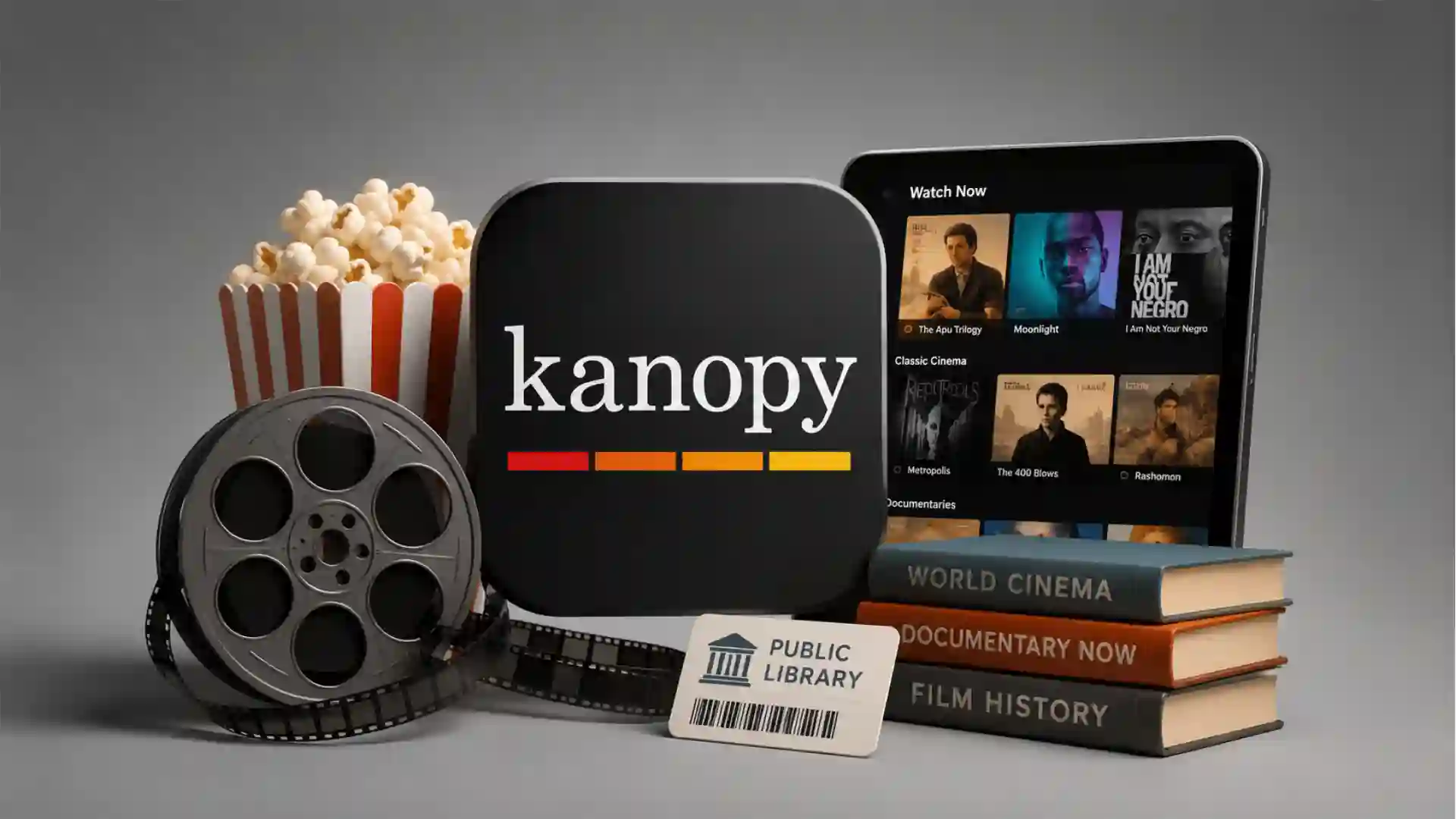
Kanopy feels almost suspicious the first time you understand the deal: open the site, connect a participating public library card or university access, and suddenly a serious film catalog appears without a subscription price staring back at you. Not a pirate site. Not a free trial waiting to turn into a charge. Not a noisy ad-funded streaming bin. Kanopy describes itself as ad-free, subscription-free streaming through libraries, and its own press materials place that idea right on the front door: films through your library, no cost to the viewer, supported by the public or academic institution behind the account.
Table of Contents
The catch is not sinister, but it matters: Kanopy is free to the viewer only when their library, college, or university pays for access. That makes it feel less like “free streaming” and more like a public benefit that happens to live inside a modern streaming interface. Public-library users add library card details and create an account; academic users may enter through their university and, in some cases, watch without creating a personal Kanopy account at all.
That tiny shift changes the whole mood of the service. Kanopy is not trying to become your forever default screen. It does not feel built to trap you in endless autoplay or bully you into watching a franchise universe for the sake of monthly retention. Its best use is more deliberate: a documentary you meant to see, a foreign film you missed, a Criterion title you forgot existed, a classroom screening, a quiet Sunday film that would otherwise be buried under algorithmic rubble. It treats film as something worth choosing.
The strange joy of Kanopy is that it makes the internet feel less exhausted. So much streaming now feels like walking through a supermarket after midnight: bright lights, too many packages, no real appetite. Kanopy has clutter too, and the catalog changes by institution, but its center of gravity is different. It belongs to the part of the web where useful public infrastructure meets careful curation. The fact that it looks like an ordinary streaming app almost makes the trick better.
Kanopy is not obscure in the technical sense; it is obscure in the cultural sense. The service says it reaches thousands of libraries and has millions of possible viewers, yet many people with eligible library cards still have no idea it exists. Kanopy’s own press site calls it an “undiscovered gem” compared with the large paid streamers and says it gives library-card holders access to more than 30,000 films, including Oscar winners, nominees, cult classics, television, and children’s programming.
The point of opening Kanopy is not that every title is there. It is that a library card, the most underrated login in public life, may already connect you to a film shelf that feels more intentional than half the paid services fighting for attention. The public library has always been a quiet cheat code for books, research, records, classes, archives, and local trust. Kanopy makes that same logic feel native to the living-room screen.
The library card trick that still feels slightly unreal
Kanopy’s best pitch is almost too plain: use your public library card or university login to stream films without paying Kanopy directly. The site’s signup flow asks public-library users to find their library, enter a card number and PIN or password when required, and then create a Kanopy account. If a library is not listed, Kanopy’s help page says that library may not offer the service and suggests contacting the library or checking another library membership.
For university access, the path is a little different. Kanopy’s academic help page says users can search for their university, complete prompts that vary by institution, and sometimes watch without creating a Kanopy account. Creating an account becomes useful for features such as Continue Watching, My Watchlist, custom playlists, mobile apps, TV apps, and adding more libraries. That difference matters because academic Kanopy is not just a movie-night perk; it is also a course tool.
This is where Kanopy becomes more interesting than another “free movies” link. Its access model carries a trace of the institution that pays for it. Your catalog may not match mine. Your monthly allowance may not match mine. Your university may show request buttons where another campus shows instant access. Your public library may offer Kanopy Kids, ticket-free shelves, or a fixed number of viewing tickets. The result feels local, even though the interface is digital.
That local quality gives Kanopy a different emotional texture. A paid streamer wants the illusion of universality: everyone gets the same monthly promise, the same splashy originals, the same battle for cultural relevance. Kanopy quietly reminds you that digital access is often negotiated, budgeted, renewed, limited, and shaped by institutions. There is something refreshingly honest about that. It may be a streaming service, but it still behaves like a library resource.
The history explains some of that shape. Kanopy says it was founded in 2008 for academic institutions, expanded into public libraries in 2016, and became part of the OverDrive family in 2021. OverDrive announced the completed acquisition on July 15, 2021, describing Kanopy as a video streaming service for public and academic libraries, with a catalog of more than 30,000 curated films and availability across major web, mobile, and TV platforms.
OverDrive’s ownership also places Kanopy inside a bigger library-tech story. Many people know Libby as the app for ebooks and audiobooks. Kanopy is adjacent to that world rather than to Netflix or Disney in spirit. It uses streaming habits people already understand, but its economics are tied to institutional purchasing, public access, and collection development. That is less glamorous than a celebrity-backed platform launch, but it is far more interesting.
The service works because it borrows trust from libraries. People do not need another account from another entertainment company. They need a reason to believe that a platform asking for attention is not just another funnel. Kanopy’s library connection gives it that reason. The library card tells the user, before any marketing line does, that this is probably legitimate, funded, and meant to be used.
There is also a small thrill in watching the old library idea survive a new interface. The familiar card number becomes a streaming credential. The branch’s budget becomes access to a film catalog. The quiet civic promise of “you can borrow this” becomes a play button. Kanopy does not need to shout about the future of libraries. It demonstrates one version of it every time someone watches an independent film through a card they already had in a drawer.
Kanopy’s limitations are part of that same promise. A library is not an infinite entertainment fountain. It has budgets, priorities, collection choices, usage limits, and public accountability. Kanopy inherits those constraints. The service would be less honest if it pretended otherwise. Its best quality is not that it abolishes payment; it moves payment to the institution and makes the viewer aware, at least faintly, that culture costs money even when the checkout price says zero.
This is why Kanopy feels so different from the usual “free streaming” category. Most free services are free because viewers pay with ads, tracking, or time wasted in mediocre catalogs. Kanopy is free because a public or academic institution has chosen to make it available. Kanopy’s press FAQ says public libraries and educational institutions cover the associated costs, allowing patrons to watch for free with no advertisements.
That does not make the model perfect. Some libraries may offer few monthly tickets. Some may pause access to manage costs. Some users may discover their branch does not subscribe. But those frustrations are different from the usual streaming irritation. They are the frustrations of a public resource, not a dark pattern. The difference is worth noticing because it changes how you judge the product.
Why Kanopy feels different from the free streaming pile
Most free streaming services ask for patience before they ask for taste. You endure ads, shuffle through bargain-bin thumbnails, and accept that the free part means the platform will take payment in interruptions. Kanopy’s angle is cleaner: no ads for the viewer, a library-funded or university-funded model, and a catalog that leans toward independent cinema, documentaries, world cinema, classics, educational titles, and children’s programming. That combination gives it an unusually adult mood.
The absence of ads changes the rhythm more than expected. A quiet documentary does not get chopped apart by insurance commercials. A foreign drama does not have to fight a jarring mid-roll break. A classroom screening does not become awkward because an ad appears before a sensitive scene. The platform’s no-ad promise is not a luxury flourish; it protects the kind of viewing Kanopy is best at.
Kanopy’s catalog has a museum-shelf feeling without becoming dusty. It is not only art-house material, and it is not pretending that every title is a masterpiece. Still, the service has a visible editorial bias toward films that someone could defend in a library meeting. That is a compliment. The internet is full of platforms that treat content as feedstock. Kanopy’s strongest pages feel closer to a librarian’s display table: not neutral, not perfect, but chosen.
The official language around Kanopy repeatedly circles one idea: films that support learning, conversation, and discovery. Kanopy’s press page says the platform is dedicated to thoughtful and thought-provoking films, and its partner list includes names such as A24, PBS, Paramount, The Criterion Collection, HBO Documentary Films, Kino Lorber, and other suppliers. The point is not brand-name collecting for its own sake; it is a catalog identity that users can understand.
That identity gives Kanopy a reason to exist beside paid services. It is not trying to win the biggest-content contest. It is not trying to replace every subscription in the house. It is better read as a second screen for the curious: a place to check when you want something with a spine, a film you meant to watch years ago, or a documentary that feels more useful than whatever autoplay was about to serve.
The web has plenty of hidden gems that become less charming once you open them. Kanopy is stronger than that because the usefulness survives the first click. The idea is great, but the practical side is also real: browser viewing, mobile apps, TV apps, Chromecast, AirPlay, and supported devices across the usual living-room stack. Kanopy’s help page lists current browser support and mobile operating-system requirements, while its press FAQ names TV options including Apple TV, Amazon Fire TV, Android TV, Samsung Smart TV, Roku, Telstra TV, and Chromecast.
The experience is familiar enough to remove friction. Search, browse, add to watchlist, resume, send to TV. None of that feels radical, and it should not. The cleverness is in making the library-funded part disappear until it matters. Kanopy looks like streaming, behaves like streaming, and only reveals its public-resource logic when you look at access, tickets, and institution-specific catalogs.
That familiarity matters for older users, students, parents, and casual viewers. A digital library service can fail by feeling like homework. Kanopy avoids most of that feeling. It may not have the slickest interface in entertainment, but it clears the basic test: a person who has used any streaming app can understand what to do. That matters more than visual novelty.
The service also rewards browsing with a different kind of surprise. On a large paid platform, surprise often means finding something algorithmically adjacent to what you already watched. On Kanopy, surprise may mean stumbling into a documentary category, a classic director shelf, an educational series, or a film distributor you forgot you liked. The pleasure is less “the machine knows me” and more “someone stocked this shelf with a point of view.”
Kanopy’s children’s section gives the service a second use case. Kanopy Kids is described as a curated children’s collection with a focus on ages 2–8, and the help page says kids’ videos allow unlimited viewing, with parental controls available so a PIN is required to leave the kids area. That makes it more than an adult film-nerd toy; for some households, it becomes a calmer children’s screen option through the library.
The children’s side is especially important because “free kids video” is often a swamp. Parents know the trade: bright thumbnails, autoplay traps, toy-adjacent characters, and videos that feel engineered more than made. Kanopy Kids is not a magic cure for screen-time worries, but its library context and unlimited viewing model make it feel less predatory than much of the open video web.
There is a bigger design lesson here. Kanopy proves that the most interesting digital products are not always the ones with the loudest interface ideas. Sometimes the product is interesting because of the institution behind it. A play button attached to a library budget is not the same as a play button attached to ad inventory. The screen may look similar. The incentives underneath are not.
The quiet design choice that makes the catalog matter
Kanopy’s catalog feels strongest when you stop treating it like a replacement for paid streaming. It is a discovery layer, not a total entertainment diet. Open it with a specific appetite and it shines: documentary night, classic cinema, independent film, international drama, film studies research, kids’ viewing, or a serious movie you keep meaning to find. Open it expecting every new studio release and it will disappoint quickly.
That expectation problem is common with library resources. People sometimes judge them against commercial abundance, then miss the quieter point. A public library is not a shopping mall. It is a curated, funded, shared resource. Kanopy works best when judged by that standard. The question is not “Does this have everything?” The question is “Does this give people access to films they might otherwise miss, avoid paying for, or never know how to find?”
Kanopy’s answer is often yes. The service says its public-facing collection includes films across documentary, independent cinema, world cinema, kids’ shows, classics, and award-winning film. Its press page also says availability of titles may vary, which is the boring but necessary sentence behind the whole product. The shelf you see depends on the institution behind your account, licensing, and local choices.
The variable catalog may sound like a weakness, but it makes Kanopy feel alive. Local access is part of the story. The film shelf is not one giant entertainment warehouse with the same shape everywhere. It is closer to a digital branch collection, affected by budgets and audience needs. That may frustrate completionists, but it gives the product a human texture that paid platforms usually sand away.
The browsing experience encourages a different kind of patience. You are not scanning for the biggest new release. You are asking what the collection thinks is worth your time. That subtle inversion gives Kanopy its charm. The service is not always good at making itself look cool; sometimes the thumbnail grid feels ordinary. But ordinary is fine when the underlying shelf is stronger than expected.
There is also a film-education layer hidden inside the interface. For academic users, Kanopy’s help pages mention watchlists, custom playlists, mobile and TV apps, and institution-specific access. The platform also supports sharing films and playlists, embeds for environments such as learning-management systems, and citation tools for films and series. That means Kanopy is not only a consumer app with a campus login; it has teaching and research habits built into its bones.
That academic DNA is one reason the service feels more serious than most “free movie” platforms. It was not born as a mass-market ad machine. It began as a way for educational institutions to provide films, then moved into public libraries. The result is a catalog and feature set that still carry traces of classrooms, screenings, course assignments, and librarians who need to justify purchases.
Kanopy is also a reminder that curation is not just a playlist aesthetic. Real curation has costs, exclusions, rights issues, metadata, budgets, and arguments about what belongs. When a library uses Kanopy, it is not merely handing users a novelty perk. It is extending its collection into video. That matters because film has always belonged in libraries, even if the format changed from tapes to DVDs to streaming rights.
The platform’s best personality comes through in the titles it foregrounds. A paid streamer often pushes whatever it owns, needs to market, or wants to keep visible before quarterly earnings. Kanopy’s shelves feel less trapped by that pressure. They can be eccentric. They can be educational. They can put a quiet documentary beside a classic film beside a children’s story without pretending they all belong to one franchise mood.
The service does have a “good for you” smell at times. Some users will bounce because the catalog looks too earnest. Others will arrive expecting popcorn escapism and feel as though they wandered into a campus media center. That is fair. Kanopy is not always the right site for a Friday night when everyone wants a loud, frictionless crowd-pleaser. Its strength is taste, not total convenience.
The better way to use it is to keep a mental Kanopy list. Films people recommended. Documentaries tied to a subject you keep circling. Classic directors you never properly watched. Children’s shows that are not designed like sugar pellets. A movie for a rainy evening when scrolling through paid services starts to feel like unpaid labor. Kanopy works beautifully as the answer to “I want something better, but I do not want to research for an hour.”
That makes it one of the rare sites where the constraint is part of the appeal. Because monthly tickets may be limited, you become more deliberate. Because the catalog is curated, you browse with more trust. Because the library pays, you remember that watching is part of a shared system. The friction is not always pleasant, but it nudges the user toward choosing instead of grazing.
A smarter model with visible limits
Kanopy’s public-library ticket system is the detail every recommendation has to explain. Kanopy’s help page says public-library patrons receive a set number of tickets from their library each month, tickets reset on the first day of the month, and unused tickets do not roll over. Title pages show the number of tickets needed and how long the viewer has to watch after spending them.
That means “free” does not mean unlimited access to everything. It means free at the point of viewing, within the rules set by the library and the title. Some films or series cost tickets. Some titles may sit in unlimited viewing areas. Kanopy Kids videos do not use tickets. The system is not difficult, but it is easy to misunderstand if someone arrives expecting a Netflix-style all-you-can-watch model.
The ticket model is both annoying and sensible. Annoying because you may run out. Sensible because the institution is paying for access and must manage demand. A public library has to make digital budgets stretch across ebooks, databases, audiobooks, programs, staff, buildings, and community needs. Unlimited free streaming of licensed films would sound wonderful right up until the invoice arrived.
Kanopy is unusually transparent about the meter. Public-library users can see remaining tickets near the top of the homepage, and title pages display the number of tickets required. If a user lacks enough tickets, the website and mobile app point toward unlimited viewing titles at that library. That kind of visible scarcity is more respectful than hiding the budget logic behind mysterious access failures.
Unlimited viewing titles soften the edges. Kanopy’s help page says unlimited viewing titles use zero tickets, have no limit on the number of plays, and can be found through shelves with “unlimited viewing” in the name or by using a “0 tickets” search filter. It also says all Kanopy Kids videos are unlimited viewing.
This creates a nice split between deliberate and casual use. Spend tickets on a film you actively chose. Let children’s content or zero-ticket shelves handle lower-stakes viewing. Browse when you are out of tickets instead of abandoning the platform. It is not as frictionless as a paid subscription, but it is more thoughtful than the usual free-service tradeoff where the viewer pays with attention.
The model also changes the ethics of recommendation. Telling someone “Watch Kanopy, it’s free” is true but incomplete. A better recommendation says: check whether your library or university offers it, look at your ticket allowance, understand that catalogs vary, and use it for the kind of films that benefit from a quieter setting. That honesty makes people more likely to appreciate it rather than bounce after one surprise limitation.
Libraries can also limit access when budgets require it. Kanopy’s help material has a page for moments when streaming access is temporarily limited, explaining to public-library patrons that the library may restrict access to manage its budget and that users may still watch started titles with access time remaining and titles that do not require tickets. The plainness of that explanation is almost refreshing. It says the quiet part aloud: digital public goods still have invoices.
That budget reality is not a flaw in the same way a dark pattern is a flaw. A dark pattern hides the cost from you until you behave in the platform’s interest. Kanopy’s limits come from a public institution trying not to overspend. The user may still be irritated, but the irritation belongs to a more honest system. That distinction is rare enough on the web to deserve praise.
For universities, the limitation may take another form. Academic users can see titles that are instantly available and titles requiring access requests, depending on the institution. Kanopy’s search help says university users may see results categorized as “In Collection” and “Request Access,” with the latter requiring a request form for institutional review.
That sounds bureaucratic until you remember the purpose. A professor may need a film for a course. A student may need it for research. The library has to decide what to license, for how long, and for whom. Kanopy’s request model gives academic users a way to ask, not just hit a wall. It keeps film access inside the educational workflow rather than outside it.
The most interesting thing about Kanopy’s limits is that they make streaming feel accountable again. On paid platforms, disappearance feels arbitrary. A title vanishes because a license expired, a corporate strategy changed, or a rights holder moved it elsewhere. On Kanopy, disappearance and limitation may still frustrate, but the reasons feel closer to library collection logic. You may not love the answer, but at least the system has a public-facing explanation.
Kanopy at a glance
| Part of Kanopy | What stands out | The honest limit |
|---|---|---|
| Public library access | Library-card streaming with no viewer subscription | Your library must participate |
| Ticket system | Monthly viewing allowance makes costs visible | Tickets vary by library and reset monthly |
| Kanopy Kids | Unlimited children’s viewing through eligible libraries | Availability depends on your library |
| Academic access | Useful for coursework, playlists, and screenings | Some titles may require requests |
| Catalog personality | Strong in documentaries, classics, indie, world cinema | Not a replacement for every paid streamer |
This compact view captures Kanopy’s real appeal: it is generous, but not infinite; polished enough, but not flashy; serious, but not joyless. The site is best judged as a library-powered film shelf with streaming convenience, not as a commercial entertainment giant that happens to cost nothing.
Where Kanopy works best
Kanopy is at its strongest when someone has a library card and an actual mood. “I want to watch something good” is too vague for most streaming services and too dangerous for an evening. “I want a documentary about a subject I keep thinking about” is Kanopy territory. So is “I want a classic film without hunting through rental stores,” or “I need something thoughtful for a class,” or “I want children’s programming that does not feel like it was born in an advertising lab.”
Film lovers get the most obvious reward. Kanopy gives them another shelf to check, and sometimes that shelf is shockingly good. It may not carry the exact title they want every time, but it often carries adjacent titles worth noticing. The site becomes a habit: before renting, before giving up, before assuming a film is unavailable, search Kanopy through the library account.
Students and teachers get a different reward. Kanopy’s academic roots show up in features and access patterns that make sense for coursework. Optional accounts support watchlists and custom playlists; sharing and embedding options connect films to teaching environments; citation tools acknowledge that a film may be part of an assignment rather than only an evening’s entertainment.
Parents get a calmer use case if their library supports Kanopy Kids. The children’s section focuses on age-appropriate content, unlimited viewing, and parental controls. That does not make it a babysitter, and it does not make every title perfect for every household. It does make the service worth checking before handing a child an open video platform that treats attention like a mineable resource.
Cord-cutters get something subtler than savings. They get relief from the feeling that every good piece of culture now lives behind a separate monthly bill. Kanopy will not replace sports, new prestige series, or the latest franchise release. It may replace some rentals. It may rescue a documentary night. It may reduce the sense that canceling a paid service means losing access to serious film.
Libraries get a modern way to express an old mission. Books remain central, but libraries have never been only about books. They have been about access: to knowledge, culture, stories, records, public space, tools, and help. Kanopy extends that mission into a format people actually use at home. A library that offers streaming film is not chasing novelty. It is meeting culture where culture already moved.
Filmmakers and distributors also sit inside the model. Kanopy’s press FAQ says that, on average, more than 50 percent of revenue collected from public libraries and academic institutions is paid to the independent film market through royalties. The exact economics will vary by agreement and title, but the broader point is useful: Kanopy frames itself not only as access for viewers, but as a distribution path for films outside the largest commercial channels.
That matters because independent films often suffer from bad digital afterlives. A film plays festivals, earns strong notices, maybe gets a limited release, and then becomes strangely hard to find. It is not always absent; it is just scattered, rented, buried, or trapped behind a platform people do not have. Kanopy gives some of those films a second public surface. For a reader of Web Radar, that is exactly the kind of internet artifact worth bookmarking.
The service also has a lovely civic absurdity to it. You can sit on a couch, open a smart TV app, and stream a serious documentary because a local public institution did the licensing work somewhere behind the scenes. That is a small miracle of public infrastructure hiding inside ordinary consumer behavior. The screen says entertainment. The model says library.
Kanopy is less successful when approached as a boredom machine. If you want endless background noise, there are better platforms. If you want a very specific new release, rental stores may win. If you want live channels, Kanopy is not the place. The site rewards intention. It does not punish casual browsing, but it does not seem built around keeping you half-watching until sleep.
That may be why it feels healthier than much of streaming. Kanopy does not need to maximize ad impressions, because it does not show ads to the viewer. It does not need to sell a giant originals slate. It does not need to become the only app you open. Its success looks more modest: people use it, libraries see the value, films reach viewers, and the service remains worth funding.
There is also less shame in not using it constantly. A paid subscription nags at you silently because unused months feel wasteful. Kanopy has the emotional shape of a library card. It is there when you need it. You do not have to turn it into a lifestyle. That low-pressure quality is rare on the web, where every service wants a daily habit, a push notification, or a streak.
Kanopy’s interface does not need to be loved for Kanopy to be worth loving. The product could improve in search, merchandising, speed, and discovery. Many platforms could. But the core bargain is strong enough to survive ordinary interface flaws. When a site gives eligible users ad-free film access through institutions they already support with taxes, tuition, or membership, the threshold for appreciation changes.
The service is especially good as a recommendation object. It is easy to explain in one sentence, but it keeps getting more interesting as you describe the details. “You may already have free, ad-free films through your library” is the hook. “There are tickets, Kids titles are unlimited, catalogs vary, universities use it for teaching, and the catalog is unusually thoughtful” is the richer version. That is a perfect Web Radar find: simple on the surface, layered underneath.
The internet lesson inside Kanopy
Kanopy reminds us that the web still has doors people do not know to open. Not secret doors in the hacker sense, but ordinary public doors hidden by bad cultural memory. Many people think of libraries as buildings, not logins. They know Netflix, YouTube, Disney, and Prime, but not the digital shelf their library already funds. Kanopy turns that blind spot into a product.
The site also exposes how narrow our imagination around streaming has become. We assume a streaming platform must be subscription-funded, ad-funded, or a giant corporate bundle. Kanopy belongs to a fourth category: institution-funded access. It is not the only service of that kind, but it is one of the cleanest examples because the viewer experience is familiar and the institution behind it is visible.
That category deserves more attention. The healthiest parts of the web often look less like startups and more like public or semi-public infrastructure: library databases, open archives, university collections, city resources, digital museums, public broadcasters, and tools built for access rather than addiction. Kanopy sits near that family, even while looking like a normal entertainment app.
This is also why Kanopy should not be praised lazily as “Netflix but free.” That comparison is catchy and wrong. Netflix is a global subscription entertainment company. Kanopy is a library and university streaming service with collection logic, institutional budgets, and access rules. The better comparison is a digital film shelf at your library branch, wrapped in the expectations of a streaming app.
That distinction protects Kanopy from the wrong kind of disappointment. If someone expects it to behave like a paid streamer, they will fixate on missing titles, monthly ticket limits, and uneven availability. If they expect it to behave like a library resource, those same facts become understandable. Not always pleasant, but understandable. The frame changes the experience.
Kanopy also makes a quiet argument against endlessness. The commercial internet often assumes more is better: more titles, more feeds, more recommendations, more notifications, more hours watched. Kanopy’s value comes from enoughness. Enough films to find something serious. Enough access to matter. Enough friction to keep the cost visible. Enough curation to make browsing feel less empty.
That enoughness is oddly premium. Not premium in the luxury sense, and not in the streaming-tier sense. Premium in the sense that no ads interrupt the film, the catalog has a point of view, and the whole service asks for a library card rather than another monthly bite from your bank account. It feels civilized, which is not a word most streaming products earn.
The service’s existence also says something about libraries as technology buyers. Libraries are often discussed as old institutions fighting digital change. Kanopy shows a different picture: libraries can be sophisticated digital access brokers. They negotiate resources, manage budgets, watch usage, and give patrons tools that would be expensive or messy to assemble alone. The library is not behind the web here; it is quietly improving it.
Kanopy’s weak spots are part of the same internet lesson. A public digital resource must balance user desire with institutional cost. It cannot say yes to everything. It cannot always hide complexity. It may feel uneven from one city or campus to another. Those are real product issues, but they are also signs that the service is tied to actual communities and budgets, not a fantasy of infinite scale.
That makes Kanopy more memorable than smoother products. Many polished apps blur together because their incentives blur together. Kanopy has a shape. It has a reason. It has a social contract. You may watch through a Roku, an iPad, a browser, or a smart TV, but the hidden protagonist is still the library. That is the part worth telling people about.
The best websites often create a small behavioral change. Kanopy does that. After you know it exists, you may check your library before renting a film. You may ask your university library for access instead of assuming a film is unreachable. You may browse documentaries through a public institution instead of through whatever the algorithm decided to push. The change is small, but it makes the web feel more usable.
Kanopy also restores a little dignity to the phrase “content discovery.” In most product decks, discovery means moving users toward more consumption. On Kanopy, discovery still has some of its older meaning: finding a film, a subject, a director, a story, or a teaching resource you did not know was available to you. The difference is not cosmetic. It is the soul of the product.
There is a reason people who discover Kanopy tend to talk about it like a secret. The service makes them feel as though they found a loophole in the streaming economy. They did not. They found a library resource. But in a market trained to charge, upsell, interrupt, and bundle, a library resource can feel like a loophole. That emotional reaction is part of the charm.
Kanopy is worth opening even if you only use it once a month. Maybe especially then. A service that does not need to dominate your life is a relief. Find your library, see whether it participates, check the ticket rules, browse the zero-ticket shelves, peek at Kanopy Kids if relevant, and search for one film you already care about. That is enough to know whether the door opens for you.
Small answers for curious streamers
Yes, for eligible users at participating public libraries, colleges, and universities. The viewer does not pay Kanopy directly, and Kanopy presents the service as free to patrons because the public library or educational institution covers associated costs. The honest version is simple: free to you, funded by your institution.
No. Your library has to offer Kanopy. Kanopy’s public-library help page says users should search for a library by name, city, zip code, or location, and if the library does not appear, it may not provide the service. A different library membership may work if that institution participates.
Tickets are the monthly viewing allowance used by public-library patrons for many titles. Each participating library sets the number of tickets, tickets reset on the first day of the month, unused tickets do not roll over, and title pages show how many tickets a film or episode needs before you play it.
No, Kanopy’s help pages say Kanopy Kids videos do not consume tickets, and all Kanopy Kids videos are unlimited viewing. The children’s area focuses on age-appropriate content, mainly for ages 2–8, and includes parental controls that require a PIN to leave the Kids area when enabled.
Yes, where supported. Kanopy’s help and press materials mention browser access, mobile apps, Chromecast, AirPlay, and TV apps including Roku, Apple TV, Amazon Fire TV, Android TV, Samsung Smart TV, and related living-room options. Exact support can change, so the current help page is the safest place to check before installing.
Not for most people, and that is the wrong test. Kanopy is best as a library-powered film shelf for documentaries, classics, independent films, world cinema, educational titles, and calmer children’s viewing. It is a strong companion to paid streaming, rentals, and public media, not a full substitute for every kind of entertainment.
Film lovers, students, teachers, documentary watchers, parents with eligible library access, and anyone tired of paying for a stack of services just to find one thoughtful movie should check it. The right user is not necessarily a cinephile. It is anyone who suspects their library card might be doing less work than it could.
It hides a surprisingly rich digital service behind one of the least flashy credentials on the internet: the library card. It is useful, culturally specific, slightly under-known, and built around a model that feels better than the attention traps surrounding it. Kanopy does not make the web louder. It makes it feel smarter. Kanopy earns its bookmark because it changes the meaning of “free streaming.” It is not free because your attention is being chopped into ad slots. It is not free because a trial clock is running. It is free to eligible viewers because libraries and universities still believe access matters enough to pay for it. That is not just a nice product detail. It is the reason the site feels worth sharing.
Author:
Jan Bielik
CEO & Founder of Webiano Digital & Marketing Agency
This article is an original analysis supported by the sources cited below
Kanopy Press
Kanopy’s official press page was used for the service description, history, catalog scale, library and patron statistics, content categories, partner references, no-ad positioning, funding explanation, Kids notes, supported TV app references, and filmmaking-community context.
OverDrive completes acquisition of Kanopy
OverDrive’s official 2021 announcement was used for the acquisition date, Kanopy’s role inside OverDrive’s library technology ecosystem, the catalog size reference, and the description of Kanopy as a streaming service for public and academic libraries.
Getting started with Kanopy for public library users
Kanopy’s help page for public-library users was used for the signup flow, library-card requirements, library search process, and guidance for users whose library does not appear.
Getting started with Kanopy for academic users
Kanopy’s academic access guide was used for the university login flow, optional account creation, and features such as Continue Watching, My Watchlist, custom playlists, mobile apps, TV apps, and adding libraries.
Using tickets
Kanopy’s ticket guide was used for the public-library ticket model, monthly reset rule, no-rollover rule, remaining-ticket display, title-level ticket information, and the note that Kanopy Kids videos do not use tickets.
Watching unlimited viewing titles
Kanopy’s unlimited viewing help page was used for the explanation of zero-ticket viewing, unlimited plays, “0 tickets” discovery, and the confirmation that all Kanopy Kids videos are unlimited viewing.
Watching Kanopy Kids
Kanopy’s Kids help page was used for the age focus, age-appropriate viewing area, parental controls, PIN exit behavior, and the rule that Kids titles do not consume tickets.
Supported browsers and devices
Kanopy’s device support page was used for browser access, mobile-device support, Chromecast and AirPlay references, and the requirement that mobile viewing works best through the Kanopy app.
| Citing this article? Brief excerpts are welcome. Please credit Webiano.digital, name the author where stated, and include a link to https://webiano.digital and to this original article. Full or substantial republication requires prior written permission. Read our Copyright and Content Use Policy. |
This article was prepared with the assistance of artificial intelligence tools. The content underwent expert human review, and Webiano Digital & Marketing Agency assumes editorial responsibility for its final version and publication.