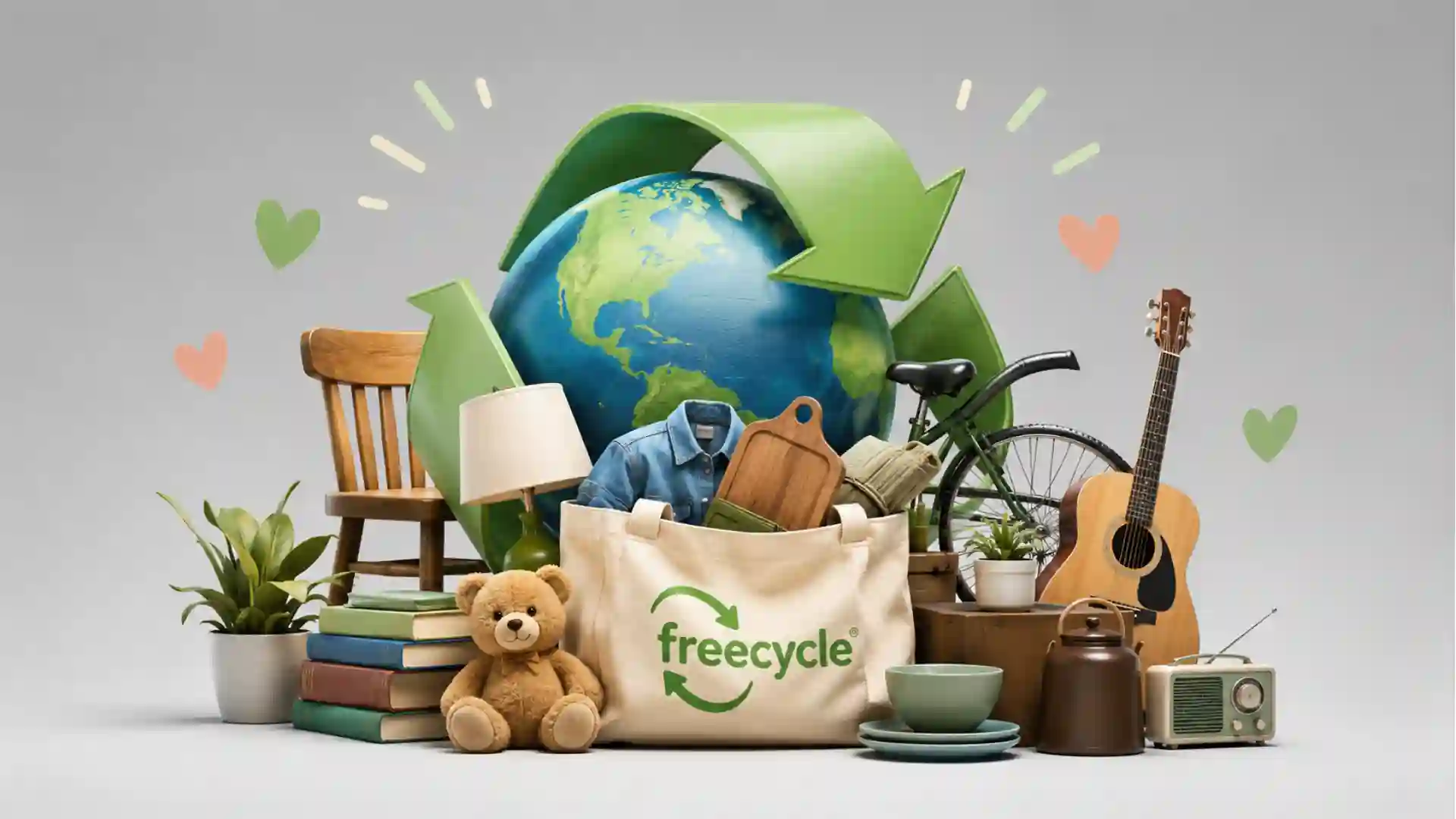
Freecycle is one of the rare websites where the most radical product decision is also the simplest one: everything on it is supposed to cost nothing. Not “cheap.” Not “discounted.” Not “available for pickup if you send a deposit through a suspicious payment app.” Freecycle is built around the old, stubborn idea that usable things should move from one person to another before they become trash. Its official front page still frames the network as a grassroots, nonprofit movement for people giving and getting free items in their own towns, with membership free and a newer Friends Circle feature for gifting and lending among people you already know.
Table of Contents
The surprise is not that Freecycle exists. The surprise is that it still feels necessary. The web is full of marketplaces, resale apps, neighborhood feeds, auction groups, buy-nothing communities, local chats, charity drives, storage-unit cleanouts, and hyperlocal “porch pickup” posts. Yet most of those places still carry the smell of commerce. Somebody wants a little money. Somebody wants reach. Somebody wants a fast claim. Somebody wants to flip the thing. Freecycle narrows the room by removing the price tag entirely, and the result feels older, stranger, and more human than most local platforms.
At first glance, Freecycle looks almost too plain for the current internet. There is no glamour in a used lamp, a box of jam jars, an outgrown stroller, or a half-working printer. The site’s whole point is that these ordinary objects still have a next stop. They do not need a content strategy. They do not need staged photos. They do not need a negotiation thread. They need a person nearby who can use them and a second person willing to let them go without turning the handoff into a transaction.
Freecycle’s scale gives the project its odd tension. The official About page says The Freecycle Network has more than 5,000 local Town groups and over 11 million members across the globe, while keeping the central rule crisp: membership is free, and posts must be free, legal, and appropriate for all ages. That mix matters. Freecycle is not just a cute local noticeboard. It is a large, dispersed reuse network that still depends on small local gestures: a pickup time, a porch, a message, a working toaster that does not need to become landfill.
The site also exposes a truth that slicker platforms tend to hide. Reuse is not mainly a design problem. It is a coordination problem. The hard part is rarely knowing that waste is bad. The hard part is finding the person who wants the thing before the owner gives up, before the move-out date arrives, before the garage clear-out becomes a dump run, before the chair gets rained on outside. Freecycle gives that moment a shape. It is not perfect. It is not frictionless. It is a simple piece of social infrastructure for the awkward middle stage between “I do not need this” and “this is gone forever.”
The internet’s quietest useful trick
Freecycle works because it respects a category of object that most digital products treat badly: the useful thing with low resale value. A $600 bike can go on a marketplace. A designer lamp can be photographed nicely. A nearly new phone has obvious demand. But what about a pile of plant pots, a spare pet carrier, a stack of moving boxes, old shelves, a bag of craft supplies, a microwave plate, a children’s desk with scratches, or a drawer full of cables that might save somebody a trip to a shop? These things sit below the threshold where selling feels worth the effort.
That threshold is where waste grows. People throw away plenty of usable objects because the mental cost of finding a new owner feels too high. A low-value item still asks for work: take photos, write a description, answer questions, filter flaky replies, arrange pickup, deal with people asking for delivery, maybe haggle over five euros. Many people decide, quietly and reasonably, that the dump is easier. Freecycle’s bet is that the work becomes easier when money leaves the room and the expectation is already set: post it, offer it, arrange collection, move on.
The “free” part is not a gimmick. It changes the mood of the interaction. A marketplace listing often begins with suspicion. Is the price fair? Is the seller honest? Is the buyer serious? Is there a scam? Is the item really in that condition? Freecycle lowers some of those tensions by making the exchange one-way. The giver is not trying to extract value. The receiver is not trying to win a bargain. The object is the center, not the deal. That does not remove every risk or annoyance, but it makes the social script easier to understand.
The script is also humbler than most platform scripts. Freecycle does not ask users to become merchants. That is a bigger distinction than it sounds. Plenty of apps encourage ordinary people to behave like small retail operations: write better listings, respond faster, ship neatly, price smartly, build trust signals, and keep inventory moving. Freecycle asks for a more modest act. Say what you have. Say where it roughly is. Let someone nearby reply. Arrange the handoff. The site treats reuse as a neighborly exchange, not a side hustle.
That choice gives Freecycle a kind of anti-product charisma. Its refusal to turn every object into money is the feature. The web has spent years making small acts measurable, monetizable, searchable, rankable, and reviewable. Freecycle sits in the middle of that machinery and says: a person has a thing, another person needs a thing, and the thing should not become trash. There is almost no drama in that. The lack of drama is the charm. The platform is not trying to make giving feel heroic. It makes giving feel normal.
Normal matters because most reuse is ordinary. The internet often celebrates the spectacular save, but landfill diversion usually looks boring. A mattress does not become a viral story. Neither does a bag of children’s books or a box of bubble wrap. Yet these objects are exactly where a local network earns its keep. Freecycle is not built around the rare magical find, although people surely find those too. It is built around the steady stream of household surplus that appears whenever people move, renovate, clean, have children, change hobbies, lose storage space, or finally admit they own too many things.
The site’s age also gives it texture. Freecycle carries the DNA of the older community web, the web of mailing lists, local groups, volunteer moderation, and plain rules posted where everyone can read them. It does not feel born from a pitch deck. It feels born from the practical irritation of seeing usable items wasted. That origin story still matters because the modern internet often rewards novelty over staying power. Freecycle’s value is almost the opposite. It has stayed close to the same core job for years: connect local people around unwanted-but-useful stuff.
There is a mild comedy in that persistence. The web keeps inventing new ways to sell you storage, then Freecycle quietly asks why the object is still in your home. Renting bigger units, buying organizing systems, and turning decluttering into a lifestyle all preserve the central problem: too many things stuck with people who no longer need them. Freecycle does not romanticize ownership. It treats possession as temporary. Your object had a use with you; maybe it has another use with someone else; maybe the best thing you can do is let it leave.
This makes the site less sentimental than it first appears. Giving something away is often a practical act, not a noble one. You clear a hallway. Someone gets a chair. The item avoids the bin. Nobody wins status points. Nobody needs a speech about community. Freecycle’s best quality is that it understands the smallness of the transaction and still thinks the smallness is worth building around. In a web full of platforms chasing scale by inflating behavior, Freecycle scales by respecting tiny, repeatable handoffs.
The result is a site that feels out of fashion in a refreshing way. It does not try to make reuse aesthetically perfect. It does not require every object to look like a thrift-store treasure. It leaves room for the awkward, the partial, the old, the weirdly specific, and the “maybe someone needs this” category. That category is huge. It includes parts, containers, leftovers from projects, spare furniture, garden odds and ends, and objects whose value depends almost entirely on being near the right person at the right time.
Why a free listing still feels different from a marketplace
Marketplaces are good at moving goods with obvious prices. They are less good at handling items whose value is mostly situational. A baby gate is useful if you have a toddler right now. A stack of tiles is useful if it matches your repair. A broken lawnmower may be useful if you like fixing things. A single dining chair may be useful if you need a desk chair, not a matching set. Freecycle gives those objects a place where the listing does not have to justify a price. It only has to explain the object well enough for the right person to recognize it.
The psychology changes on the giver’s side too. Free feels clean when the seller’s effort would exceed the sale price. A person may not want to photograph a scratched bookcase from four angles, compare prices, answer lowball messages, and then feel annoyed when someone does not show up. Giving it away creates a different bargain: the giver receives space, speed, and the pleasure of not wasting something. The receiver receives an object. The platform works when both sides understand that the exchange is already balanced, even without money.
There is a risk in romanticizing that balance. Free does not automatically mean fair, easy, or kind. Free items can attract rushed replies, vague commitments, and people who treat the giver like a delivery service. The receiver may discover that the item is rougher than expected. The giver may choose poorly among replies or vanish after posting. A zero-price platform still needs rules, moderation, and patience because removing payment does not remove human mess. Freecycle’s official rules and local Town structure are part of how it keeps the idea from dissolving into chaos.
What Freecycle gets right is the default. The site starts from generosity rather than scarcity. Many local feeds feel like a race: first to comment, first to message, first to drive across town. Freecycle still has urgency, but the cultural expectation is different. The post is an offer to a community, not bait for a bidding war. The difference is subtle until you use a platform that lacks it. Then you notice how quickly “free” can become ugly when the system does not frame the exchange with care.
The site’s insistence on no swaps or trading matters here. A trade is still a price, just paid in another object. Freecycle’s required guidelines say items must be free, legal, and appropriate for all ages, and they explicitly prohibit money, swaps, trading, spam, politics, personal attacks, and several restricted categories. Those rules may sound dry, but they protect the core experience. The minute barter enters, users have to compare value. The minute money enters, the platform becomes another local marketplace. The minute anything goes, trust drops.
The rule “free, legal, and appropriate for all ages” is also a clever compression. It turns a messy moderation philosophy into a phrase people can remember. The web has trained users to scroll past rules because rules are often long, defensive, and written for edge cases. Freecycle still has detailed guidance, but the central standard is plain enough to repeat. The platform needs that plainness because local reuse depends on fast judgment. People should know, before posting, whether an item belongs there.
A free listing also reduces the pressure to present the object as better than it is. Honesty is easier when you are not trying to close a sale. A giver can write that the table is scratched, the toaster works unevenly, the plant is leggy, the printer may need ink, or the chair is heavy and must be collected by two people. Of course, people can still misrepresent things. But the incentive is weaker. The best Freecycle post is not persuasive copy. It is a clear handoff note.
There is an underrated dignity in that clarity. A useful local web page should let ordinary people be brief without being rude. “Offered: wooden desk, collection near the station, needs two people” is not beautiful writing, but it does the job. The modern web often demands personality from users: profile polish, witty captions, social proof, ratings, bios, reactions, and endless signals of identity. Freecycle is blessedly uninterested in most of that. The item, the location, the condition, and the pickup arrangement carry the exchange.
The receiver’s experience has its own quiet appeal. Freecycle rewards attention rather than purchasing power. A person with less money but more patience may find household goods, children’s items, garden tools, materials for repairs, or hobby supplies. A person with money may use the site for the same reason: it is wasteful to buy something new when a neighbor has one sitting unused. That shared logic is rare online. Many platforms segment users by income, taste, or status. Freecycle gathers people around the practical fact that stuff moves.
That mixture can be socially interesting. The same object may mean convenience to one person and relief to another. A free desk might save a student a purchase. A baby cot might matter to a new parent. A box of jars might delight someone making jam. A pile of cardboard boxes might rescue a move. The giver does not always know the receiver’s story, and Freecycle does not need to turn every exchange into a public gratitude ritual. The point is that the network leaves room for those mismatched needs to meet.
Freecycle’s model also resists the endless upsell of local commerce. There is no natural premium version of a free couch. A platform built around sales can sell visibility, urgency, ranking, protection, shipping, ads, and payment tools. A platform built around gifting has less to monetize without damaging the culture. That limitation is partly why Freecycle’s nonprofit structure feels aligned with the product. The network is not pretending to be neutral while quietly pushing users toward paid behavior. Its official identity as a nonprofit reuse movement fits the experience it asks users to join. The organization is listed as a 501(c)(3) nonprofit in ProPublica’s Nonprofit Explorer.
The Town model makes the site feel local
The word “Town” does a lot of work on Freecycle. It makes the internet feel bounded again. Instead of dropping users into a global feed of stuff they cannot collect, Freecycle organizes activity through local Town groups. The official About page says people join one or more local Town groups when they sign up, post things they want to give or receive, receive replies, and then arrange pickup times and locations. The mechanism is simple because the physical world is not optional here. A chair must travel through streets, not through the cloud.
Locality is not a decorative feature. It is the difference between reuse and fantasy. A free item two hours away may as well not exist for many people. Fuel, time, schedules, public transport, stairs, weather, and item size all shape whether a handoff happens. Freecycle’s Town model keeps the exchange close enough to stay plausible. It also limits the absurdity of online abundance. The internet can show you infinite things. Freecycle is more interested in the thing ten minutes away that someone will put outside at 6 p.m.
That is where the site’s environmental logic becomes practical. A reuse network loses sense if pickup turns into a long trip for a minor object. Freecycle’s own help material says limits on joining many groups protect against scammers and spammers, encourage local gifting, support local communities, and keep emissions low by having members travel short distances for pickup. That note is revealing. The platform knows that “free” can attract extraction. Keeping the network local helps preserve both trust and the environmental premise.
The Town model also distributes responsibility. A global platform cannot feel neighborly by slogan alone. Local groups create smaller social rooms where expectations have a chance to settle. People learn the cadence of their area: how quickly items go, which pickup spots are common, how much detail posts need, how local moderators interpret rules, and which categories appear often. A city group may feel busy and fast. A smaller town may feel slower but more personal. The structure lets Freecycle be global without forcing every exchange into the same giant feed.
This is where volunteer moderation becomes part of the product, not a footnote. Freecycle relies on people maintaining the local culture. Moderators are not just cleaning up spam; they are protecting the fragile line between a gift network and a dumping ground. They help enforce rules, guide posts, and keep the group usable. The site’s moderator orientation points back to the core guidelines, including the free/legal/all-ages standard, no swaps or trading, and restrictions around items like weapons, alcohol, tobacco, and medications.
There is something unfashionable about that kind of governance. The current web often tries to replace local judgment with automated sorting. Freecycle cannot fully do that because the meaning of a post depends on place. A curbside pickup norm in one city may be odd in another. A rural area may require more coordination. An apartment-heavy neighborhood has different friction than a suburb with garages and driveways. Moderation has to understand both the rules and the lived texture of local exchange. That is slow work. It is also why the network does not feel like a generic classified-ad clone.
The Town format makes Freecycle less addictive than social feeds, which is good. You do not need an endless stream of faraway objects. You need a manageable list of local offers and wanted posts. This is a refreshing constraint. The platform’s value rises when it refuses to show too much. A person clearing out a home wants likely takers, not attention from people across the country. A person looking for a bookshelf wants nearby possibilities, not an algorithmic tour of every bookshelf ever posted.
Locality also changes how people write. A post for neighbors can be more practical than polished. “Near the library,” “collection from porch,” “must go by Sunday,” “bring a van,” “third floor, no lift,” or “please say when you can collect” are local sentences. They are not branding language. They are logistics. Freecycle’s usefulness depends on those details being plain. The site gives ordinary logistics a place to matter, which is exactly what many modern platforms bury beneath engagement features.
The Town structure may also soften the shame around need. Asking locally for a wanted item can feel different from shopping publicly for help. Freecycle allows Wanted posts, though the guidelines say they should be used sparingly and local limits may apply. That restraint matters. If Wanted posts overwhelm offers, the room changes. But when used well, they let someone say, “Does anyone have this thing sitting unused?” The question is practical rather than dramatic. It gives dormant objects a way to surface.
Wanted posts are one of the site’s most telling features. They acknowledge that reuse is not only about disposal; it is also about discovery. Sometimes the object exists, but the owner has not thought to offer it. A request can jog memory: the spare monitor in the closet, the plant pots behind the shed, the unused suitcase, the old bedding, the child’s bike outgrown last year. A good wanted post turns hidden surplus into a possible handoff. It makes the network more active than a passive list of offers.
The local model also makes failure less grand. Not every post has to succeed for the network to be worth using. Some items will get no replies. Some pickups will fall through. Some requests will sit unanswered. A marketplace often frames such failure as a problem of pricing, presentation, or demand. Freecycle’s failures are more ordinary: wrong timing, wrong location, too niche, too bulky, too much hassle. The network does not need every item to move. It needs enough items to move often enough that people keep trying before they throw things away.
Friends Circle brings borrowing back into the picture
The newer Friends Circle feature is one of the most interesting additions because it changes the scale again. Freecycle’s Town groups are local-public; Friends Circle is local-trusted. The official help page describes Friends Circle as a personal inner circle of people you know and trust, separate from local Town groups, where members can gift items and also lend or borrow. It also notes that friends should be near enough for easy pickup. That small shift opens a different kind of reuse: the temporary kind.
Borrowing is a surprisingly neglected internet behavior. Many objects are owned because people need them briefly and cannot easily borrow them. A drill, ladder, folding table, carpet cleaner, baby travel cot, pressure washer, projector, sewing machine, camping stove, party supplies, or specialty pan may spend most of its life waiting. Marketplaces are built for transfer of ownership. Rental companies cover some categories. Tool libraries exist in some cities. But among friends, borrowing often happens through memory and awkward group chats. Freecycle’s Friends Circle gives that behavior a dedicated slot.
The product detail matters. In Friends Circle, posts can go beyond Offer and Wanted to include Lend and Borrow. Freecycle’s help documentation for lending and borrowing says Friends Circle posts include options beyond Offer and Wanted: Lend and Borrow. The “How to make a post” guide, updated January 3, 2026, also says a Friends Circle post can be marked Offer, Wanted, Lend, or Borrow. That is a small interface choice with a real social effect. It names the behavior before the user has to explain it.
Naming matters because borrowing has different etiquette from gifting. A loan needs duration, care, return, and trust. If you give away a chair, the relationship can end at pickup. If you lend a pressure washer, you need to know when it comes back, what happens if it breaks, whether the borrower knows how to use it, and whether you will feel strange asking for it. Freecycle wisely keeps lending inside the Friends Circle rather than the wider Town group. Borrowing from strangers is not impossible, but it asks for a trust level the open network cannot assume.
The Friends Circle feature also admits something about modern neighborliness. People often trust their friends more than their street, even when the useful object is physically nearby. Local community is not evenly distributed. Some people know everyone around them. Others live in buildings where they barely know names. Some trust a WhatsApp group. Some trust a few friends across town. Friends Circle lets the social boundary be chosen rather than imposed. It says: your reuse network may be smaller than your Town group, and that is fine.
This makes Freecycle more flexible without turning it into a private social network. The public reuse layer and the trusted borrowing layer solve different problems. Town groups are good for objects you are ready to release. Friends Circle is better for objects you want back or would rather share with known people. That split is thoughtful product design because it does not force one trust model onto every exchange. A stack of moving boxes can go to anyone. A sewing machine might be loaned only to a friend.
There is a quiet cultural challenge in lending. Borrowing asks people to admit they do not need to own everything. That sounds easy until habits interfere. Ownership feels convenient because it removes coordination. Borrowing means asking, waiting, collecting, returning, and possibly feeling indebted. Yet ownership creates closets full of sleeping tools. Friends Circle is interesting because it does not preach against ownership. It simply makes the alternative more visible. A person posting “Borrow” is not making a manifesto. They are asking whether someone nearby has the thing.
Lending also creates a different kind of abundance. The same object can serve many households without leaving its original owner. A ladder can climb more than one wall. A party table can host more than one birthday. A tool can repair several homes. A suitcase can travel with different families at different times. Freecycle’s original gift model rescues objects from disposal. Friends Circle points toward higher use of objects that remain owned. That is a subtle but strong expansion of the reuse idea.
Of course, lending can go wrong. A borrowed item may come back late, dirty, damaged, or not at all. Friends Circle does not remove that risk; it contains it within relationships where trust and accountability already exist. That is why the feature feels more realistic than an open borrowing marketplace. The web has many trust systems, but a star rating is not the same as knowing whose kitchen you have been in. Friends Circle leans on existing social trust rather than pretending software can manufacture all of it.
The feature also brings Freecycle closer to how households actually manage stuff. People do not divide objects neatly into “sell,” “donate,” and “trash.” They have maybes, spares, seasonal items, sentimental items, tools, containers, duplicates, and things they would lend but not lose. A good reuse platform needs room for those shades. Freecycle’s Town groups cover the final release. Friends Circle covers the temporary share. Together they make the site less like a digital charity box and more like a small operating system for household surplus.
There is one more benefit: Friends Circle may make people post more honestly. Known recipients change the emotional risk of offering something imperfect. People may hesitate to list a half-used packet of moving supplies or a niche tool publicly, but feel comfortable offering it to friends. They may borrow from friends before buying. They may lend without making a public listing. Reuse often begins in trust, then expands outward. Freecycle’s feature recognizes that intimate scale instead of treating it as a weakness.
The rules are plain because the idea is fragile
Freecycle’s rules are not glamorous, but they are part of why the site is worth noticing. A free network only works when everyone understands what does not belong. The official guidelines ban money, swaps, trading, politics, spam, personal attacks, personal ads, and several item categories such as alcohol, tobacco, firearms, weapons, sexual content, and medications. Without those boundaries, the platform would quickly become a messy classified board, a barter pit, or a dumping channel for things nobody should be handing around casually.
The rule against money is the heart of it. Once payment appears, the culture changes immediately. People begin comparing prices, negotiating, reserving, reselling, and ranking opportunities by financial gain. Even small fees create new expectations. Is the giver profiting? Is the receiver getting a bargain? Is the item worth the trip? Freecycle avoids that entire mental economy. The platform’s clarity comes from saying no before users have to wonder. Free means free. That sounds obvious, but much of the internet has trained people to distrust obvious words.
The rule against swaps is just as sharp. Barter sounds friendly until it becomes accounting. If someone wants a bookshelf in exchange for kitchenware, the receiver now needs something the giver values. The exchange stops being about moving surplus and starts being about matching assets. That excludes people with less to trade and slows the handoff. Freecycle’s model is cleaner. The giver gives because the object can leave. The receiver receives because they can use it. The network does not need the two needs to mirror each other.
The all-ages standard is also more than legal caution. It keeps the site boring in the best sense. A local reuse network should not require users to brace themselves for disturbing listings, adult material, risky substances, or ideological fights. The point is not expression. The point is reuse. By narrowing the acceptable content, Freecycle preserves attention for the actual work of moving objects. A boring rules page may be the price of a useful community.
There is also a safety logic in the details. A zero-price platform can attract scammers precisely because users lower their guard around free things. Freecycle’s guidance warns members never to send money for anything offered, including shipping or couriers. That warning is practical and necessary. The moment someone asks for payment, the exchange no longer fits the platform. Freecycle’s rule gives users an easy exit line: this is not how the site works. They do not need to diagnose the scam perfectly.
Moderation also protects givers from being treated like a disposal service. Freecycle is not meant to be a place to offload anything under the cover of generosity. “Free” can become a loophole for dumping if the culture is weak. A broken item may still be useful if clearly described and repairable. A filthy, unsafe, or misleading item is another matter. The difference depends on honesty, local norms, and moderation. The platform has to defend the dignity of the receiver as much as the convenience of the giver.
The guidelines around Wanted posts reveal the same balance. Requests are allowed, but they cannot become the whole room. If a local group turns into a wall of demands, givers may leave. If requests are banned entirely, hidden surplus stays hidden. Freecycle’s position is more delicate: Wanted posts exist, but users should use them sparingly, with local groups setting numerical limits. That is not a flashy product idea. It is community maintenance, and community maintenance is often where useful platforms either survive or rot.
The required plainness also reduces social performance. Freecycle does not need users to prove they deserve free things. Some gifting communities drift toward moral storytelling, where recipients feel pressure to explain hardship or worthiness. Freecycle can include human stories, but its core structure does not require them. A person can ask for shelves because they need shelves. A person can offer a kettle because they no longer need it. The absence of money does not have to turn every exchange into a confession.
What stands out when you open Freecycle
| Feature | What it does | Why it matters |
|---|---|---|
| Town groups | Organize posts by local area | Keeps pickup realistic and waste reduction practical |
| Offer and Wanted posts | Let members give items or ask for items | Moves both visible and hidden surplus |
| Friends Circle | Creates a trusted smaller group | Adds gifting, lending, and borrowing among people you know |
| Free-only rule | Blocks selling and trading | Keeps the culture away from marketplace behavior |
| Volunteer moderation | Applies local rules and standards | Protects the network from spam, scams, and drift |
The table makes the site’s logic clearer because Freecycle is not a single feature pretending to be a movement. Its usefulness comes from the fit between the parts: local reach, free exchange, plain post types, trusted circles, and rules firm enough to keep the room usable.
Those parts also explain why Freecycle can feel underdesigned at first and clever after a minute. The product is intentionally narrow because the behavior is easy to damage. Add too much ranking and people chase visibility. Add payments and it becomes a marketplace. Add public social mechanics and people perform. Add broad geography and pickups become absurd. Freecycle’s simplicity is not just old-web residue. Much of it protects the use case.
The site is not above criticism. Freecycle depends on local activity, and local activity will always be uneven. A dense city may have constant posts. A quiet area may feel empty. Some groups may have better moderation than others. Some users may prefer the speed of social media groups or the polished interfaces of resale apps. Freecycle’s strength is not that it beats every alternative in every place. Its strength is that it preserves a clear, rare mode of exchange that many alternatives blur.
That clarity makes the site easy to judge. You know quickly whether your local group has life in it. Search your town, look at the rhythm of posts, scan the categories, and notice whether people are offering real household goods or whether the group feels dormant. The experience is not abstract. Either nearby people are moving stuff or they are not. In a web full of platforms that hide weakness behind interface polish, Freecycle is refreshingly exposed.
The objects are ordinary, which is the point
A Web Radar pick usually needs some oddness, and Freecycle’s oddness is hiding in plain view. It treats ordinary household surplus as worthy of its own global network. That is almost funny until you remember how much of daily life is made of such surplus. People buy furniture that stops fitting their homes. Children outgrow clothes and toys. Hobbies leave behind materials. Repairs leave parts. Offices shed equipment. Gardens produce extra pots. Kitchens accumulate duplicate tools. The web rarely treats these objects as interesting because they are not aspirational.
Freecycle’s taste is anti-aspirational. It cares about the object after the shine has worn off. That is exactly when reuse becomes hard. New objects are easy to love, sell, photograph, and justify. Tired objects need a different kind of attention. They need someone to say, honestly, “This still works.” Or “This needs repair.” Or “This is ugly but solid.” Or “This is only useful to a very specific person.” Freecycle gives those sentences a destination.
That destination has a different moral feel from donation bins and charity shops. Freecycle keeps the giver closer to the next use. Donating to an organization can be excellent, but it often sends the object into a sorting system. Some items sell, some are rejected, some travel, some are recycled, some are dumped. Freecycle’s direct handoff is more immediate. The giver sees interest from a person who wants the object. The receiver knows where it came from. The chain is short, which is part of the satisfaction.
Short chains also expose the weirdness of waste. Many things become trash only because the right person was missing for a few days. A student might need a desk next week. A gardener might need pots in spring. A parent might need baby clothes for a child who grows too fast. A theater group might need odd furniture. A repair hobbyist might want a broken appliance. Timing decides whether the object is rescued or lost. Freecycle is a timing machine, modest but real.
The site’s name may sound like a relic, but the behavior remains current. People are drowning in objects and still buying more of them. The problem is not only consumption; it is circulation. A society can own enough ladders, chairs, cables, jars, spare monitors, plant pots, and children’s bikes, while individuals still lack the one they need because the objects are trapped in private storage. Freecycle turns private surplus into local possibility without pretending every object deserves a secondhand retail journey.
The most interesting Freecycle items are often not the best ones. They are the ones that would never survive a marketplace filter. A box of mismatched tiles, a single curtain rod, a spare fridge shelf, a bag of wool, leftover gravel, a damaged table with good legs, empty jam jars, old magazines for collage, packing paper, or a cracked terracotta pot may be useless to most people. To the right person, the timing is perfect. Freecycle’s feed has room for that kind of specificity.
Specificity is one of the web’s old superpowers. A niche need used to be the internet’s favorite problem. Find the rare part, the obscure forum, the local group, the person with the same hobby, the answer nobody around you knew. Freecycle applies that logic to physical objects. The network asks whether someone nearby has a niche use for a thing before the thing disappears. It is not glamorous, but it is deeply web-native in the older sense: connecting small needs across distance, then letting the physical world finish the job.
There is also a gentle correction to the aesthetics of decluttering. Throwing things away can look clean while being lazy. A minimalist room photograph hides the afterlife of the objects removed from it. Freecycle interrupts that fantasy by making disposal social. Your unwanted thing does not vanish into a white background. It becomes a post. Someone replies. A pickup happens. The process is less visually satisfying than a before-and-after image, but it is more honest about where things go.
The site also changes how one sees storage. A cupboard full of unused things starts to look less like private abundance and more like stalled circulation. That does not mean every object must leave immediately. People keep spares for good reasons. But Freecycle creates a small mental question: is this item waiting for me, or am I just delaying its next use? That question is useful because it does not require guilt. It asks for judgment. Some things stay. Some things move.
This is why Freecycle’s environmental value feels grounded. It does not ask users to buy a greener version of anything. It asks them to pause before disposal and check whether existing demand can absorb existing supply. That sounds modest because it is. Yet modest systems often fit daily life better than grand environmental gestures. A working lamp given away locally is not a planet-saving epic. It is one less lamp wasted, one less purchase needed, one small proof that circulation beats disposal.
Freecycle’s ordinary-object focus also welcomes people who do not think of themselves as environmentalists. You can use the site because you hate waste, because you need furniture, because you are moving, because you like fixing things, or because you want your hallway back. The motivation does not have to be pure. The outcome is what counts: usable things get another chance. That practical openness is part of the site’s durability. It does not demand a perfect identity from users.
The web could use more of that. A platform does not have to make people better versions of themselves to make a good behavior easier. Freecycle’s best moments are plain. Someone posts a thing. Someone collects it. The thing remains useful. The giver gains space. The receiver gains utility. The network gains another small reason to exist. No one needs to announce a lifestyle transformation. No one needs to be converted. The site works when people behave slightly less wastefully than they might have without it.
Small doubts before opening an account
The first doubt is whether Freecycle is active near you. That is the whole test. The site can be brilliant in one area and quiet in another because local networks are living things, not inventory databases. A person in a busy Town group may see a steady flow of posts. Someone elsewhere may find sparse activity. This is not a failure unique to Freecycle. Every local exchange platform depends on density. The only honest answer is to search your area and see what the room feels like.
The second doubt is whether free attracts chaos. Sometimes it does, which is why the rules matter. Free items can draw fast, careless replies. People may ask questions already answered in the post. Some may fail to collect. Others may treat “free” as permission to be demanding. Freecycle cannot erase that behavior. But its structure gives givers ways to be clear: describe condition, state pickup limits, ask responders to include collection times, and move on if someone becomes difficult. The best defense is a plain post and firm expectations.
The third doubt is whether people take things to resell. Some probably do, and the platform cannot perfectly read intent. This bothers some givers because they want the object to reach someone who will personally use it. Others do not care once the thing is gone and reused. Freecycle’s culture is not built as a reseller supply chain, but any free network faces this tension. A giver who cares can choose recipients based on replies, timing, and local judgment. The site provides the room; people still make choices inside it.
The fourth doubt is privacy. A local pickup requires caution because the exchange leaves the screen. Users should avoid sharing unnecessary personal information, choose pickup arrangements that feel safe, and remember that no platform makes a stranger automatically trustworthy. Many people use porch pickup, public meeting points, or clear time windows. Freecycle’s directness is part of its appeal, but directness requires common sense. The physical handoff is where the digital listing becomes real, and that moment deserves care.
The fifth doubt is item quality. Free does not mean good, and good does not mean new. Freecycle works best when givers describe items honestly and receivers read carefully. A scratched table may be perfect for a workshop. A nearly new item may go quickly. A broken appliance may interest a repair person if the fault is clear. Problems begin when condition is vague or expectations mismatch. The site’s culture improves when users treat descriptions as a courtesy rather than a chore.
The sixth doubt is whether wanted posts feel like begging. They do not have to. A good wanted post is specific, modest, and local. It asks whether someone has an unused item before buying new. That is not a plea for charity; it is a reuse signal. The guidelines’ warning to use Wanted posts sparingly keeps the format from overwhelming offers. When handled well, a wanted post is one of the smartest parts of Freecycle because it reveals demand that would otherwise stay invisible.
The seventh doubt is whether Friends Circle is worth using if you already have group chats. The answer depends on how messy your chats have become. A chat thread is fine for one-off asks, but it loses track of objects quickly. Freecycle’s Friends Circle gives lending and borrowing their own post types, messages, and item context. The help material also says members can use messages to track replies and keep track of items they lend and borrow within Friends Circle. For friends who share tools, baby gear, party supplies, or hobby equipment, that structure has a real use.
The eighth doubt is whether Freecycle feels old. Yes, in some ways, and that is part of its appeal. Not every useful site needs to feel like a new app. Some web ideas age because they were shallow. Others age because they solved a stable human problem. Freecycle belongs closer to the second group. People had unwanted things in 2003. They have unwanted things now. They will have unwanted things after the next wave of software interfaces has come and gone.
The ninth doubt is whether the site is too narrow. Its narrowness is the protection. A platform for free local reuse should not also become a debate forum, a sales channel, a shipping marketplace, a social network, a rental marketplace, and a moral scoreboard. Freecycle’s restraint is why it remains legible. You open it to give, get, lend, borrow, or look for nearby usable things. If you need a broad marketplace, plenty exist. If you need a free reuse network, the narrowness is the point.
The final doubt is whether one person’s posts matter. They matter locally, which is the only scale that counts for a pickup. A single offered desk can furnish a room. A bag of clothes can move to another family. A stack of boxes can save someone’s moving day. A borrowed tool can prevent a purchase. The internet often trains people to think scale means numbers on a dashboard. Freecycle’s scale is different. It is the repeated local success of objects not becoming waste.
What Freecycle says about the web we still need
Freecycle matters because it proves a website can still be infrastructure without becoming a spectacle. The best version of the site is almost invisible in a user’s life. You need to clear space, so you post. You need something, so you search or ask. You want to lend among friends, so you use Friends Circle. Then the object moves. The platform is not the star of the exchange. The object and the people are. That humility is rare enough now to feel almost radical.
The site also reminds us that not every internet network has to be built around content. Freecycle is built around consequences. A post is not there to gather likes, comments, reach, or identity. It is there to cause a pickup. If the pickup happens, the post has done its work. That is a healthier definition of success for many local tools. The web has become very good at generating activity that stays online. Freecycle is good when online activity disappears into a completed offline handoff.
This gives the project a different relationship with time. A Freecycle post is temporary by nature. It exists because an item is available now, in this place, under these conditions. Once the item is collected, the post fades in relevance. That temporariness is not a weakness. It matches the job. Many platforms try to preserve and surface everything forever. Freecycle’s ideal outcome is closer to resolution. The thing moved. The problem ended. The network did not need to keep the moment alive.
The site’s nonprofit identity also raises a useful product question. Some behaviors are damaged when the platform’s strongest incentive is extraction. Local reuse needs trust, patience, and low pressure. Aggressive monetization would distort it. Paid boosts could privilege resellers or frequent posters. Transaction fees would violate the mood. Advertising around need and surplus could make the space feel predatory. Freecycle’s nonprofit framing does not magically solve every organizational challenge, but it fits the behavior better than a growth-at-all-costs model.
Freecycle is also a rebuke to the idea that climate-aware behavior must always be purchased. The greenest object is often the one already nearby. That sentence sounds almost too plain, but it cuts against a huge amount of consumer culture. Many people are sold new products as moral upgrades while perfectly usable old ones sit unused. Freecycle does not sell the upgrade. It reopens the question before purchase: does this already exist in the local pool of surplus? Sometimes the answer is yes.
The site is not alone in that mission. Buy-nothing groups, repair cafés, tool libraries, thrift networks, mutual aid chats, neighborhood groups, and charity shops all occupy nearby territory. Freecycle’s appeal is its particular combination: web-based, local, free-only, reuse-focused, nonprofit, and now partly friend-based through Friends Circle. It does not replace the others. It belongs in the same mental folder of practical internet spaces that make ownership less rigid and disposal less automatic.
What makes Freecycle especially Web Radar-worthy is that it is not hidden because it is tiny. It is hidden because the behavior it supports is humble. A network with millions of members can still feel overlooked if its main output is an unglamorous chain of pickups. That is why it deserves fresh attention. The web’s strangest gems are not always visually bizarre or technically experimental. Sometimes the gem is a durable social mechanism that survives because it keeps solving a problem nobody has made obsolete.
Freecycle also has a design lesson for founders and product teams. A strong constraint can be more memorable than a large feature list. Free-only. Local Towns. No swaps. No money. Friends Circle for trusted lending and borrowing. These constraints make the product easier to explain and harder to corrupt. Many platforms chase flexibility until users no longer know what the space is for. Freecycle knows what it is for. That clarity is a kind of taste.
The site’s imperfections are part of the lesson too. Community tools are never finished in the way software teams want them to be finished. They need moderation, habit, local density, trust, reminders, and patience. They go quiet in some places and thrive in others. They depend on users making the next small effort. Freecycle cannot turn reuse into a single click because physical objects refuse to behave like digital files. The platform’s job is not to remove the world from the process. It is to make the world slightly easier to coordinate.
There is a reason the site feels refreshing after scrolling through polished commerce. Freecycle does not flatter the user as a buyer. It treats the user as a neighbor with surplus, needs, storage limits, and occasional generosity. That is a better description of real life than most platform identities. People are not only consumers, sellers, creators, followers, subscribers, or targets. They are also the person with spare boxes, the person who needs a lamp, the person borrowing a drill, and the person happy to see a usable thing leave the hallway.
The best way to understand Freecycle is to imagine the counterfactual. Without a place like this, many low-value useful objects take the shortest path to waste. Not because people are cruel. Because they are busy, tired, moving house, short on space, or unsure who would want the thing. Freecycle inserts a pause. It gives the object one more chance to find its person. That is not a grand promise. It is a narrow intervention repeated across thousands of local groups.
That repetition is the beauty of it. Freecycle turns reuse from a personal virtue into a shared habit. The site does not need every member to be deeply committed. It only needs enough people to remember, before they throw something away, that there may be a local receiver. Once that memory exists, behavior changes. A garage clear-out becomes a list of offers. A shopping need becomes a quick search. A rarely used tool becomes a loan. The web becomes less like a mall and more like a circulation system.
The project also makes the internet feel less lonely in a small, practical way. A stranger wanting your old shelf is not friendship, but it is contact with purpose. Many online interactions are either too intimate or too hostile, too public or too empty. Freecycle sits in a modest middle. It lets people cooperate without demanding closeness. A handoff can be polite, brief, and complete. Sometimes that is enough. A functioning civic web does not need every interaction to become a relationship.
Friends Circle adds another layer to that civic web. It recognizes that trust exists in rings, not in one giant public square. Some items are fine for strangers. Some are better for acquaintances. Some are safe only among friends. A good platform lets those rings behave differently. Freecycle’s addition of lending and borrowing among known people suggests a mature understanding of reuse. The network is not only about getting rid of things. It is about matching the right object behavior to the right social distance.
There is also a quiet resistance here to disposability as a default setting. The easiest path for an unwanted object should not always be the bin. Freecycle does not shame people for owning things or needing things. It simply gives them another path. That path is small enough to fit into daily life: make a post, answer a reply, arrange a pickup. For a site with a plain interface and an old idea, that is a surprisingly sharp proposition.
The most persuasive thing about Freecycle is that it changes how you look around your own room. The site lingers after you close it. You notice the chair nobody uses, the spare cables, the old monitor, the plant pots, the unopened craft materials, the boxes from the last delivery, the tool you use once a year. You may still keep them. But now they look less inert. They look like possible posts. That mental shift is the real product.
Freecycle is worth opening because it is not trying to win the web’s attention war. It is trying to keep useful stuff moving. That is a narrower, better ambition. It makes the site feel almost quaint until you need it, and then the quaintness becomes the point. Somewhere nearby, a person has the thing you need or needs the thing you have. Freecycle gives that possibility a place to happen before the landfill gets another vote.
Useful things to know before using Freecycle
Yes. The core rule is that items must be given away for free, not sold, swapped, or traded.
No. Freecycle is not a barter system. You can offer items, respond to offers, or post wanted requests depending on your local group’s rules.
The best fit is usable stuff with low resale value but real practical life left in it: furniture, moving boxes, tools, craft supplies, garden items, children’s things, spare household goods, and odd materials someone nearby might need.
Yes. Town groups are local community spaces, while Friends Circle is for a smaller group of people you already know and trust. It also supports lending and borrowing, not just giving.
It depends on the item. If the object is worth selling, a marketplace may make sense. If the item is useful but not worth the time, pricing, negotiation, or delivery hassle, Freecycle is often the cleaner option.
Be clear about item condition, pickup limits, and timing. Do not send money, share unnecessary personal information, or ignore basic safety when arranging collection.
Author:
Jan Bielik
CEO & Founder of Webiano Digital & Marketing Agency
This article is an original analysis supported by the sources cited below
Freecycle official homepage
Used for the current front-page description of Freecycle as a grassroots nonprofit reuse movement, the free membership promise, and the Friends Circle mention.
About Freecycle
Used for Freecycle’s stated scale, Town group model, membership rules, and basic explanation of how local giving and receiving works.
Freecycle Guidelines
Used for the rules around free, legal, all-ages posts, no money, no swaps or trading, and restricted categories.
Friends Circle help page
Used for the official description of Friends Circle as a trusted personal circle for gifting, lending, and borrowing.
Lend or Borrow items
Used for the specific Friends Circle post types that add Lend and Borrow beyond Offer and Wanted.
How to make a post
Used for the current posting workflow and the January 2026 documentation of Offer, Wanted, Lend, and Borrow options inside Friends Circle.
My Messages
Used for the messaging and item-tracking details around Friends Circle lending and borrowing.
The Freecycle Network on ProPublica Nonprofit Explorer
Used to verify the organization’s 501(c)(3) nonprofit listing and nonprofit category context.
| Citing this article? Brief excerpts are welcome. Please credit Webiano.digital, name the author where stated, and include a link to https://webiano.digital and to this original article. Full or substantial republication requires prior written permission. Read our Copyright and Content Use Policy. |
This article was prepared with the assistance of artificial intelligence tools. The content underwent expert human review, and Webiano Digital & Marketing Agency assumes editorial responsibility for its final version and publication.