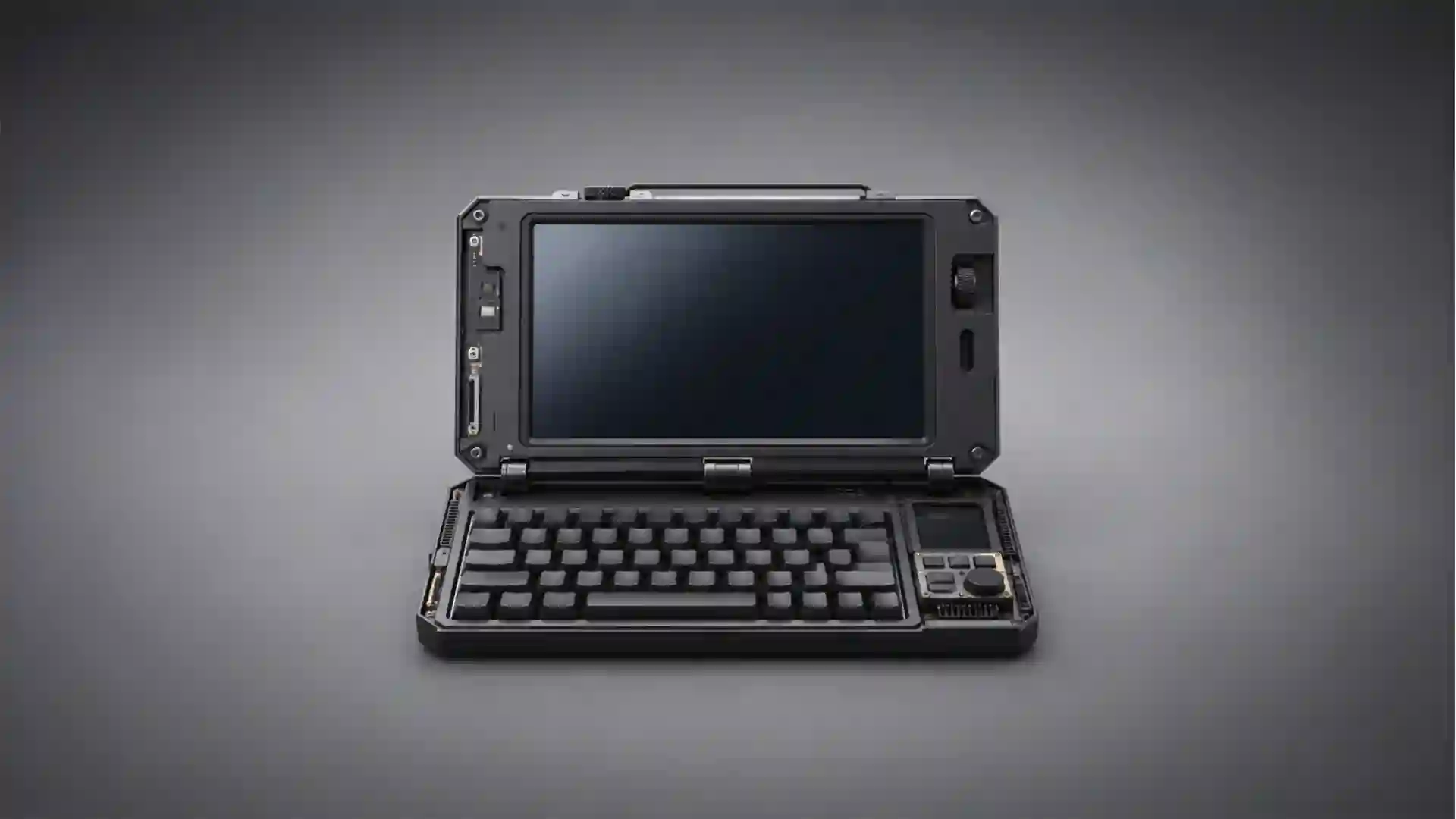
Cyberdecks have crossed a line that most hardware hobbies never reach. They are no longer only appearing in maker forums, hardware-hacking contests and cyberpunk mood boards. The search-interest brief behind this article says “cyberdeck” reached an all-time high this year, while “build a cyberdeck” also reached a peak. That matters because the related searches are not only technical. People are looking for cyberdecks for music production, reading, books, “girly” aesthetics and small-format builds. A niche object is being pulled into everyday culture by people who want a computer that feels chosen rather than assigned.
Table of Contents
Search data shows a new kind of computer desire
The data needs careful reading. Google Trends does not publish raw search volume in the standard interface. It normalizes search interest to a 0–100 index for a selected geography and time range, and Google’s own documentation says a “Breakout” rising search means a term grew by more than 5,000% compared with the previous period. A breakout query is not proof of mass adoption; it is proof of unusually fast interest growth from a smaller base. That distinction is central to understanding cyberdecks. The trend is not yet a laptop market in waiting. It is a cultural signal about dissatisfaction with ordinary computers, curiosity about single-board computers, and a renewed appetite for hands-on technology.
The terms moving with “cyberdeck” explain the shift better than the headline keyword. “Mini keyboard” and “single board computer” are build necessities, not lifestyle phrases. Their rise alongside “build a cyberdeck” suggests that searchers are trying to move from inspiration to parts lists. The breakout searches around “cyberdeck girly,” “cyberdeck for girls,” “book cyberdeck” and “Altoid cyberdeck” point in a different direction: the cyberdeck is becoming a format for self-expression, not only a format for mobile computing. It is closer to a handmade notebook, a modded Game Boy, a mechanical keyboard build, a zine, a field recorder and a Raspberry Pi project than to a normal laptop.
Recent media coverage has picked up the same pattern. WIRED described a new wave of handmade cyberdecks spreading through TikTok, including whimsical builds by young women and heavily personalized devices housed in objects such as purses. Newsweek framed the trend as a Gen Z DIY computing obsession, while The Week linked it to a desire for more open, modifiable, less standardized personal technology. These reports are useful because they show the cyberdeck moving through culture from two directions at once: established maker communities and short-form social video.
The deeper story is not that everyone suddenly needs a cyberdeck. Most people do not. A standard laptop is faster, safer, easier to charge, easier to repair through normal channels, easier to insure, and far better supported by software vendors. The point is that many people no longer feel emotional ownership over their main computers. Their phones are sealed. Their laptops are thin slabs with proprietary parts. Their tablets are app stores with screens attached. Their work devices are locked down by administrators. A cyberdeck sits against that mood. It says the device can be strange, tactile, limited, expressive and specific.
That is why the trend has spread beyond classic hacker imagery. The first wave of online cyberdeck culture leaned toward pelican cases, black plastic, orange accents, tactical handles, terminal windows and post-apocalyptic cosplay. Those designs are still present, and some are excellent. But the new search queries are softer, smaller and more domestic. People are building reading machines, writing machines, music sketchpads, decorative mini computers and book-like objects. A cyberdeck no longer has to look as if it escaped from a crashed spaceship. It can look like a jewelry box, a library card catalog, a pink compact, a planner, an e-reader, a lunchbox or an old tin.
That broadening is the news. Cyberdecks are becoming a mainstream DIY trend because they solve a cultural problem before they solve a computing problem. They give people a way to make technology feel personal again.
The old cyberpunk object is becoming a domestic craft
The word “cyberdeck” comes from cyberpunk fiction, where it described a machine for entering cyberspace. The Cyberdeck Cafe’s FAQ ties the fictional term to the Sprawl Trilogy by William Gibson and defines real-world cyberdecks as artisan-crafted computers, often powered by single-board computers, usually with a display and keyboard, and often made with a cyberpunk aesthetic. The modern definition is loose by design. A cyberdeck is not a product category with a standards body; it is a portable computer built around intent, enclosure and identity.
That looseness is why the word survived. A “small computer” is too broad. A “DIY laptop” sounds like a failed attempt to copy Dell, Apple or Lenovo. A “Raspberry Pi portable” is accurate but bloodless. “Cyberdeck” carries fiction, memory, rebellion and play. It gives a builder permission to make something less polished than a laptop and still call it finished. It also allows function and theater to coexist. A cyberdeck may be a useful offline writing tool, but it may also be a prop, costume piece, learning project, art object or desk ornament that boots Linux.
Maker culture has been preparing the ground for years. Hackaday launched cyberdeck contests in 2022 and 2023, asking builders to submit bespoke computing creations that ranged from practical tools to devices that looked pulled from cyberpunk fiction. The contest framing matters because it validated cyberdecks as a design challenge, not only a forum joke. A good cyberdeck needs mechanical design, electronics, power planning, input choices, thermal thinking, software configuration and visual coherence.
The new wave keeps the maker DNA but changes the emotional temperature. A cyberdeck inside a clamshell purse is not less serious than one inside a rugged case. It is serious about different things. It treats the computer as an object that belongs in the world of fashion, fantasy, books, collecting, journaling and room decor. That is why “girly” cyberdeck searches matter. The phrase is clumsy, but the demand behind it is precise: people are asking whether DIY computing has room for aesthetics that were often pushed to the margins of hacker culture.
This shift mirrors what happened to mechanical keyboards. Early mainstream keyboard enthusiasm centered on switches, layouts, firmware, soldering and enthusiast forums. Then the category widened into colorways, keycap profiles, artisan caps, desk setups, sound tests and TikTok aesthetics. The technical core did not disappear. It became one layer in a larger culture of personal objects. Cyberdecks appear to be entering a similar phase, though at smaller scale and with higher technical friction.
The domestic turn also matters because it pulls computing away from productivity language. Most consumer tech advertising says the device will make you faster, more connected, more creative or more capable. Cyberdeck culture often says something stranger and more honest: build a machine that does one thing, looks the way you want, and does not pretend to be universal. That is a powerful idea in an era when every mainstream device tries to absorb every task.
A book cyberdeck, for example, is not a rational replacement for an e-reader, laptop or tablet. It is a statement that reading can have a dedicated physical ritual. An Altoids cyberdeck is not a practical mobile workstation. It is a joke, a feat of miniaturization, a conversation object and a proof that Linux can be made absurdly small. A purse cyberdeck is not a new enterprise form factor. It is a claim that computing can be ornamental without being unserious.
The move from cyberpunk prop to domestic craft is not a dilution. It is the reason the trend is spreading. A niche becomes durable when people can bend it toward their own lives without asking permission from the original subculture. Cyberdecks are becoming durable because the definition is elastic enough to include hackers, writers, students, musicians, artists, readers, collectors and people who simply want a weird little computer on their desk.
The laptop backlash is not just nostalgia
The cyberdeck trend is often described as nostalgia for a more open internet or for the clunky machines of the 1980s and 1990s. That reading is partly right, but it is incomplete. The strongest demand is not only for retro styling. It is for agency. People want to see screws, ports, modules, cables, keycaps, printed brackets, exposed choices and visible compromises. They want a device that admits it was made.
Mainstream laptops have become technically impressive and emotionally anonymous. The best models are thin, quiet, bright, fast and durable. They also hide almost every decision. The keyboard is fixed. The screen ratio is chosen by a product team. Ports come and go by market strategy. Memory is often soldered. Storage may be replaceable, but not always. Batteries are sealed behind adhesive or difficult service procedures. Operating systems increasingly nudge users toward cloud accounts, AI features, app ecosystems and subscription services. The device works, but the user rarely feels like a participant.
Cyberdecks reverse the relationship. The builder chooses the computer board, enclosure, display, keyboard, battery, hinge, handle, ports, software and purpose. Each choice creates a constraint. Each constraint gives the object a personality. The machine becomes readable because its design history is visible.
This is why the trend connects to right-to-repair culture even when cyberdeck builders are not campaigning directly for policy. The European Union’s Directive on common rules promoting the repair of goods was adopted in June 2024, entered into force in July 2024, and must be applied by member states from July 31, 2026. The directive is aimed at consumer goods repair, not hobby cyberdecks, but it reflects the same pressure: users, regulators and repair advocates are pushing back against throwaway design and restricted repair access.
Framework’s modular laptops show the commercial version of the same demand. The company markets repairable, upgradeable and customizable laptops, with parts and guides built into the ownership model. Fairphone has made similar arguments in smartphones, emphasizing modular design, long support and repair access. These companies are not cyberdeck companies, but they reveal the market gap that cyberdecks exaggerate: some buyers want ownership to mean more than possession.
The difference is that Framework and Fairphone still need to behave like product companies. They have warranties, supply chains, certifications, support expectations and price targets. Cyberdeck builders do not have to satisfy a mass market. They can choose impracticality if it serves the build. They can prioritize a tiny screen, a strange keyboard, a brass plate, an e-ink panel, a rotary encoder, a handle, a latching case or a color palette that no manufacturer would approve.
That freedom is the appeal, but it also explains the limits. A cyberdeck is usually worse than a laptop by normal laptop metrics. Battery life may be uncertain. The hinge may be fragile. Cable strain may become a problem. Heat may build up inside a sealed novelty enclosure. Small keyboards may slow typing. Touchscreens may require configuration. Sleep and wake behavior may be unreliable. Audio latency may disappoint musicians. A beautiful build may be awkward in a backpack.
The trend survives those weaknesses because it is not competing on the same axis. A laptop asks, “Can this do everything well enough?” A cyberdeck asks, “Can this do one chosen thing in a way that feels mine?” That is not nostalgia. It is a design philosophy.
Nostalgia supplies the colors, references and cyberpunk language. The underlying demand comes from present-day frustration. People are tired of devices that flatten every activity into the same glowing rectangle. They are tired of working, reading, messaging, scrolling, shopping, editing and relaxing on the same machine. They are tired of computers that feel final from the moment they are unboxed. Cyberdecks answer with a rougher idea: a computer can be personal because it is incomplete until the user finishes it.
A cyberdeck is a computer with a declared purpose
A cyberdeck becomes interesting when it gives up on being a universal laptop. The best builds are not miniature MacBooks. They are machines with declared purpose. One may be for writing. Another may be for reading PDFs. Another may be for field notes. Another may be for ham radio logging, software-defined radio, network testing, retro games, MIDI sequencing, poetry drafts, offline maps or local documentation. The point is not maximum capability. The point is a tighter match between hardware and use.
That is why “what can a cyberdeck do” becoming a breakout search is revealing. Newcomers are not only asking how to build one. They are asking what the form is for. The answer is broad but not vague. A cyberdeck can do almost anything a small Linux computer can do, but a good cyberdeck should not try to do everything. It should turn a specific workflow into a physical object.
A reading cyberdeck, for instance, might use an e-ink display, a small keyboard or page-turn buttons, local storage, Calibre-compatible file organization, KOReader on Linux or Android, and no social apps. Its purpose is not to beat a Kindle on polish. Its purpose is to create a reader that can handle specific formats, store a personal library, resist notifications and look like a bookish artifact. KOReader supports formats including EPUB, PDF, DjVu, CBZ, FB2, TXT, HTML, RTF, CHM and MOBI, and runs across e-ink devices, Android and desktop Linux, making it a natural reference point for reading-focused builds.
A music cyberdeck has different demands. It needs audio I/O, low enough latency, enough CPU for the intended software, reliable power, storage, a usable screen, and input hardware that does not fight the musician. Ardour is a free and open-source digital audio workstation for Linux, macOS and Windows. REAPER supports Linux on Intel and ARM architectures, and its own description positions it as a complete multitrack audio and MIDI production application. Those facts make music cyberdecks plausible, but plausible is not the same as easy. Small boards, small batteries and small screens quickly expose the gap between a fun sketchpad and a trustworthy production rig.
A writerdeck is different again. It may need little processing power. It needs a comfortable keyboard, a readable screen, fast boot, reliable saving and fewer ways to drift into the internet. Hackaday has tracked multiple writerdeck projects, including clamshell and e-ink builds, and has described the writerdeck as a no-frills word-processing device meant to reduce distractions compared with a general-purpose computer or phone.
The declared-purpose model helps explain why cyberdecks feel fresh even though DIY computers are old. The personal computer industry spent decades selling convergence. One machine for everything. One phone for everything. One screen for every mode of life. Cyberdecks move back toward divergence. Reading, writing, listening, coding and making can each have their own machine, or at least their own physical interface.
This is not always rational. Most people do not need multiple devices. Extra hardware has cost, clutter and environmental impact. But it reflects a real behavioral insight. When every task happens on the same device, the device’s default habits dominate the task. A laptop used for work email, streaming, browsing, chat, shopping and writing will carry those temptations into every writing session. A cyberdeck built only for drafting can reduce that friction by refusing to carry the full app world.
Research on smartphone notifications supports the concern behind this behavior. A 2022 study published in Scientific Reports examined smartphone notifications and attention, adding to a wider body of research on digital interruptions and cognitive control. Such research does not prove that everyone needs a dedicated writing machine, but it explains why many users are seeking hardware boundaries rather than relying only on willpower.
A cyberdeck is therefore less a specification than a contract. The builder chooses what the device is allowed to be. That choice is the product.
Single-board computers gave the trend a practical base
The cyberdeck trend could not spread on aesthetics alone. It needed parts cheap, capable and documented enough for ordinary hobbyists to assemble into real machines. Single-board computers gave the trend that base. Raspberry Pi is the most visible name, but the broader ecosystem includes Compute Modules, Orange Pi-style boards, x86 mini boards, microcontrollers, ESP32 modules, Arduino boards, small displays, USB hubs, battery management boards, keyboard controllers, 3D-printed cases and open-source software.
Raspberry Pi’s official product page describes Raspberry Pi 5 as using a Broadcom BCM2712 quad-core Arm Cortex-A76 processor at 2.4GHz, with variants up to 16GB of RAM. That kind of performance makes a small Linux cyberdeck far more usable than early pocket-computer projects. It can run a desktop, browser, terminal, media tools, lightweight creative software, local documents and many maker utilities.
Compute Module 4 matters for a different reason. Raspberry Pi describes it as bringing the power of Raspberry Pi 4 into a compact form factor for deeply embedded applications, with dual display output and many interfaces. Cyberdeck builders who move beyond “Pi in a box” designs often care about this kind of module because it allows a custom carrier board, cleaner wiring and a more integrated object.
The software stack is just as important. Raspberry Pi OS is based on Debian, and Raspberry Pi’s documentation says it supports over 69,000 Debian packages. That gives hobbyists a huge software library without needing to create a custom operating system. A builder can start with a known Linux distribution, then strip it down, theme it, disable services, run a kiosk interface, auto-launch a writing app, configure MIDI tools or boot straight into a terminal.
Microcontrollers fill the gaps. Arduino describes itself as an open-source electronic prototyping platform for interactive objects. Espressif describes the ESP32 as a feature-rich microcontroller with integrated Wi-Fi and Bluetooth connectivity. These boards are not laptop replacements. They handle buttons, sensors, LEDs, low-power displays, keyboard matrices, knobs, sleep states and small control tasks. A cyberdeck may use a Raspberry Pi as the main computer and a microcontroller as the nervous system.
Open-source design software lowers another barrier. KiCad is an open-source electronics design automation suite for schematic capture and PCB design. FreeCAD is an open-source parametric 3D modeler for designing real objects. These tools let builders move from hot glue and jumper wires toward custom boards, printable brackets, fitted shells and repeatable designs.
The practical base is still uneven. Beginners often underestimate power and charging. A Raspberry Pi that works on a desk from a wall adapter may become unstable on a weak battery system. Displays may draw more current than expected. USB devices may brown out. Audio interfaces may dislike noisy power. Thermal throttling may appear only after the enclosure is closed. Software images may corrupt if power is cut without proper shutdown. A cyberdeck that photographs well after assembly may fail after a week of actual use.
That is why the rise of “single board computer” search interest matters. It indicates that people are learning the phrase behind the object. They are not only searching “cool tiny laptop”; they are searching the component class that makes the build possible. The cyberdeck trend becomes more durable when searchers move from aesthetic inspiration to architecture.
Architecture is the difference between a prop and a tool. A prop needs a screen, a shell and a photograph. A tool needs power budget, strain relief, ports in the right place, heat paths, software updates, file backup, replaceable parts and a reason to be carried. The single-board computer ecosystem gives builders a starting point, but the quality of the final device depends on the decisions around it.
Mini keyboards, small displays and batteries changed the build calculus
The new cyberdeck wave is possible because small components have become easier to buy and easier to integrate. Mini keyboards, compact touchscreens, USB-C battery packs, laptop-style cells, e-ink modules, 3D-printed hinges, magnetic cables and low-profile switches let hobbyists make objects that would have required far more custom engineering a decade ago. The search-interest brief’s note that “mini keyboard” reached an all-time high alongside “build a cyberdeck” is not a coincidence. Input hardware is the emotional center of a cyberdeck.
The keyboard determines whether the device feels like a toy or a tool. A tiny thumb keyboard inside an Altoids tin is charming, but it is not the same object as a split mechanical keyboard integrated into a field computer. Reading decks may need only page buttons. Music decks may need pads, knobs or a MIDI controller. Writing decks need enough spacing and stability for long sessions. A keyboard is not an accessory in this category. It is the place where intent becomes physical.
Displays create the second major constraint. A small HDMI screen is easy to buy but may have poor viewing angles, high power draw or awkward resolution scaling. A touchscreen may reduce the need for a mouse but complicate the interface. E-ink may suit reading and writing but can feel slow for general computing. AMOLED can look beautiful but may cost more and use power differently depending on content. A cyberdeck builder is forced to confront a question mainstream laptops hide: which screen is right for this job, rather than which screen looks best on a spec sheet?
Batteries are where many first builds fail. A USB power bank may run a Pi and screen for a while, but it may not deliver stable current under peak load. Some power banks shut off if draw is too low. Some charging circuits cannot safely charge and discharge at the same time. Lithium-ion and lithium-polymer cells need protection, fusing, charging discipline and mechanical care. The most dangerous cyberdeck is not the ugly one. It is the one that hides a poorly understood battery inside a flammable novelty enclosure.
Good builders treat power as a first-order design problem. They estimate current draw, choose cells and regulators with margin, add safe shutdown behavior, leave space for heat, route wires cleanly, protect against shorts and avoid crushing cells. They also accept that a device built for portability does not need to be ultra-thin. Many strong cyberdecks look chunky because the builder prioritized a safe layout over a sleek silhouette.
Small components also change aesthetics. A miniature display and keyboard can turn almost any container into a computer: a book, lunchbox, cassette case, purse, makeup case, tool case, toy, planner, briefcase, game cartridge shell or tin. This is where the trend becomes visually contagious. People see an ordinary object become a computer and immediately start scanning their own rooms for possible enclosures.
That enclosure-first thinking is both creative and risky. Starting from a found object gives the build character, but it may force bad decisions. A shell may be too shallow for ports, too weak for hinges, too closed for heat, too curved for a display, too brittle for screws or too conductive for exposed electronics. Beginners may also damage vintage objects or working electronics while trying to “cyberdeck” them. The better approach is to let the object inspire the design without letting it dictate unsafe engineering.
Mini keyboards and small displays are therefore more than parts. They are gateways. They make cyberdeck building feel approachable because they reduce the first sketch to a handful of visible components: computer board, screen, keyboard, power, case. But the simplicity is deceptive. The deeper skill lies in making those pieces reliable, maintainable and comfortable.
The cyberdeck trend will produce many beautiful failures before it produces many daily-use machines. That is normal for a maker wave. The failures are part of the learning culture. The risk is that viral aesthetics can hide electrical and mechanical mistakes from newcomers. The best online build logs will be the ones that show not only the final reveal, but also the revisions, broken prints, rewired power paths, heat problems and decisions that made the device safer.
Reading decks reveal the anti-feed side of the trend
Searches for “cyberdeck for reading” show a quieter side of the trend. These are not machines built to hack networks, run glowing terminals or cosplay a cyberpunk future. They are devices for withdrawing from the feed. A reading cyberdeck is a refusal to make every text compete with notifications, browser tabs, messaging apps and recommendation engines.
The appeal is easy to understand. Tablets are excellent reading devices in technical terms. They have sharp screens, cloud libraries, annotation tools, browser access and long battery life. Yet they also contain every distraction. A dedicated e-reader solves part of that problem, but it is usually locked to a commercial reading ecosystem unless the user modifies it or manages files carefully. A reading cyberdeck sits in the gap. It lets the builder decide which formats, libraries, input controls, fonts, storage and network access belong on the device.
KOReader’s broad file support makes it useful here because reading cyberdecks often begin with messy libraries: PDFs, scanned documents, EPUBs, comics, text files, manuals, old web pages, academic papers and public-domain books. A builder may want a device that loads local files from a folder rather than pushing every decision through a store.
The “book cyberdeck” search trend adds another layer. A book-shaped cyberdeck turns reading into an object ritual. The enclosure may resemble a hardback, journal, folio or planner. The point is not deception. It is alignment. The form of the machine matches the mental state the user wants. A book cyberdeck says the computer should behave more like a library object than a portal.
That mental state is part of a wider reaction against always-on devices. Pew Research Center reported in 2025 that it studied teens’ experiences and attitudes around social media and mental health, including parental views. Public debate around youth phone use, school restrictions and notification fatigue has grown because many users feel that general-purpose devices are too good at pulling attention away from chosen tasks. A reading cyberdeck does not solve those social problems, but it gives an individual user a hardware boundary.
The boundary can be strict or soft. A strict reading deck has no browser, no social apps and perhaps no Wi-Fi except for syncing. A soft one runs Linux and can browse when needed, but boots into a reading interface. Some builders may include a keyboard for annotations. Others may prefer physical page buttons and no keyboard at all. Some may prioritize e-ink and battery life. Others may choose a small LCD for color PDFs, comics or technical manuals.
The design challenge is different from building a small laptop. Reading is posture-sensitive. The device must be comfortable to hold, rest on a table, use in bed or carry in a bag. Buttons must be reachable without hand strain. Screen glare matters. Weight distribution matters. A cyberdeck with a heavy battery on one side may look fine in photos but feel bad after 20 minutes. A beautiful book shell may fail if the hinge cannot support the screen angle.
Reading decks also raise a useful question about ownership of libraries. A mainstream e-reader is often excellent for purchased books, but less flexible for personal archives, scanned documents, old manuals or mixed-format research folders. A cyberdeck can be built around local storage and open formats. That makes it attractive to students, researchers, archivists, writers and hobbyists who want their reading machine to behave like a personal shelf rather than a storefront.
The anti-feed side of cyberdecks may end up being more durable than the cyberpunk side. Aesthetic trends cool. The need for focused devices remains. When people search for cyberdecks for reading, they are not only searching for a gadget; they are searching for a room inside computing where reading can happen without being interrupted by the rest of computing.
Music production decks test the boundary between toy and instrument
“Cyberdeck for music production” is one of the most interesting use-case searches because it collides with the hard limits of DIY portability. Music production rewards specialized hardware. It also punishes instability. A writing deck can lose elegance and still be useful if it saves text reliably. A reading deck can be slow and still be acceptable if the page turns work. A music deck has to deal with latency, audio drivers, CPU load, heat, storage speed, physical controls, monitoring and power noise.
That does not make music cyberdecks a fantasy. Linux audio tools are real. Ardour gives users a full digital audio workstation across Linux, macOS and Windows. REAPER supports Linux on Intel and ARM architectures, and its feature set covers multitrack recording, MIDI, editing, processing, mixing and mastering. A cyberdeck built around a capable board, an audio interface and a clear workflow can become a portable sketch machine, sampler host, field recorder, MIDI sequencer or live-control box.
The mistake is treating a music cyberdeck as a cheap MacBook replacement. That framing sets the builder up for frustration. A small single-board computer may run a DAW, but plugin choices, track counts and latency targets must be realistic. External audio interfaces need stable USB power. Small displays can make timelines painful. Touchscreens may not suit precise editing. A mini keyboard may be useless for shortcuts. A fanless enclosure may throttle during a session. A battery that works during light use may sag when the CPU, screen, interface and MIDI devices draw power together.
A better music cyberdeck starts with a narrower role. It might be a four-track field recorder. It might run a tracker. It might host a soft synth controlled by a MIDI keyboard. It might be a sample launcher. It might record rehearsals with basic editing later on a desktop. It might be a portable Pure Data or SuperCollider box. It might be an effects processor for experimental performance. The strongest music cyberdeck is an instrument with a computer inside, not a workstation pretending to be smaller than it is.
Physical controls matter more here than in almost any other cyberdeck category. Musicians reach for knobs, pads, sliders, buttons and footswitches because timing and muscle memory matter. A deck with a beautiful screen but no tactile control may be worse than a headless box with a few well-chosen encoders. Microcontrollers can handle control surfaces, MIDI messages, LEDs and mode switching while the main board runs audio software. That division of labor suits cyberdeck design well.
The music use case also explains the appeal of aesthetic personalization. Instruments are personal objects. Guitarists care about finishes, wear, stickers, straps and cases. Synth users care about knobs, labels, panels and patch cables. A music cyberdeck enters that same emotional category. It can be named, decorated, tuned to one workflow and treated less like a computer than a rig.
There are safety and professional limits. A home-built music cyberdeck should not be trusted for paid performance unless the builder has tested it under real conditions, including heat, vibration, battery drain, cable movement and restart recovery. Audio pops, corrupted files, loose USB ports or ground noise can ruin a session. Musicians know gear failure; cyberdecks add more points of failure.
Still, the search spike is meaningful. It shows that people are imagining portable creative tools outside the normal laptop-plus-controller setup. That matters for music hardware companies. The cyberdeck wave suggests demand for devices that are personal, hackable, visually expressive and task-limited. Boutique synth makers already understand this. Mainstream computer companies mostly do not.
A music production cyberdeck will not be the obvious choice for most producers. But as a sketchpad, performance object or learning project, it is one of the richest branches of the trend. It turns software into a body.
Writerdecks made focus tangible
The writerdeck is the cyberdeck’s closest cousin and perhaps its most practical branch. Its premise is blunt: a writing device should let a person write without dragging the full internet into the room. Hackaday has tracked the emergence of writerdecks as no-frills word-processing machines, often designed to reduce notifications and distractions compared with a phone or laptop.
The writerdeck trend overlaps with commercial products such as Freewrite-style drafting devices, but DIY builds have a different tone. They are less about buying focus and more about building the conditions for it. A builder can choose a mechanical keyboard, a small LCD, an e-ink panel, a Pi Zero, an ESP32, a custom text editor, local file saving, sync-by-USB, email export or no network at all. The point is not elegance. It is friction placed in the right place.
This matters because writing is vulnerable to context collapse. On a normal laptop, the same screen that holds a draft also holds email, chat, analytics, news, social media, video, banking, shopping and every unresolved tab. Software blockers help, but they remain software promises inside the same temptation machine. A writerdeck moves the promise into hardware. It changes the question from “Can I resist distraction?” to “Did I bring the device that contains distraction?”
The strongest writerdecks are often modest. They boot quickly. They show text clearly. They save automatically. They expose files in a boring, recoverable way. They have a keyboard that does not exhaust the hands. They do not bury the user in menus. They do not need a touchscreen. They may be ugly and still work beautifully.
This is why writerdecks are a useful corrective to the cyberdeck trend’s visual excess. A cyberdeck can become a costume for a computer. A writerdeck has less room for performance because the user must type on it. The device either supports the work or it does not. A heavy brass shell may look good but make the machine awkward. A tiny keyboard may fit the enclosure but ruin the point. A romantic e-ink panel may refresh too slowly for editing. Writerdecks force builders to respect ergonomics.
They also force software discipline. A Linux desktop is tempting, but it may be unnecessary. A full graphical environment brings updates, menus, package managers, browsers and configuration work. A simple terminal editor, custom app or minimal interface may suit the purpose better. Some writerdecks use microcontrollers and e-ink displays rather than full Linux boards, trading capability for battery life and simplicity.
The cultural appeal is not hard to read. Many people who write for work or pleasure feel that their tools have become hostile to concentration. The hostility is not always malicious. It comes from accumulation. Every productivity app wants to notify. Every platform wants engagement. Every browser tab remains available. Every device wants to be the center of life. The writerdeck answers with subtraction.
That subtraction has a quiet luxury to it. A writerdeck says a person’s attention is worth a dedicated object. It treats drafting as a physical practice, closer to using a notebook or typewriter than opening a document in a cloud suite. In a culture that sells speed, the writerdeck sells boundaries.
The current cyberdeck surge is likely to absorb writerdeck ideas because searchers looking for reading and book styles are already moving toward focused, text-heavy use cases. Expect more hybrid builds: half e-reader, half writerdeck; planner cyberdecks with keyboards; book-shaped drafting machines; small devices that store notes, quotes and drafts offline. These will not replace laptops, but they may change what people expect from secondary devices.
Girly cyberdecks break the old hacker aesthetic
The breakout searches for “cyberdeck girly” and “cyberdeck for girls” are culturally important because they challenge the inherited look of DIY computing. For decades, the default visual language of hardware hacking leaned masculine by assumption: black cases, military styling, exposed wires, industrial labels, terminal green, tactical foam, rack handles, caution stripes and science-fiction grime. None of those aesthetics are inherently male, and many women have always built serious hardware. But the public image of the scene often made other visual languages feel secondary.
The new wave changes that. WIRED’s recent report focused on young women creating whimsical cyberdecks, including Annike Tan, known online as Ube Boobey, whose videos around DIY tech projects were described as having drawn more than 32 million views. The details matter: clamshell purses, pearls, gold accents, makeup, fake moss and decorative mice. These are not surface additions to a normal laptop. They are the structure of the build.
That matters because aesthetics shape who feels invited to build. A person who sees only tactical cyberdecks may conclude the scene is not for them. A person who sees a pastel, fantasy, bookish or ornate cyberdeck may understand the format differently: not as a test of belonging to a hacker tribe, but as permission to make a computer out of personal taste. The rise of “girly” cyberdecks is not a side trend; it is an expansion of the maker audience.
This expansion may irritate purists. Some will argue that a cyberdeck must be rugged, hacker-oriented or cyberpunk in a narrow sense. That gatekeeping misunderstands how living subcultures work. The cyberdeck was always fictional, improvised and aesthetic. The real-world version has never had a single standard. If a pelican-case SDR rig belongs, so does a shell-purse Linux box. Both turn computing into a chosen artifact.
The tension is useful because it forces the scene to separate function from costume. A decorative build can be technically competent. A rugged build can be sloppy. A pink cyberdeck can have better power design than a black one. A tactical-looking case can hide unsafe wiring. Seriousness is not a color palette.
Gendered search terms also reveal a broader hunger for playful technology. Much of consumer tech has become visually restrained to the point of sameness. Phones are slabs. Laptops are slabs with keyboards. Tablets are slabs without keyboards. Even many smart home devices are white or black pucks. People decorate them with cases and stickers because the base product leaves little room for identity. Cyberdecks move decoration into the architecture.
This is especially powerful for younger builders who grew up with polished devices they were not expected to open. A cyberdeck offers a different relationship: buy a board, print a bracket, wire a screen, choose a shell, break something, fix it, post the build, get advice, rebuild it. The aesthetic makes the learning visible and socially shareable. A purse cyberdeck can make soldering feel less like entering someone else’s workshop and more like extending one’s own style.
The risk is that platforms may flatten the movement into surface copying. Viral formats often encourage replication of the look without the underlying literacy. Some newcomers may focus on shells and ignore electrical safety. Some may destroy working objects for aesthetics. Some may treat Raspberry Pi boards as magic tokens without learning power, storage or cooling. The answer is not to reject the new audience. The answer is better tutorials, clearer safety norms and build logs that show the unglamorous parts.
The “girly cyberdeck” moment may be the healthiest thing to happen to the category. It proves that cyberdecks are not locked inside the old hacker image. A computer can be cute, ornate, soft, camp, literary, silly or beautiful and still be a real computer.
Book decks and Altoids decks shrink the idea into a prop
“Book cyberdeck” and “Altoid cyberdeck” searches show another branch of the trend: miniaturized, container-based builds that live halfway between functional computer and crafted prop. Hackaday’s cyberdeck category has long covered tiny, odd and container-based projects, including builds that use Altoids tins. These projects do not have to be practical to be important. They teach the internet what a cyberdeck can look like at its smallest and strangest.
An Altoids tin computer is almost never the best way to compute. Its screen is tiny. Its keyboard is cramped. Its thermal and battery constraints are severe. Its ports are awkward. Its ergonomics are comic. But the object has a powerful appeal because it compresses the entire idea of personal computing into a pocket joke. It says: here is Linux, or at least a working digital device, where candy used to be.
That compression is social media gold. A normal cyberdeck may need a long explanation. An Altoids cyberdeck explains itself in one image. The before-and-after is immediate. The viewer understands scale, transformation and absurdity instantly. The same is true for book decks. A book that opens into a computer has a narrative built into the hinge.
This does not mean these builds are shallow. Miniaturization is hard. Fitting a screen, board, battery, charging circuit, input system and safe wiring into a tiny enclosure requires patience and trade-offs. A small deck teaches lessons about heat, cable routing, connector access, mechanical stress and interface design. It may be a poor daily computer and still be an excellent learning project.
Book decks sit at the opposite emotional pole from tins. They are often less about miniaturization and more about atmosphere. A book shell can hold a screen on one side and keyboard on the other. It can feel like a secret terminal, a scholar’s tool, a fantasy object or a private library. The format invites reading and writing use cases, which aligns with the search spikes around “book” and “reading.”
The risk with container-based builds is that the enclosure becomes the only idea. A cyberdeck that exists only to say “computer in a thing” may lose interest after the first photo. The stronger builds use the container to support the purpose. A book deck for reading and annotation makes sense. A field deck in a waterproof case makes sense. A music sketchpad in a small instrument case makes sense. A toy shell may make sense if the deck is meant for games or playful learning. The enclosure should explain the use, not only decorate it.
There is also an ethical layer. Some viral DIY trends encourage people to gut old devices or thrifted objects without understanding their repair, resale or historical value. Not every object should become a cyberdeck. Destroying a working vintage device to make a weaker computer may be wasteful. Salvaging a broken shell, building a reversible insert, or designing a new enclosure inspired by old forms is often better.
The Altoids and book styles reveal the meme engine inside cyberdecks. The form spreads because it is legible, remixable and funny. The danger is that meme logic can reward the least durable version of the trend. But even that has value if it brings new people into electronics, Linux, CAD and fabrication.
A tiny deck may never become a daily driver. It may still be the first computer someone understands from the inside out. That is a serious outcome from a unserious object.
TikTok turns build logs into distribution
Cyberdecks are spreading because the build process itself has become content. Older maker culture relied heavily on forums, blogs, project pages, conference talks, GitHub repositories and long-form videos. Those formats still matter. They carry the details. But TikTok, Instagram Reels and YouTube Shorts carry the feeling. They show a shell opening, a tiny screen lighting up, a Raspberry Pi booting, a keyboard clicking, a decorative mouse moving across a miniature desktop. That visual payoff travels fast.
WIRED’s cyberdeck coverage is explicit about TikTok’s role in the new wave, especially around young women documenting handmade computers. The numbers attached to creators are not only vanity metrics. They show that cyberdecks have become visually understandable to people who may never have read Hackaday or joined a hardware forum.
Short-form video changes the kind of cyberdeck that wins attention. A build needs a strong reveal, a clear enclosure, a recognizable object and a satisfying transformation. This favors purses, books, tins, toys and thrifted shells over subtle technical excellence. A beautifully routed custom PCB inside a plain box may be more impressive to engineers, but a glittering shell that boots into a desktop may reach a million people.
That bias can frustrate experienced builders, but it also performs a useful recruitment function. People rarely enter a hobby through its most rigorous documentation. They enter through desire. A viewer sees a strange little computer and thinks, “I want one.” Then they search “build a cyberdeck,” “mini keyboard,” “single board computer,” “Raspberry Pi,” “small screen” and “how to power Raspberry Pi portable.” The search-interest pattern described in the brief matches that funnel.
The problem begins when the reveal replaces the build. Cyberdecks require decisions that cannot be explained in a 20-second clip. Power safety, battery chemistry, voltage regulation, thermal paths, grounding, file backup, shutdown behavior, strain relief and enclosure materials matter. A viral video may show the magical moment when the screen turns on. It may skip the part where the builder almost fried a board, redesigned the bracket three times or learned that the battery circuit was unsafe.
The healthiest version of the trend will connect short-form inspiration to long-form documentation. A TikTok can invite. A blog post can teach. A GitHub repository can preserve files. A Hackaday project page can record revisions. A Discord or forum thread can troubleshoot. Cyberdeck culture needs both spectacle and memory.
Short-form platforms also make aesthetics collaborative. The “girly cyberdeck” wave is not one creator imposing a style; it is a visible remix culture. People borrow shells, colors, motifs and layouts. They respond to each other’s builds. They turn personal devices into shared prompts. That is how a niche escapes its original boundary.
There is a commercial risk. Once a visual trend becomes popular, low-effort sellers may package unsafe kits, vague parts bundles or decorative shells as cyberdeck products. Some may overstate performance. Some may sell underpowered builds at inflated prices to people who do not understand the limitations. Buyers should be skeptical of any cyberdeck marketed as a polished laptop replacement unless it has clear specifications, safety information, support terms and honest performance claims.
For builders, the platform shift creates a new responsibility. A viral cyberdeck video may send thousands of beginners into electronics. That is exciting, but it means creators should show safe battery practices, explain that mains power is dangerous, avoid encouraging destructive salvage, and clarify when a device is a concept rather than a reliable tool.
TikTok did not invent cyberdecks. It changed their audience. The category now has two publics: the builders who understand the machine, and the viewers who understand the vibe. The future of the trend depends on whether those publics can meet. A cyberdeck that only looks good will fade; a cyberdeck that makes people learn will last.
Cyberdecks teach hardware literacy by making failure visible
The strongest argument for cyberdecks is educational. They make computing physical again. A person who builds one has to learn that a computer is not a sealed rectangle blessed by a manufacturer. It is a set of parts negotiating power, heat, input, output, storage, software and structure. That lesson is hard to learn from a phone. It is easier to learn when a loose cable stops the screen from working.
This is why the rise in “single board computer” search interest matters beyond the cyberdeck keyword. Single-board computers turn abstract computing into a board with ports, chips, pins and limitations. A beginner can identify the processor, memory, storage slot, USB ports, display connector, GPIO header and power input. They can break the system in recoverable ways. They can reflash an SD card, swap a screen, test a keyboard, print a new bracket or change the boot script.
The educational path is not smooth, but the friction is the point. A cyberdeck builder learns that HDMI is not the same as DSI, that USB-C can be confusing, that current matters, that batteries need protection, that Linux permissions exist, that drivers are real, that screen scaling can be painful, that thermal pads are not decoration, and that “portable” means more than “not plugged in at the moment.”
Arduino and ESP32 ecosystems deepen that literacy by exposing microcontrollers. A builder who adds buttons, knobs, LEDs or sensors may learn about GPIO, I2C, SPI, UART, debouncing, pull-up resistors, firmware flashing and serial debugging. KiCad and FreeCAD add another layer: schematic capture, PCB layout, enclosure tolerances, screw bosses, heat inserts, clearances and manufacturable files.
This kind of learning is different from coding education. Coding can be abstract and screen-bound. Cyberdeck building ties code to material consequence. A bad script may fail silently; a bad bracket cracks; a bad power path shuts the machine down; a bad thermal plan makes the device slow. The builder learns by touching the result.
Failure also creates community. When a build does not boot, the builder asks for help. When a battery plan seems questionable, more experienced users warn them. When a print fails, someone suggests orientation, supports or material changes. When a keyboard matrix behaves strangely, someone explains scanning. The cyberdeck becomes a social object before it becomes a finished computer.
There is a class issue here. Maker hobbies can be expensive. Tools, printers, soldering stations, spare boards, failed parts, shipping and time are not evenly available. A trend that looks democratic online may still exclude people who cannot afford mistakes. The use of thrifted objects and cheap boards helps, but it does not erase the cost of learning. Libraries, schools, makerspaces and community workshops could make cyberdeck projects more accessible if they treat them as interdisciplinary learning: design, electronics, software, writing, music, repair and media literacy in one object.
Education also requires honesty about skill levels. A beginner cyberdeck should not start with custom lithium battery packs, mains charging circuits or high-power radios. A safer first build might use a known power bank, off-the-shelf screen, USB keyboard and prebuilt case. Complexity can come later. A good beginner cyberdeck is one that fails safely.
The value of cyberdecks as literacy tools may outlast the fashion cycle. Even if the TikTok wave cools, people who built one will carry the knowledge into repairs, upgrades, keyboards, home servers, sensors, art installations, audio rigs or embedded projects. The finished object is only part of the gain.
A sealed consumer device teaches users to consume. A cyberdeck teaches them to ask why the device is built that way. That question is the beginning of technical confidence.
The supply chain beneath the trend matters
Cyberdecks feel handmade, but they depend on global electronics supply chains. A builder may assemble the device at a kitchen table, yet the parts come from semiconductor fabs, display factories, keyboard suppliers, battery manufacturers, PCB services, 3D-printer filament producers, logistics networks and online marketplaces. The trend looks local. Its material base is international.
This matters because component availability shapes what hobbyists can imagine. Raspberry Pi shortages during the pandemic years pushed some makers toward alternative boards, used hardware and microcontroller-based designs. More recent PC-market volatility shows that memory, storage and processor supply can still affect device prices. Gartner reported that worldwide PC shipments reached 62.8 million units in the first quarter of 2026, up 4% from the first quarter of 2025, while also pointing to business replacement cycles and market conditions around component costs.
Cyberdeck builders are smaller buyers, but they feel the same pressures. A spike in Raspberry Pi prices changes build choices. A shortage of small displays pushes people to different formats. Battery shipping restrictions affect availability. Keyboard parts go in and out of stock. Customs fees can make a cheap project expensive. A viral part can disappear quickly.
The supply chain also affects quality. Online marketplaces are full of small screens, power modules, boost converters, USB hubs and battery boards with inconsistent documentation. Some are fine. Some are mislabeled. Some lack safety margins. Some have clones of clones with unclear provenance. Beginners may not know how to evaluate them. A cyberdeck build can fail because a cheap module cannot deliver its claimed current or because a display board lacks proper documentation.
Open-source ecosystems reduce some risk by giving builders reference designs, community knowledge and software support. Raspberry Pi, Arduino, ESP32, KiCad and FreeCAD are not interchangeable, but each lowers a barrier. They create shared baselines. A tutorial written for a known board is more useful than advice for an unknown mystery module.
There is also a geopolitical layer. The more people build devices from parts, the more they become aware of the physical economy behind computing. Mainstream devices hide this economy. A cyberdeck parts list exposes it. The builder sees that screens, chips, batteries, cables and cases are not abstractions. They are sourced, shipped, delayed, substituted and sometimes counterfeited.
This awareness can deepen appreciation, but it can also lead to waste. Ordering five cheap modules because two may not work is common in hobby electronics. Failed prints produce plastic scrap. Wrong parts sit in drawers. Batteries age. Broken boards become e-waste. A handmade device is not automatically more sustainable than a purchased one.
The best cyberdeck culture will build norms around reuse and documentation. If a part works, document it. If it fails, document why. If a case is printable, share the files. If a battery board is unsafe, say so clearly. If a display has poor Linux support, save others the frustration. The supply chain becomes less wasteful when the community turns individual mistakes into shared knowledge.
Commercial companies watching the trend should not read it only as demand for cute small computers. They should read it as frustration with opaque supply chains and sealed design. People want parts they can understand, repair, reuse and recombine. That desire will not replace mainstream electronics, but it can influence product strategy, accessories, repair programs and education.
Cyberdecks are handmade at the final step. The parts are not. Understanding that tension keeps the trend honest.
Right to repair gives the movement a policy shadow
Cyberdecks are not a policy movement, but they share emotional ground with right-to-repair politics. Both start from the same discomfort: devices increasingly belong to users only in a limited sense. A person may own the hardware but lack parts, tools, documentation, diagnostic access, software freedom or practical permission to fix it. Cyberdecks answer privately by building from parts. Right-to-repair advocates answer publicly through law, campaigns and market pressure.
The EU’s repair directive is a clear marker. The European Commission says the Directive on common rules promoting the repair of goods was adopted on June 13, 2024, entered into force on July 30, 2024, and must be transposed by member states and applied from July 31, 2026. The law is not about cyberdecks, but it gives the cultural moment legal context. Repairability is no longer only a hobbyist complaint; it is a regulatory concern.
iFixit frames right to repair as the idea that people should be able to fix what they own, either themselves or through a repair shop of their choice. That principle sits very close to cyberdeck culture. A cyberdeck is usually repairable because the builder knows where the parts are and how they fit. The device may be crude, but it is legible.
Legibility is the missing quality in many mainstream devices. A laptop may be beautifully engineered and still feel hostile to repair if parts are glued, serialized, soldered or undocumented. A cyberdeck may be uglier and less efficient, but the screws, brackets and cables are visible. The user can open it without feeling like an intruder.
Framework is the most relevant mainstream laptop comparison because it sells modularity, repairability and customization as core features. Fairphone offers a smartphone-side comparison, emphasizing modular design and longer support. These companies show that the demand for repairable ownership can exist inside commercial products, not only hobby builds.
Cyberdecks take that demand to an extreme. They are not just repairable; they are self-authored. The user does not merely replace a battery. They decide what battery approach belongs in the device. They do not merely swap storage. They decide whether local storage, removable media or network sync fits the purpose. They do not merely choose a case color. They choose the case logic.
This makes cyberdecks politically suggestive even when builders avoid politics. Every build is a small demonstration that users can understand and shape computers. That demonstration weakens the aura of inevitability around sealed products. A person who has built a portable Linux machine from parts may look at a glued laptop differently.
There are limits. A self-built cyberdeck does not carry the same consumer protections as a manufactured laptop. It may be unsafe if built poorly. It may not meet electromagnetic compatibility standards. It may not be airline-friendly if the battery is unclear. It may fail without warranty. Repairability achieved by avoiding commercial responsibility is not the same as repairability delivered at scale.
Still, the policy shadow matters. Regulators are pushing repair from one side; makers are normalizing repair from another. The cyberdeck trend sits between them as culture. It turns the right-to-repair argument from a legislative concept into a visual object: this is what a computer looks like when the user is allowed to open the box.
Cyberdecks are not greener by default
It is tempting to frame cyberdecks as sustainable because they use salvaged parts, old cases and repairable designs. Some do. A cyberdeck built from reused components, documented for repair, and kept in use for years can be a thoughtful alternative to buying another device. But the trend should not be given an environmental halo too quickly. A DIY computer can also create waste, duplicate devices and consume parts that become obsolete in drawers.
The e-waste context is severe. The Global E-waste Monitor 2024, published by ITU and UNITAR partners, reports that 62 billion kilograms of e-waste were generated globally in 2022, with 22.3% formally collected and recycled in an environmentally sound manner. That is the background against which any new device trend has to be judged.
Cyberdecks can reduce waste when they reuse broken shells, old keyboards, spare screens, surplus boards and salvaged fasteners. They can extend the life of parts that would otherwise sit unused. They can teach repair skills that help people maintain other devices. They can normalize screws, modules and accessible internals. All of that is positive.
They can also increase waste. Viral inspiration may lead people to order parts impulsively, abandon half-built projects, damage working electronics, print multiple failed cases, buy poor-quality power modules, or build devices that are used twice and shelved. The environmental value depends on the full lifecycle, not the handmade label.
The most sustainable cyberdeck is likely not the most dramatic one. It is the one with a real use, replaceable parts, safe power, durable enclosure, documented files and a reason to stay in service. A reading deck used daily for years may justify its parts. A novelty tin that becomes clutter after a week may not.
Builders can make better environmental choices. Use parts already owned before ordering new ones. Salvage from broken devices rather than working ones. Design brackets that can be reprinted without replacing the entire shell. Use screws instead of permanent glue where possible. Label wires. Keep source files. Choose batteries that can be removed safely. Avoid potting or sealing electronics unless the design truly requires it. Share revisions so others waste fewer parts.
The community can also celebrate maintenance, not only reveal videos. A cyberdeck that receives a battery replacement after two years should be as admirable as a fresh build. A repaired hinge, updated PCB, improved thermal path or documented failure should count as content. If cyberdeck culture treats repair as part of the aesthetic, it can avoid becoming another consumption loop.
There is a useful tension here. The movement is partly a reaction against sealed consumer devices, yet it depends on buying many small consumer components. That does not make it hypocritical. It makes it modern. Almost every attempt at more personal technology must still operate inside industrial electronics. The question is whether the final object deepens respect for materials or turns them into disposable props.
A cyberdeck should make the cost of computing more visible. The batteries, boards, screens and plastics do not disappear just because the case is charming. The best builds will carry that awareness into design choices. The worst will turn e-waste into an aesthetic while producing more of it.
The cybersecurity image needs a reality check
Cyberdecks carry a hacker aura. The word itself comes from cyberpunk, and many classic builds look like tools for network intrusion, radio scanning or field operations. Some real cyberdecks are built for cybersecurity labs, Wi-Fi testing, software-defined radio, satellite signal reception or ham radio work. Hackster has covered a Wi-Fi pentesting cyberdeck called Sendai7, and Hackaday has covered satellite and SDR-oriented cyberdeck projects.
This side of the scene is legitimate when it stays within legal and ethical boundaries. A portable lab machine can be useful for learning networks, testing one’s own equipment, logging radio observations, working with public signals or carrying diagnostic tools. Cyberdecks are well suited to field use because they can integrate screens, antennas, batteries, keyboards, SDR dongles, GPS modules and rugged cases.
The problem is that the aesthetic can mislead newcomers. A cyberdeck does not make someone a hacker in the professional sense. Installing Kali Linux on a small computer does not grant skill, permission or legal cover. Network testing requires authorization. Radio reception and transmission are regulated. Some frequencies, tools and behaviors carry legal restrictions. A dramatic-looking device may attract attention in public spaces, airports or events even if it is harmless.
A responsible cyberdeck culture should separate learning from fantasy. It is fine to enjoy cyberpunk styling. It is fine to build a terminal-heavy interface. It is fine to make a deck that looks like it belongs in a film. But when the use case touches networks or radio, builders should explain the legal frame. A cyberdeck is a form factor, not a license.
The mainstreaming of the trend makes this more urgent. When cyberdecks were mostly seen by hardware hobbyists, the audience had some shared assumptions. As the trend spreads through TikTok and lifestyle coverage, more beginners may copy the look without understanding the implications of certain tools. A “hacker cyberdeck” video can encourage unsafe or unauthorized behavior if it treats pentesting as costume.
There is also a reputational risk. If cyberdecks become associated with suspicious public behavior or amateur network probing, the broader maker movement could suffer. Libraries, schools and workshops may hesitate to support projects that look risky. That would be a loss because cyberdecks can be excellent educational tools when framed correctly.
A better cybersecurity cyberdeck is transparent about purpose. It might be labeled as a home lab device. It might include documentation about legal use. It might focus on packet analysis of one’s own network, CTF practice, offline labs, radio astronomy, weather satellite reception where legal, or defensive monitoring. It might avoid aggressive language and focus on learning.
The hacker image will remain part of cyberdeck culture because it is embedded in the term’s history. The task is not to erase it. The task is to mature it. Real technical literacy includes ethics, law and restraint. A deck that teaches those lessons is stronger than one that only performs danger.
The mainstream trend may actually help by broadening the category. When people see reading cyberdecks, music cyberdecks, book cyberdecks and decorative builds, the word no longer points only to hacking. That makes room for safer, wider participation. The future cyberdeck is less likely to be one archetype and more likely to be a family of personal computers with different moral and practical demands.
Software choice shapes the device more than the shell
Cyberdecks are visually judged by their enclosures, but software often decides whether they survive beyond the reveal. A beautiful case with a frustrating interface becomes shelf art. A plain case with a clean boot path and reliable workflow becomes a tool. The shell gets the click. The software gets the second week of use.
Linux dominates many cyberdeck builds because it is flexible, free, well documented and suited to single-board computers. Raspberry Pi OS gives beginners a familiar path, while Debian-based systems provide package access. More advanced users may choose Arch, Ubuntu, DietPi, Alpine, postmarketOS, custom kiosk setups or minimal terminal environments. The choice depends on the device’s purpose.
A general-purpose cyberdeck may benefit from a lightweight desktop. A writing deck may not. A reading deck may boot straight into a document viewer. A music deck may need audio configuration more than visual polish. A field deck may need scripts, dashboards and offline documentation. A tiny cyberdeck may require a custom interface because normal desktop controls do not fit the screen.
This is where many builds reveal whether the purpose was real. If the interface is the same desktop squeezed onto a tiny display, the deck may feel like a novelty. If the software is shaped around the hardware, it becomes more convincing. A rotary encoder for scrolling long documents, page buttons for reading, macro keys for DAW control, boot-to-editor behavior for writing, and offline local search for field notes all show software and hardware working together.
Open-source applications give builders strong starting points. KOReader supports document-heavy reading. Ardour and REAPER support music workflows. KiCad and FreeCAD support the design process behind custom boards and enclosures. The Linux ecosystem supplies terminals, editors, scripts, sync tools, file managers, emulators and web servers.
The risk is maintenance. A cyberdeck is only as good as its update path and recovery plan. SD cards fail. Packages change. Display drivers break. Python scripts depend on libraries. Desktop environments grow heavier. A build that works today may become fragile if the user cannot reproduce the installation. Strong builders keep notes: OS image, packages, configuration files, wiring diagrams, CAD files, firmware versions and backup steps.
This documentation is not glamorous, but it is the difference between a personal device and a one-time sculpture. A cyberdeck should have a build manual, even if the builder is the only reader. The act of documenting turns improvisation into ownership.
Software also shapes privacy. A cyberdeck can be built with no account login, no cloud sync, no telemetry-heavy apps and no social platforms. Or it can run the same services as any laptop. The hardware alone does not guarantee autonomy. A Raspberry Pi desktop signed into the same cloud accounts may reproduce the same attention problems as a laptop. The builder has to choose.
Local-first design may become a core cyberdeck value. Store files locally. Sync deliberately. Make the device useful offline. Avoid account dependency unless the use case needs it. Use open formats. Make backups readable on another machine. These choices align with the trend’s emotional promise: a computer that feels owned.
The shell may bring someone to the project, but software determines the daily relationship. If the cyberdeck boots slowly, loses files or requires constant tinkering, it will fade. If it opens directly into the chosen task and saves work reliably, it may become beloved. The case is the face. The software is the habit.
Cyberdeck use cases and design choices
Cyberdeck build choices by purpose
| Cyberdeck purpose | Best-fit hardware choices | Software emphasis | Main risk |
|---|---|---|---|
| Reading and annotation | E-ink or low-glare display, page buttons, local storage | KOReader, Calibre workflow, offline files | Slow refresh or poor PDF handling |
| Writing | Comfortable keyboard, readable screen, safe shutdown | Minimal editor, autosave, local backups | Tiny keyboard that ruins long sessions |
| Music sketching | Audio interface, tactile controls, stable power | Ardour, REAPER, MIDI tools, low-latency setup | Latency, heat and noisy power |
| Field computing | Rugged case, bright screen, GPS or radio modules | Dashboards, scripts, offline maps, logs | Battery safety and weather sealing |
| Aesthetic art object | Strong enclosure concept, visible craft, simple boot demo | Lightweight desktop or custom launcher | Looking finished but lacking a real use |
This table shows why cyberdecks should not be judged by one set of laptop-style specifications. The right build depends on the declared purpose. A reading deck and a music deck may both be cyberdecks, but they have almost opposite requirements for display behavior, controls, software and power.
Businesses should read cyberdecks as an early signal
Cyberdecks are not about to disrupt the laptop industry by volume. They are too idiosyncratic, too hard to support and too demanding for most users. But companies should not ignore them. Small maker trends often reveal emotional demand before mainstream categories can respond. The cyberdeck surge says that some users want computers that are personal, repairable, purpose-built, visually expressive and less tied to the attention economy.
The first business lesson is that design sameness has costs. Mainstream devices became thin, minimal and polished because consumers rewarded portability and simplicity. That design language still works. Yet it leaves little room for identity. Cases, stickers and wallpapers are not enough for users who want the device itself to express a role or mood. Cyberdecks satisfy that desire through enclosure, color, input and visible structure.
The second lesson is that secondary devices may be due for reinvention. The primary laptop will remain a general-purpose work machine. The phone will remain the always-carried device. The opportunity lies in smaller companion devices: reading machines, writing machines, creative sketchpads, portable Linux terminals, offline research tools, music notebooks, field documentation devices and education kits. The search spikes around reading and music production point toward this fragmented demand.
The third lesson is that repairability has emotional value, not only environmental value. Framework and Fairphone show that repair can be part of a brand promise. Cyberdecks show the more extreme version: users feel pride when they understand the device. Companies do not need to make every product fully modular to learn from this. Clear parts availability, visible screws, public repair manuals, replaceable batteries, upgrade paths and long software support all speak to the same desire.
The fourth lesson is that AI branding may miss the mood of some users. WIRED described cyberdecks as an “anti-AI gadget” in the sense that many creators are reacting against opaque, algorithmic, mass-produced technology. That does not mean cyberdeck builders reject all AI. It means the dominant tech industry story—more automation, more cloud intelligence, more invisible assistance—does not satisfy everyone. Some users want tools they can understand, limit and shape.
This is relevant because the PC industry is moving hard toward AI PCs. Gartner projected in August 2025 that AI PCs would represent 31% of the worldwide PC market by the end of 2025 and forecast 143 million AI PC shipments in 2026. That may be commercially sound, especially for business refresh cycles. But the cyberdeck trend shows a countercurrent: demand for computers whose appeal is not intelligence but legibility.
Companies should be careful not to copy cyberdecks too literally. A mass-produced “cyberdeck laptop” could easily become cringe: fake rugged panels, decorative screws, preloaded terminal wallpaper and marketing language about rebellion. The real demand is not for costume cyberpunk. It is for ownership, purpose and personality.
A smarter commercial response might include modular accessory rails, open CAD files for cases, official Linux support, documented GPIO or expansion headers, repairable companion devices, maker editions, e-ink writing kits, keyboard-first tablets, or educational bundles that teach hardware through real assembly. Companies could also partner with maker communities without trying to sanitize them.
The business signal is not “sell cyberdecks.” The signal is “people want computers that feel less sealed, less generic and less manipulative.” That is a product strategy insight, even if the hobby remains small.
PC makers have a warning hidden in the trend
The PC market is not collapsing. Gartner reported growth in worldwide PC shipments in early 2026, and AI PC forecasts suggest manufacturers still see large refresh opportunities. But shipment growth does not mean emotional attachment is strong. A company can sell many devices while users feel little affection for them. Cyberdecks point to an affection gap.
Modern laptops are excellent at standard tasks. They are poor at feeling personal. The industry’s obsession with thinness, uniformity and platform integration has produced devices that are objectively good and subjectively bland. Many buyers choose by screen size, chip, RAM, storage, battery and price. Few feel that the machine expresses a relationship with computing.
That creates room for weirdness at the edges. Mechanical keyboards filled part of this gap for input. Steam Deck and handheld gaming PCs filled it for portable PC gaming. Framework filled it for repairable laptops. E-ink tablets filled it for focused reading and handwriting. Cyberdecks fill it for people who want a computer with a declared purpose and visible authorship.
PC makers should notice the kinds of searches growing around cyberdecks. “For music production” suggests creative users want portable rigs that are not just laptops. “For reading” suggests people want dedicated text devices outside closed e-reader ecosystems. “Book” and “Altoid” styles suggest desire for form factors that carry narrative. “Girly” suggests unmet aesthetic diversity. The warning is that the laptop has become too neutral to satisfy every emotional job.
This does not mean every user wants a strange machine. Most want reliability, warranty and speed. But subcultures often reveal what mainstream products have suppressed. The cyberdeck suppresses polish and restores agency. That is why it feels alive.
PC makers have tried personalization before. Colored shells, special editions, stickers, RGB lighting, swappable lids and skins all exist. But most are surface-level. Cyberdecks suggest deeper personalization around function and physical interaction. A writer wants a keyboard-first device with no notification pressure. A reader wants file freedom and long sessions. A musician wants controls and stable audio. A student may want a repairable learning machine. A hobbyist wants expansion pins and documentation.
The commercial challenge is support. The more customizable a product becomes, the harder it is to manufacture and service. That is why modular companies remain exceptions. Yet there are intermediate steps. Better repair manuals. More replaceable batteries. More official Linux support. More open firmware. More accessible internal layouts. More accessory ecosystems built around real screws and rails rather than glued cases. More honest support for local-first workflows.
The AI PC push could widen the affection gap if it focuses too heavily on invisible features users did not ask for. Many buyers will accept AI hardware because it comes with the next machine. Some will use it. Some will ignore it. Some will resent it if it brings cost, telemetry concerns, software clutter or branding noise. Cyberdeck culture offers a different message: give users a machine they understand before giving them a machine that claims to understand them.
The warning is subtle because cyberdeck builders are not typical buyers. But their choices are expressive. They spend time and money making worse laptops because the worse laptop gives them something the better laptop does not. That should make the PC industry curious, not dismissive.
The mainstream will copy the feeling before the form
Most trends do not enter the mainstream as exact objects. They enter as moods, features and visual cues. Cyberdecks are likely to follow that path. The average buyer will not solder a Raspberry Pi into a purse. But the desire behind that build may appear in commercial products: more tactile companion devices, more e-ink writing machines, more modular educational computers, more decorative tech shells, more small Linux terminals, more keyboard-first tablets and more “offline mode” devices.
The first mainstream copy will probably be aesthetic. Brands will borrow cyberpunk colors, chunky handles, exposed screws, translucent shells, mechanical keys and retro-futuristic packaging. Some of it will be shallow. That is normal. Once a subculture becomes visible, design teams mine it for texture.
The deeper copy will be purpose limitation. Products that proudly do fewer things may gain appeal. This is already visible in distraction-free writing devices, dedicated gaming handhelds, e-ink tablets and music hardware. Cyberdecks strengthen the case for purpose-built computing. A device does not have to replace a laptop to justify itself. It can own one ritual.
The education market may copy the form more directly. Cyberdeck kits are well suited to classrooms and workshops because they combine hardware assembly, Linux basics, design thinking, electronics, 3D modeling and documentation. A safe, modular, beginner-friendly cyberdeck kit could teach more about computing than a locked-down tablet. The challenge is safety and support. Schools need batteries, chargers and parts that meet standards.
The maker market will likely produce more semi-finished kits: printable cases, prewired displays, keyboard modules, power boards and carrier boards designed for cyberdecks. Some will be excellent. Some will be opportunistic. Community reputation will matter. Good kits will publish schematics, CAD files, assembly instructions, safety notes and realistic claims. Poor kits will sell a vibe.
The creator economy may shape the next wave too. Builders with audiences can sell plans, parts lists, case files, decorative kits, build courses and workshops. That could support better documentation if done well. It could also create pressure to produce constant novelty instead of reliable designs. The healthiest creators will show maintenance and revisions, not only reveals.
Commercial e-readers and writing devices should pay close attention to book cyberdecks. They reveal demand for local files, physical controls, expressive enclosures and mixed reading-writing workflows. Music hardware companies should watch music cyberdecks for signs around portable Linux audio, hackable control surfaces and aesthetic customization. Laptop companies should watch the repair and keyboard choices. Accessory makers should watch mini keyboards, displays and cases.
The cyberdeck form may stay niche, but the cyberdeck feeling is easier to scale. That feeling is tactile, intentional, self-authored and slightly resistant to the smoothness of mainstream tech.
The danger for brands is over-polishing it. A cyberdeck is appealing partly because it carries evidence of human decisions. A mass product that imitates the look without offering real control will feel fake. Users who are drawn to this trend are often sensitive to fake rebellion. They know the difference between screws that open something and screws molded into plastic for decoration.
The mainstream version that works will be honest. It will give users real modules, real repair, real files, real offline use, real key travel, real documentation or real build participation. It will not need to call itself a cyberdeck. It will simply learn from why people wanted one.
Safety and reliability are the line between craft and risk
Cyberdecks invite experimentation, but the category needs stronger safety norms as more beginners arrive. The risks are not abstract. Portable computers involve batteries, charging circuits, heat, sharp tools, soldering, wires, screws, screens, radio modules and sometimes salvaged electronics. A build that looks charming online can be dangerous if the power system is wrong.
Lithium batteries deserve the most respect. Cells can be damaged by puncture, crushing, overcharging, overdischarging, shorts and heat. A soft pouch cell inside a decorative case is not a toy. A battery pack should have proper protection, mechanical support, strain relief, insulation and charging behavior. Builders who do not understand battery safety should start with reputable off-the-shelf power banks rather than loose cells.
Heat is the second issue. A Raspberry Pi 5-class board inside a tight enclosure can produce enough heat to throttle or create uncomfortable surfaces. Fans, vents, heatsinks and airflow paths may be necessary. A case that looks clean because it hides all openings may perform poorly. Materials matter too. Some decorative plastics soften under heat. Some shells trap warmth. Some paints, foams or fabrics should not sit near hot components.
Wiring is the third issue. Loose wires can fatigue. Solder joints can break. Conductive cases can short exposed contacts. USB ports can tear off boards if cables are yanked. Hinges can pinch ribbon cables. A cyberdeck that will be carried needs internal strain relief and protected paths. The difference between a desk demo and a portable device is movement.
Charging and shutdown also matter. Many single-board computers dislike abrupt power loss, especially when writing to an SD card. A safe shutdown button, read-only filesystem, UPS HAT or careful power management can prevent corruption. Builders should test low-battery behavior. A device that dies silently may lose work or damage the file system.
Radio and network modules add legal and safety concerns. Transmitting on regulated frequencies without authorization can be illegal. High-gain antennas, SDR experiments and Wi-Fi testing should stay within local law and ethical boundaries. Public use of a suspicious-looking device may invite scrutiny. A builder should be able to explain what the device does.
Reliability is not the enemy of creativity. It is what lets creativity survive use. A cyberdeck that can be opened, repaired and trusted becomes more personal over time. A fragile device becomes a prop. The safest cyberdeck is not the least interesting one; it is the one whose builder respected the invisible parts of the design.
Creators have a role here. Build videos should show fuses, insulation, battery choices, heat management and shutdown methods when relevant. Parts lists should name power modules clearly. Tutorials should warn against unsafe salvage. Beginners should be encouraged to ask for review before sealing a battery into an enclosure.
Communities should also normalize saying no. If a proposed build is unsafe, experienced members should explain why without mocking the beginner. The new audience includes people attracted by aesthetics first. They may not know which parts are dangerous. A welcoming culture is not one that approves every idea. It is one that teaches risk clearly.
Safety will determine whether cyberdecks become a healthy maker wave or a short-lived content trend full of broken gadgets. The category is playful, but it is still electronics. The line between craft and risk is drawn by power, heat and respect for materials.
The best cyberdeck has constraints, not specifications
The wrong way to judge a cyberdeck is to ask whether it is powerful enough. Powerful enough for what? A reading deck does not need a fast processor. A writerdeck does not need a GPU. A field terminal may need sunlight readability more than RAM. A music deck may need reliable audio more than a browser benchmark. Cyberdecks make sense only when judged by constraints.
A good constraint is specific. “No social media.” “Runs for six hours.” “Fits in this case without crushing the battery.” “Boots into a text editor.” “Works offline.” “Has physical page buttons.” “Accepts MIDI input.” “Uses local files.” “Can be opened with one screwdriver.” “Survives a backpack.” These constraints produce design. Raw specifications produce comparison shopping.
The mainstream PC market trains buyers to think in ranked lists: faster chip, brighter screen, more RAM, thinner body, longer battery. Cyberdecks train builders to think in trade-offs. A bigger screen improves readability but hurts portability. A smaller keyboard fits the enclosure but hurts typing. A sealed case looks clean but traps heat. A full desktop adds flexibility but invites distraction. A large battery extends runtime but adds weight and safety complexity.
This is why the most interesting cyberdecks are often not the most expensive. A careful build around a modest Pi Zero can feel more coherent than an overpowered board crammed into a bad enclosure. A small e-ink writing deck can be more successful than a full Linux laptop clone. Coherence beats power when the device has a declared purpose.
Constraints also create emotional attachment. A tool with limits becomes knowable. The user learns its rhythm. It boots a certain way, saves a certain way, sits in the hands a certain way, fails in predictable ways. That intimacy is missing from many mainstream devices because they are designed to be frictionless and interchangeable. Cyberdecks restore friction, then make it meaningful.
The challenge is knowing which friction is useful. A keyboard that slows typing too much is not meaningful; it is bad ergonomics. A battery that causes anxiety is not charming; it is poor design. A tiny screen that makes reading painful is not focused; it is unsuitable. Builders should distinguish productive limitation from avoidable annoyance.
The search trends around reading and music production show that newcomers are already thinking in use cases. That is encouraging. The next step is for tutorials to move away from generic “build a cyberdeck” instructions and toward purpose-specific design: build a reading cyberdeck, build a writerdeck, build a music sketchpad, build a field notes terminal, build an offline research machine. Each path should begin with constraints before parts.
This approach would also reduce waste. A builder who starts with purpose is less likely to buy random components. They can choose only what the device needs. They can avoid overbuilding. They can test against real tasks rather than aesthetics alone.
A constraint-led cyberdeck is closer to industrial design than cosplay. It asks what the object is for, who will use it, where it will live, what it must refuse, and how it will be maintained. The best builds may still look whimsical or dramatic. The difference is that the look serves a working idea.
Search demand will fragment into micro-niches
The search-interest brief already shows fragmentation. People are not only searching “cyberdeck.” They are searching around build intent, audience, components and style. That fragmentation is likely to accelerate. The category is too flexible to remain one keyword. It will split into writerdeck, reading cyberdeck, music cyberdeck, book cyberdeck, Altoids cyberdeck, purse cyberdeck, Raspberry Pi cyberdeck, ESP32 cyberdeck, SDR cyberdeck, ham radio cyberdeck, e-ink cyberdeck, clamshell cyberdeck and many more.
This matters for creators, publishers and product makers. A broad cyberdeck article can introduce the idea, but search demand will live in specific questions. What screen works for a reading deck? Which Raspberry Pi is best for a portable writing machine? Can a Pi run REAPER? How do you power a cyberdeck safely? What mini keyboard is usable for actual typing? How do you mount an e-ink display? How do you build a cyberdeck without 3D printing? How do you make one for school? How do you avoid destroying thrifted electronics?
Search engines and answer engines reward specificity because users are moving from curiosity to execution. The all-time high for “build a cyberdeck” suggests the top of the funnel is expanding. The breakout style and use-case searches show the middle of the funnel forming. The next durable content layer will be practical, purpose-specific and safety-aware.
This is also where semantic search becomes important. A person searching “book cyberdeck” may need information about e-reader software, hinges, folio cases, low-power displays, writing tools and library management. A person searching “cyberdeck for music production” may need audio latency, USB interfaces, Linux DAWs, MIDI controllers and battery noise. The keyword is only the entry point. The topic map is much wider.
Google Trends documentation helps interpret these shifts without overclaiming. Breakout means rapid growth compared with a previous period, not necessarily huge absolute volume. The wise reading is that cyberdecks are moving from niche awareness into exploratory demand. People are asking what to build, what parts to use and what style belongs to them.
For publishers, this means the trend should not be covered only as a quirky TikTok story. It has technology, culture, education, repair, sustainability, design and software angles. For retailers, it means bundles may emerge around use cases. For makerspaces, it means workshops can be themed around writing, reading, music or repair rather than generic “cyberdeck night.” For schools, it means the project can be tied to literacy, art, electronics and computer science.
Micro-niches also protect the category from burnout. If “cyberdeck” remains one viral aesthetic, it may fade when the next visual trend arrives. If it becomes a family of practical subcultures, some branches can last. Writerdecks may survive among writers. Reading decks may survive among bookish technologists. SDR decks may survive among radio hobbyists. Decorative decks may survive as art objects. The whole category does not need one mainstream destiny.
The risk is fragmentation without shared standards. Beginners may be overwhelmed by inconsistent advice. Parts lists may become outdated. Unsafe power designs may spread. Communities can counter this with maintained guides, beginner-safe reference builds, source file repositories and clear warnings.
The next phase of the search trend will be less about discovery and more about judgment. People will ask not only “What is a cyberdeck?” but “Which cyberdeck should I build for my life?” That is where the trend becomes useful.
The cultural meaning sits between resistance and play
Cyberdecks carry a serious mood and a playful mood at the same time. The serious mood is resistance: resistance to sealed devices, algorithmic feeds, generic hardware, AI hype, attention capture, repair barriers and design sameness. The playful mood is craft: tiny keyboards, odd cases, fantasy shells, glowing screens, stickers, knobs, colors, jokes and theatrical reveals. The trend works because it does not choose between them.
A purely serious cyberdeck culture would become dour. It would reduce every build to a manifesto about autonomy. A purely playful culture would become shallow. It would treat electronics as decoration. The best builds are both: they make a point, and they make the builder smile.
The word cyberdeck helps because it is already theatrical. It never sounded like a corporate product name. It sounds like fiction. That gives builders room to exaggerate, role-play and decorate. But the real-world machine still has to boot. The fiction and the engineering meet in the object.
This blend explains why cyberdecks appeal across groups that do not always share vocabulary. Hackers may see open systems. Artists may see sculptural technology. Writers may see focus. Musicians may see a portable rig. Readers may see an anti-feed library. Young creators may see a way to make tech cute or strange. Repair advocates may see legible ownership. Educators may see a project that teaches multiple disciplines.
The mainstream technology industry often struggles with this kind of emotional complexity. Products are usually marketed around performance, convenience, creativity, productivity or entertainment. Cyberdecks are marketed by their builders through affection. The message is not “this is better.” It is “this is mine.”
That distinction is powerful. A person can love an object that is objectively less capable than a commercial alternative if it carries their decisions. This is true of notebooks, cameras, bicycles, instruments, keyboards, fountain pens and home studios. Cyberdecks bring that logic back to computers.
The resistance should not be overstated. Building a cyberdeck does not remove a person from corporate technology. The parts, platforms, software repositories, social networks and supply chains are all connected to the same industrial world. A TikTok-famous cyberdeck still depends on TikTok for reach. A Raspberry Pi build still depends on commercial manufacturing. A Linux setup still relies on global developer labor. The cyberdeck is not an escape from modern technology; it is a negotiation with it.
That negotiation is enough. Most people are not seeking total withdrawal. They are seeking pockets of agency. A dedicated writing machine. A reading device that does not sell them another subscription. A music box that feels like an instrument. A decorative computer that makes them want to learn electronics. A repairable object that can be opened without fear.
The trend’s cultural meaning sits there, between refusal and delight. It refuses the idea that computers must all look and behave the same. It delights in proving the alternative can be weird.
The aesthetic expansion changes who becomes technical
Aesthetics are often dismissed as surface, especially in technical communities. Cyberdecks show why that dismissal is wrong. The look of a tool affects who feels invited to use it, build it and learn from it. When DIY computing looks only like one subculture, it narrows the doorway. When it includes bookish, cute, ornate, pastel, rugged, minimalist, gothic, industrial, fantasy and absurd styles, more people can see a path in.
This has consequences for technical education. A young person may not begin with a desire to learn Linux. They may begin with a desire to build a mermaid computer, a book computer, a pink writing machine or a tiny tin laptop. The aesthetic desire pulls them into technical problems. They learn because the object they imagine demands it.
That is not lesser learning. It may be stronger because it is self-directed. A builder trying to make a purse cyberdeck work may learn more persistence than a student completing a generic worksheet. The problem belongs to them. The failure is personal, but so is the success.
The old hacker aesthetic often carried a gatekeeping aura even when no one intended it. It rewarded people who already knew the references: Gibson, cyberpunk, terminals, radio gear, Linux jokes, tactical cases, retro computing. The new wave adds references from fashion, fantasy, journaling, makeup, books, thrift culture, gaming, stationery and room decor. That mix lowers the cultural barrier without lowering the technical ceiling.
Experienced builders should welcome this. A bigger aesthetic vocabulary brings more builders, more ideas and more use cases. It also challenges lazy assumptions about competence. A decorative deck may be technically excellent. A rugged deck may be superficial. The only reliable judgment is the build itself: power, structure, software, purpose and reliability.
The aesthetic expansion may also bring more women and gender-diverse builders into visible DIY computing spaces. That visibility matters. People often join technical communities when they can see someone like themselves already participating. The search spikes around “cyberdeck for girls” may sound reductive, but they point to a real discovery process. Searchers are asking whether this hobby has room for them.
Media coverage should handle that carefully. The story is not that women discovered computers because of cute cases. Women have always been part of computing, electronics and making. The story is that a visible aesthetic shift is making a certain DIY form feel more accessible to audiences who may have been alienated by the dominant imagery.
Aesthetic inclusion is not decoration added after technical work. It is one of the ways technical culture grows. If the cyberdeck trend teaches that lesson, its impact will be larger than the devices themselves.
The next generation of builders may not separate art and engineering as sharply. They may expect a computer project to include CAD, soldering, Linux, color theory, textile choices, typography, photography and storytelling. That is not a dilution of engineering. It is a return to the fact that computers are designed objects used by whole people.
Comparison with laptops shows the real trade-off
Cyberdecks make the most sense when compared honestly with laptops. Romantic coverage can make them sound like liberating replacements. Skeptical coverage can dismiss them as inefficient toys. Both miss the point. A cyberdeck is usually worse than a laptop at general computing and better at making a chosen relationship with computing visible.
Cyberdecks against mainstream laptops
| Dimension | Cyberdeck strength | Laptop strength | Practical reading |
|---|---|---|---|
| Personal identity | Highly expressive and self-authored | Limited to skins, cases and configuration | Cyberdecks win on emotional ownership |
| Reliability | Depends on builder skill and testing | Factory-tested, warrantied and supported | Laptops win for daily critical work |
| Repair and modification | Often open, visible and modifiable | Varies by brand and model | Cyberdecks teach repair; laptops reduce burden |
| Focus | Can be purpose-limited by design | General-purpose and distraction-prone | Cyberdecks work well as secondary tools |
| Performance | Board-dependent and constrained by power | Strong CPU, GPU, battery and thermal design | Laptops win for demanding workloads |
| Learning value | High because the user builds the system | Low unless designed for repair or education | Cyberdecks win as educational objects |
The trade-off is not close if the task is normal productivity. A laptop wins. The trade-off becomes interesting when the task is identity, focus, repair, learning or ritual. A cyberdeck is not a better laptop; it is a better answer to a different question.
The role of AI in the cyberdeck backlash
The cyberdeck trend is arriving during a period when mainstream technology companies are pushing AI deeper into devices, operating systems and productivity tools. That timing matters. Many users are being told that the future computer will be more predictive, more assistant-like, more cloud-connected and more capable of generating content. Cyberdecks move in the opposite direction. They are manual, local, visible and limited.
WIRED’s framing of cyberdecks as an “anti-AI gadget” captures part of this mood. The phrase should not be read too literally. A cyberdeck can run local AI models if the hardware supports it. A builder may use AI tools to write code, design enclosures or troubleshoot. The backlash is not necessarily against machine learning as a technology. It is against opaque automation becoming the default story of computing.
The AI PC market is growing through the normal machinery of the PC industry: chip roadmaps, operating system integration, enterprise refresh cycles and marketing. Gartner projected large AI PC shares in the coming years. That may reshape hardware baselines. Yet the cyberdeck trend shows that another story is alive: people want to build machines that do not speak first, predict first or mediate every task.
This is partly about trust. AI features often work invisibly. They may process data locally or in the cloud depending on implementation. They may add convenience but also raise questions about privacy, authorship, dependency and interface clutter. A cyberdeck makes the opposite promise: the user chooses what runs. The device does not need to be smart. It needs to be understandable.
It is also about pace. AI product cycles move quickly and can make users feel dragged along. Cyberdeck building is slow. It involves waiting for parts, printing brackets, debugging, rewriting scripts, filing plastic, testing batteries and revising layouts. The slowness is part of the value. It changes the user from recipient to maker.
The strongest anti-AI reading is cultural: cyberdecks restore human texture to technology. They show fingerprints, mistakes, jokes, taste and repair. In a moment when generated content floods feeds and product interfaces begin to feel machine-smoothed, a hand-built computer has extra charm because it is obviously not optimized by committee.
That does not make cyberdecks pure. Many build ideas spread through recommendation algorithms. Some creators may use AI to plan, script or promote projects. The relationship is mixed. But the object itself still carries a counter-message: not every computer needs to become an assistant; some should remain tools.
Companies pushing AI into PCs should pay attention. The resistance is not only about fear. It is about fatigue. Users may welcome AI where it solves clear problems, but they may resist when it makes devices feel less owned. Cyberdecks show the demand for the opposite value: a computer that does not guess, nudge or sell. It waits.
Offline computing is becoming aspirational again
One of the quiet themes inside cyberdeck culture is the return of offline computing as an aspiration. For years, offline mode was treated as a fallback for bad connectivity. Now it is becoming a design goal for some users. A device that works offline is not merely resilient. It is calmer.
Reading decks, writerdecks and field decks all benefit from local-first design. The files are on the machine. The interface does not require an account. The device can be used on a train, in a library, in a cabin, at a park, in a rehearsal room or at a desk without asking a server for permission. The user decides when to sync.
This is not a rejection of the internet. It is a rejection of unnecessary dependency. A general-purpose laptop can work offline too, but its software often assumes connectivity. Cloud documents, web apps, streaming libraries, login prompts and sync services create subtle dependence. A cyberdeck can be built to avoid that from the start.
Offline design also fits the cyberpunk heritage in an unexpected way. Classic cyberpunk imagined immersion in networks. Modern cyberdecks often seek escape from them. The irony is useful. The same fictional object that once symbolized entry into cyberspace now becomes a way to create boundaries around it.
The offline aspiration has practical benefits. Files open faster. Privacy improves. Distractions drop. A device remains useful during outages or travel. Long-term access improves if open formats are used. For readers, writers and researchers, local control can be more important than cloud convenience.
There are costs. Offline devices need backup discipline. A cyberdeck with local-only files can become a data-loss trap if the SD card fails or the machine is stolen. Builders should design backup rituals: USB export, local network sync, removable storage, periodic cloning or simple file copies. Offline should mean controlled, not isolated and fragile.
Software selection matters again. Open formats are safer than proprietary silos. Plain text, Markdown, EPUB, PDF, WAV, MIDI, FLAC, CSV and standard image formats are easier to move between systems. A cyberdeck that stores work in obscure app-specific formats weakens its ownership promise.
Offline computing feels luxurious because attention has become expensive. A machine that cannot interrupt you is now special. That reversal says much about the state of mainstream devices. Connectivity was once the magic. Now disconnection can be the feature.
Cyberdecks are well placed to explore this because they do not need to justify themselves as universal machines. A reading deck can be offline by default. A writerdeck can sync once a day. A music sketchpad can store local sessions. A field notes machine can log data and export later. The limitation becomes the point.
The maker economy will professionalize around kits and plans
A growing search trend usually creates a small economy around it. Cyberdecks are no exception. As more people search “build a cyberdeck,” they will need parts lists, printable cases, wiring diagrams, safe power modules, mini keyboard recommendations, display mounts, battery guides, software images and troubleshooting help. Some of this will remain community knowledge. Some will become products.
The first commercial layer is already familiar from maker hobbies: Etsy shells, 3D print files, Gumroad plans, GitHub repositories, Tindie boards, PCBWay-shared projects, YouTube build courses and affiliate parts lists. The second layer may become more polished: cyberdeck kits for writing, reading, music or education. The third layer could involve boutique builders selling finished devices, though support and liability make that harder.
The kit market will need discipline. A cyberdeck kit is not like a decorative keyboard kit. It may include power systems and batteries. That raises safety expectations. Sellers should provide clear ratings, assembly steps, warnings, replacement parts and support boundaries. They should avoid vague claims such as “portable workstation” unless the performance matches the phrase.
Plans may be healthier than finished devices. A creator can sell a detailed build guide with CAD files, wiring diagrams and software setup while letting the builder source parts and understand the device. That preserves learning. Finished cyberdecks risk turning the movement back into consumption unless they are sold honestly as art objects or supported tools.
Open-source licensing will become a discussion. Cyberdeck culture benefits when files are shared. But creators also deserve compensation for careful design work. Some will release files freely. Some will sell plans. Some will use permissive licenses. Some will restrict commercial reuse. The community should respect different choices while encouraging documentation.
A professionalized maker economy may also improve quality. If builders can buy a tested power board or a well-designed carrier board, fewer beginners will improvise unsafe systems. If printable cases include ventilation, strain relief and screw inserts, builds will last longer. If tutorials explain why decisions were made, not only what to buy, the educational value remains.
There is a danger of trend kits becoming generic. A cyberdeck that comes prepackaged with no room for identity loses the thing that made the category appealing. The best kits will be frameworks rather than finished aesthetics. They will provide safe structure and leave room for shells, colors, controls and purpose.
The market opportunity is not mass-producing cyberdecks; it is making cyberdeck building safer, clearer and more repeatable without removing authorship. That is a delicate balance. The companies or creators that understand it may define the next phase.
Cyberdecks and the return of visible ports
Ports are a surprisingly emotional part of the cyberdeck story. Modern laptops often reduce ports in pursuit of thinness and simplicity. Users adapt with dongles. Cyberdecks move the other way. They often celebrate ports: USB, HDMI, audio, Ethernet, GPIO, MIDI, SD cards, antenna connectors, charging jacks, serial headers and expansion slots. A cyberdeck with visible ports says it expects to connect to things.
This is not only nostalgia. Ports represent permission. A hidden port, proprietary dock or sealed interface makes the user dependent on a manufacturer’s accessory logic. A visible standard port invites experimentation. Plug in a keyboard. Add storage. Connect a radio. Attach a controller. Use Ethernet. Export files. Debug serial. The port is a physical promise that the device can change.
Raspberry Pi-style boards encourage this because they expose interfaces. The GPIO header alone has symbolic force. It tells users the computer is not only for software. It can touch the world. That is one reason Raspberry Pi became so important to education and maker culture. Cyberdecks inherit that meaning.
Visible ports also shape the look. A cyberdeck with cables, adapters and connectors can feel like a field instrument. The cable mess that mainstream design tries to hide becomes part of the aesthetic. This can be overdone. A deck covered in unused ports may look impressive but add fragility. The best builds expose the ports the purpose needs.
For music decks, ports mean MIDI, audio and power. For reading decks, ports may be minimal: charging and file transfer. For SDR decks, antenna connectors matter. For writing decks, USB export may matter more than Wi-Fi. For education decks, GPIO access may be central. Again, purpose decides.
The return of visible ports also says something about trust. A port is understandable. Cloud sync is convenient but abstract. Wireless pairing is convenient but sometimes opaque. A cable is boring and reliable. In a culture of invisible services, boring reliability has appeal.
Mainstream companies have started to relearn this in limited ways. Some professional laptops brought back ports after years of dongle frustration. Framework built a whole expansion-card system around user-selectable ports. Cyberdecks push the idea further by making connectivity part of the object’s identity.
The cyberdeck is a vote for computers that connect outward rather than closing inward. That does not mean every device needs every port. It means users still value physical interfaces they can understand.
Community standards will decide the trend’s quality
A maker trend grows through community standards. Not formal standards at first, but norms: what counts as a good build, what risks are unacceptable, what documentation is expected, how beginners are treated, which sources are trusted, and how much credit is given. Cyberdecks are now visible enough that these norms matter.
The old community had strong technical anchors in places such as Hackaday, Reddit, project logs and maker forums. Those spaces rewarded detail more than short-form platforms do. The new audience brings energy and aesthetics but may not know the older norms. The task is to connect them without condescension.
A good cyberdeck norm would encourage build logs. Show the parts. Explain the power path. Share failures. Credit inspirations. Mention safety limits. Distinguish a prop from a daily-use device. Avoid presenting unsafe wiring as a tutorial. Share files when possible. Do not mock beginners for not knowing vocabulary. Do not gatekeep aesthetics. Do challenge dangerous designs.
The community also needs vocabulary for quality. “Cool” is not enough. A build can be judged by purpose fit, ergonomics, serviceability, power safety, thermal behavior, software coherence, documentation and originality. A decorative deck may score high on originality and low on serviceability. A rugged field deck may score high on function and low on charm. Different builds can be good in different ways.
Competitions can help if they reward more than looks. Hackaday’s cyberdeck contests gave the category a showcase, but future contests could include categories for safety, documentation, accessibility, reuse, beginner design, focused writing, reading, music, field use and aesthetic expansion. That would teach the audience what quality means.
Accessibility deserves attention. Many cyberdeck builds assume 3D printers, soldering tools, English-language documentation, disposable income and technical confidence. Community guides should include no-printer builds, low-cost builds, school-safe builds, accessible keyboards, screen readability, and adaptations for users with different physical needs. A personal computer movement should not ignore personal bodies.
Attribution is another standard. Viral platforms often blur credit. A creator may copy a layout, shell idea or software script without naming the source. Maker culture works better when credit flows. It helps viewers find documentation and encourages creators to share.
The cyberdeck trend will be judged by the quality of its community as much as the beauty of its devices. A scene that welcomes new aesthetics but teaches strong engineering can grow. A scene that rewards only reveals may burn through attention quickly.
The role of schools, libraries and makerspaces
Cyberdecks could become unusually strong educational projects for schools, libraries and makerspaces because they bring many disciplines into one object. A cyberdeck project can teach computer architecture, operating systems, electronics, CAD, 3D printing, design, writing, documentation, media literacy, repair and sustainability. Few projects connect those areas as naturally.
A school-safe cyberdeck would need careful scope. It should avoid loose lithium cells, high-power circuits and legally sensitive radio tools. It could use off-the-shelf power banks, low-voltage components, pre-approved screens, simple cases and guided software images. Students could design enclosures, choose interfaces, install software, document choices and present the device’s purpose.
Libraries could use reading and writing cyberdecks as workshops. A library is already a space for books, archives, digital access and community learning. A book cyberdeck workshop could teach local files, public-domain texts, e-reader software, keyboard input and basic Linux. A writerdeck workshop could tie into creative writing programs. The object would bridge literacy and technical making.
Makerspaces could offer deeper tracks: soldering, custom PCBs, FreeCAD enclosure design, KiCad carrier boards, battery safety, Linux scripting and repair. The cyberdeck format is broad enough to support beginner and advanced paths. A beginner can assemble modules. An advanced builder can design a custom board and enclosure.
The project also teaches critical thinking about technology. Students can compare a cyberdeck with a laptop and ask what each design values. Why are phones sealed? Why do laptops hide batteries? Why do apps notify? Why do ports disappear? Why does repair matter? Why does local storage feel different from cloud storage? These questions turn a build into media education.
E-waste can be part of the curriculum. Students can examine old electronics, learn what should and should not be salvaged, and understand the scale of global e-waste. The Global E-waste Monitor data gives the topic weight: 62 billion kilograms generated in 2022, with only 22.3% formally collected and recycled.
The key is not to romanticize DIY. Students should learn that manufactured devices solve real problems: safety, durability, accessibility, support and scale. A cyberdeck is not automatically better. It is a lens for understanding design choices.
A cyberdeck classroom project works best when the final device has a purpose beyond demonstration. A reading deck for public-domain books, a field notes deck for a school garden, a writing deck for a student magazine, a music deck for sound experiments or a local-history archive deck gives the object a reason to exist. Purpose keeps the project from becoming a pile of parts.
Cyberdecks also create pride. Students can hold a computer they assembled and explain why it looks the way it does. That kind of ownership is rare in digital education. Too much technology instruction happens inside devices students are forbidden to open. Cyberdecks reverse that.
The gendered search terms deserve careful interpretation
The breakout searches around “cyberdeck girly” and “cyberdeck for girls” should not be dismissed, but they also should not be handled lazily. Search terms often compress messy cultural questions. In this case, people may be looking for examples, tutorials, design inspiration, community belonging, safety reassurance or proof that cyberdeck building is not only for men in hacker forums.
The phrase “for girls” can sound patronizing if turned into product language. A computer does not become suitable for girls because it is pink. The deeper issue is representation and aesthetic range. When searchers use those terms, they may be trying to find a version of the hobby that does not ask them to adopt the old uniform.
Media coverage should avoid treating feminine-coded builds as surprising because women are supposedly new to technical work. That framing erases decades of women in computing, electronics, amateur radio, repair, design and craft. The news is not that women can build computers. The news is that social platforms are making a different visual language of DIY computing visible to a wider audience.
There is also a craft lineage that technical coverage often misses. Sewing, jewelry, miniatures, journaling, scrapbooking, cosplay, nail art, doll customization and room decor all involve precision, tools, materials, iteration and aesthetics. When these sensibilities enter cyberdeck building, they bring real skill. A pearl-covered clamshell computer may require as much design judgment as a rugged case build, just expressed through different materials.
The best cyberdeck culture will let these lineages meet. Electronics builders can teach power safety and Linux. Craft builders can teach finishing, texture, color, composition and object storytelling. Both sides gain. A technically safe but visually dead build can improve. A beautiful but fragile build can become reliable.
The gendered search spike is really a question about belonging: who gets to make the computer strange? The answer should be everyone. The scene becomes richer when no single aesthetic has authority.
Brands should be careful here. A “cyberdeck for girls” kit could easily become reductive. Better would be modular kits with many visual directions, creator collaborations, inclusive documentation and examples from diverse builders. Let users define the style. Do not package gender as a color option.
Communities should also watch harassment. Whenever a technical hobby becomes more visibly diverse, gatekeeping often follows. Moderators, creators and experienced builders need to set expectations early: critique the build, not the person; discuss safety clearly; do not treat feminine aesthetics as evidence of incompetence; do not demand that newcomers prove they belong.
If handled well, this branch of the trend could expand technical participation. If handled poorly, it could become another cycle of attention followed by backlash. The search data shows curiosity. The community’s response will decide whether curiosity becomes skill.
Cyberdecks expose a gap in personal technology language
Part of the reason cyberdecks feel fresh is that personal technology lacks good language for devices between categories. A laptop is clear. A tablet is clear. An e-reader is clear. A handheld gaming PC is clear. A field terminal, writing machine, reading deck, music sketchpad and personal Linux object are harder to name. “Cyberdeck” becomes a container for these unnamed desires.
This language gap matters. Markets form around names. Communities form around names. Search demand clusters around names. Before a user can ask for a product, they need a phrase. Cyberdeck gives people a phrase for “portable computer built around my purpose and taste.”
The term is imperfect. It carries cyberpunk baggage that not every build wants. It may sound too hackerish for reading decks or too theatrical for education. But its imperfection is part of its strength. It is broad enough to invite reinterpretation. A “DIY portable computer” is descriptive but dull. “Cyberdeck” makes people curious.
Subcategories may eventually take over. Writerdeck already has its own identity. Reading deck may become one. Music deck may become another. Book cyberdeck and Altoids cyberdeck are style terms. If the trend matures, the parent term may become less important than the branches.
This is common in technology culture. Early names are messy. They gather attention. Then categories refine as use cases become clearer. The current search spike may be the naming phase. People are discovering the word and using it to explore what kind of device they actually want.
The language also reveals conflict. Some purists may object that a pastel reading machine is not a cyberdeck because it lacks cyberpunk grit. Others may argue that any portable DIY computer with a screen and keyboard qualifies. The debate is not only semantic. It is about who controls the boundary of the culture.
A healthy boundary should be porous but meaningful. Not every Raspberry Pi project is a cyberdeck. A wall-mounted dashboard is probably not one. A normal laptop with stickers is not one. A phone in a keyboard case may or may not be one depending on enclosure and intent. A cyberdeck should involve some degree of self-built portable computing identity, not just accessories. But the aesthetic should remain open.
The language will survive if it names intent rather than costume. A cyberdeck is a personal portable computer built or modified around a specific use, physical form and sense of ownership. That definition leaves room for rugged and soft, practical and artistic, tiny and large.
Media coverage should avoid the novelty trap
Cyberdecks are easy to cover as novelty. A computer inside a purse. A Linux box in an Altoids tin. A book that opens into a terminal. Those angles are fun, and they help explain the trend quickly. But if coverage stops there, it misses the deeper story.
The novelty trap treats cyberdecks as cute oddities rather than signals about personal technology. It focuses on the weird shell and ignores the reasons people are building: focus, ownership, repair, identity, learning, boredom with mainstream devices, concern about attention, and desire for tactile tools. The result is a shallow cycle: “Look at this strange gadget,” then move on.
Better coverage should ask what the device does, why the builder made those choices, what failed, what it cost, how it is powered, whether it is safe, what software it runs, what it replaces, what it refuses and how often it is used. Those questions turn a novelty into a design story.
Recent coverage from WIRED, Newsweek and The Week has helped push the topic into public view. The next phase should go deeper. It should distinguish viral decorative builds from long-running maker projects, explain the component ecosystem, include repair and e-waste context, and avoid framing every build as rebellion. Some are rebellion. Some are play. Some are education. Some are art. Some are just fun.
Journalists should also be careful with claims about search interest. Google Trends data is relative, normalized and context-dependent. A peak in search interest does not mean millions of people are building cyberdecks. It means the term reached its highest relative interest in the selected period and geography. Breakout related queries show rapid growth, not necessarily large absolute volume.
The novelty trap can also distort gender coverage. A headline about “girls building cyberdecks” may draw clicks but risks treating women creators as an oddity. Better to explain how aesthetic expansion changes technical participation and why visual culture matters.
Product coverage should avoid overpromising. A cyberdeck may be cool without being practical. A responsible article can celebrate the build while noting battery, ergonomics, software and safety limits. That honesty helps newcomers. It also respects the builders, who usually know their devices are full of trade-offs.
Cyberdecks deserve coverage as design criticism, not only gadget spectacle. They sit at the intersection of hardware, software, culture, repair, education, sustainability and identity. The strange cases are the door. The room behind the door is bigger.
The most durable builds will be boring in the right places
The cyberdecks that last will not be the ones that maximize weirdness everywhere. They will be boring in the right places. Safe power. Clear wiring. Reliable storage. Comfortable input. Sensible cooling. Recoverable software. Accessible screws. Documented parts. These boring choices are what let the weird parts shine.
A cyberdeck can have a wild shell and still use a conservative power system. It can have a fantasy theme and still include strain relief. It can look like a book and still use proper hinges. It can be tiny and still warn that it is not a daily typing machine. Good design often hides discipline beneath personality.
This is a lesson the trend will learn through failure. The first wave of newcomers may build for appearance. The second wave will ask why the device is uncomfortable, unstable or hard to maintain. The third wave will produce better patterns: reference power designs, recommended keyboards, tested screens, printable mounts, beginner-safe shells and purpose-specific software images.
Boring reliability also affects emotional attachment. A device that fails unpredictably becomes stressful. A device that works within known limits becomes trusted. People do not need a cyberdeck to be perfect. They need it to keep its promises.
For reading, the promise may be: open my library and turn pages. For writing: boot and save words. For music: record sketches without crackle. For field use: log data for a day. For art: perform the intended interaction safely. The promise should be narrow enough to keep.
The best builders are honest about what their devices cannot do. They do not pretend a tiny keyboard is comfortable for novels. They do not call a two-hour battery “all day.” They do not hide that a deck is mostly an art object. This honesty builds trust and helps others design better.
Cyberdecks become mature when their creators stop confusing limitation with failure. A focused device should have limits. The task is to choose them deliberately.
What lasts after virality cools
The current search spike will not stay at peak intensity forever. Viral attention never does. Some people will build one cyberdeck, post it, and move on. Some will abandon projects. Some will decide a laptop is easier. Some will buy parts and never assemble them. That is normal. The question is what remains.
Several things are likely to last. First, more people will know that small computers can be built, modified and understood. That alone is useful. Second, the writerdeck and reading-deck branches will keep serving people who want focus. Third, the aesthetic expansion will leave behind a wider visual vocabulary for DIY computing. Fourth, safer kits and better documentation may emerge. Fifth, mainstream companies may absorb the demand for repairable, purpose-built and personal devices.
The cyberdeck label may become less trendy, but the underlying desire will stay. People will still want devices that feel owned. They will still want relief from notification-heavy general-purpose screens. They will still want computers that are physically expressive. They will still want repair and modification. They will still want learning projects that produce something tangible.
Some builds will become daily tools. Many will not. That does not make the trend empty. A hobby can be valuable because of what it teaches, not only because of what it replaces. A person who builds a flawed cyberdeck may learn enough to repair a laptop, design a keyboard, teach a workshop, build a sensor, understand Linux or question a product’s design.
The trend also leaves a cultural reminder for the tech industry. Users are not only asking for more intelligence, speed and integration. Some are asking for smaller worlds, clearer boundaries and stranger objects. That demand may be too small to dominate quarterly shipments, but it is too meaningful to ignore.
Cyberdecks matter because they make personal computing personal again at the exact moment mainstream computing risks becoming invisible, sealed and generic. They are not the future of laptops. They are a critique of laptops, a craft practice, a learning path and a search for better rituals.
The most important cyberdeck may not be the one with the best screen or the cleanest case. It may be the one that makes its builder understand, for the first time, that a computer is not a finished fact. It is a set of choices. And choices can be reopened.
Questions readers are asking about cyberdecks
A cyberdeck is a custom-built or heavily modified portable computer, usually made around a specific purpose, enclosure and aesthetic. Most modern builds include a small computer board, display, keyboard or controls, power system and custom case.
They are trending because people are searching for more personal, focused and expressive alternatives to standard laptops. Search interest has risen around building cyberdecks, mini keyboards, single-board computers, reading decks, music decks and decorative styles.
Usually no. A laptop is better for general work, performance, battery reliability and support. A cyberdeck works best as a secondary device for a focused task such as writing, reading, music sketching, field notes or learning electronics.
A cyberdeck can do many tasks a small computer can do: write, read, code, play media, run Linux tools, record audio, control MIDI devices, display dashboards, log data or run offline documents. The best builds choose one main purpose.
Most need a single-board computer or small PC, display, keyboard or controls, power system, storage, case, cables and software. More advanced builds may add microcontrollers, custom PCBs, speakers, audio interfaces, GPS, sensors or radio modules.
Raspberry Pi is popular because it is well documented and widely supported, but it is not the only option. Some builders use Raspberry Pi Compute Modules, older laptops, mini PCs, ESP32 boards, Arduino-compatible controllers or other single-board computers.
They can be safe if the builder respects battery, heat, wiring and charging rules. Beginners should avoid loose lithium cells and high-risk power circuits unless they know what they are doing. Off-the-shelf power banks are safer for first builds.
A writerdeck is a focused writing device, usually built to reduce distractions. It often has a good keyboard, simple screen, local file storage and minimal software so the user can draft without social apps, browser tabs or notifications.
A book cyberdeck is a cyberdeck built into, or styled like, a book, folio or journal. Many are designed for reading, writing, annotation or personal archives, though some are mainly artistic builds.
An Altoids cyberdeck is a tiny computer built into an Altoids-style mint tin. These builds are usually more playful than practical, but they show how small a working cyberdeck concept can become.
Yes, but the build must be realistic. A music cyberdeck needs stable power, usable controls, good audio I/O and software configured for latency. It is better suited to sketching, sampling or performance experiments than replacing a full studio computer.
Yes. A reading cyberdeck can be built around an e-ink or low-glare screen, page buttons, local storage and software such as KOReader. It appeals to people who want offline libraries and fewer distractions.
They are popular because more builders are using cyberdecks as aesthetic self-expression, not only hacker-style tools. Purse, pastel, fantasy, ornate and decorative builds are widening who feels invited into DIY computing.
No. Cyberpunk styling is part of the term’s history, but modern cyberdecks can be rugged, cute, bookish, minimalist, retro, fantasy-inspired or practical. The stronger definition is about custom portable computing, not one visual style.
Not automatically. A cyberdeck can reduce waste if it reuses parts, stays repairable and is used for years. It can also create waste if it leads to abandoned projects, damaged electronics or unused components.
Many run Linux, especially Raspberry Pi OS or other Debian-based systems. Depending on the purpose, they may run text editors, KOReader, Ardour, REAPER, terminal tools, dashboards, emulators, MIDI software or custom launchers.
Costs vary widely. A simple build using parts already owned may be relatively cheap. A polished build with custom case, good display, keyboard, battery system and accessories can cost as much as a budget laptop.
A simple cyberdeck can be a good beginner project if it uses safe modules and clear instructions. Beginners should start with low-risk power, avoid complex battery packs, and choose a clear purpose before buying parts.
The biggest mistake is starting with the case or aesthetic while ignoring power, heat, input comfort and software workflow. A cyberdeck that looks good but is unsafe or unpleasant to use will not last.
The exact DIY form will likely remain niche, but the feeling behind cyberdecks may influence mainstream devices. Expect more interest in focused computers, repairable designs, expressive accessories, maker kits and offline-first tools.
Author:
Jan Bielik
CEO & Founder of Webiano Digital & Marketing Agency
This article is an original analysis supported by the sources cited below
Google Trends
Google’s public search-interest platform used as the contextual basis for interpreting current search behavior around cyberdecks and related terms.
Find related searches
Google Trends help documentation explaining rising searches and the meaning of the “Breakout” label.
FAQ about Google Trends data
Google documentation explaining how Trends data is normalized for geography and time range.
Google Trends understanding the data
Google News Initiative training explaining the 0–100 scale and interpretation limits of Google Trends data.
FAQ — The Cyberdeck Cafe
Community reference defining real-world cyberdecks as artisan-crafted computers often powered by single-board computers with displays and keyboards.
What is a Cyberdeck?
Cyberdeck Cafe explainer describing cyberdecks as portable computing devices shaped by builder control and custom design.
2022 Cyberdeck Contest
Hackaday.io contest page showing cyberdecks as an established maker challenge before the latest mainstream search spike.
Cyberdeck 2023
Hackaday.io contest page documenting a follow-up cyberdeck challenge and the community’s interest in bespoke computing creations.
Cyberdecks
Hackaday category archive showing years of cyberdeck builds, including tiny, field-oriented, aesthetic and experimental devices.
The Hottest Anti-AI Gadget Is a Cyberdeck
WIRED report on the 2026 social-media wave around handmade cyberdecks, including whimsical builds by young women creators.
What Is a ‘Cyberdeck’: Meet Gen Z’s New DIY Obsession
Newsweek coverage of cyberdecks entering broader Gen Z DIY culture and being framed as customizable alternatives to mass-produced devices.
Computers go cyberpunk as Gen Z tricks out its own cyberdecks
The Week analysis describing cyberdecks as portable, customizable computers shaped by creative expression and resistance to standardized tech.
Buy a Raspberry Pi 5
Official Raspberry Pi product page for Raspberry Pi 5, including processor and memory details relevant to modern cyberdeck builds.
Buy a Raspberry Pi Compute Module 4
Official Raspberry Pi Compute Module 4 page describing its compact embedded form factor and interfaces.
Raspberry Pi OS documentation
Raspberry Pi documentation describing Raspberry Pi OS as Debian-based and supported by a large Debian package ecosystem.
Arduino
Official Arduino site describing the open-source electronics prototyping platform often used in maker and control projects.
ESP32 Wi-Fi and Bluetooth SoC
Espressif product page for ESP32, a Wi-Fi and Bluetooth microcontroller family useful in controls, sensors and embedded cyberdeck functions.
KiCad
Official KiCad site for the open-source electronics design automation suite used for schematics and PCB design.
FreeCAD
Official FreeCAD site for the open-source parametric 3D modeler used in enclosure and mechanical design.
Ardour
Official Ardour site describing the free and open-source digital audio workstation for Linux, macOS and Windows.
REAPER
Official REAPER site describing the digital audio production application and its use for multitrack audio and MIDI work.
KOReader
Official KOReader site describing its document support across e-ink devices, Android and desktop Linux.
Directive on repair of goods
European Commission page on the EU directive promoting repair of goods, including adoption and application dates.
Right to Repair Progress
iFixit overview of right-to-repair principles and legislative progress relevant to repairable technology culture.
Framework
Official Framework site for modular, repairable and customizable laptops, used as a mainstream comparison point for ownership-focused computing.
Our Impact
Fairphone page explaining its focus on longevity, modular design, repair and long-term hardware and software support.
The Global E-waste Monitor 2024
ITU page summarizing the 2024 Global E-waste Monitor findings, including 2022 e-waste generation and formal recycling rates.
Gartner says worldwide PC shipments increased 4% in first quarter of 2026
Gartner press release providing current PC shipment context for the broader personal-computing market.
Gartner says artificial intelligence PCs will represent 31% of worldwide PC market by the end of 2025
Gartner forecast used to compare AI PC market direction with the countercurrent demand for legible, self-authored devices.
Teens, Social Media and Mental Health
Pew Research Center report used for wider context on digital attention, social media concerns and youth technology debates.
The effects of smartphone notifications on cognitive control and attention
Peer-reviewed study used as context for the focus-device argument behind reading decks and writerdecks.
| Citing this article? Brief excerpts are welcome. Please credit Webiano.digital, name the author where stated, and include a link to https://webiano.digital and to this original article. Full or substantial republication requires prior written permission. Read our Copyright and Content Use Policy. |
This article was prepared with the assistance of artificial intelligence tools. The content underwent expert human review, and Webiano Digital & Marketing Agency assumes editorial responsibility for its final version and publication.