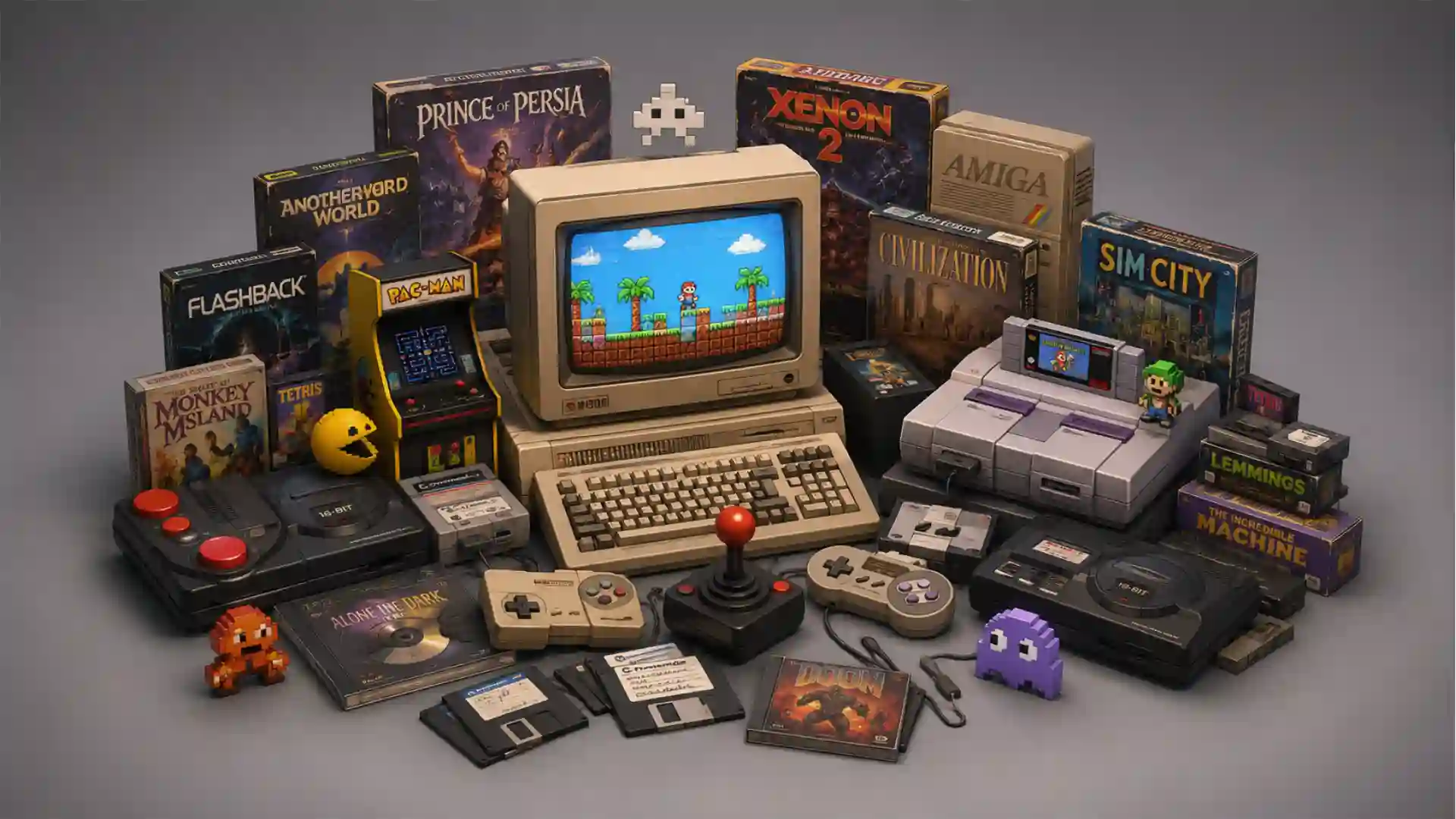
My Abandonware does something the modern web rarely does with old culture: it lets the past stay awkward, playable, searchable, half-broken, and alive. It is not a polished retro storefront with a licensing team, glossy capsule art, and a promise that every game has been tested for your current machine. It is closer to a huge, cluttered back room behind a game shop that never closed. Boxes are stacked too high. Some labels are faded. A few manuals are still inside. Someone has written notes on how to get the thing running. You may find a classic you remember perfectly, then fall into a forgotten Windows 95 racing game with a name that sounds made up.
Table of Contents
The site’s pitch is direct: download old video games from 1965 to 2015 for free. Its homepage currently says there are more than 37,300 old games available, with familiar names scattered across the invitation: Pac-Man, Tetris, Civilization, SimCity, Prince of Persia, The Incredible Machine, Another World, Flashback, Lemmings, and many others. The range matters because My Abandonware is not only selling nostalgia back to people who once had beige PCs under their desks. It is also a strange record of how wide games became before distribution became centralized, trackable, patched, authenticated, remastered, and subscription-shaped.
The best reason to open My Abandonware is not that it has old games. The internet has many places where old files drift around. The reason to open it is that it treats old games as entries in a living catalogue. A game page is rarely just a file. It may carry release year, platform, publisher, developer, file size, language, review notes, instructions, manuals, screenshots, and downloads. That sounds ordinary until you remember how many games were never granted clean second lives. They were published, patched once if lucky, reviewed in a magazine, sold in cardboard, and then left behind by hardware, storefronts, operating systems, rights holders, bankruptcies, mergers, and indifference.
The site also sits inside a legal and cultural grey zone that should not be ignored. “Abandonware” is not a magic legal category. My Abandonware’s own FAQ says an abandonware game is one no longer sold by its company, while also telling visitors to try buying a game first on GOG, Steam, Amazon, or eBay, and warning that the site does not take responsibility for downloads considered illegal in a user’s country. That honesty is part of the texture. The site is useful, fascinating, and sometimes uncomfortable because it exists in the gap between cultural memory and copyright reality.
The archive that feels bigger than nostalgia
The first surprise is scale. More than 37,300 games is not a collection; it is a weather system. You do not browse it the way you browse a neat list of best retro games. You enter through a name, year, platform, genre, theme, publisher, developer, or search filter, and then the archive starts pulling you sideways. A famous title leads to a forgotten port. A forgotten port leads to a publisher. A publisher leads to a strange run of educational games, sports licenses, shareware experiments, regional releases, and odd machines you never owned.
The span from 1965 to 2015 gives the site a weird sense of depth. The 1960s entries feel like fossils from computing rooms rather than living-room entertainment. The 1980s pages bring in the sharp edges of early home computers and arcade conversions. The 1990s become the site’s emotional center: DOS games, Windows experiments, adventure games, management sims, licensed oddities, and shooters that still look like they were designed during a hardware argument. The 2000s and early 2010s are stranger because they are close enough to feel recent but old enough to have already slipped out of normal sale. My Abandonware’s year browser makes that span explicit, listing games by release year and naming early entries such as The PDP-10 Timesharing World Series, Batnum, High Noon, Galaxy Game, and Pong.
That range gives the site a different kind of nostalgia. It is not only nostalgia for the games you played. It is nostalgia for the way games used to arrive. A title might have lived on floppies, a CD-ROM, a cartridge, a magazine cover disc, a shareware archive, a school computer, a cousin’s PC, a rental shelf, or a demo kiosk. The game itself was only part of the memory. There was also installation, configuration, manual-reading, copy protection wheels, driver errors, sound-card menus, and the small panic of not knowing whether your machine could run it.
My Abandonware preserves some of that friction. That is a feature, not a flaw. A modern store tries to remove every rough edge between wanting a game and playing it. This archive often reminds you that old games came from old machines. You may need DOSBox, ScummVM, an emulator, a patch, a virtual machine, or patience. The site does not always hide that labor behind a giant green play button. It often gives instructions because the instruction is part of the rediscovery.
There is a quiet editorial effect in seeing huge names beside obscure ones. Civilization and SimCity do not sit above the archive like museum kings; they sit inside the pile. Around them are games that never became franchises, ports that never became definitive, and small commercial projects whose main cultural trace may now be a My Abandonware page. The site collapses the hierarchy that normal games writing tends to rebuild. You search for Prince of Persia, then discover a forgotten side-scroller from the same year with three screenshots and a comment from someone trying to run it on modern Windows.
The archive also breaks the clean story that old games are either “classics” or junk. Most old culture lives between those categories. A 1997 Windows game may be too stiff, too ugly, too derivative, or too buggy to deserve canon status, but it still tells you something about what developers were trying, what publishers thought would sell, what hardware could show, and what players tolerated. My Abandonware is good at keeping those middle cases visible. It does not only rescue masterpieces. It gives room to the weird average.
That makes it more interesting than a retro best-of list. A best-of list gives you taste; My Abandonware gives you sediment. You can see how genres thickened, how naming habits changed, how platforms competed, how licenses moved through games, how PC releases absorbed console ideas, and how console ports carried technical compromises. The archive becomes less about “remember this?” and more about “look at how much there was.”
It is also a useful antidote to the clean remake economy. Modern retro culture often rewards whatever can still be sold neatly. Remasters, collections, subscription libraries, mini consoles, and anniversary editions make the past look tidier than it was. My Abandonware keeps the untidy parts in view: regional variants, forgotten manuals, unsupported executables, ports that look worse than you remembered, and games that nobody is likely to remaster because there is no obvious audience big enough to justify it.
The site’s size creates a small emotional shock. You realize how many games you never had the chance to miss. The childhood canon of any player is tiny compared with the actual output of the industry. A person might remember ten DOS games with religious clarity and still have no idea what was happening three shelves over. My Abandonware turns that ignorance into pleasure. You are not only retrieving memories; you are borrowing other people’s missed afternoons.
A museum built like a download site
My Abandonware describes itself through a museum ambition. Its about page says the goal is to create “the best video game museum on the web.” That claim could sound inflated elsewhere, but here it makes practical sense. The site was created in February 2009 as a revival of oldware.net, and its early focus was the DOS era, with rare titles found in the deep web or sent by visitors. That origin explains the site’s shape. It feels less like a company product than a long-running collection that kept expanding because people kept bringing things to the door.
The word “museum” is doing interesting work. A museum normally separates looking from owning. My Abandonware blurs that line. You read about a game, look at screenshots, scan metadata, maybe check comments, then download the archive. It treats access as part of memory. A box behind glass is one kind of preservation; a playable file is another. For games, the second matters because the object is behavior. A screenshot can remind you of a racing game, but the handling model, menu delay, AI stupidity, sound loop, and difficulty spike are the real artifact.
The site’s pages are plain in a way that now feels almost luxurious. There is no heavy editorial performance around each game. A page is usually built from title, platform, year, description, screenshots, technical details, download options, and notes. That directness suits the material. Old games already carry enough weirdness. They do not need a lifestyle wrapper. You arrive, identify, inspect, download, and maybe contribute a correction later.
The navigation is also very much of the web rather than of the app age. Browse by name, year, platform, genre, theme, publisher, developer. These are simple doors, but they are good doors. They invite different kinds of curiosity. A player looking for a childhood game may start with a title. A researcher may start with a publisher. A designer may search themes. A platform obsessive may go straight into Amiga, DOS, PC-98, J2ME, ZX Spectrum, Windows 3.x, or something stranger.
The platform browser is where the site’s scale becomes especially vivid. It lists the famous machines and the odd ones together. You get Amiga, Apple II, Atari ST, Commodore 64, DOS, Genesis, Mac, MSX, Windows, and ZX Spectrum, but also Adventure Vision, Bally Astrocade, Casio Loopy, Game Wave, Gizmondo, HyperScan, J2ME, Leapster, Mophun, Nuon, Palm OS, Pippin, RCA Studio II, Super A’Can, V.Flash, Vectrex, Zeebo, Zune, and more. The list reads like a hardware graveyard with playable doors.
That hardware spread is one of the site’s richest qualities. It reminds you that gaming history was never only Nintendo, Sega, PlayStation, Xbox, and PC. There were educational machines, failed consoles, mobile runtimes, microcomputers, media devices, handheld experiments, regional platforms, and products that barely survived long enough to leave a shelf mark. A platform list like this turns the site into a map of commercial optimism. Every machine was once someone’s bet.
The site’s “top downloads” page brings a different truth. The past people search for is not always the past critics canonize. Its top entries include Need for Speed: Most Wanted, Need for Speed: Underground 2, Sid Meier’s Civilization, Silent Hill 2: Restless Dreams, Blur, Need for Speed II: SE, The House of the Dead, The Incredible Machine, Oregon Trail Deluxe, Prince of Persia, Virtua Cop 2, Black & White, Zoo Tycoon: Complete Collection, and The Simpsons: Hit & Run. That list is revealing because it mixes PC classics, racing nostalgia, licensed comfort, cult games, school computer memories, and titles trapped by awkward rights or storefront gaps.
The download chart also punctures a romantic myth about retro gaming. People do not only return to austere classics from the early home computer era. They return to the games they actually played, which may mean a 2004 racing game, a clumsy movie tie-in, a typing game, a zoo sim, a Windows port, or a title that was critically mixed but emotionally permanent. My Abandonware is strong because it does not sneer at that. It understands that memory is not curated by Metacritic.
The “new games” page adds another layer. This is not a dead archive sitting untouched. My Abandonware says it usually releases at least one game per week, sometimes much more. A site like this gains power from that slow accretion. It feels like a salvage operation that never quite ends. Another obscure entry appears. Another platform gets a file. Another page fills in a missing patch of the map.
That slow publishing rhythm makes the site feel cared for. A static archive can become a tomb; an updated archive feels like a workshop. The difference is subtle but real. The presence of recent additions tells visitors that someone is still sorting, checking, adding, replacing, or listening. For old games, that matters. Preservation is rarely one heroic act. It is more often years of boring maintenance, file naming, metadata cleaning, link repair, compatibility notes, and user comments that save someone else an hour.
My Abandonware’s community role is quiet but visible. The about page credits visitors for sending rare titles. That matters because abandonware collecting has always depended on people who kept disks, ripped CDs, dumped cartridges, scanned manuals, remembered filenames, and cared enough to share. Formal institutions matter too, but the lived preservation of games has often been carried by fans with drawers full of old media and a stubborn refusal to throw things away.
The result is not a perfect museum. It is a folk museum with download buttons. That is why it feels alive. The site has the rough edges of amateur memory and the practical structure of a database. It sits somewhere between archive, fan project, software directory, historical reference, and grey-market access point. A cleaner site might inspire more confidence at first glance. This one inspires a different feeling: someone has been here for years, adding to the pile.
The magic is in the messy edges
The most charming part of My Abandonware is not polish. It is density. The homepage alone moves from big nostalgic names to trending games, then into practical claims about metadata, screenshots, manuals, and archives. The site does not try to seduce you with a single hero object. It gives you stacks. It knows the audience already has a hook: a game name, a machine, a year, a memory, a screenshot, a rumor.
That density works because old games are often remembered through fragments. A player may not know the title. They remember a side-view knight, a green monochrome screen, a desert track, a robot dog, a menu sound, a box cover, or the fact that the game ran on their uncle’s Amiga. My Abandonware’s structure gives those fragments a chance. Search, screenshots, platform pages, genre pages, and theme pages all serve the detective work of half-memory.
The screenshots matter more than they first appear to. A single image can confirm a lost memory faster than any description. My Abandonware notes that many games have screenshots and credits MobyGames for most of them. For old games, screenshots are not just decoration. They are identification tools. They help users distinguish ports, versions, editions, and false memories. They also show the texture of an era: palette choices, UI density, pixel fonts, menu frames, render styles, and the strange ambition of games trying to look bigger than their machines allowed.
Manuals are another quiet strength. Old games often assumed you would read. Controls, setup, lore, copy protection, installation, maps, keyboard commands, and tactical systems lived in paper. A modern player opening a DOS strategy game without the manual may think the game is hostile or broken. The manual explains the social contract. It tells you how much the player was expected to bring to the session.
The site’s practical notes also push against one of the laziest ways people talk about retro games. Old games are not always instantly approachable. Some are elegant. Some are brutal. Some are obtuse because of bad design. Some are obtuse because the manual was part of the interface. Some only make sense with period hardware assumptions. My Abandonware’s page format makes room for that reality by keeping technical and contextual material close to the download.
There is also pleasure in the site’s flatness. A massive commercial franchise and a nearly forgotten curiosity may share the same page grammar. That gives the archive a democratic feeling. The famous game gets no velvet rope. The obscure game gets no apology. Both are entries. Both have a year, a machine, a publisher if known, a file, a place in the grid. The design choice is simple, but the effect is generous.
The flatness makes browsing dangerous in the best way. A person who arrives for one download may leave with twenty tabs. One tab is the game they came for. Another is a sequel they forgot. Another is a strange platform version. Another is a publisher page. Another is a theme page for cyberpunk, World War II, dinosaurs, detective fiction, or business simulation. The site turns retrieval into wandering.
That wandering is where the editorial value lives. My Abandonware is not only useful when you know what you want. It is useful when you do not. Random game links, year lists, platform pages, trending items, and top downloads all push the visitor away from the narrow tunnel of search. The best web archives do this. They respect intent, then reward drift.
What My Abandonware does especially well
| Strength | Why it matters |
|---|---|
| Huge catalogue | More than 37,300 games turns browsing into discovery, not just lookup. |
| Long timeline | 1965–2015 connects early computing, DOS culture, console ports, and forgotten Windows releases. |
| Platform depth | Mainstream and obscure machines appear side by side, making the archive feel less canonical and more complete. |
| Practical game pages | Metadata, screenshots, manuals, instructions, and downloads sit close together. |
| Living updates | New entries still appear, so the archive feels maintained rather than abandoned itself. |
| Honest grey-zone framing | The FAQ warns users about legality and safety, which makes the site more credible than a reckless download dump. |
The table is compact because the appeal is not complicated. My Abandonware works by combining scale, context, access, and friction. Remove the scale and it becomes a fan page. Remove the context and it becomes a file dump. Remove the access and it becomes a museum label. Remove the friction and it becomes a fantasy version of old gaming that never existed.
The site also understands that old game discovery is emotional but not delicate. It lets the material be ugly when it was ugly. A forgotten 3D action game from the early 2000s may look worse now than a sharp 1989 pixel-art platformer. A low-budget DOS game may have better mood than a licensed Windows game with full-motion video. A console port may show exactly where hardware and business needs collided. My Abandonware does not smooth those contradictions away.
There is a kind of truth in bad screenshots. They show the industry learning in public. Menu systems are strange. Fonts fight backgrounds. Early polygons wobble. Character portraits look overconfident. Racing games have fog that begins three meters from the car. Strategy games fit impossible amounts of information into tiny panels. The archive lets you see ambition and limitation at the same time.
The same applies to genres. A modern player may think old genres were cleaner than they were. My Abandonware shows the clutter: puzzle games that are also educational games, adventure games that are also slideshow mysteries, sports games tied to expired licenses, action games with simulation ambitions, business sims with spreadsheet hearts, platformers with PC controls that fight the body. The site is good because it leaves the mess visible.
It also reveals how much of gaming history is attached to ordinary companies. Not every old game came from a beloved studio with a documentary-ready story. Many came from publishers that vanished, merged, changed strategy, or left behind rights nobody seems eager to untangle. Those games still shaped people’s memories. They still influenced designers. They still show what the market believed for a moment.
That is why My Abandonware is compelling even when you do not download anything. It is a browsing instrument for game history. A visitor can spend an hour moving through years, platforms, publishers, and genres and come away with a sharper sense of the medium’s sprawl. The downloads are central, but the catalogue itself is the deeper object.
The legal grey fog around abandonware
A responsible Web Radar piece cannot pretend the legal side is simple. Abandonware is a cultural word, not a free pass. A game being old, unsupported, unavailable, or commercially ignored does not automatically mean copyright has expired or that distribution is permitted. My Abandonware knows this. Its FAQ says the category has never been clear in software, and it points out that some games leave abandonware status when they return through GOG or Steam.
That last point is important. A game can move in and out of practical availability. A title may disappear for years, then return as a digital reissue, remaster, licensed bundle, subscription entry, or publisher archive. Another game may vanish because music rights, car licenses, celebrity likenesses, middleware, source code, or corporate ownership made rerelease unattractive. The commercial life of a game is not a straight line. My Abandonware sits in the breaks.
The site’s FAQ tells users to try buying the game first. That is the right instinct. If a game is available legally through a current store, buying it supports the rights holder or preservation-minded distributor and often gives a cleaner experience. My Abandonware is most interesting where the market has nothing to sell: not discounted, not remastered, not bundled, not streamed, not patched, not acknowledged.
The Video Game History Foundation’s 2023 study gives that problem a hard number. It found that 87 percent of classic video games released in the United States are critically endangered, with only 13 percent currently in release. That does not make unofficial downloading legal. It does explain why sites like My Abandonware become culturally important. A medium cannot rely only on current commercial availability when most of its older works are not commercially available at all.
That number also helps explain the emotional force behind abandonware. Players are not only chasing free entertainment. Many are trying to reach works that the market has abandoned but culture has not. A game may be discussed in design history, remembered by fans, referenced by developers, or needed by researchers while still being unavailable through ordinary channels. The mismatch creates pressure. Archives, fans, and grey-zone sites rush into the space where formal access fails.
My Abandonware’s own legal warning makes the site more credible, not less. It does not pretend that “free” means clean. It says downloads may be considered illegal depending on country, tells users to seek commercial copies first, and avoids asking for payment details. That framing will not satisfy everyone, and it should not. The site exists inside a real conflict between preservation, access, rights, and risk. Its value does not erase that conflict.
The safety warning matters too. Old files are not automatically safe because they are old. The FAQ recommends checking downloads, mentions VirusTotal, says the site usually scans files when possible, warns that limitations apply, and tells users they remain responsible for their own data and actions. It also warns about third-party programs after clicking ads. That is sober advice for any old software site.
This is where My Abandonware differs from the seedier corners of retro downloads. It speaks like a site that knows trust is fragile. It does not remove all risk. It cannot. But it gives practical warnings instead of pretending every archive is clean and every user is protected. For a visitor, that means the site is best approached with common sense: use current security tools, avoid suspicious installers, read page notes, and consider a virtual machine for old Windows software.
There is also an ethical split between downloading a commercially available game and downloading a game that no one sells. Those two acts may look similar in a browser but feel different culturally. My Abandonware tries to draw attention to that difference. It does not make law vanish, but it gives users a more responsible path: check legal stores first, then understand the grey zone before acting.
The site’s greatest tension is also its reason to exist. Game preservation often needs access to the thing itself. A review, screenshot, or video cannot fully preserve a game because the work is interactive. A game’s rules, timing, controls, bugs, save systems, copy protection, loading rhythm, and interface habits are part of its historical identity. When a title cannot be bought and cannot be studied easily, unofficial archives become the places where play remains possible.
That does not mean every archive deserves applause. There is a difference between preservation-minded access and careless piracy branding. My Abandonware earns attention because it wraps downloads in metadata, history, warnings, screenshots, and user help. It behaves like an archive, not just a loophole. The distinction is imperfect, but it matters.
The uncomfortable truth is that game history has outgrown the systems built to sell games. A medium tied to hardware, operating systems, authentication servers, licenses, and digital storefronts is fragile by design. A book can go out of print and still sit on a shelf. A game may need the right machine, firmware, controller, disc drive, codec, server check, installer, and executable environment. My Abandonware exists because those dependencies keep breaking.
This fragility is not only a retro problem. A game from 2010 can disappear faster than a game from 1990. Licensing can expire. Digital stores can close. Multiplayer servers can shut down. Games can be delisted because of music, cars, sports rights, contracts, or corporate strategy. The archive’s 1965–2015 range quietly makes that point. The line between “old” and “unavailable” is not as long as people assume.
The site is also a map of forgotten platforms
The platform browser may be the most revealing page on My Abandonware. It turns hardware history into a clickable list. Big platforms are there, but the small and failed ones are what give the page its charge. A visitor who knows DOS, Amiga, Genesis, and Windows will still run into machines that feel like rumors: Super A’Can, Nuon, Pippin, V.Flash, HyperScan, Playdia, XaviXPORT, Gizmondo, Zune, Casio PV-1000, and more.
Those names are not trivia. Each one represents money spent, developers recruited, cartridges or discs manufactured, marketing written, and players somewhere trying to make the purchase feel justified. Failed platforms are rarely blank. They have launch games, ports, educational titles, tech demos, licensed adaptations, and strange experiments. My Abandonware gives those platforms a kind of afterlife by letting them remain browseable.
The J2ME and mobile entries are especially interesting. They capture a pre-smartphone gaming world that is easy to forget. Before app stores standardized mobile distribution, phones had small games distributed through carrier portals, downloads, brand deals, and odd device ecosystems. Many were simple, compromised, and tiny. They were also part of daily gaming for millions of people. A site that treats J2ME as part of the same archive as DOS and Amiga is making a smart historical choice.
The same goes for Windows Mobile, BREW, Symbian, Palm OS, BlackBerry, and other mobile or handheld environments. These platforms make the archive less romantic and more accurate. Gaming did not move neatly from arcade to console to PC to smartphone. It splintered constantly. People played wherever screens and buttons existed. My Abandonware’s platform sprawl captures that messy path better than a prestige retro shelf ever could.
The obscure console entries have a different appeal. They show how often companies tried to build living-room machines that went nowhere. Some were underpowered. Some were too expensive. Some had weak software. Some arrived late. Some were confused products aimed at confused markets. The games left behind may not be great, but they are evidence. They show what the industry thought might work.
For designers, this is useful material. Bad and forgotten games often teach more than polished classics. You can see control ideas that failed, interface assumptions that aged badly, genres before they settled, and technical tricks built around harsh limits. A modern designer browsing My Abandonware may find awkward experiments that still contain a spark: a menu structure, a scenario idea, a visual trick, a rhythm, a weird input model.
For writers and researchers, the publisher and developer pages are just as useful. They let you follow careers and companies through forgotten work. A studio remembered for one famous title may have produced a dozen minor games. A publisher may have moved through educational software, sports licenses, compilations, imports, budget PC releases, and console ports. The archive lets those business paths become visible.
The year pages also create a strong sense of release density. A single year can hold masterpieces, clones, curiosities, shovelware, ports, and experiments side by side. That is closer to how players experienced games at the time. A person did not live inside a clean canon. They saw magazine ads, rental shelves, bargain bins, school software, shareware discs, friends’ recommendations, and whatever their machine could run. My Abandonware recreates some of that clutter.
The site’s platform breadth also challenges the lazy split between “PC retrogaming” and “console retrogaming.” My Abandonware treats them as intertwined. A game may have DOS, Amiga, Atari ST, Mac, Genesis, Master System, FM Towns, PC-98, or arcade versions. Looking across versions can show how design survived translation or failed under it. That kind of comparison is hard to do when games are locked inside separate platform stores.
A title like Prince of Persia is a good example because it traveled widely. The archive’s top downloads page lists it across DOS, Mac, Genesis, Master System, Game Gear, Amiga, Amstrad CPC, Atari ST, Apple II, FM Towns, PC-98, SAM Coupé, SEGA CD, Sharp X68000, and TurboGrafx CD. That kind of version spread is a reminder that old games were not fixed objects. They were adapted, squeezed, redrawn, recontrolled, and repackaged for machines with different strengths.
The platform list also has a melancholy side. Some machines survive mainly through archives now. Their commercial ecosystems are gone. Their stores never existed or have closed. Their hardware is rare, brittle, expensive, or region-specific. Without digital archives, their software libraries become collector objects rather than playable history. My Abandonware lowers the distance between curiosity and experience.
That accessibility changes who gets to care. A person does not need to own a working obscure console to learn what its games felt like. They still need technical patience and legal awareness, but the first barrier is lower. That makes the site useful for younger players, designers, students, writers, and anyone who came to games after these platforms had already vanished from shops.
The same idea applies to regional and format-specific histories. A site with PC-88, PC-98, FM Towns, Sharp X68000, ZX Spectrum, Amstrad CPC, and many other platforms gives English-speaking users a path into worlds they may have missed. Not every page will be complete. Not every game will be playable without work. The browseability itself still matters because it makes the existence of these libraries harder to ignore.
Why it deserves a place in your web radar
My Abandonware is worth opening because it makes old games feel discoverable rather than merely collectible. Retro culture often gets trapped between two modes: luxury nostalgia and technical hoarding. Luxury nostalgia sells the past back in clean boxes. Technical hoarding keeps files alive but may be hard for ordinary people to approach. My Abandonware sits in a useful middle. It is approachable enough to browse casually, but deep enough to reward serious digging.
The site also has a strong sense of purpose without sounding grand. Its pages mostly let the games do the work. That restraint is rare. Many modern discovery sites over-explain everything because they are fighting for attention. My Abandonware already has the thing: tens of thousands of old games, organized in enough ways to make curiosity easy. It does not need to turn every page into an essay.
The most memorable web projects often have a clear behavior. Here, the behavior is “I’ll just check one game.” Then the archive opens. You remember a title from school. You search it. You see another game from the same year. You click the platform. You notice the top downloads. You open a weird Windows game from 2001. You read comments about getting it running. You end up with a small map of your own gaming past and a larger map of everything around it.
That is the feeling Web Radar is built for. A site does not need to be new to be freshly interesting. My Abandonware has been around since 2009, but its relevance keeps changing because game availability keeps changing. Every delisting, server shutdown, rights mess, storefront closure, and abandoned PC release makes the archive feel less like a nostalgia toy and more like infrastructure.
There is also a design lesson here. Good archives need opinionated structure, not visual drama. My Abandonware’s categories are obvious because obvious is useful. Name, year, platform, genre, theme, publisher, developer. These routes match the way people remember. A flashier site might hide that behind cards, carousels, and recommendation widgets. My Abandonware keeps the old web habit of letting lists be powerful.
The “random game” link is part of that charm. Randomness is underrated in archives. Search reflects what you already know. Randomness shows you what you do not know to ask for. With a catalogue this large, random browsing becomes a tiny time machine. You may land on a game that looks terrible, a game that looks wonderful, or a game that makes you wonder how a whole platform passed you by.
The site’s limits are part of the recommendation. You should not open it expecting a friction-free modern game launcher. You should open it like a workshop, archive, and secondhand store. Some games need setup. Some pages will matter more as reference than as download. Some files should be handled carefully. Some titles should be bought elsewhere if they are available. The reward is not convenience. The reward is contact.
My Abandonware is also an antidote to algorithmic memory. Streaming platforms and modern stores tend to surface what already has a licensing path, a campaign, a bundle, or a popularity signal. My Abandonware surfaces old presence. A game exists there because someone added it, preserved it, documented it, or cared enough to make a page. That is a different kind of recommendation engine: less predictive, more archaeological.
For anyone who writes about games, the site is a reference trap in the best sense. It gives dates, platforms, publishers, screenshots, and surrounding context quickly. You still need to verify serious claims elsewhere, but as a starting point for remembering and comparing old releases, it is extremely useful. A game page can remind you that a title had a Mac version, a Saturn version, a J2ME version, or a later Windows release you forgot existed.
For players, the appeal is more direct. It gives you a chance to revisit games that shaped your taste before you had language for taste. That can be humbling. Some games hold up. Some collapse instantly. Some are clumsier than memory allowed. Some are better than their reputation. A few feel like messages from another internet, another bedroom, another family computer, another weekend.
For designers, the archive is a library of solved and unsolved problems. Old games are full of strange answers to constraints modern teams no longer face. How do you teach a control scheme with two buttons? How do you create atmosphere with a tiny palette? How do you structure a sim without tooltips? How do you make a menu readable on a CRT? How do you save progress when storage is limited? These questions shaped design instincts that still echo.
For preservation-minded readers, My Abandonware is a reminder that access is not guaranteed. Culture disappears quietly when nobody maintains the route to it. A game does not have to be destroyed to become unreachable. It only has to stop being sold, stop running on current systems, lose its server, lose its rights clarity, or become too obscure for anyone to request. The archive turns that quiet disappearance into something visible.
The site’s existence also asks a harder question: why does so much playable history depend on grey-zone labor? The answer is not simple, and it is not fair to place the entire burden on rights holders, fans, or archives alone. But the current reality is plain. When official channels do not preserve access, unofficial ones become memory’s working infrastructure. My Abandonware is one of the more readable examples of that infrastructure.
It is not perfect. No site of this kind can be. The legal status varies. Safety requires caution. Compatibility takes work. Metadata can be incomplete. Downloads may not match the clean expectation of modern software. Some users will decide the risks are too high or the ethics too messy. That is a reasonable position. A good recommendation does not need to erase doubts.
The reason My Abandonware belongs on the radar is that it reveals the web at its best and most complicated. It is generous, obsessive, useful, risky, imperfect, community-fed, historically rich, and a little stubborn. It preserves not only games but the old web idea that a site can be a place built around a shared obsession rather than a funnel.
Open it for one game, and you may leave with a better sense of the medium’s lost mass. That is the real hook. My Abandonware does not only say “play this again.” It says: look at everything that almost vanished while everyone was busy calling games disposable.
Small doubts before opening the archive
No. The site began with a strong DOS-era focus, and that heritage still shows, but it now includes many console, computer, arcade, handheld, and mobile-related platforms. The platform browser is one of the fastest ways to understand its reach because it moves from familiar systems to machines most players have never touched.
No clean universal answer exists. My Abandonware’s own FAQ says users should try to buy games first and warns that downloads may be considered illegal depending on the user’s country. The safest reading is simple: if a game is sold through an official or licensed store, use that route first; if it is not, understand that the archive still lives in a grey zone.
The site says it usually scans files with VirusTotal when possible, but it also tells users to check downloads themselves and stay alert around ads and third-party programs. The sensible approach is to treat old software like old software: read the page notes, scan files, avoid suspicious installers, and use a virtual machine when a game or operating system environment feels risky.
The strongest audience is not only people who want free old games. The site is best for players with specific memories, designers looking for old ideas, researchers tracing releases, collectors comparing versions, and curious web users who like deep catalogues. If you enjoy browsing old magazines, hardware lists, internet archives, or forgotten software directories, My Abandonware has the same pull.
A retro store sells what it has the rights to sell. My Abandonware documents and gives access to a much messier field of old software, including games that may not have a clean commercial path today. That makes it less convenient and more complicated, but also broader, stranger, and often more revealing.
Start with a game you remember, then refuse to stop there. Click the year, platform, publisher, and related pages. The archive becomes far more interesting when you treat it as a map rather than a vending machine. The first download may be nostalgia. The fifth tab is where discovery starts.
Author:
Jan Bielik
CEO & Founder of Webiano Digital & Marketing Agency
This article is an original analysis supported by the sources cited below
My Abandonware homepage
Official homepage used for the site’s current positioning, catalogue size, date range, example games, metadata claims, screenshots, and general description.
Site history, our team, sites we love
Official about page used for the site’s 2009 origin, revival of oldware.net, museum ambition, DOS-era focus, and visitor contribution context.
Frequently asked questions
Official FAQ used for the site’s own explanation of abandonware, legal caution, buy-first advice, safety guidance, VirusTotal scanning notes, and user responsibility warnings.
Abandonware games sorted by year
Official year browser used to confirm the 1965–2015 span and illustrate how the archive organizes games chronologically.
Abandonware games sorted by platform
Official platform browser used to assess the breadth of supported computer, console, mobile, arcade, and obscure hardware categories.
Most downloaded abandonware games
Official top downloads page used to identify the kinds of titles users return to most, including major PC classics, racing games, simulations, and cult releases.
New abandonware games published
Official recent releases page used for the site’s update rhythm and current platform filtering context.
87% Missing: the Disappearance of Classic Video Games
Video Game History Foundation study used for the broader preservation context around commercial unavailability of classic games.
| Citing this article? Brief excerpts are welcome. Please credit Webiano.digital, name the author where stated, and include a link to https://webiano.digital and to this original article. Full or substantial republication requires prior written permission. Read our Copyright and Content Use Policy. |
This article was prepared with the assistance of artificial intelligence tools. The content underwent expert human review, and Webiano Digital & Marketing Agency assumes editorial responsibility for its final version and publication.