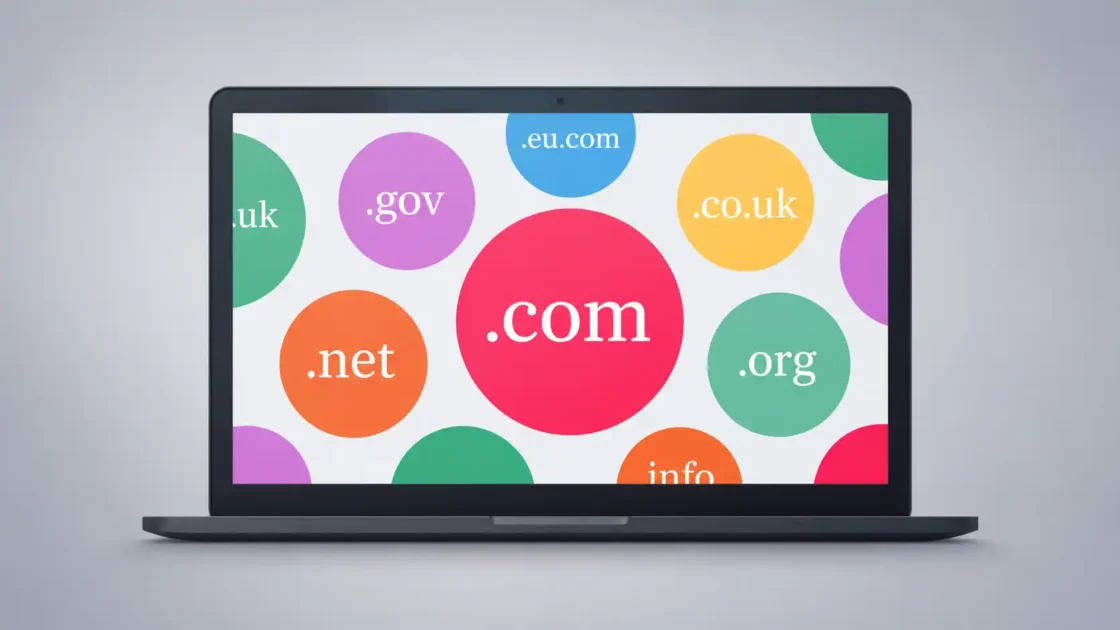
The internet’s naming system currently offers well over 1,400 active top-level domains, and the authoritative record of all of them sits in one place: the IANA Root Zone Database, maintained by the Internet Assigned Numbers Authority under ICANN. As of early 2026, the root database lists roughly 1,590 entries, of which about 1,450 are live, delegated extensions you can actually encounter on the web. The rest are revoked, retired, or reserved test strings that never reach the public. Anyone who wants the complete, machine-readable list of every valid extension can download it directly from IANA at data.iana.org/TLD/tlds-alpha-by-domain.txt, updated daily. No registrar catalogue, no matter how long, is more complete than that file.
Table of Contents
The full map of domain extensions available in 2026
The live extensions break down into a small number of categories, and understanding those categories is the single most useful piece of knowledge for anyone choosing a domain. Generic top-level domains (gTLDs) form the largest group by count, with more than 1,000 strings ranging from the legacy .com, .net, and .org to the hundreds of newer entries like .shop, .app, and .online that arrived after ICANN’s 2012 expansion round. Country-code top-level domains (ccTLDs) are the two-letter national extensions, one for each country or territory recognised in the ISO 3166 standard, from .sk for Slovakia and .cz for Czechia through .de, .fr, .jp, and roughly 250 others in Latin script, plus dozens of internationalized national variants in Cyrillic, Arabic, Chinese, and other scripts. Sponsored TLDs are a smaller family of around 14 extensions tied to specific communities and governed by their own charters, including .edu for accredited US higher education, .gov for the US government, .aero for aviation, and .museum. Finally, one infrastructure TLD, .arpa, exists purely for technical internet plumbing and is not open for registration at all.
Counting extensions is one thing; counting actual registrations is another, and the second number tells you where the market really lives. According to the Domain Name Industry Brief for the first quarter of 2026, published by DNIB.com and sponsored by Verisign, the world closed Q1 2026 with 392.5 million registered domain names across all TLDs, up 6.5% year over year. Of that total, .com alone accounts for 163.6 million names, ccTLDs collectively hold 146.3 million, and the new gTLD segment introduced since 2013 has grown to 49.6 million registrations. Put differently, a namespace with more than 1,400 available endings still concentrates over 40% of its entire registration base in a single extension, while more than a thousand newer endings share less than 13% between them.
That concentration is the central tension this article examines. The choice in front of a brand owner in 2026 is wider than it has ever been, and it is about to get wider still: ICANN opened the application window for its second round of new gTLDs on 30 April 2026, which means the count of available extensions will grow again from 2027 onward. Yet breadth of choice has not translated into breadth of adoption. Most businesses still gravitate to a short list of proven endings, and they do so for reasons that are partly rational (trust, memorability, resale value) and partly inertial (habit, defaults, autofill behaviour).
The practical question, then, is not “which of 1,400 extensions could I register?” but “which extension matches my project’s geography, audience, budget, and risk tolerance?” A Slovak accounting firm serving clients in Bratislava faces a different decision than a SaaS startup targeting developers worldwide, and both face a different decision than an e-commerce brand shipping across the EU. The extension is not just a technical suffix; it is a signal about who you are, where you operate, and how seriously you take your own name. A well-chosen ending reduces friction at every touchpoint: people remember it, type it correctly, trust the email address built on it, and click it in search results without hesitation. A poorly chosen one leaks traffic to competitors, triggers spam filters, and forces you into an expensive migration two years later.
This analysis walks through every category of available extension in detail: the legacy generics, the full national layer including .sk and its Central European neighbours, the repurposed country codes that became global tech brands, the industry-specific new gTLDs, the restricted and sponsored strings, the internationalized scripts, and the corporate dot-brands. It then covers the machinery underneath (registries, registrars, pricing, renewals, the aftermarket), the evidence on SEO and AI-driven search, and closes with concrete selection frameworks for the three most common situations: a local business, a global project, and a brand that needs defensive coverage. Every factual claim about counts, dates, and market data traces back to primary sources listed at the end.
Legacy generic TLDs and the original namespace
Before there were 1,400 extensions, there were seven. When the Domain Name System went live in 1985, the original specification defined a compact set of generic endings, each with an intended purpose: .com for commercial entities, .net for network infrastructure operators, .org for organisations that fit neither, .edu for educational institutions, .gov for the US government, .mil for the US military, and .int for international treaty organisations. The design assumed a small, orderly internet where registrants would self-sort into the correct category. That assumption collapsed almost immediately for the first three, which became open to anyone, while .edu, .gov, .mil, and .int retained genuine eligibility enforcement and remain restricted to this day.
The first registered .com domain, symbolics.com, went live on 15 March 1985 for a Massachusetts computer manufacturer. For the first decade, registration was free or nearly so, handled by government contractors, and volumes were tiny. The commercial explosion began in the mid-1990s when Network Solutions started charging for registrations and the web made a domain name a business necessity rather than an engineer’s convenience. By 2000, .com had become the shorthand for the internet economy itself; the era’s stock bubble is still called the dot-com bubble, not the dot-net bubble.
A second, smaller expansion arrived between 2000 and 2004, when ICANN, formed in 1998 to coordinate the naming system, approved a test batch of new generics: .info, .biz, .name, .pro, plus sponsored strings like .aero, .coop, .museum, and later .jobs, .travel, .mobi, and .cat. This 2000s generation proved a lesson the industry has relearned repeatedly since: creating an extension is easy, but creating demand for it is not. .info reached respectable volumes as a cheap .com alternative and .biz found a niche, but none of the batch threatened the incumbents, and several (.mobi, built for a “mobile web” that smartphones made obsolete; .travel with its verification requirements) illustrate how quickly a namespace concept can be stranded by technology or by its own rules.
The legacy generics still dominate the market’s centre of gravity. DNIB data for Q1 2026 puts the combined .com and .net base at 176.1 million names, and the broader legacy gTLD group at roughly half of all registrations worldwide. Their renewal rates, the cleanest available proxy for whether registrants actually value a name, run far above those of most newer extensions: the preliminary combined .com/.net renewal figure for Q1 2026 was 76.3%, and .org’s renewal rate around 79.6% is among the highest of any large TLD. Compare that with renewal rates below 20% reported for some heavily discounted new extensions, and the difference between a namespace people build on and a namespace people experiment in becomes visible in a single metric.
For a brand owner, the legacy set carries one more property that newer extensions cannot replicate: four decades of accumulated user habit. People do not merely recognise .com, .org, and .net; they type them reflexively, autocomplete them mentally, and treat them as the default shape of a web address. Browser behaviour reinforced this for years (pressing Ctrl+Enter in many browsers still wraps a bare word in www. and .com), and email systems, business directories, and printed materials cemented it further. Habit of that depth is an asset with real economic value, which is why the rest of this article keeps returning to a simple asymmetry: a newer extension must offer a concrete, articulable advantage to justify giving that habit up, while .com needs no argument at all beyond its price and availability.
None of this means the legacy generics are always the right answer. It means they are the baseline against which every alternative must be measured, and the following two sections examine the two halves of that baseline, .com first, then the second tier, in the detail the decision deserves.
.com and the economics of the default choice
The .com extension held 163.6 million registrations as of 31 March 2026, according to Verisign’s registry data published through DNIB.com. That is more than the next several extensions combined, more than the entire ccTLD category of most continents, and roughly one of every 2.4 domain names on the planet. Verisign operates the .com registry under a long-running agreement with ICANN and the US Department of Commerce, running the authoritative database and the constellation of name servers that answer .com queries billions of times per day with uptime measured in decades.
The economics of .com are the economics of a default. When a customer hears a brand name on a podcast, sees it on a delivery van, or half-remembers it from a conversation, the first guess is brand.com. Every percentage point of users who guess correctly is traffic a business does not have to buy. Marketing researchers and registrars have documented the effect repeatedly: .com addresses are recalled more accurately than any alternative ending, and users click them in search results at higher rates because the format matches their expectation of what a legitimate business address looks like. This “type-in trust” is invisible in analytics dashboards but shows up in the aggregate as lower acquisition costs and fewer misdirected visitors.
The default status also shows up in the aftermarket, where .com prices operate in a different league from everything else. The Sedo and InterNetX Global Domain Report data shows .com accounting for the majority of aftermarket transactions, and the record-setting sales are almost all .com: Voice.com sold for 30 million dollars in 2019, and ai.com reportedly changed hands for 70 million dollars in 2025, the largest publicly reported domain sale in history. Even routine sales tell the story: median and average resale prices for .com names run far above comparable names in newer extensions. For a business, that cuts both ways. Owning a good .com is owning an appreciating asset; acquiring one that someone else registered first can cost four to seven figures.
Scarcity is the flip side of dominance. After four decades of accumulation, virtually every dictionary word, every common two-word combination, and every pronounceable four-letter string in .com is taken, parked, or priced for resale. A new company named with a common Slovak or English word will almost never find name.com available at the standard registration fee of roughly 10 to 15 euros per year. The realistic options become: buy the name on the aftermarket, modify the name (getname.com, nameapp.com, name-sk.com), or choose a different extension. Each modification erodes exactly the memorability that made .com attractive in the first place, which is why the aftermarket exists and why alternative extensions gained their opening.
There is also a strategic argument against .com that deserves honest treatment: for a strictly local business, the global default can be the wrong signal. A dental clinic in Trnava gains nothing from an extension optimised for worldwide reach, and its patients may actually search with local intent that a national extension serves better. The .com advantage compounds with geographic ambition; it is strongest for projects that want to look placeless and weakest for projects whose entire value is their place.
Renewal economics round out the picture. Verisign’s wholesale price for .com has risen through a series of contractually permitted increases, and registrars pass those through, so a .com that cost 8 euros a decade ago now renews closer to 13 to 16 euros at typical retail pricing. That is still cheap in absolute terms, a rounding error against any real marketing budget, and the 76.3% renewal rate shows registrants agree. The practical rule that emerges from all of this data: if the exact .com for your brand is available at standard price, register it even if you plan to build elsewhere, because the cost of holding it is trivial and the cost of a competitor or squatter holding it is not. Whether it becomes your primary address is a separate decision the later sections of this article will help you make.
.net, .org, .info and the second tier of classics
Beneath .com sits a second tier of legacy generics that remain enormous by any standard except comparison with .com itself. Each carries a distinct history, a distinct audience expectation, and a distinct set of situations where it is genuinely the right choice rather than a consolation prize.
.net held 12.4 million registrations at the end of Q1 2026, also operated by Verisign on the same infrastructure as .com. Its original mandate, network infrastructure providers, faded long ago, and for most of its life .net has functioned as the first fallback when a .com was taken. That fallback role is honourable but limited: users who half-remember a brand still guess .com first, so a business running on brand.net while a competitor or parking page sits on brand.com leaks a measurable share of its own traffic. Where .net works well is in technology contexts where the word “net” itself carries semantic weight (ISPs, hosting providers, network tooling, community platforms) and in cases where the .com owner is inactive and the .net brand is distinctive enough that confusion is unlikely.
.org occupies a different position entirely: it is the only legacy generic whose connotation strengthened over time rather than diluting. Operated by Public Interest Registry, a non-profit, .org holds roughly 11 million registrations and has become the near-universal signal for non-profits, open-source projects, foundations, civic institutions, and communities. Survey data consistently shows the effect; one widely cited figure holds that around 68% of online donors say they most trust websites and email addresses ending in .org. Wikipedia, Mozilla, the Red Cross movement, and tens of thousands of NGOs anchor that association daily. For a commercial brand, .org is usually a mismatch that reads as either confusion or costume; for a genuinely mission-driven organisation, it is arguably a stronger choice than .com, and its 79.6% renewal rate, the highest of any top-ten gTLD, reflects how committed its registrant base is.
.info launched in 2001 as the flagship of ICANN’s first expansion and peaked at several million registrations as a low-cost .com alternative. Its trajectory since is a cautionary tale about pricing strategy: years of aggressive first-year promotions attracted bulk registrations, spam operations, and low-quality sites, which in turn taught a generation of users and email filters mild suspicion toward the ending. The extension still suits genuinely informational projects, documentation portals, reference sites, but a commercial brand choosing .info in 2026 is accepting a reputational discount to save a few euros. .biz, launched alongside it for businesses, suffered the same slide more severely and never escaped the perception of being the extension you pick when everything better was taken.
The remainder of the 2000s batch survives in niches. .name exists for personal names but lost that role to .me and to social platforms. .pro originally required verified professional credentials, dropped the requirement, and now competes as a generic. .mobi stands as the era’s clearest failed bet, an extension built for WAP-era mobile sites that responsive design made pointless within five years of launch. The pattern across the whole tier is consistent and worth internalising before evaluating the hundreds of newer options: an extension’s launch-era story matters less than the registrant behaviour it attracts, because users and filters learn from what they encounter, and that learned reputation, good for .org, mixed for .net, poor for .biz, becomes part of every brand that builds on it.
Country-code TLDs and the national layer of the internet
Every country and territory listed in the ISO 3166-1 standard has a two-letter code, and nearly every one of those codes exists as a delegated top-level domain. This national layer of the namespace comprises roughly 250 Latin-script ccTLDs plus several dozen internationalized national extensions, and together, per DNIB data, the category counts 316 delegated ccTLD strings holding 146.3 million registrations as of Q1 2026, about 37% of all domains on earth. Six of the ten largest extensions in the world are country codes: .cn (China), .de (Germany), .uk (United Kingdom), .ru (Russia), .nl (Netherlands), and .br (Brazil) all rank in the global top ten alongside .com.
The defining property of a ccTLD is that it answers to national rather than global governance. ICANN delegates each country code to a local registry manager, but the policies, eligibility rules, prices, dispute procedures, and even the legal framework are set nationally. Germany’s DENIC, a cooperative of German internet companies, runs .de under German law; AFNIC runs .fr under French law and a French-government mandate; CZ.NIC, an association, runs .cz; SK-NIC, a private company within the Team Internet (formerly CentralNic) group, runs .sk under contract with the Slovak state. This national governance means ccTLD rules vary enormously, and checking the specific registry’s conditions is a mandatory step before committing a brand to one.
Three broad policy models exist. Open ccTLDs accept registrations from anyone worldwide with no local connection: .de (with a minor caveat about a German administrative contact), .nl, .cz, .sk, .io, .co, .ai, and most others fall here. Restricted ccTLDs require local presence, citizenship, or registration of a local entity: .fr and .eu require EU/EEA connection, .ca requires Canadian presence, .au requires an Australian business connection, .hu has historically required EU eligibility, and some Asian ccTLDs are stricter still. Second-level-only ccTLDs don’t sell names directly under the country code but only under fixed subcategories, the classic example being the United Kingdom’s historic co.uk / org.uk structure (direct .uk registrations opened only in 2014) and Brazil’s com.br. For a company planning multi-country expansion, these eligibility differences translate into real operational work: registering .fr may require appointing an EU entity, and some registries demand local tax numbers or notarised documents.
The commercial argument for a ccTLD rests on geographic trust and local search behaviour. Consumers across Europe show strong, measurable preference for their national extension when buying domestically: German users click .de results, Dutch users expect .nl, Czech users expect .cz, and studies by national registries repeatedly confirm that a local ending increases perceived legitimacy for local transactions, particularly in e-commerce, where the extension implicitly promises local language, local currency, local consumer law, and a returns address inside the country. Google’s own documentation confirms the technical half of this: a country-coded extension is treated as a strong geotargeting signal, automatically associating the site with that country in local search results. A .sk site does not need to configure geotargeting for Slovakia; it carries the signal in its name. The cost of that signal is equally automatic: the same .sk site cannot tell Google it actually targets Austria, whereas a generic extension can geotarget any country through Search Console.
Renewal rates confirm that national extensions attract genuine, committed use rather than speculation. European ccTLDs post some of the highest renewal figures in the industry, with .fr and .eu historically above 80%, well clear of .com and dramatically above discount-driven new gTLDs. People who register their national extension mostly mean it.
The category’s one great complication is the subject of a later section: a handful of ccTLDs, .ai, .io, .co, .tv, .me, escaped their geography entirely and now function as global generic brands, complete with global pricing and global risk profiles. For now, the core point is simpler. For any business whose customers are concentrated in one country, the national ccTLD is not a fallback option; it is a first-class candidate that often beats .com on trust, availability, and local search performance simultaneously. The next section examines the ccTLD that matters most to readers of this analysis in Slovakia.
The Slovak .sk domain in detail
The .sk extension is Slovakia’s national top-level domain, delegated in 1993 after the split of Czechoslovakia dissolved the shared .cs domain that Czechoslovak networks had used since 1990. Its administrator is SK-NIC, a.s., a Bratislava-based company that has been part of the CentralNic group (today Team Internet Group) since 2017, operating the registry under an agreement with the Slovak state represented by the ministry responsible for digital affairs. The 2017 sale of the registry operator to a foreign group generated substantial public debate in Slovakia about national control of critical infrastructure, and the arrangement includes state oversight provisions and a commission that reviews registry policy. The .sk zone holds on the order of 450,000 registered domains, making it a mid-sized European ccTLD, proportionate to the country’s population of about 5.4 million.
Registration policy is open and straightforward by European standards. Any natural person over 18 or any legal entity may register a .sk domain; since the rule liberalisation of 2017 there is no requirement of Slovak residency, citizenship, or local presence. Names are registered exclusively through accredited registrars, of which SK-NIC lists dozens, including the large Slovak hosting providers (Websupport, WebHouse, Webglobe, and others) as well as international registrars. A .sk name must be 1 to 63 characters, letters, digits, and hyphens only; the registry does not support internationalized characters, so a Slovak word with diacritics (kaviareň, mäso) must be registered in its ASCII form (kaviaren, maso), a constraint worth remembering when a brand name contains š, č, ž, or á. Registration periods run from one to ten years, and typical retail pricing sits around 10 to 15 euros per year, with frequent first-year promotions from Slovak hosts in the 5 to 10 euro range, placing .sk among the affordably priced European ccTLDs.
Technically, the registry operates on modern standards: EPP provisioning for registrars, DNSSEC support for cryptographic protection of DNS answers, and a public WHOIS service at whois.sk-nic.sk that, under GDPR, discloses full holder data for legal entities while masking personal data of individuals. Disputes over .sk names are handled through an alternative dispute resolution procedure administered in cooperation with the European Information Society Institute (EISi), giving trademark holders a route against bad-faith registrations that is faster and cheaper than Slovak courts, alongside the ordinary judicial option.
The commercial case for .sk mirrors the general ccTLD argument, sharpened by local specifics. For a business selling to Slovak customers, a .sk address communicates in one glance that the shop speaks Slovak, prices in euros, ships domestically, and answers to Slovak and EU consumer law. Slovak e-commerce comparison engines, price aggregators like Heureka.sk, and local directories are built around the expectation of national domains. In organic search, the geotargeting signal helps a .sk site compete for queries with Slovak intent, and Slovak users searching in Slovak language overwhelmingly encounter and click .sk results. Availability is a further, underrated advantage: because the zone is two orders of magnitude smaller than .com, clean one-word Slovak names, exact business names, and short brandable strings remain available in .sk long after their .com equivalents were taken or priced into the aftermarket.
The limits are the mirror image. A .sk domain marks a project as Slovak, which is a cost the moment the project’s ambition crosses the border; a Slovak SaaS company selling to German enterprises will find that a .sk address raises a “local shop” question in the buyer’s mind that a .com or .eu never triggers. There is also a practical typographical footnote: the string “sk” reads naturally in Slovak marketing, where registrars have long played with it in campaigns styled around “.SKvelá doména” and similar wordplay, but it carries no meaning abroad. The working rule this article will develop in the strategy sections: .sk as the primary domain for Slovak-market businesses, paired with defensive registration of the matching .com and often .cz and .eu, is the standard, defensible pattern for a brand born in Slovakia.
.eu as a pan-European identity with real eligibility rules
The .eu extension occupies a category of its own: technically a ccTLD (the European Union holds an exceptional ISO code reservation), practically a regional identity mark for the whole single market. It launched publicly on 7 April 2006 with a landrush that recorded a million registrations on the first day, and it is operated by EURid, a non-profit registry headquartered in Diegem, Belgium, appointed by the European Commission, which has run the extension under successive EU regulations since 2003 and holds the mandate through at least 2027. The zone counts approximately 3.6 to 3.7 million registrations, placing .eu among the ten largest ccTLDs in the world, with roughly 80% renewal rates that signal a stable, committed registrant base rather than speculative churn.
Eligibility is where .eu differs sharply from open extensions, and the rules are precise. A .eu name may be registered by any organisation or undertaking established in an EU member state, Iceland, Liechtenstein, or Norway, by any natural person residing in one of those states, and, since October 2019, by any EU citizen anywhere in the world regardless of residence. The citizenship route was a deliberate policy extension aimed at the European diaspora. Enforcement has teeth: EURid runs data-quality and know-your-customer programmes, and ineligible holders lose their names. Brexit provided the demonstration at scale, when tens of thousands of .eu domains held by UK registrants without continuing EU eligibility were suspended and then withdrawn after the transition period ended in 2021, a reminder that regulatory extensions carry regulatory risk.
The registry’s operational reputation is among the strongest in the industry. EURid supports DNSSEC across the zone, holds ISO 27001 certification, and pioneered an Abuse Prevention and Early Warning System (APEWS) that analyses registration patterns to suspend likely-abusive domains before they cause harm, one reason .eu consistently ranks among the cleaner large extensions in abuse statistics. The extension also comes in three scripts: Latin .eu, Cyrillic .ею, and Greek .ευ, so a Bulgarian or Greek brand can carry its name entirely in its own alphabet.
Strategically, .eu solves one specific problem extremely well: the business that has outgrown one national market but is not, and does not want to look, global-American. A Slovak manufacturer selling into Austria, Czechia, and Poland faces an awkward choice among four national extensions, none of which covers the others; .eu covers all of them with a single address that signals European establishment, EU legal accountability, and cross-border seriousness. EURid’s own usage research shows exactly this pattern, with exporters, EU-funded projects, Erasmus-generation founders, and cross-border e-commerce as the core constituencies. Pricing is unremarkable in the best sense, typically 5 to 15 euros per year retail, and availability is far better than .com for obvious reasons of zone size.
The candid limits: .eu has never displaced national extensions in consumers’ domestic habits (a German buying domestically still expects .de), its recognition outside Europe is modest, and its regulatory nature means eligibility must be maintained, not just established, as UK holders learned. The practical role that emerges is therefore rarely “only domain” and usually “second pillar”: the pan-European address for export activity, standing beside the home-market ccTLD, or the primary address for projects whose identity is genuinely European rather than national, from EU consortia to multi-country marketplaces.
Central European ccTLDs a Slovak brand will meet
A brand operating from Slovakia rarely deals with .sk alone. The realistic expansion map runs through four neighbouring extensions whose rules and market weight differ enough to matter, and knowing them in advance prevents unpleasant surprises mid-expansion.
Czechia’s .cz is the most immediate, given the depth of Slovak-Czech commercial ties and the mutual intelligibility that lets one e-shop serve both markets with light localisation. The registry, CZ.NIC, is an association of Czech internet companies with a strong technical reputation (it develops the Knot DNS and Knot Resolver software used worldwide and the Turris router project). The zone holds roughly 1.5 million domains. Policy is fully open: anyone worldwide may register, with no Czech presence required, names up to 63 ASCII characters, no diacritics. Czech consumer behaviour strongly favours .cz for domestic purchases, and the Czech e-commerce ecosystem (Heureka.cz, Zboží.cz) assumes it. For a Slovak e-shop entering Czechia, registering the .cz early, ideally at the same time as the .sk, is close to mandatory, both for the storefront and to deny the name to local competitors.
Austria’s .at, run by nic.at, is likewise open to all registrants worldwide and holds about 1.5 million names. The Austrian market’s higher purchasing power makes it a common second or third expansion target for Slovak businesses, particularly from western Slovakia, and German-language content on a .at address is the expected combination. Austria also offers second-level options (co.at, or.at) that are cheaper but weaker as brands. Poland’s .pl, administered by the research institute NASK, is one of Europe’s large zones at roughly 2.5 million names, open to foreign registrants, with a well-developed secondary structure (com.pl, net.pl and regional endings) that mostly matters historically; direct .pl is the standard choice today. The Polish market’s size makes .pl the highest-volume opportunity among Slovakia’s neighbours, and Polish consumers, like Czech and German ones, show strong national-extension preference.
Hungary’s .hu is the outlier on rules. HuNIC/ISZT policy has historically restricted registration to entities and citizens with EU/EEA connection, and the process involves a public objection window before activation, slower and more formal than its neighbours. A Slovak company, being an EU entity, qualifies, but should plan for the procedure. Germany’s .de deserves mention beyond neighbourhood logic because it is the largest ccTLD in Europe and second worldwide at over 17 million names; DENIC’s policy is open to foreign registrants provided an administrative contact with a German address is designated, a requirement most registrars solve as a bundled service. Any Central European brand with serious export ambitions eventually confronts the German market, and there the .de expectation is absolute.
Two operational lessons cut across all five extensions. First, eligibility and paperwork differ per country, so multi-market registration is best handled through one registrar with broad ccTLD coverage rather than five local accounts, unless local hosting relationships argue otherwise. Second, the trademark dimension scales with each country added: a name that is clean in Slovakia may collide with a registered mark in Poland or Germany, and each national extension is subject to its own dispute procedure under its own law. Checking the EUIPO trademark database before a multi-country registration spree costs an hour and can save a lawsuit. The regional pattern that serious Slovak exporters converge on is consistent: home ccTLD as primary, neighbouring ccTLDs registered defensively at expansion or earlier, .eu as the umbrella, .com held for global option value.
Repurposed country codes that became global tech brands
A peculiar subplot of the namespace is the group of ccTLDs whose two letters happened to spell something the global market wanted, and which then detached from their geography almost completely. These extensions are legally national domains, governed by the policies (and exposed to the politics) of small territories, yet culturally they function as generics. Understanding both halves of that sentence is the difference between using them well and being blindsided.
.io, assigned to the British Indian Ocean Territory, became the default extension of the developer economy in the 2010s because “I/O” reads as input/output. Thousands of SaaS products, developer tools, APIs, and startups carry .io addresses; GitHub’s github.io cemented it in engineering culture. Registrations exceed a million, and pricing runs premium, typically 30 to 60 euros per year. Its geography, however, produced the category’s defining cautionary tale: in 2024 the United Kingdom agreed to transfer sovereignty over the Chagos Archipelago to Mauritius, raising the genuine question of what happens to a ccTLD when its territory’s ISO code is scheduled for retirement. The eventual resolution, with authorities signalling the string would be preserved given its economic weight, calmed the market, but the episode demonstrated that a repurposed ccTLD imports the political risk of its territory, something no .com owner ever thinks about.
.co, Colombia’s national domain, was deliberately relaunched globally in 2010 as “the .com alternative,” one letter shorter and vastly more available. The strategy worked: millions of registrations, mainstream startup adoption (Twitter’s t.co shortener gave it early credibility), and full integration into registrar storefronts worldwide. Its weakness is the typo relationship with .com itself; a share of brand.co traffic will always fat-finger its way to brand.com, which is why serious .co brands try to own both. .me, Montenegro’s domain, found its niche in personal branding and clever calls to action (about.me, visit.me constructions). .tv, belonging to the Pacific nation of Tuvalu, monetised the television association so successfully that domain licensing became a notable share of the country’s national revenue, an arrangement now run through major registry operators; streaming platforms and channels (Twitch began as justin.tv) keep demand steady. .fm (Micronesia) plays the same role for radio and podcasts, .gg (Guernsey) for gaming, .ly (Libya) had its hipster moment with bit.ly before Libyan instability illustrated the risk side, and .ws, .cc, .to each carry smaller repurposed followings.
The risk ledger for the whole category is consistent and worth stating plainly. First, policy sovereignty: the national registry can change prices, rules, or dispute procedures with little notice, and several have; .io price increases and the sudden regulatory moves seen historically in other small ccTLDs have no ICANN-contract ceiling of the kind that constrains gTLD registries. Second, geopolitical exposure, as .io and .ly showed from opposite directions. Third, no geotargeting flexibility in the traditional sense, though Google long ago added the popular repurposed codes (.io, .co, .me, .tv, .ai and others) to its list of “generic ccTLDs” treated like gTLDs for search purposes, removing the SEO penalty that a truly national extension would carry for global content. Fourth, renewal pricing that reflects a captive audience: these registries know their registrants are brands, not bargain hunters.
None of this argues against the category; it argues for eyes-open use. A developer-facing product on .io, a personal brand on .me, a streaming project on .tv are established, legible choices that audiences read instantly, and that legibility is precisely what a good extension buys. The most spectacular member of the family, though, has earned its own section, because nothing in the modern namespace illustrates the economics of extension meaning better than Anguilla’s two letters.
The .ai boom and the market price of a two-letter suffix
The .ai domain belongs to Anguilla, a British overseas territory in the Caribbean with a population around 16,000. For decades it was an obscure ccTLD with a few tens of thousands of registrations. Then the artificial-intelligence wave gave its two letters the most commercially charged meaning in technology, and the numbers went vertical. There were roughly 60,000 .ai domains in 2022 and about 354,000 by the end of 2023; the extension crossed one million registrations on 2 January 2026 and has continued growing at rates around 1% per week, with year-over-year growth near 95% into 2026. Essentially every AI startup, lab, and product line of the era considers, and very often takes, a .ai address: from perplexity.ai and character.ai to the fin.ai purchase by Intercom.
The economics compound at every layer. Standard registrations price at a premium, typically 60 to 100 euros or more per year at retail, with a two-year minimum term historically embedded in registry policy. The aftermarket is where .ai has rewritten records for a ccTLD: average reported resale prices around 239,000 dollars per name in 2026 tracking, roughly ten times the .com aftermarket average, with fin.ai reaching one million dollars as the first seven-figure .ai sale and dozens of six-figure transactions each quarter. For Anguilla itself, domain revenue has grown into a major share of government income, one of the clearest cases ever of a country’s ISO code becoming a national resource. Management of the registry was professionalised accordingly, with the government partnering with an established registry operator to run infrastructure at global standard.
The strategic reading matters more than the spectacle. What .ai demonstrates is that an extension is a semantic asset whose value is set by what its letters mean to the market at a given moment. “AI” currently signals frontier technology, venture backing, and product ambition, so a startup pays the premium not despite the price but partly because of what paying it communicates. The same mechanism worked for .io in the 2010s and .tv before that, and it defines the risk: meanings driven by a technology cycle can cool. If the AI category consolidates or the branding fashion moves on, a company whose identity is fused to the suffix has made a bet, whereas a company holding brand.ai alongside brand.com has bought an option.
Practical guidance for the extension follows from that framing. .ai is a strong primary choice for a product that is genuinely AI-native and markets to an audience fluent in the signal, investors, developers, tech-forward buyers, where the address does real branding work. It is a defensible secondary registration for established brands shipping AI features who want to route brandname.ai to their AI product line, a pattern now common among large companies, whose .ai holdings have more than doubled since 2023 according to CSC’s corporate domain research. It is a poor fit for businesses whose customers do not carry the association, a Slovak accounting firm gains nothing from .ai that a confused client won’t take back, and its pricing makes it an expensive way to look fashionable. And in every case the geography deserves one sober sentence in the risk register: the world’s AI industry has attached a piece of its naming infrastructure to a small Caribbean territory, and while operations are professionally run, hurricanes, policy shifts, and price increases are all events that have already occurred at least once in the extension’s history.
New gTLDs from the 2012 round and where they stand today
The largest expansion of the namespace in internet history began with ICANN’s 2012 application round, which invited any qualified organisation to propose and operate an entirely new generic extension for an application fee of 185,000 dollars plus the cost of running or renting registry infrastructure. 1,930 applications arrived for 1,409 unique strings, and after evaluation, objections, and auctions, more than 1,200 new gTLDs were delegated into the root between 2013 and the late 2010s. The round produced four distinct families: open generics (.shop, .online, .xyz, .site), community and interest strings (.eco, .radio), geographic names (.berlin, .london, .nyc), and closed corporate dot-brands (.google, .bmw), the last two covered in their own sections below.
A decade of market data now allows an honest verdict. The new generic segment reached 49.6 million registrations by Q1 2026, growing 31.3% year over year, roughly eight times the growth rate of .com and .net, per DNIB figures, and accounting for about 12 to 13% of all registrations worldwide. That is genuine, accelerating adoption. It is also intensely concentrated: a handful of high-volume strings dominate, led by .xyz with roughly 8 to 10 million names, .top around 5.7 million, .shop around 3.7 million, and .online, .site, .icu, .store, .vip in the next tier, while hundreds of delegated extensions hold only a few thousand registrations each and exist in commercial hibernation. The registry business consolidated to match; portfolios of dozens or hundreds of extensions are operated by a few groups, Identity Digital, GoDaddy Registry, Radix, XYZ, Team Internet, so an extension’s owner today is rarely the visionary who applied for it in 2012.
The quality picture requires the same honesty. Volume in this segment has been driven substantially by deep first-year discounting, names at under one euro, which attracts bulk registration for spam, phishing, and throwaway use, and the retention numbers expose it: renewal rates for some heavily discounted strings run below 20%, with .shop reported around 14%, against .com’s 76% and .org’s nearly 80%. Individual extensions have swung wildly on single promotions; a June 2026 bulk wave of nearly a million .xyz registrations from what analysts identified as a single operator bent that month’s entire industry statistics. An extension where most names are one-year experiments develops a reputation among users and, more consequentially, among email and security filters, a topic the abuse section below quantifies.
Against that backdrop, the segment’s successes are instructive precisely because they avoided the race to the bottom. .app and .dev, operated by Google Registry, enforce HTTPS at the browser level for every site in the zone, a technical policy that turned them into credible, developer-respected homes for software products. .xyz, despite its bulk-registration noise, earned lasting legitimacy when Alphabet chose abc.xyz as its corporate address in 2015 and later became a fixture of the web3 world. .shop and .store built real e-commerce constituencies. .online and .site became honest workhorses for small businesses priced out of short .coms. Meanings, again, did the work: an extension succeeds when its string tells the visitor something true about the site.
For a brand evaluating this family in 2026, the decision reduces to three tests. Does the string genuinely describe you (a design studio on .design, an app on .app), so the extension adds information rather than noise? Is the specific registry’s pricing sane at renewal, not just at first-year promo, and its zone reputation acceptable? And is the exact matching name available in a form short and clean enough to beat whatever compromise .com you’d otherwise accept? When all three answers are yes, a new gTLD is a legitimate primary address, and tens of thousands of successful businesses now run on one. When any answer is no, the segment’s discount pricing is buying you someone else’s neighbourhood.
Industry extensions by sector, from .shop to .law
The practical usefulness of the post-2012 namespace is easiest to see sector by sector, because that is how the extensions were designed to work: as a vocabulary that lets an address describe its own business. What follows is the working map a brand owner actually needs, organised by industry, with the caveats that experience has attached to each cluster.
Commerce and retail own the deepest bench: .shop and .store lead, with .boutique, .market, .sale, .deals, and .discount behind them. .shop, run by GMO Registry since a record 41.5-million-dollar auction for the string, is the volume leader and reads naturally in dozens of languages, including Slovak. The pairing logic is strong for e-commerce, brandname.shop is self-explanatory in a way brandname.biz never was, but the low renewal rates in the cluster mean filters see plenty of churn, so a shop on these extensions should invest early in the trust signals (proper SSL, consistent sender domains, registered business data) that established extensions get by default. Technology and software cluster around .app, .dev, .tech, .software, .cloud, .digital, and .codes, with the Google-operated .app and .dev distinguished by their enforced-HTTPS policy and strong developer reputation; .tech built its brand through startup-event sponsorship and is a common choice for IT firms, including across Central Europe.
Professional services have .law, .legal, .attorney, and .lawyer for legal practice (the first restricted to verified lawyers under its registry policy, a feature, not a bug, since verification protects the meaning), .accountant and .accountants, .consulting, .finance, .tax, .capital, and .fund. The finance cluster shades into the genuinely restricted extensions covered later (.bank, .insurance). Health offers .health, .clinic, .dental, .care, .fit, and .yoga, with .health operated under heightened abuse monitoring given the sensitivity of the vertical. Hospitality and food have .restaurant, .cafe, .bar, .pizza, .menu, .catering, and .kitchen; travel has .travel, .tours, .flights, .hotel, and .voyage; property has .realty, .estate, .immo, .house, .apartments, and .rent, a cluster popular with European agencies.
Creative and media fields are unusually well served: .design, .studio, .art, .photography and .photos, .gallery, .film, .video, .media, .news, .blog, and .wiki. The .art registry has cultivated genuine art-world adoption among galleries and institutions, and .design became a portfolio standard among designers, examples of niche extensions whose communities actually adopted them, which is the entire game. Trades and local services, plumbers, builders, electricians, cleaners, can draw on .services, .repair, .builders, .plumbing, .cleaning, .garden, and .construction, though in practice local trades are usually better served by their national ccTLD, since their market is a radius, not a sector. Education has .academy, .school, .courses, .education, and .university (the last restricted); organisations and communities have .foundation, .charity, .ngo (restricted to validated NGOs and paired with .ong), .community, and .club, of which .club achieved mainstream volume.
Three cross-cutting rules make this vocabulary safe to use. First, the extension must match the site’s actual content in the visitor’s first glance, because a mismatch (consulting content on .pizza) reads as either a joke or a scam. Second, check restriction and verification requirements before falling in love with a string; .law, .bank, .pharmacy, .ngo, and others require credentials, and their application processes take time. Third, price the renewal, not the promo, and price the “premium tier”: registries in this segment designate attractive names (short strings, generic words) as premium with annual fees of hundreds or thousands of euros, a fact the checkout page reveals only after the search box has raised hopes. The sector vocabulary is a genuine asset of the modern namespace; used with those three rules, it lets a business say in its address what a .com can only say in its tagline.
Geographic and city TLDs
Between the national ccTLDs and the sector generics sits a family of geographic gTLDs created in the 2012 round: extensions for cities, regions, and cultural areas, applied for by or with the consent of the relevant public authorities. .berlin was the first city TLD to launch in 2014, followed by .london, .nyc, .paris, .tokyo, .amsterdam, .wien, .koeln and .cologne, .brussels, .vlaanderen, .bayern, .swiss, .scot, .wales and .cymru, .quebec, .miami, and dozens more, alongside cultural strings like .eus (Basque), .cat (Catalan, actually a 2005 sponsored pioneer), and .bzh (Breton). Some enforce a local nexus, .nyc requires a New York address, .swiss requires Swiss establishment, while others, .london among them, are open to anyone.
The results after a decade are modest but real. City zones typically hold tens of thousands of names, with .berlin and .tokyo among the larger at around 50,000 or more, sustained by local businesses, professionals, and civic projects for whom the address does exactly what an extension should: states the service area in one word. A restaurant at pizzeria.wien or a lawyer at kancelaria.krakow-style address (Poland’s regional endings live under .pl rather than as TLDs, illustrating that the same job is sometimes done at the second level) communicates locality more precisely than any national extension can. For search, Google treats these geographic gTLDs as generics technically, but the string itself matches local queries and user expectations, which is where the practical benefit lives.
The Central European relevance is limited but worth stating. No Slovak city TLD exists, Bratislava and Košice were not applied for in 2012, and whether any Slovak authority pursues one in the 2026 round remains to be seen; realistic candidates in the region were rare because the application economics (six-figure fees plus operating costs) require a large city or committed sponsor. A Slovak business targeting Vienna’s market could legitimately consider a .wien address for that operation, and a bilingual project in the Austrian-Slovak border economy occasionally does. Otherwise the family’s main lesson for readers here is illustrative: geographic extensions succeed exactly where local identity is the product, tourism, hospitality, local services, civic life, and languish where it is not.
Main categories of the 2026 namespace at a glance
| Category | Approx. count of extensions | Registrations (Q1 2026) | Governance | Examples |
|---|---|---|---|---|
| Legacy gTLDs | ~20 | ~196 million | ICANN contracts | .com, .net, .org, .info |
| ccTLDs (incl. IDN) | 316 | 146.3 million | National registries | .sk, .cz, .de, .eu, .ai |
| New gTLDs (2012 round) | 1,100+ | 49.6 million | ICANN contracts | .shop, .app, .xyz, .online |
| Sponsored/restricted | ~14 + verified strings | low millions | Community charters | .edu, .gov, .bank, .museum |
| Infrastructure | 1 | n/a | IETF/IANA | .arpa |
The table condenses the categories developed so far and shows the market’s shape in one view: the newest and largest category by count of extensions holds the smallest share of actual registrations, while two-letter national codes and a 40-year-old commercial string carry most of the internet’s names. Counts are drawn from IANA’s root database and the DNIB Q1 2026 report and shift slightly month to month.
Brand TLDs and private corporate namespaces
Roughly a third of the 2012 applications were something the public rarely notices: dot-brand TLDs, extensions consisting of a company’s own trademark, operated as closed, private namespaces where only the company itself can register names. Several hundred were delegated, including .google, .apple, .bmw, .audi, .canon, .dhl, .sky, .microsoft, .barclays, .bnpparibas, .leclerc, and .aws. The corporate logic is control: a bank that moves all customer-facing services under, say, home.barclays owns a namespace no phisher can register into, simplifies “is this really us?” verification for customers, and escapes renewal negotiations and squatting forever. Google runs registry.google and blog.google; BNP Paribas moved core banking to mabanque.bnpparibas; Audi routes country sites through .audi.
The record is mixed in an instructive way. A substantial minority of delegated dot-brands were never used and were voluntarily terminated, dozens of retirements including .chrysler, .macys, and others, because a TLD is an infrastructure commitment (ICANN fees around 25,000 dollars annually, registry operations, security compliance) that only pays off if the company actually migrates its digital estate, a marketing and IT project many owners never found the appetite for. The successes share a pattern: the extension works when it becomes the operational namespace, not a vanity redirect, with the security argument, anti-phishing above all, proving more durable than the marketing argument.
For the audience of this analysis, the dot-brand is mostly a phenomenon to understand rather than an option to exercise: the 2026 application round prices participation at 227,000 dollars in fees alone, before consultants and operations, placing it in the domain strategy of multinationals, large banks, and major brands rather than SMEs. The indirect relevance is real, though. As more large companies consolidate onto their own extensions, user expectations about what a legitimate address looks like keep loosening, which slowly improves the climate for every non-.com choice, and Slovak subsidiaries of multinationals may find their web presence migrating to a parent’s dot-brand whether local marketing likes it or not.
Restricted, sponsored, and verified extensions
A small but consequential corner of the namespace refuses to sell to everyone, and that refusal is precisely its value. Restricted and sponsored extensions enforce eligibility before registration, which makes the extension itself a credential: seeing it in an address tells the visitor something that has been verified by a third party, not merely claimed.
The oldest members are the original restricted generics. .edu is limited to accredited, primarily US, degree-granting institutions; .gov to US government bodies at federal, state, and local level; .mil to the US military; .int to organisations established by international treaty. Their enforcement has been strict enough for long enough that the extensions function as trust anchors; phishing filters, journalists, and ordinary users treat a .gov source categorically differently from anything else, which is exactly what a verified namespace is for. Other governments achieve the same effect at the second level of their ccTLD, gov.uk, gov.sk under Slovakia’s public administration, bund.de, an architectural difference with identical intent.
The 2000s added the sponsored TLDs, each governed by a charter and a sponsoring organisation: .aero for the air-transport industry, .coop for cooperatives, .museum for museums, .cat for the Catalan linguistic community, .travel, .jobs, .post (Universal Postal Union), and .tel. Their volumes stayed small, restriction caps growth by design, but several serve their communities durably; .coop and .museum registrations still mean what they say. The 2012 round then produced the modern generation of verified commercial extensions, of which .bank and .insurance are the flagships: operated by fTLD Registry Services, they require registrants to be chartered financial institutions, enforce mandatory security standards across the zone (DNSSEC, strong TLS, email authentication), and re-verify eligibility periodically. Hundreds of banks worldwide adopted .bank precisely as an anti-phishing measure, since a customer can be taught that any address not ending in .bank is not the bank. .pharmacy (National Association of Boards of Pharmacy) verifies legitimate pharmacies in a vertical drowning in illegal online sellers; .law verifies lawyers; .ngo/.ong (Public Interest Registry) verifies non-profits; .realtor is limited to members of the US National Association of Realtors.
The strategic reading for a brand: where a verified extension exists for your regulated industry, the calculus differs from every other extension decision, because the alternative to adopting it may eventually be explaining why you didn’t. A Slovak bank is eligible for .bank; a Slovak licensed pharmacy for .pharmacy. Verification takes documentation and weeks rather than minutes, annual fees run to hundreds or over a thousand euros, and the address may serve better for transactional and email use than as the marketing front door. But in sectors where impersonation is the primary threat, a namespace that attackers cannot enter is a security control, not a branding accessory, and boards increasingly evaluate it as such. For everyone outside those sectors, this category’s lesson generalises: an extension’s meaning is only as strong as its enforcement, which is why open extensions live and die by their registries’ abuse policies, the subject of the trust section ahead.
Internationalized domain names and non-Latin scripts
Everything discussed so far uses ASCII, the unaccented Latin letters, digits, and hyphens the DNS was born with. Internationalized Domain Names (IDNs) extend the system to the rest of human writing through a standard called IDNA, in which a name written in any Unicode script is encoded into an ASCII form with the prefix xn-- (Punycode) that the infrastructure can carry. The result operates at both levels of an address: internationalized second-level names under ordinary extensions, and entire internationalized TLDs, of which the root now contains more than 150, including country codes like .рф (Russia), .中国 (China), .한국 (Korea), .ελ (Greece), and Indian-script variants of .bharat, alongside generic IDN strings like .онлайн, .сайт, .公司, and .网站.
The relevance to a Slovak brand is narrower than the topic’s global weight, and it is worth being precise about why. Slovak uses an extended Latin alphabet, and IDN support at the second level would in principle allow kaviareň.eu or žilina-style names under registries that accept Latin diacritics; .eu explicitly supports all official EU scripts, and several ccTLDs (.de with umlauts, .cz historically declining diacritics) made their own choices. SK-NIC does not offer IDN registration, so .sk names remain ASCII-only, and Slovak practice has settled firmly on writing names without diacritics (mesto, kosice-style forms), a convention users expect and type without thinking. Registering diacritic variants where possible (an .eu with and without ň) is a minor defensive nicety, not a strategy.
Globally, the direction of travel matters even to Latin-script businesses, because of a movement called Universal Acceptance: the ongoing engineering effort, championed by ICANN, to make every application, browser, email system, and form validator treat all valid domains and email addresses equally, including IDNs and long new extensions. Progress is real but incomplete; badly written validation code that rejects .digital as “not a real domain” or chokes on an address in Devanagari still exists across the software world, and the 2026 gTLD round explicitly prioritises IDN expansion, accepting applications in 27 scripts, to serve the billions of users whose languages are not Latin-based. The practical takeaways travel well: test your chosen address, whatever it is, against the forms and systems your customers actually use; expect occasional friction with very new or very long extensions; and read the IDN story as one more piece of evidence that the namespace’s future is more plural than its .com-shaped past.
The ICANN 2026 round and the next wave of extensions
The list of available extensions is about to grow for the first time in over a decade. ICANN opened the application window for the New gTLD Program’s 2026 Round on 30 April 2026, and it closes on 12 August 2026 after 105 days, the first opportunity to create new generic extensions since 2012. Applications flow through a purpose-built online platform called TAMS (TLD Application Management System) under the rules of an Applicant Guidebook of more than 400 pages that the ICANN board adopted in October 2025 and updated in April 2026. Any established legal entity worldwide may apply; the base evaluation fee is 227,000 dollars per application, with an Applicant Support Program offering fee reductions and assistance to qualifying applicants from underserved regions, one of several deliberate changes aimed at making this round less exclusively a rich-world exercise than 2012 was.
The process after the window closes is long and staged. Roughly two months later comes Reveal Day, when ICANN publishes all applied-for strings and applicants, followed by a new 14-day Replacement Period in which applicants who filed a backup string may swap to it to escape contention, then String Confirmation Day fixes the final list. Evaluation covers the applicant’s finances and background, the string’s technical and policy acceptability, objection procedures (rights holders, communities, and governments can all object on defined grounds), and contention resolution where multiple parties want the same string, through community priority evaluation or auction. Registry agreements, pre-delegation testing, and delegation follow, which is why no extension from this round will realistically serve the public before 2027, with 2028 the more probable horizon for most, based on the 2012 round’s experience of about 18 months from window close to first delegations. A structural innovation this time: applicants can rely on pre-evaluated Registry Service Providers rather than each proving their own infrastructure, and the round expands IDN gTLDs across 27 scripts.
Expectations for volume vary; industry projections have ranged widely around and above the 2012 round’s 1,930 applications, with dot-brands again expected to form a large share now that a decade of corporate observation has passed. For readers of this analysis, the round matters in three concrete ways. Brand owners with trademark and budget scale face a genuine strategic decision with an immovable deadline of 12 August 2026, after which the next chance is years away. Everyone else gains, from 2027-2028 onward, a broader vocabulary of extensions, possibly including strings relevant to Central European languages, cities, or industries that 2012 skipped. And every trademark holder, regardless of interest in applying, should note that the round reactivates the rights-protection machinery, Trademark Clearinghouse registration, sunrise periods on each new extension, objection windows, that the defensive-strategy section of this article covers, because new extensions mean new places where your brand can be registered by someone else first.
Registries, registrars, and the supply chain behind every price tag
Every extension, whatever its category, reaches you through the same three-layer supply chain, and understanding it explains most of the pricing, policy, and support behaviour a domain owner encounters. At the top sits the registry, the organisation that operates an extension: it maintains the authoritative database of every name in the zone, runs the DNS infrastructure that answers queries, sets the wholesale price, and defines the rules. Verisign is the registry for .com and .net; Public Interest Registry for .org; SK-NIC for .sk; EURid for .eu; Google Registry for .app and .dev; portfolio operators like Identity Digital and Radix each run dozens or hundreds of new gTLDs. You almost never buy from a registry directly.
In the middle sits the registrar, the retailer: a company accredited by ICANN (for gTLDs) or by the specific national registry (for ccTLDs) to sell registrations, collect your contact data, submit it to the registry through the EPP protocol, and manage the name’s lifecycle on your behalf. GoDaddy, Namecheap, Cloudflare, IONOS, and OVH operate globally; Slovak users know Websupport, WebHouse, Webglobe, Active24 and others, which double as hosting providers. Registrars set retail prices above wholesale, bundle services (DNS hosting, email, WHOIS privacy, TLS certificates), and differ enormously in markup, interface quality, support, and dark-pattern intensity. A third layer of resellers rides on registrar APIs, your web agency or hosting company may technically be a reseller of some larger registrar, which works fine day-to-day but adds a hop when something goes wrong or a transfer is needed.
Several practical consequences flow from the architecture. The registrar is your counterparty, so registrar choice matters more to your daily experience than most buyers assume: the same .sk name costs different amounts, renews at different prices, and is protected by different security features (two-factor authentication, transfer locks, registry locks for high-value names) depending on where you hold it. Ownership data matters more still: the registrant contact on file is the legal holder, and a business that lets its web agency register the company domain under the agency’s own name has handed its address to a supplier, one of the most common and most painful mistakes in small-business domain management. ICANN-side machinery protects gTLD holders in defined ways, a 60-day transfer authorisation system, escrow of registration data so names survive a registrar’s collapse, and the annual WHOIS accuracy reminder, while ccTLD protections vary by national policy. The clean setup that avoids nearly all supply-chain grief: company as registrant with a role email address the company controls, a reputable registrar with 2FA enabled and auto-renew on, and DNS hosting you can move independently of the registrar if needed.
Pricing mechanics, first-year promotions, and renewal economics
Domain pricing looks simple on a registrar’s homepage and behaves less simply over a name’s lifetime. The structure has three moving parts: the registry’s wholesale fee, the registrar’s markup and promotions, and the special tiers, premium names and aftermarket prices, that sit outside standard pricing altogether. Reading all three correctly is worth real money over a decade of ownership.
Standard annual pricing in 2026 clusters by category. Legacy generics: .com retails around 12 to 17 euros, .net and .org similar. European ccTLDs: .sk around 10 to 15 euros with promos to 5, .cz, .eu, .de, .at all in the 5 to 20 euro band. Repurposed tech ccTLDs price as the brands they are: .io around 30 to 60 euros, .ai commonly 60 to 100 plus, historically sold in two-year terms. New gTLDs span the widest range, from sub-euro first-year offers on .xyz, .online, .site, .shop up to standard prices of 30 to 70 euros for .app, .dev, or .tech, with verified strings like .bank in the hundreds to over a thousand. These are moving targets, registrars differ and currencies fluctuate, but the ordering between categories is stable.
The trap the structure creates is the promo-renewal gap. First-year discounts are customer acquisition spend; the renewal price is the business model. A .online registered for 99 cents can renew at 30 euros or more; some new-gTLD renewals run ten to thirty times the teaser price. Registries also reserve the right to reprice: gTLD registries operate under ICANN contracts that since 2012 mostly allow unrestricted wholesale pricing with advance notice (uniformly applied), and .com’s own wholesale fee has climbed through its contractually permitted 7%-per-year increase windows, from 7.85 dollars in 2020 toward the 10-plus range by 2025-2026. ccTLD registries answer to national policy instead, which historically kept European national extensions cheap and stable. The defensive habits are simple and worth institutionalising: check the renewal price before registering, not after; register core names for multiple years to lock pricing and reduce expiry risk; turn on auto-renew with a payment method that won’t silently expire; and calendar the expiry date anyway.
Premium names are the second structural surprise. Registries in the new-gTLD world, and aftermarket-integrated search at most registrars, designate desirable strings (short names, dictionary words, high-value keywords) as premium, with both a premium registration price and, critically, often a premium renewal that persists forever: a 400-euro-per-year “standard” price for shop.example-tld is not an error but a tier. Registrar search results increasingly blend three different offers, standard registration, registry premium, and aftermarket listings from current owners, into one results page, and the difference between “9.99 €” and “9,990 €” on visually similar lines has surprised more than one buyer at checkout.
Finally, the lifecycle after non-payment deserves one paragraph because it prices procrastination. An expired gTLD typically passes through a registrar grace period (renewal at normal price), then a Redemption Grace Period of around 30 days during which the original holder can recover the name for a redemption fee, commonly 70 to 150 euros, then pending delete and release, at which point drop-catching services compete to re-register it for whoever pays. ccTLD lifecycles differ in detail (.sk has its own held/deletion sequence measured in weeks) but rhyme. Businesses have lost established domains, and the email, SEO equity, and customer trust attached to them, over an expired credit card and a spam-filtered reminder. Against every other cost in this section, the arithmetic is lopsided: the entire decade-long price difference between a cheap and an expensive extension is smaller than the cost of losing your primary domain once.
Premium names, the aftermarket, and record sales
Beyond registration lies the second market, where domains already owned change hands, and its 2026 dimensions are worth knowing even for buyers who never intend to spend four figures on a name, because aftermarket dynamics shape what is available to register at all. The Sedo and InterNetX Global Domain Report puts the flavour in two numbers: a median sale price around 549 dollars, and .com accounting for roughly 59% of all aftermarket transactions, with marketplaces (Sedo, Afternic, GoDaddy Auctions, Atom, Dan) and brokers intermediating everything from three-figure hobby sales to eight-figure corporate acquisitions.
The record book illustrates the ceiling. Voice.com at 30 million dollars in 2019 held the public record until ai.com’s reported 70-million-dollar sale in 2025; the modern .ai wave added fin.ai at one million dollars and a steady stream of six-figure .ai and .com transactions, mom.com sold for 1.1 million dollars in June 2026 alone. These prices are not irrational: for a funded company, the exact-match name reduces marketing friction permanently, and against a lifetime of paid acquisition the capitalised value of “customers guess the address correctly” can genuinely reach seven figures. Category matters enormously, though; average resale values in 2026 tracking run around 23,000 dollars for .com and an extraordinary 239,000 for .ai at the top end of averages, versus roughly 3,000 for .xyz, meaning the same word costs wildly different amounts depending on its suffix, and extension choice is partly an asset-class choice.
For a normal business, the aftermarket presents as three practical situations. First, the name you want is registered but unused: a WHOIS lookup (or the registrar’s broker service) opens a negotiation; realistic outcomes for decent but not spectacular .com names often land in the hundreds to low thousands of euros, and escrow services (Escrow.com, marketplace-integrated transfer) make the exchange safe. Second, the name is listed for sale: marketplaces show an ask, and modest negotiation is normal. Third, the name is expiring: backorder and drop-catch services (DropCatch, SnapNames, and Slovak/Czech registrars’ own expired-domain auctions for .sk and .cz) let you compete for it at release. In all three, two due-diligence checks are non-negotiable: the name’s history (archived content via the Wayback Machine, spam-blacklist status, toxic backlink profile), since a domain’s past reputation transfers to its new owner; and the trademark position, since buying a name that infringes someone’s mark buys their lawsuit too. Sellers exist on the other side of the same market: a Slovak company holding good unused .sk or .com names from an old rebrand is holding modest assets, and listing them costs nothing. The aftermarket’s summary lesson feeds the strategy sections ahead: scarcity is priced with brutal honesty, and when the second market’s price for your perfect .com is absurd, that number is useful information about what the alternatives are actually worth.
Trust, abuse rates, and the reputation problem of cheap TLDs
Every extension has a reputation, and that reputation is not marketing folklore; it is quantified continuously by the systems that decide whether your email arrives and whether your link gets clicked. Security vendors, spam-filter operators, and ICANN’s own DAAR project (Domain Abuse Activity Reporting) measure the concentration of phishing, malware, botnet command-and-control, and spam domains per extension, and independent trackers like Spamhaus publish rolling lists of the most abused TLDs. The pattern those datasets show has been stable for years: abuse concentrates where registration is cheapest and friction lowest, historically in a rotating cast of deeply discounted new gTLDs and a few open ccTLDs, while extensions with real pricing, verification, or active registry policing stay comparatively clean.
The mechanism is straightforward economics. A phishing operation burning domains by the thousand optimises for cost per name, so 80-cent promotions attract industrial-scale malicious registration; the registries running those promotions then either invest in detection and takedown or watch their zone’s reputation sink. The industry’s response has professionalised: DNIB-cited figures for the recent period show around 91% of malicious registrations mitigated, 73% within 72 hours and over half within 24, and individual registries differ sharply in effort, EURid’s APEWS pre-emptive screening for .eu, GoDaddy Registry’s and Identity Digital’s trust programmes, and fTLD’s locked-down .bank at the strict end, versus a tail of extensions where enforcement is nominal. Extension-level reputation then propagates to you three ways: email providers weight sender domains partly by TLD history, so a cold outreach campaign from a fresh .icu address starts the deliverability race behind a .sk or .com; corporate security appliances in some organisations block whole low-reputation TLDs outright; and human users, trained by a decade of scam links, hesitate on unfamiliar endings in ways that A/B tests on click-through occasionally make visible.
CSC’s 2026 corporate research adds a nuance that protects against overcorrection: .com itself accounts for around 46% of fraud takedowns, because attackers impersonate brands where the brands live, so “familiar extension” and “safe extension” are not synonyms, and typosquats of your .com are a bigger practical threat than the existence of .top. The actionable summary for a brand owner has four lines. Check a candidate extension’s standing before committing (Spamhaus’s TLD statistics and general reputation searches take minutes). Interpret rock-bottom pricing as a signal about your future zone neighbours, not just a bargain. Whatever extension you choose, build the compensating trust infrastructure, SPF, DKIM, and DMARC on your email, TLS everywhere, consistent WHOIS/registrant data, because these now matter more than the suffix. And if your sector is finance, health, or anything phished at scale, weigh the verified extensions from the earlier section as security controls, since the cleanest reputation available is a zone attackers cannot enter at all.
SEO evidence on domain extensions, settled and unsettled
Few questions in this field generate more myth than the extension’s effect on search rankings, and few have clearer primary-source answers, so it is worth separating what Google has actually stated and demonstrated from what sellers of both premium .coms and novelty extensions like to imply. The settled core: Google has confirmed, repeatedly and in writing since 2015, that new gTLDs are treated equivalently to any other gTLD, that keywords inside a TLD confer no ranking advantage, and that a .brand or .app or .xyz suffers no algorithmic penalty relative to .com. John Mueller and Google’s official documentation have restated the position for a decade, and observed reality matches it: sites on .io, .ai, .app, and .xyz rank at the top of competitive global queries daily, Alphabet’s own abc.xyz being the standing exhibit.
The genuinely settled second piece concerns geography, and it cuts both ways. Country-code TLDs act as a hard geotargeting signal: a .sk site is associated with Slovakia in Google’s country-relevance systems, helping it for queries with Slovak local intent and, symmetrically, handicapping it for ranking as a global result, with no Search Console override available, because the extension itself is the declaration. Generic extensions (.com, .eu counts as generic-ish in practice, all gTLDs) are geographically neutral and can be targeted per-country via Search Console or run global. Google additionally maintains its list of repurposed ccTLDs (.io, .ai, .co, .me, .tv and others) explicitly treated as generic, which is the official reason a global startup on .ai suffers no Anguilla-targeting. For multi-country strategy this yields the classic architecture choice, ccTLD per market (strongest local signal, most expensive to maintain and to earn links for each) versus one gTLD with subdirectories per language (consolidated authority, weaker per-market signal), with subdirectories on a strong generic domain being the mainstream recommendation for most businesses that cannot feed several separate domains with content and links.
What remains genuinely unsettled, and honest analysis says so, sits in the second-order effects that are real but indirect. Click-through rate: users choose among the ten blue links partly on trust heuristics, and studies plus practitioner testing suggest familiar extensions (.com, the local ccTLD) win marginal CTR against exotic endings for commercial queries, an effect that feeds back into rankings weakly if at all, but feeds into revenue directly. Memorability and direct traffic: brand searches and type-ins accrue to addresses people can recall, favouring short names on familiar endings over clever hacks. Link ecosystems: journalists and directories occasionally mangle unusual extensions, and email outreach from low-reputation TLDs underperforms, friction that accumulates. None of this changes the algorithmic verdict; all of it explains why the algorithmic verdict is not the whole story. The working conclusion for this article’s purposes: choose the extension for audience, geography, and brand, not for imagined ranking magic in either direction, then execute content and authority, which is where rankings are actually decided.
GEO and domain choice in the age of AI-driven search
Search behaviour is splitting. Alongside the classic results page, a growing share of discovery now happens through AI-mediated surfaces, Google’s AI Overviews and AI Mode, ChatGPT’s browsing and search, Perplexity, Copilot, Gemini, and the answer these systems give is a synthesis with citations rather than a ranked list of links. The discipline of earning presence in those answers has acquired a name, GEO, generative engine optimization, and it changes the extension question in ways subtler than the SEO chapter’s, because the “reader” being persuaded is partly a language model deciding which sources to retrieve, trust, and cite.
The honest evidentiary baseline first: no AI search operator has published a policy privileging or penalising TLDs, and there is no credible evidence of an explicit extension factor in retrieval. What the systems demonstrably do is inherit the web’s existing authority structure, they retrieve from search indexes, weight established, frequently cited, consistently crawled sources, and reproduce the entity knowledge encoded in their training data and in knowledge graphs. The extension therefore matters through the same indirect channels as before, now amplified in specific ways worth spelling out. Entity clarity rises in value: an AI system deciding whether “Webiano” is a known digital agency resolves the question through consistent signals, a stable primary domain, matching names across the site, business registries, LinkedIn, and citations, and a brand fragmented across mismatched domains dilutes the very entity these systems assemble. Source credibility heuristics in retrieval favour domains with history, clean reputations, and recognisable provenance; the abuse-reputation problem of dirty TLDs plausibly costs their tenants twice, once in filters, once in the retriever’s implicit trust. And citation legibility is new: when an assistant names its source aloud or in a compact citation (“according to example.sk”), the address itself is read by a human as a credibility cue, which quietly favours addresses that sound like institutions over addresses that sound like promotions.
Geography behaves interestingly in AI answers. Local ccTLDs appear to help exactly where they always did, systems answering a Slovak-language question about Slovak services draw heavily on the .sk web, because retrieval respects language and country relevance, so a local business’s national extension keeps paying in the new channel. There is no evidence the models translate ccTLD ownership into penalties for global questions beyond what classic search already imposed. For practitioners, the GEO-era checklist for the domain layer is short and mostly reassuring: pick one primary domain and keep it for years, since entity authority compounds on stability; make the address consistent everywhere the brand is written; prefer extensions whose reputation and familiarity survive being read aloud; and treat migrations as more costly than before, because you are now re-teaching not only Google’s index but every system that learned your old address. The deeper shift GEO rewards, being the kind of source machines quote, is content and authority work beyond this article’s scope, but its domain-layer foundation is exactly the conservative, stable, trust-first choice the preceding sections have been assembling.
Extension strategy for a local Slovak or regional business
Everything so far becomes concrete in three recurring situations, and the first is the most common among readers of this analysis: a business whose customers live in Slovakia, or Slovakia plus one or two neighbours. A restaurant, a law office, an installation firm, a regional e-shop, a clinic, an agency serving domestic clients. For this profile the evidence assembled above converges on a clear default, and the interesting decisions are the second-order ones.
The primary domain should almost always be .sk. The reasoning stacks: Slovak customers trust and expect it for domestic commerce; it geotargets Slovakia automatically in search; the zone’s size means the exact business name is far more likely to be available than in .com; pricing is low and stable under a nationally supervised registry; and every local ecosystem touchpoint, price comparators, directories, invoices, local media, treats it as the native format. The realistic alternatives lose on this ground: a bare .com adds global neutrality the business doesn’t need while costing local signal; a new gTLD (.shop, .services) adds sector flavour at the price of unfamiliarity to an audience more conservative than San Francisco’s; .eu makes sense as a primary only when the business genuinely trades across borders from day one.
The second-order decisions deserve equal attention. Name form first: Slovak brands with diacritics must choose their ASCII form deliberately (kaviaren vs kaviarenka vs anglicised variants) and check how it reads, and short beats clever, since the address will be dictated over the phone. Defensive set second: at registration time, the marginal cost of also taking the matching .com (if free at standard price), .cz (if Czech expansion is even conceivable, and for Slovak e-shops it usually is), and .eu is perhaps 30 to 40 euros a year total, cheap insurance against the day a competitor, squatter, or Czech namesake takes them; obvious typos and the with/without-hyphen variant belong in the same basket for names where confusion is likely. All variants should permanently 301-redirect to the primary, never host duplicate content. Email third: the domain is also the sender identity, so info@firma.sk with SPF, DKIM, and DMARC configured is part of the same decision, and a business still writing to customers from a gmail.com address is undermining whatever the domain was meant to build.
Two regional patterns round out the profile. The Slovak-Czech dual market is genuinely special: mutual intelligibility means one operation can serve both countries, and the established pattern is two national storefronts, firma.sk and firma.cz, each in its language with its currency and local trust elements, sharing back-office, which outperforms a single “Czechoslovak” site on either extension. And for the business whose regional ambition is broader, adding Austria, Poland, Hungary over time, the earlier ccTLD chapter’s advice compounds: register the neighbours’ extensions at the moment expansion becomes plausible rather than the moment it becomes public, because names are cheap before your success makes them interesting to someone else. The pattern’s total cost, primary .sk plus three or four defensive registrations, runs under a hundred euros a year: for a local business, domain strategy done properly is one good decision and a small standing order, not an ongoing project.
Extension strategy for startups, SaaS, and global projects
The second recurring profile inverts the first: a product or service born in Slovakia (or anywhere) whose market is the world, or at least the English-speaking, credit-card-holding internet. SaaS tools, developer products, mobile apps, online courses, marketplaces, content projects with international ambition. Here the local-trust logic that made .sk the answer disappears, geographic neutrality becomes a feature, and the decision becomes a portfolio question about naming, budget, and signal.
The default remains .com, and the reasons are the mercenary ones from earlier chapters: maximal type-in and recall, zero explanation cost with any audience from enterprise procurement to podcast listeners, no geotargeting baggage, and the deepest asset value if the company succeeds. The correct order of operations for a new global project is therefore: generate name candidates with .com availability as a filter, not an afterthought, because the constraint is real, and a name whose exact .com is free at standard price (or buyable in the low thousands) beats a marginally prettier name whose .com belongs to a funded competitor. Naming craft absorbs most of the scarcity problem: invented words (Zendesk, Stripe-style), compound forms, and modified spellings keep clean .coms reachable in a way dictionary words stopped being fifteen years ago.
When the exact .com is unreachable, the modern alternatives are legitimate, and the choice among them is a signalling decision. .io says developer tools and technical product; .ai says the product’s core is machine intelligence, at premium prices that themselves signal; .app and .dev say software with the credibility of enforced HTTPS; .co says startup generally; .tech, .cloud, .digital fill similar roles a notch less established. All rank fine, all are treated as generic for geotargeting, and all carry the residual costs the earlier sections quantified: the radio test (say “myproduct dot ai” aloud, some traffic will still try .com), premium renewals, and the political footnotes of repurposed ccTLDs. A pattern worth copying from current practice: many funded startups launch on .io or .ai and quietly acquire the .com once revenue justifies it, treating the aftermarket price as a success tax, getproduct.com and tryproduct.com prefixes serve as interim bridges. What a global project should almost never do is launch on an extension its audience must think about, .biz, .info, obscure bargain gTLDs, or on a national ccTLD that misdeclares its geography; a Slovak-built global SaaS on .sk reads as a local tool to every non-Slovak visitor, which is why even proudly Slovak success stories present global products on global extensions.
The portfolio for this profile is heavier than the local one, proportional to the stakes. Primary on .com (or the chosen tech extension), the other one or two plausible confusions registered and redirected, the .sk kept for the domestic legal entity and local hiring page, and trademark registration pursued in parallel, because at global scale the domain and the mark defend each other: the mark enables UDRP recovery of squats, and the domain’s uniqueness supports the mark. Budget honestly: a serious global project’s naming layer, one aftermarket acquisition, a handful of registrations, a trademark filing or two, often lands in the low-to-mid four figures once, which against any real go-to-market budget is a rounding error buying permanent reductions in friction. The single sentence that summarises this profile: choose a name you can own cleanly on a global extension, pay what that cleanliness costs, and never make your customers guess.
Defensive registrations, trademarks, and dispute resolution
Owning your primary domain is half of domain strategy; the other half is what everyone else can register, and here the namespace’s breadth turns from opportunity into attack surface. With 1,400-plus extensions, no brand can or should own its name everywhere, so the discipline is risk-ranked coverage plus legal recovery tools, and both halves have well-developed machinery.
Defensive registration is triage. The tier-one set, worth holding for almost any brand, is the exact name on: the home ccTLD, .com, the ccTLDs of active markets, and .eu for EU businesses, plus redirects from obvious typos and hyphen variants where the name invites them. Tier two, justified as the brand grows or the sector’s phishing pressure rises, adds the high-abuse lookalikes attackers actually use, the brand on .net/.org, on cheap bulk extensions favoured for phishing, and common misspellings, informed by what your security or brand-protection monitoring actually observes rather than by a registrar’s upsell checklist. Beyond that, blocking products exist in the new-gTLD world (registry-operated services that reserve a trademarked string across whole portfolios of extensions for one fee), and the sensible ceiling is reached quickly: monitoring beats hoarding, because you cannot outspend combinatorics, but you can detect and act on the registrations that matter.
The legal machinery is what makes acting possible. For gTLDs, the UDRP (Uniform Domain-Name Dispute-Resolution Policy) lets a trademark holder recover a domain that is confusingly similar to its mark, registered without legitimate interest, and registered and used in bad faith, through arbitration (WIPO is the leading provider, which handled a record caseload of over 6,200 domain disputes in 2025) at a cost around 1,500 dollars and a timeline of about two months, no lawsuit required; the faster, cheaper URS suspends clear-cut abuse in new gTLDs without transferring the name. ccTLDs run national equivalents: .eu has its own ADR procedure under EU regulation, .sk disputes go through the EISi-administered alternative procedure or Slovak courts, .cz through Czech arbitration, each with its own quirks but the same trademark-anchored logic. Which surfaces the foundational point the previous section flagged: these remedies belong to trademark holders, so a registered mark (Slovak IPO or, more usefully, an EU trademark via EUIPO at 850 euros covering all member states) is the keystone of domain defence, converting “someone took our name” from a grievance into a case.
The 2026 gTLD round adds a time-sensitive layer. Every new extension that launches from 2027 onward must offer a sunrise period in which holders of marks recorded in the Trademark Clearinghouse (TMCH) can register their names before the public, plus a claims period in which anyone registering a TMCH-recorded string triggers warnings to both parties. CSC’s 2026 research already shows brands shifting behaviour, with new gTLDs jumping to 28.6% of new trademark-linked protections from a historical 5.4%, and a brand that expects to care about any of the coming extensions should have its marks in the TMCH before those launches begin. The section’s whole logic in one line: register what attackers would use, monitor what you don’t register, hold the trademark that lets you take back what monitoring finds.
Technical constraints, email deliverability, and universal acceptance in practice
An extension is not only a brand signal; it is a string that thousands of software systems will parse, validate, and judge for as long as you own it, and the friction differences between endings are practical, measurable, and worth checking before commitment rather than after. This section collects the technical layer that marketing comparisons usually skip.
Email is the highest-stakes surface. Your domain is your sender identity, and mailbox providers score that identity continuously. Three authentication records are now effectively mandatory for business mail on any extension: SPF (which servers may send for the domain), DKIM (cryptographic signing of messages), and DMARC (policy telling receivers what to do with failures), with Google and Yahoo having tightened bulk-sender requirements around exactly these standards. On a well-reputed extension with these records, mail from a new domain warms up normally; on an extension with poor abuse statistics, identical configuration starts from a deficit, and some corporate gateways apply blanket suspicion to whole TLDs. New domains of any extension also carry a “young domain” penalty in many filters for their first weeks, one more argument for registering the domain well before launch and setting up authenticated mail early. A related trap: sending marketing mail from the primary domain versus a dedicated subdomain or cousin domain is a deliverability architecture decision; the mainstream pattern protects the primary by sending bulk from a subdomain (news.firma.sk) whose reputation can suffer without contaminating transactional mail.
Validation friction is the universal-acceptance problem from the earlier IDN section, experienced from the buyer’s side. Poorly written form validators in older software still reject addresses on long new extensions (“please enter a valid email”) or choke on endings they don’t recognise, and while the situation improves yearly, a business choosing .marketing or .international should simply test: sign up for the banks, government portals, airline programmes, and B2B tools your operation actually uses, with an address on the candidate extension, before printing business cards. Length has ergonomic costs too, meno.priezvisko@firma.consulting is a lot of characters to dictate, and the “radio test” (say the address aloud to someone once, watch what they type) remains the cheapest usability study in the industry.
The remaining technical dimensions are mostly reassuring. TLS certificates work identically on every ICANN extension, Let’s Encrypt and commercial CAs issue for .sk and .xyz alike, and the Google-operated .app/.dev zones’ HSTS-preload requirement simply enforces what you should do anyway. DNS behaves identically regardless of TLD, though registry operational quality (DNSSEC support, anycast infrastructure, historical uptime) differs and is worth a glance for mission-critical projects; the major registries, Verisign, EURid, DENIC, CZ.NIC, SK-NIC among them, run to high standards, and registry outages are extraordinarily rare events. Browsers treat all extensions equally in the address bar, with the one nuance that unfamiliar endings lean harder on the padlock and on brand recognition to overcome user hesitation. And internationalized names, where used, display in native script in modern browsers but travel as xn-- Punycode through older systems and some email clients, a cosmetic inconsistency businesses using IDNs learn to expect. None of these constraints overturns a choice made on the strategic grounds of earlier sections; collectively they add one instruction to the process: test the full lifecycle, registration, email round-trip, form validation, dictation, on a candidate extension before the brand is committed to it.
Migrating a brand between extensions without losing traffic
Sooner or later many businesses face the move: the .com finally acquired, the rebrand approved, the local shop going international, the startup graduating from getname.io to name.com. Domain migration is a solved engineering problem with an unforgiving execution standard, and knowing the procedure in advance both de-risks the move and, usefully, prices the cost of choosing wrong today.
The core mechanics fit in one paragraph. Every URL on the old domain must return a permanent 301 redirect to its exact counterpart on the new domain, page-to-page, not everything-to-homepage, preserved for years, not months, because redirects are how both users’ bookmarks and search engines’ accumulated understanding transfer. Google’s documented site-move process wraps around that: prepare the new domain in Search Console, deploy the redirects, submit the change-of-address, update sitemaps, and expect rankings to wobble for weeks while signals consolidate, with medium-sized sites typically re-stabilising within one to three months when the redirect map is clean. Everything that references the old address then needs sweeping: internal links, canonical tags, backlink outreach for the most important referring pages, business profiles (Google Business Profile, social platforms, directories), ad accounts, app store listings, printed materials, and, most operationally dangerous, email.
Email migration is where businesses actually get hurt, because mail lacks redirects. The old domain must keep receiving indefinitely (forwarding or dual delivery), senders must be migrated deliberately (every SaaS login, bank contact, government registration, supplier record tied to old-domain addresses), and the new sending domain re-earns deliverability reputation from zero, which argues for warming it up with weeks of normal correspondence before any bulk sending. The GEO chapter’s warning also lands here: AI search systems and knowledge graphs learned your old address from years of citations, and re-teaching the wider machine ecosystem takes longer than re-teaching Google’s crawler, one more reason the old domain should redirect essentially forever, and why the old domain must never be allowed to expire, since an expired ex-primary domain, still carrying backlinks and inbound mail, is a gift-wrapped asset for whoever catches the drop, phishers included.
Priced honestly, a competent migration costs days of skilled work, a temporary traffic dip, months of vigilance, and permanent retention of the old registration, call it thousands of euros in real terms for a modest business, more with scale. That number is this section’s contribution to the article’s decision framework: it is the quantity you avoid paying by choosing durably in the first place, and the quantity you compare against the aftermarket price of the domain you wish you had. When the perfect .com costs 3,000 euros and migration later would cost more, the aftermarket is cheap; when a fashionable extension saves 50 euros today against even odds of a forced move in three years, it is expensive. Choose as if migration were forbidden, and migrate only when the destination is somewhere you can stay forever.
Data protection, WHOIS, and the compliance layer
Registering a domain creates records, and what happens to those records has changed more in the last eight years than in the previous twenty, driven by European law that Slovak and EU readers benefit from directly. The compliance layer around domains now touches privacy, security regulation, and content law, and a brand owner should know its shape.
WHOIS, the public directory of who owns what, was rebuilt by GDPR. Before 2018, registrant name, address, email, and phone were published openly for most extensions, a boon for spammers and a due-diligence tool in equal measure. GDPR forced redaction of personal data, and today gTLD lookups return largely anonymised records for individuals, with contact possible through registrar relay forms; the underlying protocol is being replaced by RDAP, a structured successor with tiered access. European ccTLDs implemented the same balance in national flavours, SK-NIC’s WHOIS shows legal entities’ data (a company’s ownership of firma.sk is public, which is proper) while masking natural persons; EURid, DENIC, and CZ.NIC behave similarly. Practical consequences: private individuals no longer need paid “WHOIS privacy” for extensions covered by GDPR, businesses should expect their registrations to be publicly attributable and keep the data accurate (inaccurate WHOIS is grounds for suspension under ICANN rules and most ccTLD policies), and investigating a suspicious domain now requires more than a WHOIS lookup, which is a real cost the regulation accepted.
Security regulation reached the registry layer through NIS2, the EU’s network-and-information-security directive in force across member states, which classifies TLD registries and DNS providers as critical entities and, in its Article 28, obliges registries and registrars to maintain accurate and verified registration databases and to respond to legitimate access requests from authorities within defined timeframes. For registrants the visible effects are stricter identity verification at registration and faster action against domains registered with false data, both of which raise the floor of trust for compliant extensions, European ccTLDs prominently among them, and continue the industry’s broader verification trend (EURid’s KYC programme predates the directive). Slovak implementation of NIS2 folds this into the national cybersecurity framework administered by the NBÚ, and businesses in regulated sectors may find their domain estate within audit scope.
The remaining compliance strands are quicker to state. Registrant data accuracy is contractual everywhere: the annual ICANN reminder email is not spam, and letting the registrant email die (a departed employee’s mailbox) is a leading cause of lost domains. Content liability follows national law of the market you serve, not the extension, though registries reserve suspension rights for illegal use and some (fTLD’s .bank, .pharmacy) impose sector rules. And the sanctions dimension, obscure until it isn’t, means registrars restrict services touching sanctioned jurisdictions, one more small argument for holding critical names at established European or American registrars. None of this layer changes which extension to choose; all of it reinforces the article’s running theme that a domain is a legal object with a maintenance duty, not a purchase, and the maintenance is trivial precisely when it is organised: accurate data, controlled contact addresses, and a named owner inside the company.
Domain hacks, subdomains, and second-level tricks
Beyond choosing among extensions lies a family of techniques that play with the dot itself, some clever, some structural, and the namespace’s full inventory isn’t complete without them, because for certain projects the best “extension choice” is actually a construction.
Domain hacks spell a word or phrase across the dot: del.icio.us was the genre’s founding classic, bit.ly and youtu.be its most-used descendants, and modern practice includes instagr.am-style vanity shorteners and name-based plays (novak.sk works as both a surname and an address, one of .sk’s small native gifts). The technique’s economics are those of memorability versus dictation: a hack is delightful in print and on screen, and fragile when spoken, since the listener must be told where the dot goes. The mature pattern treats hacks as secondary assets, a short link domain, a campaign address, a vanity redirect, while the primary brand lives on a conventional ending; companies that made a hack their primary (the .ly shorteners) also absorbed the repurposed-ccTLD risks of whatever small jurisdiction their pun required.
Second-level structures are the flip side: names under an established second level rather than directly under a TLD. Some are registry-defined and legitimate infrastructure, co.uk, com.br, the co.at and or.at options mentioned earlier, historically priced below the top level and carrying their national markets’ full trust. Others are commercial products masquerading as extensions: offerings like us.com or eu.com are subdomains of someone’s ordinary .com registration, sold by their owner, and a brand building on one is building on a private company’s asset with none of a registry’s regulatory anchoring, fine for a temporary need, unwise for a primary identity. The same structural logic explains free subdomain platforms (firma.wordpress.com, shop.myshopify.com, project.github.io): superb for starting, and structurally rented, since the platform owns the root, controls the terms, and pockets the accumulated SEO equity if you leave. The universally repeated and universally correct advice is to put a custom domain in front of any platform the moment a project is more than an experiment, precisely so the address, and everything the preceding chapters attached to it, belongs to you.
One more construction deserves its paragraph because it is the professional default rather than a trick: subdomains versus separate domains for a brand’s own properties. Blog, shop, app, docs, and country versions can live as subdomains (blog.firma.sk), subdirectories (firma.sk/blog), or separate registrations, and the settled practice puts content that should share the brand’s authority in subdirectories, functionally distinct applications on subdomains, and reserves separate domains for genuinely separate brands or the deliverability isolation discussed earlier. Every separate domain multiplies renewal, security, and monitoring surface, which is the quiet argument running through this whole section: constructions are tools, and the fewer names a brand’s identity depends on, the stronger each one gets.
Blockchain naming and the namespaces outside the DNS
Any complete inventory of “available domain endings” eventually meets the endings that are not domains at all in the DNS sense, and the distinction matters enough, legally, technically, and financially, to draw precisely. Alongside ICANN’s root zone, several blockchain-based naming systems sell name-plus-suffix assets: ENS (Ethereum Name Service) with .eth names, Unstoppable Domains with .crypto, .nft, .wallet and similar strings, and successors across various chains. These are entries in smart contracts on public blockchains, typically purchased as tokens (some as one-time purchases without renewal, ENS with annual fees), and their native function is real: a .eth name resolves to cryptocurrency wallet addresses and decentralised content, replacing 42-character hexadecimal strings with human-readable handles, and web3 platforms display such names as identities.
What they are not is reachable by the ordinary internet. A browser typing a .eth or .crypto address resolves nothing unless equipped with a special extension, gateway, or crypto-native software, because these suffixes do not exist in the DNS root that every standard resolver consults. There is no registrar accountability, no UDRP or trademark machinery (squatting on brand names in blockchain namespaces is rampant and remediless), no registry policy, and, crucially, no coordination guaranteeing uniqueness across systems, the same string can be sold as different assets by different projects, and a blockchain suffix can even collide with a future real TLD, a scenario ICANN has explicitly warned about and which the 2026 application round could make concrete if someone applies for a string a blockchain project already sells. The nearest thing to a bridge is that a handful of crypto-adjacent strings pursued legitimacy through actual ICANN channels, while ENS integrated in the opposite direction, letting real DNS domains (firma.sk included, in principle) be linked into ENS so one name serves both worlds, which is the architecture serious projects prefer: real domain as identity, blockchain record attached to it, not the reverse.
The guidance for a business is correspondingly short. For crypto-native projects, a .eth or equivalent is community-standard equipment held alongside, never instead of, a real domain. For everyone else, blockchain names are a speculative asset class and an occasional defensive nuisance, worth a few euros of squatting insurance for major brands at most, and worth zero re-architecture of anything. The category’s real contribution to this article is conceptual: it demonstrates by counterexample what the DNS’s boring, centralised, ICANN-coordinated uniqueness actually buys, universal reachability and enforceable rights, the two properties every preceding chapter has silently assumed, and the two properties no alternative root has yet delivered at scale.
Valuing a domain as a business asset
A recurring blind spot in small-business practice is treating the domain as an expense line rather than an asset, and the discipline of thinking about its value, even roughly, sharpens every decision this article has covered. Domains are intangible assets with observable markets, income effects, and depreciation dynamics, and the valuation logic is accessible without a broker.
Three lenses stack. Market comparables: the aftermarket chapters’ data gives the raw material, sold prices for similar names (length, word quality, extension) are searchable through marketplace archives and tools like NameBio, and the extension multiplier is dramatic, the same word commanding perhaps 23,000 dollars average on .com, six figures on .ai in the current wave, and a few thousand on bulk gTLDs, with ccTLD comparables thinner but real (.sk and .cz names trade in local auctions and private sales, mostly in the hundreds to low thousands of euros, with short and generic names above that). Income contribution: for an operating business the domain’s value is bound into the brand, type-in and direct traffic, email identity, and search equity accumulated on it, which is why an established domain is worth far more to its owner than to the market, and why acquirers of businesses list the domain explicitly among transferred assets and why lenders and buyers check its registration status during due diligence. Replacement cost: the migration chapter priced what losing or leaving a domain costs, and that figure, redirect engineering, re-earned deliverability, re-taught AI systems, reprinted materials, is the floor value of the incumbent name.
The portfolio consequences are practical. Companies accumulate names, old campaigns, abandoned rebrands, defensive sweeps, and an annual review should sort them into three piles: identity-critical (renew for a decade, registry-lock the high-value ones), genuinely defensive (renew while the risk exists), and dead weight (let lapse deliberately or sell, since the aftermarket buys decent unused names and listing is free). The tax and accounting treatment varies by jurisdiction, in Slovak practice registration fees are ordinary expenses while a purchased domain of material price is capitalised as an intangible, a question for the accountant the first time four figures are involved. And succession deserves one unglamorous sentence: domains registered to a founder personally, on a personal email, at a forgotten registrar, are a classic estate and exit problem, solved by the same hygiene the supply-chain chapter prescribed, company as registrant, role address as contact, documented access. The lens to keep: a good domain bought early is one of the few business assets that simultaneously appreciates, reduces marketing cost, and rents for fifteen euros a year, and almost everything this article recommends amounts to acquiring such assets deliberately instead of discovering their price later.
The registration process step by step, done properly
The mechanics of actually registering a name take ten minutes, and doing those ten minutes properly implements half of this article’s advice at once, so the process deserves its own walkthrough, written for the way it should be done rather than the way checkout flows nudge it.
Step one, verify availability at the source, not only in a sales interface. Registrar search boxes serve results mixed with premium tiers and aftermarket listings; a WHOIS or RDAP query (whois.sk-nic.sk for .sk, EURid’s WHOIS for .eu, any registrar’s lookup for gTLDs) shows the name’s true status, and for a name that matters, a quick trademark search (EUIPO’s database for EU marks, the Slovak IPO register) belongs in the same sitting, since an available domain that collides with a registered mark is a liability, not a bargain. Step two, choose the registrar on criteria, not habit: supports all the extensions you need (the multi-ccTLD point from the supply-chain chapter), transparent renewal pricing displayed before checkout, two-factor authentication, free basic DNS and email forwarding, and a transfer-out process without hostage-taking; for Slovak businesses the established local hosts and the major internationals all clear the bar, and consolidating the whole portfolio at one such registrar simplifies every future step.
Step three, register with the right data: the company (or the actual owner) as registrant, a role mailbox (domeny@firma.sk or a monitored group address) as contact rather than any individual’s inbox, accurate details throughout, and a multi-year term for identity-critical names. Decline the checkout upsells calmly, the SSL certificate is free elsewhere (Let’s Encrypt), WHOIS privacy is largely redundant under GDPR for individuals and irrelevant for companies, and “premium DNS” is unnecessary at small scale, while accepting the two that matter: auto-renew on, and the registrar’s transfer lock enabled. Step four, configure the minimum viable estate the same day: DNS pointed where hosting will live, the email authentication trio (SPF, DKIM, DMARC) at least in monitoring mode, a certificate on the web endpoint, and the redirect set, www to apex or vice versa, plus any defensive variants registered in the same session while the decision energy exists, 301-redirected to the primary.
Step five is the one nobody performs and everyone should: write the domain down as an operational asset. A one-page record, name, registrar, account owner, contact address, expiry, DNS host, and who inside the company is responsible, stored where the company stores things that matter, converts the whole preceding compliance chapter into a solved problem and is the difference, three years later, between a routine renewal and a Friday-afternoon crisis involving a departed employee’s mailbox. The step-by-step summary compresses to a sentence: buy from a source you can trust, in the company’s name, for years not months, with security switched on and the paperwork done while the tab is still open.
The road ahead for the domain namespace
The namespace a brand chooses into today will keep changing around it, and while forecasting is analysis rather than fact, the visible trajectories are concrete enough to plan against, and this article closes its survey with them, framed explicitly as interpretation of the evidence assembled above.
The supply side’s near future is scheduled. The 2026 application round will add hundreds of new extensions from 2027-2028 onward, weighted, if industry expectations hold, toward dot-brands, IDN strings serving non-Latin scripts, and a fresh crop of generics, with further rounds intended on a more regular cadence thereafter, so the count of available endings resumes growing after a decade’s pause. History suggests the demand side will respond as it did to the 2012 wave: concentration, a handful of new strings finding real constituencies while most idle, and no dethroning of the incumbents, whose network effects the .com chapter quantified. The steady erosion is real but slow, .com’s share of registrations drifts down as ccTLDs and ngTLDs grow faster, and the composition shift favours exactly what this article has favoured: extensions that mean something, national, sectoral, or verified, over extensions that merely exist.
Three environmental currents cut across supply. Verification keeps spreading, from NIS2’s data-accuracy duties through registry KYC programmes to the verified-TLD model, pushing the whole system toward higher-trust, higher-accountability registration and squeezing the anonymous-bulk end where abuse lives, a development that strengthens exactly the clean extensions and disadvantages the discount tail. AI-mediated discovery grows as a share of traffic, and the GEO chapter’s logic compounds with it: as more first impressions happen inside generated answers, the durable, consistent, citable domain identity becomes more of the brand’s substance, while speculative registration aimed at type-in traffic loses ground, one plausible reason renewal quality is diverging from registration quantity across the industry’s statistics. And the market consolidates, registrars and registry operators merging into a few large groups (the .sk registry’s own corporate parent among them), which changes little for a well-managed domain and argues once more for the portability disciplines, own the registrant record, keep DNS movable, that recur through this analysis.
None of the currents changes the decision framework that follows; they harden it. Extensions rise and fashion cycles turn, .mobi’s grave and .ai’s boom bracket the range, but the properties this article has priced at every step, familiarity to your actual audience, honest geography, registry accountability, renewal economics, defensibility in law, are the properties that survive namespace weather. The safest prediction available is that in 2036 the businesses best served by their domains will be the ones that chose boring, true, and owned over clever, fashionable, and rented in 2026.
Mistakes that cost brands their domains and their traffic
The failure modes in domain strategy are remarkably repetitive, the same dozen mistakes account for most of the pain observed across small-business practice, dispute archives, and security incident reports, and cataloguing them explicitly is the cheapest insurance this article can offer, because every one of them is avoidable with knowledge already presented in the preceding chapters.
Ownership mistakes are the most expensive family. The agency-owns-the-domain trap leads it: a web studio registers the client’s name under the studio’s own account and registrant data, the relationship later sours or the studio dissolves, and the business discovers its address legally belongs to someone else, recoverable only through goodwill, negotiation, or litigation. Its sibling is founder-personal registration, the domain on a co-founder’s private email through a consumer registrar, undiscovered until the co-founder leaves or the account is lost. The third variant is the orphaned contact: registrant email pointing to a mailbox nobody reads, so the expiry warnings, transfer confirmations, and eventually the loss itself all happen silently. One rule prevents all three, and it has appeared twice already because it earns the repetition: company as registrant, monitored role address as contact, documented in the company’s asset records.
Lifecycle mistakes come second. Letting a primary or former-primary domain expire is the classic: the expired name is drop-caught, and the buyer inherits years of backlinks, inbound email, and customer habit, an outcome that has handed working traffic to competitors and functioning mailboxes to phishers; the redemption-period fee is the lucky version of this story. Related is the forgotten defensive registration that lapses and gets picked up for typosquatting, and the campaign domain that expires while old QR codes and printed materials still point at it. Auto-renew, multi-year terms on critical names, a calendared inventory review, and the principle that ex-primary domains redirect forever close the family.
Choice mistakes are subtler and this article’s core subject, so a compressed list suffices. Launching on a name whose exact .com belongs to an active competitor, guaranteeing a permanent traffic leak and eventual confusion. Falling for the first-year promo without reading the renewal line. Buying at checkout a “premium” whose premium renewal wasn’t understood. Picking an extension whose meaning contradicts the business (the consulting firm on .club) or whose reputation contaminates its mail. Choosing a hack or exotic ending that fails the radio test for a business acquired by phone. Registering the diacritic-stripped Slovak name without checking what the stripped form spells or collides with. And skipping the trademark search, then building a brand on a domain a mark-holder can take through the very UDRP machinery the defence chapter described, the dispute archives at WIPO are substantially a museum of this mistake in both directions, squatters losing names they should never have taken and businesses losing names they never cleared.
Security mistakes close the catalogue. No two-factor authentication on the registrar account, the single control whose absence enables most domain hijackings; no transfer lock; DNS credentials shared in a chat thread three years ago; and no monitoring, so the first news of brand-typosquat phishing arrives from a defrauded customer. Every item in this section costs minutes to prevent; several cost businesses their names every week somewhere in the world. The pattern across all four families is identical: domains fail administratively, not technically, and the administration is small enough to do properly the first time.
Open questions the evidence cannot yet settle
An analysis this long owes its reader a map of its own limits, and several live questions about the namespace resist confident answers in mid-2026, either because the data does not exist yet or because the outcome depends on decisions not yet made. Naming them protects the reader from false certainty and marks where a strategy should stay flexible.
Whether the 2026 round produces extensions that matter commercially is genuinely open. The 2012 evidence supports both readings: sceptics point to the hundreds of delegated strings idling below ten thousand registrations, optimists to .app, .shop, and .xyz, which did not exist and now anchor real businesses. The composition of applications, revealed only after the August 2026 close, will tell most of the story; a round dominated by defensive dot-brands changes little for the public namespace, while a round rich in strong generics and language-community strings could redraw parts of this article’s sector map by 2028. A prudent brand treats the round as an option, TMCH protection in place, one eye on Reveal Day, and no strategy that depends on any particular string arriving.
The durability of the .ai economy is a bet, not a fact. The extension’s million registrations, record aftermarket prices, and near-universal startup adoption all price in the assumption that “AI” remains the defining commercial signal for years; the .io and .mobi precedents show that suffix fashions can both persist for a decade and collapse in five years. Nobody, including this analysis, knows which trajectory applies, which is exactly why the strategy chapters framed .ai as a strong primary for the AI-native and an option, not a foundation, for everyone else. The Anguilla governance question, how a microstate’s institutions handle a namespace now systemically important to a global industry, belongs in the same open file.
AI-mediated discovery’s endgame for domains is unresolved in a deeper way. If assistants increasingly complete tasks, answer questions, and even transact without the user ever seeing an address, the domain’s role shifts from the thing customers type toward the thing systems verify, identity, provenance, and machine-readable trust, and it is not yet clear whether that shift raises or lowers the premium on familiar extensions. Early evidence, retrieval favouring established authority, citations read as credibility cues, points toward incumbents strengthening, but the interfaces are two years old and the measurement tooling younger; anyone claiming certainty about GEO’s decade-out effect on extension value is extrapolating, and this article has tried to say so wherever it did.
Regulatory trajectories add three smaller unknowns. European verification duties under NIS2 are still being implemented unevenly across member states, and how strictly registrar-level identity checks land will shape both abuse statistics and registration friction. The WHOIS successor’s tiered-access model is settling case by case, with brand-protection and security practitioners still negotiating what “legitimate access” yields in practice. And price regulation of legacy strings, .com’s contractual increase windows above all, remains a live policy argument in the US, with any change rippling through the economics that currently make the default choice cheap. A final unknown sits closest to home for ccTLD users: the long-term governance of national registries themselves. The .io sovereignty episode, Slovakia’s own 2017 debate over the SK-NIC sale, and the steady consolidation of registry operators into international groups all pose the same question, how much national control over a country’s namespace matters and who guarantees continuity when contracts, owners, or governments change. Registry agreements, state oversight clauses, and the sheer operational conservatism of the DNS have kept every such transition uneventful so far, and the base case is that they continue to; but a brand built on any ccTLD holds a small, real exposure to decisions made in ministries rather than markets, worth one line in a risk register and no more.
None of these unknowns overturns the framework that follows; each is a reason the framework ends in ownership disciplines, monitoring, portability, documented control, that hold regardless of which way the open questions close.
A working decision framework for choosing your extension
Everything in this analysis compresses into a decision sequence short enough to apply in an afternoon, and this closing section states it directly, then arms it with the comparison data a final choice needs.
Start with geography, because it eliminates most of the field. Customers concentrated in one country point to that country’s ccTLD as primary, .sk for the Slovak market, with the reasoning the local-strategy chapter stacked: trust, availability, automatic geotargeting, ecosystem fit. Customers across several European markets point to .eu as primary or umbrella, with national extensions per major market as the operation matures. A global audience points to .com first and the credible tech alternatives (.io, .ai, .app, .dev, .co) where .com scarcity or sector signalling argues for them. Then apply the audience test: the extension must be one your specific customers recognise without thought, which is how a developer product justifies .io while a rural service business does not, and how a genuinely AI-native product justifies .ai’s premium while a fashion-follower merely pays it. Then the name test: exact, short, and clean on a familiar extension beats perfect-word on an exotic one; say the candidate aloud, type it on a phone, imagine it dictated over a call. Then the economics test: renewal price, not promo; premium tier checked; aftermarket price of the ideal alternative obtained, because that number, per the valuation chapter, is information. Then the defence test: the matching .com and relevant neighbours available or acquirable, trademark clear, monitoring feasible. A candidate that passes all five is the answer; where candidates tie, the tie-breaker is boring familiarity, which every chapter’s evidence has favoured.
Extension shortlist compared for common situations
| Situation | First choice | Strong alternatives | Avoid | Typical yearly cost |
|---|---|---|---|---|
| Slovak local business | .sk | .eu, .com | .biz, .info, exotic promos | 10–15 € |
| Slovak e-shop, SK+CZ | .sk + .cz pair | .eu umbrella | single “shared” domain | 20–30 € both |
| European B2B exporter | .eu or .com | home ccTLD + market ccTLDs | mismatched foreign ccTLD | 10–20 € |
| Global SaaS/startup | .com | .io, .ai, .app, .dev, .co | .biz, bargain gTLDs | 12–100 € |
| Non-profit, community | .org | home ccTLD, .eu | commercial-flavoured gTLDs | 12–15 € |
| Regulated finance/pharma | verified TLD (.bank, .pharmacy) + ccTLD | .com for marketing | anything unverifiable | 100–1,000+ € |
The table condenses the strategy chapters into starting points, not verdicts: each row assumes the audience and name tests above still get applied, prices are indicative 2026 retail ranges that vary by registrar, and the “avoid” column marks defaults that the trust and reputation evidence weighs against for that profile rather than absolute prohibitions.
The final synthesis returns to the article’s title. More than 1,400 extensions exist, the number will grow again from 2027, and the breadth is genuinely useful, national layers that carry local trust, sector strings that describe honestly, verified zones that function as security controls. But the market’s forty-year verdict, written in 392 million registrations, renewal rates, aftermarket prices, and abuse statistics, is that an extension is a promise about who you are, and the best one for your brand is the one whose promise you can keep: the national ending for the business that is proudly local, the European ending for the business that trades across the union, the global default for the project that belongs to everyone, and the fashionable ending only when the fashion is telling your truth. Choose it once, register it properly, defend it lightly and continuously, and the least glamorous line item in your budget will quietly compound into one of your most durable assets.
Complete list of top-level domain extensions according to the IANA Root Zone Database.
Source: IANA TLD list and IANA Root Zone Database
| Domain extension | Type | Description |
|---|---|---|
| .aaa | Generic gTLD | Generic top-level domain; may be open, brand-owned, geographic, sector-specific, community-based, or restricted depending on registry policy. |
| .aarp | Generic gTLD | Generic top-level domain; may be open, brand-owned, geographic, sector-specific, community-based, or restricted depending on registry policy. |
| .abb | Generic gTLD | Generic top-level domain; may be open, brand-owned, geographic, sector-specific, community-based, or restricted depending on registry policy. |
| .abbott | Generic gTLD | Generic top-level domain; may be open, brand-owned, geographic, sector-specific, community-based, or restricted depending on registry policy. |
| .abbvie | Generic gTLD | Generic top-level domain; may be open, brand-owned, geographic, sector-specific, community-based, or restricted depending on registry policy. |
| .abc | Generic gTLD | Generic top-level domain; may be open, brand-owned, geographic, sector-specific, community-based, or restricted depending on registry policy. |
| .able | Generic gTLD | Generic top-level domain; may be open, brand-owned, geographic, sector-specific, community-based, or restricted depending on registry policy. |
| .abogado | Generic gTLD | Generic top-level domain; may be open, brand-owned, geographic, sector-specific, community-based, or restricted depending on registry policy. |
| .abudhabi | Generic gTLD | Generic top-level domain; may be open, brand-owned, geographic, sector-specific, community-based, or restricted depending on registry policy. |
| .ac | Country-code ccTLD | Country-code top-level domain assigned to a country or territory; registration rules are set by the local registry. |
| .academy | Generic gTLD | Generic top-level domain; may be open, brand-owned, geographic, sector-specific, community-based, or restricted depending on registry policy. |
| .accenture | Generic gTLD | Generic top-level domain; may be open, brand-owned, geographic, sector-specific, community-based, or restricted depending on registry policy. |
| .accountant | Generic gTLD | Generic top-level domain; may be open, brand-owned, geographic, sector-specific, community-based, or restricted depending on registry policy. |
| .accountants | Generic gTLD | Generic top-level domain; may be open, brand-owned, geographic, sector-specific, community-based, or restricted depending on registry policy. |
| .aco | Generic gTLD | Generic top-level domain; may be open, brand-owned, geographic, sector-specific, community-based, or restricted depending on registry policy. |
| .actor | Generic gTLD | Generic top-level domain; may be open, brand-owned, geographic, sector-specific, community-based, or restricted depending on registry policy. |
| .ad | Country-code ccTLD | Country-code top-level domain assigned to a country or territory; registration rules are set by the local registry. |
| .ads | Generic gTLD | Generic top-level domain; may be open, brand-owned, geographic, sector-specific, community-based, or restricted depending on registry policy. |
| .adult | Generic gTLD | Generic top-level domain; may be open, brand-owned, geographic, sector-specific, community-based, or restricted depending on registry policy. |
| .ae | Country-code ccTLD | Country-code top-level domain assigned to a country or territory; registration rules are set by the local registry. |
| .aeg | Generic gTLD | Generic top-level domain; may be open, brand-owned, geographic, sector-specific, community-based, or restricted depending on registry policy. |
| .aero | Sponsored / restricted | Sponsored or restricted top-level domain for a defined sector, institution, community, or eligibility group. |
| .aetna | Generic gTLD | Generic top-level domain; may be open, brand-owned, geographic, sector-specific, community-based, or restricted depending on registry policy. |
| .af | Country-code ccTLD | Country-code top-level domain assigned to a country or territory; registration rules are set by the local registry. |
| .afl | Generic gTLD | Generic top-level domain; may be open, brand-owned, geographic, sector-specific, community-based, or restricted depending on registry policy. |
| .africa | Generic gTLD | Generic top-level domain; may be open, brand-owned, geographic, sector-specific, community-based, or restricted depending on registry policy. |
| .ag | Country-code ccTLD | Country-code top-level domain assigned to a country or territory; registration rules are set by the local registry. |
| .agakhan | Generic gTLD | Generic top-level domain; may be open, brand-owned, geographic, sector-specific, community-based, or restricted depending on registry policy. |
| .agency | Generic gTLD | Generic top-level domain; may be open, brand-owned, geographic, sector-specific, community-based, or restricted depending on registry policy. |
| .ai | Country-code ccTLD | Country-code top-level domain assigned to a country or territory; registration rules are set by the local registry. |
| .aig | Generic gTLD | Generic top-level domain; may be open, brand-owned, geographic, sector-specific, community-based, or restricted depending on registry policy. |
| .airbus | Generic gTLD | Generic top-level domain; may be open, brand-owned, geographic, sector-specific, community-based, or restricted depending on registry policy. |
| .airforce | Generic gTLD | Generic top-level domain; may be open, brand-owned, geographic, sector-specific, community-based, or restricted depending on registry policy. |
| .airtel | Generic gTLD | Generic top-level domain; may be open, brand-owned, geographic, sector-specific, community-based, or restricted depending on registry policy. |
| .akdn | Generic gTLD | Generic top-level domain; may be open, brand-owned, geographic, sector-specific, community-based, or restricted depending on registry policy. |
| .al | Country-code ccTLD | Country-code top-level domain assigned to a country or territory; registration rules are set by the local registry. |
| .alibaba | Generic gTLD | Generic top-level domain; may be open, brand-owned, geographic, sector-specific, community-based, or restricted depending on registry policy. |
| .alipay | Generic gTLD | Generic top-level domain; may be open, brand-owned, geographic, sector-specific, community-based, or restricted depending on registry policy. |
| .allfinanz | Generic gTLD | Generic top-level domain; may be open, brand-owned, geographic, sector-specific, community-based, or restricted depending on registry policy. |
| .allstate | Generic gTLD | Generic top-level domain; may be open, brand-owned, geographic, sector-specific, community-based, or restricted depending on registry policy. |
| .ally | Generic gTLD | Generic top-level domain; may be open, brand-owned, geographic, sector-specific, community-based, or restricted depending on registry policy. |
| .alsace | Generic gTLD | Generic top-level domain; may be open, brand-owned, geographic, sector-specific, community-based, or restricted depending on registry policy. |
| .alstom | Generic gTLD | Generic top-level domain; may be open, brand-owned, geographic, sector-specific, community-based, or restricted depending on registry policy. |
| .am | Country-code ccTLD | Country-code top-level domain assigned to a country or territory; registration rules are set by the local registry. |
| .amazon | Generic gTLD | Generic top-level domain; may be open, brand-owned, geographic, sector-specific, community-based, or restricted depending on registry policy. |
| .americanexpress | Generic gTLD | Generic top-level domain; may be open, brand-owned, geographic, sector-specific, community-based, or restricted depending on registry policy. |
| .americanfamily | Generic gTLD | Generic top-level domain; may be open, brand-owned, geographic, sector-specific, community-based, or restricted depending on registry policy. |
| .amex | Generic gTLD | Generic top-level domain; may be open, brand-owned, geographic, sector-specific, community-based, or restricted depending on registry policy. |
| .amfam | Generic gTLD | Generic top-level domain; may be open, brand-owned, geographic, sector-specific, community-based, or restricted depending on registry policy. |
| .amica | Generic gTLD | Generic top-level domain; may be open, brand-owned, geographic, sector-specific, community-based, or restricted depending on registry policy. |
| .amsterdam | Generic gTLD | Generic top-level domain; may be open, brand-owned, geographic, sector-specific, community-based, or restricted depending on registry policy. |
| .analytics | Generic gTLD | Generic top-level domain; may be open, brand-owned, geographic, sector-specific, community-based, or restricted depending on registry policy. |
| .android | Generic gTLD | Generic top-level domain; may be open, brand-owned, geographic, sector-specific, community-based, or restricted depending on registry policy. |
| .anquan | Generic gTLD | Generic top-level domain; may be open, brand-owned, geographic, sector-specific, community-based, or restricted depending on registry policy. |
| .anz | Generic gTLD | Generic top-level domain; may be open, brand-owned, geographic, sector-specific, community-based, or restricted depending on registry policy. |
| .ao | Country-code ccTLD | Country-code top-level domain assigned to a country or territory; registration rules are set by the local registry. |
| .aol | Generic gTLD | Generic top-level domain; may be open, brand-owned, geographic, sector-specific, community-based, or restricted depending on registry policy. |
| .apartments | Generic gTLD | Generic top-level domain; may be open, brand-owned, geographic, sector-specific, community-based, or restricted depending on registry policy. |
| .app | Generic gTLD | Generic top-level domain; may be open, brand-owned, geographic, sector-specific, community-based, or restricted depending on registry policy. |
| .apple | Generic gTLD | Generic top-level domain; may be open, brand-owned, geographic, sector-specific, community-based, or restricted depending on registry policy. |
| .aq | Country-code ccTLD | Country-code top-level domain assigned to a country or territory; registration rules are set by the local registry. |
| .aquarelle | Generic gTLD | Generic top-level domain; may be open, brand-owned, geographic, sector-specific, community-based, or restricted depending on registry policy. |
| .ar | Country-code ccTLD | Country-code top-level domain assigned to a country or territory; registration rules are set by the local registry. |
| .arab | Generic gTLD | Generic top-level domain; may be open, brand-owned, geographic, sector-specific, community-based, or restricted depending on registry policy. |
| .aramco | Generic gTLD | Generic top-level domain; may be open, brand-owned, geographic, sector-specific, community-based, or restricted depending on registry policy. |
| .archi | Generic gTLD | Generic top-level domain; may be open, brand-owned, geographic, sector-specific, community-based, or restricted depending on registry policy. |
| .army | Generic gTLD | Generic top-level domain; may be open, brand-owned, geographic, sector-specific, community-based, or restricted depending on registry policy. |
| .arpa | Infrastructure | Internet infrastructure TLD used for DNS infrastructure; not intended for ordinary public registration. |
| .art | Generic gTLD | Generic top-level domain; may be open, brand-owned, geographic, sector-specific, community-based, or restricted depending on registry policy. |
| .arte | Generic gTLD | Generic top-level domain; may be open, brand-owned, geographic, sector-specific, community-based, or restricted depending on registry policy. |
| .as | Country-code ccTLD | Country-code top-level domain assigned to a country or territory; registration rules are set by the local registry. |
| .asda | Generic gTLD | Generic top-level domain; may be open, brand-owned, geographic, sector-specific, community-based, or restricted depending on registry policy. |
| .asia | Sponsored / restricted | Sponsored or restricted top-level domain for a defined sector, institution, community, or eligibility group. |
| .associates | Generic gTLD | Generic top-level domain; may be open, brand-owned, geographic, sector-specific, community-based, or restricted depending on registry policy. |
| .at | Country-code ccTLD | Country-code top-level domain assigned to a country or territory; registration rules are set by the local registry. |
| .athleta | Generic gTLD | Generic top-level domain; may be open, brand-owned, geographic, sector-specific, community-based, or restricted depending on registry policy. |
| .attorney | Generic gTLD | Generic top-level domain; may be open, brand-owned, geographic, sector-specific, community-based, or restricted depending on registry policy. |
| .au | Country-code ccTLD | Country-code top-level domain assigned to a country or territory; registration rules are set by the local registry. |
| .auction | Generic gTLD | Generic top-level domain; may be open, brand-owned, geographic, sector-specific, community-based, or restricted depending on registry policy. |
| .audi | Generic gTLD | Generic top-level domain; may be open, brand-owned, geographic, sector-specific, community-based, or restricted depending on registry policy. |
| .audible | Generic gTLD | Generic top-level domain; may be open, brand-owned, geographic, sector-specific, community-based, or restricted depending on registry policy. |
| .audio | Generic gTLD | Generic top-level domain; may be open, brand-owned, geographic, sector-specific, community-based, or restricted depending on registry policy. |
| .auspost | Generic gTLD | Generic top-level domain; may be open, brand-owned, geographic, sector-specific, community-based, or restricted depending on registry policy. |
| .author | Generic gTLD | Generic top-level domain; may be open, brand-owned, geographic, sector-specific, community-based, or restricted depending on registry policy. |
| .auto | Generic gTLD | Generic top-level domain; may be open, brand-owned, geographic, sector-specific, community-based, or restricted depending on registry policy. |
| .autos | Generic gTLD | Generic top-level domain; may be open, brand-owned, geographic, sector-specific, community-based, or restricted depending on registry policy. |
| .aw | Country-code ccTLD | Country-code top-level domain assigned to a country or territory; registration rules are set by the local registry. |
| .aws | Generic gTLD | Generic top-level domain; may be open, brand-owned, geographic, sector-specific, community-based, or restricted depending on registry policy. |
| .ax | Country-code ccTLD | Country-code top-level domain assigned to a country or territory; registration rules are set by the local registry. |
| .axa | Generic gTLD | Generic top-level domain; may be open, brand-owned, geographic, sector-specific, community-based, or restricted depending on registry policy. |
| .az | Country-code ccTLD | Country-code top-level domain assigned to a country or territory; registration rules are set by the local registry. |
| .azure | Generic gTLD | Generic top-level domain; may be open, brand-owned, geographic, sector-specific, community-based, or restricted depending on registry policy. |
| .ba | Country-code ccTLD | Country-code top-level domain assigned to a country or territory; registration rules are set by the local registry. |
| .baby | Generic gTLD | Generic top-level domain; may be open, brand-owned, geographic, sector-specific, community-based, or restricted depending on registry policy. |
| .baidu | Generic gTLD | Generic top-level domain; may be open, brand-owned, geographic, sector-specific, community-based, or restricted depending on registry policy. |
| .banamex | Generic gTLD | Generic top-level domain; may be open, brand-owned, geographic, sector-specific, community-based, or restricted depending on registry policy. |
| .band | Generic gTLD | Generic top-level domain; may be open, brand-owned, geographic, sector-specific, community-based, or restricted depending on registry policy. |
| .bank | Generic gTLD | Generic top-level domain; may be open, brand-owned, geographic, sector-specific, community-based, or restricted depending on registry policy. |
| .bar | Generic gTLD | Generic top-level domain; may be open, brand-owned, geographic, sector-specific, community-based, or restricted depending on registry policy. |
| .barcelona | Generic gTLD | Generic top-level domain; may be open, brand-owned, geographic, sector-specific, community-based, or restricted depending on registry policy. |
| .barclaycard | Generic gTLD | Generic top-level domain; may be open, brand-owned, geographic, sector-specific, community-based, or restricted depending on registry policy. |
| .barclays | Generic gTLD | Generic top-level domain; may be open, brand-owned, geographic, sector-specific, community-based, or restricted depending on registry policy. |
| .barefoot | Generic gTLD | Generic top-level domain; may be open, brand-owned, geographic, sector-specific, community-based, or restricted depending on registry policy. |
| .bargains | Generic gTLD | Generic top-level domain; may be open, brand-owned, geographic, sector-specific, community-based, or restricted depending on registry policy. |
| .baseball | Generic gTLD | Generic top-level domain; may be open, brand-owned, geographic, sector-specific, community-based, or restricted depending on registry policy. |
| .basketball | Generic gTLD | Generic top-level domain; may be open, brand-owned, geographic, sector-specific, community-based, or restricted depending on registry policy. |
| .bauhaus | Generic gTLD | Generic top-level domain; may be open, brand-owned, geographic, sector-specific, community-based, or restricted depending on registry policy. |
| .bayern | Generic gTLD | Generic top-level domain; may be open, brand-owned, geographic, sector-specific, community-based, or restricted depending on registry policy. |
| .bb | Country-code ccTLD | Country-code top-level domain assigned to a country or territory; registration rules are set by the local registry. |
| .bbc | Generic gTLD | Generic top-level domain; may be open, brand-owned, geographic, sector-specific, community-based, or restricted depending on registry policy. |
| .bbt | Generic gTLD | Generic top-level domain; may be open, brand-owned, geographic, sector-specific, community-based, or restricted depending on registry policy. |
| .bbva | Generic gTLD | Generic top-level domain; may be open, brand-owned, geographic, sector-specific, community-based, or restricted depending on registry policy. |
| .bcg | Generic gTLD | Generic top-level domain; may be open, brand-owned, geographic, sector-specific, community-based, or restricted depending on registry policy. |
| .bcn | Generic gTLD | Generic top-level domain; may be open, brand-owned, geographic, sector-specific, community-based, or restricted depending on registry policy. |
| .bd | Country-code ccTLD | Country-code top-level domain assigned to a country or territory; registration rules are set by the local registry. |
| .be | Country-code ccTLD | Country-code top-level domain assigned to a country or territory; registration rules are set by the local registry. |
| .beats | Generic gTLD | Generic top-level domain; may be open, brand-owned, geographic, sector-specific, community-based, or restricted depending on registry policy. |
| .beauty | Generic gTLD | Generic top-level domain; may be open, brand-owned, geographic, sector-specific, community-based, or restricted depending on registry policy. |
| .beer | Generic gTLD | Generic top-level domain; may be open, brand-owned, geographic, sector-specific, community-based, or restricted depending on registry policy. |
| .bentley | Generic gTLD | Generic top-level domain; may be open, brand-owned, geographic, sector-specific, community-based, or restricted depending on registry policy. |
| .berlin | Generic gTLD | Generic top-level domain; may be open, brand-owned, geographic, sector-specific, community-based, or restricted depending on registry policy. |
| .best | Generic gTLD | Generic top-level domain; may be open, brand-owned, geographic, sector-specific, community-based, or restricted depending on registry policy. |
| .bestbuy | Generic gTLD | Generic top-level domain; may be open, brand-owned, geographic, sector-specific, community-based, or restricted depending on registry policy. |
| .bet | Generic gTLD | Generic top-level domain; may be open, brand-owned, geographic, sector-specific, community-based, or restricted depending on registry policy. |
| .bf | Country-code ccTLD | Country-code top-level domain assigned to a country or territory; registration rules are set by the local registry. |
| .bg | Country-code ccTLD | Country-code top-level domain assigned to a country or territory; registration rules are set by the local registry. |
| .bh | Country-code ccTLD | Country-code top-level domain assigned to a country or territory; registration rules are set by the local registry. |
| .bharti | Generic gTLD | Generic top-level domain; may be open, brand-owned, geographic, sector-specific, community-based, or restricted depending on registry policy. |
| .bi | Country-code ccTLD | Country-code top-level domain assigned to a country or territory; registration rules are set by the local registry. |
| .bible | Generic gTLD | Generic top-level domain; may be open, brand-owned, geographic, sector-specific, community-based, or restricted depending on registry policy. |
| .bid | Generic gTLD | Generic top-level domain; may be open, brand-owned, geographic, sector-specific, community-based, or restricted depending on registry policy. |
| .bike | Generic gTLD | Generic top-level domain; may be open, brand-owned, geographic, sector-specific, community-based, or restricted depending on registry policy. |
| .bing | Generic gTLD | Generic top-level domain; may be open, brand-owned, geographic, sector-specific, community-based, or restricted depending on registry policy. |
| .bingo | Generic gTLD | Generic top-level domain; may be open, brand-owned, geographic, sector-specific, community-based, or restricted depending on registry policy. |
| .bio | Generic gTLD | Generic top-level domain; may be open, brand-owned, geographic, sector-specific, community-based, or restricted depending on registry policy. |
| .biz | Generic-restricted | Generic-restricted top-level domain; registration is subject to additional policy or eligibility rules. |
| .bj | Country-code ccTLD | Country-code top-level domain assigned to a country or territory; registration rules are set by the local registry. |
| .black | Generic gTLD | Generic top-level domain; may be open, brand-owned, geographic, sector-specific, community-based, or restricted depending on registry policy. |
| .blackfriday | Generic gTLD | Generic top-level domain; may be open, brand-owned, geographic, sector-specific, community-based, or restricted depending on registry policy. |
| .blockbuster | Generic gTLD | Generic top-level domain; may be open, brand-owned, geographic, sector-specific, community-based, or restricted depending on registry policy. |
| .blog | Generic gTLD | Generic top-level domain; may be open, brand-owned, geographic, sector-specific, community-based, or restricted depending on registry policy. |
| .bloomberg | Generic gTLD | Generic top-level domain; may be open, brand-owned, geographic, sector-specific, community-based, or restricted depending on registry policy. |
| .blue | Generic gTLD | Generic top-level domain; may be open, brand-owned, geographic, sector-specific, community-based, or restricted depending on registry policy. |
| .bm | Country-code ccTLD | Country-code top-level domain assigned to a country or territory; registration rules are set by the local registry. |
| .bms | Generic gTLD | Generic top-level domain; may be open, brand-owned, geographic, sector-specific, community-based, or restricted depending on registry policy. |
| .bmw | Generic gTLD | Generic top-level domain; may be open, brand-owned, geographic, sector-specific, community-based, or restricted depending on registry policy. |
| .bn | Country-code ccTLD | Country-code top-level domain assigned to a country or territory; registration rules are set by the local registry. |
| .bnpparibas | Generic gTLD | Generic top-level domain; may be open, brand-owned, geographic, sector-specific, community-based, or restricted depending on registry policy. |
| .bo | Country-code ccTLD | Country-code top-level domain assigned to a country or territory; registration rules are set by the local registry. |
| .boats | Generic gTLD | Generic top-level domain; may be open, brand-owned, geographic, sector-specific, community-based, or restricted depending on registry policy. |
| .boehringer | Generic gTLD | Generic top-level domain; may be open, brand-owned, geographic, sector-specific, community-based, or restricted depending on registry policy. |
| .bofa | Generic gTLD | Generic top-level domain; may be open, brand-owned, geographic, sector-specific, community-based, or restricted depending on registry policy. |
| .bom | Generic gTLD | Generic top-level domain; may be open, brand-owned, geographic, sector-specific, community-based, or restricted depending on registry policy. |
| .bond | Generic gTLD | Generic top-level domain; may be open, brand-owned, geographic, sector-specific, community-based, or restricted depending on registry policy. |
| .boo | Generic gTLD | Generic top-level domain; may be open, brand-owned, geographic, sector-specific, community-based, or restricted depending on registry policy. |
| .book | Generic gTLD | Generic top-level domain; may be open, brand-owned, geographic, sector-specific, community-based, or restricted depending on registry policy. |
| .booking | Generic gTLD | Generic top-level domain; may be open, brand-owned, geographic, sector-specific, community-based, or restricted depending on registry policy. |
| .bosch | Generic gTLD | Generic top-level domain; may be open, brand-owned, geographic, sector-specific, community-based, or restricted depending on registry policy. |
| .bostik | Generic gTLD | Generic top-level domain; may be open, brand-owned, geographic, sector-specific, community-based, or restricted depending on registry policy. |
| .boston | Generic gTLD | Generic top-level domain; may be open, brand-owned, geographic, sector-specific, community-based, or restricted depending on registry policy. |
| .bot | Generic gTLD | Generic top-level domain; may be open, brand-owned, geographic, sector-specific, community-based, or restricted depending on registry policy. |
| .boutique | Generic gTLD | Generic top-level domain; may be open, brand-owned, geographic, sector-specific, community-based, or restricted depending on registry policy. |
| .box | Generic gTLD | Generic top-level domain; may be open, brand-owned, geographic, sector-specific, community-based, or restricted depending on registry policy. |
| .br | Country-code ccTLD | Country-code top-level domain assigned to a country or territory; registration rules are set by the local registry. |
| .bradesco | Generic gTLD | Generic top-level domain; may be open, brand-owned, geographic, sector-specific, community-based, or restricted depending on registry policy. |
| .bridgestone | Generic gTLD | Generic top-level domain; may be open, brand-owned, geographic, sector-specific, community-based, or restricted depending on registry policy. |
| .broadway | Generic gTLD | Generic top-level domain; may be open, brand-owned, geographic, sector-specific, community-based, or restricted depending on registry policy. |
| .broker | Generic gTLD | Generic top-level domain; may be open, brand-owned, geographic, sector-specific, community-based, or restricted depending on registry policy. |
| .brother | Generic gTLD | Generic top-level domain; may be open, brand-owned, geographic, sector-specific, community-based, or restricted depending on registry policy. |
| .brussels | Generic gTLD | Generic top-level domain; may be open, brand-owned, geographic, sector-specific, community-based, or restricted depending on registry policy. |
| .bs | Country-code ccTLD | Country-code top-level domain assigned to a country or territory; registration rules are set by the local registry. |
| .bt | Country-code ccTLD | Country-code top-level domain assigned to a country or territory; registration rules are set by the local registry. |
| .build | Generic gTLD | Generic top-level domain; may be open, brand-owned, geographic, sector-specific, community-based, or restricted depending on registry policy. |
| .builders | Generic gTLD | Generic top-level domain; may be open, brand-owned, geographic, sector-specific, community-based, or restricted depending on registry policy. |
| .business | Generic gTLD | Generic top-level domain; may be open, brand-owned, geographic, sector-specific, community-based, or restricted depending on registry policy. |
| .buy | Generic gTLD | Generic top-level domain; may be open, brand-owned, geographic, sector-specific, community-based, or restricted depending on registry policy. |
| .buzz | Generic gTLD | Generic top-level domain; may be open, brand-owned, geographic, sector-specific, community-based, or restricted depending on registry policy. |
| .bv | Country-code ccTLD | Country-code top-level domain assigned to a country or territory; registration rules are set by the local registry. |
| .bw | Country-code ccTLD | Country-code top-level domain assigned to a country or territory; registration rules are set by the local registry. |
| .by | Country-code ccTLD | Country-code top-level domain assigned to a country or territory; registration rules are set by the local registry. |
| .bz | Country-code ccTLD | Country-code top-level domain assigned to a country or territory; registration rules are set by the local registry. |
| .bzh | Generic gTLD | Generic top-level domain; may be open, brand-owned, geographic, sector-specific, community-based, or restricted depending on registry policy. |
| .ca | Country-code ccTLD | Country-code top-level domain assigned to a country or territory; registration rules are set by the local registry. |
| .cab | Generic gTLD | Generic top-level domain; may be open, brand-owned, geographic, sector-specific, community-based, or restricted depending on registry policy. |
| .cafe | Generic gTLD | Generic top-level domain; may be open, brand-owned, geographic, sector-specific, community-based, or restricted depending on registry policy. |
| .cal | Generic gTLD | Generic top-level domain; may be open, brand-owned, geographic, sector-specific, community-based, or restricted depending on registry policy. |
| .call | Generic gTLD | Generic top-level domain; may be open, brand-owned, geographic, sector-specific, community-based, or restricted depending on registry policy. |
| .calvinklein | Generic gTLD | Generic top-level domain; may be open, brand-owned, geographic, sector-specific, community-based, or restricted depending on registry policy. |
| .cam | Generic gTLD | Generic top-level domain; may be open, brand-owned, geographic, sector-specific, community-based, or restricted depending on registry policy. |
| .camera | Generic gTLD | Generic top-level domain; may be open, brand-owned, geographic, sector-specific, community-based, or restricted depending on registry policy. |
| .camp | Generic gTLD | Generic top-level domain; may be open, brand-owned, geographic, sector-specific, community-based, or restricted depending on registry policy. |
| .canon | Generic gTLD | Generic top-level domain; may be open, brand-owned, geographic, sector-specific, community-based, or restricted depending on registry policy. |
| .capetown | Generic gTLD | Generic top-level domain; may be open, brand-owned, geographic, sector-specific, community-based, or restricted depending on registry policy. |
| .capital | Generic gTLD | Generic top-level domain; may be open, brand-owned, geographic, sector-specific, community-based, or restricted depending on registry policy. |
| .capitalone | Generic gTLD | Generic top-level domain; may be open, brand-owned, geographic, sector-specific, community-based, or restricted depending on registry policy. |
| .car | Generic gTLD | Generic top-level domain; may be open, brand-owned, geographic, sector-specific, community-based, or restricted depending on registry policy. |
| .caravan | Generic gTLD | Generic top-level domain; may be open, brand-owned, geographic, sector-specific, community-based, or restricted depending on registry policy. |
| .cards | Generic gTLD | Generic top-level domain; may be open, brand-owned, geographic, sector-specific, community-based, or restricted depending on registry policy. |
| .care | Generic gTLD | Generic top-level domain; may be open, brand-owned, geographic, sector-specific, community-based, or restricted depending on registry policy. |
| .career | Generic gTLD | Generic top-level domain; may be open, brand-owned, geographic, sector-specific, community-based, or restricted depending on registry policy. |
| .careers | Generic gTLD | Generic top-level domain; may be open, brand-owned, geographic, sector-specific, community-based, or restricted depending on registry policy. |
| .cars | Generic gTLD | Generic top-level domain; may be open, brand-owned, geographic, sector-specific, community-based, or restricted depending on registry policy. |
| .casa | Generic gTLD | Generic top-level domain; may be open, brand-owned, geographic, sector-specific, community-based, or restricted depending on registry policy. |
| .case | Generic gTLD | Generic top-level domain; may be open, brand-owned, geographic, sector-specific, community-based, or restricted depending on registry policy. |
| .cash | Generic gTLD | Generic top-level domain; may be open, brand-owned, geographic, sector-specific, community-based, or restricted depending on registry policy. |
| .casino | Generic gTLD | Generic top-level domain; may be open, brand-owned, geographic, sector-specific, community-based, or restricted depending on registry policy. |
| .cat | Sponsored / restricted | Sponsored or restricted top-level domain for a defined sector, institution, community, or eligibility group. |
| .catering | Generic gTLD | Generic top-level domain; may be open, brand-owned, geographic, sector-specific, community-based, or restricted depending on registry policy. |
| .catholic | Generic gTLD | Generic top-level domain; may be open, brand-owned, geographic, sector-specific, community-based, or restricted depending on registry policy. |
| .cba | Generic gTLD | Generic top-level domain; may be open, brand-owned, geographic, sector-specific, community-based, or restricted depending on registry policy. |
| .cbn | Generic gTLD | Generic top-level domain; may be open, brand-owned, geographic, sector-specific, community-based, or restricted depending on registry policy. |
| .cbre | Generic gTLD | Generic top-level domain; may be open, brand-owned, geographic, sector-specific, community-based, or restricted depending on registry policy. |
| .cc | Country-code ccTLD | Country-code top-level domain assigned to a country or territory; registration rules are set by the local registry. |
| .cd | Country-code ccTLD | Country-code top-level domain assigned to a country or territory; registration rules are set by the local registry. |
| .center | Generic gTLD | Generic top-level domain; may be open, brand-owned, geographic, sector-specific, community-based, or restricted depending on registry policy. |
| .ceo | Generic gTLD | Generic top-level domain; may be open, brand-owned, geographic, sector-specific, community-based, or restricted depending on registry policy. |
| .cern | Generic gTLD | Generic top-level domain; may be open, brand-owned, geographic, sector-specific, community-based, or restricted depending on registry policy. |
| .cf | Country-code ccTLD | Country-code top-level domain assigned to a country or territory; registration rules are set by the local registry. |
| .cfa | Generic gTLD | Generic top-level domain; may be open, brand-owned, geographic, sector-specific, community-based, or restricted depending on registry policy. |
| .cfd | Generic gTLD | Generic top-level domain; may be open, brand-owned, geographic, sector-specific, community-based, or restricted depending on registry policy. |
| .cg | Country-code ccTLD | Country-code top-level domain assigned to a country or territory; registration rules are set by the local registry. |
| .ch | Country-code ccTLD | Country-code top-level domain assigned to a country or territory; registration rules are set by the local registry. |
| .chanel | Generic gTLD | Generic top-level domain; may be open, brand-owned, geographic, sector-specific, community-based, or restricted depending on registry policy. |
| .channel | Generic gTLD | Generic top-level domain; may be open, brand-owned, geographic, sector-specific, community-based, or restricted depending on registry policy. |
| .charity | Generic gTLD | Generic top-level domain; may be open, brand-owned, geographic, sector-specific, community-based, or restricted depending on registry policy. |
| .chase | Generic gTLD | Generic top-level domain; may be open, brand-owned, geographic, sector-specific, community-based, or restricted depending on registry policy. |
| .chat | Generic gTLD | Generic top-level domain; may be open, brand-owned, geographic, sector-specific, community-based, or restricted depending on registry policy. |
| .cheap | Generic gTLD | Generic top-level domain; may be open, brand-owned, geographic, sector-specific, community-based, or restricted depending on registry policy. |
| .chintai | Generic gTLD | Generic top-level domain; may be open, brand-owned, geographic, sector-specific, community-based, or restricted depending on registry policy. |
| .christmas | Generic gTLD | Generic top-level domain; may be open, brand-owned, geographic, sector-specific, community-based, or restricted depending on registry policy. |
| .chrome | Generic gTLD | Generic top-level domain; may be open, brand-owned, geographic, sector-specific, community-based, or restricted depending on registry policy. |
| .church | Generic gTLD | Generic top-level domain; may be open, brand-owned, geographic, sector-specific, community-based, or restricted depending on registry policy. |
| .ci | Country-code ccTLD | Country-code top-level domain assigned to a country or territory; registration rules are set by the local registry. |
| .cipriani | Generic gTLD | Generic top-level domain; may be open, brand-owned, geographic, sector-specific, community-based, or restricted depending on registry policy. |
| .circle | Generic gTLD | Generic top-level domain; may be open, brand-owned, geographic, sector-specific, community-based, or restricted depending on registry policy. |
| .cisco | Generic gTLD | Generic top-level domain; may be open, brand-owned, geographic, sector-specific, community-based, or restricted depending on registry policy. |
| .citadel | Generic gTLD | Generic top-level domain; may be open, brand-owned, geographic, sector-specific, community-based, or restricted depending on registry policy. |
| .citi | Generic gTLD | Generic top-level domain; may be open, brand-owned, geographic, sector-specific, community-based, or restricted depending on registry policy. |
| .citic | Generic gTLD | Generic top-level domain; may be open, brand-owned, geographic, sector-specific, community-based, or restricted depending on registry policy. |
| .city | Generic gTLD | Generic top-level domain; may be open, brand-owned, geographic, sector-specific, community-based, or restricted depending on registry policy. |
| .ck | Country-code ccTLD | Country-code top-level domain assigned to a country or territory; registration rules are set by the local registry. |
| .cl | Country-code ccTLD | Country-code top-level domain assigned to a country or territory; registration rules are set by the local registry. |
| .claims | Generic gTLD | Generic top-level domain; may be open, brand-owned, geographic, sector-specific, community-based, or restricted depending on registry policy. |
| .cleaning | Generic gTLD | Generic top-level domain; may be open, brand-owned, geographic, sector-specific, community-based, or restricted depending on registry policy. |
| .click | Generic gTLD | Generic top-level domain; may be open, brand-owned, geographic, sector-specific, community-based, or restricted depending on registry policy. |
| .clinic | Generic gTLD | Generic top-level domain; may be open, brand-owned, geographic, sector-specific, community-based, or restricted depending on registry policy. |
| .clinique | Generic gTLD | Generic top-level domain; may be open, brand-owned, geographic, sector-specific, community-based, or restricted depending on registry policy. |
| .clothing | Generic gTLD | Generic top-level domain; may be open, brand-owned, geographic, sector-specific, community-based, or restricted depending on registry policy. |
| .cloud | Generic gTLD | Generic top-level domain; may be open, brand-owned, geographic, sector-specific, community-based, or restricted depending on registry policy. |
| .club | Generic gTLD | Generic top-level domain; may be open, brand-owned, geographic, sector-specific, community-based, or restricted depending on registry policy. |
| .clubmed | Generic gTLD | Generic top-level domain; may be open, brand-owned, geographic, sector-specific, community-based, or restricted depending on registry policy. |
| .cm | Country-code ccTLD | Country-code top-level domain assigned to a country or territory; registration rules are set by the local registry. |
| .cn | Country-code ccTLD | Country-code top-level domain assigned to a country or territory; registration rules are set by the local registry. |
| .co | Country-code ccTLD | Country-code top-level domain assigned to a country or territory; registration rules are set by the local registry. |
| .coach | Generic gTLD | Generic top-level domain; may be open, brand-owned, geographic, sector-specific, community-based, or restricted depending on registry policy. |
| .codes | Generic gTLD | Generic top-level domain; may be open, brand-owned, geographic, sector-specific, community-based, or restricted depending on registry policy. |
| .coffee | Generic gTLD | Generic top-level domain; may be open, brand-owned, geographic, sector-specific, community-based, or restricted depending on registry policy. |
| .college | Generic gTLD | Generic top-level domain; may be open, brand-owned, geographic, sector-specific, community-based, or restricted depending on registry policy. |
| .cologne | Generic gTLD | Generic top-level domain; may be open, brand-owned, geographic, sector-specific, community-based, or restricted depending on registry policy. |
| .com | Generic gTLD | Generic top-level domain; may be open, brand-owned, geographic, sector-specific, community-based, or restricted depending on registry policy. |
| .commbank | Generic gTLD | Generic top-level domain; may be open, brand-owned, geographic, sector-specific, community-based, or restricted depending on registry policy. |
| .community | Generic gTLD | Generic top-level domain; may be open, brand-owned, geographic, sector-specific, community-based, or restricted depending on registry policy. |
| .company | Generic gTLD | Generic top-level domain; may be open, brand-owned, geographic, sector-specific, community-based, or restricted depending on registry policy. |
| .compare | Generic gTLD | Generic top-level domain; may be open, brand-owned, geographic, sector-specific, community-based, or restricted depending on registry policy. |
| .computer | Generic gTLD | Generic top-level domain; may be open, brand-owned, geographic, sector-specific, community-based, or restricted depending on registry policy. |
| .comsec | Generic gTLD | Generic top-level domain; may be open, brand-owned, geographic, sector-specific, community-based, or restricted depending on registry policy. |
| .condos | Generic gTLD | Generic top-level domain; may be open, brand-owned, geographic, sector-specific, community-based, or restricted depending on registry policy. |
| .construction | Generic gTLD | Generic top-level domain; may be open, brand-owned, geographic, sector-specific, community-based, or restricted depending on registry policy. |
| .consulting | Generic gTLD | Generic top-level domain; may be open, brand-owned, geographic, sector-specific, community-based, or restricted depending on registry policy. |
| .contact | Generic gTLD | Generic top-level domain; may be open, brand-owned, geographic, sector-specific, community-based, or restricted depending on registry policy. |
| .contractors | Generic gTLD | Generic top-level domain; may be open, brand-owned, geographic, sector-specific, community-based, or restricted depending on registry policy. |
| .cooking | Generic gTLD | Generic top-level domain; may be open, brand-owned, geographic, sector-specific, community-based, or restricted depending on registry policy. |
| .cool | Generic gTLD | Generic top-level domain; may be open, brand-owned, geographic, sector-specific, community-based, or restricted depending on registry policy. |
| .coop | Sponsored / restricted | Sponsored or restricted top-level domain for a defined sector, institution, community, or eligibility group. |
| .corsica | Generic gTLD | Generic top-level domain; may be open, brand-owned, geographic, sector-specific, community-based, or restricted depending on registry policy. |
| .country | Generic gTLD | Generic top-level domain; may be open, brand-owned, geographic, sector-specific, community-based, or restricted depending on registry policy. |
| .coupon | Generic gTLD | Generic top-level domain; may be open, brand-owned, geographic, sector-specific, community-based, or restricted depending on registry policy. |
| .coupons | Generic gTLD | Generic top-level domain; may be open, brand-owned, geographic, sector-specific, community-based, or restricted depending on registry policy. |
| .courses | Generic gTLD | Generic top-level domain; may be open, brand-owned, geographic, sector-specific, community-based, or restricted depending on registry policy. |
| .cpa | Generic gTLD | Generic top-level domain; may be open, brand-owned, geographic, sector-specific, community-based, or restricted depending on registry policy. |
| .cr | Country-code ccTLD | Country-code top-level domain assigned to a country or territory; registration rules are set by the local registry. |
| .credit | Generic gTLD | Generic top-level domain; may be open, brand-owned, geographic, sector-specific, community-based, or restricted depending on registry policy. |
| .creditcard | Generic gTLD | Generic top-level domain; may be open, brand-owned, geographic, sector-specific, community-based, or restricted depending on registry policy. |
| .creditunion | Generic gTLD | Generic top-level domain; may be open, brand-owned, geographic, sector-specific, community-based, or restricted depending on registry policy. |
| .cricket | Generic gTLD | Generic top-level domain; may be open, brand-owned, geographic, sector-specific, community-based, or restricted depending on registry policy. |
| .crown | Generic gTLD | Generic top-level domain; may be open, brand-owned, geographic, sector-specific, community-based, or restricted depending on registry policy. |
| .crs | Generic gTLD | Generic top-level domain; may be open, brand-owned, geographic, sector-specific, community-based, or restricted depending on registry policy. |
| .cruise | Generic gTLD | Generic top-level domain; may be open, brand-owned, geographic, sector-specific, community-based, or restricted depending on registry policy. |
| .cruises | Generic gTLD | Generic top-level domain; may be open, brand-owned, geographic, sector-specific, community-based, or restricted depending on registry policy. |
| .cu | Country-code ccTLD | Country-code top-level domain assigned to a country or territory; registration rules are set by the local registry. |
| .cuisinella | Generic gTLD | Generic top-level domain; may be open, brand-owned, geographic, sector-specific, community-based, or restricted depending on registry policy. |
| .cv | Country-code ccTLD | Country-code top-level domain assigned to a country or territory; registration rules are set by the local registry. |
| .cw | Country-code ccTLD | Country-code top-level domain assigned to a country or territory; registration rules are set by the local registry. |
| .cx | Country-code ccTLD | Country-code top-level domain assigned to a country or territory; registration rules are set by the local registry. |
| .cy | Country-code ccTLD | Country-code top-level domain assigned to a country or territory; registration rules are set by the local registry. |
| .cymru | Generic gTLD | Generic top-level domain; may be open, brand-owned, geographic, sector-specific, community-based, or restricted depending on registry policy. |
| .cyou | Generic gTLD | Generic top-level domain; may be open, brand-owned, geographic, sector-specific, community-based, or restricted depending on registry policy. |
| .cz | Country-code ccTLD | Country-code top-level domain assigned to a country or territory; registration rules are set by the local registry. |
| .dabur | Generic gTLD | Generic top-level domain; may be open, brand-owned, geographic, sector-specific, community-based, or restricted depending on registry policy. |
| .dad | Generic gTLD | Generic top-level domain; may be open, brand-owned, geographic, sector-specific, community-based, or restricted depending on registry policy. |
| .dance | Generic gTLD | Generic top-level domain; may be open, brand-owned, geographic, sector-specific, community-based, or restricted depending on registry policy. |
| .data | Generic gTLD | Generic top-level domain; may be open, brand-owned, geographic, sector-specific, community-based, or restricted depending on registry policy. |
| .date | Generic gTLD | Generic top-level domain; may be open, brand-owned, geographic, sector-specific, community-based, or restricted depending on registry policy. |
| .dating | Generic gTLD | Generic top-level domain; may be open, brand-owned, geographic, sector-specific, community-based, or restricted depending on registry policy. |
| .datsun | Generic gTLD | Generic top-level domain; may be open, brand-owned, geographic, sector-specific, community-based, or restricted depending on registry policy. |
| .day | Generic gTLD | Generic top-level domain; may be open, brand-owned, geographic, sector-specific, community-based, or restricted depending on registry policy. |
| .dclk | Generic gTLD | Generic top-level domain; may be open, brand-owned, geographic, sector-specific, community-based, or restricted depending on registry policy. |
| .dds | Generic gTLD | Generic top-level domain; may be open, brand-owned, geographic, sector-specific, community-based, or restricted depending on registry policy. |
| .de | Country-code ccTLD | Country-code top-level domain assigned to a country or territory; registration rules are set by the local registry. |
| .deal | Generic gTLD | Generic top-level domain; may be open, brand-owned, geographic, sector-specific, community-based, or restricted depending on registry policy. |
| .dealer | Generic gTLD | Generic top-level domain; may be open, brand-owned, geographic, sector-specific, community-based, or restricted depending on registry policy. |
| .deals | Generic gTLD | Generic top-level domain; may be open, brand-owned, geographic, sector-specific, community-based, or restricted depending on registry policy. |
| .degree | Generic gTLD | Generic top-level domain; may be open, brand-owned, geographic, sector-specific, community-based, or restricted depending on registry policy. |
| .delivery | Generic gTLD | Generic top-level domain; may be open, brand-owned, geographic, sector-specific, community-based, or restricted depending on registry policy. |
| .dell | Generic gTLD | Generic top-level domain; may be open, brand-owned, geographic, sector-specific, community-based, or restricted depending on registry policy. |
| .deloitte | Generic gTLD | Generic top-level domain; may be open, brand-owned, geographic, sector-specific, community-based, or restricted depending on registry policy. |
| .delta | Generic gTLD | Generic top-level domain; may be open, brand-owned, geographic, sector-specific, community-based, or restricted depending on registry policy. |
| .democrat | Generic gTLD | Generic top-level domain; may be open, brand-owned, geographic, sector-specific, community-based, or restricted depending on registry policy. |
| .dental | Generic gTLD | Generic top-level domain; may be open, brand-owned, geographic, sector-specific, community-based, or restricted depending on registry policy. |
| .dentist | Generic gTLD | Generic top-level domain; may be open, brand-owned, geographic, sector-specific, community-based, or restricted depending on registry policy. |
| .desi | Generic gTLD | Generic top-level domain; may be open, brand-owned, geographic, sector-specific, community-based, or restricted depending on registry policy. |
| .design | Generic gTLD | Generic top-level domain; may be open, brand-owned, geographic, sector-specific, community-based, or restricted depending on registry policy. |
| .dev | Generic gTLD | Generic top-level domain; may be open, brand-owned, geographic, sector-specific, community-based, or restricted depending on registry policy. |
| .dhl | Generic gTLD | Generic top-level domain; may be open, brand-owned, geographic, sector-specific, community-based, or restricted depending on registry policy. |
| .diamonds | Generic gTLD | Generic top-level domain; may be open, brand-owned, geographic, sector-specific, community-based, or restricted depending on registry policy. |
| .diet | Generic gTLD | Generic top-level domain; may be open, brand-owned, geographic, sector-specific, community-based, or restricted depending on registry policy. |
| .digital | Generic gTLD | Generic top-level domain; may be open, brand-owned, geographic, sector-specific, community-based, or restricted depending on registry policy. |
| .direct | Generic gTLD | Generic top-level domain; may be open, brand-owned, geographic, sector-specific, community-based, or restricted depending on registry policy. |
| .directory | Generic gTLD | Generic top-level domain; may be open, brand-owned, geographic, sector-specific, community-based, or restricted depending on registry policy. |
| .discount | Generic gTLD | Generic top-level domain; may be open, brand-owned, geographic, sector-specific, community-based, or restricted depending on registry policy. |
| .discover | Generic gTLD | Generic top-level domain; may be open, brand-owned, geographic, sector-specific, community-based, or restricted depending on registry policy. |
| .dish | Generic gTLD | Generic top-level domain; may be open, brand-owned, geographic, sector-specific, community-based, or restricted depending on registry policy. |
| .diy | Generic gTLD | Generic top-level domain; may be open, brand-owned, geographic, sector-specific, community-based, or restricted depending on registry policy. |
| .dj | Country-code ccTLD | Country-code top-level domain assigned to a country or territory; registration rules are set by the local registry. |
| .dk | Country-code ccTLD | Country-code top-level domain assigned to a country or territory; registration rules are set by the local registry. |
| .dm | Country-code ccTLD | Country-code top-level domain assigned to a country or territory; registration rules are set by the local registry. |
| .dnp | Generic gTLD | Generic top-level domain; may be open, brand-owned, geographic, sector-specific, community-based, or restricted depending on registry policy. |
| .do | Country-code ccTLD | Country-code top-level domain assigned to a country or territory; registration rules are set by the local registry. |
| .docs | Generic gTLD | Generic top-level domain; may be open, brand-owned, geographic, sector-specific, community-based, or restricted depending on registry policy. |
| .doctor | Generic gTLD | Generic top-level domain; may be open, brand-owned, geographic, sector-specific, community-based, or restricted depending on registry policy. |
| .dog | Generic gTLD | Generic top-level domain; may be open, brand-owned, geographic, sector-specific, community-based, or restricted depending on registry policy. |
| .domains | Generic gTLD | Generic top-level domain; may be open, brand-owned, geographic, sector-specific, community-based, or restricted depending on registry policy. |
| .dot | Generic gTLD | Generic top-level domain; may be open, brand-owned, geographic, sector-specific, community-based, or restricted depending on registry policy. |
| .download | Generic gTLD | Generic top-level domain; may be open, brand-owned, geographic, sector-specific, community-based, or restricted depending on registry policy. |
| .drive | Generic gTLD | Generic top-level domain; may be open, brand-owned, geographic, sector-specific, community-based, or restricted depending on registry policy. |
| .dtv | Generic gTLD | Generic top-level domain; may be open, brand-owned, geographic, sector-specific, community-based, or restricted depending on registry policy. |
| .dubai | Generic gTLD | Generic top-level domain; may be open, brand-owned, geographic, sector-specific, community-based, or restricted depending on registry policy. |
| .dunlop | Generic gTLD | Generic top-level domain; may be open, brand-owned, geographic, sector-specific, community-based, or restricted depending on registry policy. |
| .dupont | Generic gTLD | Generic top-level domain; may be open, brand-owned, geographic, sector-specific, community-based, or restricted depending on registry policy. |
| .durban | Generic gTLD | Generic top-level domain; may be open, brand-owned, geographic, sector-specific, community-based, or restricted depending on registry policy. |
| .dvag | Generic gTLD | Generic top-level domain; may be open, brand-owned, geographic, sector-specific, community-based, or restricted depending on registry policy. |
| .dvr | Generic gTLD | Generic top-level domain; may be open, brand-owned, geographic, sector-specific, community-based, or restricted depending on registry policy. |
| .dz | Country-code ccTLD | Country-code top-level domain assigned to a country or territory; registration rules are set by the local registry. |
| .earth | Generic gTLD | Generic top-level domain; may be open, brand-owned, geographic, sector-specific, community-based, or restricted depending on registry policy. |
| .eat | Generic gTLD | Generic top-level domain; may be open, brand-owned, geographic, sector-specific, community-based, or restricted depending on registry policy. |
| .ec | Country-code ccTLD | Country-code top-level domain assigned to a country or territory; registration rules are set by the local registry. |
| .eco | Generic gTLD | Generic top-level domain; may be open, brand-owned, geographic, sector-specific, community-based, or restricted depending on registry policy. |
| .edeka | Generic gTLD | Generic top-level domain; may be open, brand-owned, geographic, sector-specific, community-based, or restricted depending on registry policy. |
| .edu | Sponsored / restricted | Sponsored or restricted top-level domain for a defined sector, institution, community, or eligibility group. |
| .education | Generic gTLD | Generic top-level domain; may be open, brand-owned, geographic, sector-specific, community-based, or restricted depending on registry policy. |
| .ee | Country-code ccTLD | Country-code top-level domain assigned to a country or territory; registration rules are set by the local registry. |
| .eg | Country-code ccTLD | Country-code top-level domain assigned to a country or territory; registration rules are set by the local registry. |
| Generic gTLD | Generic top-level domain; may be open, brand-owned, geographic, sector-specific, community-based, or restricted depending on registry policy. | |
| .emerck | Generic gTLD | Generic top-level domain; may be open, brand-owned, geographic, sector-specific, community-based, or restricted depending on registry policy. |
| .energy | Generic gTLD | Generic top-level domain; may be open, brand-owned, geographic, sector-specific, community-based, or restricted depending on registry policy. |
| .engineer | Generic gTLD | Generic top-level domain; may be open, brand-owned, geographic, sector-specific, community-based, or restricted depending on registry policy. |
| .engineering | Generic gTLD | Generic top-level domain; may be open, brand-owned, geographic, sector-specific, community-based, or restricted depending on registry policy. |
| .enterprises | Generic gTLD | Generic top-level domain; may be open, brand-owned, geographic, sector-specific, community-based, or restricted depending on registry policy. |
| .epson | Generic gTLD | Generic top-level domain; may be open, brand-owned, geographic, sector-specific, community-based, or restricted depending on registry policy. |
| .equipment | Generic gTLD | Generic top-level domain; may be open, brand-owned, geographic, sector-specific, community-based, or restricted depending on registry policy. |
| .er | Country-code ccTLD | Country-code top-level domain assigned to a country or territory; registration rules are set by the local registry. |
| .ericsson | Generic gTLD | Generic top-level domain; may be open, brand-owned, geographic, sector-specific, community-based, or restricted depending on registry policy. |
| .erni | Generic gTLD | Generic top-level domain; may be open, brand-owned, geographic, sector-specific, community-based, or restricted depending on registry policy. |
| .es | Country-code ccTLD | Country-code top-level domain assigned to a country or territory; registration rules are set by the local registry. |
| .esq | Generic gTLD | Generic top-level domain; may be open, brand-owned, geographic, sector-specific, community-based, or restricted depending on registry policy. |
| .estate | Generic gTLD | Generic top-level domain; may be open, brand-owned, geographic, sector-specific, community-based, or restricted depending on registry policy. |
| .et | Country-code ccTLD | Country-code top-level domain assigned to a country or territory; registration rules are set by the local registry. |
| .eu | Country-code ccTLD | Country-code top-level domain assigned to a country or territory; registration rules are set by the local registry. |
| .eurovision | Generic gTLD | Generic top-level domain; may be open, brand-owned, geographic, sector-specific, community-based, or restricted depending on registry policy. |
| .eus | Generic gTLD | Generic top-level domain; may be open, brand-owned, geographic, sector-specific, community-based, or restricted depending on registry policy. |
| .events | Generic gTLD | Generic top-level domain; may be open, brand-owned, geographic, sector-specific, community-based, or restricted depending on registry policy. |
| .exchange | Generic gTLD | Generic top-level domain; may be open, brand-owned, geographic, sector-specific, community-based, or restricted depending on registry policy. |
| .expert | Generic gTLD | Generic top-level domain; may be open, brand-owned, geographic, sector-specific, community-based, or restricted depending on registry policy. |
| .exposed | Generic gTLD | Generic top-level domain; may be open, brand-owned, geographic, sector-specific, community-based, or restricted depending on registry policy. |
| .express | Generic gTLD | Generic top-level domain; may be open, brand-owned, geographic, sector-specific, community-based, or restricted depending on registry policy. |
| .extraspace | Generic gTLD | Generic top-level domain; may be open, brand-owned, geographic, sector-specific, community-based, or restricted depending on registry policy. |
| .fage | Generic gTLD | Generic top-level domain; may be open, brand-owned, geographic, sector-specific, community-based, or restricted depending on registry policy. |
| .fail | Generic gTLD | Generic top-level domain; may be open, brand-owned, geographic, sector-specific, community-based, or restricted depending on registry policy. |
| .fairwinds | Generic gTLD | Generic top-level domain; may be open, brand-owned, geographic, sector-specific, community-based, or restricted depending on registry policy. |
| .faith | Generic gTLD | Generic top-level domain; may be open, brand-owned, geographic, sector-specific, community-based, or restricted depending on registry policy. |
| .family | Generic gTLD | Generic top-level domain; may be open, brand-owned, geographic, sector-specific, community-based, or restricted depending on registry policy. |
| .fan | Generic gTLD | Generic top-level domain; may be open, brand-owned, geographic, sector-specific, community-based, or restricted depending on registry policy. |
| .fans | Generic gTLD | Generic top-level domain; may be open, brand-owned, geographic, sector-specific, community-based, or restricted depending on registry policy. |
| .farm | Generic gTLD | Generic top-level domain; may be open, brand-owned, geographic, sector-specific, community-based, or restricted depending on registry policy. |
| .farmers | Generic gTLD | Generic top-level domain; may be open, brand-owned, geographic, sector-specific, community-based, or restricted depending on registry policy. |
| .fashion | Generic gTLD | Generic top-level domain; may be open, brand-owned, geographic, sector-specific, community-based, or restricted depending on registry policy. |
| .fast | Generic gTLD | Generic top-level domain; may be open, brand-owned, geographic, sector-specific, community-based, or restricted depending on registry policy. |
| .fedex | Generic gTLD | Generic top-level domain; may be open, brand-owned, geographic, sector-specific, community-based, or restricted depending on registry policy. |
| .feedback | Generic gTLD | Generic top-level domain; may be open, brand-owned, geographic, sector-specific, community-based, or restricted depending on registry policy. |
| .ferrari | Generic gTLD | Generic top-level domain; may be open, brand-owned, geographic, sector-specific, community-based, or restricted depending on registry policy. |
| .ferrero | Generic gTLD | Generic top-level domain; may be open, brand-owned, geographic, sector-specific, community-based, or restricted depending on registry policy. |
| .fi | Country-code ccTLD | Country-code top-level domain assigned to a country or territory; registration rules are set by the local registry. |
| .fidelity | Generic gTLD | Generic top-level domain; may be open, brand-owned, geographic, sector-specific, community-based, or restricted depending on registry policy. |
| .fido | Generic gTLD | Generic top-level domain; may be open, brand-owned, geographic, sector-specific, community-based, or restricted depending on registry policy. |
| .film | Generic gTLD | Generic top-level domain; may be open, brand-owned, geographic, sector-specific, community-based, or restricted depending on registry policy. |
| .final | Generic gTLD | Generic top-level domain; may be open, brand-owned, geographic, sector-specific, community-based, or restricted depending on registry policy. |
| .finance | Generic gTLD | Generic top-level domain; may be open, brand-owned, geographic, sector-specific, community-based, or restricted depending on registry policy. |
| .financial | Generic gTLD | Generic top-level domain; may be open, brand-owned, geographic, sector-specific, community-based, or restricted depending on registry policy. |
| .fire | Generic gTLD | Generic top-level domain; may be open, brand-owned, geographic, sector-specific, community-based, or restricted depending on registry policy. |
| .firestone | Generic gTLD | Generic top-level domain; may be open, brand-owned, geographic, sector-specific, community-based, or restricted depending on registry policy. |
| .firmdale | Generic gTLD | Generic top-level domain; may be open, brand-owned, geographic, sector-specific, community-based, or restricted depending on registry policy. |
| .fish | Generic gTLD | Generic top-level domain; may be open, brand-owned, geographic, sector-specific, community-based, or restricted depending on registry policy. |
| .fishing | Generic gTLD | Generic top-level domain; may be open, brand-owned, geographic, sector-specific, community-based, or restricted depending on registry policy. |
| .fit | Generic gTLD | Generic top-level domain; may be open, brand-owned, geographic, sector-specific, community-based, or restricted depending on registry policy. |
| .fitness | Generic gTLD | Generic top-level domain; may be open, brand-owned, geographic, sector-specific, community-based, or restricted depending on registry policy. |
| .fj | Country-code ccTLD | Country-code top-level domain assigned to a country or territory; registration rules are set by the local registry. |
| .fk | Country-code ccTLD | Country-code top-level domain assigned to a country or territory; registration rules are set by the local registry. |
| .flickr | Generic gTLD | Generic top-level domain; may be open, brand-owned, geographic, sector-specific, community-based, or restricted depending on registry policy. |
| .flights | Generic gTLD | Generic top-level domain; may be open, brand-owned, geographic, sector-specific, community-based, or restricted depending on registry policy. |
| .flir | Generic gTLD | Generic top-level domain; may be open, brand-owned, geographic, sector-specific, community-based, or restricted depending on registry policy. |
| .florist | Generic gTLD | Generic top-level domain; may be open, brand-owned, geographic, sector-specific, community-based, or restricted depending on registry policy. |
| .flowers | Generic gTLD | Generic top-level domain; may be open, brand-owned, geographic, sector-specific, community-based, or restricted depending on registry policy. |
| .fly | Generic gTLD | Generic top-level domain; may be open, brand-owned, geographic, sector-specific, community-based, or restricted depending on registry policy. |
| .fm | Country-code ccTLD | Country-code top-level domain assigned to a country or territory; registration rules are set by the local registry. |
| .fo | Country-code ccTLD | Country-code top-level domain assigned to a country or territory; registration rules are set by the local registry. |
| .foo | Generic gTLD | Generic top-level domain; may be open, brand-owned, geographic, sector-specific, community-based, or restricted depending on registry policy. |
| .food | Generic gTLD | Generic top-level domain; may be open, brand-owned, geographic, sector-specific, community-based, or restricted depending on registry policy. |
| .football | Generic gTLD | Generic top-level domain; may be open, brand-owned, geographic, sector-specific, community-based, or restricted depending on registry policy. |
| .ford | Generic gTLD | Generic top-level domain; may be open, brand-owned, geographic, sector-specific, community-based, or restricted depending on registry policy. |
| .forex | Generic gTLD | Generic top-level domain; may be open, brand-owned, geographic, sector-specific, community-based, or restricted depending on registry policy. |
| .forsale | Generic gTLD | Generic top-level domain; may be open, brand-owned, geographic, sector-specific, community-based, or restricted depending on registry policy. |
| .forum | Generic gTLD | Generic top-level domain; may be open, brand-owned, geographic, sector-specific, community-based, or restricted depending on registry policy. |
| .foundation | Generic gTLD | Generic top-level domain; may be open, brand-owned, geographic, sector-specific, community-based, or restricted depending on registry policy. |
| .fox | Generic gTLD | Generic top-level domain; may be open, brand-owned, geographic, sector-specific, community-based, or restricted depending on registry policy. |
| .fr | Country-code ccTLD | Country-code top-level domain assigned to a country or territory; registration rules are set by the local registry. |
| .free | Generic gTLD | Generic top-level domain; may be open, brand-owned, geographic, sector-specific, community-based, or restricted depending on registry policy. |
| .fresenius | Generic gTLD | Generic top-level domain; may be open, brand-owned, geographic, sector-specific, community-based, or restricted depending on registry policy. |
| .frl | Generic gTLD | Generic top-level domain; may be open, brand-owned, geographic, sector-specific, community-based, or restricted depending on registry policy. |
| .frogans | Generic gTLD | Generic top-level domain; may be open, brand-owned, geographic, sector-specific, community-based, or restricted depending on registry policy. |
| .frontier | Generic gTLD | Generic top-level domain; may be open, brand-owned, geographic, sector-specific, community-based, or restricted depending on registry policy. |
| .ftr | Generic gTLD | Generic top-level domain; may be open, brand-owned, geographic, sector-specific, community-based, or restricted depending on registry policy. |
| .fujitsu | Generic gTLD | Generic top-level domain; may be open, brand-owned, geographic, sector-specific, community-based, or restricted depending on registry policy. |
| .fun | Generic gTLD | Generic top-level domain; may be open, brand-owned, geographic, sector-specific, community-based, or restricted depending on registry policy. |
| .fund | Generic gTLD | Generic top-level domain; may be open, brand-owned, geographic, sector-specific, community-based, or restricted depending on registry policy. |
| .furniture | Generic gTLD | Generic top-level domain; may be open, brand-owned, geographic, sector-specific, community-based, or restricted depending on registry policy. |
| .futbol | Generic gTLD | Generic top-level domain; may be open, brand-owned, geographic, sector-specific, community-based, or restricted depending on registry policy. |
| .fyi | Generic gTLD | Generic top-level domain; may be open, brand-owned, geographic, sector-specific, community-based, or restricted depending on registry policy. |
| .ga | Country-code ccTLD | Country-code top-level domain assigned to a country or territory; registration rules are set by the local registry. |
| .gal | Generic gTLD | Generic top-level domain; may be open, brand-owned, geographic, sector-specific, community-based, or restricted depending on registry policy. |
| .gallery | Generic gTLD | Generic top-level domain; may be open, brand-owned, geographic, sector-specific, community-based, or restricted depending on registry policy. |
| .gallo | Generic gTLD | Generic top-level domain; may be open, brand-owned, geographic, sector-specific, community-based, or restricted depending on registry policy. |
| .gallup | Generic gTLD | Generic top-level domain; may be open, brand-owned, geographic, sector-specific, community-based, or restricted depending on registry policy. |
| .game | Generic gTLD | Generic top-level domain; may be open, brand-owned, geographic, sector-specific, community-based, or restricted depending on registry policy. |
| .games | Generic gTLD | Generic top-level domain; may be open, brand-owned, geographic, sector-specific, community-based, or restricted depending on registry policy. |
| .gap | Generic gTLD | Generic top-level domain; may be open, brand-owned, geographic, sector-specific, community-based, or restricted depending on registry policy. |
| .garden | Generic gTLD | Generic top-level domain; may be open, brand-owned, geographic, sector-specific, community-based, or restricted depending on registry policy. |
| .gay | Generic gTLD | Generic top-level domain; may be open, brand-owned, geographic, sector-specific, community-based, or restricted depending on registry policy. |
| .gb | Country-code ccTLD | Country-code top-level domain assigned to a country or territory; registration rules are set by the local registry. |
| .gbiz | Generic gTLD | Generic top-level domain; may be open, brand-owned, geographic, sector-specific, community-based, or restricted depending on registry policy. |
| .gd | Country-code ccTLD | Country-code top-level domain assigned to a country or territory; registration rules are set by the local registry. |
| .gdn | Generic gTLD | Generic top-level domain; may be open, brand-owned, geographic, sector-specific, community-based, or restricted depending on registry policy. |
| .ge | Country-code ccTLD | Country-code top-level domain assigned to a country or territory; registration rules are set by the local registry. |
| .gea | Generic gTLD | Generic top-level domain; may be open, brand-owned, geographic, sector-specific, community-based, or restricted depending on registry policy. |
| .gent | Generic gTLD | Generic top-level domain; may be open, brand-owned, geographic, sector-specific, community-based, or restricted depending on registry policy. |
| .genting | Generic gTLD | Generic top-level domain; may be open, brand-owned, geographic, sector-specific, community-based, or restricted depending on registry policy. |
| .george | Generic gTLD | Generic top-level domain; may be open, brand-owned, geographic, sector-specific, community-based, or restricted depending on registry policy. |
| .gf | Country-code ccTLD | Country-code top-level domain assigned to a country or territory; registration rules are set by the local registry. |
| .gg | Country-code ccTLD | Country-code top-level domain assigned to a country or territory; registration rules are set by the local registry. |
| .ggee | Generic gTLD | Generic top-level domain; may be open, brand-owned, geographic, sector-specific, community-based, or restricted depending on registry policy. |
| .gh | Country-code ccTLD | Country-code top-level domain assigned to a country or territory; registration rules are set by the local registry. |
| .gi | Country-code ccTLD | Country-code top-level domain assigned to a country or territory; registration rules are set by the local registry. |
| .gift | Generic gTLD | Generic top-level domain; may be open, brand-owned, geographic, sector-specific, community-based, or restricted depending on registry policy. |
| .gifts | Generic gTLD | Generic top-level domain; may be open, brand-owned, geographic, sector-specific, community-based, or restricted depending on registry policy. |
| .gives | Generic gTLD | Generic top-level domain; may be open, brand-owned, geographic, sector-specific, community-based, or restricted depending on registry policy. |
| .giving | Generic gTLD | Generic top-level domain; may be open, brand-owned, geographic, sector-specific, community-based, or restricted depending on registry policy. |
| .gl | Country-code ccTLD | Country-code top-level domain assigned to a country or territory; registration rules are set by the local registry. |
| .glass | Generic gTLD | Generic top-level domain; may be open, brand-owned, geographic, sector-specific, community-based, or restricted depending on registry policy. |
| .gle | Generic gTLD | Generic top-level domain; may be open, brand-owned, geographic, sector-specific, community-based, or restricted depending on registry policy. |
| .global | Generic gTLD | Generic top-level domain; may be open, brand-owned, geographic, sector-specific, community-based, or restricted depending on registry policy. |
| .globo | Generic gTLD | Generic top-level domain; may be open, brand-owned, geographic, sector-specific, community-based, or restricted depending on registry policy. |
| .gm | Country-code ccTLD | Country-code top-level domain assigned to a country or territory; registration rules are set by the local registry. |
| .gmail | Generic gTLD | Generic top-level domain; may be open, brand-owned, geographic, sector-specific, community-based, or restricted depending on registry policy. |
| .gmbh | Generic gTLD | Generic top-level domain; may be open, brand-owned, geographic, sector-specific, community-based, or restricted depending on registry policy. |
| .gmo | Generic gTLD | Generic top-level domain; may be open, brand-owned, geographic, sector-specific, community-based, or restricted depending on registry policy. |
| .gmx | Generic gTLD | Generic top-level domain; may be open, brand-owned, geographic, sector-specific, community-based, or restricted depending on registry policy. |
| .gn | Country-code ccTLD | Country-code top-level domain assigned to a country or territory; registration rules are set by the local registry. |
| .godaddy | Generic gTLD | Generic top-level domain; may be open, brand-owned, geographic, sector-specific, community-based, or restricted depending on registry policy. |
| .gold | Generic gTLD | Generic top-level domain; may be open, brand-owned, geographic, sector-specific, community-based, or restricted depending on registry policy. |
| .goldpoint | Generic gTLD | Generic top-level domain; may be open, brand-owned, geographic, sector-specific, community-based, or restricted depending on registry policy. |
| .golf | Generic gTLD | Generic top-level domain; may be open, brand-owned, geographic, sector-specific, community-based, or restricted depending on registry policy. |
| .goo | Generic gTLD | Generic top-level domain; may be open, brand-owned, geographic, sector-specific, community-based, or restricted depending on registry policy. |
| .goodyear | Generic gTLD | Generic top-level domain; may be open, brand-owned, geographic, sector-specific, community-based, or restricted depending on registry policy. |
| .goog | Generic gTLD | Generic top-level domain; may be open, brand-owned, geographic, sector-specific, community-based, or restricted depending on registry policy. |
| Generic gTLD | Generic top-level domain; may be open, brand-owned, geographic, sector-specific, community-based, or restricted depending on registry policy. | |
| .gop | Generic gTLD | Generic top-level domain; may be open, brand-owned, geographic, sector-specific, community-based, or restricted depending on registry policy. |
| .got | Generic gTLD | Generic top-level domain; may be open, brand-owned, geographic, sector-specific, community-based, or restricted depending on registry policy. |
| .gov | Sponsored / restricted | Sponsored or restricted top-level domain for a defined sector, institution, community, or eligibility group. |
| .gp | Country-code ccTLD | Country-code top-level domain assigned to a country or territory; registration rules are set by the local registry. |
| .gq | Country-code ccTLD | Country-code top-level domain assigned to a country or territory; registration rules are set by the local registry. |
| .gr | Country-code ccTLD | Country-code top-level domain assigned to a country or territory; registration rules are set by the local registry. |
| .grainger | Generic gTLD | Generic top-level domain; may be open, brand-owned, geographic, sector-specific, community-based, or restricted depending on registry policy. |
| .graphics | Generic gTLD | Generic top-level domain; may be open, brand-owned, geographic, sector-specific, community-based, or restricted depending on registry policy. |
| .gratis | Generic gTLD | Generic top-level domain; may be open, brand-owned, geographic, sector-specific, community-based, or restricted depending on registry policy. |
| .green | Generic gTLD | Generic top-level domain; may be open, brand-owned, geographic, sector-specific, community-based, or restricted depending on registry policy. |
| .gripe | Generic gTLD | Generic top-level domain; may be open, brand-owned, geographic, sector-specific, community-based, or restricted depending on registry policy. |
| .grocery | Generic gTLD | Generic top-level domain; may be open, brand-owned, geographic, sector-specific, community-based, or restricted depending on registry policy. |
| .group | Generic gTLD | Generic top-level domain; may be open, brand-owned, geographic, sector-specific, community-based, or restricted depending on registry policy. |
| .gs | Country-code ccTLD | Country-code top-level domain assigned to a country or territory; registration rules are set by the local registry. |
| .gt | Country-code ccTLD | Country-code top-level domain assigned to a country or territory; registration rules are set by the local registry. |
| .gu | Country-code ccTLD | Country-code top-level domain assigned to a country or territory; registration rules are set by the local registry. |
| .gucci | Generic gTLD | Generic top-level domain; may be open, brand-owned, geographic, sector-specific, community-based, or restricted depending on registry policy. |
| .guge | Generic gTLD | Generic top-level domain; may be open, brand-owned, geographic, sector-specific, community-based, or restricted depending on registry policy. |
| .guide | Generic gTLD | Generic top-level domain; may be open, brand-owned, geographic, sector-specific, community-based, or restricted depending on registry policy. |
| .guitars | Generic gTLD | Generic top-level domain; may be open, brand-owned, geographic, sector-specific, community-based, or restricted depending on registry policy. |
| .guru | Generic gTLD | Generic top-level domain; may be open, brand-owned, geographic, sector-specific, community-based, or restricted depending on registry policy. |
| .gw | Country-code ccTLD | Country-code top-level domain assigned to a country or territory; registration rules are set by the local registry. |
| .gy | Country-code ccTLD | Country-code top-level domain assigned to a country or territory; registration rules are set by the local registry. |
| .hair | Generic gTLD | Generic top-level domain; may be open, brand-owned, geographic, sector-specific, community-based, or restricted depending on registry policy. |
| .hamburg | Generic gTLD | Generic top-level domain; may be open, brand-owned, geographic, sector-specific, community-based, or restricted depending on registry policy. |
| .hangout | Generic gTLD | Generic top-level domain; may be open, brand-owned, geographic, sector-specific, community-based, or restricted depending on registry policy. |
| .haus | Generic gTLD | Generic top-level domain; may be open, brand-owned, geographic, sector-specific, community-based, or restricted depending on registry policy. |
| .hbo | Generic gTLD | Generic top-level domain; may be open, brand-owned, geographic, sector-specific, community-based, or restricted depending on registry policy. |
| .hdfc | Generic gTLD | Generic top-level domain; may be open, brand-owned, geographic, sector-specific, community-based, or restricted depending on registry policy. |
| .hdfcbank | Generic gTLD | Generic top-level domain; may be open, brand-owned, geographic, sector-specific, community-based, or restricted depending on registry policy. |
| .health | Generic gTLD | Generic top-level domain; may be open, brand-owned, geographic, sector-specific, community-based, or restricted depending on registry policy. |
| .healthcare | Generic gTLD | Generic top-level domain; may be open, brand-owned, geographic, sector-specific, community-based, or restricted depending on registry policy. |
| .help | Generic gTLD | Generic top-level domain; may be open, brand-owned, geographic, sector-specific, community-based, or restricted depending on registry policy. |
| .helsinki | Generic gTLD | Generic top-level domain; may be open, brand-owned, geographic, sector-specific, community-based, or restricted depending on registry policy. |
| .here | Generic gTLD | Generic top-level domain; may be open, brand-owned, geographic, sector-specific, community-based, or restricted depending on registry policy. |
| .hermes | Generic gTLD | Generic top-level domain; may be open, brand-owned, geographic, sector-specific, community-based, or restricted depending on registry policy. |
| .hiphop | Generic gTLD | Generic top-level domain; may be open, brand-owned, geographic, sector-specific, community-based, or restricted depending on registry policy. |
| .hisamitsu | Generic gTLD | Generic top-level domain; may be open, brand-owned, geographic, sector-specific, community-based, or restricted depending on registry policy. |
| .hitachi | Generic gTLD | Generic top-level domain; may be open, brand-owned, geographic, sector-specific, community-based, or restricted depending on registry policy. |
| .hiv | Generic gTLD | Generic top-level domain; may be open, brand-owned, geographic, sector-specific, community-based, or restricted depending on registry policy. |
| .hk | Country-code ccTLD | Country-code top-level domain assigned to a country or territory; registration rules are set by the local registry. |
| .hkt | Generic gTLD | Generic top-level domain; may be open, brand-owned, geographic, sector-specific, community-based, or restricted depending on registry policy. |
| .hm | Country-code ccTLD | Country-code top-level domain assigned to a country or territory; registration rules are set by the local registry. |
| .hn | Country-code ccTLD | Country-code top-level domain assigned to a country or territory; registration rules are set by the local registry. |
| .hockey | Generic gTLD | Generic top-level domain; may be open, brand-owned, geographic, sector-specific, community-based, or restricted depending on registry policy. |
| .holdings | Generic gTLD | Generic top-level domain; may be open, brand-owned, geographic, sector-specific, community-based, or restricted depending on registry policy. |
| .holiday | Generic gTLD | Generic top-level domain; may be open, brand-owned, geographic, sector-specific, community-based, or restricted depending on registry policy. |
| .homedepot | Generic gTLD | Generic top-level domain; may be open, brand-owned, geographic, sector-specific, community-based, or restricted depending on registry policy. |
| .homegoods | Generic gTLD | Generic top-level domain; may be open, brand-owned, geographic, sector-specific, community-based, or restricted depending on registry policy. |
| .homes | Generic gTLD | Generic top-level domain; may be open, brand-owned, geographic, sector-specific, community-based, or restricted depending on registry policy. |
| .homesense | Generic gTLD | Generic top-level domain; may be open, brand-owned, geographic, sector-specific, community-based, or restricted depending on registry policy. |
| .honda | Generic gTLD | Generic top-level domain; may be open, brand-owned, geographic, sector-specific, community-based, or restricted depending on registry policy. |
| .horse | Generic gTLD | Generic top-level domain; may be open, brand-owned, geographic, sector-specific, community-based, or restricted depending on registry policy. |
| .hospital | Generic gTLD | Generic top-level domain; may be open, brand-owned, geographic, sector-specific, community-based, or restricted depending on registry policy. |
| .host | Generic gTLD | Generic top-level domain; may be open, brand-owned, geographic, sector-specific, community-based, or restricted depending on registry policy. |
| .hosting | Generic gTLD | Generic top-level domain; may be open, brand-owned, geographic, sector-specific, community-based, or restricted depending on registry policy. |
| .hot | Generic gTLD | Generic top-level domain; may be open, brand-owned, geographic, sector-specific, community-based, or restricted depending on registry policy. |
| .hotels | Generic gTLD | Generic top-level domain; may be open, brand-owned, geographic, sector-specific, community-based, or restricted depending on registry policy. |
| .hotmail | Generic gTLD | Generic top-level domain; may be open, brand-owned, geographic, sector-specific, community-based, or restricted depending on registry policy. |
| .house | Generic gTLD | Generic top-level domain; may be open, brand-owned, geographic, sector-specific, community-based, or restricted depending on registry policy. |
| .how | Generic gTLD | Generic top-level domain; may be open, brand-owned, geographic, sector-specific, community-based, or restricted depending on registry policy. |
| .hr | Country-code ccTLD | Country-code top-level domain assigned to a country or territory; registration rules are set by the local registry. |
| .hsbc | Generic gTLD | Generic top-level domain; may be open, brand-owned, geographic, sector-specific, community-based, or restricted depending on registry policy. |
| .ht | Country-code ccTLD | Country-code top-level domain assigned to a country or territory; registration rules are set by the local registry. |
| .hu | Country-code ccTLD | Country-code top-level domain assigned to a country or territory; registration rules are set by the local registry. |
| .hughes | Generic gTLD | Generic top-level domain; may be open, brand-owned, geographic, sector-specific, community-based, or restricted depending on registry policy. |
| .hyatt | Generic gTLD | Generic top-level domain; may be open, brand-owned, geographic, sector-specific, community-based, or restricted depending on registry policy. |
| .hyundai | Generic gTLD | Generic top-level domain; may be open, brand-owned, geographic, sector-specific, community-based, or restricted depending on registry policy. |
| .ibm | Generic gTLD | Generic top-level domain; may be open, brand-owned, geographic, sector-specific, community-based, or restricted depending on registry policy. |
| .icbc | Generic gTLD | Generic top-level domain; may be open, brand-owned, geographic, sector-specific, community-based, or restricted depending on registry policy. |
| .ice | Generic gTLD | Generic top-level domain; may be open, brand-owned, geographic, sector-specific, community-based, or restricted depending on registry policy. |
| .icu | Generic gTLD | Generic top-level domain; may be open, brand-owned, geographic, sector-specific, community-based, or restricted depending on registry policy. |
| .id | Country-code ccTLD | Country-code top-level domain assigned to a country or territory; registration rules are set by the local registry. |
| .ie | Country-code ccTLD | Country-code top-level domain assigned to a country or territory; registration rules are set by the local registry. |
| .ieee | Generic gTLD | Generic top-level domain; may be open, brand-owned, geographic, sector-specific, community-based, or restricted depending on registry policy. |
| .ifm | Generic gTLD | Generic top-level domain; may be open, brand-owned, geographic, sector-specific, community-based, or restricted depending on registry policy. |
| .ikano | Generic gTLD | Generic top-level domain; may be open, brand-owned, geographic, sector-specific, community-based, or restricted depending on registry policy. |
| .il | Country-code ccTLD | Country-code top-level domain assigned to a country or territory; registration rules are set by the local registry. |
| .im | Country-code ccTLD | Country-code top-level domain assigned to a country or territory; registration rules are set by the local registry. |
| .imamat | Generic gTLD | Generic top-level domain; may be open, brand-owned, geographic, sector-specific, community-based, or restricted depending on registry policy. |
| .imdb | Generic gTLD | Generic top-level domain; may be open, brand-owned, geographic, sector-specific, community-based, or restricted depending on registry policy. |
| .immo | Generic gTLD | Generic top-level domain; may be open, brand-owned, geographic, sector-specific, community-based, or restricted depending on registry policy. |
| .immobilien | Generic gTLD | Generic top-level domain; may be open, brand-owned, geographic, sector-specific, community-based, or restricted depending on registry policy. |
| .in | Country-code ccTLD | Country-code top-level domain assigned to a country or territory; registration rules are set by the local registry. |
| .inc | Generic gTLD | Generic top-level domain; may be open, brand-owned, geographic, sector-specific, community-based, or restricted depending on registry policy. |
| .industries | Generic gTLD | Generic top-level domain; may be open, brand-owned, geographic, sector-specific, community-based, or restricted depending on registry policy. |
| .infiniti | Generic gTLD | Generic top-level domain; may be open, brand-owned, geographic, sector-specific, community-based, or restricted depending on registry policy. |
| .info | Generic gTLD | Generic top-level domain; may be open, brand-owned, geographic, sector-specific, community-based, or restricted depending on registry policy. |
| .ing | Generic gTLD | Generic top-level domain; may be open, brand-owned, geographic, sector-specific, community-based, or restricted depending on registry policy. |
| .ink | Generic gTLD | Generic top-level domain; may be open, brand-owned, geographic, sector-specific, community-based, or restricted depending on registry policy. |
| .institute | Generic gTLD | Generic top-level domain; may be open, brand-owned, geographic, sector-specific, community-based, or restricted depending on registry policy. |
| .insurance | Generic gTLD | Generic top-level domain; may be open, brand-owned, geographic, sector-specific, community-based, or restricted depending on registry policy. |
| .insure | Generic gTLD | Generic top-level domain; may be open, brand-owned, geographic, sector-specific, community-based, or restricted depending on registry policy. |
| .int | Sponsored / restricted | Sponsored or restricted top-level domain for a defined sector, institution, community, or eligibility group. |
| .international | Generic gTLD | Generic top-level domain; may be open, brand-owned, geographic, sector-specific, community-based, or restricted depending on registry policy. |
| .intuit | Generic gTLD | Generic top-level domain; may be open, brand-owned, geographic, sector-specific, community-based, or restricted depending on registry policy. |
| .investments | Generic gTLD | Generic top-level domain; may be open, brand-owned, geographic, sector-specific, community-based, or restricted depending on registry policy. |
| .io | Country-code ccTLD | Country-code top-level domain assigned to a country or territory; registration rules are set by the local registry. |
| .ipiranga | Generic gTLD | Generic top-level domain; may be open, brand-owned, geographic, sector-specific, community-based, or restricted depending on registry policy. |
| .iq | Country-code ccTLD | Country-code top-level domain assigned to a country or territory; registration rules are set by the local registry. |
| .ir | Country-code ccTLD | Country-code top-level domain assigned to a country or territory; registration rules are set by the local registry. |
| .irish | Generic gTLD | Generic top-level domain; may be open, brand-owned, geographic, sector-specific, community-based, or restricted depending on registry policy. |
| .is | Country-code ccTLD | Country-code top-level domain assigned to a country or territory; registration rules are set by the local registry. |
| .ismaili | Generic gTLD | Generic top-level domain; may be open, brand-owned, geographic, sector-specific, community-based, or restricted depending on registry policy. |
| .ist | Generic gTLD | Generic top-level domain; may be open, brand-owned, geographic, sector-specific, community-based, or restricted depending on registry policy. |
| .istanbul | Generic gTLD | Generic top-level domain; may be open, brand-owned, geographic, sector-specific, community-based, or restricted depending on registry policy. |
| .it | Country-code ccTLD | Country-code top-level domain assigned to a country or territory; registration rules are set by the local registry. |
| .itau | Generic gTLD | Generic top-level domain; may be open, brand-owned, geographic, sector-specific, community-based, or restricted depending on registry policy. |
| .itv | Generic gTLD | Generic top-level domain; may be open, brand-owned, geographic, sector-specific, community-based, or restricted depending on registry policy. |
| .jaguar | Generic gTLD | Generic top-level domain; may be open, brand-owned, geographic, sector-specific, community-based, or restricted depending on registry policy. |
| .java | Generic gTLD | Generic top-level domain; may be open, brand-owned, geographic, sector-specific, community-based, or restricted depending on registry policy. |
| .jcb | Generic gTLD | Generic top-level domain; may be open, brand-owned, geographic, sector-specific, community-based, or restricted depending on registry policy. |
| .je | Country-code ccTLD | Country-code top-level domain assigned to a country or territory; registration rules are set by the local registry. |
| .jeep | Generic gTLD | Generic top-level domain; may be open, brand-owned, geographic, sector-specific, community-based, or restricted depending on registry policy. |
| .jetzt | Generic gTLD | Generic top-level domain; may be open, brand-owned, geographic, sector-specific, community-based, or restricted depending on registry policy. |
| .jewelry | Generic gTLD | Generic top-level domain; may be open, brand-owned, geographic, sector-specific, community-based, or restricted depending on registry policy. |
| .jio | Generic gTLD | Generic top-level domain; may be open, brand-owned, geographic, sector-specific, community-based, or restricted depending on registry policy. |
| .jll | Generic gTLD | Generic top-level domain; may be open, brand-owned, geographic, sector-specific, community-based, or restricted depending on registry policy. |
| .jm | Country-code ccTLD | Country-code top-level domain assigned to a country or territory; registration rules are set by the local registry. |
| .jmp | Generic gTLD | Generic top-level domain; may be open, brand-owned, geographic, sector-specific, community-based, or restricted depending on registry policy. |
| .jnj | Generic gTLD | Generic top-level domain; may be open, brand-owned, geographic, sector-specific, community-based, or restricted depending on registry policy. |
| .jo | Country-code ccTLD | Country-code top-level domain assigned to a country or territory; registration rules are set by the local registry. |
| .jobs | Sponsored / restricted | Sponsored or restricted top-level domain for a defined sector, institution, community, or eligibility group. |
| .joburg | Generic gTLD | Generic top-level domain; may be open, brand-owned, geographic, sector-specific, community-based, or restricted depending on registry policy. |
| .jot | Generic gTLD | Generic top-level domain; may be open, brand-owned, geographic, sector-specific, community-based, or restricted depending on registry policy. |
| .joy | Generic gTLD | Generic top-level domain; may be open, brand-owned, geographic, sector-specific, community-based, or restricted depending on registry policy. |
| .jp | Country-code ccTLD | Country-code top-level domain assigned to a country or territory; registration rules are set by the local registry. |
| .jpmorgan | Generic gTLD | Generic top-level domain; may be open, brand-owned, geographic, sector-specific, community-based, or restricted depending on registry policy. |
| .jprs | Generic gTLD | Generic top-level domain; may be open, brand-owned, geographic, sector-specific, community-based, or restricted depending on registry policy. |
| .juegos | Generic gTLD | Generic top-level domain; may be open, brand-owned, geographic, sector-specific, community-based, or restricted depending on registry policy. |
| .juniper | Generic gTLD | Generic top-level domain; may be open, brand-owned, geographic, sector-specific, community-based, or restricted depending on registry policy. |
| .kaufen | Generic gTLD | Generic top-level domain; may be open, brand-owned, geographic, sector-specific, community-based, or restricted depending on registry policy. |
| .kddi | Generic gTLD | Generic top-level domain; may be open, brand-owned, geographic, sector-specific, community-based, or restricted depending on registry policy. |
| .ke | Country-code ccTLD | Country-code top-level domain assigned to a country or territory; registration rules are set by the local registry. |
| .kerryhotels | Generic gTLD | Generic top-level domain; may be open, brand-owned, geographic, sector-specific, community-based, or restricted depending on registry policy. |
| .kerrylogistics | Generic gTLD | Generic top-level domain; may be open, brand-owned, geographic, sector-specific, community-based, or restricted depending on registry policy. |
| .kerryproperties | Generic gTLD | Generic top-level domain; may be open, brand-owned, geographic, sector-specific, community-based, or restricted depending on registry policy. |
| .kfh | Generic gTLD | Generic top-level domain; may be open, brand-owned, geographic, sector-specific, community-based, or restricted depending on registry policy. |
| .kg | Country-code ccTLD | Country-code top-level domain assigned to a country or territory; registration rules are set by the local registry. |
| .kh | Country-code ccTLD | Country-code top-level domain assigned to a country or territory; registration rules are set by the local registry. |
| .ki | Country-code ccTLD | Country-code top-level domain assigned to a country or territory; registration rules are set by the local registry. |
| .kia | Generic gTLD | Generic top-level domain; may be open, brand-owned, geographic, sector-specific, community-based, or restricted depending on registry policy. |
| .kids | Generic gTLD | Generic top-level domain; may be open, brand-owned, geographic, sector-specific, community-based, or restricted depending on registry policy. |
| .kim | Generic gTLD | Generic top-level domain; may be open, brand-owned, geographic, sector-specific, community-based, or restricted depending on registry policy. |
| .kindle | Generic gTLD | Generic top-level domain; may be open, brand-owned, geographic, sector-specific, community-based, or restricted depending on registry policy. |
| .kitchen | Generic gTLD | Generic top-level domain; may be open, brand-owned, geographic, sector-specific, community-based, or restricted depending on registry policy. |
| .kiwi | Generic gTLD | Generic top-level domain; may be open, brand-owned, geographic, sector-specific, community-based, or restricted depending on registry policy. |
| .km | Country-code ccTLD | Country-code top-level domain assigned to a country or territory; registration rules are set by the local registry. |
| .kn | Country-code ccTLD | Country-code top-level domain assigned to a country or territory; registration rules are set by the local registry. |
| .koeln | Generic gTLD | Generic top-level domain; may be open, brand-owned, geographic, sector-specific, community-based, or restricted depending on registry policy. |
| .komatsu | Generic gTLD | Generic top-level domain; may be open, brand-owned, geographic, sector-specific, community-based, or restricted depending on registry policy. |
| .kosher | Generic gTLD | Generic top-level domain; may be open, brand-owned, geographic, sector-specific, community-based, or restricted depending on registry policy. |
| .kp | Country-code ccTLD | Country-code top-level domain assigned to a country or territory; registration rules are set by the local registry. |
| .kpmg | Generic gTLD | Generic top-level domain; may be open, brand-owned, geographic, sector-specific, community-based, or restricted depending on registry policy. |
| .kpn | Generic gTLD | Generic top-level domain; may be open, brand-owned, geographic, sector-specific, community-based, or restricted depending on registry policy. |
| .kr | Country-code ccTLD | Country-code top-level domain assigned to a country or territory; registration rules are set by the local registry. |
| .krd | Generic gTLD | Generic top-level domain; may be open, brand-owned, geographic, sector-specific, community-based, or restricted depending on registry policy. |
| .kred | Generic gTLD | Generic top-level domain; may be open, brand-owned, geographic, sector-specific, community-based, or restricted depending on registry policy. |
| .kuokgroup | Generic gTLD | Generic top-level domain; may be open, brand-owned, geographic, sector-specific, community-based, or restricted depending on registry policy. |
| .kw | Country-code ccTLD | Country-code top-level domain assigned to a country or territory; registration rules are set by the local registry. |
| .ky | Country-code ccTLD | Country-code top-level domain assigned to a country or territory; registration rules are set by the local registry. |
| .kyoto | Generic gTLD | Generic top-level domain; may be open, brand-owned, geographic, sector-specific, community-based, or restricted depending on registry policy. |
| .kz | Country-code ccTLD | Country-code top-level domain assigned to a country or territory; registration rules are set by the local registry. |
| .la | Country-code ccTLD | Country-code top-level domain assigned to a country or territory; registration rules are set by the local registry. |
| .lacaixa | Generic gTLD | Generic top-level domain; may be open, brand-owned, geographic, sector-specific, community-based, or restricted depending on registry policy. |
| .lamborghini | Generic gTLD | Generic top-level domain; may be open, brand-owned, geographic, sector-specific, community-based, or restricted depending on registry policy. |
| .lamer | Generic gTLD | Generic top-level domain; may be open, brand-owned, geographic, sector-specific, community-based, or restricted depending on registry policy. |
| .lancaster | Generic gTLD | Generic top-level domain; may be open, brand-owned, geographic, sector-specific, community-based, or restricted depending on registry policy. |
| .land | Generic gTLD | Generic top-level domain; may be open, brand-owned, geographic, sector-specific, community-based, or restricted depending on registry policy. |
| .landrover | Generic gTLD | Generic top-level domain; may be open, brand-owned, geographic, sector-specific, community-based, or restricted depending on registry policy. |
| .lanxess | Generic gTLD | Generic top-level domain; may be open, brand-owned, geographic, sector-specific, community-based, or restricted depending on registry policy. |
| .lasalle | Generic gTLD | Generic top-level domain; may be open, brand-owned, geographic, sector-specific, community-based, or restricted depending on registry policy. |
| .lat | Generic gTLD | Generic top-level domain; may be open, brand-owned, geographic, sector-specific, community-based, or restricted depending on registry policy. |
| .latino | Generic gTLD | Generic top-level domain; may be open, brand-owned, geographic, sector-specific, community-based, or restricted depending on registry policy. |
| .latrobe | Generic gTLD | Generic top-level domain; may be open, brand-owned, geographic, sector-specific, community-based, or restricted depending on registry policy. |
| .law | Generic gTLD | Generic top-level domain; may be open, brand-owned, geographic, sector-specific, community-based, or restricted depending on registry policy. |
| .lawyer | Generic gTLD | Generic top-level domain; may be open, brand-owned, geographic, sector-specific, community-based, or restricted depending on registry policy. |
| .lb | Country-code ccTLD | Country-code top-level domain assigned to a country or territory; registration rules are set by the local registry. |
| .lc | Country-code ccTLD | Country-code top-level domain assigned to a country or territory; registration rules are set by the local registry. |
| .lds | Generic gTLD | Generic top-level domain; may be open, brand-owned, geographic, sector-specific, community-based, or restricted depending on registry policy. |
| .lease | Generic gTLD | Generic top-level domain; may be open, brand-owned, geographic, sector-specific, community-based, or restricted depending on registry policy. |
| .leclerc | Generic gTLD | Generic top-level domain; may be open, brand-owned, geographic, sector-specific, community-based, or restricted depending on registry policy. |
| .lefrak | Generic gTLD | Generic top-level domain; may be open, brand-owned, geographic, sector-specific, community-based, or restricted depending on registry policy. |
| .legal | Generic gTLD | Generic top-level domain; may be open, brand-owned, geographic, sector-specific, community-based, or restricted depending on registry policy. |
| .lego | Generic gTLD | Generic top-level domain; may be open, brand-owned, geographic, sector-specific, community-based, or restricted depending on registry policy. |
| .lexus | Generic gTLD | Generic top-level domain; may be open, brand-owned, geographic, sector-specific, community-based, or restricted depending on registry policy. |
| .lgbt | Generic gTLD | Generic top-level domain; may be open, brand-owned, geographic, sector-specific, community-based, or restricted depending on registry policy. |
| .li | Country-code ccTLD | Country-code top-level domain assigned to a country or territory; registration rules are set by the local registry. |
| .lidl | Generic gTLD | Generic top-level domain; may be open, brand-owned, geographic, sector-specific, community-based, or restricted depending on registry policy. |
| .life | Generic gTLD | Generic top-level domain; may be open, brand-owned, geographic, sector-specific, community-based, or restricted depending on registry policy. |
| .lifeinsurance | Generic gTLD | Generic top-level domain; may be open, brand-owned, geographic, sector-specific, community-based, or restricted depending on registry policy. |
| .lifestyle | Generic gTLD | Generic top-level domain; may be open, brand-owned, geographic, sector-specific, community-based, or restricted depending on registry policy. |
| .lighting | Generic gTLD | Generic top-level domain; may be open, brand-owned, geographic, sector-specific, community-based, or restricted depending on registry policy. |
| .like | Generic gTLD | Generic top-level domain; may be open, brand-owned, geographic, sector-specific, community-based, or restricted depending on registry policy. |
| .lilly | Generic gTLD | Generic top-level domain; may be open, brand-owned, geographic, sector-specific, community-based, or restricted depending on registry policy. |
| .limited | Generic gTLD | Generic top-level domain; may be open, brand-owned, geographic, sector-specific, community-based, or restricted depending on registry policy. |
| .limo | Generic gTLD | Generic top-level domain; may be open, brand-owned, geographic, sector-specific, community-based, or restricted depending on registry policy. |
| .lincoln | Generic gTLD | Generic top-level domain; may be open, brand-owned, geographic, sector-specific, community-based, or restricted depending on registry policy. |
| .link | Generic gTLD | Generic top-level domain; may be open, brand-owned, geographic, sector-specific, community-based, or restricted depending on registry policy. |
| .lipsy | Generic gTLD | Generic top-level domain; may be open, brand-owned, geographic, sector-specific, community-based, or restricted depending on registry policy. |
| .live | Generic gTLD | Generic top-level domain; may be open, brand-owned, geographic, sector-specific, community-based, or restricted depending on registry policy. |
| .living | Generic gTLD | Generic top-level domain; may be open, brand-owned, geographic, sector-specific, community-based, or restricted depending on registry policy. |
| .lk | Country-code ccTLD | Country-code top-level domain assigned to a country or territory; registration rules are set by the local registry. |
| .llc | Generic gTLD | Generic top-level domain; may be open, brand-owned, geographic, sector-specific, community-based, or restricted depending on registry policy. |
| .llp | Generic gTLD | Generic top-level domain; may be open, brand-owned, geographic, sector-specific, community-based, or restricted depending on registry policy. |
| .loan | Generic gTLD | Generic top-level domain; may be open, brand-owned, geographic, sector-specific, community-based, or restricted depending on registry policy. |
| .loans | Generic gTLD | Generic top-level domain; may be open, brand-owned, geographic, sector-specific, community-based, or restricted depending on registry policy. |
| .locker | Generic gTLD | Generic top-level domain; may be open, brand-owned, geographic, sector-specific, community-based, or restricted depending on registry policy. |
| .locus | Generic gTLD | Generic top-level domain; may be open, brand-owned, geographic, sector-specific, community-based, or restricted depending on registry policy. |
| .lol | Generic gTLD | Generic top-level domain; may be open, brand-owned, geographic, sector-specific, community-based, or restricted depending on registry policy. |
| .london | Generic gTLD | Generic top-level domain; may be open, brand-owned, geographic, sector-specific, community-based, or restricted depending on registry policy. |
| .lotte | Generic gTLD | Generic top-level domain; may be open, brand-owned, geographic, sector-specific, community-based, or restricted depending on registry policy. |
| .lotto | Generic gTLD | Generic top-level domain; may be open, brand-owned, geographic, sector-specific, community-based, or restricted depending on registry policy. |
| .love | Generic gTLD | Generic top-level domain; may be open, brand-owned, geographic, sector-specific, community-based, or restricted depending on registry policy. |
| .lpl | Generic gTLD | Generic top-level domain; may be open, brand-owned, geographic, sector-specific, community-based, or restricted depending on registry policy. |
| .lplfinancial | Generic gTLD | Generic top-level domain; may be open, brand-owned, geographic, sector-specific, community-based, or restricted depending on registry policy. |
| .lr | Country-code ccTLD | Country-code top-level domain assigned to a country or territory; registration rules are set by the local registry. |
| .ls | Country-code ccTLD | Country-code top-level domain assigned to a country or territory; registration rules are set by the local registry. |
| .lt | Country-code ccTLD | Country-code top-level domain assigned to a country or territory; registration rules are set by the local registry. |
| .ltd | Generic gTLD | Generic top-level domain; may be open, brand-owned, geographic, sector-specific, community-based, or restricted depending on registry policy. |
| .ltda | Generic gTLD | Generic top-level domain; may be open, brand-owned, geographic, sector-specific, community-based, or restricted depending on registry policy. |
| .lu | Country-code ccTLD | Country-code top-level domain assigned to a country or territory; registration rules are set by the local registry. |
| .lundbeck | Generic gTLD | Generic top-level domain; may be open, brand-owned, geographic, sector-specific, community-based, or restricted depending on registry policy. |
| .luxe | Generic gTLD | Generic top-level domain; may be open, brand-owned, geographic, sector-specific, community-based, or restricted depending on registry policy. |
| .luxury | Generic gTLD | Generic top-level domain; may be open, brand-owned, geographic, sector-specific, community-based, or restricted depending on registry policy. |
| .lv | Country-code ccTLD | Country-code top-level domain assigned to a country or territory; registration rules are set by the local registry. |
| .ly | Country-code ccTLD | Country-code top-level domain assigned to a country or territory; registration rules are set by the local registry. |
| .ma | Country-code ccTLD | Country-code top-level domain assigned to a country or territory; registration rules are set by the local registry. |
| .madrid | Generic gTLD | Generic top-level domain; may be open, brand-owned, geographic, sector-specific, community-based, or restricted depending on registry policy. |
| .maif | Generic gTLD | Generic top-level domain; may be open, brand-owned, geographic, sector-specific, community-based, or restricted depending on registry policy. |
| .maison | Generic gTLD | Generic top-level domain; may be open, brand-owned, geographic, sector-specific, community-based, or restricted depending on registry policy. |
| .makeup | Generic gTLD | Generic top-level domain; may be open, brand-owned, geographic, sector-specific, community-based, or restricted depending on registry policy. |
| .man | Generic gTLD | Generic top-level domain; may be open, brand-owned, geographic, sector-specific, community-based, or restricted depending on registry policy. |
| .management | Generic gTLD | Generic top-level domain; may be open, brand-owned, geographic, sector-specific, community-based, or restricted depending on registry policy. |
| .mango | Generic gTLD | Generic top-level domain; may be open, brand-owned, geographic, sector-specific, community-based, or restricted depending on registry policy. |
| .map | Generic gTLD | Generic top-level domain; may be open, brand-owned, geographic, sector-specific, community-based, or restricted depending on registry policy. |
| .market | Generic gTLD | Generic top-level domain; may be open, brand-owned, geographic, sector-specific, community-based, or restricted depending on registry policy. |
| .marketing | Generic gTLD | Generic top-level domain; may be open, brand-owned, geographic, sector-specific, community-based, or restricted depending on registry policy. |
| .markets | Generic gTLD | Generic top-level domain; may be open, brand-owned, geographic, sector-specific, community-based, or restricted depending on registry policy. |
| .marriott | Generic gTLD | Generic top-level domain; may be open, brand-owned, geographic, sector-specific, community-based, or restricted depending on registry policy. |
| .marshalls | Generic gTLD | Generic top-level domain; may be open, brand-owned, geographic, sector-specific, community-based, or restricted depending on registry policy. |
| .mattel | Generic gTLD | Generic top-level domain; may be open, brand-owned, geographic, sector-specific, community-based, or restricted depending on registry policy. |
| .mba | Generic gTLD | Generic top-level domain; may be open, brand-owned, geographic, sector-specific, community-based, or restricted depending on registry policy. |
| .mc | Country-code ccTLD | Country-code top-level domain assigned to a country or territory; registration rules are set by the local registry. |
| .mckinsey | Generic gTLD | Generic top-level domain; may be open, brand-owned, geographic, sector-specific, community-based, or restricted depending on registry policy. |
| .md | Country-code ccTLD | Country-code top-level domain assigned to a country or territory; registration rules are set by the local registry. |
| .me | Country-code ccTLD | Country-code top-level domain assigned to a country or territory; registration rules are set by the local registry. |
| .med | Generic gTLD | Generic top-level domain; may be open, brand-owned, geographic, sector-specific, community-based, or restricted depending on registry policy. |
| .media | Generic gTLD | Generic top-level domain; may be open, brand-owned, geographic, sector-specific, community-based, or restricted depending on registry policy. |
| .meet | Generic gTLD | Generic top-level domain; may be open, brand-owned, geographic, sector-specific, community-based, or restricted depending on registry policy. |
| .melbourne | Generic gTLD | Generic top-level domain; may be open, brand-owned, geographic, sector-specific, community-based, or restricted depending on registry policy. |
| .meme | Generic gTLD | Generic top-level domain; may be open, brand-owned, geographic, sector-specific, community-based, or restricted depending on registry policy. |
| .memorial | Generic gTLD | Generic top-level domain; may be open, brand-owned, geographic, sector-specific, community-based, or restricted depending on registry policy. |
| .men | Generic gTLD | Generic top-level domain; may be open, brand-owned, geographic, sector-specific, community-based, or restricted depending on registry policy. |
| .menu | Generic gTLD | Generic top-level domain; may be open, brand-owned, geographic, sector-specific, community-based, or restricted depending on registry policy. |
| .merckmsd | Generic gTLD | Generic top-level domain; may be open, brand-owned, geographic, sector-specific, community-based, or restricted depending on registry policy. |
| .mg | Country-code ccTLD | Country-code top-level domain assigned to a country or territory; registration rules are set by the local registry. |
| .mh | Country-code ccTLD | Country-code top-level domain assigned to a country or territory; registration rules are set by the local registry. |
| .miami | Generic gTLD | Generic top-level domain; may be open, brand-owned, geographic, sector-specific, community-based, or restricted depending on registry policy. |
| .microsoft | Generic gTLD | Generic top-level domain; may be open, brand-owned, geographic, sector-specific, community-based, or restricted depending on registry policy. |
| .mil | Generic gTLD | Generic top-level domain; may be open, brand-owned, geographic, sector-specific, community-based, or restricted depending on registry policy. |
| .mini | Generic gTLD | Generic top-level domain; may be open, brand-owned, geographic, sector-specific, community-based, or restricted depending on registry policy. |
| .mint | Generic gTLD | Generic top-level domain; may be open, brand-owned, geographic, sector-specific, community-based, or restricted depending on registry policy. |
| .mit | Generic gTLD | Generic top-level domain; may be open, brand-owned, geographic, sector-specific, community-based, or restricted depending on registry policy. |
| .mitsubishi | Generic gTLD | Generic top-level domain; may be open, brand-owned, geographic, sector-specific, community-based, or restricted depending on registry policy. |
| .mk | Country-code ccTLD | Country-code top-level domain assigned to a country or territory; registration rules are set by the local registry. |
| .ml | Country-code ccTLD | Country-code top-level domain assigned to a country or territory; registration rules are set by the local registry. |
| .mlb | Generic gTLD | Generic top-level domain; may be open, brand-owned, geographic, sector-specific, community-based, or restricted depending on registry policy. |
| .mls | Generic gTLD | Generic top-level domain; may be open, brand-owned, geographic, sector-specific, community-based, or restricted depending on registry policy. |
| .mm | Country-code ccTLD | Country-code top-level domain assigned to a country or territory; registration rules are set by the local registry. |
| .mma | Generic gTLD | Generic top-level domain; may be open, brand-owned, geographic, sector-specific, community-based, or restricted depending on registry policy. |
| .mn | Country-code ccTLD | Country-code top-level domain assigned to a country or territory; registration rules are set by the local registry. |
| .mo | Country-code ccTLD | Country-code top-level domain assigned to a country or territory; registration rules are set by the local registry. |
| .mobi | Generic gTLD | Generic top-level domain; may be open, brand-owned, geographic, sector-specific, community-based, or restricted depending on registry policy. |
| .mobile | Generic gTLD | Generic top-level domain; may be open, brand-owned, geographic, sector-specific, community-based, or restricted depending on registry policy. |
| .moda | Generic gTLD | Generic top-level domain; may be open, brand-owned, geographic, sector-specific, community-based, or restricted depending on registry policy. |
| .moe | Generic gTLD | Generic top-level domain; may be open, brand-owned, geographic, sector-specific, community-based, or restricted depending on registry policy. |
| .moi | Generic gTLD | Generic top-level domain; may be open, brand-owned, geographic, sector-specific, community-based, or restricted depending on registry policy. |
| .mom | Generic gTLD | Generic top-level domain; may be open, brand-owned, geographic, sector-specific, community-based, or restricted depending on registry policy. |
| .monash | Generic gTLD | Generic top-level domain; may be open, brand-owned, geographic, sector-specific, community-based, or restricted depending on registry policy. |
| .money | Generic gTLD | Generic top-level domain; may be open, brand-owned, geographic, sector-specific, community-based, or restricted depending on registry policy. |
| .monster | Generic gTLD | Generic top-level domain; may be open, brand-owned, geographic, sector-specific, community-based, or restricted depending on registry policy. |
| .mormon | Generic gTLD | Generic top-level domain; may be open, brand-owned, geographic, sector-specific, community-based, or restricted depending on registry policy. |
| .mortgage | Generic gTLD | Generic top-level domain; may be open, brand-owned, geographic, sector-specific, community-based, or restricted depending on registry policy. |
| .moscow | Generic gTLD | Generic top-level domain; may be open, brand-owned, geographic, sector-specific, community-based, or restricted depending on registry policy. |
| .moto | Generic gTLD | Generic top-level domain; may be open, brand-owned, geographic, sector-specific, community-based, or restricted depending on registry policy. |
| .motorcycles | Generic gTLD | Generic top-level domain; may be open, brand-owned, geographic, sector-specific, community-based, or restricted depending on registry policy. |
| .mov | Generic gTLD | Generic top-level domain; may be open, brand-owned, geographic, sector-specific, community-based, or restricted depending on registry policy. |
| .movie | Generic gTLD | Generic top-level domain; may be open, brand-owned, geographic, sector-specific, community-based, or restricted depending on registry policy. |
| .mp | Country-code ccTLD | Country-code top-level domain assigned to a country or territory; registration rules are set by the local registry. |
| .mq | Country-code ccTLD | Country-code top-level domain assigned to a country or territory; registration rules are set by the local registry. |
| .mr | Country-code ccTLD | Country-code top-level domain assigned to a country or territory; registration rules are set by the local registry. |
| .ms | Country-code ccTLD | Country-code top-level domain assigned to a country or territory; registration rules are set by the local registry. |
| .msd | Generic gTLD | Generic top-level domain; may be open, brand-owned, geographic, sector-specific, community-based, or restricted depending on registry policy. |
| .mt | Country-code ccTLD | Country-code top-level domain assigned to a country or territory; registration rules are set by the local registry. |
| .mtn | Generic gTLD | Generic top-level domain; may be open, brand-owned, geographic, sector-specific, community-based, or restricted depending on registry policy. |
| .mtr | Generic gTLD | Generic top-level domain; may be open, brand-owned, geographic, sector-specific, community-based, or restricted depending on registry policy. |
| .mu | Country-code ccTLD | Country-code top-level domain assigned to a country or territory; registration rules are set by the local registry. |
| .museum | Sponsored / restricted | Sponsored or restricted top-level domain for a defined sector, institution, community, or eligibility group. |
| .music | Generic gTLD | Generic top-level domain; may be open, brand-owned, geographic, sector-specific, community-based, or restricted depending on registry policy. |
| .mv | Country-code ccTLD | Country-code top-level domain assigned to a country or territory; registration rules are set by the local registry. |
| .mw | Country-code ccTLD | Country-code top-level domain assigned to a country or territory; registration rules are set by the local registry. |
| .mx | Country-code ccTLD | Country-code top-level domain assigned to a country or territory; registration rules are set by the local registry. |
| .my | Country-code ccTLD | Country-code top-level domain assigned to a country or territory; registration rules are set by the local registry. |
| .mz | Country-code ccTLD | Country-code top-level domain assigned to a country or territory; registration rules are set by the local registry. |
| .na | Country-code ccTLD | Country-code top-level domain assigned to a country or territory; registration rules are set by the local registry. |
| .nab | Generic gTLD | Generic top-level domain; may be open, brand-owned, geographic, sector-specific, community-based, or restricted depending on registry policy. |
| .nagoya | Generic gTLD | Generic top-level domain; may be open, brand-owned, geographic, sector-specific, community-based, or restricted depending on registry policy. |
| .name | Generic-restricted | Generic-restricted top-level domain; registration is subject to additional policy or eligibility rules. |
| .natura | Generic gTLD | Generic top-level domain; may be open, brand-owned, geographic, sector-specific, community-based, or restricted depending on registry policy. |
| .navy | Generic gTLD | Generic top-level domain; may be open, brand-owned, geographic, sector-specific, community-based, or restricted depending on registry policy. |
| .nba | Generic gTLD | Generic top-level domain; may be open, brand-owned, geographic, sector-specific, community-based, or restricted depending on registry policy. |
| .nc | Country-code ccTLD | Country-code top-level domain assigned to a country or territory; registration rules are set by the local registry. |
| .ne | Country-code ccTLD | Country-code top-level domain assigned to a country or territory; registration rules are set by the local registry. |
| .nec | Generic gTLD | Generic top-level domain; may be open, brand-owned, geographic, sector-specific, community-based, or restricted depending on registry policy. |
| .net | Generic gTLD | Generic top-level domain; may be open, brand-owned, geographic, sector-specific, community-based, or restricted depending on registry policy. |
| .netbank | Generic gTLD | Generic top-level domain; may be open, brand-owned, geographic, sector-specific, community-based, or restricted depending on registry policy. |
| .netflix | Generic gTLD | Generic top-level domain; may be open, brand-owned, geographic, sector-specific, community-based, or restricted depending on registry policy. |
| .network | Generic gTLD | Generic top-level domain; may be open, brand-owned, geographic, sector-specific, community-based, or restricted depending on registry policy. |
| .neustar | Generic gTLD | Generic top-level domain; may be open, brand-owned, geographic, sector-specific, community-based, or restricted depending on registry policy. |
| .new | Generic gTLD | Generic top-level domain; may be open, brand-owned, geographic, sector-specific, community-based, or restricted depending on registry policy. |
| .news | Generic gTLD | Generic top-level domain; may be open, brand-owned, geographic, sector-specific, community-based, or restricted depending on registry policy. |
| .next | Generic gTLD | Generic top-level domain; may be open, brand-owned, geographic, sector-specific, community-based, or restricted depending on registry policy. |
| .nextdirect | Generic gTLD | Generic top-level domain; may be open, brand-owned, geographic, sector-specific, community-based, or restricted depending on registry policy. |
| .nexus | Generic gTLD | Generic top-level domain; may be open, brand-owned, geographic, sector-specific, community-based, or restricted depending on registry policy. |
| .nf | Country-code ccTLD | Country-code top-level domain assigned to a country or territory; registration rules are set by the local registry. |
| .nfl | Generic gTLD | Generic top-level domain; may be open, brand-owned, geographic, sector-specific, community-based, or restricted depending on registry policy. |
| .ng | Country-code ccTLD | Country-code top-level domain assigned to a country or territory; registration rules are set by the local registry. |
| .ngo | Generic gTLD | Generic top-level domain; may be open, brand-owned, geographic, sector-specific, community-based, or restricted depending on registry policy. |
| .nhk | Generic gTLD | Generic top-level domain; may be open, brand-owned, geographic, sector-specific, community-based, or restricted depending on registry policy. |
| .ni | Country-code ccTLD | Country-code top-level domain assigned to a country or territory; registration rules are set by the local registry. |
| .nico | Generic gTLD | Generic top-level domain; may be open, brand-owned, geographic, sector-specific, community-based, or restricted depending on registry policy. |
| .nike | Generic gTLD | Generic top-level domain; may be open, brand-owned, geographic, sector-specific, community-based, or restricted depending on registry policy. |
| .nikon | Generic gTLD | Generic top-level domain; may be open, brand-owned, geographic, sector-specific, community-based, or restricted depending on registry policy. |
| .ninja | Generic gTLD | Generic top-level domain; may be open, brand-owned, geographic, sector-specific, community-based, or restricted depending on registry policy. |
| .nissan | Generic gTLD | Generic top-level domain; may be open, brand-owned, geographic, sector-specific, community-based, or restricted depending on registry policy. |
| .nissay | Generic gTLD | Generic top-level domain; may be open, brand-owned, geographic, sector-specific, community-based, or restricted depending on registry policy. |
| .nl | Country-code ccTLD | Country-code top-level domain assigned to a country or territory; registration rules are set by the local registry. |
| .no | Country-code ccTLD | Country-code top-level domain assigned to a country or territory; registration rules are set by the local registry. |
| .nokia | Generic gTLD | Generic top-level domain; may be open, brand-owned, geographic, sector-specific, community-based, or restricted depending on registry policy. |
| .norton | Generic gTLD | Generic top-level domain; may be open, brand-owned, geographic, sector-specific, community-based, or restricted depending on registry policy. |
| .now | Generic gTLD | Generic top-level domain; may be open, brand-owned, geographic, sector-specific, community-based, or restricted depending on registry policy. |
| .nowruz | Generic gTLD | Generic top-level domain; may be open, brand-owned, geographic, sector-specific, community-based, or restricted depending on registry policy. |
| .nowtv | Generic gTLD | Generic top-level domain; may be open, brand-owned, geographic, sector-specific, community-based, or restricted depending on registry policy. |
| .np | Country-code ccTLD | Country-code top-level domain assigned to a country or territory; registration rules are set by the local registry. |
| .nr | Country-code ccTLD | Country-code top-level domain assigned to a country or territory; registration rules are set by the local registry. |
| .nra | Generic gTLD | Generic top-level domain; may be open, brand-owned, geographic, sector-specific, community-based, or restricted depending on registry policy. |
| .nrw | Generic gTLD | Generic top-level domain; may be open, brand-owned, geographic, sector-specific, community-based, or restricted depending on registry policy. |
| .ntt | Generic gTLD | Generic top-level domain; may be open, brand-owned, geographic, sector-specific, community-based, or restricted depending on registry policy. |
| .nu | Country-code ccTLD | Country-code top-level domain assigned to a country or territory; registration rules are set by the local registry. |
| .nyc | Generic gTLD | Generic top-level domain; may be open, brand-owned, geographic, sector-specific, community-based, or restricted depending on registry policy. |
| .nz | Country-code ccTLD | Country-code top-level domain assigned to a country or territory; registration rules are set by the local registry. |
| .obi | Generic gTLD | Generic top-level domain; may be open, brand-owned, geographic, sector-specific, community-based, or restricted depending on registry policy. |
| .observer | Generic gTLD | Generic top-level domain; may be open, brand-owned, geographic, sector-specific, community-based, or restricted depending on registry policy. |
| .office | Generic gTLD | Generic top-level domain; may be open, brand-owned, geographic, sector-specific, community-based, or restricted depending on registry policy. |
| .okinawa | Generic gTLD | Generic top-level domain; may be open, brand-owned, geographic, sector-specific, community-based, or restricted depending on registry policy. |
| .olayan | Generic gTLD | Generic top-level domain; may be open, brand-owned, geographic, sector-specific, community-based, or restricted depending on registry policy. |
| .olayangroup | Generic gTLD | Generic top-level domain; may be open, brand-owned, geographic, sector-specific, community-based, or restricted depending on registry policy. |
| .ollo | Generic gTLD | Generic top-level domain; may be open, brand-owned, geographic, sector-specific, community-based, or restricted depending on registry policy. |
| .om | Country-code ccTLD | Country-code top-level domain assigned to a country or territory; registration rules are set by the local registry. |
| .omega | Generic gTLD | Generic top-level domain; may be open, brand-owned, geographic, sector-specific, community-based, or restricted depending on registry policy. |
| .one | Generic gTLD | Generic top-level domain; may be open, brand-owned, geographic, sector-specific, community-based, or restricted depending on registry policy. |
| .ong | Generic gTLD | Generic top-level domain; may be open, brand-owned, geographic, sector-specific, community-based, or restricted depending on registry policy. |
| .onion | Generic gTLD | Generic top-level domain; may be open, brand-owned, geographic, sector-specific, community-based, or restricted depending on registry policy. |
| .onl | Generic gTLD | Generic top-level domain; may be open, brand-owned, geographic, sector-specific, community-based, or restricted depending on registry policy. |
| .online | Generic gTLD | Generic top-level domain; may be open, brand-owned, geographic, sector-specific, community-based, or restricted depending on registry policy. |
| .ooo | Generic gTLD | Generic top-level domain; may be open, brand-owned, geographic, sector-specific, community-based, or restricted depending on registry policy. |
| .open | Generic gTLD | Generic top-level domain; may be open, brand-owned, geographic, sector-specific, community-based, or restricted depending on registry policy. |
| .oracle | Generic gTLD | Generic top-level domain; may be open, brand-owned, geographic, sector-specific, community-based, or restricted depending on registry policy. |
| .orange | Generic gTLD | Generic top-level domain; may be open, brand-owned, geographic, sector-specific, community-based, or restricted depending on registry policy. |
| .org | Generic gTLD | Generic top-level domain; may be open, brand-owned, geographic, sector-specific, community-based, or restricted depending on registry policy. |
| .organic | Generic gTLD | Generic top-level domain; may be open, brand-owned, geographic, sector-specific, community-based, or restricted depending on registry policy. |
| .origins | Generic gTLD | Generic top-level domain; may be open, brand-owned, geographic, sector-specific, community-based, or restricted depending on registry policy. |
| .osaka | Generic gTLD | Generic top-level domain; may be open, brand-owned, geographic, sector-specific, community-based, or restricted depending on registry policy. |
| .otsuka | Generic gTLD | Generic top-level domain; may be open, brand-owned, geographic, sector-specific, community-based, or restricted depending on registry policy. |
| .ott | Generic gTLD | Generic top-level domain; may be open, brand-owned, geographic, sector-specific, community-based, or restricted depending on registry policy. |
| .ovh | Generic gTLD | Generic top-level domain; may be open, brand-owned, geographic, sector-specific, community-based, or restricted depending on registry policy. |
| .pa | Country-code ccTLD | Country-code top-level domain assigned to a country or territory; registration rules are set by the local registry. |
| .page | Generic gTLD | Generic top-level domain; may be open, brand-owned, geographic, sector-specific, community-based, or restricted depending on registry policy. |
| .panasonic | Generic gTLD | Generic top-level domain; may be open, brand-owned, geographic, sector-specific, community-based, or restricted depending on registry policy. |
| .paris | Generic gTLD | Generic top-level domain; may be open, brand-owned, geographic, sector-specific, community-based, or restricted depending on registry policy. |
| .pars | Generic gTLD | Generic top-level domain; may be open, brand-owned, geographic, sector-specific, community-based, or restricted depending on registry policy. |
| .partners | Generic gTLD | Generic top-level domain; may be open, brand-owned, geographic, sector-specific, community-based, or restricted depending on registry policy. |
| .parts | Generic gTLD | Generic top-level domain; may be open, brand-owned, geographic, sector-specific, community-based, or restricted depending on registry policy. |
| .party | Generic gTLD | Generic top-level domain; may be open, brand-owned, geographic, sector-specific, community-based, or restricted depending on registry policy. |
| .pay | Generic gTLD | Generic top-level domain; may be open, brand-owned, geographic, sector-specific, community-based, or restricted depending on registry policy. |
| .pccw | Generic gTLD | Generic top-level domain; may be open, brand-owned, geographic, sector-specific, community-based, or restricted depending on registry policy. |
| .pe | Country-code ccTLD | Country-code top-level domain assigned to a country or territory; registration rules are set by the local registry. |
| .pet | Generic gTLD | Generic top-level domain; may be open, brand-owned, geographic, sector-specific, community-based, or restricted depending on registry policy. |
| .pf | Country-code ccTLD | Country-code top-level domain assigned to a country or territory; registration rules are set by the local registry. |
| .pfizer | Generic gTLD | Generic top-level domain; may be open, brand-owned, geographic, sector-specific, community-based, or restricted depending on registry policy. |
| .pg | Country-code ccTLD | Country-code top-level domain assigned to a country or territory; registration rules are set by the local registry. |
| .ph | Country-code ccTLD | Country-code top-level domain assigned to a country or territory; registration rules are set by the local registry. |
| .pharmacy | Generic gTLD | Generic top-level domain; may be open, brand-owned, geographic, sector-specific, community-based, or restricted depending on registry policy. |
| .phd | Generic gTLD | Generic top-level domain; may be open, brand-owned, geographic, sector-specific, community-based, or restricted depending on registry policy. |
| .philips | Generic gTLD | Generic top-level domain; may be open, brand-owned, geographic, sector-specific, community-based, or restricted depending on registry policy. |
| .phone | Generic gTLD | Generic top-level domain; may be open, brand-owned, geographic, sector-specific, community-based, or restricted depending on registry policy. |
| .photo | Generic gTLD | Generic top-level domain; may be open, brand-owned, geographic, sector-specific, community-based, or restricted depending on registry policy. |
| .photography | Generic gTLD | Generic top-level domain; may be open, brand-owned, geographic, sector-specific, community-based, or restricted depending on registry policy. |
| .photos | Generic gTLD | Generic top-level domain; may be open, brand-owned, geographic, sector-specific, community-based, or restricted depending on registry policy. |
| .physio | Generic gTLD | Generic top-level domain; may be open, brand-owned, geographic, sector-specific, community-based, or restricted depending on registry policy. |
| .pics | Generic gTLD | Generic top-level domain; may be open, brand-owned, geographic, sector-specific, community-based, or restricted depending on registry policy. |
| .pictet | Generic gTLD | Generic top-level domain; may be open, brand-owned, geographic, sector-specific, community-based, or restricted depending on registry policy. |
| .pictures | Generic gTLD | Generic top-level domain; may be open, brand-owned, geographic, sector-specific, community-based, or restricted depending on registry policy. |
| .pid | Generic gTLD | Generic top-level domain; may be open, brand-owned, geographic, sector-specific, community-based, or restricted depending on registry policy. |
| .pin | Generic gTLD | Generic top-level domain; may be open, brand-owned, geographic, sector-specific, community-based, or restricted depending on registry policy. |
| .ping | Generic gTLD | Generic top-level domain; may be open, brand-owned, geographic, sector-specific, community-based, or restricted depending on registry policy. |
| .pink | Generic gTLD | Generic top-level domain; may be open, brand-owned, geographic, sector-specific, community-based, or restricted depending on registry policy. |
| .pioneer | Generic gTLD | Generic top-level domain; may be open, brand-owned, geographic, sector-specific, community-based, or restricted depending on registry policy. |
| .pizza | Generic gTLD | Generic top-level domain; may be open, brand-owned, geographic, sector-specific, community-based, or restricted depending on registry policy. |
| .pk | Country-code ccTLD | Country-code top-level domain assigned to a country or territory; registration rules are set by the local registry. |
| .pl | Country-code ccTLD | Country-code top-level domain assigned to a country or territory; registration rules are set by the local registry. |
| .place | Generic gTLD | Generic top-level domain; may be open, brand-owned, geographic, sector-specific, community-based, or restricted depending on registry policy. |
| .play | Generic gTLD | Generic top-level domain; may be open, brand-owned, geographic, sector-specific, community-based, or restricted depending on registry policy. |
| .playstation | Generic gTLD | Generic top-level domain; may be open, brand-owned, geographic, sector-specific, community-based, or restricted depending on registry policy. |
| .plumbing | Generic gTLD | Generic top-level domain; may be open, brand-owned, geographic, sector-specific, community-based, or restricted depending on registry policy. |
| .plus | Generic gTLD | Generic top-level domain; may be open, brand-owned, geographic, sector-specific, community-based, or restricted depending on registry policy. |
| .pm | Country-code ccTLD | Country-code top-level domain assigned to a country or territory; registration rules are set by the local registry. |
| .pn | Country-code ccTLD | Country-code top-level domain assigned to a country or territory; registration rules are set by the local registry. |
| .pnc | Generic gTLD | Generic top-level domain; may be open, brand-owned, geographic, sector-specific, community-based, or restricted depending on registry policy. |
| .pohl | Generic gTLD | Generic top-level domain; may be open, brand-owned, geographic, sector-specific, community-based, or restricted depending on registry policy. |
| .poker | Generic gTLD | Generic top-level domain; may be open, brand-owned, geographic, sector-specific, community-based, or restricted depending on registry policy. |
| .politie | Generic gTLD | Generic top-level domain; may be open, brand-owned, geographic, sector-specific, community-based, or restricted depending on registry policy. |
| .porn | Generic gTLD | Generic top-level domain; may be open, brand-owned, geographic, sector-specific, community-based, or restricted depending on registry policy. |
| .post | Sponsored / restricted | Sponsored or restricted top-level domain for a defined sector, institution, community, or eligibility group. |
| .pr | Country-code ccTLD | Country-code top-level domain assigned to a country or territory; registration rules are set by the local registry. |
| .pramerica | Generic gTLD | Generic top-level domain; may be open, brand-owned, geographic, sector-specific, community-based, or restricted depending on registry policy. |
| .praxi | Generic gTLD | Generic top-level domain; may be open, brand-owned, geographic, sector-specific, community-based, or restricted depending on registry policy. |
| .press | Generic gTLD | Generic top-level domain; may be open, brand-owned, geographic, sector-specific, community-based, or restricted depending on registry policy. |
| .prime | Generic gTLD | Generic top-level domain; may be open, brand-owned, geographic, sector-specific, community-based, or restricted depending on registry policy. |
| .pro | Generic-restricted | Generic-restricted top-level domain; registration is subject to additional policy or eligibility rules. |
| .prod | Generic gTLD | Generic top-level domain; may be open, brand-owned, geographic, sector-specific, community-based, or restricted depending on registry policy. |
| .productions | Generic gTLD | Generic top-level domain; may be open, brand-owned, geographic, sector-specific, community-based, or restricted depending on registry policy. |
| .prof | Generic gTLD | Generic top-level domain; may be open, brand-owned, geographic, sector-specific, community-based, or restricted depending on registry policy. |
| .progressive | Generic gTLD | Generic top-level domain; may be open, brand-owned, geographic, sector-specific, community-based, or restricted depending on registry policy. |
| .promo | Generic gTLD | Generic top-level domain; may be open, brand-owned, geographic, sector-specific, community-based, or restricted depending on registry policy. |
| .properties | Generic gTLD | Generic top-level domain; may be open, brand-owned, geographic, sector-specific, community-based, or restricted depending on registry policy. |
| .property | Generic gTLD | Generic top-level domain; may be open, brand-owned, geographic, sector-specific, community-based, or restricted depending on registry policy. |
| .protection | Generic gTLD | Generic top-level domain; may be open, brand-owned, geographic, sector-specific, community-based, or restricted depending on registry policy. |
| .pru | Generic gTLD | Generic top-level domain; may be open, brand-owned, geographic, sector-specific, community-based, or restricted depending on registry policy. |
| .prudential | Generic gTLD | Generic top-level domain; may be open, brand-owned, geographic, sector-specific, community-based, or restricted depending on registry policy. |
| .ps | Country-code ccTLD | Country-code top-level domain assigned to a country or territory; registration rules are set by the local registry. |
| .pt | Country-code ccTLD | Country-code top-level domain assigned to a country or territory; registration rules are set by the local registry. |
| .pub | Generic gTLD | Generic top-level domain; may be open, brand-owned, geographic, sector-specific, community-based, or restricted depending on registry policy. |
| .pw | Country-code ccTLD | Country-code top-level domain assigned to a country or territory; registration rules are set by the local registry. |
| .pwc | Generic gTLD | Generic top-level domain; may be open, brand-owned, geographic, sector-specific, community-based, or restricted depending on registry policy. |
| .py | Country-code ccTLD | Country-code top-level domain assigned to a country or territory; registration rules are set by the local registry. |
| .qa | Country-code ccTLD | Country-code top-level domain assigned to a country or territory; registration rules are set by the local registry. |
| .qpon | Generic gTLD | Generic top-level domain; may be open, brand-owned, geographic, sector-specific, community-based, or restricted depending on registry policy. |
| .quebec | Generic gTLD | Generic top-level domain; may be open, brand-owned, geographic, sector-specific, community-based, or restricted depending on registry policy. |
| .quest | Generic gTLD | Generic top-level domain; may be open, brand-owned, geographic, sector-specific, community-based, or restricted depending on registry policy. |
| .racing | Generic gTLD | Generic top-level domain; may be open, brand-owned, geographic, sector-specific, community-based, or restricted depending on registry policy. |
| .radio | Generic gTLD | Generic top-level domain; may be open, brand-owned, geographic, sector-specific, community-based, or restricted depending on registry policy. |
| .re | Country-code ccTLD | Country-code top-level domain assigned to a country or territory; registration rules are set by the local registry. |
| .read | Generic gTLD | Generic top-level domain; may be open, brand-owned, geographic, sector-specific, community-based, or restricted depending on registry policy. |
| .realestate | Generic gTLD | Generic top-level domain; may be open, brand-owned, geographic, sector-specific, community-based, or restricted depending on registry policy. |
| .realtor | Generic gTLD | Generic top-level domain; may be open, brand-owned, geographic, sector-specific, community-based, or restricted depending on registry policy. |
| .realty | Generic gTLD | Generic top-level domain; may be open, brand-owned, geographic, sector-specific, community-based, or restricted depending on registry policy. |
| .recipes | Generic gTLD | Generic top-level domain; may be open, brand-owned, geographic, sector-specific, community-based, or restricted depending on registry policy. |
| .red | Generic gTLD | Generic top-level domain; may be open, brand-owned, geographic, sector-specific, community-based, or restricted depending on registry policy. |
| .redstone | Generic gTLD | Generic top-level domain; may be open, brand-owned, geographic, sector-specific, community-based, or restricted depending on registry policy. |
| .redumbrella | Generic gTLD | Generic top-level domain; may be open, brand-owned, geographic, sector-specific, community-based, or restricted depending on registry policy. |
| .rehab | Generic gTLD | Generic top-level domain; may be open, brand-owned, geographic, sector-specific, community-based, or restricted depending on registry policy. |
| .reise | Generic gTLD | Generic top-level domain; may be open, brand-owned, geographic, sector-specific, community-based, or restricted depending on registry policy. |
| .reisen | Generic gTLD | Generic top-level domain; may be open, brand-owned, geographic, sector-specific, community-based, or restricted depending on registry policy. |
| .reit | Generic gTLD | Generic top-level domain; may be open, brand-owned, geographic, sector-specific, community-based, or restricted depending on registry policy. |
| .reliance | Generic gTLD | Generic top-level domain; may be open, brand-owned, geographic, sector-specific, community-based, or restricted depending on registry policy. |
| .ren | Generic gTLD | Generic top-level domain; may be open, brand-owned, geographic, sector-specific, community-based, or restricted depending on registry policy. |
| .rent | Generic gTLD | Generic top-level domain; may be open, brand-owned, geographic, sector-specific, community-based, or restricted depending on registry policy. |
| .rentals | Generic gTLD | Generic top-level domain; may be open, brand-owned, geographic, sector-specific, community-based, or restricted depending on registry policy. |
| .repair | Generic gTLD | Generic top-level domain; may be open, brand-owned, geographic, sector-specific, community-based, or restricted depending on registry policy. |
| .report | Generic gTLD | Generic top-level domain; may be open, brand-owned, geographic, sector-specific, community-based, or restricted depending on registry policy. |
| .republican | Generic gTLD | Generic top-level domain; may be open, brand-owned, geographic, sector-specific, community-based, or restricted depending on registry policy. |
| .rest | Generic gTLD | Generic top-level domain; may be open, brand-owned, geographic, sector-specific, community-based, or restricted depending on registry policy. |
| .restaurant | Generic gTLD | Generic top-level domain; may be open, brand-owned, geographic, sector-specific, community-based, or restricted depending on registry policy. |
| .review | Generic gTLD | Generic top-level domain; may be open, brand-owned, geographic, sector-specific, community-based, or restricted depending on registry policy. |
| .reviews | Generic gTLD | Generic top-level domain; may be open, brand-owned, geographic, sector-specific, community-based, or restricted depending on registry policy. |
| .rexroth | Generic gTLD | Generic top-level domain; may be open, brand-owned, geographic, sector-specific, community-based, or restricted depending on registry policy. |
| .rich | Generic gTLD | Generic top-level domain; may be open, brand-owned, geographic, sector-specific, community-based, or restricted depending on registry policy. |
| .richardli | Generic gTLD | Generic top-level domain; may be open, brand-owned, geographic, sector-specific, community-based, or restricted depending on registry policy. |
| .ricoh | Generic gTLD | Generic top-level domain; may be open, brand-owned, geographic, sector-specific, community-based, or restricted depending on registry policy. |
| .ril | Generic gTLD | Generic top-level domain; may be open, brand-owned, geographic, sector-specific, community-based, or restricted depending on registry policy. |
| .rio | Generic gTLD | Generic top-level domain; may be open, brand-owned, geographic, sector-specific, community-based, or restricted depending on registry policy. |
| .rip | Generic gTLD | Generic top-level domain; may be open, brand-owned, geographic, sector-specific, community-based, or restricted depending on registry policy. |
| .ro | Country-code ccTLD | Country-code top-level domain assigned to a country or territory; registration rules are set by the local registry. |
| .rocks | Generic gTLD | Generic top-level domain; may be open, brand-owned, geographic, sector-specific, community-based, or restricted depending on registry policy. |
| .rodeo | Generic gTLD | Generic top-level domain; may be open, brand-owned, geographic, sector-specific, community-based, or restricted depending on registry policy. |
| .rogers | Generic gTLD | Generic top-level domain; may be open, brand-owned, geographic, sector-specific, community-based, or restricted depending on registry policy. |
| .room | Generic gTLD | Generic top-level domain; may be open, brand-owned, geographic, sector-specific, community-based, or restricted depending on registry policy. |
| .rs | Country-code ccTLD | Country-code top-level domain assigned to a country or territory; registration rules are set by the local registry. |
| .rsvp | Generic gTLD | Generic top-level domain; may be open, brand-owned, geographic, sector-specific, community-based, or restricted depending on registry policy. |
| .ru | Country-code ccTLD | Country-code top-level domain assigned to a country or territory; registration rules are set by the local registry. |
| .rugby | Generic gTLD | Generic top-level domain; may be open, brand-owned, geographic, sector-specific, community-based, or restricted depending on registry policy. |
| .ruhr | Generic gTLD | Generic top-level domain; may be open, brand-owned, geographic, sector-specific, community-based, or restricted depending on registry policy. |
| .run | Generic gTLD | Generic top-level domain; may be open, brand-owned, geographic, sector-specific, community-based, or restricted depending on registry policy. |
| .rw | Country-code ccTLD | Country-code top-level domain assigned to a country or territory; registration rules are set by the local registry. |
| .rwe | Generic gTLD | Generic top-level domain; may be open, brand-owned, geographic, sector-specific, community-based, or restricted depending on registry policy. |
| .ryukyu | Generic gTLD | Generic top-level domain; may be open, brand-owned, geographic, sector-specific, community-based, or restricted depending on registry policy. |
| .sa | Country-code ccTLD | Country-code top-level domain assigned to a country or territory; registration rules are set by the local registry. |
| .saarland | Generic gTLD | Generic top-level domain; may be open, brand-owned, geographic, sector-specific, community-based, or restricted depending on registry policy. |
| .safe | Generic gTLD | Generic top-level domain; may be open, brand-owned, geographic, sector-specific, community-based, or restricted depending on registry policy. |
| .safety | Generic gTLD | Generic top-level domain; may be open, brand-owned, geographic, sector-specific, community-based, or restricted depending on registry policy. |
| .sakura | Generic gTLD | Generic top-level domain; may be open, brand-owned, geographic, sector-specific, community-based, or restricted depending on registry policy. |
| .sale | Generic gTLD | Generic top-level domain; may be open, brand-owned, geographic, sector-specific, community-based, or restricted depending on registry policy. |
| .salon | Generic gTLD | Generic top-level domain; may be open, brand-owned, geographic, sector-specific, community-based, or restricted depending on registry policy. |
| .samsclub | Generic gTLD | Generic top-level domain; may be open, brand-owned, geographic, sector-specific, community-based, or restricted depending on registry policy. |
| .samsung | Generic gTLD | Generic top-level domain; may be open, brand-owned, geographic, sector-specific, community-based, or restricted depending on registry policy. |
| .sandvik | Generic gTLD | Generic top-level domain; may be open, brand-owned, geographic, sector-specific, community-based, or restricted depending on registry policy. |
| .sandvikcoromant | Generic gTLD | Generic top-level domain; may be open, brand-owned, geographic, sector-specific, community-based, or restricted depending on registry policy. |
| .sanofi | Generic gTLD | Generic top-level domain; may be open, brand-owned, geographic, sector-specific, community-based, or restricted depending on registry policy. |
| .sap | Generic gTLD | Generic top-level domain; may be open, brand-owned, geographic, sector-specific, community-based, or restricted depending on registry policy. |
| .sarl | Generic gTLD | Generic top-level domain; may be open, brand-owned, geographic, sector-specific, community-based, or restricted depending on registry policy. |
| .sas | Generic gTLD | Generic top-level domain; may be open, brand-owned, geographic, sector-specific, community-based, or restricted depending on registry policy. |
| .save | Generic gTLD | Generic top-level domain; may be open, brand-owned, geographic, sector-specific, community-based, or restricted depending on registry policy. |
| .saxo | Generic gTLD | Generic top-level domain; may be open, brand-owned, geographic, sector-specific, community-based, or restricted depending on registry policy. |
| .sb | Country-code ccTLD | Country-code top-level domain assigned to a country or territory; registration rules are set by the local registry. |
| .sbi | Generic gTLD | Generic top-level domain; may be open, brand-owned, geographic, sector-specific, community-based, or restricted depending on registry policy. |
| .sbs | Generic gTLD | Generic top-level domain; may be open, brand-owned, geographic, sector-specific, community-based, or restricted depending on registry policy. |
| .sc | Country-code ccTLD | Country-code top-level domain assigned to a country or territory; registration rules are set by the local registry. |
| .scb | Generic gTLD | Generic top-level domain; may be open, brand-owned, geographic, sector-specific, community-based, or restricted depending on registry policy. |
| .schaeffler | Generic gTLD | Generic top-level domain; may be open, brand-owned, geographic, sector-specific, community-based, or restricted depending on registry policy. |
| .schmidt | Generic gTLD | Generic top-level domain; may be open, brand-owned, geographic, sector-specific, community-based, or restricted depending on registry policy. |
| .scholarships | Generic gTLD | Generic top-level domain; may be open, brand-owned, geographic, sector-specific, community-based, or restricted depending on registry policy. |
| .school | Generic gTLD | Generic top-level domain; may be open, brand-owned, geographic, sector-specific, community-based, or restricted depending on registry policy. |
| .schule | Generic gTLD | Generic top-level domain; may be open, brand-owned, geographic, sector-specific, community-based, or restricted depending on registry policy. |
| .schwarz | Generic gTLD | Generic top-level domain; may be open, brand-owned, geographic, sector-specific, community-based, or restricted depending on registry policy. |
| .science | Generic gTLD | Generic top-level domain; may be open, brand-owned, geographic, sector-specific, community-based, or restricted depending on registry policy. |
| .scot | Generic gTLD | Generic top-level domain; may be open, brand-owned, geographic, sector-specific, community-based, or restricted depending on registry policy. |
| .sd | Country-code ccTLD | Country-code top-level domain assigned to a country or territory; registration rules are set by the local registry. |
| .se | Country-code ccTLD | Country-code top-level domain assigned to a country or territory; registration rules are set by the local registry. |
| .search | Generic gTLD | Generic top-level domain; may be open, brand-owned, geographic, sector-specific, community-based, or restricted depending on registry policy. |
| .seat | Generic gTLD | Generic top-level domain; may be open, brand-owned, geographic, sector-specific, community-based, or restricted depending on registry policy. |
| .secure | Generic gTLD | Generic top-level domain; may be open, brand-owned, geographic, sector-specific, community-based, or restricted depending on registry policy. |
| .security | Generic gTLD | Generic top-level domain; may be open, brand-owned, geographic, sector-specific, community-based, or restricted depending on registry policy. |
| .seek | Generic gTLD | Generic top-level domain; may be open, brand-owned, geographic, sector-specific, community-based, or restricted depending on registry policy. |
| .select | Generic gTLD | Generic top-level domain; may be open, brand-owned, geographic, sector-specific, community-based, or restricted depending on registry policy. |
| .sener | Generic gTLD | Generic top-level domain; may be open, brand-owned, geographic, sector-specific, community-based, or restricted depending on registry policy. |
| .services | Generic gTLD | Generic top-level domain; may be open, brand-owned, geographic, sector-specific, community-based, or restricted depending on registry policy. |
| .seven | Generic gTLD | Generic top-level domain; may be open, brand-owned, geographic, sector-specific, community-based, or restricted depending on registry policy. |
| .sew | Generic gTLD | Generic top-level domain; may be open, brand-owned, geographic, sector-specific, community-based, or restricted depending on registry policy. |
| .sex | Generic gTLD | Generic top-level domain; may be open, brand-owned, geographic, sector-specific, community-based, or restricted depending on registry policy. |
| .sexy | Generic gTLD | Generic top-level domain; may be open, brand-owned, geographic, sector-specific, community-based, or restricted depending on registry policy. |
| .sfr | Generic gTLD | Generic top-level domain; may be open, brand-owned, geographic, sector-specific, community-based, or restricted depending on registry policy. |
| .sg | Country-code ccTLD | Country-code top-level domain assigned to a country or territory; registration rules are set by the local registry. |
| .sh | Country-code ccTLD | Country-code top-level domain assigned to a country or territory; registration rules are set by the local registry. |
| .shangrila | Generic gTLD | Generic top-level domain; may be open, brand-owned, geographic, sector-specific, community-based, or restricted depending on registry policy. |
| .sharp | Generic gTLD | Generic top-level domain; may be open, brand-owned, geographic, sector-specific, community-based, or restricted depending on registry policy. |
| .shaw | Generic gTLD | Generic top-level domain; may be open, brand-owned, geographic, sector-specific, community-based, or restricted depending on registry policy. |
| .shell | Generic gTLD | Generic top-level domain; may be open, brand-owned, geographic, sector-specific, community-based, or restricted depending on registry policy. |
| .shia | Generic gTLD | Generic top-level domain; may be open, brand-owned, geographic, sector-specific, community-based, or restricted depending on registry policy. |
| .shiksha | Generic gTLD | Generic top-level domain; may be open, brand-owned, geographic, sector-specific, community-based, or restricted depending on registry policy. |
| .shoes | Generic gTLD | Generic top-level domain; may be open, brand-owned, geographic, sector-specific, community-based, or restricted depending on registry policy. |
| .shop | Generic gTLD | Generic top-level domain; may be open, brand-owned, geographic, sector-specific, community-based, or restricted depending on registry policy. |
| .shopping | Generic gTLD | Generic top-level domain; may be open, brand-owned, geographic, sector-specific, community-based, or restricted depending on registry policy. |
| .shouji | Generic gTLD | Generic top-level domain; may be open, brand-owned, geographic, sector-specific, community-based, or restricted depending on registry policy. |
| .show | Generic gTLD | Generic top-level domain; may be open, brand-owned, geographic, sector-specific, community-based, or restricted depending on registry policy. |
| .si | Country-code ccTLD | Country-code top-level domain assigned to a country or territory; registration rules are set by the local registry. |
| .silk | Generic gTLD | Generic top-level domain; may be open, brand-owned, geographic, sector-specific, community-based, or restricted depending on registry policy. |
| .sina | Generic gTLD | Generic top-level domain; may be open, brand-owned, geographic, sector-specific, community-based, or restricted depending on registry policy. |
| .singles | Generic gTLD | Generic top-level domain; may be open, brand-owned, geographic, sector-specific, community-based, or restricted depending on registry policy. |
| .site | Generic gTLD | Generic top-level domain; may be open, brand-owned, geographic, sector-specific, community-based, or restricted depending on registry policy. |
| .sj | Country-code ccTLD | Country-code top-level domain assigned to a country or territory; registration rules are set by the local registry. |
| .sk | Country-code ccTLD | Country-code top-level domain assigned to a country or territory; registration rules are set by the local registry. |
| .ski | Generic gTLD | Generic top-level domain; may be open, brand-owned, geographic, sector-specific, community-based, or restricted depending on registry policy. |
| .skin | Generic gTLD | Generic top-level domain; may be open, brand-owned, geographic, sector-specific, community-based, or restricted depending on registry policy. |
| .sky | Generic gTLD | Generic top-level domain; may be open, brand-owned, geographic, sector-specific, community-based, or restricted depending on registry policy. |
| .skype | Generic gTLD | Generic top-level domain; may be open, brand-owned, geographic, sector-specific, community-based, or restricted depending on registry policy. |
| .sl | Country-code ccTLD | Country-code top-level domain assigned to a country or territory; registration rules are set by the local registry. |
| .sling | Generic gTLD | Generic top-level domain; may be open, brand-owned, geographic, sector-specific, community-based, or restricted depending on registry policy. |
| .sm | Country-code ccTLD | Country-code top-level domain assigned to a country or territory; registration rules are set by the local registry. |
| .smart | Generic gTLD | Generic top-level domain; may be open, brand-owned, geographic, sector-specific, community-based, or restricted depending on registry policy. |
| .smile | Generic gTLD | Generic top-level domain; may be open, brand-owned, geographic, sector-specific, community-based, or restricted depending on registry policy. |
| .sn | Country-code ccTLD | Country-code top-level domain assigned to a country or territory; registration rules are set by the local registry. |
| .sncf | Generic gTLD | Generic top-level domain; may be open, brand-owned, geographic, sector-specific, community-based, or restricted depending on registry policy. |
| .so | Country-code ccTLD | Country-code top-level domain assigned to a country or territory; registration rules are set by the local registry. |
| .soccer | Generic gTLD | Generic top-level domain; may be open, brand-owned, geographic, sector-specific, community-based, or restricted depending on registry policy. |
| .social | Generic gTLD | Generic top-level domain; may be open, brand-owned, geographic, sector-specific, community-based, or restricted depending on registry policy. |
| .softbank | Generic gTLD | Generic top-level domain; may be open, brand-owned, geographic, sector-specific, community-based, or restricted depending on registry policy. |
| .software | Generic gTLD | Generic top-level domain; may be open, brand-owned, geographic, sector-specific, community-based, or restricted depending on registry policy. |
| .sohu | Generic gTLD | Generic top-level domain; may be open, brand-owned, geographic, sector-specific, community-based, or restricted depending on registry policy. |
| .solar | Generic gTLD | Generic top-level domain; may be open, brand-owned, geographic, sector-specific, community-based, or restricted depending on registry policy. |
| .solutions | Generic gTLD | Generic top-level domain; may be open, brand-owned, geographic, sector-specific, community-based, or restricted depending on registry policy. |
| .song | Generic gTLD | Generic top-level domain; may be open, brand-owned, geographic, sector-specific, community-based, or restricted depending on registry policy. |
| .sony | Generic gTLD | Generic top-level domain; may be open, brand-owned, geographic, sector-specific, community-based, or restricted depending on registry policy. |
| .soy | Generic gTLD | Generic top-level domain; may be open, brand-owned, geographic, sector-specific, community-based, or restricted depending on registry policy. |
| .spa | Generic gTLD | Generic top-level domain; may be open, brand-owned, geographic, sector-specific, community-based, or restricted depending on registry policy. |
| .space | Generic gTLD | Generic top-level domain; may be open, brand-owned, geographic, sector-specific, community-based, or restricted depending on registry policy. |
| .sport | Generic gTLD | Generic top-level domain; may be open, brand-owned, geographic, sector-specific, community-based, or restricted depending on registry policy. |
| .spot | Generic gTLD | Generic top-level domain; may be open, brand-owned, geographic, sector-specific, community-based, or restricted depending on registry policy. |
| .sr | Country-code ccTLD | Country-code top-level domain assigned to a country or territory; registration rules are set by the local registry. |
| .srl | Generic gTLD | Generic top-level domain; may be open, brand-owned, geographic, sector-specific, community-based, or restricted depending on registry policy. |
| .ss | Country-code ccTLD | Country-code top-level domain assigned to a country or territory; registration rules are set by the local registry. |
| .st | Country-code ccTLD | Country-code top-level domain assigned to a country or territory; registration rules are set by the local registry. |
| .stada | Generic gTLD | Generic top-level domain; may be open, brand-owned, geographic, sector-specific, community-based, or restricted depending on registry policy. |
| .staples | Generic gTLD | Generic top-level domain; may be open, brand-owned, geographic, sector-specific, community-based, or restricted depending on registry policy. |
| .star | Generic gTLD | Generic top-level domain; may be open, brand-owned, geographic, sector-specific, community-based, or restricted depending on registry policy. |
| .statebank | Generic gTLD | Generic top-level domain; may be open, brand-owned, geographic, sector-specific, community-based, or restricted depending on registry policy. |
| .statefarm | Generic gTLD | Generic top-level domain; may be open, brand-owned, geographic, sector-specific, community-based, or restricted depending on registry policy. |
| .stc | Generic gTLD | Generic top-level domain; may be open, brand-owned, geographic, sector-specific, community-based, or restricted depending on registry policy. |
| .stcgroup | Generic gTLD | Generic top-level domain; may be open, brand-owned, geographic, sector-specific, community-based, or restricted depending on registry policy. |
| .stockholm | Generic gTLD | Generic top-level domain; may be open, brand-owned, geographic, sector-specific, community-based, or restricted depending on registry policy. |
| .storage | Generic gTLD | Generic top-level domain; may be open, brand-owned, geographic, sector-specific, community-based, or restricted depending on registry policy. |
| .store | Generic gTLD | Generic top-level domain; may be open, brand-owned, geographic, sector-specific, community-based, or restricted depending on registry policy. |
| .stream | Generic gTLD | Generic top-level domain; may be open, brand-owned, geographic, sector-specific, community-based, or restricted depending on registry policy. |
| .studio | Generic gTLD | Generic top-level domain; may be open, brand-owned, geographic, sector-specific, community-based, or restricted depending on registry policy. |
| .study | Generic gTLD | Generic top-level domain; may be open, brand-owned, geographic, sector-specific, community-based, or restricted depending on registry policy. |
| .style | Generic gTLD | Generic top-level domain; may be open, brand-owned, geographic, sector-specific, community-based, or restricted depending on registry policy. |
| .su | Country-code ccTLD | Country-code top-level domain assigned to a country or territory; registration rules are set by the local registry. |
| .sucks | Generic gTLD | Generic top-level domain; may be open, brand-owned, geographic, sector-specific, community-based, or restricted depending on registry policy. |
| .supplies | Generic gTLD | Generic top-level domain; may be open, brand-owned, geographic, sector-specific, community-based, or restricted depending on registry policy. |
| .supply | Generic gTLD | Generic top-level domain; may be open, brand-owned, geographic, sector-specific, community-based, or restricted depending on registry policy. |
| .support | Generic gTLD | Generic top-level domain; may be open, brand-owned, geographic, sector-specific, community-based, or restricted depending on registry policy. |
| .surf | Generic gTLD | Generic top-level domain; may be open, brand-owned, geographic, sector-specific, community-based, or restricted depending on registry policy. |
| .surgery | Generic gTLD | Generic top-level domain; may be open, brand-owned, geographic, sector-specific, community-based, or restricted depending on registry policy. |
| .suzuki | Generic gTLD | Generic top-level domain; may be open, brand-owned, geographic, sector-specific, community-based, or restricted depending on registry policy. |
| .sv | Country-code ccTLD | Country-code top-level domain assigned to a country or territory; registration rules are set by the local registry. |
| .swatch | Generic gTLD | Generic top-level domain; may be open, brand-owned, geographic, sector-specific, community-based, or restricted depending on registry policy. |
| .swiss | Generic gTLD | Generic top-level domain; may be open, brand-owned, geographic, sector-specific, community-based, or restricted depending on registry policy. |
| .sx | Country-code ccTLD | Country-code top-level domain assigned to a country or territory; registration rules are set by the local registry. |
| .sy | Country-code ccTLD | Country-code top-level domain assigned to a country or territory; registration rules are set by the local registry. |
| .sydney | Generic gTLD | Generic top-level domain; may be open, brand-owned, geographic, sector-specific, community-based, or restricted depending on registry policy. |
| .systems | Generic gTLD | Generic top-level domain; may be open, brand-owned, geographic, sector-specific, community-based, or restricted depending on registry policy. |
| .sz | Country-code ccTLD | Country-code top-level domain assigned to a country or territory; registration rules are set by the local registry. |
| .tab | Generic gTLD | Generic top-level domain; may be open, brand-owned, geographic, sector-specific, community-based, or restricted depending on registry policy. |
| .taipei | Generic gTLD | Generic top-level domain; may be open, brand-owned, geographic, sector-specific, community-based, or restricted depending on registry policy. |
| .talk | Generic gTLD | Generic top-level domain; may be open, brand-owned, geographic, sector-specific, community-based, or restricted depending on registry policy. |
| .taobao | Generic gTLD | Generic top-level domain; may be open, brand-owned, geographic, sector-specific, community-based, or restricted depending on registry policy. |
| .target | Generic gTLD | Generic top-level domain; may be open, brand-owned, geographic, sector-specific, community-based, or restricted depending on registry policy. |
| .tatamotors | Generic gTLD | Generic top-level domain; may be open, brand-owned, geographic, sector-specific, community-based, or restricted depending on registry policy. |
| .tatar | Generic gTLD | Generic top-level domain; may be open, brand-owned, geographic, sector-specific, community-based, or restricted depending on registry policy. |
| .tattoo | Generic gTLD | Generic top-level domain; may be open, brand-owned, geographic, sector-specific, community-based, or restricted depending on registry policy. |
| .tax | Generic gTLD | Generic top-level domain; may be open, brand-owned, geographic, sector-specific, community-based, or restricted depending on registry policy. |
| .taxi | Generic gTLD | Generic top-level domain; may be open, brand-owned, geographic, sector-specific, community-based, or restricted depending on registry policy. |
| .tc | Country-code ccTLD | Country-code top-level domain assigned to a country or territory; registration rules are set by the local registry. |
| .tci | Generic gTLD | Generic top-level domain; may be open, brand-owned, geographic, sector-specific, community-based, or restricted depending on registry policy. |
| .td | Country-code ccTLD | Country-code top-level domain assigned to a country or territory; registration rules are set by the local registry. |
| .tdk | Generic gTLD | Generic top-level domain; may be open, brand-owned, geographic, sector-specific, community-based, or restricted depending on registry policy. |
| .team | Generic gTLD | Generic top-level domain; may be open, brand-owned, geographic, sector-specific, community-based, or restricted depending on registry policy. |
| .tech | Generic gTLD | Generic top-level domain; may be open, brand-owned, geographic, sector-specific, community-based, or restricted depending on registry policy. |
| .technology | Generic gTLD | Generic top-level domain; may be open, brand-owned, geographic, sector-specific, community-based, or restricted depending on registry policy. |
| .tel | Sponsored / restricted | Sponsored or restricted top-level domain for a defined sector, institution, community, or eligibility group. |
| .temasek | Generic gTLD | Generic top-level domain; may be open, brand-owned, geographic, sector-specific, community-based, or restricted depending on registry policy. |
| .tennis | Generic gTLD | Generic top-level domain; may be open, brand-owned, geographic, sector-specific, community-based, or restricted depending on registry policy. |
| .teva | Generic gTLD | Generic top-level domain; may be open, brand-owned, geographic, sector-specific, community-based, or restricted depending on registry policy. |
| .tf | Country-code ccTLD | Country-code top-level domain assigned to a country or territory; registration rules are set by the local registry. |
| .tg | Country-code ccTLD | Country-code top-level domain assigned to a country or territory; registration rules are set by the local registry. |
| .th | Country-code ccTLD | Country-code top-level domain assigned to a country or territory; registration rules are set by the local registry. |
| .thd | Generic gTLD | Generic top-level domain; may be open, brand-owned, geographic, sector-specific, community-based, or restricted depending on registry policy. |
| .theater | Generic gTLD | Generic top-level domain; may be open, brand-owned, geographic, sector-specific, community-based, or restricted depending on registry policy. |
| .theatre | Generic gTLD | Generic top-level domain; may be open, brand-owned, geographic, sector-specific, community-based, or restricted depending on registry policy. |
| .tiaa | Generic gTLD | Generic top-level domain; may be open, brand-owned, geographic, sector-specific, community-based, or restricted depending on registry policy. |
| .tickets | Generic gTLD | Generic top-level domain; may be open, brand-owned, geographic, sector-specific, community-based, or restricted depending on registry policy. |
| .tienda | Generic gTLD | Generic top-level domain; may be open, brand-owned, geographic, sector-specific, community-based, or restricted depending on registry policy. |
| .tips | Generic gTLD | Generic top-level domain; may be open, brand-owned, geographic, sector-specific, community-based, or restricted depending on registry policy. |
| .tires | Generic gTLD | Generic top-level domain; may be open, brand-owned, geographic, sector-specific, community-based, or restricted depending on registry policy. |
| .tirol | Generic gTLD | Generic top-level domain; may be open, brand-owned, geographic, sector-specific, community-based, or restricted depending on registry policy. |
| .tj | Country-code ccTLD | Country-code top-level domain assigned to a country or territory; registration rules are set by the local registry. |
| .tjmaxx | Generic gTLD | Generic top-level domain; may be open, brand-owned, geographic, sector-specific, community-based, or restricted depending on registry policy. |
| .tjx | Generic gTLD | Generic top-level domain; may be open, brand-owned, geographic, sector-specific, community-based, or restricted depending on registry policy. |
| .tk | Country-code ccTLD | Country-code top-level domain assigned to a country or territory; registration rules are set by the local registry. |
| .tkmaxx | Generic gTLD | Generic top-level domain; may be open, brand-owned, geographic, sector-specific, community-based, or restricted depending on registry policy. |
| .tl | Country-code ccTLD | Country-code top-level domain assigned to a country or territory; registration rules are set by the local registry. |
| .tm | Country-code ccTLD | Country-code top-level domain assigned to a country or territory; registration rules are set by the local registry. |
| .tmall | Generic gTLD | Generic top-level domain; may be open, brand-owned, geographic, sector-specific, community-based, or restricted depending on registry policy. |
| .tn | Country-code ccTLD | Country-code top-level domain assigned to a country or territory; registration rules are set by the local registry. |
| .to | Country-code ccTLD | Country-code top-level domain assigned to a country or territory; registration rules are set by the local registry. |
| .today | Generic gTLD | Generic top-level domain; may be open, brand-owned, geographic, sector-specific, community-based, or restricted depending on registry policy. |
| .tokyo | Generic gTLD | Generic top-level domain; may be open, brand-owned, geographic, sector-specific, community-based, or restricted depending on registry policy. |
| .tools | Generic gTLD | Generic top-level domain; may be open, brand-owned, geographic, sector-specific, community-based, or restricted depending on registry policy. |
| .top | Generic gTLD | Generic top-level domain; may be open, brand-owned, geographic, sector-specific, community-based, or restricted depending on registry policy. |
| .toray | Generic gTLD | Generic top-level domain; may be open, brand-owned, geographic, sector-specific, community-based, or restricted depending on registry policy. |
| .toshiba | Generic gTLD | Generic top-level domain; may be open, brand-owned, geographic, sector-specific, community-based, or restricted depending on registry policy. |
| .total | Generic gTLD | Generic top-level domain; may be open, brand-owned, geographic, sector-specific, community-based, or restricted depending on registry policy. |
| .tours | Generic gTLD | Generic top-level domain; may be open, brand-owned, geographic, sector-specific, community-based, or restricted depending on registry policy. |
| .town | Generic gTLD | Generic top-level domain; may be open, brand-owned, geographic, sector-specific, community-based, or restricted depending on registry policy. |
| .toyota | Generic gTLD | Generic top-level domain; may be open, brand-owned, geographic, sector-specific, community-based, or restricted depending on registry policy. |
| .toys | Generic gTLD | Generic top-level domain; may be open, brand-owned, geographic, sector-specific, community-based, or restricted depending on registry policy. |
| .tr | Country-code ccTLD | Country-code top-level domain assigned to a country or territory; registration rules are set by the local registry. |
| .trade | Generic gTLD | Generic top-level domain; may be open, brand-owned, geographic, sector-specific, community-based, or restricted depending on registry policy. |
| .trading | Generic gTLD | Generic top-level domain; may be open, brand-owned, geographic, sector-specific, community-based, or restricted depending on registry policy. |
| .training | Generic gTLD | Generic top-level domain; may be open, brand-owned, geographic, sector-specific, community-based, or restricted depending on registry policy. |
| .travel | Sponsored / restricted | Sponsored or restricted top-level domain for a defined sector, institution, community, or eligibility group. |
| .travelers | Generic gTLD | Generic top-level domain; may be open, brand-owned, geographic, sector-specific, community-based, or restricted depending on registry policy. |
| .travelersinsurance | Generic gTLD | Generic top-level domain; may be open, brand-owned, geographic, sector-specific, community-based, or restricted depending on registry policy. |
| .trust | Generic gTLD | Generic top-level domain; may be open, brand-owned, geographic, sector-specific, community-based, or restricted depending on registry policy. |
| .trv | Generic gTLD | Generic top-level domain; may be open, brand-owned, geographic, sector-specific, community-based, or restricted depending on registry policy. |
| .tt | Country-code ccTLD | Country-code top-level domain assigned to a country or territory; registration rules are set by the local registry. |
| .tube | Generic gTLD | Generic top-level domain; may be open, brand-owned, geographic, sector-specific, community-based, or restricted depending on registry policy. |
| .tui | Generic gTLD | Generic top-level domain; may be open, brand-owned, geographic, sector-specific, community-based, or restricted depending on registry policy. |
| .tunes | Generic gTLD | Generic top-level domain; may be open, brand-owned, geographic, sector-specific, community-based, or restricted depending on registry policy. |
| .tushu | Generic gTLD | Generic top-level domain; may be open, brand-owned, geographic, sector-specific, community-based, or restricted depending on registry policy. |
| .tv | Country-code ccTLD | Country-code top-level domain assigned to a country or territory; registration rules are set by the local registry. |
| .tvs | Generic gTLD | Generic top-level domain; may be open, brand-owned, geographic, sector-specific, community-based, or restricted depending on registry policy. |
| .tw | Country-code ccTLD | Country-code top-level domain assigned to a country or territory; registration rules are set by the local registry. |
| .tz | Country-code ccTLD | Country-code top-level domain assigned to a country or territory; registration rules are set by the local registry. |
| .ua | Country-code ccTLD | Country-code top-level domain assigned to a country or territory; registration rules are set by the local registry. |
| .ubank | Generic gTLD | Generic top-level domain; may be open, brand-owned, geographic, sector-specific, community-based, or restricted depending on registry policy. |
| .ubs | Generic gTLD | Generic top-level domain; may be open, brand-owned, geographic, sector-specific, community-based, or restricted depending on registry policy. |
| .ug | Country-code ccTLD | Country-code top-level domain assigned to a country or territory; registration rules are set by the local registry. |
| .uk | Country-code ccTLD | Country-code top-level domain assigned to a country or territory; registration rules are set by the local registry. |
| .unicom | Generic gTLD | Generic top-level domain; may be open, brand-owned, geographic, sector-specific, community-based, or restricted depending on registry policy. |
| .university | Generic gTLD | Generic top-level domain; may be open, brand-owned, geographic, sector-specific, community-based, or restricted depending on registry policy. |
| .uno | Generic gTLD | Generic top-level domain; may be open, brand-owned, geographic, sector-specific, community-based, or restricted depending on registry policy. |
| .uol | Generic gTLD | Generic top-level domain; may be open, brand-owned, geographic, sector-specific, community-based, or restricted depending on registry policy. |
| .ups | Generic gTLD | Generic top-level domain; may be open, brand-owned, geographic, sector-specific, community-based, or restricted depending on registry policy. |
| .us | Country-code ccTLD | Country-code top-level domain assigned to a country or territory; registration rules are set by the local registry. |
| .uy | Country-code ccTLD | Country-code top-level domain assigned to a country or territory; registration rules are set by the local registry. |
| .uz | Country-code ccTLD | Country-code top-level domain assigned to a country or territory; registration rules are set by the local registry. |
| .va | Country-code ccTLD | Country-code top-level domain assigned to a country or territory; registration rules are set by the local registry. |
| .vacations | Generic gTLD | Generic top-level domain; may be open, brand-owned, geographic, sector-specific, community-based, or restricted depending on registry policy. |
| .vana | Generic gTLD | Generic top-level domain; may be open, brand-owned, geographic, sector-specific, community-based, or restricted depending on registry policy. |
| .vanguard | Generic gTLD | Generic top-level domain; may be open, brand-owned, geographic, sector-specific, community-based, or restricted depending on registry policy. |
| .vc | Country-code ccTLD | Country-code top-level domain assigned to a country or territory; registration rules are set by the local registry. |
| .ve | Country-code ccTLD | Country-code top-level domain assigned to a country or territory; registration rules are set by the local registry. |
| .vegas | Generic gTLD | Generic top-level domain; may be open, brand-owned, geographic, sector-specific, community-based, or restricted depending on registry policy. |
| .ventures | Generic gTLD | Generic top-level domain; may be open, brand-owned, geographic, sector-specific, community-based, or restricted depending on registry policy. |
| .verisign | Generic gTLD | Generic top-level domain; may be open, brand-owned, geographic, sector-specific, community-based, or restricted depending on registry policy. |
| .versicherung | Generic gTLD | Generic top-level domain; may be open, brand-owned, geographic, sector-specific, community-based, or restricted depending on registry policy. |
| .vet | Generic gTLD | Generic top-level domain; may be open, brand-owned, geographic, sector-specific, community-based, or restricted depending on registry policy. |
| .vg | Country-code ccTLD | Country-code top-level domain assigned to a country or territory; registration rules are set by the local registry. |
| .vi | Country-code ccTLD | Country-code top-level domain assigned to a country or territory; registration rules are set by the local registry. |
| .viajes | Generic gTLD | Generic top-level domain; may be open, brand-owned, geographic, sector-specific, community-based, or restricted depending on registry policy. |
| .video | Generic gTLD | Generic top-level domain; may be open, brand-owned, geographic, sector-specific, community-based, or restricted depending on registry policy. |
| .vig | Generic gTLD | Generic top-level domain; may be open, brand-owned, geographic, sector-specific, community-based, or restricted depending on registry policy. |
| .viking | Generic gTLD | Generic top-level domain; may be open, brand-owned, geographic, sector-specific, community-based, or restricted depending on registry policy. |
| .villas | Generic gTLD | Generic top-level domain; may be open, brand-owned, geographic, sector-specific, community-based, or restricted depending on registry policy. |
| .vin | Generic gTLD | Generic top-level domain; may be open, brand-owned, geographic, sector-specific, community-based, or restricted depending on registry policy. |
| .vip | Generic gTLD | Generic top-level domain; may be open, brand-owned, geographic, sector-specific, community-based, or restricted depending on registry policy. |
| .virgin | Generic gTLD | Generic top-level domain; may be open, brand-owned, geographic, sector-specific, community-based, or restricted depending on registry policy. |
| .visa | Generic gTLD | Generic top-level domain; may be open, brand-owned, geographic, sector-specific, community-based, or restricted depending on registry policy. |
| .vision | Generic gTLD | Generic top-level domain; may be open, brand-owned, geographic, sector-specific, community-based, or restricted depending on registry policy. |
| .viva | Generic gTLD | Generic top-level domain; may be open, brand-owned, geographic, sector-specific, community-based, or restricted depending on registry policy. |
| .vivo | Generic gTLD | Generic top-level domain; may be open, brand-owned, geographic, sector-specific, community-based, or restricted depending on registry policy. |
| .vlaanderen | Generic gTLD | Generic top-level domain; may be open, brand-owned, geographic, sector-specific, community-based, or restricted depending on registry policy. |
| .vn | Country-code ccTLD | Country-code top-level domain assigned to a country or territory; registration rules are set by the local registry. |
| .vodka | Generic gTLD | Generic top-level domain; may be open, brand-owned, geographic, sector-specific, community-based, or restricted depending on registry policy. |
| .volvo | Generic gTLD | Generic top-level domain; may be open, brand-owned, geographic, sector-specific, community-based, or restricted depending on registry policy. |
| .vote | Generic gTLD | Generic top-level domain; may be open, brand-owned, geographic, sector-specific, community-based, or restricted depending on registry policy. |
| .voting | Generic gTLD | Generic top-level domain; may be open, brand-owned, geographic, sector-specific, community-based, or restricted depending on registry policy. |
| .voto | Generic gTLD | Generic top-level domain; may be open, brand-owned, geographic, sector-specific, community-based, or restricted depending on registry policy. |
| .voyage | Generic gTLD | Generic top-level domain; may be open, brand-owned, geographic, sector-specific, community-based, or restricted depending on registry policy. |
| .vu | Country-code ccTLD | Country-code top-level domain assigned to a country or territory; registration rules are set by the local registry. |
| .wales | Generic gTLD | Generic top-level domain; may be open, brand-owned, geographic, sector-specific, community-based, or restricted depending on registry policy. |
| .walmart | Generic gTLD | Generic top-level domain; may be open, brand-owned, geographic, sector-specific, community-based, or restricted depending on registry policy. |
| .walter | Generic gTLD | Generic top-level domain; may be open, brand-owned, geographic, sector-specific, community-based, or restricted depending on registry policy. |
| .wang | Generic gTLD | Generic top-level domain; may be open, brand-owned, geographic, sector-specific, community-based, or restricted depending on registry policy. |
| .wanggou | Generic gTLD | Generic top-level domain; may be open, brand-owned, geographic, sector-specific, community-based, or restricted depending on registry policy. |
| .watch | Generic gTLD | Generic top-level domain; may be open, brand-owned, geographic, sector-specific, community-based, or restricted depending on registry policy. |
| .watches | Generic gTLD | Generic top-level domain; may be open, brand-owned, geographic, sector-specific, community-based, or restricted depending on registry policy. |
| .weather | Generic gTLD | Generic top-level domain; may be open, brand-owned, geographic, sector-specific, community-based, or restricted depending on registry policy. |
| .weatherchannel | Generic gTLD | Generic top-level domain; may be open, brand-owned, geographic, sector-specific, community-based, or restricted depending on registry policy. |
| .webcam | Generic gTLD | Generic top-level domain; may be open, brand-owned, geographic, sector-specific, community-based, or restricted depending on registry policy. |
| .weber | Generic gTLD | Generic top-level domain; may be open, brand-owned, geographic, sector-specific, community-based, or restricted depending on registry policy. |
| .website | Generic gTLD | Generic top-level domain; may be open, brand-owned, geographic, sector-specific, community-based, or restricted depending on registry policy. |
| .wed | Generic gTLD | Generic top-level domain; may be open, brand-owned, geographic, sector-specific, community-based, or restricted depending on registry policy. |
| .wedding | Generic gTLD | Generic top-level domain; may be open, brand-owned, geographic, sector-specific, community-based, or restricted depending on registry policy. |
| Generic gTLD | Generic top-level domain; may be open, brand-owned, geographic, sector-specific, community-based, or restricted depending on registry policy. | |
| .weir | Generic gTLD | Generic top-level domain; may be open, brand-owned, geographic, sector-specific, community-based, or restricted depending on registry policy. |
| .wf | Country-code ccTLD | Country-code top-level domain assigned to a country or territory; registration rules are set by the local registry. |
| .whoswho | Generic gTLD | Generic top-level domain; may be open, brand-owned, geographic, sector-specific, community-based, or restricted depending on registry policy. |
| .wien | Generic gTLD | Generic top-level domain; may be open, brand-owned, geographic, sector-specific, community-based, or restricted depending on registry policy. |
| .wiki | Generic gTLD | Generic top-level domain; may be open, brand-owned, geographic, sector-specific, community-based, or restricted depending on registry policy. |
| .williamhill | Generic gTLD | Generic top-level domain; may be open, brand-owned, geographic, sector-specific, community-based, or restricted depending on registry policy. |
| .win | Generic gTLD | Generic top-level domain; may be open, brand-owned, geographic, sector-specific, community-based, or restricted depending on registry policy. |
| .windows | Generic gTLD | Generic top-level domain; may be open, brand-owned, geographic, sector-specific, community-based, or restricted depending on registry policy. |
| .wine | Generic gTLD | Generic top-level domain; may be open, brand-owned, geographic, sector-specific, community-based, or restricted depending on registry policy. |
| .winners | Generic gTLD | Generic top-level domain; may be open, brand-owned, geographic, sector-specific, community-based, or restricted depending on registry policy. |
| .wme | Generic gTLD | Generic top-level domain; may be open, brand-owned, geographic, sector-specific, community-based, or restricted depending on registry policy. |
| .wolterskluwer | Generic gTLD | Generic top-level domain; may be open, brand-owned, geographic, sector-specific, community-based, or restricted depending on registry policy. |
| .woodside | Generic gTLD | Generic top-level domain; may be open, brand-owned, geographic, sector-specific, community-based, or restricted depending on registry policy. |
| .work | Generic gTLD | Generic top-level domain; may be open, brand-owned, geographic, sector-specific, community-based, or restricted depending on registry policy. |
| .works | Generic gTLD | Generic top-level domain; may be open, brand-owned, geographic, sector-specific, community-based, or restricted depending on registry policy. |
| .world | Generic gTLD | Generic top-level domain; may be open, brand-owned, geographic, sector-specific, community-based, or restricted depending on registry policy. |
| .wow | Generic gTLD | Generic top-level domain; may be open, brand-owned, geographic, sector-specific, community-based, or restricted depending on registry policy. |
| .ws | Country-code ccTLD | Country-code top-level domain assigned to a country or territory; registration rules are set by the local registry. |
| .wtc | Generic gTLD | Generic top-level domain; may be open, brand-owned, geographic, sector-specific, community-based, or restricted depending on registry policy. |
| .wtf | Generic gTLD | Generic top-level domain; may be open, brand-owned, geographic, sector-specific, community-based, or restricted depending on registry policy. |
| .xbox | Generic gTLD | Generic top-level domain; may be open, brand-owned, geographic, sector-specific, community-based, or restricted depending on registry policy. |
| .xerox | Generic gTLD | Generic top-level domain; may be open, brand-owned, geographic, sector-specific, community-based, or restricted depending on registry policy. |
| .xihuan | Generic gTLD | Generic top-level domain; may be open, brand-owned, geographic, sector-specific, community-based, or restricted depending on registry policy. |
| .xin | Generic gTLD | Generic top-level domain; may be open, brand-owned, geographic, sector-specific, community-based, or restricted depending on registry policy. |
| .कॉम | IDN TLD | Internationalized top-level domain using a non-Latin script; Unicode and Punycode/A-label forms are both shown. |
| .セール | IDN TLD | Internationalized top-level domain using a non-Latin script; Unicode and Punycode/A-label forms are both shown. |
| .佛山 | IDN TLD | Internationalized top-level domain using a non-Latin script; Unicode and Punycode/A-label forms are both shown. |
| .ಭಾರತ | IDN TLD | Internationalized top-level domain using a non-Latin script; Unicode and Punycode/A-label forms are both shown. |
| .慈善 | IDN TLD | Internationalized top-level domain using a non-Latin script; Unicode and Punycode/A-label forms are both shown. |
| .集团 | IDN TLD | Internationalized top-level domain using a non-Latin script; Unicode and Punycode/A-label forms are both shown. |
| .在线 | IDN TLD | Internationalized top-level domain using a non-Latin script; Unicode and Punycode/A-label forms are both shown. |
| .한국 | IDN TLD | Internationalized top-level domain using a non-Latin script; Unicode and Punycode/A-label forms are both shown. |
| .ଭାରତ | IDN TLD | Internationalized top-level domain using a non-Latin script; Unicode and Punycode/A-label forms are both shown. |
| .点看 | IDN TLD | Internationalized top-level domain using a non-Latin script; Unicode and Punycode/A-label forms are both shown. |
| .คอม | IDN TLD | Internationalized top-level domain using a non-Latin script; Unicode and Punycode/A-label forms are both shown. |
| .ভাৰত | IDN TLD | Internationalized top-level domain using a non-Latin script; Unicode and Punycode/A-label forms are both shown. |
| .ভারত | IDN TLD | Internationalized top-level domain using a non-Latin script; Unicode and Punycode/A-label forms are both shown. |
| .八卦 | IDN TLD | Internationalized top-level domain using a non-Latin script; Unicode and Punycode/A-label forms are both shown. |
| .ישראל | IDN TLD | Internationalized top-level domain using a non-Latin script; Unicode and Punycode/A-label forms are both shown. |
| .موقع | IDN TLD | Internationalized top-level domain using a non-Latin script; Unicode and Punycode/A-label forms are both shown. |
| .বাংলা | IDN TLD | Internationalized top-level domain using a non-Latin script; Unicode and Punycode/A-label forms are both shown. |
| .公益 | IDN TLD | Internationalized top-level domain using a non-Latin script; Unicode and Punycode/A-label forms are both shown. |
| .公司 | IDN TLD | Internationalized top-level domain using a non-Latin script; Unicode and Punycode/A-label forms are both shown. |
| .香格里拉 | IDN TLD | Internationalized top-level domain using a non-Latin script; Unicode and Punycode/A-label forms are both shown. |
| .网站 | IDN TLD | Internationalized top-level domain using a non-Latin script; Unicode and Punycode/A-label forms are both shown. |
| .移动 | IDN TLD | Internationalized top-level domain using a non-Latin script; Unicode and Punycode/A-label forms are both shown. |
| .我爱你 | IDN TLD | Internationalized top-level domain using a non-Latin script; Unicode and Punycode/A-label forms are both shown. |
| .москва | IDN TLD | Internationalized top-level domain using a non-Latin script; Unicode and Punycode/A-label forms are both shown. |
| .қаз | IDN TLD | Internationalized top-level domain using a non-Latin script; Unicode and Punycode/A-label forms are both shown. |
| .католик | IDN TLD | Internationalized top-level domain using a non-Latin script; Unicode and Punycode/A-label forms are both shown. |
| .онлайн | IDN TLD | Internationalized top-level domain using a non-Latin script; Unicode and Punycode/A-label forms are both shown. |
| .сайт | IDN TLD | Internationalized top-level domain using a non-Latin script; Unicode and Punycode/A-label forms are both shown. |
| .联通 | IDN TLD | Internationalized top-level domain using a non-Latin script; Unicode and Punycode/A-label forms are both shown. |
| .срб | IDN TLD | Internationalized top-level domain using a non-Latin script; Unicode and Punycode/A-label forms are both shown. |
| .бг | IDN TLD | Internationalized top-level domain using a non-Latin script; Unicode and Punycode/A-label forms are both shown. |
| .бел | IDN TLD | Internationalized top-level domain using a non-Latin script; Unicode and Punycode/A-label forms are both shown. |
| .קום | IDN TLD | Internationalized top-level domain using a non-Latin script; Unicode and Punycode/A-label forms are both shown. |
| .时尚 | IDN TLD | Internationalized top-level domain using a non-Latin script; Unicode and Punycode/A-label forms are both shown. |
| .微博 | IDN TLD | Internationalized top-level domain using a non-Latin script; Unicode and Punycode/A-label forms are both shown. |
| .淡马锡 | IDN TLD | Internationalized top-level domain using a non-Latin script; Unicode and Punycode/A-label forms are both shown. |
| .ファッション | IDN TLD | Internationalized top-level domain using a non-Latin script; Unicode and Punycode/A-label forms are both shown. |
| .орг | IDN TLD | Internationalized top-level domain using a non-Latin script; Unicode and Punycode/A-label forms are both shown. |
| .नेट | IDN TLD | Internationalized top-level domain using a non-Latin script; Unicode and Punycode/A-label forms are both shown. |
| .ストア | IDN TLD | Internationalized top-level domain using a non-Latin script; Unicode and Punycode/A-label forms are both shown. |
| .アマゾン | IDN TLD | Internationalized top-level domain using a non-Latin script; Unicode and Punycode/A-label forms are both shown. |
| .삼성 | IDN TLD | Internationalized top-level domain using a non-Latin script; Unicode and Punycode/A-label forms are both shown. |
| .சிங்கப்பூர் | IDN TLD | Internationalized top-level domain using a non-Latin script; Unicode and Punycode/A-label forms are both shown. |
| .商标 | IDN TLD | Internationalized top-level domain using a non-Latin script; Unicode and Punycode/A-label forms are both shown. |
| .商店 | IDN TLD | Internationalized top-level domain using a non-Latin script; Unicode and Punycode/A-label forms are both shown. |
| .商城 | IDN TLD | Internationalized top-level domain using a non-Latin script; Unicode and Punycode/A-label forms are both shown. |
| .дети | IDN TLD | Internationalized top-level domain using a non-Latin script; Unicode and Punycode/A-label forms are both shown. |
| .мкд | IDN TLD | Internationalized top-level domain using a non-Latin script; Unicode and Punycode/A-label forms are both shown. |
| .ею | IDN TLD | Internationalized top-level domain using a non-Latin script; Unicode and Punycode/A-label forms are both shown. |
| .ポイント | IDN TLD | Internationalized top-level domain using a non-Latin script; Unicode and Punycode/A-label forms are both shown. |
| .新闻 | IDN TLD | Internationalized top-level domain using a non-Latin script; Unicode and Punycode/A-label forms are both shown. |
| .家電 | IDN TLD | Internationalized top-level domain using a non-Latin script; Unicode and Punycode/A-label forms are both shown. |
| .كوم | IDN TLD | Internationalized top-level domain using a non-Latin script; Unicode and Punycode/A-label forms are both shown. |
| .中文网 | IDN TLD | Internationalized top-level domain using a non-Latin script; Unicode and Punycode/A-label forms are both shown. |
| .中信 | IDN TLD | Internationalized top-level domain using a non-Latin script; Unicode and Punycode/A-label forms are both shown. |
| .中国 | IDN TLD | Internationalized top-level domain using a non-Latin script; Unicode and Punycode/A-label forms are both shown. |
| .中國 | IDN TLD | Internationalized top-level domain using a non-Latin script; Unicode and Punycode/A-label forms are both shown. |
| .娱乐 | IDN TLD | Internationalized top-level domain using a non-Latin script; Unicode and Punycode/A-label forms are both shown. |
| .谷歌 | IDN TLD | Internationalized top-level domain using a non-Latin script; Unicode and Punycode/A-label forms are both shown. |
| .భారత్ | IDN TLD | Internationalized top-level domain using a non-Latin script; Unicode and Punycode/A-label forms are both shown. |
| .ලංකා | IDN TLD | Internationalized top-level domain using a non-Latin script; Unicode and Punycode/A-label forms are both shown. |
| .電訊盈科 | IDN TLD | Internationalized top-level domain using a non-Latin script; Unicode and Punycode/A-label forms are both shown. |
| .购物 | IDN TLD | Internationalized top-level domain using a non-Latin script; Unicode and Punycode/A-label forms are both shown. |
| .クラウド | IDN TLD | Internationalized top-level domain using a non-Latin script; Unicode and Punycode/A-label forms are both shown. |
| .ભારત | IDN TLD | Internationalized top-level domain using a non-Latin script; Unicode and Punycode/A-label forms are both shown. |
| .通販 | IDN TLD | Internationalized top-level domain using a non-Latin script; Unicode and Punycode/A-label forms are both shown. |
| .भारतम् | IDN TLD | Internationalized top-level domain using a non-Latin script; Unicode and Punycode/A-label forms are both shown. |
| .भारत | IDN TLD | Internationalized top-level domain using a non-Latin script; Unicode and Punycode/A-label forms are both shown. |
| .भारोत | IDN TLD | Internationalized top-level domain using a non-Latin script; Unicode and Punycode/A-label forms are both shown. |
| .网店 | IDN TLD | Internationalized top-level domain using a non-Latin script; Unicode and Punycode/A-label forms are both shown. |
| .संगठन | IDN TLD | Internationalized top-level domain using a non-Latin script; Unicode and Punycode/A-label forms are both shown. |
| .餐厅 | IDN TLD | Internationalized top-level domain using a non-Latin script; Unicode and Punycode/A-label forms are both shown. |
| .网络 | IDN TLD | Internationalized top-level domain using a non-Latin script; Unicode and Punycode/A-label forms are both shown. |
| .ком | IDN TLD | Internationalized top-level domain using a non-Latin script; Unicode and Punycode/A-label forms are both shown. |
| .укр | IDN TLD | Internationalized top-level domain using a non-Latin script; Unicode and Punycode/A-label forms are both shown. |
| .香港 | IDN TLD | Internationalized top-level domain using a non-Latin script; Unicode and Punycode/A-label forms are both shown. |
| .亚马逊 | IDN TLD | Internationalized top-level domain using a non-Latin script; Unicode and Punycode/A-label forms are both shown. |
| .食品 | IDN TLD | Internationalized top-level domain using a non-Latin script; Unicode and Punycode/A-label forms are both shown. |
| .飞利浦 | IDN TLD | Internationalized top-level domain using a non-Latin script; Unicode and Punycode/A-label forms are both shown. |
| .台湾 | IDN TLD | Internationalized top-level domain using a non-Latin script; Unicode and Punycode/A-label forms are both shown. |
| .台灣 | IDN TLD | Internationalized top-level domain using a non-Latin script; Unicode and Punycode/A-label forms are both shown. |
| .手机 | IDN TLD | Internationalized top-level domain using a non-Latin script; Unicode and Punycode/A-label forms are both shown. |
| .мон | IDN TLD | Internationalized top-level domain using a non-Latin script; Unicode and Punycode/A-label forms are both shown. |
| .الجزائر | IDN TLD | Internationalized top-level domain using a non-Latin script; Unicode and Punycode/A-label forms are both shown. |
| .اليمن | IDN TLD | Internationalized top-level domain using a non-Latin script; Unicode and Punycode/A-label forms are both shown. |
| .عمان | IDN TLD | Internationalized top-level domain using a non-Latin script; Unicode and Punycode/A-label forms are both shown. |
| .ارامكو | IDN TLD | Internationalized top-level domain using a non-Latin script; Unicode and Punycode/A-label forms are both shown. |
| .ایران | IDN TLD | Internationalized top-level domain using a non-Latin script; Unicode and Punycode/A-label forms are both shown. |
| .ايران | IDN TLD | Internationalized top-level domain using a non-Latin script; Unicode and Punycode/A-label forms are both shown. |
| .العليان | IDN TLD | Internationalized top-level domain using a non-Latin script; Unicode and Punycode/A-label forms are both shown. |
| .امارات | IDN TLD | Internationalized top-level domain using a non-Latin script; Unicode and Punycode/A-label forms are both shown. |
| .بازار | IDN TLD | Internationalized top-level domain using a non-Latin script; Unicode and Punycode/A-label forms are both shown. |
| .موريتانيا | IDN TLD | Internationalized top-level domain using a non-Latin script; Unicode and Punycode/A-label forms are both shown. |
| .پاكستان | IDN TLD | Internationalized top-level domain using a non-Latin script; Unicode and Punycode/A-label forms are both shown. |
| .پاکستان | IDN TLD | Internationalized top-level domain using a non-Latin script; Unicode and Punycode/A-label forms are both shown. |
| .الاردن | IDN TLD | Internationalized top-level domain using a non-Latin script; Unicode and Punycode/A-label forms are both shown. |
| .بارت | IDN TLD | Internationalized top-level domain using a non-Latin script; Unicode and Punycode/A-label forms are both shown. |
| .بھارت | IDN TLD | Internationalized top-level domain using a non-Latin script; Unicode and Punycode/A-label forms are both shown. |
| .المغرب | IDN TLD | Internationalized top-level domain using a non-Latin script; Unicode and Punycode/A-label forms are both shown. |
| .ابوظبي | IDN TLD | Internationalized top-level domain using a non-Latin script; Unicode and Punycode/A-label forms are both shown. |
| .البحرين | IDN TLD | Internationalized top-level domain using a non-Latin script; Unicode and Punycode/A-label forms are both shown. |
| .السعودیة | IDN TLD | Internationalized top-level domain using a non-Latin script; Unicode and Punycode/A-label forms are both shown. |
| .السعودية | IDN TLD | Internationalized top-level domain using a non-Latin script; Unicode and Punycode/A-label forms are both shown. |
| .ڀارت | IDN TLD | Internationalized top-level domain using a non-Latin script; Unicode and Punycode/A-label forms are both shown. |
| .كاثوليك | IDN TLD | Internationalized top-level domain using a non-Latin script; Unicode and Punycode/A-label forms are both shown. |
| .سودان | IDN TLD | Internationalized top-level domain using a non-Latin script; Unicode and Punycode/A-label forms are both shown. |
| .السعودیۃ | IDN TLD | Internationalized top-level domain using a non-Latin script; Unicode and Punycode/A-label forms are both shown. |
| .السعوديه | IDN TLD | Internationalized top-level domain using a non-Latin script; Unicode and Punycode/A-label forms are both shown. |
| .همراه | IDN TLD | Internationalized top-level domain using a non-Latin script; Unicode and Punycode/A-label forms are both shown. |
| .سوريا | IDN TLD | Internationalized top-level domain using a non-Latin script; Unicode and Punycode/A-label forms are both shown. |
| .عراق | IDN TLD | Internationalized top-level domain using a non-Latin script; Unicode and Punycode/A-label forms are both shown. |
| .مليسيا | IDN TLD | Internationalized top-level domain using a non-Latin script; Unicode and Punycode/A-label forms are both shown. |
| .澳门 | IDN TLD | Internationalized top-level domain using a non-Latin script; Unicode and Punycode/A-label forms are both shown. |
| .澳門 | IDN TLD | Internationalized top-level domain using a non-Latin script; Unicode and Punycode/A-label forms are both shown. |
| .닷컴 | IDN TLD | Internationalized top-level domain using a non-Latin script; Unicode and Punycode/A-label forms are both shown. |
| .政府 | IDN TLD | Internationalized top-level domain using a non-Latin script; Unicode and Punycode/A-label forms are both shown. |
| .شبكة | IDN TLD | Internationalized top-level domain using a non-Latin script; Unicode and Punycode/A-label forms are both shown. |
| .بيتك | IDN TLD | Internationalized top-level domain using a non-Latin script; Unicode and Punycode/A-label forms are both shown. |
| .عرب | IDN TLD | Internationalized top-level domain using a non-Latin script; Unicode and Punycode/A-label forms are both shown. |
| .臺灣 | IDN TLD | Internationalized top-level domain using a non-Latin script; Unicode and Punycode/A-label forms are both shown. |
| .გე | IDN TLD | Internationalized top-level domain using a non-Latin script; Unicode and Punycode/A-label forms are both shown. |
| .机构 | IDN TLD | Internationalized top-level domain using a non-Latin script; Unicode and Punycode/A-label forms are both shown. |
| .组织机构 | IDN TLD | Internationalized top-level domain using a non-Latin script; Unicode and Punycode/A-label forms are both shown. |
| .健康 | IDN TLD | Internationalized top-level domain using a non-Latin script; Unicode and Punycode/A-label forms are both shown. |
| .ไทย | IDN TLD | Internationalized top-level domain using a non-Latin script; Unicode and Punycode/A-label forms are both shown. |
| .سورية | IDN TLD | Internationalized top-level domain using a non-Latin script; Unicode and Punycode/A-label forms are both shown. |
| .招聘 | IDN TLD | Internationalized top-level domain using a non-Latin script; Unicode and Punycode/A-label forms are both shown. |
| .рус | IDN TLD | Internationalized top-level domain using a non-Latin script; Unicode and Punycode/A-label forms are both shown. |
| .рф | IDN TLD | Internationalized top-level domain using a non-Latin script; Unicode and Punycode/A-label forms are both shown. |
| .تونس | IDN TLD | Internationalized top-level domain using a non-Latin script; Unicode and Punycode/A-label forms are both shown. |
| .大拿 | IDN TLD | Internationalized top-level domain using a non-Latin script; Unicode and Punycode/A-label forms are both shown. |
| .ລາວ | IDN TLD | Internationalized top-level domain using a non-Latin script; Unicode and Punycode/A-label forms are both shown. |
| .みんな | IDN TLD | Internationalized top-level domain using a non-Latin script; Unicode and Punycode/A-label forms are both shown. |
| .グーグル | IDN TLD | Internationalized top-level domain using a non-Latin script; Unicode and Punycode/A-label forms are both shown. |
| .ευ | IDN TLD | Internationalized top-level domain using a non-Latin script; Unicode and Punycode/A-label forms are both shown. |
| .ελ | IDN TLD | Internationalized top-level domain using a non-Latin script; Unicode and Punycode/A-label forms are both shown. |
| .世界 | IDN TLD | Internationalized top-level domain using a non-Latin script; Unicode and Punycode/A-label forms are both shown. |
| .書籍 | IDN TLD | Internationalized top-level domain using a non-Latin script; Unicode and Punycode/A-label forms are both shown. |
| .ഭാരതം | IDN TLD | Internationalized top-level domain using a non-Latin script; Unicode and Punycode/A-label forms are both shown. |
| .ਭਾਰਤ | IDN TLD | Internationalized top-level domain using a non-Latin script; Unicode and Punycode/A-label forms are both shown. |
| .网址 | IDN TLD | Internationalized top-level domain using a non-Latin script; Unicode and Punycode/A-label forms are both shown. |
| .닷넷 | IDN TLD | Internationalized top-level domain using a non-Latin script; Unicode and Punycode/A-label forms are both shown. |
| .コム | IDN TLD | Internationalized top-level domain using a non-Latin script; Unicode and Punycode/A-label forms are both shown. |
| .天主教 | IDN TLD | Internationalized top-level domain using a non-Latin script; Unicode and Punycode/A-label forms are both shown. |
| .游戏 | IDN TLD | Internationalized top-level domain using a non-Latin script; Unicode and Punycode/A-label forms are both shown. |
| .vermögensberater | IDN TLD | Internationalized top-level domain using a non-Latin script; Unicode and Punycode/A-label forms are both shown. |
| .vermögensberatung | IDN TLD | Internationalized top-level domain using a non-Latin script; Unicode and Punycode/A-label forms are both shown. |
| .企业 | IDN TLD | Internationalized top-level domain using a non-Latin script; Unicode and Punycode/A-label forms are both shown. |
| .信息 | IDN TLD | Internationalized top-level domain using a non-Latin script; Unicode and Punycode/A-label forms are both shown. |
| .嘉里大酒店 | IDN TLD | Internationalized top-level domain using a non-Latin script; Unicode and Punycode/A-label forms are both shown. |
| .嘉里 | IDN TLD | Internationalized top-level domain using a non-Latin script; Unicode and Punycode/A-label forms are both shown. |
| .مصر | IDN TLD | Internationalized top-level domain using a non-Latin script; Unicode and Punycode/A-label forms are both shown. |
| .قطر | IDN TLD | Internationalized top-level domain using a non-Latin script; Unicode and Punycode/A-label forms are both shown. |
| .广东 | IDN TLD | Internationalized top-level domain using a non-Latin script; Unicode and Punycode/A-label forms are both shown. |
| .இலங்கை | IDN TLD | Internationalized top-level domain using a non-Latin script; Unicode and Punycode/A-label forms are both shown. |
| .இந்தியா | IDN TLD | Internationalized top-level domain using a non-Latin script; Unicode and Punycode/A-label forms are both shown. |
| .հայ | IDN TLD | Internationalized top-level domain using a non-Latin script; Unicode and Punycode/A-label forms are both shown. |
| .新加坡 | IDN TLD | Internationalized top-level domain using a non-Latin script; Unicode and Punycode/A-label forms are both shown. |
| .فلسطين | IDN TLD | Internationalized top-level domain using a non-Latin script; Unicode and Punycode/A-label forms are both shown. |
| .政务 | IDN TLD | Internationalized top-level domain using a non-Latin script; Unicode and Punycode/A-label forms are both shown. |
| .xxx | Sponsored / restricted | Sponsored or restricted top-level domain for a defined sector, institution, community, or eligibility group. |
| .xyz | Generic gTLD | Generic top-level domain; may be open, brand-owned, geographic, sector-specific, community-based, or restricted depending on registry policy. |
| .yachts | Generic gTLD | Generic top-level domain; may be open, brand-owned, geographic, sector-specific, community-based, or restricted depending on registry policy. |
| .yahoo | Generic gTLD | Generic top-level domain; may be open, brand-owned, geographic, sector-specific, community-based, or restricted depending on registry policy. |
| .yamaxun | Generic gTLD | Generic top-level domain; may be open, brand-owned, geographic, sector-specific, community-based, or restricted depending on registry policy. |
| .yandex | Generic gTLD | Generic top-level domain; may be open, brand-owned, geographic, sector-specific, community-based, or restricted depending on registry policy. |
| .ye | Country-code ccTLD | Country-code top-level domain assigned to a country or territory; registration rules are set by the local registry. |
| .yodobashi | Generic gTLD | Generic top-level domain; may be open, brand-owned, geographic, sector-specific, community-based, or restricted depending on registry policy. |
| .yoga | Generic gTLD | Generic top-level domain; may be open, brand-owned, geographic, sector-specific, community-based, or restricted depending on registry policy. |
| .yokohama | Generic gTLD | Generic top-level domain; may be open, brand-owned, geographic, sector-specific, community-based, or restricted depending on registry policy. |
| .you | Generic gTLD | Generic top-level domain; may be open, brand-owned, geographic, sector-specific, community-based, or restricted depending on registry policy. |
| .youtube | Generic gTLD | Generic top-level domain; may be open, brand-owned, geographic, sector-specific, community-based, or restricted depending on registry policy. |
| .yt | Country-code ccTLD | Country-code top-level domain assigned to a country or territory; registration rules are set by the local registry. |
| .yun | Generic gTLD | Generic top-level domain; may be open, brand-owned, geographic, sector-specific, community-based, or restricted depending on registry policy. |
| .za | Country-code ccTLD | Country-code top-level domain assigned to a country or territory; registration rules are set by the local registry. |
| .zappos | Generic gTLD | Generic top-level domain; may be open, brand-owned, geographic, sector-specific, community-based, or restricted depending on registry policy. |
| .zara | Generic gTLD | Generic top-level domain; may be open, brand-owned, geographic, sector-specific, community-based, or restricted depending on registry policy. |
| .zero | Generic gTLD | Generic top-level domain; may be open, brand-owned, geographic, sector-specific, community-based, or restricted depending on registry policy. |
| .zip | Generic gTLD | Generic top-level domain; may be open, brand-owned, geographic, sector-specific, community-based, or restricted depending on registry policy. |
| .zm | Country-code ccTLD | Country-code top-level domain assigned to a country or territory; registration rules are set by the local registry. |
| .zone | Generic gTLD | Generic top-level domain; may be open, brand-owned, geographic, sector-specific, community-based, or restricted depending on registry policy. |
| .zuerich | Generic gTLD | Generic top-level domain; may be open, brand-owned, geographic, sector-specific, community-based, or restricted depending on registry policy. |
| .zw | Country-code ccTLD | Country-code top-level domain assigned to a country or territory; registration rules are set by the local registry. |
Domain extension questions readers ask before registering
The IANA root zone lists roughly 1,590 entries, of which about 1,450 are live, delegated TLDs: over 1,000 generics, 316 country-code strings including internationalized variants, around 14 sponsored extensions, and one infrastructure domain (.arpa). The authoritative daily-updated list is IANA’s file at data.iana.org/TLD/tlds-alpha-by-domain.txt.
.com, with 163.6 million registrations as of Q1 2026 per the Domain Name Industry Brief, over 40% of all domains on earth. The largest country codes follow: .cn, .de, .uk, .ru, .nl, and .br.
Anyone: since 2017, SK-NIC’s rules allow any adult natural person or legal entity worldwide to register .sk, with no Slovak residency requirement. Registration runs through accredited registrars at typically 10 to 15 euros per year.
It cannot, SK-NIC does not support internationalized names, so .sk domains use only ASCII letters, digits, and hyphens. Slovak names are registered in stripped form (kaviaren instead of kaviareň), which is the convention users expect.
Organisations established in the EU, Iceland, Liechtenstein, or Norway, residents of those states, and, since 2019, EU citizens anywhere in the world. Eligibility is enforced; UK holders lost their .eu names after Brexit.
Not directly. Google has confirmed for a decade that new gTLDs are treated like any other gTLD and that keywords in the extension confer no advantage. Country codes act as geotargeting signals, helping local rankings in their country, and extensions influence results indirectly through user trust and click-through.
No. Google maintains a list of widely repurposed country codes, including .io, .ai, .co, .me, and .tv, that it treats as generic extensions, so sites on them can rank globally without being tied to their original territory.
Demand from the AI industry: the extension crossed one million registrations in January 2026, standard prices run 60 to 100+ euros per year, and average aftermarket prices around 239,000 dollars are the highest of any extension, with fin.ai selling for one million dollars.
For a global project, usually yes, it remains the most recalled, most trusted, and most typed extension. For a business serving one country, the national ccTLD (.sk in Slovakia) typically beats .com on local trust, availability, and geotargeting.
The established pattern is two national storefronts, firma.sk and firma.cz, each localised, sharing back-office, because Czech and Slovak consumers each trust their own extension. A single .eu can serve as an umbrella but rarely replaces the pair.
They are legitimate ICANN extensions, and Google ranks them normally, but deep discounting attracts spam and phishing registrations, so some carry weaker reputations with email filters and users. Check renewal prices and the extension’s abuse standing before building on one.
The registry operates an extension (Verisign for .com, SK-NIC for .sk, EURid for .eu) and sets wholesale terms; the registrar is the retailer you buy from, which manages your registration. You almost never deal with a registry directly.
Typically a registrar grace period with normal renewal, then a roughly 30-day redemption period with a recovery fee of about 70 to 150 euros, then deletion and public release, where drop-catchers may seize it. Auto-renew and multi-year registration prevent the whole sequence.
Sometimes. A premium or aftermarket name capitalises permanent marketing friction savings, exact recall, type-in traffic, credibility, which for funded businesses can justify four to six figures. Compare the ask against the cost of the compromise name plus a possible later migration.
No. The application window ran from 30 April to 12 August 2026; evaluation, objections, and contention resolution follow, so the first extensions from this round will realistically launch in 2027-2028.
A TLD whose registry checks eligibility before registration, .bank and .insurance accept only chartered financial institutions and enforce zone-wide security standards, so the extension itself functions as an anti-phishing credential.
Not in the DNS sense: they are blockchain records unreachable by standard browsers without special software, with no ICANN coordination, no trademark dispute process, and no guaranteed uniqueness across systems. They complement, never replace, a real domain.
A small defensive set pays for itself: the primary (usually the home ccTLD), plus the matching .com, .eu, and neighbouring-market ccTLDs where relevant, all redirected to the primary, typically under 100 euros per year in total.
Yes, through a proper migration: page-to-page 301 redirects kept for years, Google’s change-of-address process, systematic email transition, and permanent retention of the old domain. Expect weeks of ranking turbulence and real work, which is why choosing durably the first time is cheaper.
Author:
Jan Bielik
CEO & Founder of Webiano Digital & Marketing Agency

This article is an original analysis supported by the sources cited below
IANA Root Zone Database The authoritative registry of all delegated top-level domains, their operators, and technical delegation data, maintained by the Internet Assigned Numbers Authority.
IANA list of valid TLDs The daily-updated, machine-readable file of every valid top-level domain string in the DNS root, the canonical answer to “which extensions exist.”
List of Internet top-level domains, Wikipedia A maintained encyclopedic inventory of the root zone, including counts of assigned, revoked, and test TLDs and the history of each expansion wave.
The DNIB Quarterly Report Q1 2026 The Domain Name Industry Brief’s Q1 2026 data: 392.5 million total registrations, .com at 163.6 million, ccTLDs at 146.3 million, and new gTLDs at 49.6 million.
The DNIB Quarterly Report Q4 2025 The preceding quarter’s report, source of the 316 delegated ccTLD count and the top-ten ccTLD ranking used in the national-layer analysis.
Verisign announcement of Q1 2026 domain data Verisign’s release accompanying the DNIB report, confirming quarterly and year-over-year growth figures and .com/.net renewal statistics.
ICANN New gTLD Program 2026 Round ICANN’s official hub for the second application round, including the 30 April to 12 August 2026 window and applicant resources.
New gTLD Program 2026 Applicant Guidebook The authoritative rulebook for the 2026 round, covering fees, evaluation, objections, contention resolution, and the TAMS application system.
ICANN opens the application window for new gTLDs ICANN’s 30 April 2026 announcement of the open window, including the expansion to 27 scripts for internationalized gTLD applications.
CentralNic Registry guide to the 2026 New gTLD Program A registry operator’s detailed walkthrough of the 2026 round timeline, Reveal Day, the new Replacement Period, and applicant requirements.
The Domain Universe in 2026, CircleID InterNetX’s Global Domain Report analysis covering market composition, .ai’s million-registration milestone, abuse mitigation rates, and WIPO’s record dispute caseload.
Most popular domain extensions in 2026, Hostinger Statistics on extension popularity, renewal rates including .org’s 79.6% and .shop’s 14.3%, and the .ai growth trajectory into 2026.
Domain Name Statistics 2026, HostingGuider Aggregated DNIB-based market data, new gTLD growth rates, aftermarket figures from the Sedo/InterNetX report, and Google’s position on TLD ranking equivalence.
Domain Name Trends 2026 Report, CSC Corporate domain research showing enterprise adoption of new gTLDs, the doubling of company-owned .ai registrations since 2023, and fraud-takedown distribution by extension.
Rules for .eu domain names, EURid The registry’s official eligibility and syntax rules for .eu, .ею, and .ευ, including the citizenship criterion added in 2019.
EURid statistics Registration volumes, usage classification research, and renewal data for the .eu zone published by its registry.
The top-level domain .eu, European Commission The Commission’s policy page on .eu governance, EURid’s designation through 2027, and the regulation framework behind the extension.
SK-NIC, registry of the .sk domain The official administrator of Slovakia’s national domain: registration rules, accredited registrar list, and registry news.
CZ.NIC The association operating Czechia’s .cz registry, relevant to the Slovak-Czech dual-market strategy discussed in the analysis.
nTLDStats Independent statistics on the new gTLD segment: 48+ million domains across 1,111 tracked extensions and registrar distribution data.
Most Popular Domain Extensions in 2026, Instant Domain Search Registration and aftermarket tracking including .ai’s January 2026 million milestone, average resale prices by extension, and the ai.com record sale.
Domain Lifecycle Intelligence June 2026, ABTdomain Monthly registration-stream analysis documenting bulk-registration waves, the .xyz single-operator spike, and aftermarket sales including mom.com at 1.1 million dollars.
| Citing this article? Brief excerpts are welcome. Please credit Webiano.digital, name the author where stated, and include a link to https://webiano.digital and to this original article. Full or substantial republication requires prior written permission. Read our Copyright and Content Use Policy. |
This article was prepared with the assistance of artificial intelligence tools. The content underwent expert human review, and Webiano Digital & Marketing Agency assumes editorial responsibility for its final version and publication.