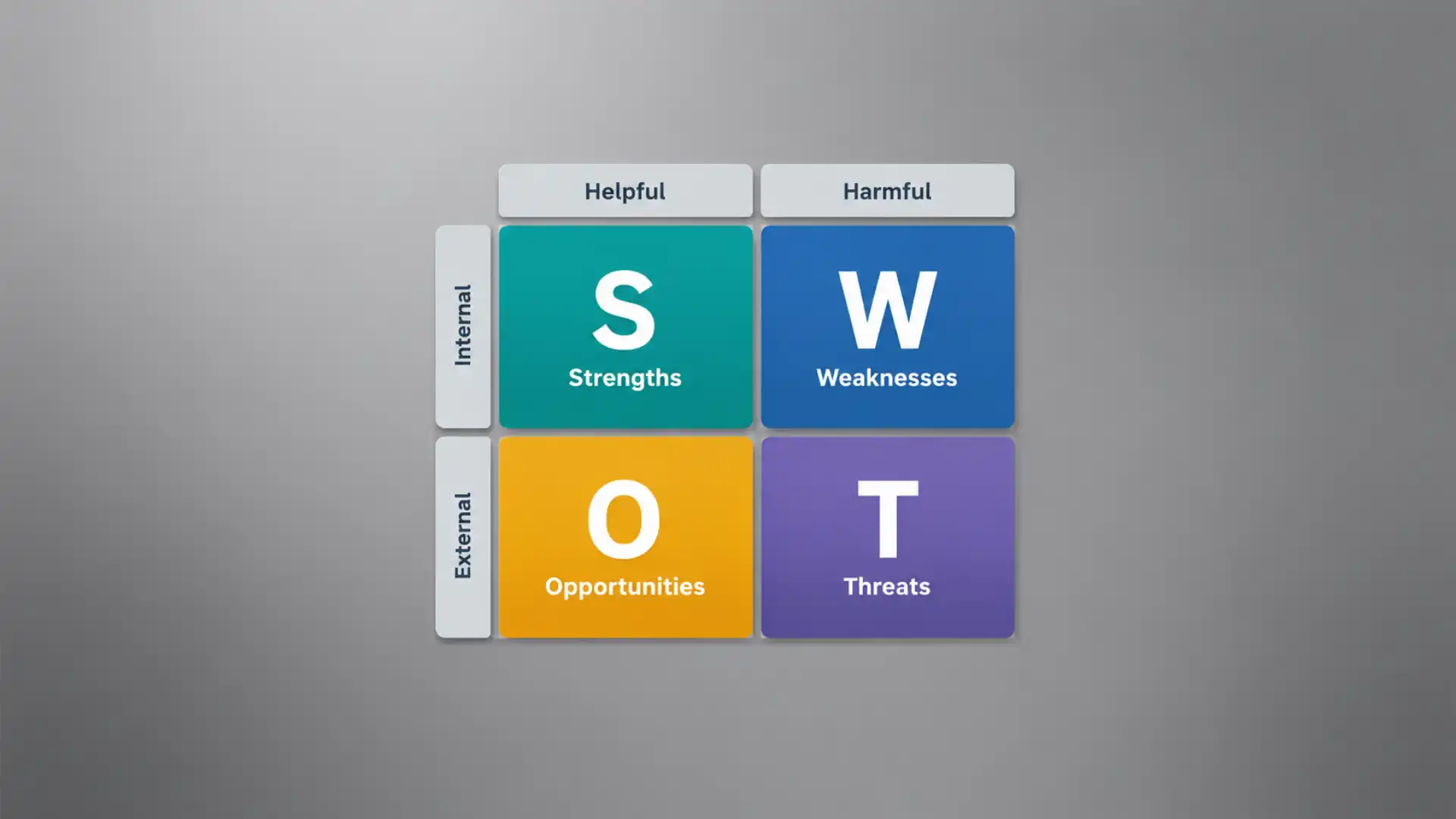
A brand SWOT used to be a meeting-room exercise. Teams gathered, wrote strengths, weaknesses, opportunities and threats on a board, and left with a matrix that often aged before anyone acted on it. AI changes the rhythm. It pulls more market signals into the room, compares customer language against competitor positioning, spots repeated complaints, maps content gaps, stress-tests brand claims and shows where a company is confusing itself. The risk is that speed makes weak thinking look rigorous. The opportunity is that AI turns SWOT from a static list into a disciplined decision system.
Table of Contents
Brand SWOT has moved from a workshop artifact to a live intelligence loop
SWOT analysis remains simple on the surface: strengths and weaknesses describe internal conditions, while opportunities and threats describe external forces. The familiar four-box model survives because it forces teams to separate what they control from what they face. Its weakness is also familiar. A rushed SWOT becomes a pile of opinions, obvious phrases and recycled assumptions. Harvard Business Review has criticized the common habit of doing SWOT as a list-making exercise without enough attention to the external change that should shape strategic action.
AI changes the method because it changes the evidence base. A brand team no longer has to rely only on annual research, quarterly reports, memory and a few competitor screenshots. Large language models, social listening systems, customer review analysis, search data, CRM segmentation, ad account exports, call transcripts and website analytics can be brought into the same strategic frame. The best AI-assisted SWOT does not ask a model to “think of strengths.” It asks the model to compare real evidence against a strategic question.
The shift matters because marketing leaders are under pressure to prove business value while adopting AI faster than their governance habits mature. McKinsey’s 2025 global AI survey found that reported revenue gains from AI are most common in marketing and sales, strategy and corporate finance, and product or service development. It also found that meaningful enterprise-wide bottom-line impact remains rare, with “AI high performers” representing about 6 percent of respondents. The difference was not model access. It was workflow redesign, leadership ambition and disciplined deployment.
That is the right frame for AI-assisted SWOT. The exercise is not about using a chatbot as a clever note-taker. It is about redesigning the way brand teams sense the market, define the problem, test strategic options and decide where to act. A weak brand can use AI and still get a weak SWOT. A strong brand can use AI badly and create a prettier version of the same old bias. AI improves SWOT only when it is tied to evidence, human judgment and decisions with owners, budgets and deadlines.
The practical consequence is sharp. Brand SWOT is no longer a once-a-year slide. It becomes a loop: collect signals, classify them, interpret their meaning, challenge the interpretation, connect the result to choices, measure what happened, and update the matrix when the market changes. The brand team still owns the judgment. AI changes the pace and scale of the input.
The news is not that marketers use AI, but that AI is entering strategy work
Marketing has already absorbed AI in execution. Copy variations, paid-search grouping, email subject lines, image generation, customer support replies and creative testing are now ordinary use cases. The more important shift is upstream. AI is moving into strategy work, where the risks are less visible and the cost of a wrong answer is higher.
The CMO Survey reported in 2025 that AI was powering 17.2 percent of marketing efforts, up 100 percent since 2022. It also reported that generative AI was being used across 15.1 percent of marketing activities, compared with 7.0 percent a year earlier. Respondents reported gains in sales productivity, customer satisfaction and lower marketing overhead costs, while the survey noted smaller progress in making generative AI outputs fit the brand and target markets.
That last point is the warning label. Brand fit is not a decorative issue. It is the difference between a brand using AI as a strategic instrument and a brand using AI as a content machine. When AI enters SWOT, it touches naming, category framing, target-market definition, differentiation, tone, trust, evidence and long-term positioning. Those are brand assets, not production tasks.
BCG’s 2025 survey of 200 CMOs found rising confidence around GenAI, with roughly 80 percent of surveyed CMOs expressing optimism and confidence. The firm also noted that marketing investment is shifting beyond efficiency toward growth, content, personalization and agentic workflows. That is exactly where SWOT becomes more exposed. A SWOT that once guided a campaign calendar may now guide automated personalization, customer journeys, answer-engine visibility, content systems and market-entry decisions.
AI does not merely produce more analysis. It changes what counts as timely analysis. A brand can ask, every week, whether complaints about service quality are rising in one region; whether competitors are changing price framing; whether customers describe a product category in different words from the brand; whether search demand is moving from “cheap” to “reliable”; whether a product feature once treated as a strength is now expected by default. The strategic advantage is not the matrix. It is the faster detection of when a quadrant has changed.
The danger is fake precision. A model can rank a “threat” as severe because a prompt asked for severity, not because evidence shows financial risk. It can infer customer motivation from weak data. It can mistake loud online communities for representative demand. It can produce a neat SWOT that hides uncertainty. Strategy teams need the discipline to ask: What data supports this? What data is missing? Which customer segment does this apply to? What decision would change if this is true?
The old SWOT problem was never the framework
SWOT’s reputation suffers because teams use it casually. The model itself is not the problem. The problem is that many SWOT sessions confuse brainstorming with diagnosis.
A useful SWOT has a strategic object. “Our brand” is too broad. “Our premium skincare brand’s ability to defend loyalty among women aged 30 to 45 in pharmacy retail over the next 18 months” is a strategy question. “Our B2B SaaS brand’s ability to win enterprise finance buyers against larger incumbents in German-speaking markets” is a strategy question. The narrower the object, the sharper the evidence.
The second requirement is separation. Strengths and weaknesses are internal realities. Opportunities and threats are external conditions. Brands often blur these categories. “Growing TikTok demand” is not a strength. It is an opportunity, unless the brand has proven distribution strength, creator access, content speed and conversion data in that channel. “Strong brand awareness” is not always a strength. It may be a vanity metric if awareness is high but associations are outdated, weak or wrong.
The third requirement is consequence. A SWOT item that does not affect a decision is noise. “Good team culture” is not a useful strength unless it explains faster launch cycles, stronger customer service, better creative judgment or lower hiring risk. “AI competitors” is not a useful threat unless the analysis identifies which competitors, which AI capability, which customer need and which revenue pool.
AI can improve all three requirements. It can force a prompt to define the objective, separate evidence by quadrant and link each item to a possible action. It can also make all three failures worse. A broad prompt will produce broad answers. A vague prompt will generate vague strategic language. A biased input file will produce a biased matrix.
The right stance is sober: AI does not make SWOT strategic. It makes evidence collection and pattern recognition faster. Strategy begins when people decide what the patterns mean.
Academic work on SWOT’s origins shows that the framework evolved from planning work around internal and external conditions, with roots in mid-20th-century corporate planning research rather than a single neat invention story. That history matters because SWOT was never meant to be a magic template. It was meant to support planning dialogue. AI should return it to that purpose, not turn it into an automated deck generator.
AI changes the evidence layer behind every quadrant
A traditional brand SWOT relies on visible evidence: market share, awareness studies, revenue data, media performance, customer feedback, staff knowledge, competitor activity. AI expands the evidence layer by making unstructured data easier to read. Reviews, comments, transcripts, survey open-text responses, sales notes, product returns, app-store complaints and support tickets can reveal brand truth that dashboards often miss.
For strengths, AI can find repeated positive language that customers use without being prompted. That matters because brands often describe their strengths in internal language. A company may say its strength is “innovation,” while customers say “it saves me from rework” or “it never breaks during peak season.” The customer phrase is more useful. It can guide positioning, landing pages, sales scripts and product naming.
For weaknesses, AI can group complaints by theme and severity. It can show that “price” complaints are really about unclear value; that “slow delivery” complaints spike only after promotions; that “confusing onboarding” is mentioned mostly by customers from one acquisition channel. A weakness becomes strategically useful only when it is specific enough to fix or to compensate for.
For opportunities, AI can scan shifts in search language, competitor pages, industry reports and customer questions. It can show demand forming around a use case before the brand names it internally. It can find white space where competitors over-index on technical features while buyers ask for implementation confidence. It can surface geographic or segment differences that a broad SWOT would flatten.
For threats, AI can detect pressure from regulation, substitute products, price comparison, low-cost entrants, reputation risk, changes in AI search visibility, creator backlash, counterfeit content or category commoditization. The threat quadrant is where brands most often underthink. They name the obvious competitor and miss the change in customer behavior that makes the competitor more dangerous.
The evidence layer must be auditable. Every serious AI-assisted SWOT should preserve source links, timestamps, sample size, geography, channel and confidence level. A board should not accept “AI found that customers dislike onboarding.” It should ask: From which customers? Which channel? Which time period? Compared with what baseline? What revenue segment is affected? What is the cost of doing nothing?
The strongest teams treat AI-generated SWOT items as claims requiring verification. They ask the model to cite the source, show the quote cluster, identify counterevidence and separate observation from interpretation. The matrix should never hide the trail from data to judgment.
AI-assisted brand SWOT is a method, not a prompt
A prompt can produce a SWOT. A method produces a defensible strategic view. The difference is process design.
A responsible AI-assisted brand SWOT begins with a clear decision. The team must know whether it is deciding market entry, repositioning, product messaging, investment allocation, content strategy, pricing architecture, customer retention or brand repair. Without a decision, SWOT becomes a document rather than a tool.
The next step is data selection. Useful inputs include brand guidelines, customer research, review exports, sales objections, win-loss notes, search data, social listening, competitor claims, pricing pages, campaign performance, media coverage, regulatory updates and product usage data. These sources should not be dumped into a model without care. Personal data should be removed or handled through approved systems. Sensitive commercial information needs access controls. Copyrighted materials need lawful use. Internal teams need to know which tools train on inputs and which do not.
Then comes extraction. AI can summarize themes, compare competitor claims, classify sentiment, identify recurring language, map audience questions, cluster complaints and flag contradictions. This stage is mechanical but not trivial. Prompts should force the model to separate raw observations from strategic interpretation. For example: “List only claims supported by at least three independent evidence points,” or “Flag any conclusion that comes from fewer than 50 customer records,” or “Identify where competitor positioning is inferred rather than stated.”
The interpretation stage belongs to humans with domain judgment. A model may see a threat in price discounting. A strategist may know the brand should not match discounting because premium trust is more profitable. A model may see an opportunity in viral short-form video. A founder may know the brand lacks the operational capacity to handle demand spikes. A model may see a weakness in low awareness. A brand lead may know the issue is not awareness but misattribution to a parent company.
The final stage is choice. Each SWOT item should connect to one of four strategic moves: use a strength, fix a weakness, pursue an opportunity, or reduce a threat. Many matrices stop before this point. AI can push teams beyond lists by generating decision options, expected trade-offs, required assets and evidence needed before action. The output should not be “Our strength is trust.” It should be “Use trust to justify a premium service tier for regulated buyers, supported by proof assets, customer case evidence and third-party validation.”
The strongest brands bring their own data to the model
Generic AI is a weak source of brand truth. It knows common patterns, not the lived reality of a specific customer base. The strongest AI-assisted SWOT systems depend on proprietary data: first-party customer records, consented research, CRM notes, product telemetry, support themes, brand tracking, loyalty behavior, community conversations and internal expertise.
IBM’s 2025 CMO study reported that 65 percent of surveyed participants said realizing the full value of generative AI depends on using proprietary data well. It also argued that brands cannot rely only on external data for targeting, attribution or customer modeling and need deeper direct customer relationships.
That point is central to SWOT. A model trained on public information can tell a coffee brand that convenience, quality, price and sustainability matter. It cannot know that the brand’s highest-margin customers buy after school drop-off, complain about parking, love one specific roast name and ignore the brand’s sustainability page. It cannot know that a B2B software brand loses deals because procurement mistrusts implementation timelines, not because the feature list is weak.
First-party data creates more precise quadrant entries. A strength becomes “customers renew because support solves integration issues within 24 hours,” not “good customer service.” A weakness becomes “enterprise buyers cannot find security documentation before sales calls,” not “poor communication.” An opportunity becomes “mid-market finance teams search for audit-ready reporting templates after regulation changes,” not “more content.” A threat becomes “low-cost competitors are using comparison pages that rank for our branded alternatives,” not “competition.”
The data advantage also creates responsibility. Brands must handle customer data lawfully and carefully. The GDPR remains the core EU privacy law for personal data processing, with requirements around lawful basis, transparency, rights and accountability. The UK ICO’s AI and data-protection guidance stresses governance, DPIAs, transparency, lawfulness, accuracy and fairness for AI systems that process personal data.
A brand that uses AI to understand customers must not betray those customers in the process. Data minimization, anonymization, access control and vendor due diligence are not legal footnotes. They shape trust. They also shape whether the SWOT is usable across the business or trapped in a risky experiment.
Public data still matters when it is treated as a signal, not proof
Public data is seductive because it is easy to scrape, search and summarize. Competitor websites, social feeds, marketplaces, Reddit discussions, LinkedIn posts, press releases, media coverage, job ads, patent databases and review platforms all contain useful signals. AI can read this material faster than a human team. It can compare claims, track changes, group themes and show where the brand’s language diverges from the market.
The trap is overconfidence. Public data is not the market. It is a visible slice of behavior, shaped by who posts, who complains, who gets amplified and which platforms dominate the category. A DTC brand may see loud TikTok criticism but stable repeat purchase. A bank may see low social engagement but strong trust among older customers. A B2B manufacturer may see little online discussion because decisions happen through distributors and field relationships.
AI-assisted SWOT should label public data as external signal, not customer fact. The model should be asked to classify evidence by source type: owned brand data, customer research, behavioral data, competitor statement, third-party report, public comment, search trend, regulatory source, or analyst interpretation. Each type has different weight.
Public data is especially useful for opportunity and threat detection. Competitor hiring patterns may reveal a push into AI support, retail media, regional expansion or compliance. Pricing-page changes may show new packaging logic. Customer reviews may expose unmet expectations. Search queries may show buyers reframing the category. Media coverage may signal reputational pressure.
Public data is weaker for internal strengths and weaknesses unless it is compared against internal evidence. A competitor’s website cannot prove your brand has weak differentiation. It can show that competitors are making similar claims. Internal win-loss data, customer interviews and conversion behavior decide whether that similarity hurts you.
The practical rule is simple: public data is a radar, not a verdict. AI gives brands a wider radar. Human teams still decide what is material.
The strength quadrant becomes more concrete under AI
Brand teams often fill the strength quadrant with flattering abstractions: reputation, quality, innovation, customer focus, expertise. AI can make the quadrant more concrete by forcing strengths to meet evidence tests.
A strength is not something the company likes about itself. It is an asset that improves the odds of winning a strategic choice. It may be emotional, operational, technical, relational, legal, cultural or distributional. Strong brands have assets that competitors cannot copy quickly: distinctive memory structures, trusted experts, channel access, community loyalty, proprietary data, service reliability, brand codes, category authority, local presence or hard-earned proof.
AI can identify these assets by comparing what a brand says, what customers repeat, what competitors lack and what behavior shows. If customers mention “no surprises” in reviews, the brand may have a reliability strength. If sales notes show buyers choose the brand after technical due diligence, the strength may be proof depth. If organic search brings non-branded demand around complex questions, the strength may be topical authority. If repeat customers buy without discounting, the strength may be perceived value.
The model should be asked to distinguish between current strengths, latent strengths and assumed strengths. Current strengths are proven in data. Latent strengths exist but are underused. Assumed strengths are internal beliefs without enough proof. This classification is useful because many brands sit on assets they do not use. A B2B company may have engineers who answer customer questions better than any content asset. A food brand may have regional heritage that matters to consumers but is absent from packaging. A SaaS company may have onboarding templates that reduce churn but are hidden behind sales calls.
AI can also expose overclaimed strengths. If the brand says it is “trusted” but reviews show trust concerns, that is not a strength. If the brand says it is “premium” but customers mention discounts more than quality, the claim is unstable. If the brand says it is “innovative” but competitors ship faster and own the category language, innovation is not yet a brand strength.
The strength quadrant should read like an inventory of usable advantage, not a list of compliments. AI makes that standard easier to enforce.
The weakness quadrant gets sharper when teams stop protecting internal assumptions
Weaknesses are uncomfortable because they expose gaps between brand promise and customer experience. AI can make this quadrant sharper by reducing the social pressure that often softens internal discussion. A model does not care that a senior leader loves a tagline. It can show that customers do not use that language. It does not care that a product team believes onboarding is simple. It can summarize hundreds of support tickets saying otherwise.
This is where AI’s impartial tone can be useful, but only if the input is honest. Teams must include negative evidence. A SWOT built only from campaign decks, brand guidelines and positive case studies will produce a polished lie. The model needs complaint data, lost-deal reasons, refund notes, customer-service transcripts, search queries that fail to convert, poor-performing content, sales objections and internal friction.
Useful weakness analysis separates symptoms from causes. Low conversion may be a symptom. The cause may be weak offer clarity, poor mobile speed, lack of trust proof, unclear pricing, bad audience fit, mismatched traffic, or a claim that customers do not believe. AI can cluster signals and propose possible causes, but the team must test them.
Weaknesses also have time dimensions. Some are urgent because they block revenue now. Some are structural because they limit future moves. Some are tolerable because the brand has strengths that compensate. A luxury hotel may tolerate a smaller room count because exclusivity supports pricing. A specialist agency may tolerate narrow service scope because focus builds authority. A local brand may tolerate lower tech maturity if community trust drives demand. Not every weakness needs fixing. Some need framing, buffering or conscious acceptance.
The worst weakness is not always the most visible complaint. It is often the gap that prevents a strategic opportunity. If a brand wants to use AI personalization but has fragmented consent, messy CRM data and no content governance, the weakness is not “AI skills.” It is data readiness. If a brand wants to appear in AI search results but has thin proof pages, weak author identity and generic content, the weakness is not “GEO.” It is authority architecture.
AI is good at naming operational gaps. It is less reliable at deciding which gaps matter most to strategy. That ranking should be tied to revenue, risk, trust, speed and difficulty.
The opportunity quadrant expands beyond campaign ideas
The opportunity quadrant often becomes a wish list: new markets, new channels, new audiences, partnerships, content, personalization, AI tools. AI-assisted SWOT can bring discipline by asking whether an opportunity has demand, timing, fit, assets and a credible path to capture.
AI is useful for detecting opportunity patterns. It can compare customer questions against existing content. It can find search topics where demand exists but competitor answers are weak. It can scan reviews for unmet needs. It can analyze social conversations for emerging use cases. It can identify segments where the brand’s strengths match a market shift. It can show where regulatory change creates demand for guidance, software, training or compliance support.
The rise of AI-mediated search adds a new opportunity layer. Google now publishes guidance for site owners on AI features such as AI Overviews and AI Mode, including how content may appear in these experiences. Google also says generative AI can be useful for research and structure, but warns that using AI tools to create many low-value pages may violate spam policies. For brand SWOT, this means content opportunity cannot be separated from authority, originality and proof.
A brand that answers real buyer questions with expert, verifiable content may gain visibility in search, answer engines and sales enablement. A brand that floods the web with generic AI pages may damage trust and search performance. Opportunity and threat sit close together.
AI can also reveal opportunities in internal reuse. Brands often create research, presentations, sales decks, training materials and expert answers that never reach the market. A model can audit internal material and identify assets that could become public guides, comparison pages, explainers, calculators, video scripts, sales emails or onboarding content. The opportunity is not more content for its own sake. It is turning trapped expertise into visible authority.
The opportunity quadrant should be scored against brand fit. A trend may be large but wrong for the brand. A channel may be growing but structurally hostile to the brand’s buying cycle. A content format may be popular but weaken premium perception. AI can surface opportunity. Brand strategy decides restraint.
The threat quadrant now includes synthetic confusion
Threats used to include competitors, price pressure, regulation, substitutes, macroeconomic shifts, supply constraints and reputation risk. Those still matter. AI adds a new class of threats: synthetic confusion.
Synthetic confusion appears when AI-generated content, fake reviews, cloned voices, deepfakes, misinformation, poor-quality automated pages, scraped brand assets, impersonation and answer-engine errors distort how customers encounter a brand. It can come from competitors, affiliates, scammers, dissatisfied users, careless partners or the brand itself.
The FTC’s Operation AI Comply actions in 2024 made clear that AI hype does not exempt companies from laws against unfair or deceptive conduct. The agency announced actions involving fake review tools, “AI lawyer” claims and AI-powered business opportunity schemes, stating that using AI tools to trick, mislead or defraud people is illegal. For brands, the threat is not abstract. AI can scale deception, but regulators still judge claims, evidence and harm.
Search and discovery systems add another threat. AI-generated answers may summarize, cite or omit brand information in ways the brand does not control. Google announced 2026 changes that give users more visibility into preferred sources within AI Overviews and AI Mode and a carousel for timely articles and perspectives. That shows search platforms are still adjusting the relationship between AI summaries and source visibility. For brands, the issue is strategic: a company must understand not only where it ranks but how answer systems describe it.
Google’s spam policies define scaled content abuse as generating many pages mainly to manipulate rankings rather than help users, regardless of how the content is made. Recent reporting also noted that Google updated spam policy language to include attempts to manipulate generative AI responses in Search. The brand threat is clear. “GEO” can become spam if it is treated as manipulation rather than authority building.
Synthetic confusion also threatens brand distinctiveness. If every competitor uses AI to produce the same benefit-led copy, the market fills with fluent sameness. Customers cannot tell who is credible, who is cheap, who is expert and who is merely well prompted. The defensive move is not to sound more polished. It is to build harder-to-copy proof: original research, named experts, customer evidence, real photography, product truth, distinctive language and consistent brand codes.
AI SWOT needs a source hierarchy
AI-assisted SWOT works only when sources have hierarchy. A founder’s belief, a customer quote, a peer-reviewed report, an internal revenue table, a search trend and a viral complaint should not carry the same weight. A model will blend them unless instructed otherwise.
A useful hierarchy starts with direct business evidence: revenue, margin, retention, conversion, churn, market share, product usage, customer lifetime value and service cost. These show whether brand claims are linked to behavior. Next comes direct customer evidence: interviews, surveys, reviews, support tickets, sales calls, community posts and complaints. Then comes competitive and market evidence: competitor positioning, pricing, media spend, search visibility, retail presence, product launches, hiring and partnerships. Then comes macro evidence: regulation, technology shifts, consumer confidence, culture, platform changes and category economics.
AI should label each SWOT item by evidence type and confidence. A high-confidence strength might be supported by renewal data, customer language and sales win notes. A low-confidence opportunity might be based on a growing search topic but no internal proof of conversion. A high-severity threat may be supported by regulatory deadlines and current product gaps.
This discipline reduces the risk of treating generative output as fact. It also makes the SWOT easier to debate. A commercial leader can challenge the revenue link. A legal lead can challenge regulatory interpretation. A customer-service lead can challenge complaint severity. A brand strategist can challenge whether an opportunity fits positioning.
NIST’s AI Risk Management Framework is relevant here because it frames AI risk management around design, development, use and evaluation, and is intended to incorporate trustworthiness considerations into AI systems. A brand SWOT process is not usually a high-risk AI system, but it still benefits from the same habit: map the use, measure risk, manage the output and govern the process.
Source hierarchy turns AI SWOT from a fluent opinion into a traceable business artifact. Without it, the matrix may look professional and still be strategically weak.
AI-assisted brand SWOT inputs by quadrant
| SWOT quadrant | Best AI-supported inputs | Human judgment required |
|---|---|---|
| Strengths | Customer praise clusters, retention reasons, win-loss notes, brand search demand, proof assets | Decide which assets create defendable advantage |
| Weaknesses | Complaint themes, lost-deal reasons, low-converting pages, support tickets, inconsistent messaging | Decide which gaps block strategy and which are tolerable |
| Opportunities | Search shifts, unmet questions, competitor claim gaps, regulatory change, segment demand | Decide fit, timing, investment level and brand permission |
| Threats | Substitute offers, AI search volatility, deceptive content, legal deadlines, price pressure | Decide severity, likelihood and defensive moves |
This table is compact by design. The point is not to make SWOT mechanical. It shows that AI belongs mainly in evidence extraction and comparison, while people own strategic interpretation and trade-offs.
Brand memory is a new competitive asset
Brand memory is the shared set of meanings, associations, proof points, codes and experiences that customers recall when they encounter a name. AI makes brand memory more important, not less. When markets fill with AI-generated sameness, memory structures help customers recognize and trust a brand quickly.
AI-assisted SWOT can audit brand memory by comparing internal identity against external perception. The model can read brand guidelines, ads, landing pages, sales decks, social posts and customer language, then identify mismatches. Does the brand keep changing its promise? Are product names consistent? Do sales teams use a different value story from marketing? Do customers remember a feature the brand barely promotes? Do competitors own words the brand wants to use?
This work matters for strengths and weaknesses. A distinctive visual system, phrase, founder story, product ritual, community norm, proof pattern or service behavior can be a strength. Inconsistency, generic tone, unclear architecture and fragmented naming can be weaknesses. AI can spot repeated phrasing and gaps across large bodies of material. Humans must decide what to keep, what to discard and what to make famous.
Brand memory also affects AI search and answer engines. If a brand has consistent entity signals across its site, media coverage, expert profiles, structured content and third-party references, machines have a better chance of understanding who the brand is and what it is authoritative about. If a brand describes itself ten different ways, the market will not remember it and AI systems may not either.
The discipline is not to freeze the brand. It is to protect distinctiveness while adapting to market language. A brand may need to use buyer terms for discovery and still retain its own voice once discovered. AI can map both layers: the language customers search with and the language the brand should own.
A useful AI SWOT asks whether the brand is becoming easier or harder to remember. That question cuts through many tactical debates.
AI exposes the gap between brand voice and customer language
Brand voice is often written as a personality guide: confident, friendly, expert, bold, warm, simple, premium. Those words rarely guide hard decisions. AI can make voice analysis more practical by comparing voice against customer language at scale.
The question is not whether the brand “sounds human.” The question is whether the brand’s language reduces friction, builds trust and strengthens memory among the right customers. AI can compare customer questions with website copy. It can show where the brand uses internal terms that buyers do not understand. It can find claims that sound similar to competitors. It can detect overused phrases, vague adjectives and unsupported superlatives. It can also flag where customer language is more persuasive than brand copy.
For example, a cybersecurity company may describe its platform as “unified threat intelligence.” Customers may say they bought it because “it tells us which alerts actually matter.” The second phrase is closer to buying motivation. A premium food brand may say “crafted for discerning palates.” Customers may say “it tastes like the one my grandmother made.” The second phrase carries memory and emotion. A recruitment brand may say “talent acquisition solutions.” Employers may say “we need people who stay past six months.” The second phrase names pain.
AI can extract this language, but it cannot decide brand taste. Customer language is not always suitable for public positioning. It may be too blunt, too technical, too narrow or too tied to one segment. The brand team must translate customer truth into brand expression.
This is where AI-assisted SWOT connects to creative judgment. A weakness may be “brand language does not match buyer language.” A strength may be “customers use unusually emotional language about reliability.” An opportunity may be “competitors explain features while customers ask for outcomes.” A threat may be “AI-generated competitor content is flooding the category with similar claims.”
The solution is not to let AI write everything. It is to use AI to reveal the language gap, then let skilled writers and strategists create sharper expression. Voice remains a human craft. AI makes the evidence harder to ignore.
Competitor analysis becomes more useful when it moves beyond feature comparison
Many brand SWOTs over-focus on direct competitors. They compare features, prices, campaigns and social followings. That work has value, but AI allows a richer view: claim architecture, proof quality, audience targeting, answer coverage, content depth, customer friction, hiring signals, product direction, review patterns and search visibility.
AI can scrape and summarize competitor pages, but the useful output is not “Competitor A offers X and Competitor B offers Y.” The useful output is: Which claims are overused? Which claims are backed by evidence? Which customer anxieties are ignored? Which competitors are moving upmarket? Which are using education to build trust? Which have weak proof? Which segments are underserved? Which competitor pages appear in AI answers or organic search for high-intent questions?
The brand’s threat quadrant becomes stronger when it includes competitor momentum, not just competitor existence. A small competitor with fast message-market fit may be a bigger threat than a large incumbent with stale positioning. A substitute product may be more dangerous than a direct competitor because it reframes the customer’s problem. A marketplace, AI agent or platform feature may absorb demand without looking like a brand rival.
Competitor analysis also sharpens strengths. A brand may discover that all rivals claim speed, but only one has audited turnaround data. If that brand owns the proof, speed can be a strength. Another brand may discover that competitors all sound expert but hide the people behind the work. Named expert identity becomes a strength. Another may find that competitors publish content but avoid pricing clarity. Transparent pricing can become a differentiator.
AI should be instructed to separate competitor claims from competitor capabilities. Public pages show what competitors want buyers to believe. Reviews, case studies, hiring, product releases and customer movement give a better view of capability. A competitor’s message is not a fact. It is a signal.
The final strategic question is not “What are competitors doing?” It is “Which competitor move changes the basis of choice for our target customer?” AI can widen the scan. Strategy narrows the answer.
Customer reviews and support tickets reveal brand reality faster than slogans
Customer reviews, support tickets and call transcripts are often the most honest brand documents a company owns. They show where promise meets experience. AI can read them at scale and identify patterns that would take teams days or weeks to extract manually.
For SWOT, these sources are especially strong because they connect emotion, language and operational reality. A review may reveal gratitude, irritation, confusion, surprise or betrayal. A support ticket may show a product gap. A call transcript may show a sales objection. A return note may show unclear sizing, weak expectation-setting or poor packaging. A community thread may show how customers teach each other to use the product when the brand’s own education fails.
AI should classify these signals by theme, severity, frequency, customer segment, journey stage and business effect. A high-frequency complaint among low-value customers may matter less than a low-frequency complaint among enterprise buyers. A small irritation may become a major weakness if it appears at the exact moment of conversion. A repeated compliment may become a strength if it explains retention.
This work needs privacy and governance. Customer data may include personal information, health details, financial context or sensitive commercial facts. The model and workflow must match the sensitivity of the data. Teams should not paste raw customer transcripts into public tools without approval. The ICO’s guidance on AI and data protection is clear that AI projects need attention to transparency, lawfulness, fairness, DPIAs and governance when personal data is involved.
The brand value is substantial. Many companies spend heavily on brand campaigns while ignoring thousands of customer comments that explain exactly why trust rises or falls. AI makes that neglect harder to justify. The customer already wrote part of the SWOT. The brand’s task is to listen without defensiveness.
Search data turns SWOT into demand analysis
Search behavior is one of the clearest signals of market demand because people reveal intent in their own words. AI-assisted SWOT can use search data to connect brand strategy with questions, problems, comparisons and category shifts.
Search data can strengthen every quadrant. Brand search growth may be a strength if it reflects demand, not just paid media. A lack of visibility for high-intent queries may be a weakness. Rising demand for a related use case may be an opportunity. Competitors owning comparison queries may be a threat. Search queries can also reveal that the brand’s category label is wrong, too narrow or too technical.
The rise of AI search complicates this work. Ranking is still important, but brands also need to understand whether their content is cited, summarized or ignored by AI-generated answers. Google’s documentation for AI features explains how AI Overviews and AI Mode relate to website content and site-owner controls. Independent research published in 2026 has also examined how AI Overviews activate across query types, choose sources and differ from traditional results, underscoring that AI-mediated search is changing source visibility.
For brand SWOT, this creates a new class of opportunity and threat. Opportunity: a brand with original expertise, clear entity signals and useful content may be surfaced in answer environments. Threat: a brand with generic content, weak proof or unclear authority may lose visibility even if it once ranked well in classic search.
Google’s guidance on generative AI content is relevant because it separates helpful use from scaled low-value production. It says generative AI can be useful for research and structure, but warns against generating many pages without adding value for users. That should shape the opportunity quadrant. AI content at scale is not automatically an opportunity. It becomes one only when the brand adds original knowledge, evidence, expertise and usefulness.
Search-informed SWOT turns “content opportunity” into a demand map. It shows not just what the brand wants to say, but what the market is trying to understand.
GEO makes authority part of the opportunity quadrant
Generative engine optimization, or GEO, is the practice of improving a brand’s chance of being understood, trusted and cited by AI answer systems. The term is new enough to attract hype, and some of that hype is dangerous. GEO should not mean tricking models. It should mean making brand knowledge clear, verifiable, original and useful across the web.
In an AI-assisted SWOT, GEO belongs mainly in opportunities and threats. A brand may have an opportunity to become the cited authority in a niche because it has data, experts or case evidence competitors lack. It may face a threat because AI systems summarize category advice without mentioning the brand, or because third-party sites define the brand inaccurately.
A healthy GEO strategy starts with entity clarity. Machines need to understand the brand name, organization, people, products, locations, categories, proof points and relationships. This requires consistent structured information, clear about pages, named authors, expert bios, original research, schema where relevant, strong internal linking and third-party validation. It also requires content that answers real questions directly without hiding behind marketing language.
Google’s 2026 search update about preferred sources, AI Overviews and original reporting shows that source visibility and publisher recognition remain active platform concerns. Brands should read that as a signal: authority is not only a ranking issue. It is a trust and citation issue.
The threat is spammy GEO. If a brand tries to manipulate AI answers through low-quality best-of pages, synthetic mentions, thin comparison content or fake authority, it risks search penalties and reputational harm. Google’s spam policies already address scaled content abuse, and recent coverage noted that manipulation of generative search responses is within the policy conversation.
The opportunity is to become easier to cite because the brand is genuinely useful. AI-assisted SWOT should not reward shortcuts. It should ask where the brand has proof that deserves to travel.
The EU AI Act brings transparency into brand planning
Regulation is now part of brand SWOT for any company using AI in customer-facing, employee-facing or public communication contexts. The EU AI Act entered into force on August 1, 2024, with staged application. The European Commission states that prohibited AI practices and AI literacy obligations applied from February 2, 2025, GPAI model obligations applied from August 2, 2025, and transparency rules are due from August 2026.
Brand teams may be tempted to treat this as a legal department issue. That is too narrow. Transparency affects brand trust, content operations, customer service, chatbots, synthetic media, influencer campaigns, AI-generated public-interest text and internal training. The AI Act’s transparency-risk section says people should be informed when interacting with AI systems such as chatbots, and that providers of generative AI must ensure AI-generated content is identifiable; certain AI-generated content, including deepfakes and public-interest text, should be clearly labelled.
For a brand SWOT, this creates weaknesses, opportunities and threats. A weakness may be lack of AI content labelling process. An opportunity may be to build trust through plain disclosure before competitors do. A threat may be regulatory exposure, customer backlash or platform removal when synthetic media is unclear. A strength may be an existing compliance culture that allows the brand to adopt AI faster and more safely.
The legal text of Regulation (EU) 2024/1689 lays down harmonised rules on artificial intelligence and amends existing EU laws across sectors. That matters because brands often operate across borders through websites, marketplaces, paid media and customer-service tools. Even companies outside the EU may need to consider EU obligations if their AI systems or outputs are used in the EU market.
The strategic point is not fear. It is maturity. AI transparency is becoming part of brand experience. A brand that tells customers when AI is involved, explains what humans review and protects sensitive data may earn more trust than a brand that hides automation until something goes wrong.
Privacy and consent decide which AI opportunities are real
Many AI opportunities in brand strategy depend on data: personalization, audience modelling, predictive churn, content recommendations, customer-service automation, loyalty triggers, next-best action, dynamic offers and segment-specific messaging. Those opportunities are real only if the brand has lawful, clean and usable data.
This is where many SWOTs become unrealistic. A team lists “personalized customer journeys” as an opportunity, but the brand has fragmented consent records, poor identity resolution, incomplete CRM fields, unclear data retention and no agreement on which tools can process customer data. The opportunity exists in theory. In practice, data readiness is a weakness.
The GDPR requires organizations to handle personal data under a lawful basis, with transparency and accountability. AI adds complexity because models may infer sensitive attributes, combine data sources, generate profiles or produce outputs that affect individuals. The ICO’s AI guidance highlights DPIAs, transparency, lawfulness, accuracy and special-category data considerations.
A serious AI-assisted SWOT should include a privacy-readiness review. Which customer data is consented? Which data is necessary? Which fields are unreliable? Which vendors process data? Where is data stored? Which teams have access? What is the policy for prompt inputs? What is logged? What is used for training? How are customers informed?
This review may sound operational, but it is strategic. A brand with clean consented first-party data has a strength. A brand with messy, risky data has a weakness. Privacy regulation can be a threat. Trustworthy data practices can be an opportunity, especially in categories where customers worry about surveillance, discrimination or misuse.
The brand promise must match the data practice. A wellness brand that claims empathy while using opaque data profiling damages trust. A financial brand that promises security while pasting customer details into unapproved AI tools creates risk. A retail brand that personalizes without clear controls may feel invasive.
The AI opportunity is only as strong as the consent and governance underneath it.
Copyright and ownership reshape creative SWOT
Generative AI raises hard questions about creative ownership, training data, imitation and output protection. These questions belong in brand SWOT because they affect campaigns, product imagery, packaging, slogans, visual identity, influencer work, social content, editorial production and internal creative systems.
The U.S. Copyright Office’s AI initiative has been releasing reports on copyright and artificial intelligence, including digital replicas, copyrightability and generative AI training. Its overview notes that Part 2 addresses copyrightability of outputs created using generative AI and Part 3 addresses training. Reporting on the Copyright Office’s Part 2 analysis emphasized that human authorship remains central and that works generated solely from prompts may not qualify for copyright protection, while AI-assisted works with meaningful human creative contribution may be evaluated differently.
For brands, the SWOT implications are practical. A strength may be a strong internal creative team that uses AI as a sketching and variation tool while preserving human authorship. A weakness may be reliance on AI-generated assets without documentation of human contribution or licensing. An opportunity may be faster prototyping, localization and concept testing. A threat may be infringement claims, weak ownership, lookalike creative or reputational backlash from using synthetic images in sensitive contexts.
WIPO notes that generative AI is increasing the need for copyright infrastructure that protects creators while allowing innovation. The advertising industry is also moving toward clearer guidance. The UK Advertising Standards Authority said in 2025 that there is no blanket UK requirement to disclose AI use in ads, but disclosure may be needed depending on context, rules, platform expectations and the risk of misleading people.
Creative SWOT should ask not “Can AI make this?” but “Can the brand safely use, own, defend and explain this?” Those are different questions. AI can produce a striking image. It cannot guarantee that the image fits the brand’s ethics, customer expectations, licensing position or long-term memory structure.
Brand creativity is not just output. It is judgment, provenance and meaning.
Trust becomes both a strength and a scarce market resource
AI adoption is rising, but trust is uneven. Stanford HAI’s 2025 AI Index reported that 78 percent of organizations used AI in 2024, up from 55 percent the previous year, and that global private investment in generative AI reached $33.9 billion in 2024. Business use is moving faster than public comfort in many markets.
Edelman’s 2025 trust analysis for the technology sector found sharp differences in AI trust by market: 72 percent of people in China expressed trust in AI, compared with 32 percent in the U.S. It also reported that only 44 percent of people globally felt comfortable with businesses using AI. These figures matter for brand SWOT because customer acceptance is not guaranteed. AI can be a strength for one category and a threat for another.
Trust should be assessed at the level of use case. Customers may accept AI for delivery updates but reject it for financial advice. They may accept AI-generated product recommendations but dislike synthetic customer-service empathy. They may accept AI-assisted content if it is accurate and labelled, but reject fake human reviews or undisclosed synthetic influencers.
A brand with high trust has more permission to test AI in visible ways, but also more to lose. A low-trust brand may not repair perception by adding AI. It may deepen suspicion. AI can make service faster, but speed without accountability feels cold. AI can personalize offers, but personalization without transparency feels invasive. AI can produce content, but content without expertise feels disposable.
Trust should appear explicitly in SWOT. Strength: customers believe the brand’s expertise and accept its guidance. Weakness: customers already doubt claims, making AI claims risky. Opportunity: transparent AI use can signal competence. Threat: hidden automation can trigger backlash.
The strongest brand position is not “we use AI.” It is “we use AI in defined ways, with human accountability, to serve a customer need, and we can explain the limits.” Trust grows when the brand’s use of AI is legible.
AI claims need evidence before they enter the brand story
AI has become a marketing term, and that makes regulators alert. The FTC’s 2023 guidance “Keep your AI claims in check” warned companies not to exaggerate what AI products can do, not to claim AI superiority without proof, not to ignore risks and not to claim a product uses AI when it does not. The FTC later brought Operation AI Comply actions against companies accused of using AI hype or AI tools in deceptive ways.
For brand SWOT, AI claims can be strengths, weaknesses, opportunities or threats. A proven AI capability that improves customer outcomes may be a strength. A vague “AI-powered” message without substantiation is a weakness. A market that wants explainable automation may be an opportunity. A regulator, journalist or customer testing unsupported claims is a threat.
The practical rule is to separate AI as technology from AI as proof. “AI-powered” is not proof. “Reduces manual invoice matching time by 42 percent in a controlled customer pilot” is proof if the evidence is sound. “Uses machine learning to flag anomalous claims for human review” is clearer than “AI fraud protection.” “Drafts first-response emails for trained advisors to approve” is clearer than “automated customer care.”
A brand should keep an AI claims register. It should list every public AI claim, where it appears, what evidence supports it, who approved it, what limitations apply and when it was last reviewed. This is not bureaucracy for its own sake. It protects the brand from hype drift, where sales decks, ads, investor materials and website copy slowly become more confident than the product.
AI-assisted SWOT can audit this register. It can compare public claims with product documentation, customer outcomes, legal language and support complaints. It can flag overstatement. It can also show where the brand is underclaiming a real capability.
The brand story should not use AI as glitter. It should use AI only where the customer benefit is true, explainable and provable.
The threat of sameness is larger than the threat of automation
Many teams worry that AI will automate marketing jobs. That concern deserves serious workforce discussion. For brand strategy, a quieter threat may be more immediate: sameness. When every brand uses similar prompts, similar benchmarks and similar “best practice” playbooks, the market gets filled with similar claims, structures and tones.
AI models are trained to produce plausible patterns. Plausible is often the enemy of distinctive. A brand that relies on AI defaults will sound fluent, safe and forgettable. It may use the same structure as competitors: problem, solution, benefits, proof, call to action. It may overuse the same adjectives. It may answer questions correctly but without memory. It may become searchable but not memorable.
SWOT can identify this as a weakness or threat. If competitor content looks and sounds similar, the brand must decide where distinctiveness will come from. It may come from a proprietary point of view, a founder voice, original data, category contrarianism, product ritual, service experience, visual system, humor, local relevance, expert identity or community participation. AI can assist these choices by mapping sameness, but it cannot supply courage.
There is a second sameness problem. AI tends to average customer language. It may flatten minority segments, premium buyers, expert users or culturally specific meanings. A brand that serves a niche cannot let the model pull it toward the middle. The point of brand strategy is often to choose who the brand is for and who it is not for.
AI can be useful as a sparring partner. Ask it to identify generic phrases, competitor overlap, missing proof, weak tension and claims that could appear on any rival’s website. Then ask skilled humans to sharpen the idea. A writer, strategist or creative director should be able to say: “This is accurate, but no one will remember it.”
The brands that win with AI will not be the ones that produce the most fluent content. They will be the ones that preserve distinctiveness while increasing intelligence.
The AI SWOT process should include red-team thinking
A SWOT without challenge becomes confirmation bias. AI can reinforce that bias if teams ask for validation rather than critique. Red-team thinking means deliberately testing the matrix against uncomfortable possibilities.
For each strength, ask: Under what condition would this stop being a strength? Which competitor could neutralize it? Does the data prove it, or do we simply believe it? Does the customer value it enough to pay, stay or recommend?
For each weakness, ask: Is this truly internal? Is it a symptom of a market shift? Does fixing it create a new problem? Are we avoiding it because it belongs to a powerful team? Is the weakness actually a strategic choice?
For each opportunity, ask: What would make this opportunity unattractive? Which brand asset gives us permission to pursue it? What would it cost to capture? What would we stop doing? Could a competitor move faster?
For each threat, ask: What early-warning signal would prove it is getting worse? What would we do if it happened next quarter? Which threat is slow but severe? Which threat is loud but minor?
AI can support red-team work by generating counterarguments, alternative explanations, pre-mortems and scenario tests. But the prompt must demand evidence and severity. A generic “challenge this SWOT” prompt may produce theatrical objections. A better instruction asks the model to identify unsupported claims, missing data, contradictions between sources, weak causal logic and items that do not connect to a decision.
Red-team thinking also reduces executive bias. Senior leaders often overrate strengths tied to past success and underrate threats from new behavior. AI can show pattern changes, but teams need a culture where bad news can be discussed.
The most useful AI SWOT is the one that survives challenge, not the one that impresses in a meeting.
Agentic AI will push SWOT from analysis into action
Agentic AI refers to systems that can plan and execute multi-step tasks with less constant human instruction. In brand work, agents may monitor competitors, summarize customer feedback, draft content briefs, update dashboards, alert teams to anomalies, generate research questions, route insights to owners and track whether actions are completed.
This moves SWOT closer to an operating system. Instead of running a quarterly analysis, a brand may maintain a live SWOT dashboard where evidence updates automatically. A spike in “delivery delay” complaints could update a weakness score. A competitor’s new pricing page could update a threat alert. A rise in search demand for a niche use case could update an opportunity watchlist. A new customer case study could strengthen a proof asset.
The risk is automation without accountability. If agents update strategy inputs, teams need rules: Which sources are monitored? Which changes trigger review? Who approves quadrant changes? Which alerts are noise? Which actions can an agent take without human approval? Which actions require legal, brand or data review?
The EU AI Act’s risk-based approach and transparency obligations make this question more serious as AI systems become more embedded in workflows. NIST’s AI RMF also encourages organizations to manage risks across AI design, development, use and evaluation. Brand teams do not need to turn every SWOT dashboard into a compliance drama. They do need proportionate controls.
Agentic workflows may suit large brands with mature data systems. Smaller brands can still use lighter versions: monthly AI-assisted review of customer comments, quarterly competitor signal scans, weekly search-query checks and a simple action tracker. The goal is not technical complexity. It is regular sensing.
When AI moves from analysis to action, governance moves from optional to central.
Human oversight is not a ceremonial approval step
Human oversight often gets reduced to “someone reviews the output.” That is too weak. In AI-assisted SWOT, human oversight means defining the problem, selecting evidence, interpreting trade-offs, judging brand fit, checking legal risk, choosing action and accepting accountability.
A junior marketer can review grammar. A strategist must review logic. A legal lead must review regulated claims. A data-protection lead must review personal data use. A product lead must review capability claims. A sales lead must review buyer reality. A customer-service lead must review operational pain. Brand SWOT touches many forms of knowledge, so oversight should match the question.
The OECD AI Principles, adopted in 2019 and updated in 2024, promote trustworthy AI that respects human rights and democratic values, including transparency, explainability, privacy, accountability and human-centered stewardship. These principles may sound broad, but they translate into daily brand practice. People affected by AI-mediated brand decisions should not be invisible. Customers, employees, creators, partners and communities all carry risk when automation scales poor judgment.
Human oversight should also protect originality. AI can summarize common category logic, but it cannot know what the brand should dare to say. It can recommend safe moves. It can miss the creative tension that makes a campaign work. It can generate a matrix that looks balanced but lacks strategic force.
The best human reviewers ask sharper questions than the model answers. What are we refusing to admit? Which strength is overvalued? Which weakness is killing trust? Which opportunity fits our unfair advantage? Which threat would make our current plan obsolete? What will we stop doing?
Human oversight is not there to bless AI output. It is there to turn output into accountable strategy.
AI-assisted SWOT changes the role of agencies
Agencies that sell strategy as workshop performance are exposed. If a client can generate a basic SWOT in minutes, the agency must provide something better: judgment, evidence design, category expertise, creative translation, governance, interpretation and action.
AI does not remove the need for agencies. It raises the bar. A strong agency can build research workflows, clean inputs, interrogate model output, connect SWOT to positioning, test strategic options, design measurement and turn insights into creative work. A weak agency will use AI to produce longer decks faster.
For agencies, the opportunity is to become the client’s strategic intelligence partner. That may include maintaining competitor maps, customer-language libraries, brand proof repositories, prompt systems, content-quality rules, AI disclosure policies and live opportunity trackers. It may include training client teams to use AI without damaging brand voice. It may include auditing AI-generated content for sameness, unsupported claims and search risk.
The threat for agencies is margin pressure on generic output. Clients may not pay premium fees for first drafts, keyword lists or basic summaries. They will pay for decisions that reduce risk, reveal opportunity and create commercial movement. Agency value moves from producing artifacts to improving judgment.
This shift also changes talent. Strategy teams need people who understand research, data, prompts, brand, SEO, regulation and creative development. They do not need everyone to be a machine-learning expert. They need enough AI literacy to know where models help, where they fail and how to interrogate output.
Agencies that use AI well will spend less time assembling obvious slides and more time on the hard part: what the brand should do. That is a healthier business, but it demands courage because it removes the comfort of volume.
Smaller brands gain access, but not immunity from error
AI-assisted SWOT is especially powerful for small and mid-sized brands because it lowers the cost of analysis. A founder, marketing manager or local business owner can now analyze reviews, compare competitors, identify search gaps and draft strategy options without a large research budget. That access matters.
A small restaurant group can analyze customer reviews across locations and find that “friendly staff” is a strength in two branches but not the third. A local clinic can identify patient questions that its website fails to answer. A regional manufacturer can compare competitor claims in export markets. A niche e-commerce brand can analyze refund reasons and discover that sizing uncertainty, not product quality, drives returns.
The risk is that smaller brands may use public AI tools without data controls, accept hallucinated sources, copy generic advice or overreact to small samples. They may mistake a model’s confident tone for expertise. They may paste customer data into tools without checking privacy terms. They may produce content at scale that weakens search trust.
Small brands need a simpler version of governance: do not upload sensitive data to unapproved tools; keep source links; verify facts; avoid unsupported claims; label AI use where appropriate; review outputs for brand fit; tie SWOT items to decisions; track results. This is not heavy compliance. It is basic discipline.
AI also gives smaller brands a chance to compete on clarity. Large brands often suffer from internal complexity. Smaller brands can move faster, speak more directly and build personal trust. AI can amplify that advantage if it helps the team listen better and decide faster. It can also erase it if the brand starts sounding like every template online.
For small brands, AI SWOT is useful when it protects specificity. The local truth is the advantage.
Enterprise brands need governance before scale
Enterprise brands face the opposite problem: too much data, too many teams, too many markets, too many tools and too many versions of the brand story. AI-assisted SWOT can unify intelligence, but without governance it can multiply confusion.
An enterprise may have regional teams creating separate SWOTs with different inputs, agencies using different tools, product teams making unapproved AI claims, sales teams feeding sensitive data into public systems, and content teams publishing AI-assisted pages without consistent review. The result is not intelligence. It is fragmentation.
Enterprise governance should define approved tools, data classes, prompt rules, disclosure standards, source requirements, review roles, brand-voice controls, legal escalation, AI claims evidence and recordkeeping. It should also define what kind of SWOT belongs at which level: corporate brand, product line, market, audience segment, campaign, channel or reputation issue.
A corporate SWOT may focus on trust, architecture, portfolio, regulation and market position. A product SWOT may focus on feature proof, buyer pain, competitors and adoption barriers. A local-market SWOT may focus on culture, regulation, distribution and language. AI can connect these layers, but people must decide which layer drives action.
Enterprise brands also need a knowledge base. AI systems perform better when they have clean, current brand material: positioning, approved claims, product facts, legal disclaimers, tone rules, customer research, case evidence, FAQ, competitor notes and forbidden claims. Without this, teams rely on generic model knowledge or outdated files.
The strategic benefit is speed with consistency. A global team can see patterns across regions while preserving local nuance. A compliance team can catch claim drift. A brand team can detect voice fragmentation. A sales team can use fresh evidence.
For enterprise brands, the AI SWOT advantage comes from controlled scale, not uncontrolled access.
Measurement must connect SWOT to commercial movement
A SWOT that does not change measurement is decorative. AI-assisted SWOT should end with measurable hypotheses. If this is a strength, what behavior should it improve? If this weakness is fixed, which metric should move? If this opportunity is pursued, how will we know it is real? If this threat grows, what early warning metric will show it?
Measurement should be tied to the strategic object. For brand positioning, useful metrics may include unaided associations, branded search, direct traffic, share of search, consideration, conversion quality, premium tolerance, sales-cycle movement and win-loss reasons. For content and GEO, metrics may include query coverage, citation presence, expert-page engagement, assisted conversions, branded mentions, answer inclusion and content quality audits. For trust, metrics may include review sentiment, complaint themes, disclosure acceptance, customer-service satisfaction and churn. For AI claims, metrics include claim approvals, substantiation records, complaints and regulatory issues.
AI can support measurement by linking signals. It can compare pre- and post-change customer language. It can analyze whether objections decline after new proof assets launch. It can detect whether support tickets shift after onboarding changes. It can track competitor claim changes. It can summarize sales-call themes by month.
The danger is measuring what AI can easily count rather than what strategy needs to know. More content is not success. Faster drafts are not brand growth. More personalization is not trust. More SWOT items are not insight.
The CMO Survey’s reported gains in sales productivity, customer satisfaction and overhead cost reduction show that marketers are beginning to measure AI effects, not just adoption. McKinsey’s finding that workflow redesign is strongly associated with AI high performance reinforces the point: value comes when AI changes the work, not when it decorates the work.
A good AI-assisted SWOT ends with a measurement plan that proves or disproves the strategic bet.
The TOWS layer turns SWOT into action
SWOT identifies conditions. TOWS turns those conditions into strategic options by pairing quadrants: strengths with opportunities, strengths with threats, weaknesses with opportunities, and weaknesses with threats. AI can make this step faster and more disciplined.
Strength-opportunity moves ask how the brand can use an existing asset to capture an external opening. For example, a brand with strong technical trust may create compliance-focused content when regulation changes. A brand with loyal community may launch a referral program when category demand rises. A brand with distinctive customer support may use AI triage to protect service quality while scaling.
Strength-threat moves ask how the brand can use an asset to defend against pressure. A premium brand may use proof and service guarantees to resist discount competitors. A regulated brand may use compliance credibility to counter AI hype. A local brand may use community presence to defend against marketplace commoditization.
Weakness-opportunity moves ask which internal gap must be fixed to capture an opening. A brand may need cleaner product data before AI personalization. It may need expert author pages before answer-engine visibility. It may need pricing clarity before entering comparison-heavy search results.
Weakness-threat moves ask where the brand is exposed. Generic content plus AI search volatility is a dangerous pair. Unsupported AI claims plus regulatory scrutiny is another. Messy customer data plus personalization ambitions is another.
AI can generate possible TOWS moves, rank them by evidence and identify required resources. Humans decide priority. A useful prioritization considers commercial upside, risk reduction, brand fit, cost, speed, capability and reversibility. Some moves are small tests. Some require structural change. Some should be rejected.
The TOWS layer is where SWOT earns its place in strategy. Without it, the matrix is only diagnosis.
Content strategy becomes stronger when SWOT defines the job of each asset
AI has made content production easier, which has made content strategy harder. Brands can publish more than before, but so can everyone else. SWOT helps decide what content should exist and why.
Strengths should produce proof assets. If expertise is a strength, the brand needs named expert articles, data-backed guides, webinars, technical explainers and sales enablement that shows the expertise. If customer trust is a strength, the brand needs case studies, reviews, service stories and transparent process pages. If heritage is a strength, the brand needs origin stories that connect to current value, not nostalgia alone.
Weaknesses should produce clarity assets. If onboarding is confusing, create onboarding guides, product tours, checklists and expectation-setting pages. If pricing is misunderstood, create pricing explainers and comparison tools. If buyers do not understand the category, create educational content. If trust is weak, create proof and accountability assets before promotional assets.
Opportunities should produce demand-capture assets. If search questions are growing, answer them with expertise. If a regulation creates confusion, publish clear guidance. If a new segment is emerging, build segment-specific pages grounded in real needs. If AI search systems need structured clarity, build content that is easy to cite and verify.
Threats should produce defensive assets. If competitors misframe the category, create comparison pages. If misinformation spreads, create correction pages. If synthetic scams target the brand, publish verification guidance. If AI-generated sameness floods the category, publish original research and stronger point-of-view content.
Google’s guidance on generative AI content says quality, accuracy and relevance matter, including metadata and context about how content was created where useful. This should anchor AI-assisted content strategy. The goal is not to publish at machine speed. It is to build a body of work that strengthens brand authority and serves users.
Every content asset should answer a SWOT-derived job. If it does not, AI will only make waste cheaper.
AI makes brand architecture easier to audit and harder to fake
Brand architecture deals with how products, sub-brands, services, features and offers relate to each other. AI can audit architecture by reading websites, menus, catalogues, product descriptions, sales decks and customer questions. It can find inconsistent naming, overlapping offers, unclear hierarchy and words that confuse customers.
This has direct SWOT value. A clear architecture can be a strength because customers understand what to buy. A confusing architecture is a weakness because it creates friction. A new category or segment may be an opportunity if the architecture can absorb it. A competitor with simpler packaging may be a threat.
AI can also compare how customers describe the portfolio with how the company describes it. If customers group products by use case but the brand groups them by internal product line, the architecture may need reframing. If sales teams rename packages in calls because official names do not work, the brand has a hidden weakness. If search demand clusters around problems rather than product categories, the website may need a problem-led layer.
The hard part is that architecture decisions involve politics. Product teams defend names. Regional teams defend local offers. Executives defend legacy brands. AI can show inconsistency, but it cannot resolve ownership. Human leadership must decide what the brand is willing to simplify.
Architecture also affects AI systems. Clear entity relationships make it easier for search engines, answer engines and internal assistants to understand the brand. Messy architecture creates ambiguous signals. If a product has three names, a feature is marketed as a platform, and a service is described differently across regions, machines and customers both struggle.
AI can reveal architecture confusion quickly. Fixing it still requires strategic discipline and internal authority.
Scenario planning is the natural partner of AI SWOT
SWOT captures a current view. Scenario planning asks what changes under different futures. AI makes this pairing easier because it can generate and compare scenarios quickly, but the scenarios must be grounded in plausible drivers.
For brand strategy, useful scenario drivers include regulation, consumer trust, AI search adoption, competitor pricing, platform policy, supply constraints, macroeconomic pressure, cultural backlash, category consolidation and new substitutes. A brand can ask how its SWOT changes if AI search reduces organic traffic, if a competitor launches a low-cost AI product, if regulation requires synthetic media labels, if customer trust in AI declines, or if first-party data becomes more important due to tracking limits.
Scenarios prevent the opportunity quadrant from becoming naive. An opportunity that looks attractive under one future may become dangerous under another. Personalized AI recommendations may be a growth opportunity if customers accept them, but a trust threat if customers see them as manipulative. Synthetic video may lower production cost, but harm a brand that depends on authenticity. Automated customer service may reduce overhead, but damage loyalty if the brand’s strength is human care.
AI can produce scenario matrices, but it should be constrained by evidence. Ask the model to list assumptions, likelihood, early indicators, strategic implications and reversible tests. Ask it to identify which SWOT items remain stable across scenarios. Stable items deserve priority. Fragile items need monitoring.
Scenario planning also improves executive conversations. Instead of arguing whether a threat is “real,” teams can define trigger points. If competitor AI tools reach a certain price, if complaint volume crosses a threshold, if search visibility drops, if regulation enters force, then the brand acts.
The future value of AI SWOT is not prediction. It is preparedness.
The boardroom version of AI SWOT must be shorter and tougher
Executives do not need a long AI-generated matrix. They need a short view of strategic truth. The boardroom version of AI-assisted SWOT should be tougher than the working version.
It should include only the few items that change resource allocation. Each item should have evidence, confidence, business effect and proposed move. A board does not need 12 strengths. It needs to know which strengths can fund growth or defend margin. It does not need 10 weaknesses. It needs to know which weakness blocks the plan. It does not need trend lists. It needs to know which opportunity is worth investment and which threat demands action.
A strong boardroom SWOT might include five columns: quadrant, claim, evidence, implication and decision. The evidence should be auditable. The implication should be commercial. The decision should be clear. For example: “Weakness: enterprise buyers cannot validate security before sales contact. Evidence: 38 percent of lost-deal notes mention security documentation; security page has low engagement and high exit; competitors publish trust centers. Implication: slows enterprise pipeline. Decision: fund trust center and security content within 60 days.”
AI can draft this, but humans must sharpen it. Executives should challenge anything that sounds generic. They should ask which customer segment is affected, which number moves, which competitor benefits and what the brand will stop doing.
The boardroom also needs risk visibility. AI-assisted strategy work may involve sensitive data, regulated claims, synthetic content, third-party tools and automated analysis. The board should know the governance model. It should not approve AI-enabled brand expansion while ignoring privacy, claims and disclosure risk.
The boardroom SWOT should be a decision document, not a strategy mural.
Human review checkpoints before using AI SWOT
| Checkpoint | Question to ask | Risk reduced |
|---|---|---|
| Evidence check | Which source proves this item, and how current is it? | Hallucinated or stale claims |
| Segment check | Which audience or market does this apply to? | Overgeneralization |
| Brand check | Does this fit the brand’s permission and memory structures? | Generic or off-brand action |
| Legal check | Does this involve AI claims, personal data, copyright or disclosure? | Regulatory and trust harm |
| Decision check | What action changes if this item is true? | Decorative analysis |
This table should sit inside the working process, not at the end of a deck. Review is strongest before decisions are made, while assumptions can still be challenged.
The most common AI SWOT failure is asking the model to invent the answer
The easiest prompt is the weakest: “Create a SWOT analysis for our brand.” The model will answer, but it will rely on generic category knowledge unless given evidence. It may produce plausible strengths, predictable weaknesses, broad opportunities and obvious threats. The output may be fine for a student exercise and useless for a brand decision.
Better prompts force evidence and specificity. “Using these 500 customer reviews, identify repeated positive themes that indicate a brand strength. Include frequency, sample quotes and segment notes.” “Compare our three product pages with these five competitor pages and identify claim overlap, proof gaps and opportunities for clearer positioning.” “Analyze these lost-deal notes and classify weaknesses by fixability and revenue effect.” “List opportunities supported by both search demand and customer-language evidence. Exclude trends without proof.”
A good prompt also asks for uncertainty. “Which conclusions are weakly supported?” “What evidence would change this view?” “Which source types are missing?” “Where might this analysis overrepresent online complaints?” “Which findings may not apply outside this market?”
AI should also be used iteratively. The first output is not the answer. It is a draft hypothesis. The team should question it, add evidence, remove weak claims, ask for counterarguments, test segment differences and convert the result into choices.
The most dangerous failure is not hallucination in the obvious sense. It is a true-sounding but strategically shallow answer. A hallucinated source can be caught. A generic insight can pass through meetings because everyone recognizes it. “Customers want trust,” “AI creates personalization opportunities,” “competition is increasing” and “brand awareness is important” may be true. They are not enough.
The model should not be invited to invent strategy from air. It should be forced to work from evidence and explain its reasoning path.
The best AI SWOT teams build a reusable operating rhythm
A one-off AI SWOT is useful. A repeatable rhythm is more powerful. The rhythm does not need to be complex. It needs cadence, ownership and standards.
A monthly rhythm might review customer complaints, search shifts, competitor claim changes and campaign learning. A quarterly rhythm might update the full SWOT and TOWS moves. An annual rhythm might connect the brand SWOT to budget, positioning, product roadmap and market expansion. During crises, the rhythm may become weekly or daily.
Ownership matters. Brand, marketing, sales, product, customer service, legal and data teams all hold pieces of the truth. A single team should coordinate the process, but no single team should own reality. The brand team may own interpretation, the data team may own data quality, legal may own claims and disclosure, customer service may own complaint context, sales may own buyer objections.
The process should create reusable assets: approved prompt templates, source lists, evidence rules, a brand knowledge base, a claims register, a competitor tracker, a customer-language library, a proof repository and a decision log. The decision log is especially useful. It records what the SWOT said, what the team decided, what action was taken and what happened. Without it, teams repeat the same arguments.
A reusable rhythm also prevents overreaction. AI makes it easy to see every signal. Not every signal deserves action. A competitor’s new campaign may not matter. A viral complaint may be unrepresentative. A search spike may fade. The rhythm should include thresholds and review rules.
The goal is not constant strategy churn. It is faster learning with steadier judgment.
The practical workflow for an AI-assisted brand SWOT
A practical workflow starts with a decision question. Write it in one sentence. For example: “Should the brand reposition around reliability rather than speed for enterprise buyers in 2026?” or “Which weaknesses prevent the brand from capturing AI search visibility in the next 12 months?”
Then gather inputs. Include internal data, customer evidence, competitor material, search data, market reports and regulatory sources. Remove or protect sensitive data. Label sources by type, date, market and reliability.
Next, run extraction prompts by source type. Do not ask for the final SWOT immediately. Ask AI to summarize customer themes, competitor claims, search questions, content gaps, complaint clusters and proof assets. Keep source references.
Then run quadrant prompts. Ask the model to propose strengths, weaknesses, opportunities and threats only from the extracted evidence. Require confidence levels and evidence links. Ask it to exclude unsupported items.
After that, run a challenge prompt. Ask the model to identify contradictions, missing sources, overgeneralizations and possible bias. Ask it to produce counterarguments. Ask which items would matter most if the decision question is the filter.
Then bring humans into interpretation. Review the evidence. Remove generic items. Merge overlaps. Reclassify mislabelled items. Add context the model lacks. Decide which items have commercial effect.
Next, build TOWS moves. Pair strengths and opportunities, strengths and threats, weaknesses and opportunities, weaknesses and threats. Choose a small number of moves. Assign owners.
Finally, define measurement and review cadence. Decide which metrics will prove whether the action worked. Set a date to revisit the SWOT. Record the decision.
This process is not slow. It is faster than old research-heavy methods, but it prevents the common failure of producing a neat matrix with no strategic consequence. AI gives speed. The workflow gives discipline.
Brand SWOT after AI is less about knowing more and more about choosing better
AI will keep increasing the amount of information available to brand teams. More signals will arrive from search, social, CRM, service channels, competitors, marketplaces, regulation, internal systems and AI answer platforms. The temptation will be to build larger SWOTs. That is the wrong direction.
The value of AI-assisted SWOT is not more items. It is fewer, better items supported by stronger evidence. It is the ability to see that a supposed strength is only an internal belief. It is the ability to detect a weakness before it becomes reputation damage. It is the ability to find an opportunity that fits the brand’s assets rather than chasing every trend. It is the ability to name threats early enough to prepare.
Marketing leaders are already reporting AI adoption and measurable gains in productivity, satisfaction and cost, while major surveys show that broad enterprise impact depends on redesigned workflows, proprietary data and serious governance. Regulation, search policy and public trust are also moving quickly, with the EU AI Act, Google’s AI content guidance and FTC enforcement all shaping the environment in which brands use AI.
The brands that treat AI SWOT as a shortcut will get prettier versions of weak thinking. The brands that treat it as a strategy discipline will build a sharper market-sensing system. They will know which strengths are real, which weaknesses matter, which opportunities fit and which threats deserve action.
AI does not replace brand judgment. It exposes whether a brand has any.
Questions brands ask about AI-assisted SWOT analysis
AI-assisted SWOT analysis uses AI to collect, classify and compare evidence about a brand’s strengths, weaknesses, opportunities and threats. The model supports research and pattern recognition, while humans decide strategic meaning and action.
No. AI can process more evidence faster, but it cannot own brand judgment, trade-offs, risk appetite or creative direction. A strategist is still needed to interpret the output and make decisions.
Useful inputs include customer reviews, support tickets, sales notes, win-loss data, brand tracking, website analytics, search queries, competitor pages, campaign data, product usage, market reports and regulatory sources.
Not automatically. Customer data may include personal or sensitive information. Brands should use approved tools, remove unnecessary personal data, follow privacy law and check vendor terms before processing customer records.
The biggest benefit is faster pattern detection across large and messy evidence sources. AI can reveal repeated customer language, competitor claim overlap, content gaps and emerging threats that teams may miss manually.
The biggest risk is accepting fluent but unsupported output. A model can produce confident strategic claims from weak, biased or incomplete data. Every serious AI SWOT needs source checks and human review.
For active markets, a quarterly full review with monthly signal checks is sensible. During launches, crises, regulation changes or major competitor moves, the review cycle should be shorter.
Yes, AI can cluster repeated positive themes, extract customer phrases and compare them with brand claims. A human team must decide whether those themes create a defendable advantage.
AI can make weaknesses easier to see by summarizing complaints, lost-deal notes and support issues without internal politics. It still needs accurate data and human interpretation.
AI expands opportunity detection by scanning search demand, customer questions, competitor gaps, regulatory shifts, content gaps and emerging use cases. The brand must still judge fit and timing.
AI adds threats such as synthetic misinformation, AI-generated competitor content, answer-engine visibility loss, fake reviews, deepfakes, unsupported AI claims and regulatory exposure.
Traditional SWOT often depends on workshop opinions and limited research. AI SWOT can process larger evidence sets and update more often, but it still uses the same strategic logic.
A strong prompt asks the model to use specific evidence, cite sources, separate observation from interpretation, assign confidence levels and link each SWOT item to a decision. A weak prompt asks for a generic SWOT without data.
They can use AI for drafts, structure and research, but final content should add original value, expert review, proof and brand voice. Mass-produced low-value content creates search and trust risk.
It identifies where the brand has authority, proof and content gaps that affect whether AI answer systems understand and cite it. It also flags risks from generic content and unclear entity signals.
It can. If the brand uses AI in customer-facing tools, synthetic media, public-interest content or automated interactions, transparency and governance obligations may affect strategy, disclosure and risk planning.
Score each item by evidence strength, business effect, urgency, brand fit, fixability and risk. Avoid scoring based only on how interesting or trendy an item sounds.
Yes. Small businesses can use AI to analyze reviews, competitor pages, search questions and customer feedback. They should still verify facts and avoid uploading sensitive data into unapproved tools.
The team should build TOWS moves, choose priorities, assign owners, define metrics and set a review date. A SWOT that does not change action is not finished.
Author:
Jan Bielik
CEO & Founder of Webiano Digital & Marketing Agency
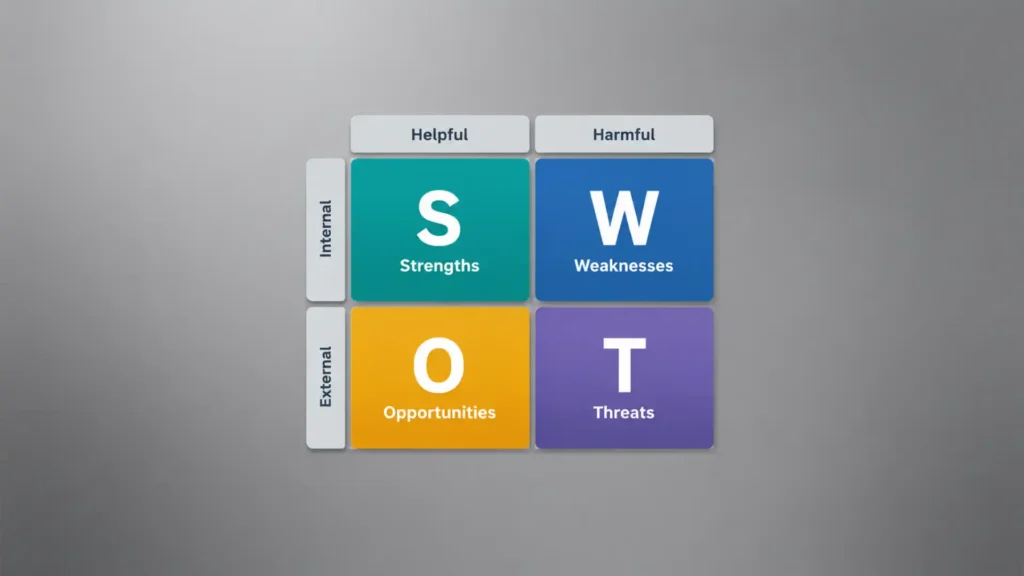
This article is an original analysis supported by the sources cited below
The State of AI Global Survey 2025
McKinsey’s global survey on AI adoption, business value, workflow redesign and where organizations report revenue gains from AI.
Marketers claim a broader role and increased influence amid pressures
The CMO Survey’s 2025 release covering AI use in marketing activities, generative AI adoption and reported marketing performance effects.
How CMOs are scaling GenAI in turbulent times
BCG’s 2025 analysis of CMO investment, confidence and priorities around GenAI in marketing.
State of Data 2025
IAB’s report page on AI adoption, challenges and opportunities across media planning, activation and analysis.
The CMO revolution
IBM Institute for Business Value research on CMOs, proprietary data, first-party relationships and AI readiness.
The 2025 AI Index Report
Stanford HAI’s annual AI Index report with data on AI investment, adoption and business use.
The AI Trust Imperative
Edelman’s 2025 trust analysis for the technology sector, including public trust and comfort with business AI use.
AI Act
European Commission policy page explaining the EU AI Act, risk categories, transparency rules and implementation timeline.
Regulation (EU) 2024/1689
Official EUR-Lex text of the European Union Artificial Intelligence Act.
Code of Practice on marking and labelling of AI-generated content
European Commission page on future support for transparency obligations related to AI-generated content marking and labelling.
Regulation (EU) 2016/679 General Data Protection Regulation
Official EUR-Lex text of the GDPR, the EU’s core legal framework for personal data processing.
Guidance on AI and data protection
UK Information Commissioner’s Office guidance on AI, data protection, transparency, lawfulness, fairness and governance.
AI Risk Management Framework
NIST’s framework for managing risks to individuals, organizations and society from artificial intelligence systems.
AI principles
OECD overview of the AI Principles, adopted in 2019 and updated in 2024, covering trustworthy and human-centered AI.
Keep your AI claims in check
FTC business guidance on avoiding exaggerated, unsupported or deceptive claims about AI products and capabilities.
FTC announces crackdown on deceptive AI claims and schemes
FTC announcement of Operation AI Comply actions against allegedly deceptive AI claims and AI-enabled misconduct.
Google Search guidance on using generative AI content
Google Search Central guidance on generative AI content, quality, accuracy, relevance and scaled content abuse risks.
Spam policies for Google Web Search
Google Search Central documentation defining spam policies, including scaled content abuse.
How Google Search helps you find original, quality content
Google blog post on AI Overviews, AI Mode, preferred sources, original reporting and content discovery changes.
AI features and your website
Google Search Central documentation for site owners on AI features such as AI Overviews and AI Mode.
Copyright and Artificial Intelligence
U.S. Copyright Office hub for its copyright and AI initiative, including reports on digital replicas, copyrightability and generative AI training.
Artificial intelligence and intellectual property
WIPO resource on AI, intellectual property and copyright infrastructure in the context of generative AI.
Disclosure of AI in advertising
UK Advertising Standards Authority article on disclosure, responsibility and AI use in advertising.
The origins of SWOT analysis
Academic article examining the development and history of SWOT analysis as a strategic planning tool.
| Citing this article? Brief excerpts are welcome. Please credit Webiano.digital, name the author where stated, and include a link to https://webiano.digital and to this original article. Full or substantial republication requires prior written permission. Read our Copyright and Content Use Policy. |
This article was prepared with the assistance of artificial intelligence tools. The content underwent expert human review, and Webiano Digital & Marketing Agency assumes editorial responsibility for its final version and publication.