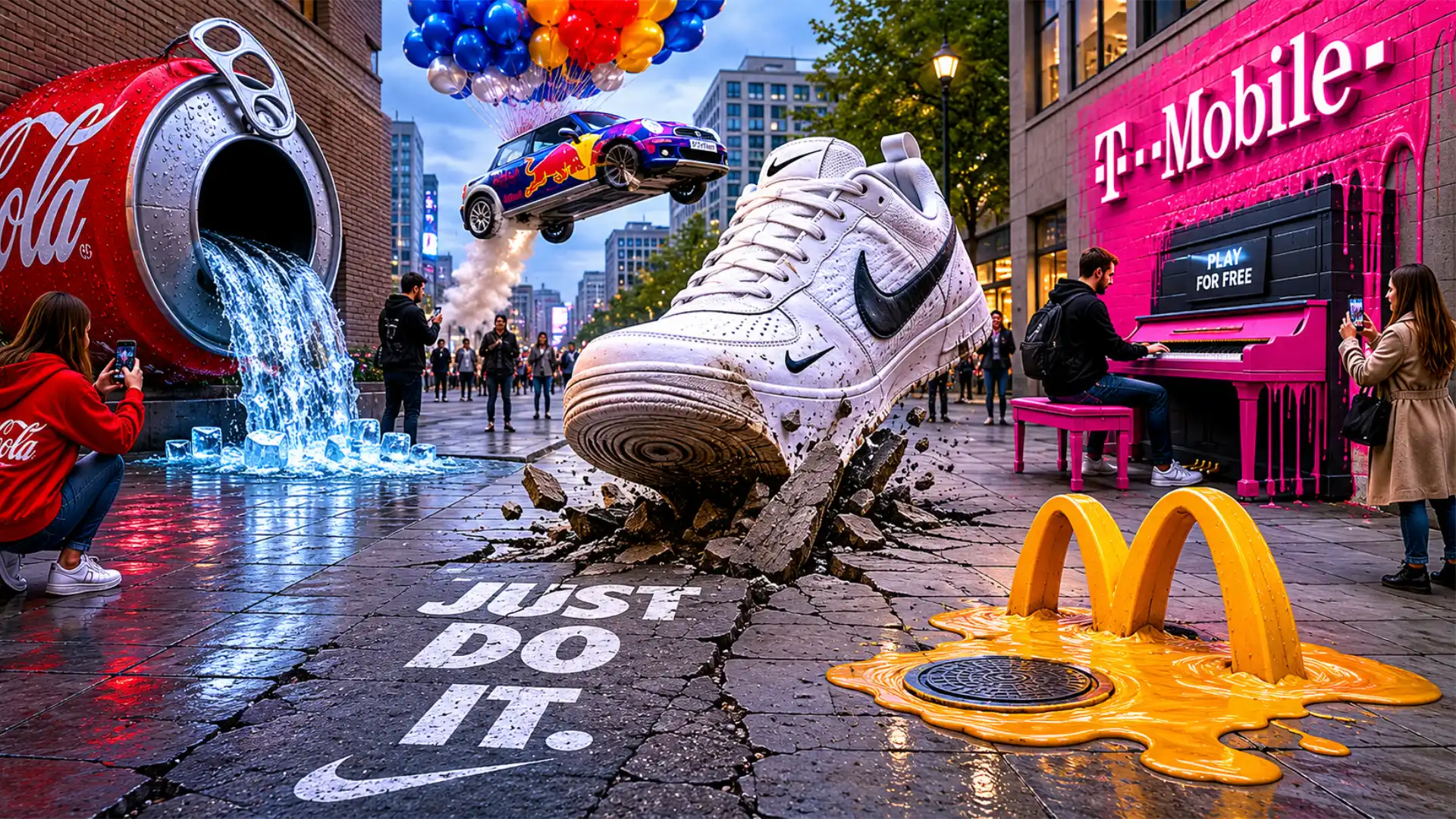
Red Bull, Burger King, IKEA, Netflix, Duolingo, Liquid Death, Patagonia, Coca-Cola and Nike stand out because they use guerrilla marketing as more than an occasional stunt. They use it to make the brand behave in public. The best guerrilla brands do not merely interrupt attention. They create an event, object, joke, contradiction or social moment that people feel compelled to explain to someone else. That is why the same names keep coming up whenever marketers discuss unconventional campaigns.
Table of Contents
Guerrilla marketing has moved from cheap trick to brand operating system
Guerrilla marketing began as a practical answer to a simple problem: small businesses needed attention but could not outspend larger competitors. The American Marketing Association describes “guerilla marketing” as an unconventional and creative strategy aimed at getting maximum results from minimal resources, while EBSCO’s marketing research starter connects the term to Jay Conrad Levinson’s 1984 book and to low-budget, attention-seeking tactics that create buzz.
The idea still carries that scrappy origin, but the strongest users today are not only underfunded challengers. They are large consumer brands that understand a harsher media truth: paid reach is not the same as cultural reach. A pre-roll ad can be skipped. A billboard can be ignored. A stunt that people photograph, argue about or imitate has a different route into memory.
The shift is visible in how the best guerrilla campaigns are built. They rarely sit alone. A Red Bull event becomes live content, earned media, athlete storytelling and brand proof. A Burger King app promotion becomes a joke at McDonald’s expense, a mobile acquisition machine and an awards case study. A Duolingo mascot stunt becomes product nudging, social theatre and community participation. A Netflix activation turns a fictional world into a real-world landmark takeover.
This matters because people are no longer just “audiences” in the old media-planning sense. They are distributors, commentators, remixers, skeptics and unpaid explainers. DataReportal’s Digital 2025 report frames the year around digital’s growing role in daily life, brand discovery and mobile video, while Kantar’s Media Reactions 2025 study says campaigns are far more powerful among receptive audiences and finds that consumer receptivity to advertising reached 57% in 2025.
Guerrilla marketing works when it enters that environment with an idea people can carry. The phrase “guerrilla marketing” can still sound like street teams and stickers, but the strongest examples now mix place, platform, participation, social narrative, commerce and press. A guerrilla campaign can be a vending machine, a live jump from the edge of space, a location-based app offer, a fake death announcement, a furniture-room recreation, a projected portal on a landmark, a provocative full-page newspaper ad or a canned water brand that behaves like a heavy-metal label.
The reason these brands use it is not mysterious. A good guerrilla idea compresses positioning into a story. Red Bull does not have to say it belongs to extreme achievement if it funds and broadcasts Red Bull Stratos. Burger King does not have to say it is cheekier than McDonald’s if it sends customers to a McDonald’s parking lot to unlock a Whopper. Patagonia does not have to say it opposes overconsumption if it buys Black Friday media telling people not to buy a jacket. The act carries the argument.
The brands that use guerrilla marketing most consistently
No public, universal scoreboard ranks every brand by guerrilla marketing usage. The fairest answer is editorial rather than mathematical: the brands that use it most are those that have repeated the pattern across campaigns, markets and years. Frequency alone is not enough. A brand belongs near the top only if unconventional activity is tied to its core identity, not bolted on for a single launch.
By that standard, Red Bull is the strongest global example. It has built a brand world around extreme sport, live events, athlete culture and media ownership. Burger King is the strongest quick-service restaurant example because it repeatedly turns competitive provocation into campaigns, from Whopper Detour to Moldy Whopper. Netflix is the entertainment example because it converts shows into physical and social events. IKEA is the retail example because it turns everyday home objects into public interaction, humor and cultural reference. Duolingo is the digital-product example because it has turned a mascot into a recurring social character and used that character to push product behavior. Liquid Death is the challenger packaged-goods example because the entire brand is a guerrilla-style category attack. Patagonia is the purpose-led example because it uses contradiction and activism to create attention that matches its operating beliefs. Coca-Cola and Nike use guerrilla marketing less constantly than the first group, but their best campaigns show how huge brands can still create surprise at street, store and event level.
Brand pattern map
| Brand | Guerrilla pattern | Strongest proof point | Core reason it works |
|---|---|---|---|
| Red Bull | Extreme events as media | Red Bull Stratos | The brand proves “energy” through risk and spectacle |
| Burger King | Competitive provocation | Whopper Detour and Moldy Whopper | The brand turns its challenger tone into public jokes |
| Netflix | Fictional worlds in real places | Stranger Things rifts and Wednesday stunts | Shows become places fans can enter |
| IKEA | Everyday life made strange | Pee Ad and Real Life Series | Products are familiar enough to become props |
| Duolingo | Mascot-led social theatre | Dead Duo | Product reminders become a shared joke |
| Liquid Death | Category inversion | Punk water branding | Water becomes merch, comedy and identity |
| Patagonia | Anti-consumption activism | Don’t Buy This Jacket | The contradiction proves the value system |
| Coca-Cola | Surprise and personalization | Happiness Machine and Share a Coke | The product becomes a social gesture |
| Nike | Athletic experiments | Breaking2 and Reactland | Performance claims become live proof |
This table is not a ranking of media spend or awards. It separates the brands by repeatable guerrilla behavior, which is the better test. A one-off stunt can be lucky. A repeatable pattern means the brand has found a public behavior that matches its identity.
Red Bull uses guerrilla marketing as proof, not decoration
Red Bull is the clearest answer to the question because it has spent decades acting less like a beverage advertiser and more like a media-and-events company. The brand does not rely on a single message repeated through conventional media. It builds spectacles that dramatize its promise. Red Bull’s guerrilla strength is that the product claim is abstract, but the brand behavior is physical. Energy is invisible. A human falling from the stratosphere is not.
Red Bull Stratos remains the cleanest example. On October 14, 2012, Felix Baumgartner jumped from nearly 40 kilometers above the New Mexico desert. Red Bull’s own 10-year retrospective states that Baumgartner reached 844 mph, or 1,358 km/h, and became the first human to travel at Mach 1 without an aircraft. The same Red Bull page lists the jump height as 39,969.4 meters, or 127,852.4 feet. Guinness World Records also documents the mission, stating that Baumgartner reached 1,357.6 km/h, broke the speed of sound and spent 4 minutes 20 seconds in freefall.
The campaign was not guerrilla in the narrow sense of cheap street marketing. It was expensive, technical and planned for years. Yet it is guerrilla in the stronger strategic sense: it bypassed normal advertising persuasion and created a public event that news, science, sport and popular culture could not ignore. Red Bull did not ask people to watch a drink commercial. It gave them a live human-risk story and attached the brand to the edge of possibility.
That is why Red Bull belongs above most brands in any serious discussion. Its model is repeatable. Flugtag, cliff diving, Rampage, Air Race, athlete films and adventure documentaries all express the same mechanism. The brand builds or funds unusual experiences, captures them as content, distributes them across owned and earned channels, and turns the activity into a living brand archive. Red Bull Media House’s content platform underscores that the company has institutionalized the model by making events, athletes and editorial assets part of its distribution system.
The reason this works is category fit. Energy drinks sell sensation, not just taste. A normal ad can claim intensity. Red Bull can stage it. The brand’s guerrilla marketing is strongest when the viewer forgets the product category and remembers the feeling. That feeling then returns to the can.
There is a risk in this approach. Spectacle raises the bar. Once a brand is known for extraordinary events, ordinary posts can feel weak. Red Bull has managed that by widening the system rather than trying to top Stratos every time. It lets different sports, athletes and formats carry different degrees of risk and wonder. Not every campaign needs the stratosphere. The brand only needs the public to believe that Red Bull belongs wherever energy, danger, skill and discipline meet.
Burger King uses provocation as a competitive weapon
Burger King is the most consistent fast-food user of guerrilla marketing because its brand voice is built around rivalry. It has spent years behaving like the second-place player that knows it can win attention by teasing the market leader. Burger King’s best campaigns make the competitor part of the media plan.
Whopper Detour is the textbook case. The One Club entry places the campaign in the “Non-traditional & Guerrilla Marketing” category and explains the mechanism with unusual clarity: Burger King relaunched its app by offering a one-cent Whopper that could be ordered only through the BK app and only when a customer was near a McDonald’s. The campaign geofenced more than 14,000 McDonald’s restaurants in the United States, unlocked when users were within 600 feet of a McDonald’s, drove more than 1.5 million app downloads in nine days, produced 3.3 billion impressions and delivered a reported 27:1 ROI.
That campaign shows why Burger King uses guerrilla tactics so often. It sells an everyday product in a heavily advertised category where product differences are hard to sustain. A burger offer by itself is not news. A burger offer that requires customers to visit the rival’s location is news. The value was not the one-cent price. The value was the absurdity of the route.
Burger King’s Moldy Whopper used a different form of provocation. Instead of making the food more appetizing, the campaign showed a Whopper decaying over time to support the message that it had no artificial preservatives. Ogilvy’s campaign page says the work showed what happened to the burger when left out for over a month and notes that the campaign broke many advertising rules. The page lists Cannes Lions Grand Prix and One Show Best of Show recognition.
Moldy Whopper was risky because it fought the visual grammar of fast food. Food ads are usually glossy, hot, fresh and controlled. Burger King showed rot. The reason it worked editorially is that the unpleasant image carried a point the brand wanted to own: food without artificial preservatives spoils. It created a mental shortcut that a polite ad would struggle to build.
The brand’s deeper reason is structural. Burger King cannot out-McDonald’s McDonald’s. It wins attention when it acts sharper, weirder and more willing to break category manners. That does not mean every stunt works. Provocation can become predictable if the public senses a brand is only trying to irritate. The best Burger King campaigns avoid that trap by tying the mischief to a business objective: app downloads, ingredient reformulation, delivery, pricing or product news.
Netflix turns content marketing into physical fandom
Netflix uses guerrilla marketing because entertainment products are built for worlds, characters and anticipation. A streaming platform can promote a show through trailers, posters and cast interviews, but the most powerful campaigns make the fictional universe feel like it has leaked into daily life. Netflix’s best guerrilla work turns viewers into witnesses before they become viewers again.
The Stranger Things 4 Global Rift Takeover is a strong example. The Shorty Awards case study says Netflix opened “portals” to the Upside Down across 15 iconic landmarks in 14 cities, using cryptic coordinates to invite fans to decode locations. The campaign included the Empire State Building, Bondi Beach, Wawel Castle and other landmarks, and the case reports more than 190 million organic impressions, over 110,000 in-person attendees and 100 million impressions in global influencer reach.
The campaign worked because it translated a narrative device into public architecture. A “rift” is meaningful to fans because it belongs inside the story. When that rift appears on the Empire State Building or Bondi Beach, the campaign does not feel like a standard ad placement. It feels like the show has invaded the city.
Netflix has kept that logic alive for Stranger Things 5. Its Tudum page for global events lists fan activations in Buenos Aires, the United States, Stockholm, Warsaw, Bangkok, Jakarta, Kuala Lumpur, Manila, Riyadh, Tokyo, Abu Dhabi, Johannesburg and other markets, including bike rides, immersive sets, arcade-style experiences and world-premiere fan access.
The reason Netflix uses this form of marketing is partly commercial and partly cultural. Streaming platforms fight churn. Shows need more than awareness; they need urgency. Physical activations create deadlines, photos, local press, fan proof and social artifacts. They also help a streaming release behave more like a film premiere or a sports event.
Netflix is especially suited to guerrilla marketing because each franchise can have its own rules. Wednesday can use deadpan anti-marketing and the roaming Thing hand in New York. Stranger Things can use portals, bikes and 1980s nostalgia. Squid Game can use games, uniforms and public tension. The Netflix brand itself does not need one fixed tone. It can let each title behave according to its own world.
The limitation is cost and franchise dependence. Not every series has a visual icon strong enough for public activation. A drama without a recognizable prop, place or gesture may not benefit from guerrilla tactics. Netflix succeeds when the stunt comes from story DNA rather than from a marketing team searching for a spectacle.
IKEA makes ordinary objects behave unusually
IKEA is one of the strongest retail examples because its products are common, tactile and easy to stage. A sofa, crib, lamp or storage box can become an ad without feeling like a traditional ad. IKEA’s guerrilla power comes from making home life appear in places where people do not expect it.
The brand has a long advertising history, and IKEA Museum describes the company’s ability to attract shoppers and communicate its vision for “a better everyday life for the many people.” That long-running connection between low-price utility and everyday imagination is crucial.
The IKEA Pee Ad is one of the most famous examples of the brand’s willingness to turn media into an object. The One Club entry explains that the print ad looked like an ordinary crib ad, but also functioned like a pregnancy test. A pregnant reader who urinated on the marked area would see a lower IKEA Family price appear under the crib’s printed price, while the entry clarifies that customers did not have to bring the used ad to IKEA.
The campaign worked because it used the medium as the mechanism. It did not merely announce a discount for expecting parents. It made the ad participate in the life moment that creates the need for a crib. That is classic IKEA: functional, bodily, awkward, clever and tied to the real mess of home.
The Real Life Series used a different route. IKEA recreated famous living rooms from The Simpsons, Friends and Stranger Things using IKEA furniture, then connected those rooms to products people could buy. Campaign Live reported that the campaign replicated three iconic family rooms using the brand’s furniture, while Architectural Digest described the project as a months-long process of matching products from IKEA’s range to recognizable TV interiors.
The reason IKEA uses guerrilla marketing is that furniture is hard to make urgent. A shelf, chair or lamp does not usually create news. IKEA creates attention by moving products into contexts charged with humor, public life, pop culture or personal need. It shows that the objects are not inert catalog items. They are pieces of daily theatre.
IKEA’s Life at Home Report also shows why this approach fits the company’s research base. The 2024 report frames home through emotional and functional needs such as enjoyment, control, comfort and security. Those needs give IKEA a broad field for public experiments because almost any surprising installation can be tied back to how people live.
The risk for IKEA is taste. Too much cleverness can turn intimate life events into gimmicks. The Pee Ad walked close to that line, and that is partly why people remember it. IKEA usually escapes the trap because its campaigns connect back to a practical product and a human situation rather than to shock alone.
Duolingo turns reminders into social entertainment
Duolingo belongs near the top because it has made guerrilla marketing native to a digital product. The app is already built on nudges, streaks, mascots and habit loops. Its social marketing turns those mechanics into public comedy. Duolingo’s strongest move is that the mascot does the job the product already does: it reminds people to return.
The company’s own strategy page says its freemium model drives scale and that better learning supports word-of-mouth growth. As of Q4 2025, Duolingo reported 52.7 million daily active users, 133.1 million monthly active users and 12.2 million paid subscribers.
Those numbers matter because guerrilla marketing for Duolingo is not separate from growth. The app needs people to come back every day. A brand character that jokes, threatens, mourns, dances and dies in public extends the product’s retention logic into culture.
The clearest proof is Dead Duo. In a Q1 FY2025 shareholder letter filed with the SEC, Duolingo called Dead Duo one of its most successful marketing campaigns and said the social-led whodunit narrative generated 1.7 billion organic impressions, while driving a meaningful lift in new and resurrected users. The same letter says the company brought more of its “unhinged” personality into the app through funny, unexpected lesson-end animations.
Duolingo’s social rise was not accidental. Contagious reported in 2023 that senior global social media manager Zaria Parvez helped turn Duo into a social favorite with 8.2 million followers, after taking over a dormant TikTok account and building a stream of offbeat mascot-led content.
The reason this works is product-character alignment. A language-learning app needs daily repetition. Repetition can feel boring. Duo turns that boring pressure into a shared joke. The owl’s exaggerated neediness lets the brand acknowledge the annoyance of reminders while making the annoyance part of the charm.
Duolingo also shows a new form of guerrilla marketing: not necessarily street activation, but social behavior that feels too strange, fast and character-driven to be traditional advertising. The brand behaves like a participant in internet culture rather than a sponsor standing outside it. That approach can collapse if the tone feels forced, but Duolingo has benefited from making weirdness a long-term operating style.
Liquid Death makes the whole brand a guerrilla act
Liquid Death is not only a brand that uses guerrilla campaigns. The brand itself is a guerrilla campaign against bottled-water category norms. Water is usually marketed through purity, wellness, mountains, blue labels and calm. Liquid Death uses skulls, tallboy cans, dark humor and heavy-metal language. Its core trick is category inversion: it makes the healthiest ordinary drink look like the least polite product in the cooler.
The company’s own manifesto says Liquid Death sells “infinitely recyclable cans” of low-calorie beverages that will “murder your thirst,” and it frames the brand around the idea that the funniest marketing had long been reserved for beer, fast food, candy and junk food.
TIME’s profile of founder Mike Cessario says he used his advertising background and skateboarding ethos to create the irreverent canned-water brand, and reports that Liquid Death exceeded $250 million in sales within six years, closed a $67 million funding round in March 2024 and reached a $1.4 billion valuation.
The reason Liquid Death uses guerrilla marketing is straightforward: the product is not functionally novel enough to win on liquid alone. Water is water. The marketing has to create difference before the first sip. A Liquid Death can lets a sober person at a party hold something that looks socially coded like beer. The brand sells hydration, but it also sells a joke, a posture and a way to opt out of bland wellness.
Its campaigns and collaborations extend that brand logic. Martha Stewart in horror-mode, fake metal albums, absurd merch, punk packaging, celebrity cameos and outrageous product names all create reasons for people to talk about a product whose physical benefit is familiar. The brand’s strength is that the joke is not a layer on top of the brand. The joke is the brand’s distribution engine.
There is a strategic lesson here for challengers. A small brand in a mature category cannot always win by claiming better ingredients, better taste or lower price. It can win by rejecting the category’s visual and verbal rules. Liquid Death turns plainness into theatre by refusing to look plain.
The risk is fatigue. Shock loses power when it becomes a habit. Liquid Death will need to keep proving that the joke expands rather than repeats. Its move into iced teas, sparkling water and energy drinks gives it more creative territory, but also raises the burden of clarity. The brand must keep being understandable at shelf level, not only entertaining online.
Patagonia uses contradiction to prove belief
Patagonia is a different kind of guerrilla marketer. It does not use provocation mainly for laughs, rivalry or spectacle. It uses contradiction to make its environmental position impossible to ignore. Patagonia’s strongest guerrilla move is saying the thing a retailer is not supposed to say.
The best-known example is “Don’t Buy This Jacket.” Patagonia’s own archive says the company ran the ad in The New York Times on Black Friday, November 25, 2011, to address consumerism directly. The article says customers need to think twice before buying and that the company wanted to call attention to the issue in a strong, clear way.
That campaign worked because it put a business contradiction in public. Patagonia sells products, but it told people not to buy what they do not need. A weaker brand might have been accused of hypocrisy. Patagonia could carry the risk because the message fit a longer record of repair, reuse and environmental funding. Its activism page says the company has used its business, voice and resources since 1985 to support grassroots environmental action, and that its self-imposed Earth tax through 1% for the Planet supports environmental nonprofits.
Patagonia’s reason for using guerrilla marketing is trust. Environmental claims are easy to make and hard to believe. A counter-commercial act becomes evidence. The ad did not ask people to accept a sustainability claim. It created a moment where Patagonia appeared to sacrifice short-term selling pressure for a larger argument.
This is why Patagonia’s approach is harder to imitate than many brands think. The tactic is not “say something shocking.” The tactic is “say something shocking that only your operating model gives you the right to say.” If a fast-fashion brand ran “Don’t Buy This Jacket,” the likely reaction would be ridicule. Patagonia could do it because the campaign sat inside a wider system of repair, product durability, activism and ownership choices.
The lesson is that purpose-led guerrilla marketing punishes inconsistency. If the public suspects that a brand is using activism only as attention bait, the tactic can backfire fast. Patagonia’s advantage is that its provocation sounds like the company, not like an agency trying to borrow a cause.
Coca-Cola uses surprise to make a mass product feel personal
Coca-Cola is not usually described as a guerrilla-first brand because it is also one of the world’s great traditional advertisers. Yet several of its most memorable campaigns use guerrilla mechanics: surprise, participation, personalization and public sharing. Coca-Cola uses guerrilla marketing when it needs a familiar product to feel newly social.
The Happiness Machine is a clear example. Coca-Cola’s investor release says hidden camera footage of students receiving more than expected from a Coke vending machine had been viewed more than 2.2 million times on YouTube by May 28, 2010, and won a CLIO Gold Interactive Award. The machine, placed at St. John’s University in Queens, gave students items such as flowers, pizzas, sunglasses, a twelve-foot hero sandwich and Coca-Cola.
The idea worked because the product did not change. The vending experience changed. A machine usually represents a cold transaction: insert money, receive drink. Coca-Cola turned the machine into a character that gives more than expected. That act matches the brand’s long-running emotional territory around sharing and happiness.
Share a Coke used personalization rather than public surprise. Coca-Cola’s own history says the campaign began in Australia in 2011 by swapping Coke branding on bottles and cans with the 150 most popular first names in the country. The company says Coke sold more than 250 million named bottles and cans that summer in a country of just under 23 million people, and that the campaign later reached more than 70 countries. Coca-Cola Europacific Partners’ 2025 explainer says the campaign has expanded to over 120 countries.
Share a Coke is not guerrilla in the street-stunt sense. It is guerrilla in how it hijacks the pack. The logo, normally sacred, becomes a social prompt. People hunt for names, post finds, buy for friends and turn a mass-produced bottle into a small personal signal. The campaign’s cleverness sits in changing the product surface rather than buying more media around the same surface.
Small World Machines pushed Coca-Cola’s public-interaction model further. The One Club entry says the custom vending machines allowed people in India and Pakistan to interact across borders through body-length touchscreens over three days, sharing rare moments of connection.
Coca-Cola uses guerrilla marketing less as a challenger tool and more as a freshness tool. It needs familiar rituals to feel alive again. The vending machine, the bottle label and the public screen become the media.
Nike uses live experiments to make performance tangible
Nike’s best guerrilla marketing does not start with surprise for its own sake. It starts with proof. The brand sells performance, aspiration and athletic identity. Its strongest unconventional campaigns turn those abstractions into events that people can watch, join or test. Nike’s guerrilla strength is making a claim feel measurable.
Breaking2 is the clearest example. Nike’s own page says that in 2016 it teamed with National Geographic to document the quest to break the two-hour marathon barrier, and that on May 6, 2017, Eliud Kipchoge, Lelisa Desisa and Zersenay Tadese attempted the feat in Monza, Italy. Nike says Kipchoge ran the fastest marathon in history at two hours and 25 seconds, missing the sub-two target by 26 seconds.
Breaking2 was not a normal product launch. It was a scientific-athletic spectacle. It attached Nike shoes, pacing strategy, course design, elite athletes and public imagination to a single question: can the two-hour marathon fall? The attempt created tension because failure was possible. That matters. Perfectly controlled advertising often lacks stakes. Breaking2 had a clock.
Nike Reactland translated proof into retail play. Wieden+Kennedy’s case page says Reactland was installed in stores around China, where shoppers tried Nike React running shoes on a treadmill while controlling an avatar of themselves inside a game. It ran in four stores and one pop-up location for one month, and the agency reports that 48% of players bought the shoes after experiencing the game.
Reactland worked because it solved a retail problem. Running shoes are hard to explain through shelf talk. “Soft, light and bouncy” are words. A game that lets the shopper feel the shoe while becoming a character turns the claim into bodily memory and social content.
Nike also has a longer history of unconventional public-media campaigns. The Guardian reported that Nike’s Chalkbot won the Cyber Lions Grand Prix at Cannes in 2010. The campaign printed public messages about cancer onto the Tour de France route through a computerized road-painting machine, connecting digital submissions to a physical sporting ritual.
The reason Nike uses these tactics is that sport already has drama. A strong Nike guerrilla campaign does not need to invent drama from nothing. It needs to stage a test. When the public sees the athlete, runner, user or community moving through that test, the brand’s promise becomes easier to believe.
Smaller challengers use guerrilla marketing because they lack permission to be boring
The big names prove the model, but guerrilla marketing remains especially useful for challengers. A smaller brand usually lacks mass reach, shelf dominance and mental availability. It needs a way to be noticed without sounding like a weaker copy of the leader. For challengers, guerrilla marketing is often the price of being remembered.
Liquid Death shows the challenger route in packaged goods. Duolingo shows it in app behavior, even though it is now large. Oatly, Cards Against Humanity, Surreal, Tony’s Chocolonely, BrewDog and other challenger brands have used similar principles at different moments: contradiction, absurdity, packaging as media, public self-awareness and brand voice that sounds unlike category convention.
The reason is psychological as much as financial. Consumers already have default choices. A new brand must create a story that interrupts the default. A normal claim may be true but not sticky. A weird act gets stored as an anecdote. People do not say, “I saw a water brand with good packaging.” They say, “There’s a water brand that looks like beer and talks about murder.” They do not say, “A language app posted a retention campaign.” They say, “Duolingo killed the owl.”
This is why guerrilla marketing often works best when the brand’s product is simple. Water, burgers, furniture, streaming shows, soda and language lessons are not obscure. The audience already understands the basic category. The stunt does not have to explain the product from zero. It only has to make the brand’s version feel different.
The trap for challengers is mistaking random weirdness for strategy. A stunt that does not connect to the product may generate views without memory. Worse, it can make the brand look desperate. The strongest challengers use a narrow kind of weirdness repeatedly. Liquid Death’s weirdness is punk-health inversion. Duolingo’s weirdness is mascot obsession. Burger King’s weirdness is flame-grilled mischief and McDonald’s rivalry. Patagonia’s weirdness is anti-consumption truth-telling. The repeat pattern is what turns attention into brand equity.
Legacy brands use guerrilla marketing to escape their own familiarity
Large legacy brands have the opposite problem from challengers. They are known too well. Familiarity is useful at shelf, but it can make marketing feel predictable. Coca-Cola, IKEA, Nike and McDonald’s all face this problem in different ways. For legacy brands, guerrilla marketing creates re-encounter. It makes people meet the brand again instead of merely recognizing it.
Coca-Cola’s Happiness Machine did this by making a vending machine generous. Share a Coke did it by replacing the logo with names. IKEA’s Pee Ad did it by turning a print ad into a test. Nike Reactland did it by turning shoe trial into a game. These ideas work because they disturb a familiar brand asset without destroying it.
Legacy brands have more to lose. A small brand can tolerate confusion because it is still being formed. A large brand must protect recognition while adding surprise. That is why many legacy guerrilla campaigns use existing brand assets as the anchor. Coca-Cola keeps the bottle and vending ritual. IKEA keeps practical home products. Nike keeps performance testing. Patagonia keeps its environmental position. The unusual part sits on top of something stable.
This explains why some large brands fail when they chase guerrilla attention. They borrow a format that does not belong to them. A bank that suddenly speaks like a meme account may look less human, not more. A luxury brand that uses street chaos without craft may weaken its own codes. A food brand that shocks without a food or ingredient reason can create disgust without persuasion.
The best legacy brands know which parts of themselves can bend. Coca-Cola can bend the label because the bottle shape, color and product memory remain strong. IKEA can bend the catalog and ad page because the product system is recognizable. Nike can bend retail because the athlete-performance logic stays intact.
Guerrilla marketing works because people retell simple conflicts
The strongest campaigns in this field contain a conflict that can be explained in one sentence. Red Bull sent a man from near space. Burger King made people go to McDonald’s for a Whopper. Patagonia told people not to buy its jacket. Duolingo killed its owl. IKEA made an ad that was also a pregnancy test. Netflix opened portals in real cities.
That sentence-level retellability is not a minor detail. It is the mechanism. A campaign is more likely to travel when people can describe it without brand jargon. Many expensive campaigns fail because the idea requires too much explanation. Guerrilla marketing rewards compression.
The conflict can take several forms. It can be physical danger, as with Red Bull Stratos. It can be competitive mischief, as with Whopper Detour. It can be bodily interaction, as with IKEA’s Pee Ad. It can be narrative intrusion, as with Netflix’s rifts. It can be moral contradiction, as with Patagonia. It can be character theatre, as with Duolingo. It can be category reversal, as with Liquid Death.
The public retells these conflicts because they are socially useful. They give people a small piece of cultural currency. Sharing the campaign says, “Look at this weird thing,” “Look how clever this is,” “Can you believe a brand did this?” or “This actually makes sense.” That is different from sharing a normal ad, which often feels like doing unpaid work for a company.
The business value lies in what happens after the retelling. If the retold sentence contains the brand and the brand logic, memory improves. “Burger King made people go to McDonald’s” includes the brand, the rival and the offer’s oddity. “Patagonia said don’t buy this jacket” includes the brand and its value system. “Duolingo killed its owl” includes the app’s mascot and reminder culture.
The weaker version of guerrilla marketing creates a retellable event but loses the brand. People remember the stunt, not the sponsor. That is why brand linkage matters. The act must be so tied to the brand that it cannot be easily reassigned.
Earned media is the prize, but behavior is the path
Guerrilla marketing is often praised for earned media. That praise is valid but incomplete. Earned media is not magic. Journalists, creators and ordinary users need something to react to. The path to earned media is not asking for coverage. It is creating behavior that looks like news, conflict, utility or culture.
Red Bull Stratos looked like science, sport and live risk. Burger King Whopper Detour looked like a business story about geofencing, rivalry and app growth. The One Club’s results for Whopper Detour show why press and awards followed: the campaign had a clear consumer hook, a clear technical mechanism and reported business outcomes.
Duolingo’s Dead Duo looked like a social mystery. The SEC-filed shareholder letter’s 1.7 billion organic impressions figure is notable because it shows the company itself treated the social narrative as a growth event, not as a vanity joke.
Netflix’s Stranger Things rifts looked like urban spectacle. The Shorty Awards case says the rifts appeared across landmarks, attracted in-person crowds and generated large organic reach.
The common element is that each campaign created something external people could report. A brand message is not enough. “We have a new app” is not news. “We built a mobile deal that activates at McDonald’s” is news. “A new season is streaming” is not enough. “A giant rift appeared on a landmark” has a visual and a location. “We care about the environment” is not enough. “We bought Black Friday media telling people not to buy” creates a public contradiction.
The strongest guerrilla marketers understand editorial selection. They design campaigns with a headline inside them. That does not mean they cheapen the idea into clickbait. It means they know that a campaign travels when it has a clear public fact.
Social platforms changed the scale of the street
Classic guerrilla marketing lived in streets, campuses, malls, subways and public squares. Those places still matter, but the street now has a second life online. A campaign may begin in one location and reach millions through mobile video, creator commentary and press embeds. The modern guerrilla site is both physical and feed-based.
DataReportal’s Digital 2025 report points to brand discovery, mobile video and social platform behavior as major parts of the digital year. Kantar’s Media Reactions 2025 findings also show that brands still need to care about channel fit and receptivity, not only raw reach.
This changes campaign design. A public stunt must work for the person standing there and for the person watching a 12-second clip later. Netflix’s rifts did this well because they were physically impressive and visually legible in a phone video. Duolingo’s mascot content works because it is built for platform humor but connected to a product habit. IKEA’s Real Life Series worked because the recreations were understandable as images even before someone clicked through to product details.
The scale of the street also increases risk. A local misstep can become global before a brand has time to explain. A stunt that blocks access, frightens people, misuses public space or hides commercial intent can attract regulatory attention or public anger. Guerrilla marketing’s speed is double-edged.
The practical lesson is to design for context collapse. Assume the audience will include locals, fans, critics, regulators, competitors, employees, journalists and people who see only a cropped clip. The idea needs to survive that compression. If it requires a long apology to explain, it may be too fragile.
The strongest campaigns turn the medium into the message
Many campaigns use a medium to carry a message. Guerrilla marketing is strongest when the medium becomes part of the message. The object, place or interface should prove the idea by how it behaves.
The IKEA Pee Ad is the clearest literal example. The ad was not merely about pregnancy and cribs; it functioned like a pregnancy test and revealed the price through interaction.
Whopper Detour used the competitor’s geography as the interface. The offer existed only near McDonald’s locations. The mobile app and the physical map were not neutral channels; they were the joke.
Coca-Cola’s Happiness Machine used a vending machine as a generosity device. The machine did not show an ad about happiness. It dispensed unexpected items and created happiness in front of hidden cameras.
Nike Reactland used the treadmill and game environment as the product demonstration. The shopper’s own run became the content and the trial.
Netflix’s Stranger Things rifts used landmarks as story surfaces. The city became the screen, which fit the show’s premise of a hidden dimension breaking through.
This is the difference between a stunt and a strong guerrilla idea. A stunt may be attention placed next to a brand. A strong guerrilla idea makes the delivery method carry the claim. If the medium can be swapped without harming the idea, the campaign may be weaker than it looks.
Product truth separates bold campaigns from empty noise
The best guerrilla campaigns are not only bold. They are anchored in product or brand truth. Surprise earns attention, but truth gives the attention somewhere to land.
Moldy Whopper’s unpleasant image was linked to preservative removal. Without that ingredient claim, the campaign would have been pure disgust. Ogilvy’s page frames the work around promoting Whoppers made with no artificial preservatives.
Reactland’s game was tied to the feel of Nike React shoes. The fantastical world represented product attributes such as softness, lightness and bounce, while the experience let shoppers run in the shoes before sharing a customized video.
Patagonia’s “Don’t Buy This Jacket” was tied to the Common Threads Initiative and to a larger argument about consuming less, repairing more and making products that last.
Duolingo’s Dead Duo was tied to the owl, user return behavior and “resurrected users,” according to the company’s shareholder letter. It was not a random death joke; it was a narrative version of the app’s retention problem.
This truth anchor is especially important for brands copying the model. Many failed guerrilla attempts begin with a format: flash mob, fake storefront, strange billboard, QR hunt, mascot prank. Strong campaigns begin with a tension: people ignore app launches, furniture is ordinary, overconsumption conflicts with environmental values, a streaming show needs a real-world premiere, water brands are dull, a burger challenger needs to steal attention from the leader.
A campaign can be strange, but the strangeness must answer a real business or brand problem. Otherwise, it becomes a moment with no memory structure.
Humor works when the brand has earned the right tone
Humor is common in guerrilla marketing because jokes travel. Yet humor is also one of the easiest ways for brands to sound fake. The strongest funny guerrilla brands have a stable comic identity before the big stunt arrives.
Burger King has earned a competitive, mischievous tone. Whopper Detour made sense because the brand had long positioned itself as a sharper rival. Duolingo has earned absurd mascot behavior through repeated social content. Liquid Death has earned dark humor through its name, packaging, copy and product line. IKEA has earned practical deadpan humor through everyday-life insight.
Humor becomes dangerous when the brand’s normal behavior is stiff and the stunt suddenly becomes chaotic. Audiences notice the discontinuity. A bank that speaks like Liquid Death may not seem brave. It may seem untrustworthy. A health brand that jokes too darkly may trigger concern rather than affection. A luxury brand that makes itself too goofy may lose desirability.
The right question is not “Can this joke go viral?” It is “Can only this brand tell this joke?” If the joke could be assigned to any brand, it may deliver attention without distinctiveness. Burger King’s Whopper Detour cannot belong to Wendy’s or Subway in the same way because the McDonald’s rivalry is baked into the meaning. Duolingo killing Duo cannot belong to another app because Duo is the product’s public conscience. Liquid Death’s tone cannot be easily copied because the brand name and visual system already commit to the bit.
Humor also needs target discipline. Guerrilla jokes often include a butt of the joke: the competitor, the category, the brand itself, the user’s habits, advertising conventions. The safest and most durable targets are conventions and self-awareness. Burger King jokes about McDonald’s but gives consumers a bargain. Duolingo jokes about its own annoying reminders. Liquid Death jokes about wellness and macho beverage culture at the same time.
Risk is part of the engine
Guerrilla marketing works partly because it feels less controlled than standard advertising. That feeling creates energy. It also creates risk. If there is no risk at all, the campaign may not feel worth sharing. If the risk is poorly chosen, the campaign can damage trust.
The risk can be physical, as with Red Bull Stratos. It can be reputational, as with Moldy Whopper showing rotten food. It can be commercial, as with Patagonia telling people not to buy. It can be legal or platform-related, as with brand stunts that rely on user participation, creators or disguised formats. It can be cultural, as with jokes that cross national or social boundaries.
Regulation matters because unconventional campaigns often blur the line between ad, entertainment, endorsement and public event. The FTC’s native advertising guidance says an ad can be deceptive if it is not readily identifiable as an ad and materially misleads consumers about its commercial nature. The FTC’s Endorsement Guides also warn that advertisers and endorsers may be liable if endorsements fail to disclose unexpected material connections.
The UK’s Advertising Standards Authority states that Section 2 of the CAP Code requires marketing communications to be obviously identifiable as such, including social media and influencer marketing.
These rules do not kill guerrilla marketing. They force better design. A campaign can be surprising without deceiving people about who is behind it. A stunt can feel organic without hiding paid relationships. A creator can join the story while making commercial links clear.
The reputational risk is broader than compliance. Brands must ask whether the audience will feel invited or manipulated. The strongest guerrilla campaigns make the public part of the pleasure. The weakest make people feel used as props.
Measurement must go beyond views
A guerrilla campaign can produce huge views and still fail. Views are not the same as brand memory, sales, app use, purchase intent or loyalty. The best guerrilla marketers measure the behavior the stunt was built to move.
Whopper Detour is persuasive because its reported results go beyond buzz. The One Club entry lists app downloads, app sales, traffic increase and ROI.
Duolingo’s Dead Duo is persuasive because the company linked the campaign to new and resurrected users in its shareholder letter, not only impressions.
Reactland is persuasive because Wieden+Kennedy reported that 48% of players bought the shoes after experiencing the game.
Coca-Cola’s Share a Coke is persuasive because Coca-Cola’s own history reports enormous named bottle and can sales in Australia and later expansion across many countries.
The right metrics depend on the campaign’s job. A challenger brand may measure unaided awareness, retail velocity, social search, branded search and repeat purchase. An app may measure installs, daily active users, resurrected users, retention and paid conversion. A streaming platform may measure trailer views, watch starts, completion, franchise engagement and earned media value. A purpose-led brand may measure participation, donations, petition signatures, repair program usage or trust.
The danger is choosing metrics after the campaign. Guerrilla marketing should not be an excuse for fuzzy accountability. The campaign idea may be strange, but the business question should be precise.
Measurement map for guerrilla campaigns
| Campaign job | Better metric | Weak metric to avoid |
|---|---|---|
| App growth | Installs, activation, retention, resurrected users | Impressions alone |
| Retail trial | Store visits, trial completions, purchase rate | Foot traffic with no purchase link |
| Brand awareness | Branded search, unaided recall, earned press quality | Raw reach without brand memory |
| Product proof | Trial-to-purchase rate, review sentiment, repeat use | Video views |
| Community building | Participation, user content, event attendance, repeat engagement | Likes on launch post |
| Trust or purpose | Action taken, repair use, nonprofit support, trust movement | Positive comments only |
The table shows the core discipline: a guerrilla campaign should be measured by the behavior it was meant to create. The best-known examples look creative, but their endurance comes from the fact that the idea and the measurement matched.
Brand fit matters more than budget
A common mistake is thinking that guerrilla marketing means “cheap.” It can be cheap, but the bigger distinction is fit. Red Bull Stratos was not cheap. Netflix landmark takeovers are not cheap. Nike Breaking2 was not cheap. Yet they behave like guerrilla marketing because they use unconventional public proof rather than standard ad repetition. Budget changes the scale, not the principle.
A small bakery could use guerrilla marketing by turning unsold bread into a public waste story. A local gym could create a public challenge tied to member progress. A software company could create a live demo that exposes a hidden pain in the category. A global brand can do the same at larger scale with more legal, production and media support.
The question is whether the tactic fits the brand’s truth, audience and product. IKEA can ask people to interact with a print ad because the brand lives in practical domestic life. Duolingo can run a strange mascot narrative because the mascot is already part of app behavior. Patagonia can tell people to buy less because it has a repair-and-activism record. Red Bull can stage extreme events because the brand has spent decades making risk part of its identity.
A brand without fit will need to explain itself too much. A strong guerrilla idea feels surprising but not arbitrary. The audience should think, “Only they would do that,” not “Why are they doing this?”
The strongest users share five strategic traits
Across the strongest brands, five traits repeat. First, the brand has a clear tension. Red Bull has energy versus human limits. Burger King has challenger versus market leader. IKEA has ordinary home life versus playful invention. Netflix has fiction versus real space. Duolingo has learning discipline versus internet chaos. Liquid Death has health versus punk aesthetics. Patagonia has retail sales versus anti-consumption values.
Second, the brand has a recognizable asset. It may be a mascot, can, logo, product, rival, athlete, show world, packaging system or point of view. Guerrilla marketing travels better when the public can attach the surprise to something already recognizable.
Third, the brand accepts discomfort. Great guerrilla work rarely feels perfectly safe. Moldy Whopper risks disgust. Dead Duo risks confusion. “Don’t Buy This Jacket” risks sales contradiction. Stratos risks enormous operational pressure. Reactland risks public trial complexity. The discomfort is managed, not avoided.
Fourth, the brand designs for retelling. The campaign can be summarized quickly and still retain the brand. That is not accidental. It is copywriting, product design, PR strategy and social planning working together.
Fifth, the brand links the stunt to a business action. Downloads, trials, purchases, viewing, sharing, repair, loyalty, store visits or app returns give the campaign a reason to exist.
These traits explain why the same brands keep appearing in guerrilla marketing discussions. They do not treat the method as decoration. They treat it as a way of behaving in public.
Red Bull and Burger King sit at opposite ends of the same spectrum
Red Bull and Burger King are both elite guerrilla marketers, but they use opposite emotional engines. Red Bull uses awe. Burger King uses mischief. One asks people to look up. The other asks people to laugh sideways at the competitor.
Red Bull’s awe depends on skill, risk and production. The viewer feels tension because the event is difficult. The brand gains stature by making the event possible. The product is almost absent, which makes the brand association feel larger rather than smaller.
Burger King’s mischief depends on contrast. It turns category rules against themselves. A mobile app launch becomes a competitor prank. A food-beauty ad becomes a mold time-lapse. A burger becomes a weapon of comparison. The brand gains affection by making the consumer feel in on the joke.
Both models work because they are stable. Red Bull rarely needs to be sarcastic. Burger King rarely needs to be majestic. Each brand knows its emotional lane. That matters for any company choosing a guerrilla direction. The tactic should match the emotional job. A charity may need moral urgency, not comedy. A fitness brand may need achievement, not prank energy. A food challenger may need sensory shock, not abstract purpose.
The spectrum also shows that guerrilla marketing is not one style. It can be beautiful, rude, funny, tender, political, technical, theatrical, local, global, cheap or costly. The unifying point is unconventional attention tied to brand meaning.
Netflix and Duolingo show the power of characters
Netflix and Duolingo use guerrilla marketing through characters and story worlds. This is a major advantage. A character can do things a logo cannot. A world can enter places a product cannot.
Duo the owl can be needy, dead, resurrected, chaotic, jealous or triumphant. The mascot gives Duolingo a body, mood and social voice. Netflix’s franchises give the company many bodies and moods: Thing from Wednesday, the Upside Down from Stranger Things, the games from Squid Game, the romance codes of Bridgerton.
This matters because people respond more easily to narrative than to proposition. A mascot death is a story. A rift opening is a story. A bike ride through Stranger Things locations is a story. A new app feature or season release is information. Guerrilla marketing turns information into plot.
Characters also make repetition easier. Duolingo can keep using Duo because the owl evolves. Netflix can revive a franchise world across seasons and markets. The danger is overexposure. A character can become annoying if the brand forces every moment through it. The audience must feel that the character still has new situations to enter.
This is why narrative discipline matters. Dead Duo worked because it had a whodunit structure and a limited arc. Stranger Things rifts worked because they tied to a season launch and a known fictional device. Character-led guerrilla marketing needs pacing. Without pacing, it becomes costume marketing.
IKEA and Coca-Cola show the power of everyday rituals
IKEA and Coca-Cola are strong because they understand ordinary rituals. Buying a crib, sitting on a sofa, waiting at home, using a vending machine, sharing a drink, finding a name on a bottle: these are everyday acts. Their guerrilla work does not create fantasy from nothing. It bends a ritual people already know.
This gives both brands scale. Not everyone follows extreme sports. Not everyone cares about fast-food rivalries. But most people understand furniture, homes, drinks, names and vending machines. IKEA and Coca-Cola can make a small shift feel widely legible.
The Happiness Machine made vending warmer. Share a Coke made packaging personal. IKEA’s Pee Ad made a print ad interactive and tied it to pregnancy. Real Life Series made furniture part of pop-culture rooms. These ideas work because the audience does not need education. The starting point is familiar.
Everyday ritual is powerful because it lowers the barrier to participation. A person can join Share a Coke by looking for a name. A viewer can understand IKEA Real Life by recognizing Friends or The Simpsons. The campaign does not ask for deep fandom or technical knowledge.
The limitation is that everyday rituals are easy to trivialize. If the twist feels too cute or too manufactured, the campaign may be dismissed. IKEA and Coca-Cola succeed when the twist makes the ritual feel more human, not merely more branded.
Patagonia and Liquid Death show two forms of rebellion
Patagonia and Liquid Death both use rebellion, but the rebellion points in different directions. Patagonia rebels against overconsumption and corporate silence. Liquid Death rebels against bland wellness and category politeness. One uses moral seriousness. The other uses comic aggression.
Patagonia’s rebellion depends on credibility. It can criticize buying because it has a history of repair, activism and environmental funding. Its language is blunt, but the bluntness is connected to real operating choices.
Liquid Death’s rebellion depends on contrast. It sells water with language and imagery borrowed from metal, skate and alcohol-adjacent culture. The company’s manifesto explicitly positions itself against the idea that funny marketing belongs only to unhealthy products.
These two brands show that rebellion is not a single tone. A brand can rebel by being more responsible than the category or by being more absurd than the category. Both approaches can work if the audience understands what is being rejected.
The risk is imitation. Many brands want the attention of rebellion without the cost of commitment. Patagonia’s model requires operational proof. Liquid Death’s model requires total brand consistency. Half-rebellion looks weak. A brand that sounds rebellious in ads but acts conventionally everywhere else will be exposed quickly.
Fast food and beverages are naturally suited to guerrilla tactics
Fast food and beverage brands appear often in guerrilla marketing because their products are easy to sample, photograph, price, compare and consume quickly. The category has low explanation cost and high social visibility. A burger, can or bottle can be understood in a second.
Burger King can create a geofenced offer because the transaction is simple. Coca-Cola can personalize bottles because the packaging is everywhere. Liquid Death can win with can design because the product is publicly held. Red Bull can build events because the drink is linked to energy and performance.
These categories also face fierce sameness. Fast-food brands sell similar occasions. Beverage brands fight over cooler space and identity. Guerrilla tactics help them create memory outside pure taste. A consumer may not distinguish every ingredient claim, but they may remember the brand that sent them to a rival location or the water can that looked like contraband.
Sampling also matters. A stunt can end in consumption. The customer unlocks a Whopper, receives a Coke, buys a Liquid Death, drinks Red Bull at an event. The distance between attention and trial is short.
The downside is regulation and sensitivity. Food and beverage campaigns must handle health claims, child audiences, alcohol-like cues, nutrition rules, packaging claims and local ad standards carefully. A clever campaign can quickly become a compliance problem if it misstates benefits or targets vulnerable audiences.
Technology makes modern guerrilla marketing more precise
Technology has changed what guerrilla marketing can do. Geofencing, app notifications, live streaming, QR codes, augmented reality, projection mapping, social listening, dynamic creative and creator distribution all give brands more ways to connect physical surprise with digital action. The best technology-led guerrilla campaigns make the technology disappear behind the idea.
Whopper Detour used geofencing, but consumers remembered the McDonald’s joke. Reactland used in-store gaming and video capture, but shoppers remembered running inside a game. Red Bull Stratos used advanced balloon, suit, camera and broadcast systems, but the public remembered the jump. Netflix rifts used projection and landmark coordination, but fans remembered portals.
Technology fails when it becomes the point. A QR code scavenger hunt is not interesting because QR codes exist. An AR filter is not a campaign. A projection is not automatically meaningful. The technology must make the brand idea possible in a way a normal ad could not.
Technology also lets brands measure behavior more tightly. App installs, location unlocks, trial completions, content shares, event registrations and conversion paths can be tracked. That measurement helps justify unconventional work inside companies that might otherwise see it as too risky.
Yet technology should not remove human surprise. The strongest examples keep a human reaction at the center: the runner racing an avatar, the student receiving flowers from a vending machine, the fan seeing a rift on a landmark, the learner mourning an owl, the customer standing near McDonald’s for a Burger King deal.
The legal boundary is transparency
Guerrilla marketing often flirts with hiddenness. That flirtation creates drama, but it must not deceive people about commercial intent in ways regulators forbid. Surprise is not the same as concealment.
The FTC’s native advertising guide is direct: an ad can be deceptive if it is not readily identifiable as advertising and misleads consumers about its commercial nature. The guide also notes that misleadingly formatted ads can be deceptive even if the underlying product claims are truthful.
The FTC’s endorsement guidance says material connections between advertisers and endorsers must be disclosed when they are unexpected and might affect credibility.
The ASA’s guidance for social media and influencer marketing says marketing communications must be obviously identifiable as such.
This matters for modern guerrilla work because creators, fans, employees, staged passersby and paid participants can blur the line between spontaneous reaction and manufactured content. If people are paid, gifted, instructed or materially connected, the campaign needs disclosure.
Physical safety and permissions matter as well. Public installations, projections, stunts, sampling and ambient ads may require city approvals, property consent, insurance, crowd control and accessibility planning. A great idea can become a public nuisance if it blocks movement, frightens people or appears suspicious.
The best brands treat legal review as creative discipline. A transparent campaign can still be surprising. Netflix can tell fans a global event is coming without revealing every detail. Burger King can disclose an offer while making the route funny. Duolingo can perform a fictional death without hiding that Duolingo is behind it. Transparency does not ruin the magic when the idea is strong.
Brand trust decides whether the public plays along
Guerrilla marketing asks the public to play along. Sometimes the play is literal. Sometimes it is social: sharing, decoding, joking, attending, filming, searching, buying or debating. The public’s willingness depends on trust. People forgive strangeness more easily when they believe the brand knows who it is.
Edelman’s 2025 Brand Trust report says 80% of people trust brands they use, more than they trust business, media, government, NGOs or employers among employees. The report also frames trust as a purchase consideration alongside quality and price.
This is important because guerrilla marketing can look manipulative when trust is weak. A brand with poor product quality, labor controversy or misleading claims may not benefit from a clever stunt. The stunt can attract people to the very issues the brand hoped to avoid.
Trust also shapes interpretation. Patagonia’s “Don’t Buy This Jacket” is read through the company’s environmental record. Burger King’s provocation is read through its cheeky brand voice. Duolingo’s Dead Duo is read through years of owl jokes. Liquid Death’s dark humor is read through its packaging and name. Without those trust cues, the same tactics could feel cynical.
Trust does not mean blandness. It means coherence. A trusted guerrilla brand can be strange because the strangeness makes sense. A distrusted brand may be punished for the same strangeness because the public reads it as distraction.
Cultural timing separates memorable from awkward
Guerrilla marketing lives close to culture, so timing matters. A campaign can be clever in the abstract and wrong in the moment. The same stunt can read as funny, tone-deaf, brave or manipulative depending on timing, location and public mood.
Red Bull Stratos landed in a moment when live streaming was becoming a mass event format and extreme-sport content could travel globally. Whopper Detour arrived when app-based ordering, location services and fast-food mobile competition were salient. Duolingo’s Dead Duo landed in a social environment comfortable with corporate mascots behaving like chaotic characters. Patagonia’s Black Friday ad worked because it confronted the retail calendar at the moment of peak consumption.
Timing also means knowing when not to use guerrilla tactics. A public tragedy, political crisis, health scare or local controversy can make a stunt feel intrusive. Brands that depend on surprise must have strong judgment about context.
International campaigns add another layer. Duolingo’s approach to mascot death in different markets, Netflix’s global activations and Coca-Cola’s localized names all show that cultural translation is not automatic. A joke, name, symbol, color, gesture or public-space behavior can shift meaning across markets.
The best brands plan locally even when the idea is global. Netflix can use a global Stranger Things concept while adapting events by city. Coca-Cola can preserve “Share a Coke” while changing names and phrases. IKEA can use home-life insight but localize the life moments.
The best campaigns create assets, not just moments
A guerrilla campaign should leave behind something the brand can use after the stunt ends. The moment is the spark; the asset is the compounding value.
Red Bull Stratos became a film, archive, science story, brand myth and long-term reference point. Netflix’s rifts became case-study proof of franchise scale. Duolingo’s Dead Duo strengthened the owl as a character and fed app personality. Burger King’s Whopper Detour became evidence of mobile acquisition creativity. Coca-Cola’s Share a Coke created a personalization platform that could be revived and localized. IKEA’s Real Life Series created product-room templates that connected pop culture to shopping.
This is a crucial difference between strong and weak campaigns. Weak stunts vanish after the press cycle. Strong ones leave creative assets, data, brand codes, formats, relationships or product learnings. They become part of the brand’s institutional memory.
A brand planning guerrilla marketing should ask what remains. Is there content? A product behavior? A reusable format? A stronger mascot? A data set? A retail mechanic? A community? A proof point for investors? A franchise ritual? If nothing remains except screenshots, the campaign may not justify the risk.
The strongest brands build libraries of behavior. Red Bull’s event archive, Nike’s performance experiments, Netflix’s fan activations, Duolingo’s mascot lore and Patagonia’s activism history are all libraries. Each new campaign gains meaning from the previous ones.
A serious ranking of the strongest guerrilla brands
Based on documented repetition, brand fit, cultural memory and business connection, the strongest current answer is this: Red Bull, Burger King, Netflix, IKEA, Duolingo, Liquid Death and Patagonia use guerrilla marketing most deeply, while Coca-Cola and Nike use it selectively at very high quality.
Red Bull ranks first because unconventional events and media are central to the brand’s operating model. The brand has turned energy into spectacle more consistently than any other global consumer brand.
Burger King ranks near the top because provocation is not occasional. It is a recurring competitive method. Whopper Detour and Moldy Whopper show both digital and product-message range.
Netflix ranks high because entertainment franchises naturally support real-world intrusion, and Netflix has invested in global fan activations that turn shows into public events.
IKEA ranks high because it repeatedly transforms practical home products into participatory media, from print interactions to pop-culture room recreations.
Duolingo ranks high because it has redefined app marketing around a mascot that behaves like an internet-native character, with Dead Duo showing the growth value of social narrative.
Liquid Death ranks high because its whole brand system is a category guerrilla move, making water behave like entertainment and merch.
Patagonia ranks high because it uses contradiction and activism with rare credibility, proving that guerrilla marketing can be moral rather than merely comic.
Coca-Cola and Nike deserve strong placement because their best examples are enduring, but guerrilla marketing is one tool among many for them rather than the dominant operating mode.
A brand-by-brand explanation of the “why”
Red Bull uses guerrilla marketing because its product benefit is emotional and physical. The brand must make energy visible. Events do that better than claims.
Burger King uses it because it plays challenger to McDonald’s. Provocation lets it borrow the leader’s scale and redirect attention.
Netflix uses it because shows need fandom, not only awareness. Public activations turn releases into shared events.
IKEA uses it because furniture is ordinary until it is placed in an unexpected human context. The brand’s products are props for life, so public-life twists fit.
Duolingo uses it because learning requires daily return. The mascot makes reminders social, funny and culturally visible.
Liquid Death uses it because water has little functional drama. The brand creates identity, humor and shelf shock around a familiar product.
Patagonia uses it because environmental trust must be demonstrated. Counter-commercial acts make its values harder to dismiss.
Coca-Cola uses it because a universal product must keep feeling personal. Surprise and personalization renew the ritual.
Nike uses it because performance is more credible when tested in public. Experiments make product claims feel embodied.
This is the simplest answer to the user’s question, but the deeper point is sharper: brands use guerrilla marketing most when conventional advertising cannot carry the full truth of the brand. If the truth is risk, rivalry, fandom, home life, habit, rebellion, activism, sharing or performance, the brand needs behavior, not only messaging.
Lessons for marketers choosing this route
A company considering guerrilla marketing should start with the business problem, not the stunt. Is the goal awareness, app installs, trial, loyalty, repositioning, community, earned media, trust or sales? Each goal suggests a different form.
The next question is brand right. Does the brand have permission to be funny, strange, confrontational, tender, technical, activist or theatrical? Permission comes from product, history, audience and past behavior. It cannot be invented overnight.
The third question is participation. What will people actually do? Watch, scan, visit, run, taste, share, decode, vote, repair, attend, unlock, search, buy or return? A campaign with no action path may create attention without value.
The fourth question is proof. What does the campaign prove that a normal ad cannot? If the answer is “nothing,” the idea may not need to exist.
The fifth question is risk. What can go wrong legally, culturally, physically, operationally or reputationally? Strong guerrilla work is not reckless. It is controlled enough to launch and loose enough to feel alive.
The sixth question is afterlife. What remains when the stunt ends? A case study is not enough. The campaign should produce learnings, assets, users, content, trust or rituals that strengthen the brand.
The future belongs to brands that behave, not brands that only publish
Guerrilla marketing will not replace media planning, product quality or brand strategy. It is not a cure for weak positioning. It is not a shortcut around trust. Yet it will keep gaining importance because audiences are surrounded by polished content and increasingly quick to recognize formula. The brands that stand out are those that do something worth noticing before they ask to be noticed.
That is why Red Bull still matters as a model. It behaves like energy. Burger King behaves like a challenger. Netflix behaves like its worlds are real. IKEA behaves like home life is full of strange practical moments. Duolingo behaves like a needy owl is chasing your streak. Liquid Death behaves like water escaped from a punk show. Patagonia behaves like a retailer uncomfortable with waste. Coca-Cola behaves like a drink can be a social bridge. Nike behaves like performance must be tested.
The strongest guerrilla brands do not chase surprise as a surface effect. They use surprise to reveal themselves. That is the difference between a stunt people forget and a brand behavior people retell for years.
Reader questions about brands and guerrilla marketing
Red Bull, Burger King, Netflix, IKEA, Duolingo, Liquid Death, Patagonia, Coca-Cola and Nike are among the strongest examples. Red Bull, Burger King, Netflix, IKEA, Duolingo, Liquid Death and Patagonia use it most deeply because unconventional public behavior is tied to their identity.
Red Bull is the strongest overall example because it has built a repeatable model around extreme events, athlete culture, owned media and public spectacle. Red Bull Stratos remains one of the clearest cases of brand behavior becoming global news.
Burger King is the strongest fast-food example. Whopper Detour used McDonald’s locations to unlock a one-cent Whopper in the Burger King app, turning competitor geography into the campaign mechanism.
Burger King uses it because it is a challenger brand in a category dominated by McDonald’s. Provocation helps it gain attention, frame rivalry and make ordinary offers feel newsworthy.
Red Bull sells energy, risk and performance more than it sells a flavor. Extreme events and athlete-led content make those ideas visible in a way normal ads cannot.
Yes. Netflix uses guerrilla and experiential tactics to make fictional worlds appear in real places. Stranger Things rifts, Wednesday stunts and global fan activations are strong examples.
IKEA uses it because ordinary home products become memorable when placed in unexpected contexts. The brand can turn a crib ad, living room, bus stop or pop-culture set into a practical joke or useful demonstration.
Yes. Duolingo uses social-first guerrilla marketing through Duo the owl, especially in campaigns such as Dead Duo. The mascot turns app reminders and habit-building into public entertainment.
Liquid Death is one of the clearest challenger examples. Its entire brand system turns water into a punk, humorous and merch-like product, rejecting the calm visual codes of the bottled-water category.
Patagonia uses contradiction as a public tactic. Its “Don’t Buy This Jacket” Black Friday ad became powerful because a retailer told people to buy less, matching its environmental position.
No. It began as a low-budget approach for smaller businesses, but large brands now use it to gain cultural attention, earned media and public participation.
No. Red Bull Stratos, Netflix landmark activations and Nike Breaking2 were not cheap. Guerrilla marketing is defined more by unconventional public behavior than by low spend alone.
A strong campaign has a simple retellable idea, clear brand fit, public participation, product truth, controlled risk and a measurable business goal.
It often fails when the stunt is random, unsafe, deceptive, off-brand, culturally careless or disconnected from the product. Attention without brand memory has little value.
Social media can be part of guerrilla marketing when a brand uses unconventional behavior, character, participation or public narrative rather than routine promotional posts. Duolingo is a strong example.
Yes. It can create legal, safety, cultural and reputational risks. Brands must be transparent, disclose paid relationships and avoid misleading audiences about commercial intent.
Food, beverage, entertainment, retail, fashion, fitness, apps and youth-focused consumer brands are especially suited because their products are easy to sample, photograph, share or turn into public behavior.
Measurement should match the goal. App campaigns should track installs and retention. Retail campaigns should track visits and sales. Awareness campaigns should track recall, branded search and earned media quality.
Yes, but the format should fit the audience. B2B guerrilla marketing often works through live demonstrations, data stunts, conference activations, industry challenges or public proof of a hidden problem.
The lesson is that a brand should behave in a way people can retell. Red Bull behaves like energy, Burger King behaves like a challenger and Duolingo behaves like a mascot-led habit machine.
Author:
Jan Bielik
CEO & Founder of Webiano Digital & Marketing Agency
This article is an original analysis supported by the sources cited below
What is marketing? — The definition of marketing — AMA
American Marketing Association page used for the formal definition of guerilla marketing as an unconventional creative strategy aimed at maximum results from minimal resources.
Guerrilla marketing — EBSCO research starters
Background source used for the origin and low-budget, buzz-building nature of guerrilla marketing.
Digital 2025: Global Overview Report
Global digital behavior report used for context on brand discovery, social media, mobile video and the digital environment in which guerrilla campaigns spread.
Media Reactions 2025: Where do people prefer advertising?
Kantar analysis used for current evidence on ad receptivity, channel fit and the importance of advertising environments.
2025 Edelman Trust Barometer special report on brand trust
Trust research used for the article’s discussion of brand trust, purchase consideration and audience willingness to engage with brand behavior.
Red Bull Stratos
Official Red Bull project page used for background on Red Bull Stratos as a brand event and media property.
Stratos by the numbers
Official Red Bull facts page used for jump height, speed, date and technical details from the Stratos mission.
Most concurrent views for a live event on YouTube
Guinness World Records page used to verify Felix Baumgartner’s speed, freefall duration and Red Bull Stratos record context.
Red Bull brand takes flight
YouGov analysis used for Red Bull brand perception context after the Stratos period.
The Whopper Detour
One Club case entry used for Whopper Detour’s mechanics, geofencing scale, downloads, impressions and ROI.
Cannes Lions: Mobile winners 2019
Contagious report used for Burger King Whopper Detour’s Cannes Lions recognition and mobile campaign context.
The Moldy Whopper
Ogilvy campaign page used for Burger King’s preservative message, film and out-of-home concept.
Moldy Whopper
One Club entry used for creative-awards context around the Moldy Whopper campaign.
Coca-Cola “Happiness Machine” wins top honors at the 2010 CLIO Awards
Official Coca-Cola investor release used for Happiness Machine details, YouTube views, CLIO recognition and campaign description.
How a groundbreaking campaign got its start “Down Under”
Coca-Cola company history source used for Share a Coke’s Australia launch, personalization concept and early sales context.
Get to know Coca-Cola’s iconic Share a Coke campaign
Coca-Cola Europacific Partners explainer used for the 2025 view of Share a Coke, its mechanics and global reach.
Small World Machines
One Club entry used for Coca-Cola Small World Machines and its India-Pakistan interactive vending-machine concept.
Breaking2
Official Nike page used for Breaking2 context, Monza attempt details and Eliud Kipchoge’s 2:00:25 result.
Nike React: Reactland
Wieden+Kennedy campaign page used for Reactland’s in-store treadmill game, China rollout and reported purchase rate.
Nike Chalkbot campaign wins Cyber Lions Grand Prix
Guardian report used for Nike Chalkbot’s Tour de France road-message mechanism and Cannes Cyber Lions recognition.
IKEA and advertising
IKEA Museum source used for IKEA’s advertising history and everyday-life brand positioning.
IKEA Pee Ad
One Club entry used for IKEA’s pregnancy-test print ad mechanism and IKEA Family price explanation.
IKEA “Real Life Series” by Publicis Spain
Campaign Live report used for IKEA’s recreation of iconic TV living rooms with IKEA furniture.
The IKEA Life at Home Report 2024
IKEA report used for context on home needs, enjoyment, comfort and everyday-life insight behind IKEA-style activations.
The world turns upside down as Stranger Things 4 rifts take over global landmarks
Official Netflix news page used for the global Stranger Things rift activation across landmarks.
Netflix Stranger Things Global Rift Takeover
Shorty Awards case study used for the rift campaign’s locations, attendance, organic impressions and experiential design.
Stranger Things 5 global events
Netflix Tudum page used for current fan activations, bike rides, immersive experiences and global event examples.
Company strategy overview — Duolingo
Duolingo investor page used for user scale, freemium model and word-of-mouth growth logic.
Q1 FY2025 Duolingo shareholder letter
SEC-hosted shareholder letter used for Dead Duo impressions, user-growth language and app-personality details.
How a 23-year-old graduate helped transform Duolingo’s social media marketing
Contagious interview used for Duolingo’s mascot-led TikTok strategy and Zaria Parvez context.
About us — Liquid Death
Official Liquid Death manifesto used for the brand’s tone, packaging language, anti-plastic positioning and category inversion.
Mike Cessario
TIME profile used for Liquid Death founder context, sales milestone, funding round and valuation.
Don’t Buy This Jacket
Patagonia archive source used for the Black Friday ad, anti-consumption message and Common Threads context.
Environmental activism — Patagonia
Patagonia activism page used for environmental funding, grassroots action and purpose-led business context.
Native advertising: A guide for businesses
FTC guidance used for transparency, deceptive ad formats and commercial-identification risks in unconventional campaigns.
FTC’s Endorsement Guides: What people are asking
FTC source used for disclosure duties around material connections between advertisers and endorsers.
Recognising ads: Social media and influencer marketing
UK Advertising Standards Authority guidance used for the rule that marketing communications must be obviously identifiable as ads.
| Citing this article? Brief excerpts are welcome. Please credit Webiano.digital, name the author where stated, and include a link to https://webiano.digital and to this original article. Full or substantial republication requires prior written permission. Read our Copyright and Content Use Policy. |
This article was prepared with the assistance of artificial intelligence tools. The content underwent expert human review, and Webiano Digital & Marketing Agency assumes editorial responsibility for its final version and publication.