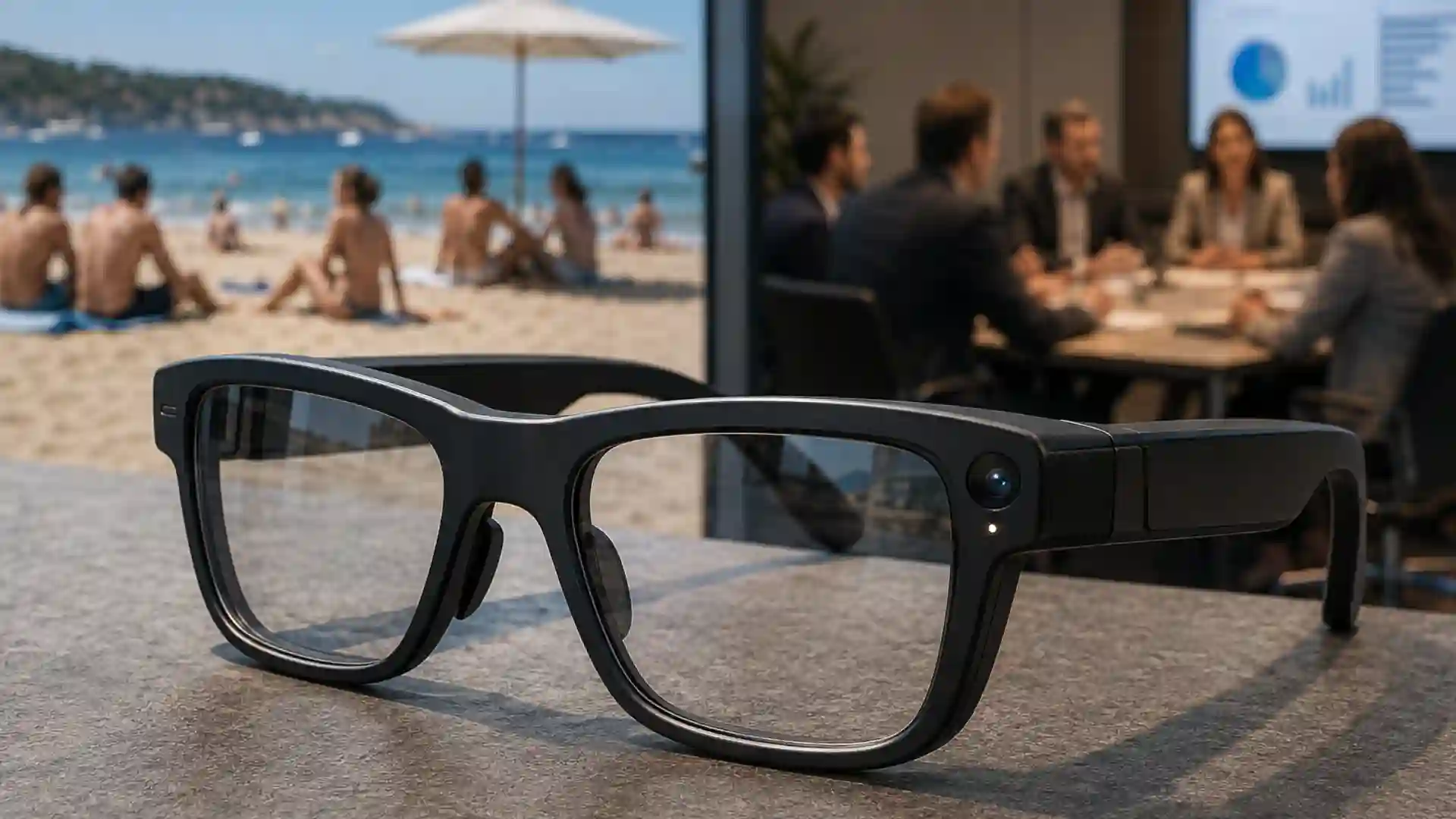
The privacy argument around smart glasses is no longer theoretical. It is now about a person wearing a normal-looking frame at a beach, beside a hotel pool, in an airport lounge, inside a meeting room, on a university campus or across a table from someone who does not know whether they are being recorded. The central issue is not only whether recording is legal. It is whether ordinary social spaces can survive when the camera becomes part of the face.
Table of Contents
The new privacy dispute is happening at eye level
Smart glasses have crossed a boundary that older cameras rarely crossed. A phone camera is visible because the hand moves, the arm rises and the screen points outward. A laptop webcam belongs to a device that sits on a table. CCTV is usually fixed, institutional and expected in shops, airports and offices. Smart glasses sit in a more intimate place. They follow the wearer’s gaze, rest at the height of normal eye contact and can make recording feel like conversation.
That change sounds small until it reaches a beach, a meeting, a campus bench or a bar. A person being filmed by smart glasses may not see a device at all. They may only see another person looking at them. The social signal that usually separates “talking” from “recording” becomes weak. The result is a privacy problem that cannot be solved only by telling people to obey the law or to check settings.
Meta’s own privacy page for Ray-Ban Meta AI glasses tries to answer that anxiety with a familiar package of controls. It tells wearers that they can manage what they share, power the glasses off, respect people’s preferences, stop recording if someone objects, avoid private spaces such as changing rooms and public toilets, keep the capture LED visible, obey the law and use a voice cue or clear gesture before capturing content. The same page says the wearer will be notified if the capture LED is covered before taking a photo, recording video or going live.
Those are useful instructions, but they also reveal the weakness. The product depends on the wearer to behave well. The bystander has no app, no dashboard and no guaranteed right to refuse before capture begins. Smart glasses move privacy control toward the person wearing the device, while the privacy risk often falls on everyone around that person.
That asymmetry is why the privacy debate has widened. It is no longer just a question for early adopters. It affects office managers, event venues, schools, gyms, hotels, public transport operators, regulators, parents, employees, journalists, creators and people who simply want to sit near the water without appearing in someone else’s first-person video.
The market has also changed. Meta and Oakley introduced Oakley Meta HSTN as performance AI glasses with a built-in camera, open-ear speakers, IPX4 water resistance and 3K video capture, while Reuters reported that Meta launched two new $499 Ray-Ban prescription smart glasses in March 2026. The device category is moving from novelty to eyewear line. Once prescription models and sports frames become normal, smart glasses stop being a gadget someone brings to a special situation. They become something people wear all day.
That is the heart of the news story. The camera is being normalized before the consent model has been settled. A privacy light, a policy page and a takedown request may not be enough when the footage has already been captured, uploaded, clipped, reposted, searched, summarized or used to identify someone.
A normal-looking frame now carries a camera, microphones and AI
Modern smart glasses are not only cameras. They are small wearable computers that combine image capture, audio capture, speakers, voice control, cloud services and, increasingly, AI interpretation. That bundle matters because privacy risk grows when capture becomes analysis.
Ray-Ban Meta glasses can take photos, stream content and let wearers speak to an AI assistant, according to Reuters reporting on Meta’s Ray-Ban Display rollout. Oakley Meta HSTN added a sports-oriented version of the same basic direction: hands-free capture, open-ear audio, Meta AI and a design that belongs in sunlight, on streets and in athletic settings. The move into prescription frames widens the likely user base because many people who need glasses no longer have to choose between vision correction and smart features.
The privacy problem is not that a camera exists. Cameras are everywhere. The privacy problem is the combination of five traits: the device is wearable, gaze-aligned, socially subtle, networked and AI-enabled. A phone camera may be just as powerful in technical terms, but it usually requires a visible action. Smart glasses reduce the bodily effort of recording. They can capture from the wearer’s natural viewpoint while the wearer keeps both hands free.
That difference changes how people judge intent. If someone holds up a phone at a beach, others can infer that a photo or video is being taken. If someone wears sunglasses with a small camera and a small indicator light, the inference is much harder. Some people will never notice the device. Others will notice only after they have already been captured.
The AI layer adds a second shift. Ray-Ban’s FAQ says that when a user asks Meta AI about something they are looking at, the glasses send a photo to Meta’s cloud for processing, and photos processed with AI are stored, used to improve Meta products and used to train Meta’s AI with help from trained reviewers. That means privacy cannot be judged only at the moment of capture. The next questions are where the media goes, how long it is retained, whether humans may review it, whether it trains models, whether bystanders are blurred, whether location and metadata travel with it and whether a third-party app can gain access.
Meta has also opened the category to developers. Its Wearables Device Access Toolkit preview, updated in December 2025, gives developers access to camera and audio functionality in Meta’s AI glasses, with select partners able to publish integrations to the public. A developer platform turns smart glasses from a single product into a sensor layer for other services. That is commercially powerful, but it raises the stakes for permission, data minimization and review.
A meeting assistant that captures a whiteboard is one use case. A fitness app that records surf conditions is another. A travel app that translates a menu may be harmless in many settings. A social app that records strangers, identifies them or posts clips for engagement is a different matter. The hardware is the same. The privacy risk depends on context, design, policy and incentives.
That is why beaches and meetings belong in the same article. They look unrelated, but they expose the same structural gap. At the beach, the risk is bodily exposure, children, swimwear, relaxed behavior and weak notice. In a meeting, the risk is confidential speech, trade secrets, HR issues, legal privilege, client data and unauthorized recording. Smart glasses compress public, private, personal and professional boundaries into one device.
The beach problem is about exposure, not secrecy
A beach is public in one sense and intimate in another. People know they are outside. They do not usually assume they are invisible. Yet they also do not behave as if every moment will become a first-person video on a stranger’s camera. They are in swimwear, applying sunscreen, caring for children, changing towels, sleeping, drinking, reading, flirting, arguing, resting or walking back from the water. The beach is a public place where people often reveal more of themselves than they would in most public places.
That is why smart glasses feel different at the beach than a phone. A phone pointed at a person in swimwear may trigger an immediate reaction. The person may turn away, object or ask what is being filmed. A pair of sunglasses can hide the act inside a normal gaze. The very object that belongs at a beach can become a camera that is hardest to question because sunglasses are expected there.
A privacy LED may be least useful in that environment. Bright sun, glare, distance, movement, tinted lenses and unfamiliarity with the product all reduce notice. Even if the LED is technically visible, many bystanders will not know what it means. The social meaning of the light has not been learned. A red tally light on a television camera has a known role. A small light on eyewear does not yet have the same public language.
The beach also creates edge cases that product policy cannot fully answer. Is it acceptable to record your friends playing volleyball if strangers in swimwear appear behind them? Is it acceptable to ask Meta AI about the best surf break if the image captures families nearby? Is it acceptable to livestream a sunset from a promenade when the lens also catches people leaving a changing hut? Is a hotel pool different from a public beach? What about a spa, resort deck, cruise ship pool or children’s swimming lesson?
Meta’s guidance says wearers should turn off the glasses in sensitive spaces such as changing rooms and public toilets, and should stop recording when people say they do not want to be recorded. That advice is sensible, but it leaves the gray zone where smart glasses are most controversial. A beach is not a changing room, but it contains changing-adjacent behavior. A pool is not a toilet, but it involves bodies, children and relaxation. A public promenade is not private, but it may still expose people to humiliating or sexualized reposting.
The privacy harm at a beach is often not the original recording. It is the loss of control after the recording leaves the sand. A short clip can be slowed down, zoomed, captioned, turned into a meme, used to mock someone’s body, shared in a group chat or uploaded to a platform. A child in the background can be captured without a parent knowing. A person escaping harassment can be located through scenery, timestamps or metadata. A private conversation near towels can be recorded if audio is captured.
This is where law and social norms diverge. In many jurisdictions, people have weaker privacy claims in public spaces than they do inside homes, bathrooms or changing rooms. But the moral problem is broader than legal expectation. A person can be in public and still have a strong interest in not being singled out, sexualized, identified or used as content. Public presence is not blanket permission for persistent recording.
For beaches, the practical rule should be simple enough to survive real life. Wearers should record only their own group, announce recording clearly, avoid close-up capture of strangers, never record near changing areas, never record children without permission, avoid livestreaming crowds in swimwear and stop immediately when asked. Venues should post clear rules at private beaches, pools and resorts. Platforms should treat non-consensual sexualized or humiliating smart-glasses footage as a high-risk content category rather than a normal creator format.
The beach exposes the core weakness of smart-glasses privacy. The device’s design makes casual capture easy, while the setting makes the captured person unusually vulnerable. The fact that a beach is open to the public does not make the footage harmless.
Meeting rooms turn convenience into governance
In a meeting room, smart glasses look useful for the opposite reason. The problem is not swimwear or bodily exposure. The problem is information. A wearer may want to record action items, capture a whiteboard, translate a foreign-language discussion, ask AI to summarize a slide or preserve a first-person view of a site visit. Those uses are tempting because meetings are full of details people forget.
Yet the meeting room is where smart glasses can create the fastest institutional damage. A recording device on a participant’s face can capture not only the official agenda, but side comments, off-screen documents, names on a whiteboard, product roadmaps, legal advice, HR issues, pricing, personal data, medical information, client identifiers and trade secrets. It can also capture people who have not agreed to be recorded and may not realize that the glasses are active.
Many companies already have rules for Zoom recordings, call recording, meeting minutes and visitor photography. Smart glasses bypass those habits. They do not require a camera tripod, a conferencing bot or a phone placed on the table. They travel with the employee. They may record by voice command, tap or app integration. They may also be connected to an AI service whose data rules differ from the company’s own retention policy.
The legal exposure depends on the jurisdiction, the content and the employment relationship. U.S. federal law generally permits a person who is a party to a conversation to record it, unless the recording is for a criminal or tortious purpose, but state laws vary and some states require all parties to consent. Cornell’s Legal Information Institute reproduces the federal rule in 18 U.S.C. § 2511, while the Reporters Committee notes that about 11 states primarily require all-party consent and that recording conversations where the recorder is not a party, has no consent and could not naturally overhear is almost always illegal.
That variation matters for meetings. A sales call with participants in several states may trigger stricter consent expectations. A global company may face EU, UK, U.S. state, employment and sector-specific rules at the same time. A meeting involving health information, financial records, minors, employee discipline or legal advice may raise separate confidentiality duties.
Workplace privacy guidance also treats audio as more intrusive than video in many contexts. The UK Information Commissioner’s Office warns organizations using CCTV that many cameras can record sound, but that does not mean they should. It says recording conversations is particularly intrusive, hard to justify and usually unnecessary unless there is a specific need, with transparency required if audio is used. Even though that guidance addresses organizational CCTV rather than consumer eyewear, the principle applies neatly to meeting rooms: audio turns a visual record into a record of thought, negotiation and trust.
Companies should not handle this through improvisation. “Ask before recording” is too weak for high-value meetings. A better policy treats smart glasses like any other recording device and sets default rules by room and meeting type. Board meetings, HR meetings, legal calls, product strategy sessions, client meetings, regulated-data discussions and investor meetings should default to no wearable recording unless explicitly approved. All-hands events, training sessions and tours may allow recording with notice, but only under defined conditions.
The policy also has to cover AI processing. A company may be comfortable with an employee taking a photo of a whiteboard for internal records. It may not be comfortable with that photo being sent to a consumer AI service, stored in a personal account, used to train a model or reviewed by outside contractors. The privacy question in meetings is not only “Was this recorded?” It is “Where did the recording go?”
Meeting rooms therefore need a visible protocol. Smart glasses should be removed, powered off or placed on the table when recording is not allowed. If recording is allowed, the host should announce the device, purpose, retention period and participants’ right to object. For sensitive work, companies may need physical signage, visitor terms, device lockers or a requirement that smart eyewear be treated like cameras in secure areas.
The convenience is real. The governance gap is also real. A meeting assistant that works too quietly can turn into a compliance incident before anyone in the room knows it is running.
Bystander consent is the missing product feature
The smart-glasses privacy debate keeps returning to one missing feature: a meaningful way for bystanders to consent, object or understand what is happening before capture. Wearers have controls. Bystanders mostly have signals.
That is a structural imbalance. The wearer decides whether to buy the device, pair the app, activate features, upload media, use Meta AI, turn on cloud processing, post content, delete recordings or show the capture LED to others. The bystander decides almost nothing. The person whose face, body, voice or behavior is captured may have less control than the person who owns the frame.
Research on camera glasses describes this as a wearer–bystander tension. A 2026 study on camera-glasses privacy, based on a survey of 525 people and 20 paired interviews in China, says camera glasses create tension between wearers seeking recording functionality and bystanders concerned about unauthorized surveillance. The tension is not merely emotional. It is built into the product relationship. The person buying the glasses is the customer. The person in front of the lens is an externality.
This is why standard privacy settings feel incomplete. A dashboard that lets the wearer manage data does not answer the bystander’s problem. A bystander may not know the wearer, may not speak the same language, may not recognize the device, may not see the LED, may be a child, may be in a vulnerable situation or may be unable to leave. A meeting participant may fear professional consequences for objecting. A woman approached by a stranger may fear escalation. A patient in a waiting room may not want confrontation. A person at a protest may face serious safety risks if identified later.
Bystander consent is also hard because smart glasses often capture groups, backgrounds and incidental speech. The wearer may be recording a friend, but the bystander appears behind them. The wearer may be asking AI to identify a plant, but a stranger’s face is included in the frame. The wearer may be capturing a scenic beach shot, but a family is walking through the image. Consent cannot be reduced to a single yes from the person wearing the device.
Product design can reduce the gap. A bright, unmistakable capture signal is one step. Audible cues are another, though they can be intrusive and may not work in noisy places. On-device bystander blurring, automatic face redaction, location-based restrictions near sensitive venues, short default retention, recording logs, visible “recording mode” patterns and tamper-resistant hardware all matter. More ambitious designs could allow people to broadcast a local “do not record” preference from phones or wearables, though that raises adoption and enforcement problems.
The point is not that every person in a crowded scene must sign a digital form. That would be absurd. The point is that bystander privacy needs to be treated as a first-class design requirement, not an etiquette footnote. The product should assume that some nearby people do not want to be recorded, identified, posted or processed. It should reduce capture where consent is unlikely, make capture unmistakable where it occurs and block the highest-risk uses by default.
The current model leans heavily on user behavior. That may be enough for friends at a party. It is not enough for a stranger at a beach, a staff member in a meeting, a student on campus or a person in a clinic waiting room.
The LED is a warning, not consent
The capture LED is the most visible privacy safeguard in smart glasses, and it is also the most contested. It is valuable because it creates some signal. It is insufficient because it does not create consent, understanding or practical control.
Meta tells users to “let that capture LED light shine,” to show others how it works and not to cover it. It says the wearer will be notified if the LED is covered before taking a photo, video or livestreaming. Meta also told People that its smart glasses include an LED that activates whenever content is captured and tamper-detection technology meant to prevent users from covering the light.
The problem is not whether the LED exists. The problem is whether it works as meaningful notice across real settings. A small light can be missed in bright sun, confused with a reflection, hidden by angle, ignored in a crowd or misunderstood by someone who has never learned the signal. In a beach setting, glare and sunglasses are normal. In a meeting, people may not stare at someone’s frame long enough to notice. In a bar, lighting may be too low or chaotic. In a classroom, a student may see the glasses but not know whether they are recording.
A signal is not consent unless the person receiving the signal understands it, has time to respond and can refuse without penalty. The LED fails that test in many settings. It may alert a knowledgeable observer. It may not alert a child, a tourist, a distracted employee, a person across a room or someone being approached unexpectedly.
The LED also places the burden of detection on the bystander. The person who may be harmed must notice the device, understand the light, interpret whether recording is active, decide whether to object, overcome social pressure and hope the wearer stops. That is a lot to demand from a stranger in a vulnerable moment.
This does not mean LEDs are useless. They should be brighter, standardized and harder to miss. The device should refuse capture if the LED is blocked. The light should use a pattern that becomes culturally recognizable. Regulators and industry bodies could require minimum visibility standards, tested in sunlight, indoor lighting and movement. Venues could train staff to recognize capture signals. Platforms could educate users and bystanders.
But an LED cannot carry the whole privacy model. A warning light can tell people that a boundary may be crossed. It cannot decide whether crossing the boundary is acceptable. Recording a child at a pool, a patient in a clinic, a colleague in an HR meeting or a woman during an unsolicited public approach does not become respectful because a small light was technically on.
The analogy is a car horn. A horn can warn others, but it does not authorize unsafe driving. A privacy light can warn others, but it does not authorize invasive recording. Product makers should stop treating the indicator as the solution and start treating it as one layer in a system that includes default restrictions, context-aware controls, retention limits, bystander protections and enforceable misuse rules.
The LED matters. It just does not solve the consent problem.
Smart glasses change the economics of recording
Privacy rules often lag because they assume recording requires effort. A person must pull out a phone, unlock it, frame a shot, aim the lens and accept the social signal that everyone nearby can see. Smart glasses lower that effort dramatically. They make capture quick, hands-free and aligned with ordinary seeing.
That change affects behavior. People record more when recording is easy. They capture moments that would have passed. They take first-person videos while walking, talking, driving, cooking, running, shopping, swimming near the shore or sitting in meetings. The cost of recording falls, so the amount of recorded life rises.
When the cost of capture approaches zero, privacy harm shifts from rare intrusion to constant possibility. A bystander no longer asks, “Is someone filming?” The question becomes, “Which of the people around me might be filming without making it obvious?”
This is not only about malicious users. Casual users create risk too. A person may record a beach clip without thinking about strangers in the frame. A conference attendee may capture a slide that includes confidential information. A friend may use live translation at dinner without realizing that audio and transcripts are processed. A worker may ask AI about a document on a desk and capture a client name. A parent may record their child’s game and capture other children without permission.
Low-friction capture also changes platform incentives. First-person footage feels intimate and viral. It gives viewers the sensation of being inside the encounter. That format rewards creators who approach strangers, provoke reactions or capture embarrassing moments. The more natural the glasses look, the more “authentic” the footage may seem to viewers — and the less likely subjects are to know they are part of content.
Recent incidents show this pressure. People reported in 2026 that a woman in a Washington, D.C., airport lounge discovered she had been secretly recorded by a stranger wearing smart glasses, refused permission to post the footage and later found it had been posted anyway. People also reported a University of San Francisco advisory after multiple community members said a man wearing Ray-Ban Meta sunglasses approached women with unwanted comments and inappropriate dating questions, with reports that the interactions may have been posted online.
These stories are not only about device misuse. They are about an attention economy that rewards the capture of unsuspecting people. Smart glasses give the creator a lower-risk way to create high-engagement footage while pushing the reputational and emotional cost onto the subject.
The same economics applies in business. A meeting recording that takes no effort may feel harmless to the person who wants better notes. But the cost is externalized to everyone else: legal risk, confidentiality exposure, morale damage and loss of trust. A company that permits casual wearable recording may find that employees speak less freely, clients hesitate and sensitive conversations move to unofficial channels.
This is the privacy paradox of smart glasses. The better they work for the wearer, the more invisible the burden becomes for others. The device is successful because it disappears into normal behavior. Privacy suffers for the same reason.
The airport and campus incidents show the same pattern
The reported airport and campus cases matter because they show a pattern that regulators, platforms and product teams should not dismiss as isolated bad behavior. In both cases, the alleged or reported conduct involved a wearer approaching women, recording interactions through smart glasses and turning private discomfort into public content.
The airport case is especially revealing. The woman was not in a secluded place. She was in an airport lounge. She spoke with a stranger and gave him her number. Later, she realized he had recorded their conversation with smart glasses. According to People’s account, he later sent her the footage and tried to persuade her to allow posting; despite her refusal, he posted it anyway. That sequence shows the weakness of after-the-fact consent. Once the footage exists, the subject’s refusal may be treated as an obstacle rather than a boundary.
The campus case shows the same issue at community scale. The University of San Francisco advisory described reports that a man wearing Ray-Ban Meta sunglasses approached women with unwanted comments and inappropriate dating questions, possibly to post the interactions online. The university said no threats or violence had been reported, but it could not identify all students who may have been posted. The harm was not only the recording. It was the uncertainty afterward: Who was filmed? Where was it posted? Who saw it? Who saved it?
That uncertainty is a major privacy injury. A person who suspects they were recorded may search platforms, worry about recognition, fear harassment and relive the interaction. Even if the clip is removed, copies may persist. Even if the original creator deletes it, viewers may have saved it. The subject must chase the harm across platforms that were never designed around their consent.
The incidents also show why platform rules and device rules must align. A device manufacturer may say harassment and privacy violations are forbidden. A platform may ban certain non-consensual content. But if creators can record, upload and gain views before enforcement occurs, the system still rewards harm. A takedown after virality is not a privacy safeguard. It is damage control.
For campuses, airports, conference centers and resorts, the lesson is practical. Do not wait for a high-profile incident. Set rules before the device appears in a conflict. Staff should know how to respond when someone reports smart-glasses recording. Signs should be clear in sensitive areas. Event terms should address wearable cameras directly. Security teams should know that smart glasses can look like ordinary eyewear.
For product companies, the lesson is harsher. Abuse cases should shape default design, not merely trust-and-safety pages. If a product makes covert social recording easy, the company cannot treat every abuse case as unpredictable misuse. The social use case was foreseeable from the beginning.
The airport and campus reports are not the whole story. Most users will not use smart glasses to harass strangers. But privacy design cannot be built around ideal users. It must be built around predictable misuse, vulnerable people and high-risk contexts.
AI turns a clip into a searchable identity trail
A recorded clip used to be mostly a file. It could embarrass someone, document something or be shared. AI changes that. A clip can now become text, metadata, identity clues, searchable summaries, extracted faces, transcribed speech, translated speech, object labels, location hints and behavioral inferences.
That is why smart glasses are not just wearable GoPros. They sit inside an AI ecosystem. When a wearer asks a model what they are seeing, the scene can become input. When a meeting is transcribed, speech becomes searchable. When a video is posted, platform systems may classify faces, voices, objects, places and engagement signals. When developers gain camera and audio access, new analysis pipelines become possible.
The privacy harm grows when footage is processed into data that can be searched, combined and reused. A beach video might expose a person’s body. An AI-enhanced beach video might also reveal location, time, companions, visible tattoos, license plates, hotel logos or a child’s school name on a bag. A meeting recording might capture a whiteboard. An AI system might extract names, deadlines, product plans and client details.
The I-XRAY demonstration made that point sharply. Harvard’s Library Innovation Lab described the project as combining Ray-Ban Meta smart glasses, face search engines, large language models and public databases to reveal personal details such as home addresses, names and phone numbers just by looking at someone. 404 Media reported that the project used commercially available Meta Ray-Ban glasses to move from a face to a name. The lesson was not that Meta shipped that specific feature. The lesson was that consumer eyewear can become the front end for a larger identification stack.
This matters for every setting in the user’s prompt. At a beach, identity lookup can turn a stranger in swimwear into a named person with social profiles. In a meeting, it can connect attendees to public records, LinkedIn pages, prior posts or leaked data. At a protest, clinic, place of worship or support group, it can destroy practical anonymity. At a school, it can expose minors. At a hotel or airport, it can turn a passing interaction into a traceable identity record.
The difference between capture and identification is legally and morally important. A person may tolerate appearing in the background of a holiday clip. They may not tolerate being identified by name, profile, employer or address. A coworker may accept meeting notes. They may not accept biometric matching or AI-generated dossiers.
That is why reported facial-recognition plans have triggered such strong opposition. ACLU said in April 2026 that 75 organizations warned Meta against reported plans to equip Ray-Ban and Oakley AI eyeglasses with facial recognition, arguing that such glasses could identify strangers in places such as protests, medical clinics and businesses, then link names to sensitive information. EFF argued that faceprints are highly sensitive biometric data and warned of mass surveillance, data breach, discrimination and safety risks if face recognition is added to street-worn glasses.
The danger is not only that the glasses see. It is that the glasses may help systems know.
Facial recognition would cross the line from capture to identification
Facial recognition is the red line in the smart-glasses debate because it changes the social meaning of being seen. Being seen by a stranger is part of public life. Being instantly identified, logged, profiled and searched by a stranger is not.
Wired reported in April 2026 that a feature reportedly known as Name Tag, described earlier by The New York Times, would work through the AI assistant built into Meta’s smart glasses and could allow wearers to pull up information about people in their field of view. Wired said engineers had reportedly weighed versions that would identify people the wearer is connected to on a Meta platform or, more broadly, people with public accounts on a Meta service such as Instagram. Meta had not launched such a universal public feature at the time of that reporting, so the claim must be treated as reported planning rather than a confirmed shipped capability.
Even a limited version would be sensitive. A system that identifies only existing contacts may sound safer, but it still changes meetings, parties, conferences and campuses. A person may not want a distant acquaintance to be reminded of their name, job, relationship history or online profile through eyewear. A broader system tied to public accounts would be far more invasive because “public” online presence does not mean a person agreed to real-world identification by anyone wearing glasses.
Facial recognition in glasses would turn public space into a query interface. The wearer would not only look at a person. They would ask the network who that person is. The subject may receive no signal, no chance to refuse and no record of the lookup. That is qualitatively different from remembering a face or searching a name after an introduction.
Civil-society opposition reflects that difference. EPIC said it joined an ACLU-led coalition of more than 70 organizations urging Meta to halt and publicly disavow plans to add facial recognition to Ray-Ban smart glasses. ACLU’s broader statement said the coalition included organizations focused on domestic violence survivors, worker rights, bodily autonomy, consumer privacy, civil rights and civil liberties. Those groups focus on different harms, but smart-glasses facial recognition connects them: stalking, retaliation, outing, labor surveillance, protest identification, harassment and discrimination.
For beaches, facial recognition intensifies exposure. Someone captured in a swimsuit is no longer an anonymous body in the background; they may become a named person. For meetings, facial recognition can identify attendees, visitors, clients, union organizers, whistleblowers or job applicants. For clinics, shelters and places of worship, it can reveal sensitive affiliations. For protests, it can chill speech.
Biometric law also becomes relevant. Illinois’ Biometric Information Privacy Act defines a biometric identifier to include a scan of face geometry and defines biometric information as information based on an individual’s biometric identifier used to identify that person. The EU AI Act restricts real-time remote biometric identification by law enforcement in publicly accessible spaces under strict conditions, and the European Commission lists real-time remote biometric identification for law enforcement in publicly accessible spaces among prohibited unacceptable-risk AI practices subject to exceptions and safeguards.
Consumer facial recognition is not identical to police facial recognition. Yet the social effect can overlap when enough consumers carry the device. Millions of private wearers can create a distributed identification network without being a state agency. That is why the smart-glasses debate should not wait until a government surveillance program is involved. A consumer product can erode anonymity at scale.
A responsible rule would be blunt: no real-time face identification of bystanders through consumer smart glasses without explicit, narrow, revocable consent from the identified person. Anything weaker risks making anonymity a privilege only for people who never leave home, never protest, never seek care, never use dating apps, never attend meetings and never cross paths with someone wearing AI eyewear.
Data flows matter as much as the camera
A camera in glasses creates the visible privacy issue. The data pipeline creates the deeper one. People need to know not only whether smart glasses are recording, but whether the recording is stored locally, copied to a phone, uploaded to cloud services, used for AI processing, reviewed by humans, retained for training, shared with developers, sent to third-party services or posted to platforms.
Ray-Ban’s FAQ gives a direct example. When users ask Meta AI about what they are looking at, the glasses send a photo to Meta’s cloud, and photos processed with AI are stored, used to improve Meta products and used to train Meta’s AI with trained reviewers. The Verge reported in April 2025 that Meta told users “Meta AI with camera use” would be enabled unless they turned off “Hey Meta,” while Meta also said ordinary photos and videos captured to the phone camera roll were not used for training unless shared to Meta AI, cloud services or a third-party product. The Verge also reported that Meta removed the option to disable cloud storage of voice recordings, while users could delete recordings in settings.
This distinction is critical. A wearer may say, truthfully, “I’m only taking a photo.” Another user may ask AI to interpret the scene. Another may livestream. Another may sync to cloud storage. Another may use a developer app. To a bystander, these actions can look identical. The visible act is one small light. The hidden data consequences can be completely different.
The same issue applies to live translation and meetings. Translation feels harmless because it solves a human problem: people want to understand one another. But translation requires audio capture and processing. Meeting summaries are useful because they reduce note-taking. But summaries require speech capture, transcription and retention decisions. A person may consent to being heard by the person across the table, not to being processed by a cloud service or reviewed by outsiders.
Businesses should treat smart-glasses data flows like software procurement, not like casual note-taking. Before permitting the devices, they need to know whether media stays on device, whether data leaves the corporate environment, whether the account is personal or managed, whether retention can be controlled, whether administrators can audit use, whether recordings can be deleted, whether the service provider uses the content for model training and whether client contracts permit such processing.
Venues need a simpler version of the same logic. A beach club, school, clinic or conference cannot audit every cloud pipeline. It can set rules: no smart-glasses recording in locker rooms, bathrooms, treatment areas, children’s areas, confidential sessions or private meetings; visible notice for allowed recording; no livestreaming without permission; removal for repeated violations.
The user data story is also tied to the business race. Reuters reported that Meta acquired Limitless, an AI wearables startup whose pendant records conversations, generates transcripts and creates searchable summaries, as Meta doubles down on AI-enabled consumer hardware. That acquisition shows where the category is heading: from capture devices to memory devices. A memory device is more intimate than a camera because it aims to preserve and search ordinary life.
The future privacy question is not “Did the glasses record?” It is “Did the glasses remember?” Once smart eyewear becomes a memory interface, every social setting needs a norm for when other people are allowed to become part of someone else’s searchable archive.
Workplace policy has to treat smart glasses as recording devices
A smart-glasses policy should not be buried inside a generic bring-your-own-device document. The device category needs explicit workplace rules because it blends eyewear, camera, microphone, AI assistant and cloud account. Employees may not think of glasses as a recorder, especially if they use them for music, calls or vision correction. Employers cannot rely on common sense when the product is designed to look ordinary.
The workplace default should be clear: smart glasses are recording devices whenever they contain active camera, microphone, AI or streaming functions. That does not mean they must be banned everywhere. It means they should be governed like other tools that capture people and confidential information.
A practical workplace policy should cover at least five layers. First, zones: where the glasses may be worn, where they must be powered off and where they are not allowed at all. Second, meeting rules: whether recording requires host approval, participant consent, a visible notice and a retention plan. Third, data handling: whether work content may be sent to consumer AI services or only approved enterprise tools. Fourth, accessibility: how the company supports employees who use smart glasses for disability-related assistance while protecting coworkers and clients. Fifth, enforcement: what happens when a policy is violated.
The hardest cases involve mixed use. An employee may need prescription smart glasses to see. Another may use live captions as an accessibility aid. A field technician may need hands-free documentation. A warehouse worker may need remote assistance. A journalist may need recording tools. A salesperson may want meeting summaries. A blanket ban may be easy, but it can punish legitimate use. A vague permission model may be dangerous.
The answer is role-based authorization. Employees who need smart glasses for an approved business purpose should receive training, managed accounts and clear limits. Employees who wear consumer smart glasses as personal eyewear should know when features must be disabled. Sensitive rooms should not depend on trust alone. Door signs, meeting invites and visitor terms should say whether wearable cameras and AI recorders are prohibited.
Audio deserves special treatment. As the ICO notes in its CCTV guidance, audio recording is particularly intrusive and difficult to justify in many organizational settings. Meeting rooms, HR interviews, medical workplaces, legal offices and union discussions should assume that audio capture is more sensitive than images. A policy that permits photos of equipment may still prohibit audio recording.
Companies also need to protect trade secrets. A wearer can capture a prototype, roadmap, pricing sheet, password on a screen, unreleased campaign, merger discussion or customer list with almost no visible motion. The risk is higher in open offices, labs, workshops and conference booths. A visitor wearing smart glasses can create the same risk as someone walking through with a camera, except the device may not be recognized.
The meeting invite is one useful enforcement point. For sensitive meetings, the invite can state: “No recording, livestreaming, transcription or AI processing through phones, laptops, smart glasses or other wearables without written approval.” That language matters because smart glasses blur categories. People may claim they did not think “recording” included AI translation or visual queries. Specific words reduce ambiguity.
Workplace privacy will not be solved by banning fashion. It will be solved by naming the functions that create risk. The rule is not about glasses. It is about capture, transmission, analysis and storage.
Schools and universities face a harder enforcement problem
Schools and universities sit between public space and institutional control. Students, visitors, parents, staff, vendors and guests move through campuses. Many areas feel public, but the institution has safety, privacy and educational duties. Smart glasses make that environment difficult to manage.
A campus walkway, cafeteria or library may not feel sensitive in the same way as a locker room or counseling office. Yet students can be targeted there. The USF advisory shows the problem: reports of a man wearing Ray-Ban Meta sunglasses approaching women with unwanted comments and inappropriate dating questions, with possible online posting. The university said it was difficult to identify all students who may have been impacted.
The campus risk is not only unauthorized recording. It is targeted recording that exploits social access. A person can approach students under the guise of conversation, capture their reactions and use the footage for content. A campus is full of young adults who may feel pressure to be polite, may not notice the device and may face harassment if a clip goes viral.
Schools also face privacy rules involving minors, education records, disability accommodations and student discipline. A smart-glasses recording in a classroom may capture students’ names, faces, voices, grades, health conditions or disability-related support. A hallway recording may capture bullying, a medical emergency or a disciplinary incident. A livestream from a school event may capture children whose parents did not consent.
Universities should not wait for a police-level threat before acting. They need smart-glasses rules in student conduct codes, event policies, residence-hall rules, library policies and classroom recording guidance. The rules should distinguish ordinary eyewear from active capture. They should prohibit recording in bathrooms, locker rooms, residence halls without consent, counseling areas, health clinics and classrooms unless approved. They should also prohibit using wearable cameras to harass, shame, sexualize or identify students.
Classrooms need special attention. A student using smart glasses for live captions or translation may have a legitimate accessibility or language need. Another student may use the same device to record classmates. The instructor should not be forced to evaluate the technology case by case with no institutional support. Universities need an accommodation pathway that protects access while limiting bystander capture.
The device signal problem is harder on campuses because enforcement requires recognition. Staff may not know what smart glasses look like. Students may not know whether recording is active. Posters and orientation materials can help. So can a simple reporting path: if someone believes they were recorded without consent, the institution should explain how to report the incident, preserve evidence, request platform takedown support and access counseling or safety resources.
Universities also need platform escalation. If a student or visitor posts non-consensual smart-glasses footage that targets campus members, the school should have a contact process for social platforms. Telling victims to report videos alone puts too much burden on them, especially when they do not know where copies have spread.
Schools and universities are early warning systems for consumer surveillance. They are dense, social and full of power imbalances. If smart-glasses norms fail there, they will fail elsewhere.
Events, gyms and beaches need visible rules before conflict starts
Private venues have more power than open streets, but they often hesitate to use it until a conflict occurs. That is a mistake with smart glasses. By the time a guest complains, footage may already be uploaded.
Beaches, pools, gyms, spas, conferences, music venues, sports clubs, hotels and wellness centers should decide now whether smart-glasses recording is allowed, restricted or banned in specific zones. A rule that appears only after someone objects is not a privacy rule. It is a dispute response.
The categories are not all the same. A conference may allow smart-glasses capture in public exhibition areas but prohibit it in closed sessions, networking lounges, meeting rooms and badge-scanning areas. A gym may allow wearable eyewear but prohibit camera use on the workout floor and ban devices entirely in locker rooms. A hotel pool may ban recording near children’s areas, cabanas and changing paths. A beach club may allow scenic recording only when strangers are not the focus. A music venue may ban livestreaming for rights and safety reasons.
Signage should be direct. “No photography” may not be enough because a guest may argue that smart glasses are not a camera in the traditional sense or that AI translation is not photography. Better wording names the functions: “No filming, livestreaming, audio recording, AI transcription or camera-enabled smart glasses in this area.” For restricted zones, venues can require smart glasses to be powered off or placed in a case.
Enforcement should be calm and standardized. Staff should not accuse every smart-glasses wearer of misconduct. Many users will be listening to music, taking calls or using prescription lenses. Staff can ask whether the camera or recording functions are active, point to the venue policy and require power-off in sensitive zones. Repeat refusal should lead to removal, not negotiation.
Risk profile by everyday setting
| Setting | Main privacy risk | Sensible default |
|---|---|---|
| Beach or waterfront | Swimwear, children, bodily exposure and weak LED visibility in sunlight | Record only your own group and avoid close-up capture of strangers |
| Hotel pool or resort | Guests expect relaxation, not viral first-person footage | Ban recording near pools, cabanas and changing routes unless approved |
| Office meeting | Confidential speech, documents, clients and trade secrets | No wearable recording or AI processing without explicit meeting approval |
| Conference or trade show | Badges, unreleased products and private side conversations | Allow only in open areas with posted rules and no hidden recording |
| Gym or locker area | Bodies, health data, minors and changing spaces | Ban camera-enabled eyewear in locker rooms and restrict filming on floors |
| School or university | Students, minors, harassment and classroom privacy | Require consent and prohibit targeted or humiliating capture |
| Clinic or place of worship | Sensitive affiliation, health information and vulnerability | Power off or prohibit smart glasses in sensitive areas |
| Protest or civic event | Identification, retaliation and chilling effects | Avoid face capture and prohibit biometric identification |
The table is a policy map, not legal advice. The most useful rule is contextual: the more vulnerable the setting, the stronger the default against recording should be. A beach, meeting room and clinic do not share the same law, but they share the same need for visible boundaries before capture happens.
Venues that ignore smart glasses will inherit the worst possible standard: whatever the most aggressive user thinks is acceptable. The better approach is boring but effective. State the rule, train staff, repeat it in booking terms and make it easy for people to report violations.
Public recording law is not a privacy ethic
One of the weakest arguments in the smart-glasses debate is “it is legal in public.” Sometimes it is. Sometimes it is not. Either way, legality is not the same as respect.
In the United States, the law often distinguishes video recording, audio recording, expectation of privacy, harassment, voyeurism, stalking, commercial use, biometric processing and location. Federal law allows one-party consent for many interceptions where the recorder is a party or one party consents, unless the recording is for a criminal or tortious purpose. State law can be stricter, and the Reporters Committee explains that some states require all parties to consent, while recording a conversation where the recorder is not a party, lacks consent and could not naturally overhear is almost always illegal.
That patchwork creates confusion. A person may be allowed to film a scene in a park but not secretly record a private conversation. A person may be able to photograph a public beach but still face claims if they use images for harassment, sexual exploitation, commercial endorsement or doxxing. A workplace may prohibit recording even if local law would not criminalize it. A school, hotel or gym may set private rules stricter than the street.
Smart glasses widen the gap between what a person can legally capture and what they should socially capture. A phone camera already raised this problem. Wearable cameras intensify it because they remove visible intent. The law may ask whether a reasonable expectation of privacy existed. Social life asks a different question: did the person reasonably expect to be turned into content?
There are settings where public recording is valuable. Journalists document police conduct, protests, disasters and matters of public concern. Citizens record misconduct. Workers document safety hazards. People capture family memories. Tourists record landmarks. Accessibility tools help people understand their environment. A privacy ethic should not erase those uses.
The problem is indiscriminate capture. A creator recording women at airports for engagement is not the same as a journalist documenting a public official. A tourist recording a beach sunset is not the same as zooming in on strangers in swimwear. An employee using approved smart glasses for a site inspection is not the same as secretly recording a confidential meeting.
A workable ethic has four tests. Is the subject the focus or merely incidental? Is the setting sensitive? Is audio captured? Will the content be posted, analyzed or shared beyond the moment? Those questions do more practical work than a vague appeal to public legality.
The smart-glasses rule for ordinary users should be stricter than the legal minimum: disclose recording when people are identifiable, ask before recording conversations, avoid vulnerable contexts, never target strangers for humiliation and stop immediately when asked. That rule will not resolve every edge case, but it matches the technology’s social risk better than “I was allowed to.”
The law may eventually catch up. Social norms need to move faster.
Europe’s framework gives regulators a stronger starting point
Europe already has a stronger privacy vocabulary for smart glasses because the GDPR, data-protection authorities and the AI Act focus on personal data, transparency, lawful basis, proportionality, biometrics and risk. That does not mean every question is settled. It means regulators have more tools than a simple public-private recording distinction.
The European Data Protection Board’s Guidelines 3/2019 address processing personal data through video devices and are explicitly connected to topics including biometrics and new technology. Those guidelines were written before the current wave of AI eyewear, but their principles fit the category. If a device captures identifiable people, it can process personal data. If it captures faces, voices, location and behavior, the risk rises. If the footage is shared, retained, analyzed or used for AI, the obligations become heavier.
The ICO’s CCTV guidance, though UK-specific and aimed at organizations, points to a key idea: recording audio is especially intrusive, transparency matters and organizations need a lawful basis for surveillance. That principle applies to offices, venues and institutions using or allowing smart glasses. A company cannot simply say a wearable is convenient if it records conversations unnecessarily.
The EU AI Act adds another layer for biometric and high-risk AI. The European Commission describes the AI Act as a risk-based framework and lists prohibited unacceptable-risk practices including untargeted scraping to create or expand facial recognition databases, emotion recognition in workplaces and education, biometric categorization to deduce protected characteristics and real-time remote biometric identification for law enforcement in publicly accessible spaces. Article 5 of the AI Act sets strict conditions around law-enforcement use of real-time remote biometric identification in publicly accessible spaces, including necessity, proportionality, safeguards, fundamental-rights impact assessment and prior authorization.
Consumer smart glasses are not automatically treated the same as law-enforcement biometric systems. Still, the European framework matters because it recognizes that biometric identification in public space is not an ordinary feature. Europe’s legal starting point is that identity, face data and public-space AI are fundamental-rights issues, not just product settings.
For beaches and meetings, this has practical implications. A resort operating in Europe that encourages smart-glasses content may need to consider GDPR transparency and third-party data. An employer allowing smart-glasses meeting summaries may need to assess lawful basis, necessity, retention, employee rights and transfers. A school using smart-glasses tools may need stronger safeguards because students and minors are involved. A product company shipping AI features in Europe may face more pressure to minimize bystander processing.
Europe also makes the “legitimate interest” debate sharper. A user may have an interest in recording. A company may have an interest in improving AI. A bystander has an interest in not being recorded, identified, analyzed or used for training without meaningful notice. Privacy law forces those interests into a balancing exercise rather than letting the product owner decide alone.
The EU model is not perfect. Enforcement can be slow. Consumer devices move faster than regulatory proceedings. Cross-border services complicate accountability. Many bystanders will never file complaints. But Europe’s framework gives policymakers a vocabulary for the exact harms smart glasses create: invisible capture, biometric risk, sensitive locations, proportionality, transparency and data minimization.
That vocabulary is already more useful than treating every beach, meeting and campus walkway as a generic public space.
U.S. law leaves gaps around bystanders and biometric harm
The U.S. privacy framework is more fragmented. It has federal wiretap law, state recording laws, tort claims, biometric laws in some states, consumer-protection enforcement, workplace rules, sector-specific laws and platform policies. There is no single national privacy law that cleanly answers what happens when consumer smart glasses record bystanders in ordinary life.
For audio, the law varies sharply. Federal law sets a one-party baseline for many recordings, while state laws may require all-party consent. For biometrics, Illinois BIPA remains one of the most important state examples because it regulates biometric identifiers such as scans of face geometry and biometric information used to identify a person. But BIPA does not create a nationwide rule, and many states have weaker or narrower biometric protections.
Consumer protection law can address deception. The FTC has warned AI companies to uphold privacy and confidentiality commitments, and it has brought enforcement where companies misrepresented or omitted material facts about facial-recognition practices. That matters if a company tells users and bystanders that a product is private while media is used in unexpected ways. But enforcement after a policy violation is not the same as a clear upfront rule for bystanders.
The largest U.S. gap is that many privacy harms from smart glasses are social, cumulative and hard to litigate. A stranger records a woman at an airport and posts the clip. A beach video captures a child. A meeting participant records a sensitive conversation. A person at a protest is identified later. Each scenario may fit some legal theory, or none, depending on facts and state law. Victims may lack the time, money, evidence or emotional bandwidth to pursue claims.
Platforms add another layer. If the harm occurs through posting, the subject may seek takedown under platform rules. But platform enforcement often happens after the clip spreads. A person harmed by smart-glasses content may not know where the original file is, who has copies, whether AI systems processed it or whether the creator’s account will return under a new name.
Employers and venues can close some gaps with private rules. A company can prohibit wearable recording in meetings. A gym can ban camera-enabled eyewear in locker rooms. A school can discipline targeted recording. A conference can eject violators. These rules are not a substitute for law, but they are often faster and clearer.
At the national level, policymakers could focus on specific harms rather than banning a device category. Stronger rules could require conspicuous capture indicators, prohibit disabling or weakening them, restrict real-time face recognition in consumer eyewear, require bystander blurring by default in sensitive contexts, create duties for non-consensual intimate or sexualized capture, strengthen platform takedown for targeted smart-glasses harassment and require clear AI data-use disclosures.
The U.S. debate often gets stuck between innovation and privacy as if they are opposites. That frame misses the commercial risk. If people start seeing smart glasses as tools for creeps, stalkers, secret recorders or workplace spies, adoption will suffer. Stronger privacy design protects the category from its worst users.
A practical privacy model starts with zones
Smart-glasses privacy becomes easier when spaces are divided by risk. Instead of asking every wearer to make a complex legal judgment, institutions and users can apply zone-based defaults.
Green zones are places where recording is usually expected or low risk: open tourist landmarks, outdoor scenery without identifiable close-ups, public product demos, opt-in events and personal settings where everyone present agrees. Yellow zones are mixed settings: beaches, hotel lobbies, conference halls, restaurants, public transport, university lawns and open offices. Red zones are sensitive: bathrooms, locker rooms, clinics, schools with minors, HR meetings, legal meetings, boardrooms, houses of worship, shelters, secure labs, gyms, children’s areas and private homes without permission.
The value of zones is that they shift privacy from personal improvisation to shared expectation. A wearer does not need to guess whether to record in a locker room. The answer is no. A meeting host does not need to debate whether wearable transcription is allowed in a legal strategy session. The default is no unless approved. A beach club does not need to judge every clip. It can ban recording near changing routes and children’s areas while allowing scenic content from designated spots.
Zones also help product design. Smart glasses could offer a “sensitive area” mode that disables capture when entering mapped venues such as schools, gyms, clinics or government offices, subject to accuracy and abuse safeguards. Enterprise-managed devices could enforce no-recording zones inside company buildings. Events could use wireless beacons or local policies to signal recording restrictions. Apps could require renewed confirmation before capture in high-risk environments.
There are limits. Geofencing can be inaccurate. Sensitive events can occur in ordinary places. A beach can include a medical emergency. A living room can become a work meeting. A protest can move. A person may need accessibility support in a red zone. The point is not perfect automation. The point is to reduce the most predictable harms.
For individuals, a zone model leads to clear behavior. At the beach, record only your own group and avoid strangers. In meetings, ask and document consent. In clinics, houses of worship and schools, power off by default. In gyms and locker rooms, do not record. At protests, avoid face capture unless there is strong public-interest justification and safety precautions. At parties, ask before recording and never post without consent from identifiable people.
For businesses, zones should be written into policy. A company campus can mark red zones for labs, customer-data rooms, HR offices and boardrooms. A hotel can define pool and spa restrictions. A conference can mark no-recording sessions in the agenda and on badges. A school can include smart glasses in device policies.
The zone model is also easier to communicate to the public. “No camera-enabled eyewear beyond this point” is clearer than a privacy policy. “Smart glasses must be powered off in this meeting” is clearer than a general statement about confidentiality. Privacy improves when rules can be understood at the door, not buried in terms of service.
Product design should create friction at the moment of capture
Tech companies often try to remove friction. Smart-glasses privacy needs some friction returned. Not enough to destroy legitimate use, but enough to make capture visible, deliberate and accountable.
A capture LED is one friction point. A shutter sound is another. A voice confirmation before recording a person at close range could be another. A device could require a visible gesture before starting video in social settings. It could automatically stop recording after short intervals unless the wearer confirms continuation. It could blur faces by default until the wearer gets consent. It could block livestreaming in sensitive zones. It could refuse third-party API access unless apps meet bystander-protection rules.
Good privacy friction is not annoyance for its own sake. It is a moment that reminds the wearer that other people are involved. The best friction appears at the boundary between personal use and bystander impact.
Meta’s own guidance already moves in this direction when it tells wearers to use a voice or clear gesture to let nearby people know they are about to capture, particularly before going live. The problem is that guidance is voluntary. Product design could make the behavior more consistent. For example, before livestreaming in a crowded setting, the glasses could require an audible announcement. Before using AI on an image with faces, the app could show a notice that bystanders may be processed and offer automatic face blur. Before sharing a first-person social clip, the app could prompt the wearer to confirm that identifiable people consented or are incidental.
Design choices that change the privacy balance
| Design choice | Privacy strength | Weakness if used alone |
|---|---|---|
| Bright capture LED | Gives a visible recording signal | May be missed, misunderstood or hard to see in sun |
| Audible capture cue | Works without visual attention | Can be disabled, masked by noise or socially disruptive |
| Tamper detection | Blocks obvious LED covering | Does not stop lawful-looking but harmful recording |
| Face blurring by default | Protects incidental bystanders before sharing | May fail on profiles, reflections or partial faces |
| Short retention defaults | Reduces long-term exposure | Does not prevent immediate posting or livestreaming |
| On-device processing | Limits cloud transfer | Still captures people and may not cover all features |
| Sensitive-zone restrictions | Prevents predictable high-risk use | Location detection is imperfect and exceptions are needed |
| Developer API limits | Controls third-party misuse | Requires strict review, auditing and enforcement |
The stronger privacy model combines signals, limits and accountability. No single safeguard is enough because smart-glasses harm can begin at capture, grow during processing and multiply through sharing. Product teams should design for the full path, not only the first click or voice command.
Friction is especially important for creator features. A user recording their own cooking is different from a user approaching strangers for viral content. The app can detect some risk signals: repeated face-forward social clips, public-interaction content, attempts to post people who are close and identifiable, or accounts receiving repeated privacy complaints. These signals should trigger stricter review, reduced reach or upload blocks.
For meetings, enterprise versions should provide stronger controls: visible recording status, admin-enforced no-recording policies, local transcription options, deletion logs, data-loss-prevention scanning, consent records and integration with approved meeting platforms. A consumer model that stores clips in a personal app is not enough for regulated workplaces.
Product makers may resist friction because it reduces spontaneity. Yet spontaneity is exactly the risk. The product should not make it effortless to capture people who never agreed to participate. A little friction at the right moment can preserve trust in the entire category.
Businesses need meeting-room defaults, not case-by-case etiquette
A business that waits for employees to negotiate smart-glasses etiquette in every meeting will end up with inconsistent behavior and preventable disputes. Meeting rooms need defaults, and the defaults should be visible before the meeting starts.
The simplest business rule is this: no recording, transcription, livestreaming, AI visual analysis or smart-glasses capture in meetings unless the host permits it and participants are told. That rule should apply to phones, laptops and wearables, but smart glasses deserve special mention because people may forget they contain cameras and microphones.
Meeting types should drive policy. Board meetings, legal calls, HR interviews, disciplinary meetings, union discussions, client strategy sessions, M&A discussions, product roadmap sessions, security reviews and finance meetings should default to no wearable capture. Training sessions, all-hands meetings, public webinars and site tours can allow recording with notice, but the notice must include how the recording will be used and retained.
Companies also need to separate internal recording from external AI processing. An approved recording stored in a company system is one thing. A personal smart-glasses account sending photos, audio or transcripts to a consumer AI service is another. Ray-Ban’s FAQ says AI queries about what the wearer is looking at send a photo to Meta’s cloud, and photos processed with AI may be used to improve and train Meta’s AI with trained reviewers. That type of disclosure should make every employer ask whether sensitive meeting content belongs in a consumer AI pipeline.
A practical meeting-room policy can use three labels. “No capture” means no recording or AI processing through any device. “Internal capture allowed” means only approved company tools may record or transcribe. “Public capture allowed” applies to events intended for public sharing. These labels can appear in calendar invites, room screens and meeting slides. The goal is to remove guesswork.
Visitors need the same clarity. A vendor wearing smart glasses into a facility may unintentionally capture confidential material. A journalist may wear them for legitimate reporting. A client may use them for accessibility. The front desk or event host should know the rule and offer a solution: power off, cover storage case, approved recording badge or alternative accommodation.
The policy should also protect employees who object. A junior employee should not have to challenge a senior executive wearing recording glasses. A client should not have to confront a salesperson. The meeting host owns the rule. If recording is allowed, the host announces it and gives people a chance to opt out or request a no-recording discussion.
This is not only privacy compliance. It is trust management. People speak differently when they think every word may be captured and summarized. A workplace that allows unclear recording will get less honest meetings, weaker brainstorming and more defensive communication.
The meeting room is where smart glasses either become a trusted productivity tool or a quiet surveillance device. The difference is governance.
Creators and influencers are the stress test for every safeguard
Influencer use is where smart-glasses privacy safeguards face their harshest test because the incentives point toward boundary-pushing. A creator who films ordinary interactions may gain attention precisely because the subject did not perform for the camera. Surprise, awkwardness, rejection and embarrassment become content.
That is why the airport and campus reports matter beyond their individual facts. They fit a broader creator pattern: approach a stranger, capture first-person footage, convert a social interaction into entertainment and post it for an audience that may sexualize, mock, identify or harass the subject. The subject may never have agreed to the recording or the publication. Even if they later refuse, the creator may post anyway.
Smart glasses make this format easier because the camera can sit inside apparent eye contact. The creator does not need to hold a phone in the subject’s face. The subject may think they are having a normal conversation. That false normality is the product advantage for abusive content.
Platforms should treat this as a distinct risk category. Non-consensual smart-glasses footage of strangers, especially in sexualized, romantic, humiliating or confrontational contexts, should not be handled like ordinary street photography. It should be eligible for fast takedown, reduced recommendation and repeat-offender penalties. If a creator builds an account around hidden or ambiguous recording of strangers, the platform should not reward the account with reach.
Device makers also have leverage. Companion apps can classify high-risk sharing patterns. They can restrict livestreaming for new accounts, require stronger cues for public-interaction recording, block uploads from tampered devices and preserve evidence for abuse reports. They can make it easier for subjects to report content if they know the device or account involved. They can cooperate with platforms on repeat misuse.
Creators will argue that public interaction has always been part of media. Street interviews, prank videos and documentary work are not new. The difference is consent and transparency. A street interviewer with a microphone and camera is visible. A prankster using a hidden wearable camera is not. A journalist can justify some recording in the public interest. A creator trying to generate dating content from unsuspecting women has a weaker claim.
The solution is not to ban all first-person media. It is to draw sharper lines around deception, vulnerability and publication. A person may be visible in public without becoming a character in someone else’s monetized story.
Brands that sponsor smart-glasses creators should also be careful. If the product becomes associated with harassment content, the brand damage will be severe. The slang around “creep glasses” or similar labels grows from concrete experiences, not abstract fear. Once that label sticks, responsible users suffer too.
The creator economy will test whether smart-glasses privacy is real. If safeguards fail there, public trust will not survive.
Accessibility benefits deserve protection without ignoring bystanders
Any serious privacy analysis has to acknowledge that smart glasses can help people. They can provide hands-free photos, live translation, captions, navigation, object recognition, reminders, visual assistance and communication support. For some users, especially blind or low-vision people, people with memory challenges or people who need captions, wearable AI may offer real independence.
The privacy debate becomes lazy when it treats every wearer as a threat. Many people use smart glasses for legitimate reasons that have nothing to do with recording strangers. Some need the device for accessibility. Some use prescription lenses. Some use audio features. Some use visual AI to understand text, signs or surroundings.
The right policy protects accessibility while limiting unnecessary bystander capture. A hospital cannot simply ban every camera-enabled device without considering patient, visitor and employee needs. A workplace cannot ignore disability accommodations. A school cannot treat all assistive use as misconduct. But accessibility does not erase the privacy interests of nearby people.
The design challenge is to separate assistive perception from general recording. A blind user may need an AI description of a room, but not a stored video of everyone in it. A person using live captions may need text output, but not long-term audio retention. A traveler may need translation of a sign, but not face capture of bystanders. A worker may need remote visual assistance, but only through approved channels.
On-device processing can help. Short retention can help. Automatic bystander blurring can help. Clear status indicators can help. Enterprise and accessibility modes can help. The goal should be to process only what the user needs, retain as little as possible and avoid turning assistive input into training data unless consent and legal basis are strong.
Meta’s AI-glasses ecosystem shows both sides of this promise. The company markets hands-free AI and live features as useful daily tools, while official Ray-Ban FAQ language says photos processed with AI can be stored and used to improve Meta products and train AI with trained reviewers. That combination creates a legitimate question: can accessibility and convenience be delivered without sweeping bystanders into broader AI data systems?
A disability-rights approach should not force users to choose between independence and social suspicion. Product makers should build privacy-preserving assistive modes that are easy to explain. Venues should provide exceptions through controlled rules rather than blanket hostility. Employers should document accommodations and communicate only what coworkers need to know.
The accessibility argument is strongest when the device does the least intrusive thing needed. A tool that reads a menu aloud is easier to justify than a tool that stores the faces and voices of everyone at the table. Precision protects both users and bystanders.
Smart glasses will gain public acceptance only if people can tell the difference between assistive use, personal memory capture, workplace recording and predatory content creation. Design and policy should make those differences visible.
The developer ecosystem raises the stakes
A single company’s product choices are only the first layer. Once developers can build on smart glasses, the privacy risk expands with every app category: fitness, travel, translation, note-taking, shopping, social networking, enterprise workflow, remote assistance, education, dating, security and entertainment.
Meta’s Wearables Device Access Toolkit preview gives developers access to camera and audio functionality for AI glasses, though public publishing is limited to select partners during the preview. That gatekeeping matters. A glasses app with camera and audio access is not like a weather app. It can capture non-users in the physical world.
Developer access turns smart glasses into infrastructure. The most important privacy decisions may no longer sit only in the operating system or companion app. They may appear in app permissions, developer review, API scopes, third-party retention policies, cloud processors and business models.
A strong developer policy should start with data minimization. Apps should request only the sensory access they need. A translation app should not get broad video access if audio or text is enough. A shopping app should not retain background faces. A meeting app should not train models on recordings without enterprise approval. A social app should not publish first-person clips of strangers without review and reporting channels.
Permissions also need to be understandable to bystanders, not just wearers. A phone permission prompt tells the user what an app can access. It does not tell the person sitting across from the user. That is the core mismatch. A third-party app may capture the bystander while the bystander has no relationship with the developer.
This argues for platform-level restrictions that third-party apps cannot bypass. Capture signals should be controlled by the operating system, not the app. Tamper detection should be hardware-level. Sensitive-zone settings should apply across apps. Face recognition should require a separate, strict approval process or be prohibited for bystanders. Upload and retention policies should be auditable. Apps that process faces, voices, children or meetings should face stronger review.
The developer ecosystem also raises security risk. If an app is compromised or malicious, smart glasses become a surveillance entry point. Camera and microphone access from a face-worn device deserves stronger scrutiny than access from many other consumer sensors. Enterprise use will require mobile-device-management controls, app allowlists and logging.
There is also a market risk for Meta and other platform owners. One abusive app can damage the reputation of the whole category. If a dating app, prank app or people-search app uses smart glasses in a predatory way, users will not distinguish between developer and platform. They will blame the glasses.
The smartphone era taught platforms that permission systems can be abused, dark patterns can normalize overcollection and app ecosystems can create harms that were not obvious at launch. Smart glasses raise the same issue in physical space. A developer program for AI eyewear should be more restrictive than a developer program for phones because the sensor points at people who never installed the app.
Detection tools are a symptom of failed social visibility
A strange new market is emerging around detecting smart glasses. That should worry the industry. When people feel they need separate tools to know whether nearby eyewear is recording, it means the device’s own social signals are not trusted.
Reports have described apps and experiments that try to detect camera glasses through Bluetooth or other signals. These tools may produce false positives, may miss devices and may not work on every platform. Yet their existence is revealing. People are building counter-surveillance for consumer eyewear because they do not believe notice is obvious enough.
Detection tools put the burden on bystanders. They require a phone, battery, app installation, technical literacy and constant attention. They may also create anxiety. A person at a beach or meeting should not have to scan the wireless environment to know whether someone is quietly recording. That is the device maker’s job, not the bystander’s job.
Still, detection tools may become part of the near-term reality. Venues might use them to enforce rules. Sensitive workplaces may scan for known wearable devices. Schools may use detection in exam rooms or locker areas. Individuals who have experienced harassment may use detection apps for peace of mind. These uses are understandable, but they are not an ideal solution.
A better approach is device-level transparency. Smart glasses should broadcast their capture state in a standardized way that venues and nearby devices can recognize without exposing unnecessary personal information. For example, a local privacy signal could say “camera-capable device present” or “recording active” without revealing the wearer’s identity. This would allow a meeting room display, venue system or phone to alert people. Such a system would need safeguards against stalking, spoofing and misuse, but it is worth exploring.
The problem is trust. Wearers may not want their devices broadcasting presence. Bystanders may not trust opt-in signals. Malicious users may seek modified hardware. Venues may not want to manage technical systems. Regulators may need to set minimum standards if voluntary efforts fail.
The deeper issue remains social visibility. Cameras became socially manageable partly because people learned what they looked like. Phones became visible recording tools because posture changed when people filmed. Smart glasses erase that posture. Detection tools try to put back the signal that the product design removed.
If smart-glasses makers want public acceptance, they should not mock detection anxiety. They should treat it as market research. People are telling the industry what they fear: not cameras, but invisible capture by ordinary-looking eyewear.
The next market battle is trust
The smart-glasses market is expanding because the product solves real problems. It makes recording hands-free, puts AI closer to the user’s environment and lets eyewear become a computing interface. That is exactly why privacy will decide whether the category becomes normal or socially toxic.
Reuters reported strong demand and limited supply for Meta Ray-Ban Display glasses in early 2026, with Meta pausing international expansion to prioritize U.S. orders. Reuters also reported Meta’s March 2026 prescription smart-glasses launch, a clear move toward broader everyday adoption. Meta’s acquisition of Limitless, a company focused on wearable conversation recording and searchable summaries, signals that AI wearables are central to its hardware direction.
Commercial momentum creates political pressure. The more common smart glasses become, the more likely they will appear in sensitive settings by default. A product used by a few enthusiasts can rely on novelty and explanation. A product worn by millions needs durable norms.
Trust will not come from saying “designed for privacy” if bystanders experience the device as designed for recording them. It will come from visible restraint, strong defaults, quick enforcement and credible limits on the most invasive features. Face recognition is the clearest test. If smart glasses become tools for identifying strangers, the category may trigger backlash that goes far beyond privacy advocates.
Businesses will also shape trust. If companies allow smart glasses in meetings without rules, employees may begin to see them as management surveillance. If conferences allow them without notice, attendees may self-censor. If gyms and beaches tolerate invasive recording, customers may complain or leave. If schools ignore misuse, parents and students will demand bans.
The most successful products may be those that make privacy legible. A device that clearly signals capture, blocks risky use, gives enterprises control, supports accessibility without broad retention and refuses bystander facial recognition may gain more long-term trust than a device that maximizes features at the cost of social acceptance.
The market should remember Google Glass. The earlier backlash was not only about technical limits. It was about the feeling that the device made social interaction uncertain. Today’s AI glasses are more stylish, more useful and more integrated, but the social question is the same: are you talking to me, or are you recording me?
A product category that lives on the face cannot afford ambiguity. Face-worn technology enters the most sensitive human channel: eye contact. If people stop trusting eye contact because it might be a camera interface, the device has damaged the social fabric it depends on.
The privacy rule for smart glasses must be simple enough to use
A privacy rule that requires a legal memo will fail on a beach. It will fail in a meeting. It will fail at a campus event, wedding, hotel pool, gym and airport lounge. Ordinary people need a rule they can remember.
Here is the simplest workable version: do not use smart glasses to record, analyze, identify or publish identifiable people unless the setting, notice and consent make that use fair. If the setting is sensitive, do not record. If the person is the focus, ask. If audio is involved, be stricter. If AI or cloud processing is involved, be clearer. If someone objects, stop. If the content could embarrass, sexualize, expose, endanger or identify someone, do not post it.
That rule is not anti-technology. It is pro-social. It lets people record their own experiences without treating everyone nearby as raw material. It protects legitimate uses while naming the conduct that breaks trust.
For beaches, the rule means no close-up recording of strangers in swimwear, no children without permission, no filming near changing areas and no posting identifiable people for commentary or entertainment. For meetings, it means no wearable recording, transcription, translation or AI analysis without the host’s approval and participant notice. For campuses, it means no targeted recording of students for social content. For gyms, clinics, schools and houses of worship, it means power off unless a specific, approved use exists.
For product makers, the rule means design must support restraint. If the device makes harmful capture easier than respectful capture, the device is misaligned. For platforms, it means non-consensual smart-glasses content should not become a growth format. For regulators, it means bystander privacy needs explicit attention because the people most affected may never touch the product.
The debate will intensify because the hardware will improve. Cameras will get better. Batteries will last longer. AI will become faster. Developer tools will expand. Displays will become more capable. Translation, memory and identity features will become more tempting. The pressure to capture more of life will grow. The need for boundaries will grow with it.
The privacy fight around smart glasses has moved from labs and launch events into daily space. A beach towel, a meeting chair and an airport lounge are now part of the same debate. The core question is plain: will smart glasses become tools that help the wearer without quietly taking from everyone else, or will they make ordinary life feel permanently available for capture?
Smart glasses privacy questions readers are asking
Wearing smart glasses at a beach may be legal in many places, but recording people is a separate question. Beaches involve swimwear, children and relaxed behavior, so the respectful default is to record only your own group, avoid close-ups of strangers and never record near changing areas.
It depends on jurisdiction, workplace rules and the type of meeting. U.S. federal law allows many one-party recordings, but some states require all-party consent, and employers can set stricter internal rules. Sensitive meetings should require explicit approval before any wearable recording or AI transcription.
Yes. Meta says Ray-Ban Meta AI glasses use a capture LED that signals when photos, video or livestreaming are active, and it says users will be notified if the LED is covered before capture. The LED is useful, but it does not equal consent.
Sometimes, but not reliably. A trained observer may notice a camera lens, LED or voice command, but bright sunlight, distance, dark venues and unfamiliarity with the device can make recording hard to detect.
Consumer smart glasses are not necessarily recording video all the time, but they can capture photos, videos, audio, livestreams or AI queries depending on settings and commands. The risk is that bystanders often cannot tell which mode is active.
Ray-Ban’s FAQ says photos processed with Meta AI are stored, used to improve Meta products and used to train Meta AI with help from trained reviewers. Meta has also said ordinary photos and videos captured to the phone camera roll are not used for training unless shared to Meta AI, cloud services or third-party products.
Current consumer availability depends on product and region, but reported plans for facial-recognition features in smart glasses have drawn strong opposition. Civil-rights and privacy groups warn that real-time identification through eyewear would threaten anonymity, safety and public freedom.
A company should not leave that to personal judgment. The safer policy is to treat smart glasses as recording devices and prohibit camera, audio, transcription, livestreaming and AI processing in meetings unless the host approves and participants are told.
Employers can often restrict recording devices in sensitive workplace areas, subject to labor, disability and local law. A strong policy should allow approved accessibility and operational uses while banning unauthorized capture in confidential areas.
They can be. Phones are powerful cameras, but recording with a phone usually has a visible posture. Smart glasses place the camera at eye level and reduce the social signal that recording is happening.
Camera-enabled smart glasses should be banned from locker rooms, changing areas and bathrooms. Gyms may also restrict them on workout floors because people are exercising, exposed and often unable to avoid being captured.
Yes, but the design and policy matter. Accessibility uses should process only what is needed, retain as little as possible, avoid broad sharing and make capture visible when other people are affected.
No. A privacy LED is notice, not consent. It helps only if people see it, understand it and have a real chance to object or leave.
Public location does not automatically make conversation recording lawful or respectful. Audio recording laws vary, and recording conversations where the recorder is not a participant or lacks consent can be illegal.
Schools should distinguish ordinary eyewear from active recording. They should prohibit unauthorized recording in classrooms, bathrooms, locker rooms, counseling areas and around minors, while creating controlled pathways for accessibility needs.
Hotels and beach clubs should post clear rules before incidents happen. Sensitive areas such as pools, spas, cabanas, children’s areas and changing routes should have strict limits or bans on smart-glasses recording.
Sometimes. A person can report privacy violations, harassment or non-consensual content to the platform, but removal may come after the footage has already spread. Faster platform escalation is needed for smart-glasses misuse.
Only under managed conditions. Businesses should use approved accounts, clear meeting rules, retention limits, enterprise controls and restrictions on consumer AI processing before allowing smart glasses in confidential work.
The biggest risk is not one photo. It is the combination of subtle capture, audio, AI processing, cloud storage, public posting and possible identity lookup. That combination can turn ordinary presence into searchable data.
Ask before recording identifiable people, avoid sensitive places, do not capture children or vulnerable people without permission, never use the device for harassment or humiliation and stop immediately when someone objects.
Author:
Jan Bielik
CEO & Founder of Webiano Digital & Marketing Agency
This article is an original analysis supported by the sources cited below
Privacy settings for Ray-Ban Meta AI glasses
Meta’s official privacy and responsible-use page for Ray-Ban Meta AI glasses, including capture LED guidance, private-space warnings, power-off controls and wearer conduct rules.
Ray-Ban Meta FAQs
Ray-Ban’s official FAQ for Ray-Ban Meta glasses, including explanations of Meta AI visual queries, cloud processing and AI training language for photos processed with AI.
Introducing the Meta Wearables Device Access Toolkit
Meta’s developer announcement explaining the preview toolkit that gives developers access to AI-glasses camera and audio functionality under controlled publishing rules.
Introducing Oakley Meta Glasses, a new category of performance AI glasses
Meta’s official announcement for Oakley Meta HSTN, including built-in camera, open-ear speakers, IPX4 water resistance, 3K video and performance-focused positioning.
Meta unveils two $499 Ray-Ban smart glasses for prescription users
Reuters report on Meta’s March 2026 launch of two Ray-Ban prescription smart-glasses models and the company’s wider push into everyday eyewear.
Meta delays global rollout of Ray-Ban Display glasses on strong U.S. demand, supply squeeze
Reuters report on Meta pausing international expansion of Ray-Ban Display glasses due to U.S. demand and limited supply, with context on smart-glasses functions.
ACLU and 75 organizations sound alarm on Meta’s plan to add facial recognition technology to Ray-Ban and Oakley eyeglasses
ACLU statement on the civil-society coalition opposing reported facial-recognition plans for Meta’s AI eyeglasses.
EPIC joins ACLU’s Eyewear, Not Spyware campaign to fight Meta’s surveillance glasses
EPIC’s April 2026 statement on joining a coalition urging Meta to halt and disavow facial recognition in Ray-Ban smart glasses.
Seven billion reasons for Facebook to abandon its face recognition plans
Electronic Frontier Foundation analysis warning that faceprints are highly sensitive biometric data and that smart-glasses face recognition raises safety and surveillance risks.
Meta is warned that facial recognition glasses will arm sexual predators
Wired report on civil-society opposition to reported Meta smart-glasses facial-recognition plans, including the reported Name Tag feature.
Meta tightens privacy policy around Ray-Ban glasses to boost AI training
The Verge report on Meta’s 2025 Ray-Ban Meta privacy-policy changes involving Meta AI with camera use and cloud storage of voice recordings.
Man secretly films woman on smart glasses, then the video goes viral
People report on a woman who said she was secretly recorded in an airport lounge by a stranger using smart glasses and later found the video posted online.
College issues warning after reports of man using Meta glasses to record women
People report on the University of San Francisco safety advisory involving reports of a man wearing Ray-Ban Meta sunglasses approaching and recording women.
Meta acquires AI-wearables startup Limitless
Reuters report on Meta’s acquisition of Limitless, an AI wearables startup focused on recording, transcribing and summarizing real-world conversations.
Guidelines 3/2019 on processing of personal data through video devices
European Data Protection Board guidance on video-device data processing, biometrics, new technology and GDPR-related obligations.
CCTV for your organisation, things you need to do
UK Information Commissioner’s Office guidance on CCTV, information rights and the heightened intrusiveness of audio recording.
Article 5, prohibited AI practices
Official EU AI Act Service Desk text for Article 5, including restrictions and safeguards around real-time remote biometric identification in publicly accessible spaces.
AI Act, shaping Europe’s digital future
European Commission overview of the AI Act’s risk-based framework and prohibited AI practices, including biometric and workplace-related restrictions.
Illinois Biometric Information Privacy Act
Official Illinois legislative text defining biometric identifiers and biometric information, including scans of face geometry.
Introduction to the Reporter’s Recording Guide
Reporters Committee for Freedom of the Press guide explaining one-party and all-party consent rules for recording conversations across U.S. states.
18 U.S. Code § 2511
Cornell Legal Information Institute text of the federal interception statute, including the one-party consent provision for certain recordings.
Mind the gap, mapping wearer–bystander privacy tensions and context-adaptive pathways for camera glasses
2026 research paper on privacy tensions between camera-glasses wearers and bystanders, based on surveys and interviews.
I-XRAY, the AI glasses that reveal anyone’s personal details
Harvard Library Innovation Lab event page describing the I-XRAY demonstration that combined Ray-Ban Meta glasses, face search engines, LLMs and public databases.
Someone put facial recognition tech onto Meta’s smart glasses to instantly dox strangers
404 Media report on the I-XRAY demonstration and the privacy implications of combining smart glasses with facial-recognition and public-data tools.
| Citing this article? Brief excerpts are welcome. Please credit Webiano.digital, name the author where stated, and include a link to https://webiano.digital and to this original article. Full or substantial republication requires prior written permission. Read our Copyright and Content Use Policy. |
This article was prepared with the assistance of artificial intelligence tools. The content underwent expert human review, and Webiano Digital & Marketing Agency assumes editorial responsibility for its final version and publication.