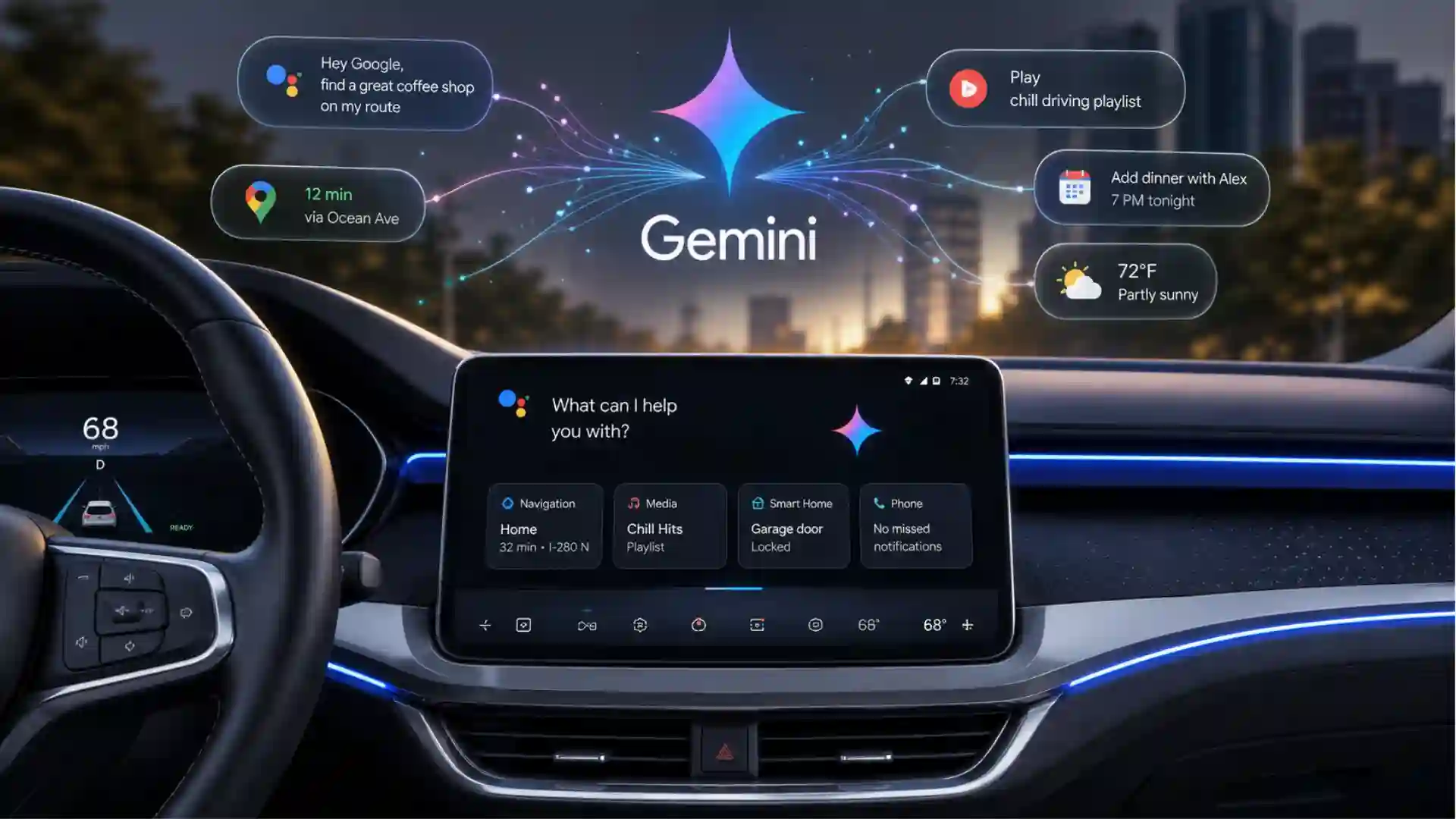
Gemini is not arriving in the car as another dashboard app. Google is placing its AI assistant inside the operating environment that already handles Maps, media, messaging, climate prompts, EV routing, app access and, in some vehicles, owner-manual intelligence. The change matters because a car cabin is one of the hardest places to introduce generative AI: attention is limited, safety pressure is real, personal data is rich, and automakers still want to own the relationship with the driver.
Table of Contents
Google announced on April 30, 2026, that Gemini is starting to roll out to cars with Google built-in as an upgrade from Google Assistant. The rollout starts with English in the United States and continues over the coming months, including new cars and compatible existing vehicles through software updates. Google says Gemini will support more natural conversations, use information from Google Maps, manage messages, answer vehicle-specific questions from the owner’s manual, control some settings, and support Gemini Live hands-free experiences.
Gemini enters the car at the point where voice assistants had stopped feeling useful
The old voice-assistant bargain in cars was simple: tolerate rigid commands in exchange for fewer taps. Drivers learned phrases such as “navigate to,” “call,” “play,” or “set temperature.” When the phrasing worked, the experience felt mildly convenient. When it failed, the driver usually looked back at the screen, reached for a phone, or gave up. That pattern made voice control useful but brittle.
Gemini changes the expectation. Google is not describing the update as a command parser with better speech recognition. It is describing a conversational assistant that can remember the thread of a request, handle follow-ups, interpret constraints, and connect those requests to apps and vehicle information. A driver can ask for a lunch stop with outdoor seating, change the constraint, ask about parking, and then route there without restarting the interaction. Google’s examples also include message summaries, ETA insertion, music requests by mood, traffic questions around a stadium, and reports of road incidents.
The shift is bigger than a nicer microphone experience. A voice assistant that understands follow-up questions changes the design center of the car interface. Instead of asking drivers to adapt to the car’s command language, the car starts adapting to natural speech. That is the promise. The risk is that the car becomes a place where a driver can request almost anything, including tasks that are not suitable while moving.
Cars with Google built-in already had a stronger foundation than smartphone projection alone. Google Maps, Google Play and Google Assistant were part of the in-car system, not merely mirrored from a phone. Android Automotive OS is the underlying in-car platform for cars with Google built-in, and Google’s developer documentation describes those vehicles as running Android Automotive OS with Google apps and services such as Google Play, Google Assistant and Google Maps.
That architecture is the difference between “voice in the car” and “voice of the car.” Android Auto, by contrast, has historically projected a phone-based experience onto the dashboard. Google had already started rolling Gemini into Android Auto in November 2025, where the assistant depends on the driver’s Android phone and the Gemini app. The Google built-in rollout goes deeper because the assistant sits inside the car’s native infotainment environment and can draw on vehicle integrations that a projected phone experience cannot always reach.
The update also lands at a moment when automakers are rethinking what a vehicle is after purchase. A car used to be mostly fixed after it left the factory. Now software updates can change screens, add apps, improve routing, alter voice behavior, and push new service layers into vehicles already on the road. Google’s own cars-with-Google-built-in site says these vehicles receive automatic updates directly from Google while parked or on the go, delivering new apps and features.
That means Gemini is not a small feature release. It is a test of whether AI can become part of the post-sale vehicle lifecycle. If it works, owners will see their cars change in a way that feels more like phones and computers. If it disappoints, the cabin could become another place where ambitious AI features collide with human impatience, patchy connectivity and the safety realities of driving.
The announcement is narrow in rollout but wide in strategic meaning
Google’s near-term rollout is cautious. The company says the update starts in English in the United States and continues over the coming months. Eligible users signed into their Google Account in the vehicle will see an upgrade option when it is available. Google also says Gemini will expand to additional regions and languages, and it plans to give drivers safe access to information in apps such as Gmail, Calendar and Google Home later.
That narrow first phase should not obscure the larger direction. Google is using the rollout to show that cars with embedded Google software can improve after sale, that automakers can deploy AI at fleet scale, and that the assistant layer can become the place where navigation, media, messaging, EV data, route planning and vehicle help converge.
General Motors gave the clearest example of scale. GM said on April 28, 2026, that Gemini will roll out soon to eligible model year 2022 and newer Cadillac, Chevrolet, Buick and GMC vehicles in the U.S. with Google built-in, with about 4 million vehicles eligible for the update. The update will be delivered over several months and requires, among other conditions, OnStar connectivity, Google Play Store sign-in, U.S. English as the assistant language, and opt-in to Gemini.
GM’s announcement matters because it moves in-car AI from demo culture into installed-base deployment. Four million eligible vehicles is not a lab trial. It is a large real-world test across mainstream brands and price points. It also reveals the operational complexity of connected-vehicle AI: a software assistant depends on vehicle model year, infotainment system, connectivity service, language settings, account status, user consent and market availability.
Google did not limit the announcement to GM. The broader Google post says Gemini is coming to cars with Google built-in, including existing cars through software updates. Volvo had already said in June 2025 that Gemini would replace Google Assistant in Volvo cars with Google built-in, and that Volvo vehicles would become a reference hardware platform for Google’s Android development work in cars.
The exact model-by-model rollout will matter to consumers. “Cars with Google built-in” is not one homogeneous fleet. It spans different automakers, screen sizes, hardware generations, connectivity plans, vehicle controls and regional settings. Some vehicles will get richer vehicle-specific answers. Some may support fewer functions. Some owners may need an active service plan. Some markets may wait for language support.
The strategic signal is still clear. Google is moving Gemini from the phone and browser into the embedded vehicle environment. The car is no longer just a destination for Maps. It is becoming a place where Google’s assistant can mediate daily tasks, route decisions, entertainment, vehicle questions and eventually home or work information.
Google built-in is not Android Auto, and that distinction now matters much more
Many drivers use “Android in the car” loosely, but the Gemini rollout makes the distinction important. Android Auto is a phone-projection experience. The driver’s phone runs the core experience, and the car display becomes an interface. Cars with Google built-in use Android Automotive OS, a version of Android made for in-car use and running on vehicle hardware. Google’s developer documentation says cars with Google built-in run Android Automotive OS and include Google apps and services such as Google Play, Google Assistant and Google Maps.
That difference affects what Gemini can do. In Android Auto, the assistant can use phone-based apps, Google Maps, messaging and, with permissions, phone-side data. In Google built-in cars, Gemini can sit closer to vehicle systems, infotainment settings, app state, EV information, owner-manual content and car-specific UX restrictions. Google’s announcement points to exactly that kind of integration: vehicle-specific information from the owner’s manual, EV-related details, and car setting control.
This does not mean Gemini controls safety-critical driving systems. Google’s March 2026 announcement about Android Automotive OS for Software Defined Vehicles was careful to describe its new AAOS SDV foundation as infrastructure for non-safety parts of vehicles. That wording matters. The assistant may reach climate, infotainment, route planning, app content, vehicle help, charging advice and other non-safety functions, but that is not the same thing as autonomous driving or driver assistance control.
The distinction also matters for automakers. With Android Auto, the phone maker owns much of the digital layer during the session. With Google built-in, the automaker licenses and integrates a platform into the vehicle. The software is still branded by the automaker’s cabin design, and the car company can decide which functions, screens and services are exposed. That gives automakers more integration depth but also ties their owner experience to Google’s roadmap.
For drivers, the practical difference is visible in daily friction. Android Auto often requires a compatible phone, connection stability and phone-side app readiness. Google built-in apps can run directly in the car. Honda’s current Google built-in information, for instance, says built-in apps do not require an Android phone or any other smartphone, though phone pairing may be needed for some calls and messages.
Gemini turns this architectural difference into a product difference. A conversational AI assistant is more useful when it knows the state of the route, the car, the battery, the apps, the message thread and the driver’s account context. A native platform can make those connections more consistently than a projected interface, provided the vehicle and user permissions allow it.
The first wave of Gemini features targets real cabin pain points
Google’s feature examples are not random. They cluster around tasks that drivers already try to do while moving and that have often been clumsy through traditional voice assistants. The first cluster is navigation. Drivers want stops along a route, not just a destination. They want food that matches a preference, parking that fits the moment, a charger that works with the vehicle, or traffic context around an event. Gemini can use Google Maps information to help answer those questions and refine the request in a conversation.
The second cluster is messaging. A driver may receive multiple texts, need the gist, respond with an ETA, change the wording, add an extra question, or translate a message. Google says Gemini can summarize new text messages, help draft a reply, add ETA context, and let the driver edit the message without starting over. In Android Auto, Google said Gemini can translate messages into more than 40 languages; in the Google built-in announcement, the focus is on summaries, context and follow-up edits.
The third cluster is entertainment. Drivers often remember a mood rather than an artist, station, genre label or playlist name. Google’s examples include asking for jazz radio without a station name or requesting upbeat 1970s folk-rock for a mountain drive while skipping slow ballads. GM’s examples go further, describing playlist generation, podcast suggestions by remaining drive time, and playback across in-vehicle apps such as Spotify, Audible, YouTube and other media services where available.
The fourth cluster is vehicle help. This may become the most distinctive part of the rollout. Owner’s manuals are long, poorly remembered and rarely consulted until something goes wrong. Google says Gemini can answer vehicle-specific questions using information from the car’s manual. Volvo used the same theme when it said drivers could ask questions from the user manual or learn details about a destination.
The fifth cluster is open-ended conversation. Gemini Live is meant to let drivers brainstorm ideas, learn facts, rehearse conversations or talk through plans hands-free. This is the most ambitious and most delicate category. It turns drive time into a conversational computing session. That could be useful on long trips. It could also become a source of cognitive distraction if the assistant invites complex back-and-forth conversation while the driver should be focused on traffic.
The best reading of the first wave is that Google is trying to solve tasks that already exist rather than inventing strange new car behaviors. The strongest near-term use case is not “AI in the car” as a slogan; it is reducing the number of failed voice commands, screen taps and phone grabs during routine driving tasks.
Rollout facts at a glance
Current Gemini rollout for cars with Google built-in
| Area | Confirmed detail | Practical meaning |
|---|---|---|
| Announcement date | April 30, 2026 | Google has moved from preview language to rollout language |
| Initial language and market | English in the United States | Early availability is limited, not global |
| Vehicle path | New and compatible existing cars | Some current owners may receive it through a software update |
| Activation | Eligible signed-in users see an upgrade option | Google Account status matters |
| Major confirmed fleet | About 4 million eligible GM vehicles in the U.S. | Cadillac, Chevrolet, Buick and GMC owners form a large first wave |
| Key functions | Conversation, Maps, messaging, media, vehicle-specific info | The assistant sits across several cabin tasks |
| Limits | Availability varies by vehicle, market, subscription and setup | Not every Google built-in car gets the same experience at the same time |
This table compresses the launch facts, but the fine print carries real weight. GM’s own availability notes say features may differ depending on subscription, compatibility and setup, and Google’s broader rollout language leaves room for different timing across automakers and models.
GM’s 4 million eligible vehicles make the rollout more than a technology demo
GM’s role gives the story its scale. The company says about 4 million eligible U.S. vehicles from Cadillac, Chevrolet, Buick and GMC can receive Gemini if they are model year 2022 or newer and equipped with Google built-in. That is a mainstream deployment across pickups, SUVs, luxury vehicles, family vehicles and commercial-use cases.
The fleet scale matters for three reasons. First, it gives Google a large real-world environment for in-car AI. Drivers do not use voice systems like product managers expect. They speak with accents, background noise, kids in the back seat, inconsistent phrasing, half-formed requests and sudden changes of mind. A deployment of this size tests whether Gemini’s conversational strengths survive the cabin.
Second, it gives GM a new software value story for owners who already bought their vehicles. The car does not need to become obsolete when a new infotainment generation launches. A 2022 model can receive a new assistant in 2026 if the hardware, service plan and software path support it. That is the clearest consumer version of the software-defined vehicle promise.
Third, it moves AI competition into the ownership lifecycle. Automakers have spent decades competing on horsepower, range, ride comfort, safety scores, design and brand identity. Now they must compete on how often the vehicle improves, how well its digital layer works, and whether the driver trusts the assistant that sits between them and the car.
GM’s announcement is also careful about dependencies. To use Gemini, the eligible vehicle must be connected to OnStar, signed into the Google Play Store, using U.S. English as the assistant language, and opted into Gemini. That is a reminder that in-car AI is not only a model deployment. It is a stack of accounts, data connections, consent screens, service plans and regional rules.
GM also teased a deeper OnStar-shaped AI experience later in 2026. That signals a layered strategy: Google provides Gemini as the assistant upgrade in Google built-in vehicles, while GM may build more proprietary assistant behavior on top of its OnStar data, services and support history.
This is where automaker ambition and platform dependence meet. GM wants smarter vehicles and a stronger service relationship. Google wants Gemini deeply embedded in the car. Both can benefit. Both will also need to decide who owns the most valuable moments: the route, the support question, the service upsell, the charging decision, the media session, the emergency workflow, and the driver’s trust.
Volvo and Polestar show the roots of Google’s embedded-car strategy
Google built-in did not appear overnight. Polestar 2 was billed by Polestar as the first car in the world with an infotainment system powered by Android Automotive OS with Google apps and services built in. That early approach gave drivers Google Play, Google Maps and Google Assistant directly in the center display, while giving developers an emulator and a path to test car apps.
Volvo has been another important partner. Volvo said it introduced Android Automotive OS in 2020, giving drivers access to Google apps and services such as Google Maps and Google Assistant. In June 2025, Volvo said Gemini would replace Google Assistant in Volvo cars with Google built-in later that year, and that Volvo cars would serve as reference hardware platforms for Google’s Android development work in cars.
That reference-hardware detail is significant. Cars are not phones. They have longer product cycles, different safety constraints, custom screens, many suppliers, and a heavier burden around support. When Google tests Android-related car features with a partner’s real hardware, it is trying to shorten the distance between software ambition and vehicle reality.
Volvo’s own April 2026 infotainment update shows the post-sale software dynamic. The company said a new Volvo Car UX was live in millions of cars and described it as one of the largest over-the-air updates in automotive history, with more prominent navigation, refreshed layout and common controls such as maps, media and phone placed on the home screen.
The Volvo and Polestar history matters because it proves two things. First, Google built-in is no longer experimental in the sense of being confined to one niche vehicle. Second, the cabin is now a software channel that can receive new interfaces and assistant behavior years after delivery.
Gemini builds on that foundation. It needs the maps, apps, accounts, microphone handling, voice permissions, vehicle APIs and update pipeline already created by Google built-in. Without those pieces, Gemini would be a chatbot bolted onto a screen. With them, it can become a conversational layer across the car’s digital functions.
That does not guarantee success. Early adopters often tolerate imperfections that mainstream drivers will not. A voice assistant in a premium EV can be forgiven for quirks. A voice assistant in millions of family SUVs and work trucks will be judged by whether it works during school pickup, rain, highway noise, service calls, long commutes and low-signal roads.
Renault, Honda and the wider platform spread make this a market story
The Gemini rollout should be read against the wider spread of Google’s automotive platform. Renault Group and Google expanded their partnership in 2022 to develop software-defined vehicle architecture, onboard and offboard software components, and cloud tools for digital twins and vehicle data use cases. Renault described continuous software innovation, predictive maintenance, personalized onboard services and usage-based insurance as possible areas tied to the broader SDV model.
Honda’s current U.S. Google built-in page shows how embedded Google services have moved into mass-market lineups. It describes Google Assistant, Google Maps and Google Play built into Honda vehicles, with Google Maps offering continuously updated traffic, automatic rerouting and lane guidance. Honda also lists current Google built-in availability across several 2026 models, including Prologue, CR-V Sport Touring, Passport, Civic trims, Accord Touring Hybrid and Prelude Hybrid.
Google’s CES 2024 Android-for-cars announcement also framed a growing brand list, saying Nissan, Ford and Lincoln models were rolling out with Google built-in and Porsche was expected later. The same announcement described EV battery information shared with Google Maps on compatible Android Auto vehicles and trip planning sent from phone to car for Google built-in vehicles.
The broader footprint matters because AI assistants benefit from distribution. The more cars ship with a platform, the more attractive the ecosystem becomes for app developers, media providers, navigation partners and automakers looking for common tools. Google said at I/O 2025 that Android Auto was supported in nearly all new cars sold, with almost 250 million compatible vehicles on the road, while cars powered by Android Automotive OS with Google built-in had grown to more than 50 available models and more than 300 apps on the Play Store.
Gemini sits on top of that expansion. It gives Google a way to make the platform feel current without requiring a new dashboard generation. It also gives automakers a way to advertise AI capability without building every model, speech system, app connection and language layer themselves.
The market question is whether automakers see this as help or dependency. A company that adopts Google built-in gets Maps, Play, assistant infrastructure, developer familiarity and update cadence. It also gives Google a privileged role in the driver’s daily experience. That trade-off will look different for every brand. A smaller automaker may welcome the shortcut. A global premium brand may want tighter control. A company with a large services business may want its own assistant logic around service, maintenance, insurance and support.
The car is becoming a software-defined product, but the assistant is the front door
The term software-defined vehicle is often used so broadly that it loses force. In this case, it has a concrete meaning: the vehicle’s features, interfaces and services can change through software after purchase. Google’s March 2026 Android Automotive OS SDV post said modern cars are becoming “computers on wheels” and described software-defined vehicles as allowing new features over the air much faster. It also said AAOS SDV is being extended beyond the car’s screen as open infrastructure for non-safety parts of vehicles.
Gemini is the front door to that idea. Most drivers will not think in terms of vehicle abstraction layers, app quality tiers or offboard cloud services. They will notice that they can ask the car a more complicated question and get a useful answer. They will notice when an old voice command becomes a conversation. They will notice when the car knows the owner’s manual better than they do.
The assistant layer matters because software-defined vehicles need human-readable access. A car may have many configurable systems: charging, route planning, climate, media, user profiles, driver-assistance settings, maintenance warnings, connected-home links, subscriptions and app permissions. If each remains buried in menus, the software-defined car becomes a software-cluttered car. Voice can reduce that friction.
The same assistant layer can also hide complexity from owners. A driver might not know whether an answer comes from Maps, the owner’s manual, the automaker, a third-party app, the Google Account, the vehicle’s state, or the model’s general knowledge. That abstraction is useful when it works. It is dangerous when it blurs responsibility.
The more the assistant becomes the interface, the more the assistant becomes the brand experience. If Gemini answers a vehicle question badly, the driver may blame Google, the automaker, or the car itself. If it helps a driver find a charger before a low-battery warning becomes stressful, the owner may feel the vehicle has become smarter. The emotional credit and blame will be shared.
That sharing is new territory for automakers. They have long relied on suppliers for components, but the driver did not usually know the supplier’s name. With Google built-in, the supplier’s brand is visible. With Gemini, it is audible. The assistant’s voice becomes part of the vehicle’s personality.
Safety is the central test, not a secondary concern
Every in-car AI feature must be judged against the reality that driving is a safety-critical task. The best assistant is not the one that can answer the most questions. It is the one that reduces risky behavior without creating new forms of distraction.
NHTSA’s distracted-driving page says texting is especially alarming because sending or reading a text takes a driver’s eyes off the road for five seconds; at 55 mph, that is like driving the length of a football field with eyes closed. NHTSA also says 3,208 people were killed in U.S. crashes involving distracted drivers in 2024.
Voice assistants are often promoted as safer because they reduce manual interaction. That claim can be true in narrow situations. Speaking a reply may be safer than typing it. Asking for a route may be safer than tapping through a menu. Asking the car to explain a warning light may be safer than searching a phone. But voice does not eliminate cognitive load. A long brainstorming session, a complex email retrieval, or a multi-step argument with an AI assistant can still occupy the driver’s mind.
Google and automakers know this. Android Automotive OS includes user experience restrictions meant to prevent the use of apps not optimized for driving. Google’s developer documentation says UX restrictions automatically prevent apps that have not been optimized for use while driving, while the exact rules are set by vehicle manufacturers and can vary by geography and display.
Google’s AOSP driver-distraction guidance says apps that follow Driver Distraction Guidelines can run on the head unit while a vehicle is moving, and that activities must be tagged as Distraction Optimized to run in a restricted state. The same guidance warns that the platform checks the app’s declaration, while adherence is enforced through Google Play review.
That creates a practical safety framework, but Gemini raises harder questions. A conventional app has screens and defined tasks. A conversational assistant can generate many possible interactions. It can summarize, reason, advise, ask follow-up questions and handle open-ended requests. The safety challenge is not only whether an app screen is allowed while moving. It is whether the assistant should answer a certain type of prompt while moving, how long the interaction should continue, and whether the answer encourages attention away from the road.
A safe Gemini-in-car experience will need strong boundaries. It should keep answers short when the vehicle is moving. It should defer screen-heavy tasks. It should avoid long reading. It should be interruptible. It should make it easy to stop, cancel or postpone. It should distinguish driving-related tasks from “I’m bored, entertain me with something complex” tasks. And it should not pretend that hands-free always means risk-free.
NHTSA’s old screen rules still matter in an AI dashboard
NHTSA’s visual-manual driver distraction guidelines were written before the generative AI boom, but their core logic still applies. The Federal Register notice says NHTSA recommended that in-vehicle devices should prevent drivers from performing inherently distracting secondary tasks while driving, including video not related to driving, automatically scrolling text, manual text entry for messaging or browsing, and text displayed for reading from books, web pages, social media or messages.
The same guidance focused on eye-glance behavior. NHTSA recommended that tasks be designed so drivers can complete them with glances away from the roadway of two seconds or less and cumulative glance time of 12 seconds or less. It also emphasized that the driver’s eyes should usually look at the road, at least one hand should remain on the wheel, tasks should be interruptible, and the driver should control the pace of interactions.
Gemini’s challenge is that it shifts part of the interaction from visual-manual to voice-cognitive. That is helpful because fewer screen glances are usually better. But the old rules still shape the environment around the assistant. If Gemini produces a long visual result, invites the driver to scroll, displays dense text, or sends the driver into an app with too much interaction, the old distraction problem returns in a new wrapper.
The safer design direction is obvious: Gemini should convert screen-heavy tasks into concise spoken choices where possible. Instead of displaying a long restaurant list, it can offer two or three options and ask a short follow-up. Instead of showing owner-manual pages, it can give the relevant instruction and suggest checking the screen or manual when parked. Instead of reading a long email, it can summarize the part needed for navigation.
The harder issue is verification. Drivers may trust a fluent answer, especially when it comes from the car itself. If Gemini gives a wrong maintenance instruction, misunderstands a warning, or confuses one trim’s feature with another, the stakes are higher than a wrong trivia answer. Google acknowledges in its Gemini Apps Privacy Hub that Gemini Apps may produce inaccurate or offensive information and says users should not rely on outputs for medical, legal, financial or other professional advice. In the car, the parallel warning is about vehicle operation and safety: the owner’s manual and automaker instructions remain authoritative.
AI dashboards do not make old safety design obsolete. They make it more important, because the system’s apparent intelligence can persuade drivers to ask for more and trust more. The discipline should be the opposite: richer capability, stricter driving-state restraint.
The most useful feature may be owner-manual intelligence
Owner-manual intelligence sounds boring compared with Gemini Live or natural route planning. It may become the feature owners use when they are most grateful. Car manuals are dense, trim-specific, filled with warnings, and hard to search from the driver’s seat. Many owners do not know what every light means, how every mode works, whether a car wash requires special preparation, or what a setting actually changes.
Google says Gemini can answer vehicle-specific questions thanks to integration with the car and information from the owner’s manual. It gave the example of asking how to prepare the car for an automatic car wash and receiving instructions based on the manual.
This is where generative AI has a clean job. It can turn structured, manufacturer-approved documentation into a spoken answer. The driver does not need broad internet knowledge. The driver needs the right answer for this car, this model year, this trim, this warning, this menu, this feature. That is a retrieval-and-explanation problem, not a free-form creativity problem.
The risks are manageable if the system is designed carefully. It should cite or label the manual as the source in the interface. It should avoid improvising beyond the manual for safety-sensitive topics. It should know when to tell the driver to stop, park, contact roadside assistance, or consult service. It should recognize uncertainty. It should separate “what this button does” from “what you should do while driving.”
For automakers, owner-manual intelligence could reduce support calls and improve feature adoption. A buyer may pay for advanced features but never use them because the setup is confusing. A voice assistant that can explain charging preferences, drive modes, climate preconditioning, trailer settings, tire-pressure warnings or service intervals could make the car feel less intimidating.
For Google, it is a way to show that Gemini is not just a general chatbot. It becomes useful because it is grounded in the car. That groundedness is the difference between a dashboard novelty and a reliable assistant.
For drivers, the best version is humble. The car should answer the questions owners already have but rarely ask because the manual is too hard to search. That is a stronger value proposition than trying to make every commute into an AI conversation.
Maps integration gives Gemini an immediate advantage over generic chatbots
Navigation is the most natural place for Gemini to prove itself because Google Maps already sits at the center of the in-car experience. Cars with Google built-in include Google Maps in the vehicle, and Google’s official site describes real-time traffic, route changes, EV routing, charging stop suggestions, charging-speed filters and payment-network filters.
A generic AI assistant can suggest a restaurant. An in-car Gemini session can use the current route, timing, Maps data, user constraints and conversational follow-up. The difference is context. The driver does not want “good restaurants in the city.” The driver wants a specific stop along the current route, open now, with a short detour, parking that fits the vehicle, food that fits the group, and maybe a charger nearby.
Google’s examples show that direction. The driver can ask for highly rated sit-down restaurants along the way, mention that they are not in a rush, ask for outdoor seating, then ask follow-ups about parking or vegetarian options. The assistant can use Google Maps information rather than requiring the driver to filter manually.
EVs raise the value. A driver may need charging stops that fit the car’s battery, charging speed, route, payment network and arrival needs. Google built-in already supports EV routing based on vehicle-specific needs, according to Google’s product page. Gemini can make that feature more conversational, especially for drivers who do not think in charger kilowatts or route-planning menus.
The same logic applies to traffic context. A driver can ask about an event near a stadium or whether a disruption should change the route. Google says Gemini can provide real-time journey updates from Google Maps and let drivers report incidents such as an accident in the right lane.
This is Google’s strongest moat in the car. The company is not just putting a language model in the dashboard. It is combining Gemini with Maps, local business information, reviews, routes, traffic, messaging and account context. Competitors can build voice assistants. Fewer can match that location graph at global scale.
The market consequence is clear: navigation becomes a conversational commerce and services layer. The assistant that helps choose a charging stop, lunch stop, hotel, repair shop or parking location has economic influence. That raises trust questions, ranking questions and eventually advertising questions, even if Google’s current car announcement is about assistant functionality rather than monetization.
Messaging and translation show the safety promise and the trust problem
Messaging is one of the most compelling use cases because the alternative is often unsafe. Drivers receive texts. They feel pressure to respond. They may glance at the screen or pick up the phone. A good voice assistant can reduce that temptation by reading a summary, drafting a reply, inserting the ETA and letting the driver approve it by voice.
Google says Gemini can summarize new text messages and help drivers respond with context. The driver can say they are on the way and ask Gemini to add the ETA. If they change their mind, they can amend the message without starting over.
That is the right direction. Dictation has always been awkward because it requires perfection on the first attempt. Natural editing is better. The driver can speak like a human: “Actually, also ask her if I should pick up dessert.” The assistant should understand that the new sentence modifies the draft.
Translation adds another layer. Google’s Android Auto Gemini announcement said drivers could adjust a message and translate it into more than 40 languages. GM also says Gemini can draft, edit or translate texts in the car.
The trust problem is equally clear. A message is personal. A summary can miss tone. A translation can change nuance. An emoji can feel wrong. A message sent to the wrong person can be embarrassing or worse. A voice assistant that drafts messages must be careful about confirmation, recipient identity, and whether the driver heard the final version.
The safest pattern is short and explicit. Gemini should summarize incoming messages briefly, identify sender names clearly, draft concise replies, and ask for confirmation before sending. It should avoid reading or composing long message threads while the vehicle is moving. It should not lure the driver into complex social negotiation at 70 mph.
This is where AI can be both safer and riskier than older systems. Older systems were limited, but their limits prevented some complexity. Gemini can handle more complexity, which means product designers must decide what complexity belongs in motion. The system should not treat every successful natural-language task as a task that should be done while driving.
Gemini Live turns drive time into conversational computing
Gemini Live in the car is the boldest part of the update. Google says drivers can use it to brainstorm ideas, ask about facts, learn something new, or practice for conversations while keeping hands on the wheel and eyes on the road. GM’s examples include planning a family holiday, preparing for a conversation with a boss, or talking through ideas during a quiet drive.
This is where the product crosses from utility into habit formation. Navigation, messaging and climate control are task-based. Gemini Live is open-ended. It gives drivers a reason to talk to the car even when there is no driving task to solve. That could make commutes more useful. It could also make the assistant a cognitive companion that competes with the road for attention.
The strongest use case is low-pressure audio interaction. A driver might ask for a short explanation of a landmark, a five-minute overview of a historical topic, or help rehearsing a sentence before a meeting. That is not radically different from listening to a podcast or calling someone hands-free. The difference is interactivity. The assistant responds to the driver, asks questions, and can lead the conversation deeper.
Interactivity is the safety challenge. Passive audio can fade into the background. A live conversation demands turn-taking and mental planning. The driver thinks about what to say next. The driver may imagine, compare, decide, argue or remember details. Some of that is normal in human conversation while driving, but AI can scale it endlessly and keep it highly engaging.
A responsible in-car Gemini Live experience should adapt to driving state. It should be briefer in complex traffic. It should avoid long multi-step reasoning tasks when the car is moving. It should pause easily. It should not require visual confirmation. It should avoid emotionally intense coaching or complex planning that absorbs the driver.
For Google, Gemini Live is a chance to make the assistant feel alive rather than transactional. For automakers, it is a way to make the car cabin feel more premium and personal. For regulators and safety researchers, it will likely become a new area of study: not just whether screens distract, but whether always-available AI conversation changes driver attention in measurable ways.
Privacy moves from the phone into the cabin
Cars collect sensitive data. They know routes, locations, stops, contacts, media habits, driving patterns, charging behavior, and sometimes vehicle diagnostics. When an AI assistant enters that environment, privacy becomes more than a generic app setting. It becomes part of the relationship among driver, passengers, automaker, Google, mobile carrier, third-party apps and service providers.
Google’s Gemini Apps Privacy Hub says users can change Gemini Apps Activity auto-delete settings from the default of 18 months to 3 months, 36 months or indefinite, and can manually delete Gemini Apps chats. It also says chats reviewed by human reviewers and related data are retained for up to three years and are not deleted when users delete their activity. Google notes that Gemini Apps may use permissions such as device location, microphone and camera when hosted by the Google app as an Android assistant.
Drivers should understand that in-car Gemini may involve several layers of data policy. Google controls Gemini and Google services. Automakers control many vehicle and connected-service data flows. Mobile carriers may provide connectivity. Third-party apps have their own terms. Polestar’s car privacy notice, for instance, says that when Polestar cars use Google Automotive Services such as Google Maps, Google Assistant and Google Play, Google is the responsible data controller and Polestar is not involved in that processing of personal data.
That kind of split is common in connected cars, but it is rarely clear to ordinary owners. A driver may think “my car heard me,” when legally and technically the request may involve Google, the automaker and app providers in different ways. Gemini makes this more visible because voice is intimate. People speak names, plans, addresses, worries and preferences.
The privacy question will become sharper when Gemini expands access to Gmail, Calendar and Google Home in cars with Google built-in, as Google says it plans to do. The usefulness is obvious: finding a hotel address in an email, checking the next meeting, opening a garage door, or preparing the home climate before arrival. The sensitivity is just as obvious.
The trust standard should be high. Drivers need clear opt-in, clear deletion controls, passenger awareness, mute options, account separation, guest modes and obvious ways to avoid mixing family members’ data. A shared vehicle is not a private phone. A car may be driven by spouses, teenagers, employees, valets, renters or fleet drivers. The assistant must respect that reality.
Personalization is useful only when the driver controls it
Google has been moving Gemini toward more personalization. In August 2025, Google said the Gemini app could reference past chats to learn user preferences and introduced Temporary Chat for conversations that would not influence future personalization. Google said the past-chat setting was on by default in the Gemini app and could be turned off in settings.
In a car, personalization has a clear appeal. Gemini could know that the driver prefers certain charging networks, avoids highways at night, likes quiet routes with scenic stops, usually sends brief messages, or wants low-temperature cabin settings. It could help with recurring commutes, school runs, work stops, favorite restaurants and EV charging routines.
The same personalization can become intrusive. A car is often shared. Personal suggestions may reveal private habits to passengers. An assistant that mentions a frequent destination, email detail or previous conversation in front of others can create social risk. This is not a theoretical privacy issue; it is a cabin-design issue.
A well-designed system should keep personal context tied to user profiles and make profile switching obvious. It should avoid speaking sensitive personalization unless the driver asks. It should treat passengers as an audience. It should support temporary or guest use. It should not assume that the person signed into the car wants every part of their Google life available through the speakers.
Personalization also changes error tolerance. A generic wrong answer is annoying. A personalized wrong assumption feels creepy or incompetent. If Gemini says “your usual charger” and picks the wrong one, or “your favorite coffee stop” in front of a passenger who should not know that routine, trust can drop quickly.
The car is an intimate but shared device. That makes it different from a phone in a pocket. Personalization must be useful without becoming socially careless.
The app ecosystem could gain a new voice-first distribution channel
Gemini does not only affect Google’s own apps. It may reshape how third-party apps are used in cars. Google’s I/O 2025 developer post said navigation apps can integrate with Gemini through core intent formats that start navigation, display relevant search results and execute custom actions such as reporting traffic congestion by voice. The same post described growth in Android Automotive OS with Google built-in, more than 50 models, and more than 300 apps already available on the Play Store for cars.
This means developers may need to think beyond dashboard screens. A parking app, charging app, podcast app, weather app, smart-home app or navigation app may be discovered and used through a conversational layer. The driver may not open the app manually. The driver may ask Gemini for a task, and Gemini may route intent to the right service.
That can help smaller apps if the system exposes them fairly. It can also concentrate power in the assistant. The assistant becomes the gatekeeper for which app is used, which option is suggested, and which result gets spoken first. Search ranking debates may move into the car cabin.
Google’s car app quality guidelines already define requirements for app categories supported by Android Auto and Android Automotive OS, including media, messaging, navigation, point of interest, internet of things, weather, video, games and browsers. Apps built for driving must meet car-specific requirements to be accepted on Google Play.
Gemini adds a semantic layer to that policy environment. Developers will need to make their app capabilities legible to the assistant. They will need short, safe voice flows. They will need to respect driving-state restrictions. They may need to compete for inclusion in spoken recommendations, not only app-store listings.
For drivers, the best outcome is less app friction. “Find a charger that takes my account and has a restroom” should not require opening three apps. For developers, the challenge is visibility. If Gemini gives only one answer, the second-best app may never be seen.
Entertainment will be shaped by parked experiences and moving restrictions
Cars with Google built-in already support media apps and, in certain parked contexts, video and browser experiences. Google’s CES 2024 announcement said Chrome was starting to roll out in beta to select Polestar and Volvo cars, while PBS KIDS and Crunchyroll were available in select cars with Google built-in for parked entertainment.
Google’s I/O 2025 developer post also described video, gaming and browser apps for parked use through car app quality tiers and said Google was working with OEMs to enable audio-only listening for video apps while driving.
Gemini fits naturally into this split. While driving, it can help find music, radio, podcasts or audio content. While parked, it may help discover video, browse, plan, shop or interact with richer app experiences. The assistant can become the bridge between moving and parked modes.
The distinction must remain strict. Video and visually rich content in the driver’s view while moving remains a safety concern. NHTSA’s driver-distraction guidance explicitly identifies non-driving-related video and certain text displays as inherently distracting tasks that should be locked out while driving.
The best entertainment use while moving is audio-first. Gemini can handle vague requests better than older assistants: “play something calm for the last 20 minutes of the drive,” “find a podcast episode about the city we’re entering,” or “play music the kids know but keep it quiet.” GM’s examples include asking for road-trip playlists and podcast suggestions that fit the remaining time.
Entertainment is also a business opportunity. Media apps want in-car listening. Automakers want owners to enjoy wait time at chargers. Google wants Play and Gemini to be useful in another high-frequency environment. The line between convenience and distraction will define how far this goes.
Apple CarPlay Ultra frames the competitive backdrop
Gemini in Google built-in cars is part of a wider battle over the dashboard. Apple’s CarPlay Ultra began rolling out in May 2025, starting with Aston Martin vehicles in the U.S. and Canada. Apple says CarPlay Ultra can provide content across all driver screens, including the instrument cluster, and can integrate with car information such as gauges, tire pressure, radio and climate controls.
The comparison is not exact. CarPlay Ultra extends the iPhone experience more deeply into the vehicle interface. Google built-in runs on the car’s native infotainment hardware through Android Automotive OS and Google Automotive Services. Gemini adds a conversational assistant layer to that embedded model.
Both strategies point to the same prize: the primary digital relationship inside the car. The dashboard used to be automaker territory. Then phone projection brought Apple and Google into the center display. Now deeper integrations let tech companies reach vehicle data, instrument clusters, climate, media, route planning and voice.
Automakers face a difficult choice. Drivers love familiar phone ecosystems. Automakers do not want to become hardware shells for Apple or Google. Deeper integrations can improve the owner experience, but they also make the tech platform more central to the brand.
CarPlay Ultra’s rollout through Aston Martin shows Apple’s premium design route. Google built-in’s spread across Volvo, Polestar, GM, Honda, Renault-linked platforms and other brands shows a platform route. Gemini gives Google a new argument: the embedded car can become conversational and improve over time through AI.
This competition may benefit drivers if it raises quality. It may also fragment experiences. A driver moving between vehicles may face Siri, Gemini, automaker assistants, phone projection, embedded systems, different permissions, different app access and different privacy rules. The dashboard could become more capable but less predictable.
The winning systems will not be the ones with the most features. They will be the ones drivers trust without thinking, because the assistant responds correctly, stays quiet when needed, respects privacy, and never makes the driving task feel secondary.
Automakers must decide where Google ends and the car brand begins
The Gemini rollout forces automakers to answer a brand question. When the driver says “Hey Google” in a Cadillac, Volvo or Honda, whose experience is that? The wake phrase is Google’s. The vehicle is the automaker’s. The answer may depend on Google’s model, Maps data, owner-manual content, vehicle APIs and user account. The customer’s emotional response attaches to all of them.
Automakers have reasons to embrace Google. Building a global conversational assistant is expensive. Maintaining maps, speech recognition, app ecosystems, language support, developer tools, privacy controls and AI safety systems is far outside traditional car engineering. Google brings scale and existing user habits.
Automakers also have reasons to be cautious. The assistant can mediate service moments, route decisions, charging preferences, media consumption, commerce and support. These are not neutral functions. They influence revenue, loyalty and data relationships.
GM’s language hints at a hybrid approach. It is deploying Gemini broadly but also says it will later deliver a more deeply integrated AI experience shaped by OnStar intelligence. That suggests GM wants Google’s assistant capability while keeping its own service layer central.
Volvo’s partnership language goes in another direction. Volvo describes a deeper collaboration in which its cars become reference hardware for Google’s Android car development work. That may give Volvo earlier access to features and tighter integration, while giving Google real vehicle platforms for testing.
Renault’s work with Google on software-defined vehicles and cloud-linked systems suggests a broader engineering partnership around vehicle software architecture, not only infotainment.
No single model will dominate every automaker. Some will build proprietary assistants on top of platform services. Some will lean heavily into Google built-in. Some will keep Apple and Google at projection distance. Some will split by region. The Gemini rollout makes the choice more visible because the assistant is no longer a passive feature. It is the conversational front end of the vehicle.
Regulators will care about data, distraction and control
In-car AI sits at the intersection of safety regulation, data policy, consumer protection, competition and product liability. The first regulatory pressure point is distraction. NHTSA’s guidelines are voluntary, but they provide a durable reference for in-vehicle electronic-device design. They emphasize limiting visual-manual tasks, locking out inherently distracting functions, keeping the driver’s eyes on the road, keeping tasks interruptible, and controlling glance duration.
The second pressure point is connected-vehicle data. The European Commission published guidance in September 2025 on vehicle data under the EU Data Act, saying it provides tailored advice to automotive stakeholders on implementing Chapter II of the Data Act and focuses on access rules for vehicle data in the automotive sector.
The third pressure point is AI governance. The EU AI Act entered into force on August 1, 2024, with a risk-based framework for AI systems and staggered application dates. The European Commission says rules for high-risk AI systems embedded into regulated products have an extended transition period until August 2, 2027.
A dashboard assistant like Gemini may not automatically be a high-risk system in every use. A music request or route search is not the same as a safety component. But AI integrated with vehicle systems, driver monitoring, safety warnings, insurance scoring, maintenance decisions or other regulated functions could raise harder compliance questions. The boundary will depend on function, deployment and legal interpretation.
The fourth pressure point is competition. If a platform assistant mediates access to apps, destinations, charging networks, repair options, parking services or commerce, regulators may ask whether rival services receive fair treatment. This question already exists in mobile search and app stores. The vehicle adds safety and data sensitivity.
Regulation will likely trail product deployment, but the issues are visible now. The car cabin is not a free-form AI playground. It is a regulated, safety-sensitive, data-rich environment where design choices can have physical consequences.
Control points for drivers, automakers and regulators
Main questions raised by Gemini in the car
| Control point | Main risk | Stronger design response |
|---|---|---|
| Driving attention | Long or complex conversations distract the driver | Short answers, easy pause, driving-state adaptation |
| Personal data | Voice requests expose routes, contacts, messages and habits | Clear opt-in, deletion controls, guest mode, profile separation |
| Vehicle accuracy | AI may misread owner-manual or vehicle-specific content | Ground answers in approved manuals and show uncertainty |
| App access | Assistant may favor one service or hide alternatives | Transparent app routing and user choice |
| Shared cabins | Personalization may reveal private information to passengers | Privacy-aware spoken responses and passenger-safe defaults |
| Regional compliance | Safety, data and AI rules vary by market | Market-specific policies, language support and audit trails |
The table shows the central governance problem. Gemini’s value comes from integration; its risks come from the same integration. A weak assistant is not useful. An unconstrained assistant is not acceptable in a moving vehicle.
The business model is still undeclared, but the incentives are obvious
Google’s car announcement does not frame Gemini as an advertising product. It frames the update as a smarter assistant for vehicles with Google built-in. That is the right near-term message. Drivers are not asking for more monetization in the dashboard.
Still, the long-term incentives are clear. A conversational assistant that helps choose stops, chargers, restaurants, parking, media and services has commercial value. Google Maps already has local discovery and business information. The car adds intent: the person is moving, route-bound, often ready to stop, charge, eat, shop or park.
Automakers also have incentives. Connected services, subscriptions, media partnerships, maintenance, insurance, charging networks and premium software features are all part of the modern vehicle revenue model. A capable assistant can make those services easier to use, easier to sell and easier to renew.
The risk is trust erosion. If drivers suspect that recommendations are driven by monetization rather than usefulness, they will treat the assistant like an ad channel. In a car, that reaction could be stronger than on a phone because the driver’s attention is more constrained.
The cleanest business path is service value first. Help the driver complete real tasks safely. Reduce support friction. Improve charging and route confidence. Make messaging less dangerous. Make vehicle features easier to understand. Use subscriptions only where the value is obvious and the alternative remains fair.
There is also a hardware value story. If Gemini makes older vehicles feel newer, automakers may improve owner satisfaction and resale perception. If the assistant requires newer hardware for richer features, it may also become a sales differentiator for new models. That creates a familiar software tension: support the installed base enough to build trust, but reserve some advanced features for newer vehicles.
Google benefits even when direct monetization is not visible. Gemini becomes more habitual. Google Account sign-in becomes more valuable. Maps becomes more central. Google Play in cars becomes more relevant. Android Automotive OS becomes more attractive to automakers. The dashboard becomes another surface in the Gemini ecosystem.
Connectivity and subscriptions will decide who actually gets the benefit
A software rollout is not the same thing as universal access. GM’s availability notes are a useful reminder. The Gemini update requires an eligible vehicle, OnStar connectivity, Google Play Store sign-in, U.S. English assistant language and opt-in. GM also says features may differ depending on subscription, setup, compatibility and availability.
This matters because connected-car features often live behind service-plan complexity. A buyer may see “Google built-in” on the window sticker but later discover that full functionality depends on a data plan, trial period, subscription, region or account linking. Honda’s FAQ says some Google apps and services can be used through Wi-Fi or a mobile hotspot, but others will not work fully without a mobile data plan.
Gemini will make these dependencies more visible. If the assistant cannot access the network, account, messages, Maps information, vehicle service data or app permissions, the experience will degrade. The difference between a brilliant assistant and a frustrating one may be a lapsed subscription or a misconfigured profile.
Automakers need to communicate this clearly. The worst owner experience is a car advertised as AI-enhanced that fails because a driver did not understand which service was needed. The second worst is a feature that works during a free trial and then quietly loses capability.
Offline behavior will also matter. Cars travel through low-signal roads, parking garages, rural regions and cross-border routes. Some assistant tasks may require cloud processing. Some vehicle commands should work locally. Some manual answers could be cached. A trustworthy car assistant needs graceful degradation: “I can adjust the temperature now, but I need a connection to search along your route.”
The subscription question is not only consumer annoyance. It affects safety. If messaging, route updates or vehicle-help features depend on connectivity, drivers may revert to phone handling when the car cannot help. Good design should make the safe path available as often as possible.
Language support will shape global impact
Google says the Google built-in rollout starts with English in the United States and expands over the coming months. That leaves much of the world waiting. Language matters more in cars than in many other devices because voice is the primary interface and driving leaves little room for correction.
A multilingual car assistant must handle accents, road names, local businesses, regional traffic terms, dialects, mixed-language households, foreign contacts and cross-border routes. It must translate messages without embarrassing errors. It must understand place names in one language and respond in another. It must handle passenger speech and road noise.
Google’s Android Auto Gemini rollout had broader language ambitions, with the official post saying Gemini was rolling out globally to Android Auto users in 45 languages. Cars with Google built-in are starting more narrowly, likely because embedded vehicle integration, manual grounding, automaker coordination and regional compliance are harder than phone projection.
Europe will be a strong test. Cars cross borders. Drivers switch languages. Regulations are stricter around data and AI. Vehicle models vary by market. The EU Data Act and AI Act add governance pressure. The assistant will need local competence, not only translation.
Language support also affects equity. Voice assistants historically work better for some accents and dialects than others. In a car, poor recognition is more than inconvenience. Repeated failures can increase frustration and distraction. If Gemini is meant to reduce screen interaction, it must work for drivers whose voices do not match the easiest training cases.
The global rollout will reveal whether Gemini’s conversational strengths transfer to the messy acoustic and linguistic environment of cars. A fluent assistant in a quiet demo is one thing. A reliable assistant with children in the back seat, rain on the windshield, a non-native speaker and a local road name is another.
The driver interface will need a new etiquette
Generative AI changes not only what the car can do, but how the car behaves. A command assistant waits. A conversational assistant may prompt, clarify, summarize and suggest. That requires etiquette.
The car should not talk too much. It should not ask unnecessary follow-up questions. It should not turn every route into a conversation. It should not over-explain. It should not announce personal details without reason. It should not interrupt urgent driving moments with low-value suggestions. It should know when a chime, a visual card or silence is better than speech.
This matters because audio space in a car is contested. The driver may be listening to navigation prompts, passengers, music, warnings, phone calls, engine noise or road noise. Gemini must earn its right to speak. A helpful assistant that talks at the wrong time becomes irritating quickly.
The interface should also preserve hierarchy. Safety warnings outrank assistant replies. Navigation prompts outrank entertainment chatter. Passenger conversations should not trigger accidental responses. Emergency calls should be easy. Manual controls should remain available. A driver should never feel trapped inside an AI dialogue.
Google’s own car design and app quality materials point toward restraint through UX restrictions and driving-optimized app requirements. Gemini will need similar restraint at the assistant level, not only the app level.
The best car assistant may feel less impressive than a phone chatbot because it chooses brevity. That is a feature, not a flaw. In a moving vehicle, a five-second answer can be better than a brilliant one-minute answer.
The owner’s manual, the vehicle state and the model must not be confused
Vehicle-specific intelligence will only be trustworthy if the system separates three kinds of knowledge: approved documentation, current vehicle state and model-generated explanation.
Approved documentation comes from the owner’s manual or automaker content. It tells the driver what the manufacturer says about a feature, warning or procedure. Current vehicle state tells the assistant what is happening now: battery level, route, temperature, connectivity, selected mode, warnings or service status, depending on what the vehicle exposes. Model-generated explanation turns the first two into plain language.
The danger is blending them invisibly. If Gemini answers from general knowledge when it should use the manual, it may give advice for the wrong model or trim. If it assumes current state without access to a sensor or permission, it may sound more certain than it is. If it paraphrases a safety instruction too casually, it may remove important warnings.
A good design should make source and uncertainty visible or audible. “According to your owner’s manual…” is useful. “I don’t have access to that vehicle status” is useful. “Park safely and check the manual or contact service” is useful. The assistant does not need to sound omniscient. It needs to be accurate.
This is especially important for EVs. Charging, battery conditioning, range estimates, charger compatibility and route planning depend on vehicle-specific data. Google built-in Maps already uses vehicle-specific needs for EV routing and charging-stop suggestions. Gemini can make that easier to ask about, but it should not overpromise range or charger availability beyond the data it has.
The same applies to driver-assistance systems. Many owners misunderstand the limits of advanced driver assistance. An AI assistant should be conservative when explaining such features, because overconfidence can encourage misuse. Gemini in the cabin should not blur the line between helpful assistant and autonomous agent.
AI hallucination is more serious when the answer sounds like the car
Google’s Gemini Apps Privacy Hub warns that Gemini Apps may produce inaccurate information. That warning is common for generative AI. In the car, the context raises the stakes. A wrong restaurant detail is minor. A wrong warning-light explanation, maintenance instruction, charging estimate or traffic claim can have more serious consequences.
The car setting intensifies trust because the answer comes through the vehicle’s interface. Drivers may assume the car “knows itself.” If Gemini gives a confident answer about the car, that confidence may feel official even when the model is generating a response from incomplete information.
Grounding is the technical answer. Gemini should use retrieval from approved vehicle documentation, live Maps data where relevant, and confirmed vehicle APIs where available. It should avoid free-form guessing in safety-sensitive domains. It should ask clarifying questions when model year, trim or feature availability matters.
Product design is the human answer. The assistant should not answer some questions while moving. It should not give repair procedures that require attention or tools during a drive. It should not instruct users to ignore warnings. It should distinguish between informational guidance and service advice. It should hand off to roadside assistance, emergency services or the automaker when needed.
This is also a liability issue. If an automaker integrates Gemini and the assistant gives bad vehicle advice, consumers may not parse whether the fault lies with Google, the automaker, the manual source, the data pipeline or user misunderstanding. The ownership chain will need contractual clarity and user-facing clarity.
The safest principle is conservative competence. Gemini should be expansive for low-risk tasks and narrow for safety-sensitive vehicle tasks. That may disappoint some AI enthusiasts, but it is the right posture for a dashboard system.
The cabin is a shared listening space, not a private assistant session
A phone assistant usually serves the person holding the phone. A car assistant serves a space. That space can include a spouse, children, coworkers, rideshare passengers, fleet employees, service technicians or a valet. Gemini’s privacy and personalization design must start there.
Voice input in a shared cabin raises consent issues. Passengers may be recorded or transcribed during a voice interaction. Google’s Gemini Apps Privacy Hub tells users to respect others’ rights and ask permission before recording them in a Live chat.
In practice, car systems need obvious cues. Passengers should know when the assistant is listening. Drivers should have a mute button. Guest profiles should be easy. Personal data should not be spoken automatically. Work and personal accounts should be separated. Fleet modes should limit personal features.
Families create special cases. A parent may want Gemini to read a text from a spouse but not a work message. A teenager may drive a shared car but should not access a parent’s calendar. A rental driver should not see the previous driver’s destinations. A service technician should not trigger personal assistant behavior.
Automakers already manage user profiles for seats, mirrors, climate and infotainment preferences. AI assistants make profile management more important. The profile is no longer just comfort. It is data access, message access, route history and conversational memory.
The shared-cabin problem may be one reason Google starts narrowly. Personalization, Gmail, Calendar and Home access are powerful, but they require careful account and permission design in a car. The assistant must know not only who is signed in, but who is present and what should be said aloud.
Commercial drivers may gain practical value if workflows stay short
GM highlighted commercial drivers in its Gemini announcement, including landscapers, service technicians and long-haul operators who manage multiple stops, schedules and equipment. Its examples include asking for the least expensive fuel along a route while needing to finish with at least half a tank, or finding trailer-friendly parking nearby.
That is a strong use case because commercial driving involves practical decisions under time pressure. A driver may need routing, fuel, parking, job addresses, customer messages, equipment constraints and schedule changes. Voice can reduce the need to stop and tap through apps.
But commercial use also raises fleet governance. Employers may want logs, policies, disabled features, approved apps and data controls. Drivers may not want personal Google accounts linked to work vehicles. Vehicles may be shared across shifts. The assistant may need to separate company data from personal data and follow fleet rules.
The best commercial Gemini flows will be task-specific. “Add these three stops in the best order.” “Find fuel under this price without leaving the route.” “Text the next customer my ETA.” “Where can I park with a trailer?” These are useful, bounded tasks. Open-ended Gemini Live brainstorming may be less relevant in a work truck during a route.
There is also a safety and compliance dimension. Commercial drivers face more scrutiny around distraction, hours, routes and vehicle condition. AI assistance should reduce administrative friction, not encourage multitasking beyond safe limits.
If done well, fleet use could become one of the strongest arguments for in-car AI. It ties directly to time, fuel, customer communication and driver stress. If done poorly, it becomes another subscription feature managers buy and drivers ignore.
EV routing and charging could become a defining Gemini use case
Electric vehicles make route planning more complex. Drivers think about battery percentage, charger speed, plug type, network reliability, payment accounts, detours, weather, terrain, occupancy, arrival range and time at the charger. Google Maps already supports EV routing in cars with Google built-in, including charging-stop suggestions and filters by charging speed and payment network.
Gemini can turn those settings into ordinary speech. “Find a charger where we can eat nearby and arrive with at least 20 percent.” “Avoid that network because it failed last time.” “Can we reach the hotel without charging?” “Add a fast charger with restrooms before the mountain road.” These are the kinds of questions EV drivers already ask, often across apps.
The assistant could also explain battery behavior. Cold weather, speed, elevation and HVAC use can affect range. Drivers do not always need a technical lecture; they need a clear reason for a changed estimate and a safe next step. A grounded assistant can reduce range anxiety by explaining and routing, not just showing numbers.
The risk is overconfidence. Charger availability changes. Payment networks fail. Stalls can be occupied. Range estimates are probabilistic. The assistant should present charging advice as current best guidance, not certainty. It should allow the driver to choose conservative buffers.
EVs also create parked-time use cases. Charging sessions give drivers idle time in the vehicle. Cars with Google built-in already support parked entertainment in some models and apps. Gemini could help choose content, plan the next leg, check messages or explain vehicle settings while the car is stationary. That is a safer environment for richer AI interaction.
This is one reason the Gemini rollout may matter more in EV-heavy lineups. EV owners already expect software updates, route intelligence and charging integration. A conversational assistant can make that complexity easier to live with.
The update changes expectations for used cars and older owners
A notable part of Google’s announcement is that Gemini is coming not only to new cars but also to existing ones through software updates. That matters for owners who bought a vehicle years before the AI feature arrived.
The used-car market may start valuing software eligibility more explicitly. A 2022 vehicle with Google built-in and an active path to Gemini may feel more modern than a newer vehicle with a weaker digital stack. Buyers may ask whether the vehicle supports Google built-in updates, whether service plans are transferable, whether the prior owner’s account has been removed, and whether Gemini is available in their language and region.
Older owners may also benefit if the assistant simplifies complex interfaces. Car screens have become dense. Voice help can make settings easier to find. Owner-manual answers can reduce confusion. Route and message tasks can become less screen-heavy.
But software updates can also frustrate owners who dislike change. A new assistant may alter familiar behavior. Some drivers preferred Google Assistant’s simpler command model. Others may distrust AI. Opt-in matters here. GM says drivers must opt into Gemini for its eligible rollout.
Automakers should treat major assistant changes like cabin redesigns. Explain what changed. Offer a simple tutorial. Preserve essential controls. Make privacy settings visible. Let owners decline or postpone where possible. Avoid forcing a new AI identity into a car without clear consent.
The vehicle lifecycle is longer than the phone lifecycle. A car may be owned for ten years and used by several people. Software updates that feel normal on a phone can feel intrusive in a car if the owner bought the vehicle for stability. Gemini’s success will depend partly on respecting that difference.
Dealers and service teams will need to explain AI, not just horsepower
Dealers are often the human layer between software promises and owner reality. Gemini will add new questions to delivery and service visits. Does the car have Google built-in or Android Auto? Is Gemini available now or coming later? Does it require a Google Account? Which subscription is needed? Can it read messages? Can it access Gmail? Does it use the owner’s manual? How do you turn it off? Can passengers trigger it? What happens when the car is sold?
A good dealer handover should include account setup, voice activation, privacy controls, data plan status, profile creation, a basic Gemini demo and a clear explanation of what the assistant cannot do. That is a different skill set from explaining trim packages.
Service departments will face the same shift. Owners may report that “Gemini doesn’t work,” but the cause could be connectivity, language settings, Google Play sign-in, account permissions, microphone hardware, service-plan status, software version, regional availability or a Google-side issue. Diagnostic workflows must include the digital stack.
This is one cost of software-defined vehicles. The support burden moves from mechanical symptoms to account and software symptoms. Automakers that deploy AI at scale need call centers, dealer tools, owner education and escalation paths that match the complexity.
GM’s rollout conditions make this visible. OnStar connectivity, Google Play Store sign-in, U.S. English and opt-in are all potential support checkpoints.
The upside is that Gemini itself may reduce support demand for simple questions. If it can answer “what does this symbol mean?” or “how do I turn off this setting?” accurately, fewer owners may call or search. But when Gemini is the problem, human support must understand it.
Google’s AI safety rules are necessary but not enough for driving
Google publishes policy guidelines for the Gemini app, saying the goal is to be helpful while avoiding outputs that could cause harm or offense, with categories covering harassment, dangerous content and other problematic outputs.
Those guidelines matter, but cars require extra policy layers. A general AI safety policy may prevent harmful advice in many settings. A driving environment needs policies around attention, motion state, visual output, vehicle controls, emergency escalation, passenger privacy and safety-critical accuracy.
For instance, a Gemini response that is acceptable on a phone may be unacceptable while driving because it is too long or demands too much thought. A recipe explanation, negotiation script or travel-planning conversation might be safe on a couch but not on a busy highway. The content is not harmful by itself; the context makes it risky.
This is where driving-state awareness becomes central. Android Automotive OS already supports UX restrictions tied to driving conditions. Gemini should inherit or respect equivalent restrictions for conversation length, screen output and task categories.
The assistant also needs escalation rules. If a driver asks about a serious warning light, brake problem, smoke smell, tire blowout or crash, Gemini should not behave like a casual explainer. It should prioritize safety: pull over safely, call emergency services if needed, contact roadside assistance, or follow the manual’s urgent instructions.
Google’s model safety rules are a baseline. The car needs a driving safety policy on top.
The route to Gmail, Calendar and Google Home will raise the stakes
Google says it plans to give drivers the ability to safely access information in apps like Gmail, Calendar and Google Home in cars with Google built-in. Android Auto already shows the shape of this idea: Gemini can find a hotel address buried in Gmail and navigate there, or summarize unread emails.
The usefulness is clear. A driver often needs information that lives in email or calendar: a hotel address, meeting location, gate code, reservation time, contact name, school event, appointment or delivery window. Fetching it by voice is safer than searching a phone.
Google Home access also fits the arrival and departure moments: turn on lights, open the garage, adjust thermostat, check a camera, or start a home routine. These tasks are natural at the beginning or end of a drive.
The stakes rise because these apps contain sensitive data. Gmail can reveal personal messages, work information, health appointments, bills, travel plans and private contacts. Calendar can reveal location and routines. Google Home can control physical devices. A car assistant with access to these systems must be conservative about spoken output and account permissions.
The safety question also returns. Summarizing a dense inbox while driving may reduce phone use, but it may still be mentally demanding. A better design would extract the specific information needed for the task: “I found the hotel address. Do you want to navigate there?” rather than reading email details.
Home control also needs safeguards. Unlocking doors, opening garages or controlling security devices by voice in a shared cabin should require appropriate authentication or context. Convenience cannot erase access control.
This future integration will be a bigger test than the first wave. Maps and messaging are familiar in cars. Gmail, Calendar and Home make the car a broader personal assistant surface.
The AI dashboard could shift search behavior
Gemini in the car is also a search story. Drivers search differently when driving. They ask immediate, local, route-bound questions: “Is there an event at the stadium?” “Where can we eat outside?” “Which charger is open?” “What is that landmark?” “Does this restaurant have parking?” “Can I make it without stopping?” These are high-intent, context-rich queries.
Traditional search returns a list. In the car, lists are often bad. Spoken answers and short choices are better. Gemini turns search into an answer-and-action flow. The driver asks. Gemini filters. Maps routes. A message is sent. A stop is added. The result is not a web page; it is a completed driving task.
This has implications for businesses. Local restaurants, chargers, parking operators, hotels, attractions and service centers may need to think about how their information appears in Maps, reviews, business profiles and structured data. If Gemini relies on Maps signals, incomplete or outdated business data becomes less visible in the car.
It also affects content. Destination information, event data, opening hours, parking details, vegetarian options, dog policies, charger status and accessibility details all become answer-engine inputs. The businesses that maintain accurate data may be chosen more often by a driver who never sees a traditional search results page.
For Google, this is a natural extension of Maps and Search into AI Mode-like behavior in a new setting. For publishers and local businesses, it means traffic may shift from clicks to decisions. The car assistant may answer without sending the user to a website.
That raises transparency questions. In a screen-light environment, how does the driver know why Gemini recommended one stop over another? Is it rating, distance, personal preference, sponsor status, availability, route fit, or some combination? The answer matters because the car context increases trust and reduces comparison.
The dashboard is becoming a competition between ecosystems
Drivers increasingly bring an ecosystem into the car. An iPhone user may expect CarPlay, Siri, Apple Maps, Apple Music and Apple Calendar. An Android user may expect Android Auto, Gemini, Google Maps, YouTube Music, Gmail and Google Home. A vehicle may also have an automaker app, connected services, subscription features and a native assistant.
Gemini in Google built-in cars strengthens the Google side because it is not merely projected from a phone. It is embedded in the car’s own infotainment platform. Apple’s CarPlay Ultra strengthens the Apple side by reaching deeper into screens and vehicle functions through iPhone-based integration.
Automakers sit between these ecosystems and their own ambitions. Some drivers demand CarPlay. Some automakers want Google built-in. Some want both. Some want neither to dominate. The result may be a layered cabin where the driver chooses among embedded Google, phone projection, automaker services and third-party apps.
That choice can be good, but it can also confuse. Which assistant answers when the steering-wheel voice button is pressed? Which map provides cluster directions? Which account controls contacts? Which app sends the message? Which privacy policy applies? Which subscription unlocks the feature?
The most successful vehicles will reduce ecosystem confusion. They will make the active assistant clear. They will avoid duplicate navigation fights. Honda’s FAQ already notes that only one navigation system—Google built-in, Apple CarPlay or Android Auto—can give directions at a time, and using one system cancels prior destinations set on another.
Gemini makes this coordination more important because the assistant may span tasks across apps and systems. A driver should not need to understand the platform architecture to get home safely.
The best near-term measure of success is fewer failed interactions
Technology companies often measure AI by capability. In cars, a better measure is fewer failed interactions. Does the driver have to repeat the request? Does the assistant misunderstand? Does the driver have to look at the screen? Does the driver grab the phone? Does the task finish safely? Does the assistant stop when interrupted? Does it avoid unnecessary speech?
Gemini should be judged by those everyday tests. A successful route query is not impressive because it uses generative AI. It is impressive if the driver gets a better stop with less effort. A message summary is not useful because it sounds smart. It is useful if the driver understands the important point without reading the thread. A vehicle-manual answer is not valuable because it is conversational. It is valuable if the owner takes the right next step.
This is where the old Google Assistant often fell short. It could handle known commands, but drivers had to phrase things correctly. The burden was on the human. Gemini can shift more of that burden to the system, interpreting imperfect speech and preserving context.
The risk is that Gemini becomes too ambitious too soon. A broad assistant can fail in more ways. It can answer the wrong question, over-explain, misclassify intent, choose the wrong app, misunderstand a contact, or keep talking. Capability without restraint becomes friction.
For automakers, the feedback loop will be important. They should measure aborted requests, repeated prompts, manual fallback, driver complaints, privacy opt-outs and safety-related incidents. AI quality in cars is not only a model benchmark. It is an operational metric tied to real driving behavior.
The launch should be treated as a long calibration period. The assistant will need updates, automaker tuning, language expansion, better integrations and clearer user education. A car feature that improves over time must also earn patience over time.
The assistant should protect physical controls, not replace them
A smarter voice assistant does not mean every control should move into speech. Physical buttons, knobs, stalks and persistent screen controls still matter. Drivers need immediate, predictable access to critical functions. Voice is powerful, but it can fail because of noise, connectivity, language, microphone issues, passenger speech or user preference.
The ideal cabin uses voice to reduce complexity, not to remove dependable controls. Climate, volume, defrost, hazard lights, wipers and core driving functions should remain easy without AI. Gemini can help adjust comfort settings or explain features, but it should not become the only path to routine control.
Google’s Android Automotive OS documentation notes that OEMs can prevent apps from hiding system bars so vehicle controls such as climate controls remain accessible on screen. That is a good design principle. AI should sit above reliable controls, not bury them.
This issue is especially important for accessibility. Voice helps many drivers, but not all. Some drivers have speech differences. Some prefer tactile controls. Some drive in noisy conditions. Some share cars with people who use different languages. A car that depends too heavily on voice can exclude users.
The assistant should also fail safely. If Gemini cannot process a request, the driver should know the manual alternative. If connectivity drops, core controls should still work. If the assistant is disabled for privacy, the car should remain fully usable.
A good AI cabin feels like an extra layer of help. A bad AI cabin feels like a gatekeeper.
Automaker data partnerships will need sharper boundaries
Connected-vehicle data has become one of the auto industry’s most contested assets. Routes, diagnostics, battery behavior, service needs, driving behavior and feature usage can support maintenance, insurance, product design, fleet management, charging services and personalized experiences. Renault’s Google partnership materials, for example, describe data capture, analytics, predictive maintenance, personalized onboard experiences and insurance models based on actual usage and driving behaviors, with compliance with security and privacy norms.
Gemini can make data use more visible and more valuable. The assistant may need vehicle state to answer questions. It may need route and location data to help plan stops. It may need app data to personalize media. It may eventually use calendar or home data. Every useful integration raises the question: which data flows where, for what purpose, under whose control?
Europe’s Data Act guidance on vehicle data is a sign of where policy is heading. The Commission’s guidance focuses on access rules for vehicle data and addresses OEMs, suppliers, aftermarket service providers and insurance providers.
For drivers, the principle should be understandable consent. They should not need a legal education to know whether Google, the automaker, an insurer, a charging network or a third-party app has access to a data category. The car should explain permissions in plain language and allow changes without punishing the user with unclear feature loss.
For automakers and Google, sharper boundaries can prevent backlash. The more capable Gemini becomes, the more people will ask what it heard, what it stored, who reviewed it, and whether it influenced recommendations. Trust will not come from long privacy documents alone. It will come from visible controls and conservative defaults.
The rollout may widen the gap between connected and unconnected cars
Gemini’s arrival makes the divide between connected cars and unconnected cars more obvious. A connected vehicle with a modern infotainment platform can receive new assistant features years after sale. An older or less connected car cannot. The ownership experience starts to diverge not only by engine, battery or trim, but by software path.
This could create new forms of value and exclusion. Buyers of higher-trim or newer vehicles may receive better voice assistants, smarter route planning and richer app integrations. Owners of older vehicles may be left with static systems or phone projection only. Rural drivers with weak connectivity may get less value than urban drivers with strong network coverage.
The divide may also affect safety. If a better voice assistant reduces phone handling, then access to that assistant has safety implications. But if it is locked behind subscriptions or limited to newer models, the benefit is uneven.
Android Auto partly reduces this gap because it brings phone-based features to many vehicles. Google said Android Auto is available in more than 250 million cars on the road.
But Google built-in goes deeper. It can integrate with the vehicle itself. That depth will not reach every car. The market may settle into layers: basic Bluetooth, phone projection, embedded infotainment, embedded AI assistant, and eventually deeper software-defined vehicle integration.
For consumers, the buying checklist changes. Software update policy, Google built-in support, app ecosystem, subscription terms, privacy controls and assistant roadmap become part of vehicle evaluation. Many buyers are not used to asking those questions. They will need to.
The old dashboard hierarchy is being rewritten
For decades, the car’s core hierarchy was mechanical: steering, pedals, gauges, climate, radio. Digital screens added navigation and media. Phone projection brought smartphone ecosystems. Software-defined vehicles added updates and apps. Gemini pushes the assistant toward the top of the hierarchy.
The assistant can sit across functions. It can start navigation, add stops, summarize messages, control media, answer vehicle questions, access apps and eventually reach home or work information. That makes it less like a feature and more like a control layer.
Control layers are powerful because they shape user habits. If drivers trust Gemini, they will ask first and tap second. If they do that often enough, the assistant becomes the main entry point. Menus become fallback. App icons matter less. Spoken intent matters more.
This is why the rollout is strategically important for Google. Gemini in the car strengthens a cross-device habit: ask Gemini on the phone, in Search, in Android Auto, in Google built-in cars, and later across home and work contexts. The assistant becomes continuous.
Automakers must decide how much continuity they want. A driver may appreciate the same assistant across devices. But a car brand may want its own identity, tone and service priorities. The balance will define the next generation of infotainment partnerships.
The old dashboard was a set of controls. The new dashboard is becoming a negotiated space among the driver, automaker, platform provider, app developers, regulators and AI models. Gemini makes that negotiation audible.
The feature set will likely expand from reactive answers to proactive help
Google’s current announcement focuses on what drivers ask Gemini to do. The next stage may be proactive assistance: reminders, suggestions, route warnings, maintenance prompts, charging advice, calendar-linked departures, and smart-home actions. Google’s broader Gemini direction already includes personalization and proactive context in other products, and its AAOS SDV post mentions future experiences such as proactive maintenance reminders.
Proactive help can be useful in cars. “Leave earlier because traffic near the stadium is building.” “You should charge before the mountain pass.” “Your tire pressure is low; the nearest safe station is on the route.” “Your calendar says the meeting moved; do you want to reroute?” These suggestions can save time and reduce stress.
Proactive help can also become annoying or unsafe. A car that talks too much will be muted. A suggestion at the wrong moment can distract. A personal reminder spoken with passengers present can embarrass. A maintenance prompt without context can create anxiety.
The rule should be strict relevance. The assistant should speak proactively only when the information is timely, useful and safe. It should use nonverbal cues for low-priority items. It should allow drivers to tune categories. It should learn silence as much as preference.
Proactivity also raises data questions because it requires monitoring context. The system must know the route, calendar, vehicle state or habits. That makes permission design central. Drivers should know what types of data produce proactive suggestions.
The move from reactive to proactive will be the real test of trust. People tolerate assistants that answer when asked. They judge assistants more harshly when those assistants interrupt.
The strongest version of Gemini in cars is modest, grounded and fast
The best possible Gemini car experience is not a sci-fi dashboard. It is a modest assistant that answers quickly, stays grounded in reliable sources, keeps the driver’s attention on the road, and knows when not to act.
It should be excellent at everyday tasks: add a route stop, explain a warning, summarize a message, find a charger, play the right audio, adjust comfort, report a road hazard, and answer a short destination question. It should be restrained with complex tasks. It should not produce long lectures while moving. It should not over-personalize in shared spaces. It should not make safety-sensitive guesses.
That version would be genuinely useful. It would reduce screen time. It would make cars easier to understand. It would give automakers a stronger post-sale software story. It would make Google built-in more attractive. It would make Gemini feel less like a chatbot and more like infrastructure.
The weaker version is easy to imagine: verbose answers, inconsistent availability, subscription confusion, privacy anxiety, misheard commands, wrong manual details, awkward app routing and too much talking. That would confirm the skepticism many drivers already have about car infotainment systems.
The rollout’s first months will not settle the question. AI assistants improve through updates, data, feedback and integration work. But first impressions in cars are sticky. Drivers remember when a system fails during a stressful moment.
Google and automakers should underpromise and make the core flows reliable. A car assistant does not need to be magical. It needs to be dependable.
The dashboard is becoming a search, AI and services surface at once
Gemini’s arrival in Google built-in cars merges three layers that used to feel separate. Search answers route-bound questions. AI turns rigid commands into conversation. Services complete actions through apps, accounts and vehicle integrations. The driver experiences all of that as one spoken interaction.
That convergence explains why this announcement matters beyond the automotive beat. The car is a high-value environment for local search, media, subscriptions, smart-home control, productivity, charging, commerce and support. It is also a constrained environment where bad design has consequences.
Google has one of the strongest starting positions because it already owns major pieces of the experience: Maps, Assistant heritage, Android Automotive OS, Google Play, Gemini, Gmail, Calendar, Google Home and account identity. Automakers provide the vehicle, the brand, the hardware, the manual, the controls and the customer relationship. The partnership is powerful because each side needs the other.
The tension is also built in. Drivers want convenience. Automakers want differentiation. Google wants ecosystem reach. Regulators want safety and data accountability. App developers want access. Local businesses want visibility. Passengers want privacy. These interests will not always align.
Gemini in cars with Google built-in is the clearest sign yet that the dashboard is no longer a static infotainment screen. It is becoming a living interface where AI interprets intent, routes decisions and mediates services. That can make driving easier. It can also make the car more dependent on invisible software judgments.
The next phase of the connected car will be judged less by whether AI is present and more by whether it behaves well under pressure.
Questions drivers are asking about Gemini in Google built-in cars
Yes. Google says Gemini is starting to roll out in cars with Google built-in as an upgrade from Google Assistant. The rollout starts with English in the United States and continues over the coming months.
Google has not published one complete model list in the announcement. GM says eligible model year 2022 and newer Cadillac, Chevrolet, Buick and GMC vehicles in the U.S. with Google built-in are in scope, representing about 4 million eligible vehicles.
Google says Gemini is coming to both new cars and existing compatible cars through software updates. Timing and features may vary by automaker, model, market and setup.
No. Gemini in Android Auto runs through a phone-projection experience. Gemini in cars with Google built-in works inside the vehicle’s native Android Automotive OS environment and can use deeper vehicle integrations where supported.
Eligible users signed into their Google Account in the vehicle will see the option to upgrade when available. GM also says its eligible vehicles require Google Play Store sign-in and opt-in to Gemini.
It depends on the automaker and vehicle. GM says Google built-in services may be subject to limitations and that a select service plan may be required. Honda says some Google apps can work through Wi-Fi or a hotspot, but others will not work fully without a mobile data plan.
Google’s examples include finding stops along a route, answering follow-up questions, summarizing text messages, helping draft replies, playing music by mood, reporting road incidents, giving journey updates and answering vehicle-specific questions from the owner’s manual.
Yes, where supported. Google says Gemini can use integration with the car and owner’s manual information to answer vehicle-specific questions. Accuracy will depend on the vehicle, integration quality and source material.
Google says Gemini can help with vehicle settings in cars with Google built-in. The exact controls will depend on the vehicle and automaker integration.
Gemini is designed for hands-free interaction, but hands-free does not automatically mean distraction-free. Short route, message and vehicle-help tasks may reduce screen use, while long or complex conversations can still create cognitive distraction. NHTSA says any non-driving activity can increase crash risk.
Google says Gemini can summarize new text messages and help drivers respond, including adding ETA context and editing the reply without starting over. The driver should still confirm recipients and content before sending.
Google says it plans to give drivers the ability to safely access information in apps like Gmail, Calendar and Google Home in cars with Google built-in in the future.
Passengers may be able to speak to the assistant, depending on vehicle behavior and microphone pickup. Because a car is a shared space, drivers should manage privacy settings, profiles and mute controls carefully.
GM says users must opt in to Gemini for its eligible rollout. Google’s broader announcement says eligible signed-in users will see an upgrade option. Exact controls may vary by vehicle and automaker.
Google’s Gemini Apps Privacy Hub says Gemini Apps Activity has an auto-delete setting that defaults to 18 months and can be changed to 3 months, 36 months or indefinite. It also says chats reviewed by human reviewers can be retained for up to three years.
Some vehicle commands may work locally depending on the car, but many Gemini features require connectivity because they depend on cloud AI, Maps data, app access or account services. Automakers and Google will need graceful offline behavior.
The Google built-in rollout starts with English in the United States. Google says it will expand to more regions and languages over time.
No. Gemini is an AI assistant for infotainment, navigation, messaging, vehicle information and related tasks. It is not an autonomous-driving system.
It moves generative AI from phones and browsers into the native car environment. That makes the assistant part of navigation, messaging, media, vehicle help, connected services and post-sale software updates.
Author:
Jan Bielik
CEO & Founder of Webiano Digital & Marketing Agency
This article is an original analysis supported by the sources cited below
Gemini is coming to cars with Google built-in
Google’s official April 30, 2026 announcement of Gemini rolling out to cars with Google built-in, including feature examples, rollout timing and existing-vehicle software updates.
GM brings Google Gemini to millions of vehicles on the road
General Motors’ announcement detailing eligible U.S. Cadillac, Chevrolet, Buick and GMC vehicles, rollout conditions and the scale of about 4 million eligible vehicles.
Cars with Google built-in
Google’s official product page for cars with Google built-in, describing Maps, Google Play, vehicle settings, EV routing and automatic updates.
Gemini is here for Android Auto
Google’s November 2025 announcement of Gemini in Android Auto, useful for distinguishing phone projection from embedded Google built-in vehicles.
Android Automotive OS overview
Google’s developer documentation explaining Android Automotive OS, cars with Google built-in, UX restrictions and vehicle-specific software constraints.
Car app quality
Android Developers guidance on app categories, car quality requirements and Google Play acceptance rules for Android Auto and Android Automotive OS.
Driver Distraction Guidelines
Android Open Source Project documentation on distraction-optimized apps and driver-distraction restrictions in Android Automotive environments.
Distracted Driving Dangers and Statistics
NHTSA’s distracted-driving safety page, including 2024 fatality figures and safety framing around texting and driver attention.
Visual-Manual NHTSA Driver Distraction Guidelines for In-Vehicle Electronic Devices
Federal Register publication of NHTSA guidance on visual-manual in-vehicle tasks, glance timing and lockouts for distracting tasks.
2025 Traffic Death Estimates and 2024 FARS
NHTSA release with 2024 annual traffic fatality data and 2025 early estimates, used for broader roadway-safety context.
Gemini Apps Privacy Hub
Google support documentation explaining Gemini Apps data controls, retention settings, human review retention and limitations of Gemini outputs.
Policy guidelines for the Gemini app
Google’s published Gemini app policy guidelines covering safety aims and categories of outputs Gemini seeks to avoid.
Gemini app personalizes responses based on past chats, plus new privacy controls
Google’s August 2025 post on Gemini personalization, past-chat context, Temporary Chat and privacy settings.
Connecting your car beyond the dashboard
Google’s March 2026 article on Android Automotive OS for Software Defined Vehicles and non-safety vehicle software infrastructure.
New in-car app experiences
Android Developers Blog post from Google I/O 2025 covering Gemini for Cars, Android Automotive OS growth and developer opportunities.
What’s new with Android for cars at CES
Google’s CES 2024 Android for Cars update covering Google built-in brand expansion, EV routing and parked app experiences.
Google Gemini is coming to your Volvo with Google built-in
Volvo Cars’ announcement on Gemini integration, Google partnership expansion and Volvo’s role as a reference hardware platform.
Polestar 2 is the first car in the world to feature an infotainment system powered by Android Automotive OS
Polestar’s release describing the early Android Automotive OS and Google apps foundation in Polestar 2.
Renault Group and Google accelerate partnership to develop the vehicle of tomorrow
Renault Group’s announcement on expanded Google collaboration for software-defined vehicles, cloud systems and future vehicle data services.
Cars and SUVs with Google built-in technology
Honda’s official Google built-in page describing Google Assistant, Maps, Google Play, data-plan considerations, account linking and model availability.
Polestar Car Privacy Notice
Polestar’s privacy notice explaining data-controller roles for Google Automotive Services and third-party in-car services.
CarPlay Ultra, the next generation of CarPlay, begins rolling out today
Apple’s official CarPlay Ultra rollout announcement, used to frame the wider competition for deeper dashboard integration.
AI Act
European Commission overview of the EU AI Act, its risk-based approach and application timeline.
Guidance on vehicle data, accompanying the Data Act
European Commission guidance on vehicle data under the Data Act, relevant to connected-car data access and governance.
Gemini is rolling out to cars with Google built-in
The Verge’s report summarizing Google’s rollout, upgrade path, eligible user prompt and planned expansion to more apps, regions and languages.
| Citing this article? Brief excerpts are welcome. Please credit Webiano.digital, name the author where stated, and include a link to https://webiano.digital and to this original article. Full or substantial republication requires prior written permission. Read our Copyright and Content Use Policy. |
This article was prepared with the assistance of artificial intelligence tools. The content underwent expert human review, and Webiano Digital & Marketing Agency assumes editorial responsibility for its final version and publication.