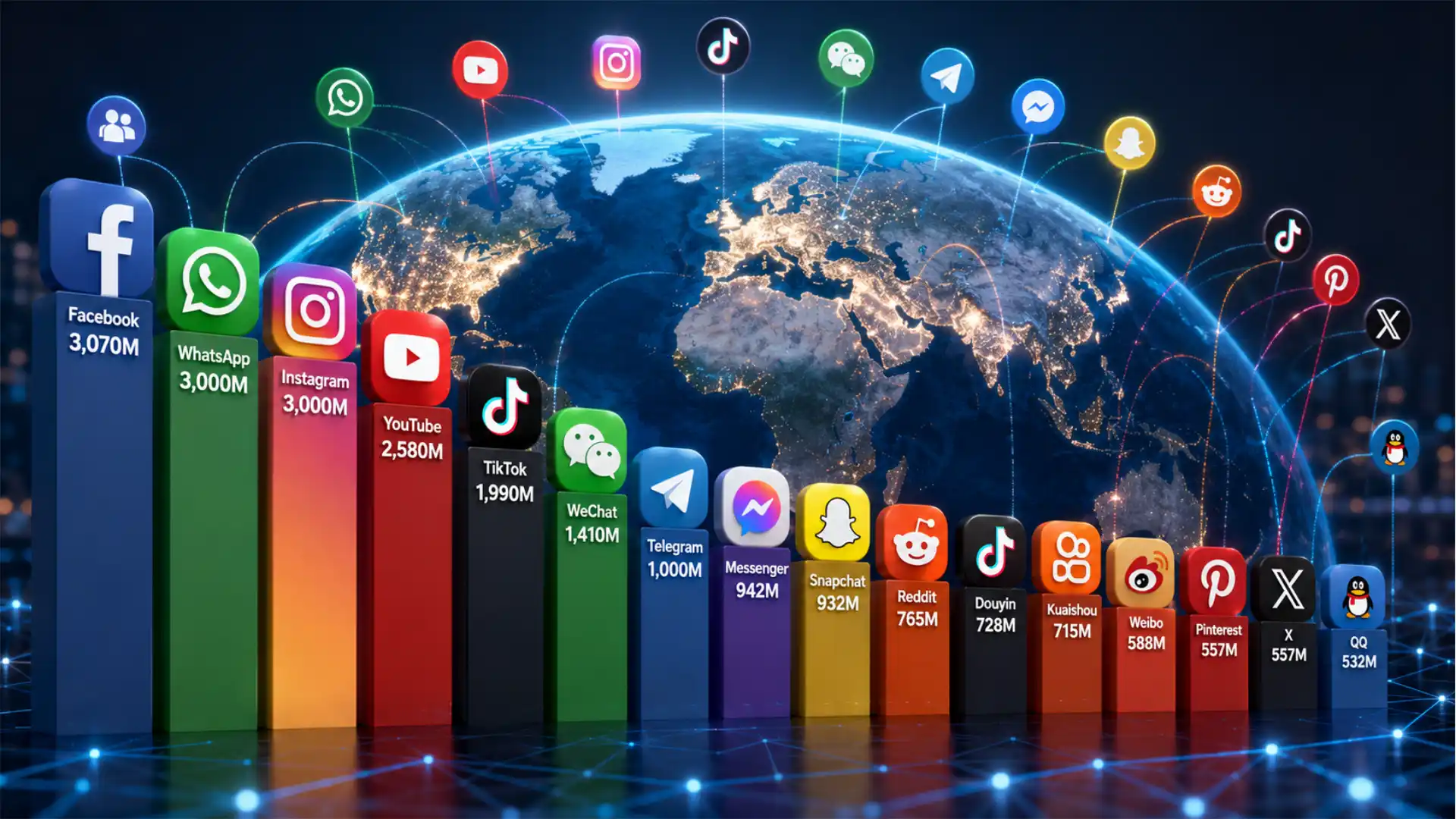
Facebook remains the world’s largest social network by monthly active users, but the October 2025 ranking no longer tells a simple Facebook story. The top of the chart has become crowded: Facebook is listed at 3.07 billion monthly active users, WhatsApp and Instagram at 3 billion each, YouTube at 2.58 billion, and TikTok at 1.99 billion. Below them sits a second tier of platforms that are not small at all: WeChat, Telegram, Messenger, Snapchat, Reddit, Douyin, Kuaishou, Weibo, Pinterest, X and QQ. The ranking shows a market where global scale is still concentrated, but user behavior has spread across messaging, video, discovery, communities and commerce.
Table of Contents
A ranking that measures scale, not the whole of influence
The Statista chart, based on We Are Social, DataReportal and Meltwater data and updated in October 2025, ranks major social platforms by monthly active users in millions. The headline number is clear: Facebook still leads at 3.07 billion monthly active users, narrowly ahead of WhatsApp and Instagram, which are both shown at 3 billion. Yet the closer the numbers are, the less useful it is to read the chart as a simple race. A platform with 3 billion monthly active users is not necessarily three times more useful to advertisers, publishers or creators than a platform with 1 billion. Scale matters, but the type of use matters just as much.
Monthly active users count whether an account or user identity has used a service at least once during a month. That definition gives a sense of reach, but not intensity. A person may open Facebook a few times, watch YouTube daily, message on WhatsApp hourly, discover products on Instagram, read Reddit from search results, and browse TikTok during idle moments. The same person can appear in the audience counts of many platforms at once, which makes the ranking a map of platform scale rather than a count of unique human beings.
DataReportal’s broader social media work makes the same point from another angle. It stresses that different data sources produce different answers to the question of which social platform is “most used,” because app-use data, self-declared survey data, company filings and advertising reach all measure different things. It also notes that audience overlap is large because connected users move across several services each month.
That distinction is not a footnote. It changes how the chart should be read. The ranking is best understood as a measure of global platform footprint, not a direct measure of daily attention, loyalty, trust, revenue quality or social importance. Facebook’s first place matters because it shows rare durability. TikTok’s fifth place matters because it shows how far a video-first feed has moved into mainstream culture. Telegram’s 1 billion figure matters because it shows that messaging networks can become public infrastructure. Reddit’s position matters because its usefulness often comes from search, archives and communities, not pure app habit.
The ranking also captures a mature market. Most of the largest platforms now have at least hundreds of millions of users. Several have passed 1 billion. The top three are around 3 billion. This does not mean growth has ended. It means the industry’s argument has shifted. For the largest platforms, the next fight is not only about adding accounts. It is about who controls attention, recommendations, messaging, commerce, creator income, AI assistants, safety systems and data access.
The 3 billion user club has become a Meta moat
The most striking feature of the ranking is Meta’s dominance near the top. Facebook is first. WhatsApp and Instagram are tied at 3 billion. Messenger is also listed in the top ten at 942 million. Meta’s Q3 2025 results show why this matters at company level: its Family of Apps reached 3.54 billion daily active people on average in September 2025, while revenue rose 26% year over year to $51.24 billion.
A single platform with 3 billion monthly users is rare. A company operating three products around that level is a different kind of power. Meta’s moat is no longer just Facebook’s social graph. It is a set of overlapping networks: Facebook for groups, feeds, video and marketplace-style activity; Instagram for visual identity, short video and creator culture; WhatsApp for private communication; Messenger for residual social messaging and Facebook-linked chat. Meta’s strength comes from owning multiple daily behaviors, not from owning one app.
This is why the phrase “Facebook is declining” can be misleading. Facebook may have lost cultural centrality in some younger Western audiences, but Meta has not lost social scale. It has redistributed attention across Instagram, WhatsApp, Reels, Stories, messaging, AI tools and recommendation feeds. The group structure lets Meta absorb changes in format. If public posting weakens, private messaging grows. If static photo sharing weakens, Reels absorbs short video. If social graphs weaken, AI recommendations fill the feed.
The company’s Q3 2025 numbers show the economics of that system. Meta reported ad impressions across its Family of Apps up 14% year over year and average price per ad up 10%. That combination matters because it means Meta was not merely serving more low-value inventory; it also improved pricing.
The chart also shows Meta’s defensive advantage. A new rival does not need to beat one Meta product; it must draw behavior away from several. TikTok competes with Instagram and Facebook video. Telegram competes with WhatsApp and Messenger in certain markets. YouTube competes with Reels for video time. Reddit competes for communities and search-driven discovery. Pinterest competes for shopping intent and visual discovery. Meta’s risk is not one rival. Its risk is fragmentation across every use case it serves.
Even so, the user chart gives Meta a strong starting point. Advertisers value reach, and Meta still has unmatched global reach across its family. Creators want large audiences, and Meta’s surfaces remain hard to ignore. Regulators focus on systemic risk, and Meta’s footprint gives it political and legal exposure. The same scale that protects Meta commercially also makes it a permanent target for scrutiny.
Facebook’s lead is smaller than its historical reputation suggests
Facebook’s 3.07 billion monthly active users still makes it the largest platform in the ranking, but its lead over WhatsApp and Instagram is narrow. A 70 million gap above 3 billion is tiny by social media standards. It is roughly the size of a large national market, but only about 2.3% of Facebook’s listed audience.
That narrow lead says something about where Facebook now sits in the wider Meta system. Facebook is no longer the sole gravitational center of social media. It is one of several platforms at near-global scale. Its user base remains enormous because the service performs functions that younger commentary often overlooks: local groups, family updates, events, resale, older-user networking, page-based media distribution, creator video and login-linked identity.
Facebook’s durability also comes from habit. Many users may not describe Facebook as their favorite platform, but they still keep an account, check groups, follow local pages, browse videos or use Marketplace. In mature digital markets, a platform can lose glamour and still retain function. Facebook’s role has moved from cultural front door to social utility layer in many countries.
The ranking should not be read as proof that Facebook has returned to its early-2010s cultural power. The platform’s influence is different now. It is less about college networks or friend-status updates and more about broad infrastructure: groups, video distribution, aging social graphs, local information, community commerce and algorithmic recommendations. A person may not talk about Facebook much, but they may still rely on it for a school group, a neighborhood alert, a marketplace listing or a community page.
Meta’s own reporting now emphasizes Family of Apps metrics more than Facebook-only headline growth. That shift matters. It reflects how the company wants investors to see the business: not as a single social network, but as a portfolio of connected attention products. Facebook’s first-place rank is still important, but its strategic meaning has changed. It is not the whole story. It is the anchor of a larger system.
For marketers and publishers, Facebook remains too large to dismiss. Yet the chart warns against treating it as the only mass-reach channel. The practical question is no longer whether Facebook is big. It is whether Facebook is the right surface for a specific audience, format, message and market.
WhatsApp turns messaging scale into strategic insulation
WhatsApp’s 3 billion monthly active users place it beside Instagram and just below Facebook in the ranking. That scale is different from feed-based social scale. WhatsApp is not primarily a place where users perform identity for a public audience. It is where they speak to family, friends, work contacts, school groups, community organizers, customers and businesses. WhatsApp’s power is intimate, repetitive and hard to replace.
Meta CEO Mark Zuckerberg said during the company’s Q1 2025 earnings call that WhatsApp had more than 3 billion monthly users, according to TechCrunch. That milestone put WhatsApp in the same numerical class as Facebook and Instagram, while maintaining a very different product character.
WhatsApp is especially important outside the United States. In many countries, it functions like a default communication layer. Phone numbers, group chats, voice notes, business accounts, payments in some markets, community channels and customer service flows all sit inside the app. The switching cost is social. A user may prefer another messenger, but the people they need to reach are often on WhatsApp.
That creates strategic insulation. Public feed platforms are easier to disrupt because entertainment formats can move quickly. A short-video product can draw time away from Instagram or YouTube. A new recommendation system can create new creator behavior. A messaging platform with deep group adoption is harder to displace because the user’s decision is collective. Messaging networks are sticky because the value sits in relationships, not only content.
WhatsApp also expands Meta’s business options. The company has long avoided a classic ad feed inside private chats, but business messaging creates monetization paths without turning every conversation into an ad surface. Click-to-message ads, customer support, commerce flows and business APIs make WhatsApp a bridge between advertising and transactions. This matters in markets where small businesses already use messaging as their operating system.
The regulatory side is becoming more serious. The European Commission designated WhatsApp as a Very Large Online Platform under the Digital Services Act in January 2026 after its Channels feature crossed the EU threshold for very large platforms. The designation applies to the broadcast-style Channels feature, not private messaging, but it shows how messaging apps are no longer outside social platform regulation when they add public or semi-public distribution.
The ranking’s message is clear: WhatsApp is not just a messenger. It is one of the largest social systems ever built.
Instagram reaches mass scale by absorbing rival formats
Instagram’s rise to 3 billion monthly active users confirms one of the defining patterns of social media competition: large platforms survive by absorbing formats that first made rivals dangerous. Instagram began as a photo-sharing app. It added video, Stories, shopping, Reels, messaging, creator tools, live video and algorithmic discovery. Its current scale comes from format absorption as much as from the original photo graph.
Reuters reported in September 2025 that Zuckerberg said Instagram had grown to 3 billion monthly active users. Reuters also noted that Meta had last disclosed Instagram’s user figures in 2022, when the app had passed 2 billion monthly active users.
Instagram’s importance is not limited to its number. It sits at the intersection of identity, entertainment, creators and commerce. People use it to post, watch, message, shop, follow celebrities, discover brands, consume Reels and maintain social presence. That breadth gives Instagram flexibility. If one behavior weakens, another can carry engagement.
Reels is central to that defense. TikTok forced every major platform to treat short video as a primary interface. Instagram responded by pushing Reels deeply into the app. The result was not a pure copy of TikTok; it was a hybrid. Instagram added short video to a platform that already had social graphs, influencer culture, messaging, Stories and brand presence. This made Reels part of a larger identity system rather than a stand-alone entertainment feed.
That also creates tension. Users who came to Instagram for friends may feel the app is too recommendation-heavy. Creators may find reach less predictable. Brands may have to produce more video even when their natural format is visual catalog content. Yet the 3 billion figure shows that these tensions have not stopped growth. Instagram’s strategy has been to trade simplicity for breadth.
Instagram also benefits from Meta’s advertising system. Advertisers can buy across Facebook and Instagram with shared targeting, creative tools, measurement and AI-powered campaign products. That makes Instagram part of a buying system, not merely a cultural app. The easier it is for advertisers to shift spend across Meta surfaces, the harder it is for rivals to take budget one platform at a time.
Still, Instagram faces a user-experience risk. A platform that tries to be photo album, TikTok rival, shopping mall, messaging app and creator economy hub can feel crowded. Its scale is real. Its challenge is to keep the app useful without making it feel overstuffed.
YouTube remains the internet’s video commons
YouTube ranks fourth in the chart at 2.58 billion monthly active users, behind Facebook, WhatsApp and Instagram. That number understates YouTube’s role in the internet because YouTube is not only a social platform. It is also a search engine, entertainment service, learning archive, music app, creator marketplace, podcast platform, livestreaming service and television destination.
Alphabet’s Q3 2025 results show YouTube’s economic weight inside Google. Alphabet reported consolidated quarterly revenue of $102.3 billion, said YouTube ads delivered double-digit growth, and noted that Google’s subscriptions, platforms and devices business was led partly by YouTube Premium.
YouTube’s strength comes from depth. TikTok excels at rapid discovery and short-form entertainment. Instagram Reels connects video to identity and social graphs. YouTube holds long-form libraries, creator archives, explainers, music videos, tutorials, reviews, commentary, podcasts, Shorts and live content. YouTube is where video becomes searchable memory. That is a different type of value from endless feed velocity.
The platform also has a monetization model creators understand. Ad revenue sharing, memberships, subscriptions, sponsorships and off-platform commerce give YouTube creators several ways to build a business. The model is not easy, and many creators struggle with algorithm changes or revenue volatility. Still, YouTube has a clearer long-form creator business structure than many feed-first platforms.
YouTube’s position in the ranking matters because it shows that short video has not replaced long video. It has changed expectations. Viewers now expect quick discovery, strong recommendations and mobile-native formats. YouTube responded with Shorts, but its advantage remains broader than Shorts. A creator can publish a 40-second clip, a 12-minute review, a 2-hour podcast and a livestream inside the same ecosystem.
For advertisers, YouTube offers another distinction: intent. People often come to YouTube to learn, compare, repair, research, review or be entertained for longer sessions. That makes its ad context different from a social feed. A person searching for a camera review or a tax tutorial is in a more defined mindset than a person passively scrolling a meme feed.
YouTube’s main strategic issue is not whether it has scale. It clearly does. Its issue is whether it can defend video time against TikTok, Reels, streaming services, podcasts and AI-generated content without weakening the trust that comes from searchability and creator authority.
TikTok’s fifth-place rank hides a stronger attention challenge
TikTok ranks fifth at 1.99 billion monthly active users in the chart, well below the 3 billion scale of Facebook, WhatsApp and Instagram. Yet TikTok’s strategic threat has never been only its user count. TikTok changed the grammar of social media. It proved that a feed could be built around interest prediction rather than a user’s chosen social graph. TikTok’s power is its ability to make strangers relevant instantly.
TikTok officially said in 2021 that more than 1 billion people used the app every month. The newer 1.99 billion figure in the October 2025 ranking indicates how far the app’s global scale has moved since that earlier company milestone.
TikTok’s influence shows up inside its rivals. Instagram pushed Reels. YouTube pushed Shorts. Facebook added more recommendation-led video. Snapchat invested in Spotlight. Even platforms not built around video had to think about algorithmic discovery, remix culture and creator-native formats. TikTok did not merely grow; it forced the rest of the market to copy its interface logic.
That interface logic matters for advertisers and creators. On a social graph, distribution often depends on followers. On TikTok-style recommendation feeds, distribution can come from content performance. That makes the platform attractive to new creators, small brands and cultural trends because the system seems to offer a path to rapid reach without a long follower-building period.
The downside is volatility. Recommendation-led growth can produce fast discovery and fast disappearance. Creators may gain enormous reach without owning a stable relationship. Brands may succeed with a post and fail to repeat it. Political content, misinformation, product trends and cultural memes can spread quickly because the feed is tuned for engagement signals rather than long-standing trust.
Regulation is another constraint. TikTok has faced intense scrutiny in the United States and Europe. Reuters reported in September 2025 that TikTok said it had more than 200 million monthly users in Europe, up from 175 million the previous year. The same scale that makes TikTok commercially attractive also makes it politically sensitive.
TikTok’s rank at fifth place can therefore mislead. It is smaller than the 3 billion platforms by MAU, but it has shaped their product roadmaps. TikTok is the platform that made every social network compete like an entertainment algorithm.
China’s platforms form a parallel social internet
The chart includes several Chinese platforms: WeChat at 1.41 billion, Douyin at 728 million, Kuaishou at 715 million, Weibo at 588 million and QQ at 532 million. Together, they show that the global social media market is not one unified system. It is split by language, regulation, payments, identity systems, app ecosystems and geopolitics.
WeChat’s figure is especially important. Tencent’s Q3 2025 results reported 1.414 billion combined monthly active users for Weixin and WeChat as of September 30, 2025. The same filing listed QQ mobile device monthly active users at 517 million, down 8% year over year.
WeChat is not equivalent to Facebook or WhatsApp in product scope. It combines messaging, social feeds, payments, mini programs, services, brand accounts and commerce into a super-app model. In China, it is closer to a digital operating layer than a conventional social network. A user can communicate, pay, book services, follow public accounts, join groups and use mini apps without leaving the ecosystem.
Douyin and Kuaishou show the video-commerce side of China’s social internet. They are not merely short-video apps. They connect entertainment, livestreaming, creator sales, local services, ads and AI-assisted content production. Kuaishou’s Q3 2025 results reported 731.1 million monthly active users and 416.2 million average daily active users on the Kuaishou app, with average daily time spent per daily active user at 134.1 minutes.
Weibo, listed at 588 million in the chart, continues to serve as a public-discussion and trend platform in China. Its Q3 2025 results reported 578 million monthly active users and 257 million average daily active users in September 2025.
These platforms matter beyond China because they show product paths that Western platforms often study: super-app integration, livestream commerce, mini-app distribution, AI content tools and payment-linked social behavior. The paths cannot be copied directly because regulation and consumer habits differ, but the mechanics travel. Instagram shopping, TikTok Shop, YouTube commerce tools and WhatsApp business messaging all echo parts of the Chinese platform model.
The Chinese social internet is not a side category. It is a second center of platform invention.
Telegram crosses from alternative messenger into global infrastructure
Telegram’s 1 billion monthly active users put it in a rare tier. It is smaller than WhatsApp, but larger than most public social networks. TechCrunch reported in March 2025 that Telegram founder Pavel Durov said the service had passed 1 billion active users, up from a previously reported 950 million.
Telegram’s role is difficult to classify. It is a messenger, broadcast channel network, media distribution tool, community system, file-sharing service, crypto-adjacent ecosystem in some contexts and political communication venue. Its use varies sharply by country. In some markets, it is an alternative to WhatsApp. In others, it is a news and channel platform. In conflict zones or politically restricted environments, it can become a public information layer.
That flexibility explains much of Telegram’s growth. It offers large groups, channels, cross-device use, public handles, bots and file capabilities that attract users beyond private chat. Telegram sits between messaging and publishing. That middle position gives it reach, but it also creates safety and moderation pressure.
The moderation question follows Telegram everywhere. Large channels and groups can spread news quickly, but they can also carry scams, extremist content, illegal markets, propaganda and misinformation. Messaging privacy, public broadcast reach and platform responsibility collide inside the same product. The more Telegram becomes infrastructure, the harder it is to claim the lighter obligations of a private messenger.
Telegram’s growth also shows that privacy branding and independence from major U.S. platform groups still matter. Many users do not choose Telegram only because of privacy. They choose it because communities are there, files are easy, channels are fast, and the app has features their local communication habits require. Yet the brand’s identity as an outsider to Meta and Google gives it a strategic edge among users who distrust dominant platforms.
For businesses, Telegram is powerful but uneven. It can be a strong community or broadcast tool in the right markets. It is less universally useful than WhatsApp for customer communication and less structured than Meta or Google for advertising. Its value depends heavily on local adoption and audience behavior.
Telegram’s billion-user scale confirms that the social market still has room for non-Meta infrastructure. The harder question is whether Telegram can maintain growth while handling the legal burden that comes with public distribution at global scale.
Messenger shows the cost of app overlap inside Meta
Messenger appears in the ranking at 942 million monthly active users. That is enormous by any normal standard, yet inside Meta it looks like a secondary asset because Facebook, WhatsApp and Instagram are all around 3 billion. Messenger’s position reveals both the advantage and the complexity of Meta’s portfolio.
Messenger began as Facebook’s chat function and later became a stand-alone app. Its strength remains tied to the Facebook graph, especially in markets where Facebook identity is widely used for communication. It also remains important for marketplace conversations, page messaging, customer service, group contact and users who maintain Facebook-based social ties.
The challenge is overlap. WhatsApp handles private messaging for much of the world. Instagram Direct handles creator, friend and brand conversations inside Instagram. Messenger handles Facebook-linked communication. For Meta, this redundancy can be useful because it covers different markets and contexts. For users, it can be confusing. Meta owns several messaging doors, but not every door leads to the same behavior.
Messenger’s 942 million user base still gives Meta reach that many companies would envy. It can support business messaging, customer service and Facebook commerce. Yet it lacks the singular global identity WhatsApp enjoys. WhatsApp often feels like the default messenger in a country. Messenger often feels like the messenger attached to Facebook.
That distinction matters for future monetization. Meta’s business messaging strategy is strongest when it meets users where they already talk to businesses. In many markets, that is WhatsApp. In some, especially where Facebook Marketplace or Pages remain strong, Messenger still matters. The ranking shows that Messenger is not fading into irrelevance, but it is no longer Meta’s flagship messaging story.
Messenger also demonstrates a broader platform lesson: being part of a dominant company does not erase internal competition. User time, product attention and strategic investment must be divided. Meta may benefit from owning WhatsApp, Instagram Direct and Messenger, but it must also avoid turning its messaging system into a maze.
The likely path is specialization. WhatsApp for global phone-number messaging and business communication. Instagram Direct for social and creator-linked messaging. Messenger for Facebook-linked identity, pages, groups and commerce. Messenger’s rank is a reminder that even “smaller” Meta products operate at near-billion scale.
Snapchat’s camera identity still matters at nearly a billion users
Snapchat is listed at 932 million monthly active users in the chart, and Snap’s Q3 2025 results reported 943 million global monthly active users with 477 million daily active users. That is a large audience for a platform often underestimated in adult business commentary.
Snapchat’s strength is not broad public posting. It is camera-first communication. Users send visual messages, maintain streaks, use lenses, share stories, communicate with close friends and interact through augmented reality features. Snapchat’s social graph is often tighter and more private than the public follower systems that dominate creator platforms.
This gives Snap a different strategic role. It is not trying to be Facebook’s global directory, YouTube’s archive or TikTok’s main entertainment feed. It remains close to daily peer communication, especially among younger users in certain markets. That makes Snapchat harder to evaluate using only content feed metrics.
Snap’s Q3 2025 release also shows how the company is trying to expand beyond messaging. It reported year-over-year growth in content viewing, Spotlight improvements, Sponsored Snaps, Snapchat+ subscription revenue and a partnership with Perplexity AI to bring conversational search into Snapchat.
The AI partnership is worth watching. If messaging apps become gateways to AI assistants, Snapchat has a reason to defend the camera and chat interface as a place where search, discovery and communication meet. This is part of a broader shift: social platforms no longer compete only through feeds. They compete through assistants, discovery tools, shopping systems and creator services.
Snapchat also faces a monetization gap. Its audience is large, but Meta, Google and TikTok command far deeper ad systems. Snap has to prove that its intimacy and camera behavior translate into advertiser results. Sponsored Snaps and augmented reality formats are part of that answer, but the company remains more exposed than larger rivals to ad market shifts.
The ranking confirms that Snapchat remains a major social platform. Its influence is not always visible in news debates because it is less public than X, less searchable than Reddit, less universal than WhatsApp and less culturally loud than TikTok. Yet for young-user communication and camera-native habits, Snapchat remains one of the world’s most important social products.
Reddit’s ranking needs a different interpretation
Reddit is listed at 765 million monthly active users in the chart. That figure requires careful reading because Reddit itself emphasizes different operating metrics. In Q3 2025, Reddit reported 116 million daily active uniques and said 444 million people came to Reddit each week, while revenue grew 68% year over year to $585 million.
Reddit’s social value does not come from behaving like Facebook or TikTok. It comes from communities, search visibility, long-tail discussions and archives of human answers. Many users do not open Reddit because they want a general feed. They arrive because they search for a product problem, a travel question, a niche hobby, a technical fix, a medical experience, a career dilemma or a news discussion.
That makes Reddit unusually important in the age of AI search. Large language models, search engines and answer engines are hungry for human discussions that contain specific experiences. Reddit has that data in depth. It is messy, subjective, often argumentative and sometimes unreliable. It is also one of the richest archives of real user language on the web.
Reddit’s business has started to reflect that position. Its Q3 2025 performance showed strong revenue growth and higher daily active uniques, while the company continued to push advertising, search and data licensing opportunities.
For brands, Reddit is not a simple ad placement channel. It is a reputation environment. Communities can reward useful participation and punish obvious marketing. Product sentiment can form in threads that later surface through Google, AI summaries and social screenshots. Reddit often matters most when companies are not directly posting there.
For publishers, Reddit can be a discovery source and a feedback loop. For AI companies, it is a source of conversational data. For search users, it is a shortcut to lived experience. For moderators, it is a constant governance challenge. The platform’s scale ranking understates this distinct role because Reddit’s influence is not only monthly activity; it is indexable conversation.
Reddit’s position in the chart should therefore be read as a sign of renewed relevance. It is not competing to be the largest social graph. It is competing to be the most useful public archive of human discussion.
X is still politically loud, but its scale has narrowed
X is listed at 557 million monthly active users, below Pinterest, Weibo, Kuaishou, Douyin, Reddit, Snapchat and Messenger. That rank may surprise readers because X remains central to political news, technology debates, financial commentary, sports conversation and media cycles. The gap between visibility and scale is one of the ranking’s clearest lessons.
X has influence because journalists, politicians, founders, analysts, activists and highly online communities still use it as a real-time arena. A platform does not need to be the largest by monthly active users to shape news agendas. It needs the right concentration of agenda-setting users, fast distribution and public embedability. X’s power is elite visibility, not mass dominance.
The weakness is that elite visibility does not solve advertiser trust, user growth or regulatory risk. Since the Twitter-to-X transition, the platform has faced recurring concerns around brand safety, verification changes, moderation, advertiser exits and competition from Threads, Bluesky, Mastodon and other public conversation tools. Some users remain because the network still offers speed and reach. Others have reduced usage or moved parts of their identity elsewhere.
The EU’s Digital Services Act shows how regulatory scrutiny follows public influence as well as raw user size. X has been designated as a Very Large Online Platform in the EU, meaning it faces the stricter DSA obligations applied to services with more than 45 million average monthly recipients in the bloc.
For marketers, X requires a sharper risk-reward calculation than larger and more stable ad systems. It may be useful for real-time conversation, public affairs, B2B thought leadership, finance, tech and media. It may be less predictable for broad brand campaigns that require safety, scale and positive sentiment.
For publishers, X can still drive visibility, but it should not be treated as the public square by default. The ranking shows that public conversation has scattered. Reddit holds searchable communities. Threads has Meta distribution. LinkedIn owns professional identity. TikTok and Instagram shape visual culture. YouTube hosts long-form commentary. X remains loud, but loud is not the same as largest.
The platform’s future depends on whether it can convert real-time cultural relevance into stable user growth and trusted monetization. The chart suggests that it has work to do.
Pinterest shows intent can be more useful than raw activity
Pinterest is listed at 578 million monthly active users in the chart, while Pinterest’s Q3 2025 earnings release reported a later all-time high of 600 million global monthly active users. The company also reported Q3 revenue of $1.049 billion, up 17% year over year.
Pinterest is often grouped with social networks, but it behaves differently. Users come to plan, collect, compare, save, shop and imagine. A person browsing Pinterest may be thinking about a kitchen renovation, wedding, haircut, outfit, classroom activity, recipe, holiday table or product style. That makes Pinterest less about public conversation and more about future intent.
This matters for advertisers. A smaller platform can be commercially strong when users arrive with planning behavior. Pinterest’s value is not only how many people use it; it is the mindset they bring. A user saving kitchen ideas may be closer to a purchase path than a user scrolling jokes. A user planning a wardrobe may be receptive to discovery ads. A user collecting travel visuals may be building a decision set.
Pinterest has leaned into that role by presenting itself as a visual search and shopping platform. Its Q3 2025 release described the platform as an AI-powered shopping assistant for 600 million consumers.
That positioning is strategically smart. Pinterest does not need to beat TikTok in entertainment, Facebook in groups or WhatsApp in messaging. It needs to own visual discovery at moments when users are planning. The AI opportunity is also clearer here than on many social platforms: better image understanding, product matching, visual search, recommendations and shopping flows fit the user’s intent.
Pinterest’s risks are real. It competes with Google, Amazon, Instagram, TikTok Shop and retailers for shopping discovery. It must also keep its product visually useful without flooding users with low-quality AI imagery or overly aggressive ads. Still, its placement in the ranking shows that platform value is not linear. A 578 million or 600 million user base with strong intent can matter more to certain advertisers than a larger audience in a weaker decision mindset.
Pinterest’s lesson for the whole ranking is simple: reach opens the door, but intent determines what the door is worth.
Scale does not mean unique people
The chart’s numbers should not be added together. Facebook’s 3.07 billion users, Instagram’s 3 billion users and WhatsApp’s 3 billion users do not imply that Meta reaches more than 9 billion separate people. The same person may use all three. The same is true across YouTube, TikTok, Snapchat, Reddit, Pinterest and X.
DataReportal’s global social media statistics page explicitly warns that social media user figures may not represent unique individuals because of duplicate accounts and platform measurement differences. It uses the term “user identities” for broader social media totals and notes that platform figures can exceed the number of internet users or even total population in some comparisons because of duplicates and measurement issues.
This is one of the most common mistakes in social media reporting. A monthly active user figure is not a census. It is a platform metric. It may count accounts, logged-in users, estimated users, app activity, self-reported reach or company-defined active recipients, depending on the source. It can include duplicates, dormant-but-active accounts, cross-device behavior and, in some cases, non-human or organizational accounts.
The ranking is most useful when read comparatively, not arithmetically. It shows which platforms operate at global scale and how their footprints compare. It does not show the total number of social media users when summed. For that, analysts use separate global social media user identity estimates, and even those come with caveats.
The distinction is especially important for media planning. A brand that buys Facebook, Instagram, YouTube and TikTok does not automatically reach the sum of their audiences. Overlap can be high, especially among digitally active younger users. The incremental reach from adding a platform depends on country, age group, format, targeting, frequency and campaign objective.
It also matters for social strategy. A company does not need to be present on every large platform to reach most of its audience. In some categories, two or three platforms may cover the core market. In others, a smaller specialist platform may add more business value than another large general platform.
The chart invites a better question: not “which platform has the most users?” but “which platform reaches the right people in the right behavior at the right moment?”
Monthly active users, daily users, ad reach and app use tell different stories
Monthly active users are only one lens. Daily active users measure intensity. Weekly active users capture more frequent reach than monthly users without the strictness of daily use. Ad reach measures the estimated number of people advertisers can reach through a platform’s advertising tools. App-use data measures actual app openings or device behavior. Surveys capture self-declared use, which can differ from logged behavior.
DataReportal’s global social media analysis notes that there is no single definitive answer to which platform is most used because different sources offer different perspectives. It compares self-declared use, app-use data and reported social media ad reach, and those methods produce different platform rankings.
Platform ranking by listed monthly active users
| Rank | Platform | Listed monthly active users |
|---|---|---|
| 1 | 3.07 billion | |
| 2 | 3.00 billion | |
| 3 | 3.00 billion | |
| 4 | YouTube | 2.58 billion |
| 5 | TikTok | 1.99 billion |
| 6 | 1.41 billion | |
| 7 | Telegram | 1.00 billion |
| 8 | Messenger | 942 million |
| 9 | Snapchat | 932 million |
| 10 | 765 million | |
| 11 | Douyin | 728 million |
| 12 | Kuaishou | 715 million |
| 13 | 588 million | |
| 14 | 578 million | |
| 15 | X | 557 million |
| 16 | 532 million |
This table condenses the ranking shown in the Statista chart. The figures are useful as a scale comparison, but they should not be treated as directly comparable measures of engagement quality, revenue strength or unique human reach because platform definitions and user behaviors differ.
The metric problem becomes clear when comparing Snapchat and Reddit. Snap reported 943 million monthly active users and 477 million daily active users in Q3 2025. Reddit reported 116 million daily active uniques and 444 million weekly users in Q3 2025. These are not the same kinds of measures, and each company frames user activity around the metrics that best reflect its product.
The same issue applies to advertising reach. A platform’s ad tools may report the number of accounts advertisers can target, not the same thing as monthly active users. DataReportal’s current statistics page says YouTube has the largest reported social media advertising audience, with YouTube ads reaching 2.65 billion users each month, while Facebook’s reported ad reach is 2.39 billion and TikTok’s is 2.21 billion.
For investors, daily use and monetization often matter more than monthly reach. A platform with fewer monthly users but daily habit and high ad pricing may be more profitable than a larger but lightly used platform. For regulators, active recipients and systemic risk matter. For creators, distribution predictability matters. For publishers, referral traffic and search visibility matter. For brands, audience fit and conversion matter.
The chart is the beginning of analysis, not the end.
The advertising market follows reach, but not blindly
Advertisers pay attention to user scale because reach is the raw material of media buying. A platform with billions of users can offer broad audience access, frequency control, measurement, creative testing and automated targeting. That is why Meta and Google continue to dominate digital advertising. They combine massive audiences with mature buying systems.
Yet reach alone does not decide budgets. Advertisers care about attention, safety, targeting, measurement, incrementality, creative format, purchase intent and price. A billion users who scroll past ads quickly may be less useful than 500 million users planning purchases. A platform with cultural heat may attract experimental budgets but lose brand campaigns if safety concerns rise. A platform with strong intent may command spend in categories where users research products.
Meta’s Q3 2025 results show the power of combining scale and pricing. Ad impressions rose 14% year over year across Family of Apps, while average price per ad rose 10%. Revenue rose 26%. That is the kind of combination advertisers and investors watch closely because it suggests demand remained strong even as inventory grew.
Alphabet’s Q3 2025 results show the other side of the ad market. YouTube ads were part of the company’s double-digit growth across major businesses, while Google Services revenue increased 14% to $87.1 billion. YouTube’s position inside Google gives it search intent, video inventory, creator relationships and subscription adjacency.
TikTok’s ad proposition is different. It offers cultural speed, algorithmic discovery and short-video engagement. Pinterest offers planning intent. Snapchat offers camera communication and younger-user intimacy in certain markets. Reddit offers community context and search-driven discussion. X offers real-time conversation and elite visibility. Each platform sells a different version of attention.
For marketers, the ranking can identify where scale exists, but not where money should go. A media plan built only from MAU rankings would be crude. It would overvalue size and undervalue fit. It would miss that YouTube may be better for education and long-form influence, Pinterest for planning and shopping discovery, Reddit for credibility and niche research, TikTok for cultural spread, and WhatsApp for customer communication.
The largest platforms will keep attracting the largest budgets because they reduce buying friction. But the smartest spending follows behavior, not just audience totals.
AI recommendation systems reshape engagement economics
The 2025 platform ranking sits inside a second major shift: AI recommendation systems are becoming the machinery of social growth. Feeds are no longer primarily lists of posts from accounts a user chose to follow. They are prediction systems deciding which video, image, post, product, thread or ad a user is likely to engage with next.
TikTok made this model mainstream. Meta copied and adapted it across Reels, Facebook video and Instagram recommendations. YouTube has long relied on recommendation systems and now operates across long-form, Shorts, music and living-room viewing. Kuaishou reported that its generative recommendation model OneRec contributed to advertising and e-commerce results in Q3 2025.
This changes the economics of social media. Under the older social graph model, growth depended heavily on users following friends, pages and creators. Under recommendation systems, platforms can increase time spent by surfacing content from outside the user’s graph. The platform becomes less dependent on who users know and more dependent on what the system predicts they will watch.
For creators, this is both an opening and a trap. A new creator can gain reach faster when the algorithm tests content beyond followers. Yet the same creator may have less control over distribution. Follower counts still matter, but they do not guarantee reach. The recommendation system can turn attention on and off.
For advertisers, AI recommendations increase automated matching between content, users and ads. Meta’s ad products increasingly rely on automation to decide who sees which creative. Tencent said its marketing services growth in Q3 2025 benefited from higher ad impressions and higher eCPMs driven by AI-powered ad targeting.
For users, AI feeds make platforms more engaging and more opaque. People may get better recommendations, but they may also understand less about why they see certain content. This opacity drives regulatory interest. The EU’s Digital Services Act gives very large platforms extra duties around systemic risks, transparency and researcher access.
The ranking therefore captures more than user scale. It captures the size of the audiences being shaped by AI-mediated attention systems. A billion-user recommendation engine is not just a media product. It is a behavioral infrastructure layer.
Messaging is becoming the quiet power layer
Messaging platforms occupy several high positions in the ranking: WhatsApp at 3 billion, WeChat at 1.41 billion, Telegram at 1 billion, Messenger at 942 million, QQ at 532 million and Snapchat’s communication core at 932 million. This is one of the most under-discussed parts of the chart. Public feeds get more attention because they are visible. Messaging gets more usage because it is necessary.
Messaging is also where social media connects to daily life. Family coordination, school groups, neighborhood chats, customer support, creator communities, political organizing, faith groups, workplace side channels and commerce all move through messaging products. Messaging platforms are often less public than social feeds, but they are more embedded in routine behavior.
The business layer is growing. WhatsApp Business, click-to-message ads, Instagram Direct, Messenger business chats, Telegram channels and WeChat official accounts all turn messaging into a commercial interface. A user can discover a product in a feed, ask a question in chat, receive support, complete a purchase and stay in a customer list. That collapses the gap between marketing and service.
This is especially important for small businesses. In many markets, a shop may not have a strong website or app, but it has WhatsApp, Instagram messages or WeChat. Social commerce does not always begin with a checkout button. It often begins with “Is this available?” or “How much?” in a chat thread.
Messaging also changes moderation. Public posts can be scanned, ranked, labeled and removed more visibly. Private chats raise encryption and privacy issues. Broadcast channels sit between the two. The WhatsApp Channels DSA designation in Europe shows how platforms that add public distribution features can enter stricter regulatory categories even when their private messaging remains distinct.
For media companies, messaging is both opportunity and limitation. Channels and groups can build loyal audiences, but they may be hard to measure and monetize compared with public feeds. For political actors, messaging can mobilize quickly, but it can also spread rumors in closed networks. For platforms, messaging is a defensive layer because users are less likely to leave when their real relationships are inside the app.
The chart’s visible ranking hides a quiet truth: the next era of social power may be as much about private and semi-private communication as public feeds.
Short video has become a universal interface
TikTok’s 1.99 billion users, YouTube’s 2.58 billion, Instagram’s 3 billion, Facebook’s video push, Snapchat Spotlight, Douyin’s 728 million and Kuaishou’s 715 million all point to the same product reality: short video is no longer a category. It is a default interface.
The reason is simple. Short video compresses entertainment, identity, education, product discovery, commentary and trend participation into a format that works on mobile screens. It is easy to watch, easy to recommend, easy to remix and easy to monetize with ads. It gives algorithms strong signals quickly: watch time, replays, skips, shares, comments, follows and purchases.
TikTok did not invent mobile video, but it perfected the interest-based short-video feed at global scale. Douyin and Kuaishou built huge parallel systems in China. Instagram Reels and YouTube Shorts brought the format into platforms with existing creator and advertising systems. Snapchat Spotlight gave Snap a public content layer beyond friend communication.
Short video also changes content production. A brand that once needed polished campaign assets now needs a steady flow of native clips. A creator who once built an audience through photos or blogs now has to understand hooks, pacing, captions, edits and trend mechanics. A news publisher that once posted links now has to produce explainers, vertical clips and personality-led formats.
The format’s rise does not mean long-form content is dead. YouTube’s scale proves the opposite. Podcasts, livestreams, newsletters, articles and long videos still matter. Short video acts as a discovery layer, often pushing users toward deeper content, creators, products or debates. The strongest media strategies treat short video as the top of a relationship funnel, not the whole relationship.
Short video also brings risks. It can reward emotional compression, shallow claims, outrage, misinformation and endless comparison. It can push users into high-frequency consumption that feels difficult to stop. It can place pressure on creators to produce constantly. It can make brands chase trends that do not fit them.
The chart shows that platforms with strong short-video systems now dominate the top tiers. The strategic lesson is not that every company must become TikTok. It is that every social platform now has to answer the short-video expectation.
The global south now matters more than Silicon Valley narratives
Western media coverage often overweights the United States and Europe. The ranking does not. A platform cannot reach 2 or 3 billion users without deep adoption across Asia, Latin America, Africa and other high-growth regions. The social media market is now shaped by India, Indonesia, Brazil, Mexico, Nigeria, the Philippines, Vietnam, Bangladesh, Egypt, Turkey and many other countries where mobile-first behavior defines the internet.
This matters because user needs differ by market. In lower-income or mobile-first markets, messaging may be more important than public posting. Data costs, device storage, language, payment systems, local commerce and family networks shape platform use. WhatsApp, Facebook, YouTube, TikTok and Instagram may all be present, but their roles vary.
Platforms also face different regulatory environments. India’s rules, Brazil’s court orders, EU regulations, U.S. national security debates and China’s domestic controls all shape product choices. A platform with global scale cannot operate as if one policy model fits every country.
The Global South also influences culture. Music, memes, religious content, football culture, beauty trends, small-business commerce and political communication move across platforms from countries that older media models treated as peripheral. TikTok trends, YouTube channels, WhatsApp groups and Instagram creator ecosystems are often driven by markets far from Silicon Valley.
The ranking is a reminder that social media is not a U.S. export story anymore. It is a global infrastructure story with local behaviors. Meta’s advantage comes partly from being deeply present in many non-U.S. markets. YouTube’s power comes from being the default video layer across languages. TikTok’s growth comes from highly localized entertainment cultures. Telegram’s role often expands in markets where users want alternative channels. WeChat’s scale comes from China’s unique app ecosystem.
For brands, this means global strategy cannot be copied from U.S. usage patterns. Platform preference, creator trust, messaging habits and commerce behavior differ by country. A platform that is central in Brazil may be secondary in Germany. A tool that works in Indonesia may fail in France. A campaign that fits Instagram in the U.S. may need WhatsApp support in India or Brazil.
The chart ranks platforms globally, but the real work happens locally.
Regulation has become a condition of scale
Every platform in the upper tier now operates under regulatory pressure. The larger the user base, the more likely governments are to treat the service as infrastructure. Regulation is no longer an external annoyance. It is part of the cost structure of scale.
The EU’s Digital Services Act is the clearest example. Very large online platforms and search engines are services with more than 45 million users in the EU and must comply with stricter rules. These include systemic risk assessments, mitigation duties, transparency obligations and researcher access requirements.
In October 2025, the European Commission preliminarily found TikTok and Meta in breach of DSA transparency obligations. The Commission focused on issues involving researcher access and reporting mechanisms for illegal content.
This regulatory direction matters for the ranking because the platforms at the top are no longer treated as ordinary websites. Their recommendation systems, ad tools, content moderation choices, child safety measures, data access practices and political information flows are now public policy concerns.
Regulation also affects product design. Platforms may need to change reporting flows, ad archives, data access processes, teen protections, recommender transparency and researcher tools. These changes can be costly, but they also set barriers to entry. A new platform that grows quickly must build trust and safety operations earlier than older platforms did.
The U.S. has taken a different path, especially around TikTok, where national security and ownership debates have dominated. China applies its own platform governance and content rules. The United Kingdom, Australia, Brazil and India all have active debates over online safety, privacy, competition and platform accountability. Social media scale now means legal exposure in many jurisdictions at once.
For investors, regulation can affect risk, costs and growth. For creators, regulation can change content rules and monetization. For users, regulation may provide more rights but also alter product experience. For advertisers, regulation can affect targeting and measurement.
The chart’s biggest platforms are not just media companies. They are regulated social infrastructure.
News publishers face a platform mix problem
For news organizations, the ranking is both useful and dangerous. It is useful because it shows where global audiences gather. It is dangerous because user scale does not equal reliable news distribution. Publishers have already learned this through years of Facebook feed changes, Twitter volatility, search algorithm shifts and platform revenue disappointments.
Facebook’s scale still matters, but publishers cannot assume Facebook will send traffic the way it once did. Instagram has huge reach, but links are limited and news often competes with entertainment. TikTok can build awareness, but converting viewers into subscribers or loyal readers is difficult. YouTube can support deep video journalism, but production demands are high. Reddit can surface stories and expertise, but community norms resist obvious self-promotion. WhatsApp and Telegram can build loyal channels, but measurement and monetization are harder.
The publisher problem is not where audiences exist. It is how to build durable relationships when platforms control distribution. A social platform can change ranking rules, reduce link reach, prioritize video, downrank political content, alter verification, change API access or restrict news in certain countries. Publishers cannot build their entire audience strategy on rented feeds.
The ranking suggests a portfolio approach. YouTube for explainers, interviews and evergreen video. Instagram and TikTok for visual storytelling and younger audience discovery. WhatsApp or Telegram for loyal updates in markets where messaging channels are strong. Reddit for listening, expertise and community-aware participation. Facebook for groups, local news and older demographics. LinkedIn, though not in the chart’s shown set, for professional journalism and business audiences.
Publishers also need to think about answer engines. Reddit threads, YouTube transcripts, news articles, social posts and structured data may all feed AI-mediated discovery. Search, social and AI are converging. A story may be found through Google, summarized by an AI assistant, debated on Reddit, clipped on TikTok, discussed on X and forwarded on WhatsApp.
The old model of “post the link everywhere” is weak. The stronger model is format-native distribution backed by owned channels: newsletters, apps, websites, podcasts, membership and direct relationships. Social platforms can create reach. They cannot be the only audience asset.
Brands cannot treat the ranking as a media plan
The ranking is tempting for marketers: choose the biggest platforms, spend money, reach people. That would be lazy planning. A monthly active user ranking is not a strategy. It does not tell a brand where its buyers are, what they want, how they behave, what content they trust or what format will move them.
Facebook may be useful for local services, community campaigns, older audiences and broad reach. Instagram may be strong for beauty, fashion, travel, food, creators and visual brands. WhatsApp may matter for customer service, retention and direct commerce. YouTube may be best for education, reviews, consideration and long-form influence. TikTok may drive discovery and cultural momentum. Pinterest may support planning and purchase intent. Reddit may shape reputation in technical, enthusiast or high-consideration categories. Snapchat may reach younger users in camera-native formats.
The right mix depends on category. A B2B software company should not chase TikTok just because TikTok is huge. A beauty brand should not ignore TikTok and Instagram because Facebook is larger. A furniture company may get more intent from Pinterest and YouTube than from X. A local restaurant may rely on Instagram, Google, TikTok and WhatsApp rather than broad Facebook ads.
The ranking also says nothing about creative fit. TikTok punishes ads that feel imported from television. YouTube rewards useful long-form and strong thumbnails. Instagram requires visual consistency and Reels fluency. Reddit requires credibility and restraint. Pinterest rewards search-like organization and planning content. WhatsApp requires conversation design, not feed creative.
Brands should use the ranking as a reach map, then layer on audience research, search data, platform analytics, customer interviews and sales attribution. The strongest question is: where does the customer already behave in a way that matches the brand’s goal?
A purchase goal may need Pinterest, YouTube and Google. A cultural launch may need TikTok and Instagram. A retention goal may need WhatsApp and email. A reputation goal may need Reddit listening and expert content. A local trust goal may need Facebook groups and community pages.
Scale matters. Fit decides.
Creators need platform risk management, not platform loyalty
The chart shows enormous audience opportunity. It also shows creator risk. Every major platform has enough users to build a career, but none gives creators full control. Algorithms change. Monetization rules shift. Ad markets soften. Formats rise and fall. Accounts can be suspended. A platform can decline in a creator’s niche even while growing globally.
Creators often learn this the hard way. A TikTok creator may gain millions of views and struggle to move followers elsewhere. A YouTuber may depend on search and recommendations that shift without warning. An Instagram creator may see reach fall when the app changes feed priorities. A Reddit community builder may face moderation conflicts. A newsletter writer may rely on social platforms for acquisition but need email for retention.
The smart creator strategy is not platform loyalty. It is audience portability. Creators need at least one direct channel they control: email, website, podcast feed, community platform, customer list, paid membership or product relationship. Social platforms are discovery engines; they should not be the only home.
The ranking also points to format diversification. A creator who understands only one format is exposed. Short video can build reach. Long video builds depth. Text builds search and authority. Messaging builds loyalty. Live formats build intimacy. Products and services build income beyond platform payouts.
This does not mean creators should post everywhere. That leads to burnout and weak work. It means creators should understand the role each platform plays. TikTok for discovery. YouTube for depth and revenue. Instagram for identity and brand deals. Reddit for community credibility. Substack or newsletters for direct audience. WhatsApp or Telegram for high-intent updates where appropriate.
Creators also need to watch regulation and platform politics. TikTok bans or ownership changes, X volatility, Meta policy shifts, YouTube demonetization, AI training debates and data access restrictions can affect livelihoods. The biggest platforms are not neutral stages. They are companies with their own incentives.
The ranking’s promise is reach. Its warning is dependency.
Search, social and answer engines are merging
The distinction between social media and search is weakening. Users search on YouTube, TikTok, Reddit, Pinterest and Instagram. Google results surface Reddit threads, YouTube videos and social posts. AI answer engines summarize content from across the web. Social platforms add AI assistants and conversational search. The ranking should be read inside this convergence.
DataReportal’s global social media statistics page notes that YouTube leads in one app-use perspective and in reported advertising reach, while Facebook leads in self-declared social platform use among surveyed adult internet users. It also highlights audience overlap across platforms.
YouTube has long been a search engine for video. Reddit has become a search destination for human experience. Pinterest is visual search for ideas and products. TikTok is increasingly used by younger users to find places, products, recipes and explanations. Instagram is a search tool for businesses, creators and locations. Social content is becoming searchable infrastructure.
This creates a new kind of competition. Google competes with TikTok for discovery. YouTube competes with podcasts and streaming. Reddit competes with forums and search snippets. Pinterest competes with Google Images, Amazon and Instagram. Meta competes to keep discovery inside its apps. AI assistants compete with all of them by answering questions directly.
For publishers and brands, the practical impact is large. Content must now work across search engines, social feeds and AI summaries. A restaurant needs Google reviews, Instagram presence, TikTok clips and maybe WhatsApp communication. A software company needs YouTube tutorials, Reddit reputation, search-optimized documentation and LinkedIn credibility. A product brand needs Pinterest discoverability, creator videos, structured product pages and community proof.
The future of social ranking may not be a simple MAU chart. It may need to measure discovery power: which platforms shape what people find, trust, compare and buy. A platform with fewer users but high search intent may matter more than a larger platform used casually.
The chart shows where people gather. The next question is where they ask questions.
User growth is no longer the only metric investors reward
The largest social platforms are so mature that user growth alone cannot carry the investment story. Investors now watch revenue growth, ad pricing, AI costs, capital expenditure, margins, daily engagement, subscriptions, commerce, creator tools and regulatory exposure.
Meta’s Q3 2025 results show this clearly. The company reported strong revenue growth and family daily active people growth, but also huge capital expenditures tied to AI infrastructure. Alphabet’s Q3 2025 release also raised expected 2025 capital expenditures to a range of $91 billion to $93 billion, reflecting AI and cloud demand.
The social media business has entered an infrastructure spending cycle. AI recommendation systems, generative AI tools, data centers, safety systems, video processing and ad automation require massive investment. A platform can have billions of users and still face investor pressure if the cost of serving and monetizing them rises.
Smaller public platforms show different investor questions. Reddit’s Q3 2025 results were judged through revenue growth, daily active uniques, weekly users, margins and AI/search opportunities. Snap’s results were judged through user growth, ad product performance, Snapchat+ subscriptions and progress in direct response advertising. Pinterest’s results were judged through user growth, revenue, visual search, shopping intent and guidance.
The market no longer rewards scale without a path to profit quality. A platform must show that users can be monetized without damaging trust or engagement. That is harder than adding accounts.
This is especially true for video. Video drives time spent, but it can be expensive to store, recommend and moderate. Short video can have lower ad load or weaker direct response than feed ads if not managed well. AI content may increase supply but lower quality. Creator payouts can attract talent but pressure margins.
The top of the ranking therefore hides a business divide. Meta and YouTube have mature ad machines. TikTok has huge cultural power but faces geopolitical risk. Snapchat has scale but weaker monetization. Reddit has unique data and community value but a smaller daily base. Pinterest has intent but must grow ad demand. Telegram has huge usage but a less conventional monetization model.
User count opens the conversation. Economics decides the valuation.
The next growth frontier is commerce inside social products
Social media started as communication and publishing. It is becoming commerce infrastructure. The ranking’s largest platforms are all trying, in different ways, to shorten the path from discovery to transaction.
WeChat already shows what deep integration can look like through payments, mini programs, official accounts and services. Douyin and Kuaishou show the power of video-linked commerce and livestream shopping in China. TikTok Shop is trying to build a version of that model across international markets. Instagram and Facebook connect ads, shops, creator content and messaging. YouTube supports shopping features, creator product links and subscriptions. Pinterest connects visual discovery to purchase intent. WhatsApp connects business messaging to customer service and sales.
Kuaishou’s Q3 2025 results reported e-commerce gross merchandise value of RMB385 billion, up 15.2% year over year. The company also described AI systems used for product matching, e-commerce search and recommendation.
This points to a future where the difference between media and retail weakens. A user sees a video, asks a question, watches a livestream, reads comments, checks a creator’s recommendation, saves an idea, receives a message and buys. The platform that owns more of that journey can capture more value.
Commerce is attractive because ad growth has limits. If platforms can take a share of transactions, payment flows, merchant tools or business messaging, they reduce dependence on classic display ads. Yet commerce is hard. It requires trust, refunds, logistics, fraud prevention, product quality, merchant tools and customer service.
Different platforms have different commerce advantages. Pinterest has planning intent. TikTok has impulse discovery. Instagram has creator-brand identity. YouTube has product review depth. WhatsApp has conversational commerce. WeChat has payment and service integration. Reddit has peer recommendations but less controlled buying flow.
The winners will not be the platforms that simply add shop tabs. They will be the platforms that match commerce to existing behavior. A user does not want every social app to become a mall. They want buying to appear when it is useful, trusted and natural.
The chart’s next version may still rank users. The business story underneath it will increasingly rank transaction power.
Trust, safety and identity verification become scale costs
At small scale, platforms often focus on growth. At billion-user scale, trust and safety become core infrastructure. Fraud, spam, impersonation, child safety, scams, political manipulation, harassment, misinformation, extremist content, copyright, privacy and data security all grow with audience size.
The EU’s DSA illustrates this shift by requiring very large platforms to address systemic risks and provide transparency. The Commission’s October 2025 preliminary findings against TikTok and Meta show that regulators are not only watching content outcomes; they are watching the systems that let researchers and users inspect platform behavior.
Safety costs vary by product. Public feeds require content moderation, ranking controls and ad review. Messaging requires spam control, abuse reporting and encryption-sensitive safety systems. Marketplaces require fraud detection. Livestream commerce requires product and seller checks. AI assistants require hallucination and misuse controls. Teen products require age-appropriate design and parental tools.
The largest platforms are now judged by their failures as much as by their features. A feed that spreads harmful content can trigger legal action. A marketplace full of scams can lose trust. A messaging service used for crime faces pressure from governments. A recommendation system that pushes harmful material to minors becomes a political issue.
Identity verification is one part of the answer, but it is complicated. Real-name systems can reduce some abuse but harm privacy and vulnerable users. Paid verification can create status confusion if not tied to actual identity. Age assurance can protect minors but raise privacy concerns. Platform safety is not solved by a single badge or document check.
Trust also affects commerce and advertising. Brands avoid unsafe environments. Users hesitate to buy from platforms with fraud. Creators leave if impersonation or harassment becomes too high. Regulators step in when platform incentives appear misaligned with public harm.
The ranking’s top platforms have the resources to build large safety systems. They also have the largest risk surfaces. Scale is an asset, but it is also a liability.
The ranking’s largest strategic signal
The October 2025 ranking’s biggest message is not that Facebook is first. It is that global social media has become a layered infrastructure market. The leading platforms are no longer simple social networks. They are communication systems, video networks, search layers, entertainment engines, commerce channels, AI recommendation systems, creator economies and regulatory subjects.
Facebook’s lead remains impressive. WhatsApp and Instagram’s 3 billion scale confirms Meta’s unmatched portfolio power. YouTube’s position shows that video depth and searchability remain durable. TikTok’s rank understates its product influence. WeChat and the Chinese platforms show a parallel model of social-commerce integration. Telegram shows that alternative messaging infrastructure can reach global scale. Snapchat proves camera-first communication still has room. Reddit proves human archives matter. Pinterest proves intent can beat noise. X proves visibility can exceed scale.
The ranking also shows that no single platform owns the whole internet. Users move across services because needs differ. They message in one place, watch in another, search in another, shop in another, argue in another and save ideas in another. The social media market is not consolidating into one app. It is consolidating into a few giant companies and ecosystems while user behavior fragments across formats.
For businesses, the lesson is disciplined choice. For publishers, it is audience independence. For creators, it is portability. For regulators, it is systems accountability. For investors, it is monetization quality. For users, it is awareness that the apps they use are no longer just apps; they are the public and private infrastructure of daily life.
The chart is a snapshot of user scale. The deeper story is power: who controls the interfaces where people talk, watch, search, buy, organize, learn and decide what matters.
Questions readers have about the global social media ranking
Facebook ranked first in the chart with 3.07 billion monthly active users. WhatsApp and Instagram followed closely at 3 billion each.
Facebook, WhatsApp and Instagram were the platforms around the 3 billion level in the ranking. Facebook was slightly higher at 3.07 billion, while WhatsApp and Instagram were listed at 3 billion.
Meta owns Facebook, WhatsApp and Instagram, which occupy the top three positions in the chart. Meta also owns Messenger, which is listed in the top ten.
YouTube ranks fourth in the chart with 2.58 billion monthly active users. Its role is broader than a social network because it also functions as a video search engine, entertainment service and creator economy platform.
TikTok ranks fifth with 1.99 billion monthly active users. Its influence is larger than its rank alone suggests because its recommendation-led short-video model has reshaped Instagram, YouTube, Facebook and Snapchat.
WhatsApp is primarily a messaging app, but it is often included in social media rankings because it supports group communication, communities, business messaging and broadcast-style features such as Channels.
The same person can use many platforms in a month. A user may be counted on Facebook, Instagram, WhatsApp, YouTube and TikTok at the same time. Some platform counts may also include duplicate accounts or user identities.
No. Adding the figures would double-count many users. The ranking compares platform scale; it does not measure the total number of unique social media users.
WeChat is the largest Chinese platform in the ranking, with about 1.41 billion monthly active users. Tencent reported 1.414 billion combined monthly active users for Weixin and WeChat as of September 30, 2025.
Telegram is listed at 1 billion monthly active users. In March 2025, Telegram founder Pavel Durov said the service had passed 1 billion active users.
Reddit matters because it holds searchable communities and long-tail discussions. Its influence often appears through Google search, AI answer systems, product research and niche communities rather than pure feed scrolling.
X remains highly visible in politics, media, finance and technology, but visibility is not the same as total monthly active users. The chart lists X at 557 million monthly active users, below Pinterest, Weibo, Kuaishou, Douyin, Reddit and Snapchat.
Pinterest reported 600 million global monthly active users in Q3 2025, an all-time high, along with 17% year-over-year revenue growth.
No single metric is best. Daily active users show habit. Weekly users show frequent reach. Ad reach shows potential advertising audience. Revenue per user shows monetization. Time spent shows attention. The right metric depends on the question.
TikTok popularized interest-based short-video discovery at global scale. Competitors responded with Instagram Reels, YouTube Shorts, Facebook video recommendations and Snapchat Spotlight.
Large platforms influence communication, politics, commerce, child safety and public information. Laws such as the EU Digital Services Act place stricter duties on very large platforms because their risks are systemic.
No. It shows reach, not campaign fit. Advertisers must also consider audience intent, format, trust, cost, measurement, brand safety and conversion behavior.
There is no universal answer. YouTube is strong for long-form video and revenue sharing. TikTok is strong for discovery. Instagram is strong for creator identity and brand deals. Reddit is strong for communities. The safest creator strategy is to build audience portability beyond one platform.
The biggest lesson is that social media scale has become infrastructure scale. The largest platforms control parts of communication, entertainment, search, commerce, advertising and AI-mediated discovery.
Facebook still leads the ranking, but its lead over WhatsApp and Instagram is small. Its future position will depend on global retention, video engagement, recommendation quality, younger-user behavior and Meta’s ability to keep Facebook useful alongside Instagram and WhatsApp.
Author:
Jan Bielik
CEO & Founder of Webiano Digital & Marketing Agency
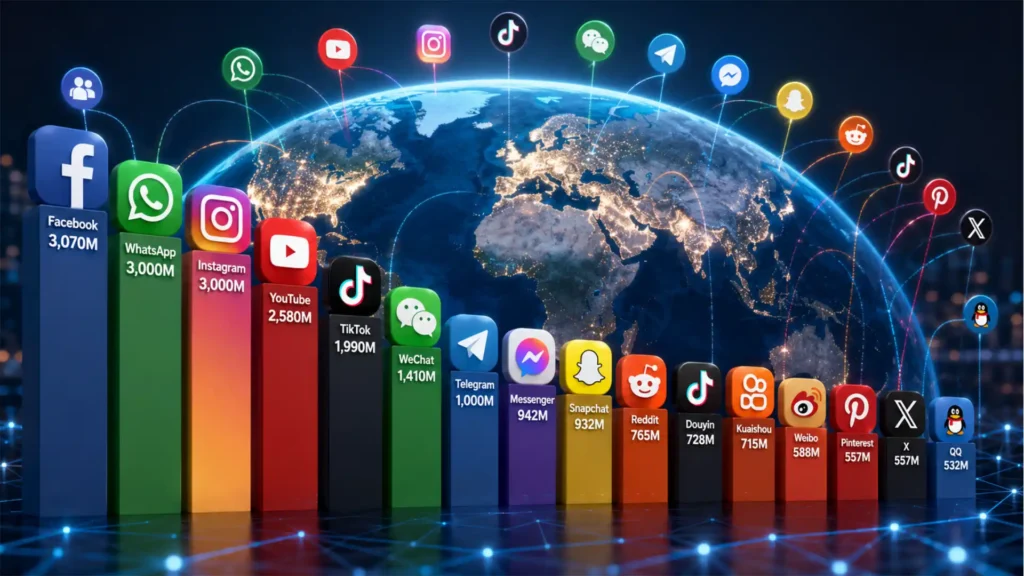
This article is an original analysis supported by the sources cited below
Most popular social networks worldwide as of October 2025, by number of monthly active users
Statista chart used as the core ranking source for platform monthly active user figures.
Digital 2026 Global Overview Report
DataReportal’s global report on internet, social media and digital behavior, published in October 2025.
Global social media statistics
DataReportal’s live global social media statistics page, used for context on user identities, platform overlap and measurement caveats.
Meta reports third quarter 2025 results
Meta’s official Q3 2025 results, including Family daily active people, revenue, ad impressions and ad pricing.
Meta CEO Zuckerberg says Instagram has grown to 3 billion monthly active users
Reuters report on Instagram reaching 3 billion monthly active users in September 2025.
WhatsApp now has more than 3 billion users a month
TechCrunch report on WhatsApp crossing 3 billion monthly users after Meta’s Q1 2025 earnings call.
Alphabet announces third quarter 2025 results
Alphabet’s official Q3 2025 earnings release, used for YouTube, Google Services and AI infrastructure context.
Thanks a billion
TikTok’s official 2021 announcement that more than 1 billion people used TikTok each month.
TikTok users top 200 million in Europe, firm says
Reuters report on TikTok passing 200 million monthly users in Europe in 2025.
Telegram founder Pavel Durov says app now has 1B users
TechCrunch report on Telegram crossing 1 billion active users in March 2025.
Reddit announces third quarter 2025 results
Reddit’s official Q3 2025 results, including daily active uniques, weekly users and revenue.
Snap Inc. announces third quarter 2025 financial results
Snap’s official Q3 2025 results, including Snapchat monthly active users, daily active users and product updates.
Tencent announces 2025 third quarter results
Tencent’s official Q3 2025 results, including Weixin and WeChat combined MAU and QQ mobile MAU.
Kuaishou Technology announces third quarter 2025 unaudited financial results
Kuaishou’s official Q3 2025 results, including MAU, DAU, time spent, AI systems and e-commerce GMV.
Weibo announces third quarter 2025 unaudited financial results
Weibo’s official Q3 2025 results, including monthly active users and daily active users.
Pinterest announces third quarter 2025 results
Pinterest’s official Q3 2025 earnings release, including 600 million global monthly active users and revenue growth.
DSA very large online platforms and search engines
European Commission explainer on very large online platforms and search engines under the Digital Services Act.
Commission designates WhatsApp as Very Large Online Platform under the Digital Services Act
European Commission announcement on WhatsApp’s DSA designation for its Channels feature.
Commission preliminarily finds TikTok and Meta in breach of transparency obligations under the Digital Services Act
European Commission press release on preliminary findings involving TikTok and Meta under the DSA.
X annual systemic risk assessment 2025
X’s Digital Services Act systemic risk assessment summary, used for context on VLOP status and EU regulatory obligations.
| Citing this article? Brief excerpts are welcome. Please credit Webiano.digital, name the author where stated, and include a link to https://webiano.digital and to this original article. Full or substantial republication requires prior written permission. Read our Copyright and Content Use Policy. |
This article was prepared with the assistance of artificial intelligence tools. The content underwent expert human review, and Webiano Digital & Marketing Agency assumes editorial responsibility for its final version and publication.