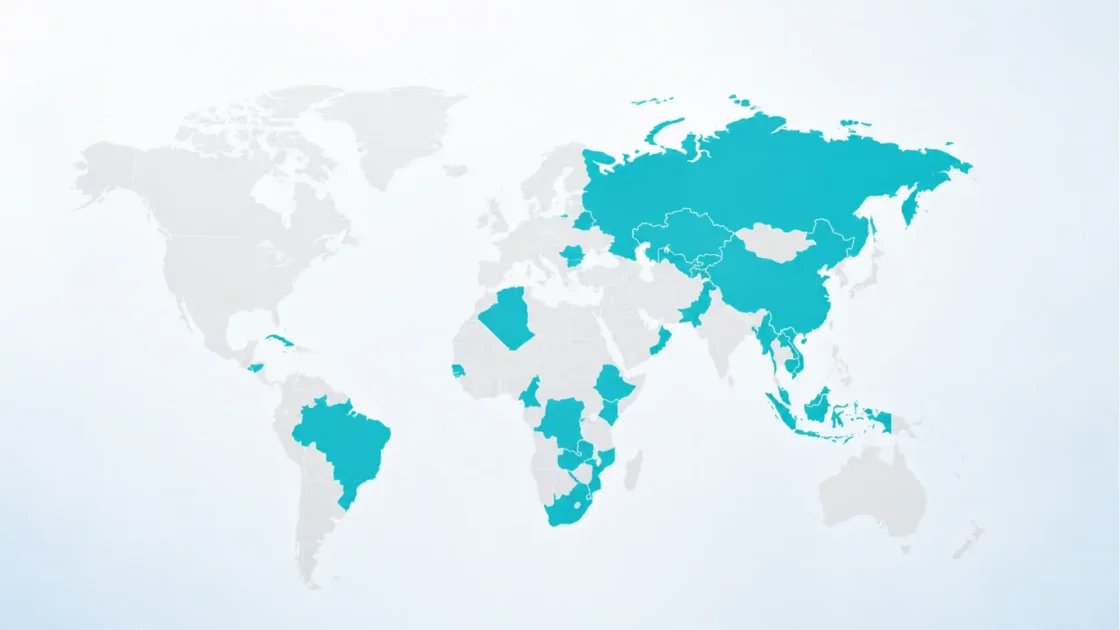
Microsoft’s May 2026 Global AI Diffusion Q1 2026 Trends and Insights report lands at a telling moment. Generative AI is no longer measured only by model launches, benchmark scores, chip orders, or venture funding. The harder question is simpler and more political: who is actually using it, in which countries, and for what kind of work? Microsoft says global AI usage reached 17.8% of the world’s working-age population in Q1 2026, up from 16.3% in the second half of 2025, while the gap between the Global North and Global South widened again.
Table of Contents
AI adoption has entered its distribution phase
The first public phase of generative AI was about novelty. ChatGPT, image generators, coding assistants, copilots, and search-style answer engines gave users a reason to test tools that had previously lived inside research labs, APIs, or enterprise pilots. The second phase was about capability. Models became more fluent, multimodal, cheaper to run, easier to embed, and more useful in daily workflows. Microsoft’s Q1 2026 report points to a third phase: distribution.
Distribution is not the same thing as invention. A country can host model labs and still lag in usage. A company can buy AI licenses and still fail to put tools into weekly work. A worker can have internet access and still avoid generative AI because it is weak in their language, too expensive, blocked by policy, or irrelevant to their job. The report’s value lies in treating adoption as a measurable social and economic signal rather than as a story told through product announcements.
Microsoft’s measure, AI User Share, tracks the share of people aged 15 to 64 who used a generative AI product during the reported period. It is derived from aggregated and anonymized Microsoft telemetry and adjusted for operating system and device-market share, internet penetration, and population. Microsoft’s GitHub repository adds that the metric is meant to reflect usage, not economic impact or model capability, and that estimates may change as the method improves.
That distinction matters. A usage metric does not prove productivity gains, learning gains, or higher wages. It shows contact with the technology. Yet contact is the starting point for every other effect. Countries with rising usage create larger user bases, more feedback, more pressure on schools and employers, more demand for local-language services, and more incentive for software vendors to build around local needs.
The global number, 17.8%, is therefore both large and early. It means generative AI has moved beyond a small expert class, but it also means more than four-fifths of the working-age population is not yet counted as a user in Microsoft’s measure. The report describes a world in which AI is already mainstream in several countries and still distant in others. That is the core news: generative AI adoption is accelerating, but the world is not converging around the same adoption curve.
The pattern also cuts against the easy assumption that frontier model ownership equals broad public use. The United States remains central to AI research, capital markets, cloud infrastructure, and product development. Yet Microsoft ranks the U.S. only 21st in Q1 2026 AI diffusion, with 31.3% working-age usage. The leaders are smaller, highly digitized, policy-active economies such as the United Arab Emirates, Singapore, Norway, Ireland, and France.
That result should not be read as U.S. weakness in AI. It should be read as proof that adoption is a different contest from invention. Model laboratories matter. Data centers matter. Chips matter. But national diffusion depends on language, institutions, schools, employers, public-sector use, trust, affordability, digital skills, and everyday relevance. Countries that treat AI as a national usage project can move faster than countries that treat it mostly as a technology sector story.
Microsoft’s new metric changes the adoption debate
AI adoption is difficult to measure because generative AI is not a single product. It appears inside search engines, office software, coding tools, customer support systems, smartphones, enterprise platforms, education apps, and standalone chatbots. Many users do not know which model they are using. Many firms do not disclose actual usage. Surveys measure self-reported behavior, while platform data measures only a slice of the market.
Microsoft’s technical paper frames this measurement problem directly. The authors describe AI User Share as a population-normalized estimate of active AI usage across 147 economies, built from anonymized Microsoft telemetry and adjusted for device access and mobile scaling. The paper also states a limitation that matters for interpretation: the metric relies on Microsoft telemetry, which can create bias related to Microsoft’s user base.
That limitation does not make the metric useless. It makes it usable with care. A cross-country telemetry-based measure has strengths that surveys often lack. It can update faster. It is less dependent on whether respondents understand the term “generative AI.” It avoids the problem of asking people to remember exact tool use. It gives policymakers a repeated signal rather than a one-off poll.
It also has weaknesses. Microsoft’s ecosystem is not equally present everywhere. Enterprise and consumer usage mix differently across countries. Device patterns vary. Some regions use local tools, open-source tools, Chinese platforms, or mobile-first products that may not be fully captured. In countries with lower Microsoft penetration, the adjustment method has to do heavier work. The metric is best treated as a strong directional indicator, not as a final census of global AI use.
The report is unusually explicit about that point. Microsoft says no single metric fully captures adoption and that the dataset should be read beside complementary indicators. This is not a footnote for specialists. It should shape how governments, investors, and media read the rankings. A country moving from 10% to 13% should not declare victory. A country falling outside the top 25 should not assume failure. The signal is most useful when paired with data on connectivity, education, firm deployment, public services, language support, and labor-market change.
The AI User Share concept also helps separate three questions that are often merged. The first is access: can people reach digital tools? The second is use: are people actually using generative AI? The third is benefit: does usage improve work, learning, public services, or income? Microsoft’s report mainly measures the second. It uses infrastructure and skills data to explain why the second varies. It does not prove the third.
That boundary is healthy. AI policy has been crowded with claims about future economic gains; a usage metric forces attention back to present behavior. If people are not using the tools, productivity claims are theoretical. If people are using them unevenly, productivity gains will also land unevenly. If adoption is growing fastest where electricity, internet, digital skills, and language support are already strong, AI may deepen older divides unless policy changes the underlying conditions.
The metric’s other benefit is semantic clarity. “AI adoption” can mean enterprise pilots, individual chatbot use, developer activity, model API calls, cloud spending, or installed software seats. Microsoft defines diffusion as a share of the working-age population using generative AI during a period. That makes it more comparable across economies, even if it remains imperfect. The clearer definition gives the debate a firmer base.
The headline number is strong, but the split matters more
Microsoft’s global figure moved from 16.3% in H2 2025 to 17.8% in Q1 2026. A 1.5 percentage-point rise in a single quarter is a sizable move for a technology that already had hundreds of millions of users. Yet the more revealing number is the regional split. The Global North reached 27.5% usage, up from 24.7%. The Global South reached 15.4%, up from 14.1%. The gap widened from 10.6 to 12.1 percentage points.
This is the most policy-sensitive finding in the report. AI is spreading almost everywhere, but faster in places that already have stronger digital foundations. That pattern is familiar from earlier technology waves, but generative AI raises the stakes because it may shape education, software creation, research, customer service, language translation, government administration, and small-business productivity at the same time.
The report links the North-South gap to infrastructure and skills. It cites electricity access, internet access, and basic digital skills as limiting factors for the Global South. The broader data supports that reading. ITU estimated in 2024 that 5.5 billion people were online, equal to 68% of the world population, while 2.6 billion people remained offline. Internet use was 93% in high-income countries but only 27% in low-income countries.
Electricity is still a binding constraint. Our World in Data’s electricity access dataset defines basic electricity access as enough supply for lighting, phone charging, or powering a radio for four hours a day, and notes that many African countries still lack even that basic access for large shares of the population.
Digital skills add a third layer. ITU’s SDG-related ICT indicators show that even among internet users, skill levels vary by domain: communication and collaboration are most common, followed by information and data literacy, problem solving, digital content creation, and safety.
The result is a stack of prerequisites. Generative AI adoption requires more than model access. It requires power, connectivity, devices, language coverage, payment access, trust, workplace permission, and enough digital fluency to know what to ask. A chatbot does not erase the need for a broadband connection. A coding agent does not matter to a school without reliable computers. A multilingual model does not reach workers who cannot afford data.
The widening gap also complicates the idea that AI will automatically democratize expertise. Better models may reduce some knowledge barriers, but they do not remove physical and institutional barriers. A rural student with unstable electricity and weak internet cannot use AI tutoring in the same way as a student with a laptop, fiber connection, and school approval. A small firm with no digital records cannot gain the same benefit from AI automation as a firm with clean databases and cloud-based workflows.
This is not a reason to dismiss generative AI as an elite technology. It is a reason to treat infrastructure policy as AI policy. The countries that close connectivity and skills gaps will not merely improve internet statistics. They will improve their ability to absorb every AI tool that rides on top of the internet.
National leaders are treating AI as a public adoption project
The Q1 2026 leaderboard is striking because the top countries are not simply the largest AI research powers. The United Arab Emirates leads with 70.1% working-age AI usage. Singapore follows at 63.4%. Norway, Ireland, and France are clustered near the high 40s. Spain, New Zealand, the United Kingdom, the Netherlands, and Qatar complete the top ten.
These countries differ in size, language, industry mix, and political systems, but they share several traits. They have high connectivity, strong public-sector digitization, relatively high income, and visible national AI strategies. They also have governments willing to frame AI as a whole-economy capability rather than a niche product category.
The UAE is the most obvious case. Its National Strategy for Artificial Intelligence 2031 sets out a goal of becoming one of the leading AI nations by 2031. The official UAE strategy page says the strategy aims to support the objectives of UAE Centennial 2071 and improve government performance.
Singapore has pursued a similar adoption-first stance. Its National AI Strategy 2.0 was launched in December 2023, and the government later created a National AI Council chaired by Prime Minister Lawrence Wong in February 2026, according to Singapore’s Smart Nation materials. Singapore also announced more than S$1 billion in AI research and development investment over five years from 2025 to 2030.
Those national strategies do not fully explain the rankings. Culture, language, wealth, product availability, cloud infrastructure, mobile usage, and labor-market structure all matter. Yet policy changes the adoption environment. It gives schools permission to experiment. It encourages ministries to buy or build tools. It sends employers a signal that AI use is not marginal. It also creates demand for skills programs, public guidelines, and procurement rules.
The lesson from the leaders is not that every country should copy the UAE or Singapore. The lesson is that adoption rises faster when AI becomes part of national administration, education, and business practice rather than a tool left to individual curiosity.
That is also why the United States ranking deserves careful reading. The U.S. has the dominant AI platforms, model labs, chip customers, cloud providers, startup ecosystem, and research universities. Yet Microsoft reports U.S. usage at 31.3%, behind many smaller economies. The U.S. is not short of AI supply. It is dealing with a fragmented adoption environment: states, school districts, agencies, enterprises, unions, and universities are moving at different speeds.
This pattern mirrors earlier technology diffusion. Countries can be early inventors and uneven adopters. The economic benefit of a technology often depends on managerial adoption, organizational redesign, training, and complementary investment. AI is now entering that old productivity bottleneck.
Leading economies in Microsoft’s Q1 2026 AI diffusion ranking
| Rank | Economy | Q1 2026 AI user share | Q1 change |
|---|---|---|---|
| 1 | United Arab Emirates | 70.1% | +6.1 |
| 2 | Singapore | 63.4% | +2.5 |
| 3 | Norway | 48.6% | +2.2 |
| 4 | Ireland | 48.4% | +3.8 |
| 5 | France | 47.8% | +3.8 |
| 6 | Spain | 44.2% | +2.4 |
| 7 | New Zealand | 43.0% | +2.5 |
| 8 | United Kingdom | 42.2% | +3.3 |
| 9 | Netherlands | 42.1% | +3.2 |
| 10 | Qatar | 41.8% | +3.5 |
This table compresses one of the report’s central signals: high diffusion is concentrated in smaller, highly connected, institutionally active economies rather than only in the countries that build frontier models. The rankings should be read as usage estimates, not as proof of model capability, industrial strength, or productivity gain.
The United States is powerful in AI supply but ordinary in usage share
The U.S. position in Microsoft’s ranking looks paradoxical at first glance. American companies dominate the frontier AI conversation. OpenAI, Anthropic, Google DeepMind, Meta, Microsoft, NVIDIA, Amazon, and many leading AI startups sit inside or closely tied to the U.S. ecosystem. The U.S. government’s 2025 AI Action Plan framed AI as a national race across innovation, infrastructure, and diplomacy.
Yet the usage share is not elite. Microsoft says the U.S. rose from 24th to 21st in Q1 2026, with 31.3% working-age usage. That is above the global average but far below the UAE, Singapore, and several European economies.
The explanation is partly mathematical. Large, diverse countries have more uneven adoption. A city like San Francisco, Seattle, Austin, Boston, or New York may look like a frontier AI economy. National averages include rural areas, older workers, non-office sectors, low-wage service roles, schools with restrictive policies, small firms with little IT support, and public agencies that move slowly. A smaller, wealthy, highly connected country can push a higher share of the population into regular use more quickly.
The U.S. also has a fragmented institutional structure. Education policy is local. Government procurement is split across federal, state, county, and municipal bodies. Health care, finance, legal services, and public administration each have their own risk rules. Employers differ sharply in whether they allow public AI tools, restrict them, or buy enterprise versions. This creates a patchwork adoption curve.
There is a second explanation: American AI supply has been heavily enterprise- and developer-oriented. The most visible U.S. AI products are widely used, but much AI value is being embedded into workflows that may not count as broad population adoption. A software engineer using Copilot is counted in one way; a warehouse worker affected by AI scheduling is not necessarily using a generative AI product. A bank analyst using an internal assistant may be counted differently from a retail worker who never touches a chatbot.
The U.S. data shows that AI leadership has two layers: building the technology and making it ordinary for the population. The United States is dominant in the first layer and uneven in the second.
That distinction will shape politics. If the public hears that AI is remaking the economy but only a minority uses it directly, fear and resentment become easier to mobilize. If AI remains concentrated in high-income occupations and technical firms, workers outside those sectors may see it mainly as a threat. Broader, safer, more useful adoption could lower that tension, but it requires training and institutional trust rather than slogans.
The U.S. still has one advantage that usage share does not capture: a deep software and startup base that can turn AI capability into new products. Microsoft’s report notes a surge in GitHub activity, and U.S.-based developers, companies, and open-source communities are deeply involved in that shift. But high supply-side strength does not remove the need for demand-side adoption. The U.S. story is not failure. It is a warning that invention alone does not guarantee diffusion.
The Global North is pulling away because the prerequisites compound
The report’s North-South gap is not a single divide. It is several divides layered on top of each other. Electricity affects device charging and network reliability. Internet access affects whether users can reach cloud AI services. Device quality affects multimodal use. Digital skills affect whether users can ask useful questions, judge output, protect privacy, and integrate AI into work. Language support affects whether the tool feels competent. Institutional support affects whether schools, firms, and governments allow use.
These prerequisites compound. A worker in a high-income country may have a smartphone, laptop, stable internet, employer access to Microsoft 365 Copilot or ChatGPT Enterprise, local-language output, online payment, and coworkers who already use AI. Each element makes the next easier. A worker in a lower-income setting may have a shared phone, prepaid data, English-only tools, weak digital skills, and no employer policy. Each missing element suppresses use.
This compounding effect explains why the gap can widen even when adoption rises everywhere. The Global South still added users in Q1 2026. Its AI user share rose to 15.4%. But the Global North gained faster, reaching 27.5%.
The same phenomenon occurred in earlier digital waves. Broadband, smartphones, cloud software, digital payments, and remote work all diffused through existing infrastructure. Wealthier countries did not merely adopt sooner; they converted adoption into institutional routines faster. Schools digitized assignments. Firms moved documents to cloud systems. Governments launched digital portals. AI now rides that accumulated base.
The most durable AI inequality may not be access to the best model. It may be access to the surrounding system that makes the model useful. A frontier model is only one input. The user also needs a use case, permission, skill, trust, and time. Without those, generative AI remains a demo.
There is also a feedback loop in product design. Vendors often improve tools around the needs of their largest and highest-paying user bases. If early adoption is concentrated in English-speaking, high-income, enterprise-heavy markets, product roadmaps may reflect those users. Better multilingual performance is starting to change that, but product-market fit still follows revenue.
Development agencies and governments should read the Microsoft report as a call to update digital policy. Connectivity programs that once aimed at web access now need to account for AI-capable usage. Digital skills programs that once taught email and spreadsheets now need to teach prompt framing, source checking, privacy judgment, and human review of model output. Public procurement rules that once covered software licenses now need to cover AI risk, model logging, data residency, and staff training.
The gap will not close through model progress alone. It will close when AI access is joined to electricity, affordable broadband, local language, public trust, and workplace routines.
Asia’s growth wave is the report’s most important regional surprise
Microsoft’s report says 12 of the 15 fastest-growing economies since June 2025 are in Asia, and each had at least 25% more AI users than in June 2025. South Korea led with a 43.2% increase in AI user share, followed by Thailand at 36.4% and Japan at 34.1%. Mongolia, Iran, Laos, Turkey, Kazakhstan, Kyrgyzstan, Uzbekistan, Vietnam, and Cambodia also appear in the fastest-growth group.
This is not a single Asian story. South Korea and Japan are advanced economies with strong digital infrastructure, major technology firms, and deep education systems. Thailand and Vietnam are fast-growing digital economies with heavy smartphone use and active consumer internet markets. Kazakhstan, Kyrgyzstan, Uzbekistan, and Mongolia have different infrastructure and language conditions. Iran, Laos, Turkey, and Cambodia each have their own constraints. The common thread is that AI is becoming more useful outside the original English-heavy adoption base.
The report attributes part of this shift to stronger local-language and multimodal capability. As models improve in Japanese, Korean, Thai, Vietnamese, Turkish, Persian, and other languages, the user’s first contact with AI changes. Instead of feeling like translated English software, the tool begins to answer questions, draft messages, summarize documents, tutor students, and support coding in a way that feels locally relevant.
Language is not just interface polish. It governs trust and cognitive load. A Japanese doctor, Korean student, Thai small-business owner, or Vietnamese developer should not need to think in English to get full value from AI. When the model handles local grammar, domain vocabulary, cultural references, documents, and images, adoption can jump because the tool finally meets users where they work.
Asia’s growth also fits the region’s mobile-first behavior. In many markets, the smartphone is the main computing device. Generative AI products that work well through mobile chat, voice, image input, camera use, and messaging-style interfaces fit naturally into daily life. The report points to smartphone adoption and digital engagement as part of the adoption story.
Asia’s AI growth wave shows that the next adoption surge will not be driven only by better models. It will be driven by models that feel native in more languages, more devices, and more routines.
The business implications are large. Consumer AI products need localization beyond translation. Enterprise products need support for local document formats, compliance regimes, business customs, and sector-specific vocabulary. Coding tools need to work with local developer communities and repositories. Education tools need to align with curricula and exam formats. Health, legal, and government tools need national context and risk controls.
For policymakers, Asia’s growth is encouraging but uneven. It proves rapid adoption is possible beyond the earliest AI markets. It also shows that the countries with the fastest percentage growth may still have low absolute usage shares. Thailand’s fast growth does not put it near the UAE or Singapore in diffusion share. Cambodia’s growth from a low base does not erase infrastructure limits. Growth rate and adoption level tell different stories.
Language is becoming a core adoption variable
The report spends unusual attention on language capability, especially in Asia and Japan. That is warranted. Generative AI first became mainstream through English-heavy products, English-heavy benchmarks, and English-speaking media coverage. Yet most of the world does not work primarily in English. A model that performs well in English but weakly in Japanese, Korean, Arabic, Hindi, Bengali, Swahili, Yoruba, or Indonesian creates a silent adoption tax.
Microsoft cites the MMMLU benchmark, a multilingual version of Massive Multitask Language Understanding covering 14 languages: Arabic, Bengali, German, Spanish, French, Hindi, Indonesian, Italian, Japanese, Korean, Portuguese, Swahili, Yoruba, and Chinese. LLM Stats describes MMMLU as professionally translated MMLU questions across those languages, with roughly 15,908 multiple-choice questions per language across 57 subjects.
Benchmarks are not everyday use. Passing a multiple-choice benchmark does not prove a model can help a nurse write a patient note, a student understand a textbook, or a civil servant summarize a regulation. Yet benchmark gaps reveal a real problem. If a model’s reasoning and factual performance degrade outside English, non-English users get a weaker product, even when they pay the same price or use the same interface.
That weakness affects trust. Users forgive occasional mistakes when a tool feels competent. They abandon tools that sound unnatural, miss local context, or fail on basic terms. In multilingual countries, the problem becomes even more complex. A user may move between English, local language, slang, and domain-specific vocabulary in one conversation. A useful AI system must follow that shift without losing accuracy.
Language also affects institutional adoption. Schools are reluctant to approve tools that perform poorly in the language of instruction. Governments cannot rely on systems that mishandle legal wording. Health providers cannot use tools that fail on medical terms. Small businesses cannot trust marketing copy or customer replies that sound foreign or awkward.
Local-language capability is not a feature at the edge of AI diffusion. It is part of the adoption infrastructure. It sits beside electricity, connectivity, devices, and skills. Without it, AI remains culturally and economically distant.
The technical progress is real. Models are improving through multilingual training, better evaluation, instruction tuning, retrieval systems, translation pipelines, and local partnerships. Japanese-specific leaderboards and evaluation suites are expanding. The Open Japanese LLM Leaderboard, for example, evaluates Japanese LLMs across 16 tasks, including natural language inference, translation, summarization, question answering, code generation, math reasoning, and human-exam tasks.
The strategic point is that language progress changes the adoption map. Countries that were previously held back by English-centric tools can move quickly when capability crosses a threshold. Japan’s Q1 2026 acceleration is the clearest example in Microsoft’s report, but it will not be the last.
Japan’s acceleration shows what happens when capability meets policy
Japan rose from 56th in H1 2025 to 48th in Q1 2026, and adoption increased 3.4 percentage points during the quarter, more than three times the global average increase in Microsoft’s report. Japan’s Q1 2026 AI user share reached 22.5%, up from 19.1% in H2 2025 and 16.7% in H1 2025.
Japan’s move is not merely a consumer chatbot story. It combines language capability, public policy, enterprise pressure, developer behavior, and demographic need. Japan has an aging workforce, productivity pressure, high education levels, strong device access, and a large base of technically sophisticated firms. For years, it also had a language barrier in AI usefulness. As models improved in Japanese, that barrier began to fall.
Microsoft points to performance gains on Japanese professional exams and standardized benchmarks. A 2023 JMIR study found GPT-3.5 scored 50.8% on a Japanese Medical Licensing Examination question set while GPT-4 scored 79.9%. A 2024 JMIR study found GPT-4o answered 373 of 400 questions correctly on the 118th Japanese Medical Licensing Examination, or 93.2%, with similar performance on text-only and image-based questions.
Medical exams are not the whole economy, and a model passing an exam does not make it safe for clinical deployment. But the signal is powerful. It shows that Japanese-language AI moved from unreliable demonstration to high-performing domain reasoning in a short period. For users, that changes perception. For institutions, it changes procurement conversations. For policymakers, it changes the cost-benefit calculation.
Japan’s policy environment is also shifting. The government’s Artificial Intelligence Basic Plan, approved under the 2025 AI Act, states a goal of promoting innovation while mitigating risks and pursuing what it calls a human-centered AI society. The plan sets out policies to accelerate AI utilization, strengthen AI development capabilities, and balance risk management with growth investment.
The Digital Agency’s GENAI project puts that policy into administrative practice. The agency says government AI will roll out an environment for generative AI use across ministries and agencies, with roughly 180,000 government employees expected to have access in fiscal 2026.
Japan’s acceleration shows the adoption effect of crossing a language-quality threshold at the same time that government begins normalizing AI use. Neither condition alone would be enough. Better Japanese models matter because workers can use them. Government policy matters because it lowers institutional hesitation.
The developer data makes the story stronger. Microsoft reports that Japanese developers uploaded 129% more code changes to GitHub year over year, compared with 78% global growth. That does not prove AI caused every extra push, but it aligns with a broader shift in coding tools, agentic workflows, and natural-language software creation.
Japan’s adoption still trails the top 25. At 22.5%, it remains below the U.S., South Korea, Taiwan, and many European economies. Yet the direction matters. Japan looks less like a laggard and more like a market that was waiting for tools good enough in its own language.
South Korea remains the clearest example of rapid mainstreaming
South Korea’s AI diffusion rose to 37.1% in Q1 2026, up from 30.7% in H2 2025 and 25.9% in H1 2025. Its Q1 change of 6.4 percentage points was one of the largest among leading economies. Microsoft’s earlier H2 2025 report described South Korea as a standout case, driven by government policies, better Korean-language frontier model capability, and consumer-facing features that resonated with the population.
The South Korean case matters because it shows how quickly national adoption can move when consumer interest, language performance, school use, workplace use, and policy support align. South Korea is highly connected, mobile-first, digitally engaged, and culturally accustomed to fast platform shifts. It also has strong local technology firms and a population that regularly adopts new digital services at scale.
The H2 2025 Microsoft report linked South Korea’s surge partly to improved Korean performance after GPT-5, and the Q1 2026 report notes that South Korea remained one of the strongest movers. The exact causal mix is hard to isolate. Model capability, media attention, pricing, local products, education use, and government programs likely reinforced one another. But the adoption curve is real.
South Korea shows that generative AI can move from curiosity to routine quickly when the product feels competent in the user’s language and appears in familiar daily channels.
For global vendors, South Korea is also a test of product localization. Korean users are demanding. They use messaging, search, gaming, education, and workplace platforms at high intensity. A tool that fails on Korean nuance, tone, search behavior, or school needs will be replaced quickly. A tool that works can scale fast.
For governments, South Korea raises a different issue: education and labor-market preparedness. Rapid diffusion creates pressure on schools to decide whether AI use is cheating, tutoring, writing support, or a basic learning skill. Employers must decide whether AI output is allowed in reports, code, customer service, and design. Regulators must handle privacy, copyright, misinformation, and workplace monitoring.
South Korea’s adoption level also complicates lazy regional labels. Asia is not uniformly behind or ahead. Singapore is near the top of the global leaderboard. South Korea is above the United States. Japan is accelerating from a lower base. Thailand is growing fast from a much lower share. Vietnam sits in the mid-20s. Cambodia remains low despite fast percentage growth. The region is not one adoption curve; it is a set of curves shaped by income, language, policy, and digital habits.
The strategic lesson from South Korea is that cultural readiness can amplify model progress. When users are already comfortable with digital platforms, a better model can spread quickly. When institutions are willing to test AI in schools and public services, adoption becomes visible. When local language quality improves, the technology stops feeling imported.
Southeast Asia is becoming an AI demand story
Southeast Asia appears in the Microsoft report through Thailand, Vietnam, Cambodia, Singapore, Indonesia, Malaysia, and the broader note that AI adoption in the region is growing faster than the global average. Microsoft cites McKinsey’s 2026 Southeast Asia work, which argues that the region is moving beyond experiments into scaled deployment. The Singapore Economic Development Board summarized the McKinsey-EDB-Tech in Asia report by saying AI adoption in Southeast Asia is outpacing the global average.
This matters because Southeast Asia has often been discussed as a market for platforms rather than as a source of AI demand in its own right. The region has hundreds of millions of mobile users, fast-growing digital finance, ecommerce, gaming, logistics, creator economies, and multilingual workforces. AI tools that lower the cost of translation, content creation, customer service, coding, marketing, analytics, and education fit many real business needs.
Singapore plays a different role from the rest of the region. It is a global AI hub, not merely a user market. It has high diffusion, research investment, government coordination, and regulatory experimentation. Its Smart Nation materials describe National AI Strategy 2.0 as an effort to use AI for public good, while the government has added major AI R&D funding and set up a National AI Council.
Thailand’s growth rate stands out. Microsoft reports a 36.4% increase in AI user share since June 2025, placing it second among the fastest-growing economies in the report. That does not mean Thailand is near the top of the leaderboard; its Q1 2026 diffusion share is 12.4%. The story is fast movement from a lower base.
Vietnam is in a different position. Microsoft reports Vietnam at 26.5% Q1 2026 AI user share, with a 3.0 percentage-point Q1 gain. That puts it above several larger economies and near some European countries. Vietnam’s software outsourcing sector, young digital workforce, and heavy mobile usage likely give AI tools a clear path into work and study.
Southeast Asia’s AI demand is practical rather than abstract: language, commerce, support, education, finance, coding, marketing, and public services. The region’s firms do not need to build frontier models to benefit from better adoption. They need tools that fit local languages, prices, devices, and workflows.
The risk is unevenness inside the region. Singapore’s diffusion level is world-leading. Cambodia’s Q1 2026 share is 5.7%. Indonesia is 14.1%. Malaysia is 21.8%. Vietnam is 26.5%. Regional averages hide very different national realities. If AI investment flows mainly to Singapore and a handful of urban hubs, the region’s internal divide will widen even as Southeast Asia as a whole becomes more visible in AI adoption data.
Multimodal AI makes adoption less dependent on typing
The report links language progress with multimodal interaction. That combination is crucial. Early generative AI was text-heavy. Users had to type prompts, read long answers, and manually move output into other tools. That favored office workers, students, developers, writers, and analysts. Multimodal AI expands the interface to images, audio, documents, screenshots, video frames, and voice.
For adoption, multimodal capability lowers friction. A user can photograph a sign, receipt, homework problem, machine part, medical document, or product shelf. A worker can ask questions about a chart. A student can use voice. A developer can show an error screen. A small merchant can generate product copy from images. A farmer can compare crop symptoms, though high-risk uses still need expert review.
The significance is strongest in mobile-first markets. Typing long prompts on a phone is tedious. Voice, image input, and camera-based workflows make AI more natural. In countries where the smartphone is the primary digital device, multimodal AI may drive adoption more than desktop copilots.
OpenAI’s 2024 GPT-4o launch helped popularize the idea of more natural multimodal interaction, and later model releases across the industry pushed toward agents that can see, read, operate tools, and produce richer output. The Japanese medical exam study cited GPT-4o’s ability to accept text, audio, images, and video input and produce text, audio, and images as a reason to test it on image-based questions.
Multimodal use also shifts which sectors feel AI first. Coding assistants affected developers early because code is text and tests provide feedback. Multimodal AI brings more service, education, fieldwork, administration, and small-business use cases into reach. It also introduces higher risk. Image interpretation, voice cloning, deepfakes, biometric inference, and medical or legal analysis require stronger guardrails.
The next adoption curve will not come only from people typing better prompts. It will come from people showing AI the world around them and asking for help in their own language.
That change affects measurement. If AI becomes embedded in cameras, operating systems, search, office tools, messaging apps, and customer service channels, users may not label it as “using generative AI.” Telemetry and product data may become more useful than surveys, but even telemetry will struggle when AI is distributed across many vendors and devices.
The business model also changes. Text chat can be priced by subscriptions or tokens. Multimodal workflows consume more compute and require more integration. Vendors must decide which markets can afford premium multimodal features. If richer interaction remains expensive, it could deepen adoption gaps. If cheaper models and on-device inference spread, multimodal AI could broaden access.
This is why infrastructure and model efficiency matter for inclusion. A tool that requires high bandwidth, new phones, and expensive subscriptions will not close the Global South gap. A tool that runs well on common devices, handles local languages, and tolerates weak networks has a better chance.
Coding is the clearest near-term economic signal
Microsoft’s report identifies software development as the clearest near-term economic signal from AI diffusion. Git pushes on GitHub increased 78% year over year globally in Q1 2026. New Git repositories increased 45% from Q1 2025, reaching 21.3 million new repositories. Merged pull requests associated with AI coding agents grew more than 28 times since June 2025, reaching 2.3 million in March 2026.
These numbers need careful interpretation. GitHub activity is not the whole software economy. A Git push is not the same as production-quality code. More repositories do not always mean more useful software. AI can generate junk, duplicates, tests, experiments, prototypes, and abandoned projects. Still, the direction is hard to ignore. Software creation is becoming faster, cheaper, and more accessible.
The technical reason is straightforward. Coding has properties that fit current AI systems better than many white-collar tasks. Code is structured text. Errors can be tested. Repositories contain context. Version control tracks changes. Build systems and test suites provide feedback. Developers already work with tools, logs, terminals, documentation, and issue trackers. AI agents can enter that workflow.
OpenAI’s GPT-5.1-Codex-Max release described a model built for long-running, detailed work across multiple context windows through compaction, able to handle project-scale refactors and multi-hour agent loops. OpenAI’s GPT-5.3-Codex release claimed stronger performance on SWE-Bench Pro, Terminal-Bench, OSWorld, and GDPval for coding and agentic tasks.
Anthropic’s Claude Opus 4.5 release also focused heavily on coding, agents, and computer use, with Claude Opus 4.6 later emphasizing longer agentic tasks, larger codebases, code review, debugging, and a beta 1 million-token context window.
GitHub’s own tooling has moved from autocomplete toward agents. GitHub introduced a coding agent for Copilot at Microsoft Build 2025, and by September 2025 the Copilot coding agent was generally available for paid Copilot subscribers. GitHub Docs says Copilot cloud agent can research a repository, create a plan, make code changes on a branch, and create a pull request for review.
Software is where AI has already moved from assistance to delegated work. That does not mean human developers vanish. It means the unit of work changes. Instead of writing every line, developers increasingly specify intent, review diffs, run tests, manage agents, and decide what should ship.
This is also why coding is the first labor-market battleground. The same tools that raise developer productivity also automate some routine programming tasks. The question is whether cheaper software creation expands demand enough to absorb and redirect labor. Microsoft’s report leans toward cautious optimism for now, citing rising software developer employment. But the long-run answer depends on demand elasticity, training pipelines, and how firms reorganize work.
Agentic coding changes the economics of software creation
Autocomplete changed the speed of writing code. Agentic coding changes the structure of software work. An autocomplete system suggests a line or function inside a developer’s current context. A coding agent can inspect a repository, plan changes, edit multiple files, run tests, fix errors, open a pull request, and respond to review comments. That shifts AI from a writing assistant to a workflow participant.
OpenAI’s Codex app announcement framed the product as a command center for agents, where developers supervise multiple agents across design, building, shipping, and maintenance. The announcement says developers are moving toward orchestrating agents across projects, delegating work, running tasks in parallel, and trusting agents to handle projects that span hours, days, or weeks.
GitHub’s Copilot cloud agent similarly moves work from the local editor into GitHub’s tracked collaboration layer. GitHub Docs contrasts IDE assistants with cloud agents: the agent can work in a GitHub Actions-powered environment, research a repo, create a plan, make changes on a branch, and optionally open a pull request. The advantage is transparency. The work appears in commits, logs, diffs, and review threads.
This matters because software development is not just code writing. It includes planning, requirements interpretation, dependency management, testing, security review, documentation, deployment, and coordination. AI agents are entering the parts of the process that used to require a human to move between tools. That is the economic change.
When agents handle the glue work around code, the cost of experimenting falls. Teams can test more ideas, build internal tools that were previously too expensive, update old systems, write more tests, translate prototypes into production, and maintain code that would otherwise decay. Small teams can attempt projects that required larger teams. Non-developers can prototype software through natural language, even though expert review remains necessary.
There are risks. More generated code can mean more vulnerabilities. Pull requests can multiply beyond review capacity. Agents may produce code that passes tests but violates architecture, licensing rules, accessibility standards, or security norms. Developers may trust agents too much, especially under deadline pressure. Firms may mistake output volume for product quality.
The best organizations will respond by redesigning review, testing, and governance. They will invest in automated tests, secure development pipelines, code owners, dependency scanning, model logs, and clear rules for human approval. They will also train developers to become better spec writers and reviewers. In agentic coding, the value shifts toward asking the right task, setting boundaries, verifying behavior, and deciding whether the result belongs in production.
The worst organizations will flood repositories with weak code and call it productivity. Microsoft’s GitHub metrics show activity. They do not guarantee quality. The next question for the industry is not whether code volume rises. It is whether maintainable, secure, useful software rises with it.
The employment signal is more complicated than the fear narrative
AI coding tools are often discussed as a direct threat to software jobs. That fear is not irrational. Tools that write, test, debug, and refactor code do automate parts of programming work. Entry-level tasks, boilerplate, simple bug fixes, test generation, documentation updates, and routine migration work are all exposed. Yet Microsoft’s report says early evidence is consistent with a different possibility: higher productivity lowers the cost of software, which increases demand for software output and keeps demand for developers strong.
The report says total U.S. software developer employment reached roughly 2.2 million in 2025, up 8.5% year over year, and early BLS data showed March 2026 employment about 4% higher than March 2025. Microsoft cites the Bureau of Labor Statistics Current Population Survey for that employment signal.
BLS occupational projections also remain positive. The Occupational Outlook Handbook projects employment of software developers, quality assurance analysts, and testers to grow 15% from 2024 to 2034, with about 129,200 openings per year on average. BLS says demand is expected to be strong due to software development for AI, IoT, robotics, automation, cybersecurity, and products that increasingly use software.
That does not settle the issue. Projections can miss turning points. Labor categories blur. Computer programmers, software developers, QA analysts, data engineers, and AI engineers face different pressures. Demand may grow for experienced developers while shrinking entry-level opportunities. Firms may hire fewer junior workers if agents handle basic tasks. Wages may polarize. Work may move from coding to product thinking, architecture, testing, security, and agent supervision.
The strongest reading is not that AI coding is harmless. It is that productivity gains do not automatically reduce developer employment when demand for software is large and elastic.
Elastic demand is plausible in software because the backlog is nearly endless. Every firm wants internal tools, dashboards, integrations, automations, customer portals, compliance systems, AI features, data pipelines, and mobile experiences. Many of those projects were never built because software teams were too expensive or too busy. If AI lowers development cost, more projects become worth doing.
Yet the distribution of work will change. A developer who only translates simple tickets into boilerplate code is more exposed. A developer who understands systems, users, security, data, and business goals becomes more valuable. A junior worker who used to learn through simple tasks may need a new apprenticeship path. Companies cannot remove entry-level work and then expect experienced talent to appear later.
The education system must adapt. Students need to learn fundamentals deeply enough to catch AI mistakes. They also need to learn how to use agents without surrendering judgment. Code review, testing, architecture, threat modeling, and product reasoning become more central. The developer labor market is not disappearing. It is being re-tiered.
The quality problem will follow the quantity boom
A 78% jump in Git pushes and a 45% rise in new repositories sound like a production boom. But software history warns that output volume can create debt. More code means more dependencies, more attack surface, more maintenance, more documentation burden, and more review work. AI coding agents make it easier to create software; they do not automatically make software easier to own.
Every organization adopting coding agents faces a quality bottleneck. Agents can generate tests, but tests may be shallow. Agents can fix bugs, but fixes may be local patches that ignore system design. Agents can refactor, but refactors can break hidden assumptions. Agents can update dependencies, but they may miss licensing or compatibility issues. Agents can write documentation, but documentation may describe intended behavior rather than actual behavior.
This is where the human role becomes sharper. Developers must define acceptance criteria, maintain architecture, enforce security rules, and judge tradeoffs. Managers must resist measuring AI productivity only by commits, pull requests, or story points. Security teams must integrate AI-generated code into threat modeling. Legal teams must track license and provenance concerns. Product teams must make sure more features do not dilute user experience.
NIST’s AI Risk Management Framework, released in January 2023, and its July 2024 profile for generative AI provide a broader model for risk management. NIST says the AI RMF was developed through an open process and that the generative AI profile identifies risks and actions for managing them.
The same mindset belongs in software teams. AI-generated code should be governed as a risk-bearing output, not as a magical productivity gift. That does not require panic. It requires traceability, testing, review, and accountability.
The next software advantage will belong to teams that combine agent speed with engineering discipline. A team that ships more code without better review will eventually slow down under its own defects. A team that uses agents to write tests, modernize old systems, improve documentation, and automate review may compound quality as well as speed.
OpenAI’s own Codex release warns that developers should review agent work before deploying to production and that internet or web search access can introduce prompt-injection risks from untrusted content.
That warning is not limited to OpenAI’s tools. Any agent with repository access, terminal access, web access, secrets, or deployment rights creates a new operational risk. The more autonomous the agent, the more important the control plane. Permissions, sandboxing, audit logs, and human approvals become basic engineering infrastructure.
The code boom is real. The quality reckoning is next.
AI diffusion is becoming a governance problem, not only a market trend
As generative AI usage spreads, governments are no longer deciding whether AI matters. They are deciding how to govern adoption without freezing it. Microsoft’s report shows diffusion moving faster in countries with strong digital foundations and public strategies. That raises a policy question: which rules speed safe adoption, and which rules slow it without reducing harm?
The European Union has chosen a risk-based legal framework. The AI Act entered into force on August 1, 2024, and the European Commission says it becomes fully applicable on August 2, 2026, with some provisions applying earlier. Rules for prohibited practices and AI literacy applied from February 2025, while governance rules and obligations for general-purpose AI models became applicable from August 2025.
The EU has also developed a General-Purpose AI Code of Practice. The Commission says the code details rules for providers of general-purpose AI models, including transparency, copyright, and risk mitigation for models with systemic risks.
The United States has moved in a different direction under its 2025 AI Action Plan, which identified more than 90 federal policy actions across accelerating innovation, building AI infrastructure, and international diplomacy and security. The White House framed the plan as a strategy for U.S. AI leadership and included policies on AI exports, data centers, removing federal barriers, and procurement rules.
Japan’s approach is another variant. Its Artificial Intelligence Basic Plan emphasizes promoting innovation while mitigating risks, an agile policy cycle, and integrated domestic and international policy.
These approaches reflect different political economies. Europe stresses rights, transparency, and product-risk classification. The U.S. stresses innovation, infrastructure, and global competition. Japan stresses adoption, trust, and industrial revitalization. Singapore and the UAE stress national coordination, public-sector use, and economic positioning.
AI diffusion turns governance into an adoption variable. Rules shape whether schools approve tools, whether firms buy enterprise licenses, whether startups can deploy models, whether public agencies experiment, whether citizens trust AI systems, and whether vendors localize products.
Bad governance can slow useful adoption or leave harm unmanaged. Weak governance can produce scandals that damage public trust. Strong governance should make safe use easier, not merely punish bad use after the fact. The practical goal is not maximum regulation or minimum regulation. It is a credible system that lets ordinary institutions use AI without guessing their way through risk.
The report’s map is also a map of institutional confidence
AI adoption depends on confidence. Users must believe the tool is useful. Employers must believe the benefits outweigh risks. Governments must believe public servants can use AI without leaking data, violating law, or creating biased decisions. Schools must believe AI can support learning without collapsing assessment. Developers must believe agents will save time after review costs.
The leading countries in Microsoft’s report tend to have high institutional capacity. That does not mean they have solved AI risk. It means they have the administrative ability to set rules, build platforms, train staff, and adjust policy. The UAE and Singapore are especially visible because the state can coordinate across ministries and public programs. European leaders benefit from high connectivity, education, and institutional trust, even where regulation is heavier.
The Global South gap reflects weaker digital foundations, but also weaker institutional pathways for adoption. A small business may know AI exists but lack training. A ministry may want AI but lack procurement rules. A university may face plagiarism concerns but lack assessment redesign. A health system may see use cases but lack data governance. A teacher may want tutoring tools but lack devices or approved platforms.
Confidence is built through boring systems: procurement, training, audit trails, local examples, data rules, and clear responsibility. Those systems rarely make headlines. They determine whether AI use becomes routine.
This is where public-sector adoption can matter even when government is not the largest technology user. If civil servants use AI safely for document search, translation, drafting, legal research, and citizen-service support, the public sees AI as an administrative tool rather than only a private-sector disruption. Japan’s GENAI rollout is relevant for that reason. It creates a controlled environment for government use rather than leaving each office to improvise.
Enterprise adoption follows a similar path. Companies move faster when they have approved tools, data classification rules, internal training, secure model access, and clear review standards. Without those, workers may either avoid AI or use unsanctioned tools. Both outcomes create problems: low adoption or hidden risk.
The Microsoft report does not measure institutional confidence directly. But the adoption rankings reveal its effects. High diffusion countries have made AI easier to try, easier to trust, or harder to ignore. Low diffusion countries often lack the infrastructure and institutions that convert curiosity into daily use.
AI adoption will not mean the same thing in every sector
A national AI user share hides sector differences. A student asking for homework help, a software engineer using a coding agent, a lawyer summarizing case law, a nurse drafting patient instructions, a marketer generating campaign variants, a civil servant searching policy documents, and a factory manager querying maintenance logs are all “AI users” in a broad sense. Their economic and social implications differ.
Software development is already showing measurable output changes. Education is showing widespread student use but unresolved assessment problems. Customer service is seeing automation and agent-assist systems. Marketing and media are seeing content generation, search disruption, and copyright disputes. Health care is cautiously testing documentation, triage support, imaging assistance, and research workflows. Government is testing drafting, translation, legal research, and citizen-service support.
The adoption curve depends on risk. Low-risk drafting and brainstorming spread faster. High-stakes decisions require validation, auditability, and professional accountability. A small business can use AI to draft social posts with little formal review. A hospital cannot use AI to diagnose without clinical governance. A bank cannot use AI in credit decisions without fairness, explainability, and compliance controls. A court cannot use AI-generated legal reasoning without accountability.
AI diffusion is broad, but trustworthy deployment is sector-specific. That is why usage metrics need interpretation. High national usage may include many low-stakes tasks. Lower usage in a heavily regulated sector may reflect caution rather than backwardness.
The business impact also differs. In software, AI can lower production cost. In education, it can personalize support but weaken traditional assessment. In legal work, it can reduce research time but create hallucination risk. In health care, it can reduce documentation burden but raises safety and liability questions. In government, it can speed administrative work but risks opaque decisions and privacy breaches.
This sectoral variation should shape policy. A single national adoption target is less useful than sector-specific maturity plans. Schools need assessment redesign. Developers need secure coding practices. Health systems need clinical validation and data governance. Public agencies need procurement and audit rules. Small firms need training and affordable tools. National AI diffusion rises when sector pathways are clear.
Microsoft’s report gives the macro signal. The next layer of analysis needs sector-level adoption quality.
The Global South needs AI infrastructure, not only AI access
Giving people access to a chatbot is not the same as giving them AI capacity. The Global South gap in Microsoft’s report should push policymakers away from tool-only thinking. A subsidized AI account will not matter much without electricity, broadband, devices, skills, local language, and relevant use cases.
The most urgent foundation remains connectivity. ITU’s 2024 figures show a world where one-third of the population remained offline, with low-income countries far below high-income countries in internet use.
Electricity access remains equally basic. Our World in Data describes access to electricity as the ability to use basic lighting, charge a phone, or power a radio for four hours per day, and notes large gaps in several African countries.
Digital skills then determine whether connectivity turns into productive use. ITU’s ICT skills indicators show uneven skills even among internet users, especially in content creation, safety, and problem solving.
For lower-adoption countries, AI policy starts before AI. It starts with power, networks, devices, schools, and digital public infrastructure.
Digital public infrastructure is especially relevant. Countries with digital IDs, payment systems, interoperable data, government service portals, and cloud-ready agencies have more places to embed AI safely. Countries with paper records and fragmented systems will struggle. AI cannot summarize documents that have not been digitized. It cannot automate workflows that exist only in informal processes. It cannot personalize public services without reliable data governance.
Local-language datasets and evaluation also matter. If a country’s languages are underrepresented in training data and benchmarks, model quality will lag. Governments, universities, and civil-society organizations can support open datasets, terminology resources, speech corpora, translation benchmarks, and local evaluation. This is not only a technical project; it is cultural infrastructure.
Affordability is another barrier. Generative AI subscriptions, API costs, data charges, and device upgrades can price out users. Cheaper models, open models, public access points, school licensing, and mobile-optimized services can broaden use. Yet low price without quality will not drive lasting adoption. Users need tools that solve real problems.
The Global South should not be treated only as a recipient of AI products. Local firms, universities, and public agencies can build applications for agriculture, health, education, local commerce, public translation, climate adaptation, and small-business operations. The adoption gap will close faster when AI use is tied to local needs rather than imported demos.
Benchmarks are shaping diffusion, but they can mislead
The report uses benchmark progress to explain adoption, especially language progress. Benchmarks are useful because they give model developers and researchers a shared signal. MMMLU, MMLU-Pro, SWE-Bench, Terminal-Bench, OSWorld, and Japanese exam benchmarks all reveal pieces of capability. They also shape marketing, investment, procurement, and user trust.
But benchmarks are not reality. They test defined tasks under defined conditions. Real users ask messy questions, mix languages, provide incomplete context, expect judgment, and operate under time pressure. A model can score well on a benchmark and still fail in a hospital, law office, classroom, or factory. A model can score lower on a benchmark and still be better for a specific workflow because it is cheaper, faster, more private, or easier to integrate.
Medical exam benchmarks show both the power and the danger. GPT-4o’s 93.2% performance on the Japanese Medical Licensing Examination is impressive. The same study still identified clinical judgment errors and prioritization issues.
Coding benchmarks have similar limits. SWE-Bench and Terminal-Bench measure valuable skills, but production development includes architecture, product intent, long-term maintainability, team conventions, security, and user impact. An agent that wins a benchmark may still produce code that a team should not merge.
Benchmarks are adoption accelerants because they create confidence, but they are weak substitutes for local validation.
Governments and enterprises should use benchmarks as screening tools, not as final purchasing decisions. The real test is whether a system works on local documents, local languages, local laws, local workflows, and local risk levels. For Japanese adoption, the combination of professional exam performance, Japanese MMLU gains, local leaderboards, and government pilots is more persuasive than any one score.
The benchmark economy also creates incentives for model developers. If the most visible benchmarks are English-heavy, models will optimize toward English-heavy tasks. Multilingual benchmarks such as MMMLU push the field toward broader performance. Sector-specific benchmarks push toward professional utility. Safety benchmarks push toward more reliable behavior. Measurement shapes product direction.
For AI diffusion, the benchmark that matters most is lived usefulness. Users return when the tool saves time, improves output, teaches something, catches an error, or makes a hard task easier. No benchmark can fully capture that.
The report underplays China because measurement is complicated
China appears in Microsoft’s data at 16.4% Q1 2026 AI user share, barely above its H2 2025 level of 16.3%. That number should be read with caution. China has a large domestic AI ecosystem, different platform patterns, different cloud and mobile ecosystems, and widespread local alternatives. A Microsoft telemetry-based measure may not fully capture the Chinese AI market.
The same caution applies to countries where Microsoft’s consumer or enterprise presence differs sharply from local digital behavior. Microsoft’s technical paper acknowledges the possible bias of relying solely on Microsoft telemetry.
This does not mean China’s figure is meaningless. It means cross-country rankings should be interpreted through the measurement lens. For countries heavily using domestic platforms, open-source deployments, or mobile ecosystems outside Microsoft’s view, reported diffusion may understate actual use. For countries deeply integrated into Microsoft software, the measure may be stronger.
AI diffusion measurement is becoming geopolitical. Whoever measures adoption influences how the world sees AI leadership.
China’s AI adoption story cannot be reduced to one number. It includes domestic models, government policy, enterprise deployment, hardware constraints, censorship rules, open-source competition, mobile super-app integration, and global export ambitions. The same is true for India, where English and local-language markets coexist, mobile usage is massive, and AI adoption may appear differently depending on the tool measured.
Microsoft’s dataset is valuable because it provides a repeated, public, population-normalized signal. It should encourage more measurement, not become the only scoreboard. Ideally, AI diffusion analysis would combine telemetry from multiple ecosystems, independent surveys, enterprise adoption data, education data, open-source activity, API usage, mobile app usage, and public-sector deployment.
The measurement issue also affects policy incentives. Countries may seek to climb adoption rankings, but a ranking can be gamed or misunderstood. A better goal is not simply more AI use. It is more useful, safe, inclusive AI use. A country with modest usage but strong governance may be better positioned than a country with high casual usage and weak safeguards.
Still, Microsoft has advanced the debate by giving AI diffusion a sharper empirical frame. The next stage should bring more plural data sources.
AI adoption is beginning to affect national competitiveness
Generative AI adoption is becoming part of national competitiveness because it affects speed of work, learning, software creation, public administration, translation, and business experimentation. The countries that use AI widely and well may move faster in service delivery, firm creation, education support, and digital exports. The countries that lag may not only use fewer AI tools; they may produce fewer AI-shaped institutions.
This does not mean high usage automatically creates growth. A country can have high chatbot use with little productive impact. Students may use AI badly. Workers may generate low-quality content. Firms may adopt tools without redesigning processes. Governments may deploy pilots that never scale. Usage is a prerequisite, not a guarantee.
Yet low usage creates a ceiling. Firms cannot gain productivity from tools they do not use. Workers cannot develop AI literacy without practice. Governments cannot learn procurement lessons without controlled deployment. Schools cannot redesign assessment around a tool students never touch. Adoption is the training ground for capability.
The Microsoft report therefore matters for economic ministries, not only technology ministries. A finance ministry should care if national AI diffusion is low because it may signal slower productivity absorption. An education ministry should care because student and teacher use will shape skills. A labor ministry should care because AI changes tasks before it changes occupations. A foreign ministry should care because AI tools are becoming part of soft power, standards, and trade.
The competitive question is also sector-specific. A country with high coding-agent adoption may produce more software startups and internal automation. A country with high AI adoption in education may support reskilling faster, if assessment and pedagogy are handled well. A country with high public-sector AI adoption may reduce administrative backlogs. A country with strong local-language AI may expand digital inclusion.
The risk is that diffusion becomes another layer of advantage for already advanced economies. If high-income countries adopt AI faster, improve productivity, build more software, train workers sooner, and attract AI firms, the gap widens. That is the central tension in Microsoft’s report: AI is spreading, but it is spreading along existing lines of capacity.
National competitiveness will not be decided by one leaderboard. It will be decided by whether countries turn usage into institutional learning.
The business impact is shifting from pilots to workflow redesign
For companies, Microsoft’s report supports a practical conclusion: AI adoption is no longer a side experiment. In leading economies, a large share of the working-age population already uses generative AI. In software teams, agentic workflows are producing measurable changes in code activity. In Asia, local-language improvements are expanding demand. The business question is no longer whether employees will encounter AI. They already do.
The next question is whether companies manage that use. Many workers adopted generative AI before employers had policies. Some use approved enterprise tools. Some paste work into public chatbots. Some avoid AI because rules are unclear. Some rely too much on outputs they cannot verify. This mixed behavior creates hidden risk and lost value.
The companies that gain most from AI will not be those with the most licenses. They will be those that redesign workflows around human judgment, model capability, and clear accountability.
Workflow redesign starts with task mapping. Which tasks are safe for drafting? Which require human review? Which require private data? Which need retrieval from internal documents? Which need audit logs? Which should never be delegated? Which outputs need sampling or approval? Which employees need training first?
The answer differs by function. Marketing may use AI for drafts and variants. Legal may use it for research support but require citation checks. Finance may use it for reconciliation assistance but restrict data. Engineering may use agents for tests and bug fixes but require code review. HR may use AI for internal knowledge search but avoid sensitive automated decisions. Customer support may use AI to assist agents but escalate high-risk cases.
Companies also need metrics that go beyond usage. Good metrics include time saved after review, defect rates, customer satisfaction, cycle time, employee adoption by function, policy violations, hallucination incidents, and quality of outputs. Bad metrics include raw prompts submitted, AI-generated words, or pull request counts without quality controls.
The report’s GitHub data is a warning for business leaders. Output will rise. Review capacity, governance, and quality systems must rise with it. Firms that treat AI as a headcount-cutting lever may miss the larger opportunity: building more internal software, improving documentation, speeding analysis, and giving workers better tools.
AI adoption is not a software rollout. It is an operating model change.
Education is the adoption arena with the longest consequences
The report does not focus heavily on education, but education sits behind every adoption curve. Students are often fast adopters of generative AI. Teachers and institutions are slower because they must protect learning, assessment, privacy, and fairness. This mismatch creates tension. A country’s future AI capability will depend on whether schools teach students to use AI critically rather than pretend it does not exist.
High-diffusion countries face this issue first. If 30%, 40%, or 60% of the working-age population is using AI, students are almost certainly using it too. Bans may work in narrow exam settings, but broad bans are hard to sustain. The better question is which uses support learning and which uses replace thinking.
AI can tutor, explain, translate, quiz, draft feedback, support accessibility, and help teachers prepare materials. It can also generate essays, solve assignments, fabricate sources, and hide skill gaps. The difference lies in pedagogy and assessment design. Oral exams, in-class writing, process logs, project work, source defense, and AI-use disclosure can reduce cheating while preserving useful support.
Education systems that teach AI judgment will produce workers who can use AI safely. Systems that rely only on bans will push use underground.
Language matters again. In countries where local-language AI has improved, students can use tools more naturally. Japan’s exam-performance gains show that AI can now handle advanced Japanese-language content far better than earlier systems. That creates opportunity for tutoring and exam preparation, but also new academic integrity problems.
Teacher training is the bottleneck. Students may experiment faster than teachers can redesign coursework. Ministries and school districts need approved tools, privacy rules, examples of good assignments, and guidance for assessment. Universities need discipline-specific policies rather than generic AI statements. Computer science departments need to teach coding with agents. Writing programs need to teach revision, argument, and source evaluation in an AI-rich environment.
The long-term labor-market impact depends on this. Workers who learn to use AI as a thinking partner, reviewer, simulator, and tutor may adapt faster. Workers who only learn to outsource tasks may become dependent and less skilled. The difference is not the tool. It is how the tool is taught.
Public-sector adoption could narrow or widen trust
Governments are large producers and consumers of information. They process applications, write policy, answer citizens, translate documents, inspect compliance, draft memos, manage procurement, and search legal materials. Generative AI fits many administrative tasks. That is why Japan’s GENAI rollout and Singapore’s AI strategy matter.
Public-sector AI adoption has a trust premium. Citizens may tolerate a private chatbot mistake more than a government mistake. An AI-generated error in a benefits decision, immigration process, tax notice, or legal response can harm people and damage trust. Public agencies therefore need stronger controls than casual users.
At the same time, public-sector underuse has costs. Slow administration, backlogs, translation gaps, inaccessible forms, and poor citizen service also harm people. AI can reduce some of those burdens if used in controlled settings. Drafting, summarization, internal search, translation support, and call-center assistance are plausible starting points. Automated eligibility decisions and enforcement actions require much stricter oversight.
Government AI should begin where human accountability remains clear and the cost of delay is high. That means AI can support civil servants, but it should not quietly replace accountable decision-makers in high-stakes contexts.
Japan’s Digital Agency describes GENAI as a safe environment for government employees and links it to the AI Act and Artificial Intelligence Basic Plan. It also says the project includes domestic LLM trials, common government datasets, and technical support for ministries and agencies.
That architecture is useful. A central platform can reduce shadow AI use, improve security, create reusable tools, and gather lessons across ministries. It can also support local model development and government datasets. Other countries may not copy Japan’s exact approach, but the principle is transferable: public-sector AI should be managed through shared infrastructure rather than scattered experiments.
Trust also depends on disclosure. Citizens should know when AI is used in public communication or decision support, especially when outputs affect rights or benefits. Agencies should log model use, retain human review, and publish risk assessments for high-impact systems. Public procurement should demand auditability, data protection, and clear liability.
The public sector can either normalize safe AI use or create scandals that set adoption back. The difference will be governance.
The private AI stack is becoming a geopolitical export
The Microsoft report is about usage, but the wider context is competition between AI stacks. An AI stack includes chips, cloud infrastructure, foundation models, developer tools, enterprise software, safety standards, data centers, and applications. Countries and companies are not only trying to build models. They are trying to export the full stack into other economies.
The U.S. AI Action Plan explicitly includes exporting American AI, with the Commerce and State Departments partnering with industry to deliver full-stack AI export packages to allies and partners.
The UAE, Singapore, Qatar, Japan, South Korea, France, and the U.K. are not passive buyers in this contest. They are building policy frameworks, attracting data centers, investing in talent, and shaping procurement. Smaller countries with high adoption can become test beds for AI governance and product localization. High diffusion makes a country more attractive to vendors because it offers a dense user base and feedback loop.
AI diffusion is becoming a market-access signal. Vendors will prioritize countries where users, governments, and firms are ready to adopt.
This creates a risk for low-diffusion countries. If vendors localize first for high-adoption markets, the gap widens. If model providers invest more in languages with profitable demand, underrepresented languages lag. If cloud providers build data centers where adoption and regulation are favorable, infrastructure concentration grows. AI export competition can therefore amplify existing divides.
Geopolitics also affects trust. Governments may prefer domestic or allied AI providers for sensitive public-sector use. Data residency rules, security concerns, sanctions, and export controls shape which tools are available. Countries may choose between U.S., European, Chinese, open-source, and local AI ecosystems. The adoption map will reflect those choices.
This is not purely strategic rivalry. It affects everyday users. A student’s AI tutor, a developer’s coding agent, a civil servant’s document assistant, or a doctor’s summarization tool may sit inside a geopolitical supply chain. The model, cloud, chip, dataset, and governance framework may come from different jurisdictions.
High diffusion countries will have more bargaining power. They can demand localization, data controls, pricing, and safety features. Low diffusion countries may get generic products late.
The local model question will become sharper
As AI spreads, countries will ask whether they need domestic models. The answer varies. Not every country needs to build frontier foundation models. Frontier training is expensive, talent-intensive, energy-intensive, and quickly obsolete. But many countries need local capability in evaluation, adaptation, retrieval, data governance, and language resources.
Japan’s policy documents point toward this middle ground. The Artificial Intelligence Basic Plan calls for strengthening AI development capabilities, and the Digital Agency says GENAI includes support for domestic LLM development and trials of domestic models.
Domestic models can matter for language, data sovereignty, public-sector trust, and industrial development. They may not beat global frontier models, but they can be good enough for government workflows, education, local search, translation, and specialized domains. They can also reduce dependence on foreign providers in sensitive areas.
The cost is fragmentation. Too much national-model policy can waste money if governments fund weak models instead of useful applications. A domestic model that performs poorly will not drive adoption. Users will choose better tools if allowed. The smarter path is often hybrid: use frontier models where appropriate, support local open models and datasets, build evaluation capacity, and require interoperability.
The strategic asset is not always a national frontier model. Often it is the ability to evaluate, adapt, govern, and deploy AI for local needs.
This is especially true for smaller economies. Singapore, the UAE, Qatar, and European states can attract global AI providers while building local capability around governance, talent, and sector applications. Lower-income countries may benefit more from open-source models, regional language collaborations, public datasets, and shared compute than from trying to train frontier systems alone.
Local model policy should start with use cases. Which public services need local-language support? Which sectors need domain-specific data? Which languages are underrepresented? Which data cannot leave the country? Which tasks require low-latency or offline use? Those questions should determine model strategy.
The adoption data strengthens the case for local capability. If language and institutional fit drive diffusion, countries cannot rely solely on generic global products. They need some power to shape tools around local reality.
AI diffusion exposes a new kind of digital divide
The old digital divide was about access to computers and the internet. The new divide is about what people can do once connected. AI deepens this shift. Two people may both be online, but one has access to a high-quality AI assistant in their language, paid by an employer, integrated into work, with training and review. The other has a free chatbot on a weak connection, no training, and no clear use case. Both are “connected.” They are not equally empowered.
Microsoft’s report captures this by showing that the Global South has lower AI diffusion despite continuing growth. The underlying barriers are not only internet access, though that remains crucial. They include digital skills, language quality, institutional support, and affordability.
This new divide may be harder to close because it is less visible. A government can count broadband lines. It is harder to count whether teachers can use AI well, whether small firms have clean data, whether local languages are supported, whether workers can verify model output, or whether public agencies have safe procurement rules.
The AI divide is a capability divide. It measures whether people can turn computation into better decisions, faster work, and stronger institutions.
This capability divide will show up inside countries too. High-income urban professionals will adopt first. Students in elite schools will use better tools. Large firms will buy enterprise systems. Small firms may rely on free tools. Rural users may face connectivity barriers. Older workers may lack training. Public agencies may vary by budget. The national average hides these internal gaps.
Policy should therefore avoid treating AI adoption as a binary. The question is not “Does the country use AI?” The question is who uses AI, for what, with what quality, and under what safeguards. A country with 30% diffusion may still have deep internal inequality. A country with 15% diffusion may have promising use in schools or public services that does not yet show in broad averages.
Closing the divide will require targeted interventions: school access, teacher training, small-business AI clinics, local-language tools, public libraries, community centers, vocational programs, open datasets, and affordable enterprise-grade services for smaller firms.
The productivity debate needs better evidence than anecdotes
AI adoption is often justified through productivity claims. Workers say they save time. Firms say coding is faster. Consultants estimate trillion-dollar gains. Skeptics point to hallucinations, review costs, security risks, and weak enterprise rollouts. Microsoft’s report adds useful evidence but does not settle the productivity debate.
The strongest productivity signal in the report is software production. Git pushes, repositories, and agentic pull requests are measurable. They show activity rising sharply in a field where AI tools are widely used. Yet even there, activity is not equal to productivity. Productivity requires useful output per unit of input. More code can be waste.
The broader economy is even harder to measure. AI may save time in drafting emails, summarizing documents, translation, customer support, and research. But saved time can be absorbed by more meetings, more content, more review, or higher expectations. A worker may produce faster but not better. A firm may save labor in one function but spend more on AI subscriptions, compute, compliance, and security.
AI productivity will appear only when organizations redesign work, not when they merely add a chatbot to old processes.
This was true of earlier general-purpose technologies. Electricity, computers, and the internet required complementary changes. Factories had to redesign layouts around electric motors. Offices had to redesign workflows around computers. Retailers had to redesign logistics around ecommerce. AI requires similar redesign: task decomposition, human review, data preparation, workflow integration, and new metrics.
The danger is premature accounting. Companies may claim AI savings by counting time saved on isolated tasks while ignoring review, errors, training, and governance. Critics may dismiss AI because early enterprise deployments are messy. Both readings are shallow. The right evidence will come from longitudinal studies, firm-level productivity data, error rates, adoption quality, and sector-specific outcomes.
Microsoft’s diffusion data helps by showing where adoption is happening. It should be paired with productivity data in the same countries and sectors. Do high-diffusion economies see faster software firm creation? Do schools with AI training see better learning outcomes? Do public agencies with AI assistants reduce backlogs? Do small firms using AI grow faster? These are the next questions.
Usage is the beginning of the productivity story, not the end.
Safety and trust will decide whether adoption survives mistakes
High adoption creates more exposure to AI failure. Hallucinations, biased outputs, privacy leaks, copyright violations, prompt injections, insecure code, deepfakes, and overreliance become more common as usage spreads. The public will not judge AI only by benchmark progress. It will judge AI by mistakes that affect real life.
Safety therefore becomes an adoption condition. If users believe AI tools are unreliable or dangerous, they will avoid them or demand bans. If employers see data leaks, they will restrict use. If schools see cheating scandals, they will clamp down. If governments deploy AI badly, public trust will fall.
The OECD AI Principles, adopted in 2019 and updated in 2024, promote trustworthy AI that respects human rights and democratic values. NIST’s AI RMF provides a risk management structure. The EU AI Act creates legal obligations for higher-risk systems and general-purpose AI. These frameworks differ, but they share a premise: AI adoption needs trust architecture.
Trust is not created by saying a model is safe. It is created by limits, logs, tests, red-teaming, disclosure, and human accountability.
The coding-agent example is a microcosm. OpenAI warns that Codex should be reviewed before production and that network access creates prompt-injection risks.
A similar principle applies across sectors. AI-written legal memos need citation checks. AI-generated medical summaries need clinician review. AI-assisted benefits processing needs appeal rights. AI tutors need age-appropriate safeguards. AI-generated media needs provenance and labeling. AI customer service needs escalation paths.
The report’s high-diffusion countries will face these issues first. Their advantage is that they can learn faster. Their risk is that a large failure can create backlash. Low-diffusion countries can learn from their mistakes, but only if lessons are shared openly.
The adoption race should not reward reckless deployment. A country that drives usage through unsafe public systems may create long-term distrust. A country that combines adoption with trust-building may compound benefits.
AI diffusion will reshape media, search, and information habits
The report focuses on AI usage, but growing diffusion will change how people find and produce information. Generative AI tools increasingly answer questions directly, summarize sources, draft content, rewrite messages, translate, and generate images. This affects search engines, news publishers, education platforms, marketing agencies, and public communication.
For media, the shift is double-edged. AI tools can support research, transcription, translation, data analysis, and audience packaging. They also increase low-cost content production, synthetic media, plagiarism, and search traffic disruption. As more users ask AI systems for answers, fewer may click through to original sources. That threatens publishers whose business models rely on search referrals.
For search, AI diffusion means users may move from keyword queries to conversational tasks. They do not ask only “Japan AI adoption 2026.” They ask what the report means, which countries lead, whether AI will affect jobs, and what a company should do. Answer engines then retrieve, summarize, and rank sources differently from traditional search. This rewards clear, source-backed, semantically rich analysis.
As AI diffusion rises, the public information layer becomes more synthetic. The premium shifts toward verified sources, clear attribution, and expert interpretation.
The risk is not only misinformation. It is informational sameness. If millions of users rely on AI-generated summaries trained on the same sources, public understanding can become flattened. Strong journalism and expert analysis become more valuable, not less, because they provide original reporting, context, skepticism, and accountability.
Governments also need to adapt communication. Public agencies should publish machine-readable, clear, authoritative information because AI systems will increasingly summarize public policy for citizens. Poorly structured government pages will produce poor AI answers. Transparent data and clean documentation become part of democratic infrastructure.
The Microsoft report itself is an example of source material that will feed answer engines. It includes defined metrics, data tables, methodology, and citations. That makes it easier for AI systems and human analysts to parse. In an AI-mediated information environment, the quality of source documents matters more.
Small businesses may be the hidden adoption prize
Large enterprises get most AI attention because they buy big contracts and have complex workflows. Small businesses may be the bigger diffusion prize. They often lack specialized staff for marketing, analytics, legal drafting, translation, design, customer support, bookkeeping, and software. Generative AI can make some of those capabilities more accessible.
A small retailer can draft product descriptions. A restaurant can translate menus. A freelancer can prepare proposals. A local manufacturer can summarize manuals. A tourism operator can answer customer messages in multiple languages. A small software shop can use coding agents to handle bugs and tests. A farmer cooperative can analyze documents or create training materials. These use cases are not glamorous, but they are adoption-rich.
The barrier is support. Small businesses may not know which tools are safe, how to protect data, how to verify outputs, or how to integrate AI into daily work. They may be targeted by scams. They may rely on free tools that are not suitable for sensitive data. They may lack time for training.
Small-business AI adoption will grow fastest where trusted intermediaries translate AI into practical routines. Chambers of commerce, banks, accounting firms, local governments, universities, libraries, and industry associations can play that role. They can offer templates, training, approved tool lists, privacy guidance, and sector examples.
This is especially relevant in the Global South and emerging Asian economies. Small firms dominate employment. If AI remains confined to large enterprises, national diffusion may rise without broad economic benefit. If small firms learn to use AI safely, adoption can spread through local economies.
The policy tool is not only subsidy. It is practical enablement. Governments can provide AI clinics, local-language guides, public training, model procurement frameworks for SMEs, and digital vouchers tied to training. They can also support shared datasets and open tools for sectors like agriculture, tourism, education, and health administration.
Microsoft’s diffusion data does not break down small-business use. But rising consumer and working-age adoption suggests many small-business owners are already experimenting. The question is whether they experiment well.
The adoption race will reward boring implementation
The public AI conversation tends to reward drama: new models, shocking demos, valuation jumps, legal fights, job-loss predictions, and geopolitical race language. The Microsoft report points toward a less dramatic truth. Adoption depends on implementation. Countries and firms that do boring things well will capture more value.
Boring implementation means training teachers. Updating procurement rules. Creating safe government AI platforms. Building local-language datasets. Improving broadband. Funding digital skills. Writing internal AI policies. Setting review standards. Measuring defects. Redesigning assessments. Cleaning data. Running pilots with evaluation. Sharing lessons.
The AI winners will not only be those with the smartest models. They will be those with the best adoption machinery.
This is visible in the leaderboard. The UAE and Singapore are not at the top because they out-research the United States in frontier models. They are at the top because they have built high-capacity digital states that push AI into public and private use. Norway, Ireland, France, Spain, the U.K., the Netherlands, and Qatar benefit from strong infrastructure and institutions. South Korea shows how fast a digitally ready society can move when language and consumer momentum align. Japan shows how a late mover can accelerate when language capability improves and policy shifts.
Implementation also explains why adoption gaps persist. The Global South does not lack interest. Microsoft’s technical paper notes latent demand among internet-connected populations in lower-income countries. The barrier is not curiosity. It is capacity.
For companies, boring implementation means the difference between sanctioned and shadow AI. Workers will use tools. The firm must decide whether to guide use or pretend it is not happening. Clear policy beats silence. Approved tools beat random accounts. Training beats fear. Review beats blind trust.
For investors, implementation is where many AI startups will win or fail. Products that solve adoption friction in regulated sectors, local languages, small businesses, education, and government may be more durable than generic wrappers. Distribution and trust will matter as much as model access.
Microsoft’s report is strongest as a warning signal
The report’s central warning is not that AI adoption is slow. It is that adoption is fast enough to matter and uneven enough to reshape inequality. The global user share rose to 17.8%. Twenty-six economies now exceed 30% working-age usage. The UAE is at 70.1%. Singapore is at 63.4%. The Global North is at 27.5%, while the Global South is at 15.4%. Asia is producing many of the fastest-growing markets. Software development is already showing a production surge.
That mix creates urgency without panic. AI is not evenly distributed magic. It is a powerful set of tools moving through unequal systems. Where systems are ready, adoption rises quickly. Where they are weak, adoption lags. Where language support improves, adoption can accelerate. Where agents fit workflows, output can surge.
The report should push leaders to stop asking whether AI will arrive and start asking whether their institutions are ready to absorb it.
For governments, readiness means infrastructure, skills, language, trust, and public-sector capability. For firms, it means workflow redesign, governance, training, and quality control. For schools, it means assessment and AI literacy. For developers, it means learning to supervise agents without losing engineering discipline. For civil society, it means protecting rights while expanding access.
The report also warns against a narrow model-centric view of AI leadership. Building frontier models is crucial, but it is not the same as broad adoption. The next stage of AI competition will reward countries that can connect model capability to everyday use across languages and sectors.
The final warning concerns evidence. Adoption data is better than hype, but it is not enough. We need better measures of productive use, harms, skill development, firm performance, public-sector outcomes, and equity. Microsoft has provided a strong cross-country usage signal. The world now needs a richer measurement system around it.
The practical agenda for governments is already visible
A government reading Microsoft’s report should not respond with a vague AI strategy. The practical agenda is clearer than that.
First, measure national AI use with multiple sources. Microsoft’s AI User Share is a useful external benchmark, but governments should add surveys, public-sector usage data, enterprise adoption studies, education data, and language-specific measures. They should track who is excluded by age, income, region, gender, disability, firm size, and sector.
Second, treat connectivity and electricity as AI policy. Without reliable power and internet, generative AI remains distant. This is especially urgent in countries where large shares of the population are still offline or poorly connected.
Third, build AI literacy into education and workforce programs. Digital skills should now include prompt framing, source checking, privacy, model limits, bias recognition, and domain review. ITU’s skills data shows that even basic digital skills are uneven.
Fourth, invest in local-language capability. This includes datasets, evaluations, public-sector terminology, speech resources, and partnerships with universities and local firms. MMMLU and Japanese leaderboards show why language measurement matters.
Fifth, create safe public-sector AI environments. Japan’s GENAI project is one model: controlled access, common tools, government datasets, and ministry support.
Sixth, support small-business adoption with practical intermediaries. Toolkits, clinics, vouchers, templates, and approved products can convert curiosity into productive use.
Seventh, align regulation with adoption. The EU, U.S., Japan, OECD, and NIST examples show different approaches, but all serious frameworks now address risk, transparency, infrastructure, or trust.
The policy target should be useful diffusion: broad, safe, local, affordable, and tied to real institutional needs.
A country that does these things will not instantly climb the leaderboard. But it will build the base for durable AI absorption. A country that chases rankings without capacity may get superficial use and avoidable harm.
Policy priorities for wider AI diffusion
| Priority | Adoption problem it addresses | Practical test |
|---|---|---|
| Reliable power and broadband | Users cannot reach or sustain AI services | AI tools work on common devices outside major cities |
| Local-language capability | Tools feel foreign or inaccurate | Models handle local exams, laws, services, and business terms |
| AI literacy | Users cannot judge or apply outputs | Workers and students can verify, cite, and revise AI output |
| Safe public-sector platforms | Agencies rely on scattered or banned tools | Civil servants use approved systems with logs and review |
| SME support | Small firms lack time and expertise | Local businesses use AI for real tasks without data leakage |
| Sector governance | High-risk uses face unclear rules | Health, finance, education, and legal uses have review paths |
The table shows that national AI adoption is not a single policy lane. It is a stack of enabling conditions, and weakness in one layer can limit the value of every layer above it.
The practical agenda for companies is less about tools than operating discipline
Companies should read the report as a signal that employee AI use is normalizing. In high-diffusion markets, workers arrive with AI habits. Developers expect coding agents. Marketing teams expect drafting tools. Analysts expect summarization. Customer support teams expect suggested replies. Blocking all AI use will become harder, and often counterproductive.
The first corporate task is discovery. Leaders need to know where AI is already being used. Not through surveillance theater, but through honest internal surveys, workshops, software audits, and risk reviews. Shadow AI is usually a sign of unmet demand. Workers use unapproved tools because approved workflows are slow or nonexistent.
The second task is classification. Companies should sort tasks by risk and value. Low-risk drafting, brainstorming, translation, and internal summarization can be encouraged with guidance. Medium-risk work involving customer data, financial analysis, or code should require approved tools and review. High-risk decisions affecting employment, credit, health, legal rights, or safety require stricter governance or should remain off-limits until controls mature.
The third task is training. AI training should not be a one-hour demo. It should be role-specific. Developers need agent review and secure coding. Lawyers need citation and confidentiality rules. Sales teams need customer-data policy. HR teams need bias and employment-law boundaries. Managers need workflow redesign and measurement. Executives need risk accountability.
The companies that treat AI as an unmanaged personal productivity hack will get uneven gains and hidden liabilities. The companies that treat it as a managed operating shift will learn faster.
The fourth task is tool rationalization. Too many AI tools create cost, security, and governance problems. Too few approved tools push workers into shadow use. Companies need a controlled portfolio: enterprise chat, document retrieval, coding agent, meeting and transcription support, customer-service assist, and approved domain tools.
The fifth task is measurement. Track time saved after review, quality, error rates, employee satisfaction, customer outcomes, cycle times, and risk incidents. Do not track only prompts or generated words.
The sixth task is redesign. AI should remove low-value friction, not merely produce more output. In software, that may mean smaller tickets, better tests, faster reviews, and agent-managed backlog items. In sales, it may mean better account preparation. In finance, faster variance analysis. In HR, better internal knowledge access. In operations, faster SOP updates.
Companies should not wait for perfect models. They should build the muscle of controlled adoption now.
The report’s biggest unknown is the quality of use
Microsoft measures whether people use generative AI, not whether they use it well. This is the largest unknown. A high diffusion country may include many casual users who ask for jokes, images, homework answers, or simple rewrites. A lower diffusion country may have fewer users but more concentrated professional use. Without quality measures, adoption rankings can mislead.
Quality of use has several dimensions. Task relevance: does the user apply AI to meaningful work or trivial use? Verification: does the user check outputs? Integration: does AI connect to documents, data, and workflow? Skill gain: does AI help the user learn or create dependency? Safety: does use protect data and rights? Outcome: does the task improve after AI involvement?
The next generation of AI adoption research needs to distinguish casual use from productive, trusted, repeated use.
This will be hard. Telemetry can count sessions and products, but not always intent or outcome. Surveys can ask about tasks, but responses may be unreliable. Enterprise data can measure workflow outcomes, but firms may not share it. Education outcomes require careful study. Public-sector outcomes need transparency.
Still, measurement can improve. Researchers can combine anonymized usage logs, task taxonomies, workplace studies, randomized trials, productivity metrics, error audits, and qualitative fieldwork. They can ask whether users are substituting AI for skill or using it to extend skill. They can compare countries not only by diffusion share but by adoption depth.
Microsoft’s GitHub metrics hint at depth because they measure production artifacts, not just tool visits. But even there, quality remains unresolved. In education, health, law, and government, the quality question is even more sensitive.
For policy, the distinction matters. A government should not chase raw usage if usage is unsafe or low value. A school should not celebrate AI use if students stop learning. A company should not celebrate adoption if output quality falls. The goal is not maximum AI contact. The goal is better human and institutional capability.
The next phase belongs to countries that connect inclusion with capability
Microsoft’s report ends with a familiar tension: AI diffusion is becoming broader, faster, and more practical, but benefits are unevenly distributed. The report is right. The hard part is avoiding two bad responses.
The first bad response is techno-optimism that assumes model progress will solve distribution. It will not. Better models matter, especially for language and multimodal use, but they do not build electricity grids, broadband networks, schools, procurement systems, or trust.
The second bad response is defensive pessimism that treats unequal adoption as proof AI should slow down. Slowing adoption in high-capacity settings will not automatically help low-capacity settings. It may reduce learning and delay useful tools. The better answer is to accelerate inclusion and governance together.
The countries that gain most will connect AI capability to social capacity: infrastructure, language, education, public services, small firms, and trust.
This is the deeper meaning of the report’s data. The UAE and Singapore show what coordinated adoption can look like. South Korea shows how quickly a ready society can move. Japan shows how language progress and policy can unlock a new phase. The Global South gap shows that basic digital foundations still decide who participates. The coding surge shows that some sectors will change faster than others.
The next year of AI diffusion will likely bring higher global usage, more multimodal tools, more coding-agent adoption, more public-sector pilots, more regulation, more local-language progress, and more tension over jobs. The direction is not mysterious. The distribution is the fight.
A technology that reaches 17.8% of the world’s working-age population is no longer a lab story. A technology with a 12.1-point gap between the Global North and Global South is no longer only a market story. It is a development story, a labor story, an education story, and a governance story.
The world is using AI faster than it can share it. That is the central fact policymakers and business leaders now have to face.
Reader questions on the global AI diffusion report
Microsoft found that global generative AI usage rose to 17.8% of the world’s working-age population in Q1 2026, up from 16.3% in H2 2025. It also found that adoption is spreading unevenly, with the Global North pulling further ahead of the Global South.
The United Arab Emirates leads the Q1 2026 ranking with 70.1% AI user share among the working-age population.
Singapore ranks second with 63.4% AI user share.
Microsoft ranks the United States 21st in Q1 2026, with 31.3% working-age AI user share.
Microsoft defines AI diffusion as the share of people aged 15 to 64 who used a generative AI product during the reported period.
The metric is based on aggregated and anonymized Microsoft telemetry, adjusted for device and operating system market share, internet penetration, and population.
No. It is useful but limited. It relies on Microsoft telemetry, so it may undercount usage in markets where people rely more on local AI platforms or non-Microsoft ecosystems.
In Q1 2026, AI usage reached 27.5% in the Global North and 15.4% in the Global South, widening the gap to 12.1 percentage points.
The gap is widening because countries with better electricity access, internet connectivity, digital skills, devices, institutional support, and local-language AI tools can adopt faster.
Asia produced 12 of the 15 fastest-growing economies in AI user share since June 2025, led by South Korea, Thailand, and Japan.
Japan’s adoption is rising as Japanese-language AI performance improves, government policy supports AI use, and developers use AI coding tools more heavily.
Japan reached 22.5% AI user share in Q1 2026, up from 19.1% in H2 2025 and 16.7% in H1 2025.
Language is central. People adopt AI faster when tools work well in their own language and can handle local documents, exams, workflows, and cultural context.
MMMLU is a multilingual benchmark based on MMLU questions translated into 14 languages, used to evaluate how well AI models perform beyond English.
Microsoft reports that global Git pushes rose 78% year over year, new Git repositories rose 45%, and pull requests linked to AI coding agents grew more than 28 times since June 2025.
Not necessarily. They automate parts of coding, but they may also increase demand for software by lowering development costs. The labor impact depends on whether firms build more software and how roles change.
Governments should treat AI adoption as infrastructure policy, education policy, language policy, public-sector modernization, and trust-building, not only as technology policy.
Companies should map current AI use, approve safe tools, train workers by role, classify tasks by risk, redesign workflows, and measure quality rather than raw AI activity.
The biggest risk is unequal, low-quality adoption: some people and countries gain real capability while others receive weak tools, poor access, unsafe systems, or no practical support.
No. High usage is only the starting point. Economic benefit depends on whether AI is used well, integrated into workflows, verified by humans, and supported by skills and institutions.
Author:
Jan Bielik
CEO & Founder of Webiano Digital & Marketing Agency
This article is an original analysis supported by the sources cited below
Microsoft Global AI Diffusion Q1 2026 Trends and Insights
Microsoft AI Economy Institute report providing the Q1 2026 AI diffusion rankings, Global North and Global South adoption data, Asia growth findings, Japan analysis, and GitHub coding metrics.
Microsoft AI diffusion report data repository
Microsoft GitHub repository describing the AI diffusion dataset, methodology notes, limitations, and report materials.
Measuring AI Diffusion
Technical paper by Misra, Wang, McCullers, White, and Lavista Ferres explaining the population-normalized AI User Share metric and its limitations.
Microsoft Global AI Adoption in 2025
Microsoft’s H2 2025 AI diffusion report used for comparison with Q1 2026 adoption shifts.
ITU Facts and Figures 2024 Internet use
International Telecommunication Union data on global internet use and connectivity gaps.
ITU ICT SDG indicators
ITU data on digital skills, including information literacy, problem solving, digital content creation, and safety.
Our World in Data access to electricity
Electricity access dataset and methodology used to explain foundational infrastructure gaps.
World Bank population total
World Bank population indicator used in the broader population-normalized measurement context.
BLS software developers, quality assurance analysts, and testers
U.S. Bureau of Labor Statistics occupational outlook data on software developer employment, wages, and projected job growth.
BLS Current Population Survey
U.S. Bureau of Labor Statistics household survey source referenced for labor-market context.
OpenAI GPT-5.3-Codex
OpenAI release describing GPT-5.3-Codex capabilities on coding and agentic benchmarks.
OpenAI GPT-5.1-Codex-Max
OpenAI release explaining long-running coding tasks, compaction, agentic coding, and safety guidance.
OpenAI Codex app
OpenAI product announcement describing multi-agent coding workflows and the shift toward agent orchestration.
Anthropic Claude Opus 4.5
Anthropic release describing Claude Opus 4.5 capabilities in coding, agents, computer use, and long-horizon work.
Anthropic Claude Opus 4.6
Anthropic release describing improvements in coding, agentic tasks, long-context work, and debugging.
GitHub Octoverse 2025
GitHub’s Octoverse report on AI, agents, language shifts, and developer platform activity.
GitHub Copilot coding agent announcement
GitHub announcement introducing the Copilot coding agent at Microsoft Build 2025.
GitHub Copilot coding agent general availability
GitHub changelog entry announcing general availability of Copilot coding agent for paid subscribers.
GitHub Copilot cloud agent documentation
GitHub documentation explaining how Copilot cloud agent researches repositories, plans changes, edits branches, and creates pull requests.
McKinsey AI in Southeast Asia
McKinsey report cited by Microsoft for Southeast Asia’s AI adoption momentum.
Singapore EDB summary of AI in Southeast Asia
Singapore Economic Development Board summary of the McKinsey, EDB, and Tech in Asia report on Southeast Asian AI adoption.
Stanford HAI 2026 AI Index public opinion
Stanford HAI data on public opinion, AI optimism, anxiety, and workplace AI use.
Stanford HAI 2025 AI Index report
Stanford HAI’s annual AI Index report used for broader context on AI measurement and public-policy relevance.
MMMLU benchmark leaderboard
Leaderboard and benchmark description for multilingual MMLU evaluation across 14 languages.
JMIR study on GPT-4o and the Japanese Medical Licensing Examination
Peer-reviewed study evaluating GPT-4o performance on the 118th Japanese Medical Licensing Examination.
JMIR study on GPT-3.5 and GPT-4 in the Japanese Medical Licensing Examination
Peer-reviewed comparison of GPT-3.5 and GPT-4 performance on the Japanese Medical Licensing Examination.
ScienceDirect study on advanced LLMs and Japanese national medical examination
Research article comparing GPT-4o, GPT-4, Gemini 1.5 Pro, and Claude 3 Opus on Japanese national medical examination questions.
Open Japanese LLM Leaderboard
Hugging Face and LLM-jp announcement describing Japanese-language model evaluation tasks and transparency goals.
Japan Artificial Intelligence Basic Plan
Japanese government AI policy document outlining principles, risk mitigation, adoption goals, and AI development capabilities.
Japan Digital Agency GENAI
Digital Agency page describing Japan’s government generative AI environment and rollout to ministries and agencies.
EU AI Act overview
European Commission overview of the AI Act, implementation timeline, and governance framework.
EU General-Purpose AI Code of Practice
European Commission page explaining the General-Purpose AI Code of Practice and obligations for GPAI model providers.
White House America’s AI Action Plan
White House release outlining the 2025 U.S. AI Action Plan and its pillars.
NIST AI Risk Management Framework
NIST resource for AI risk management and generative AI risk profile context.
OECD AI Principles
OECD principles for trustworthy AI, adopted in 2019 and updated in 2024.
UAE Strategy for Artificial Intelligence
Official UAE strategy page describing the country’s national AI goals.
Singapore National AI Strategy
Singapore Smart Nation page describing National AI Strategy 2.0 and national AI governance structures.
| Citing this article? Brief excerpts are welcome. Please credit Webiano.digital, name the author where stated, and include a link to https://webiano.digital and to this original article. Full or substantial republication requires prior written permission. Read our Copyright and Content Use Policy. |
This article was prepared with the assistance of artificial intelligence tools. The content underwent expert human review, and Webiano Digital & Marketing Agency assumes editorial responsibility for its final version and publication.