Andrej Karpathy’s four-tier funnel says 75 percent of people have barely touched an LLM and about 5,000 see systems the public cannot. Microsoft, Pew, Census and ITU data back the wide base, undercut the comparison with the internet in 2005, and cannot verify the top tier. The opening lies between casual chatbot use and supervised agent work, not in handing out accounts.
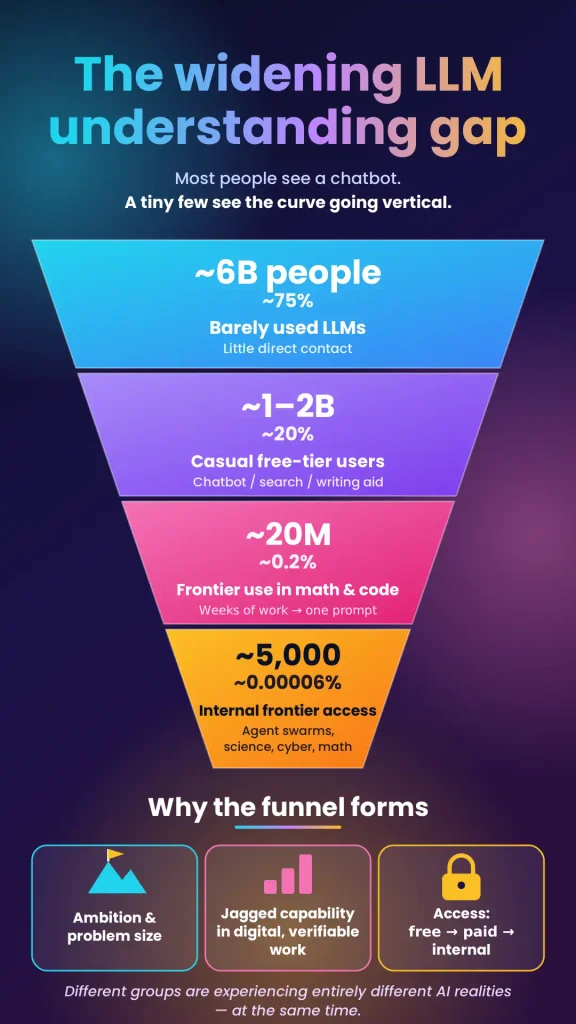
Andrej Karpathy, the OpenAI co-founder who now works at Anthropic, sorted humanity into four tiers of contact with large language models in a post that The Decoder reported on 12 October 2026. By his napkin math, about 6 billion people, roughly 75 percent, have barely touched an LLM. Another 1 to 2 billion use free chatbots now and then, about 20 million use frontier models professionally in math and code, and about 5,000 people have internal access to systems the public has not seen. A widely shared retelling turned that sorting into a reassurance: you are not late, you are early, as with the internet in 2005.
The retelling is half right. Karpathy’s funnel measures exposure to capability, not adoption, and the two diverge in ways that change what an early mover should build. Independent data from Microsoft, Pew, the US Census Bureau and the ITU support the wide base and the approximate size of the casual tier. They do not support the internet analogy, because chatbots already reach about a billion people, and they cannot confirm the 5,000 figure at all. The scarce resource in 2026 is not a login. It is a problem large enough and checkable enough to stress an agent, plus a person able to verify the result.
A reposted April thread became a four-tier funnel
The post at the centre of the debate is a re-share. According to AI Breaking Wire, Karpathy revived an April 9 post that described two groups of people speaking past each other about LLM capability, and the October version argues that the gap is now widening into a sharp funnel. The structure has four tiers, and every figure in it is his own estimate. AI Breaking Wire states that the numbers are napkin math rather than measured data.
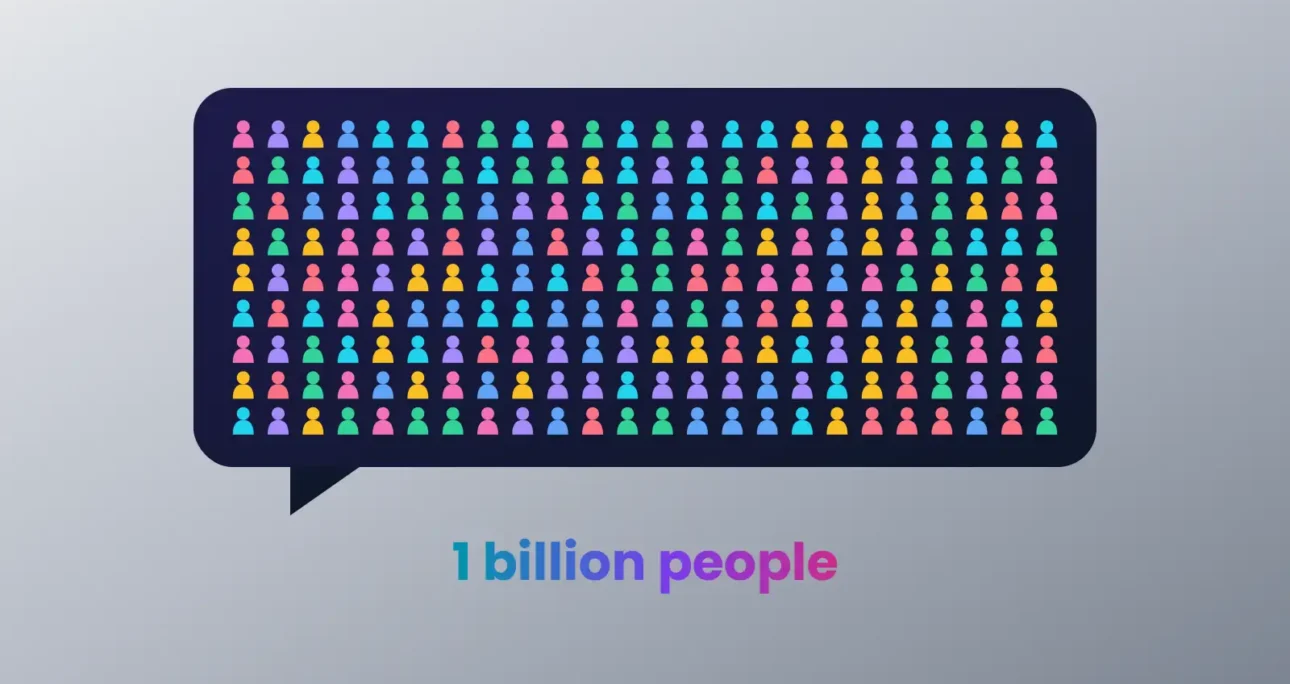
The first tier holds about 6 billion people, 75 percent of the population, who have barely come into contact with LLMs. The second holds 1 to 2 billion, about 20 percent, who use free ChatGPT-like products infrequently, as a better search engine or a writing aid. The third holds about 20 million people, 0.2 percent, who use frontier models professionally in math and code and watch agents finish from a single prompt projects that once took weeks or months. The fourth holds about 5,000 people, 0.00006 percent, with internal access to frontier-grade systems. Of everyone outside that last group, Karpathy writes that “the external world has seen the preview.”
Two details in the viral retelling need correcting. Karpathy now works at Anthropic, according to The Decoder, so the label OpenAI co-founder describes his past rather than his employer. And the funnel concerns large language models and the agents built on them, not artificial intelligence in general. A person who has never opened a chatbot may still use other AI-driven tools, and that use falls outside Karpathy’s count.
The distinction changes the commercial reading. A claim that 75 percent of people have barely touched LLMs is a claim about one product category and one kind of use. Reading it as a claim about AI adoption broadly invites the inference that three quarters of the world is a future customer base, which the next sections test against measured data.
Ambition, jagged capability and access set the funnel’s width
Karpathy gives three reasons the funnel narrows as it does, and they carry more explanatory weight than the headcounts. The first is ambition and problem size. A question with a paragraph-long answer barely stresses a frontier system, he argues, so impact scales with the size and time horizon of the problems a person is willing to hand over. That explains why he has non-tech friends who reasonably say they have little use for these tools. It also explains why executives, who spend most of their time talking to people, understand the progress intellectually but at second hand, a point The Decoder reports.
The second is jaggedness. Capability peaks in domains that are digital, verifiable and commercially useful, because it emerges from reinforcement learning on verifiable rewards, and labs direct their training environments toward revenue potential. Code and mathematics fit that description, while a delicate negotiation or a plumbing quote does not. The funnel is therefore a map of where verifiable reward exists, not a ranking of human talent or effort. The third driver is access, in three levels: free tier, paid tier and internal.
Karpathy’s own summary of the moment is that the public has mostly not interacted with these systems, that most professionals still see a modest uplift, and that a small sliver is experiencing “the vertigo of the curve going vertical.” All of it, he stresses, is happening at the same time. He also recalls that less than a year earlier he was still typing code by hand, and The Decoder notes that in October 2024 he had described agents as mostly marketing that barely worked. His own reversal in under two years is evidence that the top of the funnel moves faster than public perception can follow, though it is one person’s experience and not a measurement.
The three drivers also predict where the evidence will be easiest to find. Surveys can count who has opened a chatbot, but none can easily count who has handed a system a month-long engineering project, which is why the upper tiers rest on estimates while the lower tiers have data.
Microsoft, Pew and the ITU confirm the wide base
Three independent measurements land near the bottom of the funnel. Microsoft’s AI Economy Institute reports that 18.8 percent of the world’s working-age population, ages 15 to 64, used generative AI tools in the second quarter of 2026, up from 17.8 percent in the first quarter and 16.3 percent in the second half of 2025. The figure derives from anonymised telemetry adjusted for device share, internet penetration and population, and Microsoft’s chief data scientist writes that no single metric is perfect. By subtraction, 81.2 percent of working-age adults did not use generative AI in that period, a calculation from Microsoft’s published rate. In the first quarter the Global North stood at 27.5 percent and the Global South at 15.4 percent, and Microsoft says the gap widened in the second.
Pew Research Center’s survey of US adults, fielded 17 to 23 February 2026, found that 51 percent do not use AI chatbots, 25 percent use them several times a week or less, and 24 percent use them daily, including 12 percent several times a day and 4 percent almost constantly. A rich country with heavy usage still splits mostly between non-users and occasional users, which matches the shape of Karpathy’s first two tiers.
The ITU adds a composition point. It estimates that 6 billion people, 74 percent of the world, used the internet in 2025 and that 2.2 billion remained offline. Karpathy’s bottom tier of about 6 billion therefore contains roughly 2.2 billion people who cannot be using any chatbot, a little over a third of it, and roughly 3.8 billion who are connected and have not made a habit of it. That is arithmetic on rounded figures, not a survey result. The connected group is the commercial opening, because it already has the access that the offline group lacks.
Company counts fit the second tier. OpenAI said on 31 July 2026 that it had passed 1 billion active users, and Google announced on 11 August that the Gemini app had passed 1 billion monthly users. Trending Topics points out that the figures are only partly comparable, because Google counts one app monthly while OpenAI applies its number to several interfaces and leaves open whether it is weekly or monthly. With the overlap between the two audiences unknown, both sit inside Karpathy’s band of 1 to 2 billion.
The 2005 internet comparison fits reach but misses depth
The retelling’s second claim is that AI in 2026 resembles the internet in 2005, when about 16 percent of the world, roughly 1 billion people, was online. McKinsey’s chart, built on Statista and World Bank data, supports the starting point and adds that the World Wide Web had debuted in 1991, so the internet needed about 14 years to reach its first billion. It reached 67 percent of the world by 2023, and the ITU puts it at 74 percent for 2025. In 2005 the commercial opportunity was access, because most people and most businesses could not get online without help.
Chatbots started later and moved faster. OpenAI’s 1 billion mark came roughly three years and eight months after ChatGPT launched, according to Trending Topics, and Google’s followed within two weeks. The measures differ, since the ITU counts individuals who used the internet while companies count active users of products, so the comparison shows scale and not equivalence. Even so, the first-mile problem that defined 2005 is largely solved for chatbots among connected people. A person with a phone and a connection can open a capable assistant today for free.
What remains unsolved is depth. The ITU’s findings on the internet point the same way: most users have basic skills, while problem-solving and content creation are developing more slowly, and data-only mobile plans remain unaffordable in about 60 percent of low and middle income countries. Karpathy’s first driver says the same about AI, because usage intensity follows problem size and not login access.
The 2005 analogy therefore fits one segment well, the 2.2 billion people who are offline and cannot participate yet, and fits poorly for the connected billions who already have access and use it shallowly. A business built to hand out accounts in 2026 would copy the 2005 playbook into a market where the accounts are free.
Businesses mirror the funnel at a smaller scale
Firms show a similar shape. The US Census Bureau’s Business Trends and Outlook Survey found that between 14 December 2025 and 3 May 2026 AI use among American businesses hovered between 17 and 20 percent, with 19.8 percent in the final period and 20 to 23 percent of firms expecting to use it within six months. Use rises with size: 37 percent of firms with at least 250 employees, 32 percent of those with 100 to 249, and under 20 percent of firms with four or fewer. By sector, Information stood at 39.7 percent, Finance and Insurance at 33.9 percent and Retail Trade near 14 percent. Small firms did not move in six months, while larger firms did, since use rose among firms with 20 or more employees and showed no statistically detectable change below that size.
Counting is contested, which affects anyone quoting a single percentage. A Federal Reserve note compares three US surveys and finds a spread from 18 percent of firms using AI, in the firm-weighted Census series, to 78 percent of the labour force working at firms that have adopted it, in an employment-weighted Atlanta Fed survey of executives. Individual workers report 41 percent use of generative AI for work in November 2025 but only 12 percent daily use, against 8 percent daily in a Gallup survey from mid-2025. The note attributes most of the spread to who is sampled and how answers are weighted, with question framing and social desirability bias as further causes, and it cites earlier work that found estimates from 5 to 40 percent across 16 surveys.
Census also changed its wording in November 2025, from AI use in producing goods or services to use in any business function, which breaks comparison with older series. The practical rule is to quote an adoption rate only with its unit, its weighting and its date, and to distrust any claim that mixes two of them.
Karpathy’s four tiers set against the nearest measured figures
| Karpathy tier | His estimate | Nearest measured figure | What the measure counts |
|---|---|---|---|
| Barely touched LLMs | About 6 billion, 75% | 81.2% of working-age adults did not use generative AI in Q2 2026 (calculated from Microsoft’s 18.8%); 51% of US adults do not use chatbots (Pew, Feb 2026) | Ages 15 to 64 worldwide; US adults |
| Casual free-tier users | 1 to 2 billion, 20% | OpenAI over 1 billion active users (31 Jul 2026); Gemini app over 1 billion monthly users (11 Aug 2026) | Company-defined users; overlap unknown |
| Frontier use in math and code | About 20 million, 0.2% | No global count found; 73% of coding assistant or agent users use them daily (Stack Overflow 2026) | Survey of 30,000+ respondents, not a headcount |
| Internal frontier access | About 5,000, 0.00006% | About 50 organizations at the April 2026 Glasswing launch, about 150 added in June | Organizations, not people; no headcount in the sources reviewed |
The bottom two tiers have measured counterparts that roughly agree with Karpathy’s shares, and the agreement weakens as the tiers shrink. The third tier has no global count, and the survey figure describes people who answered a developer survey, a self-selected group. The fourth tier has only an organizational proxy, which is a different unit from the one Karpathy used.
The 20 million tier writes code under supervision
The third tier is where Karpathy sees the curve going vertical, and the surveys show intense use paired with tight supervision. Stack Overflow’s 2026 Developer Survey, answered by more than 30,000 people over seven weeks, found that 73 percent of respondents who use AI coding assistants or agents use them daily, and that a third of daily AI users spend four or more hours a day with the tools. Claude Code, at 66 percent, and GitHub Copilot, at 59 percent, were the agents of choice. Developers mostly generate code in familiar areas (67 percent) and debug (61 percent), while only 20 percent use AI for deploying, operating or troubleshooting production systems.
A May 2026 pulse survey of 1,100 developers and working professionals shows the same restraint at the agent level. Workplace agent use at any frequency rose from 31 percent to 59 percent in a year and daily use from 14 percent to 37 percent, yet 63 percent rarely or never let agents run entirely on autopilot, 60 percent block agents from unapproved system changes and 68 percent prefer a single agent to coordinated groups. The agents write the code, and people still approve what ships. Both surveys draw on Stack Overflow’s own community, so they describe engaged technologists and not all programmers.
Microsoft’s data adds the output side. Git pushes grew 78 percent year over year worldwide in the first quarter of 2026, and US software developer employment reached about 2.2 million in 2025, up 8.5 percent. Microsoft says it is too early to know the labour-market effect and offers an economic reading in which cheaper software raises demand for it if demand is elastic.
Karpathy concedes a limit himself: human review and comprehension, he says, are starting to fall behind. Both facts can hold together. A tier of professionals produces more code than before while the checking capacity around them has not grown at the same rate. In this analysis, that review gap rather than raw model skill is the constraint the survey data expose, and it is the constraint that a business buying agent tools inherits on its first day.
The 5,000 figure is a claim without an auditor
None of the reports reviewed for this analysis identifies who the 5,000 people are, which labs employ them or how Karpathy counted. The Decoder relays his account of what such systems do: swarms of thousands of agents working for weeks on software projects, finding zero-day vulnerabilities, running cyber attacks and defenses at machine speed and advancing mathematics. That is an interested description. Karpathy works at Anthropic, a lab that sells access to frontier systems, and OpenAI chief executive Sam Altman made a related claim in September, saying a current coding tool did in 17 minutes what a startup had built over three months. Both come from people whose employers gain when the public believes capability is rising fast.
One program offers a real data point about restricted access, though not a headcount. Anthropic launched Project Glasswing in April 2026 with about 50 organizations using Claude Mythos Preview to scan software for vulnerabilities, then added about 150 more in more than 15 countries in June, each required to meet security requirements before gaining access. The company says the effort has found more than 10,000 high and critical severity flaws, and it expects many other AI companies to have comparable models within 6 to 12 months, some released without safeguards. A gated tier exists and is growing, but it is counted in organizations, and a figure of 5,000 people cannot be derived from it. The reports reviewed contain no independent audit of the vulnerability total, so it stays a company claim.
Two tests would settle the top tier. A lab could publish how many staff and partners hold internal access, or an independent party could audit a restricted program’s outputs. Until one happens, the funnel’s apex is a plausible order of magnitude with no checkable anchor, and the argument rests on the three lower tiers, where the evidence is public.
Decisions for agencies, owners and executives facing the gap
The evidence supports different moves for different readers. For an agency or consultancy selling AI services to small firms, the Census data shows that businesses under 20 employees did not move in six months while larger firms did, which suggests the missing input is not tool access. Selling accounts and prompt tips targets the free, solved layer. Work that targets Karpathy’s first driver, scoping problems large enough to matter and defining what counts as a correct result, targets the unsolved one. His second driver supplies a selection rule: start with tasks that are digital, verifiable and tied to revenue, such as reconciliation, quality checks on content, code maintenance and data cleanup, because that is where capability is strongest.
For the owner of a firm with fewer than 20 employees, a defensible next step is one measured pilot on a single checkable task with a named reviewer, run for a month, recording time saved and errors caught. Stack Overflow’s pulse data shows cost falling as a barrier, from 53 percent to 38 percent agreeing, while accuracy and security remain the top concerns. In this analysis that points to review capacity as the scarcer input, so the pilot should budget reviewer hours before subscription fees.
For executives, Karpathy’s point about second-hand understanding has a practical reading. The pulse survey found 50 percent of senior executives using agents daily, a subgroup within a 1,100-person survey drawn from one developer community, so it proves little about executives generally. A skeptical leader can still test the claim directly by delegating one real task to an agent and reading the output personally, which converts an abstract belief into a first-hand observation.
Microsoft’s national rankings give a benchmark for firms that operate across borders. The United Arab Emirates led the second quarter at 73.3 percent, Singapore followed at 64.3 percent, and the Global North and South gap widened. A business can compare its own market’s rank with its team’s actual use before assuming either lead or lag.
Three observations that would change this reading
The better-supported forward judgment is that the gap narrows in reach and persists in depth over the next year (analysis, not forecast). Reach grows because free products keep adding users, while depth depends on organizations learning to scope large problems and to verify machine output, which spreads more slowly. The conditions below would revise that view.
First, Microsoft’s quarterly series. It rose 1.5 points in the first quarter of 2026 and 1.0 point in the second. If gains fall below half a point for several quarters, the casual tier is saturating faster than Karpathy’s framing implies. If they return to 1.5 points, the base is shifting quickly enough that the 2005 analogy gains force. At the second-quarter pace, reaching 25 percent would take about six more quarters, a linear extrapolation and not a prediction.
Second, the Census series for firms under 20 employees. Sustained movement there would mean the access barrier is lifting for small business, and the opportunity for outside help would shift from scoping toward volume. Third, any lab publishing a verifiable internal-access count or an audited program result would settle the top tier. Without it, 5,000 should be read as an order of magnitude and not as a measurement.
The strongest form of Karpathy’s claim survives this scrutiny: contact with the technology is uneven in a way that makes shared understanding hard. The weakest form, that most of the world is simply waiting to be onboarded, does not, because the connected majority already has access and the shortage is in problems worth giving to it.
Reader questions on Karpathy’s AI funnel and the adoption data
Andrej Karpathy is a co-founder of OpenAI who, according to The Decoder, joined Anthropic. The Decoder reported his post on the LLM understanding gap on 12 October 2026, and AI Breaking Wire describes it as a revival of an April 9 post.
No. He said about 6 billion people, roughly 75 percent of the population, have barely come into contact with LLMs, which is narrower than never having used AI. Microsoft measured 18.8 percent of working-age adults using generative AI in the second quarter of 2026, so a clear majority sits outside regular use.
No. He framed them as napkin math, and AI Breaking Wire labels them his own estimates and not measured data. Microsoft, Pew and the Census Bureau publish measured series, but they cover only the lower tiers and use different definitions.
OpenAI said on 31 July 2026 that it passed 1 billion active users, and Google said on 11 August that the Gemini app passed 1 billion monthly users. Trending Topics notes that the figures are only partly comparable because the bases differ and the overlap between audiences is unknown.
The US Census Bureau’s survey put American business use at 19.8 percent in the period ending 3 May 2026, with 37 percent among firms of 250 or more employees and under 20 percent among firms with four or fewer. A Federal Reserve note shows other surveys report far higher rates, depending on who is sampled and how results are weighted.
Yes, by the Statista and World Bank figures McKinsey cites, which put internet use at 16 percent of the world, about 1 billion people, in 2005. The ITU estimates 74 percent, about 6 billion people, for 2025, with 2.2 billion still offline.
The reports reviewed do not say. Karpathy refers to people with internal access to frontier-grade systems and names no lab. Project Glasswing is a separate, documented example of gated access, counted in roughly 200 organizations and not in individual people.
The evidence supports early for depth and not early for reach. About a billion people already use chatbots, while the harder work of scoping large problems and checking agent output is where adoption is thin. Census data show firms under 20 employees did not increase use between December 2025 and May 2026.
Karpathy says capability peaks where work is digital, verifiable and commercially useful, because training relies on reinforcement learning with verifiable rewards and labs direct effort toward revenue. Code fits that pattern, and Stack Overflow’s 2026 survey found 73 percent of coding assistant or agent users working with them daily.
Author:
Jan Bielik
CEO & Founder of Webiano Digital & Marketing Agency
This article is an original analysis supported by the sources cited below
Anthropic’s Andrej Karpathy says “the external world has seen the preview” of what AI can actually do
The Decoder’s 12 October 2026 report on Karpathy’s post, used for the four tiers, his three drivers, his move to Anthropic, the human-review remark and Sam Altman’s 17-minute claim.
Karpathy: LLM Understanding Gap Is a Widening Funnel
AI Breaking Wire’s account of the post as a revival of an April 9 thread, including the statement that the figures are napkin math and the description of the three drivers.
Global number of Internet users increases, but disparities deepen key digital divides
The ITU’s Facts and Figures 2025 release, which gives 6 billion internet users, 74 percent of the world, 2.2 billion offline, and the divides in affordability, skills and income.
The world goes online
McKinsey’s chart of Statista and World Bank data showing 16 percent of the world, about 1 billion people, online in 2005 and 67 percent in 2023, with the web’s 1991 debut as the starting point.
New Microsoft data: AI adoption continues to rise, Switzerland remains well above the global average
Microsoft’s announcement of the second-quarter 2026 AI Diffusion Report, with 18.8 percent of working-age people using generative AI, the national leaders and the widening North and South gap.
The state of global AI diffusion in 2026
Microsoft’s first-quarter 2026 report, used for the 16.3 and 17.8 percent readings, the measurement method, regional rates, the 78 percent rise in git pushes and US developer employment.
Gemini and ChatGPT Both Hit 1 Billion Users
Trending Topics’ comparison of the 31 July OpenAI and 11 August Google announcements, including why the two user definitions are not directly comparable.
About a quarter of U.S. adults use chatbots daily
Pew Research Center’s February 2026 survey chart showing 51 percent of US adults do not use chatbots and 24 percent use them daily.
Large Firms With at Least 20 Employees Biggest AI Users
The Census Bureau’s analysis of its Business Trends and Outlook Survey, with the 17 to 20 percent range, size and sector rates, and the November 2025 wording change.
Monitoring AI Adoption in the U.S. Economy
A Federal Reserve staff note comparing three US surveys, which establishes the 18 to 78 percent spread, the daily-use figures and the reasons estimates differ.
The results of the 2026 Developer Survey are here!
Stack Overflow’s summary of its 2026 survey of more than 30,000 people, with daily use of AI coding tools, agent preferences and the share of use that reaches production.
Agents on a leash: Agentic AI remains mostly single-agent and monitored at work
Stack Overflow’s May 2026 pulse survey of 1,100 respondents, used for agent usage growth, oversight habits, executive use and the fall in cost as a barrier.
Anthropic expands Project Glasswing to 150 organizations in more than 15 countries
Help Net Security’s report on the June 2026 expansion, giving the 50 and 150 organization counts, the security requirements, the 10,000 flaw claim and Anthropic’s expectation about rival models.
| Citing this article? Brief excerpts are welcome. Please credit Webiano.digital, name the author where stated, and include a link to https://webiano.digital and to this original article. Full or substantial republication requires prior written permission. Read our Copyright and Content Use Policy. |
This article was prepared with the assistance of artificial intelligence tools. The content underwent expert human review, and Webiano Digital & Marketing Agency assumes editorial responsibility for its final version and publication.