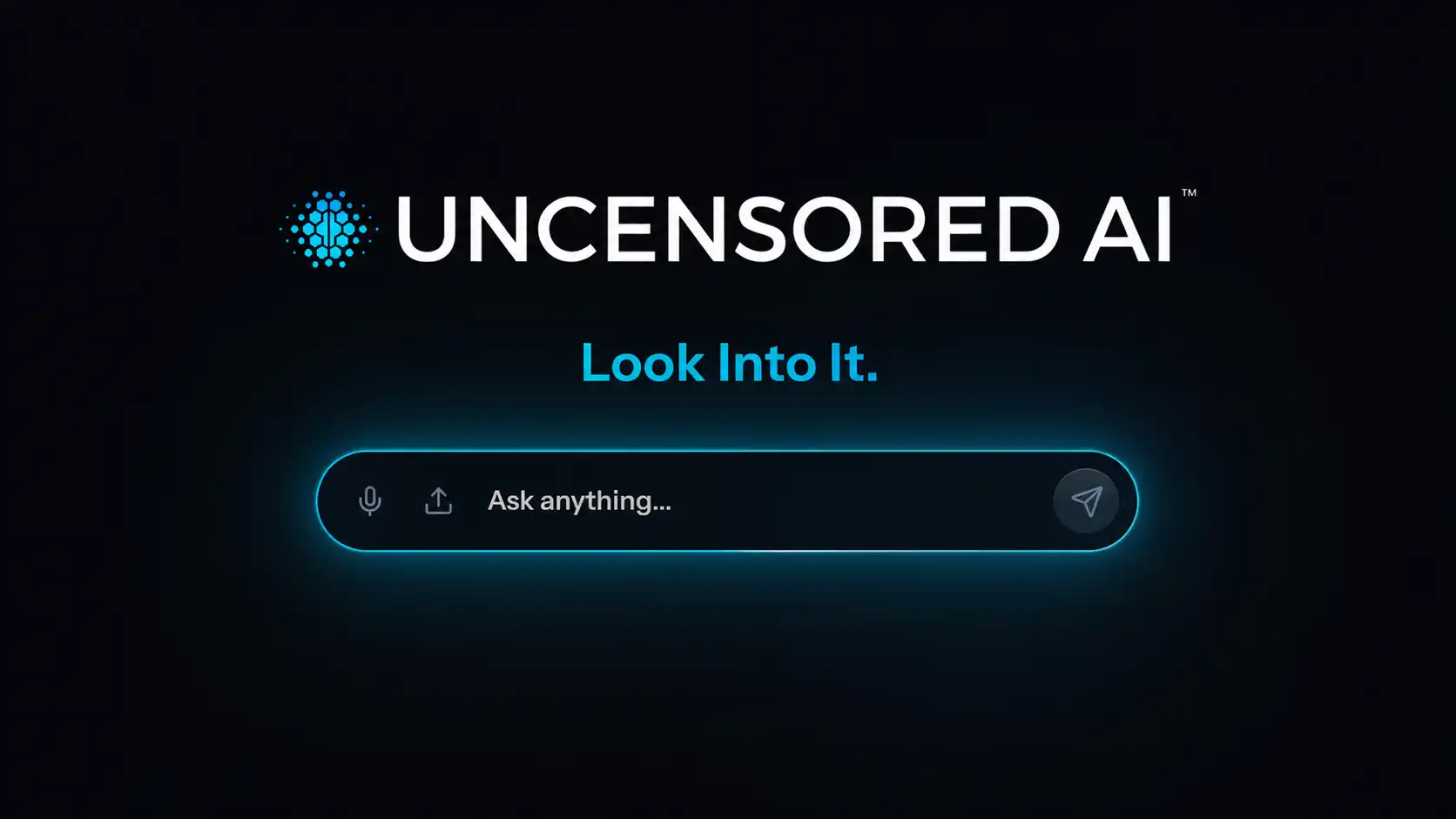
Uncensored AI has grown from a small, pre-revenue crowdfunding pitch into a consumer platform with a six-figure Android download count, paid subscriptions, an API and a social layer. Its real business proposition is broader than “no filters”: it sells users more control over the conversational boundary while shifting more responsibility for accuracy, safety and compliance back to them.
Table of Contents
Uncensored AI’s website makes a deliberately simple promise: fewer restrictions, more direct answers and less of the moderation that users encounter on mainstream AI services. By September 2026, that proposition is no longer only a startup pitch. Google Play lists the Android app at 100,000-plus downloads, while the company sells a $9.99 monthly Pro plan, a $99.99 annual plan and API access priced at five cents per inference.
The sharper story is that “uncensored” does not mean ungoverned. The company’s own terms prohibit illegal activity, harmful conduct and rights violations; its legal disclaimer warns that outputs may be inaccurate; app stores impose their own content and reporting rules; and independent testing has raised serious questions about factual reliability. The product is therefore best understood as a transfer of control and responsibility, not the disappearance of rules.
That distinction matters commercially. Uncensored AI is trying to turn dissatisfaction with safety filters into a subscription relationship, then extend that relationship into messaging, community, research tools and developer access. Its competitive moat, if one emerges, will depend less on being “uncensored” in the abstract than on proving that greater user autonomy can coexist with reliable answers, defensible privacy practices and durable distribution.
A pre-revenue pitch became a working consumer platform
The company’s public record shows a rapid change in operating posture. In a November 2024 Regulation Crowdfunding filing, Uncensored AI, Inc. identified itself as a Delaware corporation formed in February 2023 and based in Omaha. The same filing reported two employees, $64,000 in assets, $31,000 in cash, no revenue for the most recent fiscal year and a net loss of $26,000. It sought to offer $124,000 of common stock at $1 per share through StartEngine Primary. At that point, the business was still financially small and commercially unproven.
The company’s present product surface is materially broader. The website now presents a free chatbot tier limited to five responses per day and a Pro subscription with unlimited responses, voice mode, image and document analysis, chat history, community posting, encrypted messaging, research archives and API access. The API page advertises an OpenAI-compatible endpoint, a model called UncensoredAI v1.2, a 32,768-token context window and pay-as-you-go credits at $0.05 per inference. Those are company specifications, not independent performance measurements, but they show a shift from concept to packaged service.
Distribution is also visible. Google Play’s listing, reviewed on September 3, 2026, showed more than 100,000 downloads and hundreds of user reviews; it says the Android app was updated on July 24, 2026. An Apple App Store page for Norway identifies Uncensored AI, Inc. as the provider and records a version history through April 2026. The strongest verified evidence of progress is therefore reach and product breadth, not revenue or profitability. The available public sources do not establish current subscriber numbers, recurring revenue, inference volume or retention.
A large download count can show curiosity or distribution, but it does not reveal how many people become paying customers or remain active. For a business built around a polarizing product promise, conversion and retention matter more than installation alone. The transition from pre-revenue filing to functioning platform is real; the economics behind that transition remain largely private.
Minimal moderation is the product, not a side setting
Uncensored AI does not market moderation as a technical detail. It makes the absence of “heavy” filtering central to the brand. Its “What is Uncensored AI?” page says the service is designed for unrestricted access to artificial intelligence and positions itself against mainstream models that it describes as constrained by content filters and corporate bias. Its Google Play listing similarly says the app operates with minimal restrictions and offers “raw, unfiltered responses.” These are company claims about product philosophy, not proof that the outputs are objectively less biased or more accurate.
That positioning creates a clear segment. Some users dislike refusals, safety lectures or conservative model behavior around controversial subjects. A product that promises fewer refusals can therefore compete on interaction policy even when it does not have the scale, capital or benchmark reputation of the largest model providers. The differentiation is behavioral: the user is buying a different answer boundary.
The company has built its surrounding products around the same identity. Its 1A forum calls itself a free-speech community with “no shadowbans,” while the careers page says the company is building for “open discourse” and values freedom of information. The brand, community and chatbot are designed to reinforce one another.
This has an important strategic consequence. Uncensored AI cannot easily treat moderation as a back-end setting that can be tightened without cost. The promise itself is part of customer acquisition. Any increase in filtering risks disappointing the users attracted by the original proposition; any refusal to add safeguards can create distribution, reputational or legal friction elsewhere. The company has chosen a position that can attract a loyal niche precisely because it constrains its room to change direction quietly.
That is the first durable insight from the site. Uncensored AI is selling governance preference as a product feature. The commercial question is whether enough users value that preference strongly enough to pay for it after the novelty of unrestricted conversation wears off.
The real mechanism is governance moved outward
The term “uncensored” can suggest an absence of rules, but the company’s own policies show a different architecture. Its Terms of Service prohibit illegal activities, harmful content intended to harm, harass or endanger others, and violations of intellectual-property or privacy rights. The company also reserves the right to suspend or terminate access for violations. There is still a rule boundary; it is simply drawn differently from the boundaries used by more restrictive assistants.
The legal disclaimer shifts another part of the boundary onto the user. It says users must be at least 18, are responsible for complying with law and third-party rights, and should independently verify generated information because the model can hallucinate. It also says the service is provided without guarantees of accuracy, completeness or reliability. This is a familiar allocation of risk for software, but it matters more when a platform’s selling point is willingness to answer where other systems may refuse.
External platforms then add their own governance. Google Play requires generative-AI apps to prevent restricted categories of generated content and to provide in-app reporting or flagging for offensive content. Apple’s App Review Guidelines require filtering, reporting and blocking mechanisms for apps with user-generated content, and they restrict objectionable content more generally. A minimally moderated model can therefore sit inside a heavily governed distribution environment.
This layered system explains the business more accurately than a binary “censored versus uncensored” frame. There is model behavior, company policy, app-store policy, payment infrastructure, local law and user responsibility. Removing one layer of refusal does not remove the rest. It changes which actor decides and where enforcement happens.
For users, that means the practical promise is narrower than absolute speech freedom. For the company, it creates recurring negotiation costs: the product must remain distinctive enough to satisfy its core audience while compliant enough to stay distributed through mainstream channels. The hidden mechanism is not the removal of governance but its relocation from the assistant’s conversational layer to contracts, infrastructure and user accountability.
Subscriptions turn ideological differentiation into recurring revenue
The current pricing page turns that governance preference into a straightforward funnel. Free users receive up to five AI responses per day and read-only forum access. The Pro tier costs $9.99 monthly or $99.99 annually and adds unlimited responses, faster service, voice mode, multimodal analysis, chat history, forum participation, encrypted direct and group messaging, research archives and API access. The company also promises that a subscriber’s price will remain locked while the subscription remains active.
This is not a single-feature chatbot subscription. It is an attempt to bundle AI access, community, communications and research into one membership. That design has two advantages if users engage with the bundle. First, it gives the company more reasons to retain a customer than raw model quality alone. Second, it makes the identity of the service harder to substitute: a user leaving the chatbot may also leave a forum history, private conversations and research tools.
The API adds a second monetization path. Uncensored AI advertises an OpenAI-compatible interface, sells credits at $1 for 20 credits and charges one credit per inference. Compatibility matters because it lowers switching cost for developers already familiar with OpenAI-style chat completions. The company’s page claims a 99.9% uptime guarantee and describes the endpoint as having “no filters,” but those are vendor assertions; no independent reliability or benchmark data were identified in the reviewed sources.
There is also a strategic reversal embedded in the pricing model. The brand criticizes centralized moderation, yet recurring subscription revenue rewards the company for becoming the central account, archive, community and API provider for its own users. The more successful the bundle becomes, the more trust users must place in Uncensored AI as an institution. That trust covers billing, account access, storage, moderation of the forum, model behavior and the handling of private communication.
What remains unverified is whether the funnel works at scale. Public evidence shows pricing and distribution, but not conversion rate, average revenue per user, churn or gross margin. Those are the figures that would show whether “uncensored” is a durable business category rather than a compelling acquisition message.
Distribution platforms still hold a veto
The Android listing demonstrates both opportunity and dependency. Google Play gives Uncensored AI access to mainstream mobile distribution and, as of the reviewed listing, more than 100,000 downloads. Yet Google’s generative-AI policy requires covered apps to prevent restricted content and include a way for users to report offensive AI output. The store is therefore not a neutral pipe. Distribution comes with behavioral conditions that can reach into the product itself.
Apple’s rules create a similar pressure from a different direction. Its App Review Guidelines say apps should not contain certain objectionable material, and apps with user-generated content must provide filtering, reporting and blocking tools. Those policies do not establish that Apple has taken any particular action against Uncensored AI. They do establish the standards an app must navigate if it wants durable access to Apple’s ecosystem.
The company’s own site makes distribution conflict part of its narrative, including a page claiming Apple removed the app and a separate page alleging blocks by two UK mobile providers. Those are Uncensored AI’s claims and should not be treated as independently established merely because the company publishes them. The reviewed App Store page for Norway, for example, still displays an Uncensored AI listing and version history, illustrating why storefront status can vary by territory and time.
For management, the lesson is structural. A service built around resisting gatekeepers still needs operating plans for gatekeeper decisions. Mobile stores remain valuable because they solve discovery, updates, trust signals and installation.
The company’s autonomy is therefore constrained by the channels through which it reaches customers. If Uncensored AI keeps growing, its most difficult product decisions may not concern model capability at all. They may concern how much moderation or reporting it will accept to preserve distribution without diluting the proposition that brought users in.
Privacy is part of the pitch and part of the scrutiny
Privacy sits next to censorship in the company’s commercial story. The pricing page says conversations are never sold, rented or traded, that there are no ad networks or data brokers, and that AI requests carry text rather than a user’s name or email. It also advertises end-to-end encrypted direct and group messaging for Pro users. Those promises matter because people are more likely to bring sensitive or controversial questions to a service that explicitly invites them.
The surrounding disclosures show why readers should separate different privacy claims. Google Play’s data-safety section says the developer reports no data sharing with third parties, but it also says the app may collect personal, financial and other data types and that data is not encrypted. Apple’s App Store privacy disclosure says contact information, user content and identifiers may be linked to identity, while other categories including usage data, diagnostics and sensitive information may be collected without being linked to identity. Both stores note that these disclosures are supplied by the developer.
The company’s cookie policy says it uses cookies for functionality, preferences and analytics and may use third-party services such as Google Analytics. Its older beta privacy policy also described collection of account information, usage data, device data and data from third-party sources, along with retention for operational and legal purposes. These statements do not prove misuse. They do show that “privacy first” is not the same as “no data processing.”
There is another disclosure mismatch worth resolving. Uncensored AI’s current Terms of Service and legal disclaimer say users must be at least 18 or the age of majority, while Google Play displays an “Everyone” content rating and the reviewed Apple storefront page shows 13+. Store age ratings are not identical to contractual eligibility rules, so this is not necessarily a legal contradiction. It is, however, a user-experience inconsistency that can create confusion about who the product is intended for.
The strongest version of the company’s case would make encryption scope, retention, subprocessors, model-provider relationships and age eligibility easy to compare across web and mobile surfaces.
The factual-reliability problem tests the brand promise
A service can reduce content restrictions without becoming more accurate. That distinction is where Uncensored AI faces its hardest reputational test. The company itself acknowledges in its legal disclaimer that the model can hallucinate and tells users to verify generated information against multiple trusted sources. That warning is especially important because the brand also associates fewer filters with truth-seeking and objectivity.
Independent reporting has found cases where the model produced false or conspiratorial claims. In June 2026, Euronews reported that its fact-checking team tested Uncensored AI against several misinformation narratives involving Europe and received conspiracy-laden responses in many runs, while noting that repeated prompts sometimes produced more nuanced answers. Euronews also summarized findings attributed to NewsGuard about false claims generated by the chatbot and then shared by influencers.
That evidence has limits. It is not a comprehensive benchmark of the model across domains, languages and prompting conditions, and a news investigation cannot establish the error rate of every version of a rapidly changing service. It does establish a concrete failure mode: a model marketed as less filtered can answer false premises assertively enough that users may treat confidence as evidence.
NIST’s Generative AI Profile frames trustworthiness as something organizations should incorporate into the design, development, use and evaluation of generative-AI systems. The framework is voluntary, but its relevance here is practical. Reliability and freedom of response are separate engineering objectives. A company can reduce refusals while still measuring factuality, uncertainty, consistency and misuse risks.
For Uncensored AI, this is not a peripheral safety debate. It goes directly to the value proposition. If the service claims mainstream assistants over-filter truth, then its competitive burden is higher than merely showing it will answer. It must show that willingness to answer does not systematically reward unsupported premises. Independent benchmark publication, versioned model cards and transparent evaluation sets would strengthen that case far more than rhetoric about censorship.
Buyers should separate autonomy from operational trust
For an individual user, the useful decision is not whether “uncensored AI” is good or bad as a category. It is whether the additional conversational freedom is worth the reliability, privacy and support trade-offs for the specific task. Low-stakes brainstorming and controversial discussion are different risk classes from medical, legal, financial or security decisions. The company’s own disclaimer tells users not to rely on outputs without independent verification and to seek professional advice where appropriate.
A practical consumer test starts with behavior. Does the model answer difficult questions more directly than alternatives? Does it distinguish evidence from speculation when the prompt contains a false premise? Does it correct itself when challenged with sources? Those questions matter more than whether the interface uses the word “uncensored.” Users should also compare the free limit with the Pro price and decide whether the wider bundle—voice, history, forums, messaging and archives—has value beyond chatbot access.
Developers have a different decision. The API’s advertised OpenAI compatibility can reduce integration work, but production adoption requires evidence about uptime, latency, rate limits, model versioning, data handling and output stability. The company publishes pricing and a context-length specification, yet the reviewed sources did not provide independent benchmarks or a detailed public service-level agreement. For business-critical deployment, missing operational evidence matters as much as model ideology.
Organizations also need to consider distribution and policy compatibility. A product built on an external uncensored API may still be distributed through Google Play or Apple, where the application developer remains responsible for complying with store rules. A downstream business cannot outsource its policy obligations simply because its model vendor adopts a looser stance.
The best purchasing frame is therefore conditional. Choose greater answer latitude when it materially improves the task and when users can verify the output. Demand stronger controls when mistakes can harm people, trigger liability or contaminate decisions. Autonomy has value, but autonomy without verification is not the same thing as trust.
Uncensored AI’s next test is evidence, not rhetoric
Uncensored AI has already cleared one hurdle that many AI startups never do: it moved from a tiny public filing with no reported revenue into a visible multi-surface product with mobile distribution, subscriptions, an API and a community layer. The Android download count shows that the proposition has attracted attention beyond a closed beta. The current website shows a company trying to deepen that attention into recurring relationships.
The next hurdle is harder because it cannot be solved by sharper branding. The company needs evidence that its distinctive moderation stance produces durable user value without creating unacceptable reliability, privacy or distribution costs. The reviewed public record does not disclose current revenue, paid subscribers, retention, gross margin, benchmark performance or independently verified uptime. Independent reporting has documented concerning outputs, while the company itself acknowledges hallucination risk.
Our analysis indicates that the strongest version of Uncensored AI’s strategy is not “remove every guardrail.” That position is inconsistent with its own terms and with the realities of app-store distribution. The stronger strategy is to make the boundary legible: fewer conversational refusals where lawful, clear prohibitions where necessary, transparent model evaluations, precise privacy disclosures and visible user controls. That would turn a culture-war slogan into an operating model.
The conditions that would strengthen the thesis are observable. Published subscriber and retention data would show whether people pay for the difference. Independent benchmark results would show whether fewer refusals can coexist with factual discipline. More detailed security and privacy documentation would make the trust proposition auditable. Stable distribution across major platforms would show that the model can remain differentiated without becoming commercially isolated.
The conditions that would weaken it are equally clear: persistent misinformation failures, inconsistent age or privacy disclosures, repeated store conflicts, or evidence that users sample the product but do not stay. Uncensored AI has proved that “less filtered” can attract a market. It has not yet publicly proved that the same promise can mature into a trusted, durable AI institution.
Questions readers are asking about Uncensored AI
Uncensored AI is an AI platform that markets itself around minimal content restrictions and more direct answers than heavily moderated assistants. Its current offering includes web and mobile chat, a paid subscription, an API, community features and research tools.
No. Its Terms of Service prohibit illegal activities, harmful content intended to harm or endanger others, and violations of intellectual-property or privacy rights. The company can suspend or terminate accounts for violations.
The website currently lists a free tier with up to five AI responses per day, a Pro plan at $9.99 per month and an annual plan at $99.99 per year. API usage is listed separately at $0.05 per inference.
Google Play currently lists the Android app with more than 100,000 downloads. An Apple App Store page reviewed for Norway identifies Uncensored AI, Inc. as the provider and shows a version history. Availability can vary by storefront and over time.
No. Its legal disclaimer says the AI can hallucinate and that generated information should be independently verified with multiple trusted sources before being relied upon.
Yes. Euronews reported in June 2026 that its own tests produced conspiracy-oriented false claims on several European misinformation narratives, while also noting that repeated prompts sometimes yielded more nuanced responses.
The pricing page says conversations are not sold, rented or traded and that the company uses no ad networks or data brokers. Store privacy disclosures and the cookie policy still describe collection or processing of several data categories, so users should read the full disclosures rather than equate “not sold” with “no data collected.”
The company’s Terms of Service and legal disclaimer say users must be at least 18 or the age of majority, even though mobile-store age labels differ. The contractual eligibility rule published by the company is therefore the safer reference point for access.
The central risk is balancing its low-moderation identity with factual reliability, privacy expectations and distribution rules imposed by app stores. Public sources show real product reach, but they do not disclose the financial or retention metrics needed to judge long-term durability.
Author:
Jan Bielik
CEO & Founder of Webiano Digital & Marketing Agency
This article is an original analysis supported by the sources cited below
Established the company’s description of its product philosophy, minimal restrictions, privacy positioning and claimed distinction from mainstream AI services.
Pricing — Pro Plans & Features
Provided current free and Pro pricing, feature limits, privacy promises, messaging features and subscription terms.
Provided the advertised API price, OpenAI-compatible interface, context length, model name, credit structure and vendor uptime claim.
Established contractual eligibility requirements, prohibited activities and the company’s right to suspend or terminate access.
Provided the company’s hallucination warning, verification advice, age requirement, responsibility allocation and warranty limitations.
Documented the company’s stated use of functional, performance and analytics cookies and possible use of third-party analytics services.
Privacy Policy for Uncensored AI beta
Provided earlier disclosures concerning account, device and usage data, retention, cookies and international data handling.
Careers — Join the Uncensored AI Team
Established how the company describes its mission, organizational values and focus on open discourse and unrestricted intelligence.
Documented the company’s community product and its explicit positioning around free speech and absence of shadowbanning.
Provided Uncensored AI’s own claim about removal from Apple’s App Store; the article treats this as an attributed company claim rather than independently established fact.
Provided the company’s claims concerning access restrictions by UK mobile providers and its response through alternative access routes.
Established the Android app’s developer identity, 100,000-plus download count, July 2026 update date, store rating information and developer-supplied data-safety disclosures.
Uncensored AI on the Apple App Store
Provided Apple storefront information on the provider, version history, age rating and developer-declared privacy categories.
Understanding Google Play’s AI-Generated Content policy
Established Google Play’s requirements for generative-AI applications concerning restricted content, safety and user reporting.
Provided Apple’s current rules governing objectionable material, user-generated content, filtering, reporting and blocking mechanisms.
SEC Form C for Uncensored AI, Inc.
Established the company’s incorporation details, employee count, 2024 financial figures, crowdfunding structure and proposed securities offering.
Artificial Intelligence Risk Management Framework Generative Artificial Intelligence Profile
Provided the authoritative risk-management context for incorporating trustworthiness into the design, deployment, use and evaluation of generative-AI systems.
Uncensored AI The chatbot spreading conspiracies about Europe
Provided independent reporting on June 2026 tests of the chatbot, including documented misinformation failures, variability across repeated prompts and reporting on NewsGuard’s findings.
| Citing this article? Brief excerpts are welcome. Please credit Webiano.digital, name the author where stated, and include a link to https://webiano.digital and to this original article. Full or substantial republication requires prior written permission. Read our Copyright and Content Use Policy. |
This article was prepared with the assistance of artificial intelligence tools. The content underwent expert human review, and Webiano Digital & Marketing Agency assumes editorial responsibility for its final version and publication.