Camera-trap classifiers, poacher alerts and cattle-gait sensors already run in the field, and the best-documented ones keep a person in the loop. Where independent testing exists, as in veterinary radiology, results trail vendor claims. Where meaning is the claim, as with whale codas, researchers say they do not yet know what is being said.
Table of Contents
When Todd Michael Anderson of Wake Forest University faced a backlog of some 11 million Snapshot Serengeti photographs, volunteers had long since stopped being enough. Google’s open-source SpeciesNet model worked through the pile in days. In Google’s account of Idaho’s wildlife agency using the same model, human experts still conduct the final review. That pairing summarises the state of artificial intelligence applied to animals: the technology is deployed, and the deployments that hold up keep a human checkpoint. Camera-trap classifiers, bird-sound identifiers, anti-poaching cameras, cattle-lameness sensors and veterinary imaging software all produce numbers that somebody acts on.
The record is uneven. The best-documented systems share two habits: a person checks what the model says, and the model is tested at sites it has not seen. Where those habits are missing, claims and performance drift apart. An independent 2026 test of six commercial veterinary radiology platforms found variable and at times limited performance, and the scientists studying sperm whale codas say plainly that they do not yet know what the whales are saying.
This analysis argues that the open questions are about validation, data ownership and the objective a system is told to maximise, far more than about model architecture.
The camera-trap pipeline that turned volunteers into reviewers
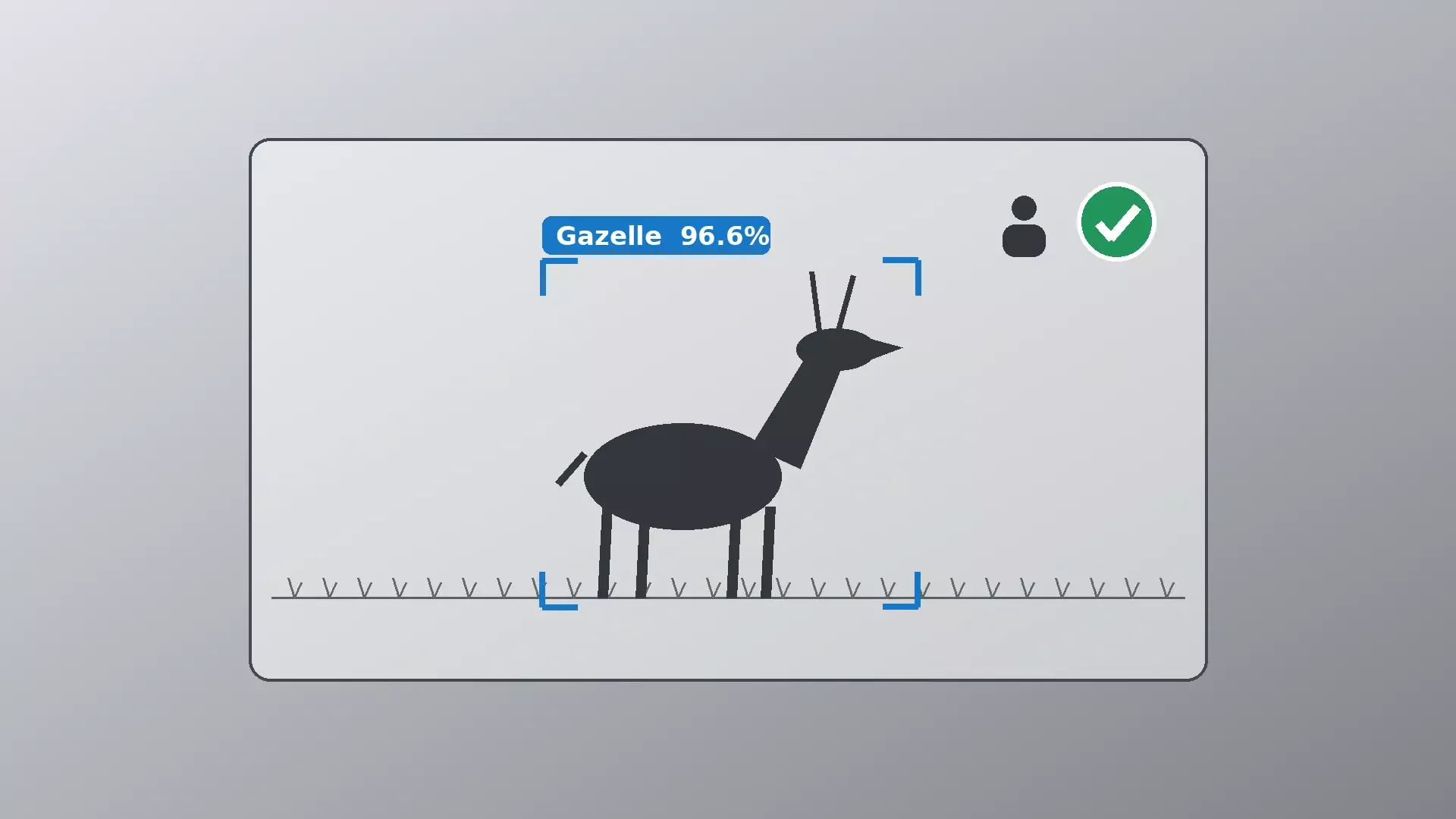
The cleanest evidence for animal AI comes from camera traps, because the task is narrow and the answers can be checked. A 2018 study in the Proceedings of the National Academy of Sciences trained deep networks on the 3.2-million-image Snapshot Serengeti archive, covering 48 species. Raw identification accuracy exceeded 93.8 percent. The headline result was different: when the system classified only images it was confident about, it could automate 99.3 percent of the data at 96.6 percent accuracy, the same as crowdsourced volunteer teams, saving more than 8.4 years of labelling effort.
That 99.3 percent figure depends on the model being allowed to abstain. Uncertain images go back to people. The authors noted that labelling each six-month batch had taken thousands of citizen scientists two to three months, so the design replaced the bulk of the routine work while leaving the doubtful cases with humans.
Google’s SpeciesNet follows the same logic at larger scale. Google says it was trained on more than 65 million images, classifies nearly 2,500 categories of mammals, birds and reptiles, and has run inside the Wildlife Insights platform since 2019. It works alongside MegaDetector, a separate open-source model that first finds which images and which pixels contain animals. Google reports about 30,000 images a day on a standard laptop and 250,000 or more on a low-end gaming graphics card.
Volume was the pressure that forced the change. At Snapshot Serengeti, online volunteers eventually could not keep up with the photographs arriving, which is why Anderson’s team turned to the model for the 11-million-image backlog. The economics are plain: a cheap sensor produced more data than a volunteer workforce could label, and software absorbed the surplus.
The payoff shows up in the science, not only in saved hours. Google’s account of Colombia’s Humboldt Institute describes a national camera network, Red Otus, whose analysed images revealed changes in the timing of bird migrations and in the daily activity patterns of wildlife across the country. That is Google’s summary of a partner’s results rather than a peer-reviewed finding, but it illustrates what cheap sorting enables: questions about behaviour and abundance that no volunteer team could have answered at that scale.
Sound is cheaper than video and easier to oversell
Audio sensors work at night, in fog and under thick canopy, which is why bioacoustics has spread quickly. The best-known tool is BirdNET, built by the K. Lisa Yang Center for Conservation Bioacoustics at the Cornell Lab of Ornithology with Chemnitz University of Technology. It identifies birds only. Other animal groups need other models, so any claim that one network “hears the forest” overstates what a single tool does.
BirdNET’s own numbers show how far field conditions sit from the lab. The 2021 paper in Ecological Informatics described a network covering 984 North American and European species. It reached a mean average precision of 0.791 on 22,960 single-species recordings but an F0.5 score of only 0.414 on 286 hours of fully annotated soundscapes. Clean recordings and real forests are different tests, and the second one is the one conservationists actually run. The F0.5 measure weights precision more heavily than recall, a sensible choice for a tool whose false alarms cost an ecologist’s time. Even so, a score of 0.414 means a user cannot treat every detection in a dense dawn chorus as a confirmed record, and the sensible workflow is to review detections for rare or protected species and accept more noise for common ones.
A second use is enforcement. Rainforest Connection mounts repurposed smartphones high in the canopy, solar-powered, to listen for chainsaws and gunshots and send alerts to local authorities. In its 2015 Cameroon project the organisation reports that alerts led authorities to confiscate a monkey carcass and a motorbike from a poacher. That is a case report from the operator, a useful demonstration that the pipeline works end to end, but not a controlled measurement of how much logging or hunting it prevents.
The pattern repeats: the detection step is well measured, while the downstream effect on animals usually rests on the operator’s own account.
TrailGuard and the economics of an alert that fires only for people
Anti-poaching cameras show the mechanism most clearly, because the model’s job is to decide what a scarce human should look at. In January 2019 Intel said its Movidius vision technology would run inside TrailGuard AI cameras developed with the nonprofit Resolve, capable of object detection and image classification on the device and of alerting rangers when a person or vehicle appears. The sources describe deployment in African wildlife reserves and across Southeast Asia from early 2019.
Moving classification into the camera changes the cost structure. Battery, bandwidth and ranger attention are the scarce resources in a remote reserve. The pencil-sized units were reported to run for up to a year and a half on one battery, and, as an inference from the design, a camera that stays silent for animals transmits less and needs fewer battery visits. The model is a filter on human attention, not a replacement for human judgment, and Intel’s head of AI for social good, Anna Bethke, said rangers will decide the most appropriate response.
That is a statement of intent and design, and the sources reviewed for this article contain no independent evaluation of how many arrests or prevented killings followed. Resolve’s own framing, that an elephant is killed every 15 minutes, is the organisation’s estimate and was not independently checked here.
The gap matters because the same design transfers to other targets. A system that alerts on people can be repointed at vehicles, boats or villagers, and what counts as suspicious is decided by whoever sets the classes. The technology is neutral about its target. The deploying organisation is not.
Open code, private data and the question of who owns the label
Two ownership models sit side by side in animal AI. In conservation, the leading species identifier is open source. Google released SpeciesNet publicly, research groups have retrained it, and Australia’s Wildlife Observatory took the open model and trained it on local species missing from the original. Human-verified labels from Wildlife Insights users flow back into the training data. The scarce asset in this field is verified labels, and the platform that accumulates them holds an advantage that open code does not remove. That last point is editorial interpretation, not a reported fact.
Veterinary imaging runs on a different footing. Commercial platforms sell interpretation as a service. The authors of the 2026 Murdoch University validation study told Today’s Veterinary Practice that many platforms do not disclose training data, model updates or versioning, which makes independent assessment hard. A 2026 audit in Frontiers in Veterinary Science documented the regulatory background: the devices themselves may not need federal approval before sale, which shifts accountability to the clinicians who use tools without any mandated independent pre-market validation.
Location data is a third ownership question. Wildlife Insights says it blurs deployment locations so the position of sensitive species cannot be recovered from downloads. A 2021 paper asked whether that protection holds and showed that simple heuristics and public satellite imagery can narrow the possible area of a camera. Blurring reduces risk. It does not remove it.
The incentives point one way. Open models invite checking by outsiders, closed services depend on the buyer’s trust, and sensitive data needs governance that the model’s accuracy figures say nothing about.
Cattle lameness detectors and the objective nobody prints on the box
Farms are where animal AI is least visible and most widely applied, and lameness in dairy cattle is the best-studied case. An August 2026 review in the journal Animals summarised 43 studies of automated lameness detection and found reported accuracies from 70 to 98 percent depending on the technology and the environment. That spread is the finding. A system at the top of the range on one farm may sit at the bottom on another, and the authors call for standardised benchmarking and validation across several farms and environments before adoption.
Early detection serves both sides of the barn. The review says delayed treatment of lameness causes major welfare and economic losses, so a lame cow found sooner is a cow treated sooner and a cheaper problem for the farmer. The interests diverge at the threshold. A system tuned to flag every borderline gait sends the farmer to inspect more animals, while one tuned to avoid false alarms misses early cases. Which setting a vendor ships is a decision about the objective, and, as an editorial point, it is rarely stated in product descriptions.
Researchers who study the sector report the same unease. An online workshop with more than 70 animal welfare experts, policy makers, farmers and industry staff, written up by Schillings, Bennett and Rose in 2021, linked slow adoption to missing validation and cost-effectiveness evidence and to unanswered questions about who owns the data and who may access it. Participants also raised pressure on farmers to keep up with performance indicators.
Welfare gains from sensors are real in principle and unproven in aggregate, because the validation that would show them across farms is what the 2026 review says is still missing. Until that exists, a farmer buying a lameness alert is buying a reasonable bet, not a measured outcome.
A single accuracy number also hides prevalence. In a herd where most cows walk soundly, a model that calls nearly every animal sound will look accurate while missing the cows that matter. The Murdoch veterinary researchers made the same point about imaging, preferring balanced accuracy and the Matthews correlation coefficient because they account for class imbalance. Buyers of lameness sensors should ask for sensitivity and specificity measured on their own herd type, since the farmer’s real question is how many early cases the system finds and how many healthy cows it flags.
Clinics and laboratories, where accuracy claims meet independent tests
Veterinary imaging offers the sharpest recent contrast between marketing and measurement. In 2025 a Frontiers in Veterinary Science study had 11 board-certified radiologists and a commercial AI package read 50 canine and feline radiographic studies and concluded that the software performed almost as well as the best radiologist. A commentary from Murdoch University researchers answered that the study lacked an independent gold-standard reference, used a small sample and risked class imbalance. Then in March 2026 the Murdoch team published its own external validation in the Journal of the American Veterinary Medical Association, sending 53 dogs’ abdominal radiographs with confirmed diagnoses to six commercial platforms. The authors’ primary takeaway was that current commercial platforms show variable and, at times, limited performance on real-world cases.
Evidence behind six animal-AI deployments
| Deployment | Best-documented result | Main open question |
|---|---|---|
| Camera-trap species identification | 99.3% of Serengeti images automated at 96.6% accuracy when the model abstains on doubtful cases | Performance at new locations |
| Bird sound identification | Mean average precision 0.791 on single-species recordings, F0.5 of 0.414 on annotated soundscapes | Accuracy in real soundscapes |
| Anti-poaching cameras | Alerts for people and vehicles, rangers decide | Independent outcome data |
| Dairy lameness detection | 70% to 98% reported accuracy across 43 studies | Validation across farms |
| Veterinary radiology | Six platforms, 53 dogs, variable and at times limited performance | Undisclosed training data and versions |
| Sperm whale codas | Combinatorial structure documented | What the codas mean |
The table sorts deployments by how much independent evidence exists. Camera traps and bird sound have measured results on field data. The others have either a result without independent testing or a technical finding without a settled application.
Drug testing is the other laboratory-facing case. On 10 April 2025 the US Food and Drug Administration announced a plan to reduce, refine or potentially replace animal testing for monoclonal antibodies using computational toxicity models and organoid testing. Healio’s reporting notes that AI-based approaches are mainly used alongside animal studies for now, which tempers the claim that AI will soon replace testing on animals outright.
The agency’s reasoning is practical. It says software models could simulate how an antibody distributes through the human body and predict side effects, that companies submitting strong non-animal safety data may receive streamlined review, and that it aimed to launch, within a year of the April 2025 announcement, a pilot letting selected antibody developers use a primarily non-animal testing strategy. On 2 December 2025 it issued draft guidance on reducing the use of nonhuman primates in antibody toxicity studies after the first three months. These are staged steps with a pilot at the front, so the honest reading is a staged reduction in one drug class rather than a switch.
Limits that headline accuracy figures leave out
Three limits cut across every deployment above, and they test the thesis that human verification is what makes animal AI work.
The first is transfer. Beery, Van Horn and Perona built a benchmark from twenty camera traps to measure how recognition holds up in places a model was not trained on. State-of-the-art algorithms performed excellently where they were trained, but generalisation to new locations was poor, especially for classification systems. A published accuracy figure therefore describes a site mix, not a species. That is why the Australian group retrained SpeciesNet on local species, and why any buyer should test a model at their own sites.
The second is the data itself. Camera locations for threatened species can help poachers as much as ecologists. The 2021 study on public camera-trap images found that heuristics and satellite imagery could shrink the area in which a blurred camera might sit, so protection depends on how the data are published and not only on how the model performs. This is also a case where the benefit and the risk come from the same asset. The coordinates that let a ranger respond are the coordinates a trafficker wants, and a sensor network that records them creates a data store worth stealing.
The third is meaning. Project CETI’s 2024 Nature Communications paper, led from MIT, proposed a “sperm whale phonetic alphabet” and reported contextual and combinatorial structure in codas. Lead author Pratyusha Sharma was direct about the boundary: “We do not know yet what they are saying.” A model that finds structure has found structure. Whether the structure carries content is a question for behavioural research, which the team said it would study next.
One counterpoint deserves weight. Human review is not automatically a safeguard. A reviewer who only confirms confident machine labels can drift into approving them, and the sources here do not measure that effect, so it remains an inference. The thesis holds where review is designed to catch errors, with abstention thresholds and checks on uncertain cases. Where review is a formality, the safeguard is nominal.
Questions to put to a vendor before an animal-AI system goes live
The evidence translates into specific demands, and they differ by reader.
A conservation manager choosing a species classifier should test it on a labelled sample from their own cameras before trusting published figures, and should keep the confidence threshold so that doubtful images return to people. If locations of sensitive species are shared, treat blurring as a partial control and decide who may download raw coordinates.
A dairy farmer buying lameness sensors should ask which farms the accuracy figure came from, and what the alert threshold optimises. The 70 to 98 percent range in the 2026 review means the vendor’s number needs support from sites that resemble the buyer’s. The farmer should also ask who owns the data and who can see it, because workshop participants flagged that as unresolved.
A veterinary practice using imaging AI should ask for external validation on general-practice cases with confirmed diagnoses, not only on curated sets. The Murdoch authors preferred measures that account for class imbalance, such as balanced accuracy and the Matthews correlation coefficient, over raw accuracy. Practices should also ask for disclosure of training data and version history, since those are the items the authors say are often withheld.
A funder or regulator has a simpler task: make independent validation a condition of purchase or funding. In veterinary medicine, the audit found that no mandated independent pre-market validation exists, so buyers are doing the testing themselves, whether they know it or not.
One market sits outside this evidence. Smart collars, treat-dispensing cameras and apps that claim to translate barking were not covered by the independent studies reviewed here. The absence of independent evidence in this article is not evidence that those products fail. It means an owner has no external benchmark to lean on and should treat activity monitoring and translation claims as unverified.
The evidence that would move this assessment
The judgment today is conditional. Animal AI works best where its outputs are checked, where uncertain cases go back to people and where sites resemble training data. On that footing, camera-trap and acoustic monitoring will keep expanding, because the labelling bottleneck they remove is real and measured.
Three developments would strengthen or weaken that view. The first is independent validation of veterinary imaging tools. If larger tests, the kind the Murdoch authors encourage, show performance near vendor claims, the gap this analysis describes was a transition problem. If they confirm the pilot, regulators in the larger veterinary markets will face pressure to require pre-market evidence. The second is the FDA’s implementation: its roadmap targets antibodies first, while specialists still describe AI as a complement to animal work. Progress will show up in accepted submissions, not announcements.
The third is whale research. If Project CETI links codas to observed behaviour, structure will become meaning, and the field will have its first strong case of AI helping to decode a non-human communication system. Until then, the strongest claim the evidence supports is detection of pattern.
None of this requires believing that the technology is good or bad. It requires asking, for each deployment, who checks the output, who owns the data and what the system was told to maximise.
Common questions about AI that watches, listens to and diagnoses animals
A 2018 study on 3.2 million Snapshot Serengeti images reported over 93.8 percent accuracy across 48 species. When the system handled only images it was confident about, it automated 99.3 percent of the data at 96.6 percent accuracy, matching volunteer teams. Accuracy at new locations can be much lower.
SpeciesNet is an open-source Google model that identifies nearly 2,500 categories of mammals, birds and reptiles in camera-trap images. Google says it was trained on more than 65 million images and works with MegaDetector, which first finds the animals in each frame.
Yes, for birds in particular. BirdNET, from Cornell and Chemnitz University of Technology, identifies birds only. Its 2021 evaluation showed a mean average precision of 0.791 on single-species recordings and an F0.5 of 0.414 on annotated soundscapes, so real forest recordings are harder.
The sources reviewed describe AI cameras and acoustic sensors that alert rangers or authorities to people, vehicles, chainsaws or gunshots. They do not contain independent evidence of how much poaching these systems prevent, and rangers still decide how to respond.
Not yet. Project CETI’s 2024 paper reported structure in sperm whale codas, but lead author Pratyusha Sharma said researchers do not yet know what the whales are saying. Detecting a pattern is different from establishing its meaning.
A 2026 review of 43 studies reported accuracies from 70 to 98 percent depending on the technology and environment, and called for standardised benchmarking and validation across farms. Results on one farm do not guarantee the same performance on another.
Independent evidence is mixed. A 2025 study found one commercial tool performed almost as well as the best of 11 radiologists, but critics noted it lacked an independent gold standard. A 2026 pilot of six platforms on 53 dogs found variable and at times limited performance.
Not yet, and not entirely. The FDA announced a plan in April 2025 to reduce, refine or potentially replace animal testing for monoclonal antibodies using computational models and organoid testing. Specialists quoted by Healio say AI is mainly used alongside animal studies for now.
Exact coordinates of threatened species can help poachers. Wildlife Insights blurs deployment locations for public download, but a 2021 study showed that simple heuristics and satellite imagery can narrow the area where a blurred camera might be.
Author:
Jan Bielik
CEO & Founder of Webiano Digital & Marketing Agency
This article is an original analysis supported by the sources cited below
Automatically identifying, counting, and describing wild animals in camera-trap images with deep learning
The 2018 PNAS study supplying the Snapshot Serengeti accuracy, 99.3 percent automation at 96.6 percent accuracy and 8.4-year labelling saving, plus the volunteer labelling timeline.
Where wild things roam: Identifying wildlife with SpeciesNet
Google Research’s account of SpeciesNet’s training set, category count, processing speeds, MegaDetector pairing, the 11-million-image Serengeti backlog and local retraining in Australia.
How our open-source AI model SpeciesNet is helping to promote wildlife conservation
Google’s partner stories, including Idaho’s final human review of sorted images and Colombia’s Red Otus camera network findings.
Recognition in Terra Incognita
The ECCV 2018 benchmark showing camera-trap classifiers perform well at training locations but generalise poorly to new ones.
Can poachers find animals from public camera trap images?
The 2021 paper on geo-obfuscation, including Wildlife Insights’ location-blurring policy and evidence that heuristics and satellite imagery can narrow blurred locations.
Intel AI to fight poaching in Africa
TechCentral’s January 2019 report on TrailGuard AI cameras, covering on-device detection, person and vehicle alerts, battery life and Intel’s statement that rangers decide the response.
BirdNET: A deep learning solution for avian diversity monitoring
The 2021 Ecological Informatics abstract giving BirdNET’s 984-species coverage, mean average precision of 0.791 and F0.5 of 0.414 on annotated soundscapes.
Community-led conservation in Cameroon
Rainforest Connection’s own project report describing repurposed-smartphone Guardians, chainsaw and gunshot alerts, and the 2015 confiscation case.
Sperm whale phonetic alphabet proposed for the first time
Project CETI’s release on the 2024 Nature Communications paper reporting contextual and combinatorial structure in sperm whale codas.
Scientists document remarkable sperm whale phonetic alphabet
Reuters-sourced coverage carrying lead author Pratyusha Sharma’s statement that the meaning of the calls is not yet known.
Hooves, Sensors, and Signals: Precision Approaches to Automated Lameness Detection in Dairy Cattle
The August 2026 review of 43 studies reporting 70 to 98 percent accuracy and calling for standardised, multi-farm validation.
Animal welfare and other ethical implications of precision livestock technology
The 2021 commentary from an online workshop of more than 70 experts, covering validation gaps, data ownership and pressure on farmers.
Is AI accurate? A validation study on AI radiology interpretation
An interview with the Murdoch authors on the 2026 JAVMA test of six platforms on 53 dogs, including limited real-world performance and undisclosed training data and versioning.
A systematic audit of transparency and validation disclosure in commercial veterinary artificial intelligence
The 2026 audit establishing that veterinary AI lacks mandated independent pre-market review, which shifts accountability to users.
Comparison of radiological interpretation made by veterinary radiologists and state-of-the-art commercial AI software
The 2025 Frontiers study using 11 radiologists and 50 studies, which concluded the software performed almost as well as the best radiologist.
Commentary on the comparison of veterinary radiologists and commercial AI software
The Murdoch critique identifying the missing gold standard, small sample and class imbalance in the 2025 study.
FDA announces plan to phase out animal testing requirement for monoclonal antibodies and other drugs
The FDA’s 10 April 2025 release describing computational and organoid methods, streamlined review and the planned pilot programme.
FDA efforts to reduce animal testing signal shift toward AI, organ-on-chip study methods
Healio’s March 2026 report noting the December 2025 draft guidance on nonhuman primates and that AI is mainly used alongside animal studies.
| Citing this article? Brief excerpts are welcome. Please credit Webiano.digital, name the author where stated, and include a link to https://webiano.digital and to this original article. Full or substantial republication requires prior written permission. Read our Copyright and Content Use Policy. |
This article was prepared with the assistance of artificial intelligence tools. The content underwent expert human review, and Webiano Digital & Marketing Agency assumes editorial responsibility for its final version and publication.