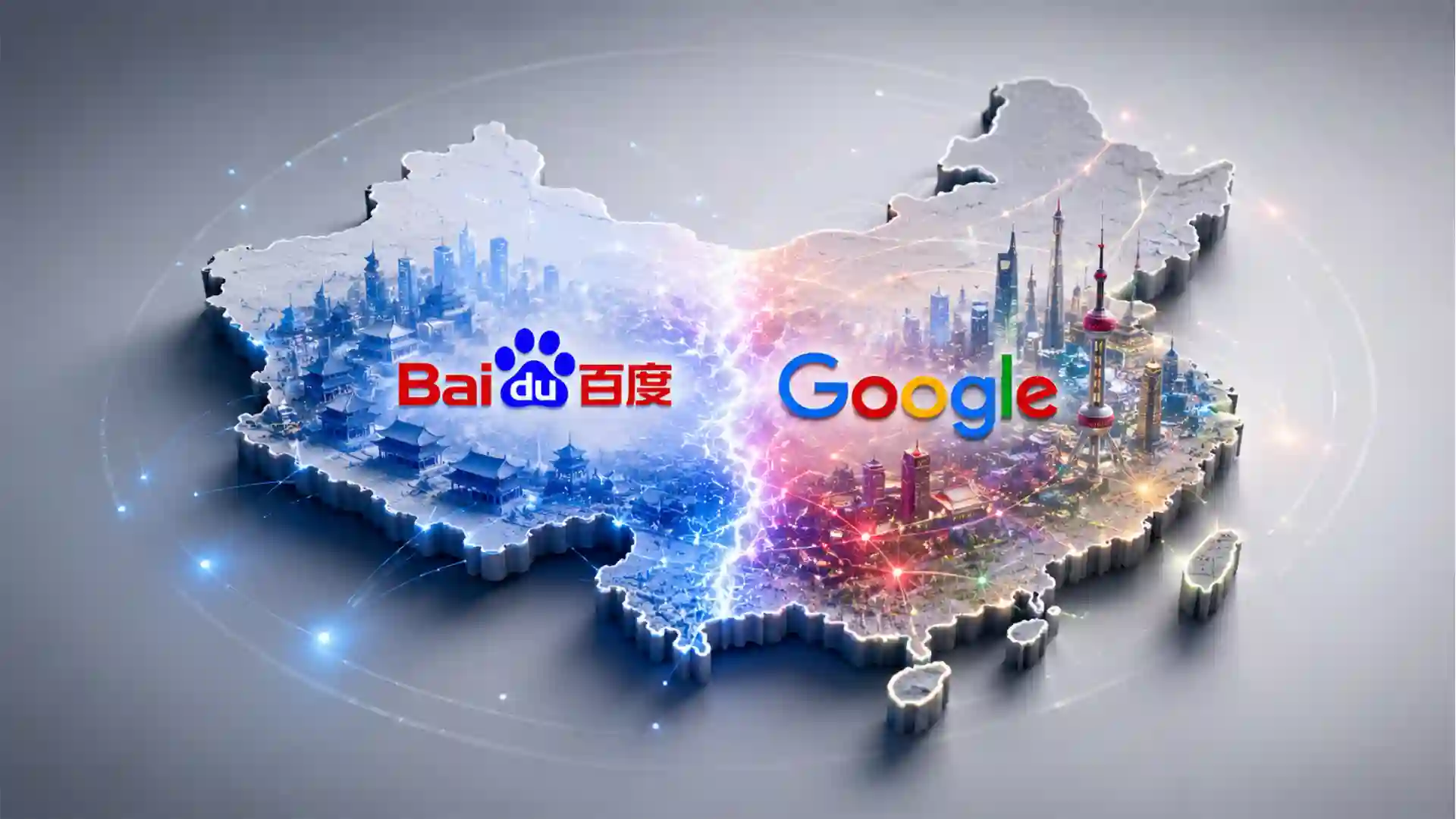
The useful headline is not that Baidu has beaten Google across Asia. It has not. The sharper story is that Baidu dominates Google inside mainland China while Google remains the dominant search engine across Asia as a whole. That split matters because China is large enough to distort casual language about “Asia,” yet not large enough to erase the search behavior of India, Japan, South Korea, Vietnam, Indonesia, the Gulf states, Southeast Asia, and the rest of the region. StatCounter’s April 2026 data shows Baidu leading China with 44.64 percent of search-engine share while Google has only 1.85 percent there; the same data shows Google at 92.65 percent across Asia while Baidu has 0.97 percent.
Table of Contents
The claim needs a sharper frame
Baidu’s power is often described too loosely outside China. People say it “dominates Asia” because they know China is the world’s largest internet market and because Baidu is widely treated as the Chinese equivalent of Google. That shorthand is tempting, but it hides the real structure of search in the region. Baidu is a China-first search company with deep local infrastructure, regulatory alignment, Chinese-language search depth, and an AI stack built for domestic platforms. Google is a global search company that remains overwhelmingly strong in most Asian markets outside mainland China.
The distinction is not cosmetic. It changes how publishers build search strategies, how advertisers allocate budgets, how foreign brands enter China, and how analysts read platform risk. A company planning content for Beijing, Shanghai, Shenzhen, Guangzhou, Chengdu, Wuhan, or Hangzhou cannot treat Google as the main discovery layer. A company planning content for Mumbai, Delhi, Tokyo, Osaka, Seoul, Bangkok, Singapore, Jakarta, Manila, Hanoi, Dubai, Riyadh, or Kuala Lumpur usually cannot ignore Google. The same regional map contains two opposite truths.
The confusion comes from three forces. The first is China’s scale. China had 1.125 billion internet users by the end of 2025, according to a government report citing CNNIC, and internet penetration reached 80.1 percent. That makes the Chinese internet larger than the entire online population of most world regions. The second force is access. Google’s consumer search service has not operated in mainland China like it does in most countries since the 2010 conflict over censorship and redirection to Hong Kong. Google’s own 2010 update said it stopped censoring Google.cn search, Google News, and Google Images and redirected users to Google.com.hk. The third force is product adaptation. Baidu was not merely the search engine left standing after Google’s retreat. It built a search and app system around Mandarin queries, local services, maps, encyclopedia content, forums, feeds, paid listings, government rules, and now generative AI.
The result is a search market with two layers. Inside mainland China, Baidu is the default search reference point even when rivals such as Bing, Haosou, Sogou, Shenma, Douyin search, Xiaohongshu search, WeChat search, and AI assistants compete for attention. Across Asia as a whole, Google remains the search layer with the widest reach. A serious analysis has to hold both truths at once.
China is the exception that changes the search map
China is not just another country market in Asian search. It is a full digital jurisdiction with its own search engines, app stores, content rules, payment systems, advertising channels, identity layers, cloud providers, consumer platforms, and state supervision. That is why “Google versus Baidu” is not a normal brand contest there. It is a contest shaped by a national digital environment that makes the open web behave differently.
Google’s weakness in China is not mainly a failure of product quality. It is the result of political, legal, technical, and commercial constraints that accumulated for two decades. In January 2006, Google explained on its official blog that users in China struggled with a service that was often slow, unavailable, or incomplete; it said Google.com appeared to be down about 10 percent of the time, Google News was never available, and Google Images was accessible only half the time. Google launched Google.cn because a China-based service would be faster and more reliable, but that service also required filtered results under Chinese rules.
That arrangement broke in 2010. Google said it would stop censoring search services on Google.cn and redirect mainland users to Google.com.hk, while acknowledging that Chinese authorities had been “crystal clear” that self-censorship was a legal requirement. A later Google update said the company would end the automatic redirect and place a landing page link to Google Hong Kong as it resubmitted its ICP license renewal application. That sequence left a long shadow: Google still has business operations tied to advertising, Android, cloud customers, and engineering, but consumer search inside mainland China is not a normal Google market.
Baidu used that opening, but not only because Google left. Baidu had already been built as a Chinese-language search company and was publicly traded before Google’s 2010 retreat. Baidu’s own investor history says it has been listed on Nasdaq since August 2005 and dual-listed in Hong Kong since March 2021. Its IPO announcement in 2005 described it as a leading Chinese-language internet search provider. That matters because Baidu’s advantage was not a sudden accident. It was a long local build-out that then became much more durable once Google’s mainland search position collapsed.
The Chinese exception also changes the meaning of competition. In most markets, Google competes with Bing, local search engines, retail search, social search, AI assistants, and vertical platforms. In China, Baidu competes inside a market where search is tied to licensing, censorship, app distribution, verified identities, domestic hosting, Chinese-language content, and platform-specific traffic flows. The question is not whether Baidu is “better than Google” in an abstract sense. The question is which engine can operate, index, rank, monetize, and survive inside the Chinese internet.
The numbers show two different realities
The latest available public market-share data gives a clean starting point. In April 2026, StatCounter put Baidu first in China with 44.64 percent, ahead of Bing at 22.38 percent, Haosou at 18.17 percent, Yandex at 10.66 percent, Sogou at 2.05 percent, and Google at 1.85 percent. In Asia overall, StatCounter put Google at 92.65 percent, Bing at 2.79 percent, Baidu at 0.97 percent, Yahoo at 0.88 percent, Yandex at 0.85 percent, and Naver at 0.53 percent.
Those two lines are the whole article in miniature. Baidu beats Google decisively in China. Google beats Baidu decisively in Asia. The difference between those sentences is not a technicality. It is the difference between a country strategy and a regional strategy.
Search share snapshot for China and Asia
| Market | Leading engine | Reported share | Baidu share | Google share |
|---|---|---|---|---|
| China, all platforms | Baidu | 44.64% | 44.64% | 1.85% |
| Asia, all platforms | 92.65% | 0.97% | 92.65% | |
| Worldwide, all platforms | 90.02% | 0.46% | 90.02% | |
| India, all platforms | 97.46% | Not in top six | 97.46% | |
| Japan, all platforms | 55.39% | Not in top six | 55.39% | |
| South Korea, all platforms | 47.36% | Not in top six | 47.36% | |
| Vietnam, all platforms | 94.79% | Not in top six | 94.79% |
The table uses StatCounter’s April 2026 public pages for China, Asia, worldwide, India, Japan, South Korea, and Vietnam. It should be read as a directional measure of search-engine usage, not a census of every query made inside every app. StatCounter says its global stats are based on more than 3 billion monthly pageviews across more than 1 million websites and are subject to revision for 45 days from publication.
The numbers also show why market-share claims can become misleading when people collapse geography. China is one market. Asia is a continent-sized region with dozens of markets, languages, and platform habits. China’s search system is distinct, but it does not represent Asia in aggregate. India alone is too large to ignore, and Google’s share there is 97.46 percent in the same StatCounter snapshot. Japan and South Korea complicate the map in different ways, but neither is a Baidu market. Japan’s all-platform share still places Google first, while South Korea shows a closer fight between Google and Naver.
A more accurate formulation is this: Baidu is the dominant Chinese search engine and a major Chinese AI platform; Google is the dominant Asian and global search engine outside the mainland Chinese exception. That sentence is less dramatic than “Baidu dominates Google in Asia,” but it is closer to the evidence and far more useful for strategy.
Baidu’s lead begins with access, but it does not end there
The first reason Baidu beats Google in China is access. Google cannot be evaluated as a normal rival in a market where its core consumer services have faced long-running access barriers. Google’s own mainland China service availability page says it was replaced by the broader Transparency Report, which was designed to show traffic disruptions and government queries. The wider record is clear enough: Google Search, Gmail, YouTube, Google Maps functions, Google Play, and other services have not operated in mainland China with the ordinary reliability users expect in countries where Google is dominant.
Access alone does not explain everything. Search habits are sticky, but they are not frozen. If Baidu had delivered poor search quality for Chinese-language queries, users would have shifted faster to domestic rivals. Instead, the market became plural but still Baidu-centered. Bing, Haosou, Sogou, Shenma, Toutiao search, WeChat search, Douyin search, Xiaohongshu search, and AI assistants have all taken portions of discovery behavior, yet Baidu remains the best-known general search engine in China.
Baidu’s position is built on local depth. It understands simplified Chinese search patterns, local commercial terminology, state-approved content boundaries, local entity databases, maps, knowledge panels, Baidu Baike, Baidu Tieba, Baidu Wenku, Baidu Zhidao, and a long advertiser base trained to buy visibility inside Baidu’s system. Google’s ranking culture grew from the open web. Baidu’s ranking culture grew from a Chinese web that is more regulated, more app-bound, and more tightly connected to domestic identity and publishing rules.
That gives Baidu a type of moat that does not travel easily outside China. The same Chinese-language advantage that matters in Guangzhou or Wuhan does not win search in India, Japan, South Korea, Thailand, Vietnam, or the Gulf. It is local power, not regional conquest. Baidu’s business has overseas ambitions, especially in AI, cloud, chips, autonomous driving, and partnerships, but its search power remains deeply tied to mainland China.
This is why Google’s absence should not be read as Baidu’s only asset. If access rules changed overnight, Google would not instantly retake China. It would face local habits, domestic compliance, app distribution gaps, payment and advertising frictions, content boundaries, cloud and data rules, and years of Baidu product integration. Baidu’s lead began with a friendlier operating environment, but it hardened through product memory, advertiser dependence, and Chinese-language infrastructure.
Google’s 2010 China decision still shapes the market
The pivotal moment remains 2010. Google’s March 2010 blog post said the company stopped censoring Google Search, Google News, and Google Images on Google.cn and redirected users to Google.com.hk. The company framed the move as a response to the legal demand for self-censorship and the difficulty of serving users in mainland China while keeping search uncensored.
That decision has aged into one of the defining platform splits of the internet. Search is often treated as universal infrastructure, but the Google-Baidu divide shows that search is also political infrastructure. A ranking page is not neutral plumbing. It decides which public facts, commercial listings, maps, health information, school results, news links, legal records, financial pages, product claims, and historical references are visible. In China, that function cannot be separated from state control of information.
Google’s move was not a pure exit from China as a country. The company kept a sales and engineering presence and has continued to have business interests tied to advertising, Android, cloud customers, and developers. AP reported in 2025 that Google services are not accessible in China in the normal consumer sense, while Google still maintains offices and a presence tied to sales, engineering, advertising, cloud, and customer solutions. That is a very different position from Baidu, which operates inside China’s consumer search market.
The market consequence is stark. Google remained the company that defines search for much of the world, but it lost the role of everyday search gateway for mainland Chinese users. Baidu filled that role. Chinese users did not merely choose between two comparable homepages. They lived inside an internet in which one company could operate normally, integrate deeply, and sell ads at scale, while the other became a foreign service with limited direct consumer availability.
The 2010 decision also shaped trust. For some Chinese users, Baidu became familiar because it was reachable, fast, local, and embedded in daily apps. For some international observers, Baidu’s dominance became a symbol of China’s controlled internet. Both readings can be true. A platform can be technically useful, commercially powerful, and politically constrained at the same time. That is one reason outside analysis often becomes too blunt. Baidu’s strength is neither purely earned nor purely protected. It is a blend of engineering, language, distribution, compliance, and state-shaped market design.
Baidu became infrastructure for Chinese-language intent
Search is not only a list of blue links. A mature search engine becomes an intent machine: it reads what a user probably wants, maps the query to entities, filters results by location and language, decides whether the intent is informational or transactional, and routes attention toward pages, apps, services, ads, videos, maps, or answers. Baidu’s strength in China comes from years of training on Chinese-language intent inside Chinese browsing behavior.
Chinese search differs from English-language search at several levels. The writing system has no spaces between words. Entity recognition is harder. Names can be ambiguous. Local slang moves quickly. Medical, education, finance, travel, public administration, and legal queries often depend on Chinese institutions and local rules. Search quality depends on mapping language to trusted domestic sources, government pages, licensed publishers, commercial platforms, and app-based content that may not be exposed to global crawlers.
Baidu’s ecosystem gives it a domestic data advantage. Baidu Baike works as an encyclopedia layer. Baidu Zhidao and Baidu Tieba capture question-and-answer and forum behavior. Baidu Maps gives location and business signals. Baidu Wenku holds document-style content. Baidu App turns search into a feed and service layer. Baidu’s AI products now sit on top of this base. For Chinese-language intent inside mainland China, Baidu is not only competing on index size. It is competing on local semantic memory.
This is the part of Baidu’s advantage that outsiders often miss. A foreign brand can translate pages into simplified Chinese and still fail because the content does not match how Chinese users ask questions, how Baidu parses trust, how local landing pages work, how ICP filing status affects hosting, or how paid and organic results interact. Google-first SEO instincts often assume a cleaner separation between the open web, paid search, and vertical platforms. In China, those borders feel different.
Baidu’s search result pages have also long been more portal-like than Google’s classic global design. Users often encounter ads, Baidu-owned properties, rich snippets, Baidu Baike entries, videos, maps, mini-program-like experiences, and service boxes. That shapes user expectations. A Chinese search user may expect the result page itself to be a task surface. A Western Google user may be more accustomed to the result page as a gateway to external pages, though Google’s AI Overviews and rich results have narrowed that difference.
The lesson is simple but often ignored: Baidu’s Chinese search advantage is not just the absence of Google. It is the accumulation of Chinese-language product decisions made under Chinese market conditions.
Search in China is no longer only search
Baidu’s historical label is “search engine,” but search in China has become a broader discovery layer. Users find information inside Baidu, WeChat, Douyin, Xiaohongshu, Bilibili, Taobao, JD.com, Meituan, Zhihu, Weibo, Kuaishou, and AI assistants. That makes Baidu dominant in general search but less absolute in total discovery. A person looking for cosmetics may search Xiaohongshu first. A person comparing restaurants may use Meituan or Dianping. A person looking for short video explanations may search Douyin. A person searching public-service information may still go to Baidu.
This matters because Baidu’s market share in search-engine data does not fully capture the fragmentation of attention. StatCounter can measure search-engine referrals from its network, but much Chinese discovery happens inside apps that do not behave like the open web. A query inside WeChat or Douyin is still search behavior, yet it may not appear as ordinary search-engine share. That is not a flaw unique to StatCounter. It is a broader measurement problem in a mobile app economy.
Baidu has tried to solve that by making search less like a destination page and more like a service platform. Baidu App is central. Its monthly active users reached 679 million in December 2025, according to Baidu’s Q4 2025 results. That number explains why Baidu’s relevance cannot be measured only by typing a query into a browser. The app is a daily surface for search, feed, AI assistance, content, and services.
The same release said ERNIE Assistant reached 202 million monthly active users in December 2025. That number matters because generative AI changes the shape of search. A user who asks an AI assistant for a comparison, a medical explanation, a legal template, a coding answer, or a travel plan may never perform a classic web search. Baidu’s strategy is to defend search by turning it into answer generation, agentic workflow, cloud demand, and AI-native marketing.
The next phase of Baidu’s China dominance will be measured less by whether users type into Baidu.com and more by whether Baidu owns the answer layer inside Chinese-language tasks. Google faces the same problem globally through Gemini, AI Overviews, and AI Mode. The difference is that Google fights that battle across the open web and app ecosystems in many countries, while Baidu fights it inside a China-specific environment where domestic AI models, content rules, and app behavior define the playing field.
Asia is not one search market
Asia is too large and internally varied to be treated as one search market. It contains Google-heavy markets, local-platform markets, state-shaped markets, multi-engine desktop markets, mobile-first emerging markets, and app-first discovery cultures. Calling Baidu the Asian search winner ignores the fact that the region’s largest non-Chinese search markets are not Baidu markets.
India is the clearest example. StatCounter’s April 2026 data puts Google at 97.46 percent in India, with Bing at 1.35 percent and DuckDuckGo at 0.53 percent. India’s internet base, language variety, Android reach, YouTube usage, and Google app distribution give Google an enormous search position. Baidu has no comparable role there.
Vietnam shows another Google-heavy market with a local challenger. Google’s April 2026 share in Vietnam was 94.79 percent, while Cốc Cốc held 4.22 percent. That is not a Baidu story. It is a Google story with a national browser-search competitor serving Vietnamese needs. The same pattern appears across much of Southeast Asia, even where TikTok, Shopee, Lazada, Grab, Facebook, and local forums compete for discovery.
Japan is more complex because Yahoo Japan and Bing have stronger roles than in many countries, and desktop behavior can differ from mobile. Yet the all-platform April 2026 data still placed Google first at 55.39 percent, ahead of Bing at 36.41 percent and Yahoo at 6.38 percent. South Korea is more complex again because Naver remains a major domestic search and portal platform. StatCounter put Google at 47.36 percent and Naver at 42.39 percent in April 2026, while mobile host data showed Naver’s mobile search host ahead of Google’s mobile host in that snapshot.
The regional lesson is blunt: Asia is a collection of search systems, not one system. China is Baidu-centered. India is Google-centered. Japan is Google-led but unusually strong for Bing and Yahoo. South Korea is split between Google and Naver depending on device and measurement. Vietnam is Google-led with Cốc Cốc as a local challenger. Russia and parts of Central Asia have Yandex dynamics. The Gulf is heavily Google-dependent but shaped by Arabic content, government services, and app search. Southeast Asia is Google-heavy but increasingly social-commerce and short-video driven.
Baidu’s role in this map is powerful but bounded. It is not Asia’s Google. It is China’s search giant and one of China’s main AI infrastructure companies.
China’s internet scale gives Baidu global relevance without regional dominance
Baidu does not need to dominate Asia to matter globally. China’s internet scale alone makes Baidu one of the most consequential search and AI companies in the world. CNNIC’s 55th Statistical Report said China had 878 million search-engine users as of December 2024, up 51.12 million from December 2023, representing 79.2 percent of all netizens. Government reporting citing CNNIC later put China’s total internet users above 1.12 billion by June 2025 and 1.125 billion by the end of 2025.
Those numbers create a paradox. Baidu’s global search share can look tiny because Google dominates almost everywhere else. StatCounter’s April 2026 worldwide page put Google at 90.02 percent and Baidu at 0.46 percent. Yet Baidu’s domestic user base sits inside one of the largest online populations ever assembled. A company can be globally small by percentage and still huge by absolute domestic reach.
This is why Baidu should not be dismissed because its worldwide share is low. The same logic applies to Naver in South Korea, Yandex in Russia, Yahoo Japan in Japan, and Cốc Cốc in Vietnam. Local search engines can be strategically decisive in specific markets even when they barely register globally. The difference is that China’s market is so large that Baidu’s local role carries global commercial and geopolitical weight.
For publishers, this means China search cannot be treated as a niche. For consumer brands, it means China entry without Baidu visibility is often incomplete. For B2B companies, it means English-language Google rankings may say almost nothing about Chinese lead generation. For governments and analysts, it means Baidu’s ranking and AI systems influence how hundreds of millions of people encounter health claims, public policy, education, financial information, travel offers, product reviews, and news.
Baidu’s influence is not regional breadth. It is national depth at massive scale. That is a different kind of power from Google’s. Google’s search power comes from being the default engine across much of the world. Baidu’s comes from being a deeply embedded Chinese discovery system in a country with more than a billion internet users.
Regulation turns search into an operating-license problem
Search engines do not merely rank pages in China. They operate under a regulatory system that treats information control, data security, personal information, algorithmic recommendation, and AI-generated content as matters of state and social order. That changes competition. Compliance is not a back-office function. It is part of product design, ranking policy, data governance, and risk management.
China’s Personal Information Protection Law regulates personal information processing and applies to processing inside China and certain processing outside China when products or services are provided to people inside China, according to Stanford DigiChina’s translation. Algorithmic recommendation rules apply to algorithmic recommendation services within mainland China, including recommendation, ranking, selection, search filtering, generation, and dispatch mechanisms, according to the Stanford DigiChina translation of the 2022 provisions. China’s generative AI interim measures apply to public generative AI services in mainland China that generate text, images, audio, video, and other content, according to China Law Translate’s translation.
For Baidu, this regulatory environment is both burden and moat. It raises compliance costs, content-control duties, model-safety obligations, and reputational risks. It also favors companies with domestic legal teams, government relationships, content moderation systems, licensed operations, Chinese hosting, and years of experience working inside the rules. Google, by contrast, would face a difficult trade-off if it tried to return to mainstream consumer search in China: comply with Chinese information rules and face global criticism, or refuse and remain marginal in consumer access.
This is why a pure technology comparison misses the point. Google may have stronger global search infrastructure, broader web indexing, deeper advertiser tools, and unmatched international distribution. None of that solves the China operating problem. Baidu’s advantage is that it is designed for the Chinese operating problem from the start.
The 2025 Google antitrust episode showed that China can still use Google as a regulatory and trade-policy target even though Google’s consumer search business is limited in the mainland. Xinhua reported in February 2025 that China’s market regulator launched an investigation into Google for suspected violation of the Anti-Monopoly Law. Reuters later reported that China had decided to end the probe amid trade talks, citing the Financial Times. Whether that episode was mainly about Android, trade leverage, competition policy, or all three, it reinforced the same point: Google’s China position is defined by state relations as much as consumer demand.
In China, search is not only a product market. It is a regulated information market.
Baidu’s commercial engine is under pressure
Baidu’s dominance in Chinese search does not mean its business is free from stress. The company’s old model depended heavily on online marketing tied to search, feed, and other properties. That model is being squeezed by weak advertising demand, competition from short-video platforms, e-commerce search, social search, and AI-driven changes in how users find answers.
Baidu’s Q4 2025 results show the transition clearly. The company reported total revenues of RMB 32.7 billion for the quarter, up 5 percent quarter over quarter, primarily because of growth in Baidu Core AI-powered Business. Full-year 2025 revenue was RMB 129.079 billion, down from RMB 133.125 billion in 2024 in the financial table. The same release said Baidu Core AI-powered Business revenue reached RMB 40.0 billion in 2025, up 48 percent year over year, while AI Cloud Infra revenue was about RMB 19.8 billion, up 34 percent.
That mix tells a larger story. Baidu is no longer only defending a search-ad business. It is trying to replace slow or pressured legacy advertising with AI cloud, AI applications, AI-native marketing, ERNIE, autonomous driving, and infrastructure revenue. The release said legacy business mainly consists of traditional advertising services across Search, Feed, and other properties, while Baidu Core AI-powered Business and Legacy Business were separated in its internal reporting framework.
This reclassification is not just accounting language. It shows a company trying to move investor attention away from “China’s Google” and toward “China’s AI infrastructure and application company.” That shift is rational. Search advertising remains useful, but search ad growth is vulnerable when users move to AI answers, app-native discovery, influencer commerce, and transaction platforms. A query that once produced a paid click may now produce an AI-generated answer or a purchase inside another app.
Baidu’s China search dominance is real, but dominance in an aging format is not enough. The company must turn search intent into AI workflows, enterprise cloud demand, and new ad formats. If it fails, Baidu can keep share in classic search while losing user time and commercial value to other discovery systems. If it succeeds, search becomes the data and distribution base for a broader AI business.
ERNIE is Baidu’s defense against answer engines
Baidu’s ERNIE project is central to its future search strategy. ERNIE is not an unrelated AI product bolted onto a search company. It is Baidu’s attempt to make Chinese-language search survive the shift from link retrieval to answer generation. The company’s ERNIE 5.0 blog describes it as a 2.4 trillion-parameter unified multimodal model trained from scratch to integrate text, images, video, and audio in a single autoregressive framework.
The technical direction is clear. Baidu wants a model that can read Chinese and multilingual text, interpret images and video, generate multimodal content, power assistants, support coding tools, and run inside enterprise products. Its Q4 2025 results said ERNIE Assistant had 202 million monthly active users in December 2025. That gives Baidu an AI distribution layer with real consumer scale, though the quality, retention, monetization, and competitive position of those users will decide the financial impact.
Search engines face a structural challenge from AI assistants. Classic search sends traffic outward. AI answers keep users inside the answer interface. That can reduce clicks to publishers, change ad placement, and shift value from web pages to model responses. Google faces that issue globally through Gemini and AI Overviews. Baidu faces it in China through ERNIE, DeepSeek-driven expectations, Alibaba’s Qwen, ByteDance’s Doubao, Tencent’s Yuanbao, Moonshot’s Kimi, and many specialized AI tools.
For Baidu, ERNIE is a shield and a risk. It is a shield because a strong Baidu-owned model keeps users inside Baidu’s system rather than moving to third-party AI assistants. It is a risk because AI answers can cannibalize classic search ads and increase inference costs. The company must train users to accept AI-native ads, sponsored answer surfaces, enterprise subscriptions, cloud infrastructure, and task-based workflows without destroying trust.
The search winner in China may not be the engine with the most links. It may be the platform that turns Chinese-language intent into trusted answers, paid actions, and compliant AI tasks. Baidu has a strong starting point because search gives it intent data and distribution. But China’s AI race is less settled than classic search. DeepSeek, Alibaba, Tencent, ByteDance, Huawei, and startups are making the answer layer far more competitive than the old search page.
Google remains the Asian default outside mainland China
Google’s weakness in China should not be mistaken for weakness in Asia. The same StatCounter snapshot that shows Google nearly absent in China shows Google dominant across Asia overall. The reason is simple: Google’s distribution advantages remain intact in most Asian markets. Android, Chrome, Google Search, YouTube, Gmail, Google Maps, Google Ads, Google Play, and Google’s default-search agreements create a deep ecosystem that most local competitors cannot match.
India shows the full strength of that ecosystem. Google’s search share there is near-total in public market-share data. That dominance is reinforced by Android phones, Chrome browsing, Google Search widgets, YouTube search behavior, Google Maps, local-language indexing, and advertiser familiarity. Baidu has no comparable distribution channel in India. A Chinese-language search advantage means little in a country where Hindi, English, Bengali, Tamil, Telugu, Marathi, Gujarati, Kannada, Malayalam, Punjabi, Urdu, and many other languages shape search demand.
Southeast Asia shows a related pattern. Google dominates general web search, while discovery fragments across TikTok, Facebook, Instagram, Shopee, Lazada, Grab, local forums, messaging apps, and review platforms. Vietnam has Cốc Cốc as a local engine, but Google still holds the overwhelming all-platform share in StatCounter’s April 2026 data. Indonesia, Thailand, Malaysia, Singapore, and the Philippines follow similar Google-heavy search patterns, though each has its own app and commerce behavior.
Japan and South Korea are reminders that Google dominance is not always uniform. Japan has unusually strong Bing and Yahoo positions in the April 2026 StatCounter snapshot. South Korea remains one of the few advanced markets where a local search platform, Naver, can challenge Google in everyday use and beat it on certain mobile-host measures. Even there, Baidu is not the beneficiary.
This makes the regional verdict clear. Google is not the search loser in Asia. It is the search loser in mainland China. That distinction should guide every headline, marketing plan, investment memo, and geopolitical argument about Baidu.
The open web versus the app-contained web
One of the deepest differences between Google and Baidu is the environment each company learned to search. Google’s strength came from crawling and ranking the open web at global scale. Baidu’s strength came from crawling, ranking, and packaging information in a Chinese internet where domestic platforms, government controls, and app ecosystems shape visibility.
The open web still matters in China, but much of the highest-value consumer discovery happens inside apps. WeChat articles, mini programs, Douyin videos, Xiaohongshu posts, Taobao product pages, JD.com listings, Meituan merchants, Bilibili videos, Zhihu answers, and private community content may not behave like ordinary crawlable web pages. That weakens the old assumption that a search engine is the single index of public knowledge.
Google faces a version of this problem globally. TikTok, Instagram, Amazon, Reddit, YouTube, app stores, and AI assistants all capture searches that once might have gone to Google. Yet Google still has a much larger open-web base outside China, and its services are woven into browsers and phones. Baidu’s challenge is more China-specific: search must coexist with super-apps, platform silos, and state-controlled information flows.
This is one reason Baidu’s product mix includes so many owned content surfaces. Baidu Baike, Wenku, Zhidao, Tieba, Maps, Health, feed content, and AI answers give Baidu internal inventory when external web crawling is not enough. That improves control and monetization. It can also create criticism when Baidu-owned results crowd out independent pages. The tension is not unique to Baidu; Google faces similar complaints about its own answers, shopping boxes, maps, videos, and AI summaries. But the China context makes the issue sharper because independent public web publishing has different constraints.
Search engines increasingly compete by owning the answer surface, not just indexing pages. Baidu understood this early because the Chinese internet pushed it in that direction. Google is moving the same way globally because AI answers and zero-click results push search away from pure outbound linking. The difference is that Google’s shift disrupts a global publisher ecosystem, while Baidu’s shift happens in a Chinese ecosystem already accustomed to portal-like, app-like, and regulated discovery.
Market-share data has limits, especially in China
Search market share looks precise, but it is not a perfect map of user behavior. StatCounter’s data is useful because it is public, updated, device-segmented, and consistent across countries. Its own about page says the stats are based on aggregate data from more than 3 billion pageviews per month across more than 1 million websites. That is a large sample. It is not the same as a complete census of all searches.
The limits are especially important in China. A great deal of search behavior occurs inside mobile apps, super-apps, short-video apps, e-commerce platforms, and AI assistants. If a user searches for a product inside Taobao, a restaurant inside Meituan, a beauty recommendation inside Xiaohongshu, a government service inside WeChat, or a video inside Douyin, that query is part of digital discovery but not necessarily part of conventional search-engine share.
Another issue is device mix. Desktop search in China can produce different rankings from mobile search. StatCounter’s desktop search-engine host data for China in April 2026 showed Bing’s cn.bing.com host ahead of Baidu’s host in that specific host category, while all-platform search-engine share still put Baidu first. That does not mean Bing is China’s overall search leader. It means measurement definitions matter: engine share, host share, desktop share, mobile share, all-platform share, browser defaults, app searches, and AI searches can tell different stories.
A third issue is volatility. Market-share pages can change month by month, and StatCounter says data may be revised during a quality-assurance period. A one-month snapshot should not be treated as a permanent structural fact. The durable point is not whether Baidu is at 44, 50, or 60 percent in one source or month. The durable point is that Baidu is far ahead of Google in China, while Google is far ahead of Baidu in Asia and worldwide.
For business decisions, the best practice is to combine sources: market-share data, server logs, Baidu Webmaster Tools, Google Search Console outside China, paid-search platform data, analytics from Chinese hosting, app-store visibility, social search behavior, and conversion data. For journalism, the best practice is to avoid a sweeping regional claim when country-level data tells a more precise story.
Google’s global business still dwarfs Baidu’s search economics
Baidu’s China role is large, but Alphabet’s global search and advertising business is on another scale. Alphabet’s 2025 Form 10-K filed with the SEC said total revenues were $402.836 billion in 2025, and Google advertising revenues were $294.691 billion. The filing also said Google Search and other revenues increased by $26.4 billion from 2024 to 2025. Alphabet’s 2025 Q4 earnings release said Google Services revenue grew 14 percent to $95.9 billion in the quarter, led by 17 percent growth in Google Search and other, 17 percent in Google subscriptions, platforms, and devices, and 9 percent in YouTube ads.
Baidu’s financial scale is much smaller. Its 2025 full-year revenue was RMB 129.079 billion, or about $18.458 billion using the exchange rate in Baidu’s release. That gap explains why Google remains the global search economy’s central company even though it is weak in China. Baidu’s dominance matters in China; Alphabet’s search and ad machine shapes global ad pricing, SEO standards, publisher dependence, browser economics, mobile defaults, and AI-search monetization outside China.
This scale difference also affects AI spending. Google can fund Gemini, AI Overviews, infrastructure, chips, cloud, YouTube, Android, Chrome, and search ads from a global cash engine. Baidu must fund ERNIE, AI Cloud, autonomous driving, chips, and applications from a smaller revenue base and a more pressured domestic ad market. Baidu has deep cash and strong engineering, but the scale of Alphabet’s global business gives Google more room to absorb AI costs.
Still, the comparison should not lead to a simple winner-loser narrative. Baidu’s task is not to outspend Google globally. Its task is to defend and monetize Chinese-language intent inside China while building AI infrastructure that can grow beyond classic ads. Google’s task is to defend global search from AI assistants, antitrust scrutiny, default-search pressure, and user behavior shifts while having little direct consumer-search upside in mainland China.
Baidu is not a global Google replacement. Google is not a China search power anymore. Each company is dominant in the arena it can actually reach.
Baidu’s AI cloud push is a business necessity
Baidu’s move into AI cloud is often described as ambition, but it is also a defensive necessity. Classic search ads face several forms of pressure: macroeconomic weakness, competition from short-video advertising, e-commerce ads, social-platform ads, AI answer cannibalization, and user attention moving away from browser search. AI cloud gives Baidu a way to monetize its models, chips, infrastructure, and enterprise relationships beyond consumer search pages.
The company’s Q4 2025 release put AI Cloud Infra revenue at RMB 5.8 billion for the fourth quarter and about RMB 20 billion for the full year, up 34 percent year over year. It also said subscription-based revenue from AI accelerator infrastructure increased by 143 percent year over year in the quarter. Those numbers show that Baidu is selling compute and AI infrastructure demand, not just advertising.
This matters for the Google comparison because Google’s cloud and AI business also turns search technology into enterprise infrastructure. Google Cloud grew 48 percent in Alphabet’s Q4 2025 release, led by demand for AI infrastructure and enterprise AI products. Both companies are trying to convert search-era strengths into AI-era platforms. The difference is geographic and regulatory. Google sells cloud globally but faces sovereign-cloud, antitrust, privacy, and competition scrutiny. Baidu sells primarily into a Chinese enterprise environment where domestic AI infrastructure, local compliance, and Chinese-language deployment matter.
Baidu’s AI cloud also supports ERNIE adoption. Models need inference infrastructure. Enterprise apps need APIs, storage, security, fine-tuning, data governance, and deployment tools. If ERNIE becomes part of search, customer service, document work, coding, marketing, healthcare, education, maps, and government services, cloud revenue becomes one way to monetize use cases that might not produce classic ad clicks.
Baidu’s future search business is inseparable from cloud because AI search is expensive to run. Traditional ranking can serve results at huge scale with optimized infrastructure. Generative answers require model inference, context retrieval, safety checks, and sometimes multimodal processing. The platform that owns both intent and compute has more options. Baidu’s challenge is to make those options profitable.
Autonomous driving shows Baidu’s ambition beyond search
Baidu’s Apollo Go robotaxi business sits outside search, but it matters to the Baidu-Google comparison because it shows how both companies turned search-era capital into AI-era bets. Google has Waymo under Alphabet. Baidu has Apollo Go. Both projects came from companies that built mapping, AI, data infrastructure, and large engineering teams from internet businesses.
Baidu said in its Q4 2025 results that Apollo Go delivered 3.4 million fully driverless operational rides in the fourth quarter of 2025, with weekly rides peaking above 300,000 during the quarter. It also said cumulative rides provided to the public exceeded 20 million by February 2026, and Apollo Go’s global footprint reached 26 cities with more than 300 million autonomous kilometers, including more than 190 million fully driverless autonomous kilometers.
The relevance to search is strategic. Baidu is trying to become a broader AI infrastructure company, not only a search company. Search produces intent data and cash. AI cloud produces enterprise infrastructure. ERNIE produces answer and application layers. Apollo Go produces autonomous mobility data and a high-visibility AI use case. Kunlunxin, Baidu’s AI chip unit, adds hardware ambition; Baidu announced a proposed spin-off and separate listing of Kunlunxin in January 2026, according to its Q4 2025 release.
This does not mean robotaxis will save Baidu’s search business. The economics are different, capital needs are high, and regulation varies city by city. But Apollo Go changes the company narrative. Baidu wants investors, regulators, customers, and partners to see it as a full-stack AI company: models, chips, cloud, applications, marketing, maps, autonomous driving, and search. That differs from the old outside label “China’s Google,” which understates the direction of the company.
Baidu’s search dominance gives it the foundation, but AI businesses decide whether it stays central in China’s next digital cycle.
The Chinese advertising market no longer belongs to search alone
Baidu’s old commercial strength came from high-intent advertising. Search ads work because users reveal intent: buy a car, find a hospital, compare schools, book travel, choose software, hire a service, get legal help, check a product, or solve a technical problem. For years, that made Baidu one of China’s core online marketing platforms.
The problem is that intent has spread. E-commerce platforms own shopping intent. Douyin and Kuaishou own entertainment-driven purchase intent. Xiaohongshu owns lifestyle and product-research intent, especially among younger urban consumers. Meituan owns local-service intent. WeChat owns brand, community, service, and private-domain intent. Bilibili owns youth culture and video explanation intent. Zhihu owns expert-style question intent. AI assistants are starting to own complex informational and productivity intent.
This does not kill search. It makes search fight harder for the most profitable queries. Users still turn to Baidu for many direct questions, official information, health searches, business searches, education searches, maps-related searches, and general web discovery. But brands that once put Baidu at the center of all digital demand generation now need a channel mix that includes platform content, social search, influencer content, e-commerce ranking, short video, community operations, and AI answer visibility.
The same trend exists outside China. Google competes with Amazon for product search, TikTok for discovery, Reddit for human recommendations, YouTube for explanation, app stores for software search, and ChatGPT-like systems for answer search. The difference is that Google’s global ad base is larger and more diversified, while Baidu’s domestic search-ad base has been more exposed to China’s macro conditions and platform shifts.
Baidu’s Q4 2025 results reflect the pivot. AI-native marketing services reached RMB 2.7 billion in revenue in the fourth quarter of 2025, up 110 percent year over year, according to the company. That metric is worth watching because it signals how Baidu wants to replace classic keyword ads with AI-generated creative, smarter targeting, automated landing experiences, and answer-surface monetization.
Search advertising will not disappear in China, but it will no longer define digital advertising alone. Baidu’s dominance over Google in Chinese search does not guarantee dominance over Chinese digital advertising.
Foreign brands often misunderstand Baidu SEO
Foreign brands entering China often make the same mistake: they treat Baidu SEO as Google SEO translated into Chinese. That usually fails. The issue is not only language. It is hosting, compliance, content trust, technical performance, ICP filing, domestic backlinks, Baidu Webmaster Tools, mobile rendering, local entity signals, Baidu-owned properties, local reviews, brand mentions, social proof, and the way Chinese users read commercial claims.
A Google-first site may be fast in Europe or the United States but slow in mainland China. It may rely on scripts, fonts, CDNs, maps, videos, or analytics services that do not load reliably. It may publish legally sensitive claims. It may lack Chinese customer-service information, local payment cues, Chinese business registration signals, domestic case studies, or the kind of product detail Chinese buyers expect. It may use machine-translated copy that sounds foreign or thin. It may host content outside China with no ICP filing and poor load times.
Baidu tends to reward signals that match Chinese web trust. A mainland-hosted or well-accelerated site, simplified Chinese content, clear entity identity, relevant Baidu Baike or Baidu Business Profile-style presence, domestic citations, local reviews, schema-like clarity, mobile accessibility, and compliance-conscious copy all matter. Paid search may also interact with brand trust because many Chinese users see Baidu as both a search page and a commercial directory.
This is not an argument to ignore Google for Chinese-language content. Chinese-speaking audiences outside mainland China may use Google, especially in Hong Kong, Taiwan, Singapore, Malaysia, North America, Europe, and Australia. Google also matters for international Chinese-language visibility, investor relations, recruitment, and global reputation. The point is market separation. For mainland China demand, Baidu and domestic platforms come first. For Chinese-language global demand, Google may still matter.
Brands also need to understand that Baidu is only one part of China discovery. A travel brand may need Baidu, Ctrip, Xiaohongshu, Douyin, WeChat, Mafengwo, and map visibility. A B2B software company may need Baidu, Zhihu, WeChat official accounts, industry media, Chinese landing pages, trade associations, and sales enablement content. A consumer brand may need Xiaohongshu, Douyin, Tmall, JD.com, WeChat, KOLs, and Baidu brand defense. Search strategy is no longer a single-engine plan.
Practical differences between Baidu and Google strategy
| Area | Baidu in mainland China | Google in most Asian markets |
|---|---|---|
| Primary constraint | Local compliance, hosting, content rules, domestic trust | Ranking quality, content usefulness, technical SEO, authority |
| Discovery pattern | Search plus Baidu-owned surfaces, apps, vertical platforms, social search | Search plus YouTube, Maps, Discover, Shopping, social and app search |
| Technical priority | Fast China access, mobile rendering, ICP and local infrastructure where needed | Core web performance, crawlability, structured data, international SEO |
| Content fit | Simplified Chinese, local proof, licensed claims, Chinese user intent | Local language depth, authority, intent match, cross-market relevance |
| Paid media role | Often tied closely to brand trust and lead generation in Baidu’s ecosystem | Highly developed auction system across search, shopping, YouTube and display |
| AI shift | ERNIE, Baidu App, AI-native marketing and domestic model rules | Gemini, AI Overviews, AI Mode and global publisher disruption |
The practical split is not “Baidu versus Google” in the abstract. It is China operating reality versus non-China operating reality. Companies that respect that split usually build faster, cleaner, and less risky acquisition systems.
China SEO starts with trust before traffic
A China search program should begin with the question “Can this site be trusted and accessed inside the Chinese internet?” not “Which keywords have the most volume?” Keyword research matters, but it is the second layer. The first layer is technical and institutional trust.
A foreign site that loads slowly, breaks key scripts, lacks Chinese business context, and sends users to a foreign checkout will not perform well even if it ranks for a few terms. Chinese users often need proof quickly: local office information, Chinese-language support, case studies, pricing clarity, certifications, platform presence, after-sales process, and evidence that the company is real. Baidu’s ranking and paid systems interact with those signals, but so do users.
The Chinese-language content itself must be written for Chinese search intent, not English source pages. A Western B2B page may open with brand positioning and a broad category explanation. Chinese buyers often want specifications, comparisons, implementation details, proof of local customers, regulatory compatibility, deployment models, and procurement cues. A healthcare, education, finance, or legal page has even higher sensitivity because claims may trigger platform or regulatory scrutiny.
Baidu also requires patience. New domains can take time to build trust. Local backlinks and mentions matter. Baidu-owned surfaces may appear above independent websites. Paid search can provide early traffic while organic authority builds. Social and content platforms can create demand that later shows up in Baidu branded search. The path is often circular: Xiaohongshu or Douyin creates curiosity, WeChat nurtures trust, Baidu confirms legitimacy, and a sales team converts the lead.
China SEO is not only ranking on Baidu. It is building a searchable Chinese identity. That identity must make sense to users, platforms, and regulators. This is where many foreign brands underinvest. They buy translation, not localization. They copy Google SEO, not China search strategy. They measure traffic, not trust. Baidu’s dominance over Google in China punishes that mistake because the main search gatekeeper is tuned to a different web.
Local rivals keep Baidu from being untouchable
Baidu leads Google in China by a wide margin, but it does not have a frictionless monopoly on discovery. The April 2026 StatCounter China snapshot put Bing, Haosou, Yandex, and Sogou behind Baidu in all-platform search-engine share. The specific rankings can move, and other Chinese discovery channels matter beyond classic search engines. The broader point is that Baidu faces many domestic pressures even though Google is weak.
Bing’s presence in China is unusual because Microsoft has maintained a more durable mainland search operation than Google. Bing can benefit from desktop defaults, Windows distribution, enterprise usage, and users seeking a different search experience. Haosou, tied to Qihoo 360, has a security-browser and desktop heritage. Sogou became part of Tencent, and Tencent’s wider ecosystem gives it relevance even if Sogou search share has weakened. Shenma, UC, and mobile-specific discovery historically mattered in mobile contexts, though market positions have shifted.
The larger competitive threat now comes from platforms that are not always categorized as search engines. Douyin is a search engine for short video, entertainment, local services, and trend-driven product discovery. Xiaohongshu is a search engine for lifestyle decisions and peer recommendations. WeChat is a search engine for official accounts, mini programs, services, and private-domain content. Taobao and JD.com are search engines for buying. Meituan is a search engine for local services. Zhihu is a search engine for longer Q&A and expert-style discussion.
This platform fragmentation cuts into Baidu’s old claim to be the default starting point for all Chinese online intent. Users now choose search surfaces by task. For official or general information, Baidu remains strong. For product inspiration, Xiaohongshu may be stronger. For restaurants, Meituan may be stronger. For short tutorials, Douyin or Bilibili may be stronger. For a brand’s public posts and service account, WeChat may be stronger.
Baidu’s real competitive problem in China is not Google. It is the unbundling of search intent across domestic apps and AI assistants. Google is too limited in mainland consumer access to be the main threat. The threat is that users no longer need a general search engine for every question.
Google’s return to China remains unlikely in its old form
A full Google Search return to mainland China would require a deal with Chinese regulators, a product that complies with Chinese content rules, local data and licensing arrangements, distribution through browsers and devices, and a plan to manage global backlash. That is a steep path. It is not impossible in theory, but it is narrow in practice.
The 2010 conflict made the reputational cost visible. Google framed its move as a refusal to continue self-censoring Google.cn search. Any return to a censored mainland search product would reopen the same debate. Civil society groups, lawmakers, employees, users, and competitors would scrutinize whether Google was accepting search filtering, data localization, content takedowns, and government oversight. China, for its part, would have little reason to grant Google a simple path back unless it served broader state, trade, or industry goals.
Even if access barriers softened, Google would face a product-distribution problem. Baidu App has hundreds of millions of monthly active users. Domestic apps dominate daily behavior. Android in China often runs without Google Mobile Services, and Chinese OEMs distribute apps through domestic app stores. Reuters reported in 2024 that Microsoft planned to offer Apple devices to employees in China because the absence of Google Mobile Services in the region limited access to security apps such as Microsoft Authenticator and Identity Pass. That illustrates the wider problem: Android’s presence in China does not equal Google’s consumer-service distribution.
Google could still play roles in China through advertising services for Chinese exporters, cloud-related enterprise relationships where allowed, developer tools, Android ecosystem influence, and AI partnerships if policy permits. But a return to mainstream consumer search would be a different matter. It would require Google to operate under rules it rejected in 2010 or persuade China to accept a product outside those rules. Neither path looks likely.
The most realistic future is not Google replacing Baidu in China. It is Google remaining globally powerful while Baidu and other domestic platforms fight over China’s search and AI-answer market.
Baidu’s overseas search ambitions are limited
Baidu has tried international search and products before, but it has not become a global search challenger to Google. Its strongest overseas prospects now appear less tied to Baidu Search and more tied to AI infrastructure, autonomous driving, cloud services for Chinese enterprises abroad, and partnerships. Apollo Go’s international moves are a good example. Baidu said Apollo Go expanded into markets including the UK, Switzerland, the Middle East, South Korea, Hong Kong, Abu Dhabi, Dubai, and partnerships involving Uber and Lyft in its Q4 2025 release. Uber also announced a February 2026 partnership with Baidu to bring Apollo Go autonomous ride-hailing to Dubai in collaboration with Dubai’s Roads and Transport Authority.
Search is harder to export. Baidu’s core search advantage depends on Chinese-language depth, China compliance, domestic content, and Chinese user habits. Outside China, those advantages weaken. In markets where Google works well, Baidu must offer a better product, better distribution, or a strong local reason to switch. That is difficult. In markets with local search habits, Baidu faces incumbents that already understand the language and culture better.
Baidu can still serve Chinese speakers abroad, Chinese travelers, Chinese businesses, and cross-border marketers. It can support tourism, education, export trade, and diaspora content. But that is not the same as becoming Asia’s search leader. A Chinese student in Singapore, a manufacturer in Guangdong targeting buyers in Germany, or a tourist planning a trip to Japan may touch Baidu in specific contexts. The ordinary search default in those destination markets will often remain Google, Naver, Yahoo Japan, or a local platform.
This is why the phrase “Baidu dominates Asia” is strategically misleading. Baidu’s international strategy is not search conquest across Asia. It is a broader AI and technology expansion from a Chinese base. Baidu’s future outside China may be more visible on roads, in cloud infrastructure, in AI applications, and in Chinese-enterprise services than on search homepages.
The geopolitical layer cannot be separated from search
Search competition between Baidu and Google sits inside the wider technology rivalry between China and the United States. That rivalry includes chips, AI models, cloud infrastructure, app stores, operating systems, autonomous vehicles, data flows, export controls, antitrust probes, content rules, and digital sovereignty. Search is one layer of a much larger contest over who controls information gateways.
Google is an American company with global reach. Baidu is a Chinese company operating in a strategic domestic sector. Their search positions are shaped by national policy. China’s internet governance favors domestic control over information infrastructure. The United States and its allies increasingly scrutinize Chinese technology companies over data, security, and influence. The same logic affects TikTok, Huawei, Nvidia, Apple, Microsoft, Alibaba, Tencent, and cloud providers.
The 2025 China probe into Google showed how a company with limited consumer access can still become part of a geopolitical bargaining system. Xinhua reported the investigation for suspected anti-monopoly violations. Reuters reported later that the probe was being ended amid trade talks. That arc fits a pattern: major technology companies are not merely market actors; they are pressure points in trade and regulatory negotiations.
Baidu faces the mirror image. It benefits from China’s domestic environment but also faces limits abroad because foreign regulators and partners may treat Chinese AI, maps, autonomous vehicles, and data systems with caution. Apollo Go expansion, AI cloud partnerships, and enterprise services will have to deal with local safety rules, data rules, national security questions, and public trust. Baidu may be welcomed in some markets as a cost-competitive AI and mobility partner, while being restricted in others.
Search dominance now sits inside digital sovereignty. Countries want control over the systems that answer questions, route ads, map cities, mediate news, recommend content, and train AI. Baidu and Google are not just search engines in that context. They are national-scale information infrastructures with different political homes.
AI answers may weaken both classic search models
The biggest threat to both Baidu and Google is not each other. It is the possibility that classic search loses value as users shift from query-result-click behavior to direct AI task completion. If users ask an assistant for a summarized answer, a buying recommendation, a travel plan, a code fix, a legal template, a medical explanation, or a document draft, the economic chain changes. The search engine may still retrieve sources in the background, but the user may not click the sources.
Google has moved AI into search through Gemini and AI-powered result formats. Baidu has moved ERNIE into search, assistant products, AI-native marketing, and applications. Both companies want to own the answer layer before independent AI assistants capture too much behavior. The stakes are high because answer engines can reduce publisher traffic, change ad inventory, raise compute costs, and shift trust away from web pages toward model outputs.
Baidu’s advantage is that China’s regulated content environment may give domestic search-AI platforms more room to shape the answer surface without facing the same publisher revolt as Google in some Western markets. Its disadvantage is fierce domestic model competition and the need to keep AI outputs compliant. Google’s advantage is enormous global distribution and infrastructure. Its disadvantage is antitrust scrutiny, publisher pressure, and the burden of changing a highly profitable search ad model without breaking it.
The AI shift also complicates measurement. A user who asks ERNIE inside Baidu App or Gemini inside Google may not produce a traditional search-engine referral. A query becomes a conversation. A result becomes a paragraph, table, route, code block, or transaction. Market-share tools built around pageviews and referrals will only capture part of that behavior. Search dominance will need new metrics: answer share, assistant usage, task completion, generated ad revenue, model trust, source attribution, and conversion from AI surfaces.
The future contest is not Baidu versus Google as ten blue links. It is Baidu, Google, and their AI rivals fighting to own intent before it becomes a click.
Publishers face a harder visibility problem in China
For publishers, Baidu’s dominance over Google in China means visibility work must adapt to the Chinese web. Newsrooms, trade publications, research firms, universities, tourism boards, government agencies, and corporate publishers cannot rely on Google indexing to reach mainland Chinese audiences. They need Chinese-language distribution through domestic search and platforms.
The first issue is accessibility. A publication hosted outside China may be slow or blocked. Embedded YouTube videos, Google fonts, foreign analytics, maps, social widgets, newsletter tools, and scripts may fail. The page may technically exist but provide a poor user experience. Baidu’s crawler and users may both struggle.
The second issue is content legitimacy. China’s rules around news, health, finance, education, and public affairs can be strict. Publishers need to know whether they can legally publish certain content for a mainland audience and whether local licensing, partnerships, or platform accounts are required. Search visibility without compliance can create risk.
The third issue is platform layering. A publisher may need a Baidu-indexable website, a WeChat official account, Baidu Baijiahao, Toutiao, Zhihu, Xiaohongshu, Bilibili, Douyin, and partnerships with local media or platforms, depending on the audience. Baidu can confirm and capture demand, but demand may be created elsewhere.
The fourth issue is AI extraction. If ERNIE-like systems answer questions directly, publishers may lose clicks unless they become trusted source material, branded destinations, or partners. This echoes the global Google AI problem but has China-specific rules. Publishers need content structures that are easy for answer systems to understand, strong entity signals, clear expertise, and distribution beyond search.
For publishers, Baidu is not optional in mainland China, but Baidu alone is not enough. The work is now search, social, app, AI, compliance, and brand trust at the same time.
Advertisers need separate China and Asia budgets
A paid-search strategy for Asia cannot be managed as a single Google Ads account with Chinese translation added later. Mainland China requires a separate platform plan. Baidu paid search, Baidu brand zones, Baidu feed ads, AI-native marketing, local landing pages, compliance review, Chinese customer support, and domestic analytics should be considered alongside Tencent, ByteDance, Alibaba, JD.com, Meituan, Xiaohongshu, and other channels.
Outside China, Google Ads remains central in most Asian markets. India, Vietnam, much of Southeast Asia, the Gulf, and many English-language Asian audiences are still Google-heavy. Japan may require Google, Yahoo Japan, Microsoft/Bing, Line/Yahoo ecosystem thinking, and marketplace-specific ads. South Korea requires Naver and Google planning, with Kakao, Coupang, YouTube, Instagram, and local platforms depending on category. A single “Asia search” budget is too crude.
The difference affects forecasting. In Google-heavy markets, keyword planning, Quality Score, Performance Max, Shopping, YouTube, Maps, and local landing pages are familiar tools. In China, advertisers must account for Baidu’s verification requirements, local ad rules, claim review, sector restrictions, landing-page speed, Mandarin copy, call tracking, chat tools, and lead-quality checks. Some industries require special licenses or documentation. Medical, finance, education, supplements, cosmetics, and franchise-like offers can be especially sensitive.
Measurement also changes. Google Analytics and Google Tag Manager may not be the right core stack inside China. Domestic analytics, server-side measurement, CRM integration, call tracking, WeChat lead capture, and Baidu platform data may matter more. Attribution is often harder because users move between Baidu, WeChat, phone calls, offline sales, e-commerce stores, and private chat.
The budget rule is clear: China gets its own search and discovery system; the rest of Asia gets country-by-country planning with Google as the default in most markets but not all. That is the operational meaning of Baidu beating Google in China but not Asia.
Baidu’s reputation problem remains part of its search challenge
Baidu’s dominance has not protected it from public criticism. Chinese users and foreign observers have questioned the quality of ads, the prominence of paid results, medical advertising scandals, content farms, and the degree to which Baidu-owned properties dominate results. Trust is a core issue for any search engine, and Baidu has had to fight the perception that monetization can crowd out user welfare.
Google faces its own trust problems globally: ads mixed with organic results, AI answer accuracy, privacy, antitrust cases, publisher traffic loss, and perceived degradation of search quality. The difference is that Baidu’s trust challenges unfold inside a more tightly regulated market with fewer global transparency norms and a different public speech environment. Complaints may circulate through Chinese social platforms, consumer media, regulators, or state channels, but the accountability structure differs from Google’s in Europe or the United States.
Trust matters because AI raises the cost of mistakes. A misleading link can be ignored by a user. A misleading AI answer can sound authoritative. If Baidu uses ERNIE to answer health, finance, legal, education, or public-policy questions, users will judge the platform not only on retrieval but on responsibility. Compliance rules also require more careful control of generated content. China’s generative AI interim measures apply to public services that generate text, images, audio, video, or other content, which means Baidu’s AI products operate under legal expectations that differ from ordinary search pages.
Baidu’s opportunity is to use AI to improve trust: clearer answers, better source grounding, safer medical content, less spam, stronger local entity data, and smarter ad labeling. Its risk is to use AI mainly as a monetization layer and make results feel less transparent. The next version of Baidu’s dominance will depend on whether users trust AI answers as much as they once trusted search rankings.
Google’s China weakness did not stop Chinese exporters from using Google
Google’s consumer services are weak in mainland China, but Chinese exporters still depend heavily on Google to reach global buyers. This is an overlooked part of the Baidu-Google story. A manufacturer in Shenzhen, Ningbo, Dongguan, Suzhou, Foshan, Yiwu, or Qingdao may use Baidu for domestic visibility and Google for international leads. The same company can live in a Baidu-first market at home and a Google-first market abroad.
Google Ads, Google Search, YouTube, Google Display, and Google Shopping can matter deeply for Chinese B2B exporters, cross-border e-commerce sellers, app developers, game studios, SaaS companies, electronics suppliers, machinery manufacturers, and consumer brands targeting Europe, North America, Southeast Asia, India, Australia, the Middle East, Africa, and Latin America. Baidu cannot replace Google for that global demand.
This creates a split marketing stack inside many Chinese companies. Domestic teams run Baidu, WeChat, Douyin, Xiaohongshu, Alibaba, JD.com, and local platforms. International teams run Google, YouTube, Meta, TikTok, Amazon, LinkedIn, marketplaces, regional search engines, and foreign-language SEO. The company may be Chinese, but its search strategy is bilingual and jurisdictional.
Google’s advertising business has historically included sales to Chinese advertisers seeking global markets. AP reported in 2025 that Google still has a China presence focused on sales and engineering for its advertising business, alongside cloud and customer solutions roles. That presence makes sense because Google can be commercially useful in China even when Google Search is not a mainstream mainland consumer tool.
Baidu owns much of the domestic search doorway; Google owns much of the global export doorway. For Chinese businesses, the two engines are often complements rather than substitutes.
Search quality depends on language, culture and institutions
The idea that one search engine should win everywhere assumes that search quality is universal. It is not. Search quality depends on language, culture, institutions, laws, content supply, user expectations, and commercial norms. A strong English-language answer engine can fail at Chinese legal queries. A strong Chinese search engine can fail at Indian local-language queries. A strong Korean portal can outperform global search for Korean community content. A strong Japanese search setup may depend on legacy Yahoo behavior, mobile habits, and local content partnerships.
Baidu’s Chinese-language performance is rooted in local query patterns. Chinese users may search with short phrases, idioms, city names, product model numbers, education terms, health symptoms, government forms, exam names, and platform-specific references. The search engine needs to know which sources are acceptable, which entities are official, which merchants are credible, and which answers are sensitive. That is cultural and institutional work, not just natural-language processing.
Google’s strength outside China comes from doing this work across many languages and countries at enormous scale. It has indexed and ranked local content in India, Japan, Vietnam, Indonesia, Thailand, Malaysia, the Philippines, Singapore, the Gulf, Israel, Turkey, and many other markets. Google is far from perfect in many languages, but its global infrastructure gives it breadth that Baidu does not have.
This is why Baidu’s Chinese dominance should not be extrapolated casually. A search engine can be the best or most practical option in one language-policy environment and irrelevant in another. Search is local at the point of intent, even when the platform is global.
The China mobile internet made Baidu adapt
China’s mobile internet did not simply shrink desktop search onto phones. It changed user behavior. The smartphone became a payment device, identity layer, media device, shopping mall, government-service counter, map, ticket office, ride-hailing tool, food-ordering platform, social network, and entertainment feed. Search had to fit into that environment.
CNNIC’s 55th report said China had 1.105 billion mobile internet users as of December 2024, and mobile phone internet access accounted for 99.7 percent of netizens. That number explains why Baidu could not survive as a desktop search box alone. It needed Baidu App, mobile search, feed content, mini-service integrations, maps, voice, image search, and now AI assistant features.
Mobile also made search more vertical. Users do not always open a browser. They open the app closest to the task. Food goes to Meituan. Shopping goes to Taobao or JD.com. Social recommendations go to Xiaohongshu. Short video goes to Douyin. Messages and services go to WeChat. Maps go to Baidu Maps, Amap, or Tencent Maps. Search became distributed across apps.
Baidu’s mobile challenge was to remain the general layer when specialized apps took many high-frequency tasks. The company’s large Baidu App MAU figure shows it retained a major mobile surface. But the strategic question is whether users will keep opening Baidu for the most commercially valuable decisions. AI may help if Baidu becomes the assistant that cuts across tasks. It may hurt if users get answers inside rival apps.
Mobile made Baidu less like a homepage and more like a gateway app. AI is now trying to make it a task engine.
The desktop anomaly favors caution
One curious detail in recent China data is the strength of Bing and other rivals in some desktop measurements. StatCounter’s desktop search-engine host market share for China in April 2026 placed cn.bing.com ahead of Baidu.com as a host in that particular desktop host category. That can surprise readers who know Baidu as China’s search leader.
The explanation is measurement scope. A host-based desktop category is not the same as all-platform search-engine share. Browser defaults, Windows usage, enterprise environments, VPN behavior, edge cases in measurement, and host definitions can create unusual desktop patterns. Mobile may tell a different story. All-platform engine share may tell another. App search may sit outside the frame altogether.
This is why analysts should avoid using one chart as proof of a sweeping claim. The stable story is built from multiple angles: Baidu leads all-platform search-engine share in China, Google is tiny in China, Google leads Asia overall, and local app search fragments attention. A desktop host anomaly can be real and still not overturn the broader market structure.
For businesses, the desktop point has practical use. B2B buyers, researchers, engineers, procurement teams, and office workers may use desktop search more heavily than consumers. If Bing or other engines have meaningful desktop share in a specific category, ignoring them could be a mistake. A China search strategy should look at device-specific data, industry logs, paid-search reports, and user journeys instead of assuming Baidu captures every query.
Baidu-first does not mean Baidu-only. That is true even inside China. It is even more true across Asia.
South Korea and Japan show local complexity without Baidu
South Korea is one of Asia’s best examples of search pluralism. Naver built a search and portal culture long before Google became dominant in many mobile contexts. Korean users have long relied on Naver for blogs, cafés, Q&A, shopping, maps, news, and local content. Google has grown stronger, especially through Android, YouTube, and broader web search, but Naver remains deeply embedded. StatCounter’s April 2026 all-platform data put Google slightly ahead of Naver, while mobile host data put Naver’s mobile search host ahead of Google’s mobile host.
Japan is different. Yahoo Japan has deep legacy behavior, and Bing has shown unusual strength in recent desktop-related measurements. Yet Google remains first in all-platform StatCounter data for April 2026. The Japanese market requires its own SEO and paid-search plan because language, SERP behavior, Yahoo Japan, local directories, Rakuten, Amazon Japan, Line/Yahoo ecosystem dynamics, and device differences shape discovery.
Neither case supports a Baidu-dominates-Asia claim. They support the opposite: Asian search is national and platform-specific. China’s Baidu system, Korea’s Naver-Google split, Japan’s Google-Yahoo-Bing mix, India’s Google dominance, and Vietnam’s Google-plus-Cốc Cốc pattern all show that the region cannot be reduced to one company.
For regional brands, this means headquarters should avoid forcing one search playbook across Asia-Pacific. A China team needs Baidu and domestic platforms. A Korea team needs Naver and Google. A Japan team needs Google, Yahoo Japan, Bing, and local marketplace awareness. An India team likely starts with Google and YouTube. A Vietnam team needs Google and perhaps Cốc Cốc depending on category. A Singapore or Malaysia team may need Google plus English, Chinese, Malay, and Tamil content choices.
Baidu’s China strength is not a regional template. It is a country-specific case study in what happens when language, regulation, domestic platforms, and state-shaped access produce a different search order.
Google’s antitrust pressure abroad does not make Baidu stronger in Asia
Google faces antitrust scrutiny in many jurisdictions. The United States, European Union, Japan, India, South Korea, and other regulators have looked at search defaults, Android bundling, app stores, advertising technology, and platform power. Japan’s Fair Trade Commission issued a cease-and-desist order against Google in 2025 over smartphone search practices, according to AP reporting. The United States case against Google’s search dominance has also produced major legal pressure. These issues can weaken Google’s default advantages over time.
But Google regulatory pressure outside China does not automatically create room for Baidu. In Japan, the beneficiary might be Bing, Yahoo Japan, local services, or a more neutral choice screen. In South Korea, it might be Naver, Kakao, or local app ecosystems. In India, it might be local apps, app stores, or rival browsers. In Europe, it might be Bing, DuckDuckGo, Ecosia, Qwant, or AI assistants. Baidu is not the default alternative in these markets.
This is another reason the Baidu-versus-Google framing should be handled carefully. In China, Baidu benefits from Google’s constrained access and domestic fit. In the rest of Asia, Google’s regulatory risks are real, but Baidu is rarely positioned to capture the displaced share. Language, trust, distribution, politics, and local habits stand in the way.
The AI shift could create new openings, but again, not necessarily for Baidu Search. Baidu’s ERNIE models or AI applications could gain users in Chinese-language contexts or through enterprise deployments. Apollo Go could expand in mobility. Baidu Cloud could support Chinese businesses abroad. But general consumer search across Asia remains a much harder target.
Google can lose some power without Baidu becoming the winner. The market may fragment among many local platforms, AI assistants, vertical search surfaces, and regulatory remedies.
Baidu’s advantage is strongest where Chinese institutions define the answer
Baidu’s strongest categories tend to be those where Chinese institutions, Chinese-language documentation, domestic services, and local trust shape the answer. Government services, education exams, local business information, Chinese maps, domestic news within approved boundaries, local healthcare searches, company registration queries, Chinese legal basics, domestic software, local travel, and China-specific consumer research all fit this pattern.
Google’s global web index is less useful when the most relevant sources are domestic Chinese pages, state-backed resources, local forums, app pages, or services that Google cannot reliably crawl or rank for mainland users. Baidu’s integration with Chinese content and services makes it the natural starting point.
This advantage also applies to Chinese commercial language. A B2B buyer searching for industrial equipment, manufacturing inputs, logistics services, trade documentation, certifications, or procurement terms may use phrasing and evaluation criteria that differ from English search habits. Baidu’s ad and organic systems have been trained on that behavior. A foreign company that wants to sell inside China must meet those terms in Chinese, not simply translate an English landing page.
The same logic supports Baidu’s AI ambitions. A Chinese-language assistant that understands local forms, exams, regulations, service processes, public holidays, city rules, medical terminology, insurance terms, and platform slang can be more useful than a globally stronger model that lacks local grounding or cannot operate freely. Model quality matters, but grounding matters too.
Baidu wins where the answer is China-specific. Google wins where the answer is global, open-web, or outside mainland constraints. That is the cleanest way to understand the split.
The publisher-source problem will intensify with AI search
Search engines have always depended on publishers, businesses, institutions, forums, government pages, and user-generated content to create the information they rank. AI search deepens that dependence while reducing the visible traffic return. If Baidu or Google answers a user directly, the source may get less traffic, less brand exposure, and less revenue.
In China, Baidu’s owned and partner content surfaces may cushion that problem for Baidu but not necessarily for independent publishers. If ERNIE answers from Baidu Baike, Wenku, Zhidao, official sources, licensed media, and structured data, independent sites may struggle for visibility unless they are recognized as authoritative. Outside China, Google faces similar complaints from publishers worried that AI Overviews use their content while reducing clicks.
The policy response may diverge by jurisdiction. Europe, the United States, Australia, Canada, and other markets have debated publisher compensation, copyright, AI training data, and platform bargaining. China’s system will frame these issues through domestic regulation, platform responsibility, copyright enforcement, content licensing, and state information priorities. The same technological problem will not produce the same legal path.
For brands, the lesson is to create content that deserves to be cited, not only ranked. That means clear entity signals, original data, author credentials, structured explanations, strong Chinese localization, multimedia assets, and distribution across trusted surfaces. For media, it means building direct audiences through apps, newsletters where available, memberships, social accounts, and platform-native presence rather than relying solely on search referrals.
AI search shifts the goal from ranking for a keyword to becoming a trusted source inside answer generation. Baidu and Google both want to own that layer. Publishers must adapt before the traffic loss becomes permanent.
Baidu’s search future depends on credibility in sensitive categories
Certain search categories carry outsized trust risk in China: healthcare, finance, education, legal services, jobs, public safety, real estate, and government services. These categories are commercially rich and socially sensitive. A search engine that ranks bad medical ads, misleading schools, scam investments, or fake legal services can cause real harm and attract regulatory attention.
Baidu has faced public pressure in the past over medical advertising and paid-result trust. The current AI era raises the stakes. If a generative answer gives poor health guidance, misstates a policy, or recommends a dubious service, users may blame the platform more directly than they blame a list of links. Search engines become advisers, not only directories.
Chinese regulation is likely to keep high pressure on platforms in these areas. Algorithmic recommendation rules, personal information rules, cybersecurity rules, and generative AI rules all push platforms toward more responsibility for automated systems. Baidu’s compliance capacity can be a moat, but it also means mistakes can be costly.
Credibility also affects AI-native advertising. If users believe AI answers are influenced too heavily by paid placement, trust will fall. If advertisers believe AI answers reduce measurable leads, they will resist paying. Baidu needs a monetization model that makes sponsored content visible and useful without making answers feel bought. Google faces the same issue, but Baidu’s China-specific trust history makes it especially sensitive.
The strongest search platform will be the one users trust in high-risk moments. Baidu’s China lead gives it the audience. Trust will decide how much of that audience remains commercially useful.
Search is becoming more conversational but not less commercial
A common mistake is to assume AI search will make advertising less relevant. It may change advertising more than it reduces it. Search has always been commercial because intent is commercial. A user asking “best air purifier for Beijing apartment,” “international school fees Shanghai,” “industrial laser cutting machine supplier,” or “Japanese visa requirements for Chinese citizens” is revealing a potential transaction. AI can make those intents richer.
Baidu’s AI-native marketing revenue growth shows the company is already trying to commercialize that shift. It reported RMB 2.7 billion in AI-native marketing services revenue in Q4 2025, up 110 percent year over year. That suggests advertisers are buying AI-shaped ad products, not only classic keywords.
The challenge is matching ads to conversational answers without turning the assistant into a salesperson. Classic search ads are easier to label because they appear as separate units. AI ads may be embedded in recommendations, summaries, generated comparisons, chat suggestions, or follow-up tasks. Clear labeling, relevance, compliance, and measurable conversion will matter.
This is where Baidu’s Chinese-market knowledge can help. It knows domestic advertisers, regulated categories, local query intent, payment behavior, and lead-generation patterns. It can build AI ad units around Chinese commercial workflows. Google has a wider global advertiser base and more mature ad infrastructure, but it must adapt AI ads across many jurisdictions and user expectations.
Conversational search will still sell. The question is whether users accept the sales layer inside an answer. Baidu’s next commercial chapter depends on getting that balance right.
The China answer engine will need government-grade restraint
Generative AI in China operates under content and safety requirements that differ from the looser early consumer chatbot culture seen in some Western markets. Providers must manage outputs related to political content, public order, discrimination, privacy, intellectual property, false information, and other regulated areas. China’s generative AI interim measures apply to public generative AI services in mainland China, according to the China Law Translate translation.
For Baidu, this means ERNIE-powered search cannot simply answer anything in any style. It must avoid prohibited content, control sensitive topics, and present answers in ways that align with domestic rules. That can reduce hallucination and harmful content in some areas, but it can also limit openness and create filtered answers in areas where state narratives are enforced.
Google’s global AI search also has safety rules, but its constraints are different. It must manage misinformation, harmful advice, copyright, privacy, election information, child safety, medical claims, and legal risks across many democracies and regulatory systems. It faces public criticism when answers are wrong or biased. Baidu faces those issues plus China-specific political compliance.
The outcome is that AI search will not be the same product in China and the rest of Asia. A Chinese answer engine may be more integrated with state-approved sources and more restricted in sensitive domains. A Google answer engine in India, Japan, or Southeast Asia may be more open in some areas but still shaped by local laws and Google’s policies. Naver, Yahoo Japan, and local platforms will make their own choices.
AI search will localize politics as much as language. Baidu’s advantage in China is that it already understands the political boundaries. Its risk is that those boundaries can limit user trust among people who want broader information.
The China-Google gap also affects Android and app distribution
Search dominance is tied to distribution. Globally, Google benefits from Android, Chrome, default search settings, Google widgets, Google Play, and app integrations. In mainland China, Android exists, but Google’s mobile services often do not. Chinese Android phones rely on domestic app stores and services from Huawei, Xiaomi, Oppo, Vivo, Tencent, Baidu, Alibaba, and others. That weakens one of Google’s biggest global search advantages.
The Reuters report about Microsoft offering iPhones to China-based employees because Google Mobile Services were not available in the region is a small but telling example. In most countries, Android strengthens Google Search. In China, Android does not automatically produce Google Search access. This is one of the deepest structural differences between China and the rest of Asia.
Baidu’s distribution is not the same as Google’s. It does not own China’s mobile operating system layer in the way Google controls Android services elsewhere. It relies on Baidu App, browser partnerships, search defaults, paid distribution, maps, content surfaces, and brand habit. It must fight other domestic giants for home-screen presence. In China, app distribution is more plural and OEM-driven.
This means Baidu’s dominance is strong but not guaranteed by operating-system control. It must keep users returning through usefulness, brand memory, and integration. Google outside China benefits from stronger default infrastructure, though antitrust pressure could weaken those advantages over time.
China breaks the usual Android-equals-Google equation. That is one reason Baidu can dominate Google in China while Google dominates across Android-heavy Asia.
Baidu and Google are both becoming less like pure search companies
The longer the comparison runs, the less it looks like a search-engine comparison. Baidu is search, AI cloud, ERNIE, autonomous driving, maps, AI chips, applications, marketing technology, and content services. Google is search, ads, Android, Chrome, YouTube, Google Cloud, Gemini, Maps, Workspace, Play, devices, and Waymo through Alphabet. Both companies use search as a base layer, but their strategic futures are broader.
Alphabet’s 2025 revenue scale shows how search funds a vast ecosystem. Baidu’s 2025 reporting shows how AI-powered business is being separated from legacy advertising to tell a new story. In both cases, search is becoming an input to AI, cloud, assistants, maps, ads, and automation.
This shift changes the competitive question. “Who has more search share?” remains useful for traffic planning. But investors and strategists increasingly ask: Who owns user intent? Who controls answer generation? Who has the compute? Who has the ad relationships? Who has regulatory permission? Who has trusted data? Who has model quality? Who has distribution across devices and apps? Who can turn a query into a paid action?
Baidu’s answer is strongest inside mainland China. Google’s answer is strongest globally. In Asia, those positions overlap only at the conceptual level because their operating territories differ so much. The search market has split into jurisdictional systems.
The Baidu-Google comparison is no longer about two homepages. It is about two national-scale AI and information stacks.
The strategic reading for 2026
The most accurate reading for 2026 is that Baidu has won the Google contest inside mainland Chinese search, but Google has not lost Asia. Baidu’s victory is deep, domestic, and structurally protected. Google’s regional dominance is broad, global, and distribution-driven. The two facts are not contradictory.
For China, Baidu remains central because it combines local language depth, user habit, regulatory fit, advertiser relationships, app distribution, AI assistant growth, cloud infrastructure, and domestic content surfaces. Google is too constrained in consumer access to act as a normal challenger. The competitors Baidu must fear most are domestic platforms and Chinese AI assistants.
For Asia, Google remains central because India, Southeast Asia, much of the Gulf, Vietnam, and many other markets remain Google-heavy. Japan and South Korea are more complex, but they do not point to Baidu. They point to local market structure. Regional strategy must be country-specific.
For businesses, the action is direct. Mainland China needs Baidu, Chinese hosting/access planning, local compliance, local content, domestic analytics, and platform distribution beyond search. The rest of Asia usually starts with Google but must account for Naver in South Korea, Yahoo/Bing dynamics in Japan, Cốc Cốc in Vietnam, marketplaces, short video, social search, and local-language SEO.
For publishers, the risk is that search traffic becomes answer traffic. Baidu and Google are both pushing AI answers. Source visibility, brand authority, structured content, and direct audience channels matter more. For advertisers, AI-native marketing will change where ads appear and how intent is priced.
Baidu dominates Google in China because China is a separate digital system. Google dominates Asia because Asia is not China. That is the cleanest conclusion, and it is the one that should shape search strategy, reporting, and investment analysis.
Questions readers ask about Baidu, Google and search in China
Yes. Public market-share data for April 2026 shows Baidu far ahead of Google in China, with Baidu at 44.64 percent and Google at 1.85 percent in StatCounter’s all-platform search-engine data.
No. StatCounter’s April 2026 Asia data shows Google at 92.65 percent and Baidu at 0.97 percent. Baidu’s dominance is a China story, not an Asia-wide story.
Google’s mainland consumer search position was reshaped by censorship, access barriers, and the 2010 decision to stop censoring Google.cn search and redirect users to Google.com.hk.
No. Google’s consumer services are limited in mainland China, but the company has maintained business activity tied to advertising, engineering, cloud-related work, and customer solutions.
Baidu built Chinese-language search depth, local content surfaces, advertiser relationships, app distribution, regulatory experience, and a Chinese-language user habit long before AI search arrived.
The better question is market fit. Baidu is better positioned for mainland Chinese search under Chinese rules. Google is stronger across most international markets and Asia as a whole.
No. Access restrictions helped Baidu, but the company also built local products, Chinese-language search systems, Baidu App, Baidu Baike, maps, AI services, and advertising tools.
Foreign brands targeting mainland China usually need Baidu, but they also need WeChat, Douyin, Xiaohongshu, e-commerce platforms, Chinese hosting/access planning, and localized content.
Google is usually the starting point, but South Korea requires Naver planning, Japan may require Yahoo Japan and Bing awareness, and Vietnam may require some Cốc Cốc consideration.
CNNIC’s 55th Statistical Report said China had 878 million search-engine users as of December 2024, representing 79.2 percent of all netizens.
A China government report citing CNNIC said China had 1.125 billion internet users by the end of 2025, with internet penetration at 80.1 percent.
Yes, but Baidu is trying to shift growth toward AI cloud, AI applications, AI-native marketing, ERNIE, and autonomous driving as legacy search and feed advertising faces pressure.
ERNIE is Baidu’s AI model and assistant ecosystem. ERNIE 5.0 is described by Baidu as a 2.4 trillion-parameter unified multimodal model integrating text, images, video, and audio.
Baidu reported that Baidu App reached 679 million monthly active users in December 2025.
Baidu reported that ERNIE Assistant reached 202 million monthly active users in December 2025.
A full return to mainstream mainland search would require compliance with Chinese rules, distribution access, and a reputational strategy. It is possible in theory but narrow in practice.
Bing can matter, especially in some desktop and enterprise contexts, but Baidu remains the leading all-platform search engine in the latest StatCounter China snapshot.
AI search can hurt classic search ads, but it also gives Baidu a way to keep users inside its ecosystem through ERNIE, AI-native marketing, and AI cloud services.
Baidu’s overseas search prospects are limited. Its stronger international opportunities may be AI infrastructure, autonomous driving, cloud services, and Chinese-enterprise support rather than consumer search.
Treat mainland China as a separate search system. Use Baidu and domestic platforms for China, and use country-specific Google-led strategies for most of the rest of Asia.
Author:
Jan Bielik
CEO & Founder of Webiano Digital & Marketing Agency
This article is an original analysis supported by the sources cited below
Search engine market share China
StatCounter’s public market-share page for all-platform search engines in China, used for the April 2026 Baidu, Bing, Haosou, Yandex, Sogou and Google comparison.
Search engine market share Asia
StatCounter’s regional search-engine market-share page for Asia, used to verify that Google, not Baidu, leads the wider Asian search market.
Search engine market share worldwide
StatCounter’s global search-engine market-share page, used to compare Baidu’s global share with Google’s worldwide position.
Search engine market share Japan
StatCounter’s Japan market-share page, used to show that Japan has its own Google, Bing and Yahoo search mix rather than a Baidu-led market.
Search engine market share Republic of Korea
StatCounter’s South Korea search-engine data, used to explain the close Google and Naver split in Korean search.
Search engine market share India
StatCounter’s India search-engine market-share page, used to show Google’s overwhelming position in one of Asia’s largest internet markets.
Search engine market share Viet Nam
StatCounter’s Vietnam search-engine market-share page, used to show Google’s lead and Cốc Cốc’s local role.
About StatCounter Global Stats
StatCounter’s methodology description, used to explain the pageview-based sample behind its public market-share data and its revision period.
The 55th statistical report on China’s internet development
CNNIC’s 2025 English report, used for China’s December 2024 search-engine user count, mobile internet scale and related internet adoption figures.
China’s internet user base hits 1.125 billion as AI adoption surges
China government English-language report citing CNNIC, used for China’s end-2025 internet user base and generative AI adoption figures.
China has over 1.12 billion internet users, boosting prowess in culture, AI
China government English-language report citing CNNIC, used for China’s June 2025 internet user base and penetration rate.
Baidu announces fourth quarter and fiscal year 2025 results
Baidu’s official investor release, used for Baidu App MAU, ERNIE Assistant MAU, AI cloud revenue, AI-native marketing revenue, Apollo Go rides and 2025 financial data.
Baidu company overview
Baidu’s official investor overview, used for listing history and corporate background.
Baidu.com, Inc. announces initial public offering
Baidu’s 2005 IPO announcement, used for Baidu’s Nasdaq listing and early description as a Chinese-language internet search provider.
ERNIE 5.0
Baidu’s ERNIE blog post, used for details on ERNIE 5.0’s multimodal design, 2.4 trillion parameters and model architecture claims.
Google in China
Google’s 2006 official blog post, used for historical context on Google.cn, service reliability problems and Google’s rationale for operating a China-based search service.
A new approach to China
Google’s March 2010 public policy post, used for Google’s statement that it stopped censoring Google.cn search and redirected users to Google.com.hk.
An update on China
Google’s June 2010 update, used for the later change from automatic redirection to a landing page approach tied to ICP license renewal.
Mainland China service availability
Google’s historical mainland China service availability page, used for context on Google’s transparency reporting around service disruptions.
Alphabet announces fourth quarter 2025 and fiscal year results
Alphabet’s official investor page for Q4 and fiscal 2025 results, used for Google Services, Search, YouTube and Cloud performance context.
Alphabet Inc. 2025 Form 10-K
Alphabet’s SEC Form 10-K for fiscal 2025, used for total revenue, Google advertising revenue and Google Search revenue growth context.
China’s market regulator launches probes into Google over suspected anti-monopoly law violation
Xinhua’s report on China’s State Administration for Market Regulation investigation into Google, used for the 2025 antitrust context.
China ends Google antitrust probe amid US trade talks, FT reports
Reuters report on the reported ending of China’s Google antitrust probe, used for later context on the regulatory episode.
China launches an antitrust probe into Google
Associated Press analysis of China’s Google probe and Google’s remaining China business presence, used for context on Google’s operations and access limits in China.
Translation of the Personal Information Protection Law of the People’s Republic of China
Stanford DigiChina translation, used for China’s personal-information processing framework relevant to search, advertising and AI services.
Translation of the Cybersecurity Law of the People’s Republic of China
Stanford DigiChina translation, used for China’s cybersecurity and network governance background.
Translation of the Internet Information Service Algorithmic Recommendation Management Provisions
Stanford DigiChina translation, used for the regulatory treatment of algorithmic recommendation, ranking, selection and filtering services.
Interim measures for the management of generative artificial intelligence services
China Law Translate version of China’s generative AI interim measures, used for the regulatory context around public generative AI services in mainland China.
| Citing this article? Brief excerpts are welcome. Please credit Webiano.digital, name the author where stated, and include a link to https://webiano.digital and to this original article. Full or substantial republication requires prior written permission. Read our Copyright and Content Use Policy. |
This article was prepared with the assistance of artificial intelligence tools. The content underwent expert human review, and Webiano Digital & Marketing Agency assumes editorial responsibility for its final version and publication.